On disjoint matchings in cubic graphs
For $i=2,3$ and a cubic graph $G$ let $\nu_{i}(G)$ denote the maximum number of edges that can be covered by $i$ matchings. We show that $\nu_{2}(G)\geq {4/5}| V(G)| $ and $\nu_{3}(G)\geq {7/6}| V(G)| $. Moreover, it turns out that $\nu_{2}(G)\leq \f…
Authors: Vahan V. Mkrtchyan, Samvel S. Petrosyan, Gagik N. Vardanyan
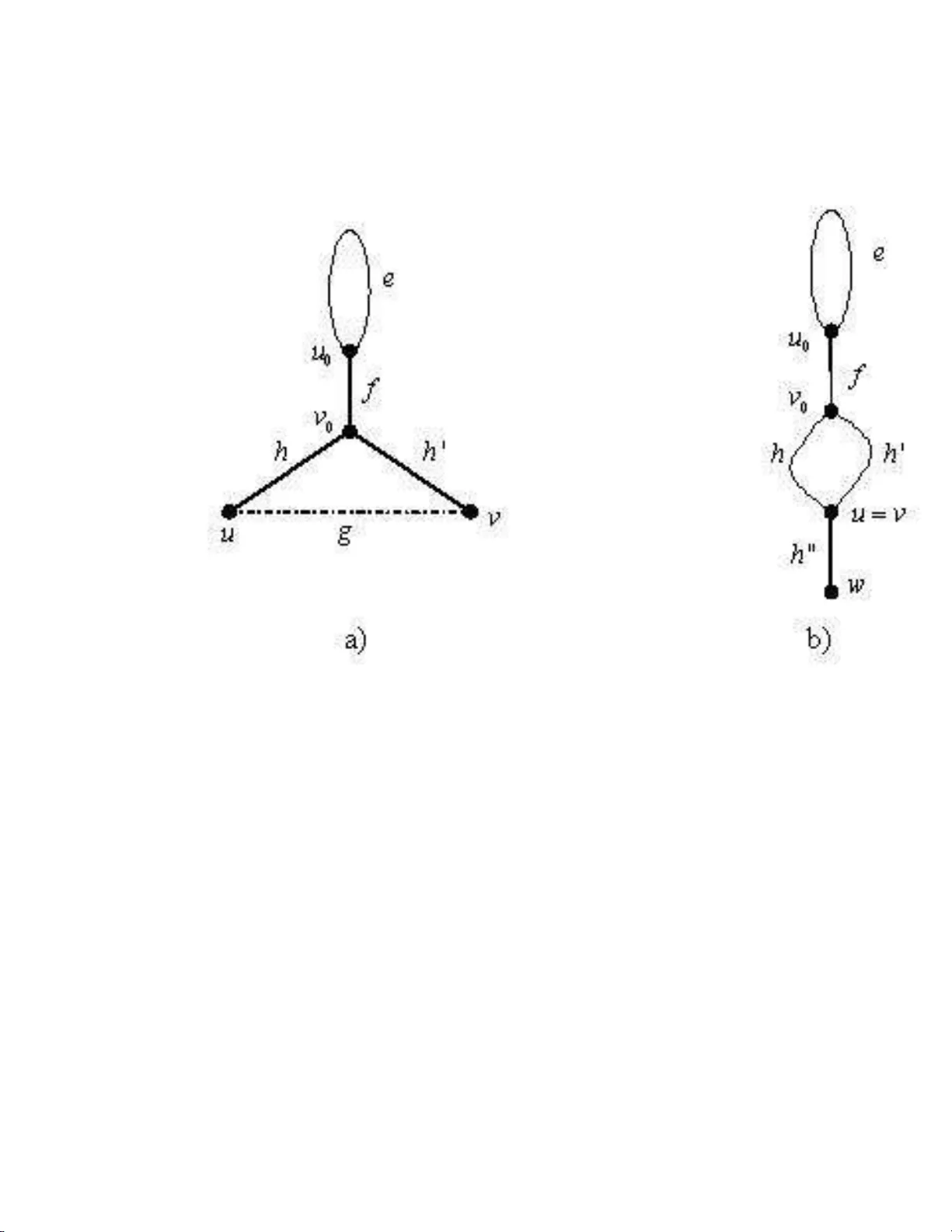
On disjoint matchings in cubi c graphs V ahan V. Mkrtc h y an a b ∗ † , Sam v el S. P etrosy an a ‡ , and Gagik N. V ardany an a § a Departmen t of Informatics and Applied Mathematics, Y erev an State Univ ersit y , Y erev an, 0025 , Armenia b Institute for Informatics and Automation Problems, National Academ y of Sciences o f R epublic of Armenia, 0014, Armenia F or i = 2 , 3 and a cubic graph G let ν i ( G ) denote the maxim um n umber of edges that can b e cov ered b y i matc hings. W e sho w that ν 2 ( G ) ≥ 4 5 | V ( G ) | and ν 3 ( G ) ≥ 7 6 | V ( G ) | . Moreo v er, it turns out that ν 2 ( G ) ≤ | V ( G ) | +2 ν 3 ( G ) 4 . 1. In t ro duction In this pap er graphs are assumed to b e finite, u ndirected and without lo ops, though they ma y con tain m ultiple edges. W e will also consider pseudo-graphs, whic h, in con trast with graphs, may contain lo ops. Th us graphs are pseudo-graphs. W e accept the con v en tion that a lo op con tributes to the degree of a v ertex by tw o. The set of v ertices and edges of a pseudo-gr aph G will b e denoted by V ( G ) and E ( G ), resp ectiv ely . W e also define: n = | V ( G ) | a nd m = | E ( G ) | . W e will also use the following sc heme for notations: if G is a pse udo-g r a ph a nd f is a g r aph-theoretic parameter, w e will write just f instead of f ( G ). So, for example, if we w ould lik e to deal with t he edge-set of a pseudo-graph G (0) ∗ i , w e will write E (0) ∗ i instead o f E ( G (0) ∗ i ); moreo v er w e will write m (0) ∗ i for the n um b er of edges in this graph. A connected 2- r egular graph with at least t w o vertice s will b e called a cycle . Th us, a lo op is not conside red to b e a cycle in a pseudo-graph. Note that our no tion of cyc le differs from the cycles that p eople working on nowhe re-zero flo ws and cycle double co v ers are used to deal with. The length of a path or a cycle is the n um b er of edges lying on it. The path or cycle is ev en (o dd) if its length is eve n (o dd). Th us, an isolated v ertex is a path o f length zero, and it is an ev en path. F or a graph G let ∆ = ∆( G ) and δ = δ ( G ) denote the maxim um and minimum degrees of v ertices in G , resp ectiv ely . Let χ ′ = χ ′ ( G ) denote the chromatic class of the graph G . The classical theorem of Shannon states: ∗ The author is supp orted by a grant of Armenia n National Sc ience and E ducation F und † email: v ahanmkrtch yan2002@ { ysu.am, ipia.sc i.am, yahoo.co m } ‡ email: s amv elpetro syan2008@yahoo.c om § email: v gagik@g mail.com. 1 2 V ahan Mkrtc h y an, Sam v el Petrosy an, Gagik V ardany an Theorem 1 (Shannon [ 1 8]). F or every gr aph G ∆ ≤ χ ′ ≤ 3∆ 2 . (1) In 1965 Vizing prov ed: Theorem 2 (Vizing, [ 21]): ∆ ≤ χ ′ ≤ ∆ + µ , wher e µ denotes the maximum multiplicity of an e dge in G . Note that Shannon’s theorem implies t hat if w e consider a cubic graph G , then 3 ≤ χ ′ ≤ 4, thus χ ′ can take only t wo v a lues. In 1981 Holy er pro v ed tha t the pro blem of deciding whether χ ′ = 3 or not for cubic graphs G is NP-complete [ 9], th us the calculation of χ ′ is already hard for cubic graphs. F or a graph G and a p os itive in teger k define B k ≡ { ( H 1 , ..., H k ) : H 1 , ..., H k are pairwise edge-disjoint matc hings of G } , and let ν k ≡ max {| H 1 | + ... + | H k | : ( H 1 , ..., H k ) ∈ B k } . Define: α k ≡ max {| H 1 | , ..., | H k | : ( H 1 , ..., H k ) ∈ B k and | H 1 | + ... + | H k | = ν k } . If ν denotes the cardinality of the largest matc hing of G , then it is clear that α k ≤ ν for all G and k . Moreo v er, ν k = | E | = m fo r all k ≥ χ ′ . Let us also note that ν 1 and α 1 coincide with ν . In contrast with the theory of 2- ma t chings, where ev ery graph G admits a maxim um 2-matc hing that includes a maximum matc hing [ 11], there are g raphs that do not ha v e a “maxim um” pair of disjoin t matc hings (a pa ir ( H, H ′ ) ∈ B 2 with | H | + | H ′ | = ν 2 ) that includes a maxim um matc hing. The following is the b est r esult that can be stated ab o ut the rat io ν /α 2 for any graph G (see [ 14]): 1 ≤ ν /α 2 ≤ 5 / 4 . (2) V ery deep c haracterization of graphs G satisfying ν /α 2 = 5 / 4 is g iv en in [ 20]. Let us also note that b y Mkrtc h y an’s result [ 12], reform ulated a s in [ 6], if G is a matc hing co v ered tree, then α 2 = ν . Note that a gra ph is said to b e matc hing co v ered (see [ 13]), if its ev ery edge b elongs to a maxim um matchin g (not necess arily a perfect matc hing a s it is usually defined, see e.g. [ 11]). The basic problem that w e are in terested is t he follo wing: what is the pro p ortion of edges of an r -regular graph (particularly , cubic gra ph), t ha t we can co v er b y its k matc hings? The form ulation of our problem stems from the recen t pap er [ 10], where the authors in v estigate the prop ortion of edges of a bridgeless cubic graph that can b e co v ered b y k of its p erfect matc hings. On disjoin t matc hings in cubic graphs 3 The aim of the presen t pap er is the inv estigation of the rat ios ν k / | E | (o r equiv alen tly , ν k / | V | ) in the class of cubic graphs fo r k = 2 , 3. Note that for cubic graphs G Shannon’s theorem implies that ν k = | E | , k ≥ 4. The case k = 1 has attracted muc h a tten tion in the literature. See [ 8] for the inv estiga- tion of the rat io in the class of simple cubic g raphs, and [ 3, 7, 16, 17, 22] for the general case. Let us also note that the relation b etw een ν 1 and | V | has also b een inv estigated in the regular graphs of high g ir th [ 4]. The same is true for the case k = 2 , 3. Albertson and Haas in v estigate these ratios in the class of simple cubic graphs (i.e. graphs without m ultiple edges)in [ 1, 2], and Steffen in v estigates t he general case in [ 19]. 2. Some auxiliary results If G is a pseudo-graph, and e = ( u, v ) is an edge of G , then k -sub division of the edge e results a new pseudo-gra ph G ′ whic h is o btained from G b y replacing the edge e with a path P k +1 of length k + 1, for whic h V ( P k +1 ) ∩ V = { u, v } . Usually , w e will say that G ′ is obtained from G b y k -sub dividing the edge e . If Q is a path or cycle of a pseudo-graph G , and the pseudo-graph G ′ is obtained f rom G b y k -sub dividing the edge e , then sometimes w e will sp eak ab out the path or cycle Q ′ corresp onding to Q , whic h roughly , can be defined as Q , if e do es not lie on Q , and the path or cycle obtained fr o m Q b y replacing its edge e with the path P k +1 , if e lies on Q . Our in terest t ow a r ds subdivisions is motiv ated b y the follo wing Prop osition 1 L et G b e a c onne cte d gr a p h with 2 ≤ δ ≤ ∆ = 3 . Then, ther e exists a c onne cte d cubic pseudo-gr aph G 0 and a mapping k : E 0 → Z + , s uch that G is obtaine d fr om G 0 by k ( e ) - s ub dividing e ach e dge e ∈ E 0 , wher e Z + is the set o f non-n e gative inte gers. Pro of. The existence of suc h a cubic pseudo-graph G 0 can b e v erified, for example, as follo ws; as the v ertex-set of G 0 , w e tak e the set of v ertices of G hav ing degree three, and connect t w o v ertices u, v of G 0 b y an edge e = ( u, v ), if these ve rtices are connected b y a path P of length k , k ≥ 1 in G , whose end-v ertices are u and v , a nd whose internal v ertices are of degree tw o. W e also define k ( e ) = k − 1. Finally , if a v ertex w of G 0 lies on a cycle C of length l , l ≥ 1 in G , whose all v ertices, except w , are of degree t w o, then in G 0 w e add a lo op f inciden t to w , and define k ( f ) = l − 1. No w, it is not hard to v erify , that G 0 is a cubic pseudo-gr a ph, and if we k ( d )-subdivide each edge d of G 0 , then the resulting graph is isomorphic t o G . Let G 0 b e a cubic pse udo-gra ph, and let e b e a lo op of G 0 . Let f b e the edge of G 0 adjacen t to e (note that f is not a lo op). Let u 0 b e the vertex of G 0 that is inciden t to f and e , and let f = ( u 0 , v 0 ). Assume that v 0 is not inciden t to a lo op of G 0 , and let h and h ′ b e the other ( 6 = f ) edges of G 0 inciden t to v 0 , and assume u and v be the endp oin ts of h and h ′ , that a r e no t inciden t to f , respective ly . Consider the cubic pseudo-graph G ′ 0 obtained from G 0 as follow s ((a) of figure 1): G ′ 0 = ( G 0 \{ u 0 , v 0 } ) ∪ { g } , where g = ( u, v ) . Note that u and v ma y coincide. In this case g is a lo op of G ′ 0 . W e will say that G ′ 0 is obtained from G 0 b y cutting the lo op e . 4 V ahan Mkrtc h y an, Sam v el Petrosy an, Gagik V ardany an Figure 1. Cutting a lo op e P eople dealing esp ecially with bridgeless cubic graphs w ould hav e alr eady recognized Fleisc hner’s splitting off op eration. Completely realizing this, w e w ould lik e to k eep t he name ”cutting the lo ops”, in order t o k eep the basic idea, that has help ed us to come to its definition! Remark 1 If G 0 is a c onne cte d cubic pseudo-gr ap h , then the suc c essi v e cut of lo ops o f G 0 in any or der of lo o p s le ads either to a c onne cte d gr aph (that is, c onne c te d pseudo- gr aph without lo ops), or to the cubic pseudo-gr aph shown on the figur e 2. Sometimes, we wil l pr efer to r e state this pr op erty in term s of applic ability of the op er ation of cutting the lo op. Mor e sp e cific al ly, if G 0 is a c on ne cte d cubic pse udo-gr aph, for which the op er ation of cutting the lo op is not applic able, then either G 0 do es not c ontain a lo o p or it is the mentione d trivial gr aph. Before we mo v e on, w e w ould lik e to state some prop e rties of the op eration o f cutting the lo ops. Prop osition 2 If G 0 is c onne cte d, then G ′ 0 is c onne cte d, to o . On disjoin t matc hings in cubic graphs 5 Figure 2. The trivial case Prop osition 3 If a c onne cte d cubic pseudo-gr aph G 0 c ontains a cycle, and a cubic pseudo- gr aph G ′ 0 obtaine d fr om G 0 by cutting a lo op e of G 0 do es not, then e is adjac ent to an e dge f , which, in its turn, is adjac ent to two e dges h and h ′ , that form the only cycle of G 0 with len gth two ((b ) of figur e 1). The following will be used fr equen tly: Prop osition 4 L et b e a, b, c, d b e p ositive numb ers with a b ≥ α , c d ≥ α . Then: a + c b + d ≥ α. (3) Prop osition 5 Su pp ose that x 1 ≤ y 1 , x 2 ≥ y 2 , ..., x n ≥ y n , x 1 + ... + x n = y 1 + ... + y n and min 1 ≤ i ≤ n { α i } = α 1 > 0 . Then: α 1 x 1 + ... + α n x n ≥ α 1 y 1 + ... + α n y n . (4) Pro of. Note that α 2 ( x 2 − y 2 ) ≥ α 1 ( x 2 − y 2 ) , . . . α n ( x n − y n ) ≥ α 1 ( x n − y n ) , th us α 2 ( x 2 − y 2 ) + ... + α n ( x n − y n ) ≥ α 1 ( x 2 − y 2 ) + ... + α 1 ( x n − y n ) = α 1 ( y 1 − x 1 ) (5) or α 1 x 1 + ... + α n x n ≥ α 1 y 1 + ... + α n y n . (6) Theorem 3 (Gal lai [ 11])L et G b e a c onne c te d gr a ph with ν ( G − u ) = ν for any u ∈ V . Then G is factor-critic a l, and p articularly: n = 2 ν + 1 . T erms and concepts that we do not define can b e found in [ 5, 1 1 , 23]. 6 V ahan Mkrtc h y an, Sam v el Petrosy an, Gagik V ardany an 3. Maxim um matc hings and unsaturated v ertices In this section w e pro v e a lemma, whic h states that, under some conditions, o ne can alw a ys pic k up a maxim um matc hing of a graph, suc h that the unsaturated v ertices with resp ect to this ma t ching ”are not placed v ery close”. Before we presen t our result, w e would lik e to deduce a low er b ound for ν in the class of regular graphs using the theorem 3 of Gallai. Observ e that Shannon’s theorem implies that χ ′ ≤ 4 for ev ery cubic gra ph G , th us m ≤ 4 ν = 4 ν 1 . Now , it turns out, that there a re no cubic graphs G , for whic h m = 4 ν 1 , th us ν 1 > m 4 . Next we pro v e a generalization of this statemen t, that originally app eared in [ 15] as a problem: Lemma 1 (a) No (2 k + 1) -r e gular gr aph G c ontains 2 k + 2 p airwis e e dge-disjo i n t max- imum matchings; (b) If G is a c o n ne cte d simple r -r e gular gr aph with r + 1 p airwise e dge-disjoint maximum matchings, then r is even and G is the c ompl e te gr aph. Pro of. (a) Assume G to con tain 2 k + 2 pairwise edge-disjoin t ma ximum matchings F 1 , ..., F 2 k + 2 . Note t ha t w e may assume G to b e connected. Clearly , fo r ev ery v ∈ V there is F v ∈ { F 1 , ..., F 2 k + 2 } such that F v do es not saturate the v ertex v . By a theorem 3 of Galla i, it follows that n = 2 ν + 1 , that is, n is o dd, whic h is impo ssible. (b) Assume G to contain r + 1 pairwise edge-disjoin t maxim um matc hings F 1 , ..., F r +1 . (a) implies that n = 2 ν + 1 and r is ev en. Since, b y Vizing’s theorem χ ′ ≤ r + 1, we hav e ( r + 1) ν = | F 1 | + ... + | F r +1 | ≤ m ≤ χ ′ ν ≤ ( r + 1) ν , th us ( r + 1) n − 1 2 = ( r + 1) ν = m = r n 2 , or r = n − 1 , hence G is the complete graph. Remark 2 As the e x a mple of the ” f a t triangle” shows, the c omplete gr aph with o dd num- b er of vertic es is not the onl y gr aph, that pr events us to gener alize (a ) to even r e gular gr aphs. Next w e pr ov e the main result of the section, whic h is intere sting not only on its o wn, but also will help us to deriv e b etter b ounds in the theorem 4. Lemma 2 Every gr aph G , with 2 ≤ δ ≤ ∆ ≤ 3 , c ontains a maxim um matchi n g, such that the unsatur ate d vertic es (w i th r esp e ct to this maximum m atching) do not sh a r e a neighb o ur. On disjoin t matc hings in cubic graphs 7 Pro of. Let F b e a maximum matc hing of G , for whic h there are minim um n um b er of pairs of unsaturated v ertices, whic h hav e a common neigh b our. The lemma will b e pro v ed, if w e sho w that this n um b er is zero. Supp ose that there ar e v ertices u and w of G whic h ar e not satura t ed ( by F ) and ha v e a common neigh b our q . Cle arly , q is saturated by an edge e q ∈ F . Consider the edge e = ( u, q ). Note that it lies in a maxim um matc hing of G (an example of suc h a maxim um matching is ( F \{ e q } ) ∪ { e } ). Moreov er, for ev ery maxim um matching F e of G with e ∈ F e , the alternat ing component P e of F △ F e whic h con tains the edge e , is a path of ev en length. Now , c ho ose a maxim um matching F ′ of G con taining the edge e for whic h the length of P e is maxim um. Let v b e the other ( 6 = u ) end-v ertex of the path P e . Note that since P e is ev en, there is a v ertex p of P e suc h that ( p, v ) ∈ F . Claim 1 The neighb ours of v lie on P e and ar e differ ent fr om u and q . Pro of. First of all let us sho w that the neigh b ours of v lie on P e . On the opp osite assumption, consider a v ertex v ′ whic h is adjacen t to v and whic h do es not lie on P e . Clearly ( v , v ′ ) / ∈ F ∪ F ′ . As F ′ is a maxim um matching, t here is an edge f ∈ F ′ inciden t to v ′ . Define: F ′′ = ( F ′ \{ f } ) ∪ { ( v , v ′ ) } . Note that F ′′ is a maxim um matc hing of G with e ∈ F ′′ for whic h the length of the alternating comp onen t o f F △ F ′′ , which con tains the edge e , exceeds the length of P e con tradicting the c hoice of F ′ . Th us the neigh b ours of v lie on P e . Let us sho w tha t they are differen t from u and q . If there is an edge e 1 connecting the v ertices u a nd v , then define: F ′′′ = ( F \ E ( P e )) ∪ ([ F ′ ∩ E ( P e )] \{ e } ) ∪ { e 1 , ( q , w ) } . Clearly , F ′′′ is a matc hing of G for whic h | F ′′′ | > | F | , whic h is imp ossible. Th us, there are no edges connecting u and v . As q is a djacen t to u and w , v can b e adja cent to q if and only if p = q , that is, if the length of P e is t w o. But this is imp ossible, to o , since d G ( v ) ≥ 2, hence there should b e an edge connecting u and v . The pr o of of claim 1 is completed. Corollary 1 The length of P e is at le ast four. T o complete the pro of of the lemma w e need to consider t w o cases: Case 1: ( p, w ) / ∈ E . Consider a maximum matc hing F 0 of G whic h is obtained from F b y shifting the edges of F on P e , that is, F 0 = ( F \ E ( P e )) ∪ ( F ′ ∩ E ( P e )) . Note that F 0 saturates all v ertices of P e except v . Consider a v ertex v 0 whic h is a neigh b our of v . Due to claim 1, v 0 is a ve rtex of P e , whic h is differen t from u and q . 8 V ahan Mkrtc h y an, Sam v el Petrosy an, Gagik V ardany an Note that the neighbours of v 0 are the v ertex v a nd one or tw o other ve rtices of P e whic h are saturated by F 0 . Th us there is no unsaturated v ertex of G , whic h has a common neigh b our with v . This implies that t he n um b er of pairs o f v ertices of G whic h are not saturated by F 0 and hav e a common neigh b our is less than the cor r esp onding n um b er for F , whic h con tradicts the c hoice of F . Case 2: ( p, w ) ∈ E . Consider a maxim um matc hing F 1 of G , defined as: F 1 = ( F \ { ( p, v ) } ) ∪ { ( p, w ) } . Note that F 1 saturates w and do es not satura te v . Consid er a v ertex v 1 whic h is a neigh b our of v . D ue to claim 1, v 1 is a v ertex of P e , whic h is differen t fro m u a nd q . Note that the neigh b ours o f v 1 are the v ertex v and tw o other ve rtices of P e whic h are saturated b y F 1 . Th us there is no unsatura t ed vertex of G , whic h has a common neigh b our with v . This implies that the n um b er of pairs of ve rtices o f G whic h are not saturated by F 1 and ha v e a common neigh b our is less than the corresp onding num b er f or F , whic h con tradicts the c hoice of F . The pro of of lemma 2 is completed. It w ould b e in teresting to generalize the statemen t of lemma 2 t o almost regular graphs. In other w ords, w e w ould lik e to suggest the follo wing Conjecture 1 L et G b e gr aph with ∆ − δ ≤ 1 . Then G c on tain s a ma x imum matching such that the unsatur ate d v e rtic es (with r es p e ct to this maximum matching) do not shar e a neighb our. W e w ould lik e to no t e that we do not ev en know, whether the conjecture holds fo r r -regular graphs with r ≥ 4. 4. The system of cycles and paths In this section w e pro v e t w o lemmas. F or graphs t hat b elong to a very p eculiar family , the first of them allo ws us to find a system of cycles and paths t hat satisfy some explicitly stated prop erties. The second lemma helps in finding a system with the same prop erties in graphs that are sub divisions of the graphs fro m the mentioned p eculiar class. Moreov er, due to the second lemma, it turns out that if there is a system of the original graph that includes a maxim um matching, then there is a system of the sub divided graph preserving this prop erty! Lemma 3 L et G b e a gr ap h with δ ≥ 2 . Supp ose that every e dge of G c onne c ts a vertex of de gr e e two to one with de gr e e at le ast thr e e. T hen (1) ther e exists a vertex-disjoin t system of eve n p aths P 1 , ..., P r and cycles C 1 , ..., C l of G such that (1.1) r = 1 2 P v,d ( v ) ≥ 3 ( d ( v ) − 2); (1.2) al l v ertic es of G lie on these p aths or cycles ; On disjoin t matc hings in cubic graphs 9 (1.3) the end-vertic e s of the p aths P 1 , ..., P r ar e of de gr e e two and these end-vertic es ar e adjac ent to vertic es of de gr e e at le ast thr e e; (2) for every maxi mum matching F of G , every p air of e dge-disjoint ma tchi n gs ( H , H ′ ) with | H | + | H ′ | = ν 2 , every v e rtex v ∈ V with d ( v ) ≥ 3 , is incide n t to one e dge fr om F , one fr om H and one fr om H ′ . (3) G c ontains two e dge-disjoin t maximum ma tchings ; (4) If δ = 2, ∆ = k ≥ 3 , d ( v ) ∈ { 2 , k } for every vertex v ∈ V , then ν 1 = 2 k + 2 n, ν 2 = 4 k + 2 n. (7) Pro of. (1) Clearly , G is a bipartite g raph, since the sets V 2 = { v ∈ V : d ( v ) = 2 } , V ≥ 3 = { v ∈ V : d ( v ) ≥ 3 } form a bipartition of G . W e intend to construct a system of pairwise v ertex-disjoint cycles and ev en paths of G such that the all v ertices of V ≥ 3 lie on them. Of course, the cycles will b e of ev en length since G is bipartite. Cho ose a system of cycles C 1 , ..., C l of G suc h tha t V ( C i ) ∩ V ( C j ) = ∅ , 1 ≤ i < j ≤ l and the graph G 0 = G \ ( V ( C 1 ) ∪ ...V ( C l )) do es not con tain a cycle. Clearly , G 0 is a forest, that is, a graph ev ery comp o nen t of whic h is a tree. Moreo v er, for ev ery v 0 ∈ V 0 (a) if d G 0 ( v 0 ) ≥ 3 then d G 0 ( v 0 ) = d G ( v 0 ); (b) if d G 0 ( v 0 ) ∈ { 0 , 1 , 2 } then d G ( v 0 ) = 2. If G 0 con tains no edge then add t he remaining isolated v ertices ( pa t hs of length zero) to the syste m to obtain the men tioned sys tem of cycle s and ev en paths of G . Otherwise, consider a non-t r ivial component of G 0 . Let P 1 b e a path of this comp onen t connecting t w o v ertices whic h hav e degree one in G 0 . Since G is bipartite, (b) implies that P 1 is of ev en length. Consider a graph G 1 obtained from G 0 b y remo ving t he path P 1 , that is, G 1 = G 0 \ V ( P 1 ) . Note that G 1 is a forest. Moreov er, it satisfies the prop erties (a ) and (b) like G 0 do es, that is, for ev ery v 1 ∈ V 1 (a ′ ) if d G 1 ( v 1 ) ≥ 3 t hen d G 1 ( v 1 ) = d G ( v 1 ); (b ′ ) if d G 1 ( v 1 ) ∈ { 0 , 1 , 2 } then d G ( v 1 ) = 2. 10 V ahan Mkrtc h y an, Sam v el Petrosy an, Gagik V ardany an Clearly , by the rep eated application of this pro c edure w e will g et a system of ev en paths P 1 , ..., P r 0 of G suc h that the graph G \ ( V ( C 1 ) ∪ ...V ( C l ) ∪ V ( P 1 ) ∪ ...V ( P r 0 )) = G 0 \ ( V ( P 1 ) ∪ ...V ( P r 0 )) con tains no edge. No w, add the remaining isolated v ertices (paths of length zero) to P 1 , ..., P r 0 to obtained a system of eve n paths P 1 , ..., P r . Note that b y the construction C 1 , ..., C l and P 1 , ..., P r are vertex -disjoint. Moreo v er, the paths P 1 , ..., P r are of eve n length. As G is bipartite, the cycles C 1 , ..., C l are of eve n length, to o. Again, b y t he construction o f C 1 , ..., C l and P 1 , ..., P r w e hav e (1 .2) and that the end- v ertices of P 1 , ..., P r are of degree t wo. As ev ery edge of G connects a v ertex of degree t w o to one with degree at least three, the system C 1 , ..., C l , P 1 , ..., P r satisfies (1.3). Let us sho w that (1.1) holds, to o. Since the num b er of v ertices of degree tw o and at least three is the same on the cycle s C 1 , ..., C l , and the difference of these t w o n umbers is one on eac h path from P 1 , ..., P r , then taking into account (1.2) and (1.3 ) we g et: r = | V 2 | − | V ≥ 3 | = 2 | V 2 | − 2 | V ≥ 3 | 2 = P v,d ( v ) ≥ 3 d ( v ) − 2 | V ≥ 3 | 2 = 1 2 X v,d ( v ) ≥ 3 ( d ( v ) − 2) . (2) Define a pair of edge-disjoin t matc hings ( H 0 , H ′ 0 ) in the following w a y: alternativ ely add the edges of C 1 , ..., C l and P 1 , ..., P r to H 0 and H ′ 0 . Note that ev ery v ertex v ∈ V ≥ 3 is inciden t to one edge from H 0 , one from H ′ 0 , and 2 ν 1 ≥ ν 2 ≥ | H 0 | + | H ′ 0 | = 2 | V ≥ 3 | . (8) On the other ha nd, for ev ery pair of edge-disjoin t matc hings ( h, h ′ ), ev ery v ertex v ∈ V ≥ 3 is inciden t to at most one edge from h and at most tw o edges from h ∪ h ′ , therefore ν 1 = max h | h | ≤ | V ≥ 3 | , ν 2 = max h ∩ h ′ = ∅ ( | h | + | h ′ | ) ≤ 2 | V ≥ 3 | , th us (see (8)) ν 1 = | V ≥ 3 | , ν 2 = 2 | V ≥ 3 | , (9) and for ev ery maxim um matching F of G , ev ery pair of edge-disjoin t matchings ( H , H ′ ) with | H | + | H ′ | = ν 2 , ev ery v ertex v ∈ V ≥ 3 is inciden t to o ne edge from F , one f rom H and one from H ′ . (3) directly follows fro m (2). (4) fo llows from (2) and the bipartiteness of G . The pro of of the lemma 3 is completed. Lemma 4 L et G b e a c onne cte d gr aph satisfying the c onditions: (a) δ ≥ 2; (b) no e dge of G c onn e cts two vertic es h a ving d e gr e e at le ast thr e e. L et G ′ b e a gr aph ob taine d fr om G by a 1 -s ub division of an e dge. If G c ontains a system of p aths P 1 , ..., P r and even cycles C 1 , ..., C l such that On disjoin t matc hings in cubic graphs 11 (1) the de gr e es of vertic es of a cycle fr om C 1 , ..., C l ar e two an d at le ast thr e e alternatively, (2) al l ve rtic es of G lie on these p aths or cycles; (3) the end-vertic es o f the p aths P 1 , ..., P r ar e of de gr e e two, and the vertic es that ar e adjac ent to these end-vertic es and do n o t li e on P 1 , ..., P r ar e of de gr e e at le ast thr e e; (4) every e dge that d o es not lie on C 1 , ..., C l and P 1 , ..., P r is inciden t to one vertex of de gr e e two an d one of de gr e e at l e ast thr e e; (5) ther e is a maxim um matchin g F of G such that every e dge e ∈ F lies on C 1 , ..., C l and P 1 , ..., P r , then ther e is a system of p aths P ′ 1 , ..., P ′ r ′ and even cycles C ′ 1 , ..., C ′ l ′ of the gr aph G ′ with r ′ = r satisfying (1)-(5) . Pro of. Let P 1 , ..., P r and C 1 , ..., C l b e a system of paths and eve n cycles satisfying (1)-( 5 ) and let e b e the edge of G whose 1- sub division led to the graph G ′ . First of all w e will construct a system of paths and even cycles of G ′ satisfying the conditions (1 ) -(4). W e need to consider three cases: Case 1: e lies o n a path P ∈ { P 1 , ..., P r } . Let P ′ b e the path o f G ′ corresp onding to P (that is, the path obtained from P b y the 1-sub division of the edge e ). Consider a system of paths and ev en cycles of G ′ defined as: C ′ i = C i , i = 1 , ..., l , { P ′ 1 , ..., P ′ r ′ } = ( { P 1 , ..., P r }\{ P } ) ∪ { P ′ } Clearly , r ′ = r . It can b e easily v erified that the system P ′ 1 , ..., P ′ r ′ and C ′ 1 , ..., C ′ l satisfies (1)-(4). Case 2: e do es not lie on either of P 1 , ..., P r and C 1 , ..., C l . Let w e b e the new v ertex of G ′ and let e ′ , e ′′ b e the new edges of G ′ , that is: V ′ = V ∪ { w e } , E ′ = ( E \{ e } ) ∪ { e ′ , e ′′ } . (4) implies that e is inciden t to a v ertex u of degree t w o and a v ertex v of degree at least three, and supp ose that e ′ = ( v , w e ) , e ′′ = ( w e , u ). Since d ( u ) = 2 and e do es not lie on P 1 , ..., P r and C 1 , ..., C l , (2) implies that t here is a path P u ∈ { P 1 , ..., P r } suc h that u is an end-ve rtex of P u . Consider the path P ′ u defined as: P ′ u = w e , e ′′ , P u and a system of paths and eve n cycles of G ′ defined as: C ′ i = C i , i = 1 , ..., l , { P ′ 1 , ..., P ′ r ′ } = ( { P 1 , ..., P r }\{ P u } ) ∪ { P ′ u } . 12 V ahan Mkrtc h y an, Sam v el Petrosy an, Gagik V ardany an Clearly , r ′ = r . Note that the new system satisfies (1) and (2 ). Let us sho w that it satisfies (3) and (4), to o. Since d G ′ ( w e ) = 2, w e is adjacent to the v ertex v of degree at least three and w e is an end-v ertex of P ′ u , w e imply that the syste m P ′ 1 , ..., P ′ r ′ and C ′ 1 , ..., C ′ l satisfies (3). Note that w e need to v erify (4) only for the edge e ′ . As d G ′ ( w e ) = 2, d G ′ ( v ) ≥ 3 , w e imply that t he sys tem P ′ 1 , ..., P ′ r ′ and C ′ 1 , ..., C ′ l satisfies (4), to o. Case 3: e lies o n a cycle C ∈ { C 1 , ..., C l } . Let w e b e the new v ertex of G ′ and let e ′ , e ′′ b e the new edges of G ′ , that is: V ′ = V ∪ { w e } , E ′ = ( E \{ e } ) ∪ { e ′ , e ′′ } . (1) implies that the edge e is inciden t to a v ertex u of degree t w o and to a vertex v of degree at least three, and supp ose that e ′ = ( v , w e ), e ′′ = ( w e , u ). Since d G ( v ) ≥ 3 , (b) implies that there is a ve rtex z ∈ V suc h that ( v , z ) ∈ E and z / ∈ V ( C ). Note that since d G ( z ) = 2 and the edge ( v , z ) do es not lie on either of P 1 , ..., P r and C 1 , ..., C l (2) implies that there is a path P z ∈ { P 1 , ..., P r } suc h tha t z is an end-v ertex of P z . Let P b e the pa th C − e of G starting from the v ertex v . Consider a path P ′ of G ′ defined as: P ′ = P z , ( z , v ) , P , e ′′ , w e and a system of paths a nd ev en cycles of G ′ defined as: { C ′ 1 , ..., C ′ l ′ } = ( { C 1 , ..., C l }\{ C } ) { P ′ 1 , ..., P ′ r ′ } = ( { P 1 , ..., P r }\{ P z } ) ∪ { P ′ } . Clearly , r ′ = r . Note that the new system satisfies (1) a nd (2). Let us sho w that it satisfies (3) a nd (4), to o. Since d G ′ ( w e ) = 2, w e is adjacen t to the v ertex v of degree at least three, we imply that the system P ′ 1 , ..., P ′ r ′ and C ′ 1 , ..., C ′ l satisfies (3). Note that w e need to v erify (4) only for the edge e ′ . As d G ′ ( w e ) = 2, d G ′ ( v ) ≥ 3 we imply that t he sys tem P ′ 1 , ..., P ′ r ′ and C ′ 1 , ..., C ′ l satisfies (4), to o. The consideration o f these three cases implies that there is a system P ′ 1 , ..., P ′ r ′ and C ′ 1 , ..., C ′ l ′ of paths and ev en cycles of G ′ with r ′ = r satisfying the conditions (1)-(4). Let us sho w that among suc h systems there is at least o ne satisfying (5), to o. Consider all pairs ( F ′ 0 , M ′ 0 ) in the graph G ′ where F ′ 0 is a system P ′ 1 , ..., P ′ r ′ and C ′ 1 , ..., C ′ l ′ of pa t hs and ev en cycles o f G ′ with r ′ = r satisfying the conditions (1)-(4) and M ′ 0 is a maxim um matc hing of G ′ . Among these c ho ose a pair ( F ′ , M ′ ) for whic h the n um b er of edges of M ′ whic h lie on cycles and paths of F ′ is maxim um.W e claim that all edges of M ′ lie on cycles and paths o f F ′ . Claim 2 If C is a cycle fr om F ′ with length 2 n then ther e ar e exactly n e d ges of M ′ lying on C . Pro of. Let k b e the n um b er of v ertices of C whic h are saturated b y an edge from M ′ \ E ( C ). (1) implies that if w e r emo v e t hese k v ertices from C we will g et k pa ths On disjoin t matc hings in cubic graphs 13 with an o dd n um b er of v ertices. Th us eac h of these k paths con tains a v ertex that is not saturated b y M ′ . Thus the total n um b er of edges from M ′ ∩ E ( C ) is at most | M ′ ∩ E ( C ) | ≤ 2 n − 2 k 2 = n − k . Consider a maxim um matching M ′ of G ′ defined as: M ′′ = ( M ′ \ M ′ C ) ∪ M ′′ C , where M ′ C is the set of edges of M ′ that are inciden t to a verte x o f C , and M ′′ C is a 1-factor of C . Note t ha t if k ≥ 1 then | M ′′ ∩ E ( C ) | > | M ′ ∩ E ( C ) | and therefore for the pair ( F ′ , M ′′ ) w e would ha v e tha t M ′′ con tains more edges lying on cycles and paths of F ′ then M ′ do es, con tradicting the c hoice of the pair ( F ′ , M ′ ), th us k = 0, and on the cycle C from F ′ with length 2 n t here are exactly n edges of M ′ . The pro of of claim 2 is completed. No w, we are ready to pro v e that all edges of M ′ lie on cycle s and paths of F ′ . Supp ose, on the con trary , that there is an edge e ′ ∈ M ′ that do es not lie o n cycles and pa ths of F ′ . (4) implies that e ′ is inciden t to a ve rtex u of degree at least three a nd to a v ertex v of degree t w o. (2) implies that there is a pa t h P v of F ′ suc h that v is an end-v ertex of P v . (2) and claim 2 imply that there is a path P u of F ′ suc h that u lies on P u . Let w and z b e the end-v ertices of P u , and let P w u and P z u b e the subpaths of the path P u connecting w and z to u , resp ectiv ely . Consider a system F ′′ of paths and eve n cycles of G ′ defined as follo ws: F ′′ = ( F ′ \{ P u , P v } ) ∪ { P z u − u, P ′ } where the path P ′ is defined as: P ′ = P w u , ( u, v ) , v , P v . Note that F ′′ con tains exactly r ′ = r paths. It can b e easily v erified that t he new system F ′′ of paths and ev en cycles of G ′ satisfies (1)-(4). No w if w e consider the pair ( F ′′ , M ′ ) we w ould ha v e that the paths and ev en cycles of F ′′ include more edges of M ′ then t he pa ths and ev en cycle s of F ′ do, contradicting the c hoice of the pair ( F ′ , M ′ ). Th us, all edges of M ′ lie on cycles and pat hs of F ′ . The pro of of the lemma 4 is completed. 5. The subdivision and the main parameters The aim of this section is to pro v e a lemma, which claims tha t, under some conditions, the subdivision of an edge increases the size of the maxim um 2-edge-colorable subgraph of a graph b y one. This is imp ortant for us, since it enables us to con trol our parameters, while considering man y graphs that are sub divisions of the others. 14 V ahan Mkrtc h y an, Sam v el Petrosy an, Gagik V ardany an Lemma 5 L et G b e a c onne cte d gr aph satisfying the c onditions: (a) δ ≥ 2; (b) G is not an even cycle; (c) no e dge of G c onne c ts vertic es with d e gr e e at le ast thr e e. L et G ′ b e a gr aph obtaine d fr om G by a 1 -sub d i v i s ion of an e dge. Then (1) ν ′ 2 ≥ 1 + ν 2 ; (2) ν ′ 2 = 2 + ν 2 , if G is an o d d cycle, 1 + ν 2 , otherwise. Pro of. (1) Let ( H , H ′ ) b e a pair of edge-disjoin t matchings of G with | H | + | H ′ | = ν 2 and let e b e the edge of G whose 1-sub division led to the graph G ′ . W e will conside r three cases: Case 1: e lies o n a H △ H ′ alternating cycle C . As G is connected and is not an ev en cycle, there is a v ertex v ∈ V ( C ) with d G ( v ) ≥ 3. Clearly , there is a v ertex u / ∈ V ( C ) with d G ( u ) = 2 and ( u, v ) / ∈ H ∪ H ′ . Let ( u, w ) b e the other ( 6 = ( u, v )) edge inciden t to u and f b e an edge of C inciden t to v . Note that since v is inciden t to t w o edges lying on C we, without loss of g eneralit y , ma y assume f to b e differen t from e . L et P 0 b e a path in G whose edge-set coincides with E ( C ) \{ f } and whic h starts from the v ertex v . Now, assume P t o b e a pat h obtained from P 0 b y adding t he edge ( u, v ) t o it, and let P ′ b e the path o f G ′ corresp onding to P (that is, the path obtained fro m P b y t he 1-sub division of the edge e ). No w, consider a pair of edge-disjoin t matc hings ( H 0 , H ′ 0 ) of G ′ obtained in the following w a y: • if ( u, w ) / ∈ H then alternativ ely add the edges of P ′ to H 0 and H ′ 0 b eginning from H 0 ; • if ( u, w ) / ∈ H ′ then alternatively add the edges of P ′ to H 0 and H ′ 0 b eginning f r o m H ′ 0 . Define a pair of edge-disjoint matc hings ( H 1 , H ′ 1 ) of G ′ as follow s: H 1 = ( H \ E ( C )) ∪ H 0 , H ′ 1 = ( H ′ \ E ( C )) ∪ H ′ 0 . Clearly , ν ′ 2 ≥ | H 1 | + | H ′ 1 | = 1 + | H | + | H ′ | = 1 + ν 2 . Case 2: e lies o n a H △ H ′ alternating path P . Let P ′ b e the path o f G ′ corresp onding to P (that is, the path obtained from P b y the 1-sub division of the edge e ). Consider a pair of edge-disjoin t matchings ( H 0 , H ′ 0 ) of G ′ obtained in the following w a y: alternativ ely add the edges of P ′ to H 0 and H ′ 0 . Define: H 1 = ( H \ E ( P )) ∪ H 0 , H ′ 1 = ( H ′ \ E ( P )) ∪ H ′ 0 . On disjoin t matc hings in cubic graphs 15 Clearly , ν ′ 2 ≥ | H 1 | + | H ′ 1 | = 1 + | H | + | H ′ | = 1 + ν 2 . Case 3: e / ∈ H ∪ H ′ . Due to (c) there is u ∈ V with d G ( u ) = 2, suc h that e is inciden t to u . Let f b e the other ( 6 = e ) edge of G that is inciden t to u , and assume e ′ to b e the edge of G ′ that is inciden t to u in G ′ and is differen t from f . Now , a dd the edge e ′ to H if f / ∈ H , and t o H ′ if f / ∈ H ′ . Clearly , w e constructed a pair o f edge-disjoin t mat chings of G ′ , whic h con tains 1 + ν 2 edges, therefore ν ′ 2 ≥ 1 + ν 2 . (2) Note that if G is an o dd cycle then G ′ is an ev en one a nd ν ′ 2 = 2 + ν 2 , therefore, taking into accoun t (1) and (b), it suffices to sho w that if G is not a cycle then ν ′ 2 ≤ 1 + ν 2 . Let ( H , H ′ ) b e a pair of edge-disjoin t matc hings of G ′ with | H | + | H ′ | = ν ′ 2 and let v b e the new v ertex of G ′ , that is, assume { v } = V ′ \ V . W e need to consider three cases: Case 1: H ∪ H ′ con tains at most one edge inciden t to the ve rtex v . Note that ν 2 ≥ | ( H ∪ H ′ ) ∩ E | ≥ | ( H ∪ H ′ ) ∩ E ( G − e ) | ≥ ≥ | H | + | H ′ | − 1 = ν ′ 2 − 1 or ν ′ 2 ≤ 1 + ν 2 . Case 2: The v ertex v b elongs to an alternating comp o nen t of H △ H ′ whic h is a path P ′ v . Let P v b e a path of G con taining the edge e and corresp onding to P ′ v , that is, let P ′ v b e obta ined fro m P v b y the 1- sub division of the edge e . Consider a pair of edge-disjoint matc hings ( H 0 , H ′ 0 ) of G defined as follows : alternatively add the edges of P v to H 0 and H ′ 0 . Define: H 1 = ( H \ E ( P ′ v )) ∪ H 0 , H ′ 1 = ( H ′ \ E ( P ′ v )) ∪ H ′ 0 . Note that ( H 1 , H ′ 1 ) is a pair o f edge-disjoint matc hings of G . Moreo v er, ν 2 ≥ | H 1 | + | H ′ 1 | = | H | + | H ′ | − 1 = ν ′ 2 − 1 or ν ′ 2 ≤ 1 + ν 2 . Case 3: The v ertex v belongs to an alternating comp o nen t of H △ H ′ whic h is a cycle C ′ v . Let C v b e a cycle of G con taining the edge e and corresp onding to C ′ v , that is, let C ′ v b e obtained fro m C v b y the 1-sub division of the edge e . As G is not a cycle, w e imply tha t 16 V ahan Mkrtc h y an, Sam v el Petrosy an, Gagik V ardany an there is a v ertex w ∈ V ( C ′ v ) with d G ′ ( w ) ≥ 3. Clearly , there is a v ertex w ′ ∈ V ′ \ V ( C ′ v ) suc h that d G ′ ( w ′ ) = 2 and ( w , w ′ ) ∈ E ′ . Let g b e t he other ( 6 = ( w , w ′ )) edge of G ′ inciden t to w ′ . Since w is inciden t to tw o edges lying on C ′ v , w e imply tha t there is an edge f 6 = e suc h that f is inciden t to w . Let P 0 v b e a path of G , whose set of edges coincides with E ( C v ) \{ f } and starts fr o m w . Now consider the path P v obtained from P 0 v b y adding the edge ( w , w ′ ) to it. Consider a pair of edge-disjoint matc hings ( H 0 , H ′ 0 ) of G defined as follows : • if g / ∈ H then alternatively add the edges of P v to H 0 and H ′ 0 b eginning from H 0 ; • if g / ∈ H ′ then alternativ ely add the edges of P v to H 0 and H ′ 0 b eginning from H ′ 0 . Define H 1 = ( H \ E ( C ′ v )) ∪ H 0 , H ′ 1 = ( H ′ \ E ( C ′ v )) ∪ H ′ 0 . Note that ( H 1 , H ′ 1 ) is a pair o f edge-disjoint matc hings of G . Moreo v er, ν 2 ≥ | H 1 | + | H ′ 1 | = | H | + | H ′ | − 1 = ν ′ 2 − 1 or ν ′ 2 ≤ 1 + ν 2 . The pro of of the lemma 5 is completed. 6. The lemma In this section w e pro v e a lemma that presen ts some lo w er b ounds for our parameters while w e consider v arious sub divisions of graphs. The aim of this lemma is the preparatio n of adequate theoretical to ols for understanding the growth of our parameters dep ending on the n um b ers that the edges of graphs are sub divided. In con trast with the pro ofs of the statemen t s (a), (b), (c), (h), (i), that do not include any induction, the pro ofs of the others significan tly rely on induction. Moreov er, the basic to ols for pro ving these statemen ts by induction are the prop osition 1 and the ”lo op-cut”, the op eratio n that helps us to reduce the n um b er of lo ops in a pseudo-graph. T o understand the dynamics of the gro wth of our parameters, w e hea vily use the lemma 5. Before w e mov e on, w e w ould like to define a class of graphs whic h will pla y a crucial role in the pro of of the main result of the pap er. If G 0 is a cubic pseudo-gra ph suc h that the r emo v al (not cut) of its lo ops leav es a tree (if w e adopt the con v en tion presen ted in [ 5], then w e ma y sa y that the ”underlying gra ph” of G 0 is a tree; the simples t example of suc h a cubic pseudo-graph is one from figure 2), then consider the graph G obtained from G 0 b y l ( e )- sub dividing eac h edge e of G 0 , where l ( e ) = 1 , if e is a lo op, 2 , otherwise. Define M t o be the class of all those g raphs G that can b e obtained in the men tioned w a y . Note that the members of the class M are connected graphs. On disjoin t matc hings in cubic graphs 17 Lemma 6 L et G 0 b e a c onne cte d cubic pseudo-g r aph, and c onsider the gr aph G o btaine d fr om G 0 by k ( d ) -sub dividin g e ach e dge d of G 0 , k ( d ) ≥ 1 . Supp ose that, for every e dge d of G 0 , which i s not a lo op, we have: k ( d ) ≥ 2 . Then: (a) If G 0 do es not c ontain a lo op then (a1) ν 2 ≥ 7 8 n ; (a2) n ≥ 4 n 0 ; (b) If G 0 c ontains an e dge f which is adjac ent to two lo ops e and g , then G 0 is the cubic pseudo-gr ap h fr om figur e 2 and ν 2 n = k ( e ) + k ( f ) + k ( g ) + 1 k ( e ) + k ( f ) + k ( g ) + 2 ; (c) If G 0 c ontains a lo op e , then c ons i d er the cubic pseudo-gr aph G ′ 0 obtaine d fr om G 0 by cutt ing the lo op e and the gr aph G ′ obtaine d fr om G ′ 0 by k ′ ( d ′ ) -sub dividi n g e ach e dge d ′ of G ′ 0 , wher e k ′ ( d ′ ) = k ( h ) + k ( h ′ ) − 2 if d ′ = g , k ( d ′ ) otherwise. (10) Then: (c1) n 0 = n ′ 0 + 2; (c2) n = n ′ + k ( f ) + k ( e ) + 4 ; (c3) ν 1 ≥ ν ′ 1 + h k ( f ) 2 i + h k ( e )+1 2 i + 1; (c4) ν 2 ≥ ν ′ 2 + k ( f ) + k ( e ) + 3; (d) (d1) ν 2 ≥ 5 6 n ; (d2) n ≥ 3 n 0 ; (e) (e1) If G 0 c ontains a lo op e such that k ( e ) ≥ 2 then ν 2 ≥ 6 7 n and n ≥ 7 2 n 0 ; (e2) If G 0 c ontains an e dge f such that f is not a lo op and k ( f ) ≥ 3 then ν 2 ≥ 6 7 n and n ≥ 7 2 n 0 ; (f ) ν 1 ≥ 3 7 n ; (g) If G ∈ M then ν 1 ≥ 6 13 n ; (h) If a cubic pseudo-gr a p h G ′ 0 is obtaine d fr o m G 0 by cutting its lo op e and if a gr a p h G ′ is obtaine d fr om G ′ 0 by k ′ ( d ′ ) -sub dividi n g e ach e dge d ′ of G ′ 0 , wh e r e k ′ ( d ′ ) is defin e d ac c or ding to (10), then if n ′ ≥ 7 2 n ′ 0 then n ≥ 7 2 n 0 ; in other wor ds , the pr op erty n < 7 2 n 0 is a n invariant for the op er ation of cutting a lo op and defining k ′ ac c or ding to (10); 18 V ahan Mkrtc h y an, Sam v el Petrosy an, Gagik V ardany an (i) If n < 7 2 n 0 then G ∈ M . Pro of. (a) F or the pro of of (a1) consider a graph G ′ obtained from G 0 b y 1-sub dividing eac h edge o f G 0 . Note that G ′ satisfies the conditions of (4 ) o f t he lemma 3, thus (see the equalit y (7)) ν ′ 2 = 4 5 n ′ = 4 5 ( n 0 + m 0 ) = 4 5 · 5 2 · n 0 = 2 n 0 therefore due to lemma 5 w e ha v e: ν 2 n = ν ′ 2 + P e ∈ E 0 ( k ( e ) − 1) n ′ + P e ∈ E 0 ( k ( e ) − 1) . (11) Note that for eac h e ∈ E 0 k ( e ) ≥ 2, hence X e ∈ E 0 ( k ( e ) − 1) ≥ m 0 = 3 2 n 0 . T aking into account (11) w e get: ν 2 n = 2 n 0 + P e ∈ E 0 ( k ( e ) − 1) 5 2 n 0 + P e ∈ E 0 ( k ( e ) − 1) ≥ 2 n 0 + 3 2 n 0 5 2 n 0 + 3 2 n 0 = 7 8 , th us ν 2 ≥ 7 8 n. F or the pro of of (a2) let us no te that as G 0 do es not contain a lo o p, for each edge f of G 0 w e hav e k ( f ) ≥ 2, thus n = n 0 + X f ∈ E 0 k ( f ) ≥ n 0 + 2 m 0 = 4 n 0 . (b) Note that n = n 0 + k ( e ) + k ( f ) + k ( g ) = 2 + k ( e ) + k ( f ) + k ( g ) . Since f is not a lo op, w e hav e k ( f ) ≥ 2 th us ν 2 = m − 2 = 1 + k ( e ) + k ( f ) + k ( g ) , and ν 2 n = k ( e ) + k ( f ) + k ( g ) + 1 k ( e ) + k ( f ) + k ( g ) + 2 . (c) The pro of of (c1) follo ws directly from the definition of the op e ration of cutting lo ops. F or the pro of of (c2) note that n = n ′ − k ′ ( g ) + k ( h ) + k ( h ′ ) + 1 + k ( f ) + 1 + k ( e ) = = n ′ + k ( f ) + k ( e ) + 4 On disjoin t matc hings in cubic graphs 19 since k ′ ( g ) = k ( h ) + k ( h ′ ) − 2 (see ( 10)). F or the pro of of (c3) and (c4) let us intro duce some additiona l notations. Let C e , P f , P h , P h ′ b e the cycle and paths of G correspo nding to the edges e, f , h, h ′ of the cubic pseudo-graph G 0 . Let K g b e the cycle or a path of G ′ corresp onding to the edge g of the cubic pseudo- graph G ′ 0 . Let F ′ b e a maxim um matc hing of the graph G ′ . Define ε = ε ( F ′ ) as the n umber of v ertices from { u, v } whic h are saturated b y an edge from F ′ ∩ E ( K g ). Note that if u 6 = v then 0 ≤ ε ≤ 2 and if u = v then 0 ≤ ε ≤ 1. Consider a subset o f edges of the g raph G defined as: F = ( F ′ \ E ( K g )) ∪ F h,h ′ ∪ F f ∪ F e where F h,h ′ is a maxim um matc hing of a path P h,h ′ obtained from the paths P h and P h ′ as follo ws: P h,h ′ = P h \{ u, v 0 } , v 0 , P h ′ \{ v 0 , v } if ε = 0; P h \{ v 0 } , v 0 , P h ′ \{ v 0 } if ε = 2; P h \{ v 0 } , v 0 , P h ′ \{ v 0 , v } if ε = 1 and an edge of F ′ ∩ E ( K g ) saturates u ; P h \{ u, v 0 } , v 0 , P h ′ \{ v 0 } if ε = 1 and an edge of F ′ ∩ E ( K g ) saturates v ; F f is a maxim um matching of P f \{ u 0 , v 0 } , and F e is a maxim um matc hing of C e . Note that if u = v and ε = 1 then w e define the pa t h P h,h ′ in t w o w ay s. W e w ould like to stress that our results do not depend o n the w a y the path P h,h ′ is defined. By the construction of F , F is a matc hing of G . Moreov er, ν 1 ≥ | F | = | F ′ | − | F ′ ∩ E ( K g ) | + | F h,h ′ | + | F f | + | F e | = = ν ′ 1 − k ′ ( g ) + ε 2 + k ( h ) + k ( h ′ ) + 1 + ε 2 + k ( f ) 2 + + k ( e ) + 1 2 = ν ′ 1 − k ( h ) + k ( h ′ ) + ε 2 + 1+ + k ( h ) + k ( h ′ ) + 1 + ε 2 + k ( f ) 2 + k ( e ) + 1 2 ≥ ≥ ν ′ 1 + k ( f ) 2 + k ( e ) + 1 2 + 1 as k ( h ) + k ( h ′ ) + 1 + ε 2 ≥ k ( h ) + k ( h ′ ) + ε 2 . No w, let us turn to the pro of of (c4). Let ( H ′ 1 , H ′ 2 ) b e a pair of edge-disjoint matchings of G ′ suc h that | H ′ 1 | + | H ′ 2 | = ν ′ 2 . Define δ = δ ( H ′ 1 , H ′ 2 ) as the n um b er of v ertices fr o m { u, v } whic h are saturated b y an edge from ( H ′ 1 ∪ H ′ 2 ) ∩ E ( K g ). Note that if u 6 = v then 0 ≤ δ ≤ 2 and if u = v then 0 ≤ δ ≤ 1. W e need to consider t w o cases: Case 1: 0 ≤ δ ≤ 1; 20 V ahan Mkrtc h y an, Sam v el Petrosy an, Gagik V ardany an Define a pair of edge-disjoint matc hings ( H 1 , H 2 ) of G as follo ws: H 1 = ( H ′ 1 \ E ( K g )) ∪ H 1 hh ′ ∪ H 1 f e , H 2 = ( H ′ 2 \ E ( K g )) ∪ H 2 hh ′ ∪ H 2 f e , where H 1 hh ′ , H 2 hh ′ are obta ined from a path P hh ′ alternativ ely adding its edges to H 1 hh ′ and H 2 hh ′ ; H 1 f e , H 2 f e are obtained from a path P f e alternativ ely adding its edges to H 1 f e and H 2 f e , and the paths P hh ′ and P f e are defined as P h,h ′ = P h \{ u, v 0 } , v 0 , P h ′ \{ v 0 , v } if δ = 0; P h \{ v 0 } , v 0 , P h ′ \{ v 0 , v } if δ = 1 and an edge of ( H ′ 1 ∪ H ′ 2 ) ∩ E ( K g ) saturates u ; P h \{ u, v 0 } , v 0 , P h ′ \{ v 0 } if δ = 1 and an edge of ( H ′ 1 ∪ H ′ 2 ) ∩ E ( K g ) saturates v ; P f e = P f \{ v 0 , u 0 } , u 0 , C e \{ u 0 } . Again, let us note that if u = v and δ = 1 then w e define the path P h,h ′ in t w o wa ys. W e w ould like to stress that our results do not dep end on the w a y the pa th P h,h ′ is defined. Note that ν 2 ≥ | H 1 | + | H 2 | = | ( H ′ 1 ∪ H ′ 2 ) \ E ( K g ) | + ( | H 1 hh ′ | + | H 2 hh ′ | )+ +( | H 1 f e | + | H 2 f e | ) = | H ′ 1 | + | H ′ 2 | − | ( H ′ 1 ∪ H ′ 2 ) ∩ E ( K g ) | + + | E ( P hh ′ ) | + | E ( P f e ) | ≥ ν ′ 2 − (( k ′ ( g ) + δ ) − 1)+ +(( k ( h ) + k ( h ′ ) + δ + 1) − 1) + ( ( k ( f ) + k ( e ) + 1 ) − 1) = = ν ′ 2 − ( k ( h ) + k ( h ′ ) + δ − 3) + ( k ( h ) + k ( h ′ ) + δ )+ +( k ( f ) + k ( e )) = ν ′ 2 + k ( f ) + k ( e ) + 3 . Case 2: δ = 2; Define a pair of edge-disjoint matc hings ( H 1 , H 2 ) of G as follo ws: H 1 = ( H ′ 1 \ E ( K g )) ∪ H 1 hf e ∪ H 1 h ′ , H 2 = ( H ′ 2 \ E ( K g )) ∪ H 2 hf e ∪ H 2 h ′ , where H 1 hf e , H 2 hf e are obta ined from a path P hf e alternativ ely adding its edges to H 1 hf e and H 2 hf e ; H 1 h ′ , H 2 h ′ are obtained from the path P h ′ \{ v 0 } a lt ernat ively adding its edges to H 1 h ′ and H 2 h ′ , and the path P hf e is defined as P hf e = P h \{ v 0 } , v 0 , P f \{ v 0 , u 0 } , u 0 , C e \{ u 0 } . Note that ν 2 ≥ | H 1 | + | H 2 | = | ( H ′ 1 ∪ H ′ 2 ) \ E ( K g ) | + ( | H 1 hf e | + | H 2 hf e | )+ +( | H 1 h ′ | + | H 2 h ′ | ) = | H ′ 1 | + | H ′ 2 | − | ( H ′ 1 ∪ H ′ 2 ) ∩ E ( K g ) | + + | E ( P hf e ) | + | E ( P h ′ \{ v 0 } ) | ≥ ν ′ 2 − (( k ′ ( g ) + 2 ) − 1)+ +(1 + k ( h ) + 1 + k ( f ) + 1 + k ( e ) − 1) + (( k ( h ′ ) + 1) − 1) = = ν ′ 2 − ( k ( h ) + k ( h ′ ) − 1) + ( k ( h ) + k ( f ) + k ( e ) + 2) + k ( h ′ ) = = ν ′ 2 + k ( f ) + k ( e ) + 3 . On disjoin t matc hings in cubic graphs 21 (d) W e will giv e a sim ultaneous pro of of the statemen ts (d1) and (d2). Note that if G 0 do es not con tain a lo op then (a1) and (a2) imply that ν 2 ≥ 7 8 n > 5 6 n , and n ≥ 4 n 0 > 3 n 0 , th us without loss of generality , w e ma y assume that G 0 con tains a lo op. Our pro of is b y induction on n 0 . Clearly , if n 0 = 2 then G 0 is the pseudo-graph from figure 2, th us (b) implies that ν 2 n ≥ 5 6 , and n = 2 + k ( e ) + k ( f ) + k ( g ) ≥ 6 = 3 n 0 as k ( e ) , k ( g ) ≥ 1 and k ( f ) ≥ 2. Note that ν 2 = 5 6 n or n = 3 n 0 if k ( e ) = k ( g ) = 1 and k ( f ) = 2. No w, b y induction, assume that for ev ery graph G ′ obtained from a cubic pseudo-graph G ′ 0 ( n ′ 0 < n 0 ) b y k ′ ( e ′ )-sub dividing eac h edge e ′ of G ′ 0 , w e hav e ν ′ 2 ≥ 5 6 n ′ and n ′ ≥ 3 n ′ 0 , and consider the cubic pseudo-graph G 0 ( n 0 ≥ 4) and its corresp onding graph G . Let e b e a lo op of G 0 , a nd consider a cubic pseudo-graph G ′ 0 , o bt a ined from G 0 , b y cutting the lo o p e ( ( a ) of fig ur e 1 ) . Note that G ′ 0 is well-define d, since n 0 ≥ 4. As n ′ 0 < n 0 , due to induction hypothesis, we ha v e ν ′ 2 ≥ 5 6 n ′ and n ′ ≥ 3 n ′ 0 , (12) where G ′ is obtained from G ′ 0 b y k ′ ( d ′ )-sub dividing each edge d ′ of G ′ 0 , and the mapping k ′ is defined according to (10). On the other hand, due to (c1), (c2) and (c4), we hav e n 0 = n ′ 0 + 2; n = n ′ + k ( f ) + k ( e ) + 4, ν 2 ≥ ν ′ 2 + k ( f ) + k ( e ) + 3 . Since k ( f ) ≥ 2, k ( e ) ≥ 1 w e hav e k ( f ) + k ( e ) + 3 k ( f ) + k ( e ) + 4 ≥ 6 7 > 5 6 , and k ( f ) + k ( e ) + 4 2 ≥ 7 2 > 3 and therefore due to (12) and prop os ition 4, w e get: ν 2 n ≥ ν ′ 2 + k ( f ) + k ( e ) + 3 n ′ + k ( f ) + k ( e ) + 4 ≥ 5 6 , and n n 0 = n ′ + k ( f ) + k ( e ) + 4 n ′ 0 + 2 ≥ 3 . 22 V ahan Mkrtc h y an, Sam v el Petrosy an, Gagik V ardany an (e) W e will prov e (e1) b y induction on n 0 . Note that if n 0 = 2 , then G 0 is the pseudo- graph from figure 2, th us n = k ( e ) + k ( f ) + k ( g ) + 2 = k ( e ) + k ( f ) + k ( g ) + 2 2 · n 0 and due to (b) ν 2 n = k ( e ) + k ( f ) + k ( g ) + 1 k ( e ) + k ( f ) + k ( g ) + 2 . No w if G 0 satisfies (e1), then taking into accoun t that k ( g ) ≥ 1, k ( e ) ≥ 1, max { k ( e ) , k ( g ) } ≥ 2 and k ( f ) ≥ 2, w e get k ( e ) + k ( f ) + k ( g ) ≥ 5, and therefore ν 2 n ≥ 6 7 and n ≥ 7 2 n 0 . No w, b y induction, assume that f o r ev ery gra ph G ′ , obtained fro m a cubic pseudo-graph G ′ 0 ( n ′ 0 < n 0 ), b y k ′ ( e ′ )-sub dividing eac h edge e ′ of G ′ 0 , w e hav e ν ′ 2 ≥ 6 7 n ′ and n ′ ≥ 7 2 n ′ 0 , pro vided that G ′ 0 satisfies (e1), and consider the cubic pseudo-graph G 0 ( n 0 ≥ 4) a nd its corresp onding gra ph G . W e need to consider tw o cases: Case 1: G 0 con tains at least tw o lo ops. Let e 0 b e a lo op of G 0 that differs from e . Consider the cubic pseudo-graph G ′ 0 , obtained from G 0 , b y cutting the lo op e 0 ((a) of figure 1), and the gr a ph G ′ , obtained fro m a cubic pseudo-graph G ′ 0 , b y k ′ ( e ′ )-sub dividing each edge e ′ of G ′ 0 , where the mapping k ′ is defined according to (1 0). Since n ′ 0 < n 0 and e ∈ E ′ 0 , due to induction h yp othesis, w e ha v e ν ′ 2 ≥ 6 7 n ′ and n ′ ≥ 7 2 n ′ 0 (c1), (c2) and (c4) imply that n 0 = n ′ 0 + 2; n = n ′ + k ( f ) + k ( e 0 ) + 4 , ν 2 ≥ ν 2 + k ( f ) + k ( e 0 ) + 3 . Since k ( f ) ≥ 2, k ( e 0 ) ≥ 1 w e ha v e k ( f ) + k ( e 0 ) + 3 k ( f ) + k ( e 0 ) + 4 ≥ 6 7 , and k ( f ) + k ( e 0 ) + 4 2 ≥ 7 2 On disjoin t matc hings in cubic graphs 23 and therefore due to prop o sition 4, w e get: ν 2 n ≥ ν ′ 2 + k ( f ) + k ( e 0 ) + 3 n ′ + k ( f ) + k ( e 0 ) + 4 ≥ 6 7 , and n n 0 = n ′ + k ( f ) + k ( e 0 ) + 4 n ′ 0 + 2 ≥ 7 2 . Case 2: G 0 con tains exactly one lo op. Let e − the only lo op of G 0 − b e adjacen t to the edge d . Let u 0 b e the v ertex of G 0 that is inciden t to d and e , and let d = ( u 0 , v 0 ). Let h and h ′ ( h 6 = h ′ ) b e t w o edges that differ from d and are inciden t to v 0 . Finally , let u and v b e the endp oin ts of h and h ′ that are not inciden t to d , resp ectiv ely . Sub case 2.1: u 6 = v . Consider a cubic pseudo-graph G ′ 0 obtained fr om G 0 b y cutting the lo op e and t he graph G ′ obtained from a cubic pseudo-gra ph G ′ 0 b y k ′ ( e ′ )-sub dividing eac h edge e ′ of G ′ 0 , where the mapping k ′ is defined a ccording to (10). As G ′ 0 do es not contain a lo op, due to (a1) and (a2), w e hav e ν ′ 2 ≥ 7 8 n ′ and n ′ ≥ 4 n ′ 0 . (13) (c1), (c2) and (c4) imply that n 0 = n ′ 0 + 2; n = n ′ + k ( d ) + k ( e ) + 4, ν 2 ≥ ν ′ 2 + k ( d ) + k ( e ) + 3 . Since k ( e ) ≥ 2, k ( d ) ≥ 2 w e hav e k ( e ) + k ( d ) ≥ 4, th us k ( d ) + k ( e ) + 3 k ( d ) + k ( e ) + 4 ≥ 7 8 > 6 7 , and k ( d ) + k ( e ) + 4 2 ≥ 4 > 7 2 . Due to (13) and prop osition 4, w e get: ν 2 n ≥ ν ′ 2 + k ( d ) + k ( e ) + 3 n ′ + k ( d ) + k ( e ) + 4 ≥ 6 7 , and n n 0 = n ′ + k ( d ) + k ( e ) + 4 n ′ 0 + 2 ≥ 7 2 . Sub case 2.2: u = v . Let h ′′ b e the edge which is inciden t to u and is differen t fro m h and h ′ , and let h ′′ = ( u, w ) (figure 3). 24 V ahan Mkrtc h y an, Sam v el Petrosy an, Gagik V ardany an Figure 3. R educing G 0 to G ′ 0 Define a cubic pseudo-graph G ′ 0 as follow s: G ′ 0 = ( G 0 \{ v 0 , u } ) ∪ { g } , where g = ( u 0 , w ), and consider the graph G ′ obtained from G ′ 0 b y k ′ ( e ′ )-sub dividing each edge e ′ of G ′ 0 , where k ′ ( e ′ ) = k ( d ) + k ( h ′′ ) − 2 if e ′ = g , k ( e ′ ) otherwise. Note that e ∈ E ′ 0 , n ′ 0 < n 0 and k ′ ( e ) = k ( e ) ≥ 2 thus, due t o induction h yp othesis, w e ha v e: ν ′ 2 ≥ 6 7 n ′ and n ′ ≥ 7 2 n ′ 0 . (14) It is not hard to see that n 0 = n ′ 0 + 2; n = n ′ + k ( h ) + k ( h ′ ) + 4 , ν 2 ≥ ν ′ 2 + k ( h ) + k ( h ′ ) + 3 . As k ( h ) , k ( h ′ ) ≥ 2, w e hav e k ( h ) + k ( h ′ ) + 3 k ( h ) + k ( h ′ ) + 4 ≥ 7 8 > 6 7 , and k ( h ) + k ( h ′ ) + 4 2 ≥ 4 > 7 2 , On disjoin t matc hings in cubic graphs 25 therefore due to (14) and pro p osition 4, we g et: ν 2 n ≥ ν ′ 2 + k ( h ) + k ( h ′ ) + 3 n ′ + k ( h ) + k ( h ′ ) + 4 ≥ 6 7 , and n n 0 = n ′ + k ( h ) + k ( h ′ ) + 4 n ′ 0 + 2 ≥ 7 2 . The pro of of ( e1) is completed. No w, let us turn to the pro of o f (e2). Note that if G 0 do es not con tain a lo op then (a1) and (a2) imply that ν 2 ≥ 7 8 n > 6 7 n , and n ≥ 4 n 0 > 7 2 n 0 , th us, without loss of generality , w e may assume that G 0 con tains a lo op. Our pro of is b y induction on n 0 . Clearly , if n 0 = 2 then G 0 is the pseudo-graph from figure 2, n = k ( e ) + k ( f ) + k ( g ) + 2 = k ( e ) + k ( f ) + k ( g ) + 2 2 · n 0 and due to (b) ν 2 n = k ( e ) + k ( f ) + k ( g ) + 1 k ( e ) + k ( f ) + k ( g ) + 2 . No w, if G 0 satisfies (e2) then k ( f ) ≥ 3 and taking in to accoun t that k ( g ) ≥ 1, k ( e ) ≥ 1, w e get k ( e ) + k ( f ) + k ( g ) ≥ 5, therefore ν 2 n ≥ 6 7 and n ≥ 7 2 n 0 . No w, b y induction, assume that for ev ery graph G ′ obtained from a cubic pseudo-graph G ′ 0 ( n ′ 0 < n 0 ) b y k ′ ( e ′ )-sub dividing eac h edge e ′ of G ′ 0 , w e hav e ν ′ 2 ≥ 6 7 n ′ and n ′ ≥ 7 2 n ′ 0 and consider the cubic pseudo-graph G 0 ( n 0 ≥ 4) and its corresp onding graph G . Case 1: There is an edge f ′ = ( u 0 , v 0 ) suc h that f and f ′ form a cycle o f the length tw o (figure 4) Let a, b, f , f ′ , u 0 , v 0 , u, v b e the edges and vertice s as on figure 4. Conside r a cubic pseudo-graph G ′ 0 , defined as follows : G ′ 0 = ( G 0 \{ u 0 , v 0 } ) ∪ { g } , where g = ( u, v ), and consider the graph G ′ obtained from G ′ 0 b y k ′ ( e ′ )-sub dividing each edge e ′ of G ′ 0 , where k ′ ( e ′ ) = k ( f ) if e ′ = g , k ( e ′ ) otherwise. 26 V ahan Mkrtc h y an, Sam v el Petrosy an, Gagik V ardany an Figure 4. The case of m ultiple edge Note that n 0 = n ′ 0 + 2; n = n ′ + k ( a ) + k ( b ) + k ( f ′ ) + 2, ν 2 ≥ ν ′ 2 − ( k ( f ) + 1) + k ( a ) + k ( b ) + k ( f ′ ) + 2 + 1 + k ( f ) − 1 = = ν ′ 2 + k ( a ) + k ( b ) + k ( f ′ ) + 1 . Let us sho w tha t ν ′ 2 ≥ 6 7 n ′ and n ′ ≥ 7 2 n ′ 0 . First of all note that n ′ 0 < n 0 and k ′ ( g ) = k ( f ) ≥ 3 , therefore if g is no t a lo op of G ′ 0 ( u 6 = v ) then the inequalities follo w directly from the induction h yp othesis. On the other hand, if g is a lo op of G ′ 0 ( u = v ) then the same inequalities hold due to (e1). Since k ( a ) + k ( b ) + k ( f ′ ) + 1 k ( a ) + k ( b ) + k ( f ′ ) + 2 ≥ 7 8 > 6 7 , and k ( a ) + k ( b ) + k ( f ′ ) + 2 2 ≥ 4 > 7 2 . prop osition 4 implies that ν 2 n ≥ ν ′ 2 + k ( a ) + k ( b ) + k ( f ′ ) + 1 n ′ + k ( a ) + k ( b ) + k ( f ′ ) + 2 ≥ 6 7 , and n n 0 = n ′ + k ( a ) + k ( b ) + k ( f ′ ) + 2 n ′ 0 + 2 ≥ 7 2 . On disjoin t matc hings in cubic graphs 27 Case 2 : G 0 con tains at least t w o lo ops a nd do es not satisfy the condition of the case 1. As G 0 is connected and n 0 ≥ 4, there is a lo op e of G 0 suc h that e is not adjacen t to f . Let d b e the edge adjacen t to t he edge e . Let u 0 b e the vertex of G 0 that is inciden t to d and e , and let d = ( u 0 , v 0 ). Let h and h ′ b e t w o edges that differ from d a nd are inciden t to v 0 . Finally , let u and v b e the endpoints of h and h ′ that are not inciden t to d , resp ectiv ely . Consider the cubic pseudo-graph G ′ 0 obtained fro m G 0 b y cutting the loo p e and the graph G ′ obtained from a cubic pseudo-gra ph G ′ 0 b y k ′ ( e ′ )-sub dividing eac h edge e ′ of G ′ 0 , where the mapping k ′ is defined according to (10). Note that n ′ 0 < n 0 . Let us sho w that G ′ 0 satisfies the condition of (e2). Clearly , if f ∈ E ′ 0 then w e are done, th us w e ma y assume that f / ∈ E ′ 0 . Since d 6 = f , w e imply that f ∈ { h, h ′ } . As G 0 do es not satisfy the condition o f the case 1, the edge g ∈ E ′ 0 is not a lo op of G ′ 0 and k ′ ( g ) = k ( h ) + k ( h ′ ) − 2 ≥ 3. Th us G ′ 0 satisfies the condition of (e2), therefore, due to induction h yp othesis, w e get: ν ′ 2 ≥ 6 7 n ′ and n ′ ≥ 7 2 n ′ 0 . (c1), (c2) and (c4) imply that n 0 = n ′ 0 + 2; n = n ′ + k ( d ) + k ( e ) + 4, ν 2 ≥ ν ′ 2 + k ( d ) + k ( e ) + 3. Since k ( d ) ≥ 2, k ( e ) ≥ 1 w e hav e k ( d ) + k ( e ) + 3 k ( d ) + k ( e ) + 4 ≥ 6 7 , and k ( d ) + k ( e ) + 4 2 ≥ 7 2 therefore, due to prop osition 4 , w e get: ν 2 n ≥ ν ′ 2 + k ( d ) + k ( e ) + 3 n ′ + k ( d ) + k ( e ) + 4 ≥ 6 7 , and n n 0 = n ′ + k ( d ) + k ( e ) + 4 n ′ 0 + 2 ≥ 7 2 . Case 3: G 0 con tains exactly one lo o p e and do es not satisfy the condition of t he case 1. Let d be the edge adjacen t to the edge e . Let u 0 b e the v ertex of G 0 that is inciden t to d and e , and let d = ( u 0 , v 0 ). Let h and h ′ b e t w o edges that differ from d a nd are inciden t to v 0 . Finally , let u and v b e the endpoints of h and h ′ that are not inciden t to d , resp ectiv ely . Sub case 3.1: d = f and u = v . 28 V ahan Mkrtc h y an, Sam v el Petrosy an, Gagik V ardany an Define a cubic pseudo-graph G ′ 0 as follow s (figure 3 ): G ′ 0 = ( G 0 \{ u, v 0 } ) ∪ { g } , where g = ( u 0 , w ), and consider the graph G ′ obtained from G ′ 0 b y k ′ ( e ′ )-sub dividing each edge e ′ of G ′ 0 , where k ′ ( e ′ ) = k ( f ) + k ( h ′′ ) − 2 if e ′ = g , k ( e ′ ) otherwise. Note that n ′ 0 < n 0 and k ′ ( g ) = k ( f ) + k ( h ′′ ) − 2 ≥ 3 th us, due to induction hypothesis, w e hav e: ν ′ 2 ≥ 6 7 n ′ and n ′ ≥ 7 2 n ′ 0 . On the other hand, it is not hard to see that n 0 = n ′ 0 + 2; n = n ′ + k ( h ) + k ( h ′ ) + 4, ν 2 ≥ ν ′ 2 + k ( h ) + k ( h ′ ) + 3 . As k ( h ) , k ( h ′ ) ≥ 2, w e hav e k ( h ) + k ( h ′ ) + 3 k ( h ) + k ( h ′ ) + 4 ≥ 7 8 > 6 7 , and k ( h ) + k ( h ′ ) + 4 2 ≥ 4 > 7 2 , therefore, due to prop os ition 4, we get: ν 2 n ≥ ν ′ 2 + k ( h ) + k ( h ′ ) + 3 n ′ + k ( h ) + k ( h ′ ) + 4 ≥ 6 7 , and n n 0 = n ′ + k ( h ) + k ( h ′ ) + 4 n ′ 0 + 2 ≥ 7 2 . Sub case 3.2: d 6 = f or u 6 = v . Consider the cubic pseudo-graph G ′ 0 obtained fro m G 0 b y cutting the loo p e and the graph G ′ obtained from a cubic pseudo-gra ph G ′ 0 b y k ′ ( e ′ )-sub dividing eac h edge e ′ of G ′ 0 , where the mapping k ′ is defined according to (10). Note that n ′ 0 < n 0 . Let us sho w tha t G ′ 0 and its corresp onding gr a ph G ′ satisfy ν ′ 2 ≥ 6 7 n ′ and n ′ ≥ 7 2 n ′ 0 . (15) Note that if f ∈ E ′ 0 , then, since n ′ 0 < n 0 and k ′ ( f ) = k ( f ) ≥ 3, (15) follo ws directly from the induction h yp othesis. So, let us assume, that f / ∈ E ′ 0 . If d = f then G ′ 0 do es not con tain a lo op as u 6 = v . Thus (15) fo llo ws fro m (a1 ) and (a2). Th us, w e ma y also assume that d 6 = f . As f / ∈ E ′ 0 , w e deduce that f ∈ { h, h ′ } . As G 0 do es not satisfy the condition On disjoin t matc hings in cubic graphs 29 of the case 1, w e ha v e u 6 = v and G ′ 0 do es not con ta in a lo op. Th us ( 1 5) again follo ws from (a1) and (a2). No w, (c1), (c2) and (c4) imply that n 0 = n ′ 0 + 2; n = n ′ + k ( d ) + k ( e ) + 4, ν 2 ≥ ν ′ 2 + k ( d ) + k ( e ) + 3 . Since k ( d ) ≥ 2, k ( e ) ≥ 1, w e hav e k ( d ) + k ( e ) + 3 k ( d ) + k ( e ) + 4 ≥ 6 7 , and k ( d ) + k ( e ) + 4 2 ≥ 7 2 therefore, due to (15) and pro p osition 4, we get: ν 2 n ≥ ν ′ 2 + k ( d ) + k ( e ) + 3 n ′ + k ( d ) + k ( e ) + 4 ≥ 6 7 , and n n 0 = n ′ + k ( d ) + k ( e ) + 4 n ′ 0 + 2 ≥ 7 2 . (f ) Note that if G 0 satisfies at least o ne of the conditions of (a), ( e1) , (e2), then, taking in to accoun t t he inequalit y 2 ν 1 ≥ ν 2 , w e get: ν 1 ≥ ν 2 2 ≥ 1 2 · 6 7 n = 3 7 n, th us, without loss of generalit y , w e ma y assu me that G 0 satisfies none of the conditions of (a), (e1), (e2), henc e G 0 con tains at least o ne lo op, and for each lo op e and for eac h edge f of G 0 , that is not a lo op, w e ha v e: k ( e ) = 1 and k ( f ) = 2. F or these cubic pseudo-graphs, w e will pro v e the inequalit y (f ) b y induction on n 0 . If n 0 = 2 , then G 0 is the cubic pseudo-graph from the figure 2 a nd, as k ( e ) = k ( g ) = 1 and k ( f ) = 2, G con tains a p erfect ma t ching, th us ν 1 = 1 2 n > 3 7 n. No w, b y induction, assume that for ev ery graph G ′ obtained from a cubic pseudo-gra ph G ′ 0 ( n ′ 0 < n 0 ) b y k ′ ( e ′ )-sub dividing eac h edge e ′ of G ′ 0 , w e hav e ν ′ 1 ≥ 3 7 n ′ , and consider the cubic pseudo-graph G 0 ( n 0 ≥ 4) and its corresp onding graph G . Let e b e a lo op of G 0 , and consider a cubic pseudo-graph G ′ 0 obtained from G 0 b y cutting the lo op e and a graph G ′ obtained from G ′ 0 b y k ′ ( d ′ )-sub dividing eac h edge d ′ 30 V ahan Mkrtc h y an, Sam v el Petrosy an, Gagik V ardany an of G ′ 0 , where the mapping k ′ is defined according to (10). As n ′ 0 < n 0 , due to induction h yp othesis, we ha v e ν ′ 1 ≥ 3 7 n ′ (c2) and (c3) imply that n = n ′ + 7 , ν 1 ≥ ν ′ 1 + 3 . Due to prop osition 4, we get: ν 1 n ≥ ν ′ 1 + 3 n ′ + 7 ≥ 3 7 . (g) Let G 0 b e the connected cubic pseudo-graph corresp onding to G and let ¯ G 0 b e the tree obt a ined from G 0 b y r emoving its lo ops (see the definition of the class M ). Assume k and k ′ to b e the num b ers of in ternal (non-p endan t) and pendant v ertices of ¯ G 0 . Clearly , k + k ′ = ¯ n 0 = n 0 . On the o t her hand, ¯ m 0 = m 0 − k ′ = 3 2 ( k + k ′ ) − k ′ . Since ¯ m 0 = ¯ n 0 − 1, w e g et k + k ′ − 1 = 3 2 ( k + k ′ ) − k ′ or k ′ = k + 2. W e pro v e t he inequalit y by induction on k . Note that if k = 0 then G 0 is the cubic pseudo-graph fr om the figure 2, therefore ν 1 n = 3 6 = 1 2 > 6 13 . On the other hand, if k = 1 , then G 0 is t he cubic pseudo-graph sho wn on the figur e 5, th us ν 1 n = 6 13 . No w, by induction, assume that for ev ery graph G ′ ∈ M , we hav e ν ′ 1 ≥ 6 13 n ′ , if the tree ¯ G ′ 0 con tains less than k in ternal vertice s, and let us consider the graph G ∈ M the corresp onding tree ¯ G 0 of whic h con tains k ( k ≥ 2 ) internal v ertices. W e need to consider t w o cases : Case 1: There is U = { u 1 , ..., u 7 } ⊆ ¯ V 0 suc h that d ¯ G 0 ( u i ) = 1, 1 ≤ i ≤ 4 and the subtree of ¯ G 0 induced by U is the tree sho wn o n the figure 6. On disjoin t matc hings in cubic graphs 31 Figure 5. The case k = 1 Let ¯ G ′ 0 b e the tree ¯ G 0 \{ u 1 , ..., u 6 } and let G ′ 0 b e the cubic pseudo-graph obtained from G 0 b y removin g the v ertices u 1 , ..., u 6 and adding a new lo op inciden t to the ve rtex u 7 . Not e that ¯ G ′ 0 con tains less than k in ternal v ertices, thu s for the gra ph G ′ ∈ M corresp onding to ¯ G ′ 0 , w e hav e ν ′ 1 n ′ ≥ 6 13 . (16) On the other hand, since n = n ′ − 1 + (6 + 16) = n ′ + 21, ν 1 ≥ ν ′ 1 − 1 + 11 = ν ′ 1 + 10 , due to (16) and prop o sition 4, w e get: ν 1 n ≥ ν ′ 1 + 10 n ′ + 21 ≥ 6 13 since 10 21 > 6 13 . Case 2: There is U = { u 1 , ..., u 6 } ⊆ ¯ V 0 suc h that d ¯ G 0 ( u 1 ) = d ¯ G 0 ( u 2 ) = d ¯ G 0 ( u 5 ) = 1 and the subtree of ¯ G 0 induced by U is the tree sho wn o n the figure 7. Let ¯ G ′ 0 b e the tree ( ¯ G 0 \{ u 1 , ..., u 4 } ) ∪ { ( u 5 , u 6 ) } and let G ′ 0 b e the cubic pseudo-gra ph obtained from G 0 b y remo ving the v ertices u 1 , u 2 , u 3 and u 4 and adding the edge ( u 5 , u 6 ). Note tha t ¯ G ′ 0 con tains less than k in ternal v ertices, th us for the gr a ph G ′ ∈ M corre- sp onding to ¯ G ′ 0 , w e hav e ν ′ 1 n ′ ≥ 6 13 . (17) 32 V ahan Mkrtc h y an, Sam v el Petrosy an, Gagik V ardany an Figure 6. The case of t w o branches On the other hand, since n = n ′ − 2 + 14 = n ′ + 12, ν 1 ≥ ν ′ 1 − 1 + 8 = ν ′ 1 + 7 , due to (16) and prop osition 4, w e get: ν 1 n ≥ ν ′ 1 + 7 n ′ + 12 ≥ 6 13 , since 7 12 > 6 13 . T o complete the pro of of the inequalit y , let us note that, since the t ree ¯ G 0 con tains k , ( k ≥ 2 ) in ternal ve rtices, ¯ G 0 satisfies at least one of the conditions of case 1 and case 2. (h) (c1) and (c2) imply that n 0 = n ′ 0 + 2; n = n ′ + k ( f ) + k ( e ) + 4. Since k ( f ) ≥ 2, k ( e ) ≥ 1 w e ha ve k ( f ) + k ( e ) + 4 2 ≥ 7 2 , th us, due to prop osition 4, w e get: n n 0 = n ′ + k ( f ) + k ( e ) + 4 n ′ 0 + 2 ≥ 7 2 . On disjoin t matc hings in cubic graphs 33 Figure 7. The case of a branc h and a lea v e (i) Note that as n < 7 2 n 0 due to (e1) and (e2), for ev ery edge e of G 0 w e hav e k ( e ) = 1 , if e is a lo op, 2 , otherwise. Let us sho w that G ∈ M . Consider a maximal (with resp ect to the op eration of cutting lo ops) sequ ence of cubic pseudo-graphs G (0) 0 , G (1) 0 , ..., G ( n ) 0 , where G (0) 0 = G 0 , and G ( i +1) 0 is obtained fro m G ( i ) 0 b y cutting a lo op e i of G ( i ) 0 , i = 0 , ..., n − 1. No te tha t prop osition 2 implies that for i = 1 , ..., n the graph G ( i ) 0 is connected. Consider the sequence of gra phs G (0) , G (1) , ..., G ( n ) , where G (0) = G , and f o r i = 1 , ..., n the graph G i is obtained fro m G ( i ) 0 b y k i ( d i )-sub dividing each edge d i of G ( i ) 0 , where the mapping k i is defined from k i − 1 according to (10) and k 0 = k . As the sequence G (0) 0 , G (1) 0 , ..., G ( n ) 0 is maximal, the op eration of cutting the lo ops is not applicable to G ( n ) 0 , th us due to remark 1 , G ( n ) 0 is either the trivial cubic pseud o-g raph from the fig ur e 2 or a connected gra ph (i.e. a connected pseudo-graph without lo o ps). On the other hand, (h) implies that for i = 1 , ..., n , w e ha v e n ( i ) < 7 2 n ( i ) 0 (18) th us, taking in to accoun t (a2), w e deduce that G ( n ) 0 is the trivial cubic pseudo-graph from the figure 2. Note that fo r the pro of of G ∈ M , it suffice s to sho w that if w e remo v e all lo ops o f G 0 then w e will get a t r ee, whic h is equiv alen t to prov ing that G 0 do es not con ta in a cycle. Supp ose that G 0 con tains a cycle. As G ( n ) 0 , whic h is the pseudo-graph from the figure 2, do es not con t a in a cycle, w e imply that there is j, 1 ≤ j ≤ n − 1 suc h that G ( j ) 0 con tains a cycle and G ( j +1) 0 do es not. Prop osition 3 implies that the lo op e j of G ( j ) 0 , whose cut led 34 V ahan Mkrtc h y an, Sam v el Petrosy an, Gagik V ardany an to the cubic pseudo-graph G ( j +1) 0 is adjacen t to an edge f j whic h, in its turn, is adjacen t to tw o edges h j and h ′ j that form the only cycle of G ( j ) 0 . As the edges h j and h ′ j form a cycle of G ( j ) 0 , the cut of the lo op e j leads to a lo op g j +1 of G ( j +1) 0 (see the definition of the op e ration of the cut of lo ops). D ue t o (10), w e ha v e k j +1 ( g j +1 ) = k j ( h j ) + k j ( h ′ j ) − 2 = 2 th us, due to (e1), w e ha v e n ( j +1) ≥ 7 2 n ( j +1) 0 con tradicting (18).The pro of of the lemma is completed. 7. The main results W e are ready to prov e the first result o f the pap er. The ba sic idea of the pro of of this theorem can b e roughly described as follows: prov ing a low er b ound f o r the main parameters of a cubic graph G is just pro ving a b ound for the graph G \ F obtained b y remo ving a maxim um matc hing F of G . Next, according to lemma 2, there is a maxim um matc hing of a cubic graph suc h that its remov al lea ve s a graph, in whic h eac h degree is either t w o or t hree. Moreo v er, the vertice s of degree three are not placed ve ry closed. This allo ws us to consider this gra ph as a subdivision of a cubic pseudo-graph, in whic h eac h edge is sub divided sufficien tly man y times. The word ”sufficien tly” here should b e understo o d as big enough to allow us to apply the main results of the lemma 6. Next, by considering the connected comp onen ts of G \ F , w e divide them into t w o or three groups. F or eac h of this groups, thanks to lemma 6, w e find a b ound for our parameters. Then, due to prop osition 5, we not only estimate the total con tribution of the connected comp onen ts to the ma in para meters, but also k eep this estimations big enough, whic h allo ws us to get the main results of the t heorem. Theorem 4 L et G b e a cubic gr aph. Then: ν 1 ≥ 2 5 n, ν 2 ≥ 4 5 n, ν 3 ≥ 7 6 n. Pro of. In [ 17] it is sho wn t hat ev ery o dd regular g raph G contains a matc hing of size at least l ( r 2 − r − 1) n − ( r − 1) r (3 r − 5) m , where r is the degree of v ertices of G . P articularly , for a cubic graph G w e hav e: ν 1 ≥ 5 n − 2 12 ≥ 2 5 n. No w, let us sho w that the other t wo inequalities a re also true. Let F b e a maxim um matc hing of G suc h t ha t the unsaturated v ertices (with resp ect to F ) do not hav e a common neighbour ( see lemma 2). Let ε b e a ra tional n um b er such that ε ∈ [0 , 1 10 ] and ν 1 = | F | = ( 2 5 + ε ) n. On disjoin t matc hings in cubic graphs 35 Note that to complete the pro of, it suffices to sho w that ν 1 ( G \ F ) ≥ ( 2 5 − ε ) n, ν 2 ( G \ F ) ≥ ( 23 30 − ε ) n. Consider the graph G \ F . Clearly , 2 = δ ( G \ F ) ≤ ∆( G \ F ) ≤ 3 . Let x and y b e the num b ers of v ertices of G \ F with degree tw o and three, respectiv ely . Clearly , x + y = | V ( G \ F ) | = n, 2 x + 3 y = 2 m − 2 | F | = 3 n − ( 4 5 + 2 ε ) n = ( 11 5 − 2 ε ) n, whic h implies that x = ( 4 5 + 2 ε ) n, y = ( 1 5 − 2 ε ) n. Let G 1 , ..., G r b e the connected comp onen ts of G \ F . F or a v ertex v i ∈ V i , 1 ≤ i ≤ r define: ν 1 ( v i ) = ν 1 i n i , ν 2 ( v i ) = ν 2 i n i . Note that ν 1 ( G \ F ) | V ( G \ F ) | = ν 1 ( G \ F ) n = ν 1 , 1 + ... + ν 1 ,r n 1 + ... + n r = = n 1 · ν 1 , 1 n 1 + ... + n r · ν 1 ,r n r n 1 + ... + n r = = n 1 · ν 1 ( v 1 ) + ... + n r · ν 1 ( v r ) n 1 + ... + n r , (19) and similarly ν 2 ( G \ F ) | V ( G \ F ) | = n 1 · ν 2 ( v 1 ) + ... + n r · ν 2 ( v r ) n 1 + ... + n r (20) where v 1 , ..., v r are v ertices o f G \ F with v i ∈ V ( G i ), 1 ≤ i ≤ r . By the c hoice of F , w e hav e that for i = 1 , ..., r G i is (a) either a cycle, (b) or a connected graph, with δ i = 2 , ∆ i = 3 whic h do es not con tain t w o vertice s of degree three that are a dj a cen t or share a neigh b our. Note that if G i is of t ype (b), then there is a cubic pseudo-graph G 0 i suc h that G i can b e obtained from G 0 i b y k ( e )-sub dividing each edge e of G 0 i (prop osition 1). Of course, if e is not a lo op then k ( e ) ≥ 2. 36 V ahan Mkrtc h y an, Sam v el Petrosy an, Gagik V ardany an Let a, b, c b e the num b ers of v ertices of G \ F t ha t lie on its connected comp onen ts G 1 , ..., G r , whic h are cycles, gra phs o f ty p e (b) that are from the class M , graphs of t yp e (b) whic h ar e not from the class M , resp ectiv ely . It is clear that if v a is a v ertex o f G \ F lying on a cycle of length l then ν 1 ( v a ) = l 2 l ≥ 1 3 . If v b is a v ertex of G \ F lying on a connected comp onent G b of G \ F whic h is from the class M , then ( g ) of lemma 6 implies that ν 1 ( v b ) = ν 1 b n b ≥ 6 13 . If v c is a v ertex o f G \ F lying on a connected comp onen t G c of G \ F whic h is of ty p e (b) and do es not belong to the class M , then (f ) of lemma 6 implies that ν 1 ( v c ) = ν 1 c n c ≥ 3 7 . Let k b and k c b e the n um b er of ve rtices of G \ F with degree t hree that lie o n connected comp onen ts G 1 , ..., G r , whic h a r e g raphs from the class M or are gra phs of type (b) , whic h are not from the class M , respective ly . Clearly , k b + k c = y = ( 1 5 − 2 ε ) n. (21) (d2) of lemma 6 implies that b ≥ 3 k b . (i) of lemma 6 implies that c ≥ 7 2 k c . Th us, due t o (1 9) ν 1 ( G \ F ) | V ( G \ F ) | ≥ 1 3 a + 6 13 b + 3 7 c n . As a + b + c = n w e get: a ≤ n − 3 k b − 7 2 k c . Since 1 3 < 3 7 < 6 13 , due to prop os ition 5, w e ha v e: 1 3 a + 6 13 b + 3 7 c ≥ 1 3 ( n − 3 k b − 7 2 k c ) + 6 13 · 3 k b + 3 7 · 7 2 k c and therefore ν 1 ( G \ F ) | V ( G \ F ) | ≥ 1 3 ( n − 3 k b − 7 2 k c ) + 6 13 · 3 k b + 3 7 · 7 2 k c n = = 1 3 n + 5 13 k b + 1 3 k c n = 1 3 + 1 3 k b + k c n + 2 39 k b n On disjoin t matc hings in cubic graphs 37 (21) implies that ν 1 ( G \ F ) n ≥ 1 3 + 1 3 ( 1 5 − 2 ε ) + 2 39 k b n = 2 5 − 2 3 ε + 2 39 k b n = = ( 2 5 − ε ) + ε 3 + 2 39 k b n ≥ 2 5 − ε whic h is equiv alen t to ν 1 ( G \ F ) ≥ ( 2 5 − ε ) | V ( G \ F ) | = ( 2 5 − ε ) n. Note tha t if ν 2 = 4 5 n , then ε = 0 , k b = 0 , whic h means that ν 1 = 2 5 n and among the comp onen ts G 1 , ..., G r there are no represen tativ es of the class M . No w, let us turn to t he pro of of the inequalit y ν 2 ( G \ F ) ≥ ( 23 30 − ε ) n . Let A, B b e the n um b ers of v ertices of G \ F that lie on its connected comp onen ts G 1 , ..., G r , whic h are cycles and graphs of t yp e (b), resp ectiv ely . It is clear that if v A is a v ertex of G \ F lying on a cycle of the length l then ν 2 ( v A ) = 2 l 2 l ≥ 2 3 . If v B is a v ertex of G \ F lying on a connected comp onent G B of G \ F whic h is of type (b), then (d1) of lemma 6 implies that ν 2 ( v B ) = ν 2 B n B ≥ 5 6 . As the n um b er of ve rtices of G \ F whic h are of degree three is y = ( 1 5 − 2 ε ) n , (d2) of lemma 6 implies that B ≥ 3 y = ( 3 5 − 6 ε ) n. (22) Th us, due to (20) ν 2 ( G \ F ) | V ( G \ F ) | ≥ 2 3 A + 5 6 B | V ( G \ F ) | . As A + B = n , (22) implies that A ≤ n − 3 y = n − ( 3 5 − 6 ε ) n = ( 2 5 + 6 ε ) n. Since 2 3 < 5 6 , due to prop osition 5, we get 2 3 A + 5 6 B ≥ 2 3 ( 2 5 + 6 ε ) n + 5 6 ( 3 5 − 6 ε ) n and therefore ν 2 ( G \ F ) | V ( G \ F ) | ≥ ( 23 30 − ε ) n | V ( G \ F ) | = ( 23 30 − ε ), 38 V ahan Mkrtc h y an, Sam v el Petrosy an, Gagik V ardany an whic h is equiv alent to ν 2 ( G \ F ) ≥ ( 23 30 − ε ) | V ( G \ F ) | = ( 23 30 − ε ) n. The pro of of the theorem is completed. Remark 3 Ther e ar e gr aphs attaining b ounds of the the or em 4. The gr aph fr om figur e 8a attains the fi rs t two b ounds and the g r aph fr om figur e 8b the last b ound. Figure 8. Examples attaining the b ounds of the theorem 4 Recen tly , w e managed t o prov e: Theorem 5 F o r every cubic gr aph G ν 2 + ν 3 ≥ 2 n. Note that this implies t ha t there is no graph attaining all the b o unds of theorem 4 at the same time. The methodolo gy dev elop ed ab o v e allo ws us to prov e the second result of t he pap er, whic h is an inequalit y among our main parameters. T o prov e it, again w e reduce the inequalit y to another one considered in the class of gra phs, that are obtained from a cubic gr a ph by remo ving a matc hing of G . Note that this time matc hing need not to b e maxim um, nev ertheless, its remo v al kee ps the v ertices of degree thr ee ”fa r enough”. Next, b y considering any of connected comp onen ts o f this graph, w e lo ok at it as a sub division of a cubic pseudo-graph. This allo ws us to apply the results from the section on system of cycles a nd pat hs, and find a suitable system, whic h not only captures the essence of the inequalit y that w e w ere trying to pro v e, but also is v ery simple in its structure, and this allows us to complete the pro of. Theorem 6 F o r every cubic gr aph G the fo l lowing i n e quality holds: ν 2 ≤ n + 2 ν 3 4 . On disjoin t matc hings in cubic graphs 39 Pro of. Let ( H , H ′ ) b e a pair of edge-disjoin t matchings of G with | H | + | H ′ | = ν 2 . Without loss o f generalit y w e ma y assume that H is maximal (not necessarily maxim um). Let G 1 , ..., G k b e the connected comp onen ts of G \ H , l i = l ( G i ) b e the n um b er of v ertices of G i ha ving degree three, 1 ≤ i ≤ k , and let l b e the num b er of vertice s of G \ H ha ving degree three. Note tha t l = l 1 + ... + l k = n − 2 | H | . Let us sho w tha t for eac h i , 1 ≤ i ≤ k , the follo wing inequalit y is true: ν 2 i ≥ 2 ν 1 i − l i 2 . (23) Note that, if G i is a cycle, then l i = 0 and ν 2 i = 2 ν 1 i , th us (23) is tr ue f or the cycles . No w, let us assume G i to con ta in a v ertex of degree three. As H is a maximal matc hing, no t w o v ertices o f degree t hr ee are a djacen t in G i . Prop osition 1 implies that there is a cubic pseudo-graph G 0 i suc h tha t G i can be obtained from G 0 i b y k ( e )- sub dividing each edge e of G 0 i where k ( e ) ≥ 1. Let G ′ i b e the graph obtained from G 0 i b y 1-sub dividing eac h edge e of G 0 i . Note t hat G ′ i con tains n 0 i v ertices of degree three, 3 n 0 i 2 v ertices o f degree t w o and no tw o v ertices of the same degree a re a djacen t in G ′ i . Due to lemma 3, there is a system F ′ i of ev en cyc les and paths o f G ′ i satisfying the conditions (1.2),(1.3 ) of the lemma 3 and containing n 0 i 2 paths (see (1.1) of the lemma 3). (2 ) of lemma 3 implies that F ′ i includes a maxim um matc hing of G ′ i . No w, note that G i can b e obtained f r o m G ′ i b y a seque nce of 1 -sub divisions. Lemma 4 implies that there is a system F i of paths and ev en cycles of G i satisfying the conditions (1)-(5) of the lemma 3 a nd containing exactly n 0 i 2 paths! Let x b e the n um b er of paths fr o m F i con taining an o dd n um b er of edges. Note that since x ≤ n 0 i 2 , w e hav e: ν 2 i ≥ X F ∈ F i | E ( F ) | = 2 X F ∈ F i ν 1 ( F ) − x = 2 ν 1 i − x ≥ ≥ 2 ν 1 i − n 0 i 2 = 2 ν 1 i − l i 2 . Summing up the inequalities (23) from 1 to k w e get: ν 2 ( G \ H ) = k X i =1 ν 2 i ≥ 2 k X i =1 ν 1 i − P k i =1 l i 2 = 2 ν 1 ( G \ H ) − l 2 . Th us ν 3 ≥ | H | + ν 2 ( G \ H ) ≥ | H | + 2 ν 1 ( G \ H ) − l 2 = | H | + 2 ν 1 ( G \ H ) − n 2 + | H | . T a king in to accoun t that | H | + | H ′ | = | H | + ν 1 ( G \ H ) = ν 2 40 V ahan Mkrtc h y an, Sam v el Petrosy an, Gagik V ardany an w e get: ν 3 ≥ 2 ν 2 − n 2 or ν 2 ≤ n + 2 ν 3 4 . The pro of of the t heorem 6 is completed. Ac kno wledgemen t W e would lik e to thank our review ers for their useful commen ts that help ed us to impro ve the pap er. REFEREN CES 1. M.O. Alb ertson, R. Haas, P arsimonious edge coloring, D iscrete Math. 148 (1 996) 1 –7. 2. M.O. Albertson, R. Haa s, The edge c hro matic difference sequence of a cubic graph, Discrete Math. 17 7 , (1997) 1–8. 3. B. Bollo b´ as, Extremal graph theory , Academic Press, London-New Y ork-San F ra n- cisco, 1978. 4. A. D. Flaxman, S. Ho or y , Maxim um ma t chings in regular graphs of high girth, The Electronic Journal of Combinatorics, 14, N 1, 20 07, pp. 1-4. 5. F. Harary , Graph Theory , Addison-W esley , Reading, MA, 1969. 6. F. Harary , M.D. Plummer, On the core of a g raph, Pro c. London Math. So c. 17 (1967), pp. 305–31 4 . 7. M.A. Henning, A. Y eo, Tight Low er Bounds on the Size of a Maxim um Matc hing in a Regular Graph, Gra phs and Com binatorics, vol. 23, N 6, 2007, pp. 647- 657 8. A. M. Hobbs, E. Sc hmeic hel, On the maxim um num b er of indep enden t edges in cubic graphs, Discrete Mathematics 42, 1982, pp. 317-3 20. 9. I. Holy er, The NP-completenes s of edge coloring, SIAM J. Comput. 1 0 , N4, 718- 720, 1981 (av ailable at : h ttp://cs.bris.ac.uk/ian/graphs ). 10. T. Kaiser, D . K r´ al, S. Norine, Unions of p e rfect matc hings in cubic graphs, Electronic Notes in Discrete Mathematics, 22: 341– 345 , 20 05. 11. L. Lo v´ asz, M.D . Plummer, Matc hing theory , Ann. Discrete Math. 29 (1986 ). 12. V. V. Mkrtc hy an, On trees with a maxim um prop er partial 0-1 coloring con taining a maxim um matc hing, Discrete Mathematics 306, (20 0 6), pp. 456-459. 13. V. V. Mkrtc hy an, A note on minimal matching cov ered graphs, Discrete Mathematics 306, (2006), pp. 4 52-455. 14. V. V. Mkrtch y an, V. L. Muso y an, A. V. Tserun yan, On edge-disjoint pairs of matchings, Discrete Mathematics 3 0 8, (2008), pp. 5823-58 28 (av a ila ble at: h ttp://arxiv.org/abs/07 0 8.1903). 15. V. V. Mkrtc h y an, Problem 11305, American Mathematical Monthly , v. 114, 20 07, p. 640. 16. T. Nishizeki and I. Baybars, Low er b o unds on the cardinalit y of the maxim um matc h- ings of planar gra phs, Discrete Math., 28, 25 5 -267, 1 9 79. 17. T. Nishizeki, On the maxim um matchin gs of regular multigraphs, D iscrete Mathe- matics 37, 198 1 , pp. 105-114. On disjoin t matc hings in cubic graphs 41 18. C. E. Shannon, A theorem on coloring the lines of a net w ork, J. Math. And Phy s., 28 (1949), pp. 148 -151. 19. E. Steffen, Measuremen ts of edge-uncolorabilit y , Discrete Mathematics 280 (2004), pp. 191 – 2 1 4. 20. A. V. Tserun y an, Characterization of a class of graphs related to pairs o f dis- join t matchings , D iscrete Mathematics 30 9, (2009), pp. 693-713 , (av a ilable at: h ttp://arxiv.org/abs/07 1 2.1014) 21. V. G. Vizing, The c hro matic class of a m ultigraph, Kib ernetik a No. 3 , (1965 ) Kiev, pp. 29-39 (in Russian) 22. J. W einstein, Large matc hings in graphs, Canadian J. Mat h., 26, 6,(1974), pp. 1498- 1508. 23. D . B. W est, In tro d uction to G raph Theory , Pren tice-Hall, Englew o o d Cliffs, 1996.
Original Paper
Loading high-quality paper...
Comments & Academic Discussion
Loading comments...
Leave a Comment