The cross covariogram of a pair of polygons determines both polygons, with a few exceptions
The cross covariogram g_{K,L} of two convex sets K and L in R^n is the function which associates to each x in R^n the volume of the intersection of K and L+x. Very recently Averkov and Bianchi [AB] have confirmed Matheron's conjecture on the covari…
Authors: Gabriele Bianchi
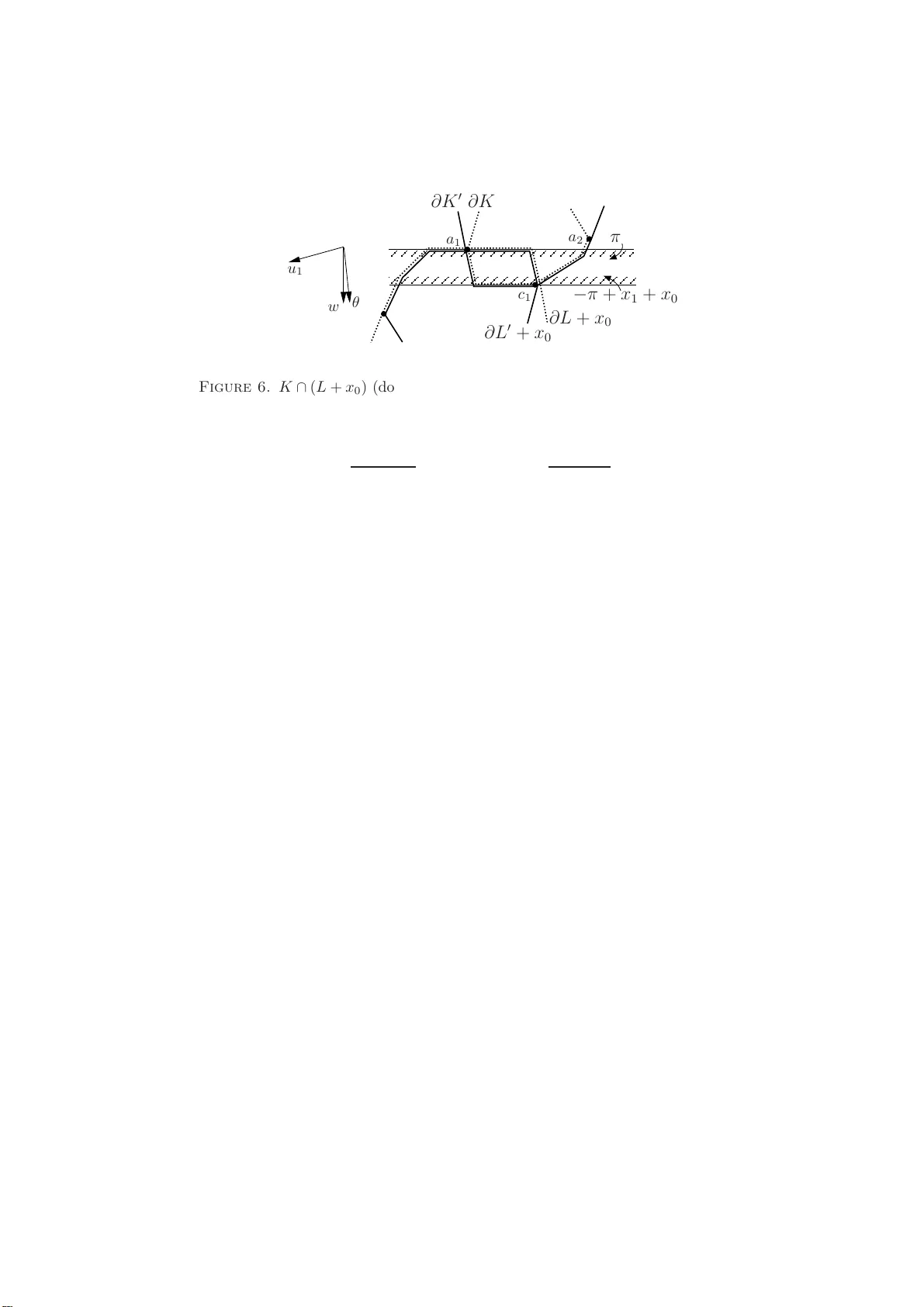
THE CR OSS COV ARIOGRAM OF A P AIR OF POL YGONS DETERMINES BOTH POL YGONS, WITH A FEW EXCEPTIONS GABRIELE BIANCHI Abstract. The cross cov ariogram g K,L of tw o con ve x sets K and L in R n is the funct ion which associates to eac h x ∈ R n the v olume of K ∩ ( L + x ). V ery recen tly Averk ov and Bianchi [AB] hav e confirmed Matheron’s conjecture on the co v ariogram problem, that asserts that any planar con v ex b ody K i s determined b y the kno wledge of g K,K . The problem of determining the sets from their cov ariogram is relev an t in probability , in statistical shape r ecogni- tion and i n the determination of the atomic s tr ucture of a quasicrystal fr om X-ray diffraction i mages. W e prov e that when K and L are conv ex polygons (and als o when K and L are planar con v ex cones) g K,L determines both K and L , up to a describ ed fami ly of except ions. These results imply that, when K and L are in these classes, the information provided by the cross co v ari- ogram is so ri c h as to determine not only one unkno wn b o dy , as required by Matheron’s conjecture, but t w o bo dies, with a few classified exceptions. These results ar e also used b y Bianchi [Bia] to prov e that an y conv ex p olytope P in R 3 is determined by g P ,P . 1. Introduction Let K and L b e conv ex sets in R n , n ≥ 2 , and let λ n stand for the n -dimensional Leb esgue measure. The cr oss c ovari o gr am g K,L of K and L is the function defined by g K,L ( x ) = λ n ( K ∩ ( L + x )) , where x ∈ R n is such that λ n ( K ∩ ( L + x )) is finite. This function, introduced by Ca bo and J a nssen [CJ94], coincides with the conv olution of the characteristic function 1 K of K with the characteristic function 1 − L of the reflection of L in the origin, that is, (1.1) g K,L = 1 K ∗ 1 − L . The function g K,K was introduced by G. Matheron in his b o ok [Mat75, Sec- tion 4.3 ] on random sets, is deno ted by g K and is ca lle d c ovario gr am or set c ovari- anc e of K . The cov ar iogram g K is clear ly unc hanged by a translation or a reflection of K . (The term r efle ction will a lwa ys mean r eflection in a po int.) A c onvex b o dy in R n is a co nv ex compact set with non-empty interior. In 19 86 Mather on [Mat86, p. 20 ] asked the following ques tion and conjectured a p ositive answer for the case n = 2. Co v ariogram problem. Do es g K determine a c onvex b o dy K , among al l c onvex b o dies, up to tra nslations and r efle ctions? Even for n = 2 this conjecture has be en completely settled only very recently , by Averk ov and Bia nchi [AB]. It is known that the cov ario gram pr oblem is equiv alent to any of the following pro ble ms (see [AB] for a detailed ex planation). Date : Nov em ber 9, 2018. 2000 Mathematics Subje ct Classific ation. Primary 60D05; Secondary 52A22, 52A10, 52A38. Key wor ds and phr ases. co v ariogram, cross cov ariogram, geometric tomograph y , quasicrystal, phase r etriev al, set co v ar iance, synisothesis. 1 2 GABRIELE BIANCHI P1. Determine a conv ex b o dy K b y the kno wledge, for each unit v ector u in R n , of the distribution of the lengths of the chords o f K parallel to u . P2. Determine a conv ex b o dy K by the distribution o f X − Y , where X and Y are independent r andom v ariables uniformly distributed ov er K . P3. Determine the c haracteris tic function 1 K of a conv ex b o dy K fr om the mo dulus of its F o urier tra ns form c 1 K . Chord-length distributions are of wide interest b eyond mathematics and are com- mon in ster e olo gy, statistic al shap e r e c o gnition and image analysis, wher e pr op er- ties of an unknown bo dy hav e to b e inferred from chord length measurements; see Schm itt [Scm93], Cab o a nd B addeley [C B 03], Serra [Ser84] and Maz zolo, Roessling er and Gille [MR G03]. Problem P2 w as asked b y Adler and P y ke [AP91] in 199 1. The same authors [AP9 7] find the cov ariog ram problem relev ant also in the study of scanning B rownian pro cesses a nd o f the equiv alence o f measur e s induced by these pr o cesses for different base sets. Problem P 3 is a specia l case of the pha se r etrieval pr oblem , where 1 K is replace d b y a function with co mpact supp ort. The phase retriev a l pro blem has a pplications in X -r ay crystal lo gr aphy, optics, ele ct r on micr osc opy and other area s, refere nc e s to which may b e found in [BSV0 0]. V ery recently , B aake and Gr imm [BG07] have proved that the cov ariogr am problem is particularly relev an t for finding the atomic structur e o f a qu asicrystal from its X - ray diffraction image. When a quasicrystal fits into the so -called cut-and-pr oje ct scheme , the determination of its atomic structure S requir es the knowledge of an unknown “ window” W , whic h in man y imp or tant case s is a conv ex bo dy . The co v a r - iogram problem enters at this p oint, s ince g W can b e obtained fr om the diffraction image o f S . W e hav e already men tioned that the cov ario gram problem ha s a po sitive answer in the plane. In higher dimensions a complete answer is known only when K is a co nv ex p oly top e . Bianchi [Bia05] proved that in R n , for every n ≥ 4 , there are pa irs of conv ex p olyto p es with equal cov ariog rams whic h ar e not translatio ns or reflections of eac h other . On the other hand, the answer to the cov a riogr a m pro blem for a three-dimensio na l conv ex p olytop e is po s itive, as prov ed by Bianchi [Bia ]. Cab o a nd Jans s en [CJ9 4] pr ove that g C, − C determines ev ery r egular (equa l to the closure of its interior) compact set C in R n , n ≥ 2. This res ult c le arly implies that the cov a riogra m determines each centrally symmetric regular compact set in R n . In general, the con vexit y assumption in the cov ariog r am pro blem is needed, since there exist examples o f no n-conv ex p olyominoes whic h are neither tr anslations nor reflections o f each other and hav e equal co v a riogr a ms; s ee Ga rdner, Gronchi and Zong [GGZ05]. H ow ever, a plana r conv ex b o dy is determined by its cov ariog ram in a class that is muc h lar ger than that of co nv ex b o dies; see B e na ssi, Bianchi and D’Ercole [BBD ]. When K is a plana r conv ex b o dy , the information provided by g K seems to b e richer than is necessar y to determine K . F or instance, for a conv ex b o dy K whose bo undary is C 2 regular and has non-zero curv ature, Av erko v and Bianchi [AB07 ] indicate so me subsets of the suppor t of g K , with ar bitrarily small Lebesg ue measur e, such that g K restricted to those subsets identifies K . In this paper we inv estigate this richness of information from a different p oint of view, trying to understand which information g K,L carries ab o ut the two con vex sets K and L . W e a re able to pr ovide a complete a nswer when K and L ar e conv ex p olygo ns, and also when they are pla nar conv ex cones. The obtained results imply that the informatio n provided by the c r oss cov ar iogra m, when K a nd L ar e in these classes , is so rich as to deter mine not only one unknown b o dy , as required by Mather o n’s conjecture, but tw o b o dies, with a few clas sified exceptions . THE CR OSS COV ARIOGRAM OF P AIRS OF POL YGONS 3 In order to genera lise the cov a riogra m problem to the case of the cross cov ar i- ogram, we observe that the translation of K a nd L by the same vector, and the substitution of K with − L and of L with − K , leave g K,L unch anged. Let K , L , K ′ and L ′ be conv ex sets in R 2 . W e call ( K , L ) and ( K ′ , L ′ ) trivial asso ciates when one pair is obta ine d by the other one via a combination of the t wo op era tions a bove, that is , when either ( K, L ) = ( K ′ + x, L ′ + x ) o r ( K , L ) = ( − L ′ + x, − K ′ + x ), fo r some x ∈ R 2 . Cross cov ariogram problem. Do es g K,L determine t he p air of close d c onvex sets ( K , L ) , among al l p airs of close d c onvex set s, up to trivial asso ciates? Assume K a nd L conv ex p olygo ns. In this case the answer to the cro s s cov a r- iogram pro blem is negative a s Examples 4.1 and 5.2 show (see Figures 3 and 4). F or each c hoice of some real pa rameters there exist four pair s o f par allelogr ams ( K 1 , L 1 ) , . . . , ( K 4 , L 4 ) suc h that, for i = 1 , 3, g K i , L i = g K i +1 , L i +1 but ( K i , L i ) is not a trivial asso ciate of ( K i +1 , L i +1 ). Theorem 1.1 prov es that, up to an affine transformatio n, the pr evious counterexamples are the only ones . Theorem 1 .1. L et K and L b e c onvex p olygons and K ′ and L ′ b e planar close d c onvex sets with g K,L = g K ′ ,L ′ . Assume that t her e exist n o affine tr ansformation T and n o differ ent indic es i, j , with either i, j ∈ { 1 , 2 } or i, j ∈ { 3 , 4 } , such that ( T K, T L ) and ( T K ′ , T L ′ ) ar e trivial asso ciates of ( K i , L i ) and of ( K j , L j ) , r esp e c- tively. Then ( K , L ) is a trivial asso ciate of ( K ′ , L ′ ) . Theorem 1 .1 has a pro babilistic in terpretation in terms of a generalisa tion of Problem P 2. It implies that the distribution o f the difference X − Y of t wo inde- pendent random v ariables X and Y , with X uniformly distributed over a conv ex po lygon K and Y uniformly distributed ov er a con vex p olygon L , together w ith λ 2 ( K ) λ 2 ( L ), deter mines b oth K and L , up to some inherent am biguities, with a few exceptions. This r esult is a c onsequence of Theorem 1.1 beca use the pro bability distribution of X − Y is g K,L / ( λ 2 ( K ) λ 2 ( L )), by (1.1). It would be int eresting to under stand if a result similar to Theorem 1.1 holds for other cla sses of planar c onv ex b o dies , for instance for b o dies with C 2 bo undary . Another motiv ation for Theorem 1.1 c o mes from the pro of of the p os itive an- swer to the cov ariog ram problem for three-dimensiona l con vex p olytop es men tioned ab ov e, of which Theo rem 1 .1 co nstitutes a crucia l step. The tw o proble ms ar e con- nected b eca use when K and L a re parallel antipo dal facets of a three-dimensional conv ex p olyto p e P , g P provides g K,L , a nd Theorem 1.1 helps to determine those pairs of facets; see [Bia] for the details. The pre vious theorem has something to say also r e garding the symmetries o f g K,L . Let F and G be conv ex bo dies in R n . It is evident that g F ( x ) = g F ( − x ) for ev ery x ∈ R n , but the cro ss cov ar io gram is no t always a n even function. (In general, o ne only has g F, G ( − x ) = g G,F ( x ) = g − F , − G ( x ).) Corollary 1.2. L et K and L b e c onvex p olygo ns. Then ther e exists z ∈ R 2 such that g K,L ( z + x ) = g K,L ( z − x ) for every x ∈ R 2 if and only if either K = L + z or b oth K and L + z ar e c entr al ly symmet ric with e qual c enter. Mani-Levitsk a [Man01] saw the study of the cro ss cov ar iogra m pro blem for pairs of po lyhedral conv ex co nes in R 3 as a step tow ards the so lution of the cov ariog r am problem fo r p olyto pes in R 3 , and indeed [Bia] con tains some results in this direction. These res ults for co nes in R 3 are no t exhaustive, but the cr oss cov ario g ram problem for planar con vex cones can be completely understo o d. Let A , A ′ , B and B ′ be conv ex cones in R 2 with ap ex the origin O . Assume int A ∩ int B = ∅ , b eca use otherwise g A,B is nowhere finite. Since the cones hav e a pe x O , ( A, B ) and ( A ′ , B ′ ) are trivia l asso cia tes if and only if { A, − B } = { A ′ , − B ′ } . Example 3.1 (see Figure 1) presents tw o different pairs of conv ex cones ( A 1 , B 1 ) a nd ( A 2 , B 2 ) with equal cr oss 4 GABRIELE BIANCHI cov ariogr am and Theorem 1 .3 proves that, up to affine transfor mations, these are the o nly counterexamples. Theorem 1.3. L et A , B , A ′ and B ′ b e p ointe d close d c onvex c ones in R 2 with non-empty interior and ap ex the origin O , such that int A ∩ in t B = ∅ . The identity g A,B = g A ′ ,B ′ holds tru e if and only if one of t he fol lowing alternatives o c curs: (i) { A, − B } = { A ′ , − B ′ } ; (ii) t her e ex ist a line ar tr ansformatio n T and i , j ∈ { 1 , 2 } , i 6 = j , su ch that (1.2) {T A, −T B } = {A i , −B i } and {T A ′ , −T B ′ } = { A j , −B j } . A crucial notion in the pr o of of Theorem 1 .1 is that of synisothetic pairs of po lytop es, introduce d b y [Bia] and explaine d in Section 2. In Section 4 we pr ov e that, up to affine transfor mations, ( K 1 , L 1 ) a nd ( K 2 , L 2 ) are the only pairs o f c o nv ex po lygons with equal cro ss cov ar iogra m which are no t sy nis othetic. T o e s tablish this result we use also Theore m 1.3, who se pro o f is contained in Section 3. The pro ofs of Theorem 1.1 and o f Corolla ry 1.2 ar e co nt ained in Section 6. W e conclude by men tioning that Lemma 5.1 is a technical result which may be o f interest by itself. 2. Definitions, no t a tions and preliminaries As usual, S n − 1 denotes the unit sphere in R n , centred a t the o rigin O . F or x , y ∈ R n , k x k is the Euclidean nor m of x and x · y denotes scalar pr o duct. F o r δ > 0, B ( x, δ ) deno tes the op e n ball in R n centred at x and with radius δ . F or θ ∈ [0 , 2 π ] we write u ( θ ) = (cos θ , sin θ ) ∈ S 1 . If A ⊂ R n we denote by int A , cl A , ∂ A a nd conv A the int erior , closur e , b oun dary and c onvex hul l of A , resp ectively . The s ymmetric differ enc e of the sets A and B is defined by A ∆ B = ( A \ B ) ∪ ( B \ A ). The Minkowski sum of A and B is A + B = { x + y : x ∈ A, y ∈ B } . W e wr ite λ k for k -dimensiona l Lebes g ue measur e in R n , where k = 1 , . . . , n , and where we identify λ k with k -dimensional Hausdo r ff measure . A c onvex b o dy K ⊂ R n is a compact convex set with non-empty in terior. The symbols r elbd K a nd r e lint K indica te re s pe c tively the r elative b oundary and the r elativ e interior of K . The diffe r enc e b o dy of K is defined b y D K = K + ( − K ). The supp ort function of K is defined, for x ∈ R n , by h K ( x ) = sup { x · y : y ∈ K } . Given x, y ∈ R n , we write [ x, y ] for the line segment with endp oints x and y . When K is a planar co n vex b o dy and a, b ∈ ∂ K , the symbol ( a, b ) ∂ K denotes the set of p oints in ∂ K whic h stric tly fo llow a and strictly pre c ede b in counterclockwise o rder on ∂ K , and [ a, b ] ∂ K denotes ( a, b ) ∂ K ∪ { a, b } . Given an arc Ω ⊂ ∂ K w ith cl Ω = [ a, b ] ∂ K , we ca ll a the lower en dp oint of Ω, b its upp er endp oint , and, with a small abuse of notation, we will ca ll ( a, b ) ∂ K the r elative interior o f Ω. Given u, v ∈ S 1 , v ≥ u means v ∈ ( u, − u ) S 1 ∪ { u } , while v > u means v ∈ ( u , − u ) S 1 ∪ { − u } . If F is a face of a conv ex polyto pe P in R n , the normal c one of P at F is denoted by N ( P, F ) a nd is the set o f a ll outer nor mal vectors to P at x , where x ∈ relint F , together with O . The supp ort c one of P at F is the set cone ( P , F ) = { µ ( y − x ) : y ∈ P , µ ≥ 0 } , where x ∈ r elint F . Neither definitions depend on the ch oice of x . If u ∈ S n − 1 , the exp ose d fac e of P in dir e ction u is P u = { x ∈ P : x · u = h P ( u ) } . It is the unique pro p er face of P such that the relative in terior of its norma l co ne contains u . [Sc h93, Th. 1.7.5(c)] prov es that, when K a nd L are convex p olyg ons and u ∈ S 1 , we hav e (2.1) ( K + ( − L )) u = K u + ( − L ) u . THE CR OSS COV ARIOGRAM OF P AIRS OF POL YGONS 5 B 1 A 1 B 2 A 2 Figure 1 . Up to a ffine transformatio ns, these ar e the only differ- ent pairs of conv ex cones with equa l cro ss cov ariog ram. In this pap er the ter m c one alwa ys mea ns cone with ap ex O . A convex co ne is p ointe d if its ap ex is a vertex. Let ( ρ, θ ) denote po lar co ordinates in R 2 and let α, β ∈ [0 , 2 π ], with α < β . F o r brevity we write { θ = α } for the ray { ( ρ, θ ) : θ = α } and { α ≤ θ ≤ β } for the cone { ( ρ, θ ) : θ ∈ [ α, β ] } . Let supp f denote the supp ort of the function f . Let K and L b e conv ex p olygons and let A and B b e clo sed convex co nes in R 2 with int A ∩ int B = ∅ . It is ea sy to prov e that (2.2) supp g K,L = K + ( − L ) and supp g A,B = A + ( − B ) = conv ( A ∪ ( − B )) . It can b e pr ov ed, by using the Minko wski inequa lit y as in [Sch93, p. 41 0-411 ], that g K,L 1 / 2 is concav e on its supp ort. Synisothesis. Let P and Q b e conv ex po lytop es in R n , let F b e a prop er face o f P , and let G b e a prop er face of Q . W e s ay that F and G are isothetic if G is a translate of F and cone ( P , F ) = cone ( Q, G ) . Given conv ex p olytop es P 1 , P 2 , Q 1 and Q 2 in R n we say that ( P 1 , P 2 ) and ( Q 1 , Q 2 ) are synisothetic if given any prop er fa ce F of P 1 or of P 2 there is a pr op er face G of Q 1 or o f Q 2 (and c onv ersely) such that F and G are isothetic. The notion of synisothesis will play a central role in this paper . Let K , K ′ , L and L ′ be conv ex p olyg ons. It is conv enient for later use to expr ess the synisothesis of ( K, − L ) and ( K ′ , − L ′ ) in t wo equiv alen t wa ys. It is clea r tha t ( K , − L ) and ( K ′ , − L ′ ) are synisothetic if a nd only if, fo r each u ∈ S 1 , one of the following prop erties hold: K u is isothetic to K ′ u and ( − L ) u is isothetic to ( − L ′ ) u ; (2.3) K u is isothetic to ( − L ′ ) u and ( − L ) u is isothetic to K ′ u . (2.4) Let u ∈ S 1 and F and F ′ be conv ex p olygons . O bserve that F u is iso thetic to F ′ u if and only if either b oth ar e edges of equal length or b oth are vertices with equal supp ort cones. Thus, ( K, − L ) and ( K ′ , − L ′ ) are syniso thetic if and only if the following equalities hold for ea ch u ∈ S 1 : { λ 1 ( K u ) , λ 1 (( − L ) u ) } = { λ 1 ( K ′ u ) , λ 1 (( − L ′ ) u ) } ; (2.5) { cone ( K , K u ) , cone ( − L, ( − L ) u ) } = { cone ( K ′ , K ′ u ) , cone ( − L ′ , ( − L ′ ) u ) } . (2.6) 3. The cross cov ariogram problem for pla nar convex cones Let us int ro duce the counterexample to the cros s c ov a riogr a m pro blem for co nes. Example 3.1. Let A 1 = { 0 ≤ θ ≤ 3 π / 4 } , B 1 = −{ π / 4 ≤ θ ≤ π / 2 } , A 2 = { 0 ≤ θ ≤ π / 4 } and B 2 = −{ π / 2 ≤ θ ≤ 3 π / 4 } ; see Fig. 1. Clearly {A 1 , −B 1 } 6 = { A 2 , −B 2 } . Ele- 6 GABRIELE BIANCHI men tary calculations prove g A 1 , B 1 = g A 2 , B 2 . Indeed, if x = ( x 1 , x 2 ) in Cartesia n co ordinates, then g A 1 , B 1 ( x ) = g A 2 , B 2 ( x ) = x 2 2 / 2 if x ∈ { 0 ≤ θ ≤ π / 4 } ; ( x 2 2 − x 2 1 + 2 x 1 x 2 ) / 4 if x ∈ { π / 4 ≤ θ ≤ π / 2 } ; ( x 1 + x 2 ) 2 / 4 if x ∈ { π / 2 ≤ θ ≤ 3 π / 4 } ; 0 if x / ∈ { 0 ≤ θ ≤ 3 π / 4 } . These pro pe rties a r e preserved by any non-singular affine transfo rmation T , since g T A 1 , T B 1 ( x ) = | det T | g A 1 , B 1 ( T − 1 x ) = | det T | g A 2 , B 2 ( T − 1 x ) = g T A 2 , T B 2 ( x ) . Lemma 3 .2. L et A and B b e p ointe d close d c onvex c ones in R 2 with non-empty interior satisfying A , − B ⊂ { 0 ≤ θ ≤ π } . The set S 2 ( A, B ) = cl { x ∈ R 2 : g A,B is not C 2 at x } c oincides with ∂ A ∪ ( − ∂ B ) . Pr o of. Let W ⊂ R 2 \ ∂ A ∪ ( − ∂ B ) be a n op en connected set. When x ∈ W the vertex x of B + x do es not b elong to ∂ A ,and the v ertex O of A do e s not b elong to ∂ B + x . Thus the combinatorial struc tur e of ∂ ( A ∩ ( B + x )) is cons tant in W . Since the vertices of A ∩ ( B + x ) are smo o th functions of x , for each x ∈ W , so is g A,B . This proves S 2 ( A, B ) ⊂ ∂ A ∪ ( − ∂ B ). Let B = { α ≤ θ ≤ β } , for suitable α, β ∈ [ π , 2 π ] with α − β 6 = ± π . It is easy to prov e that, whe n x / ∈ ∂ A , we hav e ∂ 2 g A,B ∂ u ( α ) ∂ u ( β ) ( x ) = − | sin( α − β ) | ∂ ∂ u ( α ) λ 1 A ∩ ( x + { θ = β } ) = − | sin( α − β ) | 1 A ( x ) , This formula proves ∂ A ⊂ S 2 ( A, B ). A similar formula fo r the seco nd order mixed deriv a tive of g A,B in the directio ns of the edges of A prov es − ∂ B ⊂ S 2 ( A, B ). Pr o of of The or em 1.3. W e have conv ( A ∪ ( − B )) = co nv ( A ′ ∪ ( − B ′ )) = supp g A,B , by (2.2 ). Choo s e p olar coo rdinates ( ρ, θ ) so that s upp g A,B ⊂ { 0 ≤ θ ≤ π } . Lemma 3.2 prov es that ∂ A ∪ ( − ∂ B ) is determined by g A,B . If ∂ A ∪ ( − ∂ B ) consists of tw o r ays, then b oth A and − B coincide with the c o nv ex cone bo unded by those rays. There - fore { A, − B } is determined by g A,B and g A,B = g A ′ ,B ′ implies (i). Assume that ∂ A ∪ ( − ∂ B ) consists o f three rays. Let 0 ≤ θ 1 < θ 2 < θ 3 ≤ π be the ang les cor resp onding to these r ays. Clearly exa ctly one among the rays that bo und A and − B coincides with ∂ A ∩ ( − ∂ B ). E lement ary ca lculations show that, as ε → 0 + , g A,B ( u ( θ 1 + ε )) = ( ε + o ( ε ) if { θ = θ 1 } = ∂ A ∩ ( − ∂ B ); o ( ε ) otherwise. An a na logous for mula, with { θ = θ 3 } substituting { θ = θ 1 } , holds for g A,B ( u ( θ 3 − ε )). F ro m the asymptotic be haviour of g A,B ( u ( θ 1 + ε )) and g A,B ( u ( θ 3 − ε )) it is thus p oss ible to understand whic h of the tree rays { θ = θ 1 } , { θ = θ 2 } a nd { θ = θ 3 } coincides with ∂ A ∩ ( − ∂ B ). If, for instance, { θ = θ 2 } ⊂ ∂ A ∩ ( − ∂ B ), then w e necessarily have either A = { θ 1 ≤ θ ≤ θ 2 } a nd − B = { θ 2 ≤ θ ≤ θ 3 } or else − B = { θ 1 ≤ θ ≤ θ 2 } and A = { θ 2 ≤ θ ≤ θ 3 } . Thus { A, − B } is determined. Similar ar guments prov e that { A, − B } is determined when ∂ A ∩ ( − ∂ B ) coincides with { θ = θ 1 } or with { θ = θ 3 } . The eq ua lity g A,B = g A ′ ,B ′ implies (i). Assume that ∂ A ∪ ( − ∂ B ) co ns ists of four rays, say { θ = θ i } , i = 1 , . . . , 4, with 0 ≤ θ 1 < θ 2 < θ 3 < θ 4 ≤ π . Let P 2 be the pa rallelog r am b ounded by the r ays { θ = θ 1 } and { θ = θ 4 } and by the lines which are parallel to these rays and co n tain u ( θ 2 ) (see Fig . 2). Let a 2 6 = O b e the vertex of P 2 in { θ = θ 4 } , b 2 6 = O b e the vertex THE CR OSS COV ARIOGRAM OF P AIRS OF POL YGONS 7 θ 2 θ 3 u ( θ 2 ) b 2 θ 4 a 2 θ 1 c 2 (a) (b) θ 2 θ 3 θ 1 b 2 θ 4 a 2 c 2 u ( θ 2 ) O O A ∩ ( B + u ( θ 2 )) A ∩ ( B + u ( θ 2 )) Figure 2. The set A ∩ ( B + u ( θ 2 )) in Case 1 (left) and in Case 2 (right). of P 2 in { θ = θ 1 } and let c 2 = { θ = θ 3 } ∩ [ u ( θ 2 ) , a 2 ] . There a r e thr ee po ssible cases. Case 1. { A, − B } = {{ θ 1 ≤ θ ≤ θ 3 } , { θ 2 ≤ θ ≤ θ 4 }} . It is easy to see that A ∩ ( B + u ( θ 2 )) is equal to the triang le conv { O , u ( θ 2 ) , b 2 } when A = { θ 1 ≤ θ ≤ θ 3 } and − B = { θ 2 ≤ θ ≤ θ 4 } (see Fig . 2(a)), and it is equal to the tr ia ngle co nv { O, u ( θ 2 ) , a 2 } when A = { θ 2 ≤ θ ≤ θ 4 } and − B = { θ 1 ≤ θ ≤ θ 3 } . In ea ch case we have (3.1) g A,B ( u ( θ 2 )) = 1 2 λ 2 ( P 2 ) . Case 2. { A, − B } = {{ θ 2 ≤ θ ≤ θ 3 } , { θ 1 ≤ θ ≤ θ 4 }} . Suppo se that A = { θ 2 ≤ θ ≤ θ 3 } and − B = { θ 1 ≤ θ ≤ θ 4 } . The set A ∩ ( B + u ( θ 2 )) is strictly con tained in the tria ngle T = con v ( O, u ( θ 2 ) , a 2 ) (see Fig. 2(b)). Moreov er the ratio b etw een λ 2 ( A ∩ ( B + u ( θ 2 ))) and λ 2 ( T ) equals the ra tio b etw een k u ( θ 2 ) − c 2 k and k u ( θ 2 ) − a 2 k . Th us (3.2) g A,B ( u ( θ 2 )) = k u ( θ 2 ) − c 2 k 2 k u ( θ 2 ) − a 2 k λ 2 ( P 2 ) < 1 2 λ 2 ( P 2 ) . The s ame for m ulas also hold when − B = { θ 2 ≤ θ ≤ θ 3 } and A = { θ 1 ≤ θ ≤ θ 4 } . Case 3. { A, − B } = {{ θ 1 ≤ θ ≤ θ 2 } , { θ 3 ≤ θ ≤ θ 4 }} . Arguments s imilar to those o f Ca se 2 prov e the following formula: (3.3) g A,B ( u ( θ 2 )) = k c 2 − a 2 k 2 k u ( θ 2 ) − a 2 k λ 2 ( P 2 ) < 1 2 λ 2 ( P 2 ) . The comparison o f the v alues of g A,B ( u ( θ 2 )) in (3.1), (3.2) and (3.3) distinguishes Case 1 from the others. Moreov er, it dis tinguishes Case 2 fr o m Case 3 except when c 2 divides the segment [ u ( θ 2 ) , a 2 ] in tw o equal parts. Assume that this happ e ns and let T b e a non-singular linea r tr ansformatio n which maps the ray { θ = θ i } in { θ = ( i − 1) π / 4 } , for i = 1 , 2 , 4 . The assumption r egarding c 2 easily implies T { θ = θ 3 } = { θ = π / 2 } . The sa me a nalysis, with the same θ i , is also v a lid for A ′ and B ′ . If the same case applies to ( A, B ) and to ( A ′ , B ′ ), then { A, − B } = { A ′ , − B ′ } . The only p os sibility left is that there exists an affine tra nsformation T s uch that T { θ = θ i } = { θ = ( i − 1) π / 4 } , for i = 1 , . . . , 4, Case 2 applies to ( A, B ) and Case 3 applies to ( A ′ , B ′ ) (or vic e versa). If this happ ens, then Alternative (ii) in Theorem 1.3 holds. Remark 3.3. Observe that int A 1 ∩ int ( −B 1 ) 6 = ∅ and int A 2 ∩ int ( −B 2 ) = ∅ . Thu s, if int A ∩ in t ( − B ) a nd int A ′ ∩ in t ( − B ′ ) are b oth empty or b oth non- empt y , then Theo rem 1.3 implies { A, − B } = { A ′ , − B ′ } . 8 GABRIELE BIANCHI K 2 L 2 K 1 L 1 Figure 3. Up to affine tra nsformations, ( K 1 , L 1 ) and ( K 2 , L 2 ) are the o nly pa irs of conv ex p olygo ns with equal cro ss cov ar iogram which ar e not synisothetic. Remark 3.4. In the previo us pro of it is clear that the linear map T in Theo- rem 1.3 preser ves the or de r o f the rays, that is, the ray T − 1 { θ = iπ / 4 } follows in counterclockwise order the ray T − 1 { θ = ( i − 1) π/ 4 } , for i = 1 , 2 , 3. 4. Cross cov ariogram and synisothesis The next example is due to this author a nd R. J. Gar dner. Example 4.1. Let α, β , γ and δ b e p os itive r eal num ber s, I 1 = [( − 1 , 0 ) , (1 , 0)], I 2 = 1 / √ 2 [( − 1 , − 1) , (1 , 1)], I 3 = [(0 , − 1 ) , (0 , 1)] and I 4 = 1 / √ 2 [(1 , − 1 ) , ( − 1 , 1)]. W e define four pa rallelog rams as follows: K 1 = αI 1 + β I 2 ; L 1 = γ I 3 + δ I 4 + y ; K 2 = αI 1 + δ I 4 and L 2 = β I 2 + γ I 3 + y . See Fig. 3. The pairs ( K 1 , −L 1 ) and ( K 2 , −L 2 ) are not synisothetic (no vertex in the seco nd pair has a supp ort cone equal to the supp ort c o ne of the top vertex of L 1 or to its reflection). Moreov er g K 1 , L 1 = g K 2 , L 2 . T o prov e it, let X i and Y i be independent ra ndom v ar iables uniformly distr ibuted over K i and L i , for i = 1 , 2, and let Z 1 , . . . , Z 4 be indep endent r andom v a riables uniformly dis tributed over I 1 , . . . , I 4 , r esp ectively . Then X 1 = αZ 1 + β Z 2 , Y 1 = γ Z 3 + δ Z 4 + y , X 2 = αZ 1 + δ Z 4 and Y 2 = β Z 2 + γ Z 3 + y . Moreover we hav e (4.1) X 1 − Y 1 = X 2 − Y 2 , bec ause Z 2 = − Z 2 and Z 4 = − Z 4 . The distribution o f pro bability o f X i − Y i is 1 K i ∗ 1 −L i / ( λ 2 ( K i ) λ 2 ( L i )). Obser ve that λ 2 ( K 1 ) λ 2 ( L 1 ) = αβ γ δ / 2 = λ 2 ( K 2 ) λ 2 ( L 2 ). Therefore (4.1 ) a nd (1.1) imply g K 1 , L 1 = 1 K 1 ∗ 1 −L 1 = 1 K 2 ∗ 1 −L 2 = g K 2 , L 2 . Prop ositio n 4.2. L et K and L b e c onvex p olygons, K ′ and L ′ b e planar close d c onvex sets with g K,L = g K ′ ,L ′ . Then K ′ and L ′ ar e p olygons. Assume, mor e- over, that ther e is no affine tr ansformation T and no differ ent indic es i , j ∈ { 1 , 2 } such t hat ( T K , T L ) and ( T K ′ , T L ′ ) ar e t rivial asso ciates of ( K i , L i ) and ( K j , L j ) , r esp e ctively. Then ( K, − L ) and ( K ′ , − L ′ ) ar e synisothetic. This pro of is divided in three steps and o ccupies all the rest of the sectio n. W e recall tha t ( K, − L ) and ( K ′ , − L ′ ) ar e syniso thetic if and only if for each u ∈ S 1 bo th (2.5) and (2.6) hold. W e will prov e that (2.5) holds for each u , while (2.6) fails for some u exa ctly when ( T K , T L ) and ( T K ′ , T L ′ ) are tr ivial asso cia tes of ( K i , L i ) a nd ( K j , L j ), r esp ectively . Observe that the set K ′ − L ′ is a p olygo n, b ecause K ′ − L ′ = K − L by (2.2). This may happ en o nly if K ′ and L ′ are p olygo ns . T he function g K,L determines THE CR OSS COV ARIOGRAM OF P AIRS OF POL YGONS 9 its supp ort K − L a nd, for all u ∈ S 1 , it deter mines also λ 1 ( K u ) + λ 1 ( L − u ), since (2.1) implies (4.2) λ 1 (( K − L ) u ) = λ 1 ( K u ) + λ 1 ( L − u ) . Claim 4.2. 1. Th e function g K,L determines { λ 1 ( K u ) , λ 1 ( L − u ) } for e ach u ∈ S 1 . Pr o of. If ( K − L ) u is a vertex, then b o th K u and L − u are vertices, by (4.2). In this case { λ 1 ( K u ) , λ 1 ( L − u ) } = { 0 } . Assume that ( K − L ) u is an edge. In this case at least one among K u and L − u is an edge. Le t x b e the midp oint of ( K − L ) u . F or sufficiently small ε > 0, le t x ε ∈ [ O, x ] b e the point at distance ε from ( K − L ) u . Then it is ea sy to see that, as ε → 0 + , we hav e (4.3) g K,L ( x ε ) = min { λ 1 ( K u ) , λ 1 ( L − u ) } ε + o ( ε ) . (This c o rresp onds to tra nslating L so that the translated midpo in t of L − u is close to the midp oint of K u .) If g K.L ( x ε ) = o ( ε ), then min { λ 1 ( K u ) , λ 1 ( L − u ) } = 0, that is, either K u is an edge and L − u is a vertex, or vice versa. If, for ins ta nce, L − u is a vertex, then the length of K u is determined, since it equals the leng th of ( K − L ) u . If g K.L ( x ε ) ≥ α ε , for some constant α > 0, then both K u and L − u are edges. F ro m (4.3) we obtain the minimum of the lengths of these e dg es. Since the sum of these lengths is determined b y (4.2), the pair { λ 1 ( K u ) , λ 1 ( L − u ) } is known. Let z 0 , . . . , z n , w 0 , . . . , w t , z ′ 0 , . . . , z ′ n ′ , w ′ 0 , . . . , w ′ t ′ and q 0 , . . . , q p denote r esp ec- tively the vertices of K , of L , o f K ′ , of L ′ and of K − L = K ′ − L ′ in coun- terclo ckwise order on the resp ective b oundaries . F or each j , let A j = cone ( K , z j ), B j = cone ( L, w j ), A ′ j = cone ( K ′ , z ′ j ) and B ′ j = cone ( L ′ , w ′ j ). Ea ch vertex of K − L is the difference of a vertex o f K and of one of L , and also of a v ertex of K ′ and of o ne of L ′ . Assume that q m = z s − w l = z ′ h − w ′ k . In a neighbour ho od o f z s , K equals A s + z s , while in a neighbourho o d o f w l , L equa ls B l + w l . If x belo ngs to a small neighbourho o d of q m , then we hav e K ∩ ( L + x ) = ( A s + z s ) ∩ ( B l + w l + x ) and this set is a tr anslate of A s ∩ ( B l + x − q m ). The function g A s ,B l is thus determined, in a neig h b ourho o d o f O , by g K,L . Since g A s ,B l is ho mogeneous o f degree 2 it is determined on its entire domain. S imilar consider a tions apply to ( K ′ , L ′ ) a nd imply g A s ,B l = g A ′ h ,B ′ k . W e say that the v ertex q m = z s − w l = z ′ h − w ′ k is ambiguous if { A s , − B l } 6 = { A ′ h , − B ′ k } . It is element ary to chec k that when [ z s , z s +1 ] and [ w l , w l +1 ] are parallel we hav e (4.4) [ q m , q m +1 ] = [ z s , z s +1 ] − [ w l , w l +1 ] , while w he n they are not para llel we hav e either [ q m , q m +1 ] = [ z s , z s +1 ] − w l or (4.5) [ q m , q m +1 ] = z s − [ w l , w l +1 ]. (4.6) Claim 4.2.2. L et q m = z s − w l and assu me that q m is ambig uous. Then q m +1 is ambiguous to o and (4 .4) do es not hold. Mor e over, when (4.5) holds, [ z s − 1 , z s ] and [ z s +1 , z s +2 ] ar e p ar al lel, while when (4.6) holds, [ w l − 1 , w l ] and [ w l +1 , w l +2 ] ar e p ar al lel. Pr o of. Cho o se p ola r co or dina tes ( ρ, θ ) so that [ q m , q m +1 ] is par allel to { θ = 0 } and A s and − B l are contained in { 0 ≤ θ ≤ π } . Since conv ( A s ∪ ( − B l )) = conv ( A ′ h ∪ ( − B ′ k )), by (2.2), also A ′ h and − B ′ k are contained in { 0 ≤ θ ≤ π } . The o rem 1.3 10 GABRIELE BIANCHI prov es that there exist a linear trans formation T and i , j ∈ { 1 , 2 } , with i 6 = j , such that Alternative (ii) of Theorem 1 .3 o ccurs , with A = A s , B = B l , A ′ = A ′ h and B ′ = B ′ k . Since no edge of A i is para llel to an edg e of −B i , for each choice of i , (1 .2) implies that no edge of K a djacent to z s is parallel to an edge of L adjacent to w l . This rules out (4.4). Ana lo gous arguments rule out [ q m , q m +1 ] = [ z ′ h , z ′ h +1 ] − [ w ′ k , w ′ k +1 ]. The latter implies that [ q m , q m +1 ] equals either [ z ′ h , z ′ h +1 ] − w ′ k or z ′ h − [ w ′ k , w ′ k +1 ]. Assume (4.5) and [ q m , q m +1 ] = [ z ′ h , z ′ h +1 ] − w ′ k . This clea rly implies A s = { 0 ≤ θ ≤ α } , A ′ h = { 0 ≤ θ ≤ α ′ } , (4.7) A s +1 = { β ≤ θ ≤ π } and A ′ h +1 = { β ′ ≤ θ ≤ π } , (4.8) for suitable α , α ′ , β and β ′ in (0 , π ). It also implies q m +1 = z s +1 − w l = z ′ h +1 − w ′ k . F or t = 1 , 2 , 3 , 4, let θ t ∈ [0 , 2 π ) be such that { θ = θ t } = T − 1 { θ = ( t − 1) π / 4 } . The cones A s , − B l , A ′ h and − B ′ k are b ounded by the r ays { θ = θ t } , by (1.2) . By Remark 3.4, and since these co nes ar e contained in { 0 ≤ θ ≤ π } , we may assume (4.9) 0 ≤ θ 1 < θ 2 < θ 3 < θ 4 ≤ π and θ 4 6 = θ 1 + π . Moreov er, the identities in (4.7) imply that o ne of the θ t , (necessa r ily θ 1 , by (4.9)) equals 0. Assume i = 1 a nd j = 2 in (1.2). The co nditio n (1.2), when express ed in terms of the θ t , b eco mes { A s , − B l } = {{ 0 ≤ θ ≤ θ 4 } , { θ 2 ≤ θ ≤ θ 3 }} and { A ′ h , − B ′ k } = {{ 0 ≤ θ ≤ θ 2 } , { θ 3 ≤ θ ≤ θ 4 }} . Since (4 .7) implies A s 6 = { θ 2 ≤ θ ≤ θ 3 } and A h 6 = { θ 3 ≤ θ ≤ θ 4 } , we have (4.10) A s = { 0 ≤ θ ≤ θ 4 } , − B l = { θ 2 ≤ θ ≤ θ 3 } a nd − B ′ k = { θ 3 ≤ θ ≤ θ 4 } . Similar a rguments imply that if i = 2 and j = 1 in (1.2), then w e hav e (4.11) A s = { 0 ≤ θ ≤ θ 2 } , − B l = { θ 3 ≤ θ ≤ θ 4 } a nd − B ′ k = { θ 2 ≤ θ ≤ θ 3 } . Summarising, either (4.10) or (4.11) holds. Let us prove that q m +1 is am biguous, that is, since q m +1 = z s +1 − w l = z ′ h +1 − w ′ k , let us prov e (4.12) { A s +1 , − B l } 6 = { A ′ h +1 , − B ′ k } . The cone − B ′ k do es not b elong to the set in the le ft-hand side of (4.12). Indeed, we hav e θ 3 < θ 4 < π , by (4.9) and the equality θ 1 = 0. Thus (4.8), (4.10) and (4.11) imply − B ′ k 6 = − B l and − B ′ k 6 = A s +1 . Since q m +1 is ambiguous, there e x ist a linear transforma tio n A and i , j ∈ { 1 , 2 } , with i 6 = j , such that Alternative (ii ) of Theorem 1.3 o ccurs, with A = A s +1 , B = B l , A ′ = A ′ h +1 , B ′ = B ′ k and T = A . F o r t = 1 , 2 , 3 , 4 , let θ ′ t ∈ [0 , 2 π ) b e such that { θ = θ ′ t } = A − 1 { θ = ( t − 1) π / 4 } . The θ ′ t satisfy a co ndition analog ous to (4 .9) and, moreover, (4.8) implies θ ′ 4 = π . It can be prov ed, b y a rguing as ab ov e, that one of the following p os sibilities o ccurs: A s +1 = { θ ′ 1 ≤ θ ≤ π } , − B l = { θ ′ 2 ≤ θ ≤ θ ′ 3 } a nd − B ′ k = { θ ′ 1 ≤ θ ≤ θ ′ 2 } ; (4.13) A s +1 = { θ ′ 3 ≤ θ ≤ π } , − B l = { θ ′ 1 ≤ θ ≤ θ ′ 2 } a nd − B ′ k = { θ ′ 2 ≤ θ ≤ θ ′ 3 } . (4.14) Observe that (4.10) and (4.13) do not hold together, b ecause (4.10) and (4.1 3) imply θ ′ 3 = θ 3 = θ ′ 1 , whic h cont radicts θ ′ 3 > θ ′ 1 . Similar arguments prove that (4.11) and (4.14) do not hold tog e ther. Assume (4.10) and (4.14). In this cas e we hav e θ 4 = θ ′ 3 . Th us the identities in (4 .11) and (4.14) regar ding A s and A s +1 bec ome A s = { 0 ≤ θ ≤ θ 4 } and A s +1 = { θ 4 ≤ θ ≤ π } . THE CR OSS COV ARIOGRAM OF P AIRS OF POL YGONS 11 These c o nditions clearly imply that [ z s − 1 , z s ] and [ z s +1 , z s +2 ] are par allel to { θ = θ 4 } . When (4 .1 1) and (4.13) hold w e hav e θ 2 = θ ′ 1 . Th us we hav e A s = { 0 ≤ θ ≤ θ 2 } and A s +1 = { θ 2 ≤ θ ≤ π } , which aga in imply [ z s − 1 , z s ] par allel to [ z s +1 , z s +2 ]. This concludes the pr o of if (4.5) holds a nd [ q m , q m +1 ] = [ z ′ h , z ′ h +1 ] − w ′ k . If (4.5) ho lds and [ q m , q m +1 ] = z ′ h − [ w ′ k , w ′ k +1 ], then the cla im can be prov ed as b efore , by substituting in the pro of A ′ h , A ′ h +1 and − B ′ k resp ectively with − B ′ k , − B ′ k +1 and A ′ h . Similar arg ument s pr ov e the claim if (4.5) is substituted by (4.6). Claim 4. 2.3. The function g K,L determines { c one ( K, K u ) , cone ( − L, ( − L ) u ) } for e ach u ∈ S 1 . Pr o of. Assume that no vertex of K − L is ambiguous. Let u ∈ S 1 . Claim 4 .2.1 implies that g K,L distinguishes whether b oth K u and L − u are vertices, o r b o th K u and L − u are edges or one is a v ertex and the other one is a n edge. If b oth K u and L − u are vertices, then the claim follows from the assumption that ( K − L ) u is not a m biguous. If K u and L − u are edges, then { cone ( K, K u ) , cone ( − L, ( − L ) u ) } = { H } , where H = { x ∈ R 2 : x · u ≤ 0 } . If K u is an edge a nd L − u is a vertex (or vice versa), then consider the set [ w ∈ S 1 :( K − L ) w is a vertex { cone ( K , K w ) , cone ( − L, ( − L ) w ) } . This set is determined b y g K,L , since no v ertex of K − L is am biguous. The conv exit y of K and of L implies that only one a mong these cones, say A , ha s the prop erty that A \ { O } ⊂ int H . Then { cone ( K , K u ) , cone ( − L, ( − L ) u ) } = { H , A } . Assume that so me vertex o f K − L is a m biguous. By Claim 4.2.2, all vertices are ambiguous. Let us use the no tations in tro duced b efore Claim 4.2.2. Let s b e any index in { 1 , . . . , n } a nd cho ose l ∈ { 1 , . . . , t } in such a way tha t [ z s , z s +1 ] − w l is an edge o f K − L . This is p oss ible b ecause if u denotes the outer norma l to K at [ z s , z s +1 ], then L − u is a vertex, by Claim 4.2 .2. By the same claim, [ z s − 1 , z s ] and [ z s +1 , z s +2 ] ar e para llel. A similar ar gument proves that, given a ny l ∈ { 1 , . . . , t } , [ w l − 1 , w l ] and [ w l +1 , w l +2 ] ar e pa rallel. This is p os sible o nly if b oth K and L ar e parallelog rams. Similar arguments pr ov e tha t K ′ and L ′ are parallelog rams to o. Consider a g iven v ertex q m = z s − w l = z ′ h − w ′ k of K − L . Since q m is a mb iguous there exists a linear tra nsformation T such that Alternative (ii) o f Theorem 1 .3 holds, with A s = A , B l = B , A ′ h = A ′ and B ′ k = B ′ . Assume, for instance, T A s = A 1 , T B l = B 1 , T A ′ h = A 2 and T B l = B 2 . Since T K is a pa rallelog ram, the s et of the directions o f its edges coincide s with the set of the directions of the edges of the supp ort cone T A s in one vertex of T K . Thus the edges of T K are parallel to those of K 2 . Similarly , the edges of T L (of T K ′ and T L ′ ) are par allel to those of L 2 (of K 1 and L 1 , res pec tively). Let x 1 and x 2 be the centres o f T K and of T K ′ , res pec tively , and let y b e the center o f T L − x 1 and T L ′ − x 2 (these sets hav e e q ual center b eca use K − L = K ′ − L ′ , by (2.2)). Cho ose the pa rameters defining K 2 and L 2 so that T K − x 1 = K 2 and T L − x 1 = L 2 + y . The edges of T K and T K ′ parallel to { θ = 0 } hav e equal leng th, by Claim 4.2.1 and b ecause T L and T L ′ hav e no edges pa rallel to { θ = 0 } . Also the edges of T K and T L ′ parallel to { θ = 3 π / 4 } hav e equal length, and the same prop erty holds for the edges of T K ′ and T L parallel to { θ = π / 4 } , and for those of T L and T L ′ parallel to { θ = π / 2 } . Therefor e T K ′ − x 2 = K 1 and T L ′ − x 2 = L 1 + y . This contradicts the assumptions of P rop osition 4.2 a nd prov es the claim. Claim 4.2 .1 and Claim 4.2.3 imply that ( K, − L ) and ( K ′ , − L ′ ) are syniso thetic and conclude the pr o of of Prop ositio n 4.2. 12 GABRIELE BIANCHI 5. A crucial lemma This section is dedica ted to the pro o f of Le mma 5.5 a nd to some re s ults needed in its pro of. The first o ne, Lemma 5.1, is, in our opinio n, of interest by itse lf. It is contained in the unpublished note [Man01], where it is prov ed with geo metrical arguments. Here we present a differen t, shorter pro of which is based on the Theo rem of supp orts for conv olutions [Hor8 3, Th. 4.3 .3]. Lemma 5. 1. L et A , B , C and D b e c onvex c ones in R n , n ≥ 2 , with ap ex the origin O . A ssume that e ach of them either c oincides with { O } or has non-empty interior and, mor e over, A ∪ B ⊂ { ( x 1 , x 2 , . . . , x n ) ∈ R n : x n ≥ 0 } , A ∩ { x n = 0 } = B ∩ { x n = 0 } = { O } , C ∪ D ⊂ { x n ≤ 0 } and con v ( C ∪ D ) is p ointe d. If (5.1) g A,C + g B ,D = g A,D + g B ,C then either A = B or C = D . The same c onclusion holds if the hyp othesis “ conv ( C ∪ D ) is p ointe d” is substitu te d by “either A ⊂ B or B ⊂ A , and, mor e over, either C ⊂ D or D ⊂ C ”. Pr o of. F or r > 0, let A r = A ∩ B ( O, r ), B r = B ∩ B ( O, r ), C r = C ∩ B ( O, r ) and D r = D ∩ B ( O, r ). W e prov e that there exists s > 1 s uch tha t, for ea ch x ∈ B ( O , 1), we have (5.2) g A,C ( x ) = g A s ,C s ( x ) , g B ,D ( x ) = g B s ,D s ( x ) , g B ,C ( x ) = g B s ,C s ( x ) and g A,D ( x ) = g A s ,D s ( x ) . Since A ∩ { x n = 0 } = B ∩ { x n = 0 } = { O } , there exists s > 1 s uch that ( A ∪ B ) ∩ { x n ≤ 1 } ⊂ B ( O, s − 1). Let x ∈ B ( O , 1). Since C + x ⊂ { x n ≤ 1 } , we hav e A ∩ ( C + x ) ⊂ A ∩ { x n ≤ 1 } ⊂ B ( O , s − 1). Moreov er, by the triang le inequality , we hav e ( C + x ) ∩ B ( O, s − 1) ⊂ ( C s + x ) ∩ B ( O, s − 1 ). Therefore A ∩ ( C + x ) = A s ∩ ( C s + x ) and g A,C ( x ) = g A s ,C s ( x ). Similar ar guments prov e the other identities in (5.2). All the functions which app ear in (5.1) are ho mogeneous of degr e e n and (5.1) holds true if and o nly if it ho lds true in B ( O , 1 ), that is, if and only if g A s ,C s ( x ) + g B s ,D s ( x ) = g A s ,D s ( x ) + g B s ,C s ( x ) for each x ∈ B ( O , 1). By (1.1) this condition is equiv a le n t to (5.3) (1 A s − 1 B s ) ∗ (1 − C s − 1 − D s )( x ) = 0 for e a ch x ∈ B ( O, 1). Let us conclude the pro of under the assumption conv ( C ∪ D ) p ointed. Let S = supp (1 A s − 1 B s ) ∗ (1 − C s − 1 − D s ). By (5.3), we have S ∩ B ( O , 1) = ∅ . The set S is clearly contained in co n v ( A ∪ B ∪ ( − C ) ∪ ( − D )) and the ass umptions o f the lemma imply that this union is p ointed. Therefore the identit y S ∩ B ( O , 1) = ∅ implies that there exists ε > 0 such tha t (conv S ) ∩ B ( O, ε ) = ∅ . W e may apply the Theo r em of supp orts for convolutions [Ho r 83, Th. 4.3 .3], s ince the involv ed functions have compact suppo rts. This theo rem implies conv S = conv supp (1 A s − 1 B s ) + con v s upp (1 − C s − 1 − D s ) . Therefore either we have conv supp (1 A s − 1 B s ) ∩ B ( O , ε/ 2) = ∅ or we have conv supp (1 − C s − 1 − D s ) ∩ B ( O, ε/ 2) = ∅ . In the first ca se we hav e A s ∩ B ( O , ε/ 2) = B s ∩ B ( O, ε/ 2), which is eq uiv alent to A = B . In the second case, by similar arguments, we hav e C = D . Drop the a ssumption conv ( C ∪ D ) p o inted. When A ⊂ B and C ⊂ D then the functions which are co nv olved in (5.3) ar e constant in the interior of their s uppo rts, and their c o nv olution v anish in B ( O, 1) if a nd only if one o f them v anish. The o ther cases ar e treated similarly . THE CR OSS COV ARIOGRAM OF P AIRS OF POL YGONS 13 K 3 L 3 K 4 L 4 Figure 4. Up to affine tra nsformations, ( K 3 , L 3 ) and ( K 4 , L 4 ) are the o nly pa irs of conv ex p olygo ns with equal cro ss cov ar iogram which ar e syniso thetic and are no t trivia l ass o ciates. Let us in tro duce the second c o unt erexa mple for the cross cov a riogra m problem for co n vex p olyg ons. Example 5. 2. Let α, β , γ and δ b e p ositive real n umbers, m ∈ R , y ∈ R 2 , I 1 and I 3 be as in E x ample 4.1 and I ( m ) = (1 / √ 1 + m 2 ) [( − m, − 1) , ( m, 1)]. Assume either m = 0 , α 6 = γ and β 6 = δ or else m 6 = 0 and α 6 = γ . W e define four par allelogr ams as follows: K 3 = αI 1 + β I 3 ; L 3 = γ I 1 + δ I ( m ) + y ; K 4 = γ I 1 + β I 3 ; and L 4 = αI 1 + δ I ( m ) + y . See Fig. 4. W e ha ve g K 3 , L 3 = g K 4 , L 4 (it ca n b e pro ved b y a rguing a s in Ex ample 4.1), and the pa irs ( K 3 , −L 3 ) a nd ( K 4 , −L 4 ) are cle a rly syniso thetic. Ho wev er, ( K 3 , L 3 ) and ( K 4 , L 4 ) a re not trivial asso ciates. Lemma 5.3. L et K , L , K ′ and L ′ b e c onvex p olygo ns satisfying the assumptions of The or em 1.1 with ( K, − L ) and ( K ′ , − L ′ ) synisothetic. Assume that, for a given u ∈ S 1 , K u and K ′ u ar e e dges and have differ ent lengths. L et I 1 K (and I 2 K ) b e the e dge of K adjac ent to K u that, in c ounter clo ckwise or der on ∂ K , pr e c e des (and fol lows, r esp e ctively) K u . F or i = 1 , 2 , let I i − L , I i K ′ and I i − L ′ b e r esp e ctively e dges of − L , of K ′ and of − L ′ define d in analo gy to I i K . The n ( − L ) u and ( − L ′ ) u ar e e dges and (i) either I i K is p ar al lel to I i − L ′ and I i K ′ is p ar al lel to I i − L , for i = 1 , 2 , (ii) or I 1 K , I 2 K , I 1 K ′ and I 1 K ′ ar e p ar al lel and I 1 − L , I 2 − L , I 1 − L ′ and I 2 − L ′ ar e p ar al lel. Remark 5.4. When ( K, L ) = ( K 3 , L 3 ), ( K ′ , L ′ ) = ( K 4 , L 4 ) and u = (0 , 1), then Alternative (ii) of Lemma 5.3 o ccur s; see Fig. 4. Pr o of. Since λ 1 ( K u ) 6 = λ 1 ( K ′ u ), the synisothesis of ( K , − L ) and ( K ′ , − L ′ ) im- plies (2.4). Therefor e ( − L ) u and ( − L ′ ) u are edges, λ 1 ( K ′ u ) = λ 1 (( − L ) u ) and λ 1 (( − L ′ ) u ) = λ 1 ( K u ). Let K u = [ z 0 , z 1 ] a nd ( − L ) u = [ w 0 , w 1 ], where z 1 follows z 0 and w 1 follows w 0 , in counterclo ckwise or der on the r esp ective b oundaries. F or i = 1 , 2, let v i K ∈ S 1 be parallel to I i K and oriented in such a wa y that v i K · u > 0. Define v i − L , v i K ′ and v i − L ′ similarly . Assume, for instance, λ 1 ( K u ) > λ 1 ( K ′ u ), that is, λ 1 ( K u ) > λ 1 (( − L ) u ) and λ 1 ( K ′ u ) < λ 1 (( − L ′ ) u ). Let q 0 = z 0 + w 0 , q 1 = z 0 + w 1 , q 2 = z 1 + w 0 and q 3 = z 1 + w 1 . The p oints q 0 , q 1 , q 2 and q 3 belo ng to [ q 0 , q 3 ] = K u + ( − L ) u Moreov er we have [ q 0 , q 3 ] = ( K − L ) u (b y (2.1)) and q 0 < q 1 < q 2 < q 3 in co unt erclo ckwise order o n ∂ ( K − L ). Let S 2 ( K, L ) = cl { x ∈ R 2 : g K,L is not C 2 at x } . W e ana lyse the shap e o f S 2 ( K, L ) ∩ W , wher e W is a neighbour ho od of [ q 0 , q 3 ]. It is easy to prov e that S 2 ( K, L ) = ∪ z vertex of K ( − ∂ L + z ) ∪ ∪ w vertex of − L ( ∂ K + w ) . Schm itt [Scm93] prov es this form ula when K = L and the general case can be prov ed in the sa me w ay . W e als o r ecall Lemma 3.2, which prov es the previous 14 GABRIELE BIANCHI formula when K and L are planar conv ex cones. Thus, when W is s ufficien tly small, we hav e W ∩ S 2 ( K, L ) = W ∩ ( − ∂ L + z 0 ) ∪ ( − ∂ L + z 1 ) ∪ ( ∂ K + w 0 ) ∪ ( ∂ K + w 1 ) . This set is the union of [ q 0 , q 3 ] and, for each i = 0 , . . . , 3, o f t w o line segments (po ssibly coinciden t) containing q i . If U i denotes the set of the directions o f the line s egments co ntaining q i , then U 0 = { v 1 K , v 1 − L } , U 1 = { v 1 K , v 2 − L } , U 2 = { v 2 K , v 1 − L } and U 3 = { v 2 K , v 2 − L } . The a bove ana ly sis can be rep eated for g K ′ ,L ′ . Ho wev er, in this case K ′ has the role of − L a nd − L ′ the role of K , b ecause λ 1 ( K ′ u ) < λ 1 (( − L ) ′ u ). Therefore the ident ity g K,L = g K ′ ,L ′ implies U 0 = { v 1 K ′ , v 1 − L ′ } , U 1 = { v 2 K ′ , v 1 − L ′ } , U 2 = { v 1 K ′ , v 2 − L ′ } and U 3 = { v 2 K ′ , v 2 − L ′ } . Observe that if one of the equalities v 1 K = v 1 − L ′ , v 2 K = v 2 − L ′ , v 1 − L = v 1 K ′ and v 2 − L = v 2 K ′ holds, then also the other three equalities hold. F or instance, if v 1 K = v 1 − L ′ , then the iden tities in volving U 0 imply v 1 − L = v 1 K ′ , those in volving U 1 imply v 2 − L = v 2 K ′ . Once these are esta blished, the identities inv olving U 2 imply v 2 K = v 2 − L ′ . When o ne of these equa lities holds, Alternative (i) o ccurs. Assume U 0 = U 1 = U 2 = { v , w } , for suitable v , w , with v 6 = w . If v 1 K = v 1 − L ′ , then Alternative (i ) o ccur s, as pro ved ab ove. If v 1 K 6 = v 1 − L ′ and, for instance, v 1 K = w and v 1 − L ′ = v , then necessa rily v 1 K = v 2 K = w , v 1 − L = v 2 − L = v , v 1 K ′ = v 2 K ′ = w a nd v 1 − L ′ = v 2 − L ′ = v , that is, Alterna tive (ii ) o ccurs. When U 0 = U 1 = U 2 consists of a single element, clearly v 1 K = v 1 − L ′ and Alternative (i) o ccurs. If U 0 6 = U 1 , then v 1 K and v 1 − L ′ coincide, bec ause they are the o nly element of U 0 ∩ U 1 , and Alternative (i) o ccurs. Finally , if U 0 6 = U 2 , then v 1 K ′ and v 1 − L coincide, b ecause they are the only element of U 0 ∩ U 2 , a nd aga in Alternative (i) o ccurs. Lemma 5.5. Assume that K , K ′ , L and L ′ ar e c onvex p olyg ons satisfying the assumptions of The or em 1.1, that ( K, − L ) and ( K ′ , − L ′ ) ar e synisothetic and t hat ( K, L ) and ( K ′ , L ′ ) ar e not t rivial asso ciates. Assume also the fol lowing pr op erties: (i) ther e exists an ar c U ⊂ S 1 , which is not a p oint, such that (2.3) holds true for e ach u ∈ U , and U is a maximal ar c (with r esp e ct to inclusion) with this pr op erty; (ii) t her e ex ist u 0 ∈ U such that K u 0 = K ′ u 0 and ( − L ) u 0 = ( − L ′ ) u 0 ; (iii) if Σ denotes the maximal close d ar c c ontaine d in ∂ K ∩ ∂ K ′ and c ontaining K u 0 , and Ω denotes the maximal close d ar c c ontaine d in ∂ ( − L ) ∩ ∂ ( − L ′ ) and c ont aining ( − L ) u 0 , then neither Σ nor Ω ar e p oints or line s e gments. Then Σ is a t r ans late of Ω . The pro of of this le mma is divided in fiv e steps a nd o ccupies all the res t o f the section. First obser ve that Σ 6 = ∂ K and Ω 6 = ∂ ( − L ). Indeed, if, for instance, Σ = ∂ K , then K = K ′ . Moreo ver L = L ′ , beca us e K − L = K ′ − L ′ (b y (2.2)) and the Minkowski additio n s atisfies a cancellation law (s e e [Sch93, p. 126]). Th us ( K, L ) and ( K ′ , L ′ ) a re trivial asso ciates , a contradiction. Claim 5. 5.1. L et a 1 , a 2 ∈ ∂ K , b 1 , b 2 ∈ ∂ ( − L ) and u 1 , u 2 ∈ S 1 satisfy Σ = [ a 1 , a 2 ] ∂ K , Ω = [ b 1 , b 2 ] ∂ ( − L ) and cl U = [ u 1 , u 2 ] S 1 ; se e Fig. 5. T hen, for e ach j = 1 , 2 , t he sets K u j and K ′ u j ar e e dges which c ontain a j and have a c ommon endp oint a ′ j c ont aine d in r elint Σ . Similarly , the sets ( − L ) u j and ( − L ′ ) u j ar e e dges which c ont ain b j and have a c ommon endp oint b ′ j c ont aine d in relin t Ω . In p articular, Σ and Ω + a j − b j c oincide in a neighb ourho o d of a j . THE CR OSS COV ARIOGRAM OF P AIRS OF POL YGONS 15 u 2 u 1 U a 2 a 1 ∂ K ′ ∂ K Ω b 1 b 2 ∂ ( − L ′ ) ∂ ( − L ) a ′ 2 Σ a ′ 1 b ′ 1 b ′ 2 Figure 5. The sets U , Σ and Ω. Mor e over, if, for some j ∈ { 1 , 2 } , either λ 1 ( K u j ) 6 = λ 1 ( K ′ u j ) and Alternative (i) of L emma 5.3 (with u re plac e d by u j ) holds, or else λ 1 ( K u j ) = λ 1 ( K ′ u j ) , t hen (5.4) N ( K , a j ) = N ( − L ′ , b j ) and N ( K ′ , a j ) = N ( − L, b j ) . Pr o of. Let u 0 1 be the upp er endp oint of S 1 ∩ N ( K, a 1 ) and of S 1 ∩ N ( K ′ , a 1 ). These endpo int s coincide b ecaus e [ a 1 , a 2 ] ∂ K ⊂ ∂ K ∩ ∂ K ′ . Define u 0 2 as u 0 1 , with low er replacing upp er and a 2 replacing a 1 . Since K u 0 = K ′ u 0 ⊂ Σ and K u 0 is isothetic to K ′ u 0 , by ass umption, we hav e u 0 ∈ [ u 0 1 , u 0 2 ] S 1 . Let us prove (5.5) [ u 0 1 , u 0 2 ] S 1 = cl U. If u ∈ ( u 0 1 , u 0 2 ) S 1 then K u and K ′ u are isothetic, b ecause K u and K ′ u are contained in relint Σ and there fore ∂ K and ∂ K ′ coincide in a neighbourho od o f K u = K ′ u . The synisothesis o f ( K, − L ) and ( K ′ , − L ′ ) implies that a lso ( − L ) u and ( − L ′ ) u are isothetic. Thus (2.3) holds for each u ∈ ( u 0 1 , u 0 2 ) S 1 . Since [ u 0 1 , u 0 2 ] S 1 int ersects U (bo th ar cs co nt ains u 0 ) a nd U is max ima l, we hav e [ u 0 1 , u 0 2 ] S 1 ⊂ cl U . In or der to conclude the pro of of (5.5) it suffices to show that in any neighbour - ho o d of u 0 j there are directions u for which (2.3) do es not hold, for j = 1 , 2. Since ∂ K and ∂ K ′ bifurcate at a j , a j is a vertex of K or of K ′ . If it is b oth a vertex of K and o f K ′ then the vertex a j of K is not isothetic to the vertex a j of K ′ . In this case (2.3 ) do es not hold fo r all u ∈ N ( K , a j ) ∪ N ( K ′ , a j ). I f a j is a vertex of o ne po lygon and it b elongs to the relative interior of an edge of the other p olygo n, then the unit outer normal to this edg e is necessar ily u 0 j . Since ∂ K and ∂ K ′ bifurcates at a j , (2 .3) do es not hold when u = u 0 j . The iden tity (5.5) implies u 1 = u 0 1 and u 2 = u 0 2 . The definition o f u 0 j clearly implies that K u j and K ′ u j are line segments, for j = 1 , 2, and that K u j ∩ K ′ u j is a line segment which, in counterclockwise order on ∂ K , follows a j when j = 1 and pre c edes a j when j = 2. Assumption (iii) of Lemma 5 .5 implies that the upper e ndpo ints of K u 1 and K ′ u 1 coincide and that this p oint b elong s to r elint Σ. Similar ar guments pr ov e the a nalogous prop erty for the low er endp oints of K u 2 and K ′ u 2 . The pr op erties pr ov ed up till now for K and K ′ can b e prov ed, by similar arguments, a lso for − L and − L ′ . If, for s ome j , λ 1 ( K u j ) 6 = λ 1 ( K ′ u j ), then (5 .4) is an immediate co nsequence of Alterna tive (i) o f Lemma 5.3. Assume λ 1 ( K u j ) = λ 1 ( K ′ u j ). In this case the synisothesis of ( K , − L ) and ( K ′ , − L ′ ) implies λ 1 (( − L ) u j ) = λ 1 (( − L ′ ) u j ). There- fore, a j is a vertex of K and of K ′ and b j is a vertex of − L and of − L ′ . Since N ( K , a j ) ∩ S 1 , N ( K ′ , a j ) ∩ S 1 , N ( − L, b j ) ∩ S 1 and N ( − L ′ , b j ) ∩ S 1 hav e the end- po int u j in common, there exists a “per turbation” ¯ u of u j which b elongs to the relative interior of N ( K , a j ), N ( K ′ , a j ), N ( − L, b j ) and N ( − L ′ , b j ). The vertex a j of K is not isothetic to the vertex a j of K ′ , b ecaus e ∂ K and ∂ K ′ bifurcate at a j . Therefore, the vertex a j of K is isothetic to the vertex b j of − L ′ , and the vertex a j of K ′ is isothetic to the vertex b j of − L . This is equiv alent to (5.4). 16 GABRIELE BIANCHI 00000000000000 11111111111111 0000000000000 1111111111111 w u 1 θ a 2 ∂ K π − π + x 1 + x 0 ∂ L ′ + x 0 ∂ K ′ ∂ L + x 0 a 1 c 1 Figure 6. K ∩ ( L + x 0 ) (dotted lines) and K ′ ∩ ( L ′ + x 0 ) (co ntin uous line s ). Let R denote clo ckwise ro tation by π / 2 and let (5.6) θ = R a 2 − a 1 k a 2 − a 1 k and θ ′ = R b 2 − b 1 k b 2 − b 1 k . Since the as sumptions and the conclusion of Lemma 5.5 a re preserved by substi- tuting K , − L , K ′ and − L ′ with − L , K , − L ′ and K ′ , resp ectively , we may assume θ ≤ θ ′ without los s o f gene r ality . The next claim s tates tha t, under suitable hy- po theses, the ar cs Σ and Ω + a 1 − b 1 can bifurcate only at a p o int c 1 where every outer no rmal to these arcs is θ , or it is larg er than θ ′ . Claim 5.5.2. L et θ and θ ′ b e as in (5.6) , with θ ≤ θ ′ . F or i = 1 , 2 , let a i , a ′ i , b i , b ′ i and u i b e as in Claim 5.5.1 and let x i = b i − a i . Assu me that for some j ∈ { 1 , 2 } the fol lowing two hyp otheses hold: if λ 1 ( K u j ) 6 = λ 1 ( K ′ u j ) , t hen Alternative (i) of L emm a 5.3, with u r eplac e d by u j , holds; we have c j ∈ relint Σ ∩ r elint (Ω + x j ) , wher e c j is t he endp oint differ ent fr om a j of the ar c that is c ontaine d in Σ ∩ (Ω + x j ) and c ontains a j . Then, when j = 1 we have N ( K , c 1 ) ∩ N ( − L + x 1 , c 1 ) ∩ [ u 1 , θ ) S 1 = ∅ and (5.7) N ( K , c 1 ) ∩ N ( − L + x 1 , c 1 ) ∩ ( θ , θ ′ ) S 1 = ∅ , (5.8) while when j = 2 we have N ( K , c 2 ) ∩ N ( − L + x 2 , c 2 ) ∩ ( θ ′ , u 2 ] S 1 = ∅ and (5.9) N ( K , c 2 ) ∩ N ( − L + x 2 , c 2 ) ∩ ( θ , θ ′ ) S 1 = ∅ . (5.10) Pr o of. W e prov e the claim when j = 1. T o prov e (5.7) assume that there exists w ∈ S 1 in the intersection of the three sets. Let us first prov e that a 1 is a vertex of K and of K ′ when w = u 1 . Indeed, due to Claim 5.5.1, a 1 is a vertex of b oth sets if and only if λ 1 ( K u 1 ) = λ 1 ( K ′ u 1 ). If λ 1 ( K u 1 ) 6 = λ 1 ( K ′ u 1 ), then Alternative (i) of Lemma 5 .3 implies that K and − L ′ + x 1 coincide in a neighbour ho o d of K u 1 . In particular, c 1 / ∈ [ a 1 , a ′ 1 ]. Th us u 1 / ∈ N ( K , c 1 ), a contradiction to w = u 1 . Similar arguments pr ove that b 1 is a vertex of − L and of − L ′ when w = u 1 . Let x 0 = a 1 + c 1 − x 1 . W e claim that g K,L ( x ) 6 = g K ′ ,L ′ ( x ) for s ome x close to x 0 . First we prov e (5.11) K ∩ ( L + x 0 ) = K ′ ∩ ( L ′ + x 0 ) . The tr anslation b y x 0 maps the p oints − c 1 + x 1 and − b 1 of ∂ L ∩ ∂ L ′ resp ectively to a 1 and c 1 ; see Fig. 6. Let π = y ∈ R 2 : ( y − a 1 ) · w ≥ 0 . The sets K , K ′ , − L + x 1 and − L ′ + x 1 are contained in − π + x 1 + x 0 = { y ∈ R 2 : ( y − c 1 ) · w ≤ 0 } (beca use w is an outer norma l to all thes e sets at c 1 ). The inclusions − L + x 1 , − L ′ + x 1 ⊂ − π + x 1 + x 0 are equiv alent to L + x 0 , L ′ + x 0 ⊂ π . Therefore (5.12) K ∩ ( L + x 0 ) , K ′ ∩ ( L ′ + x 0 ) ⊂ π ∩ ( − π + x 1 + x 0 ) . THE CR OSS COV ARIOGRAM OF P AIRS OF POL YGONS 17 a 1 c 1 a 2 ∂ K ′ A + a 1 ∂ K − c 1 + x 1 + x − b 2 + x − b 1 + x C − c 1 + x 1 + x ∂ L + x ∂ L ′ + x Figure 7. K ∩ ( L + x ) (dotted lines) and K ′ ∩ ( L ′ + x ) (contin uous lines) fo r a suitable x c lo se to x 0 . W e claim that (5.13) K ∩ π = K ′ ∩ π a nd cl ( K ∆ K ′ ) ∩ π = { a 1 } . When w = u 1 the first ide ntit y is true because K ∩ π = [ a 1 , a ′ 1 ] = K ′ ∩ π , by Claim 5.5.1 and be cause a 1 is a v ertex o f K and of K ′ . When w ∈ ( u 1 , θ ) S 1 , we have ∂ K ∩ π = ∂ K ′ ∩ π , beca use ∂ K ∩ π and ∂ K ′ ∩ π are contained in Σ (observe tha t a 2 / ∈ π b ecause w < θ ), which is contained in ∂ K ∩ ∂ K ′ . Since K and K ′ are co nv ex, the identit y ∂ K ∩ π = ∂ K ′ ∩ π implies K ∩ π = K ′ ∩ π . T o prov e the second identit y observe that K ∆ K ′ is contained in one of the halfplanes bo unded by the line thr ough a 1 and a 2 , and observe that this ha lfplane intersects π ∩ K only in a 1 . Similar ar guments prov e ( − L + x 1 ) ∩ π = ( − L ′ + x 1 ) ∩ π and cl (( − L + x 1 )∆( − L ′ + x 1 )) ∩ π = { a 1 } . These identities ar e equiv alen t to ( L + x 0 ) ∩ ( − π + x 1 + x 0 ) = ( L ′ + x 0 ) ∩ ( − π + x 1 + x 0 ) and (5.14) cl (( L + x 0 )∆( L ′ + x 0 )) ∩ ( − π + x 1 + x 0 ) = { c 1 } . (5.15) F or mu las (5.1 2), (5.13) and (5.1 4) imply (5 .1 1). F or mu las (5 .13) and (5.15) imply that cl (( K ∆ K ′ ) ∪ (( L + x 0 )∆( L ′ + x 0 ))) in- tersects the strip π ∩ ( − π + x 1 + x 0 ) o nly in a 1 and c 1 . Therefore, when x is clo se to x 0 , the s e ts K ∩ ( L + x ) and K ′ ∩ ( L ′ + x ) may differ only in a neighbourho o d of a 1 and of c 1 (see Fig. 7). Assume K ⊂ K ′ in a neighbour ho od of a 1 (note that either we ha ve K ⊂ K ′ or we hav e K ′ ⊂ K , b ecause ∂ K a nd ∂ K ′ coincide on o ne side of a 1 ). Define A = co ne ( K ′ , a 1 ) \ cone ( K , a 1 ). By (5.4) we hav e A = cone ( − L, b 1 ) \ cone ( − L ′ , b 1 ). Let C = co ne ( L, x 1 − c 1 ) = cone ( L ′ , x 1 − c 1 ) and − D = cone ( K , c 1 ) = cone ( K ′ , c 1 ) (recall tha t K = K ′ near c 1 and L = L ′ near x 1 − c 1 ). If δ > 0 is chosen sufficiently small, outside B ( a 1 , δ ) ∪ B ( c 1 , δ ) w e hav e K ∩ ( L + x ) = K ′ ∩ ( L ′ + x ). On the other hand (( K ′ ∩ ( L ′ + x )) \ ( K ∩ ( L + x ))) ∩ B ( a 1 , δ ) = ( A + a 1 ) ∩ ( C + x 1 − c 1 + x ); see Fig. 7. Therefore λ 2 ( K ∩ ( L + x ) ∩ B ( a 1 , δ )) − λ 2 ( K ′ ∩ ( L ′ + x ) ∩ B ( a 1 , δ )) = − λ 2 (( A + a 1 ) ∩ ( C + x 1 − c 1 + x )) = − λ 2 ( A ∩ ( C + x − x 0 )) = − g A,C ( x − x 0 ) . Similar a rguments prove λ 2 ( K ∩ ( L + x ) ∩ B ( c 1 , δ )) − λ 2 ( K ′ ∩ ( L ′ + x ) ∩ B ( c 1 , δ )) = g A,D ( x − x 0 ) . 18 GABRIELE BIANCHI Therefore, for each x in a neighbourho o d of x 0 , we hav e (5.16) g K,L ( x ) − g K ′ ,L ′ ( x ) = g A,D ( x − x 0 ) − g A,C ( x − x 0 ) . W e apply Lemma 5.1, with B = { O } , n = 2 a nd the Car tesian co o rdinates c hosen so that w = (0 , − 1 ). The as sumptions of this lemma are satisfied. Indeed, C , D ⊂ { x 2 ≤ 0 } , and e ither C ⊂ D or D ⊂ C , b eca use the low er endp oints of C ∩ S 1 and of D ∩ S 1 coincide, by [ a 1 , c 1 ] ∂ K ⊂ ∂ K ∩ ∂ ( − L + x 1 ). Moreov er, cl ( K ∆ K ′ ) ∩ π = { a 1 } implies A ∩ { x 2 = 0 } = { O } . Obse r ve that w e hav e C 6 = D , b ecause ∂ K and ∂ ( − L ) + x 1 bifurcate a t c 1 . Thus, this lemma implies g A,D 6≡ g A,C . Since g A,D and g A,C are homog eneous functions o f degree 2, they do not coincide in any neighbourho o d of O . Thus (5.16) implies g K,L 6 = g K ′ ,L ′ . This contradiction prov es (5.7). The pro of o f (5.8) is similar a lthough simpler. Ass ume that w ∈ S 1 belo ngs to the three sets in (5.8 ) and define x 0 = a 2 + c 1 − x 1 . W e prov e aga in that g K,L do es not coincide with g K ′ ,L ′ in a ne ig hbourho o d of x 0 . The transla tio n by x 0 maps the p oint − c 1 + x 1 of ∂ L ∩ ∂ L ′ to the p oint a 2 . The identit y K ∩ ( L + x 0 ) = K ′ ∩ ( L ′ + x 0 ) is proved as b efore. Defining π = { y : ( y − a 2 ) · w ≥ 0 } , the inclusion (5.12) ho lds a lso in this case. Moreover, when x is close to x 0 the sets K ∩ ( L + x ) a nd K ′ ∩ ( L ′ + x ) may differ only in a neighbourho o d of a 2 , b ecaus e cl ( K ∆ K ′ ) in tersects the strip π ∩ ( − π + x 1 + x 0 ) only in a 2 (recall that a 1 / ∈ π bec ause w > θ ) and cl (( L + x 0 )∆( L ′ + x 0 )) do es not in tersect this strip (reca ll that − b 1 + x 0 / ∈ − π + x 1 + x 0 bec ause this is equiv alent to a 1 / ∈ π which holds true, and − b 2 + x 0 / ∈ − π + x 1 + x 0 bec ause w < θ ′ ). Assume K ⊂ K ′ in a neigh bo urho o d of a 2 , let A = co ne ( K ′ , a 2 ) \ cone ( K, a 2 ) and let C = cone ( L , x 1 − c 1 ) = cone ( L ′ , x 1 − c 1 ). F or each x c lose to x 0 we hav e g K,L ( x ) − g K ′ ,L ′ ( x ) = − g A,C ( x − x 0 ) . Lemma 5 .1, with D = B = { O } , implies that the pr evious for m ula con tradicts g K,L = g K ′ ,L ′ . This contradiction proves (5.8). Claim 5.5.3. L et cl U = [ u 1 , u 2 ] . If λ 1 ( K u j ) 6 = λ 1 ( K ′ u j ) , for some j ∈ { 1 , 2 } , t hen Alternative (i) of L emma 5.3, with u substitu t e d by u j , holds. Pr o of. Let θ a nd θ ′ be as in (5.6). W e may as s ume θ ≤ θ ′ . F o r i = 1 , 2 , let a i , a ′ i , b i and b ′ i be a s in Cla im 5.5.1 and let x i = b i − a i . Assume the claim false for some j . By (2.4 ), with u substituted by u j , we hav e (5.17) λ 1 ( K u j ) = λ 1 (( − L ′ ) u j ) and λ 1 ( K ′ u j ) = λ 1 (( − L ) u j ) . Let a ′′ j be the endpo in t o f K u j which doe s no t b elong to K ′ u j or the endpo int of K ′ u j which do es not b elong to K u j , accor ding to whether λ 1 ( K u j ) > λ 1 ( K ′ u j ) or λ 1 ( K u j ) < λ 1 ( K ′ u j ). Define b ′′ j similarly , by substituting K with − L and K ′ with − L ′ . First we prove that if Claim 5.5 .4 is fals e b oth when j = 1 and when j = 2, then ( K , − L ) and ( K ′ , − L ′ ) a re not synisothetic, contrary to what assumed in Lemma 5.5. Let w ∈ S 1 be orthogo nal to the edges of K a djacent to K u 2 and to those of K ′ adjacent to K ′ u 2 , or iented in such a wa y that w ∈ N ( K, a ′ 2 ). W e recall that Lemma 5.3 prov es that tho se edges are parallel. Define v as w , with K , K ′ and a ′ 2 replaced b y − L , − L ′ and b ′ 2 , resp ectively . W e stress that w 6 = v , bec ause other w is e b oth (i) and (ii) in Lemma 5.3 hold true, a nd this implies that Claim 5.5 .4 is true when j = 2. W e distinguish t wo po ssible ca ses. Case a ′ 1 = a ′ 2 . W e hav e Σ = [ a 1 , a ′ 1 ] ∪ [ a ′ 2 , a 2 ], w = u 1 and u 2 ∈ ( u 1 , − u 1 ) S 1 ; s ee Fig. 8. Case a ′ 1 6 = a ′ 2 . W e hav e Σ = [ a 1 , a ′ 1 ] ∪ [ a ′ 1 , a ′ 2 ] ∪ [ a ′ 2 , a 2 ], w 6 = u 1 and w 6 = u 2 . Moreov er, the parallelism of the edges of K adjacent to K u i and the para llelism of THE CR OSS COV ARIOGRAM OF P AIRS OF POL YGONS 19 a ′ 1 a ′ 2 a 1 a 2 a ′′ 2 u 2 u 1 w a ′′ 1 a ′′ 1 a 1 u 2 a 2 a ′′ 2 w = u 1 a ′ 1 = a ′ 2 ∂ K ′ ∂ K K ′ K Figure 8. The tw o po ssible configura tio ns for K and K ′ . the edge s o f K ′ adjacent to K ′ u i , for each i ∈ { 1 , 2 } , together with the conv exity of K and K ′ , imply that K = c o nv ( a 1 , a ′ 1 , a ′ 2 , a 2 ) a nd K ′ = conv ( a ′′ 1 , a ′ 1 , a ′ 2 , a ′′ 2 ), or vice versa. Similar descriptions hold also for − L and − L ′ , with v , b i , b ′ i and b ′′ i replacing, resp ectively , w , a i , a ′ i and a ′′ i . It cannot b e a ′ 1 = a ′ 2 and b ′ 1 = b ′ 2 , b ecause the de s criptions ab ov e imply w = v , which is false. Assume a ′ 1 6 = a ′ 2 and b ′ 1 6 = b ′ 2 . If, sa y , K ′ = conv ( a ′′ 1 , a ′ 1 , a ′ 2 , a ′′ 2 ), then no edge o f − L is a translate of the edge [ a ′′ 1 , a ′′ 2 ] of K ′ , bec a use no edge of − L is orthogo na l to w . Thu s, the sy nisothesis of ( K, − L ) and ( K ′ , − L ′ ) implies that an edg e o f K is a tra nslate of [ a ′′ 1 , a ′′ 2 ]. This implies that u 2 = − u 1 . Both K , K ′ , L a nd L ′ are parallelog rams with t wo edg es o rthogona l to u 1 . This prop er ty and (5.17) imply that, up to an affine transformation, ( K , L ) and ( K ′ , L ′ ) are tr ivial asso ciates o f ( K 3 , L 3 ) a nd ( K 4 , L 4 ), r esp ectively . This contradicts the a ssumptions of Lemma 5.5. Assume a ′ 1 6 = a ′ 2 and b ′ 1 = b ′ 2 . W e ha ve λ 1 ([ a ′′ 1 , a ′′ 2 ]) > λ 1 ([ a 1 , a 2 ]) > λ 1 ([ a ′ 1 , a ′ 2 ]), bec ause u 2 ∈ ( u 1 , − u 1 ) S 1 . W e also have λ 1 ([ a ′′ 1 , a ′′ 2 ]) = λ 1 ([ b ′′ 1 , b ′′ 2 ]) + λ 1 ([ a ′ 1 , a ′ 2 ]) > λ 1 ([ b ′′ 1 , b ′′ 2 ]) > λ 1 ([ b ′ 1 , b ′ 2 ]), by the pr evious des criptions, (5.17) with j = 1 and (5.17) with j = 2. Therefore, if, say , K ′ = conv ( a ′′ 1 , a ′ 1 , a ′ 2 , a ′′ 2 ), then neither K nor − L hav e an edge which is a transla te of the edg e [ a ′′ 1 , a ′′ 2 ] of K ′ . This co nt radicts the synisothesis o f ( K , − L ) and ( K ′ , − L ′ ). It r emains to prov e that it is not possible that Claim 5.5.4 holds for one index, say j = 1, and it do es not hold for the other o ne, say j = 2. Assume this false and let w and v b e defined as ab ov e. Up to exchanging the roles of K a nd K ′ we may assume λ 1 ( K u 2 ) < λ 1 ( K ′ u 2 ), so that a 2 is a vertex of K and N ( K, a 2 ) ∩ S 1 = [ u 2 , − w ] S 1 . Therefore, since [ a 1 , a 2 ] is a c hord of K , we hav e (5.18) w ≤ θ and w = θ if and only if [ a 1 , a 2 ] is an edge of K . Similar a rguments prove that (5.19) v ≤ θ ′ and v = θ ′ if a nd only if [ b 1 , b 2 ] is an e dge of − L ′ . W e c la im that a ′ 2 / ∈ [ a 1 , c 1 ) ∂ K . If a ′ 2 ∈ [ a 1 , c 1 ) ∂ K , then ∂ K and ∂ ( − L ′ ) + x 1 coincide in a neighbour ho o d of a ′ 2 . In particula r − L ′ has a vertex p with N ( − L ′ , p ) ∩ S 1 = [ w, u 2 ] S 1 . This is false , beca us e b ′ 2 is the o nly v ertex of − L ′ with the proper ty that u 2 is the upp er endp oint o f the intersection of S 1 with the nor mal cone at that vertex, how ev er the low er endpoint of N ( − L, b ′ 2 ) is v and w 6 = v . This contradiction prov es a ′ 2 / ∈ [ a 1 , c 1 ) ∂ K . Let z be the lower endp oint o f N ( K, c 1 ) ∩ S 1 . The vector z is a lso the low er endpo int of N ( − L ′ + x 1 , c 1 ) ∩ S 1 , since [ a 1 , c 1 ] ∂ K ⊂ ∂ K ∩ ( ∂ ( − L ′ ) + x 1 ). Since a ′ 2 / ∈ [ a 1 , c 1 ) ∂ K we hav e z ≤ w , by co n vexit y . Thus, (5.7) and (5.18) imply z = w = θ . The line segment [ a 1 , a 2 ] is an edge of K , by (5.18) . Therefore, by (5.4) with j = 1 , the line l through b 1 and or thogonal to θ suppor ts − L ′ . This implies θ ≥ θ ′ . Since we assumed θ ≤ θ ′ , we hav e θ = θ ′ . Th us b 2 ∈ l and [ b 1 , b 2 ] is an edge o f − L ′ . The equalities θ ′ = v (a co nsequence of (5.19)), θ = w a nd θ = θ ′ contradict v 6 = w . 20 GABRIELE BIANCHI Claims 5 .5 .1 and 5.5.3 imply that (5.4) holds b oth when j = 1 and w hen j = 2. Claim 5. 5.4. L et cl U = [ u 1 , u 2 ] and, for i = 1 , 2 , let x i = a i − b i , wher e a i and b i ar e as in Claim 5.5.1. A ssume that Σ is not a t r ans late of Ω . Then U c ontains an half-cir cle and x 1 6 = x 2 . Mor e over, if U is an half-cir cle, t hen Σ is t he union of thr e e c onse cutive e dges L 1 , M and L 2 of a p ar al lelo gr am, L 1 and L 2 ar e ortho gonal to u 1 and Ω is t he u nion of L 1 − x 1 , of a line se gment M ′ p ar al lel to M and of L 2 − x 2 . Pr o of. Let θ a nd θ ′ be as in (5.6) and, for i = 1 , 2 , let a ′ i and b ′ i be as in Claim 5.5.1 and let c i be as in Cla im 5 .5.2. W e may a s sume θ ≤ θ ′ . First we prov e (5.20) c i ∈ relint Σ ∩ (r elint Ω + x i ) , for i = 1 , 2 . Assume (5.20) false when i = 2. Since Σ a nd Ω + x 2 coincide in a neighbourho o d of their common upper endp oint a 2 , by Claim 5.5.1, c 2 coincides with the low er endp oint of one arc, that is, with a 1 or with b 1 + x 2 . Assume c 2 = a 1 . In this ca se Σ ⊂ Ω + x 2 and, since Σ 6 = Ω + x 2 by ass umption, a 1 6 = b 1 + x 2 . The po rtion of Ω with o uter normal u 1 , that is [ a 1 , a ′ 1 ], should b e con tained in the portio n of Ω + x 2 with outer norma l u 1 , that is in [ b 1 , b ′ 1 ] + x 2 . Mor e over, the inequa lity a 1 6 = b 1 + x 2 implies λ 1 ([ a 1 , a ′ 1 ]) < λ 1 ([ b 1 , b ′ 1 ]). The previous description implies that Ω + x 1 bifurcates from Σ at a ′ 1 , that is, it implies c 1 = a ′ 1 . Claim 5.5.3 and the obser v ation that c 1 = a ′ 1 ∈ relint Σ ∩ (r elint Ω + x 1 ) imply that (5.7 ) holds. On the other hand, c 1 = a ′ 1 implies u 1 ∈ N ( K , c 1 ) ∩ N ( − L + x 1 , c 1 ), which contradicts (5.7). Similar ar guments prove c 2 6 = b 1 + x 2 , a nd prove (5.20) when i = 1. Let w 1 be the lower endpoint of N ( K, c 1 ) ∩ S 1 and o f N ( − L ′ + x 1 , c 1 ) ∩ S 1 (these endpo int s co inc ide b eca us e [ a 1 , c 1 ] ∂ K ⊂ Ω ∩ ( ∂ ( − L ) + x 1 )). Let w 2 be the upper endpo int o f N ( K , c 2 ) ∩ S 1 and N ( − L ′ + x 2 , c 2 ) ∩ S 1 . W e prov e (5.21) w 1 ≤ w 2 . Assume w 1 > w 2 . In this case the t w o sub- a rcs [ a 1 , c 1 ] ∂ K and [ c 2 , a 2 ] ∂ K of ∂ K ov erlap and con tain the arc [ c 2 , c 1 ] ∂ K . Moreover [ c 2 , c 1 ] ∂ K is neither a p oint nor a line segment , because it contains a segment o rthogona l to w i , for i = 1 , 2, by definition o f w i . Ther e fore the inclusions [ c 2 , c 1 ] ∂ K ⊂ [ a 1 , c 1 ] ∂ K ⊂ Ω + x 1 and [ c 2 , c 1 ] ∂ K ⊂ [ c 2 , a 2 ] ∂ K ⊂ Ω + x 2 , imply x 1 = x 2 . Since Ω + x 1 is contained in the union of tw o ov erlapping sub- a rcs of Σ, a nd its endp oints coincide with those of Σ, we hav e Ω + x 1 = Σ. This contradicts the a ssumptions o f Claim 5.5.4 a nd pr ov es (5.21). Claim 5.5.3 and (5.20) imply that the ass umptions of Claim 5.5.2 are sa tis fie d for ea ch j = 1 , 2. Thu s (5.7), (5 .8), (5.9) and (5.10) ho ld. Assume θ = θ ′ . F ormulas (5.7) and (5.9) imply resp ectively w 1 ≥ θ a nd w 2 ≤ θ . Thu s (5 .21) implies w 1 = θ = w 2 . Let K θ = [ ˙ a 1 , ˙ a 2 ] a nd ( − L ) θ = [ ˙ b 1 , ˙ b 2 ], wher e ˙ a 2 follows ˙ a 1 and ˙ b 2 follows ˙ b 1 , in co unt erclo ckwise order on the r e s pe c tive boundaries . W e may clearly wr ite (5.22) Σ = [ a 1 , ˙ a 1 ] ∂ K ∪ [ ˙ a 1 , ˙ a 2 ] ∪ [ ˙ a 2 , a 2 ] ∂ K and Ω = [ b 1 , ˙ b 1 ] ∂ ( − L ) ∪ [ ˙ b 1 , ˙ b 2 ] ∪ [ ˙ b 2 , b 2 ] ∂ ( − L ) , where [ ˙ a 1 , ˙ a 2 ] and [ ˙ b 1 , ˙ b 2 ] ar e para llel. The definitions of w 1 and w 2 imply c i ∈ [ ˙ a 1 , ˙ a 2 ] and c i ∈ [ ˙ b 1 , ˙ b 2 ] + x i , for i = 1 , 2 , c 1 6 = ˙ a 1 and c 2 6 = ˙ a 2 . There fore, b y definition o f c 1 and of c 2 we have (5.23) [ b 1 , ˙ b 1 ] ∂ ( − L ) = [ a 1 , ˙ a 1 ] ∂ K − x 1 and [ ˙ b 2 , b 2 ] ∂ ( − L ) = [ ˙ a 2 , a 2 ] ∂ K − x 2 . W e hav e λ 1 ([ ˙ a 1 , ˙ a 2 ]) 6 = λ 1 ([ ˙ b 1 , ˙ b 2 ]), b ecause o ther wise Σ = Ω + x 1 , b y (5.22) and (5.23). THE CR OSS COV ARIOGRAM OF P AIRS OF POL YGONS 21 ∂ K ′ ∂ K ∂ L ′ + x ¨ π ˙ π ∂ L + x ∂ K ∂ K ′ a 2 ˙ a 1 ∂ L ′ + x 0 a 1 − b 2 + x 0 ˙ a 2 θ − ˙ b 1 + x 0 − ˙ b 2 + x 0 ∂ L + x 0 − b 1 + x 0 Figure 9. K ∩ ( L + x ) (dotted lines) and K ′ ∩ ( L ′ + x ) (contin uous lines) w he n x = x 0 (left) and when x = x 0 − εθ (right). In order to prov e that U contains an ha lf-c ircle it suffices to prov e (5.24) k a 2 − a 1 k ≤ k ˙ a 2 − ˙ a 1 k . Indeed, if U do es not contain an ha lf- c ir cle, then the line l thro ugh a 1 orthogo nal to u 1 and the line r throug h a 2 orthogo nal to u 2 bo und a co ne with ap ex contained in the halfplane b ounded by the line through a 1 and a 2 and containing [ ˙ a 1 , ˙ a 2 ]. Since l and r supp ort K , the co ne co n tains [ ˙ a 1 , ˙ a 2 ] a nd (5 .24) is false. W e a ssume k a 2 − a 1 k > k ˙ a 2 − ˙ a 1 k and o btain a contradiction b y proving that g K,L ( x ) 6 = g K ′ ,L ′ ( x ), for some x clos e to x 0 , where x 0 will b e defined later. W e may write a 2 − a 1 = α ( ˙ a 2 − ˙ a 1 ) and ˙ b 2 − ˙ b 1 = β ( ˙ a 2 − ˙ a 1 ) , with α > 1, β > 0. The inequalit y λ 1 ([ ˙ a 1 , ˙ a 2 ]) 6 = λ 1 ([ ˙ b 1 , ˙ b 2 ]) implies β 6 = 1. Up to exchanging K , K ′ , a i and ˙ a i with − L , − L ′ , b i and ˙ b i , resp ectively , we may assume β < 1. Let x 0 = ˙ a 1 + b 1 + γ ( ˙ a 2 − ˙ a 1 ), where γ is a fixed num ber in ( β , min(1 , β + α − 1)). Easy computatio ns and the equa lities a 2 − ˙ a 2 = b 2 − ˙ b 2 and a 1 − ˙ a 1 = b 1 − ˙ b 1 (that are cons equences o f (5.23)) give the following expres s ions: − b 1 + x 0 = ˙ a 1 + γ ( ˙ a 2 − ˙ a 1 ); − ˙ b 1 + x 0 = a 1 + ( γ /α )( a 2 − a 1 ); − ˙ b 2 + x 0 = a 1 + (( γ − β ) /α )( a 2 − a 1 ) and − b 2 + x 0 = ˙ a 1 + (1 − α + γ − β )( ˙ a 2 − ˙ a 1 ). Since 0 < ( γ − β ) /α < γ /α < 1 and 1 − α + γ − β < 0, the previous express ions imply the following formulas: − ˙ b 1 + x 0 , − ˙ b 2 + x 0 ∈ relint [ a 1 , a 2 ]; (5.25) − b 2 + x 0 / ∈ K ∪ K ′ ; (5.26) − b 1 + x 0 ∈ relint [ ˙ a 1 , ˙ a 2 ]; (5.27) k − b 1 + x 0 − ˙ a 1 k > k ˙ b 2 − ˙ b 1 k . (5.28) See Fig. 9. Let π = { y ∈ R 2 : ( y − a 1 ) · θ ≥ 0 } . The halfplane π contains Σ and its b oundary contains a 1 , a 2 and b 1 + x 1 . Since θ = θ ′ , we have b 2 + x 1 ∈ ∂ π a nd Ω+ x 1 ⊂ π . By convexit y of the involv ed p olygo ns, K ∆ K ′ and ( − L + x 1 )∆( − L ′ + x 1 ) are contained in R 2 \ π . The halfplane − π + x 1 + x 0 has outer normal θ and its bo undary contains ˙ a 1 , ˙ a 2 and c 1 . Thus − π + x 1 + x 0 contains K , K ′ , − L + x 1 and − L ′ + x 1 , since its boundar y supp or t the fo ur sets at c 1 . Summarising, the following inclusio ns ho ld for any x ∈ R 2 : (5.29) K, K ′ ⊂ − π + x 1 + x 0 ; L + x, L ′ + x ⊂ π − x 0 + x ; K ∆ K ′ ⊂ R 2 \ π ; ( L + x )∆ ( L ′ + x ) ⊂ R 2 \ ( − π + x 1 + x ) . Therefore K ∩ ( L + x ) and K ′ ∩ ( L ′ + x ) are contained in the strip N 1 ( x ) = ( π − x 0 + x ) ∩ ( − π + x 1 + x 0 ), while K ∆ K ′ and ( L + x )∆( L ′ + x ) do not int ersect 22 GABRIELE BIANCHI the str ip N 2 ( x ) = π ∩ ( − π + x 1 + x ). Since N 1 ( x 0 ) = N 2 ( x 0 ) we have K ∩ ( L + x 0 ) = K ′ ∩ ( L ′ + x 0 ). Let x = x 0 − εθ , with ε > 0. W e hav e (5.30) K ∩ ( L + x ) ∆ K ′ ∩ ( L ′ + x ) ⊂ N 1 ( x ) \ N 2 ( x ) = ˙ π ∪ ¨ π, where ˙ π = ( π − εθ ) \ π and ¨ π = ( − π + x 1 + x 0 ) \ ( − π + x 1 + x 0 − εθ ); see Fig. 9. In order to pro ve g K,L ( x ) 6 = g K ′ ,L ′ ( x ), w e need to distinguish t wo cases , a ccording to whether [ a 1 , a 2 ] is an edge of K (or of K ′ ) or not. Note that [ a 1 , a 2 ] is an edge of K if and only if [ b 1 , b 2 ] is an edge of − L ′ . Indeed these conditions are e quiv alent resp ectively to − θ ∈ N ( K , a 1 ) and to − θ ∈ N ( − L ′ , b 1 ), and thes e co nes coincide by (5.4). Simila r a rguments prov e that [ a 1 , a 2 ] is an edge of K ′ if and only if [ b 1 , b 2 ] is an edge of − L . W e also observe that [ a 1 , a 2 ] cannot b e an edge of b o th K and K ′ , since otherwise Σ = ∂ K , contradicting what has b een proved in the lines pr eceding Claim 5.5 .1. Assume that [ a 1 , a 2 ] is a n edg e of K . In this ca se [ b 1 , b 2 ] is an edge of − L ′ , relint [ a 1 , a 2 ] ⊂ K ′ and relint [ b 1 , b 2 ] ⊂ − L . W e hav e K ∩ ˙ π = ∅ , b eca use K ⊂ π . When ε is small, the inclusio n (5.25) implies ( L ′ + x ) ∩ ˙ π ⊂ int K ′ , by contin uit y; see Fig. 9. Therefore K ∩ ( L + x ) ∆ K ′ ∩ ( L ′ + x ) ∩ ˙ π = ( L ′ + x ) ∩ ˙ π . This s et is a r ectangle o f base k ˙ b 2 − ˙ b 1 k and heig h t ε , up to triangles of edge-lengths prop ortiona l to ε . Its area is ε k ˙ b 2 − ˙ b 1 k + o ( ε 2 ). Similar a rguments prove that K ∩ ( L + x ) ∆ K ′ ∩ ( L ′ + x ) ∩ ¨ π = K ∩ ( L + x ) ∩ ¨ π , and that this set has ar ea ε k − b 1 + x 0 − ˙ a 1 k + o ( ε 2 ). Therefore we hav e g K,L ( x ) − g K ′ ,L ′ ( x ) = ε ( k − b 1 + x 0 − ˙ a 1 k − k ˙ b 2 − ˙ b 1 k ) + o ( ε 2 ) , which, in v ie w of (5.28), contradicts g K,L = g K ′ ,L ′ . Assume that [ a 1 , a 2 ] is neither an edge o f K nor a n edg e of K ′ (and, a s a conseq uenc e , [ b 1 , b 2 ] is neither an edge of − L nor an edge of − L ′ ). In this case we have, for ε > 0 small, K ∩ ( L + x ) ∆ K ′ ∩ ( L ′ + x ) ∩ ˙ π = ∅ , bec ause ( L + x ) ∩ ˙ π = ( L ′ + x ) ∩ ˙ π (b y (5.29)) and bo th these sets ar e co nt ained in K and K ′ (b y (5.2 5)). Mo r eov er, (5.29) implies K ∩ ¨ π = K ′ ∩ ¨ π (b ecause ¨ π ⊂ π when ε is small), while (5 .26) and (5.27) imply that (( L + x )∆( L ′ + x )) ∩ ¨ π is co ntained in B ( − b 1 + x 0 , δ ) ∪ B ( − b 2 + x 0 , δ ), for a suitable δ = δ ( ε ) p ositive which tends to 0 as ε tends to 0. If ε is sufficiently small, B ( − b 2 + x 0 , δ ) do es not intersect K ∪ K ′ and B ( − b 1 + x 0 , δ ) ∩ ¨ π ⊂ K , K ′ . Th us w e have K ∩ ( L + x ) ∆ K ′ ∩ ( L ′ + x ) ∩ ¨ π = ( L + x )∆ ( L ′ + x ) ∩ B ( − b 1 + x 0 , δ ) ∩ ¨ π . Arguing a s in the last part o f the pro o f of Claim 5.5.2 proves g K,L ( x ) 6 = g K ′ ,L ′ ( x ). W e omit the details. Assume θ < θ ′ . The for m ulas (5.7), (5.8), (5 .9 ), (5.1 0) a nd (5.2 1) imply that either w 1 = θ holds or w 2 = θ ′ holds. Assume w 1 = θ , for instance. Le t ˙ a 1 , ˙ b 1 , ˙ a 2 , ˙ b 2 and π b e defined as in ca se θ = θ ′ . Let us prov e (5.31) k a 2 − a 1 k < k ˙ a 2 − ˙ a 1 k . Assume (5.31) false and define x 0 = a 2 + ˙ b 2 . W e hav e [ a 1 , ˙ a 1 ] ∂ K = [ b 1 , ˙ b 1 ] ∂ ( − L ) + x 1 , ˙ a 1 = ˙ b 1 + x 1 , c 1 ∈ [ ˙ a 1 , ˙ a 2 ] ∂ K ∩ ([ ˙ b 1 , ˙ b 2 ] ∂ ( − L ) + x 1 ) a nd c 1 6 = ˙ a 1 , b ecause the a rguments that prov e these relations in the ca se θ = θ ′ are v a lid als o in this case. In particula r [ ˙ b 1 , ˙ b 2 ] is not a p oint. The condition θ < θ ′ implies − b 2 + x 0 / ∈ − π + x 1 + x 0 . Since K , K ′ ⊂ − π + x 1 + x 0 , this implies − b 2 + x 0 / ∈ K ∪ K ′ . Arguments similar to those used in the case θ = θ ′ prov e that − ˙ b 1 + x 0 , − b 1 + x 0 / ∈ K ∪ K ′ . Therefo r e, when x = x 0 − εθ , with ε > 0 small, K ∩ ( L + x ) ∆ K ′ ∩ ( L ′ + x ) is contained in a neighbour ho o d of a 2 . Argumen ts simila r to those in the last pa rt of the pr o of THE CR OSS COV ARIOGRAM OF P AIRS OF POL YGONS 23 of Claim 5 .5.2 prov e g K,L ( x ) 6 = g K ′ ,L ′ ( x ). W e omit the details. This contradiction prov es (5.31). Arg umen ts similar to those contained in the lines which follow (5.24) prov e that (5 .31) implies that U strictly contains an half-circle. Let us prove x 1 6 = x 2 arguing b y con tradiction. If x 1 = x 2 then θ = θ ′ , by definition. Th us (5.22) and (5.23) hold and imply Σ = Ω + x 1 , contrary to the assumptions of Claim 5.5.4. Summarising, U may co incide with an ha lf-circle only when θ = θ ′ . When U is an half-circle, K is co ntained in the strip b ounded b y the line through a 1 orthogo nal to u 1 and by the line line thr ough a 2 orthogo nal to u 1 . Since [ ˙ a 1 , ˙ a 2 ] is cont ained in this strip a nd it is par allel to [ a 1 , a 2 ], equality holds in (5.24). Mor eov er the arcs [ a 1 , ˙ a 1 ] ∂ K and [ ˙ a 2 , a 2 ] ∂ K are line segments contained in the lines b ounding the s trip. The la st par t of the claim follows from these obse r v a tio ns, (5.22) and (5 .23). Claim 5.5. 5. Th e ar c Σ is a tr anslate of Ω . Pr o of. Assume that Σ is not a transla te of Ω. F or i = 1 , 2, let a i , b i and u i be as in Cla im 5.5.1, let x i = b i − a i , let c i be as in Cla im 5 .5.2 and let w i be defined as in the lines preceding (5.21). If u ∈ ( u 1 , w 1 ) S 1 , then both (2.3) and (2.4) hold, since K u , K ′ u , ( − L + x 1 ) u and ( − L ′ + x 1 ) u are all contained in the r elative interior o f Σ ∩ (Ω + x 1 ), which is contained in ∂ K ∩ ∂ K ′ ∩ ( − ∂ L + x 1 ) ∩ ( − ∂ L ′ + x 1 ). Let e U ⊂ S 1 be the maximal arc which contains ( u 1 , w 1 ) S 1 and s uch that (2 .4) ho lds for each u ∈ e U . Let e Σ b e the ma x imal ar c of ∂ K ∩ ∂ ( − L ′ + x 1 ) co nt aining ∪ u ∈ ( u 1 ,w 1 ) S 1 K u and let e Ω b e the maximal arc of ∂ K ′ ∩ ∂ ( − L + x 1 ) containing ∪ u ∈ ( u 1 ,w 1 ) S 1 K ′ u . Since u 1 6 = w 1 , by (5.7), e U is no t a p oint and neither e Σ no r e Ω are p o ints or line se g ments. Clea rly e Σ and e Ω contain a 1 . Mor e over, since ∂ K and ∂ ( − L ′ + x 1 ) bifurcate a t c 1 (and the same is tr ue for ∂ K ′ and ∂ ( − L + x 1 )), c 1 is the upp er endp oint o f e Σ and of e Ω and e Σ 6 = ∂ K . If e Σ is a translate of e Ω, then this trans lation is the ident ity , since e Σ and e Ω hav e their upper endp oint in common. On the other hand, (5.4), with j = 1 , implies that e Σ co inc ide s with ∂ K and e Ω coincides w ith ∂ K ′ in a neighbo urho o d of a 1 ,. Since ∂ K and ∂ K ′ bifurcate at a 1 , e Σ is not a tr anslate of e Ω. Results analo gous to Claim 5 .5.1 and 5.5 .4 hold for e U , e Σ and e Ω. In particular, e U co nt ains an half-cir cle. Let ¯ U ⊂ S 1 be the ma ximal arc which contains ( w 2 , u 2 ) S 1 and such that (2.4) holds for each u ∈ ¯ U . Let ¯ Σ be the maximal arc of ∂ K ∩ ∂ ( − L ′ + x 2 ) cont aining ∪ u ∈ ( w 2 ,u 2 ) S 1 K u and let ¯ Ω b e the max imal arc o f ∂ K ′ ∩ ∂ ( − L + x 2 ) c o ntaining ∪ u ∈ ( w 2 ,u 2 ) S 1 K ′ u . Also ¯ U contains an half-circle . F or i = 1 , 2, let e u i and ¯ u i ∈ S 1 be such that cl e U = [ e u 1 , e u 2 ] S 1 and cl ¯ U = [ ¯ u 1 , ¯ u 2 ] S 1 , and let e a 1 ∈ ∂ K and ¯ a 2 ∈ ∂ K be such that e Σ = [ e a 1 , c 1 ] ∂ K and ¯ Σ = [ c 2 , ¯ a 2 ] ∂ K . Let us prove ¯ u 2 ≤ e u 1 . Assume ¯ u 2 > e u 1 . In this case the sub-ar cs e Σ and ¯ Σ of ∂ K overlap and co nt ain the arc [ e a 1 , ¯ a 2 ] ∂ K . The latter is not a p oint or a line segment, b eca use arg uing as we did in Claim 5.5.1 o ne can prov e that e U co nt ains a line segment orthogo nal to e u 1 containing e a 1 and ¯ U co nt ains a line segment o rthogona l to ¯ u 2 containing ¯ a 2 . The inclusions [ e a 1 , ¯ a 2 ] ∂ K ⊂ e Σ ⊂ ∂ ( − L ′ + x 1 ) , and [ e a 1 , ¯ a 2 ] ∂ K ⊂ ¯ Σ ⊂ ∂ ( − L ′ + x 2 ) , and the c onv exit y o f ∂ ( − L ′ ) imply x 1 = x 2 . This equality contradicts the as sump- tion “Σ is not a translate of Ω”, as shown b y Claim 5.5.4, and proves ¯ u 2 ≤ e u 1 . Similar arg umen ts prov e ¯ u 1 ≥ e u 2 . These inequalities imply that b oth e U a nd ¯ U a re half-circles with e U ∪ ¯ U = S 1 . 24 GABRIELE BIANCHI A descriptio n analo gous to that of Claim 5.5.4 a pplies to e Σ and e Ω and a ls o to ¯ Σ and ¯ Ω. This description easily implies that K , K ′ , − L and − L ′ are parallelo grams with tw o edges o rthogona l to e u 1 and tw o edg es o r thogonal to v , for some v ∈ S 1 with v 6 = e u 1 . It also implies λ 1 ( K v ) = λ 1 (( − L ′ ) v ) and λ 1 ( K ′ v ) = λ 1 (( − L ) v ). I t cannot be λ 1 ( K e u 1 ) = λ 1 (( − L ′ ) e u 1 ), b ecause otherwise e Σ = ∂ K and this c ontradicts what has b een proved ab ov e. Thus, λ 1 ( K e u 1 ) = λ 1 ( K ′ e u 1 ) a nd λ 1 (( − L ) e u 1 ) = λ 1 (( − L ′ ) e u 1 ), by the synisothesis of ( K , − L ) and ( K ′ , − L ′ ). Therefore, up to an affine transfor- mation, ( K , L ) and ( K ′ , L ′ ) ar e trivial ass o ciates o f ( K 3 , L 3 ) and ( K 4 , L 4 ) (with the defining para meter m equal to 0), r esp ectively . This contradicts the assumptions of Lemma 5.5 and co ncludes its pro of. 6. Proof of Theorem 1 . 1 Pr o of. Pr op osition 4.2 implies that ( K ′ , − L ′ ) is a pair of polyg ons synisothetic to ( K, − L ). In particular, for each u ∈ S 1 , either (2.3) or (2.4) holds. W e assume that ( K, L ) and ( K ′ , L ′ ) a re not trivial asso ciates a nd prove that (6.1) K = − L + x and K ′ = − L ′ + x ′ , for so me x, x ′ ∈ R 2 . These identities, together with K − L = K ′ − L ′ (whic h follo ws by (2.2)), imply K = K ′ + ( x − x ′ ) / 2 a nd L = L ′ + ( x − x ′ ) / 2, that is, they prove that ( K , L ) a nd ( K ′ , L ′ ) a re trivial asso ciates , concluding the pro o f. In order to prove (6.1), let p b e a vertex of K and q a vertex of − L such that relint N ( K , p ) ∩ relint N ( − L, q ) 6 = ∅ . W e prove that (6.2) N ( K , p ) = N ( − L, q ) . Let u 0 ∈ S 1 ∩ relint N ( K , p ) ∩ relint N ( − L, q ) a nd as sume that (2.3) holds when u = u 0 . This co ndition implies that there exist y , y ′ ∈ R 2 such that K and K ′ + y co incide in a neigh b ourho o d of p , while − L and − ( L ′ + y ′ ) coincide in a neighbourho o d of q . F ormulas (2 .2 ) a nd (2.1) imply p + q = K u 0 + ( − L ) u 0 = K ′ u 0 + ( − L ′ ) u 0 = ( p − y ) + ( q + y ′ ) , that is y = y ′ . W e apply Lemma 5.5 to ( K , L ) and ( K ′ + y , L ′ + y ), with U c hosen so tha t it contains N ( K , p ) ∩ N ( − L, q ). If Σ and Ω are defined as in the sta temen t of Lemma 5.5, then they are not p oints nor line s egments. This lemma implies tha t Σ is a trans late of Ω, which yields (6.2). Similar a rguments prove (6.2) when (2.4) replaces (2.3). In this cas e we apply Lemma 5.5 to ( K, L ) a nd ( − L ′ + y , − K ′ + y ), where y ∈ R 2 is c hosen so that K and − L ′ + y coincide in a neighbourho od of p . What has b een prov ed so far implies tha t to eac h edge E of K it cor resp onds an edge F of − L with equal outer nor mal, and vice versa. T o prov e that K is a translate of − L it suffices to show that (6.3) λ 1 ( E ) = λ 1 ( F ) . Let E = [ x 1 , x 2 ] a nd F = [ y 1 , y 2 ]. W e ma y lab el the vertices in such a wa y that int N ( K , x i ) ∩ int N ( − L , y i ) 6 = ∅ , for each i = 1 , 2. Let u 0 be the unit outer normal to K at E and assume that (2.3) holds when u = u 0 . One prov es, ar guing as ab ov e, that there exists y ∈ R 2 such tha t E is an edg e of K ′ + y with o uter normal u 0 and F is an edge o f − ( L ′ + y ) with outer normal u 0 . W e apply Lemma 5 .5 to ( K, L ) and ( K ′ + y , L ′ + y ), with U c hosen so that it contains u 0 . What has b een proved above implies that K and K ′ + y coincide in a neighbo urho o d of E , that − L a nd − ( L ′ + y ) coincide in a neighbo urho o d of F , and that U is not a p oint. If Σ and Ω are defined as in the statement of Lemma 5.5, then they are not p o in ts nor line seg ment s. This lemma implies that Σ is a transla te of Ω, which yields (6 .3). Similar arguments get the same co nclusion when (2.4) substitutes (2.3), and similar arguments also pr ov e that K ′ is a trans late of − L ′ . THE CR OSS COV ARIOGRAM OF P AIRS OF POL YGONS 25 Pr o of of Cor ol lary 1.2. First we pr ov e the coro lla ry as suming z = 0. Assume g K,L ( x ) = g K,L ( − x ) for each x ∈ R 2 . This is equiv alent to g K,L ( x ) = g L,K ( x ) for each x ∈ R 2 , since g L,K ( x ) = g K,L ( − x ). W e claim that ther e exis t no affine transformatio n T and no different indices i, j , with either i, j ∈ { 1 , 2 } or i , j ∈ { 3 , 4 } , such that ( T K, T L ) and ( T L, T K ) are trivial asso ciates o f ( K i , L i ) and ( K j , L j ), resp ectively . Indeed, if this claim is false, then ( K i , L i ) is a trivial asso cia te of ( L j , K j ), b ecause b eing trivial asso ciates is a tr a nsitive prop er t y . How ev er, when i 6 = j , ( K i , L i ) is not a trivial asso c ia te of ( L j , K j ), b ecause K i is not a tr a nslate of −K j or of L j . This cla im and Theorem 1.1 imply that ( K , L ) is a trivial as- so ciate o f ( L, K ). It is immedia te to understand that this happe ns ex a ctly when K = − K + y a nd L = − L + y , for some y ∈ R 2 , (that is , y / 2 is the center o f K and of L ) or when K = L . The converse implication follows from the identities g K,L ( x ) = g − K + y, − L + y ( − x ) = g L,K ( − x ), v alid for a ny x, y ∈ R 2 . The pro of for z 6 = 0 follows from the one for z = 0 applied to g K,L + z , since g K,L ( z + x ) = g K,L + z ( x ) and g K,L ( z − x ) = g K,L + z ( − x ). Ackno wledgements. W e a r e ex tr emely gra teful to G. Averk ov and R. J. Gard- ner for re ading larg e parts o f this manuscript and suggesting many arguments tha t simplified a nd c la rified some pr o ofs. W e a lso thank P . Mani-Levitsk a for giving us his unpublished note [Man01]. References AP91. R. J. Adler and R. Pyke, Pr oblem 91–3 , Inst. Math. Statist. Bul l . 20 (1991), 409. AP97. , Sca nning Br ownian pr o cesses , Adv. in Appl. Probab. 29 (1997), 295–326. AB07. G. Averk o v and G. Bianchi, R etrieving c onvex bo dies fro m r estricte d c ovario gra m func- tions , Adv. in A ppl. Pr obab. 39 (2007), 613–629. AB. , Confirmation of Mather on ’s c onje ct ur e on the c ovario gr am of a planar c onvex b o dy , prepri nt, BG07. M. Baake and U. Gr i mm, Homometric mo del sets and window c ovario gr ams , Zeitsc hrift f ¨ ur Kris tallographie 222 (2007), 54–58. BBD. A. Benassi, G. Bianc hi and G. D’Ercole, Covario gr ams of non-c onvex sets , in prepara- tion. Bia05. G. Bianchi, Mather on ’s c onje c tur e for the c ovario gr am pr oblem , J. London Math. Soc. (2) 71 (2005), 203–220. Bia. , The co vario gr am determines t hr e e-dimensional c onvex p olytop es , preprint. BSV00. G. Bianchi, F. Segala and A . V olˇ ciˇ c, The solution of the co vario gr am pr oblem for plane C 2 + b o dies , J. Di fferen tial Geom. 6 0 (2002) , 177–198. CB03. A. Cab o and A. B addeley , Estimation of me an p article volume using the set c ovarianc e function , Adv. in Appl. P r obab. 35 (2003), 27–46. CJ94. A. Cab o and R. H. P . Janssen, Cr oss-c ovarianc e funct ions c har acterise b ounde d close d r egula r sets , CWI T echnical R ep ort, Am s terdam, 1994. GGZ05. R. J. Gardner, P . Gronc hi and C. Zong. Sums, pr oje ctions, and se ctions of lattic e sets, and the discr ete c ovario gr am , Dis crete Comput. Geom. 34 (2005), 391–409. Hor83. L. H¨ ormander, The analysis of linea r p artial diffe rential op er ators I , Springer- V erlag, Berlin, 1983. Man01. P . Mani-Levitsk a, unpublished note, 2001. Mat75. G. Matheron, R ando m sets and inte gr al ge ometry , Wiley , New Y ork, 1975. Mat86. , L e co vario gr amme g´ eometrique des c omp acts c onvexes de R 2 , T echnical rep ort 2/86, 54, Cen tre de G´ eostatistique, Ecole des Mines de Paris, 1986. MRG03 . A. Mazzolo, B. Ro essli nger and W. Gille, Pr op erties of chor d length distributions of nonc onvex b o dies , J. Math. Phys. 44 (2003), 6195–6208. Scm93. M . Schmitt , On two inverse pr oblems in mathematic al morpholo gy , M athematical Mor- phology in Image Pro cessing, Dekker, New Y ork, 1993, pp. 151–169. Sc h93. R. Sc hneider, Convex b o dies: the Brunn-Minkowski the ory , Cambridge Uni versity Press, Camb ridge, 1993. Ser84. J. Serra, Image analysis and mathematic al morpholo gy . Academic Pr ess, London, 1984. 26 GABRIELE BIANCHI Dip a r timento di Ma tema tica, Un iversit ` a di Firenze, Viale Morgagni 6 7/A, Firenze, It a l y I-50134 E-mail addr ess : gabriele.bia nchi@unifi .it
Original Paper
Loading high-quality paper...
Comments & Academic Discussion
Loading comments...
Leave a Comment