Interlace Polynomials: Enumeration, Unimodality, and Connections to Codes
The interlace polynomial q was introduced by Arratia, Bollobas, and Sorkin. It encodes many properties of the orbit of a graph under edge local complementation (ELC). The interlace polynomial Q, introduced by Aigner and van der Holst, similarly conta…
Authors: Lars Eirik Danielsen, Matthew G. Parker
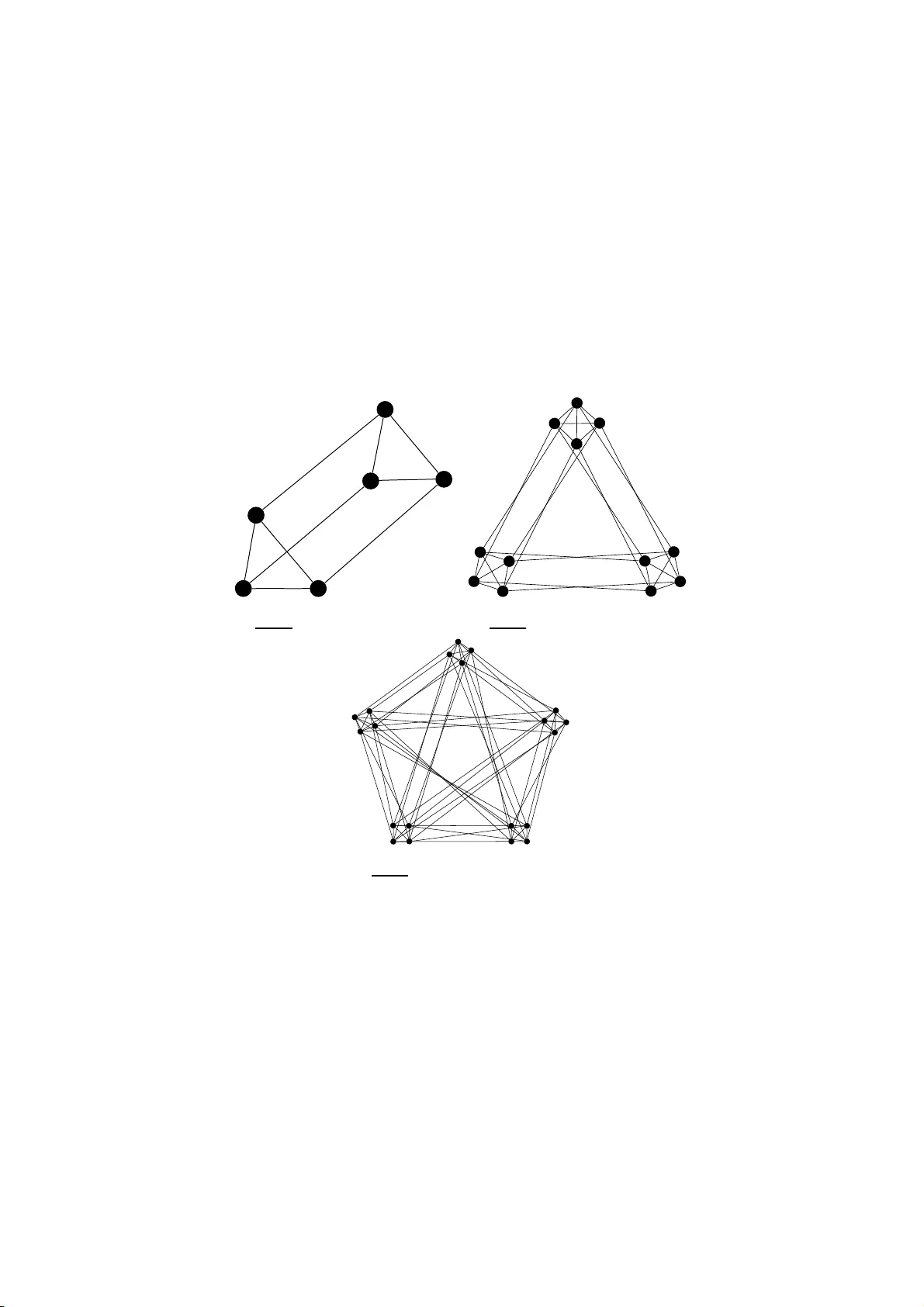
In terlace P olynomial s: En umeration, Unimo dal it y , and Connections to Co des Lars Eirik Danielsen ∗ Matthew G. P arker ∗ Octob er 1, 2009 Abstract The interlac e p o l ynomial q w as introduced by Arratia, Bollob´ as, a n d Sorkin. It enco des man y prop erties of the orbit of a graph un der e dge lo c al c omplementation (ELC ). The interl ace p olynomial Q , introdu ced by Aigner and v an der Holst, similarly contains information about the orbit of a graph under lo c al c omplementation (LC). W e have previously classified LC and ELC orbits, and no w g ive an enumeratio n of the corresponding interl ace p olynomials of all graph s of order u p to 12. An enumeration of all cir cle gr aphs of order up to 12 is also given. W e show th at th ere exist graphs of all orders grea ter than 9 with interlace p olynomials q whose coefficient sequences are non-unimo dal , thereby dispro ving a conjec t ure by A rratia et al. W e h a ve verified t hat for graphs of order up t o 12, all polyn omials Q have unimo dal co efficients. It has been shown that LC and ELC orbits of graphs correspond to equiv alence classes of certain err or-c or r e cting c o des an d quantum states . W e show that th e prop erties of these co des and quantum states are related to prop erties of the associated interl ace p olyn omials. 1 In tro du ction A gr aph is a pair G = ( V , E ) where V is a set of vertic es , and E ⊆ V × V is a set o f e dges . The or der of G is n = | V | . W e will only c onsider simple undir e cte d g raphs, i.e., g raphs where all edges are bidirectional and no vertex can b e adjacent to it s e lf. The neighb ourho o d of v ∈ V , denoted N v ⊂ V , is the set of vertices co nnected to v b y an edge. The num b er of vertices adjacent to v is called the de gr e e o f v . An Eulerian gr aph is a gra ph where all v er tice s ha ve even deg r ee. The induc e d sub gr aph of G on W ⊆ V co n ta ins vertices W and a ll edges from E whos e endp oints a re b oth in W . The c omplement of G is found by replacing E with V × V − E , i.e., the edges in E are changed to non-edg es, and the non-edges to edg es. Tw o gr aphs G = ( V , E ) and G ′ = ( V , E ′ ) are isomorphic if and only if ther e exists a p ermutation π on V s uch that { u, v } ∈ E if and only if { π ( u ) , π ( v ) } ∈ E ′ . A p ath is a sequence of vertices, ( v 1 , v 2 , . . . , v i ), such that { v 1 , v 2 } , { v 2 , v 3 } , . . . , { v i − 1 , v i } ∈ E . A graph is c onne ct e d if there is a path from any vertex to any other vertex in the graph. A gra ph is bip artite if its set ∗ Departmen t of Informatics, Uni v ers it y of Bergen, PO Box 7803, N-5020 Bergen, Norw ay . {larsed,matthew}@ii.uib .no http://w ww.ii.uib.no/~{l a rsed ,matthew} 1 2 1 3 4 (a) The Graph G 2 1 3 4 (b) The Graph G ∗ 1 Fig. 1: Example of Local Complemen t ation of v ertice s can be decomp osed in to tw o disjoint sets such that no t wo v ertices within the same set are adjacent. A c omplete gr aph is a gr aph where all pairs of vertices ar e connected by an edge. A clique is a complete s ubgraph. A k -clique is a clique co ns isting of k v er tices. An indep endent set is the complement o f a clique, i.e., an empt y subgr aph. The indep endenc e numb er of G is the size of the largest independent set in G . Definition 1 ([5, 1 3, 14]) . Given a graph G = ( V , E ) and a vertex v ∈ V , let N v ⊂ V b e the neighbourho o d of v . L o c al c omplementation (LC) on v transforms G in to G ∗ v by replacing the induced subgraph of G on N v by its complement. (Fig. 1) Definition 2 ([5]) . Giv en a gra ph G = ( V , E ) and an edg e { u, v } ∈ E , e dge lo c al c omplementation (ELC) o n { u, v } transfor ms G into G ( uv ) = G ∗ u ∗ v ∗ u = G ∗ v ∗ u ∗ v . Definition 3 ([5]) . EL C on { u, v } can equiv alently b e defined as follows. De- comp ose V \ { u , v } into the following four disjoint sets, as visualized in Fig. 2. A V ertices adjacent to u , but not to v . B V er tices adjacent to v , but not to u . C V ertices adjacent to both u and v . D V ertices adjacent to neither u no r v . T o obtain G ( uv ) , p erform the following pro cedure. F or any pair of vertices { x, y } , where x be longs to cla s s A , B , o r C , and y belo ngs to a different class A , B , or C , “toggle” the pa ir { x, y } , i.e., if { x, y } ∈ E , delete the edge, and if { x, y } 6∈ E , add the edg e { x, y } to E . Finally , swap the lab els of vertices u and v . Definition 4 . The LC orbit of a gra ph G is the set of all unlab eled gra phs that can be o btained by p erfor ming any sequence of LC op erations on G . Similarly , the ELC orbit of G comprises all unlab eled graphs that can be obtained by per forming a n y seque nce of ELC op eratio ns on G . The LC op eration was fir st defined by de F raysseix [1 3], and later studied b y F on-der-Flaas [14] and Bouchet [5 ]. Bouchet defined ELC as “co mplemen ta tio n along a n edge” [5], but this op eration is also known as pivoting on a gra ph [3]. The r ecently defined interlac e p olynomials are based on the LC and ELC op erations. Arratia , B o llob´ as, a nd Sorkin [3] defined the interlace p o lynomial q ( G ) o f the g raph G . This work was motiv ated by a problem r elated to DNA sequencing [2 ]. 2 u v D A B C Fig. 2: Visualization of the ELC Op eration Definition 5 ([3 ]) . F or every gra ph G , there is an asso ciated interlace p oly- nomial q ( G, x ), which we will usually denote q ( G ) for brevity . F or the edgeless graph of order n , E n = ( V , ∅ ), q ( E n ) = x n . F or any o ther g r aph G = ( V , E ), choose a n a r bitrary edge { u , v } ∈ E , and let q ( G ) = q ( G \ u ) + q ( G ( uv ) \ u ) , where G \ u is the graph G with vertex u and a ll edg es incident on u r e moved. It was prov en by Arratia et al. [3] that the p olynomia l is indep endent of the order of remov a l of edg es, and that the p oly no mial is in v ar iant under ELC, i.e., that q ( G ) = q ( G ( uv ) ) for any edge { u, v } . Aigner and v an der Hols t [1] later defined the interlace po lynomial Q ( G ) which similarly enco des pro pe r ties o f the LC orbit of G . Definition 6 ([1]) . F or every gr aph G , there is a n asso cia ted interlace p olyno- mial Q ( G, x ), which we will usually deno te Q ( G ) for brev ity . F or the edge le s s graph of order n , E n = ( V , ∅ ), Q ( E n ) = x n . F or a ny other gr aph G = ( V , E ), choose a n a r bitrary edge { u , v } ∈ E , and let Q ( G ) = Q ( G \ u ) + Q ( G ( uv ) \ u ) + Q ( G ∗ u \ u ) . Again, the o rder of remov al o f edges is irrelev ant, and the p olyno mial is inv ariant under LC and ELC. It was shown b y Aigner and v an der Holst [1] that bo th q ( G ) and Q ( G ) can a ls o b e derived from the ra nks of matr ic es obtaine d by cer ta in mo difica tions of the adjacency matr ix of G . A similar appr o ach, but expressed in ter ms of cer tain se ts of lo c al unitary tr ansforms , w a s shown by Riera and Parker [20]. If G is an unconnected g raph with c o mpo nent s G 1 and G 2 , then q ( G ) = q ( G 1 ) q ( G 2 ) and Q ( G ) = Q ( G 1 ) Q ( G 2 ). The int er lace p olynomials q ( G ) and Q ( G ) summarize s everal prop erties of the E LC and LC orbits of the graph G . The degree o f the low est-degr ee term of q ( G ) equa ls the num ber of connected comp onents of G , and is therefor e o ne fo r 3 (a) (b) Fig. 3: Example of an LC Orbit a connected gr aph [3]. The degree of q ( G ) equals the ma ximum independence nu mber ov er a ll graphs in the ELC orbit o f G [1]. It follows that the degree of q ( G ) is also an uppe r b ound on the independence n umber of G . Likewise, the degree of Q ( G ) gives the size of the larg est indep endent set in the L C orbit of G [10]. The degre e o f Q ( G ) will alwa ys be grea ter than o r equal to the degree of q ( G ). Ev aluating interlace p olyno mials for certain v alues of x can als o gives us so me informatio n a bo ut the as so ciated gra phs . F or a graph G o f or der n , it alwa ys ho lds that q ( G, 2) = 2 n and Q ( G, 3) = 3 n . q ( G, 1) equals the num ber of induced subgr aphs of G with an o dd num b er of p erfe ct matchings [1]. Q ( G, 2) equals the num ber of g eneral induced subgraphs of G (with possible loo ps attached to the vertices) with an odd n umber of general per fect matchings [1]. Q ( G, 4) equals 2 n times the num be r o f induced Eulerian subgraphs of G [1]. It has been shown that q ( G, − 1) = ( − 1) n 2 n − r , where n is the order of G a nd r is the rank ov er F 2 of Γ + I , wher e Γ is the adjacency matrix of G [1 , 4]. q ( G, 3) is always divisible by q ( G, 1 ), a nd the quo tien t is an o dd int e g er [1]. Example 7. The tw o graphs in Fig . 3 co mprise a n LC orbit, and a n ELC orbit. (Note that in g eneral, an LC or bit can b e decomp osed into one o r more ELC o rbits.) Both graphs hav e interlace po lynomials q ( G ) = 1 2 x + 10 x 2 and Q ( G ) = 108 x + 45 x 2 . The fa c t that deg ( Q ) = 2 matches the observ ation that none o f the t wo g raphs have an independent set of s ize greater tha n t wo. Tha t Q ( G, 4) 2 6 = 18 means tha t each g r aph has 1 8 Euler ian subgr aphs. In their list of o p en problems [3], Arra tia et al. pose the question o f how many differ en t interlace polynomia ls there a re for gr a phs of order n . In Section 2, we answer this question for n ≤ 12, for bo th in ter lace p olynomia ls q a nd Q . In the DNA sequencing setting [2], interlace poly no mials of cir cle gr aphs are of par ticular in ter est. Arratia et al. [2] e numerated the cir cle gra phs of or de r up to 9 . In Section 3, we extend this enum er ation to o rder 1 2. Let q ( G ) = a 1 x + a 2 x 2 + · · · + a d x d . Then the sequence of coefficients of q is { a i } = ( a 1 , a 2 , . . . , a d ). A r ratia et al. [3] conjecture that this sequence is unimo dal for all q . The sequence { a i } is unimo dal if, for s ome 1 ≤ k ≤ d , a i ≤ a j for all i < j ≤ k , a nd a i ≥ a j for a ll i > j ≥ k . In o ther words, the s equence is non-decrea sing up to some co e fficien t k , and the rest o f the sequence is non- increasing. In Section 4, we show that there exist interlace p olynomia ls q who se 4 co efficient sequences a r e non-unimo dal, and ther eby dispr ove the conjecture by Arratia et a l. Our enumeration shows that all interlace p olyno mials o f gra phs of order up to 9 a re unimo dal, but that there are tw o gra phs of or der 1 0 with the same no n-unimo dal interlace p olyno mial. F rom these gra phs o f order 1 0 it is p os sible to construct g raphs of any o rder grea ter than 1 0 with non-unimo dal int er lace p o lynomials. W e verify that all in terlace p olyno mials Q ( G ) and all po lynomials x · q ( G, x + 1) of graphs o f order up to 12 hav e unimo dal co efficients. In Section 5 we highlight an interesting relations hip b etw een interlace poly - nomials, err or-cor recting co des, and q ua nt um sta tes. The LC or bit o f a graph corres p o nds to the equiv a lence c la ss of a self-dual quantum c o de [26], a nd E LC orbits of bipartite graphs corres p ond to equiv a lence classes of binary line ar c o des [12]. In b oth ca s es, the minimum distanc e of a co de is given by δ + 1, where δ is the minimum vertex degree ov er all gra phs in the corr esp onding or bit. W e hav e pr eviously shown [10] that a self-dual quantum co de with high minimum distance o ften corr esp onds to a gra ph G where deg ( Q ), the deg ree of Q ( G ), is small. A self-dual quan tum code can als o b e in terpr eted as a quantum gr aph state [1 7]. A co de with high minimum distance will co rresp ond to a quantum state with a high degree o f entanglement . The deg ree o f Q ( G ) gives an indica tor of the entanglement in the gr aph state repres ent ed by G known as the p e ak-to- aver age p ower r atio [10] with res pec t to cer ta in trans fo rms. Another indicator of the en tangle men t in a graph s tate is the Cliffor d merit factor (CMF) [18], which can b e derived from the ev a lua tion of Q ( G ) at x = 4 [21]. In Sectio n 5 we give the rang e of p ossible v alues o f δ , deg ( Q ), and Q ( G, 4) fo r g r aphs o f o rder up to 12 , and b ounds o n these parameter s for graphs of or der up to 25 , derived from the bes t k nown self-dua l qua ntum c o des. 2 En umeration of In terlace P olynomials In the c o ntext of e rror- correcting co des, we hav e previously c la ssified the LC orbits [11] and ELC orbits [12, 19] of all graphs on up to 12 vertices. In T able 1, the sequence { c L,n } giv es the n umber of LC orbits o f connected gr aphs on n vertices, while { t L,n } gives the total num b er of LC orbits of gra phs on n vertices. Similarly , the se quence { c E ,n } gives the num b er of ELC or bits of connec ted graphs on n vertices, while { t E ,n } gives the total num b er of ELC o rbits of gra phs on n vertices. A databas e containing one repr esentativ e from each LC orbit is av ailable at h ttp:// www.i i.uib.no/~larsed/vncor b its/ . A similar database of E LC o rbits ca n b e found a t htt p://w ww.ii.uib.no/~larsed/pivot/ . Note that the v alue o f t n (for either ELC or LC orbits) can be derived easily once the sequence { c m } is known for 1 ≤ m ≤ n , using the Euler tra nsform [24], a n = X d | n dc d , t 1 = a 1 , t n = 1 n a n + n − 1 X k =1 a k t n − k ! . The question of how many distinct in ter la ce p olynomia ls there ar e for g raphs of orde r n was p osed b y Arratia et al. [3]. F or a r epresentativ e from ea ch LC and ELC orbit, we hav e calcula ted the interlace p oly no mials Q and q , resp ectively . 5 T able 1: Nu mber of LC and ELC Orbits n c L,n t L,n c E ,n t E ,n 1 1 1 1 1 2 1 2 1 2 3 1 3 2 4 4 2 6 4 9 5 4 11 10 21 6 11 26 35 64 7 26 59 134 218 8 101 182 777 1068 9 440 675 6702 8038 10 3132 399 0 104,82 5 114,188 11 40,457 45,144 3,370,3 17 3,493,96 5 12 1 ,274,06 8 1,323,363 231,55 7,290 235,176,0 9 7 T able 2: Number of Distinct Interlace Polynomial s n c Q,n t Q,n c q,n t q,n 1 1 1 1 1 2 1 2 1 2 3 1 3 2 4 4 2 6 4 8 5 4 11 9 17 6 10 24 24 41 7 23 52 71 112 8 84 152 25 7 369 9 337 521 1186 1555 10 2154 2793 7070 8625 11 22,956 26,17 8 56,698 65,323 12 4 86,488 51 5,131 614,95 2 680,275 W e then counted the num b er of distinct in ter lace p oly nomials. In T able 2, the s equence { c Q,n } gives the num b er of interlace p olyno mials Q of connected graphs of order n , while { t Q,n } g ives the to tal num b e r o f interlace p o ly nomials Q of gr aphs of order n . Similarly , { c q,n } and { t q,n } give the num b e r s of interlace po lynomials q . W e o bs erve that in T able 2, the relationship t q,n = c q,n + t q,n − 1 holds. 3 En umeration of Circle Graphs A g raph G is a cir cle gr aph if each vertex in G can be represented as a chord on a circle, such that tw o chords intersect if and o nly if there is an edge b etw een the tw o corr e s po nding vertices in G . An exa mple of a cir cle gr aph a nd its corres p o nding cir cle dia gram is given in Fig. 4. Whether a given g raph is a cir cle graph can b e reco gnized in polyno mial time [25]. It is also known tha t LC op eratio ns will map a circle graph to a circle 6 2 1 3 4 (a) The Circle Graph G 4 2 1 3 (b) The Circle Representat i on of G Fig. 4: Example of a Circle Graph Fig. 5: Circle Graph Obstructions graph, and a non-circle g r aph to a non- circle gr a ph [6]. B o uchet [6 ] prov ed that a g r aph G is a cir cle graph if and only if ce rtain obstructions , shown in Fig. 5, do no t app ear a s subg raphs a n y w he r e in the LC orbit of G . Arratia et al. [2 ] po in ted o ut that an enumeration of circle g raphs did not seem to hav e app eared in the liter ature be fo re, a nd then g av e a n enumeration of cir cle gra phs of or der up to 9. Us ing our previous cla ssification of LC or bits, and the fact that the circle g raph pr op erty is preserved by LC op er ations, we are able to gener ate all circle graphs o f o rder up to 12. In T able 3 , the seq ue nc e { c c,n } gives the n umber o f co nnected c ircle g raphs of o rder n , while { t c,n } gives the to tal num b er of circle graphs of o rder n . The sequence s { c ′ c,n } and { t ′ c,n } give the num b er of LC orbits containing circle gra phs. A data base with one representative from each LC orbit of c o nnected circle graphs is av aila ble at http:/ /www. ii.uib.no/~larsed/circle/ . 4 Unimo dalit y Having calcula ted the interlace p olynomials q of all graphs of order up to 12, it was p ossible to check whether their co efficient sequences were unimo dal, as con- jectured b y Arratia et al. [3]. Note that a s imilar c o njecture has b een disprov ed for the related T u t te p olynomial [2 3]. Our r esults show that all interlace po lynomials q of g raphs of or der n ≤ 9 are unimo dal, but that for n = 10 there exists a single non-unimo dal inter- lace p olynomial with co efficient sequence { a i } = (2 , 7 , 6 , 7 , 4 , 3 , 2 , 1 , 0 , 0). Only t wo graphs on 10 vertices, comprising a single ELC orbit, corr esp ond to this po lynomial. One of these gra phs is shown in Fig . 6. 7 T able 3: Number of Circle Graphs n c c,n t c,n c ′ c,n t ′ c,n 1 1 1 1 1 2 1 2 1 2 3 2 4 1 3 4 6 11 2 6 5 21 34 4 11 6 110 154 1 0 25 7 789 978 2 3 55 8 8336 9497 81 157 9 117 ,283 127 ,954 293 499 10 2,02 6,331 2,165,29 1 1403 2059 11 40,302 ,425 42,609,994 7968 10,5 43 12 8 92,278 ,076 937,233,30 6 55,553 68,281 Fig. 6: The Smallest Graph with Non-Un imodal Interla ce P olynomial q W e have further found that, up to EL C e quiv a lence, there are 4 g raphs on 11 vertices with non-unimo dal interlace po lynomials, 3 of which are connected graphs, and 20 gr aphs on 12 v er tices with non-unimo dal p olynomials, 1 5 o f which are connected. Given the sing le non-unimo dal interlace p olynomia l o f a gra ph of or der n = 10, it is eas y to show that there must exist non-unimo dal int er lace p olynomials for all n > 10 , since the following metho ds of extending a gra ph will preser ve the non-unimo dality of the a sso ciated interlace p olynomia l. Given a gr aph G o n n vertices with no n- unimo dal interlace po lynomial, we can add an isolated vertex to obtaining an unconnected gr aph G ′ on n + 1 vertices, where q ( G ′ ) = x · q ( G ) is clearly also no n-unimo dal. Non-unimo dality is a lso pres e rved by su bstituting a vertex v o f G by a clique of size m , i.e., we obtain G ′ where v is replaced by m vertices, all connected to each other and all connected to w whenever { v , w } is a n edge in G . It can then be shown that q ( G ′ ) = 2 m q ( G ) [3, Pro p. 38]. Prop ositio n 8. Given a gr aph G , let G ′ b e the gr aph obtaine d by duplicating a vertex v of G , i.e ., by addi n g a vertex v ′ such t hat v ′ is c onne cte d to w whenever { v , w } is an e dge in G . The interlac e p olynomial of G c an b e written q ( G ) = a ( x ) + cx j + x j +1 b ( x ) , wher e a and b ar e arbitr ary p olynomials, c is a c onstant, and j = deg ( a ) + 1 . The u nimo dality or lack ther e of of G wil l b e pr eserve d in G ′ if q ( G \ v ) = a ( x ) + x j b ( x ) . Pr o of. By duplica ting the vertex v , we obtain a g raph G ′ with interlace po ly- nomial q ( G ′ ) = (1 + x ) q ( G ) − x · q ( G \ v ) [3, Pro p. 40]. If the condition ab ov e is 8 Fig. 7: Non-trivial Graphs of Order 12 with Non-Un imodal Interlace Polynomial q satisfied, q ( G ′ ) = x j +2 a ( x ) + c ( x j +1 + x j ) + b ( x ). The o nly difference be tw ee n the c o efficient sequences of q ( G ) a nd q ( G ′ ) is that the co efficient c is rep eated in q ( G ′ ), and unimo dality or non-unimo da lit y must therefore b e preserved. Let G b e the g r aph depicted in Fig. 6, and let v b e o ne of the six vertices o f degree one in this gra ph. If we duplicate v w e o btain a gra ph whose interlace po lynomial has the non-unimo dal co efficient sequence (2 , 7 , 6 , 7 , 6 , 4 , 3 , 2 , 1 , 0 , 0). According to Prop. 8, we ca n rep eat the duplication of a vertex with degree one and the co efficient sequence will remain (2 , 7 , 6 , 7 , 6 , . . . , 6 , 4 , 3 , 2 , 1 , 0 , 0), i.e., non-unimo dal. By the described extension metho ds we can obtain, from the single graph on 10 vertices shown in Fig. 6, a ll the 4 inequiv alent gr aphs on 1 1 vertices and 16 of the 20 inequiv alent graphs on 12 vertices with non-unimo dal interlace po lynomials. Representativ es from the ELC orbits of the 4 non-trivial graphs on 1 2 vertices with no n-unimo dal in ter lace p olynomia ls are shown in Fig. 7. The tw o following conjectures have b een chec ked for all graphs on up to 1 2 vertices, and no counterexamples hav e b een found. Conje ctu r e 1 ([3]) . F or any in ter lace p olynomial q ( G, x ), the as so ciated po lyno- mial x · q ( G, x + 1 ) has a unimo da l co efficient sequence . Conje ctu r e 2 . F o r any graph G , the interlace po lynomial Q ( G ) has a unimo dal co efficient sequence. 5 Connections to Co des and Quan tum S tates An imp orta n t ques tion is what the int er lace p olynomials q ( G ) a nd Q ( G ) a c tua lly compute a bo ut the graph G itself. When G is a circle graph, q ( G ) can b e used to solve counting problems rele v ant to DNA sequencing [2]. W e will show tha t the interlace p olynomials a lso give clues ab out the err or-co r rection capability o f co des and the entanglement of qua n tum states. 9 T able 4: Ran ge of deg( Q ) F or Given δ and n δ \ n 2 3 4 5 6 7 8 9 10 11 12 1 1 2 2,3 3,4 3–5 3–6 3– 7 4– 8 4–9 4– 10 4–1 1 2 2 3 3,4 3,4 3–5 4– 6 4– 7 4–8 3 2 3,4 3,4 3–5 4–6 4–7 4 4 4 5 4 It is known that self-dual quantum c o des , so called be c a use they corr e spo nd to self-dual additiv e co des o ver F 4 [7], can b e represented as graphs [1 6, 22]. The LC orbit of a g raph cor resp onds to the equiv alence c la ss o f a self-dual quantum co de [26]. Similarly , the E LC o rbits of bipa rtite graphs corresp ond to equiv alence classes of bina ry line ar c o des [12]. In b oth cases the minimum distanc e , an impo rtant parameter that determines the er ror-c orrecting capabilit y of a co de, is given by δ + 1, where δ is the minim um vertex degre e over all gra phs in the corr esp onding L C or ELC orbit. A self-dual q uantum co de can also be int er preted as a quantum gr aph stat e [17], and the δ -v alue of the a sso ciated LC orbit is then a n indicato r o f the degr ee of entanglement in the state. Although the v alue δ ca n not b e obtained from an interlace p olynomial, sev - eral v alues that ar e corr e lated with δ ar e enco ded in the interlace p olynomial. The size o f the la r gest independent set ov er all members of the LC orbit o f G equals deg( Q ), the degree of Q ( G ) [1, 10]. W e hav e previously shown that opti- mal self-dual quantum co des co rresp ond to LC orbits wher e de g ( Q ) is small [1 0]. These co des have la rgest po ssible minimum distance for a given length n , and th us the a s so ciated LC orbits of graphs o n n vertices have maximum p ossible v a lues of δ . The data in T able 4 implies that the L C orbits with the highest δ -v alues als o hav e the lowest v alues of deg ( Q ), but that the conv er s e is not al- wa ys true. In the context of quantum gra ph s tates, the v alue 2 deg( Q ) is equa l to the p e ak-to-aver age p ower r atio [10] with respect to certain tr ansforms, which is a nother indicator o f the degr ee o f entanglement in the state. Another measure o f the entanglemen t in a quantum graph state is the Clif- for d merit factor (CMF) [1 8]. A qua ntum gra ph state ca n be represented as a graph G , and the CMF o f the state ca n be derived fro m the v alue obtained by ev a luating the as so ciated interlace po lynomial Q ( G ) a t x = 4 [21]. The CMF v a lue ca n b e obtained with the formula 6 n 2 n Q ( G, 4) − 6 n . In teres tingly , Q ( G, 4) 2 n is also the num b er of induced E ulerian subgr aphs o f a g raph o n n vertices [1], which is inv ariant ov er the LC or bit. As can b e seen in T able 5 , the LC or bits with the highest δ -v alues also hav e the low est v alues o f Q ( G, 4). Other ev aluations of the int er lace p olynomials a re also of interest in the context o f quantum gra ph s tates, for instance q ( G, 1) and Q ( G, 2 ) give the num b er of fl at sp e ctr a with resp ect to certain sets of tra nsforms o f the state [21]. Although no a lgorithm is known for computing the interlace p olynomia l of a gr aph efficiently , it is in gener al faster to genera te interlace p o lynomials, by simply using the recursive algorithm given in Definitions 5 and 6, than it is to gener ate the en tir e ELC o r LC orbits o f a graph. No te that calculating δ can a lso b e done fas ter than by generating the complete L C orbit, by us- ing metho ds for calculating the minimum dis ta nce of a se lf-dual qua nt um co de 10 T able 5: Range of Q ( G, 4) 2 n F or Given n and δ n \ δ 1 2 3 4 5 2 3 3 5 4 8–9 5 13–1 7 12 6 20–3 3 19 18 7 30–6 5 29–30 8 47–12 9 45–48 44 –45 9 73–25 7 69–80 68 –69 10 112– 513 106– 128 104–10 9 11 172–1 025 1 60–1 8 3 15 7–180 1 56 12 260–2 049 2 44–3 6 2 23 7–288 238– 2 39 234 represented as a gra ph [11]. W e hav e calculated the int e r lace p olyno mials Q o f graphs co r resp onding to the b est known self-dual quantum c o des, obtained from http:/ /www. codetables.de/ and from a search we hav e pr eviously per formed of cir culant gr aph c o des [8]. An a djacency matrix is called cir culant if the i -th row is equal to the first row, cyclically s hifted i − 1 times to the righ t. The results, for g raphs of o r der n up to 2 5 , ar e given in T able 6 . V alues printed in bo ld font are the b est v alues we hav e found, and are thus upp er b ounds on the minim um p ossible v alues of deg( Q ) a nd Q ( G, 4 ) for the g iven n . The v alues of δ printed in b old font are known to b e optima l, except for n = 23 and n = 25, where a gr aph with δ = 8 could exist, and n = 24 , n = 26, and n = 27, where δ = 9 is p ossible. In g e neral, the following b ounds hold [7]. δ ≤ 2 j n 6 k + 1 , if the corresp o nding self-dual quantum code is of T yp e II , which mea ns that its gr aph representation is anti-Eulerian [11], i.e., a gra ph where all vertices hav e o dd degr ee. Such g r aphs must hav e an even num ber o f vertices, and it is int er esting to note that the anti-Eulerian proper t y is pres erved by LC ope r ations. δ ≤ 2 n 6 , if n ≡ 0 (mo d 6 ) 2 n 6 + 2 , if n ≡ 5 (mo d 6) 2 n 6 + 1 , otherwise, if the corres po nding self-dual quantum co de is of T yp e I , i.e., cor resp onds to a gr aph wher e at leas t one vertex has even deg ree. T able 6 also lists the first row of those adjacenc y matrices that ar e circ ula nt . The remaining adjac e ncy matrices a re as follows. 11 Γ 13 , 1 = 0 1 0 0 0 0 0 0 0 1 1 1 1 1 0 1 0 0 0 0 1 0 0 0 1 1 0 1 0 1 0 1 0 0 0 0 0 1 1 0 0 1 0 0 0 1 0 0 0 1 1 1 0 0 0 0 0 1 0 1 0 0 1 1 1 0 0 1 0 1 0 0 0 0 1 1 0 1 0 0 0 1 0 0 0 0 1 1 1 0 1 0 1 0 0 1 0 0 0 1 0 1 1 0 0 0 0 0 0 0 1 1 0 1 1 1 0 1 0 0 0 0 1 1 0 1 0 0 1 0 1 0 0 1 1 1 1 1 1 0 0 0 0 1 1 1 1 1 0 0 1 1 1 0 0 0 1 1 1 1 1 1 1 0 0 0 0 0 0 Γ 13 , 2 = 0 1 1 0 0 0 0 0 1 0 0 0 1 1 0 0 0 1 0 1 0 0 0 0 1 1 1 0 0 1 0 0 0 1 0 0 1 0 0 0 0 1 0 0 0 0 0 0 1 1 1 0 0 1 0 0 0 1 0 0 0 0 1 1 1 0 0 0 0 1 0 1 1 0 1 0 1 0 0 1 0 0 0 1 0 0 1 1 0 1 0 0 0 1 0 0 1 0 0 1 1 1 0 1 1 0 0 0 0 0 1 1 0 1 1 1 1 0 0 0 1 0 1 1 1 1 0 1 0 0 0 0 1 1 1 0 0 1 1 1 0 1 1 0 1 0 1 1 1 1 0 1 0 1 0 1 1 1 0 0 1 0 0 1 1 0 1 1 0 Γ 18 = 0 0 1 0 0 0 0 0 1 1 0 0 0 1 0 1 1 1 0 0 0 1 1 0 0 0 0 1 0 1 0 0 0 1 1 1 1 0 0 0 0 1 0 0 1 1 1 1 0 1 0 0 0 0 0 1 0 0 0 0 0 0 1 0 1 0 0 0 1 1 1 1 0 1 0 0 0 1 1 1 0 0 0 1 1 0 1 0 0 0 0 0 1 0 1 0 0 1 0 0 0 1 0 1 0 1 0 1 0 0 0 0 1 0 0 1 1 0 1 0 1 0 1 0 1 0 0 0 0 0 1 1 1 0 0 1 1 0 0 1 1 0 0 0 1 0 1 1 0 0 1 0 0 0 1 0 1 0 0 0 0 1 1 1 1 0 0 0 0 1 0 0 0 1 1 0 0 0 0 1 0 0 1 1 0 0 1 1 1 0 0 0 0 1 0 1 0 0 0 1 1 0 1 1 0 0 0 1 0 0 1 0 1 1 1 0 0 0 0 0 1 0 1 0 1 1 0 1 0 1 0 1 0 0 1 0 1 0 0 1 0 1 0 0 1 0 1 0 1 0 0 0 0 0 0 1 1 0 1 1 0 0 0 1 0 1 0 0 1 0 1 1 0 1 0 1 0 0 0 0 1 1 1 0 0 0 0 0 1 1 0 1 0 0 1 0 0 0 0 1 0 0 1 0 0 1 1 1 0 1 0 1 0 0 1 1 0 0 0 0 0 0 1 0 12 Γ 21 = 0 0 0 0 0 1 0 0 0 1 1 0 1 0 1 0 1 1 1 0 1 0 0 1 1 0 0 1 1 0 1 1 0 0 0 1 1 0 0 0 0 0 0 1 0 0 1 1 0 0 0 1 0 1 0 0 0 0 0 1 1 1 0 0 1 0 0 1 0 1 1 0 0 0 1 1 0 0 0 1 0 1 0 0 0 0 1 1 0 1 0 0 0 1 0 0 0 1 1 0 0 0 1 1 0 1 0 1 0 1 0 1 1 1 0 0 0 0 1 0 0 0 1 0 1 0 0 1 0 1 0 1 0 1 0 1 1 0 1 0 0 0 0 0 1 0 1 0 1 0 1 0 1 1 0 0 0 0 0 0 1 0 0 0 1 0 1 1 0 0 0 0 0 1 0 0 0 1 1 1 1 1 0 1 0 0 1 0 1 1 1 1 0 1 0 1 0 1 0 0 0 0 0 1 1 0 0 0 1 0 1 1 0 0 0 0 1 0 1 0 0 0 1 1 0 0 1 0 0 0 1 0 0 1 1 0 0 0 0 1 0 0 0 0 1 0 1 1 0 1 0 1 1 0 0 1 0 0 1 0 1 0 1 0 0 0 0 1 0 1 0 0 1 0 0 0 0 1 1 0 1 1 0 1 1 0 0 0 1 0 1 0 0 0 1 1 0 0 1 0 0 0 0 1 0 0 0 0 0 1 1 1 0 0 1 0 1 0 0 0 0 0 0 1 1 0 1 1 1 1 0 0 0 0 1 0 1 0 0 1 0 0 0 0 0 0 1 1 0 0 1 0 0 1 1 1 0 1 0 1 0 0 1 0 1 0 0 0 0 1 1 1 0 1 0 0 0 0 1 0 1 1 1 0 1 0 1 0 0 1 0 0 0 0 1 0 0 1 0 0 0 1 0 1 1 0 1 0 1 0 0 0 0 0 1 1 0 1 0 0 1 0 0 0 0 0 1 1 1 0 1 1 1 0 1 0 0 0 0 0 0 F or n = 13 and n = 14 we w ere able to co mpute the int er lace p olynomial Q of all gr aphs with optimal δ , since the co rresp onding co des hav e b een classified [11, 27]. F or o ther n , co des with the same δ but with low er deg( Q ) o r Q ( G, 4 ) may exist. The b e st self-dual quantum codes corresp ond to LC or bits where δ is maximized, and our results for graphs on up to 12 vertices suggested that these LC orbits als o minimize deg( Q ) and Q ( G, 4). How ever, in T able 6 w e find several examples where the gra ph we hav e found with low est deg ( Q ) do es not hav e maximum δ . W e hav e not found a single example where the low est Q ( G, 4) is found in a g raph with s ubo ptimal δ , which indicates tha t Q ( G, 4) may b e a better indicator of the minimum distance of a co de tha t deg ( Q ), a nd leads to the following conjecture. Conje ctu r e 3 . Le t G b e a graph on n vertices, and let δ be the minimum vertex degree over all g r aphs in the LC o rbit of G . If there exis ts no other gr aph G ′ on n vertices such that Q ( G ′ , 4 ) < Q ( G, 4 ), then there exists no other gr aph on n vertices where the minimum vertex degree ov er a ll gr aphs in the LC orbit is greater than δ . Note that once we hav e found a graph G on n vertices with a cer tain deg( Q ( G )), we can obtain a gr a ph G ′ on n − 1 vertices with deg( Q ( G ′ )) = deg( Q ( G )) or deg ( Q ( G ′ )) = deg( Q ( G )) − 1 by s imply deleting any vertex of G . This pro c e s s is equiv alent to shortening a quantum co de [1 5], a nd it is k nown that if the minim um vertex degree in the LC orbit of G is δ , then the minimum vertex degree in the LC orbit of G ′ is δ or δ − 1. The following theo rem gives an upp er bo und on Q ( G, 4) for a graph G with a given v alue o f δ . Note that the pro of relies on cer ta in pr op erties of the ap erio dic pr op agation criteria [9] for Bo o lean functions, which will not b e defined here. Theorem 9. Q ( G, 4 ) ≤ γ ( δ + 1) + 6 n 2 n , 13 T able 6: Best F ound V alues of δ , deg ( Q ), and Q ( G, 4) 2 n n δ deg( Q ) Q ( G, 4) 2 n Adjacency ma trix 13 4 4 361 Γ 13 , 1 13 4 5 360 Γ 13 , 2 14 5 4 549 (00001 01110 1000) 15 5 6 830 (00 11100 1100 1 110) 15 4 5 833 (00111 10110 1111 0) 16 5 5 1264 (001 01011 01101 010) 17 6 6 18 7 2 (00100 01111 1100010) 17 5 5 1906 (000 0 0111 0 0111 0 000) 18 7 6 28 0 8 Γ 18 18 5 5 2835 (001 0 0111 1 1111 1 0010) 19 6 6 4296 (000 01010 01100 101000) 20 7 6 6444 (000 00100 11111 0010000) 21 7 9 96 7 2 Γ 21 21 6 6 9756 (000 0 0110 0 1001 0 0110000) 22 7 6 14 , 688 (000 00010 01111 100100000) 23 7 7 22 , 0 13 (00 0 0001 1 1011 1 1011100000) 23 6 5 22 , 036 (0000 0111 1 1011 0111110000) 24 7 6 33 , 156 (001 00111 01001 00101110010) 25 7 7 49 , 8 12 (00 0 1100 0 0111 1 111100001100) 25 7 6 49 , 86 2 (000001 11110 01100111110000) wher e γ ( d ) = n X t =0 n t 2 t t X k =max(1 ,d + t − n ) t k 2 n − k . Pr o of. The gr a ph G cor r esp onds to a Bo o lean function with APC distance d = δ + 1, whic h means that all fixed-ap er io dic auto correla tion co efficients [9] up to and including weigh t d − 1 are set to zer o. As the Clifford mer it factor (CMF) can b e computed with the out-o f- pha se sum-of-squar es of these auto cor relation co efficients in the deno minator, then we immediately have a lower b ound o n CMF dependent on d . F or a Bo olean function f of n v ariables with AP C distance d , it ca n thus be shown that the s um-of-square s is upp er- bo unded by γ ( d ). The CMF is then low er -b ounded b y CMF( f ) ≥ 6 n γ ( d ) . When f is a quadratic Bo olea n function representing a g raph G , the upp er bo und on Q ( G, 4 ) follows. A cla ss o f self- dua l quantum co des known to have hig h minimum distance are the quadr atic r esidue c o des . The graphs corr esp onding to these co des ar e Paley gr aphs . T o co nstruct a Paley g raph on n vertices, where n must be a prime p ow er and n ≡ 1 (mo d 4), let the elements of the finite field F n be the set of vertices, and let tw o vertices, i and j , b e joined by an edge if a nd only if their difference is a qua dratic residue in F n \{ 0 } , i.e., there exists an x ∈ F n \{ 0 } 14 such that x 2 ≡ i − j . This co nstruction will result in a circulant a djacency matrix, where the first row is called a L e gendr e s e qu enc e . P a le y gr aphs are known to hav e low independenc e num b ers, and, since they corresp ond to strong quantum co des, the degrees of their interlace p olynomia ls Q a re also low, i.e., the size of the largest independent set in the LC orbit of a Paley graph is small, compar ed to other g raphs on the same num b er of vertices. This suggests that Paley graphs, due to their high degree o f sy mmetry , hav e the prop erty that their indep endence num b ers r emain largely inv aria nt with resp ect to LC. Another co de constr uction is the b or der e d quadr atic r esidue c o de , equiv alent to extending a Paley gr aph by adding one vertex a nd connecting it to all existing vertices. F or e x ample, optimal q uantum co des of leng th 5, 6, 29, and 30 can b e constructed using Paley graphs or extended Paley g raphs. W e hav e previo usly discov er ed [10] that many strong se lf- dua l quantum codes can b e r epresented a s highly structure d neste d clique gr aphs . Some of these graphs a re shown in Fig. 8. F or instance , Fig . 8 b shows a gra ph c o nsisting of three 4 -cliques. The remaining edges for m a Hamiltonian cycle , i.e., a c ycle that visits every vertex of the graph e x actly o nce. Fig . 8 c shows five 4-c liq ues int er connected b y one Hamiltonian cy cle and tw o cycles of length 10 . Ignoring edges in the c liq ues, there are no cycles of leng th s horter than 5 in the gra ph. The graph in Fig. 8a ca n b e viewed as tw o interconnected 3- cliques. Note that the g raphs in Fig. 8 ha ve v alues of δ , deg( Q ), and Q ( G, 4) that match the optimal or bes t known v a lues in T able s 4, 5, a nd 6. Also note that they are all r e gular graphs, with all vertices having degree δ , which means that the num b er of edg es is minimal fo r the g iven δ . It is interesting to o bserve that the problem of finding go o d quantum co des, or highly ent a ngled quant um s tates, can b e refor m ula ted as the problem o f find- ing LC orbits of graphs with certain prop erties, a nd tha t these pr op erties are related to the interlace p olynomials of the g r aphs. Even though certain con- struction techniques are known, as shown ab ov e, ma ny op en problems r emain, such as providing b etter bounds on δ , deg ( Q ), and Q ( G, 4), and finding new metho ds for constr ucting g r aphs with optimal o r go o d v alues for these pa ram- eters. It w ould also be int er esting to study po s sible connections b etw een the observ ation that the b est self-dua l quantum co des hav e a minimal num b e r of Eu- lerian subgra phs, and the fact that that many o ptimal self-dual quantum co des are of Type I I, i.e., corr esp ond to a nt i- E ulerian graphs. No te that all the gra phs in Fig. 8 ar e anti-Eulerian. The gr aphs in Fig. 8 also give other clues a s to the t y p es of graphs that may optimise deg( Q ) and Q ( G, 4). If a gr a ph contains a k -clique, p erforming LC on any vertex in the cliq ue will pro duce a gr aph with an indep endent set of size at lea st k − 1. Thus the interlace p olyno mial Q o f a c omplete gra ph will have the highest p ossible deg ree of any connected graph. This ex plains why our graphs contain several rela tively small cliques. That the graphs c o nt a in a few long cycles reduce s the num be r o f cycles in the gr a ph, which makes sense when we co ns ider that a cycle is an Euleria n subgra ph. It is als o p ossible to s ay something ab out which prop erties sho uld no t be present in a gra ph with optimal δ , deg ( Q ), or Q ( G, 4). A bipartite gra ph on n vertices will hav e an indep endence num b er of at lea st n 2 . Thus the interlace po lynomial Q asso cia ted with an LC orbit that co nt a ins a bipartite g raph will hav e degr ee at least n 2 . Note that bipa rtiteness is preser ved b y E LC, but not by LC. In T able 7, we g ive the num b er of LC o rbits co n ta ining connected bipartite graphs on n vertices with a given v alue of δ . Compar e this to T able 9, 15 (a) n = 6, δ = 3, deg( Q ) = 2, Q ( G, 4) 2 n = 18 (b) n = 12, δ = 5, deg( Q ) = 4, Q ( G, 4) 2 n = 234 (c) n = 20, δ = 7, deg ( Q ) = 6, Q ( G, 4) 2 n = 6444 Fig. 8: Examples of Nested Clique Graphs 16 T able 7: Nu mber of LC Orbits Con taining Connected Bipartite Graphs by δ and n δ \ n 2 3 4 5 6 7 8 9 10 11 1 2 1 1 1 2 3 7 14 40 106 3 5 2 1218 5140 2 1 1 2 4 16 41 21 5 3 1 2 1 11 All 1 1 2 3 8 15 43 110 3 70 126 0 5366 T able 8: Nu mber of LC Orbits of Connected Circle Graphs by δ and n δ \ n 2 3 4 5 6 7 8 9 10 11 12 1 1 1 2 3 9 21 75 2 77 134 6 7712 54 ,0 67 2 1 1 2 5 16 55 254 1 474 3 1 2 2 12 All 1 1 2 4 10 23 81 293 1403 7 968 55,55 3 T able 9: Nu mber of LC Orbits of Conn ected Graphs by δ and n δ \ n 2 3 4 5 6 7 8 9 10 11 12 1 1 1 2 3 9 22 85 363 2436 26,7 50 611,036 2 1 1 4 11 69 576 1 1,200 467,5 13 3 1 5 8 120 2 506 195,45 5 4 1 63 5 1 All 1 1 2 4 11 26 10 1 440 3132 40 ,457 1,274 ,068 which includes LC orbits of a ll connected gra phs. It also tur ns out that cir cle graphs are bad. This is no t surprising, given that the circle graph obstructions shown in Fig. 5 all hav e o ptimal v alues of δ . The o bs truction on 6 vertices also ha s o ptimal v alue of Q ( G, 4), and the tw o other obstructions hav e Q ( G, 4) only one grea ter than o ptimal. In T able 8, we give the num b er of LC o rbits of connected circle graphs on n vertices with a given v alue of δ . Ac kno wl edgements This resear ch was s uppo rted by the Research Council of Nor wa y . References [1] Aign e r, M. and v an der H olst, H . : “Interlace p olyn omials” . Li ne ar Algebr a Appl. , 377 , pp. 11–30, 2004. [2] Arra tia, R., Bollob ´ as, B., Coppersmith, D., and Sorkin, G. B. : “Euler circuits and D N A sequ encing by hybridization” . Discr ete Appl. M ath. , 104 (1–3), pp. 63–96, 2000. [3] Arra tia, R., Bollob ´ as, B., and Sorkin, G. B. : “The interlace p olynomial of a graph” . J. Combin. The ory Ser. B , 92 (2), pp. 199–233, 2004. 17 [4] Balister, P. N., B ollob ´ as, B., Cutler, J., and Pebod y, L. : “The interlace p olynomial of graph s at − 1” . Eur op e an J. Combin. , 23 (7), pp . 761–767, 2002. [5] Bouchet, A. : “Graphic presentations of isotropic systems” . J. C om bin. The ory Ser. B , 45 (1), pp. 58–76, 1988. [6] Bouchet, A . : “Circle graph obstructions” . J. Combin. The ory Ser. B , 60 (1), pp. 107–144 , 1994. [7] Calderbank, A. R., Rain s, E. M., Shor, P. M., and Slo ane , N. J. A. : “Quantum error correction v ia cod es ov er GF(4)” . IEEE T r ans. I nform. The ory , 44 (4), pp. 1369–13 87, 1998. [8] Danielsen, L. E. : “Graph-based classification of self-dual additive codes o ver finite fields” , 2008. T o app ear in Ad v . Math. Commun. arXiv:08 01.3773 . [9] Danielsen, L. E., Gulliver, T. A., and P arker, M. G. : “Ap eriodic propaga- tion criteria for Boolean functions” . I nform. and Comput. , 204 (5), pp. 741–770, 2006. [10] Danielsen, L. E. and P arker, M. G. : “Spectral orbits and p eak-t o-a verage p o wer ratio of Boolean functions with resp ect to the { I , H, N } n transform” . In Se quenc es and Their Applic ations – SET A 2004 , v olume 3486 of L e ctur e Notes in C om put. Sci. , pp. 373–388, Sp rin ger, Berlin, 2005. [11] Danielsen, L. E. and P arker, M. G. : “On th e classification of all self-dual additive co des o ver GF(4) of length up to 12” . J. Combin. T he ory Ser. A , 113 (7), pp. 1351–13 67, 2006. [12] Danielsen, L. E. and P arker, M. G . : “Edge local complemen tation and equiv- alence of b inary linear co des” . Des. Co des Crypto gr. , 49 (1–3), pp . 161–17 0, 2008. [13] de Fra ysseix, H. : “Local complementation and interlacemen t graphs” . Discr ete Math. , 33 (1), pp. 29–35, 1981. [14] Fon-der Flaas, D. G. : “On lo cal complementations of graphs” . In Combina- torics (Eger, 1987) , volume 52 of Col lo q. Math. So c. J´ anos Bolyai , pp . 257–266, North-Holland, A msterdam, 1988. [15] Gaborit, P., Huffman , W. C., Kim, J.-L., and Pless, V. : “On additiv e GF(4) codes” . In Co des and Asso ciation Schemes , volume 56 of DIMACS Ser. Di scr ete Math. The or et. Comput. Sci. , pp. 135–149, Amer. Math. S oc., Pro v idence, RI, 2001. [16] Grassl, M., Klappe necker, A., and R ¨ otteler, M. : “Graphs, quadratic forms, and quantum co des” . In Pr o c. IEEE Int. Symp. Inform. The ory , p. 45, 2002. [17] Hein, M. , Eiser t, J., and Briege l, H. J. : “Multi-part y enta n glemen t in graph states” . Phys. R ev. A , 69 (6), p. 062 311, 2004. [18] P arker, M. G. : “Univ ariate and multiv ariate merit factors” . In Se quenc es and Their Applic ations – SET A 2004 , volume 3486 of L e ctur e Notes in Comput. Sci. , pp. 72–100, Springer, Berlin, 2005. [19] Riera, C. and P arker, M. G. : “On pivot orbits of Bo olean functions” . In F ourth International Workshop on Optimal Co des and R elate d T opics , pp. 248– 253, Bulgarian Acad. Sci. Inst. Math. Inform., Sofia, 2005. [20] Riera, C. and P arker, M. G. : “Generalised b ent criteria for Bo olean functions (I)” . IEEE T r ans Inform. The ory , 52 (9), pp. 4142–4159 , 2006. [21] Riera, C. and P arker, M. G. : “One and tw o-v ariable interlace p olynomials: A sp ectral interpretation” . In Co ding and Crypto gr aphy , volume 3969 of L e ctur e Notes in Comput. Sci. , pp . 397–411, Sp rin ger, Berlin, 2006. [22] Schlingem ann, D. and W erner, R. F. : “Quantum error-correcting co des as- sociated with graphs” . Phys. Re v. A , 65 (1), p. 012 308, 2002. [23] Schw ¨ arzler, W. : “The co efficients of t h e Tutte p olynomial are not unimo dal” . J. Com bin. The ory Ser. B , 58 (2), pp. 240–24 2, 1993. [24] Sloane, N. J. A. and Plouffe, S. : The Encyc l op e di a of Inte ger Se quenc es . Academic Press, San Diego, CA, 1995. 18 [25] Spin ra d, J. : “Recognition of circle graphs” . J. Algorithms , 16 (2), pp. 264–282, 1994. [26] V a n den Nest, M., Dehaene, J., and De Moor, B. : “Graphical description of the action of lo cal Clifford transformations on graph states” . Phys. R ev. A , 69 (2), p. 022 316, 2004. [27] V a rban ov, Z. : “Some n ew results for additive self-dual codes ov er GF(4)” . Ser di c a J. Comput. , 1 (2), pp. 213–22 7, 2007. 19
Original Paper
Loading high-quality paper...
Comments & Academic Discussion
Loading comments...
Leave a Comment