Geometric approach to Ending Lamination Conjecture
We present a new proof of the bi-Lipschitz model theorem, which occupies the main part of the Ending Lamination Conjecture proved by Minsky and Brock-Canary-Minsky. Our proof is done by using techniques of standard hyperbolic geometry as much as poss…
Authors: Teruhiko Soma
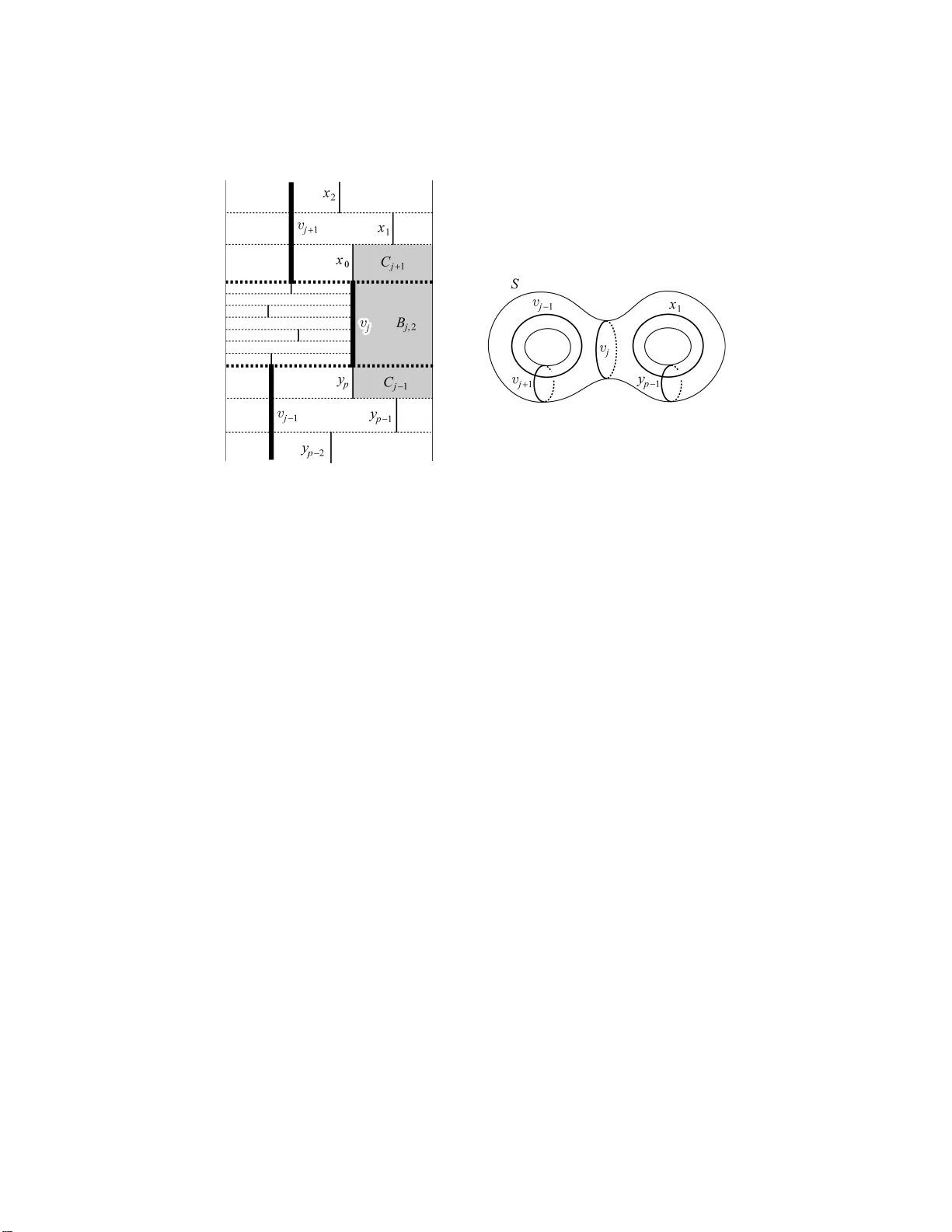
GEOMETRIC APPR O A CH TO ENDING LAMINA TION CONJECTURE TERUHIK O SOMA Abstract. W e present a new pro of of the bi-Lipschitz model theorem, which occupies t he main part of the Ending Lamination Conjecture prov ed by Minsky [Mi2] and Brock, Canary and Minsky [BCM]. Our proof is done b y using tec hniques of standard hyperb olic geometry as muc h as p ossible. In [Th2], Thurston conjectured t hat any open hyperb olic 3-manifold N with finitely generated fundamental g roup is deter mined up to isometry by its end inv a ri- ants. In the case that π 1 ( N ) is a surface g roup, the conjecture is prov ed by Minsky [Mi2] and Br o ck, Canary and Minsk y [BCM]. They a lso announced in [BCM] that the conjecture holds for all hyperb olic 3- manifolds N with π 1 ( N ) finitely gener ated. In this pap er, we concentrate o n the previous case that π 1 ( N ) is isomorphic to the fundamen tal g roup of a compact surface S . The origina l pro of of the Ending Lamination C o njecture deeply dep ends on the theory of the curve complex dev el- op ed by Masur and Minsky [MM1, MM2]. Our aim here is to replace some of such arguments (esp ecially those concerning hiera r c hies) by a rguments o f standa rd hyperb olic g eometry . In [Mi2], Minsky cons tructed the Lips c hitz mo del manifold by using hiera rchies in the following steps: (1) the definition of hier archies, (2) the pro of of the existence of a hierarch y H ν asso ciated to the end inv ar ian ts ν of a given hyperb olic 3-manifold, (3) the definition of slices of H ν , (4) the pr oo f of the ex is tence o f a resolution containing thes e slices, (5) the construc tio n of the mo del manifold M ν from the resolution which is r ealizable in S × R . In Sec tio n 2, we define a hierarchy directly as an ob ject in S × R , so the steps (1)-(5) as ab ove a re acco mplis hed at once. Lemma 2.2 is a g eometric version of an assertion of Theo rem 4.7 (Structure of Sigma) in [MM2], w hich plays an imp ortant role in our geo metric pro of of the bi-Lipschitz mo del theo rem. Section 3 re views Minsky’s definition of the piece w is e Riemannian metric on the mo del manifold. In the pro of of the Lips c hitz mo del theorem in [Mi2, Section 1 0], the hyperb olicity of the curve g raph C ( S ) is crucial. This hyper bolic ity is prov ed by [MM1] (see also [Bow1 ]). The pro of of this theo r em also needs tw o key lemmas. One of them (Lemma 7.9 in [Mi2]) is called the Length Upp er Bounds Lemma, which shows that vertices o f tight geo desics in C ( S ) asso ciated to the end inv ariants of N are realized b y geo desic loo ps in N o f length less than a uniform constant. Bowditc h [Bow2 ] gives an alternative pro o f of this lemma by us ing mor e hyperb olic g eometric techn iques compared with Minsky’s origina l pro o f. Soma [So] also gives a pro of 2000 Mathematics Subje ct Classific ation. Pr imary 57M50; Secondary 30F40. Key wor ds and phr ases. Hyperb olic 3- manifolds, Ending Lamination Conjecture, curve graphs. The third version (Septem ber 18, 2021). 1 2 TER UHIKO S O M A based on arg umen ts in [Bow2]. The pro of in [So] skips r ather harder discussions in [Bow2 , Sections 6 and 7] by fully relying on g eometric limit a rguments. The other key lemma (Lemma 1 0.1 in [Mi2]) shows that any vertical s olid torus in the mo del manifold of N with large meridian co efficient c orresp onds to a Marugulis tube in N with sufficiently sho rt geo desic core. The original pr o of of this lemma is based on the ing enious estimatio ns o f meridia n co efficients in [Mi2, Section 9]. In Section 4, we will g ive a shor ter geometric pro of o f it. Section 5 is the main part o f this pap er, where the bi-Lipschitz mo del theorem is pr o ved b y arguments of ourselves. Alternate approaches to the Ending Lamination Conjecture are given by [Bow3, BBES, Re]. In [Bow3], Bowditch pr ov ed the sesqui-Lipschitz mo del theo rem with- out using hier archies. Though the asser tion of Bowditc h’s theorem is slightly weak er than that of the bi-Lipschitz mo del theorem, it is sufficien t to prove the Ending Lamination Conjecture. Ideas in this pa p er are muc h inspir ed from the philosophy of [Bow3]. 1. Preliminaries W e refer to Thurston [Th1], Benedetti a nd Petronio [BP], Ma tsuzaki and T aniguchi [MT], Mar den [Ma] for details on hyperb olic geometry , and to Hemp el [He] for those on 3-manifold to polo gy . Throughout this pap er, all sur faces and 3-ma nifolds are assumed to b e oriented. 1.1. The curv e graph and ti gh t g eo desics. Her e we re view some fundamental definitions a nd r esults on the curve gr a ph. Let F be a connected (p ossibly clos ed) surface which has a hyperb olic metr ic of finite a rea such that ea c h comp onent of ∂ F is a geo desic loop. The complexit y of F is defined b y ξ ( F ) = 3 g + p − 3, wher e g is the ge nus of F and p is the num b e r of b oundary comp onents and punctures of F . When ξ ( F ) ≥ 2 , we define the curve gr aph C ( F ) of F to b e the simplicia l gra ph whose vertices are homotopy cla sses of non-contractible and non-p eripher al simple closed c ur ves in F and whose edges ar e pairs of distinct vertices with disjo in t representatives. W e simply c a ll a vertex of C ( F ) or any representative of the cla ss a curve in F . F or our conv enience, we take a uniquely determined geo desic in F as a representativ e for any curve in F . The notion of curve graphs is introduced by Harvey [Har] and extended and mo dified versions a re s tudied by [MM1, MM2, Mi1]. In the case that ξ ( F ) = 1 , the curve graph C ( F ) is the 1-dimensional simplicial complex such tha t the vertices ar e curves in F and that tw o curves v , w form the end p oints of an edge if a nd o nly if they hav e the minimum geometr ic int erse ction nu mber i ( v , w ), that is, i ( v , w ) = 1 when F is a o ne-holed torus and i ( v , w ) = 2 when F is a four -holed sphere. In either case, C ( F ) is supp osed to have a n arcwise metric such that each edg e is isometric to the unit interv al [0 , 1 ]. T he graph C ( F ) is not loca lly finite but is proved to be δ -h yp erb olic by Masur and Minsky [MM1] (see als o Bowditch [Bow1]) for some δ > 0. The set of vertices in C ( F ) is deno ted by C 0 ( F ). W e say that the unio n of k + 1 elements of C 0 ( F ) with mutually disjoint representatives is a k -simplex in C 0 ( F ). Let ML ( F ) b e the space of compact measur e d laminations on Int F a nd U ML ( F ) the quotient space of ML ( F ) obtained by forge tting the mea sures, and let E L ( F ) be the subspace o f U ML ( F ) consisting of filling laminations µ . Here µ b eing fi l ling means that, for any µ ′ ∈ U M L ( F ), either µ ′ = µ or µ ′ int ersec ts µ non-tr ivially ENDING LAMINA TION CONJECTURE 3 and transversely . Acco rding to Kla rreich [Kla] (see also Hamenst¨ adt [Ham]), there exists a homeomo rphism k from the Gromov b oundar y ∂ C ( F ) to E L ( F ) which is defined so that a sequence { v i } in C 0 ( F ) conv erges to β ∈ ∂ C ( F ) if and only if it conv erges to k ( β ) in U ML ( F ). Definition 1.1. A sequence { v i } i ∈ I of simplices in C 0 ( F ) is called a t ight se quenc e if it satisfies one of the following c o nditions, whe r e I is a finite or infinite interv al of Z . (i) When ξ ( F ) > 1, for any vertices w i of v i and w j of v j with i 6 = j , d C ( F ) ( w i , w j ) = | i − j | . Moreover, if { i − 1 , i, i + 1 } ⊂ I , then v i is represented by the unio n of comp onent s of ∂ F i +1 i − 1 which are non-p eriphera l in F , where F i +1 i − 1 is the min- im um subsurface in F with g eo desic b oundary a nd containing the geo desic representatives of all vertices of v i − 1 and v i +1 . (ii) When ξ ( F ) = 1, { v i } is just a geo desic sequence in C 0 ( F ). W e re g ard that a single vertex is a tight sequence o f le ng th 0. The definition implies that, for a n y tight sequence { v i } , if a vertex w of C ( F ) meets v i transversely , then w meets at least one of v i − 1 and v i +1 transversely . The following theo rem is Lemma 5.14 in [Mi2] (see also Theorem 1.2 in [Bow2]), which is crucial in the pro of of the Ending Lamination Conjecture. Theorem 1.2. L et u, w b e distinct p oints of C 0 ( F ) ∪ E L ( F ) , ther e exists a tight se quen c e c onne cting u with w . Let i , t b e unions of m utually disjoint cur v es in F and laminations in U ML ( F ). Then a tight sequence g = { v i } i ∈ I in F is sa id to b e a tight ge o desic with the initial marking i ( g ) = i a nd the terminal marking t ( g ) = t if it satisfies the follo wing conditions. • If i 0 = inf I > −∞ , then v i 0 is a curve comp onen t o f i , other wise i consis ts of a s ingle lamina tion comp onent and i = lim i →−∞ v i ∈ E L ( F ). • If j 0 = s up I < ∞ , then v j 0 is a curve co mponent of t , otherwise t co nsists of a s ingle lamina tion comp onent and t = lim j →∞ v j ∈ E L ( F ). Our r ule in the definition is that, whenever an end of a tigh t g eo desic is chosen, curve compo nen ts hav e prio rit y over lamination co mponents if any . 1.2. Se tting on h yp erb oli c 3-m anifolds. Throughout this pap er, we suppo se that S is a compact connected surface (pos sibly ∂ S = ∅ ) with χ ( S ) < 0 a nd ρ : π 1 ( S ) − → PSL 2 ( C ) is a faithful discr ete repr esent ation which maps a n y element of π 1 ( S ) r e presented by a co mp onent of ∂ S to a para b olic element. F or conv enience, we fix a complete hyperb olic sur face b S containing S a s a compact core and such that ea c h comp onent P of b S \ S is a par ab olic cus p with length( ∂ P ) = ε 1 . W e denote the quotient hyperb olic 3-manifold H 3 /ρ ( π 1 ( S )) by N ρ (or N for short). By B onahon [Bo], N is homeomor phic to b S × R . Fix a 3 -dimensional Ma r gulis constant ε 0 > 0 . F or a n y 0 < ε < ε 0 , the (op en) ε -thin and (closed) ε -thick pa rts of N are denoted b y N (0 ,ε ) and N [ ε, ∞ ) resp ectively . It is well known that there exists a constant ε 1 > 0 dep ending only on ε and the to polo gical type of S such that, for any pleated map f : b S − → N , the image f ( b S ( σ f ) [ ε 0 , ∞ ) ) is disjoint fr o m N (0 ,ε 1 ) , where σ f is the hyperb olic structure on b S induced fro m that on N via f . If necessa ry retak ing ε 1 > 0, we may as sume that each simple clo sed ge o desic in b S 4 TER UHIKO S O M A is co n tained in S . The augmente d c or e b C ρ of N is defined by b C ρ = C 1 ρ ∪ N (0 ,ε 0 ] , where C 1 ρ is the closed 1-neig h b orho o d of the con vex core of N and N (0 ,ε ] is the closure of N (0 ,ε ) in N . The complemen t N \ Int b C ρ is denoted by E N , which is considered to b e a neighbor ho od of the union o f geo metr ically finite rela tiv e ends of N . The or ie n tations of S , N and a prop er ho motopy equiv alence f : b S − → N with π 1 ( f ) = ρ determines the (+) and ( − )-side ends o f N . Le t q + = l 1 ∪ · · · ∪ l n be the disjo int union of simple closed geo desic s in S corre s ponding to the para bo lic cusps in the (+)-side end and let G F + (resp. S D + ) b e the set o f co mp onents of b S \ q + corres p onding to geometrica lly finite (resp. simply degene r ate) r elative ends in the (+)-side. F o r a n y F i ∈ G F + (resp. F j ∈ S D + ), let σ i ∈ T e ich( F i ) (resp. λ j ∈ E L ( F i )) b e the conformal s tructure on F i at infinity (r esp. the ending lamination on F i ), see [Th1 , Bo] for deta ils on ending la minations. The family ν + = { σ i , λ j } is called the (+)-side end invariant set of N . The ( − )-side end inv ar ia n t set ν − is defined similarly . The pair ν = ( ν − , ν + ) is the end invariant set of N . It is well known that ther e exis ts a constant L > 0 dep ending only on the top ological type of S such that, for any σ i ∈ ν + with F i ∈ G F + , there exis ts a pants decomp osition r i = s 1 ∪ · · · ∪ s m on F i such that l σ i ( s k ) < L , w he r e l σ i ( s k ) is the leng th o f the geo desic in F ( σ i ) homotopic to s k . Then the union (1.1) p + = q + ∪ [ F i ∈G F + r i ∪ [ F j ∈S D + λ j is called a gener alize d p ants de c omp osition o n b S asso ciated to ν + . A gener alize d p ants de c omp osition p − on b S asso cia ted to ν − is defined simila rly . 1.3. Annulus union and brick s. W e suppo se that b R = {− ∞} ∪ R ∪ {∞} is the t wo-po in t compactifica tion of R . So b R is homeomorphic to a closed interv al in R . F or a n y subset P of b S × b R , the image of P by the o rthogonal pro jection to b S (resp. b R ) is denoted by P S (resp. P R ), that is, P S = { x ∈ b S ; ( x, t ) ∈ P for some t ∈ b R } and P R = { t ∈ b R ; ( x, t ) ∈ P for some x ∈ b S } . F or a n y non-p eripheral simple geo desic lo op l in b S a nd any clo sed interv al J o f b R , A = l × J is called a vertic al annulus in S × b R . F or a connected op en subsurface F of b S with F r( F ) geo desic, the pr o duct B = F × J is called a brick in b S × b R , where F r( F ) denotes the frontier F ∩ ( b S \ F ) of F in b S . Set ∂ vt B = F r( F ) × J , ∂ − B = F × { inf J } , ∂ + B = F × { sup J } (po ssibly inf J = −∞ or s up J = ∞ ) and ∂ hz B = ∂ − B ∪ ∂ + B . The surface ∂ + B (resp. ∂ − B ) is calle d the p ositive (resp. n e gative ) fr ont of B . W e sa y that a union A of mutually disjoint vertical annuli in b S × b R which ar e lo cally finite in b S × R is an annulus u nion . A horizontal surfac e F of ( b S × b R , A ) is a connected comp onent of b S × { a } \ A for some a ∈ b R . In particular, F r ( F ) ⊂ A and F S is an op en subsurface o f b S . A horizo n tal surface F is critic al with r esp e ct to A if at lea st one comp onent of F r( F ) is an edge of some comp onen t of A . Let B b e the s et of bricks in b S × b R which ar e maximal among bricks B with Int B ∩ A = ∅ and ∂ vt B ⊂ A , see Fig. 1.1 (a). Note that, for any B ∈ B , B ∩ A is a disjoint union (p ossibly empt y) of simple geo desic lo ops in ∂ hz B . This fact is imp ortant in the definition of ENDING LAMINA TION CONJECTURE 5 hierarchies in Section 2. Ea c h comp onent of ∂ hz B \ A is a critica l ho rizontal sur fa ce of ( b S × b R , A ). Figure 1.1. (a) The union o f v ertica l segments is A . (b) The shaded regio n represents W . F or a v ertical annulus A = l × J , U = Int ( L × J ) is ca lled a vertic al solid torus (for short v.s.-torus ) with the ge o desic c or e A , where L be an equidistant regular neighborho o d of l in S . Then L × J is the closure U of U in S × b R . W e set ∂ U = ∂ U for simplicity . A simple lo op in ∂ U is a longitude of U if it is isoto pic in ∂ U to a comp onent of ∂ A . A meridian o f ∂ U is a simple lo op in ∂ U which is non-contractible in ∂ U but contractible in U . F or a ny annulus union A in b S × b R , there exists a disjoint unio n V of v.s.-to ri the union of whose geo desic co res is equal to A . Then V is called a v.s.-torus union with the geodes ic co r e A . In general, the union V • of the closures of comp onent s of V is not equal to the closur e V o f V in S × b R . A horizontal surfac e of ( S × b R , V ) is a compact co nnec ted s urface F in S × { a } for some a ∈ b R with Int F ∩ V • = ∅ and ∂ F ⊂ V • . The horizontal surface is critic al if it is contained in a cr itical horizontal surface of ( b S × R , A ). F or any B ∈ B , the closure B o f B \ V • in S × b R is a brick of ( S × b R , V ). No te that B is a co mpact subset of S × b R . The brick de c omp osition B of ( S × b R , V ) is the set of bricks of ( S × b R , V ). Then the union W = S B satisfies S × R \ V ⊂ W ⊂ S × b R \ V , see Fig . 1 .1 (b). When B ∈ B is contained in B ∈ B , set ∂ hz B = ∂ hz B ∩ B , ∂ ± B = ∂ ± B ∩ B a nd le t ∂ vt B b e the closure of ∂ B \ ∂ hz B in ∂ B . 1.4. Ge ometric limi ts and b ounde d geom etry . W e say that a sequence { ( N n , x n ) } of hyperb olic 3- manifolds with ba se p oin ts conv erges ge ometric al ly to a hyperb olic 3-manifold ( N ∞ , x ∞ ) with ba se p oint if ther e exist monoto ne decreasing and in- creasing sequences { K n } , { R n } with lim n →∞ K n = 1, lim n →∞ R n = ∞ and K n - bi-Lipschitz maps g n : N R n ( x n , N n ) − → N R n ( x ∞ , N ∞ ) , 6 TER UHIKO S O M A where N R ( x, N ) denotes the c losed R -neighbo r ho o d of x in N . It is w ell known that, if inf { inj N n ( x n ) } > 0, then { ( N n , x n ) } has a g eometrically conv ergent subse - quence, for example see [JM, BP]. If we take a Mar gulis co ns tan t ε > 0 sufficiently small, then one can c ho ose the bi-Lipschitz maps s o that g n ( N R n ( x n , N n ) [ ε, ∞ ) ) = N R n ( x ∞ , N ∞ ) [ ε, ∞ ) , where N R ( x, N ) [ ε, ∞ ) = N R ( x, N ) ∩ N [ ε, ∞ ) . In gener al, the top olog ical type o f the limit manifo ld N ∞ is very complica ted, fo r example see [OS]. In spite of the fact, b y o bserving situations in g eometric limits, we often k now the existence of useful uniform constants. W e will g iv e here t ypical examples. Example 1.3. L e t F be a co nnected co mpact sur face and N a hyper b olic 3- manifolds as in Subsection 1.2. Suppo se that T eich ε ( F ) is the T e ic hm ¨ uller spa ce such that, for any σ ∈ T eich( F ), F ( σ ) represents a hyperb olic s tructure o n F ea c h bo undary co mp onent of which is a geo desic lo op of length ε . Let f i : F ( σ i ) − → N [ ε, ∞ ) ( i = 0 , 1 ) be K - Lipsch itz maps prop erly homo to pic to ea c h other in N [ ε, ∞ ) , where K ≥ 1 and σ i ∈ T eich ε ( F ) ( i = 0 , 1). F or the homotopy H : F × [0 , 1] − → N [ ε, ∞ ) and a p o in t x ∈ F , the image H ( { x } × [0 , 1 ]) is said to b e a homotopy ar c co nnecting f 0 ( F ) and f 1 ( F ). Her e we will show by invoking a geometric limit argument that ther e exists a co nstan t d 0 > 0 dep ending only on ε , d 1 , K and the top ological type o f S such that, if there exists a ho motopy arc connec ting f 0 ( F ) with f 1 ( F ) of length a t most d 1 , then dist T eich ε ( F ) ( σ 0 , σ 1 ) < d 0 . Suppo se contrarily that ther e would exis t a sequence of pairs of homotopy equiv- alence K -Lipsc hitz maps f i,n : F ( σ i,n ) − → N n [ ε, ∞ ) with homoto p y arcs α n connect- ing f 0 ,n ( F ) with f 1 ,n ( F ) of length ≤ d 1 and dist T eich ε ( F ) ( σ 0 ,n , σ 1 ,n ) ≥ n , where N n are hyper b olic 3 -manifolds as in Subsection 1 .2. Since the ε/K -thin par t of F ( σ i,n ) is empty , there exis ts a K ′ -bi-Lipschitz map γ i,n : F ( σ 0 ) − → F ( σ i,n ) for some fixed σ 0 ∈ T eich ε ( F ), wher e K ′ is a constant depending only o n ε , K and S . W e note that γ i,n do es not necessarily pres erve the mar king on F . Let Q n be the unio n of bo unded c o mponents o f N n [ ε, ∞ ) \ f 0 ,n ( F ) ∪ f 1 ,n ( F ) and R n a small regula r neighbor- ho o d of f 0 ,n ( F ) ∪ f 1 ,n ( F ) in N n [ ε, ∞ ) . Then J n = R n ∪ Q n is a compact c o nnected subset of N n [ ε, ∞ ) . By [FHS], we kno w that f 0 ,n is pro p erly ho motopic to f 1 ,n in J n . If we take a base p oint x n of N n in J n , then { ( N n , x n ) } has a subsequence, still denoted by { N n } , con verges geo metrically to a h yp erb olic 3-manifold ( N ∞ , x ∞ ). Thu s we hav e K n -bi-Lipschitz maps g n : N R n ( x n , N n ) − → N R n ( x ∞ , N ∞ ) as a bove. F or a n y po in t y ∈ J n with dist N n [ ε, ∞ ) ( y , f 0 ,n ( F ) ∪ f 1 ,n ( F )) > 1, we have a pleated map g : b S − → N n such that there exists a comp onent L of g ( b S ) ∩ N n [ ε, ∞ ) meeting the 1-neighborho o d of x in N n [ ε, ∞ ) . It is not ha rd to see that L meets f 0 ,n ( F ) ∪ α n ∪ f 1 ,n ( F ) non-triv ially and the diameter of L is b ounded b y a co nstan t depe nding only on ε , S . Th us the diameter of J n is less than a c onstant R > 0 depe nding only on ε, d 1 , K, S and hence J n is contained in N R n ( x n , N n ) [ ε, ∞ ) for a ll sufficiently large n . By the Ascoli-Arz el` a Theorem, if necess a rily passing to subsequences, one can show that ψ i,n = g n ◦ f i,n ◦ γ i,n : F ( σ 0 ) − → N ∞ [ ε, ∞ ) ( i = 0 , 1) co n verge uniformly to K K ′ -Lipschitz maps ϕ i : F ( σ 0 ) − → N ∞ [ ε, ∞ ) . Since ψ i,n ( i = 0 , 1 ) is prop erly homotopic to ϕ i for all sufficien tly large n and f 0 ,n ◦ γ 0 ,n is pr ope r ly ho motopic to f 1 ,n ◦ γ 1 ,n in J n up to marking, there exists a diffeomorphism (hence a K ′′ -bi- Lipschitz map for some K ′′ ≥ 1) α : F ( σ 0 ) − → F ( σ 0 ) suc h that ϕ 0 is pr ope r ly homotopic to ϕ 1 ◦ α in a small compact neighborho o d of g n ( J n ) in N ∞ [ ε, ∞ ) . This implies that, for any no n-contractible simple clo sed cur v e l in F , γ 0 ,n ( l ) is homotopic ENDING LAMINA TION CONJECTURE 7 to γ 1 ,n ◦ α ( l ) in F . Thu s γ 1 ,n ◦ α ◦ γ − 1 0 ,n : F ( σ 0 ,n ) − → F ( σ 1 ,n ) is a marking- preserving K ′ 2 K ′′ -bi-Lipschitz map for all sufficien tly large n , which contradicts that dist T eich ε ( F ) ( σ 0 ,n , σ 1 ,n ) ≥ n . This shows that the ex istence of our desire d uniform co nstant d 0 . Example 1.4. W e work in the situation a s in the previous e x ample and supp ose moreov er that there exists a constant d 2 > 0 with dist N n [ ε, ∞ ) ( f 0 ,n ( F ) , f 1 ,n ( F )) ≥ d 2 for all n and ea c h f i,n is prop erly ho motopic in N n [ ε, ∞ ) to an embedding. By [FHS], one can supp ose tha t such an embedding is c on tained in a n arbitra rily s mall regular neighborho o d of f i,n ( F ) in N n [ ε, ∞ ) and the image of the homotopy is in J n given as ab ov e. Then ϕ i : F − → N ∞ [ ε, ∞ ) ( i = 0 , 1) are als o ho motopic to em b eddings ϕ ′ i contained in an arbitr a rily s ma ll regula r neighbo rho o d of ϕ i ( F ) in N ∞ [ ε, ∞ ) and the image of the homotopy is in g n ( J n ) for a sufficiently la rge n . By the standard theo ry of 3- manifold top ology (for example see [W a, He]), the union ϕ ′ 0 ( F ) ∪ ϕ ′ 1 ( F ) bo unds a submanifold B o f N ∞ [ ε, ∞ ) contained in g n ( J n ) a nd ho meo morphic to F × [0 , 1]. Then, fo r all sufficiently la rge n , B n = g − 1 n ( B ) is the submanifold of N n [ ε, ∞ ) such that F r( B n ) consists of tw o comp onen ts F i,n ( i = 0 , 1) prop erly homotopic to f i,n ( F ) in J n . Since the comp osition g − 1 m ◦ g n | B n defines a marking-pr eserving K m K n -bi-Lipschitz map from B n to B m and since lim m,n →∞ K m K n = 1 , we know that B n ’s hav e the geometry unifor mly b ounded b y constants dep ending only on ε, d 1 , d 2 and the top olog ical type of S . Remark 1.5. Deform the metric on N n [ ε, ∞ ) in a small collar neighborho o d of ∂ N n [ ε, ∞ ) so that ∂ N n [ ε, ∞ ) is lo cally conv ex but the se c tional cur v ature of N n [ ε, ∞ ) is still pinched. W e here conside r the case that f i,n : F ( σ i ) − → N n [ ε, ∞ ) ( i = 0 , 1) are embeddings which hav e the lea st ar ea among all maps homotopic to f i,n without moving f i,n | ∂ F ( σ i ) and such that Area( F ( σ i )) is b ounded by a constant indep endent of n . Then the limits ϕ i : F − → N ∞ [ ε, ∞ ) are least ar e a maps (see [HS, Lemma 3.3]), and hence by [FHS] they a re also embeddings. Thus, in Ex a mple 1.4, one can suppo se that ϕ ′ i = ϕ i and hence the fro n tier of the ma nifo ld B is ϕ 0 ( F ) ∪ ϕ 1 ( F ). 2. Three-dimensional appr oa ch to hierarchies W e s tudy hier archies in the curve graph C ( S ) intro duced by [MM2]. W e realize them as families of annulus unio ns in b S × b R , the o riginal idea of which is due to [Bow3 , Section 4]. 2.1. H ierarc hi es. Let p ν = ( p − , p + ) be the pair of g e neralized pant s decomp osi- tions on b S given in Subsection 1 .2. W e denote b y B 0 and b B 0 the single element set { b S × b R } . Consider a tight geo desic g 0 = { v i } i ∈ I with i ( g 0 ) = p − and t ( g 0 ) = p + , where I is an interv al in Z . In this section, we always assume that, for any disjoint union v o f simple g eo de s ic lo op l 1 , . . . , l k in b S , A ( v ) repres en ts a union of vertical annuli A i ( i = 1 , . . . , k ) in b S × b R with A S i = l i and A R i = A R j for all i , j ∈ { 1 , . . . , k } . Thu s A ( v ) is determined uniquely from v and A ( v ) R . Suppo se that ξ ( S ) > 1 and p − , p + are in b S × {−∞} and b S × {∞} r espec tiv ely . When i ∈ I is no t either inf ( I ) o r sup( I ), A ( v i ) is defined to b e the union o f vertical annuli in b S × R with A ( v i ) R = [ i , i + 1 ]. When i = s up I < ∞ (resp. i = inf I > − ∞ ), let A ( v i ) R = [ i, ∞ ] (resp. A ( v i ) R = [ −∞ , i + 1 ]). W e say that A ( g 0 ) = S n i =0 A ( v i ) is the annulus union determined from the tight geo desic g 0 . 8 TER UHIKO S O M A Let B 1 be the brick decomp osition of ( b S × b R , A ( g 0 )). An element B ∈ B 1 is said to b e c onne ctable if b oth ∂ ± B ∩ A 0 are not empty , where A 0 = A ( g 0 ) ∪ p − ∪ p + . Let b B 1 be the subset of B 1 consisting of connecta ble bricks B w ith ξ ( B ) > 1, where ξ ( B ) = ξ ( B S ). If ξ max ( B 1 ) = max { ξ ( B ); B ∈ B 1 } > 1, then any B ∈ B 1 with ξ ( B ) = ξ max ( B 1 ) is an ele men t of b B 1 . F or a n y B ∈ b B 1 , consider a tig h t geo desic g B in B S with i ( g B ) = ( ∂ − B ∩ A 0 ) S and t ( g B ) = ( ∂ + B ∩ A 0 ) S . One can define the annulus union A B of vertical ann uli in B determined from g B as ab ov e. In particula r, A B consists of vertical annuli with the s ame width unless the length of g B is finite a nd B R ∩ {−∞ , ∞} 6 = ∅ . Note that A B is a single a nn ulus when the initia l vertex of g B is equal to the terminal vertex of g B . Set A 1 = A 0 ∪ S B ∈ b B 1 A B , i ( A B ) = ∂ − B ∩ A 0 and t ( A B ) = ∂ + B ∩ A 0 . Repe a ting the same argument at most ξ ( S ) − 1 times, say k times, one can show that each elemen t B of the set B k of bricks of ( b S × b R , A k − 1 ) ha s ξ ( B ) = 1. Since ξ max ( B k ) = 1, each B ∈ B k is connectable. W e set then B k = b B k . Let g B = { w i } b e a tight geo desic in B S with i ( g B ) = ( ∂ − B ∩ A k − 1 ) S and t ( g B ) = ( ∂ + B ∩ A k − 1 ) S . Since w i ∩ w i +1 6 = ∅ , w e need to add a buffer brick betw een A ( w i ) and A ( w i +1 ) to make them mutually dis join t. Suppose that B R = [ a, b ]. If a 6 = −∞ a nd b 6 = ∞ a nd g B = ( w 0 , w 1 , . . . , w m ), then A ( w i ) R = [ a + 2 iτ , a + (2 i + 1) τ ] for i = 0 , 1 , . . . , m , where τ = ( b − a ) / (2 m + 1). Note that B S × [ a + (2 i + 1) τ , a + (2 i + 2) τ ] is the buffer brick b et ween A ( w i ) a nd A ( w i +1 ). If a 6 = −∞ and b = ∞ and g B = ( w 0 , w 1 , . . . , w m ), then A ( w i ) R = [ a + 2 i , a + 2 i + 1 ] for i = 0 , 1 , . . . , m − 1 and A ( w m ) R = [ a + 2 m, ∞ ]. If a 6 = −∞ and b = ∞ and g B = ( w 0 , w 1 , . . . ), then A ( w i ) R = [ a + 2 i, a + 2 i + 1] for all i . In the ca se that a = −∞ , A ( w i ) for w i ∈ g B is defined similar ly . As ab ove, let A B = S w i ∈ g B A ( w i ), i ( A B ) = ∂ − B ∩ A k − 1 and t ( A B ) = ∂ + B ∩ A k − 1 . When B ∈ b B j , we say that the level of B is j and denote it by level( B ). The set H ν of all tig h t g eo des ics app eared in this cons truction is called a hier ar chy asso ciated to the pair p ν = ( p − , p + ) of generalized pants decomp o sitions a nd A H ν = A k − 1 ∪ [ B ∈B k A B is the annu lus u nion determined by H ν . Note that the set H ν is not nec essarily defined from p ν uniquely . F or any B ∈ b B j , a maximal brick C in B with Int C ∩ A B = ∅ and ∂ vt C ⊂ A B is called a su bbrick of B . F r om our cons truction, for any B ∈ b B j with 0 < j ≤ k , there exists either a brick B ′ ∈ B j − 1 with ∂ + B ′ = ∂ + B or a subbrick C o f some ele ment of b B j − 1 with ∂ + C = ∂ + B . In the for mer ca s e, B ′ is not in b B j − 1 , otherw is e B would be split by A B ′ ⊂ A j − 1 . Repeating the s a me arg umen t, we hav e even tually a br ick B 0 ∈ b B j 0 for some j 0 < j which co n tains a subbrick C with ∂ + C = ∂ + B . Then we say that B is dir e ctly forwar d sub or dinate to B 0 and denote it by B ց d B 0 . The dir e ctly b ackwar d sub or dinate B 0 d ւ B is defined similarly , see Fig. 2.1. It is p ossible that B is directly forward and backw ard to the same brick B 0 , i.e. B 0 d ւ B ց d B 0 . Since only hor izont al surfaces o f ( b S × b R , A i ) contained in Int B for some B ∈ b B i +1 are split by A i +1 , any c r itical hor iz on tal surfa ce of ( b S × b R , A i ) is still a (possibly non-critical) horiz o n tal surface of ( b S × b R , A i +1 ). The relatio n B ց d B 0 for B ∈ b B j and B 0 ∈ b B j 0 implies that, fo r a n y i with j 0 < i ≤ j , ∂ + B is the pos itiv e fro n t of ENDING LAMINA TION CONJECTURE 9 Figure 2.1. Let g 0 = ( . . . , v j − 1 , v j , v j +1 , . . . ) be a tight geo desic in the c lo sed s urface S of genus 2. Let B a ∈ b B 1 ( a = j ± 1 ) be the element with ∂ vt B a = A ( v a ). Let B j, 1 , B j, 2 be the elements of B 1 whose v ertical boundar ies ar e A ( v j ) and such that B j, 1 is connectable but B j, 2 is not. ( v j = x 0 , x 1 , x 2 , . . . ) is a tight geo desic in B S j +1 and ( . . . , y p − 1 , y p − 1 , y p = v j ) is a tight geo desic in B S j − 1 . The shaded region represents an elemen t B = C j − 1 ∪ B j, 2 ∪ C j +1 of b B 2 with B j − 1 d ւ B ց d B j +1 . In fact, we hav e ∂ + B = ∂ + C j +1 and ∂ − B = ∂ − C j − 1 , where C a ( a = j ± 1) is the subbrick of B a as illustrated in the figure. some element B i of B i . Since G = ∂ + B \ A j 0 is a union o f cr itical ho r izontal surfaces of ( b S × b R , A j 0 ), each comp onent F of G is a hor izontal surface of ( b S × b R , A j 0 +1 ). Since moreov er F ⊂ ∂ + B j 0 +2 , F is critical with resp ect to A j 0 +1 . Rep eating the same ar gumen t, one can show that F is a critical hor izont al surface of ( b S × b R , A j − 1 ). It follows tha t G = ∂ + B \ A j − 1 = ∂ + B \ t ( A B ) and hence t ( A B ) = ∂ + B ∩ A j 0 . 2.2. Si ngle bric k o ccupation. Let A 0 , . . . , A k − 1 , A H ν be the a nnulus unions a nd B 0 , . . . , B k the brick decomp ositions given in Subsectio n 2 .1. Lemma 2.1. Any two c omp onent s of A H ν ar e not p ar al lel in S × R . Pr o of. Supp ose that A H ν contains distinct m utually parallel comp onents A, A ′ . When more than one elements are parallel to A , w e may ass ume that A ′ is clo sest to A among them a nd max A R < min A ′ R . Let B (resp. B ′ ) b e the elemen t of b B k with ∂ + A ⊂ Int B (resp. ∂ − A ′ ⊂ Int B ′ ). Since any tw o co mponents of A B are not m utually parallel, Int B ∩ Int B ′ is empty . Consider a pair o f t wo directly sub o rdinate s equences (2.1) B 0 ց d B 1 ց d · · · ց d B m +1 , B ′ n +1 d ւ · · · d ւ B ′ 1 d ւ B ′ 0 satisfying the following c o nditions. (i) B 0 = B , B ′ 0 = B ′ , and Int B i ∩ Int B ′ j = ∅ for any 0 ≤ i ≤ m and 0 ≤ j ≤ n . 10 TER UHIKO S O M A (ii) The pa ir (2.1) has the minimum max { level( B m +1 ) , level( B ′ n +1 ) } among all pairs o f sub or dina te sequences satisfying the condition (i). Note that any B i and B ′ j meet the vertical ann ulus A 0 with ∂ − A 0 = ∂ − A and ∂ + A 0 = ∂ + A ′ non-trivially . First, we will show that B m +1 = B ′ n +1 . F or the symmetricity , w e may ass ume that level ( B m +1 ) ≤ level( B ′ n +1 ). T ake the en try B i in the the dire ctly forw ard sub o rdinate s equence with level ( B i +1 ) ≤ level( B ′ n +1 ) < level( B i ) . Then there e x ists a n element of D ∈ B a with D \ ∂ − D ⊃ ∂ + B i , where a = level ( B ′ n +1 ). Then, in pa rticular, ( ∂ + B i ) R ≤ ( ∂ + D ) R . Supp ose that D 6 = B ′ n +1 . Since A p enetrates b oth D and B ′ n +1 , this implies ( ∂ + D ) R ≤ ( ∂ − B ′ n +1 ) R . If D ∈ b B a , then B i ց d D and hence D = B i +1 . Since then Int B i +1 ∩ Int B ′ n +1 = ∅ , B 0 ց d B 1 ց d · · · ց d B i +1 ց d B i +2 , B ′ n +2 d ւ · · · d ւ B ′ 1 d ւ B ′ 0 is a sequence satisfying the conditio n (i) and ma x { level ( B i +2 ) , level ( B ′ n +2 ) } < a . If D ∈ B a \ b B a , then D 6 = B i +1 and hence le vel( B i +1 ) < a . Thus B 0 ց d B 1 ց d · · · ց d B i +1 , B ′ n +2 d ւ · · · d ւ B ′ 1 d ւ B ′ 0 is a sequence satisfying the co ndition (i) a nd max { level( B i +1 ) , level ( B ′ n +2 ) } < a . In either c ase, this contradicts the minimality co ndition (ii). It follows tha t D = B ′ n +1 . Since this implies D ∈ b B a , B i +1 = D . Thus we hav e i = m a nd B m +1 = B ′ n +1 = D . F or short, set D S = F , A S 0 = l , v = F r( ∂ + B m ), w = F r( ∂ − B ′ n ) and let t m be the compo nen t of t ( A B m ) suc h that t S m is the terminal v ertex of g B m . Since A 0 ∩ (F r( ∂ + B m ) ∪ F r( ∂ − B ′ n )) = ∅ , d C ( F ) ( v S , w S ) ≤ d C ( F ) ( v S , l ) + d C ( F ) ( l, w S ) = 2 . Suppo se fir s t that d C ( F ) ( v S , w S ) = 2 and consider the union J o f comp onents of A ( g D ) with ( ∂ − J ) R = v R and ( ∂ + J ) R = w R , see Fig. 2.2. Since l ∩ ( v S ∩ w S ) = ∅ , Figure 2.2. The case of d C ( F ) ( v S , w S ) = 2. the tightness o f g D implies either l ⊂ J S or l ∩ J S = ∅ . How ever, the former do es not oc c ur since A and A ′ are a clos est pair. So, we hav e A 0 ∩ t m = ∅ . When ENDING LAMINA TION CONJECTURE 11 d C ( F ) ( v S , w S ) = 1 , either t m ∩ ∂ − B ′ n = ∅ or t m ⊂ w holds. This also implies A 0 ∩ t m = ∅ . Repe a ting the same ar gument fo r B m − 1 , B m − 2 , . . . , B 0 = B , one ca n s how tha t A 0 ∩ t 0 = ∅ . This contradicts tha t the sur face ∂ + B with ξ ( ∂ + B ) = 1 can not contain m utually disjoint tw o curves. Thus any tw o co mponents o f A H ν are no t parallel to each other . The following lemma is a g eometric version of the fourth assertio n of Theorem 4.7 (Structure o f Sig ma ) in [MM2]. Lemma 2.2 . Supp ose that B , B ′ ar e elements of b B a and b B b r esp e ctively. If B S = B ′ S , then B = B ′ . Pr o of. W e supp ose that B 6 = B ′ and induce a contradiction. Since any tw o elements of b B a hav e mutually disjoint interiors, if Int B ∩ Int B ′ 6 = ∅ , then a 6 = b , say a < b . The ass umption B ∈ b B a implies A B ⊂ A a ⊂ A b − 1 . Since B S = B ′ S , In t B ∩ Int B ′ 6 = ∅ implies Int B ′ ∩ A B 6 = ∅ . This contradicts the fact that Int B ′ ∩ A b − 1 ( ⊃ Int B ′ ∩ A B ) is empt y . Thus we hav e Int B ∩ Int B ′ = ∅ . Now, w e consider a sequence B = B 0 ց d B 1 ց d · · · ց d B m +1 = D = B ′ n +1 d ւ · · · d ւ B ′ 1 d ւ B ′ 0 = B ′ as in the pro o f o f Lemma 2 .1. Let E b e the br ick in b S × b R with ∂ − E = ∂ − B a nd ∂ + E = ∂ + B ′ . W e se t E S = H and H j = E ∩ ∂ + B j . Since H ⊂ ∂ + B S m ∩ ∂ − B S n − 1 , the smallest surface F ′ in F = D S with geo desic boundar y and con taining F \ Int ( ∂ + B S m ∩ ∂ − B S n − 1 ) is disjoint from Int H . Since g D is a tight geo desic in F , the terminal v ertex t S m of g B m with t m ⊂ t ( A B m ) is contained in F ′ and hence Int H m ∩ t m = ∅ . Repeating the same ar gumen t for B m − 1 , . . . , B 0 = B , one can show that In t( ∂ + B 0 ) = Int H 0 is dis jo in t fr o m t 0 . This co n tradicts that B 0 is a connectable brick with B 0 ց d B 1 . Thus we hav e B = B ′ . Let B be an element o f B i . If B is not connec ta ble, then Int B ∩ A i = ∅ . Thus there e xists a C ∈ B i +1 with C ⊃ B and C S = B S (po ssibly B = C ). Rep eating the same a rgument if C is not connectable, we hav e even tually a unique element B ∨ of b B j with j ≥ i , B ∨ ⊃ B and B ∨ S = B S , which is called the exp anding c onne ctable brick of B . F or example, C j − 1 ∪ B j, 2 ∪ C j +1 ∈ b B 2 in Fig. 2.1 is the expanding connectable brick of B j, 2 ∈ B 1 . The following lemma sugges ts that a large part o f any long er brick Q in b S × b R with ∂ vt Q ⊂ A H ν is o ccupied by a sing le brick in b B a for some a . Lemma 2.3 (Single brick o ccupation) . Ther e exist s an inte ger n 0 dep ending only on ξ ( S ) such that, for any brick Q in b S × b R with ξ ( Q ) ≥ 1 and ∂ vt Q ⊂ A H ν , ther e is a set B Q = { B 1 , . . . , B n } of bricks in Q with ∂ vt B i ⊂ A H ν and satisfyi ng the fol lowing c onditions. (i) n ≤ n 0 and S B Q = B 1 ∪ · · · ∪ B n ⊃ Q . (ii) F or at most one of the elements of B Q , say B 1 , ther e exists a brick C in b B a with C S = Q S and C ∩ Q = B 1 for some a . F or al l other bricks B i of B Q , ∂ vt B i ∩ Int Q is non-empty. W e note that B i are not nece s sarily elements of B a ( a = 0 , . . . , k ). 12 TER UHIKO S O M A Pr o of. When Q S = b S , the pair C = b S × b R ∈ b B 0 and B Q = { Q } satis fy the conditions (i) and (ii). So we may ass ume tha t Q S 6 = b S or equiv alently ∂ vt Q 6 = ∅ . In particular , ξ ( b S ) > 1. Recall that, for each entry v i of the tight geo desic g 0 = { v i } in b S , A ( v i ) is co n tained in A H ν . Since ∂ vt Q ⊂ A H ν , A ( v i ) R ∩ Int Q R 6 = ∅ means that d C ( b S ) ( w i , x ) ≤ 1 for a n y vertices w i of v i and a ny comp onent x of ∂ vt Q S . It follows that A ( v i ) R ∩ Int Q R 6 = ∅ for at most three succ e e ding entries v i of g 0 . Thu s the brick dec ompo s ition of ( Q, A 0 ∩ Q ) co nsists of at most − 3 χ ( Q S ) subbricks C 1 , . . . , C m of Q . Let B (0) Q be the set of C i with ∂ vt C i ∩ Int Q 6 = ∅ . F o r a ny C i not in B (0) Q , there exists a unique D i of B 1 with D i ∩ Q ⊃ C i . Let B (1) Q be the set of C i with D S i = Q S . Suppo se that C i is not in B (0) Q ∪ B (1) Q . Then Q S is a prop er subsurface of D S i and Int D i ∩ ∂ vt Q is not empty . W e repe a t the argument as above for ( D ∨ i , D ∨ i ∩ Q ) instead o f ( b S × b R , Q ), where D ∨ i is the expanding connectable brick of D i . Then we hav e the sets B (0) D ∨ i ∩ Q and B (1) D ∨ i ∩ Q of bricks in D ∨ i ∩ Q as ab ove. Since 1 < ξ ( D ∨ i ) < ξ ( b S ), this r epetition finishes at most ξ ( b S ) − ξ ( Q ) times. Ev entually we have at most ( − 3 χ ( Q S )) ξ ( b S ) − ξ ( Q ) bricks B ′ j in Q with S j B ′ j ⊃ Q , ∂ vt B ′ j ⊂ A H ν such that either ∂ vt B ′ j ∩ Int Q 6 = ∅ o r there ex is ts a n element D ∨ j ∈ b B a for s ome a with D ∨ j ⊃ B ′ j and D ∨ S j = Q S . B y Lemma 2.2, all D ∨ j app eared in the latter case are the same br ic k C . The s et B Q consisting of all B ′ j in the former case a nd Q ∩ C (if the latter cas e o ccurs) s atisfies the conditions (i) and (ii) by setting n 0 = ( − 3 χ ( b S )) ξ ( b S ) − 1 . 3. The model manifold W e will define the mo del manifold and a piecewise Riemannian metr ic o n it as in [Mi2, Sectio n 8 ]. A co nstant c is said to b e uniform if c dep ends only on the top ologica l type of S and previously determined uniform constants, and indep endent of the end inv ariants ν = ( ν − , ν + ). Througho ut the rema inder of this pa per , for a g iven consta nt k , a uniform co nstant c ( k ) means tha t it dep ends only o n previo usly determined uniform constants and k . 3.1. M etric on the bri ck union. Let A = A H ν be the annulus union asso cia ted to H ν given in Section 2 a nd V a v.s .-torus union with the geo desic core A . Let B b e the brick decomp osition of ( S × b R , V ) and let W = S B . Recall that for any B ∈ B , ξ ( B ) = ξ ( B S ) is either zero or one. Suppo se that Σ 0 , 3 is a hyper bo lic three-holed spher e suc h that ea c h comp onent o f ∂ Σ 0 , 3 is a g eode s ic lo op of length ε 1 , where ε 1 is the constant given in Subsec tion 1.2. Let B 0 , 3 be the pro duct metric space Σ 0 , 3 × [0 , 1 ]. Let Σ 0 , 4 be a four-holed sphere which has t wo esse ntial simple closed curves l 0 , l 1 with the geo metric in tersection num b er i ( l 0 , l 1 ) = 2, a nd let B 0 , 4 = Σ 0 , 4 × [0 , 1 ] top ologically . Let A i ( i = 0 , 1) b e a regula r neighborho o d of l i × { i } in Σ 0 , 4 × { i } . Suppo se that B 0 , 4 has a piecewise Riemannian metric such that each comp onent o f Σ 0 , 4 × { i } \ Int A i is iso metric to the hyperb olic surface Σ 0 , 3 , each comp onent of A 0 ∪ A 1 ∪ ∂ vt B is isometric to the pr oduct a nn ulus S 1 ( ε 1 ) × [0 , 1] and dist B 0 , 4 ( ∂ − B 0 , 4 , ∂ + B 0 , 4 ) = 1, where S 1 ( ε 1 ) is a round circle in the Euclidean plane of circumference ε 1 . Let Σ 1 , 1 be a fixed one-holed torus Σ 1 , 1 with geo desic bo undary of length ε 1 and es sent ial s imple close d curves l 0 , l 1 with i ( l 0 , l 1 ) = 1. ENDING LAMINA TION CONJECTURE 13 Then a piece wise Riemannian metric on B 1 , 1 = Σ 1 , 1 × [0 , 1] is defined similarly . W e note that these metr ics ar e indep e ndent of ν . F or any element B ∈ B of t yp e ( i, j ) ∈ { (0 , 3) , (0 , 4) , (1 , 1 ) } , consider a diffeo- morphism h B : B i,j − → B such that h B ( ∂ vt B i,j ) = ∂ vt B a nd mo reov er h B ( A ± ) = ∂ ± B ∩ U when ξ ( B ) = 1, where A − = A 0 and A + = A 1 . One can choo se these homeomo r phisms so tha t, for any B , B ′ in B with F = ∂ + B ∩ ∂ − B ′ 6 = ∅ , ( h B | h − 1 B ( F ) ) ◦ ( h B ′ | F ) − 1 is a n isometry . Then W ha s the piecewis e Riemannian metric induced from those on B 0 , 3 , B 0 , 4 , B 1 , 1 via embeddings h B : B − → W . Since any automor phism η : Σ 0 , 3 − → Σ 0 , 3 is isotopic to a unique isometry , the metric on W is uniquely determined up to ambien t isotopy . 3.2. C o nstruction of the mo del manifold . W e extend W to the manifold M ν [0] with piecewise Riema nnian metric as in [Mi2, Subsections 3.4 and 8.3]. F or a n y subset C of S , we set C × { ∞} = C { + } and C × {−∞} = C {−} . Let V p . c . (resp. V g . f . ) be the union of comp onents U of V such that the clo sure U in S × b R co n tains a comp onent of q {−} − ∪ q { + } + (resp. r {−} − ∪ r { + } + ), where r ± = S F i ∈G F ± r i . If w e denote the complement V \ ( V p . c . ∪ V g . f . ) by V int . , then V is represented b y the disjoint union V = V int . ∪ V g . f . ∪ V p . c . . F or any F i in G F + (resp. in G F − ), we supp ose that F i = F { + } i (resp. F i = F {−} i ) and denote the c lo sure of ( F i ∩ S {±} ) \ V p . c . in S {±} by F ′ i , see Fig. 3.1 (a). Th us F ′ i is a c ompact surface obtained fro m F i by deleting the parab olic cusp co mponents. F or the confor mal structure σ i ∈ T eich( F i ) at infinity given in Subsection 1.2, co ns ider the co nformal res caling τ i of σ i ∈ T eich ( F i ) such that τ i /σ i is a contin uo us ma p which is equal to 1 on F i ( σ i ) [ ε 1 , ∞ ) and ea c h comp onent of F i ( σ i ) (0 ,ε 1 ] is a Euclidea n cylinder with resp ect to the τ i -metric. There exists a piecewis e Riemannia n metric υ i on F ′ i such that F ′ i ( υ i ) (0 ,ε 1 ] is eq ua l to F ′ i ∩ U g . f . , each compo nen t of F ′ i ( υ i ) (0 ,ε 1 ] is iso metric to a Euclidean cylinder S 1 ( ε 1 ) × [0 , n ] with n ∈ N , and each comp onent of F ′ i ( υ i ) \ Int F ′ i ( υ i ) (0 ,ε 1 ] is isometric to Σ 0 , 3 . It is not hard to choo se such a metric υ i so that the identit y F ′ i ( τ i ) − → F ′ i ( υ i ) is uniformly bi-Lipschitz. Note that our υ i corres p onds to the metric σ m ′ given in [Mi2, Subsection 8.3]. Endow the union R i = F ′ i × [ − 1 , 0] ∪ ∂ F ′ i × [0 , ∞ ) with a piecewis e Riemannian metric such that (i) F ′ i × {− 1 } is equal to F ′ i ( υ i ), (ii) F ′ i × { 0 } ∪ ∂ F ′ i × [0 , ∞ ) is is o metric F i ( τ i ) via an isometry whose r estriction on F ′ i is the identit y , (iii) ∂ F ′ i × [ − 1 , 0] is a Euc lide a n cylinder o f width 1 a nd (iv) the ident ity from F ′ i × [ − 1 , 0] to the pro duct metric space F ′ i ( υ i ) × [ − 1 , 0] is uniformly bi-Lipschitz. W e call that the metric space R i is a b oundary brick asso cia ted to σ i ∈ T eich( F i ) for F i ∈ G F + . A b oundary brick asso ciated to σ j ∈ T eich( F j ) for F j ∈ G F − is defined similar ly . Then M ν [0] is the metric s pace obtained b y attaching R i to W for any F i ∈ G F a ( a = ± ) b y the isometry ( ∂ a B 1 ∪ · · · ∪ ∂ a B m ) × { − 1 } − → ∂ a B 1 ∪ · · · ∪ ∂ a B m isotopic to the identit y , where B 1 , . . . , B m are the elements o f B meeting F ′ i non-trivially , see Fig. 3.1 (b). Extend further more M ν [0] by attaching the spaces F i × [0 , ∞ ) with metric ds 2 = τ i e 2 r + dr 2 ( r ∈ [0 , ∞ )) for F i ∈ G F a ( a = ± ) to M ν [0] by identif ying F i × { 0 } with the ‘outer bo undary’ F ′ i × { 0 } ∪ ∂ F ′ i × [0 , ∞ ) of R i . W e se t the extended manifold M ν [0] ∪ E ν by M E ν [0], wher e E ν = S F i ∈G F + ∪G F − F i × [0 , ∞ ). F rom o ur co ns truction, we can re - em b ed M E ν [0] to S × R so that there e x ists a homeomo rphism η : V − → b S × R \ M E ν [0] ⊂ b S × R is o topic to the inclusion 14 TER UHIKO S O M A Figure 3.1. (a) Ea c h white rectang le lab eled with ‘p.c.’ (resp. ‘g.f.’) repr e s en ts a comp onent o f V p . c . (resp. V g . f . ). The shaded regions in (a)–(d) re pr esent W , M ν [0], M E ν [0] and M ν resp ectively . V ⊂ b S × R a nd such that, for any compo nen t U of V \ V g . f . , η | U is the identit y , see Fig. 3.1 (c). W e deno te η ( V int . ) by U int . , η ( V g . f . ) by U g . f . and η ( V p . c . ) ∪ U ( b S \ S ) by U p . c . resp ectively , where U ( b S \ S ) = ( b S \ S ) × R . Then the c o mplemen t U = b S × R \ M E ν [0] is r epresented by the dis join t unio n (3.1) U = U int . ∪ U g . f . ∪ U p . c . . F or any c o mponent U of U , the frontier ∂ U of U in b S × R is a torus if U ⊂ U \ U p . c . , otherwise ∂ U is an op en annulus. W e s et her e M ν = M ν [0] ∪ U and M E ν = M ν ∪ E ν (= b S × R ) . 3.3. M eridian co efficients. Let U = U ( v ) denote the co mponent of U \ U ( b S \ S ) such that η − 1 ( U ) ⊂ V is a v .s.-torus with geo desic c o re A ( v ). F rom o ur constructio n of the metric on M ν [0], any co mponent ∂ U ( v ) is a Euclidean cylinder which has the foliation F U = F v consisting of geo desic longitudes of le ngth ε 1 . F or a n y complex num b er z with Im( z ) > 0 and η > 0, w e denote the quo tien t map C − → C /η ( Z + z Z ) by π z ,η . If U ⊂ U \ U p . c . , then we hav e a unique ω ∈ C with Im( ω ) > 0 ENDING LAMINA TION CONJECTURE 15 such that there exists a n orientation-preserv ing isometry from the quotient spa ce C /ε 1 ( Z + ω Z ) to ∂ U whic h maps π w, ε 1 ( R ) (res p. π w, ε 1 ( ω R )) to a longitude (resp. a meridian) of U . W e denote the ω by ω M ( U ) or ω M ( v ) and call it the meridian c o efficient of ∂ U . If U ⊂ U p . c . , then we define ω M ( U ) = √ − 1 ∞ . Note that ε 1 Im( ω M ( U )) is a p ositive int eger whenever U ⊂ U \ U p . c . . In fa c t, the brick decomp osition B induces the decomp osition on ∂ U co nsisting o f tw o hor izontal annuli with integer width a nd ε 1 Im( ω M ( U )) − 2 vertical annuli of width one. F or a n y int eger k > 0, consider the union U [ k ] of comp onents U o f U with | ω M ( U ) | ≥ k and M ν [ k ] = M ν [0] ∪ ( U \ U [ k ]) and M E ν [ k ] = M ν [ k ] ∪ E ν . Thu s M ν = M ν [ k ] ∪ U [ k ] and M E ν = M E ν [ k ] ∪ U [ k ]. W e supp ose that each comp onent U of U \ U [ k ] has a Riemannian metr ic extending the Euclidea n metric on ∂ U and isometric to a hyperb olic tub e with g eo desic core. These metrics define piecewise Riemannian metr ics on M ν [ k ] and M E ν [ k ]. 4. The Lipschitz mo del theorem The Lipschitz Mo del Theorem given in [Mi2] is a homotopy equiv alence map from M ν to the augmented core b C ρ of N ρ such that the r estriction to M ν [ k ] is a K -Lipschitz ma p for some uniform consta n t K independent of ν, ρ . The following is the pre c ise statement. Theorem 4 . 1 (Lipschitz Mo del Theorem) . Ther e exists a de gr e e-one, homotopy e quivalenc e map f : M ν − → b C ρ with π 1 ( f ) = ρ and satisfying the following c ondi- tions, wher e K ≥ 1 , k ∈ N ar e c onstants indep endent of ν, ρ . (i) The image T [ k ] = f ( U [ k ]) is a u nion of c omp onent s of N ρ (0 ,ε 1 ) with T [ k ] ⊃ N ρ (0 ,ε 2 ) for some u niform c onstant 0 < ε 2 ≤ ε 1 and the r estriction f | U [ k ] : U [ k ] − → T [ k ] defines a bije ct ion b etwe en the c omp onents of U [ k ] and T [ k ] . (ii) f ( M ν [ k ]) = b C ρ [ k ] and the r estriction f | M ν [ k ] : M ν [ k ] − → b C ρ [ k ] is a K - Lipschitz map, wher e b C ρ [ k ] = b C ρ \ T [ k ] . (iii) The r estriction f | ∂ M ν : ∂ M ν − → ∂ b C ρ is a K -bi-Lipsch itz home omorphi sm which c an b e extende d to a K -bi-Lipschi tz map f ′ : E ν − → E N and mor e over to a c onformal map fr om ∂ ∞ M E ν to ∂ ∞ N ρ . (Mor e over, one c an c onstruct the map f so that, for any b oundary brick R i , f | R i : R i − → f ( R i ) is K -bi- Lipschitz and f − 1 ( f ( R i )) = R i .) The pro of starts with the restriction f 0 : M ν − → N ρ of a marking-pr eserving homeomorphism S × R − → N ρ . Minsky’s pro o f needs the fo llowin g tw o lemmas which corresp ond to Lemma s 7.9 and 10.1 in [Mi2] r espectively . Lemma 4.2 (Length Upp er Bo unds) . Ther e exists a u niform c onstant d 0 such that, for any vertex v app e ar e d in H ν , l ρ ( v ) ≤ d 0 . Recall that H ν is the hierarch y defined in Sectio n 2. F or an y cur ve c in M ν , l ρ ( c ) denotes the length o f the ge odes ic in N ρ freely homotopic to f 0 ( c ) if any and otherwise l ρ ( c ) = 0. W e a ls o define l ρ ( v ) = l ρ ( c ) for a curve v in S with v = c S . As was stated in Introduction, an alternative pro of of Lemma 4.2 is given b y [Bo w2], see als o [So] where this le mma is prov ed by full geo metr ic limit a rguments along ideas in [Bow2]. 16 TER UHIKO S O M A The o ther key lemma for the Lipschitz Model Theor em is replaced by the fol- lowing lemma. W e will give a shorter pro of of it. Lemma 4. 3. Su pp ose that ε is any p ositive n u mb er and ther e exists a c onstant L > 0 with l ρ ( c ) ≤ L length M ν [0] ( c ) for any re ctifiable curve c in M ν [0] . Then, ther e exists a c onstant d 1 dep ending only on ε, ε 1 , L such t hat, for any c omp onent U ( v ) of U with | ω M ( v ) | > d 1 , l ρ ( v ) ≤ ε . Pr o of. Let λ b e the geo desic lo op in N ρ freely homotopic to f 0 ( v ). Suppo s e that l ρ ( v ) > ε . If ε 1 Im( ω M ( v )) ≥ n , then there e x ist a t leas t n mutually non-homotopic pleated maps p j : F ( σ j ) − → N ρ such that ea c h p j ( ∂ F ) contains λ , where F is a compact 3-holed sphere . Since l ρ ( v ) = length N ρ ( λ ) > ε , a ll p j ( F ( σ j ) [ ε, ∞ ) ) are cont ained in a uniformly bo unded neighborho o d o f λ in N ρ [ ε, ∞ ) . F r om this bo undedness, w e know that Im( ω M ( v )) is bounded by a constant d dep ending only on ε and ε 1 . Set U ( v ) = U and let m b e the shortest g eo desic in ∂ U a mong a ll geo desics meeting a leaf l of the foliation F v transversely in a sing le p oint. The length of m is at most ( d + 1) ε 1 . If m is a meridian of U , then | ω M ( v ) | = length ∂ U ( m ) /ε 1 ≤ d + 1. Otherwise, f 0 | m is homotopic to a cyclic cov ering η : m − → λ whose degree is at most L ( d + 1) ε 1 /ε . This means that the geo metric intersection n umber α of m with a meridian m 0 of U is at most L ( d + 1) ε 1 /ε . Under a suita ble c hoice of the orientations of m a nd l , the homology class [ m 0 ] ∈ H 1 ( ∂ U , Z ) is repre s en ted b y [ m ] + α [ l ] and hence | ω M ( v ) | = 1 ε 1 length ∂ U ( m 0 ) ≤ 1 ε 1 (length ∂ U ( m ) + α length ∂ U ( l )) ≤ ( d + 1 ) 1 + Lε 1 ε =: d 1 . This co mpletes the pro of. 4.1. M insky’s construction. Here we will review briefly how Minsky constructs the Lipschitz map. Recall that, for each element B o f the brick deco mpos ition B of ( S × b R , V ) defined in Subsection 3.1, either ξ ( B ) = 0 or 1 holds. Let B ∂ be the set o f b oundar y bricks ass ocia ted to elements of G F + ∪ G F − . In Subsection 3.2, we re- em b edded M ν [0] = S ( B ∪ B ∂ ) into S × R so that V is identified with U \ U ( b S \ S ) , see Fig. 3.1. F or a n y ele men t B = F × [ a, b ] of B with ξ ( B ) = 0, let F B be the horizontal co re F × ( b − a ) 2 of B . Then f 0 | F B : F B − → N ρ is homotopic to a pleated map f B such that, for each comp onent l of ∂ F B , f B ( l ) is either a closed g eo de s ic in N ρ or the ideal p oint of a para bolic cusp comp onent of N ρ (0 ,ε 1 ) . Fix a hype r bo lic metr ic on F isometric to Σ 0 , 3 . By Leng th Uppe r Bounds Lemma (Lemma 4.2), there exists a ma rking-preser ving K 1 -bi-Lipschitz map i B : F − → F B ( σ B ) [ ε 0 , ∞ ) for s ome uniform co nstant K 1 ≥ 1, where ε 0 is the co nstan t given in Subsection 1.2 and σ B is the hype r bo lic structure on F B induced from that on N ρ via f B . Steps 1– 6 in [Mi2, Section 10] define a map f 6 : M ν − → N ρ homotopic to f 0 and satisfying the following conditions. (a) F or any B ∈ B with ξ ( B ) = 0, f 6 | F B = f B ◦ i B . (b) F or any vertex v app eared in H ν and satisfying l ρ ( v ) ≤ ε 1 , f 6 ( U ( v )) is contained in a co mponent of N ρ (0 ,ε 1 ) . ENDING LAMINA TION CONJECTURE 17 (c) F or an y k ≥ 0 , there exist uniform constants L ( k ) ≥ 1 and ε ( k ) ∈ (0 , ε 0 ) such that the restriction f 6 | M ν [ k ] is L ( k )-Lipsc hitz and f 6 ( M ν [ k ]) ∩ N ρ (0 ,ε ( k )) = ∅ . Applying Lemma 4.3 to f 6 | M ν [0] for L = L (0 ), one can choose k so that l ρ ( v ) ≤ δ for any U ( v ) with | ω M ( v ) | ≥ k , where δ > 0 is a co ns tan t less than ε 1 / 2. By the prop erty (b), f 6 ( U ( v )) is contained in a comp onent T ( v ) of N ρ (0 ,ε 1 ) . Let T [ k ] be the union of all T ( v ) with | ω M ( v ) | ≥ k . Lemma 2.1 implies that f 6 defines a bijection betw een the co mponents of U [ k ] a nd T [ k ]. Her e w e may take the k and hence δ so that f 6 ( M ν [ k ]) ∩ T δ ( v ) = ∅ for any co mponent U ( v ) of U [ k ], wher e T δ ( v ) is the c o mponent o f N ρ (0 ,δ ) contained in T ( v ). Fixing such a k a nd deforming f 6 by a homo to p y who se supp ort is contained in a neighbor ho o d of U [ k ] in M ν , we hav e a K 7 -Lipschitz map f 7 with f 7 ( U [ k ]) = T [ k ] and f − 1 7 ( T [ k ]) = U [ k ]. Here w e set ε 2 = ε ( k ) for the k . A Lipschitz map f = f 8 is obtained b y extending the definition of f 7 to U p . c . . Minsky shows that the map f is a prop er degree one ma p satisfying the co nditions of Theore m 4 .1. The extension of f to a K -bi-Lipsc hitz map f ′ : E ν − → E N is prov ed by hyperb olic g eometric ar gumen ts together with some different ial geometric ones in [Mi2, Subsection 3.4]. 4.2. Addi tional prop erti e s of the Lipschitz map. By the form (3.1) o f U and the prop erty (i) of Theo r em 4.1, T [ k ] is represented as the disjoint union: T [ k ] = T [ k ] int . ∪ T [ k ] g . f . ∪ T [ k ] p . c . . W e set b g = ( f ∪ f ′ ) : M E ν − → N ρ and consider the r estriction (4.1) g = b g | M E ν [ k ] : M E ν [ k ] − → N ρ [ k ] := N ρ \ T [ k ] . Let U [ k ] b e the closur e of U [ k ] in M E ν [ k ]. Recall that a horizontal s urfac e in M E ν [ k ] (resp. M ν [ k ]) is a co nnected s ur face F in S × { a } (resp. S × { a } ∩ M ν [ k ]) for some a ∈ R with Int F ∩ U [ k ] = ∅ a nd ∂ F ⊂ U [ k ]. Prop osition 4.4. F or any horizontal surfac e F in M ν [ k ] , the r estriction g | F is pr op erly homotopic an emb e dding h : F − → N ρ [ k ] which is un iformly bi-Lipschitz onto the emb e dde d surfac e c ontaine d in the 1 -neighb orho o d of g ( F ) in N ρ [ k ] . Pr o of. Set M E ′ ν = M E ν \ U ( b S \ S ) and N ′ ρ = N ρ \ T ( b S \ S ) , where T ( b S \ S ) = b g ( U ( b S \ S ) ) ⊂ T [ k ] p . c . . Then M E ν [ k ] is a subset of M E ′ ν . Suppose that U 1 , . . . , U m are the co mp o- nent s of U [ k ] \ U p . c . such that the c losure U j in M E ν [ k ] meets ∂ F non-trivially . Let denote b g ( U j ) = T j and U m 1 = U 1 ∪ · · · ∪ U m , T m 1 = T 1 ∪ · · · ∪ T m . Let { Q 1 , . . . , Q n } be the set of comp onents of N ′ ρ \ ( g ( F ) ∪ T m 1 ) such that the clo sure o f Q i in N ′ ρ is compact. By Otal [Ot], T m 1 is unlink ed in N ′ ρ . Hence, by [FHS], g | F is prop erly homotopic to an e m b edding in the unio n of the (closed) 1 -neighborho o d R of g ( F ) in N ρ [ k ] and Q 1 , . . . , Q n . Note that the union is also a compact set. Supp ose that Q 1 contains a comp onent T of T [ k ] and U is the co mponent o f U [ k ] with b g ( U ) = T . There exists a prop erly embedded surface S 0 in M E ν [ k ] w ith S 0 ⊃ F and such that the inclusion S 0 ⊂ M E ′ ν is a homotopy equiv alence a nd one o f the tw o com- po nen ts of M E ′ ν \ S 0 , say P , is disjoint from U ∪ U m 1 . Fix a horizo ntal surface S 1 in P sufficiently far aw ay from S 0 . Then b g | M E ′ ν \ ( U ∪ U m 1 ) : M E ′ ν \ ( U ∪ U m 1 ) − → N ′ ρ \ ( T ∪ T m 1 ) is prop erly homotopic to a map α such that α | S 1 is an em b edding. Let P 0 be the closure of the b ounded co mponent o f M E ′ ν \ S 0 ∪ S 1 , and let A i ( i = 1 , . . . , m ) be a pro per ly embedded vertical a nn ulus in P 0 such that one of the comp onent s o f ∂ A i is a long itude of ∂ U i , see Fig . 4.1. If necessa ry deforming α b y a pro per homoto py ag ain, we may as sume that that the restriction α | A 1 ∪···∪ A m is 18 TER UHIKO S O M A Figure 4.1. also an em b edding. It follows from the fact that any tw o c ompo ne nts of T ∪ T m 1 are not par allel in M E ′ ν and hence α | A i can not wind around a n y comp onent of T ∪ T m 1 homotopically essentially . Th us F is pr op e rly isotopic to a surface F ′ in M E ′ ν \ ( U ∪ U m 1 ) with F ′ ⊂ S 1 ∪ A 1 ∪ · · · ∪ A m such that α | F ′ is an embedding. This shows that g | F is prop erly homotopic to an e mbedding in N ρ \ ( T ∪ T m 1 ). Since Q 2 , . . . , Q 2 are the co mp onents of N ′ ρ \ ( g ( F ) ∪ T m 1 ∪ T ) whose clo sures in N ′ ρ \ T ar e compact, again by [FHS] g | F is pro p erly ho motopic to an embedding in R ∪ ( Q 2 ∪ · · · ∪ Q m ). Repeating the same a rgument repea tedly , one ca n show that g | F is prop erly homoto pic to an embedding h in R ∪ Q u 1 ∪ · · · ∪ Q u a ⊂ N ρ [ k ], where { Q u 1 , . . . , Q u a } is the s ubset o f { Q 1 , . . . , Q n } with Q u j ∩ T [ k ] = ∅ . The uniform bi-Lipschitz prop erty for a suitable em b edding h is derived eas- ily from geometr ic limit a r gument s together with the uniform b oundedness of the geometry on R ∪ Q u 1 ∪ · · · ∪ Q u a . A horizontal se ction of M E ν [ k ] is the union of horizontal sur faces of M E ν [ k ] in the same level S × { a } for so me a ∈ R . F or any horizontal sec tio n Σ of M E ν [ k ], let U Σ be the union of the comp onents U o f U [ k ] \ b U with ∂ U ∩ Σ 6 = ∅ . Then, Σ separates M E ′ ν \ U Σ int o the (+) a nd ( − )-end comp onents P + , P − . By P rop osition 4.4, g : M E ν [ k ] − → N ρ [ k ] is prop erly homotopic to a map β s uc h that β | Σ is an embedding. The map β is extended to a prop er degre e-one ma p b β : M E ′ ν − → N ′ ρ . The embedded surface b β (Σ) = β (Σ) also separ ates N ′ ρ \ T Σ to the (+) a nd ( − )-end comp onent s Q + , Q − , w he r e T Σ = b β ( U Σ ) = b g ( U Σ ). Since b β defines a bijectio n betw een U [ k ] and T [ k ], if a comp onent U o f U [ k ] is in P − , then b β ( P + ) ∩ T = ∅ for T = b β ( U ) = b g ( U ). Since b β ( P + ) ⊃ Q + , T is contained in Q − . Similarly , for any comp onent U of U [ k ] ∩ P + , b g ( U ) is contained in Q + . This means that the pair (Σ , β (Σ)) pr eserves the or ders of U [ k ] a nd T [ k ]. Corollary 4.5. The map g of (4.1) is pr op erly homotopic to a home omorphism g 0 . Pr o of. Let H 0 be a ma ximal set of horizontal surfaces in M ν [ k ] such that any tw o elements of H 0 are not mutually paralle l in M ν [ k ]. F rom Pr op o sition 4 .4 together with the order-pre s erving prop erty of horizo n tal sur faces, we know that, for a n y ENDING LAMINA TION CONJECTURE 19 F 1 , F 2 ∈ H 0 , the res trictions g | F 1 and g | F 2 are pro per ly homotopic to mutually disjoint e m b edded surfaces. By [FHS], g is prop erly ho motopic to a map g ′ such that g ′ | S F ∈H 0 F is an embedding, w her e g ′ ( F ) ha s the leas t area among a ll sur faces prop erly homotopic to g ( F ) on a fixed Riemannian metr ic on N ρ [ k ] with res pect to which ∂ N ρ [ k ] is lo cally convex. By us ing standa r d arg umen ts in 3-ma nifold top ology (see for example [W a, He]), one ca n prove that g ′ is prope rly homoto pic to a homeomo rphism g 0 without moving g ′ | S F ∈H 0 F . In [Bow3 , Prop ositio n 3.1 ], this corolla ry is proved under more general settings. W e note tha t Coro llary 4.5 do es not necessa rily imply that g 0 is Lipschitz. In fa ct, since we used the free b oundar y v alue problem o f the minimal surface theory , we can not con trol the p osition of least area surface s in N ρ [ k ]. F or the pro of of the bi-Lipschitz mo del theo rem, we need to apply the fixed b o undary v alue problem. Let F be any horizontal surface in M ν [ k ]. Since F ∩ U = F ∩ ( U \ U [ k ]) a nd the geometries on a ll compo nen ts of U \ U [ k ] are uniformly b ounded, one ca n show that any tw o horizontal surfaces in M ν [ k ] with the same topo logical type are uniformly bi-Lipschitz up to mar king. Remark 4. 6 (T echnical mo difications on g ) . Since the length of g ( l ) is at most K ε 1 for any b oundary comp onent l of a horiz o n tal surface in M ν [ k ], we may a ssume by slig h tly mo difying g that the image g ( ∂ F ) is a disjoint union of closed geo desics in ∂ T [ k ] for any horizontal surface F . Let U b e a co mponent of U [ k ] \ U ( b S \ S ) and T = b g ( U ). If ∂ U is a to rus, then it cons ists o f tw o horizo n tal annuli a nd tw o vertical annuli. Otherwise, ∂ U con- sists of one hor izont al annulus a nd two vertical half-op en annuli. Let L b e the set of longitudes l i in ∂ U cor resp onding to the bo undary co mponents o f these horizontal annuli, F ( l i ) the ho rizontal surface in M ν [ k ] with ∂ F ( l i ) ⊃ l i and A j the hor izontal annuli in ∂ U with ∂ A j ⊂ L . Note that L has either t wo or four comp onent s. W e say that g | L is wel l-or der e d if g | ∂ U : ∂ U − → ∂ T is prop erly ho- motopic rel. L to a homeo morphism. Since the diameter of an y horiz o n tal surface F in M ν [ k ] is les s than a uniform constant δ 0 , dia m N ρ [ k ] ( g ( F )) < K δ 0 . As in the pro of o f Prop osition 4.4, there exists a prop er homotopy for g whos e suppo r t consists of a t mos t four comp onents o f uniformly b ounded diameter a nd which mov es g to a ma p γ such that γ | S F ( l i ) ∪ S A j is an embedding into a small reg ular neighborho o d of g S F ( l i ) ∪ S A j in N ρ [ k ], see Fig. 4.2. Thus one can mo dify the Lipschitz map g in a s mall neighborho o d N ( ∂ U ) of ∂ U in M ν [ k ] by a uni- formly b ounded-tr a nsferring homo to p y so that g new | ∂ U = γ | ∂ U and hence g new | L is well-ordered. Here the homotopy b e ing uniformly b oun de d-tr ansferring means that sup x ∈ M ν [ k ] { dist N ρ [ k ] ( g ( x ) , γ ( x )) } is less than a uniform co nstan t. The reaso n wh y we did not define g new = γ to ta lly in M ν [ k ] is to do such a mo dification of g o n each comp onent of ∂ U [ k ] indep enden tly and simult aneous ly . The L ips c hitz constant of g new may be g reater than the o riginal cons tan t, but still deno ted by K . Since N ρ [ k ] ⊂ N [ ε 2 , ∞ ) by Theorem 4.1 (i), mo difying g a gain if necessa rily , one can supp ose that dist ∂ T ( ∂ − A, ∂ + A ) ≥ ε 2 / 2 for the clo s ure A of any comp onent o f ∂ T \ g ( L ). 4.3. Position o f the i mages o f ho rizon tal s urfaces. Let Q b e the brick de- comp osition of ( M ν , U [ k ]). Note that Q ma y contain a brick Q the form of which is either F × ( −∞ , a ] or F × [ b, ∞ ) o r S × R . F or example, when Q = F × [ b, ∞ ), Q contains comp onents of U \ U [ k ] exiting the end of Q . W e say that a comp onent 20 TER UHIKO S O M A Figure 4.2. The dotted curves in the right side represent γ S F ( l i ) . of ∂ hz Q con tained in S × R (resp. in S × {−∞ , ∞} ) is a r e al fr ont (resp. a n ide al fr ont ) of Q . Let σ ( F ) b e the metric on a hor izontal s ur face F in Q ∈ Q induced from tha t o n M ν [ k ] and se t dist( σ ( F ) , σ ( F ′ )) = dist T eich( Q S ) ( σ ( F ) , σ ( F ′ )). Let F, F ′ be hor izontal surfaces in Q ∈ Q . Then dist M ν [ k ] ( F, F ′ ) is the length of a shortest a rc α in M ν [ k ] connecting F with F ′ . How ever, such an arc α may not be homotopic into Q rel. ∂ α . So we c onsider the covering p : f M ν [ k ] − → M ν [ k ] as- so ciated to π 1 ( Q ) ⊂ π 1 ( M ν [ k ]) and set dist M ν [ k ]; Q ( F, F ′ ) = dist f M ν [ k ] ( e F , e F ′ ), where e F , e F ′ are the lifts of F , F ′ to f M ν [ k ]. One can define dist N ρ [ k ]; Q ( g ( F ) , g ( F ′ )) and diam N ρ [ k ]; Q ( g ( B )) for any brick B in Q similar ly by using the cov ering q : e N ρ [ k ] − → N ρ [ k ] ass o cia ted to g ∗ ( π 1 ( Q )) ⊂ π 1 ( N ρ [ k ]). Note that, since B is embedded in Q , B and its lift to f M ν [ k ] hav e the same diameter. Lemma 4.7. F or any d > 0 , ther e ex ists a uniform c onstant ι ( d ) satisfying the fol lowing c onditions. L et F j ( j = 0 , 1) b e horizontal su rfac es in Q ∈ Q which c ontains simple non-c ontr actible lo ops w j of length not gr e ater than ε 1 . If the ge ometric interse ction numb er i ( w S 0 , w S 1 ) ≥ ι ( d ) , t hen dist N ρ [ k ]; Q ( g ( F 0 ) , g ( F 1 )) ≥ d . Pr o of. F o rm the cons truction of M ν [ k ], we know that horizontal surfaces in Q have uniformly b ounded geometr y up to marking. Since more over N ρ [ k ] ⊂ N ρ [ ε 2 , ∞ ) , a geometric limit argument a s in Exa mple 1.3 shows the existence of a uniform con- stant τ ( d ) > 0 such that, if d ( σ ( F 0 ) , σ ( F 1 )) ≥ τ ( d ), then dist N ρ [ k ]; Q ( g ( F 0 ) , g ( F 1 )) ≥ d . Suppo se her e that d ( σ ( F 0 ) , σ ( F 1 )) < τ ( d ). Then the leng th of a shor test lo op w ′ 1 in F 0 freely homotopic to w 1 in Q is b ounded fr om ab ov e by a uniform co nstant l ( τ ( d )). Let α b e any arc α in F 0 with ∂ α ⊂ w 0 such that α is not homotopic in F rel. ∂ α to an ar c in w 0 . It is not ha rd to see that the length of α is not less than a uniform co nstant λ > 0. Since λi ( w S 0 , w S 1 ) ≤ length F 0 ( w ′ 1 ) < l ( τ ( d )), ι ( d ) := λ − 1 l ( τ ( d )) is o ur desir ed uniform constant. F or a n y brick Q of Q , we will define a new brick decomp osition D Q on Q . F rom the definition of mer idian co efficients in Subsection 3 .3, we know that, for any compo nen t U of U \ U [ k ], the diameter of ∂ U is less than a uniform constant δ 1 . W e may assume that δ 1 > 1. Let B b e any brick of Q s uc h that at lea st one comp onent A of ∂ vt B is contained in ∂ U for some comp onent U of U \ U [ k ]. ENDING LAMINA TION CONJECTURE 21 Since any p oint of B is connected with a p oint of A along a path in a horizontal surface in B , the dia meter of B is a t most 2 δ 0 + δ 1 . By L emma 2.3, either the diameter o f Q is less than n 0 (2 δ 0 + δ 1 ) or there exists a bric k C of b B a for so me a such that Q S is a compact co re of C S and the compliment of B Q = C ∩ Q in Q consists of at most tw o comp onents the closures B α of whic h a re bricks of diameter less than n 0 (2 δ 0 + δ 1 ). Hence diam N ρ [ k ]; Q ( g ( B α )) is less than the unifor m co ns tan t K n 0 (2 δ 0 + δ 1 ) =: γ 0 . These B α are c alled the c omplementary brick of B Q in Q . Since δ 1 > 1 , γ 0 > K ( δ 0 + 1). According to [Mi1 , Lemma 2.1], there exis ts a uniform consta n t d 0 = d 0 (2 γ 0 ) such that d C ( F ) ( u, v ) ≥ d 0 implies i ( u, v ) ≥ ι (2 γ 0 ) for any u, v ∈ C 0 ( F ), where ι ( · ) is the unifor m constant giv en in Lemma 4 .7. Let g C be the tight geo des ic in C S defined in Subsection 2.1. Consider the subsequence g B Q = { v i } i ∈ I of the tight geo desic g C consisting of entries v i with A ( v i ) ∩ Int B Q 6 = ∅ , w he r e I is an interv al in Z . In the case o f ξ ( Q ) = 1 , one can adjust B Q in Q so that A g B Q ∩ ∂ ± B Q 6 = ∅ if ∂ ± B Q 6 = ∅ . Suppo se that the cardinality | I | of I is g reater than 2 d 0 . Then there exists a maximal subsequence { i j } j ∈ J of I = { i } with d 0 ≤ i j +1 − j j < 2 d 0 and co n taining inf I , sup I if they a re b ounded. Consider horizontal surfaces F j ( j ∈ J ) in Q such that F j ⊂ B Q and F j ∩ A ( v i j ) 6 = ∅ if i j 6∈ { inf I , sup I } and F j = ∂ − Q if i j = inf I , F j = ∂ + Q if i j = sup I . Let D Q be the set of br ic ks D j in Q with ∂ hz D j = F j ∪ F j +1 . In the case that | I | ≤ 2 d 0 , we supp ose that D Q is the s ingle po in t s et { Q } . W e denote the union S Q ∈ Q D Q by D . F or any element of D in D Q with ∂ hz D ∩ ∂ hz Q = ∅ , if ξ ( D ) > 1 , then ∂ − D and ∂ + D are co nnected by the unio n R of at most 2 d 0 bricks in D of dia meter not greater than 2 δ 0 + δ 1 . Since ea c h hor izont al surfac e F ′ of D meets R non- tr ivially , the diameter of D is less than 2 d 0 (2 δ 0 + δ 1 ) + 2 δ 0 =: δ ′ 2 . If ξ ( D ) = 1, then D contains at mo st 2 d 0 buffer bricks ea c h of which is isometric to either B 0 , 4 or B 1 , 1 . Then one ca n retake the unifor m constant δ ′ 2 if necess ary so that diam( D ) < δ ′ 2 even if ξ ( D ) = 1. In the case that ∂ hz D ∩ ∂ hz Q 6 = ∅ , D co n tains at most tw o complementary bricks B α . Since diam( B α ) < n 0 (2 δ 0 + δ 1 ), the diameter of D is less than δ ′ 2 + 2 n 0 (2 δ 0 + δ 1 ) =: δ 2 . It follows that δ 2 is a uniform co nstan t with (4.2) diam( D ) < δ 2 for any D ∈ D . Similarly , each comp onent of ∂ vt D is a n annulus of diameter less than δ 2 . W e say that a sequence o f ho r izontal surfaces { Y l } l ∈ L in Q indexed by an interv al in Z r anges in or der in M ν [ k ] if e Y l − 1 and e Y l +1 are contained in distinct co mponents of f M ν [ k ] \ e Y l for any { l − 1 , l , l + 1 } ⊂ L , w he r e e Y u is the lift of Y u to the cov ering p : f M ν [ k ] − → M ν [ k ] asso ciated to π 1 ( Q ) ⊂ π 1 ( M ν [ k ]). The definition o f { g ( Y l ) } l ∈ L r anging in or der in N ρ [ k ] is defined similar ly when g ( Y l ) ∩ g ( Y l +1 ) = ∅ for any { l , l + 1 } ⊂ I . Lemma 4. 8. L et Q b e a element of Q such that D Q has at le ast two elements. Then, for the se quenc e { F j } j ∈ J of horizontal surfac es in Q as ab ove, { g ( F j ) } r anges in or der in N ρ [ k ] and, for any j ∈ J and n ∈ N with F j + n wel l define d, (4.3) dist N ρ [ k ]; Q ( g ( F j ) , g ( F j + n )) ≥ nγ 0 . Pr o of. Set F ′ j = ∂ ± B Q if F j = ∂ ± Q a nd F ′ j = F j otherwise. Both F ′ j ∩ A ( v i j ) and F ′ j +1 ∩ A ( v j j +1 ) contain simple non-co n tractible lo o ps w 1 , w 2 of length ε 1 , resp ectively . Since d C ( Q S ) ( w S 1 , w S 2 ) = i 1 ≥ d 0 , i ( w S 1 , w S 2 ) ≥ ι (2 γ 0 ). By Lemma 4.7, 22 TER UHIKO S O M A dist N ρ [ k ]; Q ( g ( F ′ j ) , g ( F ′ j +1 )) ≥ 2 γ 0 . F or the pro of, we need to conside r the cas e that F ′ u 6 = F u or F ′ u +1 6 = F u +1 for some u ∈ J , say F u 6 = F ′ u . Then F ′ u +1 = F u +1 since D Q has a t least tw o elements. There exists a complemen tary br ic k B α with ∂ hz B α = F u ∪ F ′ u . Since dia m N ρ [ k ]; Q ( g ( B α )) ≤ γ 0 , dist N ρ [ k ]; Q ( g ( F u ) , g ( F u +1 )) ≥ γ 0 . It follows tha t dist N ρ [ k ]; Q ( g ( F j ) , g ( F j +1 )) ≥ γ 0 for any j ∈ J . If { g ( F ′ j ) , g ( F ′ j +1 ) , g ( F ′ j +2 ) } did not ra nge in order in N ρ [ k ], then for some integer a with i j ≤ a ≤ i j +2 , there would exist horizontal sur faces G a , G ′ a in B Q with G a ∩ A ( v a ) 6 = ∅ , dist M ν [ k ]; Q ( G a , G ′ a ) ≤ 1 a nd g ( G ′ a ) ∩ g ( F ′ j + b ) 6 = ∅ , where b = 2 if i j ≤ a ≤ i j +1 and b = 0 if i j +1 ≤ a ≤ i j +2 . Here G ′ a is taken to be equal to G a unless ξ ( Q ) = 1 and G ′ a is in a buffer brick. Since d C ( Q S ) ( v a , v i j + b ) ≥ d 0 , Lemma 4.7 would imply dist N ρ [ k ]; Q ( g ( G a ) , g ( F ′ j + b )) ≥ 2 γ 0 . On the other hand, since g ( G ′ a ) ∩ g ( F ′ j + b ) 6 = ∅ , dist N ρ [ k ]; Q ( g ( F ′ j + b ) , g ( G a )) ≤ diam N ρ [ k ]; Q ( g ( G ′ a )) + dist N ρ [ k ]; Q ( g ( G ′ a ) , g ( G a )) ≤ K δ 0 + K < γ 0 . This contradiction shows that { g ( F ′ j ) , g ( F ′ j +1 ) , g ( F ′ j +2 ) } ranges in or der in N ρ [ k ]. Since dist N ρ [ k ]; Q ( g ( F ′ v ) , g ( F ′ v +1 )) ≥ 2 γ 0 for v = j, j + 1, dist N ρ [ k ]; Q ( g ( F w ) , g ( F ′ w )) ≤ γ 0 for w = j, j + 2 and F ′ j +1 = F j +1 , it follows tha t { g ( F j ) , g ( F j +1 ) , g ( F j +2 ) } also ranges in order and hence { g ( F j ) } does. Then the inequality (4.8) is derived immediately fro m dis t N ρ [ k ]; Q ( g ( F j ) , g ( F j +1 )) ≥ γ 0 for any j . F or an y co mponent U of U [ k ], ∂ U has the foliation F U consisting o f geo desic longitudes of length ε 1 . By Rema r k 4 .6, the bo undary ∂ T of T = b g ( U ) can have the foliation G U consisting of geo desic le a ves such tha t g ( l ) ∈ G U for any leaf l of F U . Thus g | ∂ U defines a K -Lipsch itz map θ U : F U − → G U , where F U and G U hav e the metrics defined by the leaf distance in the Euclidea n cylinders ∂ U and ∂ T resp ectively . Any c on tractible comp onent of F U or G U can be identified with an int erv al in R a s a metric space. F o r any annulu s A in ∂ U with geo desic b oundar y , the s ubfolia tion of F U with the supp ort A is denoted by F A . When A is vertical, for any x ∈ F A , the ho rizontal surface in M ν [ k ] which has a b oundar y comp onent corres p onding to x is denoted by F ( x ). If F ( x ) is a comp onent of ∂ hz D for some D ∈ D , then x is called a se ctional p oint . 5. Geometric proof of the bi-Lipschitz model theorem In this section, w e will present a hyp e r bo lic geometric pro of of the bi-Lipschitz mo del theorem given in [BCM]. Theorem 5.1 (Bi-Lipschitz Mo del Theorem) . Ther e exist un iform c onstants K ′ ≥ 1 , k > 0 s uch t hat t her e is a marking-pr eserving K ′ -bi-Lipschitz home omorphism ϕ : M E ν [ k ] − → N ρ [ k ] which c an b e extende d to a c onformal home omorphism fr om ∂ ∞ M E ν to ∂ ∞ N . F or the pro of, we need the fo llowing t wo lemmas. Lemma 5.2. F or any c omp onent U of U [ k ] , let A b e a vertic al c omp onent of ∂ U . Then ther e exists a uniform c ons t ant a 0 such that, for any x 0 , x 1 ∈ F A with dist F U ( x 0 , x 1 ) ≥ a 0 , dist G U ( θ U ( x 0 ) , θ U ( x 1 )) ≥ K . Pr o of. Since each c o mponent of ∂ vt D ( D ∈ D ) has dia meter less than δ 2 , for any x i ∈ F A , there ex ists a sectional p oint y i ∈ F A with | x i − y i | ≤ δ 2 / 2. Since θ U is K - Lipschitz, it suffices to s ho w that there exists a uniform constant a 0 with | y 0 − y 1 | < ENDING LAMINA TION CONJECTURE 23 a 0 − δ 2 for any sectional p o in ts y 0 , y 1 in F A with | θ U ( y 0 ) − θ U ( y 1 ) | < K ( δ 2 + 1). W e may assume that y 0 < y 1 and θ U ( y 0 ) ≤ θ U ( y 1 ). Consider the annulus A ′ in ∂ T with G A ′ = [ θ U ( y 0 ) , θ U ( y 1 )], where T = b g ( U ). Set X = g ( F ( y 0 )) ∪ A ′ ∪ g ( F ( y 1 )). Since diam N ρ [ k ]; Q ( g ( F ( y i ))) ≤ K δ 0 for i = 0 , 1 , diam( X ) < K (2 δ 0 + δ 2 + 1). Suppo se that g ( F ( y )) ∩ X is empty for so me sectional p o in t y ∈ ( y 0 , y 1 ). W e may assume tha t θ U ( y ) < θ U ( y 0 ). Since g is prop erly homotopic to a homeomorphism g 0 by Corolla ry 4 .5, one can exchange the pos itions o f g ( F ( y )) and g ( F ( y 0 )) by a prop er homoto p y in N ρ [ k ]. If necessary mo difying g 0 near A , w e may assume that g 0 ( ∂ A F ( y 0 )) = g ( ∂ A F ( y 0 )), where ∂ A F ( y 0 ) = F ( y 0 ) ∩ A . Since g ( F ( y )) ∩ g ( F ( y 0 )) = ∅ and g 0 ( F ( y 0 )) ∩ g 0 ( F ( y )) = ∅ , b y [FHS] there exist prop erly embedded mutually disjoint surfaces H y , H y 0 , H ′ y in N ρ [ k ] suc h that g ( F ( y )) is pro p erly homotopic to H y rel. g ( ∂ A F ( y )), b oth g ( F ( y 0 )) and g 0 ( F ( y 0 )) to H y 0 rel. g ( ∂ A F ( y 0 )), and g 0 ( F ( y )) to H ′ y rel. g 0 ( ∂ A F ( y )). Since H y ∪ H ′ y excises from N ρ [ k ] a to polo gical brick B containing H y 0 as a prop er subsur face, H y is pro p erly homotopic to H y 0 in N ρ [ k ]. This implies that F ( y ) and F ( y 0 ) a re pro p erly homotopic to each other in M ν [ k ] and hence c on tained in the same brick Q ∈ Q . Let Z b e the set of sectional po in ts z of F A ∩ Q with z > y 0 . By Lemma 4.8, θ U ( z + ) < θ U ( y 0 ) and θ U ( Z ) is con tained in the in terv a l [ θ U ( z + ) , θ U ( y 0 )), wher e F ( z + ) ⊂ ∂ + Q . Since θ U ( z ) < θ U ( y 1 ) for a n y z ∈ Z , y 1 is not in Z . If y ′ is the smallest sectional point in ( z + , y 1 ], then g ( F ( y ′ )) meets X non-triv ially . Let A ′′ be the annulus in ∂ T with G A ′′ = [ θ U ( z + ) , θ U ( y ′ )] (or [ θ U ( y ′ ) , θ U ( z + )]) and Y = A ′′ ∪ g ( F ( y ′ )). Since diam( A ′′ ) ≤ K δ 2 , diam( Y ) ≤ K ( δ 0 + δ 2 ). If g ( F ( z )) ∩ Y = ∅ for z ∈ Z , then the p ositions of g ( F ( y ′ )) and g ( F ( z )) would b e ex c hanged by prop er homoto p y in N ρ [ k ]. This c on tradicts that y ′ 6∈ Z . Hence g ( F ( z )) intersects X ′ = N K ( δ 0 + δ 2 ) ( X, N ρ [ k ]). It follows that g ( F ( y )) ∩ X ′ 6 = ∅ for a n y sectional p oint y in [ y 0 , y 1 ]. The int erv al [ y 0 , y 1 ] has at leas t ( y 1 − y 0 − δ 2 ) /δ 2 sectional p oints y α . Since the surfaces F ( y α ) hav e m utually non-para llel simple no n-contractible lo ops l α with length N ρ [ k ] ( g ( l α )) ≤ K ε 1 and diam( X ′ ) is uniformly bo unded, b y a geo metric limit argument as in Exa mple 1.3, one ca n prov e that ( y 1 − y 0 − δ 2 ) /δ 2 is less than a uniform co nstant m 0 . Thus we hav e | y 0 − y 1 | < a 0 − δ 2 for a 0 := ( m 0 + 2) δ 2 . F or an interv a l J in F U , an interv al I in G U with ∂ I = θ U ( ∂ J ) is the r e duc e d image of J if θ U | J is ho mo topic rel. ∂ J to a homeomo r phism to I . Lemma 5. 3. Ther e exist uniform c onstants K 0 , d 3 such that θ U is homotopi c to a K 0 -bi-Lipschitz map ζ U : F U − → G U such t hat dist G U ( θ U ( x ) , ζ U ( x )) < d 3 for any x ∈ F U . Pr o of. Consider any comp onent U ∈ U [ k ] such that ∂ U contains a vertical annulus comp onent A with diam F U ( F A ) ≥ a 0 . Let { x i } be a sequence in F A with a 0 ≤ x i +1 − x i ≤ 2 a 0 and F A = S i J i , where J i = [ x i , x i +1 ]. By Lemma 5.2, the reduced image I i of J i satisfies (5.1) K ≤ diam G U ( I i ) ≤ diam G U ( θ U ( J i )) ≤ 2 K a 0 . Thu s θ U | F A : F A − → G U is homotopic to the map ζ A : F A − → G U rel. { x i } such that, for any J i , the res triction ζ A | J i is an affine map o nto I i . Then, by (5.1), dist G U ( θ U ( x ) , ζ A ( x )) < 2 K a 0 for any x ∈ F A . If I i ∩ I i +1 \ { x i +1 } were not empty , then there would exist z i ∈ J i and z i +1 ∈ J i +1 with max { x i +1 − z i , z i +1 − x i +1 } = a 0 24 TER UHIKO S O M A and θ U ( z i ) = θ U ( z i +1 ). Since z i +1 − z i ≥ a 0 , this contradicts Lemma 5.2. Th us, by (5.1), ζ A is a uniformly bi- L ips c hitz map onto an interv al in G U . Let A ′ be a horizontal comp onent of ∂ U . If A ′ is not contained in a b oundary brick in B ∂ , then A ′ is iso metric to S 1 ( ε 1 ) × [0 , 1 ] as defined in Subsection 3.1 and hence dia m F U ( F A ′ ) = 1. By Remark 4.6, the reduced image I of F A ′ satisfies ε 2 2 ≤ dia m G U ( I ) ≤ diam G U ( θ U ( F A ′ )) ≤ K. Thu s θ U | F A ′ : F A ′ − → G U is homo topic to a uniformly bi-Lipschitz map ζ A ′ : F A ′ − → I ′ ⊂ G U rel. ∂ F A ′ by a uniformly b ounded-transferr ing homotopy . If A ′ is contained in a bo undary br ic k, then ζ A ′ = θ U | A ′ : A ′ − → G U is alr eady uniformly bi-Lipschitz onto the image by Theore m 4 .1 (iii). The unio n ζ U of these bi-Lipschitz maps is our desir e d map. Pr o of of The or em 5.1. By Lemma 5.3, there exists a uniform constant K 1 such that g : M E ν [ k ] − → N ρ [ k ] is pr oper ly homotopic to a K 1 -Lipschitz map g 1 with dist N ρ [ k ] ( g ( x ) , g 1 ( x )) ≤ d 3 + 1 for any x ∈ M E ν [ k ] and suc h that the restriction g 1 | ∂ U induces the K 1 -bi-Lipschitz map ζ U : F U − → G U for any comp onent U of U [ k ], where the supp ort of the homotopy is co n tained in a small collar neighborho o d of ∂ U [ k ] in M E ν [ k ]. Here ‘+1 ’ just means that d 3 + 1 is a consta nt strictly gr eater than d 3 . Since the or iginal g | E ν : E ν − → E N is uniformly bi-L ipsc hitz by Theo rem 4.1 (iii), we may suppo se that g 1 | E ν is also a uniformly bi-Lipschitz map o nto E N . Deform the metric on N ρ [ k ] in a s mall colla r neighbor hoo d of ∂ N ρ [ k ] so that ∂ N ρ [ k ] is lo ca lly con vex but the s ectional curv ature of N ρ [ k ] is s till pinched b y − 1 and s ome uniform constant κ 0 > 0. F or any critical hor izont al sur fa ce G α of M E ν [ k ], le t H α be a sur fa ce in N ρ [ k ] which has the least ar ea with r espec t to the mo dified metric on N ρ [ k ] among all surfa ces prop erly homotopic to g 1 ( G α ) without moving their b oundaries. By Prop ositio n 4.4, g 1 ( G α ) is pro per ly homotopic to an em b edding without moving the b oundary . By [FHS], H α is also an em b edded surface and H α ∩ H β = ∅ whenever H α 6 = H β . Since the ar e a of G α is less than s ome uniform cons tan t A 0 , Area( H α ) ≤ Area( g 1 ( G α )) ≤ K 2 1 A 0 . Since N ρ [ k ] ⊂ N ρ [ ε 2 , ∞ ) by Theorem 4 .1 (i), the injectivity radius of H α is not less than ε 2 . Since moreover the intrinsic c urv ature of H α at any p oint is at mos t κ 0 , the diameter of H α is less than a uniform consta nt. As was seen in Example 1.4 a nd Remar k 1.5, there exists a uniform co nstan t K 2 > 1 such tha t g 1 is homoto pic without moving g 1 | ∂ M E ν [ k ] to a K 2 -Lipschitz map g 2 the restric tio n g 2 | G α of which is a K 2 -bi-Lipschitz ma p onto H α for any G α . Let { F j } b e the sequence of horizontal surfaces in Q ∈ Q given in Lemma 4.8. Since g 2 is obtained from g by a uniformly b ounded-transferring homotopy , there exists a unifor m constant a 1 ∈ N and a subsequence Y Q = { Y l } l ∈ L of { F j } with Y l = F j l indexed b y an interv al L in Z which satisfies the following conditions if D Q contains at least ( a 1 − 1) br ic ks. (i) Y inf L = ∂ − Q and Y sup L = ∂ + Q if any . (ii) j l +1 − j l ≤ a 1 and dist N ρ [ k ]; Q ( g 2 ( Y l ) , g 2 ( Y l +1 )) ≥ 3 γ 0 for any { l , l + 1 } ⊂ L . (iii) The sequence { g 2 ( Y l ) } r anges in or de r from g 2 ( ∂ − Q ) to g 2 ( ∂ + Q ) in N ρ [ k ]. By (4.2) a nd (ii), dist N ρ [ k ]; Q ( g 2 ( Y l ) , g 2 ( Y l +1 )) ≤ K 2 δ 2 a 1 . Set Y = S Q ∈ Q Y Q . Note tha t the γ 0 -neighborho o ds N γ 0 ( g 2 ( Y u )) of g 2 ( Y u ) in N ρ [ k ] for Y u ∈ Y Q not in ∂ hz Q are m utually disjoint a nd disjoint from the γ 0 -neighborho o d o f g 2 ( ∂ hz Q ). By P rop osition 4.4, for a n y Y u ∈ Y \ S α { G α } , the restriction g 2 | Y u : Y u − → N ρ [ k ] ENDING LAMINA TION CONJECTURE 25 is pr ope r ly homotopic to an em b edding h u which is a K 3 -bi-Lipschitz ma p onto a surface contained in N γ 0 ( g 2 ( Y u )) for some uniform cons tan t K 3 ≥ 1 . Since the geometries on these embedded surfaces a re uniformly bo unded, there exists a uniform constant K ′ ≥ max { K 2 , K 3 } as in Exa mple 1.4 such that g 2 is prop erly homotopic to a K ′ -bi-Lipschitz map ϕ with ϕ | S α G α = g 2 | S α G α and ϕ | Y u = h u for any Y u ∈ Y \ { G α } . This completes the pro of. It is well known that the bi-Lipschitz model theorem toge ther with s tandard hyperb olic g eometric ar gumen ts implies the Ending Lamina tio n Conjecture. Theorem 5.4 (Ending Lamina tion Conjectur e ) . L et N ρ , N ρ ′ b e hyp erb olic 3 - manifold s as in S ubse ction 1.2 which have the same end invariant set ν . Then, any marking- pr eserving home omorphism f : N ρ − → N ρ ′ is pr op erly homotopic to an isometry. Pr o of. By Theo rem 5.1, there exist ma rking-preser ving uniformly bi-Lipschitz maps ϕ : M E ν [ k ] − → N ρ [ k ] a nd ϕ ′ : M E ν [ k ] − → N ρ ′ [ k ] which are ex tended to confor - mal ho meomorphisms from ∂ ∞ M E ν [ k ] to ∂ ∞ N ρ and ∂ ∞ N ρ ′ resp ectively . One can furthermore extend ϕ, ϕ ′ to uniformly bi-Lipschitz ma ps b ϕ : M E ν − → N ρ and b ϕ ′ : M E ν − → N ρ ′ by using standard a rguments of h yp erb o lic geometry , for exam- ple see [BCM, Lemma 8.5] or [Bow3, Lemma 5.8]. Then Φ = b ϕ ′ ◦ b ϕ − 1 : N ρ − → N ρ ′ is a marking -preserving bi-Lipschitz map. T he Φ is lifted to a bi-Lipschitz map e Φ : H 3 − → H 3 betw een the universal cov erings, which is equiv ar iant with re- sp ect to the cov ering tr ansformations. The map e Φ is extended to a quasi-confor mal homeomorphism e Φ ∂ on the Riemann sphere b C such that e Φ ∂ | Ω ρ is a co nformal home- omorphism from Ω ρ to Ω ρ ′ , where Ω ρ is the domain of discontin uity of the Kleinian group ρ ( π 1 ( S )). By Sulliv an’s Rigidity Theorem [Su], e Φ ∂ is an equiv a riant confor- mal ma p on b C and hence extended to an equiv ar iant isometry e Ψ : H 3 − → H 3 , which cov ers an isometry ψ : N ρ − → N ρ ′ prop erly homotopic to f . References [BP] R. Benedet ti and C. Petronio, Lectures on hyperb olic geometry , Uni v ersitext, Springer- V erlag, Berlin, 1992. [Bo] F. Bonahon, Bouts des v ari´ et ´ es h yp erboliques de dimension 3, Ann. of Math. 1 24 (1986) 71-158. [Bow1] B. Bo wditch, Intersection num b ers and the hyperb olicity of the curve complex, J. Reine Angew. Math. 598 (2006) 105-129. [Bow2] B. Bowditc h, Length b ounds on curv es arising from tigh t geodesics, Geom. F unct. Anal. 17 (2007) 1001-1042. [Bow3] B. Bowditc h, Geometric mo dels for hyperb olic 3- m anifolds, prepri n t (2006). [BBES] J. Bro c k, K. Br omberg, R. Ev ans and J. Souto, in preparation. [BCM] J. Bro ck, R. Canary and Y. Minsky , The classi fication of K leinian surface groups, I I: The Ending Lamination Conjecture, E- print math.GT/04120 06 . [FHS] M. F reedman, J. Hass and P . Scott, Least area incompressible surfaces in 3-manifolds, In ven t. Math. 71 (1983) 609-642. [Ham] U. Hamenst¨ adt , T rain trac ks and the Gromo v boundary of the complex of curves, Spaces of Kleinian groups, pp. 187-207, London Math. So c. Lecture Note Ser., 329, Cambridge Univ. Press, Cambridge, 2006. [Har] W. Harvey , Boundary structure of the mo dular group, R i emann surfaces and related topics: Pro ceedings of the 1978 Stony Bro ok Conference (State Univ. New Y ork, Stony Bro ok, N.Y. , 1978), pp. 245-251, Ann. of Math. Studies No. 97, Princeton Univ. Press, Princeton, N.J. 1981. [HS] J. Hass and P . Scott, The existence of least area surfaces in 3- manifolds, T r ans. Amer. Math. Soc. 310 (1988) 87-114. 26 TER UHIKO S O M A [He] J. Hemp el, 3-Manif ol ds, Ann. of Math. Studies, No. 86, Pri nceton Univ. Press, Princeton, N.J. 1976. [JM] T. Jørgensen and A. Marden, Geometric and algebraic con vergenc e of Kleinian groups, Math. Scand. 66 (1990) 47-72. [Kla] E. Klarr eic h, The b oundary at infinit y of the curve complex and the relativ e T eichm¨ uller space, preprint (1999). [Ma] A. Marden, Outer Circles: An introduction to h yp erboli c 3-manifolds, Cambridge Univ. Press, 2007. [MM1] H . Masur and Y. Mi nsky , Geometry of the complex of curve s, I: Hyperb olicity , Inv ent. Math. 138 (1999) 103-149. [MM2] H . Masur and Y. Minsky , Geometry of the complex of curves, I I: Hierar c hical structure., Geom. F unct. Anal. 1 0 (2000) 902-974. [MT] K . Matsuzaki and M. T aniguchi, Hyp erb olic manif olds and Kleinian groups, O xford Uni v. Press (1998). [Mi1] Y . Minsky , Bounded geometry f or K leinian gr oups, Inv ent. Math. 146 (2001) 143-192. [Mi2] Y . Minsky , The classification of Kleinian sur face groups I: mo dels and b ounds, Ann. of Math. (to app ear). [OS] K. Ohshik a and T. Soma, Geometry and topology of geometric limits I, in preparation. [Ot] J.-P . Otal, Sur le nouage des g´ eod´ esi ques dans les v ari´ et ´ es h yp erboli ques, C. R. Acad. Sci. Pa ris Ser. I Math. 320 (1995) 847-852. [Re] M. Rees, The ending laminations theorem direct from T eichm¨ uller geo desics, E-print math/04040 07 v5. [So] T. Soma, Geometric limits and length b ounds on curves, preprint. [Su] D . Sulliv an, On the ergo dic theory at infinity of an arbitrary di screte group of h yper bolic motions, Riemann surf aces and r elated topics, Pro ceedings of the 1978 Stony Br ook Confer - ence (State Univ. New Y ork, Stony Br o ok, N.Y. , 1978) pp. 465-496, Ann. of Math. Stud., 97, Princeton Univ. Press, Princeton, N.J., 1981. [Th1] W. Th urston, The geometry and topology of 3-manifolds, Lecture Notes, Pri nceton Univ., Princeton (1978), on l i ne at http://www. msri.org/pub lications/b ooks/gt3m/ . [Th2] W. Thurston, Three dimensional manifolds, Kl einian groups and hyperb olic geometry , Bull. Amer. Math. So c. 6 (1982) 357-381. [W a] F. W aldhausen, On i rreducible 3-manifolds which are sufficiently large, Ann. of Math. 87 (1968) 56-88. Dep art ment of Ma thema tics an d Informa tion Sciences, Tokyo Metropolit an Univer- sity, Min ami-Ohsa w a 1-1, Hachioji, Tokyo 1 92-0397, Ja p an E-mail addr ess : tsoma@tm u.ac.jp
Original Paper
Loading high-quality paper...
Comments & Academic Discussion
Loading comments...
Leave a Comment