A Framework for Validation of Object Oriented Design Metrics
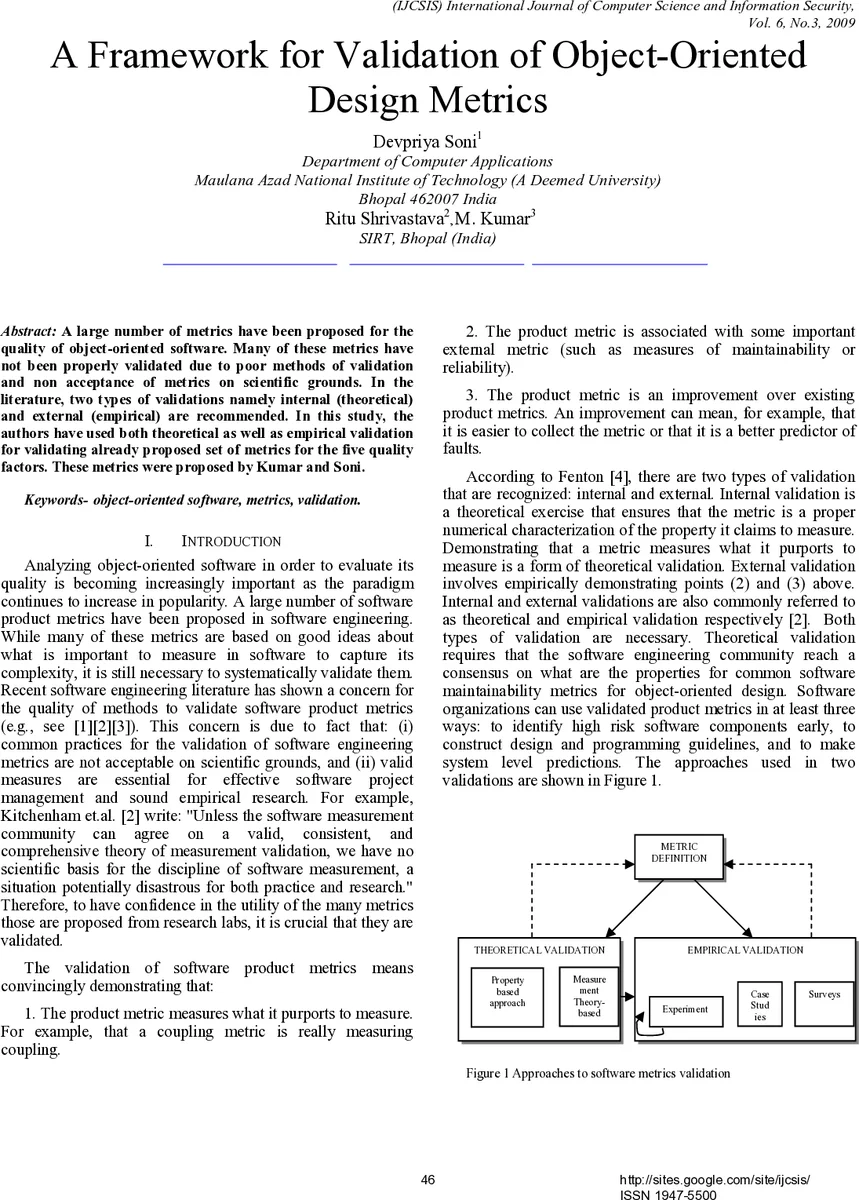
A large number of metrics have been proposed for the quality of object oriented software. Many of these metrics have not been properly validated due to poor methods of validation and non acceptance of metrics on scientific grounds. In the literature, two types of validations namely internal (theoretical) and external (empirical) are recommended. In this study, the authors have used both theoretical as well as empirical validation for validating already proposed set of metrics for the five quality factors. These metrics were proposed by Kumar and Soni.
💡 Research Summary
The paper addresses the critical need for scientifically validated metrics to assess the quality of object‑oriented (OO) software designs. While many OO design metrics have been proposed, most suffer from inadequate validation, limiting their practical usefulness. The authors therefore present a comprehensive validation framework that combines internal (theoretical) validation with external (empirical) validation, applying it to the hierarchical set of metrics originally proposed by Kumar and Soni for five quality attributes: functionality, effectiveness, understandability, reusability, and maintainability.
Theoretical Validation (Internal Validation)
The internal validation is based on the DISTANCE framework, a measurement‑theory approach originally described by Poels and Dedene. DISTANCE consists of five systematic activities: (1) constructing a measurement abstraction that highlights the property to be measured; (2) defining a generic distance between two abstractions using elementary transformation functions; (3) quantifying that distance by counting the minimal number of elementary transformations; (4) identifying a reference abstraction that represents the theoretical minimum of the property; and (5) defining a concrete metric function μ that maps any object to a real number based on the distance to the reference. The authors apply these steps to each of the 22 metrics in the Kumar‑Soni model (e.g., Number of Classes, Number of Hierarchies, Cohesion Among Methods, Number of Polymorphic Methods, Data Access Ratio, etc.). For each metric they explicitly describe the abstraction, the distance definition, the quantification scheme (often a discrete scale EQ={1,0.8,0.6,0.4,0.2,0}), the reference point, and the final measurement function. This systematic treatment demonstrates that the metrics are mathematically well‑grounded and truly capture the intended design properties.
Empirical Validation (External Validation)
To assess external validity, the authors designed a questionnaire that listed each metric together with its definition and asked respondents to indicate whether the metric influences each of the five quality factors (Yes/No/Partial). The questionnaire was distributed to two groups: industry professionals from major Indian IT firms (Infosys, TCS, Wipro, Accenture) and academics from Indian universities. A total of 52 completed responses were received, with roughly 70 % from industry. The data were analyzed in Microsoft Excel and the results were considered statistically significant at the 95 % confidence level.
The empirical findings show a strong consensus that the metrics affect the targeted quality attributes. For example:
- Number of Classes (NOC) – 92.31 % of respondents agreed it impacts functionality, 90.38 % maintainability, and 76.92 % reusability.
- Number of Hierarchies (NOH) – 90.38 % linked it to functionality, 88.46 % to effectiveness, and 78.85 % to maintainability.
- Cohesion Among Methods (CAM) – 90.38 % said it influences understandability, 84.62 % reusability, and 82.69 % functionality.
- Number of Polymorphic Methods (NOP) – 86.54 % for understandability, 80.77 % for functionality, 78.84 % for maintainability, and over 75 % for effectiveness.
Similar high agreement percentages (generally above 75 %) were observed for the remaining metrics (Class Interface Size, Number of Ancestors, Maximum Depth of Inheritance, Data Access Ratio, Number of Aggregation Relationships, Functional Abstraction, Direct Class Coupling, Number of Methods, Extent of Documentation). The authors present these results in a series of bar charts (Figures 3–8), illustrating the impact of each metric on each quality factor.
Discussion of Strengths and Limitations
The dual‑validation approach demonstrates that the Kumar‑Soni metric suite is both theoretically sound and perceived as practically relevant by experienced practitioners. The use of the DISTANCE framework provides a rigorous, repeatable method for internal validation that can be applied to other metric families. The empirical survey adds external credibility, showing that industry and academia share similar views on metric usefulness.
However, the study has notable limitations. The sample size (52 respondents) is modest, and all participants are based in India, which may limit the generalizability of the findings to other cultural or organizational contexts. The questionnaire relies on subjective judgments rather than objective outcome data (e.g., defect density, maintenance effort), so the link between metric values and actual software quality remains indirect. Future work could expand the participant pool globally, incorporate longitudinal project data, and employ statistical modeling (regression, machine learning) to quantify predictive power of the metrics against concrete quality outcomes.
Conclusion
The paper contributes a structured validation framework that integrates measurement‑theoretic internal validation with practitioner‑driven external validation. Applying this framework to the Kumar‑Soni hierarchical design metrics confirms their internal consistency and external relevance across five key OO quality attributes. The methodology offers a template for rigorously validating other software engineering metrics, thereby strengthening the scientific foundation of metric‑based quality assessment and supporting more reliable decision‑making in software design and maintenance.
Comments & Academic Discussion
Loading comments...
Leave a Comment