Momentum-space interferometry with trapped ultracold atoms
Quantum interferometers are generally set so that phase differences between paths in coordinate space combine constructive or destructively. Indeed, the interfering paths can also meet in momentum space leading to momentum-space fringes. We propose and analyze a method to produce interference in momentum space by phase-imprinting part of a trapped atomic cloud with a detuned laser. For one-particle wave functions analytical expressions are found for the fringe width and shift versus the phase imprinted. The effects of unsharpness or displacement of the phase jump are also studied, as well as many-body effects to determine the potential applicability of momentum-space interferometry.
💡 Research Summary
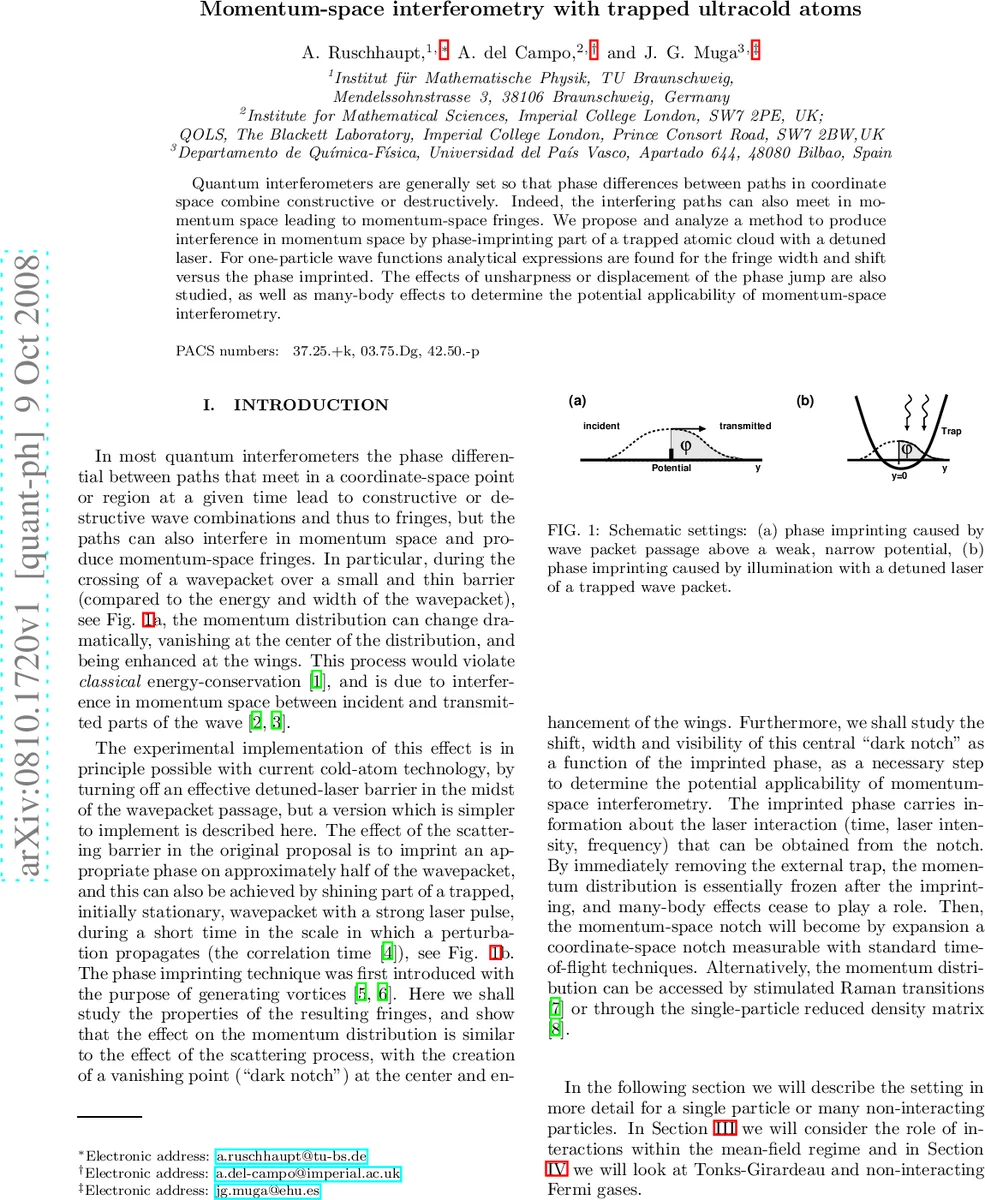
The authors propose and theoretically investigate a momentum‑space interferometer based on phase‑imprinting a portion of a trapped ultracold atomic cloud. A detuned laser pulse is applied briefly to the right half of a one‑dimensional harmonic trap, imprinting a uniform phase ϕ on that region. In momentum space the wavefunction becomes a coherent sum of two contributions with a relative phase, producing interference fringes whose central “dark notch” can be shifted by varying ϕ.
For a non‑interacting single particle initially in the ground state, an analytical expression for the momentum probability density is derived (Eq. 1). The notch occurs at q = 0 for ϕ = π, and its position moves linearly with ϕ near π (q₀ ≈ π/2·(ϕ − π)). The fringe width is essentially constant, Δq ≈ √(2π), while the visibility reaches unity at ϕ = π and falls off outside the interval π/2 < ϕ < 3π/2. Approximate formulas for the positions of the neighboring maxima (q±) and for the visibility are obtained and validated against numerical results.
The robustness of the effect against imperfections is examined. Shifting the phase boundary away from the trap centre (y₀ ≠ 0) leaves the fringe position essentially unchanged for small y₀ but reduces visibility. Replacing the ideal step function with a smooth sigmoid of width ζ similarly lowers visibility and slightly shifts the optimal phase.
Excited harmonic‑oscillator states are also considered. For even n the notch moves linearly with (ϕ − π), while for odd n it moves with ϕ, both scaled by the ratio Aₙ/Bₙ of integrals over Hermite polynomials. As n increases, Aₙ/Bₙ decreases, making the interferometer less sensitive to phase changes; the ground state remains optimal.
In the mean‑field regime the Gross‑Pitaevskii equation is solved for various interaction strengths g. Weak interactions only modestly modify the density profile, while strong repulsion drives the system into the Thomas‑Fermi limit where kinetic energy is negligible. In this limit the momentum distribution after phase imprinting is expressed analytically in terms of Bessel J₁ and Struve H₁ functions (Eq. 9). The fringe width stays at √(2π), but visibility improves with increasing g, albeit at the cost of more demanding time‑of‑flight measurements.
Overall, the work demonstrates that a simple, experimentally feasible laser pulse can generate controllable momentum‑space interference patterns, allowing the phase ϕ (and thus laser parameters) to be extracted from the position, width, and depth of the central notch. The analysis provides explicit formulas for these observables across non‑interacting, excited‑state, and interacting regimes, establishing momentum‑space interferometry as a promising tool for precision measurements and non‑destructive probing of ultracold atomic systems.
Comments & Academic Discussion
Loading comments...
Leave a Comment