Energy Efficiency in Multi-Hop CDMA Networks: a Game Theoretic Analysis Considering Operating Costs
A game-theoretic analysis is used to study the effects of receiver choice and transmit power on the energy efficiency of multi-hop networks in which the nodes communicate using Direct-Sequence Code Division Multiple Access (DS-CDMA). A Nash equilibri…
Authors: Sharon Betz, H. Vincent Poor
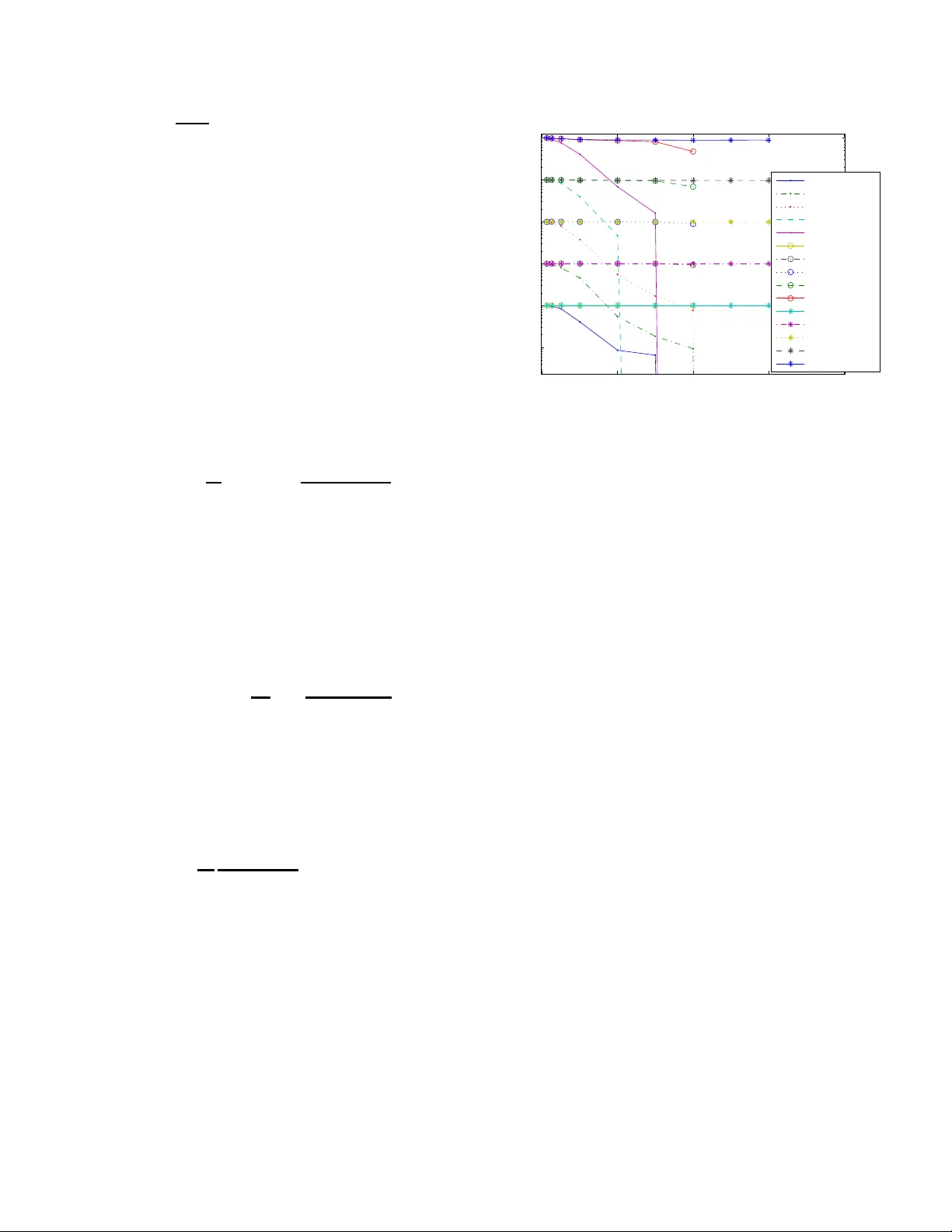
ENERGY EFFICIENCY IN MUL TI-HOP CDMA NETWORKS: A GAME THEORET IC ANAL YSIS CONSIDERING OPERA TING COSTS Shar on Betz and H. V incent P oor Department of Electrical Engineering Princeton Unive rsity { sbetz,poor } @prin ceton.edu ABSTRA CT A game-theo retic analysis is used to study the e ff ec ts o f re- ceiv er choice an d tran smit power on the energy e ffi ciency of multi-hop networks in which the nodes communicate using Direct-Seq uence Code Division Multiple Access (DS- CDMA). A Nash equ ilibrium of the g ame in which the net- work nodes ca n cho ose their rec eiv ers as well as their transmit powers to maximize the total n umber of b its they transmit per unit of energy spent (includ ing bo th transmit and oper ating energy) is derived. Th e energy e ffi ciencies resulting from the use of di ff er ent lin ear m ultiuser r eceivers in this context ar e compare d for the n on-co operative game . Significant gains in energy e ffi ciency ar e ob served when mu ltiuser receivers, particularly th e linear minimum mean- square erro r (MMSE) receiver , are u sed instead of conventional matched filter re- ceiv e rs. Index T erms — Code division mu ltiaccess, Commun ica- tion systems, Game theory 1. INTR O DUCTION In a wireless multi-ho p network, nod es comm unicate by pass- ing message s fo r one ano ther; permitting m ulti-hop co mmu- nications, rather than re quiring one-ho p co mmunicatio ns, can increase network capac ity a nd allow for a more ad hoc (an d thus scalable) system (with little or n o centralized con trol). For these reason s, and because of their poten tial fo r c om- mercial, m ilitary , an d civil ap plications, wireless m ulti-hop networks h av e attracted considerab le attention over the p ast few year s. In these networks, energy e ffi cient communication is im portant because the no des ar e typ ically b attery-p owered and therefo re energy-limited . W ork on en ergy-e ffi cien t com- munication in these multi-h op networks has often focused on routing p rotoco ls; this work instead loo ks at power con trol This research was supported by the U. S. Air Force Research L abo- ratory under Cooperati ve Agreement F A8750-06-1-0252, the Defense Ad- v anced Re search Project s Agency under Grant HR0 011-06-1-0052, the U. S. Nationa l Science Founda tion under Grant ANI-03-38807, and an Intel Fel- lo wship. and re ceiv er design choices th at ca n b e implemented ind epen- dently of (and thus in conjunc tion with) the routin g proto col. One approach that has been very succe ssful in researching energy e ffi cien t comm unication s in both cellular and multi- hop networks is the game- theoretic approach described in [1, 2]. Much of the gam e-theore tic research in m ulti-hop n et- works has focused on p ricing schemes (e.g . [3, 4]). In this work, we avoid the need for such a pr icing sch eme by using instead a nod al utility fun ction to captu re the en ergy costs. It further di ff ers from pre vious research by considering recei ver design, as [5] do es for cellular network s. This work furth er di ff ers from existing resear ch, in cluding [6], thro ugh an ex- tension of the utility function tha t considers the total en ergy costs, not just the transmit energy . W e prop ose a distributed n oncoop erative game in which the nodes can choose their transmit power and linear recei ver design to maximize the n umber of b its that they can send per unit of power . Afte r describing the ne twork and internod al commun ications in Section 2, we describ e the Nash e quilib- rium for this game , as well as for a set o f game s with set receivers, in Section 3. W e present num erical results and a conclusion in Sections 4 and 5. 2. SYSTEM MODEL Consider a wireless multi-h op n etwork with K n odes (u sers) and an established logical top ology , where a sequence of con- nected link-no des l ∈ L ( k ) fo rms a route origin ating fr om a source k (with k ∈ L ( k ) by definition ). Let m ( k ) be the node after n ode k in the rou te fo r n ode k . Assume that all routes that go through a node k continue through m ( k ) so that node k transmits only to m ( k ) . 1 Nodes commun icate with each other using DS-CDMA with processing gain N ( N chip s per bit). The signal receiv ed at any nod e m (after chip-matche d fil- tering) sampled at the chip rate over one symbol duration can 1 If the routin g has a node, k , transmitting to multiple nodes, ne w “nodes” can be introdu ced, collocated with k , each wit h a di ff erent d estinat ion. The modificati ons to the results, taking in to acc ount the channe l dependence, is straight forward. be expressed as r ( m ) = K X k = 1 √ p k h ( m ) k b k s k + w ( m ) (1) where p k , b k , an d s k are the tran smit power , transmitted sym- bol, and ( binary ) spreadin g sequ ence for node k ; h ( m ) k is the channel g ain between nod es k an d m ; and w ( m ) is the n oise vector which is assumed to be Gaussian with mean 0 and co- variance σ 2 I . (W e assume here p m = 0.) Assume the sprea d- ing sequenc es are rand om, i.e., s k = 1 √ N [ v 1 . . . v N ] T , wh ere the v i ’ s are indepen dent an d identically d istributed (i.i.d.) ran dom variables taking values { − 1 , + 1 } with equal probab ilities. De- note th e cross-co rrelations betwee n spreading seq uences as ρ k j = s T k s j , noting that ρ kk = 1 for all k . Let the vector c ( m ) k represent the linear receiver at the m th node fo r the k th signature sequence. The o utput of this re- ceiv e r can be written as y = c k T r ( m ) (2) = √ p k h ( m ) k b k c k T s k + X j , k √ p j h ( m ) j b j c k T s j + c k T w ( m ) . (3) The signal- to-interfe rence-plu s-noise r atio (SI NR), γ k , of the k th user at the outp ut of recei ver m ( k ) is γ k = p k h ( m ( k )) k 2 c k T s k 2 σ 2 c k T c k + P j , k p j h ( m ( k )) j 2 c k T s j 2 . (4) Each user has a utility fun ction th at is the ra tio of its e f- fective throug hput to its expended tr ansmit and comp utation power , i.e., u k = T k p k + q k . (5) Here, the thr oughp ut, T k , is the net nu mber of infor mation bits sent b y k (genera ted b y k o r any no de who se r oute goes throug h k ) and received with out error at the intended destina- tion, m ( k ), per un it o f tim e an d q k is the power expended b y the nod e to imp lement the receiver . (W e assume that all the congestion control is done in the choice of routing.) Follo win g the discussion in [5], we will use T k = L M R f ( γ k ) (6) where L and M are the nu mber of in formatio n bits and the total n umber of bits in a packet, respectively (without loss of generality assum ed he re to be the same for all u sers); R is the tran smission rate, wh ich is the ratio of the band width to the proce ssing gain and is taken for n ow to be equal f or all users; and f ( · ) is an e ffi ciency fun ction that closely appro xi- mates the packet success rate. This e ffi ciency function can be any increasing , con tinuously di ff eren tiable, sigmo idal 2 func- tion w ith f (0) = 0 an d f ( + ∞ ) = 1. Let its first d eriv ative be denoted as f ′ ( γ ) = ∂ f ( γ ) ∂γ and let γ 0 be its inflection po int. See [5] for more discussion of the e ffi ciency function. Using (6), (5) becomes u k = L M R f ( γ k ) p k + q k . (7) When th e receiver used is a matched filter (MF) ( i.e. c ( m ( k )) k = s k ), the receiv ed SINR is γ MF k = p k h m ( k ) k 2 s k T s k 2 σ 2 s k T s k + P j , k p j h m ( k ) j 2 s k T s j 2 (8) = p k h m ( k ) k 2 σ 2 + P j , k p j h m ( k ) j 2 ρ 2 k j . (9) When th e receiver is a linear minim um mean -squared er- ror (MMSE) receiver , th e filter coe ffi cients and the rece iv ed SINR are [7] c MMSE k = √ p k h m ( k ) k 1 + p k h m ( k ) k 2 s T k A − 1 k s k A − 1 k s k (10) and γ MMSE k = p k h m ( k ) k 2 s T k A − 1 k s k , (11) where A k = σ 2 I + P j , k p j h m ( k ) j 2 s j s T j . When the receiv er is a de correlator 3 (DE) (i.e. C = [ c 1 · · · c K ] = S ( S T S ) − 1 where S = [ s 1 · · · s K ]), the received SINR is γ DE k = p k h m ( k ) k 2 σ 2 c T k c k . (12) For any line ar recei ver with all nodes’ coe ffi cien ts chosen indepen dently of their tran smit p owers (includ ing th e MF and DE), as well as for th e MMSE recei ver, the SINR f or user k is the pro duct of user k ’ s p ower and a factor that is indep endent of user k ’ s power: γ k ( p k , p − k ) = p k g k ( p − k ), wher e p − k is a vector of the powers o f all users except fo r u ser k and g k is a function that depend s on the receiv er typ e, the channel gains, q k , and the users’ spreadin g s e quences. This me ans that ∂γ k ∂ p k = γ k p k = g k ( p − k ) , (13) so γ k is strictly in creasing in p k . Th us, fo r a fixed receiver type and fixed powers fo r the other users, there is a one- to- one relation ship b etween the power of user k and its SINR. 2 A continuous increasing function is sigmoidal if there is an inflection point abov e which the function is conca ve and below which the function is con ve x. 3 Here, we must assume that K ≤ N . Let p 0 ( p − k ) = γ 0 g k ( p − k ) be the unique positi ve number for which γ r k ( p 0 ( p − k ) , p − k ) = γ 0 , wher e, as b efore, γ 0 is the inflection point of the e ffi ciency function f ( γ ) . 3. THE NONCOOPERA TIVE PO WER-CONTROL GAME Let G = h K , { A k } , { u k } i denote the n oncoo perative game where K = { 1 , . . . , K } and A k = [0 , P max ] × R is the strat- egy set for the k th user . Here, P max is the maximum allowed power fo r transmission and R is the set of allowable receivers, for no w restricted to the MF , DE, and MMSE recei vers. E ach strategy in A k can be written as a k = ( p k , r k ), wh ere p k and r k are the tr ansmit power and the receiver typ e, respectively , of user k . Then th e resulting no ncoop erative ga me can be expressed as the max imization problem for k = 1 , . . . , K : max a k u k = max p k , r k u k ( p k , r k ) (14) = L M R max r k max p k f ( γ r k k ( p k , p − k )) p k + q r k k ! , (15) where γ k and q k are expressed explicitly as fu nctions of the transmit power and receiver type. For each of the receivers, r , in R , let G r = h K , { [0 , P max ] } , { u k } i denote the nonc ooperative game tha t di ff ers from G in that users cannot cho ose their linear receivers but are forc ed to use the receiver r . The resulting non coope rativ e game can be expressed as the following max imization p roblem for k = 1 , . . . , K : max p k u k ( p k , r ) = LR M max p k f ( γ r k ( p k , p − k )) p k + q k . (16) The following re sults are sum marized without pro of d ue to space constraints. When giv en the choic e b etween receivers, it is o ptimal for the users to use MMSE recei vers. Given a certain s y stem and fixed powers ( p ) fo r all oth er users, there is a un ique optimal power level for each user , e p ( p ), that satisfies for each k ∂ ∂ p f ( γ k ( p , p − k )) p + q k p = e p k = 0 (17) and it occu rs in the co ncave region o f th e e ffi ciency fun c- tion: e p k ( p ) > p 0 ∀ p ∈ K + . The game has at least on e Nash equilibriu m and f or any Nash equilibriu m, p ′ , it ho lds that e p ( p ′ ) = p ′ . Then , as lo ng as p ≥ p ′ = ⇒ e p ( p ) ≥ e p ( p ′ ) (that is, that a node never lowers its po wer when other no des don’t lower theirs), the Nash eq uilibrium is uniq ue. Fu rthermo re, the alg orithm wh ere, fo r ea ch tim e t , th e u sers use th e power described by p ( t ) = e p p ( t − 1) conv erges to the unique Nash equilibriu m for any initial choice of power vector . The solu tion to γ f ′ ( γ ) = f ( γ ) is a lower bou nd o n the achieved SINR at th e Nash equilibriu m; as q k increases, so does γ k . T hat is, as th e power necessary to run increa ses, the 0 0.5 1 1.5 2 10 1 10 2 10 3 10 4 10 5 10 6 Load: K/N mean utility for Nash equilibrium MF q=1 MF q=0.1 MF q=0.01 MF q=0.001 MF q=0.0001 DE q=1 DE q=0.1 DE q=0.01 DE q=0.001 DE q=0.0001 MMSE q=1 MMSE q=0.1 MMSE q=0.01 MMSE q=0.001 MMSE q=0.0001 Fig. 1 . Mean u tility for the di ff erent receiv e rs nodes aim for a high er SINR: to make the transmission worth - while, they need more th rough put. Because of this, for the MF and MMSE receivers, th e utilities of all u sers decreases when any u ser’ s value of q k increases (for the DE receiver , only the k th user’ s utility dec reases). For th e deco rrelator, the Na sh eq uilibrium is Pareto op ti- mal. For the MMSE an d MF receivers, the Nash equ ilibrium is not Pareto optimal and can b e improved upon if every user decreases its power by a small factor . 4. NUMERICAL RESUL TS Consider a mu lti-hop network with K n odes distributed ran- domly in a square wh ose area is 100 K squ are km , surro und- ing an access point in th e center . For simplicity , the simu- lations assume a routing scheme where a ll nodes transmit to the clo sest nod e that is closer to the access point (o r the ac- cess point o f that is closest). The packets each contain 100 bits of data and no overhead ( L = M = 100); the trans- mission rate is R = 100 kb / s; the therma l no ise power is σ 2 = 5 × 1 0 − 16 W atts; the chan nel gains are d istributed with a Rayleig h distribution with mean 0 . 3 d − 2 , whe re d is the dis- tance betwe en the tran smitter and r eceiver; and the pr ocessing gain is N = 32. W e use th e same e ffi ciency functio n as [5], namely f ( γ ) = (1 − e − γ ) M , whic h can be shown to satisfy the condition s for t he e xisten ce o f a uniqu e Nash equilibrium. Fi- nally , the am ount of ene rgy that a n ode h as to expend to r un, q k , is assumed to be th e sam e for all nod es and is allow to range f rom 0 . 0001 Joule s to 1 Jo ule p er tr ansmission (equiv- alently , for th e rate and packet size g iv en , it ran ges between 0 . 001 W atts an d 10 W atts). Figure 1 shows the mean u tility ( av e raged over 100 real- izations of the system) for the di ff eren t rec eiv er s as a function of the system lo ad. Here the lo ad ranges fro m 0 to 1.5 . For 0 50 100 150 200 250 300 10 −250 10 −200 10 −150 10 −100 10 −50 10 0 time utility for MF Fig. 2 . Utility f or all 1 6 users using th e MF fo r o ne scenario with β = 1 2 and q = 0 . 0 1 0 50 100 150 200 250 300 10 0 10 20 10 40 10 60 10 80 time power for MF Fig. 3 . Power for all 16 users u sing th e MF for o ne scenario with β = 1 2 and q = 0 . 0 1 loads grea ter than 1, the DE r eceiver canno t be used. Chang - ing the value of q by a factor of ten for all the users chang es the mean u tility by roug hly a factor of te n as well. The M F receiver is most a ff ected by the increased load, with the mean utility dropp ing by about a factor of ten when the load in- creases from 1 0% to 50%. The perfor mance of the DE and MMSE r eceivers are similar , altho ugh the MMSE receiver outperf orms the DE receiver at all points, with more signif- icant gains at high load. As shown ab ove, fo r the MMSE an d MF receivers, the Nash e quilibrium p oint is not Pareto o ptimal. This is partic- ularly obviou s for the match ed filter . Figure 2 shows h ow the utility for all 16 u sers in on e scena rio chang e with tim e when the simple algo rithm describ ed above is run. No tice th at all users have be tter utility b efore co n vergence . In fact, for this example, mean { u k } ach iev es its max imum at t = 2 while min k { u k } ach iev es its maximum at t = 6. Figure 3 shows th e transmit power fo r all users in the same examp le; fro m this it is clear that th e users are tran smitting at high er an d hig her powers to the detriment of their utilities. The MMSE receiver tends to do mu ch better (tho ugh it would still be better fo r all users to use slightly less p ower each); the MMSE receiver also co n verges much faster . The DE r eceiv er conv erges in just one time step (du e to the ind ependen ce of th e power ch oices of di ff erent users) and results in a Pareto optimal solution. 5. CONCLUSION W e hav e analyzed the cro ss-layer issue of en ergy e ffi cien t commun ication in multi-hop networks using a g ame theoretic model. W e’ ve extended pr evious work in this area to consider the en ergy costs used in ru nning the receiver and transmitter, in addition to the actual transmit costs. Amo ngst all linear re- ceiv e rs, the M MSE receiver is o ptimal. For the MF , MMSE, and DE receivers, a unique Nash equ ilibrium exists, thou gh for the MF and MMSE receiv ers, this Nash equilibriu m is not Pareto optimal. 6. REFERENCES [1] D. J. Goodman and N. B. Mandayam , “Power control for wireless d ata, ” IE EE P ersonal Commun ications , vol. 7 , no. 2, pp. 48–54 , Apr . 2000. [2] C. U. Saray dar, N. B. M andayam , and D. J. Goo dman, “E ffi cient p ower co ntrol via pricing in wireless data net- works, ” IEEE T rans. on Comm. , vol. 50, no. 2, pp. 2 91– 303, Feb . 20 02. [3] O. Ileri, S.-C. Mau, and N. B. Mandayam, “Pricing for e nabling forwardin g in self-co nfigurin g ad h oc ne t- works, ” IEEE Journal on Sel. Ar eas in Comm. , vol. 23, no. 1, pp. 151–1 62, Jan. 2005 . [4] P . M arbach and Y . Qiu, “Cooper ation in wireless ad hoc networks: A market-ba sed appro ach, ” IE EE / ACM T rans. on N etworking , v ol. 13, n o. 6, pp. 132 5–13 38, Dec. 2005 . [5] F . Meshkati, H. V . Poor, S. C. Sch wartz, and N. B. Man - dayam, “ An en ergy-e ffi cient appr oach to power contro l and receiv er desig n in wireless data network s, ” I EEE T rans. on Comm. , vol. 53 , no. 11, pp. 188 5–18 94, Nov . 2005. [6] S. M. Betz and H. V . Poor, “Energy e ffi c iency in m ulti- hop cdma networks: A game theoretic analysis, ” P r o- ceedings o f the W orkshop on Mu lti-Layer Mo delling a nd Design of Multi-Hop W ir eless Networks (MLMD 06) , 12- 15 July 2006. [7] S. V e rd ´ u, Multiuser Detection . Cambridge, U.K.: Cam- bridge University Press, 1998.
Original Paper
Loading high-quality paper...
Comments & Academic Discussion
Loading comments...
Leave a Comment