Tannaka duality for comonoids in cosmoi
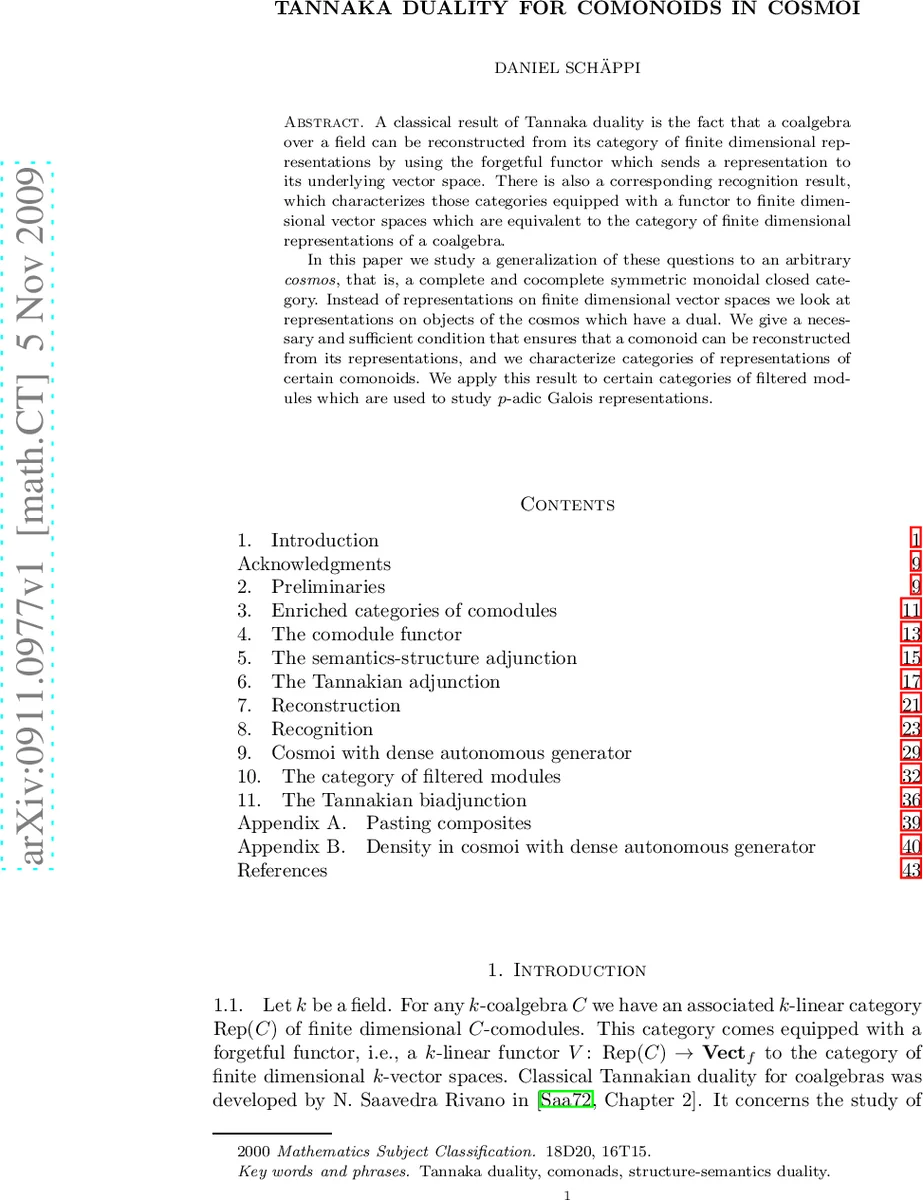
A classical result of Tannaka duality is the fact that a coalgebra over a field can be reconstructed from its category of finite dimensional representations by using the forgetful functor which sends a representation to its underlying vector space. There is also a corresponding recognition result, which characterizes those categories equipped with a functor to finite dimensional vector spaces which are equivalent to the category of finite dimensional representations of a coalgebra. In this paper we study a generalization of these questions to an arbitrary cosmos, that is, a complete and cocomplete symmetric monoidal closed category. Instead of representations on finite dimensional vector spaces we look at representations on objects of the cosmos which have a dual. We give a necessary and sufficient condition that ensures that a comonoid can be reconstructed from its representations, and we characterize categories of representations of certain comonoids. We apply this result to certain categories of filtered modules which are used to study p-adic Galois representations.
💡 Research Summary
The paper “Tannaka Duality for Comonoids in Cosmoi” extends the classical Tannaka–Krein reconstruction and recognition theorems from coalgebras over a field to comonoids living in an arbitrary cosmos – that is, a complete, cocomplete, symmetric monoidal closed category. In the classical setting one works with finite‑dimensional vector spaces; the authors replace this by the full sub‑category V⁽ᶜ⁾ of objects possessing a dual in the chosen cosmos V. Assuming V⁽ᶜ⁾ is essentially small, they define for any comonoid T the category V⁽ᶜ⁾_T of Cauchy T‑comodules (comodules whose underlying objects lie in V⁽ᶜ⁾). The forgetful functor V⁽ᶜ⁾_T → V⁽ᶜ⁾ is V‑enriched, and the authors construct a “Tannakian adjunction”
Comon(V) ─L→ V‑Cat / V⁽ᶜ⁾ ⊣ V⁽ᶜ⁾(–) : V‑Cat / V⁽ᶜ⁾ → Comon(V),
where L(ω) is the co‑end ∫^A ω(A) ⊗ ω(A)∨. This adjunction generalises the familiar correspondence between a coalgebra C and the pair (Rep(C), forgetful functor). The paper’s first major contribution is a new construction of this adjunction as a composite of a basic pull‑back adjunction and a “semantics‑structure” adjunction, which clarifies its categorical nature.
The reconstruction problem asks when the counit ν_T : L(V⁽ᶜ⁾_T) → T is an isomorphism. The authors introduce the notion of a dense autonomous generator X ⊂ V: X consists of dualizable objects, is closed under tensor product and duals, and is Set‑dense in V. Typical examples include finitely generated free modules over a commutative ring, or bounded complexes of such modules. Under the hypothesis that V possesses such a generator, Theorem 9.3 shows that ν_T is an isomorphism precisely when T, regarded as a T‑comodule over itself, is the colimit of the diagram of all Cauchy T‑comodules (i.e., the canonical tautological diagram V⁽ᶜ⁾_T / T → V_T). This result removes the usual requirement that the subcategory of dualizable objects be closed under finite limits; instead, arbitrary colimits of diagrams of dualizable objects are allowed.
The recognition problem asks for conditions on a V‑functor ω : A → V⁽ᶜ⁾ (with A small) that guarantee the unit η_A : A → V⁽ᶜ⁾_{L(ω)} to be an equivalence. The authors define ω‑rigid diagrams: a diagram D : D → A is ω‑rigid if the colimit of ω∘D lies again in V⁽ᶜ⁾. They prove that if ω preserves ω‑rigid colimits (right exactness) and is left exact in the sense of preserving kernels of morphisms whose images under ω are ω‑rigid, then η_A is an equivalence. When V has a dense autonomous generator, these conditions become necessary and sufficient.
To illustrate the theory, the paper studies the category MF_n^{proj} of filtered F‑modules (as introduced by Fontaine–Laffaille) over the Witt vectors modulo pⁿ. The forgetful functor ω : MF_n^{proj} → Mod_{W_n} satisfies the rigidity and exactness hypotheses, so the unit of the Tannakian adjunction is an equivalence. Consequently, MF_n^{proj} is equivalent to the category of Cauchy comodules over the comonoid
L = ∫^{M∈MF_n^{proj}} ω(M) ⊗_{ℤ/pⁿℤ} ω(M)∨,
which is flat as a right W_n‑module. This provides a Tannakian description of the filtered module categories that appear in the study of p‑adic Galois representations.
In summary, the paper establishes a robust Tannaka duality framework valid in any cosmos with a dense autonomous generator, gives precise necessary and sufficient criteria for both reconstruction and recognition, and demonstrates its utility by applying it to filtered Witt‑vector modules relevant to p‑adic Hodge theory. The work significantly broadens the scope of Tannakian methods beyond the classical field‑based setting, opening new avenues for categorical approaches in algebraic geometry, representation theory, and arithmetic geometry.
Comments & Academic Discussion
Loading comments...
Leave a Comment