Local Convexity Properties of j-metric Balls
This paper deals with local convexity properties of the j-metric. We consider convexity and starlikeness of the j-metric balls in convex, starlike and general subdomains of R^n.
Authors: Riku Klen
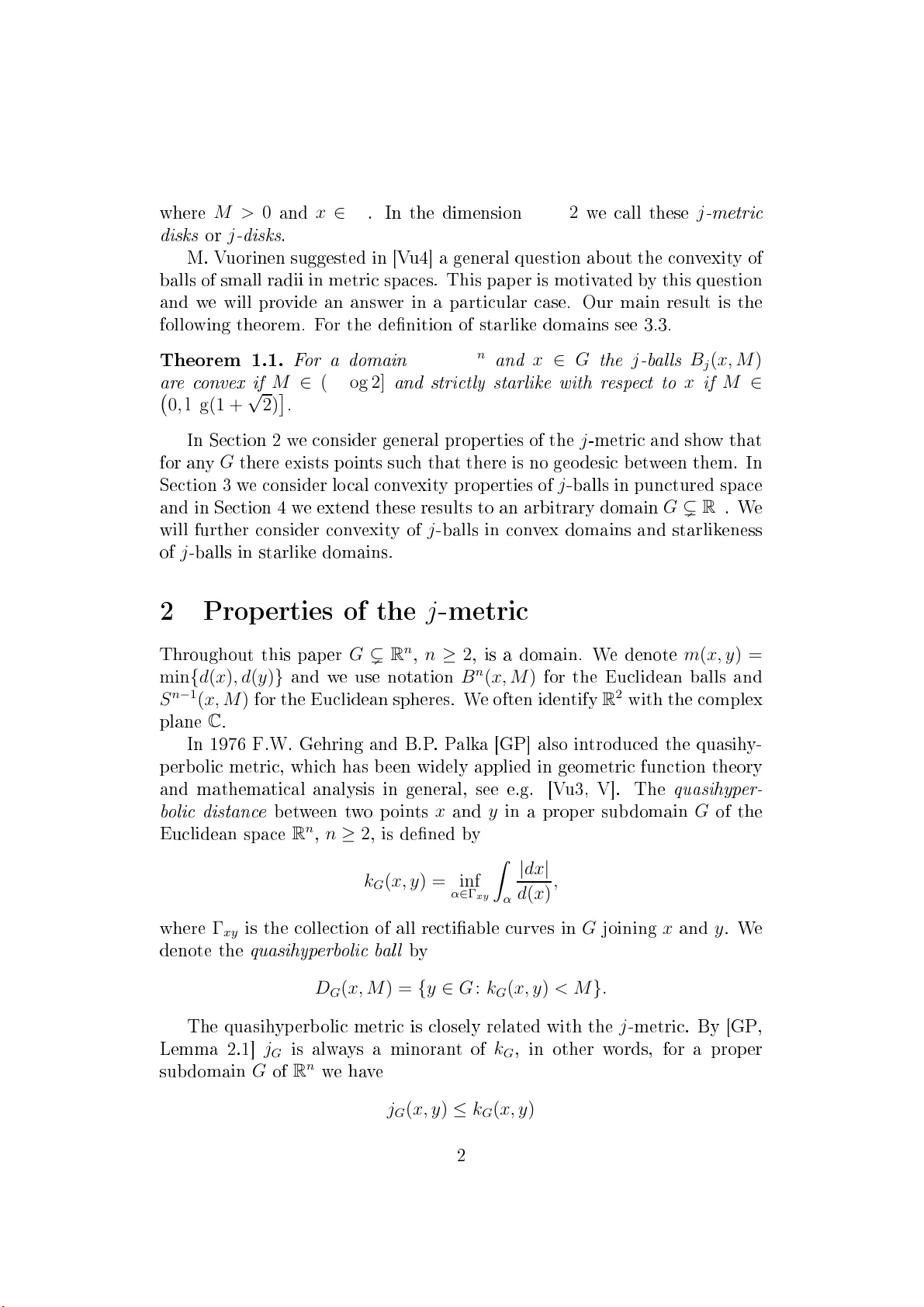
Lo al Con v exit y Prop erties of j -metri Balls Riku Klén Abstrat This pap er deals with lo al on v exit y prop erties of the j -metri. W e onsider on v exit y and starlik eness of the j -metri balls in on v ex, starlik e and general sub domains of R n . 2000 Mathematis Sub jet Classiation: Primary 30F45, Se- ondary , 30C65 Key w ords: j -metri ball, lo al on v exit y File: jmetri.tex, 2007-01-10, printed: 2018-10-25, 14.41 1 In tro dution The j -distan e in a prop er sub domain G of the Eulidean spae R n , n ≥ 2 , is dened b y j G ( x, y ) = log 1 + | x − y | min { d ( x ) , d ( y ) } , where d ( x ) is the Eulidean distane b et w een x and ∂ G . If the domain G is understo o d from the on text w e use notation j instead of j G . The j -distane w as rst in tro dued b y F.W. Gehring and B.P . P alk a [ GP℄ in 1976 in a sligh tly dieren t form and in the ab o v e form, b y M. V uorinen [V u2℄ in 1985. The j -distane is atually a metri and a pro of of the triangle inequalit y v alid for general metri spaes is giv en in [S℄. Previously the j -metri has b een studied in onnetion with the study of other metris [GO, H, S, V, V u2℄. See also reen t pap ers [HL , L℄. In spite of these studies man y basi questions of the j -metri remain op en and some of them will b e studied here. The purp ose of this pap er is to study metri spaes ( G, j G ) and esp eially lo al on v exit y prop erties of j -metri b al ls or in short j -b al ls dened b y B j ( x, M ) = { y ∈ G : j ( x, y ) < M } , 1 where M > 0 and x ∈ G . In the dimension n = 2 w e all these j -metri disks or j -disks . M. V uorinen suggested in [V u4℄ a general question ab out the on v exit y of balls of small radii in metri spaes. This pap er is motiv ated b y this question and w e will pro vide an answ er in a partiular ase. Our main result is the follo wing theorem. F or the denition of starlik e domains see 3.3. Theorem 1.1. F or a domain G ( R n and x ∈ G the j -b al ls B j ( x, M ) ar e onvex if M ∈ (0 , log 2] and stritly starlike with r esp e t to x if M ∈ 0 , log ( 1 + √ 2) . In Setion 2 w e onsider general prop erties of the j -metri and sho w that for an y G there exists p oin ts su h that there is no geo desi b et w een them. In Setion 3 w e onsider lo al on v exit y prop erties of j -balls in puntured spae and in Setion 4 w e extend these results to an arbitrary domain G ( R n . W e will further onsider on v exit y of j -balls in on v ex domains and starlik eness of j -balls in starlik e domains. 2 Prop erties of the j -metri Throughout this pap er G ( R n , n ≥ 2 , is a domain. W e denote m ( x, y ) = min { d ( x ) , d ( y ) } and w e use notation B n ( x, M ) for the Eulidean balls and S n − 1 ( x, M ) for the Eulidean spheres. W e often iden tify R 2 with the omplex plane C . In 1976 F.W. Gehring and B.P . P alk a [ GP℄ also in tro dued the quasih y- p erb oli metri, whi h has b een widely applied in geometri funtion theory and mathematial analysis in general, see e.g. [V u3, V ℄. The quasihyp er- b oli distan e b et w een t w o p oin ts x and y in a prop er sub domain G of the Eulidean spae R n , n ≥ 2 , is dened b y k G ( x, y ) = inf α ∈ Γ xy Z α | dx | d ( x ) , where Γ xy is the olletion of all retiable urv es in G joining x and y . W e denote the quasihyp erb oli b al l b y D G ( x, M ) = { y ∈ G : k G ( x, y ) < M } . The quasih yp erb oli metri is losely related with the j -metri. By [ GP, Lemma 2.1℄ j G is alw a ys a minoran t of k G , in other w ords, for a prop er sub domain G of R n w e ha v e j G ( x, y ) ≤ k G ( x, y ) 2 for all x, y ∈ G . The follo wing result an b e used to estimate the quasih yp erb oli metri from ab o v e b y the j -metri. Prop osition 2.1. [V u3, L emma 3.7℄ L et G ( R n b e a domain, x ∈ G , y ∈ B n x, d ( x ) and s ∈ (0 , 1) . Then k G ( x, y ) ≤ 1 1 − s j G ( x, y ) . The follo wing lemma giv es Eulidean b ounds for the j -balls. Prop osition 2.2. [S , The or em 3.8℄ F or a pr op er sub domain G ⊂ R n , x ∈ G and M > 0 we have B n x, r d ( x ) ⊂ B j ( x, M ) ⊂ B n x, R d ( x ) , wher e r = 1 − e − M and R = e M − 1 . Mor e over B j ( x, M ) ⊂ z ∈ G : e − M d ( x ) ≤ d ( z ) ≤ e M d ( x ) . Remark 2.3. A similar result to Prop osition 2.2 is also true for the quasi- h yp erb oli metri see [V u1, page 347℄. By Prop osition 2.2 the j -ball B j ( x, M ) shrinks to w ards the en ter { x } as M approa hes 0. The follo wing lemma sho ws that the j -balls B j ( x, M ) exhaust the domain G . Lemma 2.4. L et G ⊂ R n b e a b ounde d domain and x x ∈ G and s ∈ (0 , d ( x )] . Then { y ∈ G : d ( y ) > s } ⊂ B j x, log(1 + d/ s ) , for d = sup z ∈ ∂ G | x − z | . Pr o of. Let us assume d ( y ) > s . Then either m ( x, y ) = d ( x ) ≥ s or m ( x, y ) = d ( y ) > s . In b oth ases m ( x, y ) ≥ s and sine | x − y | < d for all y ∈ G w e ha v e j ( x, y ) = log 1 + | x − y | m ( x, y ) < log 1 + d s . 3 Let us denote the set of losest b oundary p oin ts of a p oin t x in a domain G ⊂ R n b y R x = { z ∈ ∂ G : | z − x | = d ( x ) } . The next result haraterizes the ase of equalit y in the triangle inequalit y for the j -metri. Its pro of is based on the pro of of the triangle inequalit y [S, Lemma 2.2℄. Theorem 2.5. L et x, y , z ∈ G ( R n b e distint p oints and d ( x ) ≤ d ( z ) . Then j G ( x, z ) = j G ( x, y ) + j G ( y , z ) implies that x , z and u ar e ol line ar for some u ∈ R x and y ∈ ( x, z ) with d ( x ) < d ( y ) < d ( z ) . Pr o of. By denition j G ( x, z ) < j G ( x, y ) + j G ( y , z ) is equiv alen t to | x − z | m ( x, z ) < | x − y | m ( x, y ) + | y − z | m ( y , z ) + | x − y || y − z | m ( x, y ) m ( y , z ) . (2.6) The assumption d ( x ) ≤ d ( z ) implies m ( x, z ) = d ( x ) . If d ( y ) ≤ d ( x ) , then the inequalit y (2.6 ) is equiv alen t to | x − z | < | x − y | d ( x ) d ( y ) + | y − z | d ( x ) d ( y ) + | x − y || y − z | d ( y ) d ( x ) d ( y ) , whi h is true, b eause | x − z | ≤ | x − y | + | y − z | , ( | x − y || y − z | ) /d ( y ) > 0 and d ( x ) /d ( y ) ≥ 1 . If d ( y ) > d ( x ) , then the inequalit y (2.6) is equiv alen t to | x − z | < | x − y | + | y − z | d ( x ) + | x − y | m ( y , z ) , whi h is false if and only if x , y and z are ollinear and d ( x ) + | x − y | m ( y , z ) = 1 . If d ( x ) = d ( z ) , then d ( x ) /m ( y , z ) = 1 and d ( x ) + | x − y | m ( y , z ) > 1 . (2.7) If d ( x ) < d ( z ) < d ( y ) , then the inequalit y ( 2.7 ) is true, b eause d ( x )+ | x − y | ≥ d ( y ) > d ( z ) = m ( y , z ) . If d ( x ) < d ( y ) ≤ d ( z ) , then the inequalit y ( 2.7 ) is true if and only if y / ∈ { k ( x − u ) : k > 0 } , where u ∈ R x . 4 The impliation of Theorem 2.5 in the other diretion w as pro v ed b y Hästö, Ibragimo v and Lindén [HIL , Corollary 3.7℄. Denition 2.8. Let G ( R n b e a domain and γ a urv e in G . If j ( x, y ) + j ( y , z ) = j ( x, z ) for all x, z ∈ γ and y ∈ γ ′ , where γ ′ is the sub urv e of γ joining x and z , then γ is a ge o desi se gment or shortly a ge o desi . W e denote a geo desi b et w een x and y b y J [ x, y ] . By Theorem 2.5 and the result of Hästö, Ibragimo v and Lindén w e an easily nd all geo desis J [ x, y ] for an y domain G . The geo desi needs to satisfy the triangle inequalit y as equalit y at ea h p oin t and therefore the geo desi an only b e a line segmen t l with the follo wing prop ert y . Lemma 2.9. L et G ( R n b e a domain and J [ x, y ] b e a ge o desi se gment with x, y ∈ G . Ther e exists u ∈ ∂ G suh that u ∈ R s for al l s ∈ J [ x, y ] and u and J [ x, y ] ar e ol line ar. Pr o of. Let us assume, on the on trary , that there exists z ∈ J [ x, y ] su h that d ( z ) < d ( x ) − | x − z | . No w j G ( x, z ) + j G ( z , y ) = j G ( x, y ) is equiv alen t to d ( z ) | x − z | + d ( x ) + | x − z | | z − y | = d ( z ) | x − y | . W e ha v e d ( z ) | x − y | ≤ d ( z ) | x − z | + d ( z ) | z − y | < d ( z ) | x − z | + d ( x ) + | x − z | | z − y | = d ( z ) | x − y | whi h is a on tradition. Theorem 2.10. L et G ( R n b e a domain. Then ther e exist x, y ∈ G suh that ther e is no ge o desi J [ x, y ] . Pr o of. Let us assume, on the on trary , that for all x, y ∈ G there exists a geo desi J [ x, y ] . Sine G is a domain, w e an ho ose x, y , z ∈ G to b e three distint nonollinear p oin ts. No w there exists a geo desi J [ x, y ] from x to y . W e ma y assume d ( x ) < d ( y ) and then b y Lemma 2.9 B n x, d ( x ) ⊂ B n y , d ( y ) ⊂ G . On the other hand, there exists a geo desi J [ x, z ] from x to z and therefore there has to exist a p oin t u ∈ S n − 1 x, d ( x ) ∩ ∂ G su h that x , z and u are ollinear. This is a on tradition, b eause x , y and u are nonollinear and therefore u ∈ B n y , d ( y ) . 5 Remark 2.11. By Theorem 2.10 a j -metri geo desi do es not alw a ys ex- ist b et w een t w o p oin ts. F.W. Gehring and B.G. Osgo o d ha v e pro v ed [ GO , Lemma 1℄ that for the quasih yp erb oli metri there alw a ys exists a geo desi b et w een t w o p oin ts of a domain G ( R n . Ho w ev er, the geo desis of the j -metri are unique while the geo desis of the quasih yp erb oli metri need not b e unique. 3 Con v exit y and starlik eness of j -balls in pun- tured spae In this setion w e onsider the ase G = R n \ { 0 } . By denition the j -balls in puntured spae G = R n \ { 0 } are similar, whi h means that B j ( x, M ) an b e mapp ed on to B j ( y , M ) for all x, y ∈ G b y rotation and stret hing. W e see easily that these balls are also symmetri along the line that go es through 0 and the en ter p oin t. Theorem 3.1. L et x ∈ R n \ { 0 } . Then 1) the j -b al l B j ( x, M ) is onvex if and only if M ∈ (0 , log 2] . 2) the j -b al l B j ( x, M ) is stritly onvex if and only if M ∈ (0 , lo g 2) . Pr o of. 1) By similarit y w e an assume x = e 1 and b y symmetry it is suien t to onsider only the ase n = 2 . W e will onsider ∂ B j (1 , M ) for xed M . By denition w e ha v e for z ∈ ∂ B j (1 , M ) M = log(1 + | z − 1 | ) , | z | ≥ 1 , log (1 + | z − 1 | / | z | ) , | z | < 1 , whi h is equiv alen t to e M − 1 = | z − 1 | , | z | ≥ 1 , | 1 − 1 /z | , | z | < 1 . F or | z | ≥ 1 the ∂ B j (1 , M ) is an ar of a irle with en ter 1 and radius e M − 1 . F or | z | < 1 the ∂ B j (1 , M ) is a irle that go es through p oin ts 1 / ( e M ) and 1 / (2 − e M ) and has en ter on the real axis. This means that the en ter of the irle is c = 1 / e M (2 − e M ) and the radius of the irle is | e M − 1 | / | e M (2 − e M ) | . No w c > 1 , if M ≤ log 2 , and c < 0 , if M > lo g 2 . Therefore ∂ B j (1 , M ) is on v ex for M ≤ log 2 and not on v ex for M > log 2 . 2) W e ha v e c ∈ (1 , ∞ ) , where c is as ab o v e. Therefore B j ( x, M ) is stritly on v ex. In the ase M = log 2 w e ha v e c = ∞ and B j ( x, M ) is not stritly on v ex. 6 Remark 3.2. F or xed x ∈ G the quasih yp erb oli ball D G ( x, M ) is stritly on v ex in G = R n \ { 0 } if and only if M ∈ (0 , 1 ] [K℄. Clearly B j ( x, M ) is nev er smo oth. W e will next dene starlik eness of a domain. Denition 3.3. Let G ⊂ R n b e a b ounded domain and x ∈ G . W e sa y that G is starlike with r esp e t to x if ea h line segmen t from x to y ∈ G is on tained in G . The domain G is stritly starlike with r esp e t to x for x ∈ G if ea h ra y from x meets ∂ G at exatly one p oin t. The next theorem determines the v alues of M for whi h the j -ball B j ( x, M ) is stritly starlik e with resp et to x . Theorem 3.4. F or x ∈ R n \ { 0 } the j -b al l B j ( x, M ) is stritly starlike with r esp e t to x if and only if M ∈ 0 , log(1 + √ 2) . Pr o of. Beause the j -balls are similar it is suien t to onsider x = e 1 . By symmetry it is suien t to onsider the ase n = 2 and the part of ∂ B j (1 , M ) that is ab o v e the real axis. If M ≥ log 3 , then B j (1 , M ) = B 2 (1 , r ) \ B 2 ( c, s ) , where c , r and s are giv en in the pro of of Theorem 3.1 and B 2 ( c, s ) ⊂ B 2 (1 , r ) . Therefore B j (1 , M ) an b e starlik e with resp et to 1 only for M < log 3 . Let us assume M < lo g 3 . By the pro of of Theorem 3.1 B j (1 , M ) = B 2 (1 , r ) \ B 2 ( c, s ) . Let us denote the p oin t of in tersetion of S 1 (1 , r ) and S 1 ( c, s ) ab o v e the real axis b y z . No w z is also the p oin t of in tersetion of the unit irle and the b oundary ∂ B j (1 , M ) . Let us denote b y l the line that go es through p oin ts 1 and z . No w B j (1 , M ) is stritly starlik e with resp et to 1 if and only if l ∩ B 2 (1 , r ) ∩ B 2 ( c, s ) = ∅ . If z is a tangen t of S 1 ( c, s ) , then the irles S 1 (1 , r ) and S 1 ( c, s ) are p erp endiular and M has the largest v alue su h that B j (1 , M ) is starlik e with resp et to 1. By the pro of of Theorem 3.1 w e ha v e c = − 1 /e M ( e M − 2) , r = | 1 − z | = e M − 1 , | 1 − c | = ( e M − 1) 2 /e M ( e M − 2) and s = | z − c | = ( e M − 1) /e M ( e M − 2) . Let us assume that z is a tangen t of S 1 ( c, s ) . No w b y the Pythagorean Theorem ( e M − 1) 4 e 2 M ( e M − 2) 2 = ( e M − 1) 2 + ( e M − 1) 2 e 2 M ( e M − 2) 2 , whi h is equiv alen t to e 2 M − 2 e M − 1 = 0 and therefore M = log (1 + √ 2) . 7 Figure 1: The b oundaries of j -disks j (1 , M ) in puntured plane G = R 2 \ { 0 } with M = 0 . 5 , M = log 2 , M = log (1 + √ 2) and M = 1 . 1 ≈ log 3 . Example 3.5. Let us onsider the starlik eness of j -balls B j ( x, M ) with re- sp et to z ∈ B j ( x, M ) for M > log 2 . By ho osing z = ( e − M + ε ) x/ | x | for ε > 0 and letting ε approa h to zero w e see that B j ( x, M ) is not starlik e with resp et to z . On the other hand, if w e ho ose z = ( e M − ε ) x/ | x | for ε > 0 and M < log (3 + √ 5 / 2 , w e see that B j ( x, M ) is stritly starlik e with resp et to z for small enough ε . Remark 3.6. F or xed x ∈ G the quasih yp erb oli ball D G ( x, M ) is stritly starlik e with resp et to x in G = R n \ { 0 } if and only if M ∈ (0 , κ ] [ K℄, where κ ≈ 2 . 83 297 . 4 Con v exit y and starlik eness of j -balls W e will onsider on v exit y and starlik eness of j -balls B j ( x, M ) for M > 0 in on v ex, starlik e and general domains. Let us onsider j -balls in a domain G with a nite n um b er of b oundary p oin ts. The ase ard ∂ G = 1 is iden tial to G = R n \ { 0 } . If ∂ G = { y 1 , y 2 } , then B j G ( x, M ) = B j R n \{ y 1 } ( x, M ) ∩ B j R n \{ y 2 } ( x, M ) . This is lear, b eause the j -distane b et w een a and b dep ends only on the losest b oundary p oin t of the end p oin ts a and b . Similarly for ∂ G = { y 1 , y 2 , . . . , y m } w e ha v e B j G ( x, M ) = m \ i =1 B j R n \{ y i } ( x, M ) . This giv es an idea to pro v e Theorem 1.1 , whi h sho ws that j -balls are on v ex in an y domain G for small radius M . 8 Figure 2: The b oundaries of j -disks in a domain with 1, 2, 3 and 6 b oundary p oin ts. Pr o of of The or em 1.1. Let x ∈ G b e arbitrary . W e laim that A = B j G ( x, M ) = \ z ∈ ∂ G B j R n \{ z } ( x, M ) = B . (4.1) Let y ∈ B . W e an ho ose z ′ ∈ ∂ G with j R n \{ z ′ } ( x, y ) = min z ∈ ∂ G j R n \{ z } ( x, y ) . Beause z ′ ∈ ∂ G w e ha v e j G ( x, y ) ≤ j R n \{ z ′ } ( x, y ) and therefore y ∈ A . On the other hand, let y ∈ A . By denition there is a p oin t z ′ ∈ ∂ G with min {| x − z ′ | , | y − z ′ |} = min z ∈ ∂ G {| x − z | , | y − z | } . No w j R n \{ z ′ } ( x, y ) ≤ j G ( x, y ) and y ∈ B . By Theorem 3.1 ea h B j R n \{ z } ( x, M ) is on v ex for 0 < M ≤ log 2 and (4.1 ) B j G ( x, M ) is an in tersetion of on v ex domains and therefore it is on v ex. If M ∈ (0 , lo g 2] , then B j G ( x, M ) is on v ex and therefore also starlik e with resp et to x . If M ∈ (log 2 , log(1 + √ 2)] , then B j ( x, M ) = B \ [ z ∈ ∂ G A z ! , where B = B n x, ( e M − 1) d ( x ) and A z = B n ( c z z , r z ) for c z = | z | / ( e M (2 − e M )) and r z = | z || 1 − e − M | / | e M − 2 | . Let us assume that B j ( x, M ) is not stritly starlik e with resp et to x . No w there exists a, b ∈ B su h that b ∈ ( x, a ) , a ∈ B j ( x, M ) and b / ∈ B j ( x, M ) . No w b ∈ B n ( c z z , r z ) for some z ∈ ∂ G . By the pro of of Theorem 3.4 a ∈ B n ( c z z , r z ) , whi h is a on tradition. Corollary 4.2. F or a domain G ( R n and x ∈ G the j -b al ls B j ( x, M ) ar e simply onne te d if M ∈ 0 , log ( 1 + √ 2) . Pr o of. By Theorem 1.1 B j G ( x, M ) is starlik e with resp et to x and therefore also simply onneted. 9 Corollary 4.3. F or a domain G ( R n and x ∈ G the j -b al ls B j ( x, M ) ar e stritly onvex if M ∈ (0 , lo g 2) . Pr o of. By the pro of of Theorem 1.1 and Theorem 3.1 B j ( x, M ) = \ z ∈ ∂ G ( B z , 1 ∩ B z , 2 ) , where B z ,i is a Eulidean ball and x ∈ B z ,i . Therefore B j ( x, M ) is stritly on v ex. Bounds of Theorem 1.1 are sharp as G = R n \ { 0 } sho ws. Also the b ound log(1 + √ 2) of Corollary 4.2 is sharp. This an b e seen b y ho osing G = R 2 \ { 0 , z } for a ertain z and onsidering B j ( e 1 , M ) for M > log (1 + √ 2) . By the pro of of Theorem 3.1 w e kno w that B j ( e 1 , M ) = B 2 ( e 1 , r 1 ) \ B 2 ( c, r 2 ) for r 1 = e M − 1 , c = e 1 / e M (2 − e M ) and r 2 = ( e M − 1) / e M ( e M − 2) . Let l b e the tangen t line of B 2 ( c, r 2 ) that go es through e 1 . Denote { y } = S 1 ( c, r 2 ) ∩ l . Cho ose z to b e the reetion of 0 in the line l . By a simple omputation w e ha v e | y − e 1 | = e M − 1 p e M ( e M − 2) < r 1 . Let us denote b y c ′ the reetion of c in the line l . No w B j R 2 \{ 0 ,z } ( e 1 , M ) = B 2 ( e 1 , r 1 ) \ B 2 ( c, r 2 ) ∪ B 2 ( c ′ , r 2 ) and therefore B j ( e 1 , M ) is disonneted for M > log (1 + √ 2) . Similar oun terexamples an b e onstruted for n > 2 . Let us assume n ≥ 2 and M > log (1 + √ 2) . No w w e ho ose G = R n \ S n − 1 ( z , | z | ) \ B n ( e 1 , 1) , where z ∈ S n − 1 ( e 1 , e M − 1) and the line [ z , e 1 ] is a tangen t of S n − 1 ( c, r ) for c = e 1 / e M (2 − e M ) and r = | 1 − e M | / | e M (2 − e M ) | . Let y ∈ [ z , e 1 ] ∩ S n − 1 ( e 1 , e M − 1) . No w j G ( e 1 , y ) = M and j G e 1 , 1 2 ( z + y ) < M . Therefore B j ( e 1 , M ) is disonneted. Remark 4.4. The idea of the pro of of Theorem 1.1 annot b e used for the quasih yp erb oli metri. W e alw a ys ha v e D G ( x, M ) ⊂ \ z ∈ ∂ G D R n \{ z } ( x, M ) 10 but inlusion in the other diretion is not alw a ys true. F or example G = R n \ { 0 , e 1 } , x = e 1 / 4 and M = 1 giv es an oun terexample. No w y = e 1 (1 − 1 /e ) is on the b oundary ∂ D G ( x, M ) b eause k G ( x, y ) = k R n \{ 0 } ( x, e 1 / 2) + k R n \{ e 1 } ( e 1 / 2 , y ) = log 2 + log( e/ 2 ) = 1 . On the other hand, z = e 1 1 − 3 / (4 e ) b elongs to the b oundary ∂ D R n \{ e 1 } ( x, M ) . No w 0 . 632 ≈ | y | < | z | ≈ 0 . 7 2 4 and therefore D R n \{ 0 } ( x, M ) ∩ D R n \{ e 1 } ( x, M ) 6⊂ D G ( x, M ) . The next theorem states on v exit y of j -balls in on v ex domains. Theorem 4.5. L et M > 0 , G ( R n b e a onvex domain and x ∈ G . Then j -b al ls B j ( x, M ) ar e onvex. Pr o of. By Theorem 1.1 w e need to onsider only the ase M > log 2 . Let us divide G in to t w o parts D 1 = { z ∈ G : d ( z ) ≥ d ( x ) } and D 2 = G \ D 1 . W e will rst sho w that on v exit y of G implies on v exit y of D 1 . Let us assume that D 1 is not on v ex. There exists a, b ∈ D 1 su h that c = ( a + b ) / 2 / ∈ D 1 and d ( a ) = d ( x ) = d ( b ) . No w B n a, d ( x ) and B n b, d ( x ) do es not on tain an y p oin ts of ∂ G , but B n ( c, r ) for some r < d ( x ) on tains at least one p oin t of ∂ G . Therefore G is not on v ex, whi h is a on tradition. Let us onsider B j ( x, M ) ∩ D 1 . By denition of the j -metri w e ha v e for y ∈ ∂ B j ( x, M ) ∩ D 1 | x − y | = d ( x ) e M − 1 and therefore ∂ B j ( x, M ) ∩ D 1 is a subset of S n − 1 ( x, r ) , where r = d ( x ) e M − 1 . By on v exit y of D 1 the domain B j ( x, M ) ∩ D 1 is on v ex. Let us then sho w that ea h hord with end p oin ts in B j ( x, M ) ∩ D 2 is on tained in B j ( x, M ) . By denition for y ∈ ∂ B j ( x, M ) ∩ D 2 w e ha v e d ( y ) = | x − y | e M − 1 . (4.6) Let us assume y 1 , y 2 ∈ B j ( x, M ) ∩ D 2 and z = ( y 1 + y 2 ) / 2 / ∈ B j ( x, M ) . If z ∈ D 1 , then z ∈ B j ( x, M ) b eause B j ( x, M ) ⊂ B n ( x, r ) . Therefore w e ma y assume z ∈ D 2 \ B j ( x, M ) . By (4.6) w e ha v e d ( y i ) > | x − y i | / ( e M − 1) for i ∈ { 1 , 2 } and d ( z ) < | x − z | / ( e M − 1) . Sine M > log 2 w e ha v e c = 1 / ( e M − 1) < 1 . No w the b oundary ∂ G is outside B n ( y 1 , c | x − y 1 | ) ∪ B n ( y 2 , c | x − y 2 | ) and has a p oin t in B n ( z , c | x − z | ) , see Figure 3. W e will sho w that for c < 1 the domain G is not on v ex. Let us denote b y l a line that is a tangen t to balls B n ( y 1 , c | x − y 1 | ) and B n ( y 2 , c | x − y 2 | ) . Beause d ( y i , l ) = c | x − y i | for i ∈ { 0 , 1 } w e ha v e d ( z , l ) = c | x − y 1 | + c | x − y 2 | 2 . (4.7) 11 b b b y 1 z y 2 l B j ( x, M ) B 1 B 2 Figure 3: Line l , Eulidean balls B 1 = B n ( y 1 , c | x − y 1 | ) and B 2 = B n ( y 2 , c | x − y 2 | ) and p oin ts y 1 , y 2 and z . By the triangle inequalit y | x − z | = x − y 1 2 + x − y 2 2 ≤ | x − y 1 | 2 + | x − y 2 | 2 and b y (4.7) d ( z , l ) = c 2 ( | x − y 1 | + | x − y 2 | ) ≥ c | x − z | . No w the domain G is not on v ex, whi h is a on tradition, and ea h hord with end p oin ts in B j ( x, M ) ∩ D 2 is on tained in B j ( x, M ) . Sine ea h hord with end p oin ts in B j ( x, M ) ∩ D 2 is on tained in B j ( x, M ) , B j ( x, M ) ∩ D 2 ⊂ B n ( x, r ) , D 1 is on v ex and ∂ B j ( x, M ) ∩ D 1 ⊂ S n − 1 ( x, r ) the j -ball B j ( x, M ) is on v ex. Theorem 4.8. L et M > 0 and G ( R n b e a starlike domain with r esp e t to x ∈ G . Then the j -b al ls B j ( x, M ) ar e starlike with r esp e t to x . Pr o of. By Theorem 1.1 w e need to onsider M > log ( √ 2 + 1) whi h is equiv- alen t to e M − 1 > √ 2 . Let us divide G in to t w o parts D 1 = { z ∈ G : d ( z ) ≥ d ( x ) } and D 2 = G \ D 1 . Similarly as in the pro of of Theorem 4.5 the b oundary ∂ B j ( x, M ) ∩ D 1 is a subset of a sphere S n − 1 ( x, r ) and B j ( x, M ) ⊂ S n − 1 ( x, r ) . Therefore it is suien t to sho w that for ea h y ∈ B j ( x, M ) ∩ D 2 the line segmen t [ x, y ] is in B j ( x, M ) . W e will sho w that all hords [ x, y ] for y ∈ B j ( x, M ) ∩ D 2 are on tained in B j ( x, M ) . Let us assume, on the on trary , that there exists p oin ts y 1 , y 2 ∈ ∂ B j ( x, M ) ∩ D 2 with y 1 ∈ ( x, y 2 ) and z = ( y 1 + y 2 ) / 2 / ∈ B j ( x, M ) . Let us rst assume z ∈ D 1 . No w j G ( x, z ) > j G ( x, y 2 ) is equiv alen t to | x − z | /d ( x ) > 12 | x − y 2 | /d ( y 2 ) . By the seletion of y 1 and y 2 w e ha v e | x − z | < | x − y 2 | and d ( x ) > d ( y 2 ) implying | x − z | /d ( x ) < | x − y 2 | /d ( y 2 ) , whi h is a on tradition. Let us then assume z ∈ D 2 . No w | x − y 1 | d ( y 1 ) = | x − y 2 | d ( y 2 ) = e M − 1 < | x − z | d ( z ) b b b b x y 1 z y 2 B j ( x, M ) Figure 4: Seletion of p oin ts y 1 and y 2 . Gra y irles are B n y 1 , d ( y 1 ) , B n z , d ( z ) and B n y 2 , d ( y 2 ) . and therefore the b oundary ∂ G do es not in terset B n y 1 , d ( y 1 ) or B n y 2 , d ( y 2 ) and on tains a p oin t in B n z , d ( z ) , see Figure 4. This means that G is not starlik e with resp et to x , whi h is a on tradition. Remark 4.9. (1) Let us onsider the domain G = B n (0 , 1) ∪ B n ( e 1 , 1 / 4) ∪ B n (2 e 1 , 1) and sho w that the j -ball B = B j (0 , log 3) is onneted but the j -sphere S = { z ∈ G : j G (0 , z ) = log 3 } is disonneted. W e ha v e j G (0 , e 1 ) = log 1 + 1 1 / 4 = log 5 and therefore all p oin ts x ∈ G with x 1 = 1 are neither in B nor on the b oundary ∂ B . W e also ha v e B , ∂ B ⊂ B n (0 , 1) ∪ B n (2 e 1 , 1) . F or all y ∈ B n (2 e 1 , 1) \ { u ∈ G : ∠ 0 2 e 1 u < atan (1 / 4) } w e ha v e j G (0 , y ) = log 1 + | y | 1 − | 2 − y | ≥ log (1 + 2) = log 3 , b eause | y | + 2 | 2 − y | ≥ 2 . F or all y ∈ B n (2 e 1 , 1) ∩ { u ∈ G : ∠ 0 2 e 1 u < atan (1 / 4) } w e ha v e j G (0 , y ) = log 1 + | y | d ( y ) ≥ log 1 + | y 1 | d ( y 1 ) ≥ log (1 + 2) = log 3 13 and therefore B ⊂ B n (0 , 1) and it is onneted. Let us no w onsider S and denote z ∈ S . If z ∈ B n (2 e 1 , 1) , then z = 2 e 1 . If z ∈ B n (0 , 1) , then z ∈ ∂ B . No w S = ∂ B ∪ { 2 e 1 } and it is disonneted. In partiular, w e see that { z ∈ G : j G (0 , z ) < log 3 } 6 = { z ∈ G : j G (0 , z ) ≤ log 3 } . (2) W e ha v e seen that in on v ex domains the j -balls are on v ex and in starlik e domains the j -balls are starlik e. Ho w ev er in simply onneted domains the j -balls need not b e simply onneted. Let us onsider G = B n (0 , 1) ∪ B n ( e 1 , h ) ∪ B n (2 e 1 , 1) for h ∈ (0 , 1) . Clearly G is simply onneted. Let us onsider B = B j (0 , log 4) . W e ha v e j G (0 , 2 e 1 ) = log 1 + 2 1 = log 3 and therefore 2 e 1 ∈ B . Let x = ( x 1 , . . . , x n ) ∈ G with x 1 = 1 . No w j G (0 , x ) ≥ j G (0 , e 1 ) = log 1 + 1 h and x / ∈ B for h < 1 / 3 . F or h = 1 / 4 the j -ball B is not ev en onneted. Instead of the radius log 4 w e ould ho ose an y r > lo g 3 . Questions 4.10. W e p ose some op en questions onerning the quasih yp er- b oli metri and quasih yp erb oli balls. (1) Is it true that for an y domain G ( R n and x ∈ G the quasih yp erb oli ball D G ( x, M ) is stritly on v ex if M ∈ (0 , 1 ] ? (2) Is it true that for an y domain G ( R n and x ∈ G the quasih yp erb oli ball D G ( x, M ) is stritly starlik e with resp et to x if M ∈ (0 , κ ] for κ ≈ 2 . 83 297 ? (3) Are the quasih yp erb oli geo desis unique in ev ery simply onneted domain G ( R 2 ? F or the ase R n \ { 0 } see Remarks 3.2 and 3.6. A know le dgements. This pap er is part of the author's PhD thesis, ur- ren tly written under the sup ervision of Prof. M. V uorinen and supp orted b y the A adem y of Finland pro jet 8107317. 14 Referenes [GO℄ F.W. Gehring, B.G. Osgood : Uniform domains and the quasi- hyp erb oli metri. J. Anal. Math. 36 (1979), 50-74. [GP℄ F.W. Gehring, B.P. P alka : Quasi onformal ly homo gene ous do- mains. J. Anal. Math. 30 (1976), 172-199. [H℄ P. Hästö : Gr omov hyp erb oliity of the j G and ˜ j G metris. Pro . Amer. Math. So .134 (2006), no. 4, 11371142. [HIL℄ P. Hästö, Z. Ibra gimo v, H. Lindén : Isometries of r elative metris. Comput. Metho ds F unt. Theory 6 (2006), no. 1, 1528. [HL℄ P. Hästö, H. Lindén : Isometries of the half-ap ol lonian metri. Com- plex V ar. Theory Appl. 49 (2004), 405-415. [K℄ R. Klén : L o al Convexity Pr op erties of Quasihyp erb oli Bal ls in Puntur e d Sp a e. In preparation. [L℄ H. Lindén : Quasihyp erb oli Ge o desis and Uniformity in Elementary Domains. Dissertation, Univ ersit y of Helsinki, 2005, Ann. A ad. Si. F enn. Math. Diss. 146 (2005). [S℄ P. Seittenrant a : Möbius-invariant metris. Math. Pro . Cam b. Phil. So . 125 (1999), 511-533. [V℄ J. V äisälä : Quasihyp erb oli ge ometry of domains in Hilb ert sp a es. Ann. A ad. Si. F enn. Math. 32 (2007), no. 2, 559578. [V u1℄ M. Vuorinen : Cap aity densities and angular limits of quasir e gular mappings. T rans. Amer. Math. So . 263 (1981), 2, 343-354. [V u2℄ M. Vuorinen : Conformal invariants and quasir e gular mappings. J. Anal. Math. 45 (1985), 69-115. [V u3℄ M. Vuorinen : Conformal Ge ometry and Quasir e gular Mappings. Leture Notes in Math. V ol. 1319, Springer-V erlag, 1988. [V u4℄ M. Vuorinen : Metris and quasir e gular mappings. Pro . In t. W ork- shop on Quasionformal Mappings and their Appliations, I IT Madras, De 27, 2005 - Jan 1, 2006, ed. b y S. P onn usam y , T. Suga w a and M. V uorinen, Quasi onformal Mappings and their Appli ations , Narosa Publishing House, New Delhi, India, 291325, 2007. 15 Departmen t of Mathematis Univ ersit y of T urku FIN-20014 FINLAND e-mail: riku.klenutu. 16
Original Paper
Loading high-quality paper...
Comments & Academic Discussion
Loading comments...
Leave a Comment