Foliations on non-metrisable manifolds: absorption by a Cantor black hole
We investigate contrasting behaviours emerging when studying foliations on non-metrisable manifolds. It is shown that Kneser's pathology of a manifold foliated by a single leaf cannot occur with foliations of dimension-one. On the other hand, there a…
Authors: Mathieu Baillif, Alex, re Gabard
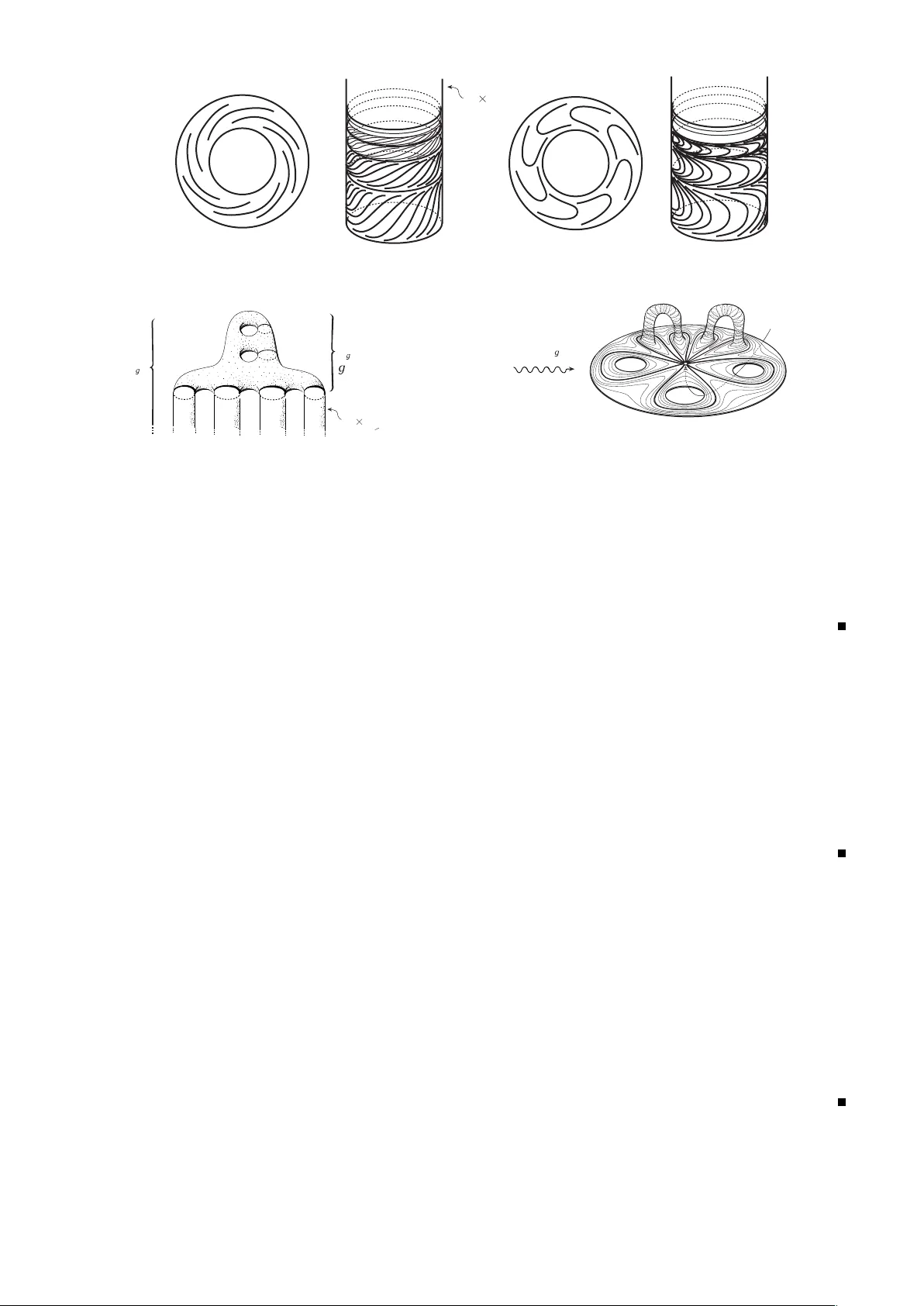
F oliations on non-metrisable manifolds: absorption b y a Can tor blac k hole Mathieu Baillif, Alexandre Gabard and Da vid Gauld ∗ Octob er 23, 2018 Abstract. W e inv estigate contrasting behaviours emerging when studying foliations on non-metrisable manifolds. It is shown that Kneser’s pathology of a manifold fo- liated by a single leaf cannot o ccur with foliations of dimension-one. On the other hand, there are op en surfaces admitting no foliations. This is derived from a qual- itative study of foliations defined on the long tub e S 1 × L + (product of the circle with the long ra y), which is reminiscent of a ‘black hole’, in as muc h as the leav es of such a foliation are strongly inclined to fall into the hole in a purely v ertical wa y . More generally the same qualitativ e behaviour occurs for dimension-one foliations on M × L + , provided that the manifold M is “sufficien tly small”, a technical condition satisfied by all metrisable manifolds. W e also analyse the structure of foliations on the other of the t wo simplest long pipes of Nyikos, the punctured long plane. W e are able to conclude that the long plane L 2 has only t wo foliations up to homeomorphism and six up to isotop y . 2000 Mathematics Subje ct Classific ation. 57N99, 57R30, 37E35. Key wor ds. Non-metrisable manifolds, Long pip es, F oliations. 1 In tro duction All of our manifolds are assumed to b e non-empty , connected, Hausdorff spaces in which eac h p oint has a neigh b ourho o d homeomorphic to Euclidean space R n of some fixed dimension n . W e note in passing that there are man y conditions equiv alent to metrisabilit y of a manifold, including paracompactness, Lindel¨ ofness and second countabilit y . W e recall that there are four manifolds of dimension 1: the circle S 1 , the real line R , the long r ay L + and the long line L (apparen tly this classification w as first work ed out b y Hellm uth Kneser [24]). The spaces L + and L are, resp ectively , the interior and double of the close d long r ay , denoted by L ≥ 0 and constructed through ‘con tinuous in terp olation’ of the first uncoun table ordinal ω 1 , that is to say as ω 1 × [0 , 1) top ologised by the lexicographical order. The idea originates with Can tor [5, p. 552], reapp ears in an unpublished ‘Nachlass’ of Hausdorff [17, pp. 317–318], Vietoris [40, pp. 183–184], Alexandroff [1, fo otnote p. 295] and the Knesers [26], Spiv ak [37] or Nyikos [30]. While compact, indeed metrisable, 2-manifolds hav e been classified, there is little hop e of classifying the non-metrisable 2-manifolds. How ever, there is the Bagpip e Theorem of Nyikos [30, Theorem 5.14] which states that every ω -b ounded 2-manifold is obtained from a closed surface by removing finitely many disjoint discs and replacing them b y long pip es. F ollowing Nyikos we define ω -b ounde d to mean that ev ery countable subset has compact closure and a long pip e to be the union of a chain h U α : α < ω 1 i of op en subspaces each homeomorphic to S 1 × R suc h that U α ⊂ U β and that the frontier of U α in U β is homeomorphic to S 1 when α < β . The literature contains a range of definitions of a foliation, esp ecially on a metrisable manifold. When it comes to non-metrisable manifolds one needs to be more careful, particularly , in view of Kneser’s example of a non-trivial foliation with a single leaf, one m ust a void definitions inv olving partitions. W e will adopt the follo wing definition, whic h go es back to Reeb’s thesis [33] and is quite close to that of Milnor [28], where some of the issues arising in the non-metrisable case are discussed. Definition 1.1 A foliation F on a manifold M n is a maximal atlas { ( U i , ϕ i ) : i ∈ I } on M such that for e ach i, j ∈ I the c o or dinate tr ansformations ϕ j ϕ − 1 i : ϕ i ( U i ∩ U j ) → ϕ j ( U i ∩ U j ) ar e of the form ϕ j ϕ − 1 i ( x, y ) = g i,j ( x, y ) , h i,j ( y ) ∗ Supported by the Marsden F und Council from Gov ernment funding, administered by the Ro yal So ciety of New Zealand. 1 for al l ( x, y ) ∈ R p × R n − p , wher e g i,j : ϕ i ( U i ∩ U j ) → R p and h i,j is an emb e dding fr om a r elevant op en subset of R n − p to R n − p . Cal l such a chart a foliated chart . Comp onents of sets of the form ϕ − 1 i ( R p × { y } ) ar e c al le d plaques . The latter c onstitute the b asis for a new top olo gy on M n (known as the leaf top ology ) whose p ath c omp onents ar e inje ctively immerse d p -manifolds c al le d the leav es of F . The numb er p is the dimension of F while n − p is the co dimension . Our primary goal is to study foliations on non-metrisable manifolds. As w e shall see, the shift to non- metrisable foliated manifolds is “tw o-fold” pro ducing b oth regularities and anomalies. By the former w e mean that sometimes foliation theory on certain (non-metrisable) manifolds turns out to collapse to a very rigid art form, ob eying some crystallographic patterns, hardly exp ectable from the plasticity observ ed in the metrisable realm. On the other hand, some curious phenomena can happ en when metrisability is dropp ed, including a co dimension-one foliation on a non-metrisable 3-manifold possessing only a single leaf. This w as first p oin ted out by Martin Kneser [27] 1 , mentioned in Haefliger [14] and p opularised by Milnor [28]. This contrasts with the metrisable case, where the set of lea ves is at least uncountable; indeed has exactly the p ow er of the contin uum. (This follows from the fact that each leaf endow ed with its (fine) leaf top ology is still second countable, see [13].) One may then w onder if Kneser’s pathology already o ccurs on surfaces. A negativ e answer is included in: Theorem 1.2 A dimension-one foliation on a (not ne c essarily metrisable) manifold of dimension at le ast 2 has exactly c = card( R ) many le aves. W e shall present a visual approach to Kneser’s example in Section 2 and prov e Theorem 1.2 in Section 3. Because of the role play ed b y long pip es in Nyikos’s Bagpip e Theorem we sp end some time lo oking at foliations on long pip es. W e firstly require some basic results which w e gather in Section 4 for later reference. A unifying feature observed in the long pip es and their generalisations which we consider is a pro duct structure in whic h one factor is a metrisable manifold M and the other is L + . This pro duct structure manifests itself in any foliation yielding a kind of asymptotic rigidit y; we think of this as a kind of black hole b eha viour. W e mak e this more precise in Section 5, where w e presen t an analysis of dimension-one foliations on manifolds of the form M × L + . One of the simplest long pipes is S 1 × L + . W e pro ve the following and related results in Section 6. Theorem 1.3 A dimension-one foliation F on S 1 × L + is c onfine d to the fol lowing (mutual ly exclusive) alter- natives: (i) either the set C = { α ∈ L + : S 1 × { α } is a le af of F } is a close d unb ounde d subset of L + , or (ii) the foliation is ultimately vertic al, i.e. ther e is an or dinal α ∈ ω 1 such that the r estricte d foliation on S 1 × ( α, ω 1 ) is the trivial pr o duct foliation by long r ays. Picturesquely , the leav es (thought of as light rays) are inclined to fall in to the black hole in a purely vertical w ay due to the strength of gravitation (Case (ii)), but sometimes they manage to resist the huge attraction by winding fast around it (Case (i)). Recall that in the classical metrisable setting, the existence of foliations is well understo o d in co dimension- one (at least if smo othness is assumed). In the op en case existence is systematic, while in the closed case there is a single obstruction, the non-v anishing of the Euler characteristic (Thurston [39]). The existence of a co dimension-one foliation on an y smo oth metrisable op en manifold M reduces to the existence of a differentiable function f : M → R without critical p oin ts, therefore a submersion whose level h yp ersurfaces generate the desired foliation. Suc h a function f is obtainable by eliminating the (isolated) critical p oints of a Morse function; either b y using Whitehead’s spines as in Hirsc h [19, Theorem 4.8], or b y pushing them to infinity along arcs, as in Go dbillon [12, p. 9]. In some sense the latter metho d is b etter, since av oiding triangulations, it allows a clearcut extension to top ological manifolds: Theorem 1.4 Any op en metrisable top olo gic al manifold c arries a c o dimension-one foliation, which is definable by a single glob al r e al value d top olo gic al submersion. Pro of. Recall first that metrisable top ological manifolds of dimension n 6 = 4 admit handlebo dy decompo- sitions: for n ≥ 6 see Kirb y-Sieb enmann [22, p. 104]; while the case n = 5 is settled b y Quinn in [31] (see also [9, p. 135-6]). Such a decomposition is the same as a top ological Morse function, whic h can then b e improv ed to a submersion by the trick ab ov e of pushing ‘troubles’ to ∞ . The remaining case n = 4 cannot b e so handled 1 Actually Martin Kneser presen ted his example as a dimension raising contin uous bijective map from a surface to a 3-manifold, a bit in the spirit of Peano’s curv e, and his father Hellm uth in terpreted the example in terms of foliations (see [25]). 2 due to the disruption of handleb o dy theory (see Sieb enmann [35], up dated by F reedman [8], to locate 4 as a disrupting dimension). How ev er one can get around the disruption b y quoting another result of Quinn, namely the smo othability of op en metrisable 4-manifolds (cf. [9, p. 116]). The hop e encouraged by Theorem 1.4 that non-metrisable manifolds might all admit foliations is not b orne out. W e will in tro duce a class of surfaces Λ g ,n obtained from the compact surface of gen us g as in the Bagpip e Theorem where there are n long pip es, all homeomorphic to S 1 × L + , (see Figure 9 b elow). As a corollary to Theorem 1.3 we will show the following in Section 6. Corollary 1.5 None of the surfac es Λ g ,n admit foliations exc ept for Λ 0 , 2 the spher e with two black holes (home- omorphic to the ‘doubly’ long cylinder S 1 × L ) and Λ 1 , 0 the torus without any black hole. A result in this direction w as already mentioned in a pap er of Nyikos [29, p. 275], but unfortunately neither a detailed pro of nor a description of the surfaces w as giv en. The analogue of Theorem 1.3 for S 2 × L + also holds but with a difference. As the base manifold S 2 has no dimension-one foliation, this prompts the more cannibalistic b ehaviour that eac h one-dimensional foliation is ultimately vertical. This is the ob ject of Corollary 6.3. Of course a four-dimensional blac k hole S 3 × L + is not cannibalistic, b ecause S 3 admits one-dimensional foliations, e.g. the one given by the Hopf fibration S 3 → C P 1 . In fact in this case we obtain an exact analogue of Theorem 1.3, except that in (i) the condition “ S 1 × { α } is a le af of F ” is replaced by “ S 3 × { α } is foliate d by F ”. Here of course this do es not imply the presence of a circular leaf: remember Sch w eitzer’s negative solution to the “Seifert conjecture” [34]. Our understanding of higher-dimensional foliations on long-ob jects like M × L + is muc h more fragmen tary . Again one might guess that longness imposes som e kind of rigidit y in the large (say ultimately one can only observ e a pro duct foliation or ev entually a transfinite gluing of a foliation on M × [0 , 1]). F or instance it would b e interesting to understand b etter co dimension-one foliations on S 2 × L + . Do they alwa ys exhibit a spherical leaf ? Do they never exhibit compact lea ves of genus ≥ 2? It could be also interesting to ask whether for eac h integer n ≥ 2 one can find an op en n -manifold supporting no codimension-one foliations (or ev en no foliation at all). A natural candidate is the n -dimensional “long glass” Λ n = B n ∪ ∂ ( S n − 1 × L ≥ 0 ), an n -dimensional version of the surface Λ 0 , 1 considered in Corollary 1.5. The manifold Λ n is hard to foliate, b ecause it is essentially imp ossible to foliate the n -ball, B n (compare Prop osition 8.4 for a precise statement). This, alb eit rather slim evidence, leads us to put forw ard the following: Sp eculation. The n -dimensional long glass Λ n supp orts no C 0 -foliations (exc ept the two trivial ones). Our metho ds v alidate this for dimension-one foliations (see Corollary 6.5): giving examples in each dimension n ≥ 2 of an op en n -manifold without dimension-one foliations. Another of the simplest long pip es is the punctured long plane, L 2 − { pt } . Our effort is concen trated on the b eha viour of dimension-one foliations ‘tow ards infinity’. In terestingly , L 2 − { pt } , or more generally L 2 − K for some compactum K , splits naturally into pieces whic h, while not themselves being pro ducts of the form M × L + , ha ve enough of the structure of this product for us to b e able to apply the results of Section 5. W e find that there are six different cases, describ ed in Section 7. Filling the holes in these six asymptotic structures enables one to deduce a complete classification of foliations on the long plane L 2 , whic h up to homeomorphism contains only two represen tatives : the trivial foliation and the “broken” foliation, in whic h lea ves switch from the vertical to the horizontal mo de when they cross the diagonal. So from the foliated viewp oint the “Cantorian” plane L 2 app ears as an extremely “rigid” ob ject, when compared to its Euclidean analogue R 2 , which in con trast allo ws a (huge) menagerie of foliations b y the celebrated works of Kaplan [21] and Haefliger-Reeb [15]. So far w e hav e studied foliations p er se , without w orrying muc h ab out applications. How ever the general philosoph y that geometric structures (in particular foliations) aid a b etter understanding of the underlying manifold top ology is v ery effective in our setting to o. Concretely , foliations pro vide a sensitive medium to distinguish among similar lo oking manifolds, whose n uances remain undetected through the eyes of classical algebro-top ological inv ariants. Suc h a situation o ccurs when it comes to distinguish the rectangular from the rhom bic quadrants (see Corollary 7.9). 2 Visualising Kneser’s example The example presented by Kneser in [27] is related to the non-metrisable surface introduced by Pr ¨ ufer in 1923 and first described in print b y Rad´ o [32]. W e first recall Pr¨ ufer’s construction in order to get an in tuitive picture of such a surface. This b eing done it is then easy to visualise explicitly how the pathology of a single leaf can come ab out. 3 W e use the complex num b ers C as mo del for the Euclidean plane. The idea is to consider the set P formed b y the (op en) upp er half-plane H = { z : Im( z ) > 0 } together with the set of all rays emanating from p oints of R and p ointing in to the upp er half-plane. W e top ologise P with the usual topology for H , and by declaring as neigh b ourho o ds of a p oint r which is a ray (say emanating from x ∈ R ) an (op en) sector of rays deviating by at most ε radian from r , together with the p oin ts of H lying b etw een the t wo rays, while remaining at (Euclidean) distance smaller than ε from x (see Figure 1). ... ... x r ... ! ! ! Figure 1: A neighbourho o d of a ray stretch the missing point to a missing interval ... ... x fill into the missing interval with the rays ... ... x ... ... x ... ... ... ... ... ... ... ... ... ... ... ... ... ... Figure 2: Pro ving that P is a surface-with-b oundary The space P is a surface-with-b oundary , as heuristically explained b y Figure 2. (A more careful discussion of this p oin t may b e found e.g. in [10].) Observ e that P has a contin uum c of b oundary comp onen ts each homeomorphic to the real line R . So one may think of P as b eing just the (closed) upp er-half-plane, with eac h b oundary p oint blown up to a copy of the real line. W e are now ready to describ e a foliated structure on a 3-manifold ha ving just a single leaf. W e first consider the product W 3 = P × R 3 ( z , t ) which is a 3-manifold with boundary comp onen ts C x indexed b y the reals, eac h homeomorphic to R 2 . F rom it we construct a 3-manifold M 3 b y identifying for eac h x > 0 the b oundary comp onen ts C − x and C x through a translation of amplitude x in the t -co ordinate, and adding an (op en) collar to the central comp onent C 0 . W e foliate M 3 b y the ‘vertical’ ( t =constan t) plane field (see Figure 3). ... ... -1 0 +1 ... ... ... ... ... ... ... ... ins tant tra vel due to the ide ntif icat ion P R ( i ,0) (1,0) (-1,-1) the Prüfer surface with boundary t Figure 3: A non-metrisable 3-manifold foliated b y a single leaf Starting say from the p oint ( i, 0) ( i = √ − 1), and trav elling as indicated by the arrows on Figure 3, one crosses the (ex-)b oundary at (1 , 0) to reappear in ( − 1 , − 1) (due to the iden tification). So b y v arying the p osition at which one decides to cross the b oundary , one can v ary as one pleases the t -coordinate of the reapp earance. Therefore one may reach any other p oint of the manifold M 3 b y moving only in the restricted wa y prescrib ed b y the foliation. This shows that the envisaged foliation has just a single leaf. Remark 2.1 Kneser’s example sho ws that the concept of a foliation cannot (in general) b e reduced to the single data of a partition of the manifold satisfying certain conditions how ever stringent they might b e. So at a foundational level it is certainly quite imp ortan t forcing us to work with the mo dern definition of a foliation as the geometric structure associated with a suitable pseudo-group. In the metrisable case the partition p oint of view is equiv alen t to Definition 1.1 in the sense that the function taking a foliation to the partition in to leav es is injective. W e hav e found no formally published reference of this fact but [3, Lemma 7] do es giv e a complete pro of. 4 3 F oliations of dimension-one hav e man y lea v es In this section w e show that the anomaly (of Section 2) of a single leaf filling up the whole manifold ‘ergo dically’ cannot o ccur if the ambien t dimension is only 2. The reason b ehind this well-behaviour is not sp ecifically t wo- dimensional, but rather to b e found in the one-dimensionalit y of the leav es, particularly the fact that 1-manifolds are completely classified. W e prov e the more general Theorem 1.2. Pro of of Theorem 1.2. Let L ( F ) denote the set of leav es of the dimension-one foliation F on the n - manifold M and set λ = card L ( F ): to show λ = c . The obvious surjection M → L ( F ) shows that c ≥ λ b ecause the cardinality of non-trivial connected, Hausdorff manifolds is alwa ys that of the contin uum (see [37, Problem 8, p. A-15–A-16] or [30, Theorem 2.9]). Let ϕ : U → R n b e a foliated chart for F with ϕ ( U ) = R n , so that P y = ϕ − 1 ( R × { y } ) with y ∈ R n − 1 are the corresp onding plaques. One has an ‘integration’ map P := { P y } y ∈ R n − 1 → L ( F ) taking each plaque to its leaf extension. It suffices to show that each leaf of F contains only countably many plaques of P . Indeed, in that case one can find an injection P → L ( F ) × N . Since n ≥ 2, this giv es c = card( P ) ≤ λ · ω , and hence c ≤ λ . Supp ose for a contradiction that there is a leaf L containing uncountably many plaques of P . In view of the classification of 1-manifolds the leaf L is either L or L + , b ecause the t wo separable manifolds S 1 and R cannot con tain uncountably many pairwise disjoin t op en sets. Let us first assume L ≈ L . The uncoun table subset { y ∈ R n − 1 : P y ⊂ L } of R n − 1 has a c ondensation p oint , i.e. a p oint of the set which is the limit p oin t of a non-stationary sequence of p oints of the set. Hence, one finds inside L a p oint x ∈ U which is the limit of a con verging sequence h x n i of p oints of U , none of whic h b elongs to the plaque through x (compare Figure 4). U R R n- 1 condensation point L the leaf with uncountably many plaques x 1 x 2 x Figure 4: Finding many leav es Since the long line L is sequentially compact, taking a subsequence if necessary , we may assume that h x n i con verges also in the leaf top ology on L (sa y to e x ). Note that e x 6 = x , b ecause the plaque through x does not con tain an y member of the sequence h x n i . Since the leaf topology on M is a refinemen t of its usual top ology , it follo ws that h x n i con verges to e x as well in the usual top ology on M . This contradicts the uniqueness of the limit in Hausdorff spaces. Finally , if L ≈ L + , one finds a p oin t p ∈ L not in any of the plaques of U lying in L . The short side of L − { p } can absorb at most countably man y plaques, and arguing exactly as b efore one can contradict the assumption that there are uncountably many plaques in the long side of L − { p } (think of this as closed b y adding p , to make it sequen tially compact). The same argument shows that if all lea ves of a codimension > 0 foliation are sequen tially compact then there are c many leav es. It also sho ws that leav es mo delled on L are em b edded. 4 Basic results In this section we gather some useful facts. The first is a standard prop erty of the order topology on ω 1 . Criterion 4.1 A subset C ⊂ ω 1 is close d if and only if every incr e asing se quenc e in C c onver ges in C . Definition 4.2 Cal l a top olo gic al sp ac e X squat pr ovide d that every c ontinuous map f : L + → X is even tually constan t , i.e. ther e ar e β ∈ L + and x ∈ X so that f ( α ) = x for e ach α ≥ β . Our first lemma generalises the well-kno wn fact that R is squat (consult [26, Satz 3] or [30, Lemma 3.4 (iii)]): indeed, the lemma implies that all metrisable manifolds are squat. 5 Lemma 4.3 If a sp ac e X is first c ountable, Lindel¨ of and Hausdorff then it is squat. Pro of. W e will prov e it using the graph of f : L + → X and th us w ork in L + × X . The graph Γ f of f is closed (b ecause X is Hausdorff ) and L + - unb ounde d (i.e. its pro jection on the L + -factor is unbounded). W e shall use the: Sublemma. L et X b e a sp ac e as ab ove and C ⊂ L + × X b e close d and L + -unb ounde d. Then ther e is x ∈ X so that C ∩ ( L + × { x } ) is L + -unb ounde d. W e apply this to C = Γ f . Since the L + -pro jection of Γ f ∩ ( L + × { x } ) is nothing but f − 1 ( x ), we conclude that the latter is a closed unbounded set. Let ( V n ) n ∈ N b e a countable fundamental system of op en neighbourho o ds of x so that ∩ n V n = { x } , and consider the closed subsets f − 1 ( X − V n ) ⊂ L + . The latter are disjoin t from f − 1 ( x ) and therefore b ounded (recall that tw o closed un b ounded subsets of L + alw ays in tersect). Hence f − 1 ( X − { x } ) = ∪ n ∈ N f − 1 ( X − V n ) is b ounded as well; b ey ond this b ound f can take only the v alue x . This completes the pro of of the lemma. Pro of of the Sublemma. If not, then for all x ∈ X , C ∩ ( L + × { x } ) is L + -b ounded. So there is a β x ∈ L + suc h that [ β x , ω 1 ) × { x } do es not intersect C . Fix some x ∈ X . Then there is an n so that the “thic kening” [ β x , ω 1 ) × V n still do es not meet C . If not construct a sequence h x n i b y choosing p oints x n ∈ [ β x , ω 1 ) × V n ∩ C whic h due to the sequential compactness of [ β x , ω 1 ) can b e assumed to b e conv ergent (extracting a subsequence if necessary). The limiting p oint x ω w ould b elong to [ β x , ω 1 ) × { x } ∩ C . A con tradiction. No w let x v ary , and denote the V n ab o ve more accurately b y V x n ( x ) . The ( V x n ( x ) ) x ∈ X form an op en cov er of X . By Lindel¨ ofness we ma y extract a countable sub co ver corresp onding to some coun table subset N of X . Then β = sup x ∈ N β x is an L + -b ound for C . This contradiction pro ves the sublemma. Note. None of the assumptions in Lemma 4.3 can b e remo ved. First countabilit y cannot b e relaxed (choose as X the one-point compactification of L + ), Lindel¨ of is of course essential (tak e X = L + ) and finally Hausdorffness cannot b e completely omitted (take for X a space with coarse top ology of cardinality at least tw o). Ev en for manifolds we cannot exp ect a simple con verse of Lemma 4.3 as the follo wing example shows. Example 4.4 Both classic al versions of the Pr¨ ufer surfac e ar e squat. Both versions of the Pr ¨ ufer surface we are referring to are obtained from the surface-with-b oundary P in tro duced in Section 2 either by adding op en collars or b y doubling it (see Figure 5); denote either here by b P . T o v erify squatness of b oth versions of the Pr ¨ ufer surface, given a con tinuous map f : L + → b P , follo w it by pro jection onto the y -co ordinate. As this gives a map into R , it follows that the y -co ordinate of f is ev entually constan t, which then implies that even tually f maps in to a copy of R and hence f is even tually constan t. R the original Prüfer surface (= P with an open collar added) Calabi-Rosenlicht version of the Prüfer surface (=the double of P ) 0 Figure 5: Pr¨ ufer surfaces are squat Let us emphasise that separability and squatness are logically unrelated, a p oint which is esp ecially relev ant in Theorem 5.2. The original (collared) Pr¨ ufer surface is squat but not separable. On the other hand Nyikos has describ ed (unpublished) a surface-with-boundary N whose interior is R 2 and whose b oundary is L + . The doubled surface 2 N is separable but not squat. Lemma 4.5 (T ub e Lemma) (cf. [11]) Supp ose L is a le af of a dimension-one foliation F on a manifold M m and that e : [0 , 2] → L is an emb e dding. Then ther e is a foliate d chart ( U, ϕ ) such that e ([0 , 2]) ⊂ U . 6 Pro of. There is a partition { 0 = t 0 < t 1 < . . . < t n = 2 } of [0 , 2] and foliated charts ( U 1 , ϕ 1 ) , . . . , ( U n , ϕ n ) so that for each i , e ([ t i − 1 , t i ]) ⊂ U i . Thus using induction on i it suffices to show: • if there are foliated charts ( U, ϕ ) and ( V , ψ ) such that e ([0 , 1]) ⊂ U and e ([1 , 2]) ⊂ V then there is a foliated chart ( W, χ ) such that e ([0 , 2]) ⊂ W . W e ma y assume that ψe (1) = (0 , . . . , 0). Let C b e a closed subset of R m of the form [ a, b ] × B m − 1 con taining ψ e ([1 , 2]) in its interior, where B m − 1 is the closed unit ball in R m − 1 . Let η : [ a, b ] → [ a, b ] b e a homeomorphism fixing the end p oints and sending 0 to the first co ordinate of ψe (2). Let η t : [ a, b ] → [ a, b ] b e an isotopy fixing { a, b } suc h that η 0 = η and η 1 is the identit y . Define θ : C → C by θ ( x, y ) = ( η k y k ( x ) , y ) for ( x, y ) ∈ C . See Figure 6. Let W = U − ψ − 1 ( C ) ∪ ψ − 1 θ ψ ( U ∩ V ) and define χ : W → R m b y χ ( ξ ) = ϕ ( ξ ) if ξ ∈ U − ψ − 1 ( C ) ϕψ − 1 θ − 1 ψ ( ξ ) if ξ ∈ ψ − 1 θ ψ ( U ∩ V ) . Then ( W, χ ) is the required chart. e(0) U V e(1) e(2) ( V ) W is U inflated by a ''nose'' protuberance ( U V ) C= [ a , b ] B m -1 -1 ( C ) ( U V ) e(0) R R m -1 has the ef fect of pushing Pinocchio's nose inside ( U ) e(1) e(2) ( U V ) e(1)= e(2) - 1 Figure 6: Extending a foliated chart along a leaf Lemma 4.6 L et F b e a foliation of dimension n on the pr o duct M × N of a manifold M with a c onne cte d n -manifold N . Assume that ther e is a dense subset D of M such that for e ach d ∈ D the subset { d } × N is a le af of F . Then F is the trivial pr o duct foliation with le aves of the form { x } × N for x ∈ M . Pro of. Let x ∈ M : w e show that { x } × N is a leaf. Cho ose a sequence h d k i from D with d k → x . Supp ose y ∈ N and c ho ose a foliated chart ( U, ϕ ) ab out ( x, y ) w ith ϕ ( x, y ) = 0 and open O ⊂ N so that y ∈ O and { x } × O ⊂ U . Because { d k } × N is a leaf for each k , it follows that all points of ϕ (( { d k } × N ) ∩ U ) ha ve the last n co ordinates the same. Moreov er, as ( d k , y ) → ( x, y ) and ϕ ( x, y ) = 0 these co ordinates m ust all go to 0 as k → ∞ . F or each z ∈ O , as ( d k , z ) → ( x, z ), then ϕ ( x, z ) has last coordinates all equal to 0. It follows that { x } × O lies in a single leaf. As y ∈ N w as arbitrary and N is connected, it follows that { x } × N is a single leaf. 5 Blac k holes In this section we use the concept of a squat manifold to analyse the asymptotic b ehaviour of a dimension-one foliation on a pro duct manifold M × L + , provided that M is “sufficiently small” in the sense that it is b oth squat and separable. Basically squatness forces an individual “long” leaf to mo ve vertically inside the pro duct while separability enable us to extend this individual verticalit y to a collectiv e one for the foliation. T o state the first result let us agree on some terminology: Definition 5.1 Cal l a one-dimensional (Hausdorff ) manifold long if it is non-metrisable (so by the classific a- tion it is either the long r ay or the long line), and short otherwise. 7 Theorem 5.2 Supp ose that M is a squat, sep ar able manifold and that F is a dimension-one foliation on M × L + having at le ast one long le af. Then ther e is α ∈ L + so that F r estricte d to M × ( α, ω 1 ) is the trivial pr o duct foliation by long r ays. Say in this c ase that the foliation F is ultimately vertic al. Pro of. The pro of breaks into three steps. Step 1. If L is a long le af of F then ther e ar e x ∈ M and α ∈ L + such that L ⊃ { x } × [ α, ω 1 ) . (Say in this c ase that the foliation is vertic al ab ove the p oint ( x, α ) ). Let i : L + → L b e an em b edding. As M is squat the M -co ordinate of i is even tually constant, say equal to x after some β ∈ L + . Next the L + -co ordinate of i cannot b e b ounded for if it were then it would b e con tained in a homeomorph of R , which is squat, so the second co ordinate would be even tually constant, violating the injectivit y of i . It follows that i ([ β , ω 1 )) = { x } × [ α, ω 1 ), where α is the L + -co ordinate of i ( β ). This establishes Step 1. Step 2. L et A = { x ∈ M : ther e is α ∈ L + so that { x } × [ α , ω 1 ) lies in a single le af of F } . Then we claim that A = M . Since M is connected, it suffices to show (i) A 6 = ∅ ; (ii) A is op en; (iii) A is closed. (i) A 6 = ∅ . This follows from the assumption that F has at least one long leaf and Step 1. (ii) A is op en. Let x ∈ A , so there is an α ∈ L + so that the foliation F is vertical ab o ve the p oint ( x, α ). Since x is a p oint in a manifold M we can fix a coun table fundamen tal system of neighbourho o ds ( V n ) n ∈ N . By applying Lemma 4.5 to the arc { x } × [ α , β ] for v arying β ∈ ω 1 greater than α , we see that for each such β there is an n ∈ N such that “ every le af thr ough V n × { α } cr osses M × { β } ”. Call this last (italicised) statemen t S ( n, β ) and let S = { ( n, β ) ∈ N × ω 1 : S ( n, β ) is true } . By the argument abov e the set S is uncoun table, hence there is an n ∈ N so that S ∩ ( { n } × ω 1 ) is uncoun table. This means that eac h leaf through V n × { α } crosses M × { β } for uncountably many β > α . In particular each such leaf is long. By squatness of the base M , each long leaf of F stabilises and b ecomes pur ely vertic al ab ov e some height α ∈ L + , i.e. the leaf intersects M × [ α, ω 1 ) in one or tw o v ertical segments (dep ending on whether the long leaf under insp ection is a long ray or a long line). T ake now D a coun table dense subset of V n × { α } . Eac h leaf L d through the point d ∈ D is long, and so by the previous discussion there is a height α d ∈ L + ab o ve which L d is purely vertical. Consider α D = sup d ∈ D α d ∈ L + . Apply Lemma 4.5 to { x } × [ α, α D ] to pro duce a foliated chart ( U, ϕ ) with U ⊃ { x } × [ α, α D ]. Lo oking through the chart one obtains a pair of neighbourho o ds N , N 0 of ϕ ( x, α ) in ϕ (( V n × { α } ) ∩ U ) resp ectively of ϕ ( x, α D ) in ϕ (( M × { α D } ) ∩ U ) related by a homeomorphism h : N → N 0 whic h is just propagation along the vertical straigh t lines (see Figure 7). Let ∆ := ϕ ( D ∩ U ) ∩ N : b y construction the foliation F is v ertical ab o ve ϕ − 1 ( h (∆)). Since ϕ − 1 ( h (∆)) is dense in ϕ − 1 ( N 0 ) it follows from Lemma 4.6 that F is vertical abov e the neighbourho o d ϕ − 1 ( N 0 ), hence the M -pro jection of ϕ − 1 ( N 0 ) is a neighbourho o d of x contained in A . (iii) A is closed. Since M is first coun table, it suffices to show that A is sequen tially closed. Let h x n i b e a sequence in A conv erging to x . F or each n there is α n ∈ L + so that F is vertical ab ov e ( x n , α n ). W e ma y assume that the sequence h α n i is increasing. Let α = lim n →∞ α n ∈ L + . Using foliated charts centred at v arious p oints ( x, β ) with β ≥ α , it is routine to chec k that the foliation is vertical ab o ve the p oint ( x, α ), and hence that x ∈ A . Step 3. F is ultimately vertic al. Since M is separable, it admits a countable dense subset D . F or each d ∈ D there is by Step 2 an α d ∈ L + suc h that F is v ertical ab ov e the p oint ( d, α d ). T ak e α = sup d ∈ D α d : then F is vertical ab o ve the subset D × { α } . By Lemma 4.6, one concludes that F is v ertical ab o ve M × { α } . Prop osition 5.3 Supp ose that M is a manifold with a de c omp osition of the form M = ∪ α ∈ ω 1 U α , wher e e ach U α is sep ar able and op en, U α ⊂ U β whenever α < β , and U λ = ∪ α<λ U α whenever λ is a limit or dinal. Supp ose that F is a foliation on M for which al l le aves ar e metrisable. Then C = { α ∈ ω 1 : U α is satur ate d by F } is a close d unb ounde d subset of ω 1 . In p articular, for e ach α ∈ C , the set U α − U α is satur ate d by F . 8 0 ( x, ) x d ( x, ) R m +1 d D d U M D D N N + L { x } [ , ) 1 ( ) M D V n ( ) ( ) U ( ) U ( x, ) D ( x, ) V n { } L { } { } Figure 7: Applying the tub e lemma around a v ertical leaf Pro of. Recall that a connected metrisable manifold is Lindel¨ of, hence eac h leaf of F is con tained in some U α for α ∈ ω 1 (the leaf is then said to be b ounde d by α ). W e show that C is unbounded. Construct an increasing sequence h α n i in ω 1 as follows. Let α 0 ∈ ω 1 b e arbitrary . Now supp ose giv en α n . Let D α ⊂ U α b e a countable dense subset and consider the lea ves of F which pass through points of D α n . Because each leaf is b ounded, collectiv ely they all are b ounded, sa y by α n +1 > α n . W e claim that L ⊂ U α n +1 for each leaf L of F for whic h L ∩ U α n 6 = ∅ . Supp ose that L is a leaf with L ∩ U α n 6 = ∅ and let e : [0 , 1] → L be any em b edding so that e (0) ∈ U α n . T o sho w that L ⊂ U α n +1 it suffices to sho w that e (1) ∈ U α n +1 , because the arcwise-connexity of L allo ws the end-p oin t e (1) to reach an y p oint of L . By Lemma 4.5 there is a foliated chart ( U, ϕ ) so that e ([0 , 1]) ⊂ U . Cho ose h x n i a sequence in D α n con verging to e (0). Since U is open the sequence ev entually lands in U , and so b y means of the c hart we easily construct a sequence h y n i con verging to e (1) by setting ϕ − 1 ( L n ∩ H ) = { y n } , where L n is the straight line through ϕ ( x n ) and H is the orthogonal hyperplane through ϕ ( e (1)). By construction y n b elongs to the same leaf as x n , so each y n is in U α n +1 , and therefore the limit e (1) b elongs to U α n +1 . No w let α = lim α n . Then α ∈ C , b ecause if L is any leaf meeting U α then L meets U α n for some n (since α is a limit ordinal) and hence lies in U α n +1 ⊂ U α , so U α is saturated. That C is closed follows from Criterion 4.1 and the fact that a union of F -saturated subsets is saturated. 6 Blac k hole consequences In this section we complete our analysis of foliations on the simplest long pip e, S 1 × L + . W e then exhibit a family of surfaces, almost none of which admit foliations but when we delete a p oint then the punctured surface admits a foliation. This is follow ed by a lo ok at dimension-one foliations on S 2 × L + . Pro of of Theorem 1.3. If there are only short leav es then by applying Prop osition 5.3 to S 1 × L + = ∪ α ∈ ω 1 S 1 × (0 , α ) the situation describ ed in (i) holds. (Notice that in Proposition 5.3 we only obtained closedness of C when it was restricted to ω 1 , but routine arguments will verify that C is closed in L + .) On the other hand if there is a long leaf then situation (ii) follows from Theorem 5.2. Remark 6.1 In situation (ii) of Theorem 1.3 it is p ossible to hav e a b ounded collection of circular lea ves running around the cylinder. The situation described in (i) is “sharp” in the sense that one cannot exp ect all lea ves to b e ultimately circular. Indeed first consider the Kneser foliation on S 1 × [0 , 1], namely the unique foliation without circular leav es except the tw o b oundaries which moreov er is transverse to the foliation by in terv als. T ransfinite gluing of an ω 1 -sequence of such foliated annuli produces a foliation on S 1 × L + suc h that the set C is exactly ω 1 . A t the opp osite extreme the R e eb foliation on the annulus S 1 × [0 , 1] dev elops “singularities” when reaching a limit ordinal. See Figure 8. As an application of Theorem 1.3 w e now describ e a family of op en surfaces supporting no foliations. Start with Σ g a gen us g (orientable) closed surface. Cut out n pairwise disjoint (op en) disks to obtain Σ g ,n a gen us g surface with n b oundary comp onen ts, and glue back n long cylinders S 1 × L ≥ 0 (see Figure 9). The resulting surface Λ g ,n could b e termed the genus g surface with n black holes . 9 L S 1 + Kneser foliation 1 2 Reeb foliation ! 3 4 1 2 ! 3 4 Figure 8: T ransfinite gluing: p ossible with the Kneser foliation but imp ossible with the Reeb foliation L S 1 > 0 where =2 and n =4 ,n ,n ! " Figure 9: The genus g surface with n black holes the puncture almost planar model for ,n ! Figure 10: F oliation on the punctured surface of genus g with n boundary comp onents Pro of of Corollary 1.5. Assume that Λ g ,n has a foliation (of dimension one). The complemen t Λ g ,n − Σ g ,n splits into n tub es S 1 × L + , eac h equipp ed with an induced foliation. According to Theorem 1.3 there is in eac h of those tub es a circle either tangent or transverse to the foliation. Cutting the surface Λ g ,n along those n circles and discarding the non-metrisable comp onents leads to a surface-with-b oundary homeomorphic to Σ g ,n with a foliation well b eha ved along the b oundary . Therefore it can b e doubled and yields a foliation on the double 2Σ g ,n whic h is a surface of gen us 2 g + ( n − 1). This is p ossible only if 2 g + ( n − 1) = 1, whic h has only 2 solutions ( g , n ) = (0 , 2) and (1 , 0), corresp onding to the tw o exceptional surfaces. Note. W e used the classical fact that a closed surface of genus g carries a dimension-one C 0 -foliation only if g = 1. In Lemma 8.1 in the App endix b elow, we recall how this follo ws from the Lefsc hetz fixed-p oint theorem applied to a dyadic ‘cascadization’ of Whitney’s flo w generated by the foliation. Let us observe the following: Prop osition 6.2 If one p erforms a single punctur e in any of the surfac es Λ g ,n then it has a foliation. Pro of. By sliding the b oundary circles of Σ g ,n along the tubes if necessary , one can assume the puncture to b e lo cated in the interior of the compact ‘nucleus’ Σ g ,n of the surface Λ g ,n . It is easy to see that Σ g ,n − (an in terior p oint) carries a foliation in which the b oundary comp onents are lea ves, since the surface Σ g ,n admits an almost planar mo del as a disk with n − 1 holes to whic h g handles are attached (see Figure 10). This foliation can b e extended to Λ g ,n − ∗ by foliating the tub es with circles. Question. Is there a surface whic h do es not admit a foliation even after puncturing? When the base manifold M has no foliation of dimension 1, then the manifold M × L + b eha ves more cannibalistically forcing the leav es to fall in to the hole in a purely v ertical wa y: Corollary 6.3 L et F b e a dimension-one foliation on S 2 × L + . Then ther e is α ∈ L + so that F r estricte d to S 2 × ( α, ω 1 ) is the trivial pr o duct foliation by long r ays. Mor e gener al ly the same c onclusion holds when S 2 is r eplac e d by any close d (top olo gic al) manifold with non vanishing Euler char acteristic. Pro of. According to Theorem 5.2 it suffices to show that there is a long leaf. If not, then by Prop osition 5.3 applied to ∪ α ∈ ω 1 S 2 × (0 , α ) there would hav e to be α ∈ ω 1 suc h that F restricts to a dimension-one foliation on S 2 × { α } . How ever S 2 carries no dimension-one foliation (Lemma 8.1). The more general statemen t follows b y the same argument using the classical fact that a closed manifold M with χ ( M ) 6 = 0 has no dimension-one foliation (see Lemma 8.1). It is not the case that up to equiv alence there is a unique dimension-one foliation on S 2 × L + . F or example one can p erturb the “radial” foliation on S 2 × L + b y long rays, along an ellipsoid of rev olution touching the north and south p oles of S 2 × { 0 } equipp ed with a longitudinal motion from the south to the north pole (see 10 Figure 11). The resulting foliation is clearly not equiv alent to the trivial radial foliation since it has man y short lea ves (inside the ellipsoid, eac h b eing homeomorphic to R ). rad ial outsi de thi s ba ll sout h pole S {0} 2 elli psoid re vol ution in 3- space nort h pole sout h pole nort h pole S {0} 2 the ell ipsoi d is equi pped with the ob viou s fo liati on b y the lon gitud es ins ide the b all the rad ial f olia tion is inf luen ced b y th e lon gitu dinal fol iati on on the elli psoi d Figure 11: A non-trivial asymptotically radial foliation on S 2 × L + If we seek a foliation (still on S 2 × L + ) realising S 1 as a leaf, w e need only to alter slightly the construction ab o ve b y equipping the ellipsoid with the foliation by latitudinal circles. This gives a foliation on S 2 × L + exhibiting all top ological types of one-manifold as leav es except for the long line. (Inside the ellipsoid the lea ves are lines R spiraling asymptotically to a latitude, on the ellipsoid w e hav e circular leav es, and outside the ellipsoid we see long rays spiraling in general tow ards a latitudinal circle.) Actually the long line cannot be realised as a leaf of a foliation on S 2 × L + . Indeed by ultimate verticalit y (Corollary 6.3) there w ould b e an induced foliation on some truncation S 2 × (0 , α ] transv erse to the b oundary . Since S 2 × (0 , α ] is simply connected the foliation is orientable and so asso ciated to a flo w by a classical result of Whitney [41]. Since the boundary is connected a standard “closed-op en set argumen t” shows that the flo w can b e assumed to b e p ointing in ward everywhere along the b oundary . Hence there cannot b e a long-line leaf, b ecause its restriction to S 2 × (0 , α ] would b e an arc joining tw o b oundary-points, whic h when oriented would p oin t in ward at one p oint and outw ard at the other, con tradicting the global inw ardness of the flow. Ob viously the same argument applies to an y ultimately vertical foliation on M × L + , b ecause one can alw ays lift the foliation to the universal cov er f M × L + to ensure the orientabilit y of the foliation. Since long-line lea ves are conserved when lifting to a cov er, we obtain the following addendum to Theorem 5.2: Prop osition 6.4 Under the assumptions of The or em 5.2, no le af c an b e a long line. Corollary 6.5 The n -dimensional long glass Λ n = B n ∪ ∂ ( S n − 1 × L ≥ 0 ) has no dimension-one foliation for e ach n ≥ 2 . Pro of. By contradiction assume F is such a foliation. W e restrict F to the “pipe” P := S n − 1 × L + . If the restricted foliation F P con tains a long leaf, then F P is ultimately vertical by Theorem 5.2, say after some α ∈ L + . Restricting to the compact subregion B n ∪ ∂ ( S n − 1 × [0 , α ]) yields a foliation on (a homeomorph of ) the ball B n transv erse to its b oundary . Such a foliation would imply a flow (Whitney [41]) entran t throughout the connected boundary sphere, con tradicting the Brou wer fixed p oint theorem. Otherwise F P con tains only short leav es. Then according to Prop osition 5.3 there is α ∈ ω 1 suc h that S n − 1 × (0 , α ) is saturated b y F P . This implies that B n ∪ ∂ ( S n − 1 × [0 , α ]) is saturated b y F , yielding again an imp ossible foliation on the ball. The most general statement that can b e deduced conjointly from Theorem 5.2 and Prop osition 5.3 is: Corollary 6.6 L et F b e a dimension-one foliation on M × L + , wher e M is a manifold that is squat, sep ar able and without dimension-one foliations. Then ther e is α ∈ L + so that F r estricte d to M × ( α, ω 1 ) is the trivial pr o duct foliation by long r ays. Remark 6.7 Unfortunately we do not know an y example of such an M whic h is not compact! W e susp ect that a strong candidate is a mixed Pr¨ ufer–Mo ore surface, i.e. we start from the Pr ¨ ufer surface with b oundary P , auto-glue by x ∼ − x some of the b oundaries of P and then take the double. By the wa y it would b e in teresting to find an example of a non-foliable surface which is separable (without being compact). 11 W e no w make some remarks deploring our p oor knowledge of co dimension-one foliations on S 2 × L + . Question 6.8 Is it true that any c o dimension-one foliation on S 2 × L + has a spheric al le af (i.e. home omorphic to S 2 .) The answer is yes under the extra assumption that all leav es are b ounded (apply Prop osition 5.3). If the answer is yes then it would follow from Reeb’s stabilit y theorem [33] that the foliation ultimately consists only of spherical leav es. Nevertheless there ma y w ell b e a toral leaf as illustrated in Figure 12. S {0} 2 re volu tion i n 3-sp ace Reeb foli ation Reeb foli ation con centr ic ou tside thi s bal l tor al le af Figure 12: A foliation on S 2 × L + with a toral leaf Are compact leav es of higher genus g ≥ 2 precluded? As weak p ositive evidence w e ha ve the following: Prop osition 6.9 In c ase of a p ositive answer to Question 6.8, ther e c annot b e le aves of genus ≥ 2 . Pro of. Clearly using homology theory any closed leaf F splits its complement in S 2 × L + in to t wo comp o- nen ts, exactly one of whic h is metrisable. Call the (closure of the) latter the inside of the le af F , denoted b y ins( F ). W e distinguish t wo cases depending on whether the inside is op en or not. In the first case the region b etw een the spherical leaf S and F ∼ = Σ g w ould b e compact and this is imp ossible b y Reeb’s stability . The precise meaning of “the region b etw een” is the symmetrical difference ins( S ) 4 ins( F ) of the insides. The compactness comes from the fact that ins( S ) is op en as w ell, because otherwise according to the Alexander–Schoenflies theorem ins( S ) would b e a 3-ball, but the latter has no foliation. In the second case ins( F ) = W w ould b e a compact 3-manifold with b oundary . No w doubling W , we ha ve χ (2 W ) = 2 χ ( W ) − χ ( ∂ W ) and the double 2 W has zero Euler c haracteristic by P oincar´ e dualit y so χ ( W ) = 1 − g . No w consider F W the induced foliation on W . If it is transversely orientable then w e can find a flow ( f t ) on W pointing inw ard (ev erywhere along the connected b oundary). This w ould violate the Lefschetz fixed-p oin t theorem. [Indeed if t n = 1 2 n denotes the dyadic time then K n = Fix( f t n ) would b e non-void b y Le fsc hetz, so in the nested in tersection ∩ ∞ n =1 K n one finds a p oint at rest for all time of the flow. This contradicts the fact that the orbits of the flow are exactly the leav es of the foliation, none of which can collapse to a single p oin t.] The general case follows by noting that the foliation b eing the restriction of a foliation defined on the simply-connected manifold S 2 × (0 , α ) for some sufficien tly large α is automatically transversely orientable. 7 F oliating large subsets of L 2 W e b egin this section b y determining the asymptotic b ehaviour of dimension-one foliations on the long plane, p ossibly punctured by the remov al of a compact subset. Up to certain rigid motions, only six p ossible pictures will emerge, as depicted in Figure 13. The key idea in detecting these six asymptotic structures is to cut L 2 not along the axes but along the tw o diagonals. Doing so yields quadran ts whic h, while not b eing themselv es pro ducts, can b e filled by strips suc h as ( − α, α ) × ( α, ω 1 ) ha ving a “squat-long” pro duct decomp osition to sub ordinate their foliation theory to the general metho ds of Section 5. Note the sp ecial case where the puncture is just a single p oint: in that case we hav e foliated a second long pip e. As sho wn in Figure 13 all except some regions hav e prescrib ed foliations. In the second part of the section w e inv estigate how these regions may b e foliated. W e are able to conclude that L 2 has tw o foliations up to homeomorphism and six up to isotop y . Prop osition 7.1 L et K b e a c omp act subset of L 2 and supp ose that F is a dimension-one foliation on L 2 − K . Within the quadr ant Q = { ( x, y ) ∈ L 2 : − y < x < y } exactly one of the fol lowing must hold: 12 • { α ∈ L + : Q ∩ ([ − α, α ] × { α } ) is p art of a le af of F } is a close d unb ounde d subset of L + ; • { α ∈ L + : { x } × [ α, ω 1 ) is p art of a le af of F for e ach x ∈ [ − α, α ] } is a close d unb ounde d subset of L + . Pro of. Either no leaf of F meets Q in an unbounded set, which w e show leads to the first option, or there is a leaf whose intersection with Q is un b ounded, whic h will lead to the second option. W e may assume that K ⊂ [ − 1 2 , 1 2 ]. The first case follows b y applying Prop osition 5.3 to Q = ∪ α> 0 ( Q ∩ ( L × (0 , α ))), noting that b ounded leav es are Lindel¨ of and hence metrisable. Un b oundedness in the second case may b e deduced from Theorem 5.2 as follo ws. W e know there is at least one un b ounded leaf in Q : choose one such leaf and denote it b y L . Let α 0 ∈ ω 1 : we construct an increasing sequence h α n i as follo ws. Any leaf un b ounded in Q must hav e b ounded first coordinate (otherwise an easy argument sho ws that it meets the boundary of Q in a closed un b ounded set) and hence, b y Lemma 4.3, ev en tually has constan t first coordinate. Hence we may assume that α 0 is big enough that L ⊂ Q ∩ (( − α 0 , α 0 ) × L + ). Giv en α n , the manifold ( − α n , α n ) satisfies the h yp otheses of the manifold M in Theorem 5.2. Hence there is α n +1 > α n suc h that F restricted to ( − α n , α n ) × ( α n +1 , ω 1 ) is the trivial pro duct foliation by long ra ys. Letting α = lim α n w e find that α > α 0 and { x } × [ α, ω 1 ) is part of a leaf of F for eac h x ∈ ( − α, α ). It follows from Lemma 4.6 that { x } × [ α, ω 1 ) is part of a leaf of F for eac h x ∈ [ − α, α ]. It is routine, using conv ergent sequences, to show that the set in the second case is closed. Remark 7.2 It follows from Prop osition 7.1 that the semi-diagonals { ( ± x, ± x ) : x ∈ L + } cannot be leav es of an y dimension-one foliation on L 2 − K . Figure 13 illustrates the six cases respectively of the follo wing theorem. Arro wheads indicate that the leaf is long in the direction of the arro w. The foliation may b e extended arbitrarily when not explicitly prescrib ed. Theorem 7.3 L et K b e a c omp act subset of L 2 and supp ose that F is a dimension-one foliation on L 2 − K . Then ther e is a close d unb ounde d set C ⊂ L + so that, up to r otation of the axes, appr opriate le aves of F must take one of the fol lowing forms for e ach α ∈ C : 1. ( {± α } × [ − α, α ]) ∪ ([ − α, α ] × {± α } ) ; 2. ( {± α } × ( − ω 1 , α ]) ∪ ([ − α, α ] × { α } ) ; 3. ( { α } × ( − ω 1 , α ]) ∪ (( − ω 1 , α ] × { α } ) ; 4. ( − ω 1 , ω 1 ) × { α } and ( − ω 1 , ω 1 ) × {− α } ; 5. ( − ω 1 , ω 1 ) × { α } , (( − ω 1 , − α ] × {− α } ) ∪ ( {− α } × ( − ω 1 , − α ]) and ([ α, ω 1 ) × {− α } ) ∪ ( { α } × ( − ω 1 , − α ]) ; 6. (( − ω 1 , − α ] × { α } ) ∪ ( {− α } × [ α, ω 1 )) , ([ α, ω 1 ) × { α } ) ∪ ( { α } × [ α, ω 1 )) , (( − ω 1 , − α ] × {− α } ) ∪ ( {− α } × ( − ω 1 , − α ]) and ([ α, ω 1 ) × {− α } ) ∪ ( { α } × ( − ω 1 , − α ]) . F urther wher e ther e ar e unb ounde d le aves as describ e d ab ove then C may b e chosen so that for any α ∈ C , sets of the form { x } × [ α, ω 1 ) , or appr opriate variants of them with c o or dinates inter change d or multiplie d by − 1 , wil l lie entir ely in one le af of F whenever x ∈ [ − α, α ] . Pro of. It is a matter of fitting together the four quadrants asymptotically foliated according to the tw o options of Prop osition 7.1. In order to ha ve a consistent patc hw ork along the four semi-diagonals, one m ust keep in mind that the intersection of finitely many closed unbounded sets is again closed and unbounded. Remark 7.4 In the first case of Theorem 7.3 we do not hav e complete freedom to foliate the concentric annuli. As w e sa w in Remark 6.1, there are essentially t w o wa ys to foliate an ann ulus with real lines and tw o circles so that the b oundary comp onents are lea ves; see Figure 8. Because the set referred to in Case 1 is closed and un b ounded it follo ws that outside any given square centred on the origin and containing the puncture w e can ha ve only finitely many of the annuli con taining the Reeb foliation (there may , of course, be infinitely many con verging tow ards the puncture dep ending on the form of the puncture). W e no w address the question: how may the regions in which the foliation is not prescrib ed by Theorem 7.3 b e filled. Our first observ ation is that the regions to b e filled fall into seven different categories with or without punctures as follows; refer to Theorem 7.3 and Figure 13. 13 ◦ possible puncture ◦ ! ! ! ! ! ! ! ! ! ! ! ! ! ! ! ! ! ! ! ! ! ! ! ! ! ! ! ! ! ◦ ! ! ! ! ! ! ! ! ! ! ! ! ! ! ! ! ! ! ! ! ! ! ! ! ! ! ! ! ! " " " " " " " " " " " " " " " " " " " " " " " " " " " " " Case 1 Case 2 Case 3 ◦ # # # # # # # # # # # # # # # # # # # # # # # # # # # # # " " " " " " " " " " " " " " " " " " " " " " " " " " " " " ◦ # # # # # # # # # # # # # # # # # # # # # # # # # # # # # " " " " " " " " " " " " " " " " " " " " " " " " " " " " " ! ! ! ! ! ! ! ! ! ! ! ! ! ! ! ! ! ! ! ! ! ! ! ! ! ! ! ! ! ◦ # # # # # # # # # # # # # # # # # # # # # # # # # # # # # " " " " " " " " " " " " " " " " " " " " " " " " " " " " "$ $ $ $ $ $ $ $ $ $ $ $ $ $ $ $ $ $ $ $ $ $ $ $ $ $ $ $ $ ! ! ! ! ! ! ! ! ! ! ! ! ! ! ! ! ! ! ! ! ! ! ! ! ! ! ! ! ! Case 4 Case 5 Case 6 Figure 13: F oliating L 2 − { pt } 5. A square in whic h t w o adjacen t s i des are foliated b y a single leaf while the other t w o sides are foliated transv ersely , but notice that the corner where the latter t w o sides meet is part of a leaf me etin g this square only at that corner. This arises in Cas e 3 (the remaining regions), Cas e 5 (the b ottom left hand and righ t hand regions) an d Case 6 (all regions except the cen tral s qu are). 6. A square in whic h one side is a leaf and eac h of the remaining sides is foliated tran s v ersely , again with sp ecial atten tion where t w o of these sides meet. This arises only in the cen tral square of Case 5. 7. A square in whic h all four sides are foliated transv ersely , again with sp ecial atten tion where t w o of these sides mee t. This arises only in the cen tral square of Case 6. Let us denote these sev en partially foliated regions b y C i , i = 1 , . . . 7 resp ec tiv ely . Of cour s e C 2 app ears only as an unpunctured region. P ossible foliations of C 1 and C 2 are w ell-kno wn when there are no punctures: the closed disc cannot b e foliated and [ 17, Prop. 4.2.12, p. 57; Thm 4.2.15, p. 59] pro vides a complete classification of foliations on the closed ann ulu s (see also [21]). Prop osition 7.5 None of the r e gions C i for 3 ≤ i ≤ 7 when punctur e d by r emoval of a singleton admi ts a foliate d extension of its b oundary d ata in which ther e o c curs a cir cular le af. Pro of. Start b y obse r ving that if there is a circular leaf then it m u s t enclose the puncture in its in terior (otherwise w e get a foliation of the 2-disc). After remo ving from C i the in terior of this c ir c u lar leaf, w e obtain a compact surface-w i th-b oundary W i . Let us “plum b” together t w o copies of W i along the fol iate d b oun dary-data (see Figure 14): the e ff ect of this plu m bing is to an nihilate the mixed transv erso- tan ge n tial b eha viour along the b oundary to render it purely tangen tial. Observ e that this “plu m b e d - d ouble” denoted π W i is in eac h case a planar surface-with-b oundary , hence a disc with a certain n um b er of holes (sa y g i ). One can ev en tak e the double of π W i , to obtain a closed surface of gen us equal to g i . By coun ting hol e s on Figure 14, w e fin d g 2 = 2, g 3 = 3, g 4 = 3, g 5 = 4 and g 6 = 5. Since this gen us is nev er equal to 1, the b oundary foliation cannot b e extended to include a circular leaf. 14 Figure 13: F oliating L 2 − { pt } 0. An ann ulus each of whose boundary comp onents is a leaf. This arises only in Case 1 (all regions except the central square). 1. A disc whose b oundary is a leaf. This arises only as the central square in Case 1. 2. A square in which three sides are foliated by a single leaf while the fourth side is foliated transversely . This arises only as the cen tral square in Case 2. 3. A square in which t w o adjacent sides are foliated by a single leaf while the other tw o sides are foliated transv ersely , but notice that the corner where the latter tw o sides meet is part of a leaf meeting this square only at that corner. This arises in Case 3 (the central square and bottom left regions), Case 5 (the b ottom left hand and right hand regions) and Case 6 (all regions except the central square). 4. A square in whic h a pair of opposite sides are lea ves while the remaining tw o sides are foliated transv ersely . This arises in Case 2 (all remaining regions), Case 3 (the top right hand regions), Case 4 (all regions) and Case 5 (the top regions). 5. A square in which one side is a leaf and eac h of the remaining sides is foliated transversely , again with sp ecial attention where tw o of these sides meet. This arises only in the central square of Case 5. 6. A square in whic h all four sides are foliated transv ersely , again with sp ecial atten tion where t wo of these sides meet. This arises only in the central square of Case 6. Let us denote these seven partially foliated regions by C i , i = 0 , . . . 6, resp ectiv ely . P ossible foliations on C 0 and C 1 are well-kno wn when there are no punctures: [18, Prop. 4.2.12, p. 57; Thm 4.2.15, p. 59] pro vides a complete classification of foliations on the closed ann ulus (see also [23]), while the closed disc cannot b e foliated. Prop osition 7.5 None of the r e gions C i for 2 ≤ i ≤ 6 when punctur e d by r emoval of a singleton admits a foliate d extension of its b oundary data in which ther e o c curs a cir cular le af. Pro of. Start by observing that if there is a circular leaf then it m ust enclose the puncture in its interior (otherwise we get a foliation on the 2-disc). After removing from C i the interior of this circular leaf, we obtain a compact surface-with-boundary W i . Let us “plum b” together t wo copies of W i along the foliated b oundary-data (see Figure 14): the effect of this plumbing is to annihilate the mixed transverso-tangen tial b ehaviour along 14 the b oundary to render it purely tangen tial. Observe that this “plumbed-double” denoted π W i is in each case a planar surface-with-b oundary , hence a disc with a certain num b er of holes (say g i ). One can ev en take the double of π W i , to obtain a closed surface of gen us equal to g i . By counting holes on Figure 14, we find g 2 = 2, g 3 = 3, g 4 = 3, g 5 = 4 and g 6 = 5. Since this genus is never equal to 1, the b oundary foliation cannot b e extended to include a circular leaf. Case 2 Case 3 Case 5 Case 4 Case 6(Gwynplain from V ictor Hugo) the circular leaf enclosing the puncture Case 6 Figure 14: Differen t types of plum bings Hence we obtain a complete understanding of the p ossible leaf types occurring for the sets C i when punctured b y a singleton: F or i = 1 , only S 1 and R c an o c cur, while for 2 ≤ i ≤ 6 only the cir cle is pr e clude d. Of course this is only a coarse o verview, still fara wa y from a complete classification sc heme of the topologically distinct foliations. In classifying foliations on L 2 − { 0 } , one of the main complications arises from the possible occurrences of real lea ves (in the form of “p etals” ab out the puncture). Petals can be arranged in to “flo wers” with finitely many p etals (see Figure 15). In fact one can ev en observe flo w ers with countably man y p etals (of shrinking sizes). F urther one can nest many (non-nested) p etals inside a given p etal, and also plug a Reeb comp onent b etw een t wo nested p etals, etc. Hence the c lassification scheme looks quite complicated. W e do not attempt here to giv e a complete solution ev en though this problem resembles Kaplan’s classification of foliations on the plane (b y means of chordal systems of curves or via non-Hausdorff, second countable, simply connected one-manifolds whic h is Haefliger-Reeb’s p oin t of view) and so can b e considered as b eing “essen tially” completely solv ed in the existing literature. Figure 15: A menagerie of p etals The plumbing construction also allows us to understand the unpunctured case completely . First a lemma. Lemma 7.6 L et F b e a foliation on the squar e S = [0 , 1] 2 extending the fol lowing b oundary pr escriptions: the two horizontal sides [0 , 1] × { 0 , 1 } of the squar e ar e le aves and the foliation is horizontal on thin strips 15 ([0 , ε ] ∪ [1 − ε, 1]) × [0 , 1] along the vertic al sides (for some immaterial 0 < ε < 1 / 2 ). Then ther e exists a self-home omorphism h : S → S such that the push-forwar d foliation h ∗ F b e c omes the (r e ctiline ar) horizontal foliation. Pro of. W e divide the pro of in three steps. Step 1 (Analysis of the p ossible leaf t yp es via P oincar´ e-Bendixson). Each le af L of F is an ar c with extr emities lying on the opp osite sides Σ 0 = { 0 } × I and Σ 1 = { 1 } × I of the squar e. Since the ambien t manifold S is metrisable, a classical chain-argumen t (of Chev alley-Haefliger, [13]) shows that the leaf L endow ed with the leaf topology is also second coun table. Hence L is homeomorphic to one of the only four p ossible metrisable one-manifolds (with b oundary): namely S 1 , R , [0 , ∞ ) or I = [0 , 1]. Of course a circular leaf cannot o ccur (otherwise via Schoenflies we get a foliation on the 2-disc). The tw o cases R , [0 , ∞ ) are precluded by the Poincar ´ e-Bendixson theorem (restrict the foliation to the in terior of the square (0 , 1) 2 and note that the un b ounded-side of L , in the sense of ha ving no b oundary , cannot escap e to infinit y .) In conclusion, the only p ossible leaf-type is I . Clearly such a leaf is forced to tra verse the square, otherwise it comes back to the same side where it started, and so cuts out a p ortion of S whic h when doubled along the boundary via plum bing yields a foliated 2-disc. Step 2 (Synchronising a Whitney flo w). T o eliminate the transversal b eha viour of F along the vertical sides of S , let us extend the square S to an (infinite) strip X = R × I ov er which the foliation is extended horizon tally . Since the ambien t space X is simply connected, the extended foliation F ∞ on X is orientable, hence describable as the orbits of a flo w ψ : R × X → X (Whitney [41]). According to Step 1 (rev ersing time if necessary), eac h p oint s of Σ 0 will be carried b y the flow ψ to a p oint of Σ 1 after the elapsing of a certain amoun t of time τ ( s ) (which dep ends contin uously on s ). Via the time reparametrisation ϕ ( t, x ) = ψ τ ( s ( x )) t, x , where s ( x ) denotes the unique p oint of the leaf through x ∈ X lying on Σ 0 (whose existence is guaranteed b y Step 1), w e get a new flow ϕ for whic h the elapsed time required to trav erse from Σ 0 to Σ 1 is constantly equal to 1. Step 3 (The synchronised flo w ϕ induces a global trivialisation to the horizon tal foliation). By restricting ϕ : R × X → X to [0 , 1] × Σ 0 , w e obtain a map g : [0 , 1] × Σ 0 → S . It is easy to c hec k that g is bijectiv e. F or the surjectivity , tak e x ∈ S . The leaf L x through x is according to Step 1 a (closed) interv al with extremities rooted in different sides. Hence L x ∩ Σ 0 is a point s 0 and b y contin uit y there is a time t 0 ∈ [0 , 1] such that ϕ ( t 0 , s 0 ) = x . F or the injectivit y assume ϕ ( t 1 , s 1 ) = ϕ ( t 2 , s 2 ), then s 1 = s 2 (else one obtains a foliation on the disc), and in turn this implies t 1 = t 2 (otherwise one gets a p erio dical orbit, circulating again around an imp ossible foliated disc). Finally when ( t, s ) mov es horizontally in the square [0 , 1] × Σ 0 (i.e. s fixed, t v ariable), the p oint g ( t, s ) describ es a sp ecific leaf of F . Hence the inv erse homeomorphism h = g − 1 tak es the foliation F to the horizontal (straight) foliation on the square. Corollary 7.7 Up to home omorphism ther e ar e only two foliations on the long plane L 2 given by the r e ctiline ar mo dels extending Cases 3 and 4 of The or em 7.3. Up to isotopy they ar e only six foliations (four of the “br oken typ e” c orr esp onding to Case 3 and two which ar e the pr o duct foliations). Pro of. W e apply Theorem 7.3 and consider the associated sets C i without punctures. The plum b ed doubles of C 2 , C 5 and C 6 ha ve non-zero Euler characteristic so by Lemma 8.1 do not allow the corresp onding foliations to extend. The case C 1 do es not lead to a foliation on L 2 b ecause it w ould inv olve a foliated disc. The remaining t wo cases, C 3 and C 4 , eac h admit a unique foliated extension according to Lemma 7.6. The proof of the first clause is now completed by noticing that Lemma 7.6 applies as well to all the p eripheral (unpunctured) regions arising in Cases 3 and 4 of Figure 13. The classification up to isotopy follo ws from the “super-rigidity” of the group of self-homeomorphism of L 2 isotopic to the identit y map, [2, Theorem 1.1]. Remark 7.8 The metho d of pro of given in this section may also b e extended to other situations. As an example, L 2 is really just obtained by sewing together eigh t copies of the first octant { ( x, y ) ∈ L 2 : 0 ≤ y ≤ x } in a judicious wa y . W e may sew together any finite num b er of such o ctants similarly and puncture the outcome to get man y more long pipes and related manifolds. As a second example, we ma y generalise the methods to analyse dimension-one foliations on L n for n > 2. Let us conclude by giving a simple example vindicating the viewp oint that foliations can b e used to distin- guish some very similar lo oking manifolds. 16 Corollary 7.9 The r e ctangular quadr ant Q = L ≥ 0 × L ≥ 0 has a foliation tangent to the b oundary, while the rhombic quadr ant Q = { ( x, y ) ∈ L 2 : − y ≤ x ≤ y } do es not. In p articular the quadr ants Q and Q ar e not home omorphic. Pro of. Note first that Q has a foliation tangent to the boundary , namely by broken long lines, i.e. sets of the form [ α, ω 1 ) × { α } ∪ { α } × [ α, ω 1 ) with α ∈ L ≥ 0 . In con trast Q has no such foliation. Indeed according to Prop osition 7.1 any foliation on Q is either asymptotically horizontal or vertical. In b oth cases one observes a “trip od” singularity , where a horizontal (resp. vertical) leaf meets the b oundary leaf. 8 App ended tec hnical lemmas Lemma 8.1 If a close d top olo gic al manifold M c arries a dimension-one C 0 -foliation, then its Euler char acter- istic χ ( M ) vanishes. Pro of. Let F b e a dimension-one foliation on M , and assume χ ( M ) 6 = 0. Let us first supp ose F orientable. Then according to Whitney [41], there is a flow f : R × M → M whose tra jectories are exactly the leav es of the foliation. Let t n = 1 / 2 n denote the dy adic times. W e consider the nested sequence K n = Fix( f t n ) of the fixed-p oin t sets of the dyadic-times of the flo w f t n . As the f t n are all homotopic to the identit y map, their Lefsc hetz n umbers Λ( f t n ) = P i ( − 1) i T race H i ( f t n ) all reduces to χ ( M ). Since χ ( M ) 6 = 0, the Lefsc hetz fixed-p oint theorem tell us that all the K n are non-void. By compactness of M it follo ws that ∩ ∞ n =1 K n 6 = ∅ . So there is a p oint at rest for all dy adic times of the flow, which is then a rest p oin t of the flow. This is a contradiction, as the orbits of Whitney’s flow are exactly the lea ves of the giv en foliation. If the foliation F is not orien table, it generates canonically a t wo-fold cov er M ∗ → M making its pull-bac k F ∗ to M ∗ orien table. When the foliation is smo oth this cov er is just the spherisation of the tangen t (line) bundle T F to the foliation, and in the C 0 -case this cov er is still av ailable thinking in terms of “germs”, see [14, p. 371] or [18, p. 16–17]. As χ ( M ∗ ) = 2 χ ( M ), and hence non zero, arguing as abov e leads to a con tradiction. This completes the pro of of the lemma. Lemma 8.2 If a close d top olo gic al manifold M has a c o dimension-one C 0 -foliation, then its Euler char acteristic χ ( M ) vanishes. Pro of. Cho ose F a co dimension-one foliation on M . According to Siebenmann [36, Theorem 6.26, p. 159] there is a (dimension-one) foliation F t on M transverse to F . The pro of is completed by Lemma 8.1. Remark 8.3 Note that the con verses of Lemmas 8.1 and 8.2 hold when M supp orts a smo oth structure, by results of Hopf [20] and Thurston [39], resp ectiv ely . Whether these conv erses extend to topological (closed) manifolds is unclear to the authors as b oth pro ofs rely on triangulations. A p ossible first step tow ards a p ositiv e solution of the Hopf conv erse might b e the construction of a non-singular path field by Bro wn and F adell, [4]. Prop osition 8.4 The n -b al l B n c annot b e C 1 -foliate d (neither tangential ly nor tr ansversal ly and whatever the c o dimension). In dimension- or c o dimension-one the c onclusion may b e str engthene d with C 0 in plac e of C 1 . Pro of. Assume there is a p -dimensional foliation F on the ball B n . W e lo ok simultaneously at the induced b oundary-foliation ∂ F and its double 2 F , defined resp ectiv ely on ∂ B n = S n − 1 and 2 B n = S n . But recall that ev en-dimensional spheres S m nev er admits C 1 -foliations. Indeed, according to Steenrod [38, Theorem 27.18, p. 144], such spheres do not ev en supp ort fields of tangent p -planes (0 < p < m ). This gives almost the result, but a careful analysis is nev ertheless demanded. • If n is even, then since dim(2 F ) = p , we hav e by Steenro d p = 0 or p = n , and we are done. • If n is o dd, we concen trate on the b oundary-foliation ∂ F on S n − 1 (an even-dimensional sphere). W e distinguish tw o cases according as F b eha ves tangen tially or transversally along the b oundary ∂ B n . First c ase (tangential b ehaviour). Then dim( ∂ F ) = p . Again b y Steenro d, w e hav e p = 0 or p = n − 1. In the first case w e hav e finished. In the second, the b oundary ∂ B n is a leaf of F . Hence ∂ B n = S n − 1 is a leaf of ( S n , 2 F ). A well-kno wn result of Ehresmann-Reeb [6], [7], tell us that the leaf S n − 1 is parallelisable. [Indeed, remo ving a p oin t of S n (not on the ‘equator’ S n − 1 ) leav e us with U ≈ R n whic h is con tractible. Hence the tangen t plane field to the induced foliation on U is trivial. Since this bundle restricts to the tangent bundle of S n − 1 , the assertion follows.] In particular χ ( S n − 1 ) = 0 2 . A contradiction as n is o dd. 2 Actually m uch more is true: namely n = 2 , 4 , 8 (Bott-Kerv aire-Milnor), but w e don’t need this deep information here. 17 Se c ond c ase (tr ansversal b ehaviour). Then dim( ∂ F ) = p − 1. So still by Steenro d, p − 1 is 0 or n − 1. In the second case, we hav e finished. In the first case p = 1, and so 2 F is an orientable one-dimensional foliation (orientabilit y comes from the simple-connectivity of S n ). According to Whitney [41] there is a flow f : R × S n → S n whose orbits describe exactly the leav es of 2 F . Due to the transv ersal b eha vior of F at the b oundary , the flo w f is p oin ting into the same hemisphere along ∂ B n = S n − 1 . So b y restriction, one obtains a semi-flo w ϕ : R ≥ 0 × B n → B n . By the Brou wer fixed-p oint theorem (conjointly with the trick of dyadic cascadization, compare pro of of Lemma 8.1), there is a rest p oint for ϕ , whic h obviously is also at rest for the flo w f . But this contradicts the fact that the tra jectories of Whitney’s flow are describing exactly the leav es of the foliation. This establishes the C 1 part of the prop osition. The C 0 -strengthening follows from the Siebenmann transversalit y theorem from [36] and already quoted in the pro of of Lemma 8.2. Note. W e do not kno w whether Proposition 8.4 holds in general for C 0 -foliations. This cannot b e straight- forw ardly reduced to the C 1 -case, due to the failure of smo othing C 0 -foliations (consult [16]). References [1] P . Alexandroff, ¨ Ub er die Metrisation der im Kleinen kompakten top ologischen R¨ aume , Math. Ann. 92 (1924), 294–301. [2] M. Baillif, S. Deo, and D. Gauld, The mapping class group of p ow ers of the long ray and other non- metrisable spaces , T op. App. (in press), h ttp://dx.doi.org/10.1016/j.top ol.2009.07.018 [3] E. v an den Ban, Notes for the course foliation theory , 2006, h ttp://www.math.uu.nl/p eople/ban/foliations2006/foliations.p df [4] R. F. Brown, E. F adell, Nonsingular path fields on compact top ological manifolds , Pro c. Amer. Math. So c. 16 (1965), 1342–1349. [5] G. Cantor, Ueb er unendlic he, lineare Punktmannichfaltigk eiten (5. F ortsetzung) , Math. Ann. 21 (1883), 545–591. [6] Ch. Ehresmann, G. Reeb, Sur les champs d’´ el´ ements de contact de dimension p compl ` etemen t int ´ egrables dans une v ari´ et´ e contin uement diff´ erentiable V n , C. R. Acad. Sci. P aris 218 (1944), 955–957. [7] Ch. Ehresmann, Sur la th ´ eorie des v ari´ et´ es feuillet´ ees , Rend. Mat. e Appl. 10 (1951), 64–82. [8] M. H. F reedman, The top ology of four-dimensional manifolds , J. Differential Geom. 17 (1982), 357–453. [9] M. H. F reedman, F. Quinn, T op olo gy of 4-Manifolds , Princeton Mathematical Series 39, Princeton Univer- sit y Press, Princeton, 1990. [10] A. Gabard, A separable manifold failing to hav e the homotop y type of a CW-complex , Archiv der Math. 90 (2008), 267–274. [11] D. Gauld, T ubular neighbourho o ds for submersions of topological manifolds , Bull. Austral. Math. Soc. 8 (1973), 93–102. [12] C. Go dbillon, F euil letages, ´ Etudes g´ eom´ etriques , Progress in Mathematics 98, Birkh¨ auser V erlag, Basel, 1991. [13] A. Haefliger, Sur les feuilletages des v ari´ et´ es de dimension n par des feuilles ferm ´ ees de dimension n − 1, Collo que de T op ologie de Strasb ourg (1955), 8pp. [14] A. Haefliger, V ari´ et´ es feuillet´ ees , Ann. Scuola Norm. Sup. Pisa (3) 16 (1962), 367–397. [15] A. Haefliger, G. Reeb, V ari´ et´ es (non s´ epar´ ees) ` a une dimension et structures feuillet´ ees du plan , L’Enseign. Math. (2) 3 (1957), 107–125. [16] J. Harrison, Unsmo othable diffeomorphisms , Ann. of Math. (2) 102 (1975), 85–94. [17] F. Hausdorff, Metrische und top ologische R¨ aume . Nac hlass Hausdorff: Kapsel 33: F asz. 223. Greifsw ald, 25.5.1915. In: Gesammelte Werke, Band IV, Analysis, Algebr a und Zahlenthe orie. Herausgegeb en von S. D. Chatterji, R. Remmert und W. Sc harlau. Springer-V erlag, 2002. 18 [18] G. Hector, U. Hirsch, Intr o duction to the Ge ometry of F oliations, Part A , Asp ects of Mathematics 1, View eg & Sohn, Braunsch weig, 1981. [19] M. W. Hirsc h, On imbedding differen tiable manifolds in Euclidean space , Ann. of Math. (2) 73 (1961), 566–571. [20] H. Hopf, V ektorfelder in n -dimensionalen Mannigfaltigkeiten , Math. Ann. 96 (1927), 225–250. [21] W. Kaplan, Regular curve-families filling the plane, I , Duke Math. J. 7 (1940), 154–185. [22] R. C. Kirby , L. C. Sieb enmann, F oundational essays on top olo gic al manifolds, smo othings, and triangula- tions , Annals of Mathematics Studies, No. 88, Princeton Universit y Press, Princeton, 1977. [23] H. Kneser, Regul¨ are Kurvensc haren auf den Ringfl¨ achen , Math. Ann. 91 (1924), 135–154. [24] H. Kneser, Sur les v ari´ et´ es connexes de dimension 1, Bull. So c. Math. Belg. 10 (1958), 19–25. [25] H. Kneser, Abz¨ ahlbarkeit und gebl¨ atterte Mannigfaltigkeiten , Arch. Math. 13 (1962), 508–511. [26] H. Kneser, M. Kneser, Reell-analytische Strukturen der Alexandroff-Halbgeraden und der Alexandroff- Geraden , Arch. Math. 11 (1960), 104–106. [27] M. Kneser, Beispiel einer dimensionserh¨ ohenden analytischen Abbildung zwischen ¨ ub erabz¨ ahlbaren Man- nigfaltigk eiten , Arch. Math. 11 (1960), 280–281. [28] J. Milnor, F oliations and foliated vector bundles , Notes from lectures given at MIT, F all 1969. File lo cated at http://www.foliations.org/surv eys/F oliationLectNotes Milnor.pdf [29] P . J. Nyik os, The top ological structure of the tangent and cotangent bundles on the long line , T op ology Pro c. 4 (1979), 271–276. [30] P . J. Nyik os, The theory of nonmetrizable manifolds , In: Handb o ok of Set-The or etic T op olo gy , ed. Kunen and V aughan, 633–684, North-Holland, Amsterdam, 1984. [31] F. Quinn, Ends of Maps. I I I: dimensions 4 and 5 , J. Differential Geom. 17 (1982), 503–521. [32] T. Rad´ o, ¨ Ub er den Begriff der Riemannschen Fl¨ ache , Acta Szeged 2 (1925), 101–121. [33] G. Reeb, Sur certaines propri ´ et ´ es top ologiques des v ari´ et´ es feuillet´ ees , In: Sur les espaces fibr´ es et les v ari´ et´ es feuillet´ ees , Actualit ´ es scientifiques et industrielles, Hermann, Paris, 1952. [34] P . A. Sc hw eitzer, Counterexamples to the Seifert conjecture and op ening closed leav es of foliations , Ann. of Math. (2) 100 (1974), 386–400. [35] L. C. Sieb enmann, Disruption of low-dimensional handleb o dy theory by Rohlin’s theorem , In: T op olo gy of Manifolds (Pr o c. Inst., Univ. of Ge or gia, Athens, Ga., 1969), Markham, Chic ago, Il l. , 57–76, 1970. [36] L. C. Sieb enmann, Deformation of homeomorphisms on stratified sets , Comment. Math. Helv. 47 (1972), 123–163. [37] M. Spiv ak, A comprehensiv e in tro duction to differen tial geometry , V ol. 1, Publish or Perish, New-Y ork, 1970. [38] N. Steenro d, The top ology of fibre bundles , Princeton Mathematical Series 14, Princeton Universit y Press, Princeton, 1951. [39] W. P . Thurston, Existence of co dimension-one foliations , Ann. of Math. (2) 104 (1976), 249–268. [40] L. Vietoris, Stetige Mengen , Monatsh. f. Math. u. Phys. 31 (1921), 173–204. [41] H. Whitney , Regular families of curves , Ann. of Math. (2) 34 (1933), 244–270. Mathieu Baillif Univ ersit´ e de Gen` eve Section de Math´ ematiques 2-4 rue du Li` evre, CP 64 CH-1211 Gen` eve 4 Switzerland. Mathieu.Baillif@unige.c h Alexandre Gabard Univ ersit´ e de Gen` eve Section de Math´ ematiques 2-4 rue du Li` evre, CP 64 CH-1211 Gen` eve 4 Switzerland. alexandregabard@hotmail.com Da vid Gauld Departmen t of Mathematics The Universit y of Auckland Priv ate Bag 92019 Auc kland New Zealand. d.gauld@auc kland.ac.nz 19
Original Paper
Loading high-quality paper...
Comments & Academic Discussion
Loading comments...
Leave a Comment