On multi F-nomial coefficients and Inversion formula for F-nomial coefficients
In response to [6], we discover the looked for inversion formula for F-nomial coefficients. Before supplying its proof, we generalize F-nomial coefficients to multi F-nomial coefficients and we give their combinatorial interpretation in cobweb posets…
Authors: M. Dziemianczuk
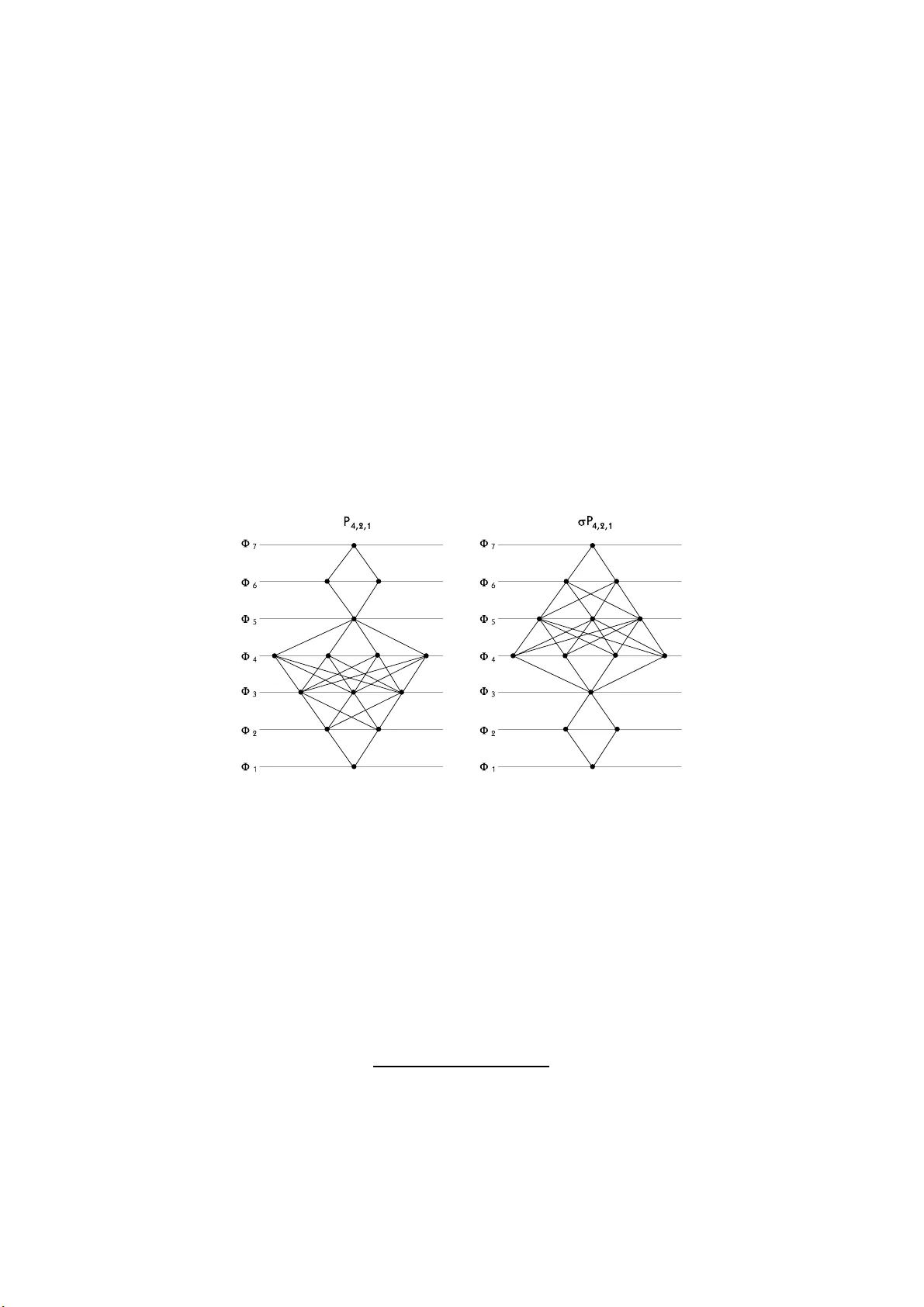
On mul ti F-nomial coefficients and Inversion f ormula f or F-nomial coefficients Maciej Dziemia´ nczuk Studen t in the Institut e of Computer Scien ce, University of Gda´ nsk PL-80-952 Gda´ nsk, st. Wita St wosza 57, Poland e-mail: Maciek.Ciupa@gmail.com Summary In resp onse to [7], w e disco v er the lo ok ed for inv ersion form ula for F -nomial co e fficien ts. Before su pplying its pro of, we generalize F -nomial co efficien ts to m ulti F -nomia l co efficien ts and we giv e their com binatorial interpretation in cobw eb p osets language, as the num b er of maximal-disjoin t blo c ks of the form σ P k 1 ,k 2 ,...,k s of la y er h Φ 1 → Φ n i . Then w e present in v ersion form ula for F -nomial co efficien ts using multi F-nomial coefficients f o r all cobw eb- admissible sequen ces. T o this end we infer also some ident ities as conclusions of that inv ers i on formula for the case of binomial, Gaussian and Fib onomial co e fficien ts. AMS Classification Num b ers: 05A19 , 11B39, 15A09. Keyw ords: cob web p oset, in v ersion form ula, f-nomial, fib onomial coefficient s Presen ted at Gian-Carlo Polish S emin a r: http://ii.uwb.e du.pl/akk/sem/ sem r ota.htm 1 Preliminaries A t fi rst, let us recall original p roblem called In v ersion form ula f or F - nomial co effic ien ts whic h w as brough t u p by A. K. Kwa ´ sniewski, in his 2001 lectures and p l aced then in [7] as an Exercise 7. Ex.7 [7] Disc over t he inversion f o rmula i.e. t he arr ay elements n k F − 1 for n k F b eing the so c al le d fib onomial c o efficients, i.e. n k F = n F ! k F !( n − k ) F ! , (1) for n F = F n b eing the n -th Fib onac ci numb er ( n, k > 0 ). (end of quote) In this note w e derive inv ersion form ula, n ot only for Fib onacc i num b er, but for all F-cob w eb adm iss i ble sequences [4 , 5 , 6, 10]. Therefore w e can 1 exp ect general hence s im p le r form of new and kn o wn ident ities for certain sequences, s uc h as for example for Natural and Gaussian n umbers as w e shall present it fu rther on. 2 Multi F -nomial co efficien ts In this section F -nomia l co efficien ts n k F and multi F -nomial co efficie nts n k 1 ,k 2 ,...,k s F with their resp ectiv e com bin atorial int erpretation are consid - ered. Definition 1 ([4, 5]) L et any F -c obweb adm issible se quenc e, then F -nom ial c o efficie nts ar e define d as fol lows n k F = n F ! k F ! · ( n − k ) F ! = n k F k F ! (2) wher e n F ! = n F · ( n − 1) F · ... · 1 F and n k F = n F · ( n − 1) F · ... · ( n − k + 1) F The combinatorial interpretatio n of n k F is the follo wing [4, 5]: F or F -c obweb tiling se quenc es F -nomial c o efficient n k F is the numb er of max-disjoint e quip otent c opies σ P m of the layer h Φ k +1 → Φ n i , wher e m = n − k . No w we generalize F -n omial to m ulti F -n o mial co efficien ts and we giv e also their combinato rial in terpretation in cob we b p osets language. Definition 2 L et F ≡ { n F } n ≥ 0 b e any natur al numb ers’ value d se quenc e i.e. n F ∈ N ∪ { 0 } and s ∈ N . Multi F -nomial c o efficient is then identifie d with the symb ol n k 1 , k 2 , ..., k s F = n F ! ( k 1 ) F ! · ... · ( k s ) F ! (3) wher e k i ∈ N and P s i =1 k i = n for i = 1 , 2 , ..., s . In other c ases is e qual to zer o. Observ ation 1 L et F b e any F - c obweb admissible se quenc e. The value of the multi F - no mial c o efficients is natur al numb er or zer o i.e. n k 1 , k 2 , ..., k s F ∈ N ∪ { 0 } (4) for any n, k 1 , k 2 , ..., k s ∈ N . 2 F or the sak e of forthcoming com binatorial in terpretation we int ro duce the follo w ing notation. Definition 3 L et any layer h Φ 1 → Φ n i , n ∈ N and a c omp osition of the numb er n into s nonzer o p arts designate d by the v e ctor h k 1 , k 2 , ..., k s i , wher e s ∈ N . Any c obweb sub- p oset cr e ate d by c onc atenate of blo ck s P k 1 , P k 2 , ..., P k s i.e. P k 1 ,k 2 ,...,k s = C n [ F ; 1 F , 2 F , ..., ( k 1 ) F , 1 F , ..., ( k 2 ) F , ..., 1 F , ..., ( k s ) F ] and c onse quently σ P k 1 ,k 2 ,...,k s = C n [ F ; σ h 1 F , 2 F , ..., ( k 1 ) F , 1 F , ..., ( k 2 ) F , ..., 1 F , ..., ( k s ) F i ] is c al le d multi-blo ck and denote d by P k 1 ,k 2 ,...,k s and σ P k 1 ,k 2 ,...,k s . Figure 1: Picture of m ulti blo c ks P 4 , 2 , 1 and σ P 4 , 2 , 1 . Observ ation 2 F or F - c obweb tiling se quenc es multi F -nomial c o efficient n k 1 ,k 2 ,...,k s F is the numb e r of max-disjoint e quip otent c opies σ P k 1 ,k 2 ,...,k s of the layer h Φ 1 → Φ n i , wher e n = k 1 + k 2 + ... + k s . Pr o of. The n umber of maximal c hains in a la y er h Φ 1 → Φ n i is equal to n F ! , ho w ev er the n umber of maximal chains in any multi b loc k σ P k 1 ,k 2 ,...,k s is ( k 1 ) F ! · ( k 2 ) F · ... · ( k s ) F . Therefore th e n umber of b loc ks is equal to n F ! ( k 1 ) F ! · ( k 2 ) F · ... · ( k s ) F where n = k 1 + k 2 + ... + k s and n, s ∈ N 3 Of course for s = 2 we hav e n k , n − k F ≡ n k F = n n − k F (5) Note. F or an y p erm utation σ of th e s e t { 1 , 2 , ..., s } the follo wing holds n k 1 , k 2 , ..., k s F = n k σ 1 , k σ 2 , ..., k σs F (6) as is obvious from Definition 2 of the multi F-nomial sy mb ol. i.e. n F ! ( k 1 ) F ! · ( k 2 ) F · ... · ( k s ) F = n F ! ( k σ 1 ) F ! · ( k σ 2 ) F · ... · ( k σs ) F Lemma 1 L et any c obweb-tiling se quenc e F fr om T λ family [10] i.e. suc h that for any m, k ∈ N ∪ { 0 } its terms satisfy n F = ( m + k ) F = λ m · m F + λ k · k F (7) for c ertain c o efficients λ m , λ k . T ake any c omp osition of the numb er n into s nonzer o p arts designate d by the v e ctor h k 1 , k 2 , ..., k s i . Then terms of the se quenc e F also satisfy n F = s X j =1 k j F = s X j =1 λ k j · ( k j ) F (8) for c ertain c o efficients λ k j ≡ λ k j ( k 1 , k 2 , ..., k s ) : N s 0 → N 0 , wher e N 0 ≡ N ∪ { 0 } and j = 1 , 2 , .., s . Pr o of. Let any cob we b tiling sequence F ∈ T λ and take a comp o sition of the natural n umber n giv en b y the ve ctor h k 1 , k 2 , ..., k s i . Th en from definition of T λ its terms satisfy n F = ( k 1 + ( n − k 1 )) F = λ k 1 · ( k 1 ) F + λ ( n − k 1 ) · ( n − k 1 ) F Then, next summand of the ab o ve can b e also separates in to tw o su mmands ( k 1 + k 2 + ( n − k 1 − k 2 )) F = λ k 1 · ( k 1 ) F + λ k 2 · ( k 2 ) F + ... + λ k s · ( k s ) F and so on u p to the k s = ( n − k 1 − k 2 − ... − k s − 1 ) case ( k 1 + k 2 + ... + k s ) F = λ k 1 · ( k 1 ) F + λ k 2 · ( k 2 ) F + ... + λ k s · ( k s ) F 4 Examples: F or F - Natural num b ers eac h of co efficien ts is constan t i.e. λ k 1 , λ k 2 , ..., λ k s = const = 1. Therefore w e obtain trivial iden tit y ( k 1 + k 2 + ... + k s ) F = ( k 1 ) F + ( k 2 ) F + ... + ( k s ) F . F or F - Fib onac ci n umber s and s = 3 case, w e ha v e ( a + b + c ) F = λ a a F + λ b b F + λ c c F (9) where λ a = ( c + 1) F ( b − 1) F , λ b = ( c + 1) F ( a + 1) F and λ a = ( a F b F + ( a − 1) F ( b − 1) F . Theorem 1 L et any se quenc e F ∈ T λ . Then F is c obweb multi tiling i.e. any layer h Φ 1 → Φ n i c an b e tiling with the help of max-disjoint multi-blo cks σ P k 1 ,k 2 ,...,k s and the numb er of max-disjoint multi-b lo cks satisfies n k 1 , k 2 , ..., k s F = s X j =1 λ k j n − 1 k 1 , ..., k j − 1 , k j − 1 , k j +1 , ..., k s F (10) wher e n = k 1 + k 2 + ... + k s for any k 1 , k 2 , ..., k s ∈ N . Pr o of. The m a in idea of this pro of w as already used in [11, 9], see there for more details. Give n an y Cobw eb p ose t Π designated by sequence F of cob web tiling sequences family T λ . Let an y lay er h Φ 1 → Φ n i , where n ∈ N and any n umber s ∈ N . W e need to tiling the la y er with h elp of max-disjoint m ulti blo c ks of the form σ P k 1 ,k 2 ,...,k s . Consider Φ n lev el, w h ere is n F v ertices, m o reo v er from Lemma 1 the num b er of vertic es in this level can b e written down as the follo wing sum n F = s X j =1 λ k j · ( k j ) F for certain co effici ent s λ k j ≡ λ k j ( k 1 , k 2 , ..., k s ) : N s 0 → N 0 , w here N 0 ≡ N ∪ { 0 } . Therefore let us separate this n F v ertices by cutting into s d isjoin t subsets as illustrated by Fig. 2 and cop e at fi rst λ k 1 · ( k 1 ) F v ertices in Step 1, th en λ k 2 · ( k 2 ) F ones in Step 2 and so on up to the last λ k s · ( k s ) F v ertices to consider in the last s -th step. 5 Figure 2: Idea’s p ic ture of Theorem 1. Step 1. T emp orarily w e hav e λ k 1 · ( k 1 ) F fixed v ertices on Φ n lev el to consider. Let us co ver them λ k 1 times by ( k 1 )-th lev el of blo c k P k 1 ,k 2 ,...,k s , whic h h as exactly ( k 1 ) F v ertices. If λ k 1 = 0 we skip this step. What w as left is the la yer h Φ 1 → Φ n − 1 i and w e might eve nt ually tiling it with smaller max-disj oint blo c ks σ P k 1 − 1 ,k 2 ,...,k s in n e xt indu ct ion s t ep. Note. In next in duction steps we use smaller blo c ks σ P without lev el, whic h w e ha v e used in cur ren t step (maximal-disjoin t condition). Notice also, that w e could co v er last lev el of la y er h Φ 1 → Φ n i b y n ot the last lev el of blo c k P k 1 ,k 2 ,...,k s due to fact, that we can tiling by b loc ks obtained from lev els’ p erm utation σ i.e. with help of maximal d isjoi nt blo c ks of the f o rm σ P k 1 ,k 2 ,...,k s . Step 2. Consider no w the second situation, where we h a v e λ k 2 · ( k 2 ) F v ertices on Φ n lev el b eing fixed. W e co ve r them λ k 2 times b y ( k 1 + k 2 )-th leve l of blo c k P k 1 ,k 2 ,...,k s , whic h has ( k 2 ) F v ertices. Therefore we sh a ll obtain smaller la y er h Φ 1 → Φ n − 1 i to tiling with blo c ks σ P k 1 ,k 2 − 1 ,k 3 ,...,k s . And so on up to ... Step s . By analogous to pr evi ous s teps , w e co ver the last λ k s v ertices by last ( k 1 + k 2 + ... + k s ) = n -th lev el of blo c k P k 1 ,k 2 ,...,k s , obtaining smaller la y er h Φ 1 → Φ n − 1 i to tiling with blo c ks σ P k 1 ,...,k s − 1 ,k s − 1 . Recapitulation: The lay er h Φ 1 → Φ n i ma y b e tiling with blo c ks σ P k 1 ,k 2 ,...,k s if h Φ 1 → Φ n − 1 i ma y b e tiling w i th blo c ks σ P k 1 − 1 ,k 2 ,...,k s and h Φ 1 → Φ n − 1 i by σ P k 1 ,k 2 − 1 ,k 3 ,...,k s again and so on up to tiling la y er h Φ 1 → Φ n − 1 i by σ P k 1 ,...,k s − 1 ,k s − 1 . Con- tin uing these steps b y induction, we are left to prov e that h Φ 1 → Φ s i ma y b e partitioned by b loc ks σ P 1 , 1 ,..., 1 or h Φ 1 → Φ 1 i by σ P 1 , 0 ,..., 0 ones, which is ob vious. 6 3 In v ersion form u la for F -nomial co efficien ts Let Π b e an y cob w eb p oset designated by F - cobw eb-admissible sequence. Let us consid e r standard red u ce d inciden ce algebra R (Π) . F -nomial co effi- cien t n k F is an elemen t of redu ce d incidence algebra R (Π) [1, 2]. F or more, see also references th er ein. Theorem 2 L et any F - c obweb admissible se quenc e and the matrix of n k F elements. Then the inverse matrix n k − 1 F is given b y the formula: n k − 1 F = n k F n − k X s =1 ( − 1) s X k 1 + k 2 + ... + k s = n − k k 1 ,k 2 ,...,k s ≥ 1 n − k k 1 , k 2 , ..., k s F = = n − k X s =1 ( − 1) s X k 1 + k 2 + ... + k s = n − k k 1 ,k 2 ,...,k s ≥ 1 n k , k 1 , k 2 , ..., k s F (11) for any n , k ∈ N such that n 6 = k and n n − 1 F = 1 . Pr o of. W e n e ed to show that n k F ∗ n k − 1 F = δ n,k i.e. P n s = k n s F s k − 1 F = δ n,k for the n 6 = k case only , f or n = k it is easy to see that, it holds. n X s = k +1 n s F s − k X j =1 ( − 1) j X k 1 + k 2 + ... + k j = s − k k 1 ,k 2 ,...,k j ≥ 1 s k , k 1 , k 2 , ..., k j F + n k F · 1 = 0 n X s = k +1 s − k X j =1 ( − 1) j X k 1 + k 2 + ... + k j = s − k k 1 ,k 2 ,...,k j ≥ 1 n k , n − s, k 1 , k 2 , ..., k j F + n k F = 0 Let u s distinguish s = n case from the sum : n − 1 X s = k +1 s − k X j =1 ( − 1) j X k 1 + k 2 + ... + k j = s − k k 1 ,k 2 ,...,k j ≥ 1 n k , n − s, k 1 , k 2 , ..., k j F + n − k X j =1 ( − 1) j X k 1 + k 2 + ... + k j = n − k k 1 ,k 2 ,...,k j ≥ 1 n k , 0 , k 1 , k 2 , ..., k j F + n k F = 0 Then renumerate fir st su m, such that s 7→ s − k 7 n − k − 1 X s =1 s X j =1 ( − 1) j X k 1 + k 2 + ... + k j = s k 1 ,k 2 ,...,k j ≥ 1 n k , n − s − k , k 1 , k 2 , ..., k j F + n − k X j =1 ( − 1) j X k 1 + k 2 + ... + k j = n − k k 1 ,k 2 ,...,k j ≥ 1 n k , k 1 , k 2 , ..., k j F + n k , n − k F = 0 F rom the second su m w e distin gu ish j = 1 case and reduce it with the last summand i.e. ( − 1) 1 X k 1 = n − k k 1 ≥ 1 n k , k 1 F + n k , n − k F = 0 Therefore we h av e t w o summand s, denote them as A, B i.e. A + B = 0 and ren umerate second sum, suc h that j 7→ j − 1 n − k − 1 X s =1 s X j =1 ( − 1) j X k 1 + k 2 + ... + k j = s k 1 ,k 2 ,...,k j ≥ 1 n k , n − s − k , k 1 , k 2 , ..., k j F + n − k − 1 X j =1 ( − 1) j +1 X k 1 + k 2 + ... + k j + k j +1 = n − k k 1 ,k 2 ,...,k j ,k j +1 ≥ 1 n k , k 1 , k 2 , ..., k j , k j +1 F = 0 Let us n o tice that, in A term we ha v e su m after Dioph antine equ ations w it h non-zero terms, where s tak es o v er v alues from the set { 1 , 2 , ..., n − k − 1 } lik e additional v ariable k j +1 in B term i.e. n = k + s + ( n − k − s ) s = 1 , 2 , ..., n − k − 1 k 1 + k 2 + ... + k j = s k 1 , k 2 , ..., k j ≥ 1 j = 1 , ..., s ⇒ n = k + k 1 + ... + k j + k j +1 k 1 , k 2 , ..., k j ≥ 1 j = 1 , ..., s The sign of the summ a nds in A and B sums c hanges with c hanging the n umber of v ariables in Diophan tine equations and dep ends only on that, hence n − k − 1 X j =1 ( − 1) j X k 1 + k 2 + ... + k j + k j +1 = n − k k 1 ,k 2 ,...,k j ,k j +1 ≥ 1 n k , k 1 , k 2 , ..., k j , k j +1 F + 8 n − k − 1 X j =1 ( − 1) j +1 X k 1 + k 2 + ... + k j + k j +1 = n − k k 1 ,k 2 ,...,k j ,k j +1 ≥ 1 n k , k 1 , k 2 , ..., k j , k j +1 F = 0 Corollary 1 W hitney numb ers of first kind define inverte d matrixes f or Whitney numb ers of se c ond kind i.e. [ W ij ] n × n ∗ [ w ij ] n × n = δ i,j for c ertain p osets [8]. Whitney numb ers of se c ond kind of a few p osets ar e p articu- lar c ase of F -nomial c o effici e nt s, and f r om Inversion formula of F -nomial c o efficie nts we c an infer some identities: 1. hP n , ⊆i Whitney n umb e rs W P n ( k ) = n k and w P n ( k ) = ( − 1) n − k n k F or F - Natural num b ers W P n ( k ) = n k = n k F ⇒ n k − 1 F = ( − 1) n − k n k (12) 2. h L ( n , q ) , ⊆i Whitney n umbers W L ( n,q ) ( k ) = n k q and w L ( n,q ) ( k ) = ( − 1) n − k n k q q ( n − k 2 ) F or F - Gaussian num b ers W L ( n,q ) ( k ) = n k q = n k F ⇒ n k − 1 F = ( − 1) n − k n k q q ( n − k 2 ) (13) Corollary 2 L et { Φ n ( x ) } n ≥ 0 b e a p olynomia l se quenc e (deg (Φ n ( x )) = n ) . Then f o r any n , k ∈ N Φ n ( x ) = X k ≥ 0 n k − 1 F x k ⇔ x n = X k ≥ 0 n k F Φ k ( x ) (14) while Φ 0 ( x ) = 1 . 1. N atural n um b ers , tak e F such that n F = n , then ( x − 1) n = X k ≥ 0 n k F ( − 1) n − k x k ⇔ x n = X k ≥ 0 n k F ( x − 1) k where n k F ≡ n k 2. Gaussian in tegers , take F such that n F = 1 − q n − 1 1 − q , then Φ n ( x ) = X k ≥ 0 n k F ( − 1) n − k q ( n − k 2 ) x k ⇔ x n = X k ≥ 0 n k F Φ k ( x ) where n k F ≡ n k q and Φ n ( x ) = Q n − 1 s =0 ( x − q s ). 9 3. F ibonacci num b ers , i.e. n F = ( n − 1) F + ( n − 2) F , 1 F = 2 F = 1 then with the h e lp of in v ersion form ula for F-nomial co effici en ts, let us sho w a f e w first p olynomials Φ n ( x ) Φ 0 ( x ) = 1 Φ 1 ( x ) = x − 1 Φ 2 ( x ) = x 2 − x Φ 3 ( x ) = x 3 − 2 x 2 + 1 Φ 4 ( x ) = x 4 − 3 x 3 + 3 x − 1 Φ 5 ( x ) = x 5 − 5 x 4 + 15 x 2 − 5 x − 6 Φ 6 ( x ) = x 6 − 8 x 5 + 60 x 3 − 40 x 2 − 48 x + 35 Φ 7 ( x ) = x 7 − 13 x 6 + 260 x 4 − 260 x 3 − 624 x 2 + 455 x + 181. Φ 8 ( x ) = x 8 − 21 x 7 + 1092 x 5 − 1820 x 4 − 6552 x 3 + 9555 x 2 + 8301 x − 6056 . ho w ev er simp le r formula for Φ n ( x ) wher e F -Fib onacci sequence as for instance in the case of Natural and Gaussian num b ers is still un kno wn. T o b e the next As we can see ab o v e, for certain sequences F , inv ersion f o rmula r e duces to simpler form. Therefore for other sequ e nces, like Fib onacci num b ers with a lot of p roperties, w e can exp ect also simpler ones. Ac kno w ledgemen ts I w ould lik e to thank Professor A. Krzysztof Kwa ´ sniewski - w ho initiated m y interest in his cobw eb p oset concept - for his very helpf ul comment s, impro v emen ts and corrections of this note. Assistance of E. Krot-Sienia ws k a with resp ect to incidence algebras of cob w eb p osets is highly app r ec iated to o. References [1] Ew a Kr o t-Sienia wsk a, On incidenc e algebr as description of c obweb p osets , W ed, 27 F eb 2008, arXiv:0802 .3703 , [math.CO] Discrete Math- ematics (cs.DM) submitted for publication [2] Ew a Krot-Sienia wsk a, R e duc e d Incidenc e algebr as description of c obweb p osets and KoDA Gs , F ri, 29 F eb 2008, arXiv:0802.4293, [math.CO] Dis- crete Mathematics (cs.DM) [3] Ew a K rot, An Intr o duction to Finite Fib onomial Calculus , Cen tral Eu- rop ean Journal of Mathematics 2(5) (2005) 754-766. [4] A. Krzysztof Kwa ´ sniewski, Cobweb p osets as nonc ommutative p r e- fabs , Adv. Stu d . Con temp. Math. v ol.14 (1) 2007. pp. 37-47; h ttp://arxiv.org/a bs/ math/050328 6 cs.DM S u n, 25 Sep 2005 10 [5] A. Kr z ysztof K w a ´ sniewski, On c obweb p osets and their c ombinator ial ly admissible se quenc es , arXiv: math.CO cs.DM /0512578 Su n, 21 Oct 2007 http://a rxiv.org/abs/math/0512 578 [6] A. Krzysztof K w a ´ sniewski, M. Dziemia ´ nczuk, Cobweb Posets - R e- c ent R esults , I SRAMA 2007, Decem b er 1-17 2007 K o lk ata, I NDIA, Adv. Stud . Contemp. Math. v olume 16 (2), 2008 (Ap r il) pp. 197-21 8, arXiv:0801 .3985 math.CO, cs.DM, 25 Jan 2008 [7] A. Krzysztof Kwa ´ sniewski, Ewa Krot-Sienia wsk a, On inv e r sion formu- las and Fib onomial c o efficients , Pro c. Jang jeon Math. So c, 11 (1), 2008 (June), math.CO, cs.DM, math.GM, arXiv:0803.1 393 Mon, 10 Mar 2008 [8] W. Lipski, W. Marek, Combinato rial Analysis , v.59 BM, PWN, W arsa w 1986 (in p olish) [9] M. Dziemia´ nczuk, On Cobweb p osets tiling pr oblem , Adv. Stud. Con- temp. Math. vo lume 16 (2), 2008 (April) p p. 219-23 3, arXiv:0709 .4263 math.CO, cs.DM, 4 Oct 2007 [10] M. Dziemia ´ nczuk, On Cobweb A dmissible Se quenc es - The P r o duction The or em , Th e 2008 International Conference on F oun dati ons of Com- puter Science (F C S’08 : WORLDCOMP’08, USA, Las V egas) [11] M. Dziemia´ nczuk, R ep ort On Cobweb Posets’ Tiling Pr oblem , arXiv:0802 .3473 v1 W ed, 27 F eb 2008, math.CO , cs.DM 11
Original Paper
Loading high-quality paper...
Comments & Academic Discussion
Loading comments...
Leave a Comment