Superposition-Coded Concurrent Decode-and-Forward Relaying
In this paper, a superposition-coded concurrent decode-and-forward (DF) relaying protocol is presented. A specific scenario, where the inter-relay channel is sufficiently strong, is considered. Assuming perfect source-relay transmissions, the propose…
Authors: Chao Wang, Yijia Fan, Ioannis Krikidis
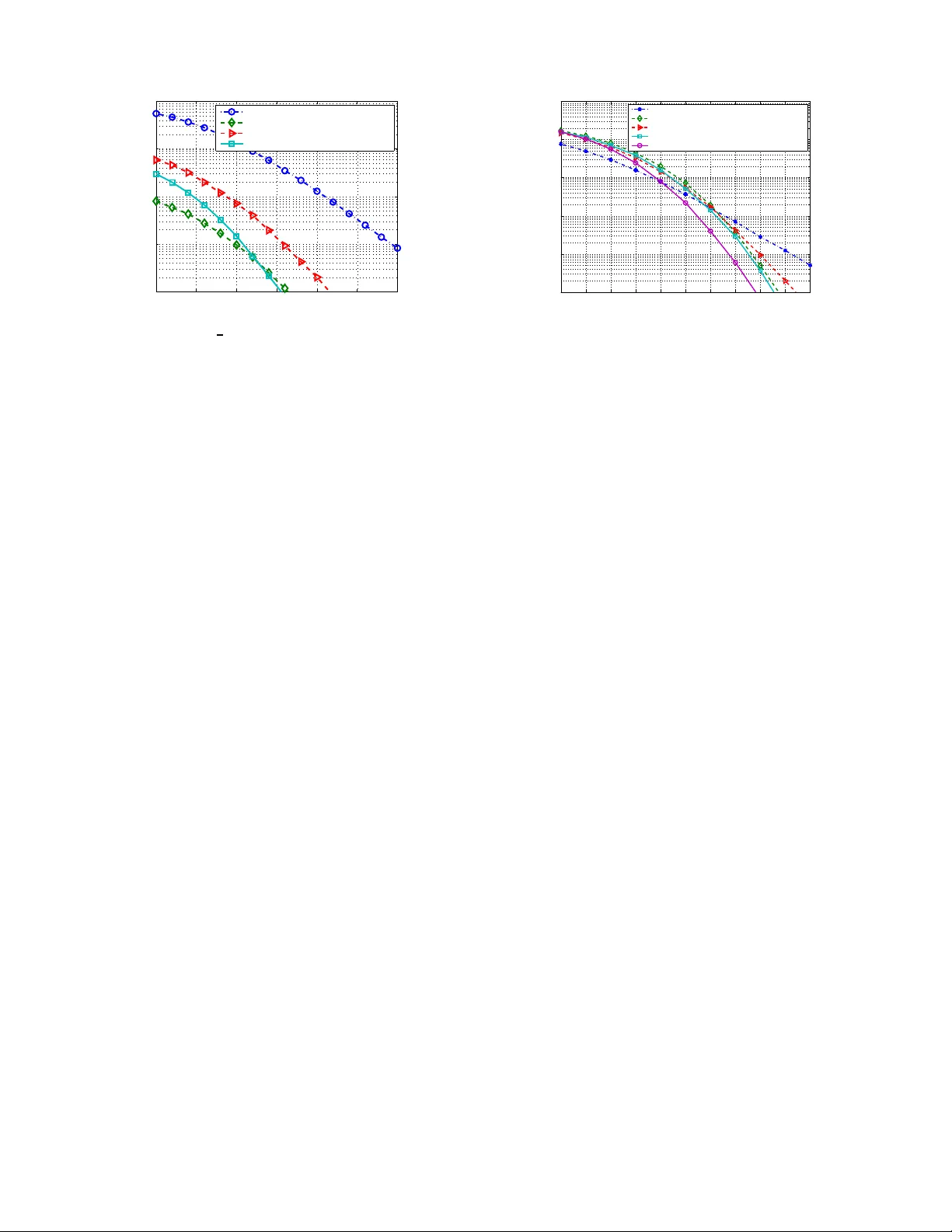
Superposition-Coded Concurrent Decode-and-F orwa rd Relaying Chao W ang ∗ , Y iji a Fan † , Ioannis Krikidis ∗ , John S. Thompson ∗ and H. V incen t Poor † ∗ Institute for Digital Communica tions, Uni versity of Edinburgh, Edinbur gh , UK † Departmen t of Electrical Engine ering, Princeto n University , Princeton, USA Abstract — In this paper , a superposition-coded concurrent decode-and-forwar d (DF) relaying p rotoc ol is p resented. A spe- cific scenario, where the inter -relay channel is sufficientl y strong, is considered. Assu ming perfect source-relay transmissions, the proposed scheme further imp ro ves t he diversity performance of prev iously proposed repetition-coded concurrent DF relaying, in which the advantage of the inter-r elay interference is n ot fully extracted. I . I N T R O D U C T I O N The exploitatio n of cooper ation amo ng users has been studied in recent years as a means fo r improving di versity perfor mance fo r single- antenna wireless systems. Due to the half-du plex limitation, standar d cooper ati ve diversity proto- cols (e. g. [1] [ 2]) usually req uire two time-division-mu ltiple- access (TDMA) time slots to finish each signal codeword’ s transmission. Altho ugh diversity gain can b e improved over conv entio nal TDMA direct so urce-destinatio n transmission, standard coopera tion protoco ls result in lost spectral efficienc y , especially in the h igh signal-to -noise r atio (SNR) r egion. T o overcome the m ultiplexing limitation of standard pro- tocols, an advanced successi ve relaying pr otocol (inde pen- dently propo sed by [3 ], [4], and [5] in d ifferent contexts) has been considered such th at two relay s take turns helping the source to mimic a fu ll-duplex relay . The single-source single-anten na network studied in [5] has been extended to a two-source multiple-anten na (at the destination only) scen ario in [6] and [7], in which the scheme is termed concurr ent decode- and-fo rward (DF) relaying . For such a p rotocol, a two- source tw o- relay one-destination cooperation network has been considered . Th e two sources’ standard DF relaying steps are combined so that th e degrees of the freed om of the channel are efficiently used an d th e multiplexing lo ss induced by standard protoco ls can be effecti vely recovered. The m ajor issue with conc urrent DF relay ing is that the interferen ce gener ated among the two relays sign ificantly affects the system d iv ersity-m ultiplexing tradeoff (DMT) per- forman ce. In [7], two specific scenarios (i.e. th e isolate d-r elay and str ong-inte rfer ence scenarios) are examined to investigate the imp act of the in ter-relay in terference. Howe ver, for both scenarios, reference [7 ] requires the relays to u se re petition coding to r etransmit their so urce messages. I n th is p aper, we argue th at suc h an assum ption is not very efficient fo r the strong -interferen ce scenario bec ause the advantage of the inter-relay interf erence, which is also useful infor mation, is not fu lly extracted. Specifically , for the strong-interfer ence scenario, instead of re quiring each relay to fo rward its own source’ s codeword, we perm it it to use superp osition coding to transmit both source s’ codewords. In this way , the ach ie vable div er sity gain can be fu rther impr oved with the sacrifice of only one extra transmission time slot. Whe n the signa l frame length L is large, the multiplexing lo ss in duced by this extra transmission time is n egligible. The rest of th is paper is organized a s follows. In Section II, we briefly r evie w the DMT behavior of the rep etition-cod ed concur rent DF relay ing protocol and present the superposition- coded concur rent DF relaying protoco l for a two-source network. The system model is gen eralized to an M -source network in Section III. Fin ally , we of fer simulatio n results and discu ssions in Sectio n IV. I I . T W O - S O U R C E C O N C U R R E N T D F R E L AY I N G W e first stud y a fiv e- node network with two single-anten na sources S 1 and S 2 , two single- antenna half-d uplex DF relays R 1 and R 2 , and one N -antenna destination D . The transmitted messages fr om each source are divided into different fram es, each contain ing L co dew or ds d enoted as x j i , i = 1 , 2 , j = 1 , . . . , L . T wo ind ependen t Gaussian rand om codeb ooks are used by the two sources a nd a re known by both re lays. Each codeword x j i is independe ntly chosen fro m th e associated Gaussian rand om codeboo k and has u nit average power . A slow , flat, bloc k Rayleigh fading environment is assumed, where the cha nnel remains static for one c oherence interval (two frame period s) and chang es in depende ntly in different coheren ce in tervals. Moreover , w e assume a un iform power allocation scheme, i.e. the total transmit power in e ach trans- mission time slot remains the s am e and each terminal transmits with equal power . A. Rep etition-Coded Concurrent DF R elaying For such a two-relay scenario , due to the half- duplex oper- ation of the relays, fo r each source co dew or d, the space-time- coded stand ar d DF r elayin g protoco l [8], which is a practica l example of the protoco l prop osed by [2], requires each sour ce to br oadcast the co dew ord to b oth relays and the destination in the first time slot (broad casting step). The relays then retransmit the cod ew ord (u sing a distributed Alamouti sp ace- time block code) to the destination in the secon d time slot (relaying step), as shown in Fig. 1 (b) . Assuming th e sour ce messages are co rrectly de coded by the r elays, the stan dard protoco l can pr ovide significan t div ersity gain impr ovement Fig. 1. Time -divisi on channel allocati ons for (a) TDMA direct transmission, (b) space-time-code d standard DF relayin g, (c) repetition-c oded concurre nt DF relayi ng, (d) superpositio n-coded concurrent DF relaying for the two- source networ k, and (e) superpositi on-coded concurrent DF relayi ng for the M -source network ( M is eve n). The terminals displayed in each time slot denote the tran smitters in that time slot. over TDMA d irect source- destination transmission. Howe ver , to finish the transmission o f the 2 L c odewords fr om the two sources to the d estination, 4 L time slots mu st be used. Compared with TDMA d irect transmission display ed in Fig. 1 (a), whic h nee ds only 2 L time slots, the standard protoco l loses spectra l efficiency , especially fo r the hig h SNR region . In ord er to compe nsate f or the m ultiplexing g ain reduc tion induced by the standa rd pro tocol, for co ncurren t DF relayin g [6] it is assumed that each source is in dividually assisted by one relay (i.e. S 1 and S 2 are suppo rted b y R 1 and R 2 respectively) an d one sourc e’ s bro adcasting step is combin ed with the o ther sou rce’ s relay ing step . As displayed in Fig. 1 (c), except in th e fir st an d the last time slots, on e relay and o ne source always commu nicate with the destination simultaneou sly so that on ly (2 L + 1) time slots are n eeded to finish the transmission of the 2 L codewords. It is clear th at the in terference generated am ong relays can sign ificantly d egrade the system capacity and d iv ersity perfor mance. Howe ver, the two relays may be isolated [4], which means the qu ality of the inter-relay link is much worse than those of the source-relay lin ks. I n this case, the inter- relay inter ference is trivial comp ared with sou rce-relay trans- missions and thus can be igno red. Since the relays are assumed to simply r epeat their source codewords after d ecoding them, we refer to this transmission scheme as the repetition-coded concurrent DF relaying throu ghout the pap er . Define the diversity gain d and mu ltiplexing gain r as those in [9] and assume the system is symmetric [1 0], where the two sou rces have identical multiplexing g ains r . Assumin g the source-re lay links ar e sufficiently strong such that the relays can always perfectly deco de their source messag es, the DMT achieved by each source for the repetitio n-coded concurren t DF relay ing protoco l can be expressed by [7 ] d ( r ) = 2 N 1 − 2 L + 1 L r . (1) The repetitio n-coded con current DF relaying significantly improves the div er sity perfor mance over TDMA d irect tr ans- mission (with DMT d ( r ) = N (1 − 2 r ) ) except for a m ultiplex- ing loss 1 2 − L 2 L +1 = 1 4 L +2 . Such multiplexing loss d ecreases as L increases and can be neglected for large frame length L . Howe ver , com pared with the space- time-coded standar d DF relaying (with DMT d ( r ) = 3 N (1 − 4 r ) ), the rep etition-cod ed concur rent DF relaying obtains smaller diversity gain when 0 ≤ r ≤ L 8 L − 2 since each co dew or d is only forwarded by o ne relay . B. Su perposition-Co ded Concurrent DF relaying A str ong -interfer ence scena rio [1 1], where the channel between the two r elays is sufficiently stron ger than the source- relay lin ks, is also studie d in [7]. In th is case, each relay is required to decode the interf erence sign al first and sub tract it from the r eceiv ed sign al b efore d ecoding the desire d signal. The goo d quality of the inter-relay ch annel guarantee s that each rela y can correctly d ecode the interference be fore decod - ing its desired source cod ew ord with very hig h probability . Therefo re, the interferen ce between relays d oes not limit the system DMT perfo rmance. Howe ver , for such a stro ng- interferen ce scen ario, r eference [7] still assumes that each relay only forwards its own sour ce message (the d esired signal). In fact, since th e interferenc e sign al is the transmitted codeword fro m the other source, in this pape r , we argue that we can m ake u se of the interference sig nal to fu rther improve th e system d i versity gain . Specifically , we permit the relays to use superpo sition coding [11] to retransmit both sources’ messages, i.e. instead of retran smitting its desired source codeword, each relay tran smits the sum o f the inter- ference codeword an d the desired cod e word. T o gu arantee ev ery codeword to be tran smitted via three indep endent path s, (2 L + 2 ) time slots ar e used to fin ish the transmission of the 2 L cod ew ord s fro m the two sour ces. The tra nsmission of th e two frame s can be d escribed as follows: T ime slot 1 : S 1 broadc asts x 1 1 to bo th R 1 and D ; S 2 and R 2 remain silent. T ime slot 2 : R 1 forwards x 1 1 to D and S 2 transmits x 1 2 . R 2 listens to S 2 while b eing interfered b y x 1 1 from R 1 . D receives x 1 1 from R 1 and x 1 2 from S 2 . T ime slot 3 : R 2 forwards ( x 1 2 + x 1 1 ) to D . S 1 transmits x 2 1 . R 1 listens to S 1 while being interfered by ( x 1 2 + x 1 1 ) from R 2 . D rec ei ves ( x 1 2 + x 1 1 ) fro m R 2 and x 2 1 from S 1 . T ime slot 4 : R 1 forwards ( x 2 1 + x 1 2 ) to D . S 2 transmits x 2 2 . R 2 listens to S 2 while being interfered by ( x 2 1 + x 1 2 ) from R 1 . D rec ei ves ( x 2 1 + x 1 2 ) fro m R 1 and x 2 2 from S 2 . This proc ess repeats u ntil the (2 L ) th time slo t. T ime slot 2 L + 1 : R 2 retransmits ( x L 2 + x L 1 ) to R 1 and D . T ime slot 2 L + 2 : R 1 decodes, r e-encod es and retran smits x L 2 to D . Unlike th e repetition-co ded case, from the 3 rd to the (2 L + 1) th time slot, th e interfer ence signal receiv ed by each relay is not only the other relay’ s desired source codeword, but also the codeword tra nsmitted by the relay itself du ring the previous time slot. Because eac h relay h as full knowledge of its own transmitted codeword, it can su btract its previously transmitted codeword fr om the received sign al befo re decodin g without Fig. 2. Tra nsmission schedule for the superposition-cod ed concurrent DF relayi ng protocol (from time slot 3 to time slot 2 L ) in (a) time slot 2 i − 1 , and (b) time slot 2 i , i = 2 , . . . , L . Solid lines and dashed lines denote the broadca sting step (time slot 1 ) and relayi ng step (time slot 2 ) of each source’ s standard DF relaying process respecti vely . any difficulty . After all the 2 L cod ew ord s are received, D perfor ms joint decod ing to recover the sour ce inf ormation. W e refer to this protoco l as the sup erposition-co ded concurrent DF r elaying an d its time-division chann el allocation and the transmission schedu le (fro m the 3 rd time slot to the 2 L th time slot) ar e illustrated in Fig. 1 (d ) and Fig . 2 r espectively . Assuming perfect sour ce-relay tra nsmissions, the pr oposed protoco l m imics a 2 L -user multiple acce ss single-inp ut multiple-ou tput (SIMO) channel (except that th e d imensions of the signals are expand ed in the time do main): y = √ ρ Hx + n , (2) in wh ich the eq uiv alent channe l matr ix is H = h S 1 0 0 · · · 0 0 h R 1 √ 2 h S 2 √ 2 0 · · · 0 0 h R 2 √ 4 h R 2 √ 4 h S 1 √ 2 · · · 0 0 0 h R 1 √ 4 h R 1 √ 4 · · · 0 0 . . . . . . . . . . . . . . . . . . 0 0 0 · · · h R 1 √ 4 h S 2 √ 2 0 0 0 · · · h R 2 √ 2 h R 2 √ 2 0 0 0 · · · 0 h R 1 , (3) where h a is the N × 1 chan nel fading vector b etween n ode a and the d estination, 0 den otes an N × 1 all zero vector, y = [ y T 1 y T 2 . . . y T 2 L +2 ] T , y i is the N × 1 r eceiv e signal vector at the i th time slot, x = [ x 1 1 x 1 2 x 2 1 . . . x L 2 ] T is the 2 L × 1 tra nsmit sig nal vector, n is a (2 L + 2) N × 1 unit p ower comp lex circular ad ditiv e white Gaussian no ise (A WGN) vector at the destinatio n, an d ρ m eans the a verage received SNR. It is worth notin g tha t th e scaling factors 1 √ 2 and 1 √ 4 come fro m the un iform p ower allocation assumptio n and h av e no con sequence fo r the system infin ite-SNR DMT perfor mance. In terms of th e achiev able DMT , we have th e following th eorem. Theor em 1 : In a symmetric scenar io, on assuming th at the source codew ord s are correctly dec oded by the relays, the achiev able DMT for each source of the superp osition-cod ed concur rent DF relay ing p rotocol (i.e. th e system mo del in (2)) is given by d ( r ) = 3 N 1 − 2 L + 2 L r . (4) Pr oof: For a sy mmetric 2 L - user multiple- access SIMO system d escribed in (2), following the c apacity calcula tion in [12], there are (2 2 L − 1 ) so urce transmission rate constraints for a given realization o f the channe l: R ≤ lo g det I + ρ h k h H k , (5) 2 R ≤ log det I + ρ h k 1 h H k 1 + ρ h k 2 h H k 2 , (6) . . . and 2 LR ≤ lo g det I + ρ HH H , (7) where h k denotes the k th column o f H . Th e system diversity gain is thu s the smallest diversity gain calculated by all the constraints fr om (5) to (7). Consider an ( m + 2) N × m multiple-inp ut multiple-o utput (MIMO) channel (each codew or d s i has multiplexing ga in r ′ = 2 L +2 L r so that the average transmission rate ¯ R = L 2 L +2 r ′ log ρ = r log ρ ) r 1 r 2 r 3 . . . r m +1 r m +2 = √ ρ g 1 0 0 · · · 0 g 2 g 3 0 · · · 0 g 4 g 4 g 1 · · · 0 0 g 2 g 2 · · · 0 . . . . . . . . . . . . . . . 0 0 0 · · · g k 1 0 0 0 · · · g k 2 0 0 0 · · · g k 3 s 1 s 2 s 3 . . . s m + n , (8) where k 1 = 1 , k 2 = 2 , and k 3 = 4 wh en m is odd and k 1 = 3 , k 2 = 4 , an d k 3 = 2 wh en m is even. For infinite SNR, the task o f finding the smallest diversity gain obtain ed by each constrain t from (5) to (7 ) is the same as finding the smallest d i versity gain achieved by the system (8) f or every 1 ≤ m ≤ 2 L [6 ]. When m = 1 , the system mod el in (8) is a 1 × 3 N SIMO system. The achievable DMT is clearly d ( r ) = 3 N (1 − r ′ ) = 3 N 1 − 2 L +2 L r . When m > 1 , applying a metho d similar to that u sed for the DM T calculation for th e ISI chan nels in [13], it is not difficult to show that d ( r ) = 4 N (1 − r ′ ) . Because the overall system diversity gain is do minated by th e smallest one f or all m , it thu s is (i.e. the case where m = 1 ) the same as the r ight hand side of (4). Du e to limited sp ace, her e w e omit the detailed proof , which can be fou nd in [14] . Theor em 1 indicates that super position-co ded co ncurren t DF relaying obtains th e maximal div ersity gain 3 N and maximal multiplexing gain L 2 L +2 . This means that the di versity perfor mance of the repe tition-coded con current D F relay ing is further imp roved by mak ing use o f the inter-relay interferen ce. Therefo re, un like the repetition-co ded case, where th e achiev- able div er sity gain is larger than that of the space- time-coded standard proto col only in th e high r region, superpo sition- coded co ncurren t DF relay ing strictly outp erform s the stan- dard protoc ol within th e range of all possible multiplexing gains (except f or the worst case L = 1 , where the two protoco ls have identical perform ance). Althoug h the re exists a 0 0.05 0.1 0.15 0.2 0.25 0.3 0.35 0.4 0.45 0.5 0 1 2 3 4 5 6 Multiplexing Gain r Diversity Gain d(r) TDMA Direct Transmission Space−Time−Coded Standard DF Repetition−Coded Concurrent DF, L=15 Superposition−Coded Concurrent DF, L=15 . Fig. 3. DMT performan ce for dif ferent proto cols with N = 2 . slight dif fe rence for the max imal achievable multiplexing g ain L 2 L +1 − L 2 L +2 = L (2 L +1)(2 L +2) between the rep etition-cod ed and sup erposition- coded con curren t DF relaying p rotocols (due to th e extra transmission tim e slot), whe n L is large this difference is negligible and the maximal multiplexing gains for both proto cols ap proach 1 2 . Th e multiplexing loss ind uced b y the standard pr otocol is fully co mpensated in both proto cols. Fig. 3 disp lays an example ( N = 2 , L = 15 ) of the DMT compariso n. Throu ghout this p aper, we assume that the sou rce-relay transmissions are perfect so that the system diversity gain is n ot limited b y the quality of source- relay links. Making use of the inter-relay interfer ence can thus further improve the di versity perfor mance over the simple repetition-cod ed protoco l. One may argue that, in pr actical systems, su ch good sou rce-relay lin ks m ay no t b e ab le to be guaranteed and the system DMT perfo rmance may be affected by any weak sou rce-relay link. In fact, in a gener al co operation network, ther e usually exist multip le termin als which can act as p otential relay s. I f the numb er of potential r elays is very large, the prob ability of selectin g at least o ne relay pair such that one r elay can co rrectly decode one sou rce and the other relay can corre ctly decode the oth er source is sufficiently high. In this case, th e system DMT perfo rmance behaves the same as the case in which the tr ansmissions between the sources and their relays are always successful. Therefore, our assumption is actually not u ncommo n in reality . The impact of using relay selection sche mes in m ultiple-relay scenario s on the system DMT p erforma nce is currently unde r investigation. I I I . M - S O U R C E C O N C U R R E N T D F R E L A Y I N G The two-source system model can also be extended to a large network with M single-an tenna source s, two single- antenna relays and on e N -antenna destination, as has been done fo r the repetition -coded case in [7]. The basic idea is that th e M sou rces commu nicate with the co mmon destination using TDMA and the tw o relays take turns helping each source until the transmission of the L codewords f rom ea ch source is finished. Theref ore, M L + 2 time slots are used to com plete the transmission of th e M L codewords f rom the M sources. Assuming perfect deco ding at the relays, th e tim e-division channel allocation is illustrated in Fig. 1 (e) (wh ere M is even) and in terms of the achiev able DMT , we hav e the fo llowing corollary to Theor em 1 . Cor ollary 1: In a symmetric scenario, on assuming p er- fect source -relay transmissions, the achiev able DMT f or each source of the sup erposition- coded M -source conc urrent DF relaying pro tocol is given by d ( r ) = 3 N 1 − M L + 2 L r . (9) Cor ollary 1 im plies that, compa red with repetition -coded concur rent DF r elaying for the M -source network, wh ich needs ( M L + 1) time slots and ob tains DMT d ( r ) = 2 N 1 − M L +1 L r , the super position-co ded proto col impr oves the max imal achievable d iv ersity ga in fro m 2 N to 3 N , but reduces the max imal achie vable multiplexing gain from L M L +1 to L M L +2 . However , if M L is large, the maximal m ultiplexing gain difference is n egligible and bo th gains ap proach 1 M (the maximal multiplexing gain for TDMA direct transmission) so that th e multiplexing loss is f ully recovered and the re- quiremen t of L bein g large is relaxed. Clearly , when M = 1 , the system model is the single-so urce scenario studied in the content of the succ essi ve relay ing proto col prop osed in [5]. This means that superposition coding can also be used in successiv e r elaying to further incr ease diversity pe rforman ce and thu s (9) offers a genera lized result. I V . S I M U L A T I O N R E S U LT S A N D D I S C U S S I O N S In th is section, we com pare ou r two-sourc e super position- coded con current DF relayin g scheme with oth er scheme s discussed in Section II in terms of erro r proba bility thr ough Monte-Carlo simulations. The sour ce messages are assumed to be alw ays cor rectly decoded by the relay s. In our simulation s, we c onsider the signal frame lengths L = 1 and L = 2 for the repetition -coded and su perposition -coded concurr ent DF relaying protocols, respectiv ely . For this choice, both schemes obtain the maximal mu ltiplexing gain 1 3 . These two cases are actually the worst cases fo r bo th schemes. (Recall that when L = 1 , the sup erposition- coded concu rrent DF relaying has the same DMT perfo rmance as th e space-time-cod ed stan dard protoco l and we therefo re d o not consider this c ase.) And following th e analysis in Section II, when L > 1 ( L > 2 ), the perfor mance of the re petition-cod ed (supe rposition-co ded) concur rent DF relaying would b e even better than tho se shown in the following simulations. Fig. 4 display s the o utage pro babilities compar ison for different sch emes when multiplexing ga in r = 1 6 (i.e. the t ran s- mission rates are n ot fixed and scale with SNR). Follo wing the analy sis in Section II, it can be seen that the DMT cur ves for the stan dard proto col and th e repetition- coded con current DF relaying intersect, wh ich means the two proto cols h av e the same d i versity gain s. Clearly , this diversity gain is furth er improved b y the use of th e superposition c oding in the relays. Such a div ersity p erforman ce can be seen by comparing the slopes of the high-SNR o utage p robability cu rves f or different schemes. W e also study the error perfor mance fo r unco ded symb ols for different schemes. For a fair co mparison, we con sider 4 - 0 5 10 15 20 25 30 10 −5 10 −4 10 −3 10 −2 10 −1 Signal−to−Noise Ratio (dB) Outage Probability TDMA Direct Transmission Space−Time−Coded Standard DF Repetition−Coded Concurrent DF Superposition−Coded Concurrent DF Fig. 4. Outa ge probabiliti es comparison for differe nt protocols with N = 2 and multiple xing gain r = 1 6 . QAM, 8 -QAM and 16 -QAM mod ulation for TDMA direct transmission, co ncurren t DF relay ing and th e standar d pro- tocol r espectiv ely so that all schemes ha ve identica l average transmission rates at two bits pe r channel use (BPCU). For decodin g at the destination , a maximal ratio combining (MRC) receiver is used for TDMA direct transmission and the stan- dard protoc ol, and a maximum likelihood sequence detector (MLSD) receiver is used for the concurr ent DF re laying protoco ls. Mo reover , we co nsider two different ways to use superpo sition coding in the r elays. The first o ne (deno ted as mode 1 in Fig. 5) is similar to super position m odulation [15] and we require each relay to retr ansmit the direct sum of its desired signal and the interfer ence. The second one is similar to co de sup erposition [1 6] (den oted as mo de 2). In this case, each codeword transmitted by the relays r epresents the XORed version of the two signa ls. From Fig. 5, it can be seen TDMA d irect tr ansmission has the worst high- SNR perfo rmance. Althoug h repetition- coded concur rent DF relaying im proves the er ror perform ance due to the signal pro tection by the relay s, it p erform s worse than space-time-co ded standar d DF relaying since each cod e word is only fo rwarded by one relay . Clearly , su perposition -coded concur rent DF relaying has the same d i versity order as the standard p rotocol. Fur thermore, mo de 2 superp osition coding outperf orms mo de 1 by nearly 1 . 7 dB, which c onfirms the advantage of code sup erposition analyzed in [16] . T his obser- vation suggests in teresting fu ture work in app lying network coding techn iques in o ur app roach. A C K N O W L E D G M E N T C. W ang ’ s, I. Kr ikidis’ and J. S. Thompson’ s work re- ported in this paper has fo rmed par t of the Deli very Effi- ciency Core Research Programm e of th e V irtual Centre of Excellence in Mobile & Personal Co mmunication s, Mobile VCE, www .mobilevce.com. This research has been funded by EPSRC an d b y the Indu strial Compan ies who are Members o f Mobile VCE. Fully detailed technical re ports on this research are av ailable to I ndustrial M embers of Mobile VCE. Y . Fan’ s and H. V . Poor’ s work was supported in p art by th e U. S. National Scien ce Foun dation und er Gra nts ANI- 03-38 807 and CNS-06-25 637. The authors acknowledge th e suppo rt of the Scottish Funding Council for the Join t Research I nstitute with 0 2 4 6 8 10 12 14 16 18 20 10 −5 10 −4 10 −3 10 −2 10 −1 10 0 Signal−to−Noise Ratio (dB) Bit Error Rate TDMA Direct Transmission Space−Time−Coded Standard DF Repetition−Coded Concurrent DF Superposition−Coded Concurrent DF mode 1 Superposition−Coded Concurrent DF mode 2 . Fig. 5. Bit error rate comparison for dif ferent protoc ols with N = 2 . the Herio t-W att Un i versity which is a p art of the E dinburgh Research Partnership. R E F E R E N C E S [1] J. N. L aneman, D. N. C. Tse, and G. W . W ornell, “Cooperati ve div ersity in wireless networks: Efficie nt protocols and outage beha vior , ” IEE E T rans. Inform. Theory , vol. 50, no. 12, pp. 3062–3080, Dec. 2004. [2] J. N. Laneman and G. W . W ornell, “Distribut ed space-time-cod ed protocol s for exploiti ng cooperati ve div ersity in wireless networks, ” IEEE T rans. Inform. Theory , vol . 49, no. 10, pp. 2415–2425, Oct. 2003. [3] B. Ranko v and A. W ittneben, “Spectral ef ficient protocols for half- duple x fading relay channels, ” IEEE J. Select. Areas Commun. , vol. 25, no. 2, pp. 379–389, Feb . 2007. [4] S. Y ang and J.-C. Bel fiore, “T o wards the optimal amplify-and-fo rward coopera tiv e di versity scheme, ” IE EE T rans. Inform. Theory , vol . 53, no. 9, pp. 3114–3126, Sept. 2007. [5] Y . Fan, C. W ang, J. S. Thompson, and H. V . Poor , “Recov ering multiple xing loss through successi ve relaying using simple repetiti on coding, ” IEEE T rans. W ire less Commun. , vol. 6, no. 12, pp. 4484–4493, Dec. 2007. [6] C. W ang, Y . Fan, and J. S. Thompson, “Reco vering m ultipl exing loss through concurrent decode -and-forward (DF) relaying, ” W ir eless P er . Commun. , to appear . [7] C. W ang, Y . Fan, J. S. Thompson, and H. V . Poor, “On the di versity-mul tiplexi ng tradeof f of concurre nt deco de-and-forwa rd relay- ing, ” in Proc. IEEE W ir eless Communications & Networking Conferen ce (WCNC) 2008 , Las V egas, NV , 31 Mar . - 3 Apr . 2008. [8] P . A. Anghel, G. Leus, and M. Kav eh, “Distribute d space -time coopera- ti ve systems with reg enerati ve relays, ” IEEE T rans. W ire less Commun. , vol. 5, no. 11, pp. 3130–314 1, Nov . 2006. [9] L. Zheng and D. N. C. Tse, “Dive rsity and multiple xing: A fundamental tradeof f in multiple-ant enna channels, ” IEEE T rans. Inform. Theory , vol. 49, no. 5, pp. 1073–109 6, May 2003. [10] D. N. C. Tse, P . V iswanat h, and L. Z heng, “Di versity-mul tiplexing tradeof f in m ultipl e access channel s, ” IEEE T rans. Inform. Theory , vol. 50, no. 9, pp. 1859–187 4, Sept. 2004. [11] T . M. Cove r and J. A. Thomas, E lement s of Information Theory . New Y ork: Wi ley , 1991. [12] B. Suard, G. Xu, H. Liu, and T . Kailat h, “Uplink channe l capaci ty of space-di vision- multiple-access schemes, ” IEEE Tr ans. Inform. Theory , vol. 44, no. 4, pp. 1468–147 6, July 1998. [13] L. Grokop, “Div ersity multiple xing tradeof f in ISI channels, ” Master’ s thesis, Department of Electri cal Engineeri ng and Computer Science, Uni versity of Californi a at Berk eley , May 2005. [14] C. W ang, Y . Fan, J. S. Thompson, and H. V . Poor , “The div ersity- multiple xing tradeof f for concurrent decode-a nd-forward relaying co- operati ve di versit y , ” in preparation . [15] E. G. L arsson and B. R. V ojcic, “Cooperati ve transmit di versity based on superposition modulation, ” IEEE Commun. Lett. , vol. 9, no. 9, pp. 778–780, Sept. 2005. [16] L. Xiao, T . E. Fuja, J. Klie wer , and J. Daniel J. Costello, “Cooperati ve di versity based on code superposi tion, ” in P r oc. IEEE Interna tional Symposium on Information Theory (ISIT) 2006 , Seattle, W A, July 2006.
Original Paper
Loading high-quality paper...
Comments & Academic Discussion
Loading comments...
Leave a Comment