Conformally flat submanifolds in spheres and integrable systems
E. Cartan proved that conformally flat hypersurfaces in S^{n+1} for n>3 have at most two distinct principal curvatures and locally envelop a one-parameter family of (n-1)-spheres. We prove that the Gauss-Codazzi equation for conformally flat hypersur…
Authors: Neil Donaldson, Chuu-Lian Terng
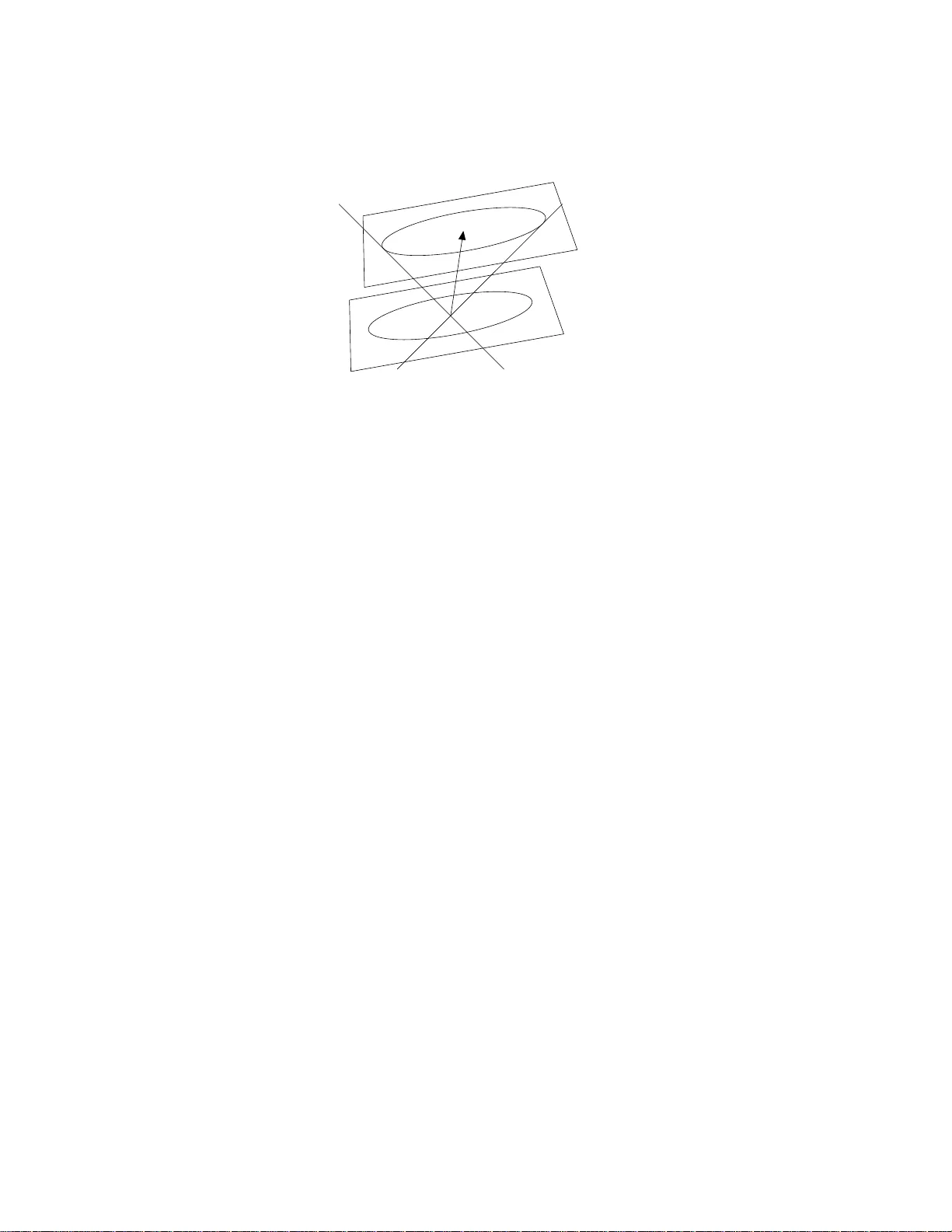
CONFORMALL Y FLA T SUBMANIFOLDS IN SPHERES A ND INTEGRABLE SYSTEMS NEIL DONALDSON † AND CHUU-LIAN TE RNG ∗ November 6, 2018 A B S T R A C T . ´ E. Cartan proved that conformal ly flat hypersurfaces in S n + 1 for n > 3 have at most two distinct princ ipal curvatures and locally en velop a one- parameter family of ( n − 1 ) -spheres. W e prove t hat the Gauss-Codazzi equation for conformally flat hypersurfaces in S 4 is a soliton equation, an d use a dressing action fro m soliton theory to construct geometric Ribaucour transforms of the se hypersurfaces. W e describe the moduli of these hypersurfaces in S 4 and the ir loop group symm e tries. W e also generalise these results to conformally flat n - immersions in ( 2 n − 2 ) -sph e res wi th flat and non-degenerate normal bundle. 1. I N T R O D U C T I O N An immersion f : M n → ( N , g ) is co nformally flat if there exists a flat metric in the conformal class of the induced metric f ∗ g : that is there exists a smooth function u : M → R such that e 2 u f ∗ g is flat. This condition is equivalent to the W eyl tensor of f ∗ g being zero when n > 3 , and to the S chouten tensor S = Ric ( f ∗ g ) − R 4 f ∗ g being a Codazz i tenso r when n = 3 ( i.e., ∇ S is a symmetric 3-tensor). The history of conformally flat immersions is long, the search for conformally flat submanifolds b e ing a natura l ta sk in conformal geometry . The study of con- formally flat hy persurfaces in S n + 1 dates back to Cartan [4] who, demonstrated that the only such hypersurfaces for n > 3 a re the channel hyper surf aces: envelopes of a 1- p a rameter family of ( n − 1 ) -spheres. In particular these have (at most) two distinct principal curva tures. For n = 2 the problem is uninteresting as every sur- face is con formally flat. For n = 3 , h owever , there are more varied c onformally flat hypersurfaces: not only a re there th e channel examples, there also exist hypersur- faces with 3 distinct curva tures. These were first discussed by Hertrich–Jeromin [6, 7], who moreover d e scribed the link betwee n conformally flat hyper surf aces in S 4 , c ur v e d flats in the space of circles in S 4 , tr iply orthogonal systems, and Guichard nets. The cla ssification of these hypersurface s, however , remained un- known. Given a conformally fl at immersion f : M n → S 2 n − 2 with flat no rmal bun- dle, we embed S 2 n − 2 naturally in the light-c o ne L 2 n − 1 ,1 of is otropic v e ctors in a Lorentzian R 2 n − 1 ,1 , and construct a flat lift F : M n → L 2 n − 1 ,1 : thi s F is immersed, has flat induced metric, and flat normal bundle. Since both a re flat, th e ta ngent and normal bundle decomposition of the trivial R 2 n − 1 ,1 -bundle is a curved flat [5] † Researc h supported in part b y NSF Advance Grant. ∗ Research supported in part by NSF G rant DMS-0707132. 1 2 NEIL DONALDSON † AND CHUU-LIAN TE RNG ∗ in the pseudo-Riemannian symmetric space U / K = O ( 2 n − 1,1 ) O ( n ) × O ( n − 1 ,1 ) (the Grassman- nian of spa ce-like n - planes in R 2 n − 1 ,1 ). W e are thus immediately in the realm of integrable systems. Curved flats in U / K with a g ood co- ordinate system give r ise to T erng’s U / K - system ( [10]), which is constructed a s follows: s uppose that τ is the involution of the L ie group U d efined by τ ( g ) = I n , n g I − 1 n , n , where I n , n = I n 0 0 − I n and I n is the n × n ide ntity matrix. Then K is the fixed point set of τ in U . Let u = k + p denote the ± -eigenspace decomposition of d τ e . K then acts on p by conjugation. Let a be a maximal abelian suba lgebra in p , and { a 1 , . . . , a n } a ba sis of a . The U / K -system defined by a is the following system for Ξ : R n → a ⊥ ∩ p : [ a i , Ξ x j ] − [ a j , Ξ x i ] − [ [ a i , Ξ ] , [ a j , Ξ ] ] = 0, i 6 = j , (1.1) where a ⊥ is the orthogonal complement of a with respect to the Killing form. Unlike in the Riemannian symmetric ca se, not all maximal abe lian subalgebras in p a re conjugate under K ; there are both semi-simple and non-semisimple such subalgebras. W e note that two maximal abelian subalgebras in p conjugate under K give rise to equivalent U / K -systems, whi le two non conjugate maximal abelian subalgebras in p give non-equivalent U / K systems. The normal bundle of a n immersion is termed non-degenerate if the dimension of th e space of shape operators at each poin t is e qual to the co-dimension . An immersion has uniform multiplicity one if it has flat norm al bundle and disti nct cur- vature normals (equivalently all curva ture distributi ons have rank one). It follows from the definition that an n -dimensional submanifold in R 2 n − 1 ,1 with flat a nd non-degenerate normal bundle has uni form multipli city on e. W e prove that a con- formally flat n -immersion into S 2 n − 2 with uniform multiplicity one gives rise to a flat n -immersion in the light-cone L 2 n − 1 ,1 with flat n on-degenerate normal bun- dle, and that the converse is also true. T o study conformally flat n -immersions in S 2 n − 2 with uniform multiplicity one is thus the same as to study flat n -immersions in L 2 n − 1 ,1 with flat non-degenerate normal bundle. W e show that there exist line of curvature co-ordinate systems for these flat immersions, and that their Gauss- Codazzi equations a mount to the U / K = O ( 2 n − 1,1 ) O ( n ) × O ( n − 1 ,1 ) -system defined by a semi- simple maximal a belian subalgebra a . Conversely , given a solution to the U / K - system defined by a , and a null vector c ∈ R n − 1,1 we obta in a a conformally flat immersion in S 2 n − 2 with uniform multiplicity one. Motivated by definitions in classical differential geometry , we call a diffeomor- phism φ : M → ˜ M between n -immersions in spa ce forms with flat normal bundle a Combescure transform if φ maps principal directions of M to those of ˜ M and they are pa rallel. A Combescure tra nsform φ is Christoffel if it is orientation reversing. Given a solution to the U / K -system d e fined by a and a null vector c ∈ R n − 1,1 with c t c = 2, we construct a flat n -immersion F c in L 2 n − 1 ,1 with flat normal and non-degenerate bundle. Hence F c projects to a conformally flat immersion in S 2 n − 2 with uniform multiplicity one. Moreover , if c and b are null vectors with E uclidean length √ 2, then F c ( x ) 7 → F b ( x ) is a C ombescure transform. Because of the correspondence be tween solutions of the U / K -system a nd con- formally flat n immersions in S 2 n − 2 with flat a nd non-degenera te normal bundle, all the machinery of solito n theory applies: loop-group dressing of solutions to CONFORMALL Y FLA T SUBMANIFOL DS IN SPHERES AND INTEGRABL E SY S TEMS 3 obtain new conformal flats or simply dressing v a cuum solutions to obtain more complex explicit conformally flat immersion s; existence results such as Cartan- K ¨ ahler and inverse scattering, etc. In particular: (1) W e may dress solutions by special, simple elements, whose action may be calculated explicitly by residues. The action o f such elements is seen to be by Ribaucour transforms on conformal flats: corresponding immersions envelop (ha v e first-order contact wi th) a congruence of n - spheres in such a way tha t principal curvature directions on the e nvelopes correspond under the congruence. (2) Local analytic conformally flat n -immersions in S 2 n − 2 are d etermined by n 2 − n functions of one varia ble. (3) The Cauchy problem f or the U / K -system with rapidly decaying initial data on a regular line c an be solved globally . 1 Although the resultin g n dimensional submanifolds ma y have cusp singularities, the fr ame is glob- ally defined and smooth. (4) The moduli space of such immersions has a loop group symmetry . If the normal bundle is degenerate and the curvature distributions E i (com- mon eigenspaces of the shape operators) have constant r anks, then we show that all but one of the E i s h ave rank one. Such submanifolds ar e thus envelopes of k -pa r ameter families of ( n − k ) -spheres. If, in addition, these immersions are a s- sumed to have line of curvature co-ordinates, then the Gauss-Codazz i equations are the U / K - system defined by a non-semisimple maximal abelia n subalgebra a in p . Con versely , given a solution of the U / K -system defined by a , we obtain an ( n − 2 ) - p a rameter family of flat lifts, each of which gives rise to a conformally flat immersion in S 2 n − 2 with flat normal bundle, but not with uniform multiplicity one. Wh en n = 3, these give ch annel imm ersions . Loop group dressing still works, and we can constru ct channel im mersions from any germ of an o ( 2 n − 1, 1, C ) - valued holomorphic map at λ = ∞ that satisfi es the reality conditio n associated to U / K . Most of the results for conformally flat n -immersions in S 2 n − 2 with uniform multiplicity one hold for conformally flat n -immersions in S 2 n − 2 + k with flat nor- mal bundle, n curva ture normals such that the orthog onal complement of the sub- bundle spanned by n curvature normals is flat. There exist line of curvature co- ordinates and a correspo ndence between such immersions and solutio ns of the O ( 2 n + k − 1 ,1 ) O ( n ) × O ( n + k − 1,1 ) -system. The pa per is organised as follows. In section 2, we generalise He rtrich–Jeromin’s work on conformally flat immersions of hypersurfaces in S 4 to n -submanifolds in S 2 n − 2 : we outline the light-cone model and how conformal flat immersions in the sphere correspond to genuine flat immersions in the light-cone, then consider the curvature distributions of corr esponding maps, a nd how their fundamental forms compare. The link between conformal flats and the U / K -system is detailed in section 3 , and we expla in its generalisation to conformally flat n -immersions in S 2 n − 2 + k in section 4. W e give a discussion of the dressin g transformation s of a negative loop o n t he space of solutions to the U / K -system and their associated conformally flat immersio ns; certain dressing transforms a re sh own to give rise to 1 Recall that a ∈ a is regular if ad ( a ) : a ⊥ ∩ p → k is a inj ective. 4 NEIL DONALDSON † AND CHUU-LIAN TE RNG ∗ geometric Ribaucour transforms in section 5. In the final section, we show that solutions of the U / K -system defined by a non-semisimple maximal abelian subal- gebra give rise to the channel immersions. 2. F L AT L I F T S , C U RV AT U R E S PA C E S A N D C O - O R D I N AT E S In this section we give definitions and explain, via the light-cone model, the correspondence between conformally flat n -dimensional immersio ns in S 2 n − 2 and flat n - dimensional immersions in L 2 n − 1 ,1 . W e also show the existence of l ine of curvature co-ordinates for conformally flat n -immersion s i n S 2 n − 2 with uniform multiplicity one. The light- cone model. The light -cone mo del of the conformal m -sphere is n ow well-understood, its prime advantage being that it linearises conformal geometry in S m : the fundamental objects of the theory , subspher es S k ⊂ S m and their in- tersections, become the geometry of the Grassmannians G + m − k ( R m + 1,1 ) of definite signature pla nes. Her trich-Jeromin’s book [8] contains an excellent in troduction to this, as does Burstall’s d iscussion of isothermic surfaces [2]. Let I m + 1,1 denote the dia gonal ( m + 2 ) × ( m + 2 ) matrix d iag ( 1, . . . , 1, − 1 ) and ( x , y ) = x t I m + 1,1 y the Lorentzian bilin ear form on R m + 1,1 . L m + 1,1 = { x ∈ R m + 1,1 | ( x , x ) = 0 } is the light-co ne of isotropic vectors in R m + 1,1 . Fix a choice of unit time-like vector t 0 . The restriction of ( , ) to t ⊥ 0 is positive definite, and hence t ⊥ 0 is isometric to the Euclidean R m + 1 . Let S m denote the set of unit vectors in t ⊥ 0 , then the map 2 t ⊥ 0 ⊃ S m → L m + 1,1 : x 7 → x + t 0 is clearly an isometry which, since each isotropic line ℓ ≤ L m + 1,1 intersects the plane t ⊥ 0 + t 0 exactly once, diffeomorphically puts a metric on the projective li ght- cone P ( L m + 1,1 ) . However , any other choice of unit time-like t ′ 0 gives a different diffeomorphism and induces a different metric. Indeed the following c ompound map is seen to be a conformal diffeomorphism from on e m -sphere to another: t ⊥ 0 ⊃ S m ∼ = P ( L m + 1,1 ) ∼ = S m ⊂ t ′ 0 ⊥ x / / h x + t 0 i / / − x + t 0 ( x + t 0 , t ′ 0 ) − t ′ 0 d x 2 / / 1 ( x + t 0 , t ′ 0 ) 2 d x 2 For this reason the projective light-con e is known as the conforma l m- sphere . 2 Throughout we shall use h i for the span of a collection of vectors, usually d ropping the brackets when referring to th e p e rpendicular space t o the span of a v ector . CONFORMALL Y FLA T SUBMANIFOL DS IN SPHERES AND INTEGRABL E SY S TEMS 5 L m + 1,1 t 0 S m t ⊥ 0 t ⊥ 0 + t 0 All ge ometric properties of S m that a re genuinely conformal are detecta ble di- rectly in the light-cone and do not depend on the choice of t 0 , a s can be seen by the following theorem. Theorem 2. 1 (Liouville) . The action of O ( m + 1, 1 ) on the light-cone, and thus on any choice of m -sph ere S m ⊂ t ⊥ 0 , is said t o be by M ¨ obius transformations . For n ≥ 3 all (even local!) conformal diffeomorphism s of S m are M ¨ obius. Liouville’s theorem allows us to treat submanifolds of the conformal sphere similarly to those in metric geometry: the e x istence of submanifolds up to isometry is replaced by up to M ¨ obius transforms ; in the light-cone picture these really are isometries. In particular , star ting from submanifolds in L m + 1,1 , we need not worry about specific choices of t 0 , since exa mining the submanifold via any other choice merely a mounts to a M ¨ obius transform. W e will, however , tend to assume that a fixed choice has been made, if only so that we may anchor discussions in a genuine S m . Definition 2.2. Given a map f : M → S m ⊂ t ⊥ 0 , a lift of f is any map F : M → L m + 1,1 such that f + t 0 ∈ h F i . A flat lift is a lift such that the induced metric | d F | 2 on M is flat. Remarks 2.3 . T o facilitate computations, we set up notations for moving frames of flat lifts F : M n → R 2 n − 1 ,1 . Suppose that g = ( e 1 , . . . , e 2 n ) is an O ( 2 n − 1, 1 ) frame on M such that e 1 , . . . , e n are tangent to F ( M ) . Let ω 1 , . . . , ω n be the 1-f orms dual to e 1 , . . . , e n . Then d F = ∑ n i = 1 ω i e i . W rite d e A = 2 n ∑ B = 1 ω B A e B . Then g − 1 d g = ( ω A B ) and ω B A ǫ B + ǫ A ω A B = 0 , wh ere I 2 n − 1 ,1 = diag ( ǫ 1 , . . . , ǫ 2 n ) , d ω A B = − 2 n ∑ C = 1 ω A C ∧ ω C B . The shape operator is A e α = − π h d F i ( d e α ) , the tangential component. The two fundamental forms and the normal c onnection are: I F = n ∑ i = 1 ω 2 i , I F = n ∑ i = 1 2 n ∑ α = n + 1 ω i ω α , i e α , 6 NEIL DONALDSON † AND CHUU-LIAN TE RNG ∗ ∇ ⊥ e α = 2 n ∑ β = n + 1 ω βα e β , n + 1 ≤ α ≤ 2 n . W e may now state the main correspondence of the paper ( due to Hertrich- Jeromin [7] when n = 3 ). Theorem 2.4. A conformally flat immersion f : M n → S 2 n − 2 with flat normal bundle has a flat lift F : M n → L 2 n − 1 ,1 with flat normal bundle. Conversely , any immersed F : M n → L 2 n − 1 ,1 with a flat, definite signat ure, metric | d F | 2 and flat normal bundle is a flat lift of a conforma lly flat immersion f : M n → S 2 n − 2 with flat normal bundle. Remark 2.5. For reference we collect some important relations. If e 2 u I f is flat, we will d e fine, in the proof, a flat lift F as below; similarly , given a flat lift F and a choice of t 0 , we recover a conformally flat f . Eve rything is related by the following notation: F = − e u ( f + t 0 ) , f = − F ( F , t 0 ) − t 0 , e u = ( F , t 0 ) . Since ± F project to the same f , we can always assume that ( F , t 0 ) is positive. The locations of the normal bundles viewed as subbun dles of the trivial bundle are as follow s, where both d ecompositions are ortho gonal: M n × R 2 n − 1 ,1 = h d f i ⊕ h f i ⊕ h t 0 i ⊕ N f = h d F i ⊕ N F . It is important to note that N f ⊂ N F ∩ F ⊥ . The metric | d F | 2 will almost always be definite: the only time this doesn’t happen is if some tangent direction is parallel to F itself (anything else forces a contrad ic- tion b y r equiring either a 2 -dimensional isotropic or time-like subspace of L 2 n − 1 ,1 ). It follows that, for us, the metric on the normal bundle N F is always non-degenerate and of signature ( n − 1, 1 ) . Proof. (1) Suppose that e 2 u I f is flat and define F : = − e u ( f + t 0 ) . Then d F = d u F − e u d f , and thus F is an immersion. Moreover I F = | d F | 2 = e 2 u I f is flat, hence F is a flat lift, with positive de finite tangent bundle. A s is well- known, the bundle h d F i is then flat (the induced connection is F -related to the Levi-Civita of I F on M ). Now let e i | n i = 1 be parallel orthonormal sections of h d F i and n j n − 2 j = 1 par- allel orthonormal sections of the normal bundle N f . M oreover le t ˆ F be the unique isotropic section of N F such that ( ˆ F , n j ) = 0 and ( ˆ F , F ) = 1. By the flatness of I F and N f , there e x ist 1-forms such that the moving frame equations are d e i n j F ˆ F = e k n l F ˆ F 0 ω k j ω k ˆ ω k ω l i 0 0 − η l − ˆ ω i η j 0 0 − ω i 0 0 0 . Here I F = ∑ i ω 2 i . The Maurer–Cartan equations quickly yield d ω i = 0 and d ω i j = ω i ∧ η j , from which we conclude that ω i ∧ d η j = − d ω i ∧ η j = 0 , ∀ i , j . CONFORMALL Y FLA T SUBMANIFOL DS IN SPHERES AND INTEGRABL E SY S TEMS 7 Since the ω i form a base of T ∗ M it follows that the η j are closed and thus the normal bundle N F is flat. (2) Suppose that an immersed F has flat tangent and normal bundles. Then f : = − F ( F , t 0 ) − t 0 is easily seen to be immersed. Now let N i | n − 2 i = 1 be any space-like parallel orthonormal sec tions of h F , d F i ⊥ . Defining n i : = N i − ( N i , t 0 ) ( F , t 0 ) F , it is easy to see that the n i are a p a rallel orthonormal frame of N f and hence f has flat normal bundle. W e have now reduced the study of conformally flat n -immersions in S 2 n − 2 with flat normal bundle to the study of flat n -immersions in L 2 n − 1 ,1 with flat normal bundle. Curvature distri b utions and flat non-de ge nerate norma l bundl e. Suppose that F has flat normal bundle and that the curvature d istributions of F have constant r a nk: that is the tangent bundle of M dec omposes orthogonally and smoothly a s T M = p M i = 1 E i , where each E i ( x ) is an eigenspac e of all the shape operators A v ( x ) , and the ra nks of the E i are constants. W e say that F has m ultiplicity 3 ( m 1 , . . . , m p ) if each ra nk E i = m i . T o each curvature distribution there corresponds a curvat ure normal v i ∈ Γ N F such that A v | E i = ( v , v i ) Id ( see e.g. [9]). Suppose that ( e 1 , . . . , e n ) is a n O ( n ) tangent fra me consisting of principal curvature directions and ( e n + 1 , . . . , e 2 n ) a parallel O ( n − 1 , 1 ) normal frame. Moreover let ω i α = λ i α ω i for 1 ≤ i ≤ n a nd n + 1 ≤ α ≤ 2 n . Then v i = 2 n ∑ α = n + 1 ǫ α λ i α e α . Lemma 2.6 . If F is an immersed flat lift whose p rincip a l curvatures along any parallel normal fields have constant m ult ip licities, then its curvature normals are mutually or- thogonal. If the curva t ure d istribution E i has rank ≥ 2 , then the corresponding curvature normal v i is isotropic. Proof. Since F is flat, the Gauss equation implies that 2 n ∑ α = n + 1 ω i α ∧ ω α j = ( v i , v j ) ω i ∧ ω j = 0 , which yields ( v i , v j ) = 0. Distinct cur vature normals a re th erefore orthogonal, and repeated curvature normals are necessarily isotr opic. It is now an ( almost) obvious corollary that there can only be one ra nk ≥ 2 distribution. A full discussion will wait until section 6. Note that a flat immersion F with flat normal bundle is non-degenerate iff all curvature distributions have 3 F thus has uniform mu ltiplicity one if p = n and m i = 1 for all i . 8 NEIL DONALDSON † AND CHUU-LIAN TE RNG ∗ rank 1 (uniform multiplicity one) and all curvature normals are non-zero: theorem 2.8 will show that this second condition is vacuous. Non-degene ra cy and li ne of curvature co-ordina tes. The following theorem de- scribes how immersio ns with non-degenerate norm al bun dle com e e quipped with line of curvature co-ordinates. Theorem 2.7. Let F : M n → L 2 n − 1 ,1 be flat with flat non-d egenerate norm a l bundle and curvature normals v 1 , . . . , v n . Then there ex ist curvature line c o -ordinates x 1 , . . . , x n on M. Moreover F and I F can be written entirely in terms of the curvature normals as F = − n ∑ j = 1 v j ( v j , v j ) , I F = n ∑ i = 1 d x 2 i | ( v i , v i ) | . (2.1) Proof. First recall from lemma 2 .6 that the curvature normals are non-isotropic. Since π N F d e i = ω i v i , (2.2) it follows that π h d F i d v j = − ω j ( v j , v j ) e j . (2.3) Since the v j are a frame of N F , there exist functions µ j such that F = ∑ µ j v j . How- ever d F = ∑ ω j e j . Putting this together quickly gives µ j = − ( v j , v j ) − 1 . Assume ǫ i = sgn ( v i , v i ) . Let n i > 0 b e d efined by n 2 i = ǫ i ( v i , v i ) = | ( v i , v i ) | . (2.4) Now n i ω i = ǫ i n − 1 i v i , d e i . By (2.2),(2.3) a nd the fac t that e i and n − 1 i v i are unit length, it is immediate that 4 d ( n i ω i ) = ǫ i d ( n − 1 i v i ) ∧ , d e i = 0 . The ω i are indepe ndent, thus we have co-ordinates x i . Since the ω i diagonalise the fundamental forms of F , it follows that the d x i do simi larly and are thus c urvature line co-ordinates. The exp ression for I F is then immediate. Comparing cu rvat ures. Since d N f ⊥ h f i and d f ⊥ N f , it f ollows tha t if n i are parallel sections of N f , then { f , n i } a re a parallel frame for the Euclidean normal bundle h f i ⊕ N f ⊂ M × t ⊥ 0 . f therefore has flat normal bundle when viewed as an immersion into R 2 n − 1 = t ⊥ 0 . It a lso therefore has an orthogonal curvature distribution; moreover S 2 n − 2 will inherit a curvature distribution f rom R 2 n − 1 . A priori we now hav e th ree curvature d istributions on M : the next theorem tidies things up. W e also have curvature normals for F and f which we would like to relate. Theorem 2.8 . Let f : M n → S 2 n − 2 be a conformally flat immersion with flat normal bundle, and F = − e − u ( f + t 0 ) flat lift. Th en 4 ( p ∧ , q ) ( X , Y ) = ( p ( X ) , q ( Y ) ) − ( p ( Y ) , q ( X ) ) . CONFORMALL Y FLA T SUBMANIFOL DS IN SPHERES AND INTEGRABL E SY S TEMS 9 (1) The curvature directions (on M n ) induced by F and f are identical. (2) If v i , v S i , v R i are corresponding curvature normals of F and f ( the latter as a map into S 2 n − 2 and R 2 n − 1 respectively), and e i , ˜ e i the corresponding curvat ure direc- tions, then we h ave the relations ˜ e i = − e i + e − u ( e i , t 0 ) F v S i = − e u π N f v i = v R i + f . (2.5) (3) All curvature normals of F are non-zero. (4) F has non-degenerate normal bundle iff f ha s uniform m ultiplicity one. Proof. Let e i be orthonormal curva ture dir ections for F and define ˜ e i as in the the- orem. The ˜ e i are ortho normal, a nd we calculate that e u d f = d u F − d F = ∑ i ω i ˜ e i − e − u ( e i , t 0 ) ω i F + d u F = ∑ i ω i ˜ e i , hence the ˜ e i frame h d f i . Moreover π N f d ˜ e i = − π N f d e i = − ω i π N f v i , π f d ˜ e i = ( d ˜ e i , f ) f = − ( ˜ e i , d f ) f = − e − u ω i f , hence the ˜ e i are curvature d irections for f . It follows that the curv a ture normals for f as a map into S 2 n − 2 are v S i = − e − u π N f v i . W e thus have ( 1) and (2). For (3) and (4 ) we calculate explicitly: π N f v i = v i − n ∑ j = 1 ( v i , ˜ e j ) ˜ e j − ( v i , f ) f + ( v i , t 0 ) t 0 = v i − n ∑ j = 1 ( v i , e − u ( e j , t 0 ) F ) ( − e j + e − u ( e j , t 0 ) F ) − ( v i , e − u F + t 0 ) ( e − u F + t 0 ) + ( v i , t 0 ) t 0 = v i − e − u n ∑ j = 1 ( e j , t 0 ) e j + e − u t 0 + e − 2 u n ∑ j = 1 ( e j , t 0 ) 2 + 1 − e u ( v i , t 0 ) ! F . (2.6) Supposing that v i = 0, we read ily o btain t 0 = n ∑ j = 1 ( e j , t 0 ) e j − e − u n ∑ j = 1 ( e j , t 0 ) 2 + 1 ! F . However taking the norm squared of both sides results in the contradiction − 1 = n ∑ j = 1 ( e j , t 0 ) 2 . It follows that v i cannot be zero, yielding (3). By (2.6 ) we have that v S i − v S j = v i − v j − e − u ( v i − v j , t 0 ) F . (2.7) 10 NEIL DONALDSON † AND CHUU-LIAN TE RNG ∗ If the v S i are distinct, then the v i are distinct and, by lemma 2. 6, orthogonal. Rear- ranging and taking the norm squared of (2 .7) yields v i − v j > 0, hence no pair of v i are para llel isotropic. The v i are thus a ll non-isotropic a nd N F is non-degenerate. Conversely , if v S i = v S j , then v i − v j ∈ h F i , so that either v i = v j is a repea te d cur- vature of F , or F ∈ v i − v j . The la tter case yields a contradiction, f or it would require that d F ∈ ω i , ω j only . This e sta blishes (4). Remarks 2.9. Observe that if f has distinct cur vature normals, then N f is automat- ically non-degenerate: v S 1 , . . . , v S n = π N f h v 1 , . . . , v n i . Indeed the proof shows that v S i − v S j ⇐ ⇒ v i = v j . All curva ture normals of F are non-zero, hence the only way N F can be degen- erate is if F has a repeate d non-zero cur v a ture, necessarily isotropic. Thus F is non-degenerate iff it has uniform multiplicity one. By contrast, f may have a zero curvature normal — i.e. the curva ture line is a geodesic — whether F is degenerate or not. The multiplicities of f are however identical to those of any flat lift. When F is non-degenerate we may obtain further relations from ( 2.1) and (2 .5): I f = e − 2 u I F = e − 2 u ∑ i d x 2 i | ( v i , v i ) | , I S f = e − 2 u ∑ i d x 2 i | ( v i , v i ) | v S i = I R f + I f · f = − e − u π N f I F = − e − u ∑ i d x 2 i | ( v i , v i ) | π N f v i . W e will say more on the c ur vature distributions of conformal flats w ith repeated curvature normals in section 6. 3. T H E U / K - S Y S T E M W e pro ve that the Gauss-Codazzi equation for flat n -immersions in L 2 n − 1 ,1 with flat normal bundle and ”good” co-ordinates is the O ( 2 n − 1,1 ) O ( n ) × O ( n − 1 ,1 ) -system. The U / K -system [ 10] is a general construction common to any symmetric space. W e give its constr uction for the case U = O ( 2 n − 1, 1 ) and K = O ( n ) × O ( n − 1, 1 ) : these will be viewed as matrices where g ∈ U ⇐ ⇒ g T I 2 n − 1 ,1 g = I 2 n − 1 ,1 . K is then represented by the block n × n diagonal matrices. The Lie algebras of U and K will be w ritten u and k , whi le the Killing perp of k will be denoted by p . As is well- known, U / K is a pseudo-Riemannian symmetric space defined by the involution τ ( ξ ) = I n , n ξ I − 1 n , n with ± -eigenspaces k = o ( n ) × o ( n − 1, 1 ) , p = 0 ξ T J − ξ 0 ξ ∈ gl ( n ) , J = I n − 1,1 . Moreover , [ k , k ] , [ p , p ] ⊂ k , [ k , p ] ⊂ p . The conjugation of K on p is g 1 0 0 g 2 ∗ 0 ξ T J − ξ 0 = 0 g 1 ξ T J g − 1 2 − g 2 ξ g − 1 1 0 . CONFORMALL Y FLA T SUBMANIFOL DS IN SPHERES AND INTEGRABL E SY S TEMS 11 Let a be a ma x imal abe lian subalgebra in p , and a 1 , . . . , a n a basis of a . The U / K - system d efined by a is the PDE (1.1) f or Ξ : R n → a ⊥ ∩ p . It is known and can be easily checked that the following state ments are equivalent: (1) Ξ is a solution of the U / K - system, (2) The following one-paramete r family of o ( 2 n − 1 , 1, C ) connection 1 -forms is flat for all λ ∈ C : θ λ = n ∑ i = 1 ( λ a i + [ a i , Ξ ] ) d x i , (3.1) (3) θ λ = ∑ n i = 1 ( λ a i + [ a i , Ξ ] ) d x i is flat for some λ ∈ R \ { 0 } . W e call θ λ the Lax pair of the U / K -system, and a solution Φ λ : R n × C → O ( 2 n − 1, 1, C ) ) to Φ − 1 λ d Φ λ = θ λ satisfying the U / K -reality condition , Φ λ = Φ λ , τ Φ λ = Φ − λ , (3.2) an extended flat frame for the solution Ξ of the U / K -system. Observe that: (a) W e could normalise the extende d flat f rame at a base point, e.g. Φ λ ( 0 ) = Id, which will be called the normalised ext ended flat frame . Choosin g a dif- ferent extended flat frame merely affects submanifold geometry by rigid motions (equivalently M ¨ obius transforms of S 2 n − 2 ). (b) If Φ λ is a n extended flat fr ame, then Φ r ∈ O ( 2 n − 1, 1 ) for all r ∈ R and Φ 0 ∈ O ( n ) × O ( n − 1, 1 ) . There are both sem isimple and no n-semisimple max ima l abelian subalgebra s in p . These comprise n conjugacy classes, each of which give rise to non-equivalent U / K - systems. W e will show in this section that the U / K -system defined by a semisimple abelian subalgebra in p is the Gauss-Codazz i equation f or flat lifts of conformally flat immersions with uniform multiplicity one. In section 6 we will see that solutions of a U / K - system defined by a non-semisimple maximal abelian subalgebra give rise to conformally flat immersions with one multiplicity greater than one. Theorem 3 .1. Suppose that F : M n → L 2 n − 1 ,1 is a flat imm ersion with flat non- degenerate normal bundle, induced metric I F = ∑ n i = 1 h 2 i d x 2 i , and th a t ( x 1 , . . . , x n ) is a line of curvature c o-ordinate sy st em . Let Ψ = ( e 1 , . . . , e n , u 1 , . . . , u n ) be a n O ( 2 n − 1, 1 ) -frame such that t he e i are principal curvature directions and the u i are par- allel to th e curvature normals of F . Let U K = O ( 2 n − 1,1 ) ( O ( n ) × O ( n − 1,1 )) , u = k + p its Cartan decomposition, and a = 0 D J − D 0 D diagonal , a Cartan subalgebra in p , w h ere J = I n − 1,1 . Set ξ = ( ξ i j ) , where ξ i j = ( h i ) x j h j , i 6 = j , 0 i = j . Then Ξ : = 0 ξ T − J ξ 0 is a solution o f th e U / K -system defined by a , [ a i , Ξ x j ] − [ a j , Ξ x i ] + [ [ a i , Ξ ] , [ a j , Ξ ] ] = 0, i 6 = j , (3.3) 12 NEIL DONALDSON † AND CHUU-LIAN TE RNG ∗ and Ψ − 1 d Ψ = n ∑ i = 1 ( a i + [ a i , Ξ ] ) d x i , where a i = 0 e i i J − e i i 0 for 1 ≤ i ≤ n. Moreover , let g = g 1 0 0 g 2 in K be a solution of g − 1 d g = ∑ n i = 1 [ a i , Ξ ] d x i , then there exists a constant null vector c ∈ R n − 1,1 such that F = Ψ 0 g − 1 2 c . Proof. Let v 1 , . . . , v n be the curvature normals f or the flat lift F : M n → L 2 n − 1 ,1 . W e may assume that ( v n , v n ) < 0. Define (a s in (2.4)) ǫ i = sgn ( v i , v i ) , n i = | ǫ i ( v i , v i ) | 1/ 2 , then v i = n i u i . ( u 1 , . . . , u n ) is an O ( n − 1, 1 ) normal f rame. Let ( e 1 , . . . , e n ) be an O ( n ) tangent frame consisting of corresponding principal curvature directions. It is clear that θ : = Ψ − 1 d Ψ = A − δ J δ B where J = I n − 1,1 , δ = dia g ( d x 1 , . . . , d x n ) and the Lie a lgebra valued 1- f orms A , B are the connection f orms for the induced flat connections on h d F i and N F . The flatness d θ + θ ∧ θ = 0 reads d A + A ∧ A = 0 = d B + B ∧ B = δ ∧ A + B ∧ δ . (3.4) By considering where the d x i ∧ d x j terms appear in the third e quation, it is not hard to see that A i j , B i j ∈ d x i , d x j and that there therefore exists a unique map ξ : M n → { off-diagonal n × n matrices } , such that A = δ ξ − ξ T δ , B = δ ξ T − J ξ δ J . The first two equations of (3 .4) constitute a system of PDEs in the entries of ξ . In- deed writing Ξ = 0 ξ T − J ξ 0 and ∑ i a i d x i = 0 δ J − δ 0 , we see that [ Ξ , a i d x i ] = diag ( A , B ) . It is straightforward to see that Ξ is a map Ξ : M n → p ∩ a ⊥ = [ k , a ] , and is thus a solution of the U / K -system (3.3). Since N F is flat, and the normal connection 1-form defined by the normal frame ( u 1 , . . . , u n ) is B , there exists g 2 : M → O ( n − 1, 1 ) such that g − 1 2 d g 2 = B and ( e n + 1 , . . . , e 2 n ) = ( u 1 , . . . , u n ) g − 1 2 is a para llel normal frame. Since F is a null parallel normal section, there exists a constant null vector c such that F = ( e n + 1 , . . . , e 2 n ) c = ( u 1 , . . . , u n ) g − 1 2 c = Φ 0 g − 1 2 c . Theorem 3 .2. Let Ξ be a solution to th e U / K - system (3.3 ) , and Φ λ an extended flat frame for the Lax p air θ λ = ∑ n i = 1 ( λ a i + [ a i , Ξ ] ) d x i . Then: CONFORMALL Y FLA T SUBMANIFOL DS IN SPHERES AND INTEGRABL E SY S TEMS 13 (1) Φ 0 is of the form g 1 0 0 g 2 , a nd if c ∈ R n − 1,1 is a constant non-zer o null vector , then F c : = Φ 1 0 g − 1 2 c is (locally) a flat lift of a c onformally flat immersion into S 2 n − 2 . (2) F c , its fundamental forms and c urvature normals v i are given explicitly by F c = n ∑ i = 1 q i u i , I F c = n ∑ i = 1 q i d x 2 i , I F c = n ∑ i , j = 1 q i d x 2 i u i , v i = q − 1 i u i , where Φ 1 = ( e 1 , . . . e n , u 1 , . . . , u n ) and g − 1 2 c = ( q 1 , . . . , q n ) T . (3) If b is another non-zero null vector in R n − 1,1 , then F c ( x ) 7 → F b ( x ) is a Combes- cure transf orm and is a Christoffel t ransform if h ( g − 1 2 b ) and h ( g − 1 2 c ) have oppo- site sign, where h ( y ) = ∏ n i = 1 y i . Proof. Such an F c is clearly a flat lift. W rite θ 1 = A − δ J δ B . Then g − 1 2 d g 2 = B . It follows from Φ − 1 1 d Φ 1 = θ 1 and g − 1 2 d g 2 = B that d F c = Φ 1 − δ J g − 1 2 c 0 . W rite Φ 1 = ( e 1 , . . . , e n , u 1 , . . . , u n ) and g − 1 2 c = ( q 1 , . . . , q n ) t . Then d F c = − n ∑ j = 1 ǫ j q j e j . Statements (2) and (3 ) follow . W e recall below three know n approaches to constr ucting solutions to the U / K - system (see e.g. [10, 11, 12]). Dressing: Given a solution we may ap p ly dressing actions to find new solu- tions to (3. 3). W e shall pursue this in section 5. Cartan–K ¨ ahler: [12] The U / K -system is unchanged with respect to the sub- stitution ( a i , x i ) 7→ ( b j , y j ) where b j = ∑ i p i j a i , y j = ∑ i p j i x i for a ny constant invertible ( p i j ) , where ( p i j ) − 1 = ( p i j ) . Almos t a ny choice of ( p i j ) will result in b 1 being regular , i.e . ad b 1 : p ∩ a ⊥ → k is injec- tive. The corresponding exterior differential system is involutive, hence we may apply the Cartan–K ¨ ahler theorem: give n local analytic initial data Ξ 0 : ( − ε , ε ) → p ∩ a ⊥ , there is a unique local ana lytic solution Ξ to (3.3) which satisfies Ξ ( y 1 , 0, 0 ) = Ξ 0 ( y 1 ) . Note that dim ( a ⊥ ∩ p ) = n 2 − n . Inverse sca ttering: [1 0] If b 1 ∈ a is regular , then given rapidly dec reasing ini- tial d a ta Ξ 0 : R → p ∩ a ⊥ with small L 1 norm, there exists a unique global smooth solution Ξ to the U / K -system (3 .3) such that Ξ ( y 1 , 0, . . . , 0 ) = Ξ 0 ( y 1 ) . W e will compute the dressing action of the simplest type r ational loops in sec- tion 5 14 NEIL DONALDSON † AND CHUU-LIAN TE RNG ∗ Remark 3.3. The discussion on constructions of solutions of the U / K - system given above a nd in Theorem 3.2 imply that local flat n -immersions in L 2 n − 1 ,1 with flat, non-degenera te normal bundle a nd uniform multiplicity one are determined by n 2 − n functions of one variable (the restriction of ξ to a regular line). W e sta te this more precisely . Fix a regular element b = ∑ n i = 1 b i a i in a . Given a real a nalytic map ξ 0 = ( ( ξ 0 ) i j ) : ( − ǫ , ǫ ) → gl ( n ) such that ( ξ 0 ) i i = 0 for all 1 ≤ i ≤ n , there is a unique solution Ξ of the U / K -system (3 . 3) de fined on a n open subset of the origin of R n such that Ξ ( t b 1 , . . . , t b n ) = 0 ξ 0 ( t ) T − J ξ 0 ( t ) 0 . The same statement holds if we replace ξ 0 by a rapidly decaying smooth map on R whose L 1 norm is less than 1 . For each solution of the U / K - system, Theorem 3.2 gives a f amily of flat n -immersions in L 2 n − 1 ,1 parameterised by the light-cone of R n − 1,1 . 4. C O N F O R M A L L Y FL AT n - I M M E R S I O N S I N S 2 n + k − 2 An immersion f : M n → S 2 n + k − 2 with flat normal bundle is said to ha ve uni- form multiplicit y one if it has c onstant multiplicities and each curvature distribution has rank one. It is easy to see th at the proofs of the existence of flat lifts and li ne of curvature c o-ordinates still work for these immersions. Let v 1 , . . . , v n be the curva- ture normals for a flat lift F , N v = h v i i n i = 1 the curvature normal bundle , and N ⊥ v the orthogonal complement of N v in N F . Note that Theorem 3.1 holds if we replace the U / K -system with the O ( 2 n + k − 1 ,1 ) O ( n ) × O ( n + k − 1,1 ) -system and a ssume that N ⊥ v is flat. W e state the analogous results below . Theorem 4. 1 . Let f : M n → S 2 n + k − 2 be a conformally flat immersion with flat normal bundle and uniform multiplicit y one. T hen: (1) There is a flat lift F : M n → L 2 n + k − 1,1 for f with flat norm al bundle and uniform multiplicity one, (2) There exist line of curvature co-ordinates for F . The symmetric space O ( 2 n + k − 1 ,1 ) O ( n ) × O ( n + k − 1,1 ) is de fined by the involution τ ( ξ ) = I n , n + k ξ I − 1 n , n + k , and the ± 1 eigenspaces of τ a re k = o ( n ) × o ( n + k − 1, 1 ) , and p = 0 ξ − J ξ t 0 ξ ∈ gl ( n , n + k ) , where J = I n + k − 1 ,1 . Set a + = h a i i n i = 1 , where a i = e i , n + i − e n + i , i , a − = h b i i n i = 1 , where b i = e i , n + k + i − ǫ i e n + k + i , i , where ǫ i = 1 for i < n and ǫ n = − 1. Then both a + , a − are maximal a belian subalgebras in p , and a ⊥ + ∩ p = 0 ξ − J ξ t 0 ξ = ( ξ i j ) ∈ gl ( n , n + k ) , ξ i i = 0, 1 ≤ i ≤ n , a ⊥ − ∩ p = 0 ξ − J ξ t 0 ξ = ( ξ i j ) ∈ gl ( n , n + k ) , ξ i , k + i = 0 , Theorem 4.2. Let F : M n → L 2 n + k − 1,1 be a flat lift of f with flat normal bundle and uniform multiplicity one, v 1 , . . . , v n the curvature normals for F, and a ± as above. CONFORMALL Y FLA T SUBMANIFOL DS IN SPHERES AND INTEGRABL E SY S TEMS 15 Suppose that the ind uced connection on the subbundle N ⊥ v of N F is flat, wh ere N v = h v i i n i = 1 . (i) If ( v i , v i ) > 0 for all 1 ≤ i ≤ n , t hen th ere exists a solution Ξ : M n → a ⊥ + ∩ p of t he O ( 2 n + k − 1 ,1 ) O ( n ) × O ( n + k − 1,1 ) -system defined by a + and an O ( 2 n + k − 1, 1 ) frame Φ = ( e 1 , . . . , e n , u 1 , . . . , u n + k ) such tha t (1) e i are principal curvature directions, u i = v i / ( v i , v i ) 1/ 2 for 1 ≤ i ≤ n, and ( d u i , u j ) = 0 if n < i , j ≤ n + k, (2) Φ − 1 d Φ = ∑ n i = 1 ( a i + [ a i , Ξ ] ) d x i . (ii) If ( v n , v n ) < 0 , then th ere ex ists a solution Ξ : M n → a ⊥ − ∩ p of th e O ( 2 n + k − 1 ,1 ) O ( n ) × O ( n + k − 1,1 ) - system d efined by a − and an O ( 2 n + k − 1, 1 ) frame Φ = ( e 1 , . . . , e n , u 1 , . . . , u n + k ) such that (1) e i are principal curva ture directions, u k + i = v i / ( v i , v i ) for 1 ≤ i ≤ n, a nd ( d u i , u j ) = 0 if 1 ≤ i , j ≤ k , (2) Φ − 1 d Φ = ∑ n i = 1 ( b i + [ b i , Ξ ] ) d x i . Moreover , there is a constant null v ect or c ∈ R n + k − 1 ,1 such that F = Φ 0 g − 1 2 c , where ∑ n i = 1 [ a i , Ξ ] d x i = g − 1 d g and g = g 1 0 0 g 2 . Theorem 4. 3. Let Ξ be a solution o f th e O ( 2 n + k − 1 ,1 ) O ( n ) × O ( n + k − 1,1 ) -system d efined by a + ( a − resp.), Φ λ an ext ended flat frame for the Lax p air of Ξ and c ∈ R n + k − 1 ,1 a null vecto r . Th en Φ 0 = g 1 0 0 g 2 , a nd F = Φ 1 0 g − 1 2 c is flat with flat normal bundle, uniform multiplicity one, and the subbundle N ⊥ v is flat. A different choice of null vector b yields a Combescur e transform F b = Φ 1 0 g − 1 2 b of F . 5. D R E S S I N G A C T I O N A N D R I B A U C O U R T R A N S F O R M AT I O N S W e first give a brief review of the dressing action (cf. [11]) for the U / K - system. Then we construct simple elements in the rational loop group with two poles that lie in the negative loop group, a nd give exp licit formulae for the dressing action of simple elements on solutions of the U / K -system and the corresponding action on the flat lifts of conformally flat n -immersions in S 2 n − 2 . W e prove in the end of the section that the d ressing action of simple elements on flat lifts a re Ribaucour transformations enveloping n -sphere or n - hyper b oloid congruences which more- over project down to Ribaucour tra nsforms enveloping n -sphere congruences of conformally flat n -immersions in S 2 n − 2 . Througho ut, U C = O ( 2 n − 1, 1 , C ) where will denote conjugation across the real form U ⊂ U C . τ will refer both to the symmetric involution of U C which defines the symmetric space U / K and its deriva tive at the ide ntity , whose eigenspaces are k , p . Fix ǫ > 0. Let O ǫ = { λ ∈ P 1 | ǫ − 1 < λ ≤ ∞ } , and L ( U ) the group of holo- morphic maps from O ǫ \ { ∞ } to U C that satisfy the U / K reality condition (3.2). Let L + ( U ) denote the subgrou p of g + ∈ L ( U ) that is the restriction of a holomo r- phic map on C , and L − ( U ) the subgroup of g − ∈ L ( U ) that is the restriction of a 16 NEIL DONALDSON † AND CHUU-LIAN TE RNG ∗ holomorphic map defined on O ǫ such that g − ( ∞ ) = Id. The Birkhoff Factorisa- tion Theorem implies that the multiplication maps L + ( U ) × L − ( U ) → L ( U ) a nd L − ( U ) × L + ( U ) → L ( U ) defined by ( g + , g − ) 7→ g + g − and ( g − , g + ) 7→ g − g + are injective and the images a re o pen dense. He nce the big cell O ( U ) : = ( L + ( U ) L − ( U ) ) ∩ ( L − ( U ) ∩ L + ( U ) ) is open and de nse. The local dressing action of L − ( U ) on L + ( U ) is defined a s follows. Since the big ce ll O ( U ) is open and dense, given g ± ∈ L ± ( U ) , there generically exist ˆ g ± ∈ L ± ( U ) such that g − g + = ˆ g + ˆ g − . Then g − ♯ g + : = ˆ g + defines a local action of L − ( U ) on L + ( U ) : this is the dressing action . It is proved in [11] that the dressing action of L − ( U ) induces an a ction of L − ( U ) on the space of solution s of the U / K - system: Theorem 5. 1 . [11] Let Φ λ be t he norm a lised flat frame of the Lax pair of a solution Ξ of the U / K -system, and g ∈ L − ( U ) . Then (1) There exists an open s ubset B of t he orig in in R n such t hat th e dressing action of g at Φ ( x ) , ˜ Φ ( x ) : = g ♯ Φ ( x ) , is defined for all x ∈ B, in other words, we can factor g Φ ( x ) = ˜ Φ ( x ) ˜ g ( x ) with ˜ Φ ( x ) ∈ L + ( U ) and ˜ g ( x ) ∈ L − ( U ) for all x ∈ B , (2) ˜ Φ λ is the normalised frame for a solution of the U / K -system, which will be de- noted by g ♯ Ξ . In general it is difficult to ca lculate the dressing action of a given g − ∈ L − ( U ) on L + ( U ) ex p licitly . It is, however , now standard theory that if g ∈ L − ( U ) is ra- tional [11, 1, 2], then th e dressing action of g on L + ( U ) can be computed explicitly via residue calculus. Moreover , the action of a rational g ∈ L − ( U ) with minimal number of poles ( a so-called simple element) often corresponds to known classical transforms (e.g. B ¨ acklund transforms of pseudospherical surfaces, Darboux trans- forms of isothermic surface s, etc.). Let τ be conjug ation by ρ = I n , n , choose a scalar α ∈ R × ∪ i R × , a nd an isotropic line ℓ such that either ℓ ≤ R 2 n − 1 ,1 and α ∈ R × , or ℓ ≤ R n ⊕ i R n − 1,1 and α ∈ i R × . ( 5.1) Let L = ℓ C and suppose in addition that ρ L 6 = L (equivalently ρ L 6 ⊥ L ). Let π L denote projection onto L away from ρ L ⊥ . In fact, if ℓ = h v i with | v | = 0 a nd ( v , ρ v ) = 1 , then π L = v v T ρ , π ρ L = ρ v v T . Define the simple element p α , L by p α , L ( λ ) = λ − α λ + α π L + π ( L ⊕ ρ L ) ⊥ + λ + α λ − α π ρ L . (5.2) Then p α , L = g α , ρ L g − α , L , where g α , L ( λ ) = I + 2 α λ − α π L . It is easily checked that p α , L is an element of L − ( U ) . Let Ξ : R n → a ⊥ ∩ p be a solution to the U / K -system ( 3.3). An extended frame Φ λ of the Lax pa ir θ λ (3.1) of Ξ is called the normalised extended frame if Φ λ ( 0 ) = Id. Since the solution of an ODE depending on a holomorphic parameter is holomorphic in that pa r ameter , the map λ 7 → Φ λ ( x ) lies in L + ( U ) . Using the dressing action of g α , L computed in [1 1], or alternatively from [1, 2], we get the following: CONFORMALL Y FLA T SUBMANIFOL DS IN SPHERES AND INTEGRABL E SY S TEMS 17 Theorem 5. 2 . Let Φ λ ( x ) be the normalised extended frame for a solution of the U / K = O ( 2 n − 1,1 ) O ( n ) × O ( n − 1 ,1 ) -system, and p α , L the simple el ement defined by (5.2 ) . Then there is an open subset B of the origin in R n such that ˜ Φ ( x ) : = p α , L # Φ ( x ) , the d ress ing action of p α , L on Φ ( x ) , is defined for all x ∈ B . Moreover , (1) ˜ L ( x ) = Φ − 1 α ( x ) L and α satisfy (5.1) , (2) ˜ Φ ( x ) = p α , L # Φ ( x ) = p α , L Φ ( x ) p − 1 α , Φ − 1 α ( x ) L is the normalised extended fram e of a new solution o f the U / K -system, (3) p α , L ♯ Φ ( x ) is well-defined if Φ − 1 α ( x ) L 6 = ρ ( Φ − 1 α ( x ) L ) . Proof. If α ∈ R , then Φ α is real and in O ( 2 n − 1, 1 ) . So α , ˜ L ( x ) satisfy (5.1). If α = i s for some real s , then Φ i s = ρ Φ − i s ρ = ρ Φ i s ρ . So if we write Φ i s = η 1 η 2 η 3 η 4 , then η 1 , η 4 are real and η 2 , η 3 are pure imaginary matrices. A computation shows that α , ˜ L ( x ) satisfy (5.1). In other words, p α , ˜ L ( x ) satisfies the U / K -reality c ondition. T o prove that ˜ Φ ( x ) lies in L + ( U ) , we expand p α , L g + p − 1 α , g − 1 + ( α ) L in a power series about λ = α and checking that it is in fa ct holomorphic and invertible there. The twisting condition e nsures that the same is true at λ = − α , hence p α , L g + p − 1 α , g − 1 + ( α ) L is a map into L + ( U ) ; uni que fa ctorisation finishes things off. Let ˜ p = p α , ˜ L ( x ) . Then ˜ Φ − 1 d ˜ Φ = ˜ p θ λ ˜ p − 1 − d ˜ p ˜ p − 1 . (5.3) Expand the above equality at λ = ∞ , noting that θ λ is a de gree one polynomi al in λ ; we see that ˜ Φ − 1 d ˜ Φ i s degree one 5 in λ a nd is thus the Lax pair of a new solution of the U / K -system. W e now write d own explicit f ormulae for the a ction of p α , L on F and the frame of F . Recalling section 3 , we note that a fla t lift F can be written F = Φ 1 0 g − 1 2 c , where Φ λ is an extended fra me and Φ 0 = g 1 0 0 g 2 . Set m : = g − 1 2 c = ( m 1 , . . . , m n ) , Φ 1 = ( e 1 , . . . , e n , u 1 , . . . , u n ) . Then F = n ∑ j = 1 m j u j , and e 1 , . . . , e n are principal curvature directions, u j is para llel to the curvature normal v j of F , and u j = m j v j . 5 lim λ → ∞ λ − 1 ˜ Φ − 1 d ˜ Φ = 0 − δ J δ 0 is bounded. 18 NEIL DONALDSON † AND CHUU-LIAN TE RNG ∗ Assume that α 6 = ± 1. W e ca ncel the factor of p α , L ( 1 ) from the definition of the dressed frame ˜ Φ ( x ) a nd write p α , L ♯ F : = ˜ F = Φ 1 p − 1 α , Φ − 1 α L ( 1 ) p α , Φ − 1 α L ( 0 ) 0 g − 1 2 c = Φ 1 p − 1 α , Φ − 1 α L ( 1 ) p α , Φ − 1 α L ( 0 ) Φ − 1 1 F . (5.4) (Note that the factor p α , L ( 1 ) ∈ O ( 2 n − 1, 1 ) is an isometry of R 2 n − 1 ,1 , hence ˜ F is equal to ˜ Φ 1 0 ˜ g − 1 2 c up to an isometry .) Introduce the notation Φ − 1 α L = W Z , where choices are normalised such that | W | 2 = − | Z | 2 = 2: it is easy to check that W = W and Z = sgn ( α 2 ) Z . W e have p − 1 α , Φ − 1 α L ( λ ) = I + α 2 λ 2 − α 2 W W T − αλ λ 2 − α 2 W Z T J αλ λ 2 − α 2 ZW T I − α 2 λ 2 − α 2 Z Z T J ! , J = I n − 1,1 , from which we write ˜ Φ λ = Φ λ I + α 2 λ 2 − α 2 W W T − αλ λ 2 − α 2 W Z T J αλ λ 2 − α 2 ZW T I − α 2 λ 2 − α 2 Z Z T J ! . W rite ˜ Φ 1 = ( ˜ e 1 , . . . , ˜ e n , ˜ u 1 , . . . , ˜ u n ) , ˜ Φ 0 = ˜ g 1 0 0 ˜ g 2 , and set ˜ F = ˜ Φ 1 0 ˜ g − 1 2 c , ˜ m : = ˜ g − 1 2 c = ( ˜ m 1 , . . . , ˜ m n ) . Then ˜ e i = Φ 1 p − 1 α , Φ − 1 α L ( 1 ) Φ − 1 1 e i = e i + α W i 1 − α 2 Φ 1 α W Z , (5.5) ˜ u i = Φ 1 p − 1 α , Φ − 1 α L ( 1 ) Φ − 1 1 u i = u i − α ǫ i Z i 1 − α 2 Φ 1 W α Z , (5.6) ˜ m j = m j + ( Z , m ) Z j , (5.7) ˜ F = F + ( Z , m ) 1 − α 2 n ∑ i = 1 α W i e i + Z i u i ! , (5.8) where W , Z are written with respect to the standard bases of R n , R n − 1,1 . The above formulae imply that ˜ F − F / / ˜ e i − e i ⊥ ˜ u j − u j / / ˜ u i − u i . More is true, for F a nd ˜ F envelop of a congruence of n -spheres or n - hyperbolae and are, in fact, Ribaucour transforms of eac h other (defined next). Definition 5.3. A congruence of n -spheres ( n -hyperbolae resp.) is a map into the space of n -spheres in a spaceform. An enveloping submanifold of a congruence is a submanifold which has first-order contact with the congruence, i.e. ea ch sphere (hyperbola resp.) is tangent to the submanifold it touches. CONFORMALL Y FLA T SUBMANIFOL DS IN SPHERES AND INTEGRABL E SY S TEMS 19 Remark 5.4. An n -sphere in R 2 n − 1 ,1 can be written as c + { x ∈ V | ( x , x ) = r 2 } for some space- like ( n + 1 ) -dimensional linear subspac e V , c ∈ V ⊥ , and a constant r . This n -sphere lies in the light-cone L 2 n − 1 ,1 if and only if ( c , c ) = − r 2 . An n -hyperbola ca n be written as c + { x ∈ V | ( x , x ) = − r 2 } f or some L orentzian ( n + 1 ) -dimensional linear subspace V , c ∈ V ⊥ , and a constant r . This n -hyperbola lies in L 2 n − 1 ,1 if and only if ( c , c ) = r 2 . Note that the projections of both n -spheres and n - hyperbolas in L 2 n − 1 ,1 to S 2 n − 2 are n -spheres. 6 Remark 5.5 . It can be ea sily seen that a generic n -dimensional congruence of n - spheres (or n -hyperbolae) has exa ctly two enveloping submanifolds M , M ∗ and a map φ : M → M ∗ , so that for each p ∈ M there is a n -sphere (or n -hyperbola) C ( p ) in the congruence such that M and M ∗ are ta ngent to C ( p ) a t p a nd φ ( p ) respectively . W e will also call the map φ a congruence. The congruence φ is said to be Ribaucour if the lines of curvature on M map to lines of curva ture on M ∗ . Otherwise said, the lines of c urvature correspond a nd the tangent line th rough p in the direction e i ( p ) meets the tangent line through φ ( p ) in the direction d φ ( e i ( p ) ) at equal distance. This is the d efinition given of Ribaucour transform in [1] for isothermic surfaces. Theorem 5.6 . Let α ∈ C and L an isotropic line in C 2 n − 1 ,1 satisfying (5.1) , and p α , L be the simp le element in L − ( U ) defined by (5.2) . Then th e dressing action F 7 → ˜ F = p α , L ♯ F defined by (5.4) is a Ribaucour n-hyp erbola congruence in L 2 n − 1 ,1 if α is real, and a Ribaucour n -sphere congruence in L 2 n − 1 ,1 if α is pure imaginary . Moreover , (1) ˜ F − F ∈ I n 0 0 α − 1 I n L 2 n − 1 ,1 and ˜ e i − e i is parallel to ˜ F − F for all 1 ≤ i ≤ n , where the e i and ˜ e i are principal curvature dir ections for F and ˜ F respectively , (2) If F is a flat lift of a conformally flat immersion f in S 2 n − 2 , then ˜ F is a flat lift of another conformally flat immersion ˜ f in S 2 n − 2 , and th e transform f → ˜ f is a Ribaucour transform in S 2 n − 2 . Proof. Note that F and ˜ F e nvelop an n -sphere (or a n -hyperbola) congruence if there exist vector fields ξ normal to F and ˜ ξ normal to ˜ F satisfying the following conditions: (1) F + ξ = ˜ F + ˜ ξ and ( ξ , ξ ) = ( ˜ ξ , ˜ ξ ) , (2) h e 1 ( x ) , . . . , e n ( x ) , ξ ( x ) i = h ˜ e 1 ( x ) , . . . , ˜ e n ( x ) , ˜ ξ ( x ) i , which will be denoted by V ( x ) , (3) ˜ F ( x ) − F ( x ) ∈ V ( x ) . The above conditions imply tha t both F and ˜ F are tangent to the quad rics in the affine space F ( x ) + V ( x ) , ( y − c ( x ) , y − c ( x ) ) = ( ξ ( x ) , ξ ( x ) ) , at F ( x ) a nd ˜ F ( x ) , where the centre c ( x ) = F ( x ) + ξ ( x ) . If V ( x ) is space-like then this quadric is an n -sphere, and if V ( x ) is L orentzian then this quadric is an n - hyperbola. Since F ( x ) is null, there exists a time-like t 0 ( x ) such that the quadric lies in the affine space t 0 ( x ) + V ( x ) . 6 W e w ill explain this more clearly in remarks 5.7. 20 NEIL DONALDSON † AND CHUU-LIAN TE RNG ∗ W e have seen that ˜ F − F = ( Z , m ) 1 − α 2 α ∑ j W j e j + ∑ j Z j u j ! , ˜ e i − e i = α W i 1 − α 2 α ∑ j W j e j + ∑ j Z j u j ! , ˜ u i − u i = − α ǫ i Z i 1 − α 2 ∑ j W j e j + α ∑ j Z j u j ! , where W Z = Φ − 1 α L and is normalised so that | W | 2 = − | Z | 2 = 2 and m = g − 1 2 c . It follows from the formulae for ˜ F − F and ˜ e i − e i that ˜ F − F = ( Z , m ) α W i ( ˜ e i − e i ) , for each i . Equate the coefficients of the e i and u i in ˜ F − F = ξ − ˜ ξ to get n ∑ i = 1 ǫ i ˜ ξ i Z i = ( m , Z ) , ξ i = ˜ ξ i + ( Z , m ) Z i , (5.9) where ξ = ∑ n i = 1 ξ i u i and ˜ ξ = ∑ n i = 1 ˜ ξ i ˜ u i . Case 1: α ∈ R . Then Z is real (5.1 ). Use the condition that e i ( x ) lies in V ( x ) to see tha t ξ has to be parallel to ∑ j Z j u j , hence ξ = f ∑ j Z j u j for some real function f . It follows f rom ( ˜ ξ , ˜ ξ ) = ( ξ , ξ ) a nd (5.9 ) that f = 1 2 ( Z , m ) . So ξ j = 1 2 ( Z , m ) Z j = − ˜ ξ j . Since ξ is time-like, it follows that V ( x ) is Lorentzian. This shows that F and ˜ F envelop a congruence of n -hyperbolae and ξ = 1 2 ( Z , m ) n ∑ j = 1 Z j u j , ˜ ξ = − 1 2 ( Z , m ) n ∑ j = 1 Z j ˜ u j . Case 2: α ∈ i R . Then Z = i γ for some γ ∈ R n − 1,1 . W e can use the above argument to obtain ξ j = − ˜ ξ j = − 1 2 ( γ , m ) γ j . Since γ is spa ce like, so is V ( x ) . In other words, F and ˜ F envelop a congruence of n -spheres. It is easy to check that both the n -spheres and the n -hyperbolae lie in L 2 n − 1 ,1 . As a con sequence of Theorem 5 .2, ˜ F is a fl at li ft of a new conformally flat ˜ f in S 2 n − 2 with identical line of curvature co-or d inates for ˜ F . Remarks 5.7. The discussion of congruences in S 2 n − 2 is particularly beautiful in the light-cone picture (e . g. [2]). A congruence of n -spheres may b e viewed as a map S : M n → G + n − 2 ( R 2 n − 1 ,1 ) into the Grassmannian of positive d efinite ( n − 2 ) - planes; P ( S ⊥ ∩ L 2 n − 1 ,1 ) ∼ = P ( L n + 1,1 ) ∼ = S n . The condition that h F i envelops S then becomes very simple: S ⊥ h F , d F i . Burstall–Calderba nk [3] genera lise the CONFORMALL Y FLA T SUBMANIFOL DS IN SPHERES AND INTEGRABL E SY S TEMS 21 notion of Ribaucour in this setting by demanding simply that a general codimen- sion congruence with two enveloping submanifolds h F i , ˜ F is Ribaucour iff the bundle F , ˜ F is flat. W e may restate the above theorem in a more invariant manner , that views the hyperbola and sphere congruences as sub-quad r ics of the quadric P ( R 2 n − 1 ,1 ) ∼ = S 2 n − 2 . Ea ch S ⊥ ( x ) : = V ( x ) ⊕ F ( x ) = V ( x ) ⊕ ˜ F ( x ) is a signature ( n + 1, 1 ) -pla ne, hence S : M n → G + n − 2 ( R 2 n − 1 ,1 ) is an n -sphere congruence in the conformal S 2 n − 2 , enveloped by h F i , ˜ F : M n → P ( L 2 n − 1 ,1 ) ∼ = S 2 n − 2 . W e may moreover calculate the flatness of the bundle F , ˆ F to see that the enveloped congruence is indeed Ribaucour in the sense of B ur stall–Calderbank [3]. Since the notion of enveloped sphere congruence is conformally invariant, the theorem is true in any Riemannian S 2 n − 2 ⊂ t ⊥ 0 we choose. Specifically: let f ֒ → S 2 n − 2 be c onformally flat with uniform multiplicity one, F a flat lift and ˜ f the projection of the transform p α , L # F by a simple element; then f , ˜ f envelop a congruence of n -spheres and have corresponding c urvature directions. T o sum- marise, we have the f ollowing theorem: Theorem 5.8. Simple elements act by Ribaucour transforms on conformal flats with uni- form multiplicity one. Returning to fl at lifts, we may also rephrase the construction of Ribaucour trans- forms in terms of a system of first order PDE: in particular , given a flat lift F , α ∈ R × ∪ i R × , and ℓ 0 = h Y 0 i = W 0 Z 0 , such that α , ℓ 0 satisfy ( 5.1), the Ribau- cour transform of F by p α , Φ − 1 α ( ℓ 0 ) may be constructed. Theorem 5.9 . Let F , Ψ , x , Ξ be as in Theorem 3.1 — Ψ 1 = ( e 1 , . . . , e n , u 1 , . . . , u n ) , Ψ 0 = g 1 0 0 g 2 , F = Φ 1 ( 0 m ) , and m = g − 1 2 c — and θ λ = ∑ n i = 1 ( λ a i + [ a i , Ξ ] ) d x i the Lax pair of t he solution Ξ of t he U / K -system. Given α ∈ R × ∪ i R × and ℓ = h Y 0 i satisfying (5.1) . Then: (1) The following system for C 2 n -valued maps Y has a unique solution: d Y = − θ α Y , Y ( 0 ) = Y 0 . (5.10) (2) α and h Y ( x ) i satisfy (5.1) , where Y is the solution to (5 .10) . (3) Choose W , Z so th at h Y i = W Z with | W | 2 = − | Z | 2 = 2 . Then F 7 → ˜ F : = F + ( Z , m ) 1 − α 2 ∑ j aW j e j + Z i u i ! is the Ribaucour transform given in Theorem 5.6 by p α , Φ − 1 α ( ℓ 0 ) . Proof. System (5 . 10) is solvable because θ α is flat. The rest follows. If we apply the dressing action of si mple elements to the v a cuum solution Ξ = 0 repeatedly , then we ca n construct infinitely many families of explicit conformally flat n -immersions in S 2 n − 2 with uniform multiplicity one. 22 NEIL DONALDSON † AND CHUU-LIAN TE RNG ∗ Permutabi lity . W e may easily obtain a pe rmutability theorem for Ribaucour trans- forms, or at least those that arise via simple element d ressing. By theorem 5.2 , combined with linear fra ctional transforms x 7 → x − α , β x + α , β we see that p α , p β , M ( α ) L p β , M p − 1 α , L and p β , p α , L ( β ) M p α , L p − 1 β , M , are pole-free and invertible at ± α , ± β respectively . Putting these together and applying Liouville’s theorem (holomorphic on P 1 ⇒ constant) we see that in f act p α , p β , M ( α ) L p β , M = p β , p α , L ( β ) M p α , L . (5.11) Applied to our discussion, we see that given two Ribaucour transforms via sim- ple e lements, there exists a common fourth immersion which is simultaneously a Ribaucour transform of the first two (and is not the original immersion). 6. C H A N N E L I M M E R S I O N S In this section, we consider conformally flat n -d imensional immersions into S 2 n − 2 with some multiplicity greater than one. The curvature distributions of such immersions have constant r a nks and are smooth. Their flat lifts into L 2 n − 1 ,1 also have constant multiplicity . W e show that in f act a ll but one curvature distribu- tion has rank 1. Such submanifolds e nvelop a p -dimensional family of ( n − p ) dimensional spheres; they are the analogues of the channel hypersurfaces in S 4 , and hence will b e ca lled channel immersions . Unlike the uniform multiplicity one case, we do not know whether line of curvature co-ordinates exist for such immer- sions. If line of curvature co-ordinates do exist, then the Gauss-Codazzi equation s for such a n immersion is the U / K - system d efined by a non-semisimple maximal abelian algebr a in p . Conversely , solutions to these U / K -systems give rise to c on- formally flat immersions with one multiplicity ≥ 2. Recall first theorem 2 .8, which says that a conformal flat f and any flat lift F have identical curvature distributions. Theorem 6.1. Sup pose that f is conformally flat with flat normal bundle and constant multiplicities, wit h at least one multiplicity k ≥ 2 . Then the curva ture distributions are smooth and th ere is precisely one curvat ure d istribution with rank ≥ 2 so t hat f has multiplicity ( 1, . . . , 1, k ) . We may therefore write T M = p M i = 1 E i ⊕ E , where rank E i = 1 , rank E = k = n − p . Let F be any flat lift of f and let v 1 , . . . , v p , v be the curvature normals of F . T h e v i are space-like and orthogonal, v is isotropic and orth ogonal to the v i , and all are non-zero. Any flat lift F has degenerate normal bundle and the formulae of th eorem 2.8 relating curvature normals of f and F still h o ld. Moreover the distribution E is integrable, and t he leaf of E through any point is conta ined in a copy of S n − p ⊂ S 2 n − 2 . Indeed th e repeated curvature normal v R of f is a parallel section of N f ⊕ h f i over E and the ( n − p ) -sph ere in question has (Euclidean) radius 1 | v R | < 1 . Proof. First recall, from theorem 2 .8, that f and any flat lift F share the same curva- ture distributions, and that any distribution of rank ≥ 2 has an isotropic, non-zero curvature normal for F . If there are two such then they must be scalar multiples, CONFORMALL Y FLA T SUBMANIFOL DS IN SPHERES AND INTEGRABL E SY S TEMS 23 since two orthogonal non-zero isotropic vectors contradict the fact that maximal isotropic subspaces of R 2 n − 1 ,1 are lines. The part of flat differentiation d that map s h d F i ↔ N F between ta ngent and normal bundle is well- known to be a o ( 2 n − 1 , 1 ) - valued 1- form N such that I F = N d F . Since F is par allel in N F , it f ollows that d F = N F . Applying this to the supposition that there are two isotro pic curva ture normals which are non-trivial multiples of each other gives a contradiction. For the remainder , we appeal to a theorem of T erng [9] which states that the curvature distributions of f a re integrable and that the leaf of E through any poin t is an open subset of a ( n − p ) -plane or an ( n − p ) -sphere. S ince, f or us, the leaf must li e in S 2 n − 2 , we necessa r ily have (part of an) ( n − p ) -sphere. Indeed one may see that f + v R | v R | 2 is constant on any leaf of E , hence the ( n − p ) -sphere has radius 1 | v R | : since v R is par allel, this radius is independent of E . The f ollowing theorems can be proved in the same way as for Theorems 3.1 and 3.2. Theorem 6 .2. Let f , E 1 , . . . , E p , E be as in Th eorem 6.1, F be a flat lift of f , and v 1 , . . . , v p , v th e corres ponding curvature norma ls of F . Sup p ose that F is p arameterised by line of curvature co-ordinates ( x 1 , . . . , x n ) . Th en: (1) There exists an O ( 2 n − 1, 1 ) fram e Φ = ( e 1 , . . . , e n , u 1 , . . . , u n ) with e 1 , . . . , e n principal c urva ture directions, and u i = v i / | | v i || for 1 ≤ i ≤ p , and v = u n − 1 + u n + 1 , (2) Φ − 1 d Φ = A δ − J δ T B , where δ = ∑ p i = 1 e i i d x i + ∑ n j = p + 1 ( e j , n − 1 − e j n ) d x j . (3) Set a i = 0 e i i − J e i i 0 for i ≤ p, and a j = 0 e j , n − 1 − e j n − ( e n − 1, j + e n j ) 0 for p + 1 ≤ j ≤ n. Th en a p = h a i i n i = 1 is a non-semisimple m aximal abelian subalgebra in p and D = ∑ n i = 1 a i d x i . (4) There exists a map Ξ : M → a ⊥ p ∩ p such that A 0 0 B = ∑ n i = 1 [ a i , Ξ ] d x i . In other words, Ξ is a solution of the U / K -system defined by a p . (5) There exists a constant null vecto r c ∈ R n − 1,1 such that F = Φ 0 g − 1 2 c . Set y : = g − 1 2 c = ( y 1 , . . . , y n ) T . Then I F = ∑ n j = 1 y 2 j d x 2 j . Theorem 6.3. Given a solution Ξ of the U / K -sy st em defined by a p and a constant null vector c ∈ R 2 n − 1 ,1 , let Φ λ be an extended flat frame for the Lax pair of Ξ , then: (i) Φ 0 = g 1 0 0 g 2 . (ii) Wr ite y : = g − 1 2 c = ( y 1 , . . . , y n ) T and Φ 1 = ( e 1 , . . . , e n , u 1 , . . . , u n ) . T hen F = Φ 1 0 y is a flat immersion with degenerate flat normal bundle and constant multiplicities, F is parameterised by line of curvature co-ordinates, I F = n ∑ i = 1 y i d x 2 i , I F = p ∑ i = 1 y i d x 2 i u i + n ∑ j = p + 1 y j d x 2 j v , and the curvat ure norma ls are v i = y − 1 i u i for 1 ≤ i ≤ p and v = u n − 1 + u n . 24 NEIL DONALDSON † AND CHUU-LIAN TE RNG ∗ The discussion of dressing and Ribaucour tra nsforms goes through ex a ctly as in section 5 for channel immersion s that have line of curvature co-ordinates. Since, by (5.3 ), logarithmic derivatives of d ressed fra mes have the same p -pa r t, and thus similar second fundamental f orms, it is clear that dressing a channel hypersur- face yields a nother . Similarly , by the correspondence of theorem 6.2 , we also get dressing and Ribaucour transforms of solutions to the U / K -system defined by non-Cartan maximal subalgebra a p . W e may also repeatedly a pply the dressing action of p α , L to the vacuum solu- tion Ξ = 0 to construct infinitely many families of conformally flat channel im- mersions. These immersions a re given by explicit formulae because the extende d frame for the vac uum solution is exp ( ∑ n i = 1 a i λ x i ) . R E F E R E N C E S [1] Br ¨ uck M., Du X., Park J., T erng C. L .: The submanifold geometries associated to Grassmannian systems ; Mem. Amer . Math. Soc.; 155 (735): (2002) viii +95. [2] Burstall F .E .: Isothermic surfaces: conformal geometry, Cli fford algebras and integrable systems ; in Inte- grable systems, geometry, and topol ogy ; volume 36 of AMS/IP Stud. Adv . Math. ; pp. 1–82; Amer . Math. Soc., Providence, RI (2006). [3] Burstall F. E., Calderbank D.M.J.: Conformal submanifold geometry ; in preparation. [4] Cartan ´ E.: La d ´ e formation des hypersurfaces dans l’espace confo rme r ´ eel ` a n ≥ 5 dimensions ; Bull. Soc. Math. France; 45 : (1917) 57–121. [5] Ferus D., Pedit F .: Curved flats in sym m etric spaces ; Manuscri pta Math.; 91 (4): (1996) 445–454. [6] Hertrich-Jeromin U.: On conformally flat hypersurfaces and Guichard’ s nets ; B eitr ¨ age A lgebra Geom.; 35 (2): (1994) 315–331. [7] Hertrich-Jeromin U.: On conformally flat hypersurfaces, curved flats and cyclic system s ; Manuscripta Math.; 91 (4): (1996) 455–466. [8] Hertrich-Jeromin U. : Intr oduction to M ¨ obius differential geometry ; volume 300 of London Mathematical Society Lecture N ote Series ; Cambridge University Press, Cambridge (2003). [9] T erng C. L.: Submanifolds with flat normal bu n dle ; Math . Ann.; 277 (1): (1987) 95–111. [10] T erng C.L .: Solito n equatio ns and differential geometry ; J. Differential Geom; 45 (2): (1997) 407–4 45. [11] T erng C.L ., Uh lenbeck K.: B ¨ acklund transformatio ns and loo p group actions ; Comm. Pure Appl. Math.; 53 (1): (2000) 1–75. [12] T erng C.L ., W ang E .: Curved flats, exterior differential systems, and conservation la ws ; in Complex, con- tact and symmetric manifolds ; volume 234 of P rogr . Math. ; pp. 235–2 54; B irkh ¨ auser Boston, B oston, MA (2005). D E PAR T M E N T O F M AT H E M AT I C S , U C I , I RV I N E , C A 9 2 6 9 7 - 3 8 7 5 E-mail address : ndonalds @math.uc i.edu D E PAR T M E N T O F M AT H E M AT I C S , U C I , I RV I N E , C A 9 2 6 9 7 - 3 8 7 5 E-mail address : cterng@m ath.uci. edu
Original Paper
Loading high-quality paper...
Comments & Academic Discussion
Loading comments...
Leave a Comment