Analysis of Non-binary Hybrid LDPC Codes
In this paper, we analyse asymptotically a new class of LDPC codes called Non-binary Hybrid LDPC codes, which has been recently introduced. We use density evolution techniques to derive a stability condition for hybrid LDPC codes, and prove their thr…
Authors: Lucile Sassatelli, David Declercq
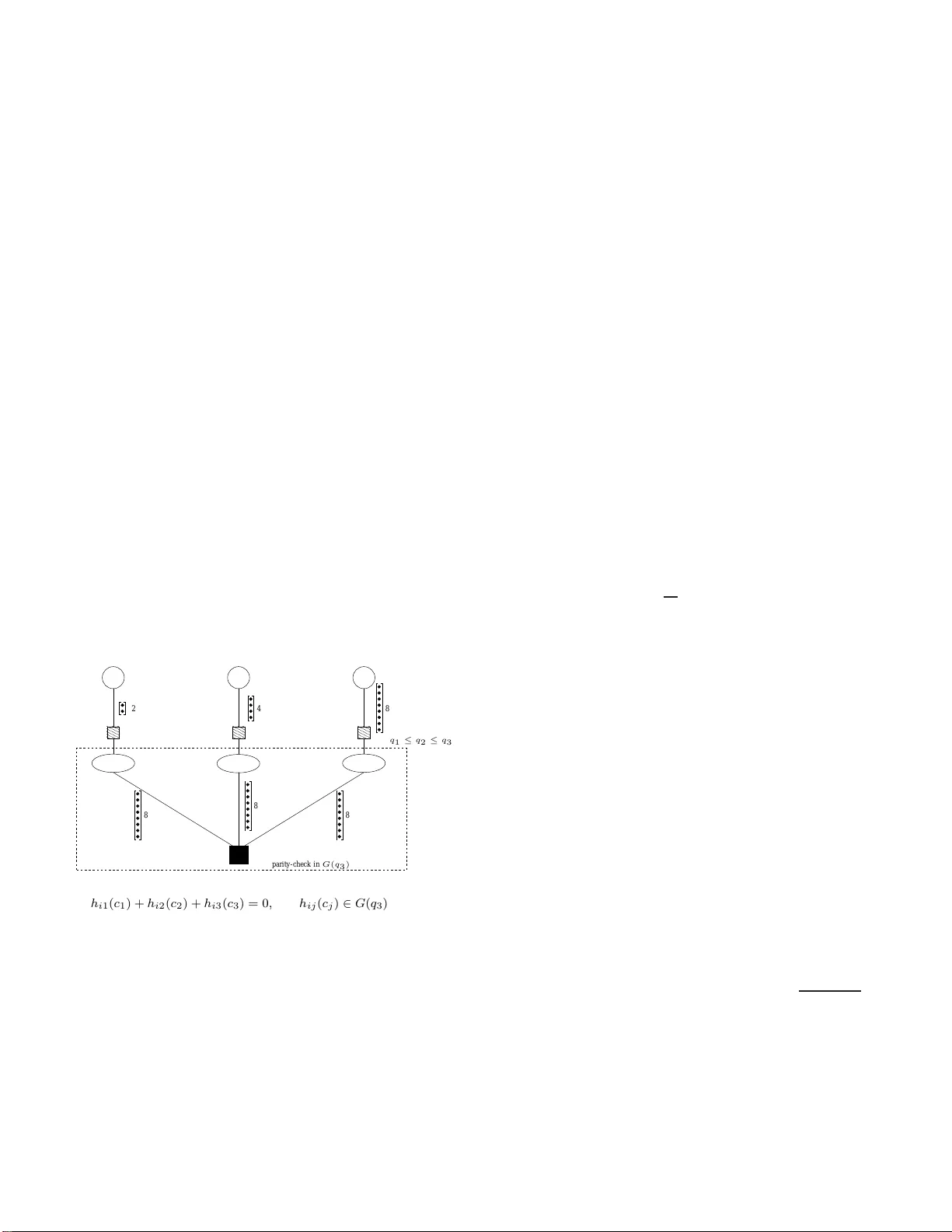
Analysis of Non-binary Hybrid LDPC Codes Lucile Sassate lli and David Declercq ETIS ENSEA/UCP/CNRS UMR-8051 95014 Cergy , FRANCE { sassatelli,declercq } @ensea.fr Abstract — This paper is eligible for the stu dent paper award. In this p aper , we analyse asymptotically a new class of LDPC codes called Non-bi nary Hybrid LDPC codes, wh ich has been recently introduced in [7]. W e use density evolution techn iques to derive a stability condition f or hybrid LDPC codes, and prov e their threshold behav ior . W e study thi s stability condition to conclud e on asymptotic advantages of hybrid LDPC codes compared to their non-hybrid counterparts. I . I N T R O D U C T I O N Like T urbo Codes, LDPC codes are pseu do-ran dom codes which are well-known to be c hannel capacity-app roachin g. LDPC code s have b een red iscovered b y MacKay u nder their binary form and soon after their non-bin ary cou nterpart ha ve been studied by Dav ey [1] . No n-bina ry LDPC codes have recently received a g reat attention beca use they hav e better perfor mance than binar y LD PC codes f or short block length and/or hig h ord er modu lations [ 3], [ 8], [4]. Howe ver, good short length non-binar y LDPC codes tend to be ’ultra-spar se’, and have worse convergence th reshold than binary LDPC codes. Our main mo tiv atio n in introd ucing an d study ing th e new class of hyb rid LDPC co des is to comb ine the adv antage s of both families of codes, binary and non-b inary . Hyb rid c odes families aim a t achieving this tr ade-off by mixing different order for the symb ols in the same codeword. Our resu lting codes are called Non -binary Hybrid LDPC Codes becau se o f the mixture of different symbol sets in the codew ord. In [7], we have dem onstrated the inter est of the Hy brid LDPC co des by designing cod es that compare fav orably with existing codes for quite moderate code l ength (a few thousands bits). Hybrid LDPC codes appe ar to be especially interesting for low rate codes, R ≤ 0 . 2 5 . In this paper, we study the asymptotic behavior and pro perties of Hybr id L DPC codes under iterati ve b elief propagation (BP) decodin g. The section two of this paper highlights the generality of our new co des stru cture, and explains why we have f ocused th e asymptotic study on the particular subclass of linear codes. In third and fourth sections, we present the context of the study , and detail symmetry and linear-in variance pro perties which are usefu l for the stability cond ition.This condition is then expressed and analyzed to sh ow theoretic advantages of Hybrid LDPC codes. 1 This work was supported by the French Armament Procurement Agency (DGA). I I . T H E C L A S S O F H Y B R I D C O D E S W e de fine a No n-binar y Hybrid LDPC c ode as LDPC code whose variable n odes b elong to finite sets of dif ferent o rders. More pr ecisely , this class of codes is n ot d efined in a finite field, but in finite groups. W e will only consider groups wh ose cardinality q k is a power o f 2 , that says g roups o f th e type G ( q k ) = Z 2 Z p k with p k = log 2 ( q k ) . Th us to each element of G ( q k ) co rrespond s a bin ary map of p k bits. Let us call th e minimum or der of codeword symbols q min , an d the maximum order of codew ord symbols q max . The class of h ybrid LDPC codes is d efined o n the product gro up Z 2 Z p min × . . . × Z 2 Z p max . Let us n otice that this ty pe of LDPC co des built o n produ ct grou ps ha s a lready been prop osed in the literatur e [2 ], but no op timization o f the code structure has been pro posed and its ap plication was restricted to the mapp ing of the codeword symbols to dif feren t modulation orders. Parity check codes de fined on ( G ( q min ) × . . . × G ( q max )) are particular since th ey are linear in Z 2 Z , but could be no n-linear in the produ ct grou p. Althou gh it is a lo ss of generality , we have decided to restrict ou rselves to hy brid L DPC co des that are linear in their p roduc t group, in order to byp ass the encoding problem . W e will therefor e only consider upper-triangular parity check matrices and a specific sor t of the symbo l or ders in the codeword, which ensures the linearity of the hybrid codes. The structure of th e codeword and the associated parity check matrix is dep icted in Figure 1. W e hierar chically sort the Redundancy Information 0 . . . H = . . . . . . c = G ( q max ) G ( q r +1 ) G ( q r ) G ( q min ) G ( q max ) G ( q r +1 ) Fig. 1. Hybrid code word and parity-chec k matrix. different group orders in the rows of the p arity-check matr ix, and also in the codeword, such that q min < . . . < q k < . . . < q max . T o encode a red undan cy sy mbol, we co nsider each symbol that p articipates in the parity ch eck as an elemen t of the highest group, which is only possible if the gr oups are sorted as in Figure 1. Th is clearly shows that enco ding is feasible in linear time b y ba ckward computation of th e ch eck symbols. In o rder to explain the decodin g algor ithm for hybrid LDPC codes, it is useful to interpret a parity chec k of a hybrid co de as a special case of a parity che ck built on the highest o rder group o f the sym bols of the row , denoted G ( q l ) and have a look at the binary imag e o f the equiv alent code [8]. For co des defined over Galois fields, the no nzero values of H co rrespon d to the co mpanion matrices of the finite field elements and ar e typically ro tation matr ices (bec ause of the cyclic property of the Galois field s). In the case of hybr id LDPC cod es, a nonzero value is a function th at co nnects a row in G ( q l ) and a colum n in G ( q k ) , i.e., th at m aps the q k symbols of G ( q k ) into a subset of q k symbols th at b elongs to G ( q l ) . Such application is no t necessarily linear, but in the case it is, its equ iv alent binar y representatio n is a matrix of dimension ( p l × p k ) . Note that, with th e ab ove m entioned c onstraints, we have necessarily p k ≤ p l . It is po ssible to gen eralize the Belief pro pagation decoder to h ybrid codes, and it has been shown that even for those very specific stru ctures, it is possible to d erive a fast version of the d ecoder using FFTs [5]. In this work, we consider only maps that are linear application s, an d h ence that have a binary representation , in order to be able to apply all known results on linear codes. W e call the message passing step through h ij (cf. figure 2 ) extension when it is from G ( q k ) to G ( q l ) and trun cation when it is from G ( q l ) to G ( q k ) . 000 000 000 000 111 111 111 111 000 000 000 000 111 111 111 111 000 000 000 000 111 111 111 111 2 4 8 8 8 8 q 1 ≤ q 2 ≤ q 3 parity-check i n G ( q 3 ) h i 1 ( c 1 ) + h i 2 ( c 2 ) + h i 3 ( c 3 ) = 0 , h ij ( c j ) ∈ G ( q 3 ) defines a component c ode in the group G = G ( q 1 ) × G ( q 2 ) × G ( q 3 ) h i 1 ( c 1 ) h i 2 ( c 2 ) h i 3 ( c 3 ) c 1 ∈ G ( q 1 ) c 2 ∈ G ( q 2 ) c 3 ∈ G ( q 3 ) Fig. 2. Pari ty-check of an hybrid LDPC code. I I I . P RO P E RT I E S O F L I N E A R H Y B R I D L D P C C O D E S A. The Extension and T run cation Operations W e first c larify the nature o f the non-zer o elements of the parity-ch eck matrix of a hybrid LDPC code. W e consider a n element A of the set of linear extension s from G ( q k ) to G ( q l ) . Im( A ) d enotes the image of A . A belongs to th e set of linear applications from G (2) p k to G (2) p l which are full-rank (that is injecti ve since dim( Im( A ))=r ank( A )= p k ). A : G (2) p k → G (2) p l i → j i denotes the binary map of i in G ( q k ) in G (2) p k , with p k = log 2 ( q k ) . Th at is, each in dex i is taken to mean the i th elemen t of G ( q k ) , given some en umeratio n of the field . x i is the i th element of vector x . Th e extension y , of the probab ility vector x by A , is deno ted by x × A and de fined by : for all i = 0 , . . . , q l − 1 if i / ∈ Im ( A ) , y i = 0 if i ∈ Im ( A ) , y i = x j with j such that i = A j A is called extension , and the in verse fun ction A − 1 trunca- tion from Im ( A ) to G ( q k ) . The truncation is defined by A − 1 : Im ( A ) → G (2) p k j → i with j such that j = A i The truncation x of the probability v ector y b y A − 1 is denoted by y × A − 1 and defined b y i = 0 , . . . , q k − 1 , x i = y j with j such that j = A i Giv en a p robability -vector x o f size q , the compo nents of the logarithmic density ratio (L DR) vector w associated with x are defined as w i = log x 0 x i , i = 0 , . . . , q − 1 . At chann el output, LDR messages are actually log arithmic likelihood r atio (LLR) vectors. B. P arameterization of Hybrid LDPC fa mily An edge of the T anne r graph of an H ybrid LDPC code has four parameters ( i, q k , j, q l ) . A hybrid LDPC co de is then represented by π ( i, j, k , l ) which is the pro portion o f ed ges connectin g variable node s of degree i in G ( q k ) , to check nodes of d egree j in G ( q l ) . Thus, hyb rid LDPC codes have a very rich p arameterizatio n since the para meter space has four dimensions. C. Symmetry definitio n for density evolution ap pr oa ch Let W b e a LLR vector compu ted at the output of a discre te memory less channel, and v the comp onent of th e co dew ord sent, corr espondin g to the requ ired value for th e data node the edge with message W is conn ected to. W a denotes the cyclic-permutatio n of W . c den otes the value o f the sym bol linked to the e dge with the message W , and y th e available informa tion on all othe r ed ges of th e graph. W a i is the i th compon ent of W a and is d efined b y W a i = log P ( a · c =0 | y ) P ( a · c = i | y ) , where · denotes the multiplication in G ( q ) . L ike in [ 4], W a , for all a ∈ G ( q ) is defined by W a i = W a + i − W a , ∀ i = 0 . . . q − 1 A channel is cyclic if ou tput LLR vector W fulfills P ( W a | v = 0 ) = P ( W | v = a ) Definition 1 On a cyclic c hannel, a LDR message is symmet- ric, if th e following expression hold s ∀ a ∈ G ( q ) , P ( W = w | v = a ) = e − w a P ( W = w | v = 0) Most practica l channels are cyclic, and th us, in this work, we assume tran smission o n arb itrary me moryless cyclic- symmetric channels. The g eneralization of th e results in th is paper to non -symmetric ch annels can be do ne th anks to the co set app roach as in [ 4]. Th e symmetry proper ty is the essential conditio n f or any asympto tic study since it ensu res that th e er ror p robability is indep enden t of the codeword sen t. Lemma 1 : If W is a symm etric L DR-vector ran dom variable, then its extension W × A , by any linear extension A with full rank, is also sym metric. The same lemma ho lds for trunc ation . The data pass and the check pass of belief p ropag ation have alread y been shown to preserve sym metry . T hus, lem ma 1 ensures th at th e h ybrid decoder preserves the symmetry property if the input messages are symmetric. Lemma 2 : Th e erro r-probability of a code in a hyb rid family , used on a cyclic-sym metric chann el, is ind ependen t on the codeword sent. For lack o f sp ace, we do no t give the p roof o f th is lemma, which is a direct generalizatio n of [6]. D. Linear Applica tion-Invariance Now we introduce a pro perty that is specific to the hybrid codes families. Benn atan et al. in [4] used per mutation- in variance to der iv e a stability condition for non -binar y LDPC codes, and to app roxima te the d ensities of g raph messages using o ne-dimen sional functionals, for extrinsic informatio n transfert (EXI T) charts an alysis. The d ifference b etween non - binary and Hybrid LDPC codes holds in the non- zeros ele- ments of the parity-ch eck matrix . In deed, they do n ot corre- spond anymore to cyclic p ermutation s, but to linear extensions or truncation s , that we d enote by linear applicatio ns. Th e goal is to prove that linear application- in variance (sho rtened by LA- in variance) of messages is in duced by cho osing un iformly the linear e xtensions which are the non-zer o eleme nts of the hybrid parity-ch eck matrix. In p articular, LA-in variance allows to characterize message densities with only o ne scalar param eter [7]. W e work with probab ility vector ran dom variables, but all the definitions and p roofs giv en in the rema ining also apply to LDR-vector rando m variables. W e denote by E the set o f linear extension s f rom G ( q 1 ) to G ( q 2 ) , an d by T the set of ”inv erse f unction s” of E , what we call the set of linear truncation s from G ( q 2 ) to G ( q 1 ) (see previous section on linear e xtensions ). Definition 2: Y is LA-inv ariant if and on ly if for all ( A − 1 , B − 1 ) ∈ T × T , the probab ility-vector rand om variables Y × A − 1 and Y × B − 1 are identically d istributed. Lemma 3 : If a pro bability-vector rando m variable Y o f size q 2 is L A-in variant, then f or all ( i, j ) ∈ G ( q 2 ) × G ( q 2 ) , the random variables Y i and Y j are identically d istributed. Definition 3 : Let X be a q 1 -sized pro bability-vector random variable, we define the random-extension of size q 2 of X , denoted ˜ X , as the prob ability-vector random variable X × A , where A is unifo rmly chosen in E and indep endent on X . Lemma 4 : A probab ility-vector ra ndom variable Y is LA- in variant if and only if there exists a probab ility-vector random variable X such that Y = ˜ X . For lack of space r eason, we will detail the p roof o f th is lemma, which is easy , in a future publication. Thanks to lemma 4, the check no de incomin g messages ar e LA-inv ariant in the code f amily made of all the possible cycle-free interlea vers and unifor mly ch osen linear extension s ( and hence correspo nding truncation s) . Moreover , random - truncation s , at check nod e output, e nsures LA -in variance of variable n ode inco ming m es- sages. Thus, as shown in [7] under Gaussian appro ximation, the densities of vector messages are c haracterized by only one parameter . I V . T H E S TA B I L I T Y C O N D I T I O N F O R H Y B R I D L D P C C O D E S The stability conditio n, intr oduced in [6], is a necessary and suffi cient condition for th e error probability to approach arbitrarily close to zero, ass umin g it has already droppe d below some value at some itera tion. In this p aragraph , we gene ralize the stability co ndition to hy brid LDPC cod es. Giv en a h ybrid family defined by π ( i, j, k , l ) , we define th e following family parameter: Ω = X j,k,l π ( i = 2 , k , j, l ) q k − 1 q l − 1 ( j − 1) Also fo r a g iv en mem oryless symmetric o utput ch annel with transition prob abilities p ( y | x ) and a mapp ing δ ( · ) , we define the follo wing channel pa rameter: ∆ = X k,l π ( k , l ) 1 q l − 1 q k − 1 X i =1 Z p p ( y | δ ( i )) p ( y | δ (0 )) dy E.g., for BI-A WGN channel, we have ∆ = X l,k π ( l , k ) 1 q l − 1 q k − 1 X i =1 exp ( − 1 2 σ 2 n i ) where n i is the number of ones in the binary map of i ∈ G ( q k ) . Theorem : Let assume ( π , δ ) g iv en for a hybr id LDPC set. Let P 0 denotes the probability distribution fu nction of in itial messages R ( k ) (0) for all k . Let P t e = P e ( R t ) denotes the av erage er ror probab ility at iter ation t un der den sity evolution. • If Ω ≥ 1 ∆ , th en ther e exists a p ositiv e con stant ξ = ξ ( π , P 0 ) such that P t e > ξ for all iter ations t . • If Ω < 1 ∆ , th en ther e exists a p ositiv e con stant ξ = ξ ( π , P 0 ) su ch that if P t e < ξ at some iteration t , then P t e approa ches zero as t app roaches infinity . For lack of space reason , we give the re only a sketch of the proof . Proof • W e first give the general lines of the proof of th e necessary co ndition. Let R ( k ) t + n denotes the variable node outcomin g m essages in G ( q k ) at iteratio n t + n , where n = 0 , 1 , . . . . Since we c onsider only cyclic-symmetric channels, we can apply lemm a 4 fr om [4]. It ensures th at there exists an erasurized channel such that th e cyclic- symmetric ch annel is a d egraded version of it, a nd hence provides a lower bou nd on the err or prob ability . Let ˆ R ( k ) t + n , n = 0 , 1 , . . . , denote the respecti ve messages of the erasurized ch annel, and ˆ ǫ 0 the erasure probab ility . In the remainder of the p roof, we switch to log- density repre- sentation of m essages. Let ˆ R ′ ( k ) t + n denote the L DR-vector representatio n o f ˆ R ( k ) t + n , n = 0 , 1 , . . . . Q ( k ) n ( w ) d enotes the distribution of ˆ R ′ ( k ) t + n . P ( k ) 0 denotes the distribution of the initial message R ′ ( k ) 0 of the cyclic-symmetric channel. The overline notation X a pplied to vector X represen ts the vector resulting from random extension fo llowed by random truncatio n of X . Provided that random extension and truncation are such that X and X are of same size, we can sho w that the error p robabilities are equal. Thus, if Q ( k ) n is the distrib ution of ˆ R ′ ( k ) t + n , we have P e ( Q n ) = X k π ( k ) P e ( Q ( k ) n ) = X k π ( k ) P e ( Q ( k ) n ) Therefo re P e ( Q n ) is lower bound ed by a constant strictly greater than zero if and o nly if there exists k such th at P e ( Q ( k ) n ) is lo wer bou nded by a constant strictly greater than zero. Defining Ω k = X j ≥ 2 ,l π ( i = 2 , j, l | k ) q k − 1 q l − 1 ( j − 1) and P 0 = P k π ( k ) P ( k ) 0 , we show that P e ( Q ( k ) n ) ≥ 1 2( q max − 1) 2 ˆ ǫ ( k ) 2 0 Ω k Ω n − 1 P 0 n − 1 (1) W e p rove that P 0 is sym metric in th e binary sense, and as in [4], we obtain lim n →∞ 1 n log P 0 ( W 1 ≤ 0) ⊗ n = log E − 1 2 R ′ 1 where R ′ 1 is the shortened notation for the first compon ent of the mix ture of d ecoder input LLR-vector ran dom variables R ′ ( k ) 0 . W e have E − 1 2 R ′ 1 = E A,B E s R × A × B − 1 1 R × A × B − 1 0 | A, B !! and finally o btain E − 1 2 R ′ 1 = X k,l π ( k , l ) 1 q l − 1 q k − 1 X i =1 E r R i R 0 ! and E r R i R 0 ! = Z p p ( y | δ ( i ) p ( y | δ (0))) dy Hence, we find E − 1 2 R ′ 1 = ∆ . This last equation combined with equ ation (1) lead s to th e conclusion that P e ( Q ( k ) n ) is lower bouded by a strictly positive constant, as n tends to infin ity , as soon as Ω∆ ≥ 1 . This condition is the same for all k . Thus, the necessary cond ition f or stability is Ω < 1 ∆ . • W e g iv e now the main steps for th e p roof of the su ffi- ciency of the conditio n. X ( k ) denotes a p robab ility-vector random v ariable of size k . W e define D n and D a : D n ( X ( k ) ) = E v u u t X ( k ) i X ( k ) 0 = E v u u t X ( k ) 1 X ( k ) 0 = X l π ( l | k ) 1 q l − 1 q k − 1 X i =1 E v u u t X ( k ) i X ( k ) 0 D a ( X ( l ) ) = 1 q l − 1 q l − 1 X j =1 E v u u t X ( l ) j X ( l ) 0 T o shorten the notations we can omit the index of iteration t . T he data pass is translated by R ( k ) i = R (0) ( k ) i i − 1 Y n =1 L ( k ) i W e obtain D n ( R t ) = E i,k 0 B @ v u u u t R ( k ) i R ( k ) 0 1 C A = ∆ X k π ( k ) 2 4 E 0 @ v u u t L ( k ) i L ( k ) 0 1 A 3 5 i − 1 First, we are going to prove the recursive ineq uality (2) W e show the three following equation s. E v u u t L ( k ) i L ( k ) 0 = D n ( L ( k ) ) D n ( L ( k ) ) = X l π ( l | k ) q k − 1 q l − 1 D a ( L ( l ) ) 1 − D a ( L ( l ) ) ≥ P j π ( j | l )(1 − D a ( R ( l ) )) j − 1 + O ( D a ( R ( l ) ) 2 ) Connecting D a ( R ( l ) ) to D n ( R t ) ends up with the pr oof of equation 2: D a ( R ( l ) ) = 1 q l − 1 X k π ( k | l ) q k − 1 X i =1 E v u u t R ( k ) i R ( k ) 0 D n ( R t ) = X l π ( l ) 1 q l − 1 X k π ( k | l ) q k − 1 X i =1 E v u u t R ( k ) i R ( k ) 0 we o btain D n ( R t ) = X l π ( l ) D a ( R ( l ) ) D n ( R t +1 ) ≤ ∆ X i,k π ( i, k ) 2 4 X l π ( l | i, k ) q k − 1 q l − 1 0 @ 1 − X j ≥ 2 π ( j | i, k , l )(1 − β t D n ( R t )) j − 1 1 A 3 5 i − 1 + O ( D n ( R t ) 2 ) (2) W e express D a ( R ( l ) ) in terms o f D n ( R t ) : 1 − D a ( R ( l ) ) ≤ 1 − min l D a ( R ( l ) ) ≤ 1 − β t D n ( R t ) as soon as β t is a function of the iter ation such that β t ≤ min l D a ( R ( l ) ) D n ( R t ) . Thus, we o btain equation ( 2). W e then can prove that if Ω < 1 ∆ then there exists α such that if D n ( R t 0 ) < α at some iteratio n t 0 , then lim t →∞ D n ( R t ) = 0 . More over , if X ( k ) is a symmetric probab ility-vector r andom v ariables of size q k , then 1 q 2 k D n ( X ( k ) ) 2 ≤ P e ( X ( k ) ) ≤ ( q k − 1) D n ( X ( k ) ) (3) Let us r emind that D n ( R t ) = P k π ( k ) D n ( R ( k ) t ) , and that the sequence D n ( R t ) ∞ t = t 0 conv erges to zero . Thus for all k , the sequen ces D n ( R ( k ) t ) ∞ t = t 0 also conver ge to zero. And hen ce P e ( R ( k ) t ) c onv erges to zero. This is true for all k , and since we have P e ( R t ) = P k π ( k ) P e ( R ( k ) t ) , P e ( R t ) also conver ges to zero . This proves th e suffi- ciency of the stability condition. Thus, we have proved tha t, provide d that a fixed point of density ev olution exists for hybrid codes, this point can be stable und er certain condition . Ou r hybrid codes have hence threshold behavior . V . A N A LY S I S O F T H E S TA B I L I T Y C O N D I T I O N Now we are able to co mpare the stability co nditions for hybrid LDPC codes whose high est order group is G ( q ) an d for non-b inary LDPC co des d efined on the highest field GF ( q ) . T o illustrate advantages of hy brid codes over non- binary codes concern ing the stability , we consider on fig ure 3 a code rate of one half, achieved b y non- binary cod es on GF ( q ) , with q = 2 . . . 25 6 , and hybrid cod es of type G (2) − G ( q ) , hen ce with graph rate varying with q . The inf ormation pa rt of hybrid LDPC codes is in G (2) , an d the redun dancy in G ( q ) . W e assume regular T ann er graphs for those cod es, with connectio n degree of variable nodes d v = 2 . The conn ection d egree of check node s will be henc e varying whith the grap h rate for hybrid codes. W e con sider BI-A WGN ch annel whose variance σ 2 is set to 1 . W e d enote by Ω nb and Ω hy b the par ameters of GF ( q ) LDPC codes and hyb rid LDPC cod es, respectively . The same for ∆ nb and ∆ hy b . Remark 1 : W e no te, on figure 3, that Ω hy b ≤ Ω nb and ∆ hy b ≤ ∆ nb . Hence, with th ose assumptions, a fixed point of d ensity ev olution is stable at lower SNR fo r hybr id codes than for GF ( q ) codes. Remark 2 : For a usual non-bin ary GF ( q ) L DPC code, the 8 16 32 64 128 256 0 0.1 0.2 0.3 0.4 0.5 0.6 0.7 Evolution of ∆ q ∆ ∆ nb ∆ hyb 8 16 32 64 128 256 2 2.2 2.4 2.6 2.8 3 3.2 3.4 3.6 3.8 4 Evolution of Ω q Ω Ω nb Ω hyb d v Fig. 3. Channel and code paramete rs ∆ and Ω for hybrid and non-hybri d codes in terms of maximum symbol order q . T hese figures show that a hybrid code can be stable when a non-binary code is not. hybrid stability condition reduces to n on-h ybrid stability con- dition, gi ven b y: Ω nb = ρ ′ (1) λ ′ (0) ∆ nb = 1 q − 1 q − 1 X i =1 exp ( − 1 2 σ 2 n i ) with n i , the numb er of o nes in the binary map of i ∈ G ( q ) . Under this for m, we can prove that ∆ nb tends to zero as q goes to in finity . On BI-A WGN chann el, this means that a ny fixed point of den sity ev o lution is stable as q tends to infinity for non- binary LDPC codes, and for hybr id codes too (b ecause of Remark 1 ). Those re sults indicate th at o ptimization proce dures will be more efficient since there exist m ore stable h ybrid codes than non-h ybrid LDPC codes f or a giv en set of chann el and code parameters. Th e o ptimization and cod e de sign is repor ted in a future application. R E F E R E N C E S [1] M. Dav ey and D.J. C. MacKay , “Lo w Density Parity Check Codes over GF ( q ) , ” IEEE Commun. Lett. , vol . 2, pp. 165-167, June 1998. [2] D. Sridhara and T .E. Fuja, “Low Densi ty parity Check Codes over Grou ps and Rings, ” in the proc . of ITW’02 , Banglad ore, India, Oct. 2002. [3] X.-Y . Hu and E. Eleft heriou, “Binary Represent ation of Cycle T anner- Graph GF (2 q ) Codes, ” in the proc. of ICC’04 , pp. 528-532, Paris, France, June 2004. [4] A. Bennatan and David Burshtein, ”Design and Anal ysis of Nonbi nary LDPC Codes for Arbitrary Discrete-Memoryl ess Channels, ” IEEE T rans. on Inform. Theory , vol. 52, no. 2, pp. 549-583, Feb . 2006. [5] A. Goupil, M. Colas, G. Gelle and D. Declercq, “FFT -based BP Decoding of General LDPC Codes ove r Abel ian Groups, ” to appear in the IEEE T rans. on Commun. , 2006. [6] T . Richardson, A. Shokrollahi and R. Urbanke, ”Design of Capacity- Approachi ng Irre gular LDPC Codes, ” IEEE T rans. on Inform. Theory , vol. 47, no. 2, pp. 619-637, Feb . 2001. [7] L. Sassatelli and D. Declercq, ”Non-binary Hybrid LDPC Codes: Structure, Decoding and Optimizat ion, ” in IEEE Inform. Theory W orkshop , Chengdu, China, October 2006, http:/ /arxi v .org/PS cache /cs/pdf/0701 /0701066v1.pdf . [8] C. Poullia t, M. Fossorie r and D. Decle rcq, “Using Binary Image of Nonbinary LDPC Codes to Improve Overal l Performance, ” in IEE E Intern. Symp. on T urbo Codes , Munich, April 2006.
Original Paper
Loading high-quality paper...
Comments & Academic Discussion
Loading comments...
Leave a Comment