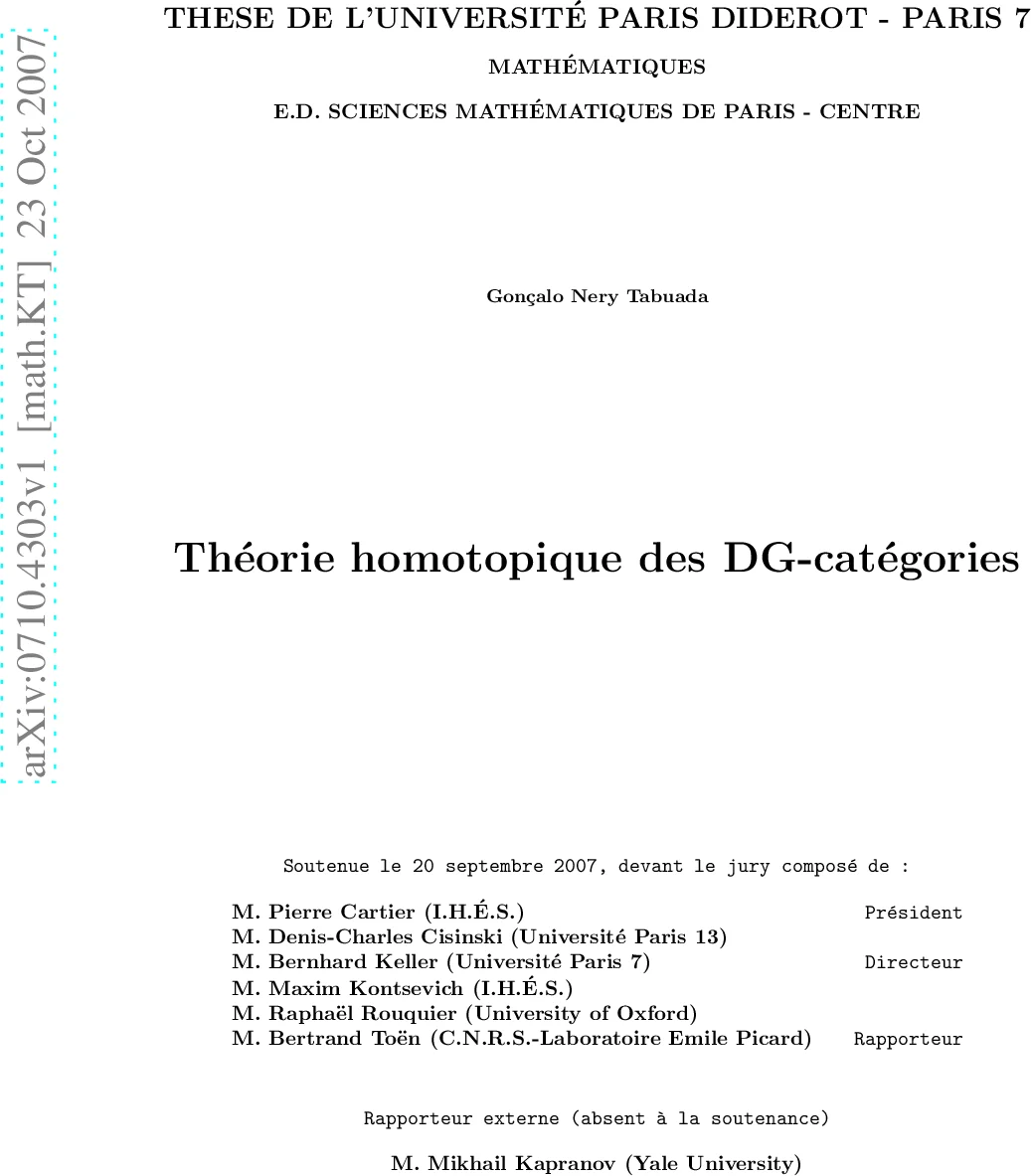
Theorie homotopique des DG-categories
In this thesis we present several original contributions to the study of: - DG categories and their invariants; - Neeman’s well-generated (algebraic) triangulated categories; - Fomin-Zelevinsky’s cluster algebras approach via representation theory.
💡 Research Summary
This dissertation develops a comprehensive homotopical framework for differential graded (DG) categories and applies it to several central topics in modern algebraic geometry, representation theory, and higher algebra. The work begins with a detailed construction of a cofibrantly generated Quillen model structure on the category of small DG categories (dgcat), where weak equivalences are the quasi‑equivalences and fibrations are dg‑functors that are surjective on Hom complexes and satisfy a lifting condition on objects. This model structure is inspired by Drinfeld’s DG‑quotient K, which plays the role of an “interval” object in the homotopy theory of DG categories.
Building on this, the author introduces a second model structure, the Q‑model, whose weak equivalences are Morita equivalences—dg‑functors inducing equivalences of derived categories. Localizing dgcat with respect to these morphisms yields the homotopy category Hmo. Within Hmo the author defines a universal additive invariant, a single functor that simultaneously recovers algebraic K‑theory, Hochschild homology, cyclic homology, and other classical invariants. The universal property of Drinfeld’s DG‑quotient is proved purely homotopically, showing that it represents the universal localizing invariant.
The third part of the thesis exploits the universal additive invariant to construct higher K‑theory for DG categories. Using the language of derivators, filtered homotopy colimits, and pointed derivators, the author defines a universal localizing invariant and shows how it yields a robust higher K‑theory spectrum that behaves well under Morita equivalence and exact sequences.
In the fourth chapter the Q‑model is examined in depth: the author describes Q‑cofibrant and Q‑fibrant objects, establishes a closed symmetric monoidal structure on dgcat, and constructs a derived internal Hom‑functor, thereby providing a fully fledged tensor‑triangulated homotopy theory for DG categories.
Chapter five connects this homotopical machinery to Neeman’s well‑generated algebraic triangulated categories. By endowing dgcat with a monad T and applying Quillen’s lifting argument, the author builds a model structure on T‑algebras, leading to a precise dg‑enhancement of any well‑generated triangulated category. This includes a treatment of α‑cocomplete DG categories, exact α‑cocomplete dg‑categories, and the construction of compact generators in the derived setting.
The final substantive chapter applies the developed theory to Calabi‑Yau categories equipped with a cluster‑tilting subcategory. The author shows how DG‑categorical techniques give a clean description of the embedding of the cluster‑tilting subcategory, determines its image, and proves a main theorem linking cluster tilting objects to Calabi‑Yau structures. An appendix supplies a homotopical proof of Drinfeld’s DG‑quotient theorem, relying solely on the earlier Quillen model structure.
Overall, the dissertation unifies several strands—model category theory for DG categories, universal additive invariants, higher K‑theory, well‑generated triangulated categories, and cluster algebra representations—into a coherent homotopical picture, providing powerful new tools for researchers in algebraic geometry, homological algebra, and representation theory.
Comments & Academic Discussion
Loading comments...
Leave a Comment