Matys Biography of Abraham De Moivre, Translated, Annotated and Augmented
November 27, 2004, marked the 250th anniversary of the death of Abraham De Moivre, best known in statistical circles for his famous large-sample approximation to the binomial distribution, whose generalization is now referred to as the Central Limit …
Authors: ** - **주 저자**: *
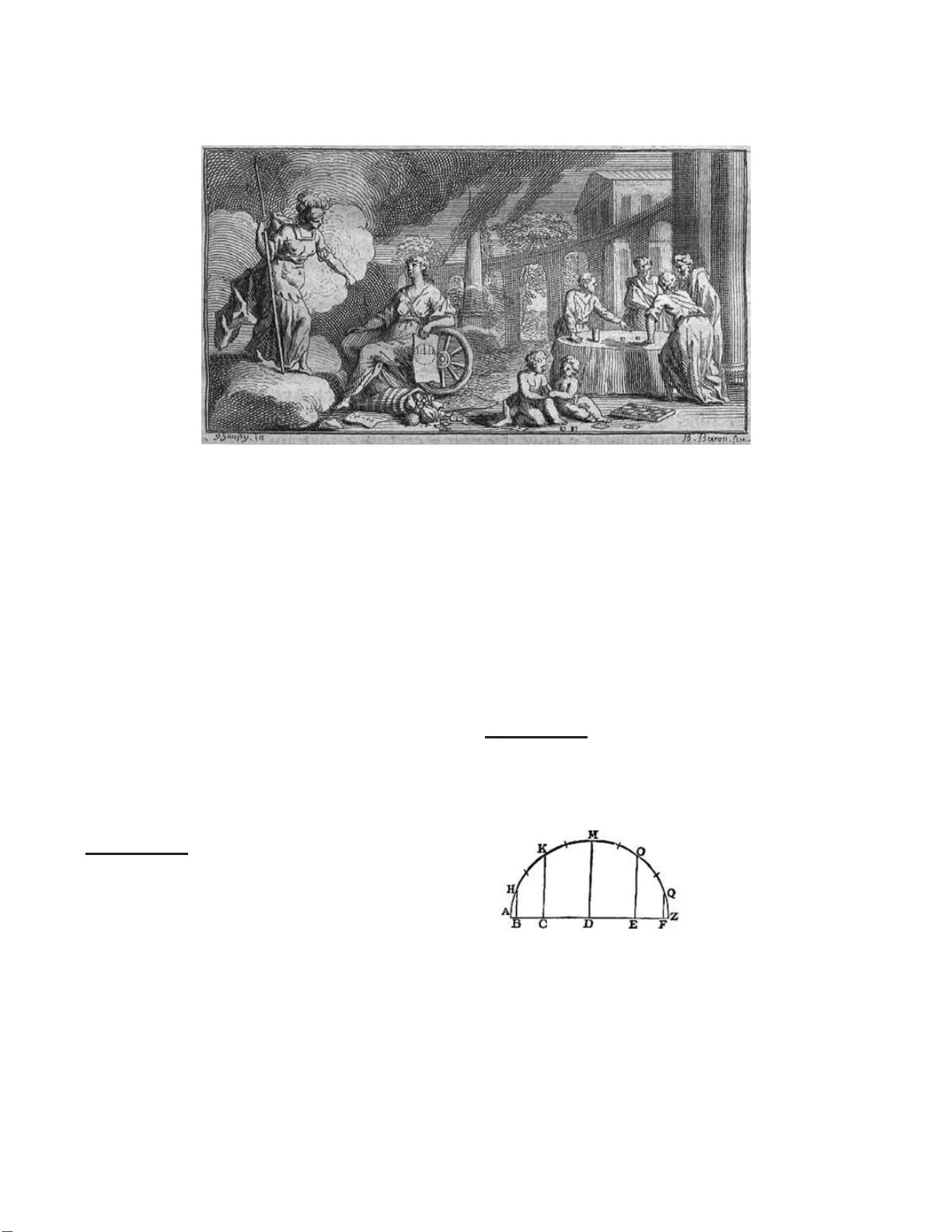
Statistic al Scienc e 2007, V ol. 22 , N o. 1, 109– 136 DOI: 10.1214 /0883423 06000000268 c Institute of Mathematical Statistics , 2007 Mat y’s Biography of A b r aham De Moivre, T ranslated, Annotated and Augmented David R. Bellhouse and Christian Genest Abstr act. No v em b er 27, 2 004, mark ed the 250t h annive rsary of the death of Abraham De Moivre, b est kno wn in stati stical circles for his famous large-sample approxima tion to the binomial distribution, whose generaliza tion is no w referred to as t he Cen tral Limit Theorem. De Moivre w as one of the great p ioneers of classical probabilit y the- ory . He also made seminal con tributions in analytic geometry , complex analysis and the theory of annuities. The first biograph y of De Moivre, on wh ic h almost all sub sequen t ones ha ve since r elied, w as written in F rench by Matthew Mat y . It w as published in 1755 in the Journal britannique . The authors provi de here, f or the first time, a complete translation in to English of Mat y’s biography of De Moivre. New mate- rial, muc h of it tak en from mo dern sources, is giv en in fo otnotes, along with numerous annotations designed to provi de additional clarit y to Mat y’s biog raphy for co ntemporary readers. INTRODUCTION Matthew Mat y (1718– 1776) w as b orn of Huguenot paren tage in the cit y of Utrec h t, in Holland. He stud- ied medicine and philosoph y at the Univ ersit y of Leiden b efore immigrating to England in 1740 . Af- ter a d ecade in Lond on, he edited for six yea rs the Journal britannique , a F renc h-language p ublication out of the Netherlands that was mean t to promote British science and literature throughout cont inen- tal Europ e. Some time after his arriv al in London, Mat y b e- came acquain ted with Abraham De Moivre. It is p ossible that their first encoun ter o ccurred at Slaugh- ter’s Coffee-house, a fa v orite meeting place of F r enc h David R. Bel lhouse is Pr ofessor, Dep artment of Statistic al and A ctuarial Scienc es, University of Western Ontario, L ondon, Ontario, Canada N 6A 5B7 e-mail: b el lhouse@stats.uwo.c a . Christian Genest is Pr ofesseur t itulair e, D´ ep artement de math´ ematiques et de statistique, Universit´ e L aval, Qu´ eb e c, Canada G1K 7P4 e-mail: genest@mat.ulaval.c a . This is an electronic re pr int of the or iginal article published by the Institute o f Mathematical Statistics in Statistic al Scienc e , 2007, V ol. 22, No. 1 , 109– 136 . This reprint differs from the original in pagination and t yp ogr aphic detail. ´ emig r´ es that b oth of them are known to h a v e fre- quen ted. In the w eeks prior to De Moivre’s d eath, Mat y b egan to in terview h im in order to write his biograph y . De Moivre d ied sh ortly after giving his reminiscences up to the late 1680s and Mat y com- pleted the task usin g only his own kno wledge of th e man and De Moivre’s published work. The biogra- phy , wr itten in F rench, app eared in the 1755 edition of the Journa l britannique . Surviving copies of Mat y ( 1755 ) are a v ailable in only a few lo cations and are r elativ ely difficult for man y to access. 1 More readily a v ailable , via Gal lic a on the Int ernet, is Grandjean d e F ouc hy’ s eulogy of De Moivre (F ouc h y , 1754 ). Also written in F renc h, it is b ased largely on the w ork of Mat y ( 175 5 ), as F ouc hy ac kno wledges n ear the end of his text. In fact, his eulog y is for the most part a trans crip tion of excerpts of Mat y’s biography , with the latter’s scien tific and p ersonal biases replaced by his o wn 1 De Morgan ( 1846 ) w as p ossibly the first to refer to Mat y ( 1755 ) in p rint. Some 90 y ears after its p ublication, Mat y’s biograph y of De Moivre w as already regarded as obscure by De Morgan, who states: “I can hardly find any notice of this little tract of Dr. Mat y .” A transcript of Mat y ( 1755 ) is now a v ailable in PDF format on the second author’s webpag e, at archimede. mat.ulaval.ca/p ages/genest . 1 2 D. R. BELLHOUSE AND C. GENEST in some places. In spite of app earances, the biogra- phy of Mat y ( 1755 ) pr edates the eulogy of F ouch y ( 1754 ) considerably , since the 1754 volume of the Histoir e de l ’ A c ad ´ emie r oyal e des scienc es whic h carried F ouc h y’s article was actually pub lished in 1759. Since De Moivre’s times, concise descriptions of his life and wo rks ha v e b een p ublished in several bio- graphical dictionaries, th e most recen t b eing Schnei- der ( 2004 ). Mat y’s article is the ma jor source for almost all of them and remains, to this d ate, the b est and most complete description of this great mathematicia n’s life (Schneider, 2001 ). On the o cca- sion of the 250th ann iv ersary of De Moivre’s d eath, therefore, it seems fitting to revisit Mat y’s biogra- phy and to provi de it in a language that is accessible to a large num b er of readers. Much additional source material is readily accessible to day so th at Mat y’s biographical information has b een sub stan tially an- notated and augmen ted. Th ese complemen ts app ear in the form of n umb ered fo otnotes. Mat y’s o wn let- tered fo otnotes to his biography of De Moivre are giv en as endnotes to the article. A thorough description and ev aluatio n of De Moivre’s mathematical w ork may b e foun d in Sc hneider ( 1968 , 2005 ). Hald ( 1990 ) also giv es a de- tailed accoun t of De Moivre’s work in pr obab ilit y . Consequen tly , atten tion is restricted here mostly to biographical rather than tec hnical detail; the excep- tions are wh en some mathematical commen tary en- hances Mat y’s text. MEMOIR ON THE LIFE AND WRITINGS OF MR. DE MOIVRE By Matthew Ma t y I hereby p ay tribute to the memory of Mr. De Moivre 2 on b ehalf of a Journal britannique and dis- c harge th e duty in v ested in me through h is trus t, b y 2 W alker ( 1934 ) has given an extensive discussion of the spelling of De Moivre’s surname. F renc h sources almost in- v ariably refer to the name as Moivre, since the particle “de” w ould normally b e associated with nobility . How ever, En- glish sources, including De Moivre h imself, use De Moivre, de Moivre and Demoivre. D e Moivre is used here, since it is the form of his signature on most of his manuscript writings that the authors hav e b een able to see. Schneider ( 2004 ) sp eculates that De Moivre added the particle “de” to his name on arriv al in England in order to gain prestige in dealing with English clien ts, especially among the nobilit y . This seems doubtfu l. Among the nearly 1600 Huguenot refugees presenting them- selv es to the Sa vo y Churc h, a F renc h Huguenot ch urch in Lon- don, appro ximately 120 had “de” prefixing their surnames and Ab r aham De Moivr e 1667–1754 publishing w h at I hav e b een able to gather p ertain- ing to his life and writings. Dra wing up on materi- als that I ha ve collecte d at pains to m yself as well as disco v eries that only exp erts in su c h matte rs are comp eten t to app raise, I shall attempt to p ortra y a mathematicia n who took prid e in h is o wn rectitude and who imp osed n o condition to m e other than I sp eak the language of the truth. Abraham De Moivre was b orn at Vitry 3 in Cham- pagne on Ma y 26, 1667. His father was a surgeon and although he w as not we alth y , he sp ared no ex- p ense to edu cate his c hildren. 4 His son was sen t to sc ho ol at an early age, and this son, who r etained the fond est memory of his parent s throughout his life, recalled with pleasure a letter that he wrote to them on New Y ear’s Da y , 1673. Religious zea l, w hic h w as not as k een in this cit y as in the rest of F r ance, did not pr eclude Catholic and Protestan t families from entrusting their c hil- dren to the same tutors. Y oung De Moivre b egan his stud ies in Latin with a p r iest, and after one a further 20 or more had “de la” (Huguenot S o ciety , 1914 ). If the p erson was of noble origin, it w as noted in the register; for example, Louis de Sain t-Delis, Marquis de Heucourt, and Jean de Meslin, Seigneur de Campagny . The v ast ma jority of the 120 entries were not from the nobilit y . 3 Modern- d a y V itry-le-F ran¸ cois, a rebuilding of “Vitry en P erthois,” is located in the Department of Marne, about halfw a y b etw een P aris and N ancy in North-Eastern F rance. 4 In a p etition for English citizenship (naturalization), Abraham De Moivre states that his paren ts were named Daniel and A nne (Huguenot Society , 1923 ). De Moi vre had at least one brother, also n amed Daniel, who wa s a m usician and comp oser in London; see Lasocki ( 1989 ). Schneider ( 2004 ) states that this brother b ecame a merchan t. How ev er, it w as more lik ely Daniel’s son, another Daniel, who wa s the mer- c hant. The latter Daniel made a b usiness trip to Mexico to buy jewelr y in the early 1730s (PRO C104/266 Bundle 38). MA TY’S BIOGRAPHY OF ABRAHAM DE MOIVRE 3 y ear, con tin ued his education with the F athers of the Ch ristian Do ctrine. He studied with the latter unt il the age of eleve n and reac hed third grade. A t the time, he was also b eing taugh t arithmetic by a tutor of writing. Ho we ve r, one day , wh en he ask ed his teac her to clarify an op eration on aliquot parts, 5 the latter replied by b o xing his ears. T his answ er w as neither to the taste of the young student nor to that of his father; and as the latter was already displeased w ith the sc hool, he then enrolled his son at the Protestan t Academ y in Sedan 6 . In the b egin- ning, y oung De Moivre b oarded with th e teac her of Greek, wh ose friendship he wo n b y his dev otion to his studies. Although he w as among the b est stu- den ts in h is class and d id n ot ov erlook an y part of his formal edu cation in the humanities, he found time for studies of a d ifferen t kind . Assisted only by a fello w studen t of thirteen y ears of age, he read a treatise on arithmetic b y a certain le Gendre. 7 This is ho w h e learned th e ru dimen ts, suc h as the ru le of three, op erations on fractions and aliquot parts— the justification for which he had disco vered by this time—and ev en the rule of false p osition. When ever his teac her, who wa s not so keen on arithmetic as he w as on Greek, found the table of his p upil forev er strewn with calculati ons, h e could not help wonder- ing wha t do es the little r o gue intend to do with those numb ers ? After some time with the professor of Greek, Mr. De Moivre p ursued his edu cation under the famous h umanist Mr. d u Rondel, 8 who wa s in c harge of first 5 The aliquot parts of a num b er are the set of prop er divisors of the n umber. F or example, the aliquot parts of 12 are 1, 2, 3, 4 and 6. 6 Sedan is located in th e Meuse v alley , at the Belgian b order, North-East of P aris. The Protestant Academy in Sed an was founded in 1579 at the initiative of F ran¸ coise de Bourb on, wido w of Hen ri-Rob ert de la Marck. The principalit y of S edan b ecame part of F rance in 1642. 7 F ran¸ cois Le Gend re wrote L’Arithm ´ etique en sa p erfe ction , mise en pr atique selon l ’ usage des financiers , b anquiers , & mar chands ( Le Gendre, 1657 ). A d escription of Le Gendre’s w ork is giv en in Sanford ( 1936 ). 8 Jacques du R ond el (ca. 1630–1715 ) and Pierre Bayle (1647–1 706) were b oth teachers at the Huguenot Academy in Sedan. When it was suppressed, du Rondel b ecame a p ro- fessor of b elles lettres at the Universit y of Maestric ht, in the Netherlands; his most famous published w ork is De Vita et Moribus Epicuri (On t he life and death of Epicurus), whic h app eared in 1693. As for Ba yle, he mov ed to Rotterdam, where he taugh t philosoph y and history at the ´ Ecole illustre. In 1684 he founded t h e Nouvel les de la r ´ epublique des lettr es , the most influential literary and philosophical review of the grade, also known as R hetoric . He remained there unt il he reac hed the age of thirteen, that is, until the y ear 1680, famed for its comet. 9 It had b een in- tended that h e en ter the Academ y und er Mr. Ba yle after the summer holida ys the follo wing y ear, but his plans were thr o wn into confusion b y the sup- pression of the Academ y and, for lac k of a tutor, he w as forced to return to Champagne. The progress he had made in arithmetic w as me- teoric. Thus h is father was advised to find s omeone to teac h him algebra but he had su ffi cien t confid ence in his son’s abilit y simp ly to place in his hands th e b o ok by F ather Prestet . 10 Unfortunately , the y oung man foun d in the in tro duction to this treatise a pre- liminary discussion on the nature of our ideas, and since he did not kn o w what an idea w as—he had nev er had the go o d fortune to hear Mr. Bayl e on the su b ject—he closed the b o ok without ev er read- ing it. When he was fif teen, he wa s sent to the Academ y in Saum ur , 11 where h e took his y ear in L o gic. His teac her, wh o instructed h im to attend the classes of the Scotsman Duncan, 12 w as a p o or physici st who had scan t esteem for Descartes and who cited no other reason for h is con tempt than the f act that he was b orn b efor e him . Suc h a teac her w as ob viously unsu itable for suc h a gifted student . The latter’s wish wa s to b e sent to time; he is most acclaimed for his Dictionnair e historique et critique ( Bayle, 1696 ). 9 This w as not H alley’s Comet, which app eared in 1682, b ut rather th e “bright comet” disco vered by Gottfried K irc h on Nov em b er 14, 1680, whose p osition w as track ed for severa l months b y astronomers throughout Europ e and which New- ton used as an illustration of his metho d of fitting parabolic orbits for comets in the 1687 edition of Principia M athemat- ic a . 10 Jean Prestet (ca. 1648–1690), who taught mathematics in Nantes and Angers, p opu larized Descartes’ p rinciples in his writings. The b o ok referred t o here is most likely ´ El´ ements de math ´ ematiques (Prestet, 1675 ). 11 Saumur is lo cated in the Loire val ley , some 300 kilometers South-W est of P aris, b etw een T ours and Nantes. The Protes- tant Academy in Saum ur w as founded in 158 9 by Duplesis- Morna y , a friend of K ing Henri IV . It is notew orthy that Descartes b egan his life’ s w ork there. 12 Mark Duncan (1570 –1640) taught philosoph y and Greek at Saumur (Rigg and Bak ew ell, 2004 ). The Dun can mentioned here is likely one of his three sons, whom the father had given the names C´ erisan tis, S ain te-H´ el ` ene and Montf ort. Among these sons, the most lik ely cand idate is Sain te-H´ el ` ene, who “took refuge in London where he died in 1697” (Smiles, 1868 , page 508). 4 D. R. BELLHOUSE AND C. GENEST P aris, and his indulgen t father tried once again to accommodate him. The son, w h o had finally grasp ed what wa s an idea, read almost all of Prestet’s b o ok on his o wn b efore h e left S au mur. In addition, he studied a sh ort treatise by Mr. Huygens on games of c hance. 13 Although h is comprehension of it w as far from complete, he n ev er tired of reading this text and extracted from it ideas that p r o v ed u s efu l for the in vest igations that he u nderto ok thereafter. Mr. De Moivre arrived in Paris in 1684, and the follo wing year, after studying physics at the Coll ` ege de Harcourt, 14 he returned to the family home. He tra v eled thence to Burgun d y to keep company with the son of one of his relativ es. S earc hing among some old b o oks, he found a work on Euclidian geometry b y F ather F ournier. 15 He read the first few p ages eagerly , b ut on disco ve ring that he w as incapable of adv ancing past the Fifth Prop osition, he brok e do wn in tears. 16 When he found h im reduced to this state, his relativ e s u cceeded in consoling him only after he had promised to explain the prop osition to h im. Thereafter, he had no troub le finishing all six b o oks. He also read Henrion’s Pr actic al Ge ome- try , 17 he learned trigonometry and the construction of sine tables, and h e s tu died Rohault’s treatises on 13 Christiaan Hu ygens (1629–169 5) is most fa mous for his con tributions to astronomy . He disco vered the true shap e of the rings of Saturn and, in 1656, patented the first p endulum clock, whic h greatly increased the accuracy of time measure- ment. The short treatise referred to here is De R atio cini is in Ludo Ale ae (Hu y gens, 1657 ), whic h is considered to b e th e first printed work on the calculus of probabilities. This w ork w as part of a larg er b o ok b y F rans van Schooten, Exer cita- tiones M athematic ae . I t seems curious that the latter would not b e mentioned by Maty , as it con tained material that wo uld hav e b een of in terest to a devel oping mathematician. 14 Among others, the famous F renc h writer Jean Racine w as also educated at the Coll` ege de Harcourt b eginning in 1658, where he met Moli ` ere. This coll ` ege w as located where Lyc´ e e Saint-Louis now stands, n ear the Sorb onne in Paris. 15 The Jesuit Georges F ournier (1595–16 52) published a Latin v ersion of Euclid’s Elements (F ournier, 1643 ). 16 The fifth prop osition in Bo ok I of Euclid’s Elements states: “In isosceles triangles the angles at the base are equal to one another, and if t he equal straight lines b e pro duced further, the angles u n der the base will b e equal to one an- other.” This w as the first difficult prop osition in Euclid, and since man y b eginners and the dull-witted stum bled ov er it, it was often referred to as the p ons asinorum , or “bridge of fools,” in the mid- eigh teenth century . 17 Denis Henrion is the pseudonym for Baron Cl ´ ement Cyri- aque de Mangin (d. 1642). The bo ok referred to here is proba- bly Quatr e livr es de la g´ eom´ etrie pr atique (Cyriaque de Man- gin, 1620 ). p ersp ectiv e, mec hanics and sp herical triangles, all of wh ic h had j ust b een pub lished along with some p osthumous work. 18 As Euclid’s Bo oks XI and XI I seemed to o ad- v anced for him, our pu pil to ok adv an tage of h is re- turn to P aris, where he accompanied his father, in order to find a tutor. This p erson w as none other than the famous O zanam, 19 with whom he stud- ied not only the aforemen tioned b o oks, bu t also the rudiments of Theo dosius. 20 The aging m athemati- cian wa s often unequal to th e task, 21 but as Mr. De Moivre himself commen ted: I dissemble d , e ar- marke d the lesson and chal lenge d my te acher to a 18 This is most likely th e Oeuvr es p osthumes de Mr. R ohault (Rohault, 1682 ). 19 Jacques O zanam (1640– 1717) w as a prolific writer of b ooks on mathematics and is b est k n o wn to da y for his w ork on recreational mathematics. Interestingl y , the only published connection b etw een De Moivre and Jacques Ozanam app ears after Ozanam’s d eath and it is ab out chess. In a p osthumous edition of Ozanam’s R´ ecr ´ eations math ´ ematiques et physiques (Ozanam, 1725 , pages 266–269 ), there are three solutions to the k n igh t’s tour problem, which is to co ver all 64 squares of a c hess b oard using a knight’s mo ve. There is one solutio n by Mon tmort, one by De Moivre and one by Jean-Jacques Mairan who supplied the editor of the R´ ecr´ eations with the solutions. At the time, Mairan was directeur de l’Acad´ emie roy ale des sciences, in Pari s. In a margi nal comment in the bo ok, Mairan sa ys that the solutions were obtained in 1722 (three years af- ter Montmo rt’s death). Twiss ( 1787 , pages 138–139) refers to the problem; he states that of t h e th ree solutions, “. . . it [De Moivre’s ] is the most regular of any I hav e seen, and the easiest to b e learn t.” H ere is a diagramma tic representation of De Moivre’s solution to the knight’s t our problem. The tour starts in the upp er right-hand corner of the b oard. The gr aphic al solution of the knight’s tour pr oblem 20 De Moivre was p robably studying the Sphaerics , written by Theodosius of Bithynia (d. ca. 90 BCE). This was Theodo- sius’s w ork on the geometry of the sphere, work t h at pro vided a mathematical background for astronom y . 21 Here, Mat y is clearly trying to b e k ind, as Ozanam would hav e b een only 45 years old at th e time when he taught De Moivre. MA TY’S BIOGRAPHY OF ABRAHAM DE MOIVRE 5 game of chess . Little d id he sa y ho w great w as the satisfactio n he later d eriv ed from disco v ering on h is o wn wh at his tutor had b een u nable to explain! The tide of religious p ers ecution, 22 whic h forced man y F renc h p eople to flee to other countries, un- doubtedly caused Mr. De Moivre to m ov e to Eng- land. A t least I ha v e found no other reason why , nor can I sa y with any precision w h en h e did so, except that he wa s living there in late 1686, 23 as pro ve d b y the follo wing anecdote, whic h he related to me 22 The p ersecution wa s th e result of King Louis XIV’s Ed ict of F ontainebleau in 1685. This edict revo ked the Edict of Nantes of 1598 that had b een p roclaimed by Louis’s grand- father Henri IV. The Edict of Nan tes h ad given substan tial righ ts to F rench Protestants, known as Hu guenots; Henri had b een a Protestant and had conv erted to Catholici sm in order to obtain th e throne of F rance. The Edict of F ontainebleau forbade Protestan t worship and required all children to b e baptized by Catholic priests. Huguenot churc hes we re de- stro yed and Protestan t schools w ere closed. 23 In view of the Englis h calendar prior t o the calendar re- form of 1752, the date giv en as “in late 1686” could mean as late as March 1687 (new style) since the new year in the old-st yle calendar began Marc h 25. The title page of Newton’s Principia (Newton, 1687 ) has tw o printers and tw o dates given, an earlier date of July 5, 1686, associated with S am uel Pep ys and a later date of 1687 associated with Joseph Streater. The b o ok is also printed in tw o different typ es which are presumably indicative of t h e presses of Pep ys and Streater. In the anecdote, reference is made to a b oun d versio n of the b o ok. It is thus likely to b e the fin ished version of 1687. There are other sources that lend supp ort t o a 1687 date for De Moivre’s entry in to England. One source is Jacquelot ( 1712 ), who described the life and mart yrdom of Louis de Marolles , a Huguenot also from Champagne who had b een a counsellor to Louis XIV. Marolles had b een imprisoned in F rance by Ma y of 1686. Subsequently , he was sen t to the galleys, the p enalt y for a male Hu guenot refusing to con- vert to Catholicism and trying to leav e F rance. Jacquelot ( 1712 , pages 61–64 ) mentions that De Moivre was acquainted with Marolles during h is confin ement. At one point, b ecause Marolles would not ab jure, the authorities claimed th at he w as insane. Marolles responded to the accusation by prop os- ing a mathematics problem that he solved. De Moivre stated that the problem posed wa s from one given b y O zanam. There is no further information on De Moivre until the fol- lo wing year. On A ugust 28 , 1687, Abraham D e Moivre and his brother Daniel presented themselves as Huguenots to b e admitted to the S a vo y Churc h in London (Huguenot So ci- ety , 1914 , page 19). L ater that yea r, on Decem b er 16, 1687, the t w o brothers (their surname sp elled phonetically as “de Moa vre” in the do cument), along with sev eral others, were made denizens of England (Coop er, 1862 , page 50). Gran ts of letters paten t by the Crow n for d en ization and natural- ization (citizenship) were made on v arious o ccasions to some Huguenot refugees, usually at a significa nt cost to the grantee. p ersonally . Once, when h e w as on his wa y to pay his resp ects to the Earl of Dev onshire, a distinguished patron of b elles-lettres and m athematici ans, he s aw a man unknown to h im lea v e the Earl’s house. The The designation of denizen allo w ed some p rivileges such as o wnership of land but fell short of full citizenship. Abraham D e Moivre, but n ot his brother, did even tually b e- come a full citizen of England. In 1704, Abraham De Moivre w as listed on a p etition presented to the House of Lords. In the p etition, the signatories expressed willingness to serve the Cro wn in the armed forces. When the names w ere presented for naturalization in a b ill read b efore the H ouse of Lords, De Moivre’s name was not present (Huguenot So ciet y , 1923 , page 37 and Roy al Commission on Historical Manuscripts, 1910 , page 557). Ab raham De Moivre’s name, among sev- eral others, did app ear in a naturalization act presented to the Lords in D ecem b er of 1705. The House of Commons made some amendments and the act received roy al assent in March of 1706 (Hu guenot So ciety , 1923 , pages 49 and 51 and Roy al Commissio n on Historical Manuscripts, 1912 , pages 330–33 4). Prior to being n atu ralized, t h e applican ts had to receiv e the sacramen t of Holy Communion in the Churc h of England. De Moivre, with tw o of his Huguenot friends, Gideon Nautanie and John Mauries, as well as man y other Huguenots, receiv ed the sacrament on December 9, 1705, at St. Martin-in-the-Fields churc h. The three friends eac h in tu rn attested t o th e other tw o taking comm union at the churc h (Roy al Commission on Historical Manuscripts, 1912 ). De- spite t he required n ominal adherence to th e Ch urch of Eng- land, Abraham De Moivre probably contin ued to attend a F rench Huguenot c hurc h in London, in particular W est Street Ch urch. His brother Daniel w as definitely a mem b er of this parish. Three of Daniel De Moivre’s c hildren w ere baptized at W est Street Churc h: Daniel on January 16, 1707, with his uncle Abraham standing in as godfather; An n e on Marc h 12, 1708, and Elizabeth on June 14, 1709 (H uguenot So ciet y , 1929 ). There are tw o sources that con tradict the 1687 arriv al in England. Haag and Haag ( 1846–1 859 , V olume V I I, page 433) state that De Moivre w as imprisoned in the Prieur ´ e de Saint- Martin, in Paris, and wa s not released by th e F renc h authori- ties u ntil April 27, 1688. A reference to source material is given (Arch. G´ en. E 3374). An enq uiry to the Archiv es nationales in P aris has resulted in the information th at these records hav e b een lost for many y ears. Agnew ( 1871 , page 84) also states that De Moivre w as in the Prieur´ e de Saint-Ma rtin and was disc harged in 1688, although he giv es the day as April 15. “Imprisoned,” as used b y the Haags, is p robably too strong a w ord. The Prieur ´ e de S ain t-Martin w as a sc ho ol where Protes- tant c hildren w ere sent by the authorities to b e indo ctrinated into Catholicism. Ho we ver, the school was not at all successful in conv erting the children. A s Agnew ( 1871 ) d escribes: “In the house the b oys burnt devotional b ooks, broke images , made an uproar at meal-times, and mixed lumps of lard with fast-day fare. In ch urch they talke d or sang where the rubric enjoined si- lence, mov ed about from seat to seat, turned their 6 D. R. BELLHOUSE AND C. GENEST man, w ho turned out to b e Newton, h ad just left a cop y of his P rincipia in the antec h amb er. Mr. De Moivre w as ushered int o the same ro om and to ok the lib erty of op ening this b o ok as h e waited for the Earl to en ter. The illustrations it cont ained led h im to b eliev e that he w ould h a v e no difficult y reading it. His p ride w as greatly injured, ho w ev er, wh en h e realised that he could mak e neither head nor tail of what he h ad just read, and that rather than p r op el him to th e forefront of science, as he had an ticipated, his studies as a young sc holar had m erely qualified him f or a new develo pment in h is career. He ru shed out to bu y the Principia , and as the need to teac h mathematics as well as the long walks he wa s thus forced to tak e around London left h im scarce fr ee time, 24 he would tear out pages from the b o ok and bac ks on the semi-pagan altar, and sto od or sat cross-legge d when th e congregation knelt.” Agnew notes al so that there were many escap es from the priory . This might lead to th e explanation t h at reconciles these sources with the English ones. De Moivre could h ave es- caped from the Prieur´ e de Saint-Martin a year or more earlier. It w as only when the authorities finally gav e up or u p dated their records that they officially discharg ed him in 1688. There is some third-hand anecdotal evidence of De Moivre’s attitude to the Catholi c Ch urch given later in h is life. It is attac hed at the en d of a list of Huguen ot refugees drawn up by Edw ard Mangin in 1841. The list is printed in Ewles-Bergero n ( 1997 ). The anecdote is: “I ha ve heard my father sa y that D e Moi vre b eing one day in a Coffee-house in St. Martin’s Lane, muc h frequented by Refugees and other F renc h, o verheard a F renchman say that every goo d sub- ject ought to b e th e relig ion of his King—‘Eh quoi donc, Monsieur, si son roi professe la religion d u diable, doit-il suiv re?”’ [W ell then, Sir, if his king professes the religio n of the dev il, should he follo w him?] It is imp ossible to know whether or not this anecdote, writ- ten p erhaps 100 years after it originally o ccurred, is accurate. The beginning of the anecdote, n ot giv en here, do es con tain some inaccuracie s. There is reference to De Moivre’s daughter rather than to his niece. 24 Tw o sources describ e D e Moivre’s work as a teac her or tutor. I n a letter to Leibniz dated April 26, 1710, Jo- hann Bernoulli (Leibniz, 1962 ) referred to De Moivre teac hing young b oys (he uses the Latin word adolesc entum ) and h is state of affairs at the time ( cum fame et miseria ). This as- sessmen t is related to complain ts that De Moivre had made to Bernoulli nearly tw o and a half years earlier (W ollensc hl¨ ager , 1933 , page 240). De Moivre said at that time that h e taugh t from morning until night. He w as instructing several students during the day and had to wa lk to where they lived in order Sir Isaac Newton 1643–1727 carry them around in his p o ck ets so that he could read them dur in g the in terv als b et we en the lessons. a Mr. De Moivre’s p r ogress in the science of in- finity w as as sw ift as it had b een in elemen tary mathematics. He b egan to establish his reputation. In 1692, he b ecame friends with Mr. Halley 25 and, so on after, Newton 26 himself. The origin and na- ture of his d ealings with th e celebrated Mr. F acio 27 sp eaks of him ev en more highly . As he was visiting to give instruction. He spent a considerable amoun t of time w alking around London. 25 This is th e famous astronomer Edmond Halley (1656– 1742), who w as also Assistan t Secretary to the Roy al So ci- ety at the time. Cook ( 1998 , p age 119) has speculated that De Moivre and H alley first met in Saumur when Halley vis- ited there for about three months in 1681. The meeting of the t w o at th at time is u n like ly since, according to his p er- sonal recollections given to Mat y , D e Moivre w ent to Saum ur when h e was fifteen yea rs old, which would hav e b een after Ma y , 1682. It is more likely th at Halley was introduced to De Moivre through the London Huguenot community , some of whose members w ere Halley’s friends and neighbors in Lon- don. 26 De Moivre b ecame close en ough to Newton, probably through man y conv ersations, as to be knowledgeable of the latter’s early b ac kground and work b efore they had met. He related these details to John Conduitt, husband of Newton’s niece, who was collecting biographical material on Newton a few months after the latter’s death. The manuscript of De Moivre’s recollections is in th e Universi ty of Chicago Li- brary . 27 Nicolas F atio de Duillier (1664– 1753), whose n ame some- times app ears as F acio, was a Swiss mathematician and close friend of Isaac Newton. He arrived in London the same year as De Moivre, that is, 1687, and w as made a fello w of th e Roy al Society the follow ing year. F atio w as the first to accuse Leib- niz of plagiar ism in the Newton–Leibniz feud ov er priority for the discov ery of calculus. MA TY’S BIOGRAPHY OF ABRAHAM DE MOIVRE 7 Edmond Hal ley 1656–1742 a fr iend named Mr. de Manneville, 28 this mathe- matician f r om Genev a once caugh t him examining a man uscript con taining some difficult p roblems. Mr. F acio asked him ban teringly whether he un d ersto o d them and ho w he had come up on them. As so on as de Manneville informed him that his teac her w as Mr. De Moivre, Mr. F acio wa nted the latte r to b e his teac h er, to o. He wa s tutored by h im for a month and spread the w ord that the lessons h ad b een of considerable b en efi t to him. According to the corre- sp ondence b et wee n Mr. Leibn itz and Mr. Bernoulli, b the same Mr. de Manneville told the latter that for t w o y ears, our t w o mathematicians had sat up whole nigh ts together w orking on the most abstract topics, among them, the problem of the most r apid ly de- sc e nding curve . In the pro cess, I learned that early on, it was Mr. De Moivre’s preference to wo rk on difficult problems at night r ather than in the day , since they required a great d eal of atten tion; and that, several yea rs later, whenev er he felt able to fix his mind on the m ost complex calculations ev en during th e day , he could not tolerate noise in the house, as the d isturbance up set his concent ration. c On June 26, 1695, Mr. Halley ad vised the Ro ya l So ciet y of London that one Mr. Moivr e a F r ench Gentleman has lately disc over e d to him an impr ove- ment d of the metho d of fluxions or differ entials in- vente d by Mr. Newton with a r e ady applic ation ther e of to r e ctifying of c u rve lines , squaring them and their 28 P eter de Magneville (d. 1723), phonetically sp elled Man- neville by Mat y , w as a Huguen ot refugee who even tually liv ed in London. He app ears to hav e stud ied with De Moivre and then met Johann Bernoulli on his extensive trav els. The Bernoulli–De Moivre correspondence has him at v arious times in Basel, F rankfurt and Ireland. Bernoulli aske d De Moivre to obtain some phosphorus for him and send it to him in Basel; it w as Magneville who made the delivery . Magneville died Ma y 8, 1723 , while visiting Amsterdam. In his will, b esides legacies for his family , he left money to some of h is friends including £ 20 for Abraham De Moivre. Johann Bernoul li 1667–1748 curve surfac es , and finding their c entr es of g r avity , etc. 29 As a r esult of Halley’s rep ort and no doubt fur- ther to Newton’s o wn recommendation, Mr. De Moivre’ s pap er was pu blished in the Philosophic al T r ansac- tions the same ye ar. 30 It w as at some p oint d uring this p erio d that Mr. De Moivre devised his general metho d of raising or 29 Mat y , in his footn ote d, says that the q uotation in italics w as taken from th e Registers of the R o yal Society . He trans- lated the quotation into F rench. The vers ion given here is in its orig inal form tak en directly from the register or Journ al Bo ok (pages 307 –308) for 1695. That same y ear, De Moivre help ed Halley with one of his pap ers by p ro viding him with a mathematical result relating to stereographic pro jections (Halley , 1695 ). They remained friends for several years. In a 1705 letter (W ollenschl¨ ager, 1933 , page 198) to t h e mathe- matician Johann Bernoulli (1667–1 748), D e Moivre referred to Halley as “m y goo d and dear friend.” If b o ok o wnership is anything to go by , H alley’s friendship with De Moivre ma y hav e co oled b y the late 1720s . Accord- ing to Osb orne ( 1742 ), Halley ow ned copies, at his death in 1742, of most of De Moivre’s ma jor b ooks (De Moivre, 1704 , 1718 and 1725 ) as w ell as a bound cop y , separate from the Philosophic al T r ansactions , of De Moivre’s fi rst pub lication on probabilit y (De Moivre, 1711 ). What is missing from t h e list is De Moivre’s ma jor mathematical wo rk, the Misc el lane a An alytic a (D e Moivre, 173 0 ) and later editions of The Do c- trine of Chanc es and Annuities up on Li ves ; Halley’s name does not app ear on th e sub scription list for the Misc el lane a An alytic a . 30 The paper, whic h is in the form of a letter, app ears as De Moivre ( 1695 ). Prior to his introduction to the Roy al Society by Halley , De Moivre seems to ha ve b een v irtually unknown in the mathematical communit y . When De Moivre ( 1695 ) appeared in p rint, th e mathematicia n John W allis (1616–1 703) wrote on October 24, 1695 to Ric hard W aller (1646?– 1715) at the Roy al Society suggesting that some let- ters written in 1676 from Newton to Henry Oldenburg, then secretary to th e Roy al So ciety , should b e p rin ted since they “are more to the p urp ose t han th at of De Moivre.” Prior to this suggestion W all is commen ted, “Who this De Moivre is, I k n o w not.” See Newton ( 1959–1 977 , V olume IV , page 183). 8 D. R. BELLHOUSE AND C. GENEST lo w ering a m ultinomial ax + bxx + cx 3 + dx 4 and so on to any giv en p ow er. 31 This metho d enta ils deriv- ing separately th e literary and n umerical co efficients of eac h term in the resu lting expression. Th e literary part consists of the v ario us pr o ducts of letters whose exp onent s, represen ted b y their ranks in the alpha- b et, add up to the p o wer of the desired term. Their form can b e deduced from th e consideration of the previous terms. As for the numerical factors, they accoun t for reordering. Sp ecifical ly , the numerical factor asso ciated with eac h literary pro duct r ep r e- sen ts the total n umber of p ermutati ons of the letters whic h comp ose it. 32 As so on as one sees three or four terms, the regularit y of the expression b ecomes apparen t and it can b e written do wn without cal- culation. Although, as sev eral mathematicians h a v e remark ed, this raising or lo w ering of the multinomial is only a sp ecial ca se of Newton’s binomial formula that can b e d educed from it, it s h ould b e recognized that there is no b etter w a y of disco v ering the p attern according to w hic h eac h term is formed; an y other approac h would lea v e us wondering ab out the natur e of the terms we fac e . e The Ro y al S o ciet y , which was apprised of th is metho d in 1697, 33 rew arded its dis- co v erer b y making him a mem b er t w o months later. 31 The result that Maty is ab out to describe is often re- ferred to as th e “m ultinomial theorem.” It is an extension of Newton’s famous “binomial theorem.” 32 T o und erstand what Maty is trying t o sa y here, consider the simple sp ecial case in whic h one wa nts to determine the coefficient of x 4 in the expression ( ax + bx 2 + cx 3 + dx 4 + · · · ) 2 without expanding the square. Since 1 + 3 and 2 + 2 are the only possible decompositions of 4 as the sum of t wo natu - ral num b ers, the “literary” parts of the coefficient w ould be ac and bb , b ecause a and c are respectively the first and third letters of the alphab et, while b is the second letter. (More to point, of course, a and c are the co efficients of x and x 3 , while b is the co efficient of x 2 . ) As for the associated “nu- merical” parts of these coefficients, they w ould b e 2 and 1, respectively , b ecause there are tw o arrangemen ts of factors in the produ ct ac , namely ac and ca , but only one for bb . Consequentl y , the co efficient of x 4 w ould b e 2 ac + b 2 , which it is. The technique is v alid for infinite p olynomials raised to arbitrary integer p ow ers. 33 The en try in the Journal Bo ok for Jun e 16, 1697, reads “Mr. Moivre’s pap er w as read ab out a method of raising an in- finite multinomial to any given pow er or extracting any given root of the same. He w as ordered t o ha ve t he thanks of the Society and that his pap er should b e p rinted.” The pap er app eared in the Philosophic al T r ansactions for that year. On Nov em b er 30, 1697, the Journal Bo ok records that D e Moivre and fo ur others that day “w ere prop osed for mem b ers, bal- loted and elected.” The follo wing y ear, Mr. De Moivre used this the- orem to devise a very simple metho d for reversing a series, that is, for expr essing the v alue of one of the unkno wns through a n ew series consisting of the p o wers of the other u n kno wn. 34 This metho d ini- tially seemed less general to Leibnitz than it actu- ally was, so he int ended to prop ose an extension; ho w ev er, Mr. De Moivre sho w ed that his tec hnique encompassed all the cases that the great m athemati- cian had original ly though t to b e excluded. f I sh all only touc h br iefly on t wo or thr ee short writings published in the Philosoph ic al T r ansactio ns . The first discusses the rev olutions of Hipp o crates’s lune; the second deals with the quadr atures of com- p ound curve s that h a v e b een redu ced to simpler ones, and the thir d describ es a particular curve of the th ird order, similar in sev eral wa ys to the foli- ate , bu t differen t in other resp ects, just as th e el- lipse differs fr om the circle. Although such disco v- eries migh t constitute great accomplishmen ts f or an ordinary m athematici an, they are trifling for a man whose mind is set on loft ier ac hiev emen ts. Mr. De Moivre’s career w as in terrupted by a con- tro v ersy that was all the m ore unpleasan t since it to ok a p ersonal turn. In 1703, a S cottish do ctor, 35 who h as since b ecome famous for a v ariet y of works on theolog y and medicine, published an essay called Fluxionum Metho dus Inversa . 36 The sub j ect-matt er w as new, and the f ew men capable of making dis- co v eries in this regard w ere quic k to tak e issu e with those who w ould d ep r iv e them of the honor. Mr. Cheyne wronged them by taking the credit for their findings, 37 and although he did not understand their 34 F or a function expressed, for example, as y = a 1 x + a 2 x 2 + · · · in a series with no constant term, th is w ould inv olve writ- ing x = b 1 y + b 2 y 2 + · · · with b 1 = a − 1 1 , b 2 = − a − 3 1 a 2 , and so on. 35 George Cheyne (1671– 1743) was a Scottish medical d oc- tor who had mo ved t o Lond on. He w as one of those physi- cians interested in applying mathematics to medicine as was his teac her Arc hibald Pitcairne. 36 Literally the title translates to “Methods of Inverse Flux- ions” or, in modern terms, integra l calculus. According to Guicciardini ( 1989 , page 11), the b o ok by Cheyne ( 1703 ) w as the first attempt in Britain to hav e a systematic treatment of the calculus. 37 Mat y is a highly sympathetic biographer for his friend De Moivre, and so is taking the “party line” here. Cheyn e ( 1703 ) made sev eral references in his b o ok to pub lished wo rk. He even asked Newton to look at h is manuscript b efore pub- lishing it. In itially , Newton was fa vorable to the b ook and even offered money to Cheyne to get it published. Cheyne d e- MA TY’S BIOGRAPHY OF ABRAHAM DE MOIVRE 9 meaning prop erly , nev ertheless att empted to gener- alize them. Among the plagiariz ed and disgrun tled mathematicia ns w as Mr. De Moivre, w ho a ve nged himself the follo wing y ear b y pu blishing a scathing criticism of Mr. Cheyne’s w ork. 38 The latte r’s re- ply carried even more ve nom in its tail and Mr. De Moivre abandoned the figh t. It is clear from Mr. J oh ann Bernoulli’s corresp onden ce and writings ho w little esteem the great mathematici an had for Cheyne’s v arious publications. They also ga v e rise to a relationship b et w een him and Mr. De Moivre 39 clined and a misunderstanding ensued. Cheyne wan ted N ew- ton to read the w ork and correct any errors. I n the end, it w as Joseph R aphson (1648–1715) who did the li st of errata published in Cheyne ( 1703 ). Newton w as app arently offended when the offer of money was d eclined. D. T. Whiteside, in an introductory section to Newton ( 1967–1981 , V olume V I I I), has d escribed in detail the publishing of Cheyne’s b ook and the reaction to it. Whiteside describes the b o ok as “a comp e- tent and comprehensiv e survey of recent developmen ts in the field of ‘inv erse fl u xions’ n ot merely in Brita in, at the hands of Newton, David Grego ry and John Craige, bu t also by Leibniz and Johann Bernoulli on the Con tinent.” A contemporary , Humphrey Ditton (1675–1 715) also held a balanced view of the d ispute and p erhaps even mocked the tw o of them for their fight in the preface to his ow n b o ok (Ditton, 1706 ), whic h wa s another early work on calculus. 38 A letter from V arignon to Bernoulli (quoted by Schnei- der, 1968 ) suggests that De Moivre’s resp onse (De Moivre, 1704 ) to Chey ne wa s written at Newton’s request. What w as really at issue wa s N ewton’s failure to publish his w ork on “quadratures,” that is, on fi n ding areas under cu rves, in 1693. He then let b oth Da vid Gregory and Edmond Halley see the manusc ript, but still did not publish it. What had b ecome clear to Newton w as that, in Whiteside’s wo rds, “. . . in the ten years since he had p enn ed his re- vised treatise on quadrature, contemporary tech- niques for squaring curves had progressed to the p oin t where its prop ositions were in serious dan- ger of b eing duplicated. . . ” In other w ords, Newton felt th reatened by Cheyne’s publica- tion. 39 Prior to the publication of De Moivre ( 1704 ), Johann (or Jean, as Maty refers to him in th e original F rench of De Moivre’s biograph y) Bernoulli (1667–1748) did n ot know who De Moivre was. This is evident in a letter from Bernoulli to Gottfried Leibniz (1646–171 6) dated Nov ember 29, 1703 (Leibniz, 1962 ). Bernoulli was passing on to Leibniz informa- tion he had received from Cheyne ab out p ublications that w ere in th e w orks in England. He mentioned that a certain De Moivre, whom he knew nothing about, was soon to pub lish something. The extant corresp ondence b etw een De Moivre and Bernoulli b egins in April of 1704 and con tinues to 1714; the letters are transcribed in W ollenschl¨ ager ( 1933 ). F rom the con text of the t w o earlie st letters (D e Moivre’s first missi ve that w as as close as can p ossibly b e imagined b e- t w een t wo great mathematicians and thus, to some degree, riv als. 40 There wa s less jealousy and mis- trust b et w een Mr. de V arignon and Mr. De Moivre. Indeed, the tw o of them corresp onded w ith p erfect confidence, neve r quarreled ov er the priorit y of their disco v eries, and displa ye d an abiding affection for one another as if they had not b oth b een math- ematicia ns. I w ould b e remiss, should I forget to men tion that w h en Mr. Cheyne ga v e up mathemat- ics, he sh o w ed greater inclination to recognize Mr. De Moivre’s merits, and ev en b ought a subscription to one of the latter’s ma jor w orks. 41 to Bernoulli and Bernoulli’s reply), it appears that D e Moivre initiated the corresp ondence b y sending Bernoulli a copy of his b o ok reply ing to Chey n e (De Moivre, 1704 ) along with a letter that made some additional commen ts on Cheyne’s w ork. Some sub sequent letters also discussed Cheyne. The correspondence and friendship contin ued for a decade, with De Moivre keeping Bernoulli informed of what w as happen ing on th e mathematical scene in England. The corre sp ondence came to an end p ossibly because of the dispute b etw een Leib- niz and Newton o ver priorit y for the disco very of the calculus. Related to the dispute, Bernoulli had a falling out with New- ton. One of the high p oin ts in their relationship occurred in 1712. On Octob er 18, 1712, De Moivre wrote to Bernoulli say- ing that the mathematicians in England, especially Newton and Halley , were impressed with Bernoulli’s latest w ork. They w ere going to propose him and his nephew, Nicolaus Bernoulli (1687–1 759) for fello wship in the R o yal So ciet y . On O ctober 23, 1712, Isaac Newton, in his position as Presiden t, prop osed Johann Bernoulli for fello wship; he was elected fello w on D e- cem b er 1 (Roya l So ciet y Journal Bo ok ). De Moivre wrote to Bernoulli on December 17 informing h im of th e election and that it w as Newton’s idea to p ostp one the election of Nico- laus. N ewton felt that the elder Bernoulli should b e elected first, as it would confer on Johann a greater honor. Nicolaus Bernoulli was elected fello w ab out a year and a half later. Jo- hann Bernoulli wrote b ack to De Moivre about his election on F ebruary 18, 1713, thanking him for the honor and remarking that it w as principally De Moivre’s efforts that made the elec- tion p ossible. D u ring the time that the election of his uncle to fello wship wa s underwa y , N icolaus Bernoulli w as visiting London. D e Moivre introduced h im to b oth Newton and Hal- ley . De Moivre and the younger Bernoulli met with N ewton three times and dined with him t wice. 40 In his eulogy of D e Moivre for the F renc h Academy , which is largely tak en from Mat y ( 1755 ), F ouch y ( 175 4 ) expresses some doubts ab out the depth of this relationship as his p ara- phrase of Mat y’s biogra phy says: “Some ev en sa y that it migh t hav e earned h im Bernoulli’s friendship, had they not b een b oth b usy with the same problems, and consequently riv als to a certain extent.” 41 Cheyne sub scrib ed to the M i sc el lane a Analytic a . 10 D. R. BELLHOUSE AND C. GENEST T o div ert his fr iend’s min d from these unpleasan t ev en ts, Dr. Halley encouraged him to turn his atten- tion to astronom y . 42 His advice led to some intrigu- ing findings. In 1705, Mr. De Moivre disco ve red that the c e ntrip etal for c e of any planet is dir e ctly r elate d to its distanc e fr om the c entr e of the for c es and r e cip- r o c al ly r elate d to the pr o duct of the diameter of the evolute and the cub e of the p e rp endicular on the tan- gent . 43 This theorem, whic h he stated without pr o of 42 Edmond Halley began his work on comets as early as 1695 (MacPike, 1932 ). By the next year, based on some calcu- lations h e made on the orbits of the comets of 1607 and 1682, he had concluded t h at the tw o comets wer e one and the same. His findings w ere not pub lished un til 1705 at whic h p oint h e had made calculatio ns on tw en ty comets and concluded that the comets app earing in 1531, 1607 and 1682 were the same. Now known as Halley’s Co met, this comet last app eared in 1986. Halley’s work was p ublished in Latin in the Phil osoph- ic al T r ansactions (Halley , 1705 ). The article w as reprinted in Oxford in pamphlet form, th en translated into English and again printed in pamphlet form. On one of the surviving Latin pamphlets, stored at Carnegie Mellon Universit y (Pittsburgh, P A), there is a manuscript letter from De Moivre dated Au- gust 25, 1705. The letter is written to a duke (p ossibly William Ca vendish (1641–17 07), Duke of Devonshire, who wa s a fellow of t h e Ro yal So ciety at the time); t he opening of the letter reads: “The difficulty y our Grace h as about a passage in Mr. Halley’s theory of the comets will I hop e b e cleared b y the follow ing calculation which I wo uld hav e made sooner and sent yo ur Grace had not I b een a little indisposed.” Then follo ws a number of mathematical calculations related to the velocity of a comet. 43 In modern notation, the result intuited by De Moivre and later published by Bernoulli (1710) may b e described as follo ws. Supp ose that a planet located at p oint M follo ws, sa y , an elliptical orbit whose center of forces is lo cated at focus F , as in the picture b elow. Let P M b e the tangent to the curve at M , and assume that FPM is a righ t angle, so that F P is th e p erp endicular to the tangent. The centripetal force at that point is t hen proportional to F M / { R ( F P ) 3 } , where R is the “diameter of the evo lute,” that is, the radius of curv ature at M . In th e special case where the ellipse is circular, R is nothing but the radius of t he circle centered at F , and P is confounded with M , so that the centripetal force is then prop ortional to 1 / ( F P ) 2 , a classical result of Newtonian mecha nics. to Mr. Bernoulli in 1706, was first established b y this v ery kno wledgeable professor, who proud ly r ep orted it in 1710 44 in a memoir to the P aris Academy of Sciences. g Mr. De Moivre pursued further researc h along those lines. He disco vered sev eral v ery simple prop erties of conical sections suc h as, for instance, the fact that the pr o duct of the se gments extending fr om the two fo ci to any p oint on an el lipse or a hyp erb ola is e qual to the squar e of the half-diam eter p ar al lel to the tangent . 45 A simple expression for the principal axes of the ellipse allo w ed h im to s olv e a n umb er of p roblems asso ciated with b oth the gen- eral force that main tains planets in their orbits, the p oint s at whic h the greatest c hanges in ve lo cit y o c- cur, and so on. In 1706 , Mr. De Moivre p rop osed without pro of v arious formulae for solving, in the manner of C ar- dan, a large n umber of equations inv olvi ng only o dd p o wers of th e unkn o wn; these formulae we re de- riv ed from the consideratio n of h yp erb olic sections. Since the equation of the equilateral h yp erb ola is the same as that of the circle up to a sign, our sc holar applied his formulae to circular arcs, and when Mr. Cotes’s treatises app eared p osth umously in 1722, Mr. De Moivre w as able to use his p r inci- ples to pro ve the main theorem. Supp ose that the cir cu mfer enc e of a cir cle with r adius a is divide d into any numb er 2 λ of p arts ; if a line is extende d fr om a p oint on one of the r adii at a distanc e x fr om the c entr e of the cir cle to e ach of the p oints 44 Bernoulli (1710 ) states that h e sent a pro of of the the- orem to De Moivre in a letter dated F ebruary 16, 1706. It is not clear, t h erefore, whether his work was stim ulated by De Moivre’s conjecture, or whether he k new of the result al- ready . Mat y’s o wn w ording is equivocal on this point. 45 The result app ears in De Moivre ( 1717 ) along with its relationship to centripetal forces. A graphical rep resen tation of this fact is as follo ws: In the graph, x and y are the lengths of the tw o segmen ts joining the foci to an arbitrary p oin t M on the ellipse, and z is the length of a particular segmen t going from the origin to the ellipse. Then as stated by Maty , one finds xy = z 2 , p ro vided that the segment of length z is parallel to the tangent at th e p oin t M . MA TY’S BIOGRAPHY OF ABRAHAM DE MOIVRE 11 of the division , the pr o duct of these lines taken al- ternately wil l b e e qu al to the binomial a λ + x λ and so on and wil l g ive its factors . 46 Cotes h ad deduced from this theorem the fluen ts for an infinite n umber of fluxions represen ted by an extremely general ex- pression wherein the qu an tit y had to b e restricted, ho w ev er, to one of the num b ers in the sequence 2, 4, 8, 16, and so on . Mr. De Moivre ac kno wledges somewhere h that his most fervent , abiding wish — he wa s alw a ys strongly determined— was that this pr oblem b e solve d . It was n ot long b efore he found the solution, and he ev en succeeded in remo ving the restriction to the p ow ers of 2. The use he made to this end of his disco v eries on sections of arcs and angles, as w ell as particular series—I will return to this matter later—is an analytical marvel . i It earned him Mr. Johann Bernoulli’s un stin ting pr aise. k It 46 This statement is imprecise and h ence somewhat perplex- ing at first. T o clarify its meaning, take a = 1 without loss of generalit y and observe th at if n = 2 λ is an even integer, the roots of x n + 1 = 0 are of the form exp { iπ (2 k − 1) /n } for k = 1 , . . . , n . Thus x 2 λ + 1 = n Y k =1 [ x − exp { iπ (2 k − 1) /n } ] , and the roots divide the unit circle into 2 λ e qual parts. Mat y does not make the latter restriction explicit, how ever, and he further clouds the issue by speaking of “alternate” pro ducts. The thought that he is presumably trying t o con vey here is that since n is ev en, the roots can b e matched in pairs of the form e iθ and e − iθ , that is, whose exp onents are of alternating sign. Indeed, if θ = π (2 k − 1) /n for some k = 1 , . . . , n/ 2 and if l = n − k + 1, then exp { iπ (2 l − 1) /n } = exp( − iθ ) . F urther- more, ( x − e iθ )( x − e − iθ ) = x 2 − 2 x cos( θ ) + 1 , b ecause cos( θ ) = ( e iθ + e − iθ ) / 2. This leads to the factorization x 2 λ + 1 = n/ 2 Y k =1 h x 2 − 2 x cos n π (2 k − 1) n o + 1 i , whic h Cotes ( 1722 ) had obtained while w orking on a num b er of problems in volving logarithmic, trigo nometric and hype r- b olic functions (Go wing, 1983 , page 34). In his Mi sc el lane a An alytic a , De Moivre (1730) generaliz ed th is result, using an equiv alen t form of what is no w kno wn as De Moivre’s identit y , namely { cos( θ ) + i sin( θ ) } n = cos( nθ ) + i sin( nθ ) . De Moivre used th is iden tity to obtain a factorization form ula for an y integer n rather than in th e special case n = 2 λ . A discussion of D e Moivre’s w ork in this area and its relationship to th e results of Cotes and W alli s is giv en in Schneider ( 1968 , pages 237–247). See also Go wing ( 1983 , Chapters 3 and 4). w as neither of the lat ter’s doing l nor, f or that mat- ter, was it th e fault of Leibn itz, to whom he had b een highly recommended and w h o regarded him as one of England’s mathematicians most d eserving of esteem, m that Mr. De Moivre was not, as he had hop ed, app ointe d to a Chair of Mathematic s at s ome German univ ersit y—a p osition that would hav e res- cued him from a form of dep end en ce [on tutoring] that bu rdened his life more th an an y one else’s. 47 The n otorious trial su rround in g the disco v ery of these new metho ds un dermined the impartialit y that Mr. De Moivre had observed up to that p oin t in the qu arr els b etw een the m aster of German mathe- maticians an d his English coun terpart. On April 17, 1712, he was app oin ted to the Board of Commission- ers c harged by the R oy al So ciet y with examining the old letters in the arc hiv es. 48 The names of these com- missioners, all of whom h a v e no w passed a wa y , are suc h an in tegral part of the history of mathemat- ics that they deserv e to b e ment ioned h ere. They 47 De Moivre h ad heard from his friend and former stu- dent Magneville that academic p ositions, chairs of mathe- matics, were op en at tw o Dutch universities , one at Gronin- gen and the other at F raneker; the latter unive rsity closed in 1811. De Moivre wrote to Johann Bernoulli on December 2, 1707, asking h is help in obtaining one of these positions, esp e- cially the one at Groningen (W ollenshl¨ ager, 1933 , page 240). Bernoulli, in turn, wrote to Leibniz. Judging by a letter from Leibniz to Bernoulli dated September 6, 1709, n othing had happ ened by then (see Schneider, 1968 , page 207). The only other surviving correspondence on th is sub ject is dated Ap ril 26, 1710, at which time Bernoulli asked Leibniz’s advice on p ositions that migh t b e a v ailable for D e Moivre (Leibniz, 1962 ). Mat y’s fo otn ote m at first glance app ears to b e a reference to De Moivre’s attempt to get an app oin tment at a “Ger- man” universit y . What is giv en in Des Maizeaux ( 1720 ) is a transcription of a letter from Conti to Newton that is in part p raising De Moivre. The part of t he letter referring to De Moivre reads [authors’ translation] as follo ws: “There is a F renchman in England, named Mr. de Moivre, whose mathematical knowledg e I admire. There are no doubt other skillful p eople, b ut who are not totally silent, and from whom you will undoubtedly hear, Sir, & yo u wo uld oblige me b y letting me know.” 48 The Ro yal So ciety’s Journal Bo ok show s that De Moivre, along with tw o other appointmen ts on th e same d ay (F rancis Aston and Bro ok T aylor), was a late app oin tment to the Com- mission. The first six names on Maty’s list w ere app ointed Marc h 6, 1712. The Commissi on rep orted to the Roy al So ci- ety on April 24, one wee k after De Moivre’s app oin tment. He could not hav e had muc h impact on th e Commissi on’s rep ort. 12 D. R. BELLHOUSE AND C. GENEST w ere MM. Arbu th n ot, Hill, Halley , Jones, Mac hin, Burnet, n Robarts, Bonet, o De Moivre, Aston, and T aylo r. Th e rep ort that w as dra wn up and pu blished b y these gen tlemen with the consen t of, and b y or- der of, the Ro y al So ciet y , p is well kno wn. 49 No w that p ersonal and national jealousies are a thing of the past, few p eople among those wh o understand the 49 The Newton–Leibniz case b efore the R o yal S ociety is Mat y’s only mention of De Moivre’s activit y in the S ociety . There are other examples of his invo lvemen t, ho wev er, mostly from the 1730s and beyond. Beginning in 1730 , th ere are eigh- teen o ccasions when De Moivre app ears as one of th e pro- p osers for an individual for fello wship in the S ociety . Man y of his nominees were his students; other nominees can b e recog- nized as ha ving H uguenot origins or ´ emigr´ es with other na- tional origins; and the b alance w ere continen tal mathemati- cians or scien tists. These nominations show that De Moi vre w as active in the R o yal So ciety almost until th e end of h is life. One year prior to his death, De Moivre w as the lead prop oser for Rob ert Symmer ( d. 1763) for fellow ship. Prior to New- ton’s death in 1727, De Moivre’s n ominations probably were done by Newton, as in the case of Johann Bernoulli. There is at least one exception; in 1718 D e Moivre p roposed Thomas F antet de Lagny (1660–1734 ), a F rench mathematicia n, for fello wship. De Moivre was asked by the Ro yal So ciety to ev aluate the w ork of at least t wo individuals, neither of them mem b ers of the So ciety . On one occasion, the Reverend Mr. John Shut- tlew orth su b mitted a critique of a treatise on p erspective by Lam y ( 1701 ). Shuttlew orth’s clai m w as that Bernard Lamy (1640–1 715) had not tak en in to account the p osition of the p erson’s ey es, especially when viewing an ob ject from an an- gle. In a letter to Shuttlew orth (Ro yal Society), De Moivre refuted the claim and Sh uttleworth resp onded to the Secre- tary of the Roy al S ociety: “I hav e sent you Mr. De Moivre’s letter. I think he hath not used me candidly in sp ending so many words up on m y letter and sa ying so little to my treatise. It is, but little en couragement for me to endeav or to p erfect the Art of Perspective whic h L’Amy (th o’ a ve ry ingenious author) had not done.” Shuttlew orth was never made a fell ow of the Ro yal So ci- ety , although he did p ublish his treatise (Shuttlew orth, 1709 ). De Moivre did lo ok fa vorably on another p ublication that he w as asked to critique, namely Ludwig Martin Kahle’s bo ok on probabilit y (Kahle, 1735 ). His summary commen ts at th e b eginning of his review were: “I fi n d that the design of the bo ok is v ery com- mendable, it being to shew by several examples that uses that the do ctrine of probability ma y hav e in common life, and also how the study of it migh t form the judgement of mankind to a more accurate wa y of reasoning, than can b e derived from common rules of logick.” De Moivre suggested that Kahle be nominated for fello wship in the Roy al Society . The name, ho wev er, d oes n ot app ear among the list of fello ws. do cument s used to draft th is r ep ort fail to agree at least on its main conclusions. 50 Mr. de Mon[t]mort’s Essay d ’ analyse sur les jeux de hazar d , pu blished in 1710, 51 almost spark ed a similar con tro ve rsy . Ha vin g read this b o ok, Mr. Ro- bart[e]s, who was esteemed for his mathematica l eru - dition at least as m uch as for his noble extraction, q brought the atten tion of his friend Mr. De Moivre to problems that w ere more d ifficult and general than an y of those considered therein. Th e do ctrine [the- ory] of com binations and series, on whic h the lat ter had b een working dilige ntly for a long time, pro vided him w ith the means. He w as fueled b y his success, and when h e ev en tually b ecame a ware of th e paths that he and Mr. de Mont mort had tak en, h e was surprised to see ho w different they w ere. Hence, he w as not afraid to b e accused of plagiarizi ng his w ork. The R oy al S o ciet y concurred and ord ered that his collec tion of prop ositions D e M ensur a Sortis 52 [The Measuremen t of Chance], w hic h fi lled a w h ole is- sue of the j ou r nal, b e pu blished in the Philosophic al 50 In view of th e do cuments made av ailable since t he mid- nineteenth century , most if not all historians of mathematics w ould disagree with Maty’s conclusion. 51 Pierre R´ emond d e Mon tmort (1678– 1719) was a w ealthy mem b er of the F renc h aristocracy . His mathematical inter- ests ran from algebra and geometry to probabilit y theory . The Essay was actually pu b lished in 1708 (Montmort, 1708 ). According t o Rigaud ( 1841 , V olume I, page 256), Montmort sen t a copy of the b o ok to th e mathematician William Jones (1675–1 749) with a co vering letter, early in 1709. Mon tmort ma y p ossibly h a ve sent a copy to F rancis Robartes (1650– 1718) as wel l. Robartes wa s a fello w of the Roy al So ciety who w as interested in problems in probabilit y . Maty’s claim that Robartes encouraged De Moivre to w ork on problems b eyond Mon tmort’s b o ok probably comes from t h e dedica- tion that De Moivre wrote to Robartes in De Mensur a Sortis (De Moivre, 1711 ). De Moivre also men tioned the Robartes connection in a letter that he wrote to Johann Bernoulli in 1712 (W ollenschl¨ ager, 1933 , page 272) and expanded on it. He said that R obartes h ad show n him a lab orious solution to a p robability problem that had in volv ed sev eral cases. The next day , De Moivre found a very simple solution; it appears as Problem 16 in De Mensur a Sortis . Robartes then posed t wo more problems and encouraged him to write on probabili ty . During a holida y that he to ok at a country h ouse, De Moivre finished the man uscript for De Mensur a Sortis and then sub- mitted it to the Roya l So ciety . 52 The p ap er was p resen ted to the So ciet y late in the meet- ing of June 21, 1711. The original title of th e pap er wa s “De Probabilitate Even tum in Ludo Alea” ( Journal Bo ok , V olume 10, page 305). A translation in to English of De Mensur a Sortis is found in Hald ( 1984 ). MA TY’S BIOGRAPHY OF ABRAHAM DE MOIVRE 13 T r ansactions. 53 Despite Mr. De Moivre’s praise of Mr. de Mon tmort’s wo rk, the latte r regarded him as a servile imita tor. 54 He complained to a few fr iends, and in the second edition of his b o ok, he tried to s trip the pr oblems solv ed in D e M ensur a Sortis of an y merit of orig- inalit y . Y et Mr. De Moivre wan ted Mr. de Mon t- mort to b e h is sole judge. This ga v e rise to an ex- c hange of letters b etw een them; familiarit y and trust app eared to ensu e. Our t w o sc holars corresp onded with eac h other ab out their d isco v eries on a topic whic h they treated differen tly . Mr. de Mon tmort tra v elled to London in 1715, in or der , he wrote to Mr. De Moivre, to me et with schol ars , 55 r ather than to observe the famous e clipse . 56 He found in the latter a fello w count ryman eager to extend to him all the courtesies of friendship , and so, when he re- turned to F rance, he wrote to him and expressed his 53 De Moivre gav e “reprin ts” of the p aper to his friends and close associates. Both Isaac Newton and Edmond Halley had b ound versio ns of the pap er in their libraries (Harrison, 1978 and Osb orne, 1742 ). A copy was also sen t to Montmort (Mon tmort, 1713 ). There is some evidence that D e Moivre used De M ensur a Sortis to advertise or ingratiate himself to p otenti al patrons or clients for his teaching. The Earl of Sun- derland received a b ound presentati on copy from De Moivre with an inscription on th e flyleaf (Sunderland, 1881–1 883 ); the current lo cation of this b o ok is unknown. 54 The praise that De Moivre gav e to Mon tmort w as rather muted. In the dedicatory letter to De Mensur a Sor- tis , De Moivre stated that, to his knowl edge, Huygens was the first to la y do wn the ru les of probabilit y , adding that a F rench author (unnamed) had recently given sev eral exam- ples of probabilit y calcula tions that foll ow ed these ru les. Then De Moivre launched into a description of what was different about his w ork. In particular, he claimed that his metho ds w ere simpler and more general th an those of th e previous au- thors. Mon tmort interpreted these statements as an attack on his w ork and resp onded vehemently in the preface to the second ed ition of Essay d ’ analyse (Mon tmort, 1713 ). 55 In his eulogy of Mon tmort, de F on tenelle ( 1719 ) rather suggests that th e main purp ose of Montmort’s visit to Lon- don w as to observe the eclipse. An other contemp orary source is ambig uous. Halley ( 1715 , page 251) states that he observed the eclipse with several others, n aming th e Chev ali er de Lou- ville as w ell as Mon tmort among those in attendance. He notes specifically that Louville w as there “purp osely to observe the eclipse with us” and took severa l measuremen ts with the in- struments that he h ad brought with him implying that Mon t- mort was just there to watc h the “show.” 56 There w as a total solar eclipse o ver London on May 3, 1715 (April 22, old style). Belo w is the fi rst- ever eclipse map, prod uced at the time by Edmond Halley , who also made his- tory by predicting the timing to within four minutes. In the picture, the hea vily shaded ov al d isc represents the umbra or moon’s shadow. gratefulness. 57 In 1718, Mr. d e Mon tmort w as pr o- vided with Mr . De Moivre’s second edition, whic h differed eve n m ore significan tly than the fir st edition from anything that he himself h ad pro du ced. The former died in 1719, without ev er rep eating his origi- The map of England and F r anc e 57 Mon tmort’s letters to Brook T aylo r (T a ylor, 1793 ) sho w that, from his p oint of view, De Moivre and he h ad patched up their differences. I n a letter dated Jan uary 2, 1715, Mon t- mort expressed concern o ver an illness th at De Moivre w as suffering from. H e had also heard that D e Moivre w as plan- ning a second edition of his work on probabilit y and that it w as to b e published in English. He referred to the b o ok as “excellen t” and ex pressed his desire for it to b e pu blished in Latin so that it w ould b e more widely read. During this time, Mon tmort sen t De Moivre ten theorems on p robability that he felt could b e included in De Moivre’s next edition. By 1716, Mon tmort was concerned about their scientific re- lationship and esp ecially the status of his ten t h eorems. In April of 1716, he wrote to Brook T aylor expressing concern that although he had written D e Moivre t wice after his visit to England, the latter had n ot replied. He asked Brook T ay- lor to lo ok into the matter discretely , saying that he liked De Moivre and thought he was a goo d man. One reas on why De Moivre may hav e stopped writing to Mon tmort is th at the latter con tinued to colla b orate with Nicolaus Bernoulli; he w ould hav e view ed b oth as comp eti- tors, as t h ey were w orking on similar problems. The corre- spond ence b etw een Bernoulli and Montmort contin ued until the latter’s death. F urth er, it w as an adv an tage to De Moivre not to tell the others what he w as doing, since he had dis- co vered a new meth od of solving problems in probability , first using generating functions and then geometrical argu- ments. Both method s are u sed in The Do ctrine of Chanc es (De Moivre, 1718 ) without explanation. He w ould likely ha ve b een anxious to keep the metho d to himself. In confirmation of this, it should be noted that at some p oint during th e t ime he was preparing The Do ctrine of Chanc es , De Moivre wrote a manusc ript containing the mathematical background to his method ology . H e ga ve the man uscript to Newton on Ma y 22, 1718, for safek eeping. He explained his position in the preface to T he Do ctrine of Chanc es (De Moivre, 1718 , page ix): “Those Demonstrations are omitted purp osely to giv e an o ccasion for t h e Reader to exercise his o wn Ingenuit y . In the mean time, I ha ve dep osited 14 D. R. BELLHOUSE AND C. GENEST nal accusatio ns. 58 Nev ertheless, a few wo rd s 59 in Mr. de F on tenelle’s eulogy of Mon tmort r suggest that the F rench academician’s resentmen t had grown in in- tensit y b ecause he had suppr essed it for so long. 60 Despite the pr aise heap ed up on Mr. De Moivre by the illustrious Secretary of the F ren ch Academ y of Sciences, and the eagerness of th e former to sho w his appreciation through their common friend Mr. them with the Roy al So ciety , in order to b e pub- lished when it shall b e thought requisite.” It was shortly after Mon tmort’s death that De Moivre made the manuscript public. Mon tmort d ied Octob er 7, 1719, and De Moivre had the man uscript opened at a meeting of the Roy al So ciety on May 5, 1720 (Ro yal Society , Class ified P a- p ers). Some, if not all, of the results in this manuscript appear in De Moivre ( 1722 ). 58 F rom his letter to Nicolaus Bernoulli dated June 8, 1719, it is clear that Montmort was not only displeas ed bu t really in- furiated by The Do ctrine of Chanc es of 1718, which De Moivre had sent to him as a presen t. Montmort stated that he w anted nothing more to do with a man lik e De Moivre who h ad in- serted in to his bo ok th e results from the second edition of the Ess ay without menti oning either Montmort or Nicolaus Bernoulli ( Schneider, 1968 , pages 265, 209). 59 A translation of the relev an t words could b e as follow s: “It is true that he [Montmo rt] was praised, and is that not sufficien t, might one say! But a lord of the manor will not, based on praise alo ne, release from his obligations a tenant from whom h e would exp ect lo yalt y and respect for the lands conferred upon h im. I [de F ontenelle ] sp eak here as Montmort w ould ha ve done, without in any wa y passing judgment as to whether he was in effect th e lord.” 60 A p ossible cause of Montmort’s resen tment w as an en- gra ving t hat De Moivre included in The Do ctrine of Chanc es (De Moivre, 1718 ). The picture is an allego rical rendering of how De Moivre felt ab out th e imp ortance of his own wo rk when compared to Montmort’ s. I n a dominant posture, the goddess of wisdom is showing the god dess of fortune a dia- gram b y De Moivre that holds the key to his cha nce calcula- tions, indicating that wisdom now has some hold o ver c hance. The young men in th e picture are reading De Moivre’s b o ok and ha ve cast aside a chess b oard, a criti cism of Montmo rt since it was a symbol th at app eared in an alle gorical picture in the Essay d ’ analyse . The chess b oard in D e Moivre’s render- ing is n ot a square one, while in Mon tmort it is a full b oard, sho wing that Montmort’ s work is incomplete in De Moivre’s mind. On the righ t side of the p icture, De Moivre is demon- strating his k n o wledge of p robabilit y to Greek p hilosophers. The demonstration takes p lace in th e courty ard outside a building that could b e interpreted as A ristotle’s New Lyceum. A full description of the allego ry in the context of the dis- pute b etw een De Moivre and Mon tmort is giv en in Bellhouse ( 2007b ). Montmort wa s no stranger to allegory , having him- self made allegorical allusio ns to N ewton in a sonnet (T ay- lor, 1793 ), and w ould h ave easily recognized the inte nt of De Moivre’s picture. de V arignon, Mr. De Moivre n on etheless felt duty- b ound to defend hims elf publicly against the o dious suspicion of plagiarism in his Misc el lane a Ana lytic a , s whic h is the source of m y remarks. Mr. De Moivre’s fi rst essa y on chance app eared in Latin; the follo wing tw o editions w ere published in English and the last one, dated 1738, greatly impro v ed on the earlier ones. 61 The in tro d u ction, whic h la ys d own the general principles go verning calculati ons on c hance, pro vides the b est p ossible guidelines for any one wishing to inv estigat e this Logic of likel iho o ds that Leibnitz call ed for. t Mr. De Moivre describ es in the simplest p ossible terms the under- pinnings of the metho ds presen ted in his b o ok. The form ulae expr essin g the infin ite v ariet y of combi- nations are su fficien t to ans wer most qu estions on lotteries and games 62 ; a num b er of other pr oblems, 61 There was a p osthumous edition published in 1756 (De Moivre, 1756 ). It w as edited by Patric k Murdoch (1710– 1774), a mathematicia n and Ch urch of En gland clergyman. Earlier, Murdo ch had edited a p osthumous w ork of Maclau- rin. Confirmation of his editing of De Moivre ( 1756 ) is in a letter from Murdoch to Lord Philip Stanhop e (1714–1786) dated March 18, 1755 (Cen tre for Ken tish S tudies). The letter reads: “The Edition whic h Mr. De Moivre desired me to make of his Chances is no w almost printed; and a few th ings, taken from other parts of his w ork, are to b e sub joined in an App endix. T o whic h Mr. Stevens, and some other Gentlemen, prop ose to add some things relating to th e same sub ject; but without naming any author: and he thought if your Lordship was pleased to communi- cate anything of yours, it w ould b e a fa vour d one the pu blic k. Mr. S cott also tells me, there are in your Lordship’s h ands tw o Copy Books containing some prop ositions on Chances, whic h De Moivre allo w ed him to copy . If y our Lordship w ould b e pleased to transmit these (to Millar’s ) with your judgemen t of th em, it migh t b e a great advan tage to the Edition.” 62 In De Mensur a Sortis (De Moivre, 1711 ), De Moivre made no menti on of sp ecific games of chance, generally for- mula ting his p roblems instead in t erms of p la ying at d ice or at bowls. Later, The Do ctrine of Chanc es (De Moivre, 1718 ) con tains insightful analyses of particular games p la yed at th e time, such as Pharaon and Bass ette. The question th en arises: did De Moivre gam ble? His earlier w ork uses generic gam bling situations as a model; the latter w ork sho ws very go o d k now l- edge of particular card games. There is no direct evidence of De Moivre gambling at these games. S ome circumstantial ev- idence is that later in life, De Moivre ga ve advice to gam blers (Le Blanc, 1747 , V olume II, page 309). The only other evi- dence is also circumstantia l. In the early 1730s, De Moivre’s MA TY’S BIOGRAPHY OF ABRAHAM DE MOIVRE 15 Al le goric al engr aving fr om De Moivr e (1718) in particular those p ertaining to p riorit y and du- ration of play , can only b e solve d with the help of series. T h ose th at Mr. De Moivre broac hes most of- ten and w hic h he calls r e c u rr ent u are p eculiar inso- far as eac h of the terms h as a fixed relatio nsh ip to t w o or three of those that precede it. 63 As these al- w a ys break do wn in to a certain n umb er of geo metric progressions, their s u ms can b e computed, and one can determine any term or giv en num b er of terms thereof. Without the help of appro ximations, h ow- ev er, the n umb er of op erations required wo uld so on b ecome o v erwh elming. Once more, our sc holar’s pre- vious disco v eries on circular sections sup p lied him with the means needed for expressing, thr ough the logarithms of sines, the v alues that he sought. This ingenious ap p licatio n is illustrate d in the frontispiec e 64 nephew Daniel De Moivre underto ok an ove rseas business ven ture in whic h he was required to keep detailed fi nancial records (PRO C104). Ove r several months of 1731 and 1732, Daniel b oth won and lost at cards with wins nearly as h igh as £ 4 and losses ranging to th e same lev el. Typically his net in any mon th w as about £ 1 usually on the win side. Like nephew, lik e u n cle? 63 According to De Moivre ( 1718 , page 133), the terms of a recurrent series are “so related to one another that eac h of them may hav e to the same num b er of preceding terms a certain given relation, alw a ys exp ressible by the same index .” The t erm “recurrent” w as only introduced in De Moivre ( 1722 ). In modern notation, a series P a n is recur- rent if there exist constan ts b 1 , . . . , b k suc h that for all n > k , a n = b 1 a n − 1 + b 2 a n − 2 + · · · + b k a n − k . 64 Strictly sp eaking, t h e picture is not a fron tispiece. It ap- p ears on page 1 of the b o ok after th e title page follo wing b y a tw o-page dedication to N ewton and a fourteen-page preface. of his b o ok, where a semi-circumference, wh ose di- visions r ep licate the sp ok es of a wh eel, 65 o v erlaps a wheel of fortun e. If any student, as generous as he is appreciativ e, were ev er to erect a mon ument to the memory of Mr. De Moivre alongside that of the great Newton, he could hav e a similar emblem en- gra v ed on it, ju st as a sphere [Mat y writes “circle”] inscrib ed in a cylinder wa s engra ve d on the tomb of Arc himedes and the logarithmic spiral in s crib ed on that of the Bernoullis’ eldest son. 66 65 The frontispiece is the picture previously men tioned t hat ma y ha ve irritated Montmort. 66 The “semicircumference” mentioned by Maty which should have b ecome De Moivre’s epitaph first app ears in De Moivre ( 1722 ). The diagram w as actually used, but did not app ear, four yea rs earlier in De Moivre ( 1718 ). In the first edition of The Do ctrine of Chanc es , De Moivre solved the duration of play using recursion methods and then quite abruptly inserted a geometric solution without proof or reference to th e d iagram. Using modern n otation from Hald ( 1990 , page 372), the prob- abilit y th at the duration of play exceeds n games when tw o pla yers, with probabilities p and q each of winning a game, initially hav e b stakes eac h, is giv en by De Moivre, sa y for b even, as b/ 2 X j =1 c j t n/ 2 j , 16 D. R. BELLHOUSE AND C. GENEST Sp eaking of Bernoulli, I am remind ed of a prob- lem raised and solve d in part in a p osth umous trea- tise of his on the art of conjecture. x A t issue is whether it is p ossible to incr e ase the numb er of ob- servations of c ontingent events sufficiently to guar- ante e with a desir e d de gr e e of c ertainty that the num- b e r of times they o c cur wil l b e cir cumscrib e d within c e rtain limits . 67 Mr. Nicolaus Bern oulli, editor of the b o ok wr itten by his uncle b u t pu blished p osth u- mously , approac hed the problem from the opp osite end by seeking the pr ob ability that would r esult fr om a given numb er of exp eriments . But b oth obtained only partial results, and Nicolaus Bernoulli, who w as rather m o dest ab out h is own accomplishmen t, con- sidered this problem to b e harder than the squarin g of the circle. y Its solution inv olv es a b inomial raised to v ery high p o w ers and dep ends on the p rop ortion b et we en the v arious terms of the binomial r aised in this manner. Mr . De Moivre arranged to ha v e a pap er on this sub ject pr in ted for a few friends in 1733, 68 but it w as only published fiv e y ears later in the fin al edition of his b o ok. This pap er con tains where t j = 2 pq h 1 + cos n (2 j − 1) π b oi and c j = Q i 6 = j (1 − t i ) Q i 6 = j ( t j − t i ) . Note that th e diagram corresp onds to the case b = 10 and that the lengths of the lines QF , OE , M D , K C and H B in the di- agram are sin( π / 10), sin(3 π / 10), sin(5 π / 10), sin(7 π / 10) and sin(9 π / 10), resp ectively . A reconstruction of D e Moivre’s so- lution exclusively based on to ols a v ailable to him is contained in Schneider ( 1968 , pages 288–292). 67 In modern mathematical notation, the issue is to find th e smallest number, n , of mutually indep en d ent Bernoulli trials X 1 , . . . , X n with common success probability p for which giv en constan ts c and α , the even t {| ( X 1 + · · · + X n ) /n − p | ≤ c } occurs with probabilit y greater than or equal to 1 − α . 68 This is De Moivre ( 1733 ), ab out whic h De Moivre ( 1756 ) writes in his preface: “I sh all here translate a Pa p er of mine whic h w as printed Nov ember 12, 1733, and was communi- cated to some F riends, but never yet made public, reserving to myself the right of en larging my own thoughts as o ccasion shall req u ire.” A copy of the 1733 pap er th at orig inally b e- longed to James Stirling (1692–1770) is in the Universit y of London Library . The inscription in D e Moivre’s handwriting reads simply: “for Mr. Stirling.” R eferences to earl y tw enti- eth century discussions of De Moivre ( 1733 ) and the location of extant versio ns of it are in Da w and P earson ( 1972 ). A modern reprin t of the 1733 pap er ma y b e found in A rchiba ld ( 1926 ), av aila ble on JSTOR. larger, simp ler appr o ximations, whic h in tur n lead to results that I am pleased to rep ort b elo w. Let u s supp ose that there is an equal chance that an eve nt m a y or may not happ en, as for example, in the game of cross or pile, 69 and that the num- b er of trials is arbitrary . As long as this num b er is greater th an one hundred, the o dds are then 28 to 13, or more than t w o to one, 70 that one of the cases will not o ccur more often than th e other by m ore than h alf the square ro ot of the latt er num b er. z As the n um b er of trials increases, the half of the square ro ot decreases prop ortionally . T his represents only the 120th part if it is 3,60 0, the 260th [sic] p art if it is 14,400 , the 2,000th if it is a million, and it v anishes 69 “Cross and pile” refers to heads or tails on coins. Many early Europ ean coins h ad a cross on one side. Shown b elo w, for example, is an English silver groat, a coin three p ence in v alue, from the reign of King Edw ard I I I (1327 –1377). The pile was the opposite or reverse side of the coin. It took its name from the u n der iron, called the pile, that w as used in the minti ng apparatus to strike the coin. The die on the surface of the pile prod uced th e reverse or pile side of the coin. 70 Mat y h as giv en an abbreviated and garbled versi on of problems th at app ear in De Moivre ( 1733 ) to illustrate De Moivre’s appro ximation to th e terms in a binomial ex- pansion. A n English translation of De Moivre ( 1733 ) is in De Moivre ( 1738 , pages 235 –243 and 1756 , pages 243–254). Assume X is binomial with sample size n and success proba- bilit y p = 1 / 2. D e Moivre show ed that for n large relative to an integer l , P X = n 2 ± l ∼ = 2 √ 2 π n exp( − 2 l 2 /n ) . Crucial to this result is a fo rm of t h e so-called “Stirling ap- pro ximation” for n ! The latter was obtained by De Moivre indep endently of S tirling in 1730. In a series of corollari es, De Moivre used this app ro ximation to obtain, for c = 1 , 2 , 3, P X − n 2 ≤ c √ n 2 . The resulting probabilities are given in terms of o dds 28:13, 280:13 (the tenfold increase) and 369:1 for c = 1 , 2 , 3 , resp ec- tivel y . F or details, see Schneider ( 1968 , pages 296–2 99) and Schneider ( 2005 ). The odd s are from De Moivre’s o wn ap- pro ximation to the probabilities given b y 0.682 688, 0.95428 and 0.99 874, respectively; they ma y b e compared to the p rob- abilities resulting from the o dds (0.6829, 0.9556 and 0.9973 , resp.). MA TY’S BIOGRAPHY OF ABRAHAM DE MOIVRE 17 at infinity . 71 The size of the w ager will increase ten- fold if the range of the limits is doubled; it will b e 369 to 1 if trip led, and considerably greater if multiplied tenfold. But were one to double, triple or multiply a h und redfold the range of these limits, it is p ossible to imagine a large enough n umber of trials that an y connection with these limits will ev en tually disap- p ear. T he same calculat ions and argumen ts will ap- ply in cases in whic h the probabilities of the ev ents are in fi xed relationships to one another. 72 Hence it follo ws that in the long run , chanc e do es not affe ct or der ; in other wor ds , exp erienc e al lows us to dis- c over with c ertainty the r esults to which chanc e is subje ct. 73 According to our sc holar, 74 We may imagine Chanc e and Design to b e as it wer e in Comp etition with e ach other , for the pr o- duction of some sorts of Events , and may c alculate what Pr ob ability ther e is , that those Eve nts should 71 The clear meaning of th e tw o sen tences b eginning with, “As t h e num b er of trials increases. . . ” and ending with, “. . . it v anishes at infinity” is that 1 2 √ n = 1 120 , 1 240 , 1 2000 whenever n is successively equ al t o 3 ,600, 14,40 0 and 1,000, 000. This is a garbled attempt at explaining Remark I (e.g., De Moivre, 1756 , pages 250–25 1) at th e end of the section on De Moivre’s approximatio n to the binomial. When c = 1 the probabilit y in the previous footnote can be written as P X n − 1 2 ≤ 1 2 √ n = 0 . 682688 , or o dds of ab out 2 to 1, as De Moivre says. De Moivre then notes that the fraction of the total number n of cases that satisfies t his probabilit y is 1 / (2 √ n ) . F urther, he calculates this fraction for the three cases that Mat y gives, making the same typ ographical error of 260 instead of 240. 72 In mo dern terms, Mat y is saying that whatever the v alue of c , the probability of the event of intere st conv erges to a fixed limit as n → ∞ , and the result contin ues t o hold ev en when p 6 = 1 / 2. 73 This appears to b e Maty’s p araphrase of the last p ara- graph of Remark I follo wing th e normal approximation to the binomial distribution (De Moivre, 1756 , page 251). The orig- inal reads “And thus in all Cases it will b e found that altho’ Chance pro duces Irregularities, still the Od ds will b e infin itely great, that in process of Time, t hose Irregularities wil l b ear no proportion to the recurrency of th at Order which naturally results from Origi nal Design .” 74 This q uotation is excerpted from t he preface of De Moivre ( 1718 , pages v–vi). The original passa ge is repro duced here, with brack ets indicating the parts that Mat y left out in h is translation. b e r ather owing to one than to the oth er. [ T o give a familiar Instanc e of this ,] L et us supp ose [ that two Packs of Piquet-Car ds b eing sent for , it should b e p er c ei v e d that ther e is , fr om T op to Bottom ,] the same Disp osition of the Car ds in b oth Packs ; [ L et us like wise supp ose that , some doubt arising ab out this Disp ositio n of the Car ds , it should b e questione d whether it ought to b e attribute d to Chanc e , or to the Maker ’ s D esign : In this c ase , the Do ctrine of Combination de cides the Q u estion , sinc e it may b e pr ove d by its Rules , that ] ther e ar e the Odds of ab ove 26,313 ,08[3] Mil lions of Mi l lions of Mil lions of Mil- lions to One , 75 that the Car ds wer e designe d ly set in the Or der in which they wer e found. [ F r om this last Consider ation we may le arn , in many Cases , how to distinguish the Events which ar e the effe ct of Chanc e , fr om those which ar e pr o duc ’ d by Design :] the very Do ctrine that finds Chanc e wher e it r e al ly is , b eing able to pr ove by a gr adual Incr e ase of Pr ob ability , til l it arrive at D emonstr ation , that wher e Uniformity , Or der and Constancy r eside , ther e also r eside Choic e and Design. In the dedicatory letter to Newton which prefaces the second edition of h is b o ok, Mr. De Moivre fur- ther wrote: 76 I should think my self very happy , if , having given my R e aders a Me tho d of c alculating the Effe cts of Chanc e , as they ar e the r esult of P lay , and ther eby fix ’ d c ertain R ules , for estimating how far some sort of Ev ents may r ather b e owing to Design than Chanc e , I c ould by this smal l Essay , excite in others a desir e for pr ose cuting these Studies , and of le arning fr om your Philosophy how to c ol le ct , by a just Calcula- tion , the Evidenc es of exqui site Wisdom and Design , which app e ar in the Phenomena of N atur e thr ough- out the Universe . 75 The game of piquet had either 32 or 36 cards, depend - ing on the version pla yed. H ere, De Moivre is considering the 32-card version, so that the p robabilit y of a p erfect matc h b et ween tw o such d ec ks of cards would b e 1 in 32! ≈ 26 , 313 , 083 × 10 28 . It is in teresting to note that in his at- tempt to make the magnitude of the probabilit y easier to grasp, De Moivre en ds up b eing off by a factor of 10 4 . In inadverten tly dropping the last digit, Maty is off by an addi- tional factor of 10. 76 This qu otation is taken verbatim from the fi rst ed ition of The D o ctrine of Chanc es (De Moivre, 1718 ); it is repro duced here in its original form. Maty’s reference to “th e second ed i- tion of his b o ok” is presumably mean t to sa y that he view ed The Do ctrine of Chanc es as the second edition of De Mensur a Sortis . 18 D. R. BELLHOUSE AND C. GENEST I felt it to b e my dut y to record these thought s, whic h Mr. De Moivre communicate d to me in p er- son, adding that in his opinion, there wa s no more p o werful argumen t ag ainst a system that would at- tribute the creation to a fortuitous collision of atoms, than that whose principles are set forth in h is b o ok. I am uncertain whether to include among Mr. De Moivre’s writings his revision of Mr. Coste’s F r enc h translation of Newton’s Opticks . 77 Recommendations made b y the court had led the English ph ilosopher to us e the same hand as the one emplo y ed to trans- late [in to F renc h Lo c k e’s] Essay on H uman Under- standing . No w just as that h and had to b e guided b y Mr. Lo c ke h imself, it w as fortunate to b e as- sisted also in the presen t case by a m athematici an trained by Newton hims elf; for otherwise, the essa y w ould ha ve b een pub lished with a plethora of errors, whic h Mr. De Moivre notice d immediate ly and cor- rected at Newton’s bidding. The latter had absolute confidence in Mr. De Moivre for thirty y ears. 78 He to ok deligh t in his compan y and w ould arrange to 77 Born in F rance and educated in Genev a, Pierre Coste (1668–1 747) w as another Huguenot refugee. He is kno wn for his translation of several English w orks into F rench whic h h elp ed introduce English thought to eighteen th cen- tury F rance. After Coste translated into F rench tw o w orks of the English philosopher John Lo ck e (1632–1704 ), the lat- ter in vited him t o England in 1697 . There, he work ed on the translation of Lo ck e’s Essay Conc erning Hum an Understand - ing under the auth or’s guidance. F ollo wing on this p ro ject, Coste subsequently w orked as a tutor to th e wea lthy and the nobilit y . Coste translated th e second edition of Newton’s Opticks (N ewton, 1718 ) into F rench (Newton, 1720 ). It was published in H olland. Another edition (N ewton, 1722 ) was to be published in F rance. When it wa s sub mitted to the go vernmen t censor for approv al, the mathematician Pierre V arignon (165 4–1722) w as ask ed t o lo ok at the bo ok (New- ton, 1959–1 977 , V olume VI I, pages x xxv–xxx vi, 200–2 01, 214– 215). H e not only approv ed of th e pub lication but took charge of getting the work to print. F rom that p oin t on, he w as in con- tact with N ewton ab out the publication. It is lik ely that New- ton ask ed De Moivre to handle the corrections to the F rench edition and Coste was shun ted to t h e side. Coste complained to Newton that his corrections were b eing ignore d and that he had not been shown De Moivre’s corrections as promised. V arignon did receiv e corrections from both De Moivre and Coste and commen ted th at De Moivre’s were more helpful. I n the end, Coste ackno wledged in the preface of Newton ( 1722 ) how De Moivre had impro ved the translatio n. 78 Without giving an y sources, W alker ( 1934 ) writes: “T ra- dition says that in his later years, Newton often replied to questions by saying ‘Ask Mr. Demoivre, he k now s all t hat b etter than I do.”’ meet h im in a certain coffee-house 79 to w hic h the F rench mathemati cian retired as so on as he h ad fin- 79 This w as most lik ely Slaughter’s Coffee-house in St. Mar- tin’s Lane, whic h was probably near where De Moivre lodged. A succinct description of the activities of a coffee-house is giv en in Lewis ( 1941 , pages 32–33): “The coffee-house is where one ma y talk p olitics, read the ten London newspap ers of the day , where one’s letters ma y b e addressed, where one mak es app oin tments and where one may meet others of one’s trade or professio n.” Eac h coffee-house tended to hav e its own distinct clien tele. According to Lillywhite ( 1963 , page 530), Slaugh ter’s was known as a meeting place for chess pla yers as we ll as a place where Huguenots met. Prior to the establishment of the Roy al Academy of Art s in 1768, it w as also a meeting place for artists. F requenting a coffee-house w as probably ideal for De Moivre, whose lodgings may hav e consisted of only a cou- ple of ro oms. He definitely did not ow n or rent an entire house since h is n ame d o es not app ear in t he P o or La w Rate Books for the Cit y of W estminster. His lodgings were large enough, how ev er, that he employ ed a serv an t by the name of Susanna Sp ella, whom he mentioned in his will (Public R ecord Office). Slaughter’s c offe e house There are at least three contemp orary references that hav e De Moivre frequenting Slaughter’s b etw een 1712 and 1747. In a letter of Octob er 12, 1712, De Moivre wrote to Jo- hann Bernoulli that h e sh ould add ress his reply at Slaughter’s Coffee-house (W ollensc hl¨ ager, 1933 , page 274). In a 1730 let- ter from Colin Maclaurin to James Stirling, Maclaurin men- tions that he had written to De Moivre at Slaughter’s Coffee- house. The letter to De Moivre, whic h has also survived, w as about Maclaurin’s subscription for six copies of the Misc el- lane a Analytic a . The letter, which w as accompanied by the paymen t of the subscription, described who should receive the copies of the b o ok (Maclaurin, 1982 ). In 1747, Jean-Bernard Le Blanc (1707– 1781), t he F rench abb ot, author, historian and art critic, wrote a series of letters (Le Blanc, 1747 ) com- paring F rance and England, their p eople and institutions. With regard to gambling, Le Blanc p u ts De Moivre at Slaugh- ter’s giving advice on gambling (Le Blanc, 1747 , V olume I I, page 309). Le Blanc also notes that De Moivre, although “the MA TY’S BIOGRAPHY OF ABRAHAM DE MOIVRE 19 ished teac hing. 80 Newton would tak e him bac k to his h ouse, where they sp ent their evenings debating philosophical matters. a greatest calculator of chances now in England,” had never cal- culated the effects of gam bling on moralit y (Le Blanc, 1747 , V olume II, page 307). There is also a more “mo dern” refe rence (Fisk e, 1902 ) to De Moivre p la ying chess at Slaughter’s. Unfortunately , no sources w ere given in the publication for th e informatio n on De Moivre and some of the statemen ts made by Fiske about De Moivre are inaccurate. Lord Philip Stanhop e, 2nd Earl Stanh ope probably v isited De Moivre at Slaughter’s in 1744 (Cen tre for Ken tish Studies). He reco rded in his accoun t b ook on July 24 th at he paid a shilling at Slaughter’s. If they did meet at Slaughter’s that day , it wa s to discuss mathematics. Earlier, on July 5 and 12, De Moivre had written to Stanhop e (Centre for Kentish Studies). The earlier letter b egins: “Since I had the h onour a seeing your Lordship . . . ” The sub jects of the letters, as w ell as an u ndated third letter, w ere a topic from the Misc el lane a An alytic a and a result due to Euler. Slaugh ter’s Coffee-house was n ot the only one that De Moivre patronized. Edw ard Montag u (1678–1761 ), a for- mer De Moivre stud ent and at th e time Member of Parliame nt for Hu ntingdon, wrote to his wife in 1751 (Climenson, 1906 ): “I desire when wheatears are p len ty and you send any to your friends in London, you would send some to Monsieur de Moivre at Pons Coffee House in Cecil Court in St. Martin’s Lane, for I think h e longs to taste them.” P ons coffee-house w as frequented b y the more prominen t Huguenots or, as quoted by Lillywhite ( 1963 , page 450) from an origi nal source, some “fore igners of distinction.” 80 F or muc h of his career, De Moivre tutored the sons of the w ealthy and titled in order to make a living. On e of h is ear- liest aristocratic clients was William Cav endish (1641–1 707), 1st D uke of Devonshire. D e Moivre probably paid more th an his respects to the Earl of D evonshire (later D uke) as noted in Mat y’s anecdote of De Moivre seeing the Principia Math- ematic a for the first time. Maty’s list of De Moivre’s stu- dents includes a Ca vendish, probably Lord James Cav endish, a younger son of the Duke. The eldest son was p robably also a student; the 2nd Duke subscribed to the Misc el lane a Ana lyt- ic a . The role of tutor probably contin ued into another gener- ation; a younger son of the 2nd Duke is also on the subscrip- tion list. An oth er aristocratic clien t was Ralph Montagu, 1st Duke of Monta gu; De Moivre ga ve lessons of mathematics to the Duk e’s son, John Mon tagu, later 2nd Duke of Mon tagu (Murdoch, 1992 ). Within a decade of his arriv al in Lond on, De Moivre had b ecome w ell establis hed as a mathemati cs teac her. Early in 1695, th ere w as an attempt to establish v ia a lottery tw o R o yal Academies th at w ould provide instruction in languages, math- ematics, m usic, writing, singing, d ancing and fencing. An ad - vertis ement in the F eb ruary 22 , 1694 /5 issue of the journal The Misc el lane a Anal ytic a , whic h was published in 1730 and dedicate d to Mr. F olk es, 81 the author’s studen t and friend, is a comp endium of his disco v- eries and metho ds. It conta ins deriv ations of the main theorems that Mr. De Moivre had stated with- out pro of in h is previous wr itings, particularly those concerning r e curr ent series . This b o ok, intended as A Col le ction f or Impr ovement of Husb andry and T r ade sho ws Abraham De Moivre and Richard Sault (d. 1702) as the tw o mathematics teachers (Anonymous, 1695 ). De Moivre conti n- ued to teach mathematics throughout his career, as evidenced by a p o em of Deslandes ( 1713 ) in which De Moivre is referred to as an “eminen t teac her of mathematics.” On his arriv al in England De Moivre app arently tried his hand, unsuccessfully , at lecturing in coffee-houses. The Penny Cyclopaedia states: “He app ears at the earliest p eriod to whic h any accoun t of him reaches to ha ve devo ted himself to teac hing mathematics, as the surest means of ob- taining a subsistence. He also, though he was not the first who adopted that plan, read lectures on natural philosoph y: but it does not app ear that his attempts in this wa y were very successful, he neither b eing fluent on the use of the English language, nor a goo d exp erimental manipulator.” (Society for the Diffusion of Useful K n o wledge, 1837 , page 380). By the time of th e publication of The Do ctrine of Chanc es in 1718 his written English, at least, had b ecome very go o d. 81 In the subscription list to th e Misc el lane a Analytic a , Mar- tin F olkes (1690–1754 ) is listed as ha ving ordered sev en copies. At his death, F olkes still p ossessed th ree copies of the b o ok in his library; they we re in v arious b indings and typ es of p a- p er (Baker, 1756 ). Also on the subscription list are Martin’s brother, William F olk es (ca. 1700 –1773) and uncle, Thomas F olkes (d. 1731). Martin and William’ s father, also Martin F olkes, died in 1706. It is probable th at their uncle Thomas ar- ranged for th em b oth to b e taugh t mathematics by De Moivre. The strength of t he friendship, as we ll as th e professio nal connection, betw een Martin F olkes and Abraham De Moivre migh t b e guessed from what little historical information sur- vives. F olkes had copies in his library of all editions of The Do ctrine of Chanc es and Annuities up on Li ves with multiple copies of some of the editions. In add ition, he had a mathe- matical manuscript by D e Moivre that commen ted on New- ton’s Quadr atur e (Baker, 1756 ). There are tw o recorded v is- its b etw een De Moivre and F olk es. They dined together in 1747 on the o ccasion of D e Moivre’s eightieth birthday; also in attendance w as Edward Mon tagu, another of De Moivre’s former pupils (St irling and Tw eedie, 1922 ). Sometime, p er- haps late in his life , De Moivre visited F olkes at his h ouse. There is a letter (R o yal So ciety , F olkes Collectio n) in F ren ch from De Moivre to F olkes asking if he could make a short visit to F olkes t hat da y . The hand is uneven and so the note was p ossibly written in old age. 20 D. R. BELLHOUSE AND C. GENEST it is for only the very b est mathematici ans, 82 is uncommon inasm uc h as the pr op ositions con tained therein are presen ted separately fr om their pro ofs in order to allo w the mind to grasp the logical connec- tions more easily , while s purring it to indep enden t disco v ery of the p ro ofs. 82 The Misc el lane a A nalytic a con tains the only extant sub- scription list for an y of De Moivre’s b o oks. There was a sub- scription to The Do ctrine of Chanc es (De Moivre, 1718 ), but the list of subscribers was not prin ted. All editions to Annu- ities up on Lives we re p robably not sold by sub scription. A n advertis ement in Wilford ( 1723–1 729 , V olume I I) states that the first ed ition (D e Moivre, 1725 ) could b e obtained from tw o different b o oksellers, F rancis F a yram at the Roya l Ex- c hange and Benjamin Motte at T emple Bar, at a cost of three shillings. In an advertisemen t in Wilford ( 1723–1 729 , V olume II I), there is a description of how De Moivre put together t h e sub- scription list. He contacted several p eople himself , probably by letter, and to ok pa yment for t heir subscriptions. He then advertis ed that he w as prin ting a few more copies th an there w ere subscriptions so that anyone wan ting a copy should con- tact a b o okseller in S t. Martin’s Lane near where he lived. The cost for the sub scription was one guinea, or 21 shillings. There are some very astute mathematicians on the sub- scription list, but they are in the minorit y and so there must b e other explanations for buying the b o ok. The mathemati- cians include William Jones (1675–1749 ), Samuel Klingen- stierna (1698–1765 ), Colin Maclaurin (1698–1 746) who or- dered six copies for himself and his friends, John Machin (1680–1 751) and Pierre d e Maupertuis (169 8–1759). Gabriel Cramer (1704–1752) also ordered a copy through the b o ok- seller W illiam I nnys. There w ere others who were amateur mathematicians. The mathematicians are, how ever, a small minorit y of appro ximately 160 subscrib ers in t otal, exclud - ing some college libraries from Cambridge. The complete list of subscrib ers includes memb ers of the aristo cracy [includ - ing t h e 2nd Duke of Mon tagu, a know n patron of H u guenots (Murdoch, 1992 ), who bought ten copies] and their relations, mem b ers of Parlia ment, fello ws of the Roy al Society and some Huguenot friends. The aris to cracy and the parliamen- tarians on the list were mostly Whigs by p olitical p ersua- sion. Several subscrib ers had a fairly close connection to Isaac Newton including John Conduitt, the h usband of Newton’s niece, who bought 15 copies. Some subscrib ers were prob- ably De Moivre’s former students. Bellhouse, Renouf, Raut and Bauer ( 2007 ) has analyzed the subscription list and has suggested that one of the main themes b ehind t he act of sub- scribing in th is case is t he provisi on of patronage for t he new Euclid of probability , the man who had systematized chance. A p oem in praise of De Moivre (D eslandes, 1713 ) b egins by calling h im the new Euclid. Martin F olkes 1690–1754 Mr. Naud´ e, 83 the famous mathemati cian fr om Berlin, w as pr o vided by Mr. De Moi vre with a copy of this b o ok, along with a letter conta ining the solutions to sev eral algebraic problems for him to present it at the Berlin Academy of Sciences. 84 A t the Assem- bly of August 23, 1735, he tabled a prop osal that a man of suc h great distinction should b e app oint ed a m emb er. b The prop osal w as put to the v ote and Mr. De Moivre’s election w as r atified b y a kind of acclama tion. The pub lish er of Jacques Bernoulli’s b o ok 85 in- vited Mr. De Moivre to follo w the example of this famous writer b y applying the science of p robabili- ties to daily life. Our sc holar p olitely declined to un- dertak e this new task. Ho wev er, th e invit ation seems 83 Born in the F rench city of Metz, Philippe Naud´ e (1684 – 1745) became Professor of Mathematics at the Roy al Col- lege of Joac him in Berlin (F ormey , 1748 , pages 465–46 8). The family fled to Berlin after the revocation of the Edict of Nantes in 1685. De Moivre returned the fa vor that was giv en to h im. N aud´ e was elected F ellow of the R o yal So ci- ety in 1737; De Moivre was one of his sp onsors with Martin F olkes, De Moivre’s friend, the first sp onsor (Roy al Society EC/173 7/17). 84 F ounded in 1700 by F rederic k I I I, Elector of Branden- burg, with Leibniz as its first presiden t, the Academ y was known originall y as the “Berlin-Brandenburgis che S oziet¨ at der Wissenschaften” (Berlin-Brandenburg So ciety of Scien- tists). In 1743, the academy w as reorganized un d er Leonh ard Euler with the new name “Acad ´ emie roy ale des sciences et b elles lettres” (Knobloch, 1998 ). Its p resen t name is Berlin- Brandenburgis che Ak ademie der Wissenscha ften. 85 The publisher of Bernoulli’s Ars Conje ctandi is give n in Latin as Thurnisi orum F ratrum. This refers to the brothers Emman uel and Johann Rudolph Th urneysen. Note, h o wev er, that Mat y is wrong in his statemen t that it is these publishers who encouraged De Moivre to write on these su b jects. The in- vitation came from Nicolaus Bernoulli, who edited his uncle’s Ar s Conje ctandi . In the preface to the bo ok, he asked b oth De Moivre and Montmort to consider economic and p oliti- cal applications of probability , sub jects th at h is u ncle Jacob Bernoulli ( 1654–1 705) had intended to pursue. MA TY’S BIOGRAPHY OF ABRAHAM DE MOIVRE 21 to ha v e induced h im, in 1721, to initiate new r e- searc h on p robabilistic issues connected with h uman life. England is probably the coun try where suc h matters as the v alue of life ann uities, s ubstitution con tracts, purchase s of exp ectations 86 and so on, are m ost common. Pr ior to Mr. De Moivre’s w ork, the English blindly follo w ed the s ame incorrect and customary recip es. Th us, our Islanders enth usiasti- cally w elcomed the simple, general and precise ru les that Mr. De Moivre put forw ard in his Annuities up on Lives , publish ed initially in 1724 87 and again in 1743. As th e theory on whic h his tec hniqu es are based is strictly his o wn , I cannot gloss ov er any details lest I distort them b y trying to o h ard to b e brief. As early as 1692 , Dr. Halley had dra wn up a mor- talit y table based on th e Breslau registers. c He had ev en dev elop ed some ru les for calculating annuities for one or more liv es. Ho w ev er, the calcula tions for eac h single life inv olv ed as m an y arithmetic op era- tions as th ere were yea rs b et w een a p erson’s current age and the p oin t at whic h this p erson turned a h und red. When it came to calculating the sum s and differences for sev eral live s, there wa s a p henomenal rise in the n umb er of com binations; and ev en the in v ent or agreed that, d espite the con v enience of log- arithms, it w as preferable to find a shorter method than his o wn . It w ould not b e easy to find wh at Hal- ley h ad sough t in v ain. Nonetheless, Mr. De Moivre applied himself to the task and his results exceeded his exp ectatio ns. He b egan by observing—it is sur- prising that Ha lley h ad n ot seen this h imself—that there were int erv als of sev eral yea rs d uring whic h the length of h uman life decreases uniformly . Of 646 adults of 12 y ears of age, namely the sur viv ors of c hildho o d mortalit y out of an initial group of one thousand , six die ev ery y ear, tw elv e ev ery t wo y ears and so on, up to age 25. Eac h of the subse- quen t four years, sev en more die. F r om ages 29 to 34, the annual prop ortion is eigh t; it is then n ine up to age 42, ten up to age 49, and elev en up to 86 The term “life annuiti es” is still in common use to day , bu t the others are n ot. A substitut ion contra ct probably refers to leases b ased on the liv es of the lessees: on the death of one of these lessees, another person could b e substituted into the lease through a monetary payment whose v alue needed to b e determined. As for the purchas es of exp ectations, they lik ely refer to reve rsionary annuities, as exemplified in Prob- lem X XVI I of De Moivre ( 1725 ). 87 The date of publication for the first edition is 1725 (De Moivre, 1725 ). age 54. d The prop ortion drops bac k to ten up to age 70, rises to elev en again up to age 74, and re- turns to ten up to age 78. Th e death rate then fol- lo ws an arithmetic progression of nine, eigh t, sev en and six for the four sub sequen t y ears, and of the t w ent y p eople still living at age 86, one at most will liv e to one hundred. Mr. De Moivre wa s not con ten t with his disco v ery of these int erv als, whic h alone shorten the time of calculation considerably; he further observe d that their inequalities b alance eac h other. He thus concluded that they can b e re- garded as parts of an arithmetic p rogression that could b e computed with more abun d an t, accurate data. 88 The first term of this progression m a y b e set at age 12, and the last one at age 86. Of 74 adolescen ts of the former age, one m ust die eve ry y ear, and th e in terv al b et wee n their individual ages and the time they die is their complement of life. Eac h age corresp onds to a series, wh ic h expresses the probabilit y of life exp ectancy; when m ultiplied b y the amount of the individual’s life annuit y for that n um b er of years, it represents the v alue of the ann uit y . Mr. De Moivre had no difficult y calcula ting this v alue and consequen tly pr o duced a ve ry simp le form ula that could b e applied whatev er a p erson’s age. It r equires jus t four easy op erations, and an y- one with a basic kn o wledge of arithmetic can p er- 88 P earson ( 1978 , pages 146–154 ) examined De Moivre’s piecewise linear solution in detail. He lo oked at Halley’s data and concluded that “De Moivre’s hyp othesis deviates consid- erably from the truth.” He also noted that this may not b e important if the hypothesis provides a reasonable appro xima- tion to the price of an ann uity . F or a life age 50 and using 5% interest, Pearson found that the price of th e annuit y us- ing D e Moivre’s metho d w as sligh tly greater than 4% ov er the price without the appro ximation. The approxima tion then w ould be in fa vor of the annuit y vendor. These calculations w ere d one, either by hand or hand calculator, by an actuary that Pea rson knew. The fact that the actuary did the calcu- lations for one special case only points to the en ormit y of the burden of calculation for annuit y val uations done by hand in the eighteen th cen tury . Age at issue Rate 20 25 30 35 40 45 50 55 60 65 70 3% − 3 . 8 − 2 . 0 − 0 . 3 1.2 2.5 3.8 4.6 4.3 5 .3 6.8 8.9 5% − 3 . 7 − 2 . 2 − 0 . 7 0.7 1.9 3.1 4.0 3.7 4 .8 6.3 8.8 7% − 3 . 6 − 2 . 3 − 0 . 9 0.3 1.4 2.6 3.5 3.2 4 .3 5.9 8.7 The table above show s, for v arious rates of interest and ages at issue, the p ercentage increase ov er the t ru e price of the annuit y when De Moivre’s approximation is used instead of the complete set of calculations using Halley’s lif e table. At younger ages, the approximation is in th e annuitan t’s fav or. 22 D. R. BELLHOUSE AND C. GENEST form this calculation with the h elp of appropriate tables. The same rules app ly to join t liv es, sur viv ors and mortgag es and so on. Ind eed, our mathemati- cian’s rules are so simple that by the Help of them , mor e c an b e p erforme d in a Q uarter of an Hour , than by any M etho d b efor e extant , in a Q u arter of a Y e ar. e Ho w ev er, annuities computed in this manner are sub ject to the follo wing condition: pa yment is d ue ev ery ye ar and if the holder dies, the p a ymen t for the y ear of his death is forf eited by his inheritors. When this condition is c hanged so th at the pa ymen ts cease at the ve ry momen t of death, a differen t problem arises for whic h our mathematician pr op osed a so- lution in a memoir that he comm unicated to the Ro y al So ciet y in 1744. He also demonstrated therein ho w the v arious in terv als of a p erson’s life should b e link ed and h ow their probabilities sh ould b e com- puted, on th e b asis of the data alone. As one of his student s has sho wn, f the accum ulation of data tends to confirm Mr. De Moivre’s general formula. F ur th erm ore, the simp licit y of nature is grounds for b elieving that yet again, he has uncov ered a rule that ultimately transcends chance, though sub ject it may b e to anomalie s in a few cases. 89 Mr. De Moivre’s life was as unev en tful as it was ric h in disco v eries and writings. T o a certain exten t, 89 Mat y has left out completely De Moivre’s disput e with Thomas Simpson (1710–1761 ). Briefly , the fight wa s about Simpson’s incu rsion into De Moivre’s domain of exp ertise with b ooks that we re for the most p art simplifications and p opu- larizatio ns of De Moivre’s work on p robabilit y and annuities. Schneider ( 1968 , page 21 6), Stigler ( 1986 , pages 88–90 ) and P earson ( 1978 , pages 170–182) d escrib e the dispute in de- tail. Simpson supp orted himself in part by writing inexp ensive textb o oks, the first of whic h was a b o ok on in tegral and d if- feren tial calculus (Simpson, 1737 ). Initially , relations b etw een De Moivre and Simpson w ere cordial. This changed, how ever, after the publication of S impson’s next t wo b ooks, one on probabilit y (Simpson, 1740 ) and one on annuities (Simpson, 1742 ). In the preface to th e second edition of h is b ook on annuities , De Moivre ( 1743 , page x ii) complained: “After th e pains I hav e taken to p erfect this S ec- ond Edition, it may h app en, that a certain P er- son, whom I need not name, out of Comp assion to the Public , will publish a Second Ed ition of his b ook on the same Sub ject, which he will afford at a very mo der ate Pric e , not regarding whether he mutil ates m y Prop ositions, obscures what is clear, makes a S hew of any Rules, and w orks by mine; in short, confounds, in his u sual wa y , everything with a cro wd of useless Symbols; if this be the Case, I must forgiv e the indigent Author, and his disappointed Bookseller.” it could b e compared to a sequence in w hic h eac h term encompasses and is greater than those whic h precede it. It is regrettable that suc h a sequence should ha ve a final term and that a man w ho en- ric hes so ciet y daily through his students, and who enhances science through the disco verie s he make s, cannot b e freed from the limits of the human condi- tion. Nonetheless, there is a difference b et we en Mr. De Moivre in the latte r stages of his life and the com- mon run of men: although the faculties of his soul b e- came less resilien t, they lost n one of their vigour. He suffered partial loss of sight and hearing 90 ; his b od y required more rest and his mind, greate r respite. Al- though he came to need t wen t y hours sleep, he sp ent the remaining thr ee or four hours taking h is only meal of the d a y and talking with his friends. F or the latter, he remained the same: alw a ys w ell-informed on all matters, capable of r ecalling the tiniest even ts of his life, and still able to dictate answ ers to letters and replies to inquiries related to algebra. It was du ring this last p eriod of a life reduced to its smallest terms—if I ma y b e allo w ed to re- fer to a mathematician in this w a y—that he learned that he had b een admitted to the Roy al Academy of Sciences in P aris. 91 He w as o v erjo y ed and d eclared on several o ccasions that he regarded this election as the cro wning momen t of h is career. In a letter to Mr. De Mairan, 92 whic h he f ound the energy to d ictate and sign, he expr essed h is commitment and gratitude with en thusiasm. Ho w ev er, h e o v eres- timated the time that h e pr obably had left to live and u nderestimated the difficult y of reco v ering the man uscripts that he h ad lent when h e promised to Simpson quic kly replied that De Moivre’s behavior was u n- gen tlemanly . D e Moivre w as tempted to make one more ri- p oste b u t was dissuaded by his friends. 90 The advertisemen t to De Moivre ( 1756 , page xi) rather refers to the “failure of Eye-sigh t” and in h is eulogy of De Moivre, F ouch y ( 1754 ) writes that “he found himself suc- cessiv ely deprived of sigh t and hearing.” [authors’ translation] 91 There w as a fix ed num b er of foreign members in t h e Acad´ emie roy ale and n ew members were admitted only to replace those whose memberships terminated by death. When Prussian philosopher and mathematician Christian W olf (1679–1 754) died, the Acad ´ emie, at their meeting of Au- gust 14, 1754, p ut forw ard tw o names for consideration to the king: Abraham De Moivre and Swiss biologist Albrecht von Haller (1708–1777 ). The A cad´ emie was informed three days later that the king had chosen De Moivre (Biblioth` eque n a- tionale de F rance). 92 This is again Jean-Jacques Mairan, who had no w b ecome “secr ´ etaire perp´ etuel d e l’Acad´ emie.” MA TY’S BIOGRAPHY OF ABRAHAM DE MOIVRE 23 repa y the honor b esto wed u p on him through some sc holarly tribu te. He wa s to enjoy this recognition for a few months only . His health grew s teadily w orse and he needed to s leep longer and often. After b eing confin ed to b ed for sev en or eigh t da ys, he died in his sleep on No v em b er 27, 1754. 93 It b eho v es those p eople qualified t o read Mr. De Moivre’s w r itings to assign h im his place in his- tory . The r est may judge him by the f riends he had and the studen ts he trained. Newton, Bernoulli, Halley , V arignon, Sterling, Saunderson, F olke s and man y others could b e listed in the fir st group; Mac- clesfield, Ca v endish, Stanhop e, Scot[t], Da v al[ l] and Do d son, 94 b elong to the second. 95 Had it n ot b een for his need to giv e lessons, h e w ould no doubt hav e risen to ev en greater heights. Efforts w ere made on h is b ehalf to free him from his state of dep endence by obtaining a professorship for him at the Univ ersit y of Cambridge. 96 Ho w ev er, he 93 De Moivre was buried four days later from S t. Martin-in- the-Fields churc h on Decem b er 1, 1754 (W estminster Council Archiv es). 94 Bellhouse ( 2007a ) argues that the students on the list are: George P arker (1697–174 4), 2nd Earl of Macclesfield; probably Lord James Cav endish (1673– 1751), third son of the 1st Duke of D evonshire, or p ossibly Lord Charles Ca vendish (1693–1 783), second son of the 2nd Du ke of D evonshire ; Philip S t anhop e, 2nd Earl of S tanhop e (1714–1786); George Lewis Scott (1708– 1780); Peter Dav all; and James Do d- son ( 1709–1757), resp ectively . Augustu s De Morgan (1806– 1871) h ad a d ifferen t interpretation for one of the names on the list (De Morgan, 1857 ). H e assumed that “Stanhop e” mean t Philip Dormer S tanhop e, 4th Earl of Chesterfield . Bell- house ( 2007a ) has argued against the Chesterfield interpre- tation based on Earl Stanhop e’s mathematical bac kground and the Earl of Chester field’s lack of interes t in mathemat- ics. De Morgan is not the only eminent mathematician to ha ve mixed up Philip Stanhop e and Philip Dormer S tanhop e. P ear- son ( 1978 ) assumed incorrectly that it wa s the latter Stanh ope who n ominated Bay es for fello wship in the Roy al So ciety . 95 Barnard ( 1958 ) has sp eculated that T homas Ba ye s (1701?– 1761) w as another of De Moivre’s students, writing that “Ba yes ma y have learned mathematics from one of the founders of the theory of probabilit y .” This is unlikely . Bay es studied at the Universit y of Edinburgh, probably learning h is mathematics from the professor of mathematics at Edinburgh at the time, James Gregory . Bellhouse ( 2007a ) has suggested that it w as Philip Stanhop e who initially met Bay es and got him interested in working on problems in probabilit y . 96 The p osition came open i n 173 9 on the d eath of the Lucasian Professo r of Mathematics, Nicholas Saunder- son (1682–17 39) . There were tw o candidates for the p osi- tion, De Moivre and John Colson (1680–176 0). Ball ( 1889 , page 101) has described the election succinctly as follo ws: w as a foreigner, and fr ank ly , he lac k ed the kind of sa vvy needed to win the fav our of those wh o could ha v e ensu r ed that h is origins b e forgotten and his talen t r ecomp ensed. 97 His knowle dge extended b ey ond the purview of mathematics. His lo ve of humanities an d b elles-lettres remained constan t. He w as keenly aw are of the b eaut y of the classics and w as often consulted on obscure and con tro v ersial passages from these w orks. His fa v ourite F renc h authors w ere Rab elais and Moli ` ere, 98 and he could recite them b y heart. He once told one “When a candidate for th e Lucasian chair in 1739, he [Colson] wa s opp osed by Ab raham de Moivre, who was admitted a mem b er of T rinity College and created M.A. to qu alify him for office. Smith [Rob ert Smith, the master of T rinity Coll ege] re- ally decided the election, and as de Moivre w as very old and almost in his d otage he pressed the claims of Colson. The app ointmen t [of Colson] w as admitted to b e a mistak e . . . ” The C ambridge Universit y registers (V enn a nd V enn 1922–1 954 ) sho w De Moivre obtaining an M.A. in 1739. 97 In De Moivre’s eulogy , F ouch y ( 1754 ) tu rns the sen tence into a double-entendre by writing “Ho wev er, he w as a for- eigner, and frankly , he lac ked the kind of sa vvy n eeded to win the fa v or of those who could ha ve ensured that this qualit y b e forgotten.” [authors’ translation] Here, the word “quality” could b e taken neutrally as in “condition” bu t also p ositiv ely as an “adv antage, ” whic h migh t b e interpreted as a snub at the English scholar ly elite. 98 According to another source (Motteux, 1740 , page 114), De Moivre enjo yed reading the F renc h authors Corneille, Moli ` ere, La F ontaine and Rab elais. Motteux ( 1740 ) is a p osth umous edition with severa l footnotes added by C ´ esar d e Missy (1703–17 75), who was F rench Chaplai n to King George I I I. I n one footnote, de Missy remarks that there w as some question ov er whether Book V of Rab elais’s Gar gantua w as actually written by him. De Moivre, among others, not only attributed the b o ok to Rab elais bu t deemed it to b e th e b est part of th e w ork. Le Blanc ( 1747 , V olume I, page 155) d e- scribes De Moivre as “not less a lov er of the elegan t arts than of geometry .” Pierre Coste (Montaigne, 1754 , V olume I V , page 133) also notes De Moivre’s fami liarity with Monta igne’s Essais . De Moivre also read con temp orary commentaries on F rench literature and the arts. F or example, he expressed interest in receiving th e 1740 edition of Jean-Baptiste Dub os’s reflec- tions on p oetry and p ain ting. D ub os w as the secretary to the Acad´ emie fran¸ caise (Le Blanc, 1747 , V olume I, page 155). There are also p ossible connections to English literary soci- ety . The celebrated English po et Alexander P op e (1688– 1744) included a reference to De Moivre in his epic p oem An Essay on Man (P op e, 1734 ). The relev ant lines in the po em are: “Who made the Spider Paralle ls d esign, Sure as De-Moivre, without rule or line?” 24 D. R. BELLHOUSE AND C. GENEST of his friend s that h e w ould rather ha v e b een Moli ` ere than Newton. He recited scenes from L e Misanthr op e with all the fl are and wit that he recalled seeing them presented with on the da y he sa w the pla y p erformed in Paris 70 y ears earlier by Moli ` ere’s o wn compan y . It is true that misan thropy w as nothing new to him. 99 He was a stern judge of men and at times, a glance wa s all that wa s required for him to form a judgment. He wa s un able to conceal suffi- cien tly h is impatience with s tu p idit y and h is hatred of hypo crisy and lies. The quotation is from the th ird epistle ab out the gro wth of society . I t is imp ossible to sa y whether P op e knew D e Moivre or just knew of him. De Moivre w as als o in terested in music ( p ossibly through his brother Daniel), or at least the mathematical asp ects of it. When the composer and m usic theorist Johann Pepusc h (1667–1 752) tried to work out the mathematical theory be- hind ancient Greek music , he consulted De Moivre and h is student George Lewis Scott. De Moivre “used to call him [Pe- pusch] a stup id German dog, who could n either count four, nor understand an y one that did” (Burney , 1789 , V olume IV, page 63 8). The commen t ma y h a ve b een made only in jest; De Moivre and Scott were t wo of Pepusc h’s sp onsors for fel- lo wship in the Ro yal So ciety (EC/1745/0 9). Pepusc h ev en- tually published his insigh ts into ancient Greek music in the form of a letter to D e Moivre ( Pepusc h, 1746 ). De Moivre made other strong commen ts ab out his con temp oraries, again p erhaps in jest. In a letter (Columbia Universit y) to Ed- w ard Montagu, De Moivre referred to Henry Stewar t S tevens (d. 1760) as a fool since the latter could not solve or eve n b egin a c hallenge problem in p robabilit y . The letter p robably dates from the mid-1720s; in 1740 De Moivre was the first prop oser for Stevens’s fello wship in the Ro yal Society . De Moivre’s brother, Daniel, w as an accomplished flautist. He comp osed, taught and p erformed on the instrument. In 1695, there wa s an attempt to found some Roy al Academies to pro vide instruction in th e arts and sciences. Abraham De Moivre was one of the prop osed instructors in mathematics and Daniel an instructor of the flute or recorder (Tilmouth, 1957 ). Bet ween 1701 and 1715, Daniel composed and pub- lished three collections of m usic for the recorder (Stratford, 1987 ). He also performed at Stationers Hall, one of the lead- ing musical ven ues in London, as well as at tav erns and cof- feehouses (Lasocki, 1989 ). 99 “Le Mysanthrope” is one of Moli ` ere’s most famous plays; it w as first p erformed on June 4, 1666. Mat y’s wording sug- gests a parallel b etw een De Moivre and the hero of the play . Having lost all patience with the flattery and hyp o crisy of fashionable so ciety , the latter has vo w ed to sp eak and act only with complete sincerity . P arado xically , he falls in lov e with the epitome of all that h e despises, a cruel co quette. Disgusted by his loss in a law suit in whic h justice w as on h is side, he resolv es to abandon society once and for all, and asks his true lo ve to accompan y him. Unfortunately , she is more in lo ve with her frivolo us lifestyle th an with him. In the end, the hero departs alone. His discours e w as far-reac h in g and instructiv e. 100 He nev er tried to flaunt his kno wledge, and he sho w ed himself to b e a mathematic ian simply through the soundness of his mind . He wa s lucid and metho di- cal in his conv ersati on, his teac hing and his wr iting. He only sp ok e after careful thought. Strength and depth rather than c harm and liv eliness were the hall- marks of h is conv ers ation and writing. His E n glish and L atin essa ys w ere m o dels of concision and accu- racy . He devo ted equal time and energy to p olishing his st yle as he did to refinin g h is calculations, and it is a testamen t to his p ersev erance that one is hard pressed to fi nd errors in an y of h is wo rk. He un dersto o d the cost and imp ortance of time only to o w ell to waste it. 101 Nor did h e allo w matters of idle curiosit y to distract him from his purp ose. On one o ccasion, he d eclined to answ er a fr iend’s question as it en tailed a h uge set of calculations and did not in h is opinion deserve his time and atten tion. 100 Charles- ´ Etienne Jordan (1700–1745 ) visited De Moivre in 1733 (Jordan, 1735 , pages 147 and 174). He describ ed De Moivre as a man of wit and of pleasan t company . Jordan, the son of Huguenot refugees, was b orn in Berlin and work ed for F rederic k the Great of Prussia. When Jordan’s wife died in 1732, he fell in to a d ep ression and was coun selled by his family to tra vel. He decided to go to F rance, H olland and Eng- land to meet some of the leading literary and scientific figures whic h included V oltaire in F rance, mathematicians Willem s’Gra vesa nde and Pieter v an Mussen bro eck in the N eth er- lands, as w ell as Alexander Po p e and Abraham De Moivre in England ( F rederic k II, 1789 , pages 5–7). 101 There is one example of where De Moivre may ha ve w asted his time. It concerns a p roposed method to measure longitude at sea. The measurement of longitude had b een suc h an important practical problem that in 1713 , the British P arliamen t offered a prize of £ 20,000 for its solution. The responsibility for a warding of the prize fell to the Commis- sioners of Longitude. The only woman to try for th e prize w as Jane Squire. In 1731, she prop osed a method to divide the sky into more than a million numbered spaces, which she called “clo ve s.” Based on the clov e directly abov e the na vi- gator at sea, and using an astral watc h that w as set to the mo vemen t of t h e stars, the naviga tor could calculate the lon- gitude from Squ ire’s prime meridian which ran through the manger at Bethlehem. In 1742, Squire published her corre- spond ence (Sq uire, 1742 ) with the Commissioners and oth er scien tists; they were all sceptical of her method. De Moivre w as one of her correspondents. F rom a friend, h e had learned that her prop osal w as based on the exact course of the ship and the distance trav eled by the ship. He p oin ted out that in practice, these measurements were very imp erfect. Squire replied that D e Moivre had b een misinfo rmed by his friend and th at her method w as based on using the fixed stars. MA TY’S BIOGRAPHY OF ABRAHAM DE MOIVRE 25 When a b elo v ed neph ew 102 of his p assed a w a y some time later, how ev er, h e d id return to the p roblem and solv ed it since it distracted him fr om his grief. Those who claim to h a v e surmised his b eliefs deem that his faith d id not extend b ey ond Naturalism, but they main tain that his scepticism was in no wa y absolute, that he regarded religious rev elation as an enigma, and that he could n ot suffer p eople who lev eled unfoun ded c harges or treated suc h questions with derision. One da y , he said to a man who had blamed mathematici ans f or their lac k of faith: I ’ m going to show you that I ’ m a Christ ian by for giving the inane r emark you have just made ! Mr. De Moivre nev er to ok a wife. Mathematic s did not mak e h im ric h and h e liv ed a medio cre life, 103 b equeathing his few p ossessions to his next-of-kin. 104 102 His nephew Daniel De Moivre died in July of 1734 and his brother, also Daniel De Moivre, less than a year earlier in September of 1733 (Public Record Office). 103 Literally , “son ´ etat a ´ et´ e de la m ´ edio crit´ e.” In eigh teenth century F renc h and English, “mediocre” mean t “av erage to b elo w av erage” whereas it is usually taken to mean “po or” in mo dern da ys. This is p erhaps th e reason why De Moivre is generally described as having “died in p over ty” in contem- p orary sources. In his eulogy of De Moivre, F ouch y ( 1754 ) com bines this sentence with the previous one to state that “The medio crity of Mr. Moivre’s fortune made it impossible for him to ever consider getting married.” [authors’ transla- tion] 104 Throughout his life, De Moivre failed to obtain any kind of patronage appointmen t that w ould allow him to pursue h is researc h interests and liv e comfortably . Le Blanc ( 1747 , V ol- ume I, pages 168–169) comments on th e situation by compar- ing D e Moivre to the famous castrato singer F arinelli. After noting that F arinelli made large amounts of money on th e stage, Le Blanc commen ts of De Moivre: “. . . it is surprising th at a gentleman, who has ren- dered himself so va luable to science whic h they [the English] honour most, that Mr. De Moivre one of the greatest mathematicians in Europe, who has liv ed fifty yea rs in England, has not the least rew ard made to him; he, I say , who, h ad he remained in F rance, would enjoy an annual p en- sion of a thousand crowns at least in the academy of sciences.” There is a reference to De Moivre’s “pov erty” in the 1710s in correspondence b etw een Leibniz and Bernoulli ( Leibniz, 1962 ). The reference to p ove rty may h a ve b een made in com- parison to patronage or un ivers ity app ointmen ts, as enjo yed by Leibniz and Bernoulli, respectively . How ev er, De Moivre w as not particularly p o or when com- pared to the general p opulation. When he died in 1754, he left £ 1600 in South Sea Annuities to his grandnieces Sarah and Marianne De Moivre, grandchildren of his brother Daniel. The legacy w as akin t o a go vernmen t ann uity , or more sp ecif- ically a perp etuity; th e South Sea Company had taken o ver part of England’s national debt and the money w as raised through sale of shares and annuities. The speculation on shares wen t rampan t and ended in the South Sea Bubble. Other evidence of De Moivre’s lac k of p ov erty is th e free dis- tribution of some copies of his b o oks. As noted already at v arious p oints h ere, th e Earl of Sunderland and Montmort receiv ed De Mensur a Sortis and Johann Bernoulli receiv ed the Animadversiones concerning Chey n e. De Moivre also sup- plied continen tal mathematicians with English mathematical b ooks by other authors, someti mes without exp ecting reim- bursement. F or example, in a letter from Pierre V arignon to Isaac Newton in 1722, V arignon writes (Newton, 1959–1 977 , V olume VII , page 209): “I b eg you to pay Mr. De Moivre, on m y b ehalf, the price of the p osthumous bo ok of Mr. Cotes (Cotes, 1722 ), which he recently sent me: I shall deduct the sum from the expenditu re made and to be made by me on your accoun t, as so on as I learn h ow muc h it is in our money .” According to King ( 1804 , pages 48–49), p ersons in the sci- ences and liberal arts were making ab out £ 60 a year. Where did De Moivre’s money come from? T eaching w ould not have brought in large quantitie s of money . Sales of his b o oks may not hav e amounted to muc h either. One of his more p opu- lar bo oks, the first edition of Ann uities up on Lives sold for three shillings a copy . A normal b o ok run of 500 copies would hav e amoun ted to £ 75 gross and m uch less net. It is lik ely that he received small patronage amounts from man y of his aristocratic friends and clients. He also d id some consulting, on issues related to his w ork b oth in annuities and proba- bilit y . S c hneider (200 1) has made reference to an item, in a Berlin arc hive, where one can find answ ers by De Moivre to a client about financial mathematics. Fitz-Adam ( 1755–1 757 , V olume I, page 131), which is a collective pseudonym for Ed- w ard Moore, Lord Chesterfield and several others, has made reference to calculations t h at De Moivre did for someone re- garding the ratio of married wo men to married men based on the Bills of Mortalit y . H is advice with respect to gam bling is found in at least tw o sources. An anon ymous writer (Anony- mous, 1731 , page 8) referred to gam blers versed in mathemat- ics and the calculation of chances as “de Moivre men.” More telling of De Moivre’s actual w ork in th is area, Le Blanc ( 1747 , V olume II, page 307) recounts: “I must add that the great gamesters of this coun- try , who are not usually great geometricians, hav e a custom of consulting those who are reputed able calculators up on the games of h azard. M. de Moivre giv es opinions of this sort every d a y at Slaugh ter’s coffee-house, as some physicia ns give 26 D. R. BELLHOUSE AND C. GENEST His manuscripts are in the hands of a few friends, 105 equally w ell kno wn for their erudition as they are for their determination to preserve his heritage. Th ey alone are resp onsible for publishing whatev er ma y still b e of v alue in his work, and their o wn merit is so great that they could not p ossibly depriv e oth- ers of materials capable of enhancing their life and times. A CKNO WLEDGMENTS F un ding in p artial s u pp ort of this wo rk wa s provided b y the Natural S ciences and En gineering Researc h Council of C anada, and by the F ond s qu´ eb ´ ecois de la rec herc he sur la nature et les tec hnologie s. Th e au- thors are grateful to: Professor Alan Manning (Uni- v ersit ´ e La v al) for assistance and advice with the En- glish translation of Mat y’s biograph y; Pr ofessor Iv o Sc hneider (Unive rsit¨ at der Bun desw ehr M ¨ unc hen) for many h elpful comments on an earlier d raft of the pap er; Professor Duncan J. Mu r do c h (Unive r- sit y of W estern Ont ario) for carrying out some li- brary searc hes at the Univ ersit y of Oxford ; and Pro- fessor Stephen M. S tigler (Univ ersit y of C h icago) for pr o viding a cop y of the allegorical picture from De Moivre’s The D o ctrine of Chanc es . MA T Y’S F OOTNOTES TO HIS BIOGRAPHY OF DE MOIVRE a The memoirs that Mr. De Moivre dictated to me a few w eeks b efore his death end here. b Commer c. Epistolic . vol I, page 464. See also t h e L eipzig Pr o c e e dings , 1699, page 585. Mr. F acio disa vo w ed this rela- tionship as b eing false and without merit. Comm . Epist . vol. I I, page 29. [The reference to Commer c . Epistolic . and the other abbreviation is to Leibniz’s correspond en ce published in tw o volumes in 1745. The full title is Comm er cii Epistolici L eibnitiani .] c P erhaps his no cturnal habits exp lain an amazing o ccur- rence that the sceptical mathematician related to a few friends. One da y , as he was w orking at a very early hour in his stu d y , his mind was suddenly filled with ligh t, causing him to mak e significan t disco veries concerning the probabilities he w as in- vesti gating. He said that this ligh t, whic h remained with h im their adv ice up on diseases at several other coffee- houses ab out London.” 105 In his will , De Moivre left h is manuscripts to one of his former stu d ents, Georg e Lewis Scott, who was also one of the executors of the will. for severa l da ys, could w ell b e construed by some p eople as a kind of inspiration. d This is tak en from the registers of the Roy al So ciety . Mr. Birc h w as kind enough to chec k th is for me. e See the Misc el lane a Analytic a , page 88. f See Commer c. Epist. , vol . I. page 462 and v ol. II, page 11 and the L eipzig Pr o c e e dings of Ma y 1700 with Mr. Moivre’s memoir in the Philosophic al T r ansactions 1702, no. 278, p age 1126. g See the Memoirs p ublished th at year, page 529, as well as th e L eipzig Pr o c e e dings of Marc h 1713. As of 1708 , Mr. Keil had attributed this problem to th e disco verer. As is ap- parent in the Philosophic al T r ansactions , no. 317, he credited him with this honour in his writings published in the Jour- nal litt´ er air e , vol. VI I I, page 420, and vol. X, page 181. The replies by Mr. Crufius on this matter are contained in the L eipzig Pr o c e e dings of Octob er 1718. [The L eipzig Pr o c e e d- ings are known as A ct a Eruditorum. ] h Misc el lane a Analytic a , page 17. i It can b e found in his Misc el lane a , ibid. k See his Œuvr es , v ol. IV. pages 67–68. l Commer c. Epistol. , vol. I I, page 187 & page 222. m See the letter t o Abb ot Con ti in Mr. Des Maise aux’s R e- cueil , vol. I I, page 10. [The author is Pierre D es Maizeaux— note the v ariant spelling.] n L’Ev ˆ eque’s oldest son. He w as kn o wn p ersonally to, and muc h esteemed b y , Mr. Leibnitz and Mr. Bernoulli. He is often mentio ned in their correspond ence. o Minister of the King of Prussia in Lond on. p It can b e found in Collins’s Commer cium Epi stolicum , published in London in 1712. q He was the father of the current Lord R adnor. As early as 1693, he had informed the Roy al So ciety of sev eral problems concerning lotteries. Tw ent y years b efore Mr. De Montmort’s essa y wa s p ublished, he had drawn up a table for use in the game of the thr e e r affles. [The game of Raffles is analyzed in all three editions of De Moivre’s Do ctrine of Chanc es ; three Raffles u ses th ree sets of three dice.] r Histoir e de l ’ A c ad´ emie des Scien ces of 1719 , p age 89. How- ever, it seems to me that at th is p oint, Mr. De F ontenelle w as speaking only of the initial impression t h at Mr. De Moivre’s essa y had made on Mr. De Montmort, and not the one that sta yed with him after he read the second. s Lib ., vol. VI I . t Comm. Epist ., vol, I I, page 220. u His discov ery of th ese sequences follo ws closely on the heels of his essay on The Me asur ement of Chanc e ; vol. XVI I I. Some of t h eir prop erties w ere inferred in the Philosophic al T r ans- actions of 1722, no 373, but their pro ofs can only b e found in the Mi sc el lane a Analytic a . x Ar s Conje ctand i Basel 1713 In Pt. 4. y See his ´ Elo ge in the Histoir e de l ’ A c ad´ emie des Scien ces of 1705, page 149. z Numerous trials had been made at Mr. De Moivre’s re- quest, and they confirmed h is ru le. MA TY’S BIOGRAPHY OF ABRAHAM DE MOIVRE 27 a As everything concerning great men ma y b e of in terest, it is p erh aps w orth noting that Mr. Newton often told Mr. De Moivre that if he had not been so old, he would have b een tempted , in the ligh t of h is recent observ ations, to have another pul l at the mo on (i.e., to revise his th eory of the moon). Mr. De Moivre himself related this to me. [The itali- cized p hrase is in English in Maty’s original.] b Mr. F orney , Secretary of the Berlin Academy , kindly pro- vided me with this information. c See the Philosophic al T r ansactions, nos 196 and 198. d Could it not b e conjectured th at this increase, which takes place on a perio d of four to five years, is d ue to gender-related illnesses o ccurring during this critical p eriod ? e Quoted ve rbatim from the preface t o h is b o ok (De Moivre, 1743 ). f Mr. Dodson. See his memoir in the Philosophic al T r ansac- tions of 1752, vo l. XL VI I. REFERENCES Man uscript Sources Biblioth ` eque nationale de F rance Pro c ` es verbaux de l’Acad ´ emie ro y ale des sciences, tome 73, 1754, pages 425 and 428 Carnegie Mellon Un iversit y P osner F amily Colle ction Colum bia Universit y Libr ary Da vid Eugene Smith Collection: letter from Abr a- ham de Mo ivre to Edwa rd Mon tague Cen tre for Ken tish S tu d ies U1590 C14/2. C orresp onden ce with P . Mu r do c h U1590 C21. P ap ers by sev eral eminen t mathemat- icians addressed to or collec ted b y Lord Stanhop e (con tains three letters f rom De Moivre to Stan- hop e) U1590 A98. Accoun t of m y Exp enses b eginning No v em b er 28th. 1735 Public Record Office C 104/266 Bundle 38: P ap ers of Daniel de Moivre relating to trade, mainly in pr ecious stones and jew ellery , in Lond on and V era Cruz, Mexico PR OB 11/588: will of Pete r Magneville PR OB 11/661: will of Daniel De Moivre (senior) PR OB 11/666: will of Daniel De Moivre (ju n ior) PR OB 11/811: will of Ab raham De Mo ivre Ro y al So ciet y Classified Pa p ers: Cl.P .I.43 Election certificates: EC/1737 /04 (George Lewis Scott); EC/1737/0 9 (John Pete r Bernard); EC/ 1737/ 17 (Philip Naud´ e); EC/1738/1 1 (Hermann Bernard); EC/1739/10 (John Pete r S tehelin); EC/1740/ 07 (P eter Da v all); EC/1740 /08 (Henry Stew art S tev ens); EC/1741/03 (F rancis Philip Duv al); EC/1743/02 (Roger P aman); EC/1743 /09 (Jean Masson); EC /1745 /03 (Pete r Wyc he); EC/ 1745/ 09 (John Christopher Pepusc h); EC /1745 /18 (Edw ard Monta gu); EC/1746/1 5 (Da niel Pe ter La y ard); EC/174 7/05 (Da vid Rav aud); EC/ 1753/ 07 (Rob ert Symmer) F olk es C ollecti on: ms. 250 lett er from De Moivre to F olk es Journal Books of Scient ific Meeti ngs: V olumes 9, 10, 11 Letter Bo ok V olume 14: corresp ondence of John Shutt lew orth Univ ersit y of Chicago The J oseph Halle Sc haffner Collecti on Box 1, F ol- der 51: Memorandu m relating to Sir Isaac Newton giv en me b y Mr. Abraham Demoivre in No vr. 1727 W estminster Council Arc hives P arish Register, St. Martin-in-the-Fields Ch urc h, 1754 P o or La w Rate Bo oks, St. Martin-in-the-Fie lds P arish, 1750–175 4 PRINTED SOUR CES Agnew, D. C. A. (1871). Pr otestant Exiles fr om F r anc e in the R eign of L ouis XIV , 2nd ed. Reeves and T urner, Lon- don. Anonymous (1695). The R o yal Academies: Encourag’d by seve ral of the N obilit y , and many other ve ry Eminent P ersons. A Col le ction for Impr ovement of Husb andr y and T r ade 6 134. Anonymous (1731). A View of the T own : Or , Memoirs of L ondon , 2nd ed. Moore, London. Archibald, R. C. (1926). A rare p amphlet of Moivre and some of his disco veries. I si s 8 671–683 . Baker, S. (1756). A Catalo gue of the Entir e and V aluable Libr ary of Martin F olkes , Esq . London. Ball, W. W. R. (1889 ). A Histor y of the Study of Mathe- matics at Cambridge. Cam bridge Univ. Press. Barnard, G . A. (1958). Thomas Bay es—A biographical note. Bi ometrika 45 293–295 . Ba yle, P. (1696). Dictionnair e historique et critique . Reinier Leers, Rotterdam. Bellhouse, D. R . ( 2007a). Lord S tanhop e’s pap ers on the Doctrine of Chances. Hi storia Math . 34 173–18 6. Bellhouse, D. R. (2007b). Banishing F ortuna: Mon tmort and De Moivre. T o app ear. Bellhouse, D. R., Renouf, E. M., Ra ut, R. and Bauer, M. A. (2007). De Moivre’s k now ledge communit y: An anal- ysis of the subscription list to the Misc el l ane a A nalytic a . T o appear. Bernoulli, J. ( 1710). Extrait d’un e lettre de M. Her- man ` a M. Bernoulli dat´ ee de P ado ¨ ue le 12 juillet 1710. 28 D. R. BELLHOUSE AND C. GENEST M´ emoir es de math ´ ematique et de physique tir ez de r e gistr es de l ’A c ad ´ emi e r oyale des scienc es ann ´ ee 1710 (P aris, 1732). Burney, C. (1789). A Gener al History of M usic fr om the Earliest A ges to the Pr esent Perio d 4 . London. Cheyne, G. (1703). Fl uxionum Metho dus Inversa : Sive Quantitatum Fluentium L e ges Gener alior es . J. Matthew, London. Climenson, E. J. (1906). El izab eth M ontagu : T he Que en of the Bluesto ckings , her Corr esp ondenc e fr om 1720 – 1761 . John Murra y , London. Cook, A. (1998). Edmond Hal ley : Charting the He avens and the Se as . Clarendon Press, Oxford. Cooper, W. D. (1862). Lists of F or eign Pr otestant s , and Aliens , R esident i n England 1618–1688. F r om R eturns in the State Pap er O ffic e . Camden So ciet y , London. Cotes, R. (1722). Harmonia Mensur arum , Sive , Analysis & Synthesis p er R ationum & Angulorum Mensur as Pr o- motae : A c c e dunt ali a Opuscula Mathematic a . Cambridge, England. Cyriaque de Mangin, C. (1620). Quatr e livr es de la g ´ eom ´ etrie pr atique . P aris. Da w, R. H. and Pearson, E. S . (1972). Studies in the history of probabil ity and statis tics. XXX. Abraham De Moivre’s 1733 deriva tion of the normal curv e: A bib- liographical n ote. Bi ometrika 59 677–680 . MR034167 9 De Moivre, A. (1695). Sp ecimina Quaedam Illustria Doc- trinae Fluxionum siv e Exempla q uibus Metho d i istius usus et Praestantia in Solv endis Problema tis Geometricis Elu- cidatur, ex Epistola Per itissimi Mathematici D. Ab. de Moivre Desump t a. Phil osophic al T r ansactions 19 52–57. De Moivre, A. (1704). An imadversiones in G. Cheynaei T r actatum de Fl uxionum Metho do Inversa . Edwa rd Mid- win ter, London. De Moivre, A. (1711). De Mensura Sortis. Philosophic al T r ansactions 27 213–2 64. De Moivre, A. (1717). Proprietates Q uaedam S implices Sec- tion um Conicarum ex Natura F o corum deductae; cum The- oremate Generali de Viribus Cen trip etis; quorum op e Lex Virium Centripetarum ad F o cos Section um T endentium, V elo citates Corporum in Illis Revolv entium, & Descriptio Orbium F acillime Determinantur. Philosophic al T r ansac- tions 30 622 –628 . De Moivre , A. (1718). The Do ctrine of Chanc es , or , a Metho d of Calculating the Pr ob abili ty of Events in Pl ay . P earson, London. De Moivre , A. ( 1722). De F ractionibus Algebraicis Radical- itate Immunibus ad F ractio nes Simpliciores R educendis, Deque Summandis T erminis Qu arumd am Serierum A e- quali Interv all o a Se Distantibus. Phi l osophic al T r ansac- tions 32 162 –178. De Moivre, A. (1725). Annuities up on Lives , or , the V al- uation of Annuities up on any Numb er of Lives , as also , of R eversions to whi ch is adde d , an App endix Conc erning the Exp e ctations of Li f e , and Pr ob abilities of Survivorship . W.P ., London. De Mo ivre , A. (1730). Misc el lane a Analytic a de Seriebus et Quadr atu ris . J. T onson and J. W atts, London. De Moivre, A. (1733). Appr oxim atio ad Summ am T ermino- rum Binomii a + b n in Seriem exp ansi . London. De Moivre , A. ( 1738). The Do ct rine of Chanc es : or , a Metho d of Calculating the Pr ob ability of Events in Play , 2nd ed. W o o dfall, London. De Moivre, A. (1743). Annuities up on Lives : With Sever al T ables , Exhibiting at One View , the V alues of Lives for Sever al R ates of I nter est . W oo dfall, London. De Moivre , A. (1756). The Do ctrine of Chanc es : Or , a Metho d of Calculating the Pr ob ability of Events in Play , 3rd ed. Millar, London. Reprinted in 1967 by Chelsea, N ew Y ork. De Mor gan, A. (1846). On a p oint connected with the dis- pute b etw een Keil and Leibnitz ab out the inven tion of fl ux- ions. Philosophic al T r ansactions R oy. So c. L ond. 136 107– 109. De Mor gan, A. (1857). Dr Johnson and D r Mat y . Notes and Queries 4 341. Deslandes, A. F. (1713). Po etae Rus tiantis Li ter atum Otium . Lintot, London. Des Maizeaux, P. (1720). R e cueil de di verses pi ` ec es , sur la phil osophie , la r eligion natur el l e , l ’ histoir e , les math ´ ematiques , &c. Par Mr.s. L eibniz , Clarke , Newton , & autr es auteurs c ´ el` ebr es 2 . Sauzet, Amsterdam. Ditton, H . (1706 ). An I nstitution of Fluxions . Botham, Lon- don. Ewles-Ber geron, P. (199 7). Edw ard Ma ngin’s lis t of Huguenot names, 1841. Pr o c. Huguenot So ciety 26 611– 634. Fiske, D. W. (1902 ). The L ost Manuscript of the R ever end L ewis R ou ’ s ‘ Critic al R emarks up on the Lett er to t h e Craftsman on the Game of Chess.’ Landi Press, Florence. Fitz-Adam, A. (1755–1 757). The World . Dodsley , London. de F ontenelle, B. (1719). ´ Eloge d e M. de Mon tmort. Histoir e de l ’ A c ad ´ emie r oyale des scienc es. Ann ´ ee 1719 ( Paris , 1721 ) 83–93. F ormey, S. (1748). ´ Eloge de Monsieur Naud´ e. Histoir e de l ’ A c ad ´ emi e r oyale des scienc es et de b el l es lettr es de Berlin , 1746. Ambroise Haude, Berlin. de Fouchy, G. (1754). ´ Eloge de M. Moivre. Histoir e de l ’ A c ad ´ emi e r oyale des scienc es. Ann ´ ee 1754 ( Paris , 1759 ) 175–18 4. F ournier, G. (1643). Euclidis sex Primi Elementorum Ge- ometric orum Libri , in Commo dior em F ormam Contr act i Demonstr ati . H´ en ault, Paris. Frederick I I, King of Prussia. (1789). Posthumous Works of F r e deric II . King of Prussia 9 . Corr esp onden c e. L etters b etwe en F r e deric II and M. Jor dan . Robinson, London. Go wing, R. (1983). R o ger Cotes—Natur al Philosopher . Cam- bridge Univ. Press. MR077964 0 Guicciardin i, N. (1989). The Development of Newtonian Calculus in Britain 1700–1800 . Cambridge Univ. Press. MR104179 3 Haag, E. and Haag, E . (1846–185 9). L a F r anc e pr otest ante . J. Cherbuliez, Paris. Reprinted in 1966 b y S latine Reprints, Genev a. Hald, A. (1984). A. de Moivre: ‘De Mensura Sortis’ or ‘On the Measurement of Chance.’ Internat. Statist. R ev. 52 229–26 2. MR086717 3 Hald, A. (1990). A History of Pr ob abil i ty and Statistics and Their Applic ations b efor e 1750 . Wiley , New Y ork. MR102927 6 MA TY’S BIOGRAPHY OF ABRAHAM DE MOIVRE 29 Halley, E. (1695). An easie demonstration of th e analogy of the lo garithmick tangen ts to t he meridian line or sum of the secants. Phi losophic al T r ansact ions 19 202–214. Halley, E. (1705). Astronomiae cometi cae synopsis. Philo- sophic al T r ansactions 24 1882–1899 . R ep rinted in Oxford, 1705. Reprinted and translated into English, 1705 under the title A Synopsis of the Astr onomy of Comets . London. Halley, E. (1715). Observa tions of the late total eclipse of the sun on the 22d of April last past, made b efore the Roy al So ciety at th eir h ouse in Crane-Court in Fleet-Street, London. Philosophic al T r ansa ctions 29 245–262. Harrison, J. (1978). The Libr ary of Isaac Newton. Cam- bridge Univ. Press. MR056070 3 Huguenot Society (1914). Conv ersions et reconnoissances faites a l’ ´ Eglise de la S a vo ye 168 4–1702. Public ations of the Huguenot So ciety 22 . Sp ottisw oo de, London. Huguenot Society (1923). Letters of denization and acts of naturalization for aliens in England & Ireland 1701– 1800. Publi c ations of the Huguenot So ciety 27 . S herratt and Hughes, Manchester. Huguenot Society (1929). Register of the Churc h of W est Street. Public ations of the Huguenot So ciety 32 . Butler and T anner, F rome. Huygens, C. (1657). De R atiociniis in Lu d o Aleae. In F r ancisci a Scho oten Exer citationum Mathematic arum libri quinque (F. v an S chooten, ed.) 517– 524. Elsevier, Leiden. Ja cquelot, I. ( 1712). A Sp e cim en of Pap al and F r ench Per- se cut ion . S. Holt, London. Jord an, C.-E. (1735). Histoir e d ’ un voyage li tt ´ er air e f ai t en 1733 en F r anc e , en Ang leterr e et en Hol lande . Adrien Moetjens, The Hague, The Netherlands. Reprinted in 1968 by S latkine R eprints, Geneva . Kahle, L. M. (1735). Elementa L o gic ae Pr ob abilium Metho do in Usum Scientiarum et Vi tae A dornata . Officina R engeri- ana, Halle. King, G . (1804). Natur al and Politic al O bservations and Con- clusions up on the State and Condition of England , 1696 . Stockdale, London. Reprinted in The Earliest Class ics, 1973, Gregg International, F arnborough. Knobloch, E. (1998). Mathematics at the Prussian Academy of Sciences 1700–181 0. In Mathematics in Berli n (H. G. W. Begehr, H. Ko ch, J. Kramer, N. Scha ppacher, E.-J. Thiele, eds.) 1–8. Birkha ¨ user, Berlin. MR164867 1 Lamy, B. (1701). T r ai t ´ e de p ers p e ctive , o` u sont les f ondemens de la p eintur e . A nisson, P aris. Lasocki, D. (1989). The life of Daniel D e Moivre. The Con- sort 45 15–17. Le Blanc, J.-B. (1747). L etters on the English and F r ench Nations . J. Brindley , London. Le Ge ndre, F. (1657). L ’ A rithm´ etique en sa p erfe ction , mise en pr atique selon l ’ usage des financiers , b anquiers , & mar chands. Leibniz, G. W. (1962). Mathematisc he Schriften . Olms, Hildesheim, Germany . Lewis, W . S. (1941). Thr e e T ours thr ough L ondon i n the Y e ars 1748, 1776, 1797 . Greenw o od, W esport. Lill ywhite, B. (1963). L ondon Coffe e Houses . George Allen and Unwin, Lond on. Macl aurin, C. (1982). The Col le cte d L etters of Colin MacL aurin . Sh iv a, Nant wic h, England. MacP ike, E. F. (1932). Corr esp ondenc e and Pap ers of Ed- mond Hal l ey . Clarendon Press, Oxford. Ma ty, M. (1755). M´ emoire sur la vie et sur les ´ ecrits d e Mr. Abraham de Moivre. Journal britannique 18 1–51. de Mont a igne, M. (1754). Essais de Montaigne, ave c les notes de M. Coste 4 . Nourse and V aillant, London. de M ontmor t, P. R. (1708). Essay d ’ analyse sur les jeux de hazar d . Qu illau, P aris. de M ontmor t, P. R. (1713). Essay d ’ analyse sur les jeux de hazar d , 2nd ed. Quillau, P aris. Motteux, P. A. ( 1740). R emar ques de Pierr e L e Motteux sur R ab elais . Lond on. Murdoch, T. ( 1992). The Dukes of Mo ntagu as patrons of the H u guenots. Pr o c. Huguenot So ciety 25 340–355. Newton, I. (1687). Philosophiae Natur alis Principia Mathe- matic a . Pep ys and Streater, London. Newton, I. (1718). Opticks ; or , a T r e atise of the R efle ctions , Infle ctions and Colours of Light , 2nd ed. Innys, London. Newton, I . (1720). T r ait´ e d ’ optique sur les r ´ eflexions , r ´ efr actions , inflexions , et c ouleurs de la lumi` er e. Par m. L e chev. Newton tr aduit de l ’ anglois p ar M. Cost , sur la se c onde ´ edition , augment´ ee p ar l ’ auteur . P . Humbert, Am- sterdam. Newton, I. (1722). T r ai t ´ e d ’ optique : sur les r ´ eflexions , r ´ efr actions , inflexions , et les c ouleurs , de l a lumi` er e/p ar Monsieur le Chevalier Newton. T r aduit p ar M . Coste , sur la se c onde ´ edition angloise , augment ´ ee p ar l ’ auteur. Se c onde ´ edition f r an¸ coise , b e auc oup plus c orr e cte que la pr emi ` er e . Montalan t, P aris. Newton, I. ( 1959–1977). The Corr esp ondenc e of Isaac New- ton. Cambridge Univ . Press. Newton, I. (1967 –1981). The Mathematic al Pap ers of Isaac Newton . Cambridge Univ . Press. MR082677 1 Osborne, T. (1742 ). A Catalo gue of a Choic e and V aluable Col l e ction of Bo oks : Being the Li br aries of a late eminent Serje ant at L aw and of Dr. Edmund Hal l ey . London. Ozanam, J. (1725). R´ ecr ´ eations math ´ ematiques et physiques . C. Jombert, Paris . Pearson, K. (1978). The History of Statistics in the 17th and 18th Centuries against the Changing Backgr ound of Intel- le ctual , Scientific and R eligious Thought . Charles Griffin and Company , London. MR061248 1 Pepusch, J. C. (1746 ). Of th e v arious genera and species of musi c among the an tients, with some observ ations concern- ing t h eir scale. Philosophic al T r ansactions 44 266–274. Pope, A. ( 1734). An Essay on M an , Being the First Bo ok of Ethic Epistles . John W righ t, Lond on. Prestet, J. (1675). ´ El´ ements de math ´ ematiques . Andr´ e Pralard, Paris. Rigaud, S . J. (1841). Corr esp ondenc e of Scientific Men of the Sevente enth Century . O x ford Univ. Press. R eprinted 1965 by Georg Olms, Hildesheim, Germany . Rigg, J. M. and Ba kewell, S. (2004). Mark Duncan (d. 1640). In Oxfor d Dictionary of Na- tional Bio gr aphy . Oxford Univ. Press. Ava ilable at www.oxford dnb.com/view/ar ticle/8226 . Ro haul t, J. (1682). Oeuvr es p osthumes de Mr. R ohault . Guillaume Desprez, Paris . 30 D. R. BELLHOUSE AND C. GENEST Ro y al Commission on Historical Manuscripts (1910). Manuscripts of the House of L or ds. New Series 5 1702– 1704. H. M. Stationary O ffice, London. Ro y al Commission on Historical Manuscripts (1912). Manuscripts of the House of L or ds. New Series 6 1704– 1706. H.M. Stationary Office, London. Sanford, V. (1936). F ran¸ cois le Gendre, Arithm´ eticien. Osiris 1 510–518. Schneider, I. (1968). Der Mathematiker Abraham de Moivre (1667–1 754). Ar chive for Hi story of Exact Scienc es 5 177– 317. Schneider, I. (2001). Abraham De Moivre. In Statisticians of the Centuries (C. C. Heyde and E. Seneta, ed s.) 45–51. Springer, New Y ork. Schneider, I. (2004). Abraham De Moivre (1667– 1754). In Oxfor d Dictionary of National Bi- o gr aphy . Oxford Univ. Press. Av ailable at www.oxford dnb.com/view/ar ticle/18893 . Schneider, I. (2005). Ab raham De Moivre, Do ctrine of Chances (1718, 1738, 1756). In L andmark Writings in Western Mathematics 1640–1940 (I. Grattan-Guinness, ed.) 105–120. Elsevier, Amsterdam. Shuttlew or th, J. (1709). A T r e atise of Opticks Dir e ct . Mid- win ter, London. Simpson, T. (1737). A New T r e atise of Fluxions . Gardner, London. Simpson, T. ( 1740). The Natur e and L aws of Chanc e . Edward Ca ve, London. Simpson, T. (1742 ). The Do ctr ine of Annuities and Re ver- sions . Nourse, London. Smiles, S. (1868). The Huguenots : Their Settlements , Chur ches and Indust ries in England and Ir eland , 2nd ed. John Murra y , London. Society for the Diffusion of Useful Knowledge. (1837). The Penny Cyclop ae dia of the So ciety for the Dif - fusion of Useful Know le dge 8 . Charles Knight, London. Squire, J. (1742). A Pr op osal for D i sc overing our L ongitude . V aillan t and Needham, Lond on. Stigler, S. M. (1986). The History of Statistics : The Me a- sur ement of Unc ert ainty b efor e 1900 . Belknap Press of Har- v ard Univ. Press, Cam bridge, MA. MR085241 0 Stirling, J. and Tweed ie, C. (1922). James Stirli ng : A Sketch of His Life and Works Along with Hi s Scientific Corr esp ondenc e . Clarendon Press, Oxford. Stra tf ord, M. (1987). D aniel Demoivre (c. 1675–c. 1720) and his music. The Consort 43 13–16. Sunderland, C. S . (1881–1883). Bibliothe c a Sunderlandi- ana : Sale Catalo gue of the T ruly Imp ortan t and very Exten- sive Bo oks Known as the Sunderland or Blenheim Libr ary , sold by Auc tion by Messr s Puttick and Simpson , L ondon , W.C. N orman and Son, London. T a ylor, B. (1793). Contemplatio Philosophic a : A Posthu- mous Work of the L ate Br o ok T aylor LLD FRS . Bulmer, London. Tilmouth, M. (19 57). The Roy al Academies of 1695. Music and L etters 38 327–3 34. Twiss, R. (1787). Chess . Robinson, London. Venn, J. and Ve nn, J. A. (1922–195 4). Alumni Cantab- rigienses . Cambridge Univ . Press. W alker, H. M. (1934). A braham de Moivre. Scripta Mathe- matic a 2 316–333. Reprinted in t h e Chelsea reprint of the third edition of The Do ctrine of Chanc es . Wilford, J. (1723–1729 ). The Monthly Catalo gue Being a Gener al R e gister of Bo oks , Sermons , Plays , Po etry , and Pamphlets , Printe d and Publishe d in L ondon , or th e Uni- versities . John Wilford, London. Wo llenschl ¨ ager, K. (1933 ). Der mathematisc he Briefw ec hsel zwisc hen Johann I Bernoulli und A b ra- ham de Moivre. V erhand l ungen der Naturforschenden Gesel lschaft in Basel 43 151–317 .
Original Paper
Loading high-quality paper...
Comments & Academic Discussion
Loading comments...
Leave a Comment