Free Products of Higher Operad Algebras
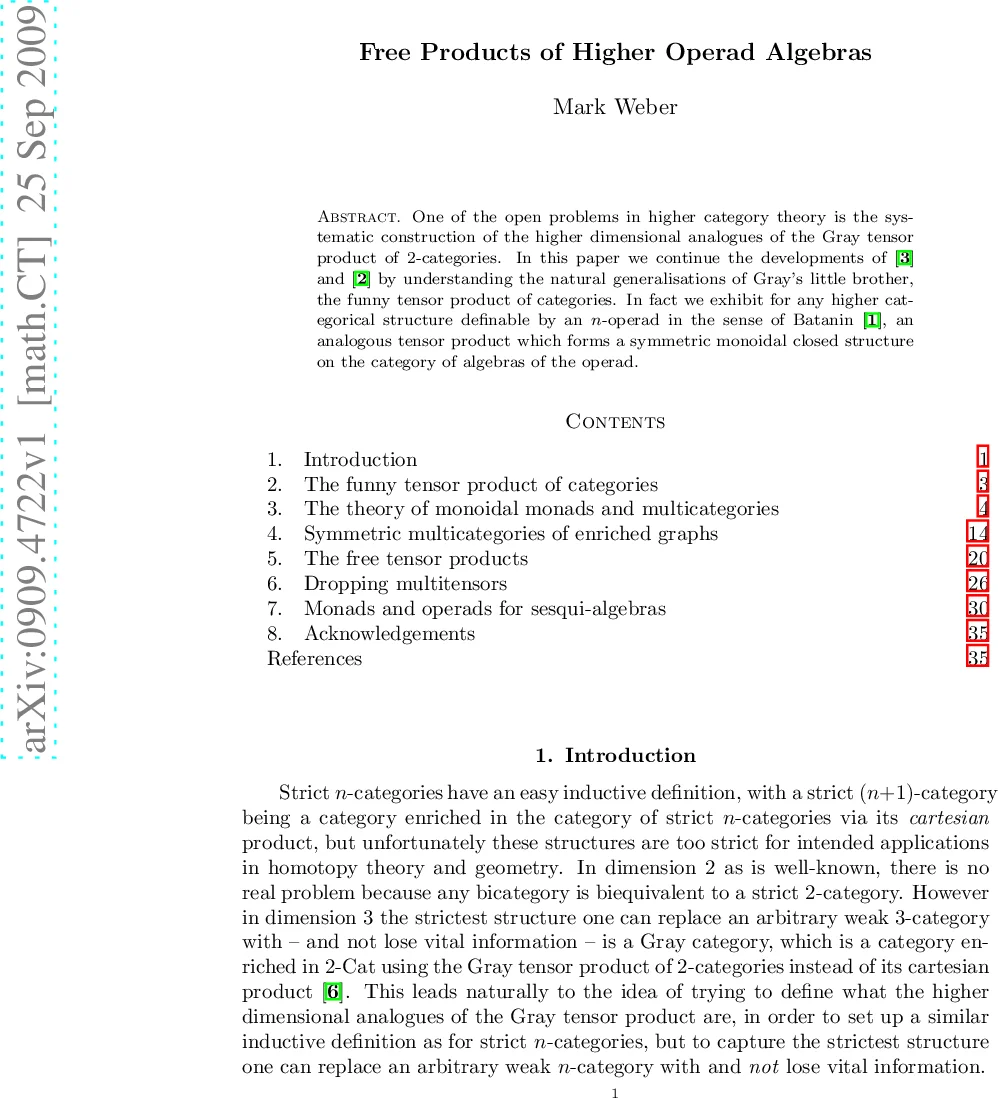
One of the open problems in higher category theory is the systematic construction of the higher dimensional analogues of the Gray tensor product of 2-categories. In this paper we continue the developments of [3] and [2] by understanding the natural generalisations of Gray’s little brother, the funny tensor product of categories. In fact we exhibit for any higher categorical structure definable by an n-operad in the sense of Batanin [1], an analogous tensor product which forms a symmetric monoidal closed structure on the category of algebras of the operad.
💡 Research Summary
The paper tackles the long‑standing problem of constructing higher‑dimensional analogues of the Gray tensor product for n‑categories. Starting from the well‑known “funny tensor product” (also called the free product) of ordinary categories—a symmetric monoidal structure distinct from the Cartesian product—the author shows how this construction can be lifted to any higher categorical structure that is presented by an n‑operad in the sense of Batanin.
The exposition proceeds in several stages. First, Section 2 recalls the definition of the funny tensor product ⊗ on Cat. Objects are pairs (a,b) as in the Cartesian product, but morphisms are generated by “horizontal” arrows (α, b) and “vertical” arrows (a, β) subject only to the relations coming from composition in each factor. This makes ⊗ behave like a coproduct on monoids, which motivates the terminology “free product”.
Next, Sections 3–4 develop the machinery of symmetric monoidal monads and symmetric multicategories. The author reviews Anders Kock’s theory of symmetric monoidal monads (monads in the 2‑category SMONCAT) and Claudio Hermida’s viewpoint that a symmetric monoidal closed structure on a category V can be recovered from the representable symmetric multicategory underlying V. The paper shows that for any monad T on the category GV of V‑enriched graphs (with V → Set a chosen underlying‑set functor), one obtains a canonical symmetric monoidal structure on the category of T‑algebras. The key technical tools are the notions of representability and closedness for multicategories, together with a 2‑functor U : SMONCAT → SMULT that forgets the monoidal product but retains the multicategorical hom‑sets.
Section 5 introduces the central construction: given an n‑operad A, the author defines a tensor product ⊗A on the category Alg(A) of A‑algebras. Objects of A⊗A B are simply the Cartesian product of the underlying A‑algebras, while morphisms are generated by pairs (α, β) as in the ordinary free product, now interpreted in the enriched setting of A‑algebras. The construction uses a “multitensor dropping theorem” (Section 6.4) which provides sufficient conditions for collapsing a multitensor (a family of multi‑ary operations) to a binary tensor product. This theorem guarantees that the free product ⊗A is well‑defined and inherits associativity, unit, and symmetry from the underlying operadic structure.
A natural transformation κA,B : A⊗A B → A×B is exhibited; on objects it is the identity, while on morphisms it identifies the two diagonal composites that exist in the free product. This map mirrors the situation for the Gray tensor product of 2‑categories, where the Gray tensor can be obtained by factoring κ for the monad whose algebras are 2‑categories. Thus the paper provides a conceptual explanation of why the Gray tensor arises from the free product via an orthogonal factorisation system.
Section 7 moves one dimension higher. For a given operad A, the author defines “sesqui‑A‑algebras”, i.e., V‑graphs enriched in Alg(A) equipped with the free product ⊗A. Using the multitensor dropping theorem, a monad whose algebras are sesqui‑A‑algebras is constructed, and it is shown that this monad itself forms part of an (n + 1)‑operad. This establishes the inductive step needed for building semi‑strict n‑categories: starting from strict (n − 1)‑categories, one can enrich them in the free‑product‑closed category of A‑algebras to obtain a candidate model for weak n‑categories.
Throughout the paper, the term “free product” is deliberately used to emphasize the analogy with the classical coproduct of monoids and to underline that the construction is universal with respect to a pair of A‑algebras. The author also points out that the free product’s universal property yields a closed symmetric monoidal structure on Alg(A), making it a natural setting for higher‑dimensional tensor products.
In summary, the work achieves three major contributions:
- It generalises the funny tensor (free) product from ordinary categories to algebras over any Batanin n‑operad, providing a symmetric monoidal closed structure on Alg(A).
- It connects this construction to the Gray tensor product by exhibiting a canonical comparison map κ whose factorisation recovers the Gray tensor in the 2‑categorical case.
- It establishes an inductive framework for higher‑dimensional enrichment: sesqui‑A‑algebras form the algebras of an (n + 1)‑operad, paving the way for a systematic theory of semi‑strict n‑categories.
These results open a promising route toward a unified, operadic description of higher tensor products and suggest that a full operadic treatment of the Gray tensor and its higher analogues is now within reach.
Comments & Academic Discussion
Loading comments...
Leave a Comment