Edge Local Complementation and Equivalence of Binary Linear Codes
Orbits of graphs under the operation edge local complementation (ELC) are defined. We show that the ELC orbit of a bipartite graph corresponds to the equivalence class of a binary linear code. The information sets and the minimum distance of a code c…
Authors: Lars Eirik Danielsen, Matthew G. Parker
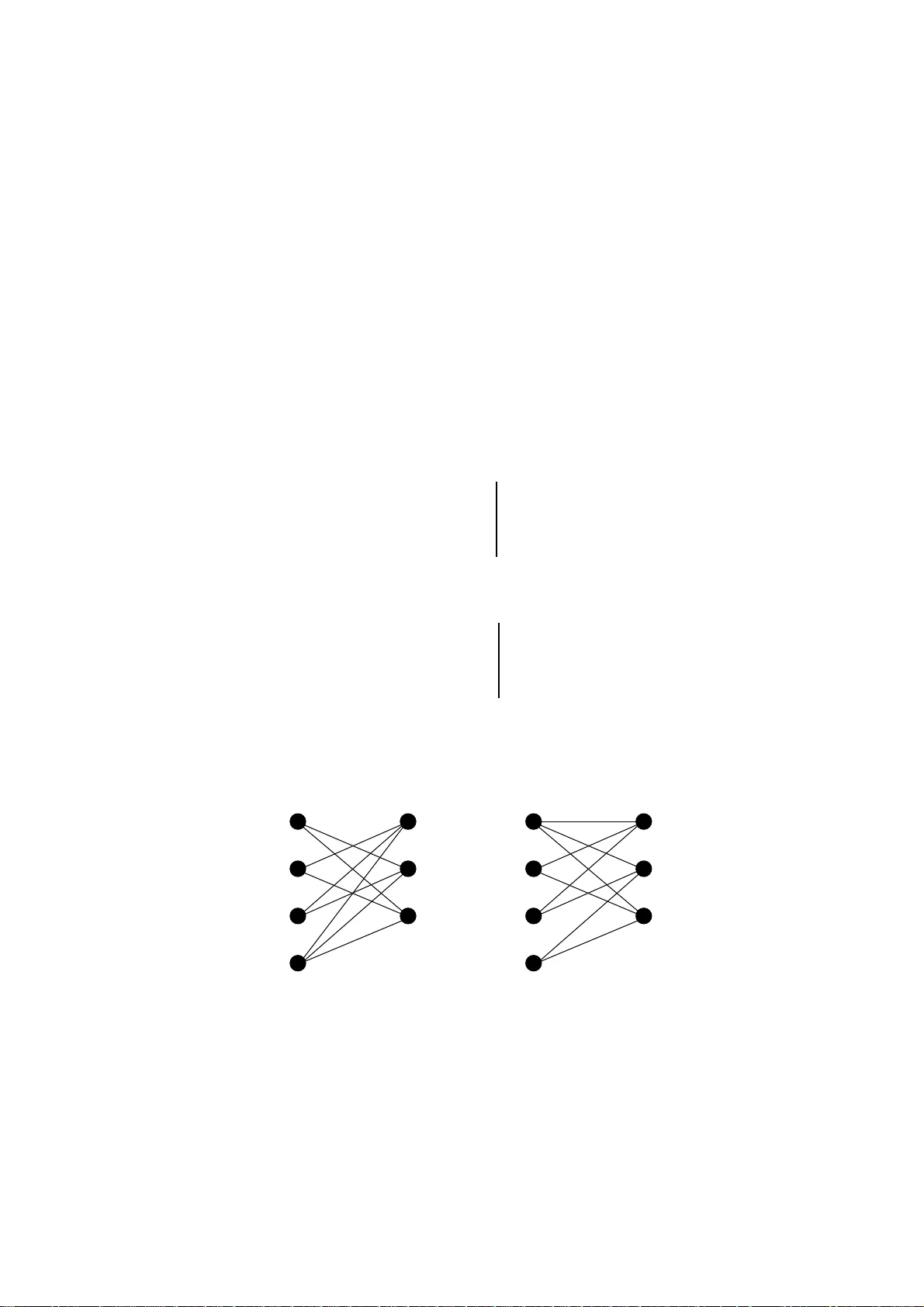
Edge Lo cal Complemen tation and Equiv ale nce of Binary L inear Co des Lars Eirik Danielsen and Matthew G. Parker Department of Informatics, Universit y of Bergen, PB 7803, N -502 0 Bergen, Norwa y {larsed,matthe w}@ii.uib.no http://www .ii.uib.n o/~{larse d ,matthew} Abstract. Orbits of graphs under the op era tion e dge lo c al c omplemen- tation (ELC) are defined. W e sho w that the ELC orbit of a bip artite graph corresp onds to the equiva lence class of a binary line ar c o de . The information s ets and the minimum distanc e of a code can b e d e rived from the corresponding ELC orbit. By ext en ding earlier results on lo c al c omplementation (LC) orbits, we classi fy the ELC orbits of all graphs on up to 12 vertices. W e also give a new metho d for classifying binary linear codes, with ru nning time comparable to the best kno wn algorithm. Keywor ds: Binary linear cod e s, Classification, Graphs, Edge local com- plementatio n 1 In tro duction In this sec t ion w e first give some definitions from gr aph theory , in particular we describ e the tw o gr a ph op erations lo c al c omplementation (LC) and e dge lo c al c omplementation (ELC), the latter als o known as the pivot op eration. W e then give some definitions rela ted to binary line ar c o des . Of particular interest is the concept of c o de e quivalenc e . ¨ Osterg ˚ ard [1] r e presen ted co des as gr aphs, a nd de- vised an algorithm for classifying co des up to equiv alence. In Section 2, w e show a different w ay of representing a binary linear co de as a bip artite graph. W e prov e that ELC on this gra ph provides a simple w ay of jumping betw een equiv alen t co des, a nd that the orbit o f a bipartite g raph under ELC corresp onds to the complete equiv alence c la ss of the co rrespo nding c ode. W e also show how ELC on a bipar tit e gra ph genera tes all information sets of the corresp onding co de. Finally , we show tha t the minimum distanc e of a co de is related to the mini- m um vertex degree ov er the corr e s ponding E LC orbit. In Section 3 we describ e our algorithm for classifying ELC or bit s, whic h we have used to gener a te all ELC orbits of graphs on up to 12 vertices. Although ELC orbits of non-bipartite graphs do not ha ve an y ob vious applications to cla ssical co din g theory , they a re of interest in other con texts, such as i nterlac e p olynomials [2,3] a nd quantum gr aph s t ates [4] which are related to quant u m err or c orr e cting c o des . F rom the ELC or bit s of bipartite g raphs a classificatio n of binar y linear co des can b e de- rived. Binary linear co des hav e previo usly be en classified up to length 1 4 [1,5]. W e have genera ted the bipartite E L C orbits of graphs o n up to 14 v ertices, and 2 this c lassification can b e extended to a t least 1 5 vertices [Sang-il Oum, pers onal communication], s ho wing that our metho d is compa rable to the b est known al- gorithm. Howev er , the main result of this pap er is not a cla ssification of co des, but a new wa y of repre s en ting equiv ale nce clas ses of co des, and a cla ssification of all ELC or bits of length up to 12 . 1.1 Graph Theory A gr aph is a pair G = ( V , E ) wher e V is a set of vertic es , a nd E ⊆ V × V is a set of e dges . A gr aph with n vertices can b e repr esen ted by an n × n adja c ency matrix Γ , where γ ij = 1 if { i, j } ∈ E , and γ ij = 0 otherwise. W e will only consider simple undir e cte d g raphs whose adjacency matrices are symmetric with all diago nal elemen ts b eing 0, i.e., all edg es are bidirectiona l and no vertex can be adjacent to itself. The neighb ourho o d of v ∈ V , denoted N v ⊂ V , is the set of vertices connected to v by an edg e. The num b er o f vertices adjacent to v is called the de gr e e of v . The induc e d sub gr aph of G on W ⊆ V contains vertices W and all edges fr om E whose endp oin ts ar e b oth in W . The c omplement of G is found by replacing E with V × V − E , i.e., the edge s in E ar e changed to non- edges, a nd the non-edges to edges. Two gr a phs G = ( V , E ) a nd G ′ = ( V , E ′ ) a re isomorphi c if and only if ther e exists a per m utatio n π o n V such that { u , v } ∈ E if and o nly if { π ( u ) , π ( v ) } ∈ E ′ . A p ath is a s equence of vertices, ( v 1 , v 2 , . . . , v i ), such that { v 1 , v 2 } , { v 2 , v 3 } , . . . , { v i − 1 , v i } ∈ E . A gra ph is c onne cte d if there is a path from any vertex to a n y other vertex in the graph. A gr aph is bip artite if its set of vertices ca n be decomp osed int o tw o disjoint sets such that no t w o vertices within the sa me set are adjacent. W e call a gra ph ( a, b ) -bip artite if its vertices can b e decomp osed in to sets of s ize a and b . Definition 1 ([6,7,8]). Given a gr aph G = ( V , E ) and a vertex v ∈ V , let N v ⊂ V b e the neighb ourho o d of v . Lo cal complemen tation (LC) on v tr ansforms G into G ∗ v by r eplacing the induc e d sub gr aph of G on N v by its c omplement. (Fig. 1) 2 1 3 4 (a) The Graph G 2 1 3 4 (b) The Graph G ∗ 1 Fig. 1: Example of Lo cal Complemen tation Definition 2 ([7]). Given a gr aph G = ( V , E ) and an e dge { u, v } ∈ E , edg e lo cal complementation (ELC) on { u, v } tr ansfo rms G into G ( uv ) = G ∗ u ∗ v ∗ u = G ∗ v ∗ u ∗ v . 3 Definition 3 ([7]). ELC on { u , v } c an e quivalently b e define d as fol lows. D e- c omp ose V \ { u , v } into the fol lowing four disjoint s et s, as visualize d in Fig. 2. A V ertic es adjac ent to u , bu t not t o v . B V ertic es adjac ent to v , but not to u . C V ertic es adjac ent t o b oth u and v . D V ertic es adjac ent t o neither u nor v . T o obtain G ( uv ) , p erform the fol lowing pr o c e dur e. F or any p air of vertic es { x, y } , wher e x b elongs to class A , B , or C , and y b elongs to a differ ent class A , B , or C , “to ggle” the p air { x, y } , i.e., if { x, y } ∈ E , delete the e dge, and if { x, y } 6∈ E , add the e dge { x, y } to E . Final ly, swap t he lab els of vertic es u and v . u v D A B C Fig. 2: Visualization of the ELC Op eration Definition 4. The LC o rbit of a gr aph G is the set o f al l gr aph s that c an b e obtaine d by p erforming any se quenc e of LC op er ations on G . Similarly, the E LC orbit of G c omprises al l gr aphs that c an b e obtaine d by p erforming any se qu enc e of ELC op er ations on G . (U sual ly we c onsider LC and ELC orbits of u nlab ele d gr aphs. In the c ases wher e we c onside r orbits of lab ele d gr aphs, this wil l b e n o te d.) The LC op eration w as first defined by de F raysseix [8], and later studied b y F on-der - Flaas [6] and Bouchet [7]. Bo uc het defined ELC as “complementation along an edge” [7 ], but this op e r ation is a ls o known as pivoting o n a gra ph [2,9]. LC orbits of gr aphs hav e been used to study quant um gr ap h states [10,11,12], which ar e equiv a len t to self-dual additive c o des over GF(4) [13]. W e hav e previ- ously used LC orbits to classify such co des [14 ,15]. ELC orbits hav e also b een 4 studied in the context of quantum graph states [4,9]. Interlac e p olynomia ls o f graphs hav e b een defined with resp ect to b oth ELC [2] and LC [3]. These poly- nomials enco de prop erties of the graph orbits, a nd w ere origina lly used to study a problem related to DNA sequencing [16]. Prop osition 1. If G = ( V , E ) is a c onne cte d gr aph, then, for any vertex v ∈ V , G ∗ v must also b e c onne cte d. Likewise, for any e dge { u , v } ∈ E , G ( uv ) must b e c onne cte d. Pr o of. If the edg e { x, y } is deleted as part of a n LC oper ation on v , b oth x and y must be, a nd will remain, connected to v . Similarly , if by p erforming ELC on the edge { u, v } , the edge { x, y } is deleted, b oth x a nd y will remain connected to either u , v , or bo th, a nd u and v will remain connected. ⊓ ⊔ Prop osition 2 ([9]). If G is an ( a, b ) -bip artite gr aph , then, for any e dge { u , v } ∈ E , G ( uv ) must also b e ( a, b ) -bip artite. Pr o of. A bipartite graph with an edge { u, v } ca n not contain a n y vertex that is connected to b oth u and v . Using the terminology of Definition 3, the set C will alwa ys be empty when we p erform E LC on a bipartite gr aph. Moreov er, all vertices in the set A must belo ng to the same partition as u , a nd all vertices in B m ust be lo ng to the same pa rtition as v . All edges that are added or deleted have one endpo in t in A and one in B , and it follows that bipartiteness is preserved. ⊓ ⊔ Prop osition 3. L et G b e a bip artite gr aph, and let { u , v } ∈ E . Then G ( uv ) c an b e obtaine d by “t o ggling” al l e dges b et we en the sets N u \ { v } and N v \ { u } , fol lowe d by a swapping of vert i c es u and v . 1.2 Co ding Theory A binary linear co de, C , is a linear s ubspace of GF(2 ) n of dimension k , where 0 ≤ k ≤ n . C is c alled an [ n, k ] co de, a nd the 2 k elements of C ar e called c o dewor ds . The Hamming weight o f u ∈ GF(2) n , denoted wt( u ), is the num ber of nonzer o co mponents of u . The Hamming distanc e b et w een u , v ∈ GF(2) n is wt( u − v ). The minimum distanc e of the code C is the minimal Hamming distance b et w een an y tw o co dew ords o f C . Since C is a linear co de, the minim um distance is also given by the sma lle st weigh t o f any codeword in C . A co de with minim um distance d is called a n [ n, k , d ] co de. A co de is de c omp osable if it can b e written as the dir e ct sum of t w o smaller codes. F or example, let C b e an [ n, k , d ] co de and C ′ an [ n ′ , k ′ , d ′ ] co de. The direct s um, C ⊕ C ′ = { u || v | u ∈ C , v ∈ C ′ } , where || means co ncatenation, is an [ n + n ′ , k + k ′ , min { d, d ′ } ] code. Two c o des, C and C ′ , are cons ide r ed to be e qu ivalent if one can be obtained fro m the other by some per m uta tio n of the co ordinates, or equiv alen tly , a p ermutation of the columns of a g enerator matrix. W e define the dual o f the co de C with r espect to the standa r d inner pro duct, C ⊥ = { u ∈ GF(2) n | u · c = 0 for a ll c ∈ C } . C is called self-dual if C = C ⊥ , a nd iso dual if C is equiv alent to C ⊥ . Self-dua l 5 and iso dual co des must hav e even length n , a nd dimension k = n 2 . The co de C ca n b e defined by a k × n gener ator matrix , C , whose rows span C . A set o f k linea rly indep enden t columns of C is called an information set of C . W e c a n per m ute the columns of C such that an infor mation set ma k e s up the first k columns. By elementary r o w o perations, this matrix ca n then be transformed int o a matrix o f the form C ′ = ( I | P ), where I is a k × k ident it y matrix, and P is so me k × ( n − k ) matrix. The matrix C ′ , whic h is said to b e of standar d form , generates a co de C ′ which is e q uiv alent to C . Every co de is equiv a len t to a co de with a g enerator matrix of standa rd form. The matrix H ′ = ( P T | I ), where I is an ( n − k ) × ( n − k ) identit y matrix is called the p arity che ck matrix o f C ′ . Observe that G ′ H ′ T = 0 , wher e 0 is the all- z ero v ector. It follows that H ′ m ust be the genera tor matrix of C ′⊥ . 2 ELC and Co de Equiv alence As men tioned earlier, L C o rbits of graphs corr espond to equiv alence cla sses o f self-dual quan tum codes. W e hav e pr eviously cla ssified all such co des of length up to 12 [15], b y classifying LC orbits of simple undirected gr aphs. In this pap er, we show that ELC orbits of bipa r tite graphs corresp ond to the equiv alence clas ses o f binary linear co de s . First we explain how a bina ry linear co de can b e repr esen ted by a gr aph. Definition 5 ([17,18]). L et C b e a binary line ar [ n, k ] c o de with gener ator m a- trix C = ( I | P ) . Then the c o de C c orr esp onds to the ( k , n − k ) -bip artite gr aph on n vertic es with adjac ency matrix Γ = 0 k × k P P T 0 ( n − k ) × ( n − k ) , wher e 0 denote al l-zer o matric es of the sp e cifie d dimensions. Theorem 1. L et G = ( V , E ) b e the ( k , n − k ) -bip artite gr aph derive d fr om a standar d form gener ator matrix C = ( I | P ) of t he [ n, k ] c o de C . L et G ′ b e t h e gr aph obtaine d by p erforming ELC on the e dge { u, v } ∈ E , fol lowe d by a swappi ng of vertic es u and v . Then the c o de C ′ gener ate d by C ′ = ( I | P ′ ) c orr esp ondi ng to G ′ is e quivalent t o C , and c an b e obtaine d by inter cha nging c o or dinates u and v of C . Pr o of. Assume, without loss of generality , that u ≤ k a nd v > k . C ′ can b e obtained fro m C by adding row u to all r o ws in N v \ { u } and then swapping columns u a nd v , wher e N v denotes the ne ig h b ourho od of v in G . These o per- ations pr eserv e the equiv alence of linea r co des. As describ ed in Pro p osition 3 , the bipartite graph G is trans f ormed into G ′ by “toggling” all pa irs of vertices { x, y } , where x ∈ N u \ { v } a nd y ∈ N v \ { u } . This a ction on the submatrix P is implemented by the row additio ns on C describ ed ab ov e. How ever, this als o “toggles ” the pairs { v , y } , where y ∈ N v \ { u } , tr ansforming c o lumn v of C into 6 a vector with 0 in a ll coo rdinates exc ept u . But co lumn u of C now contains the original column v , and thus swapping columns u and v restores the neighbour- ho od of v , giving the desired submatrix P . ⊓ ⊔ Corollary 1. Applying any se quenc e of ELC op er ations to a gr aph G c orr e- sp onding to a c o de C wil l pr o duc e a gr aph c orr esp onding to a c o de e quivalent to C . Instead of mapping the generato r matrix C = ( I | P ) to the adjacenc y matr ix of a bipar tite g raph in order to per form EL C on the edge { u , v } , we can work directly with the subma trix P . Let the r o ws of P b e la beled 1 , 2 , . . . , k a nd the columns of P b e labele d k + 1 , k + 2 , . . . , n . Assume that u indicates a row of P and that v indicates a column of P . The e le ment P ij is then replaced b y 1 − P ij if i 6 = u , j 6 = v , and P uj = P iv = 1 . Example 1. The [7 , 4 , 3 ] Hamming co de has a generator matrix C = 1 0 0 0 0 1 1 0 1 0 0 1 0 1 0 0 1 0 1 1 0 0 0 0 1 1 1 1 , which corr esponds to the graph shown in Fig . 3a. ELC o n the edge { 2 , 7 } pro- duces the graph shown in Fig. 3b, whic h corresp onds to the g e nerator matrix C ′ = 1 0 0 0 1 1 1 0 1 0 0 1 0 1 0 0 1 0 1 1 0 0 0 0 1 0 1 1 . The co de ge ne r ated b y C ′ is also obtained by swapping co ordinates 2 and 7 o f the co de g enerated by C . 1 2 3 4 5 6 7 (a) The Graph G 1 2 3 4 5 6 7 (b) The Graph G (27) Fig. 3: Two Graph Represen tations of the [7 , 4 , 3] Hamming Cod e 7 Consider a co de C . As describ ed in Se c t ion 1.2, it is p ossible to go from a generator matrix of standard form, C = ( I | P ), to another genera tor matrix of standar d for m , C ′ , o f a co de equiv alen t to C by one o f the n ! pos sible p er- m utations of the columns o f C , follo w ed by elementary r o w op erations. More precisely , we ca n get from C to C ′ via a com bination o f the following op erations. 1. Perm uting the columns of P . 2. Perm uting the columns of I , followed by the same p erm utation on the rows of C , to restor e standar d form. 3. Swapping columns from I with columns fro m P , such that the first k columns still is an information set, follow e d by some elementary row op erations to restore standard form. Theorem 2. L et C and C ′ b e e quivalent c o des. L et C and C ′ b e matric es of standar d form gener ating C and C ′ . L et G and G ′ b e the bip artite gr aphs c orr e- sp onding to C and C ′ . G ′ is isomorphic to a gr aph obtaine d by p erforming some se quenc e of ELC op er ations on G . Pr o of. C and C ′ m ust b e r elated by a combination of the ope r ations 1, 2 , and 3 listed ab ov e. It is easy to see that o p erations 1 a nd 2 applied to G pro duce an isomorphic gra ph . It remains to prove that o peration 3 a lw ays cor responds to s o me sequence of E LC op erations. W e know from T he o rem 1 that swapping columns u and v of C , where u is part of I and v is part of P , corres ponds to ELC on the edge { u, v } of G , follow ed by a swapping of the vertices u and v . When { u, v } is no t an edge o f G , we can no t swap columns u a nd v of C via EL C . In this case, co ordinate v of column u is 0, and column u has 1 in c o ordinate u and 0 elsewhere. Swapping these columns w ould res ult in a generator matr ix where the first k columns all hav e 0 at co ordinate u . These columns can not cor respond to an information set. It follows that if { u, v } is no t a n edge of G , swapping columns u and v is not a v alid op eration of type 3 in the ab o v e list. Thus ELC and gra ph isomo rphism cover all p ossible op erations that map standa rd fo r m generator matrices of equiv a len t co des to each other . ⊓ ⊔ Let us for a moment consider ELC or bits of lab ele d g r aphs, i.e., wher e we do not take isomorphism int o considera tio n. Let G = ( V , E ) b e the connected bipartite graph representing the indecomp osable co de C , and G ( uv ) be the g raph obtained by ELC on the edge { u, v } ∈ E . Since w e per form E LC o n { u, v } w ith- out swapping u and v afterwards, the adjacency matrix of G ( uv ) will not be o f the t ype w e saw in Definition 5. Assuming that vertices { 1 , 2 , . . . , k } make up one of the pa rtitions of the bipartite gr aph G , we can think of G as a graph co rrespond- ing to the informatio n set { 1 , 2 , . . . , k } of C . Assume that u ≤ k a nd v > k . G ( uv ) will then represent another information set o f C , namely { 1 , 2 , . . . , k } \ { u } ∪ { v } . Theorem 3. L et G b e a c onne cte d bip artite gr aph re pr esenting t h e inde c om- p osable c o de C . Each lab ele d gr aph in the ELC orbit of G c orr esp onds to an information set of C . If C is a self-dual c o de, e ach gra ph c orr esp onds to two in- formation s et s, one for e ach p artition. Mor e over, the numb er of info rmation sets of C e quals t h e numb er of lab ele d gr aph s in the ELC orbit of G , or twic e the numb er of gr aphs if C is a self-dual c o de. 8 Pr o of. Performing ELC without swapping vertices afterwards corresp onds to elementary row oper a tions on the asso ciated gene r ator matrix, and will thus leav e the co de inv a rian t. The only thing we change with ELC is the information set of the co de, as indicated b y the bipartition of the g raph. W e know fro m Theorem 2 that if tw o generator matrices of standard form g enerate equiv alent co des, we can a lw ays get from one to the other via ELC ope rations on the asso ciated gr aph. It follows from this that when we co nsider lab eled graphs, and do not swap vertices to obtain a co de of standar d form, we find all information sets in the ELC orbit. If and only if a co de is self-dual, ( I | P ) will gener ate the same co de as ( P T | I ). Since the matrices ( I | P ) a nd ( P T | I ) corr espond to exactly the same graph, but tw o different information sets, we must multiply the ELC or bit size with tw o to get the num ber of information sets of a self-dual co de. ⊓ ⊔ Note that the distinction betw een ELC with or without a final sw apping of vertices is only significa n t when we wan t to find information s ets. F o r other applications, wher e w e consider g raphs up to isomorphism, this distinction is not of imp ortance. Theorem 4. The minimum distanc e, d , of a binary line ar [ n, k , d ] c o de C , is e qual to δ + 1 , wher e δ is the smal le st vertex de gr e e of any vertex in the p artition of size k over al l gr aphs in the asso ciate d ELC orbit. Pr o of. If there is a vertex with degree d − 1, belonging to the par titio n o f size k , in the ELC o rbit, there is a ro w o f weight d in a ge ner ator matrix tha t gener ates a co de equiv a len t to C . Hence there must also b e a co dew ord o f weigh t d in C . W e ne e d to show that when d is the minimum distance o f C , such a vertex always exists. L e t C be the standard fo r m g enerator matrix of C . If C contains a row of w eight d , we are done. Otherwise, select a codeword c of w eight d , generated by C , a nd let the i -th row of C b e one of the rows that c is linearly dep enden t on. Replace the i -th row of C by c to get C ′ . Permute the columns o f C ′ to obtain C ′′ where the first k columns is s till an information set, and wher e c is mapp ed to c ′ with 1 in coo rdinate i , with the rest of the k first co ordinates being 0. Tha t suc h a p erm utation will always exist follows from the fact that c has weight d while all other rows of C ′ hav e weigh t g reater than d − 1 in the last n − k coor dinates. Th us, fo r eac h co ordinate j ≤ k , j 6 = i , where c is 1, there mu st exist a distinct co ordinate l > k where c is 0 and the j -th row of C ′ is 1. W e c a n transform C ′′ int o a matrix of the form ( I | P ) by elementary row op erations. Row i of this final matrix has weight d , a nd th us the corres ponding bipartite graph has a vertex with degree d − 1. ⊓ ⊔ 3 Classification of ELC Orbits W e hav e previo usly class ified all self-dual a ddit ive co des over GF(4) of length up to 12 [15,19], b y classifying o r bits of simple undirec t ed graphs with r e- sp ect to lo cal complementation and g raph isomor phism. In T able 1, the se- 9 quence ( i LC n ) gives the num b er of LC o rbits of connected gr aphs on n ver- tices, while ( t LC n ) g iv es the total num b er of LC or bits o f graphs on n vertices. A databa se co n ta ining one repr esen tativ e fro m each LC orbit is av aila ble at http:/ /www.ii.uib.no/~larsed/vncorbits/ . T able 1: Numbers of LC Orb i ts n 1 2 3 4 5 6 7 8 9 10 11 12 i LC n 1 1 1 2 4 11 26 101 440 3,132 40,457 1,274,0 68 t LC n 1 2 3 6 11 26 59 182 675 3,990 45,14 4 1,323,363 By r ecursiv ely applying ELC opera tions to a ll edges of a graph, whilst chec k- ing for graph isomorphism using the progra m nauty [20], w e can find all mem ber s of the ELC orbit. Let G n be the set of all unlabeled simple undirected connected graphs on n vertices. Let the set o f all distinct ELC orbits o f connected graphs on n v ertices be a partitioning o f G n int o i E LC n disjoint sets. Our previous clas- sification of the LC orbits of all gra phs of up to 12 vertices helps us to c lassify ELC orbits, since it follows from Definition 2 that each LC o rbit can b e parti- tioned into a set o f disjoint ELC orbits. W e hav e used this fact to c la ssify all ELC orbits of graphs on up to 12 v ertices, a computation tha t required approx- imately o ne month of running time o n a parallel cluster c o mput er. In T a ble 2, the sequence ( i E LC n ) g iv es the n um ber of ELC orbits of connected gra phs on n vertices, while ( t E LC n ) gives the total num b er of ELC o rbits of g raphs on n vertices. Note that the v alue of t n can b e derived ea sily o nce the sequence ( i m ) is known for 1 ≤ m ≤ n , using the Euler tr ansfo rm [2 1 ], c n = X d | n di d , t 1 = c 1 , t n = 1 n c n + n − 1 X k =1 c k t n − k ! . A database containing one representative from each ELC orbit can b e found at http:/ /www.ii.uib.no/~larsed/pivot/ . W e are particular ly interested in bipar tit e graphs, becaus e of their connec t ion to binar y linear co des. F or the classificatio n of the or bits of bipartite gra phs with resp ect to ELC and gra ph isomor phis m, the following tec hnique is helpful. If G is an ( a, b )-bipar tite graph, it has 2 a + 2 b − 2 pos sible ext ensio ns . Each extension is for med b y a dding a new vertex and jo ining it to all po ssible comb inations of at least one of the old vertices. Let P n be a set containing one re pr esen tativ e from each ELC orbit o f a ll connected bipartite gr aphs on n v ertices. The set E n is formed by ma king all p ossible extensio ns of all gra phs in P n − 1 . It ca n then be shown that P n ⊂ E n , i.e., that the s et E n will contain at leas t one 10 T able 2: Numbers of ELC Orbits and Binary Linear Co des n i E LC n t E LC n i E LC,B n t E LC,B n i C n i C iso n 1 1 1 1 1 1 - 2 1 2 1 2 1 1 3 2 4 1 3 2 - 4 4 9 2 6 3 1 5 10 21 3 10 6 - 6 35 64 8 22 13 3 7 134 21 8 15 43 30 - 8 777 1,068 43 104 76 10 9 6,702 8,038 110 250 220 - 10 104,825 114,188 370 720 700 40 11 3,370, 317 3,493,9 65 1,260 2,229 2,520 - 12 231,557,2 90 235,176 ,097 5,366 8,361 10,503 229 13 ? ? 25,684 36,441 51,368 - 14 154,104 199,61 0 306,328 1,88 0 15 1,156,7 16 1,395,3 26 2,313,4 32 - 16 ? ? 23,069,977 ? 17 157,302,628 ? 314,605,256 - representative from each ELC orbit of c onnected bipartite graphs on n vertices. The set E n will b e m uc h smaller than G n , so it will b e more efficient to search for a set o f ELC orbit r epresen tatives within E n . A similar technique was used by Glynn, et al. [10] to classify LC orbits. In T able 2 , the seq uence ( i E LC,B n ) gives the num b er of E L C orbits of co n- nected bipa rtite gr aphs on n vertices, and ( t E LC,B n ) gives the total num ber of ELC orbits of bipartite graphs on n vertices. A da ta base containing one repr esen- tative from each of these orbits can be found at h ttp://www. ii.uib.no/~ larsed/pivot/ . Theorem 5. L et k 6 = n 2 . Then the nu mb er of ine quivalent binary line ar [ n, k ] c o des, which is also the n u mb er of ine quivalent [ n, n − k ] c o des, is e qual to t h e numb er of ELC orbits of ( n − k , k ) -bip artite gr aphs. When n is even and k = n 2 , the numb er of ine quivale nt binary line ar [ n, k ] c o des is e qual to twic e the n u mb er of ELC orbits of ( k , k ) -bip artite gr aph s minu s the numb er of iso dual c o des of lengt h n . Pr o of. W e recall that if a co de C is genera t ed by ( I | P ), then its dual, C ⊥ , is generated b y ( P T | I ). Also note that C ⊥ is equiv alent to the code generated by ( I | P T ). The bipar tite graphs corres p onding to the co des genera ted by ( I | P ) and ( I | P T ) a re isomorphic. It follows tha t the ELC orbit asso ciated with an [ n, k ] co de C is simult aneously the o rbit asso ciated with the dual [ n, n − k ] co de C ⊥ . In the case where k = n 2 , each ELC o r bit cor responds to t w o non-equiv alent [ n, k ] codes, except in the case where C is iso dual. ⊓ ⊔ 11 Corollary 2. The total nu mb er of binary line ar c o des of length n is e qual to twic e the numb er of ELC orbits of bip artite gr aphs on n vertic es, minus t h e numb er of iso dual c o des of lengt h n . Note that if we only consider connected gr aphs on n vertices, we get the nu m ber o f indecomp osable co des of length n , i C n , i.e., the co des that can not be written as the direct sum of tw o smalle r co des. The total num ber of co des ca n eas- ily b e der ived from the v alues of ( i C n ). T able 2 gives the n um ber o f ELC orbits of connected bipartite graphs on n vertices, i E LC,B n , the n um ber of indecomp osable binary linear co des of leng th n , i C n , and the num ber of indecomp osable iso dual co des of length n , i C iso n . A method for coun ting the n um b er of binary linea r co des by using computer a lgebra to ols w a s devised by F rip ertinger and Ker- ber [22]. A table en umerating binary linear co des of length up to 25 is av aila ble online at http: //www.mathe2.uni- bayreuth.de/frib/co des/tables_2.html . The num bers in italics in T able 2 are taken from this webpage. Note how e ver that this a pproach only gives the num ber of inequiv a len t co des, and do es not pro duce the co des themselv es. Classification of a ll binary linear co des of length up to 14 and w ith distance at lea st 3 was carr ie d out by ¨ Osterg ˚ ard [1]. He also used a graph-based algorithm, but one quite different from the metho d describ ed in this pap er. In a re c en t b oo k by Kas ki and ¨ Osterg ˚ ard [5], it is pro posed as a resear ch problem to extend this classificatio n to lengths higher than 14. Sang-il Oum [p ersonal c omm unica tion] demons tr ated that the 1,39 5,326 ELC orbits o f bipartite g raphs o n 15 vertices can b e g enerated in ab out 58 hours. This indi- cates that class ifica tion of co des by E LC orbits is compa r able to the cur ren tly bes t known algorithm. It may a lso b e p o ssible that our metho d will b e more efficient than existing alg orithms for classifying sp ecial types of co des. F or in- stance, matrices of the form ( I | P ), wher e P is symmetric, gener ate a subset of the iso dual co des. The bipartite graphs corr esponding to these co des, which were also studied b y Curtis [1 7 ], should b e well suited to our method, since any graph of this type must arise as an extension of a graph of the same type. A cknow le dgements This resea rc h was supp orted b y the Resear c h Council o f N or- wa y . W e would like to thank the Ber gen Cen ter for Computational Science, whos e cluster computer made the re s ults in this pa per p ossible. Thanks to Joa kim G. Knudsen for help with impr o ving Theor em 3. References 1. ¨ Osterg ˚ ard, P .R.J.: Classifying subspaces of Hamming sp a ces. Des. Co des Cr yptogr. 27 (2002) 297–3 05 2. Arratia, R., Bollob´ as, B., S orkin, G.B.: The interla ce p ol ynomial of a graph. J. Combin. Theory S er. B 92 (2004) 199–233 arXiv: math.CO/02 09045 . 3. Aigner, M., van der H o lst, H .: Interlace p olynomials. Linear Algebra App l. 377 (2004) 11–30 4. V an den N e st, M., De Mo or, B.: Edge-local equiv alence of graphs. Preprint, arXiv:math .CO/05102 46 (2005) 12 5. Kaski, P ., ¨ Osterg ˚ ard, P .R.J.: Classification algorithms for cod es and designs. V ol- ume 15 of Algorithms and Computation in Mathematics. Springer-V erlag, Berlin (2006) 6. F on-der Flaas, D .G .: On lo cal complementations of graphs. I n: Com binatorics (Eger, 1987). V olume 52 of Collo q. Math. Soc. J´ anos Bolyai. North-Holland, Am- sterdam (1988) 257–2 66 7. Bouchet, A.: Graphic presentations of iso tropic systems. J. Com bin. Theory Ser. B 45 (1988) 58–76 8. de F raysseix, H.: Local complementatio n and i nterla cement graphs. D i screte Math. 33 (1981) 29–35 9. Riera, C., P arker, M.G.: O n p ivot orbits of Boolean functions. In: F ourth In- ternational W orkshop on Optimal Co des and Related T opics, Sofia, Institute of Mathematics and Informatics, Bulgarian Academ y of S cie nces ( 2005) 248–253 10. Glynn, D.G., Gulliver, T.A., Maks, J.G., Gup ta, M.K.: The geometry of additive quantum co des. S ubmitted to Sp ri nger-V erlag (2004) 11. Hein, M., Eisert, J., Briegel, H.J.: Multi-part y en tanglemen t in graph states. Ph ys. Rev. A 69 (2004) 0623 11 arXi v:quant-p h/0307130 . 12. V an den Nest, M., Dehaene, J., De Mo or, B.: Graphical description of the actio n of local Clifford transformations on graph states. Ph ys. Rev. A 69 (2004) 022316 arXiv:quan t-ph/0308 151 . 13. Calderbank, A.R., Rains, E.M., Shor, P .M., S l oane, N.J.A.: Quantum error cor- rection via co des ove r GF(4). IEEE T rans. I nfo rm. Theory 44 (1998) 1369–1387 arXiv:quan t-ph/9608 006 . 14. Danielsen, L.E., P ark er, M.G.: Sp ectral orbits and p eak-to-av erage pow er ratio of Boolean functions with resp ect to the { I , H , N } n transform. In: Sequences and Their Ap plica tions – SET A 2004. V olume 3486 of Lecture Notes in Compu t . Sci., Berlin, Springer-V erlag ( 2005) 373–388 arXiv:cs.IT/050 4102 . 15. Danielsen, L.E., Park er, M.G.: On the classification of all self-dual add itive co des o ver GF(4) of length up to 12. J. Combin. Theory Ser. A 113 (2006) 1351–1367 arXiv:math .CO/05045 22 . 16. Arratia, R., Bol lob´ as, B., Copp ersmi th, D., S orkin, G.B.: Euler circuits and DNA sequencing by hybridization. Discrete Appl. Math. 104 (2000) 63–96 17. Curtis, R.T.: On graphs and co des. Geom. Dedicata 41 (1992) 127–134 18. Park er, M.G., Rijmen, V.: The q uan tum en tanglemen t of binary and bip olar se- quences. In: Sequences and Their A pplicatio ns – SET A ’01. Discrete Math. Theor. Comput. Sci., Lond on , Springer-V erlag (2002) 296–309 arXiv:quant-ph /0107106 . 19. Danielsen, L.E.: On self-dual quantum codes, graphs, and Boolean functions. Master’s thesis, Department of Informatics, U niv ersit y of Bergen, Norwa y (2005) arXiv:quan t-ph/0503 236 . 20. McKay , B.D.: nauty User’s Guid e. (2003) http://cs.anu .edu.au/~b dm/nauty/ . 21. Sloane, N.J.A., Plouffe, S.: The Encyclop edia of Integer Sequ ences. Academic Press, San Diego, CA ( 1 995) 22. F rip ertinger, H., Kerber, A.: Isometry classes of indecomp osable linear cod es . I n: Applied algebra, algebraic algorithms and error-correcting co des. V olume 948 of Lecture Notes in Comput. S ci. , Berlin, Springer-V erlag (1995) 194–20 4
Original Paper
Loading high-quality paper...
Comments & Academic Discussion
Loading comments...
Leave a Comment