The Solecki dichotomy for functions with analytic graphs
A dichotomy discovered by Solecki says that a Baire class 1 function from a Souslin space into a Polish space either can be decomposed into countably many continuous functions, or else contains one particular function which cannot be so decomposed. I…
Authors: Janusz Pawlikowski, Marcin Sabok
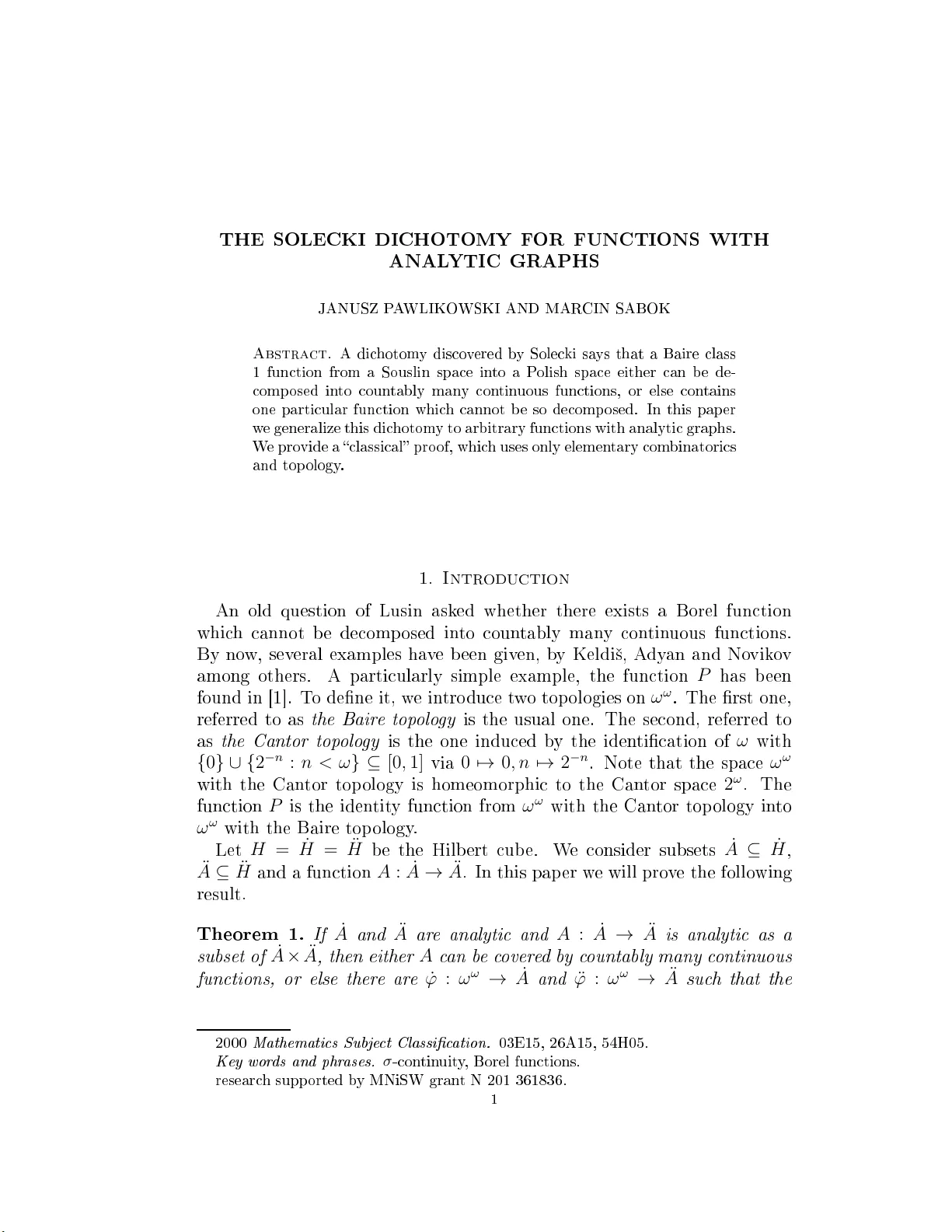
THE SOLECKI DICHOTOMY F OR FUNCTIONS WITH ANAL YTIC GRAPHS JANUSZ P A WLIKO WSKI AND MAR CIN SABOK Abstra t. A di hotom y diso v ered b y Sole ki sa ys that a Baire lass 1 funtion from a Souslin spae in to a P olish spae either an b e de- omp osed in to oun tably man y on tin uous funtions, or else on tains one partiular funtion whi h annot b e so deomp osed. In this pap er w e generalize this di hotom y to arbitrary funtions with analyti graphs. W e pro vide a lassial pro of, whi h uses only elemen tary om binatoris and top ology . 1. Intr odution An old question of Lusin ask ed whether there exists a Borel funtion whi h annot b e deomp osed in to oun tably man y on tin uous funtions. By no w, sev eral examples ha v e b een giv en, b y Keldi², A dy an and No vik o v among others. A partiularly simple example, the funtion P has b een found in [1℄. T o dene it, w e in tro due t w o top ologies on ω ω . The rst one, referred to as the Bair e top olo gy is the usual one. The seond, referred to as the Cantor top olo gy is the one indued b y the iden tiation of ω with { 0 } ∪ { 2 − n : n < ω } ⊆ [0 , 1] via 0 7→ 0 , n 7→ 2 − n . Note that the spae ω ω with the Can tor top ology is homeomorphi to the Can tor spae 2 ω . The funtion P is the iden tit y funtion from ω ω with the Can tor top ology in to ω ω with the Baire top ology . Let H = ˙ H = ¨ H b e the Hilb ert ub e. W e onsider subsets ˙ A ⊆ ˙ H , ¨ A ⊆ ¨ H and a funtion A : ˙ A → ¨ A . In this pap er w e will pro v e the follo wing result. Theorem 1. If ˙ A and ¨ A ar e analyti and A : ˙ A → ¨ A is analyti as a subset of ˙ A × ¨ A , then either A an b e over e d by ountably many ontinuous funtions, or else ther e ar e ˙ ϕ : ω ω → ˙ A and ¨ ϕ : ω ω → ¨ A suh that the 2000 Mathematis Subje t Classi ation. 03E15, 26A15, 54H05. Key wor ds and phr ases. σ -on tin uit y , Borel funtions. resear h supp orted b y MNiSW gran t N 201 361836. 1 2 JANUSZ P A WLIKO WSKI AND MAR CIN SABOK fol lowing diagr am ommutes ω ω ¨ ϕ − − − → ¨ A x P x A ω ω ˙ ϕ − − − → ˙ A and • ˙ ϕ is a top olo gi al emb e dding fr om ω ω with the Cantor top olo gy into ˙ A , • ¨ ϕ is a top olo gi al emb e dding fr om ω ω with the Bair e top olo gy into ¨ A . Theorem 1 has b een pro v ed b y Sole ki [2, Theorem 4.1℄ in the ase when A is a Baire lass 1 funtion. Zapletal [3, Corollary 2.3.48℄ pro v ed this di hotom y in the ase when A is a Borel funtion and ˙ A = ω ω (ho w ev er, that argumen t do es not seem to w ork in ase when ˙ A is an arbitrary Souslin spae). The form ulation of Theorem 1 seems to b e a natural generalization of b oth these ases. It should b e noted that b oth pro ofs of Sole ki and Zapletal use quite sophistiated metho ds of mathematial logi and the Borel ase uses the Baire lass 1 ase and Borel determinay . On the other hand, our pro of w orks in the seond-order arithmeti. 2. Not a tion If T ⊆ S <ω ( S is some oun table set) is a tree, then w e write lim T for { s ∈ S ω : ∀ n < ω s ↾ n ∈ T } . F or σ ∈ S <ω w e denote b y [ σ ] the set { s ∈ S ω : σ ⊆ s } . The Hilb ert ub e H is endo w ed with the standard omplete metri. W e write | x, y | for the distane b et w een p oin ts x, y ∈ H , | X | for the diameter of a subset X ⊆ H and | X , Y | for the Hausdor distane b et w een X , Y ⊆ H . F or k ≤ l < ω write | k , l | = 2 − k − 2 − l if k > 0 , 2 − l if k = 0 and for l < k < ω let | k , l | = | l, k | . If 0 < N ≤ ω and s, r ∈ ω N , dene | s, r | = X n 0 and ˙ X ⊆ ˙ H . Ther e is K ∈ ω suh that for any se quen e h ˙ X k ⊆ ˙ X : k < K i suh that for k 6 = k ′ < K ˙ X k ∪ ˙ X k ′ is dense in ˙ X ther e is k < K suh that | ˙ X k , ˙ X | < ε . Pr o of. Using ompatness of ˙ H , nd nite set ˙ Y ⊆ ˙ X su h that | ˙ Y , ˙ X | < ε . Let K b e an y n um b er greater than the ardinalit y of ˙ Y . Sine | ˙ X k , cl ˙ X k | = 0 , without loss of generalit y assume that all ˙ X k are losed and for k 6 = k ′ w e ha v e ˙ X k ∪ ˙ X k ′ = ˙ X . W e sear h for k su h that ˙ Y ⊆ ˙ X k . If ev ery k fails at some p oin t of ˙ Y , then there are k 6 = k ′ that fail at the same p oin t. This violates ˙ X k ∪ ˙ X k ′ = ˙ X . 4 JANUSZ P A WLIKO WSKI AND MAR CIN SABOK 3.1. Pro jetion and ordering. F or σ ∈ ω <ω write lh σ for the length of σ and σ ∗ for σ with the last digit remo v ed if σ 6 = ∅ (and let ∅ ∗ = ∅ ). F or n < ω w e dene the pro jetion funtion ω n ∋ σ 7→ σ ′ ∈ ω n as follo ws: the rst largest digit of σ whi h is ≥ n is hanged to 0 ; if there is no su h digit, w e put σ ′ = σ . W rite σ 1 = σ ′ and σ i +1 = ( σ i ) ′ . Note that for σ ∈ ω n • ( σ n ) ′ = σ n , • | σ , σ ′ | ≤ 2 − n · 2 − i if the hange o ures at i -th digit, • | σ , σ ′′ | = | σ , σ ′ | + | σ ′ , σ ′′ | , sine the onseutiv e hanges o ure at dieren t plaes, • | σ , σ n | ≤ 2 · 2 − n Fix an ordering of ω <ω in to t yp e ω su h that σ ′ σ and σ ∗ σ for ea h σ ∈ ω <ω . W rite # σ for the n um b er indiating the p osition of σ with resp et to . Note that # ∅ = 0 , # h 0 i = 1 and lh σ ≤ # σ 3.2. Solids. W e all a nonempt y analyti X ⊆ A solid if for all op en U ⊆ ˙ H × ¨ H either U ∩ X = ∅ , or else U ∩ X is I -p ositiv e. Note that ev ery analyti I -p ositiv e set on tains a solid. If X is a solid, then for ea h op en set U ⊆ ˙ H × ¨ H either U ∩ X = ∅ , or else U ∩ X is solid. Without loss of generalit y w e assume that A is solid . 3.3. T rees. F or a tree T on ω × ω write pro j[ T ] = { σ ∈ ω <ω : ∃ τ ( σ , τ ) ∈ T } . F or σ ∈ ω <ω write T σ = { τ : ( σ , τ ) ∈ T } and for s ∈ ω ω write T s = S n<ω T s ↾ n . If { X ρ,τ : ( ρ, τ ) ∈ T } is a family of sets and σ ∈ ω <ω , put X σ = [ { X σ ,τ : τ ∈ T σ } . Lemma 3. Supp ose T is a tr e e on ω × ω suh that for e ah s ∈ ω ω the tr e e T s is nitely br anhing and ther e is exatly one br anh ψ ( s ) ∈ lim T s . Then the map ψ : ω ω → ω ω is ontinuous. Pr o of. Let t = ψ ( s ) and x n < ω . W e need to nd m ≥ n su h that ψ [ s ↾ m ] ⊆ [ t ↾ n ] . Supp ose to w ards a on tradition that for ea h m ≥ n there is s m ⊇ s ↾ m su h that ψ ( s m ) 6⊇ t ↾ n . Consider the tree T ∗ = { τ ∈ T s : τ 6⊇ t ↾ n } . Then for ea h m ≥ n w e ha v e • ψ ( s m ) ↾ m ∈ T s m ↾ m = T s ↾ m ⊆ T s , • ψ ( s m ) ↾ m 6⊇ t ↾ n , i.e. ψ ( s m ) ↾ m ∈ T ∗ . THE SOLECKI DICHOTOMY F OR FUNCTIONS WITH ANAL YTIC GRAPHS 5 So T ∗ is an innite nitely bran hing tree. Pi k t ∗ ∈ lim T ∗ . Then t ∗ ∈ lim T s but t ∗ 6 = t , a on tradition. 3.4. Cylinders. By a ylinder with b ase X w e mean a losed set ˜ X ⊆ ( ω ω ) ω × ˙ H × ¨ H su h that π [ ˜ X ] = X and there exists N < ω su h that for ea h x ∈ X and for ea h r , s ∈ ( ω ω ) ω s ↾ N = r ↾ N ∧ ( s, x ) ∈ ˜ X ⇒ ( r , x ) ∈ ˜ X . In this ase w e sa y that X is unfolde d to ˜ X . Note that the base of a ylinder is analyti and that ev ery analyti subset of A an b e unfolded to a ylinder. A ylinder is solid if its base is solid. F or the rest of the pro of x a solid ylinder ˜ A with base A . Lemma 4. (a) Given a ylinder ˜ X with b ase X , any analyti Y ⊆ X an b e unfolde d to a ylinder ˜ Y ⊆ ˜ X . (b) Given ε > 0 , solid ylinder ˜ X and an analyti I -p ositive Y ⊆ X , ther e is a solid Z ⊆ n wd Y that an b e unfolde d to a ylinder ˜ Z ⊆ ˜ X suh that | ˜ Z | < ε . Pr o of. (a) Fix losed D ⊆ ω ω × ˙ H × ¨ H that pro jets on to Y . Let N < ω witness that ˜ X is a ylinder. Dene ˜ Y b y ( x, z ) ∈ ˜ Y i ( s, z ) ∈ ˜ X ∧ ( s ( N ) , z ) ∈ D . (b) By Lemma 1 nd analyti I -p ositiv e Y 0 ⊆ n wd Y . Unfold Y 0 to a ylinder ˜ Y 0 ⊆ ˜ X and write ˜ Y 0 as a oun table union of ylinders of diameter less than ε . A t least one of them, sa y ˜ Y , has I -p ositiv e base. Shrink this base to a solid Z and unfold Z to a solid ylinder ˜ Z ⊆ ˜ Y . 3.5. Solid trees. Giv en a nite tree S on ω × ω , all a family h ˜ X σ ,τ : ( σ, τ ) ∈ S i of solid ylinders a solid tr e e if • ˙ X σ ,τ ⊆ cl ˙ X σ ∗ ,τ ∗ , • ¨ X σ ,τ are pairwise disjoin t and relativ ely op en in S ( σ ,τ ) ∈ S ¨ X σ ,τ . Lemma 5. L et ε > 0 and h ˜ X σ ,τ : ( σ, τ ) ∈ S i b e a solid tr e e. Supp ose η 6∈ pro j [ S ] and η ∗ ∈ pro j[ S ] . L et Y ′ , Y ⊆ ˙ H × ¨ H b e suh that ˙ Y ′ ⊆ cl ˙ Y . Then ther e exists a solid tr e e h ˜ X ′ σ ,τ : ( σ, τ ) ∈ S ′ i suh that S ′ ⊇ S , pro j[ S ′ ] = pro j[ S ] ∪ { η } and (1) for τ ∈ S ′ η we have | ˜ X ′ η,τ | < ε , (2) if ( σ , τ ) ∈ S , then ˜ X ′ σ ,τ ⊆ ˜ X σ ,τ , (3) if σ ∈ pro j[ S ] , then | ˙ X ′ σ , ˙ X σ | < ε , 6 JANUSZ P A WLIKO WSKI AND MAR CIN SABOK (4) | X ′ η , Y ′ | < | X η ∗ , Y | + ε . Pr o of. Denote η ∗ b y ξ . Fix large K < ω . Find L < ω and a k τ ,l ∈ X ξ ,τ (for l < L, k < K , τ ∈ S ξ ) su h that • |{ ˙ a k τ ,l : l < L } , ˙ X ξ ,τ | < ε for ea h k , τ (use ompatness of ˙ H ), • all ¨ a k τ ,l are distint and at distane > δ for some xed δ > 0 . F or l < L nd a solid ylinder ˜ X k ξ ,τ ,l ⊆ ˜ X ξ ,τ of diameter less than ε su h that X k ξ ,τ ,l ⊆ n wd { x ∈ X ξ ,τ : | ¨ x, ¨ a k τ ,l | < δ / 4 } . Next, nd L k τ ⊆ L su h that |{ ˙ a k τ ,l : l ∈ L k τ } , ˙ Y ′ | < |{ ˙ a k τ ,l : l ∈ L } , ˙ Y | + ε ( ˙ Y ′ ⊆ cl ˙ Y is used here). No w unfold X k ξ ,τ = { x ∈ X ξ ,τ : ∀ l < L | ¨ x, ¨ a k τ ,l | > δ / 3 } to a solid ylinder ˜ X k ξ ,τ ⊆ ˜ X ξ ,τ . F or ( σ , τ ) ∈ S su h that ξ ( σ nd a solid ylinder ˜ X k σ ,τ ⊆ ˜ X σ ,τ su h that ˙ X k σ ,τ = in t ˙ X σ,τ cl ˙ X k σ ∗ ,τ ∗ . Claim. If ( σ , τ ) ∈ S , ξ , ⊆ σ and k ′ 6 = k , then cl ˙ X σ ,τ = cl ˙ X k σ ,τ ∪ cl ˙ X k ′ σ ,τ . Pr o of of Claim. Clearly ˙ X ξ ,τ = ˙ X k ξ ,τ ∪ ˙ X k ′ ξ ,τ . Using cl ˙ X ∪ cl ˙ Y = cl in t cl ˙ X ∪ cl in t cl ˙ Y w e get cl ˙ X k σ ,τ ∪ cl ˙ X k ′ σ ,τ = cl in t ˙ X σ,τ cl ˙ X k σ ∗ ,τ ∗ ∪ cl in t ˙ X σ,τ cl ˙ X k ′ σ ∗ ,τ ∗ = cl cl ˙ X σ,τ in t ˙ X σ,τ cl ˙ X k σ ∗ ,τ ∗ ∪ cl ˙ X σ,τ in t ˙ X σ,τ cl ˙ X k ′ σ ∗ ,τ ∗ = cl cl ˙ X σ,τ ˙ X k σ ∗ ,τ ∗ ∪ cl ˙ X σ,τ ˙ X k ′ σ ∗ ,τ ∗ = cl ˙ X k σ ∗ ,τ ∗ ∪ cl ˙ X k ′ σ ∗ ,τ ∗ No w, using Lemma 2 w e nd k ∈ K su h that ∀ ( σ , τ ) ∈ S ξ ⊆ σ ⇒ | ˙ X k σ ,τ , ˙ X σ ,τ | < ε. Let S ′ = S ∪ { ( η , τ a l ) : l ∈ L k τ , τ ∈ S ξ } and put ˜ X ′ η,τ a l = ˜ X k ξ ,τ ,l THE SOLECKI DICHOTOMY F OR FUNCTIONS WITH ANAL YTIC GRAPHS 7 (for l ∈ L k τ ), for ( σ , τ ) ∈ S put ˜ X ′ σ ,τ = ˜ X k σ ,τ if ξ ⊆ σ, ˜ X σ ,τ if ξ 6⊆ σ. 3.6. Constrution of ˙ ϕ and ¨ ϕ . In order to dene ˙ ϕ and ¨ ϕ w e shall on- strut • a tree T on ω × ω su h that pro j[ T ] = ω <ω and T σ is nite for ea h σ ∈ ω <ω , • a Lusin s heme h ˜ Z σ ,τ : ( σ , τ ) ∈ T i with the v anishing diameter prop ert y of solid sub ylinders of ˜ A so that (i) the s heme h ˙ Z σ : σ ∈ pro j[ T ] i also has the v anishing diameter prop ert y , (ii) ¨ Z σ ,τ is relativ ely op en in S { ¨ Z ρ : lh ρ = lh σ } , (iii) ∀ σ ∈ ω n ∃ ε σ > 0 ∀ ρ ∈ ω n | ρ, σ | < ε σ ⇒ | ˙ Z ρ , ˙ Z σ | < | ρ, σ | + 2 · 2 − n Supp ose w e ha v e done this and let Φ : lim T → ˜ A , { Φ( s, t ) } = \ n<ω ˜ Z s ↾ n,t ↾ n b e the asso iated map. Note that for ea h s ∈ ω ω the tree T s is nitely bran hing, so lim T s 6 = ∅ and b y | ˙ Z s ↾ n | → 0 there is exatly one bran h ψ ( s ) ∈ lim T s . By Lemma 3 the map ψ : ω ω → ω ω is on tin uous and therefore its graph is homeomorphi to ω ω via ¯ ψ : ω ω → lim T , ¯ ψ ( s ) = ( s, ψ ( s )) . Dene ¯ Φ = Φ ◦ ¯ ψ . No w, ¯ Φ is on tin uous and π ◦ ¯ Φ maps ω ω in to A . Dene ˙ ϕ = ˙ π ◦ ¯ Φ and ¨ ϕ = ¨ π ◦ ¯ Φ . Note that A ◦ ˙ ϕ = ¨ ϕ = P ◦ ¨ ϕ sine π ◦ ¯ Φ ⊆ A . Claim. The map ˙ ϕ is a homeomorphi em b edding from ω ω with the Can tor top ology in to ˙ A . Pr o of. Note that the map ˙ ϕ is asso iated with the Lusin s heme h ˙ Z σ : σ ∈ ω <ω i . Sine the Can tor top ology is ompat, w e only need to pro v e that ˙ ϕ is on tin uous. Fix s ∈ ω ω and large n ∈ ω . Consider r ∈ ω ω su h that | r , s | < ε s ↾ n . Then | ˙ ϕ ( r ) , ˙ ϕ ( s ) | ≤ | ˙ Z r ↾ n , ˙ Z ↾ n | + | ˙ Z s ↾ n | < | r ↾ n, s ↾ n | + 2 · 2 − n + | ˙ Z s ↾ n | ≤ | r , s | + 2 · 2 − n + | ˙ Z s ↾ n | Claim. The map ¨ ϕ is a homeomorphi em b edding from ω ω with the Baire top ology in to ¨ A . 8 JANUSZ P A WLIKO WSKI AND MAR CIN SABOK Pr o of. F rom the previous laim w e get that ¨ ϕ is on tin uous, sine the Can tor top ology extends the Baire top ology . T o see that it is op en note that ¨ ϕ is the map asso iated with the Lusin s heme h ¨ Z σ : σ ∈ ω <ω i and use (ii). 3.7. Constrution of the solid tree. The follo wing lemma is prett y straigh tforw ard, so w e lea v e it without pro of. Lemma 6. L et S b e a tr e e and h ¨ X σ : σ ∈ S i b e a Lusin sheme suh that for e ah σ ∈ S the set ¨ X σ is r elatively op en in S { ¨ X ρ : lh ρ = lh σ } . L et Σ ⊆ S b e an antihain. Then for e ah σ ∈ Σ the set ¨ X σ is r elatively op en in S { ¨ X ρ : ρ ∈ Σ } . No w, w e indutiv ely onstrut the i -th appro ximation T i = { ( σ, τ ) ∈ T : # σ ≤ i } of T and a solid tree h ˜ Z i σ ,τ : ( σ , τ ) ∈ T i i su h that ˜ Z i +1 σ ,τ ⊆ ˜ Z i σ ,τ and | ˜ Z i σ ,τ | < 2 − lh σ W e ensure that (1) if σ 6 = σ ′ , then | ˙ Z i σ , ˙ Z i σ ′ | < | σ , σ ′ | (hene | ˙ Z i σ , ˙ Z i σ k | < | σ, σ k | for ea h k ), (2) if σ = σ ′ , then | ˙ Z i σ | < 2 − lh σ , (3) | ˙ Z i +1 σ , ˙ Z i σ | < 2 − i (hene | ˙ Z j σ , ˙ Z i σ | < 2 · 2 − lh σ for ea h j ≥ i ). One this is done, set ˜ Z σ ,τ = ˜ Z # σ σ ,τ and note that (4) | ˙ Z σ , ˙ Z σ k | ≤ | σ, σ k | + 2 · 2 − lh σ . Indeed, | ˙ Z σ , ˙ Z σ k | ≤ | ˙ Z # σ σ , ˙ Z # σ σ k | + | ˙ Z # σ σ k , ˙ Z # σ k σ k | < | σ , σ k | + 2 · 2 − lh σ . Moreo v er, (5) ∀ n < ω ∀ σ ∈ ω n | ˙ Z σ | < 5 · 2 − n . Indeed, b y (2) and (4) w e get | ˙ Z σ | ≤ 2 · | ˙ Z # σ σ , ˙ Z # σ σ n | + | ˙ Z # σ σ n | < 2 · | σ, σ n | + 2 − n < 5 · 2 − n . No w w e sho w ho w the ab o v e onstrution is used in Setion 3.6 . Note that (5) implies (i). T o see (ii) and (iii) observ e that: • (ii) follo ws b y Lemma 6 applied to the Lusin s heme, whose i -th lev el is { ¨ Z i σ ,τ : # σ ≤ i } . The set { (( σ, τ ) , i )) : ( σ , τ ) ∈ T ∧ # σ ≤ i } is giv en a tree ordering so that (( σ , τ ) , i ) ≤ (( σ, τ ) , i + 1) and (( σ ∗ , τ ∗ ) , i ) ≤ (( σ , τ ) , i + 1) ; so (( σ , τ ) , i + 1) ∗ = (( σ , τ ) , i ) if # σ ≤ i, (( σ ∗ , τ ∗ ) , i ) if # σ = i + 1 . • to see (iii), x σ ∈ ω n and ho ose ε σ so small that if | ρ, σ | < ε σ , then for ea h m < n : if σ ( m ) 6 = 0 , then σ ( m ) = ρ ( m ) , if σ ( m ) = 0 , then ρ ( m ) = 0 or ρ ( m ) > max σ , n . THE SOLECKI DICHOTOMY F OR FUNCTIONS WITH ANAL YTIC GRAPHS 9 Then | ρ, σ | < ε σ implies that σ = ρ k for some k ≤ n and th us | Z ρ , Z σ | < | ρ, σ | + 2 · 2 − n , b y (4). The onstrution of the trees T i go es as follo ws. Step 0 . Put T 0 = {∅ , ∅} and ˜ Z 0 ∅ , ∅ = ˜ A . Step n → n + 1 . Apply Lemma 5 to small ε > 0 , S = T n , η su h that # η = n + 1 and ˜ X σ ,τ = ˜ Z n σ ,τ for ( σ , τ ) ∈ T n , as Y and Y ′ use: ( A ) if η 6 = η ′ , then use Y = Z n η ′∗ and Y ′ = Z n η ′ , ( B ) if η = η ′ , then use Y = Z n η ∗ and Y ′ = { y } for an y y ∈ Y , (note that in b oth ases w e ha v e ˙ Y ′ ⊆ cl ˙ Y ). Put T n +1 = S ′ and ˜ Z n +1 σ ,τ = ˜ X ′ σ ,τ for ( σ , τ ) ∈ T n +1 . W e need to v erify (1) and (2) , small ε tak es are of (3) . Pi k σ . There are t w o ases Case 1 . Supp ose σ = η . Sub ase 1A . If w e are in ase ( A ) of the onstrution, then | ˙ Z n +1 η , ˙ Z n +1 η ′ | < | ˙ Z n +1 η , ˙ Z n η ′ | + ε < | ˙ Z n η ∗ , ˙ Z n η ′∗ | + 2 ε the rst inequalit y follo ws from Lemma 5(3) and the seond follo ws from Lemma 5(4) and hoie of Y , Y ′ . Next, if η ∗ = η ′∗ , then | ˙ Z n η ∗ , ˙ Z n η ′∗ | = 0 and w e are done; else if η ∗ 6 = η ′∗ , then η ′∗ = η ∗ ′ (the same plae hanges in η and η ∗ ) and | ˙ Z n η ∗ , ˙ Z n η ′∗ | + 2 ε ≤ | ˙ Z n η ∗ , ˙ Z n η ∗ ′ | + 2 ε < | η ∗ , η ∗ ′ | = | η , η ′ | b y small ε and indution h yp othesis. Sub ase 1B . If w e are in ase ( B ) of the onstrution, then w e ha v e | ˙ Z n +1 η | ≤ 2 · | ˙ Z n +1 η , Y ′ | < 2 · | ˙ Z n η ∗ , Y | + 2 ε = 2 ε sine | ˙ Z n η ∗ , Y | = 0 . Case 2 . Supp ose σ 6 = η . No w (1) follo ws b y | ˙ Z n +1 σ , ˙ Z n +1 σ ′ | < | ˙ Z n +1 σ , ˙ Z n σ | + | ˙ Z n σ , ˙ Z n σ ′ | + | ˙ Z n σ ′ , ˙ Z n +1 σ ′ | < ε + | ˙ Z n σ , ˙ Z n σ ′ | + ε < | σ, σ ′ | b y the indution h yp othesis and sine ε is small enough. Finally , (2) follo ws b y Z n +1 σ ⊆ Z n σ . Referenes [1℄ Ci ho« J., Mora yne M., P a wlik o wski J. and Sole ki S., De omp osing Bair e funtions , Journal of Sym b oli Logi, V ol. 56, Issue 4, 1991, pp. 12731283 [2℄ Sole ki S., De omp osing Bor el sets and funtions and the strutur e of Bair e lass 1 funtions , Journal of the Amerian Mathematial So iet y , V ol. 11, No. 3, 1998, pp. 521550 10 JANUSZ P A WLIKO WSKI AND MAR CIN SABOK [3℄ Zapletal J., Desriptive Set The ory and Denable F or ing , Memoirs of the Amerian Mathematial So iet y , 2004 Ma thema tial Institute, Wr oªa w University, pl. Gr unw aldzki 2 / 4 , 50 - 384 Wr oªa w, Poland E-mail addr ess : pawlikowmath.u ni. wr o .pl , sabokmath.uni.w ro .p l
Original Paper
Loading high-quality paper...
Comments & Academic Discussion
Loading comments...
Leave a Comment