The Classifying Space of a Topological 2-Group
Categorifying the concept of topological group, one obtains the notion of a 'topological 2-group'. This in turn allows a theory of 'principal 2-bundles' generalizing the usual theory of principal bundles. It is well-known that under mild conditions o…
Authors: John C. Baez, Danny Stevenson
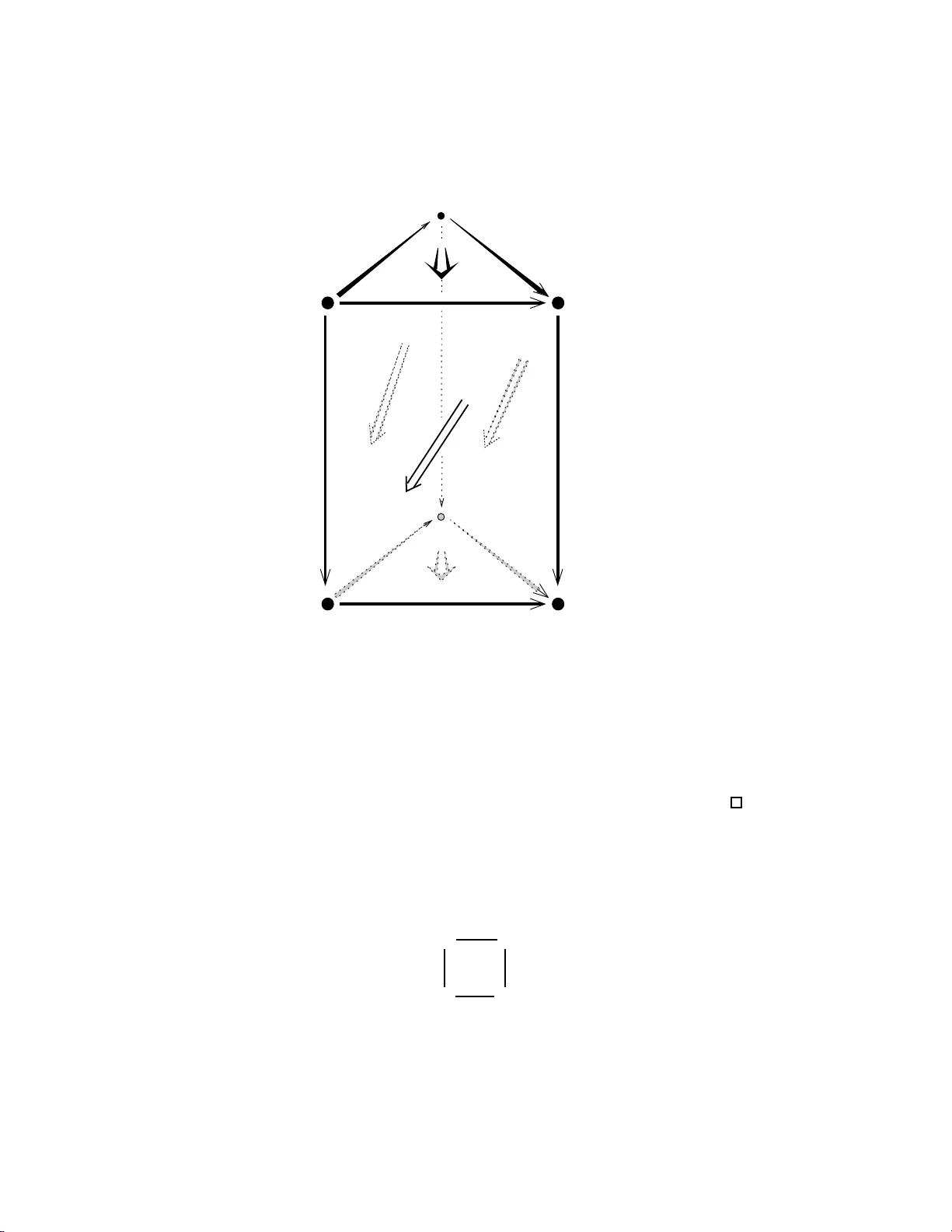
The Classi fying Space of a T op o logical 2-Group John C. Baez ∗ Dann y Stev e nson † Ma y 28, 2018 Abstract Categorif ying the concept of top ological group, one obtains the notion of a ‘topological 2-group’. This in turn allows a th eory of ‘principal 2-b undles’ generalizing the usual theory of principal bundles. It is w ell-know n that under mild cond itions on a top ological group G and a space M , principal G -bundles o ver M are classified by either the ˇ Cec h cohomology ˇ H 1 ( M , G ) or the set of homotopy classes [ M , B G ], where B G is the classif ying space of G . Here we review wo rk by Bartels, Jur ˇ co, Baas–B¨ okstedt–Kro, and others generalizing this result to top ological 2-groups and even topological 2-categories. W e explain v ari ous viewp oints on topological 2-groups an d the ˇ Cec h cohomology ˇ H 1 ( M , G ) with coefficients in a top ological 2-group G , a lso known as ‘nonab elian cohomology’. Then w e giv e an elemen- tary pro of that under mild conditions on M and G there is a bijection ˇ H 1 ( M , G ) ∼ = [ M , B |G | ] where B |G | is the classifying space of the geo- metric real ization of the nerve of G . Ap plying this result to the ‘string 2-group’ String ( G ) of a simply-connected compact simple Lie group G , it follo ws that principal String ( G )-2-bun dles hav e rational c haracteristic classes coming from elemen ts of H ∗ ( B G, Q ) / h c i , where c is any generator of H 4 ( B G, Q ). 1 In tro duction Recent w ork in higher g auge theo r y has revealed the imp ortance of categorifying the theory of bundles and considering ‘2-bundles’, where the fib er is a to p o logical category instead of a top olo gical space [5]. Thes e structures show up not only in mathematics, where they form a useful generalization o f nonabelia n ger b es [10], but also in physics, where they can b e used to describ e parallel transp ort of strings [3 1, 32]. The concepts of ‘ ˇ Cech co homology ’ and ‘cla ssifying space’ play a w ell-known and fundamental r ole in the theory of bundles. F o r any to p o logical gro up G , principal G -bundles ov er a spa c e M ar e clas sified by the first ˇ Cech co homology ∗ Departmen t of Mathematics, Universit y of Calif ornia, Riv erside, CA 92521, USA. Em ail: baez@mat h.ucr.edu † F ach bereich M athematik, Univ ersit¨ at Hamburg, Hambu rg, 20146, Germany , Email: stevenso n@math.un i-hamburg.de 1 of M with co efficients in G . F urther more, under some mild co nditio ns , these ˇ Cech cohomolo g y classes are in 1-1 corres p o ndence with homo topy classes of maps from M t o the classifying space B G . This lets us define characteristic classes for bundles, coming from c o homology cla s ses for B G . All these co ncepts and r esults can b e gener alized from bundles to 2-bundles. Bartels [6] has defined principal G -2- bundles where G is a ‘top ologic a l 2-gr oup’: roughly speak ing, a categ orified version of a top olo gical g roup. F urther more, his work shows how pr incipa l G -2- bundles ov er M are classified by ˇ H 1 ( M , G ), the first ˇ Cech cohomo lo gy of M with co efficients in G . This form of cohomolog y , also known as ‘no nab elian cohomolog y’, is fa miliar from work o n nonab elian gerb es [9, 19]. In fact, under mild conditions on G and M , there is a 1-1 corres po ndence betw een ˇ H 1 ( M , G ) and the set of homo topy clas s es of maps fr om M to a cer tain space B |G | : the classifying space of the geometric realiza tion of the nerve o f G . So, B |G | serves as a c lassifying spa ce for the top olog ical 2-gro up G ! This pap er seeks to provide an in tro duction to top ologica l 2- groups a nd nonab elian cohomolog y leading up to a self-contained pro of of this fact. In his pioneering w ork on this sub ject, Jurˇ co [22] asser ted that a certain space homotopy eq uiv alent to our s is a cla ssifying spa ce for the firs t ˇ Cech co homology with co efficients in G . How ever, there a re some gaps in his argument for this assertion (see Section 5.2 for details). Later, Baas , B¨ okstedt and Kro [2] gav e the definitive tre a tment of classifying spaces for 2-bundles. F or any ‘go o d’ to po logical 2-categor y C , they construct a classifying space B C . They then s how that for any space M with the ho motopy t yp e of a CW complex, concor dance cla sses o f ‘charted C -2 -bundles’ corres po nd to ho motopy classes of maps from M to B C . In particular, a top ologica l 2-g roup is just a topo logical 2 -categor y with one ob ject and with all morphisms and 2- morphisms inv ertible — and in this sp ecial case, their res ult almost reduces to the fact mentioned ab ov e. There are some s ubtleties, ho w ever. Most imp orta nt ly , while their ‘charted C -2- bundles’ reduce precis ely to our principal G -2-bundles, they class ify these 2- bundles up to co ncordance, while we classify them up to a sup erficia lly different equiv alence relation. Two G - 2-bundles ov er a s pa ce X are ‘conco rdant’ if they are res trictions of some G -2 -bundle over X × [0 , 1] to the tw o ends X × { 0 } and X × { 1 } . This makes it easy to see that homotopic maps fro m X to the classifying space define concordant G -2- bundles . W e instead consider tw o G -2 - bundles to b e equiv alent if their defining ˇ Cech 1 -co cycles are cohomolo gous. In this approach, so me w ork is req uired to show that homotopic maps from X to the clas sifying space define equiv a le nt G -2 -bundles. A priori , it is not ob vio us that t wo G -2 -bundles are equiv alent in this ˇ Cech sense if and only if they are concorda nt. How ever, since the classifying space o f Baas, B¨ okstedt and Kro is homotopy equiv alent to the one we use, it follows from our w o rk that these equiv alence r elations ar e the sa me — at least given G a nd M satisfying the techn ical conditions of b oth their result and o urs. W e also discuss an in teresting example: the ‘string 2 -gro up’ String( G ) o f a simply-connected compact simple Lie g roup G [4, 20]. As its name sug gests, 2 this 2-g roup is o f sp ecial interest in physics. Mathematically , a key fact is that | String( G ) | — the geometric realization o f the nerv e o f String ( G ) — is the 3- connected cover of G . Using this, one can co mpute the rational cohomology of B | Str ing ( G ) | . This is nice, bec ause these cohomolo gy clas ses give ‘characteris tic classes’ for principal G -2- bundles, and when M is a manifold one can hop e to compute these in terms of a connectio n and its curv ature, muc h as o ne do es for ordinary principa l bundles with a Lie gro up as structure group. Section 2 is an ov e r view, starting with a review o f the classic r esults that peo ple are now categ orifying. Section 3 reviews four viewp oints on to p o logical 2-gro ups. Section 4 explains nonab elia n co homology with co efficients in a top o- logical 2 -gro up. Finally , in Section 5 we prov e the res ults sta ted in Section 2, and comment a bit further on the work o f Jurˇ co and Ba a s–B¨ okstedt–K ro. 2 Ov erview Once one knows a b o ut ‘top olo gical 2-gr oups’, it is irres istibly tempting to gen- eralize a ll ones favorite results a bo ut topolo gical g roups to these new entities. So, let us b eg in with a quic k rev iew of so me classic r e s ults ab out topo logical groups and their classifying s pa ces. Suppo se that G is a top olog ical gro up. The ˇ Cech co homology ˇ H 1 ( M , G ) of a top olog ic al space M with co efficients in G is a set ca refully des igned to b e in 1-1 corr esp ondence with the set of isomorphism classes of principal G -bundles on M . Let us re c all how this works. First s uppo se U = { U i } is a n op en cov er o f M and P is a principa l G -bundle ov er M that is trivial when r estricted to each op en set U i . Then by comparing lo cal trivialisations o f P ov er U i and U j we ca n define maps g ij : U i ∩ U j → G : the transition functions of the bundle. On triple intersections U i ∩ U j ∩ U k , these maps satisfy a co cycle condition: g ij ( x ) g j k ( x ) = g ik ( x ) A collection of maps g ij : U i ∩ U j → G satisfying this condition is called a ‘ ˇ Cech 1-co cycle’ sub o rdinate to the cover U . Any such 1-co cycle defines a pr incipal G -bundle ov er M that is trivial ov er ea ch set U i . Next, supp o se we have tw o principa l G -bundles over M that are trivial over each s et U i , descr ib ed by ˇ Cech 1-co cycles g ij and g ′ ij , r e s p e ctively . These bundles are isomorphic if and only if for so me maps f i : U i → G we have g ij ( x ) f j ( x ) = f i ( x ) g ′ ij ( x ) on ev ery double intersection U i ∩ U j . In this case w e say the ˇ Cech 1-co c ycles are ‘cohomolo gous’. W e define ˇ H 1 ( U , G ) to be the quotient of the set o f ˇ Cech 1-co cycles sub or dinate to U by this equiv alence rela tion. Recall that a ‘go o d’ cov er of M is an op en cov er U for whic h all the non- empt y finite intersections of op en s ets U i in U are co ntractible. W e say a spa ce M admits go o d co v ers if any cov er of M has a go o d cov e r that refines it. F or 3 example, any (paracompact Hausdorff ) smo oth manifold admits go o d covers, a s do es any s implicia l complex. If M admits go o d cov er s, ˇ H 1 ( U , G ) is independent of the choice of go o d cover U . So, we can denote it s imply by ˇ H 1 ( M , G ). F urther more, this set ˇ H 1 ( M , G ) is in 1- 1 corresp ondence with the set of iso morphism cla sses o f principal G -bundles ov er M . The reas o n is that we ca n alwa ys trivialize any principa l G -bundle over the op en sets in a go o d cov e r . F o r more genera l spac e s, we need to define the ˇ Cech cohomo logy more care - fully . If M is a paracompact Hausdor ff space, we ca n define it to b e the limit ˇ H 1 ( M , G ) = lim − → U ˇ H 1 ( U , G ) ov er all o p en c ov ers , par tially order ed by r efinement. It is a cla ssic result in top o logy that ˇ H 1 ( M , G ) can b e unders to o d using homotopy theory with the help of Milnor ’s constr uction [1 4, 28] o f the class ifying space B G : Theorem 0. L et G b e a top olo gic al gr ou p. Then t her e is a top olo gic al sp ac e B G with the pr op erty t hat for any p ar ac omp act Hausdorff sp ac e M , ther e is a bije ction ˇ H 1 ( M , G ) ∼ = [ M , B G ] Here [ X , Y ] denotes the set of homotop y class e s o f maps from X int o Y . The top ologica l space B G is called the classifying s pace of G . There is a canonica l principal G -bundle on B G , ca lled the univ ersal G -bundle, a nd the theorem ab ov e is usually understo o d a s the assertion that every principal G -bundle P on M is obtained by pullba ck from the universal G -bundle under a cer tain map M → B G (the classifying map of P ). Now let us discuss how to generalize all these res ults to topo logical 2-gr oups. First of all, what is a ‘2- group’ ? It is like a gr oup, but ‘categorified’. While a group is a set e q uipped with functions describing m ultiplicatio n and inverses, and an identit y element , a 2- g roup is a c ate gory equipp ed with functors descr ib- ing multiplication and in verses, and an identit y obje ct . Indeed, 2-g roups a re also known as ‘ca tegorica l gro ups ’. A down-to-earth wa y to work with 2- groups inv olves trea ting them as ‘cr ossed mo dules’. A crossed mo dule cons ists of a pair of gro ups H and G , to g ether with a homomorphis m t : H → G and an action α of G on H satisfying t wo conditions, equations (4) and (5) b elow. Crossed mo dules were in tr o duced by J. H. C. Whitehead [38] without the aid of ca tegory theory . Mac La ne and Whitehead [2 4] later prov ed that just as the fundamental gro up captures all the homotopy-in v a r iant informa tio n a b o ut a connected po inted homotopy 1-type, a crossed mo dule captures all the homotopy-inv ariant information ab out a con- nected p ointed homotopy 2-type. By the 19 60s it was cle ar to V erdier and others that crossed mo dules are essen tially the same as ca tegorica l groups. The first published pro o f of this may b e due to Brown a nd Spe nc e r [1 2]. 4 Just as one can define principal G -bundles over a space M fo r an y topo logical group G , o ne can define ‘principal G -2 -bundles’ o ver M for any top olog ical 2- group G . Just as a principal G -bundle has a copy of G as fib er, a principal G -2-bundle has a copy of G as fib er. Readers interested in more details are urged to r ead Bar tels’ thesis, av ailable online [6]. W e shall hav e nothing else to say abo ut principal G -2- bundles ex cept that they are cla s sified by a categor ified version of ˇ Cech co homology , de no ted ˇ H 1 ( M , G ). As befo re, we can desc r ib e this categ orified ˇ Cech cohomology as a set of co cycles modulo an equiv alence relation. Let U b e a cov er o f M . If w e think of the 2-gr oup G in terms o f its asso cia ted cross ed module ( G, H, t, α ), then a co cycle sub or dinate to U consists (in pa rt) o f maps g ij : U i ∩ U j → G as b efor e . How ever, we now ‘weak en’ the co cycle condition a nd only r equire that t ( h ij k ) g ij g j k = g ik (1) for some maps h ij k : U i ∩ U j ∩ U k → H . These ma ps ar e in turn re q uired to satisfy a co c ycle condition of their own on quadruple in ter sections, namely α ( g ij )( h j kl ) h ij l = h ij k h ikl (2) where α is the action of G on H . This mildly in timidating equation will b e easier to understand when we draw it as a c o mmut ing tetrahedron — see equatio n (6) in Section 4. The pair ( g ij , h ij k ) is called a G -v alued ˇ Cec h 1-co cycle sub o rdinate to U . Similarly , we say tw o co cycles ( g ij , h ij k ) a nd ( g ′ ij , h ′ ij k ) a re cohomol ogous if t ( k ij ) g ij f j = f i g ′ ij (3) for some maps f i : U i → G and k ij : U i ∩ U j → H , whic h must make a cer tain prism co mm ute — see equa tion (7). W e define ˇ H 1 ( U , G ) to b e the set o f coho- mology classes of G -v alued ˇ Cech 1- co cycles. T o ca pture the entire cohomo logy set ˇ H 1 ( M , G ), w e m ust next take a limit of the s ets ˇ H 1 ( U , G ) as U rang es ov er all cov e r s of M . F or mo re details we refer to Sectio n 4. Theorem 0 g eneralizes nicely from top o logical groups to top ologica l 2-gro ups. But, following the usua l tradition in algebr aic top olo gy , we shall hencefor th work in the ca tegory of k - spaces, i.e ., co mpactly generated weak Haus dorff space s . So, by ‘top olog ical space’ we shall a lwa ys mean a k - space, and by ‘top olo gical gro up’ we shall mean a gro up ob ject in the category of k -spaces. Theorem 1. Supp ose that G is a wel l-p ointe d t op olo gic al 2-gr oup and M is a p ar ac omp act Hausdorff sp ac e admitting go o d c overs. Then ther e is a bije ction ˇ H 1 ( M , G ) ∼ = [ M , B |G | ] wher e the t op olo gic al gr oup |G | is the ge ometric r e alization of the nerve of G . One term her e requir es explanation. A topolo gical gro up G is said to be ‘w ell po inted’ if ( G, 1) is an NDR pair , or in o ther words if the inclusion { 1 } ֒ → G 5 is a closed cofibra tion. W e say that a top ologica l 2 -group G is w ell p ointed if the top ologica l gro ups G and H in its corre sp onding cro ssed mo dule ar e well po inted. F o r exa mple, any ‘Lie 2-g r oup’ is well p o int ed: a topolo gical 2-g roup is called a Lie 2-g roup if G and H are Lie g roups and the maps t, α are s mo oth. More gener ally , a ny ‘F r´ e chet Lie 2- g roup’ [4] is well pointed. W e e xplain the impo rtance of this notion in Sec tio n 5.1. Bartels [6] has a lready co nsidered tw o e x amples of principal G -2-bundles, corres p o nding to a b e lian gerb es and no nab elian ger b es. Let us discuss the classification of these b e fo re turning to a thir d, more novel example. F o r an ab elian gerb e [7], we first choose an ab elian topo lo gical group H — in pra ctice, usually just U(1). Then, w e for m the cross e d mo dule w ith G = 1 and this choice of H , with t and α trivial. The corresp onding to po logical 2 - group deser ves to b e called H [1], since it is a ‘shifted version’ of H . Bartels shows that the classifica tion of abelia n H -ger be s matc he s the classifica tio n of H [1]-2- bundles . It is well-known that | H [1] | ∼ = B H so the cla ssifying space for ab elian H -ge rb es is B | H [1] | ∼ = B ( B H ) In the cas e H = U(1), this class ifying space is just K ( Z , 3). So, in this case, we recov e r the well-known fact that ab elian U(1)-ger be s ov er M ar e cla ssified by [ M , K ( Z , 3)] ∼ = H 3 ( M , Z ) just as pr incipal U(1) bundles are cla ssified by H 2 ( M , Z ). F o r a nona be lian gerb e [9, 1 8, 19], we fix an y top ologica l group H . Then we form the cr ossed mo dule with G = Aut ( H ) and this choice of H , where t : H → G sends ea ch elemen t of H to the cor resp onding inner automorphism, and the action o f G o n H is the tautolo gous o ne. This giv es a top olo gical 2 -gro up called AUT( H ). Bartels s hows that the cla ssification of no na b elian H -ger b es matches the clas sification of AUT( H )-2-bundles . It follows that, under suitable conditions o n H , nona b elian H - gerb es ar e clas sified by homotopy classes o f maps into B | AUT( H ) | . A thir d applica tion of Theorem 1 ar is es when G is a simply-c onnected co m- pact s imple Lie group. F or any such group there is an isomo rphism H 3 ( G, Z ) ∼ = Z a nd the gener a tor ν ∈ H 3 ( G, Z ) transgr esses to a characteristic c la ss c ∈ H 4 ( B G, Z ) ∼ = Z . Asso ciated to ν is a map G → K ( Z , 3) and it c a n b e shown that the homotopy fib er of this ca n be given the s tr ucture of a top olog ical group ˆ G . This group ˆ G is the 3- connected cov er of G . When G = Spin ( n ), this group ˆ G is known as String ( n ). In general, we might call ˆ G the string group o f G . Note that until one picks a sp ecific construction fo r the ho mo topy fib er, ˆ G is only defined up to homotopy — or mo r e pre cisely , up to equiv alence of A ∞ -spaces. In [4], under the a b ov e hypo theses on G , a to p o logical 2-gro up subsequently dubbed the string 2 -group o f G was intro duced. Let us denote this by 6 String( G ). A key result a b o ut String ( G ) is that the top olog ical gro up | String( G ) | is eq uiv a le nt to ˆ G . By construction String( G ) is a F r´ echet Lie 2-gro up, hence well p ointed. So, from Theo rem 1 we immediately co nclude: Corollary 1. Supp ose that G is a simply-c onne cte d c omp act simple Lie gr oup. Supp ose M is a p ar ac omp act Hausdorff sp ac e admitting go o d c overs. Then ther e ar e bije ct ions b etwe en the fol lowing sets: • the set of e qu ivalenc e classes of princi p al Str ing( G ) -2-bund les over M , • the set of isomorphism cla sses of princip al ˆ G -bund les over M , • ˇ H 1 ( M , String( G )) , • ˇ H 1 ( M , ˆ G ) , • [ M , B ˆ G ] . One ca n describ e the r ational cohomology of B ˆ G in terms of the rational cohomolog y o f B G , w hich is well-understo o d. The following result was po inted out to us b y Matt Ando [1 ], and la ter discussed by Greg Ginot [17]: Theorem 2. Supp ose t hat G is a simply-c onne cte d c omp act simple Lie gr oup, and let ˆ G b e the string gr oup of G . L et c ∈ H 4 ( B G, Q ) = Q denote the tr ans - gr ession of t he gener ator ν ∈ H 3 ( G, Q ) = Q . Then t her e is a ring isomorphism H ∗ ( B ˆ G, Q ) ∼ = H ∗ ( B G, Q ) / h c i wher e h c i is t he ide al gener ate d by c . As a r esult, we o btain characteristic classes for String ( G )-2-bundles: Corollary 2. Su pp ose t hat G is a simply-c onne ct e d c omp act simple Lie gr oup and M is a p ar ac omp act Hausdorff sp ac e admitting go o d c overs. Then an e quiv- alenc e class of princip al String ( G ) -2-bund les over M determines a ring homo- morphism H ∗ ( B G, Q ) / h c i → H ∗ ( M , Q ) T o s e e this, we us e Coro llary 1 to reinterpret a n eq uiv a lence cla ss of principa l G -2-bundles ov er M as a ho motopy c la ss of maps f : M → B |G | . Picking any representative f , w e obtain a ring ho momorphism f ∗ : H ∗ ( B |G | , Q ) → H ∗ ( M , Q ) . This is indep endent of the choice of r epresentativ e. Then, w e use Theo rem 2. It is a nice problem to compute the r ational characteristic classes of a pr in- cipal String( G )-2-bundle ov er a manifold using de Rha m cohomolo g y . It sho uld be p ossible to do this using the curv atur e of an arbitrar y connection on the 2-bundle, just as for ordinary principal bundles with a Lie group as structure group. Sati, Sc hreib er and Stasheff [31] have r ecently made ex cellent pro gress on solving this pr oblem a nd its genera lizations to n -bundles for hig her n . 7 3 T op ological 2 -Groups In this section we reca ll four useful p ersp ectives o n top ologic a l 2 -groups. F or a more detailed a ccount, we refer the reader to [3]. Recall tha t for us, a ‘top olo gical space’ really means a k -space, and a ‘top o- logical gro up’ rea lly mea ns a group ob ject in the categor y of k -s paces. A top olog ical 2 -group is a group oid in the catego ry of topolo gical groups. In other words, it is a group oid G w her e the set Ob( G ) of o b jects and the s et Mor( G ) o f morphisms a re each equipp ed with the structure o f a topo logical group such that the so urce a nd targ et maps s, t : Mor( G ) → Ob( G ), the map i : Ob( G ) → Mor( G ) a ssigning ea ch ob ject its iden tit y morphism, the compo - sition map ◦ : Mor( G ) × Ob( G ) Mor( G ) → Mor( G ), a nd the ma p s ending each morphism to its in verse are all contin uous g r oup ho momorphisms. Equiv alently , w e can think of a topolo gical 2 -gro up as a group in the category of top ologic a l group oids. A top ol ogical g roup oid is a group oid G where Ob( G ) a nd Mor( G ) are top ologic a l spaces (or mor e precisely , k -spa ces) and all the gr oup oid op eratio ns just listed ar e co nt inuous maps. W e say that a functor f : G → G ′ betw een top olo gical gr oup oids is con ti n uous if the maps f : Ob( G ) → Ob( G ′ ) a nd f : Mor( G ) → Mor( G ′ ) are co ntin ous. A group in the catego ry of top ologica l gr oup oids is such a thing equipped with contin uo us functors m : G × G → G , inv : G → G and a unit ob ject 1 ∈ G s atisfying the us ual group axioms, w r itten out as commut ative diagr ams. This second viewp oint is us eful b eca use any top ologica l group oid G has a ‘nerve’ N G , a simplicial space wher e the space of n -simplices co nsists of com- po sable string s o f morphisms x 0 f 1 − → x 1 f 2 − → · · · f n − 1 − → x n − 1 f n − → x n T aking the geometric realiza tion of this ner ve, we obtain a top olo gical space which w e deno te as |G | for shor t. If G is a top olo gical 2 -gro up, its nerve inherits a group structure, so that N G is a top o lo gical simplicial gr oup. This in turn makes |G | into a to po logical gro up. A thir d wa y to understand top olog ical 2- groups is to view them a s top o log- ical crossed mo dules. Recall that a top ol ogical crossed mo dule ( G, H, t, α ) consists of top olog ical gr oups G and H together with a contin uous homomor- phism t : H → G and a contin uo us action α : G × H → H ( g , h ) 7→ α ( g ) h of G as automorphisms of H , satisfying the following tw o identities: t ( α ( g )( h )) = g t ( h ) g − 1 (4) α ( t ( h ))( h ′ ) = hh ′ h − 1 . (5) 8 The first equation ab ove implies that the map t : H → G is e q uiv a riant for the action of G on H defined by α and the action o f G on itself by conjugation. The second equatio n is ca lled the P e iffer iden tit y . When no confusion is likely to result, we will sometimes denote the 2- group corres p o nding to a cros s ed mo dule ( G, H , t, α ) simply by H → G . Every top olo gical cross ed mo dule determines a top olog ical 2-gro up and vice versa. Since there are so me c ho ices of conven tion in volv ed in this construction, we brie fly review it to fix our conv entions. Given a top olog ical cro s sed mo dule ( G, H , t, α ), we define a top o logical 2- group G as follows. Fir s t, define the group Ob( G ) of ob jects of G and the gro up Mor( G ) of morphisms of G by Ob( G ) = G, Mor( G ) = H ⋊ G where the semidirect pro duct H ⋊ G is formed us ing the left a ction of G on H via α : ( h, g ) · ( h ′ , g ′ ) = ( hα ( g )( h ′ ) , g g ′ ) for g , g ′ ∈ G and h, h ′ ∈ H . The source and target of a morphism ( h, g ) ∈ Mor( G ) ar e defined by s ( h, g ) = g and t ( h, g ) = t ( h ) g (Denoting b oth the target map t : Mor( G ) → Ob( G ) and the homomor phism t : H → G by the sa me letter sho uld not cause a ny pro blems, since the first is the r estriction of the sec ond to H ⊆ Mor( G ).) The identit y morphism o f a n ob ject g ∈ Ob( G ) is defined by i ( g ) = (1 , g ) . Finally , the comp o s ite of the morphisms α = ( h, g ) : g → t ( h ) g a nd β = ( h ′ , t ( h ) g ) : t ( h ) g → t ( h ′ h ) g ′ is defined to b e β ◦ α = ( h ′ h, g ) : g → t ( h ′ h ) g It is easy to chec k that with these definitions, G is a 2 -gro up. Co nv ersely , given a top ologic a l 2-group G , we define a c r ossed mo dule ( G, H , t, α ) by setting G to be Ob( G ), H to b e ker( s ) ⊂ Mor ( G ), t to be the r estriction of the target homomorphism t : Mo r( G ) → O b( G ) to the subgro up H ⊂ Mor( G ), and setting α ( g )( h ) = i ( g ) hi ( g ) − 1 If G is any top o logical gr oup then there is a top ologica l cro ssed mo dule 1 → G where t and α a re trivial. The underlying gr oup oid of the c orresp o nding top ologica l 2-gro up ha s G as its spa ce o f ob jects, and only identit y morphis ms . W e so metimes call this 2-gro up the discrete top olo gical 2- g roup as so ciated to G — where ‘dis crete’ is used in the sense of ca tegory theory , not to po logy! 9 A t the other extreme, if H is a top olo g ical group then it follo w s from the Peiffer identit y that H → 1 can b e made into to p o logical cro ssed mo dule if and only if H is ab elian, and then in a unique wa y . This is b ecause a group oid with one o b ject a nd H as mor phisms ca n b e made into a 2-gr oup pr ecisely when H is ab elian. W e already men tioned this 2-gr oup in the previous section, where we called it H [1]. W e will also need to talk ab o ut homomorphisms of 2-gr oups. W e shall understand these in the strictest p ossible sense. So, w e say a hom omor- phism of top o logical 2-g roups is a functor such that f : Ob( G ) → Ob( G ′ ) and f : Mo r( G ) → Mo r( G ′ ) are b o th contin uo us homomorphisms of topo logi- cal gro ups. W e can a lso describ e f in terms o f the c rossed mo dules ( G, H , t, α ) and ( G ′ , H ′ , t ′ , α ′ ) a sso ciated to G and G ′ resp ectively . In these terms the data of the functor f is describ ed by the c ommut ative diag r am H f / / t H ′ t ′ G f / / G ′ where the upper f denotes the restrictio n of f : Mor( G ) → Mor( G ′ ) to a map from H to H ′ . (W e ar e using f to mean s everal different things , but this makes the notation le s s cluttered, a nd should no t cause any confusion.) The maps f : G → G ′ and f : H → H ′ m ust b oth b e contin uous homomor phisms, and moreov er must satisfy an equiv ar iance proper ty with resp ect to the actions of G on H and G ′ on H ′ : we hav e f ( α ( g )( h )) = α ( f ( g ))( f ( h )) for all g ∈ G and h ∈ H . Finally , we will need to talk ab out shor t exact s equences of top ologica l groups and 2-gro ups . Here the top ology is imp or tant. If G is a top ologic a l group and H is a no rmal top ologica l s ubgroup of G , then w e can define an action of H on G by right tra nslation. In some circumstances, the pro jection G → G/H is a Hurewicz fibration. F or instance, this is the case if G is a Lie group and H is a clo sed normal subgroup of G . W e define a sho rt exact se quence of top ologica l gr oups to be a s equence 1 → H → G → K → 1 of top olo gical g roups and contin uo us homomor phisms such that the underly ing sequence of groups is e xact and the map underlying the ho momorphism G → K is a Hurewicz fibration. Similarly , we define a short exact sequence of top ologica l 2- groups to be a sequence 1 → G ′ → G → G ′′ → 1 10 of top o logical 2- g roups and contin uous ho momorphisms betw een them suc h that bo th the resulting sequences 1 → Ob( G ′ ) → O b( G ) → Ob( G ′′ ) → 1 1 → Mor( G ′ ) → Mo r( G ) → Mo r( G ′′ ) → 1 are shor t exact sequences of top ologic a l groups. Ag a in, w e c an interpret this in ter ms of the asso c iated cross e d mo dules: if ( G, H, t, α ), ( G ′ , H ′ , t ′ , α ′ ) a nd ( G ′′ , H ′′ , t ′′ , α ′′ ) denote the asso cia ted crossed mo dules, then it can b e shown that the seq ue nc e of to po logical 2-g roups 1 → G ′ → G → G ′′ → 1 is e x act if and only if b oth rows in the commutativ e diag ram 1 / / H ′ / / H / / H ′′ / / 1 1 / / G ′ / / G / / G ′′ / / 1 are sho rt exact sequences o f top ologica l gro ups. In this s itua tion we a ls o say we hav e a shor t exact sequence of top olog ical c rossed mo dules. A t times we shall also need a fourth v ie w p o int on top ologica l 2-gro ups: they are strict top ologica l 2-gr oup oids with a single o b ject, s ay • . In this approach, what we had b een ca lling ‘o b jects’ are renamed ‘morphisms ’, and what we had bee n calling ‘mo rphisms’ are rena med ‘2-morphisms’. This verbal shift ca n b e confusing, so we will not enga ge in it! How ever, the 2 -gro upo id viewp oint is very handy for diagr a mmatic re a soning in nona b e lian cohomology . W e draw g ∈ O b( G ) as a n arrow: • g / / • and draw ( h, g ) ∈ Mor( G ) as a big on: • g % % g ′ 9 9 h • where g ′ is the target o f ( h, g ), namely t ( h ) g . With our conven tions, horizontal comp osition of 2 -morphisms is then given by: • g 1 % % g ′ 1 9 9 h 1 • g 2 % % g ′ 2 9 9 h 2 • = • g 1 g 2 $ $ g ′ 1 g ′ 2 : : h 1 α ( g 1 )( h 2 ) • 11 while vertical co mp o sition is given by: • g / / g ′ C C h h ′ • = • g % % g ′ 9 9 h ′ h • 4 Nonab elian Cohomology In Section 2 we gave a quick s ketch of nona b e lian cohomolo gy . The s ub ject deserves a mor e thoroug h and more conceptual expla nation. As a warm up, consider the ˇ Cech cohomolo gy of a spa ce M with co efficients in a top ologic al gr o up G . In this case, Segal [3 3] realized that we can reinterpret a ˇ Cech 1-co cycle as a fun ctor . Supp o se U is an op en cov er o f M . T he n there is a top ologica l group o id ˆ U whose ob jects are pa irs ( x, i ) with x ∈ U i , and with a single morphism from ( x, i ) to ( x, j ) when x ∈ U i ∩ U j , and none otherwise . W e can also think of G as a to po logical gr oup oid with a single o b ject • . Seg al’s key obser v ation was tha t a co nt inuous functor g : ˆ U → G is the sa me as a no rmalized ˇ Cech 1-co cy cle sub o rdinate to U . T o see this, no te that a functor g : ˆ U → G maps each ob ject of ˆ U to • , and each morphism ( x, i ) → ( x, j ) to s o me g ij ( x ) ∈ G . F or the functor to preserve comp osition, it is necessary and sufficient to have the co cyc le equation g ij ( x ) g j k ( x ) = g ik ( x ) W e can draw this suggestively as a commuting tr iangle in the group oid G : • • • g ij ( x ) F F g jk ( x ) 1 1 1 1 1 1 1 1 1 1 1 1 g ik ( x ) / / F o r the functor to preserve identities, it is necessary and sufficient to have the normalizatio n condition g ii ( x ) = 1 . In fact, even mo r e is tr ue: tw o co c ycles g ij and g ′ ij sub o rdinate to U are cohomolog ous if and only if the cor resp onding functor s g and g ′ from ˆ U to G hav e a contin uous natural isomor phis m betw ee n them. T o see this, note that g ij and g ′ ij are coho mologous pre c isely when ther e are ma ps f i : U i → G sa tisfying g ij ( x ) f j ( x ) = f i ( x ) g ′ ij ( x ) 12 W e can draw this equation as a commuting sq uare in the group oid G : • g ij ( x ) / / f i ( x ) • f j ( x ) • g ′ ij ( x ) / / • This is pr ecisely the naturality square for a natural iso mo rphism betw een the functors g a nd g ′ . One ca n obta in ˇ Cech co homology with co e fficie nts in a 2-gro up by categ ori- fying Segal’s ideas. Suppo se G is a topolo gical 2-group a nd let ( G, H , t, α ) b e the cor resp onding top olog ical crosse d mo dule. Now G is the sa me as a top olog- ical 2-gr oup oid with one ob ject • . So, it is no lo nger appropria te to c o nsider mere fun ctors from ˆ U into G . Instead, we should consider we ak 2 -funct ors , also known as ‘ps e udo functors’ [23]. F or this, we should think of ˆ U as a top olo g ical 2-gro upo id with only identit y 2-mo rphisms. Let us sketc h how this works. A weak 2 -functor g : ˆ U → G sends e a ch ob ject of ˆ U to • , and each 1 -morphism ( x, i ) → ( x, j ) to s ome g ij ( x ) ∈ G . How ever, comp osition of 1-morphisms is only weakly preser ved. This mea ns the above triangle will now commute o nly up to is omorphism: • • • g ij F F g jk 1 1 1 1 1 1 1 1 1 1 1 1 g ik / / h ijk where for reada bilit y we hav e omitted the dep endence on x ∈ U i ∩ U j ∩ U k . T ranslated into equations, this triangle says that we hav e contin uo us maps h ij k : U i ∩ U j ∩ U k → H sa tisfying g ik ( x ) = t ( h ij k ( x )) g ij ( x ) g j k ( x ) This is pr ecisely equation (1) from Sectio n 2. F o r a weak 2-functor , it is not merely true tha t comp osition is pr eserved up to isomor phism: this isomor phism is also sub ject to a co herence law. Namely , 13 the following tetra hedron must commute: g jk g jl g il g ik g kl g ij h ij l h ikl h jk l h ijk g il (6) where a gain we hav e o mitted the dep endence on x . The commutativit y of this tetrahedron is equiv a lent to the following equatio n: α ( g ij )( h j kl ) h ij l = h ij k h ikl holding for a ll x ∈ U i ∩ U j ∩ U k ∩ U l . This is equation (2). A w eak 2-functor may also preser ve iden tity 1-morphisms only up to iso- morphism. Howev er, it turns o ut [6] that witho ut loss of gener ality we ma y assume that g preserves iden tit y 1 -morphisms st rictly . Thus we hav e g ii ( x ) = 1 for all x ∈ U i . W e may als o ass ume h ij k ( x ) = 1 whenever tw o or more of the indices i , j and k are equal. Finally , just as fo r the case o f an ordina ry top o- logical g r oup, we requir e that g is a c ontinuous weak 2- functor W e shall not sp ell this out in detail; s uffice it to say that the maps g ij : U i ∩ U j → G and h ij k : U i ∩ U j ∩ U k → H should be contin uous. W e say such contin uo us weak 2-functors g : ˆ U → G a re ˇ Cec h 1- co cycles v alued in G , sub ordina te to the cover U . W e now need to unders tand when tw o such co cycles should b e consider e d equiv alent. In the cas e o f co ho mology with co efficients in an ordinar y top olo gical group, w e saw that t wo co c ycles w ere cohomologous pr ecisely when there was a contin uous na tur al isomorphism b etw een the corresp o nding functor s . In our categorifie d s etting we sho uld instead use a ‘weak natural isomorphism’, also called a pseudonatural isomor phism [23]. So, we declare tw o co cycles to b e cohomologo u s if there is a co ntin uous w eak natural isomo rphism f : g ⇒ g ′ betw een the co rresp onding weak 2- functors g a nd g ′ . In a weak natural iso morphism, the usual naturality squar e commutes only up to isomo rphism. So , f : g ⇒ g ′ not o nly s e nds every o b ject ( x, i ) of ˆ U to some f i ( x ) ∈ G , but also sends every mor phism ( x, i ) → ( x, j ) to s ome k ij ( x ) ∈ H filling in this square: • • • • f i g ij / / f j g ′ ij / / k ij { 14 T ranslated into e quations, this squa re says that t ( k ij ) g ij f j = f i g ′ ij This is eq uation (3). There is als o a co herence law that the k ij m ust satisfy: they must ma ke the following prism comm ute: f k f i f j g ′ ik g ik g ′ ij g ij g ′ jk g jk h ′ ijk h ijk k ik k ij k jk (7) A t this po int, trans lating the diagrams int o equations b ecomes tir esome and unenlightening. It can be shown that this no tio n of ‘co homologo usness’ of ˇ Cech 1-co c ycles g : ˆ U → G is an eq uiv a le nce relation. W e denote by ˇ H 1 ( U , G ) the set of equiv a - lence classes of co cycles obta ined in this wa y . In other words, w e let ˇ H 1 ( U , G ) be the set o f contin uous weak natural iso mo rphism classes of cont inuous weak 2-functors g : ˆ U → G . Finally , to define ˆ H 1 ( M , G ), we need to take all cov ers into a ccount a s follows. The set of all op en covers o f M is a dir e cted set, partially order e d by refinement. By r estricting co cycles defined relative to U to any finer co ver V , we obtain a map ˇ H 1 ( U , G ) → ˇ H 1 ( V , G ). This allows us to define the ˇ Cech coho mology ˇ H 1 ( M , G ) as a limit: Definition 3. Given a top olog ical space M and a top ologica l 2-gr oup G , we define the first ˇ Cec h cohomolog y of M with co efficients in G to b e ˇ H 1 ( M , G ) = lim − → U ˇ H 1 ( U , G ) 15 When we want to emphasize the cross ed module, we will sometimes use the notation ˇ H 1 ( M , H → G ) instead o f ˇ H 1 ( M , G ). Note that ˇ H 1 ( M , G ) is a p ointed set, pointed by the trivial co cycle defined relative to any open cov er { U i } by g ij = 1, h ij k = 1 for all indices i , j and k . In Theorem 1 we assume M admits g o o d cov ers , so that every cov er U of M has a r efinement by a go o d c ov er V . In other words, the directed set of goo d cov ers of M is c ofinal in the set of all co vers of M . As a result, in computing the limit a bove, it is sufficient to o nly consider go o d cov er s U . Finally , w e remark that there is a more refined version of the set ˇ H 1 ( M , G ) defined using the no tio n o f ‘hypercov er’ [9, 11, 2 1 ]. F or a par acompact space M this r e fined cohomology se t H 1 ( M , G ) is isomorphic to the set ˇ H 1 ( M , G ) defined in terms o f ˇ Cech cov ers. While the technology of hypercovers is certainly useful, and ca n s implify so me pro ofs, our appr oach is sufficient for the applica tions we hav e in mind (see a lso the rema rk following the pro o f of Lemma 2 in sub- section 5.4). 5 Pro ofs 5.1 Pro of of Theorem 1 First, we need to distinguish be t ween Milnor’s [28] original construction of a classifying s pa ce for a top olo gical g roup and a later construction introduced by Milgram, Seg al a nd Steenro d [27, 33, 3 6] a nd further studied by May [25]. Mil- nor’s construction is very pow erful, as witnessed b y the gener ality of Theorem 0. The later constr uction is conceptually more b eautiful: for any topo logical group G , it c o nstructs B G as the g eometric r ealization o f the nerve o f the to p o logical group oid with one ob ject asso cia ted to G . But, here we are p erforming this construction in the categ ory o f k -space s, rather than the traditional catego ry of top ologica l spaces. It a lso seems to give a slightly weaker result: to obtain a bijection ˇ H 1 ( M , G ) ∼ = [ M , B G ] all of the ab ov e cited works r equire some extr a hypotheses o n G : Seg al [34] requires that G b e lo cally co ntractible; May , Milgram and Steenro d re q uire that G b e well p ointed. This extra h y po thesis on G is require d in the constr uction of the universal principal G -bundle E G ov er B G ; to ensure that the bundle is lo cally triv ial we must make one of the above a ssumptions on G . May’s work go es further in this regar d: he proves that if G is well p ointed then E G is a numer able principal G -bundle ov er B G , and hence E G → B G is a Hurewicz fibration. Another feature of this later construction is that E G co mes equippe d with the s tructure o f a top olo gical gr oup. In the work o f May a nd Sega l, this a r ises from the fact that E G is the g eometric r ealization of the nerve of a top ologic al 2- group. W e need the gro up structure on E G , so we will use this later constructio n rather than Milnor’s. F or further compariso n of the co nstructions see tom Diec k [37]. 16 W e prov e Theor em 1 using thre e lemmas that a re of s o me interest in their own right. The second, a s far as we know, is due to Larr y Br een: Lemma 1. L et G b e any wel l-p ointe d top olo gic al 2-gr ou p, and let ( G, H , t, α ) b e the c orr esp onding top olo gic al cr osse d mo dule. Then: 1. |G | is a wel l-p ointe d top olo gic al gr oup. 2. Ther e is a top olo gic al 2-gr oup ˆ G su ch that | ˆ G | fits into a short ex act se- quenc e of top olo gic al gr oups 1 → H → | ˆ G | p → |G | → 1 3. G acts c ontinuously via automorphisms on the t op olo gic al gr oup E H , and ther e is an isomo rphism | ˆ G | ∼ = G ⋉ E H . This exhibits |G | as G ⋉ H E H , the quotient of G ⋉ E H by the normal sub gr oup H . Lemma 2 . If 1 → H t → G p → K → 1 is a short exact se quenc e of top olo gic al gr oups, ther e is a bije ction ˇ H 1 ( M , H → G ) ∼ = ˇ H 1 ( M , K ) Her e H → G is our shorthand for t he 2-gr oup c orr esp onding to the cr osse d mo dule ( G, H , t, α ) wher e t is the inclusion of the normal su b gr oup H in G and α is the action of G by c onjugation on H . Lemma 3 . If 1 → G 0 f → G 1 p → G 2 → 1 is a short exact se quenc e of top olo gic al 2-gr oups, then ˇ H 1 ( M , G 0 ) f ∗ → ˇ H 1 ( M , G 1 ) p ∗ → ˇ H 1 ( M , G 2 ) is an exact se quenc e of p ointe d sets. Given these lemmas the pr o of of Theorem 1 go es as follo ws. Assume that G is a well-pointed top olog ical 2 -group. F r om Lemma 1 w e see that |G | is a well-pointed top olog ical group. It follows that we have a bijection ˇ H 1 ( M , |G | ) ∼ = [ M , B |G | ] So, to pr ov e the theorem, it suffices to construct a bijection ˇ H 1 ( M , G ) ∼ = ˇ H 1 ( M , |G | ) By Lemma 1, |G | fits int o a sho rt exact seq uence of top o logical gro ups: 1 → H → G ⋉ E H → |G | → 1 17 W e can use Lemma 2 to co nclude that there is a bijection ˇ H 1 ( M , H → G ⋉ E H ) ∼ = ˇ H 1 ( M , |G | ) T o complete the pr o of it thu s suffices to construct a bijectio n ˇ H 1 ( M , H → G ⋉ E H ) ∼ = ˇ H 1 ( M , G ) F o r this, obse r ve that we hav e a shor t exact sequence of top o lo gical cr ossed mo dules: 1 / / 1 / / H 1 / / H t / / 1 1 / / E H / / G ⋉ E H / / G / / 1 So, by Lemma 3, we hav e an exact s equence of sets: ˇ H 1 ( M , E H ) → ˇ H 1 ( M , H → G ⋉ E H ) → ˇ H 1 ( M , H → G ) Since E H is contractible a nd M is paraco mpact Hausdorff, ˇ H 1 ( M , E H ) is easily seen to b e tr ivial, s o the map ˇ H 1 ( M , H → G ⋉ E H ) → ˇ H 1 ( M , H → G ) is injectiv e. T o see that this map is sur jective, note that there is a homomor phism of crosse d mo dules going back: 1 / / 1 / / H 1 / / H t 1 y y / / 1 1 / / E H / / G ⋉ E H / / G / / i x x 1 where i is the natural inclusion of G in the semidirect pro duct G ⋉ E H . This homomorphism g o ing ba ck ‘splits’ o ur exa ct sequence of crossed mo dules. It follows that ˇ H 1 ( M , H → G ⋉ E H ) → ˇ H 1 ( M , H → G ) is onto, so we hav e a bijection ˇ H 1 ( M , H → G ⋉ E H ) ∼ = ˇ H 1 ( M , H → G ) = ˇ H 1 ( M , G ) completing the pr o of. 5.2 Remarks on Theorem 1 Theorem 1, a sserting the existence of a cla s sifying space for first ˇ Cech coho- mology with co efficients in a top o logical 2 -group, was o riginally sta ted in a preprint by Jurˇ co [22]. How ever, the argument given there was miss ing some details. In ess e nc e , the Jurˇ co’s arg ument b oils down to the following: he con- structs a map ˇ H 1 ( M , |G | ) → ˇ H 1 ( M , G ) and sketches the construction o f a map ˇ H 1 ( M , G ) → ˇ H 1 ( M , |G | ). The cons truction of the latter map how ever requires some further justification: for instance , it is not obvious that one ca n choo se a 18 classifying ma p satisfying the co cycle proper ty listed on the top of page 13 of [22]. Apart from this, it is not demonstrated that these t wo maps are inv ers e s of each other . As mentioned earlie r , Jurˇ co a nd also Baas, B¨ okstedt and Kro [2] use a dif- ferent approa ch to cons tr uct a cla ssifying space for a top olog ical 2-g roup G . In their appr oach, G is reg arded as a topo logical 2-gr oup oid with one ob ject. There is a well-known nerv e cons tr uction that turns any 2-g r oup oid (or even any 2 -catego ry) into a simplicial set [15]. Internalizing this cons tr uction, these authors tur n the top o logical 2- g roup oid G into a simplicial spac e , and then take the geometr ic rea lization of that to o btain a space. Let us deno te this space by B G . This is the class ifying spa ce use d by Jurˇ co and Baa s –B¨ okstedt–Kr o. It should b e noted that the assumption tha t G is a w ell-p o inted 2- g roup ensures that the nerv e o f the 2-gr oup oid G is a ‘go o d’ simplicial space in the sense of Segal; this ‘go o dness ’ co ndition is imp o rtant in the work of Ba as, B¨ okstedt and Kro [2]. Baas, B¨ okstedt and Kr o also cons ider a third wa y to constr uct a cla ssifying space for G . If we take the nerve N G o f G we get a s implicial group, as descr ib e d in Section 3 ab ove. B y thinking of each gro up of p -s implices ( N G ) p as a group oid with one ob ject, we ca n think of N G as a simplicial gro upo id. F ro m N G w e can obtain a bisimplicial space N N G b y applying the nerve construction to each group oid ( N G ) p . N N G is sometimes calle d the ‘double nerv e ’, since w e apply the nerve c o nstruction t wic e . F rom this bisimplicial s pace N N G we can form an ordinary simplicial spa c e dN N G b y taking the dia gonal. T ak ing the geometric realization of this simplicial spa ce, we obtain a space | dN N G | . It turns out that this space | dN N G | is homeomor phic to B |G | [8 , 30]. It can also b e shown that the spaces | dN N G | a nd B G ar e homotopy equiv alent — but although this fact seems w ell-known to exp erts, we have b een unable to find a reference in the case of a top olo gic al 2-gro up G . F or or dina ry 2- groups (without top ology) the re lation b etw een all three nerves was work ed out by Mo er dijk and Svensson [29] and Bullejos and Cegar ra [13]. In an y case, since we do not use these facts in our ar guments, we forgo providing the pro o fs here. 5.3 Pro of of Lemma 1 Suppo se G is a w ell-p ointed top olo gical 2-group with topo logical crossed mo dule ( G, H , t, α ), and le t |G | b e the geometr ic realiza tion of its nerve. W e shall prov e that there is a top olo g ical 2- group ˆ G fitting in to a shor t exa ct se q uence of top ologica l 2 - groups 1 → H → ˆ G → G → 1 ( 8) where H is the discr ete top ologica l 2-gr oup ass o ciated to the topo logical group H . On taking nerves and then geometric realiz a tions, this gives an exact se- quence of g roups: 1 → H → | ˆ G | → |G | → 1 Redescribing the 2-gr oup ˆ G with the help of some work by Segal, we shall show that | ˆ G | ∼ = G ⋉ E H and th us |G | ∼ = ( G ⋉ E H ) /H . Then we pr ov e tha t the ab ov e 19 sequence is an exact sequence of top olo gic al gro ups: this requires chec king that | ˆ G | → |G | is a Hurewicz fibration. W e co nclude by showing that | ˆ G | is well- po inted. T o build the e x act sequence of 2-gro ups in equation (8), we co ns truct the corres p o nding exact seque nce of top olog ic al cr ossed modules. This takes the following form: 1 / / 1 / / H t ′ 1 / / H t / / 1 1 / / H f / / G ⋉ H f ′ / / G / / 1 Here the cr ossed mo dule ( G ⋉ H , H , t ′ , α ′ ) is defined as follows: t ′ ( h ) = (1 , h ) α ′ ( g , h )( h ′ ) = α ( t ( h ) g )( h ′ ) while f a nd f ′ are given by f : H → G ⋉ H h 7→ ( t ( h ) , h − 1 ) f ′ : G ⋉ H → G ( g , h ) 7→ t ( h ) g It is easy to c heck that these formulas de fine an ex act s equence of top ologic a l crossed mo dules. The corr esp onding exact sequence of top olog ical 2-gro ups is 1 → H → ˆ G → G → 1 where ˆ G deno tes the topolo gical 2-gr oup asso ciated to the topolog ical crossed mo dule ( G ⋉ H , H , t ′ , α ′ ). In more detail, the 2-g roup ˆ G has Ob( ˆ G ) = G ⋉ H Mor( ˆ G ) = ( G ⋉ H ) ⋉ H s (( g , h ) , h ′ ) = ( g , h ) , t (( g , h ) , h ′ ) = ( g , h ′ h ) i ( g , h ) = (( g , h ) , 1) , (( g , h ′ h ) , h ′′ ) ◦ (( g , h ) , h ′ ) = (( g , h ) , h ′′ h ′ ) Note that ther e is an isomorphism ( G ⋉ H ) ⋉ H ∼ = G ⋉ H 2 sending (( g , h ) , h ′ ) to ( g , ( h, h ′ h )). Here by G ⋉ H 2 we mean the se midirect pro duct for med with the diago nal action of G on H 2 , namely g ( h, h ′ ) = ( α ( g )( h ) , α ( g )( h ′ )). Thus the gro up Mor( ˆ G ) is isomorphic to G ⋉ H 2 . W e can give a clea r er description of the 2-gro up ˆ G using the work of Sega l [33]. Se g al noted tha t for an y top o logical gr o up H , there is a 2 -group H with 20 one ob ject for each element of H , and one morphism from a ny ob ject to any other. In other words, H is the 2 - group with: Ob( H ) = H Mor( H ) = H 2 s ( h, h ′ ) = h, t ( h, h ′ ) = h ′ i ( h ) = ( h, h ) , ( h ′ , h ′′ ) ◦ ( h, h ′ ) = ( h, h ′′ ) Moreov er, Segal prov ed that the g eometric realization | H | of the nerve o f H is a mo del for E H . Since G a cts on H by automorphisms, we can define a ‘semidirect pro duct’ 2-gro up G ⋉ H with Ob( G ⋉ H ) = G ⋉ H Mor( G ⋉ H ) = G ⋉ H 2 s ( g , ( h, h ′ )) = ( g , h ) , t ( g , ( h, h ′ )) = ( g , h ′ ) i ( g , h ) = ( g , ( h, h )) , ( g , ( h ′ , h ′′ )) ◦ ( g , ( h, h ′ )) = ( g , ( h, h ′′ )) The isomorphism ( G ⋉ H ) ⋉ H ∼ = G ⋉ H 2 ab ov e can then be int erpreted as an isomorphism Mor( ˆ G ) ∼ = Mor( G ⋉ H ). It is easy to c heck that this isomorphism is compatible with the structure maps for ˆ G and G ⋉ H , so we hav e an isomorphism of top ologica l 2 - groups: ˆ G ∼ = G ⋉ H It follows that the ner ve N ˆ G of ˆ G is is omorphic as a simplicial top o logical gr oup to the nerve o f G ⋉ H . As a simplicial spac e it is clear that N ( G ⋉ H ) = G × N H . W e need to iden tify the simplicial g roup structur e on G × N H . F r om the de finitio n of the pro ducts on Ob( G ⋉ H ) and Mo r( G ⋉ H ), it is clear that the pro duct o n N ( G ⋉ H ) is given by the simplicia l map ( G × N H ) × ( G × N H ) → G × N H defined on p - simplices by ( g , ( h 1 , . . . , h p )) , ( g ′ , ( h ′ 1 , . . . , h ′ p )) 7→ ( g g ′ , ( h 1 α ( g )( h ′ 1 ) , . . . , h p α ( g )( h ′ p ))) Thu s one migh t well call N ( G ⋉ H ) the ‘semidirect product’ G ⋉ N H . Since geometric realizatio n pre s erves pro ducts, it follows that there is an isomor phism of top ologica l g r oups | ˆ G | ∼ = G ⋉ E H . Here the semidirect pro duct is formed using the action of G on E H induced from the actio n o f G on H . Finally note tha t H is embedded as a normal subgroup of G ⋉ E H throug h H → G ⋉ E H h 7→ ( t ( h ) , h − 1 ) 21 It follo ws that the exact sequence of groups 1 → H → | ˆ G | → |G | → 1 can be ident ified with 1 → H → G ⋉ E H → |G | → 1 (9) It follows that |G | is isomo r phic to the quo tient G ⋉ H E H of G ⋉ E H by the normal subgr oup H . This amounts to fac toring out b y the actio n of H o n G ⋉ E H given by h ( g , x ) = ( t ( h ) g , xh − 1 ). Next we need to show that equatio n (9) sp ecifies an exact sequence of top o- lo gic al groups : in par ticular, that the map G ⋉ E H → |G | = G ⋉ H E H is a Hurewicz fibr ation. T o do this, we pr ov e that the following diag ram is a pullback: G ⋉ E H / / E H G ⋉ H E H / / B H Since H is well p ointed, E H → B H is a numerable principa l bundle (and hence a Hurewicz fibration) by the results of May [25] referred to ea rlier. The statement ab ov e now follows, as Hurewic z fibrations are pres erved under pullbacks. T o show the ab ov e diagra m is a pullback, we co nstruct a homeo morphism α : ( G ⋉ H E H ) × B H E H → G ⋉ E H whose inv erse is the canonica l ma p β : G ⋉ E H → ( G ⋉ H E H ) × B H E H . T o do this, supp os e that ([ g , x ] , y ) ∈ ( G ⋉ H E H ) × B H E H . Then x and y b elong to the same fib er of E H ov er B H , s o y − 1 x ∈ H . W e set α ([ g , x ] , y ) = ( t ( y − 1 x ) g , y ) A straightforward calculation shows tha t α is w ell defined and that α and β ar e inv erse to one another. T o co nclude, we need to show that |G | is a well-p ointed top o logical group. F o r this it is sufficien t to show that N G is a ‘pr op er’ simplicial space in the sense of May [26] (note that we can repla ce his ‘s trong’ NDR pairs with NDR pa ir s). F o r, if we follow May and denote b y F p |G | the image of ` p i =0 ∆ i × N G i in |G | , it then follows from his Lemma 11 .3 that ( |G | , F p |G | ) is a n NDR pair for all p . In particular ( |G | , F 0 |G | ) is an NDR pair . Since F 0 |G | = G a nd ( G, 1) is a n NDR pair, it fo llows that ( |G | , 1) is an NDR pair: that is, |G | is well p ointed. W e still need to s how that N G is prop er. In fa c t it suffices to s how that N G is a ‘go o d’ simplicial spa c e in the sense o f Segal [35], meaning that a ll the degeneracies s i : N G n → N G n +1 are closed cofibrations . The reason fo r this is that every go o d simplicia l space is automatically prope r — see the pro o f of Lewis’ Corollary 2.4(b) [16]. T o see that N G is go o d, note that every degener acy homomorphism s i : N G n → N G n +1 is a section of the cor resp onding face ho mo- morphism d i , so N G n +1 splits as a semidirect pro duct N G n +1 ∼ = N G n ⋉ ker( d i ). Therefore, s i is a clo sed cofibra tion provided that ker( d i ) is well p ointed. But ker( d i ) is a retra ct o f N G n +1 , so k er( d i ) will b e well p o int ed if N G n +1 is w ell 22 po inted. F o r this, note that N G n +1 is isomor phic as a spac e to G × H n +1 . Since the groups G a nd H are well p ointed by h yp o thesis, it follows that N G n +1 is well p ointed. Her e we hav e used the fact that if X → Y a nd X ′ → Y ′ are closed cofibrations then X × X ′ → Y × Y ′ is a closed cofibratio n. 5.4 Pro of of Lemma 2 Suppo se that M is a top olo gical space admitting go o d cov ers . Also supp ose that 1 → H t → G p → K → 1 is an exact sequence of top olog ical g roups. This data gives rise to a topolo gical cr ossed mo dule H t → G wher e G acts on H by conjuga tion. F or sho rt we denote this by H → G . The sa me data also gives a top o logical crosse d mo dule 1 → K . There is a homomor phism of cros sed mo dules from H → G to 1 → K , ar ising from this c o mmut ing squar e: H / / t 1 G p / / K Call this ho momorphism α . It yields a map α ∗ : ˇ H 1 ( M , H → G ) → ˇ H 1 ( M , 1 → K ) . Note that ˇ H 1 ( M , 1 → K ) is just the or dinary ˇ Cech co homology ˇ H 1 ( M , K ). T o prov e Lemma 2, w e need to construct an inv er se β : ˇ H 1 ( M , K ) → ˇ H 1 ( M , H → G ) . Let U = { U i } b e a go o d cover of M ; then, as noted in Sectio n 4 there is a bijection ˇ H 1 ( M , K ) = ˇ H 1 ( U , K ) Hence to define the ma p β it is sufficient to define a map β : ˇ H 1 ( U , K ) → ˇ H 1 ( U , H → G ). Le t k ij be a K -v alued ˇ Cech 1-co cy cle sub ordinate to U . Then from it w e construct a ˇ Cech 1- c o cycle ( g ij , h ij k ) taking v a lues in H → G a s follows. Since the spaces U i ∩ U j are contractible and p : G → K is a Hurewicz fibration, w e ca n lift the maps k ij : U i ∩ U j → K to maps g ij : U i ∩ U j → G . The g ij need not sa tis fy the co cycle condition for or dinary ˇ Cech co homology , but instead we hav e t ( h ij k ) g ij g j k = g ik for s o me unique h ij k : U i ∩ U j ∩ U k → H . In terms of diagrams , this mea ns w e hav e triangles • • • g ij F F g jk 1 1 1 1 1 1 1 1 1 1 1 1 g ik / / h ijk 23 The uniquenes s o f h ij k follows from the fact that the homomorphis m t : H → G is injective. T o show that the pair ( g ij , h ij k ) defines a ˇ Cech co cycle w e need to c heck that the tetra hedron (6 ) commutes. How ever, this follows from the commutativit y of the co rresp o nding tetrahedro n built from tria ngles of this form: • • • k ij F F k jk 1 1 1 1 1 1 1 1 1 1 1 1 k ik / / 1 and the injectivity of t . Let us show that this construction gives a w e ll-defined map β : ˇ H 1 ( M , K ) = ˇ H 1 ( U , K ) → ˇ H 1 ( M , H → G ) sending [ k ij ] to [ g ij , h ij k ]. Suppo se tha t k ′ ij is a no ther K -v alued ˇ Cech 1 -co cycle sub o rdinate to U , such that k ′ ij and k ij are cohomolog ous. Starting from the co cycle k ′ ij we can construct (in the same manner as ab ov e) a c o cycle ( g ′ ij , h ′ ij k ) taking v alues in H → G . Our ta sk is to show that ( g ij , h ij k ) and ( g ′ ij , h ′ ij k ) are cohomolog ous. Since k ij and k ′ ij are cohomo lo gous there exists a family of maps κ i : U i → K fitting in to the naturality s quare • k ij ( x ) / / κ i ( x ) • κ j ( x ) • k ′ ij ( x ) / / • Cho ose lifts f i : U i → G of the v ar ious κ i . Since p ( g ij ) = p ( g ′ ij ) = k ij and p ( f i ) = κ i , p ( f j ) = κ j there is a unique map η ij : U i ∩ U j → H t ( η ij ) g ij f j = f i g ′ ij . So, in ter ms of diagr ams, we hav e the following squa r es: • • • • g ij / / f i f j g ′ ij / / η ij | The triangles a nd squares defined so far fit together to for m prisms : 24 f k f i f j g ′ ik g ik g ′ ij g ij g ′ jk g jk h ′ ijk h ijk η ik η ij η jk It follo ws from the injectivit y of the ho momorphism t that these pr isms com- m ute, and ther efore that ( g ij , h ij k ) and ( g ′ ij , h ′ ij k ) ar e coho mologous . Therefore we ha ve a well-defined ma p ˇ H 1 ( U , K ) → ˇ H 1 ( U , H → G ) and hence a well- defined map β : ˇ H 1 ( M , K ) → ˇ H 1 ( M , H → G ). Finally we need to chec k that α and β are inv er s e to o ne ano ther. It is obvious that α ◦ β is the identit y on ˇ H 1 ( M , K ). T o see tha t β ◦ α is the identit y on ˇ H 1 ( M , H → G ) we argue as follows. Cho ose a co cycle ( g ij , h ij k ) sub ordinate to a goo d cover U = { U i } . Then under α the c o cycle [ g ij , h ij k ] is se nt to the K -v alued co c ycle [ p ( g ij )]. But then w e may take g ij as our lift of p ( g ij ) in the definition of β ( p ( g ij )). It is then clea r that ( β ◦ α )[ g ij , h ij k ] = [ g ij , h ij k ]. A t this p oint a remar k is in order . The pro o f of the above lemma is one place where the definition of ˇ H 1 ( M , H → G ) in terms of hype r cov er s would lead to simplifications, and w ould a llow us to replace the hypo thes is that the map underlying the homomorphism G → K was a fibra tion with a less re s trictive condition. The ho momorphism o f cr ossed mo dules H / / t 1 G p / / K gives a homomorphis m between the asso ciated 2 -groups and hence a simplicial map b etw een the nerves of the asso ciated 2-g r oup oids. It tur ns out that this 25 simplicial map b elo ngs to a cer tain class o f simplicial maps with resp ect to whic h a sub catego ry of simplicial spaces is lo ca lized. In the formalis m of hypercovers, for M paracompa c t, the no nab elian coho mology ˇ H 1 ( M , G ) with co efficients in a 2-gro up G is defined as a cer tain s e t of morphisms in this lo calized s ubca tegory . It is then eas y to see that the induced map ˇ H 1 ( M , H → G ) → ˇ H 1 ( M , K ) is a bijection. 5.5 Pro of of Lemma 3 Suppo se that 1 → G 0 f → G 1 p → G 2 → 1 is a short ex act s e quence of top ologica l 2-g roups, s o that we have a sho rt exact sequence of top olo gical cross ed mo dules: 1 / / H 0 t 0 f / / H 1 t 1 p / / H 2 t 2 / / 1 1 / / G 0 f / / G 1 p / / G 2 / / 1 Also supp os e that U = { U i } is a go o d cover o f M , and that ( g ij , h ij k ) is a co cycle repr esenting a class in ˇ H 1 ( U , G 1 ). W e claim that the image of f ∗ : ˇ H 1 ( M , G 0 ) → ˇ H 1 ( M , G 1 ) equals the k ernel of p ∗ : ˇ H 1 ( M , G 1 ) → ˇ H 1 ( M , G 2 ) . If the clas s [ g ij , h ij k ] is in the image of f ∗ , it is clearly in the kernel of p ∗ . Conv ers e ly , suppo s e it is in kernel of p ∗ . W e need to show that it is in the image of f ∗ . The pair ( p ( g ij ) , p ( h ij k )) is c o homolog o us to the trivia l co cycle, at least after refining the cov er U , so there exist x i : U i → G 2 and ξ ij : U i ∩ U j → H 2 such that this diagram commutes: 26 x k x i x j 1 p ( g ik ) 1 p ( g ij ) 1 p ( g jk ) 1 p ( h ijk ) ξ ik ξ ij ξ jk Since p : G 1 → G 2 is a fibration and U i is contractible, w e can lift x i to a map ˆ x i : U i → G 1 . Similarly , we can lift ξ ij to a map ˆ ξ ij : U i ∩ U j → H 1 . There are then unique maps γ ij : U i ∩ U j → G 1 giving squa res like this: • • • • g ij / / ˆ x i ˆ x j γ ij / / ˆ ξ ij | namely γ ij = ˆ x i g ij ˆ x − 1 j t ( ˆ ξ ij ) Similarly , ther e ar e unique maps c ij k : U i ∩ U j ∩ U k → H 1 making this prism commute: 27 ˆ x k ˆ x i ˆ x j γ ik g ik γ ij g ij γ jk g jk c ijk h ijk ˆ ξ ik ˆ ξ ij ˆ ξ jk T o define c ij k , we simply comp ose the 2- morphisms on the sides a nd top o f the prism. Applying p to the prism ab ove we obtain the previous prism. So , γ ij and c ij k m ust take v alues in the kernel of p : G 1 → G 2 and p : H 1 → H 2 , resp ectively . It follows that γ ij and c ij k take v a lues in the image of f . The ab ove prism says that ( γ ij , c ij k ) is cohomolo gous to ( g ij , h ij k ), a nd therefore a co cyc le in its own rig ht . Since γ ij and c ij k take v alues in the image of f , they r epresent a class in the ima ge of f ∗ : ˇ H 1 ( M , G 0 ) → ˇ H 1 ( M , G 1 ) . So, [ g ij , h ij k ] = [ γ ij , c ij k ] is in the image of f ∗ , as was to b e shown. Pro of of Theorem 2 The following pro o f was first des c r ib ed to us by Matt Ando [1], a nd later dis- cussed by Greg Ginot [17]. Suppo se tha t G is a simply-connected, compact, simple Lie gr oup. Then the string gr oup ˆ G of G fits into a short ex a ct sequence of top ologica l gr oups 1 → K ( Z , 2) → ˆ G → G → 1 for some realization of the E ilenberg-Ma c Lane s pa ce K ( Z , 2) a s a topolog ical group. Applying the classifying space functor B to this short exac t sequence 28 gives rise to a fibratio n K ( Z , 3 ) → B ˆ G p → B G. W e wan t to co mpute the r ational cohomo lo gy of B ˆ G . W e can use the Serr e spe c tral sequence to co mpute H ∗ ( B ˆ G, Q ). Since B G is simply co nnected the E 2 term of this sp ectral seq uence is E p,q 2 = H p ( B G, Q ) ⊗ H q ( K ( Z , 3) , Q ) . Because K ( Z , 3) is ratio na lly indistinguishable fro m S 3 , the first nonze ro dif- ferential is d 4 . F urthermor e , the differ entials of this sp ectra l s equence a re all deriv ations. It follows that d 4 ( y ⊗ x 3 ) = ( − 1) p y ⊗ d 4 ( x 3 ) if y ∈ H p ( B G, Q ). It is not har d to iden tify d 4 ( x 3 ) with c , the cla ss in H 4 ( B G, Q ) which is the transgre ssion of the generator ν of H 3 ( G, Q ) = Q . It follows that the sp ectral sequence colla pses a t the E 5 stage with E p,q 5 = E p,q ∞ = ( 0 if q > 0 H p ( B G, Q ) / h c i if q = 0 . One chec k s that a ll the s ubc o mplexes F i H ∗ ( B ˆ G, Q ) in the filtration of H ∗ ( B ˆ G, Q ) are zer o for i ≥ 1. Hence H p ( B ˆ G, Q ) = E p, 0 ∞ = H p ( B G, Q ) / h c i a nd so Theor em 2 is proved. Ac kno wledgeme n ts W e would like to thank Ma tthew Ando and Greg Gino t for showing us the pro of of Theorem 2, Peter May for helpful re marks on classifying spaces, a nd T oby Bartels, Bra nislav Jurˇ co , and Urs Schreib er for many discussions on higher g a uge theory . W e also tha nk Nils Baas, Bjørn Dundas, Eric F rie dla nder, Bjørn J ahren, John Ro gnes, Stefan Sc hw ede, and Graeme Segal for o rganizing the 2 007 Ab el Sympo sium and for us e ful discus sions. Finally , DS has received supp or t from Collab ora tive Res earch Ce nter 676 : ‘Particles, Strings, and the Early Universe’. References [1] M. Ando, p ersonal communication. [2] N. A. Baas, M. B¨ okstedt, and T. A. Kro, 2-Categ orical K -theor y . Av ailable as arX iv:mat h/061 2549 . [3] J. C. Ba e z and A. La uda, Higher -dimensional algebr a V: 2-gro ups, Th. Appl. Ca t. 12 (2004 ), 423– 491. Also av a ilable as a rXiv: math/ 0307200 . [4] J. C. Baez, A. S. Crans, U. Schreiber a nd D. Stevenson, F rom lo op groups to 2-groups, HHA 9 (2007), 101– 135. Also av ailable a s arXiv: math/ 05041 23 . 29 [5] J. C. Baez and U. Schreiber, Hig her gauge theory , in Categor ies in Algebra, Geometry a nd Mathematica l P hysics , eds. A. Davydo v et al , Co nt emp. Math. 431 , AMS, Pr ovidence, Rho de Island, 20 07, pp. 7-30 . Also av aila ble as arX iv:mat h/051 1710 . [6] T. Bartels, Higher ga uge theor y I: 2-bundles. Av a ilable as arXiv: math/ 04103 28 . [7] J.-L. Brylinski, Lo op Spac e s, Char acteristic Classes and Geometr ic Quan- tization , Bir khauser, Bosto n, 19 93. [8] J. Braho, Haefliger structures and linear homo topy (app endix), T ra ns. Amer. Math. So c. 282 (19 84), 529 –538 . [9] L. Breen, Bitorseurs et coho mologie non- ab´ elienne, in The Grothendieck F e s tschrift I , eds. P . Car tier et al , Pro g r. Math. 86 , Bir kh¨ auser, Boston, MA1990, pp. 401–4 76. [10] L. B reen and W. Messing, Differential geometr y of gerb es, Adv. Ma th. 198 (2005) 7 32–84 6. Av a ilable as a rXiv: math/0 106083 . [11] K. S. Brown, Abstract homo topy theor y a nd ge neralised sheaf coho mology , T rans. Amer. Math. So c. 18 6 (1973 ), 41 9–458 . [12] R. Brown and C. B. Sp encer, G -gr oup oids, cr o ssed mo dules, a nd the clas- sifying space of a top olog ical g roup, Pr o c. Kon. Ak ad. v . W et. 79 (19 76), 296–3 02. [13] M. Bullejos a nd A. M. C e garra , On the geometry o f 2 -catego ries and their clas sifying spaces, K-T heo ry 29 (2003 ), 2 11-22 9. Also av a ilable a t ht tp://www.ugr.es /%7Ebullejos/ geometryampl.p df . [14] A. Dold, Partitions o f unity in the theo r y o f fibratio ns , Ann. Math. 78 (1963), 2 23–25 5. [15] J. Duskin, Simplicial matrices and the nerves of weak n -categ ories I: nerves of bicateg ories, Th. Appl. Cat. 9 (2 0 01), 198– 308. [16] L. Gaunce Lewis Jr., When is the natural map X → ΩΣ X a co fibration?, T rans. Amer. Math. So c. 27 3 (1982 ), 14 7–155 . [17] G. Ginot, commen t on U. Schreiber’s p os t L ie ∞ -co nnections and their application to string- and C he r n–Simons n -transp o rt, n -Categ o ry Caf´ e . [18] G. Ginot a nd M. Stienon, Gr oup oid e x tensions, principal 2- group bundles and characteristic classes. Av aila ble as arX iv:08 01.12 38 . [19] J. Gir aud, Cohomo logie Non Ab´ elienne , Die Grundlehren der mathematis- chen Wissens chaften 179 , Springe r , Berlin, 19 71. 30 [20] A. Henriques, Integrating L ∞ algebras , Comp os. Ma th. 1 44 (200 8), 101 7– 1045. Also av ailable as arXiv:m ath/0 603563 . [21] J. F. J a rdine, Universal Hasse–Witt classes, Contemp. Math. 83 (1 989), 193–2 39. [22] B. Jurˇ co, Cr ossed mo dule bundle g erb es; class ification, string gro up and differential g eometry . Av a ilable a s a rXiv: math/ 05100 78v2 . [23] G. Kelly and R. Street, Review of the elements of 2-catego ries, Ca tegory Seminar (P ro c. Sem., Sydney , 1972/1 973) Le c ture Notes in Ma thematics 420 , Springer , Berlin, 19 74, pp. 75 -103. [24] S. Ma c Lane and J. H. C. Whitehead, On the 3-type of a co mplex, P ro c. Nat. Acad. Sci. 36 (1 9 50), 41–4 8. [25] J. P . May , Classifying spaces a nd fibratio ns, Mem. Amer. Math. So c. 1 (1975), no . 155. [26] J. P . May , The Geo metry of Iterated Lo op Spaces , Le cture Notes in Ma th- ematics 2 7 1 , Springer, Berlin, 1972. [27] R. J . Milgram, The bar co nstruction and abelia n H -spa ces, Illinois J. Math. 11 (19 67), 242– 2 50. [28] J. Milnor , Construction o f universal bundles I I, Ann. Math. 63 (1956), 430–4 36. [29] I. Mo erdijk and J.-A. Svensson, Algebraic classifica tio n of equiv aria nt ho- motopy 2-types , part I, J. Pure Appl. Alg. 89 (19 93), 187– 216. [30] D. Quillen, Higher a lgebraic K- theory I, in Algebraic K -theory , I: Higher K - theories (Pro c. Conf., Batelle Memorial Ins t., Se a ttle, Ash., 1972 , Lecture Notes in Mathematics, 341 , Spr inger, Ber lin, 1973 , pp. 85–147 . [31] H. Sati, J. Stasheff and U. Schreiber , L ∞ -algebra connections a nd appli- cations to String– a nd Che r n–Simons n -transp ort, to app ear in the pro - ceedings of Recent Dev elopments in Quantum Field Theory , Max P la nck Institute. Av aila ble as arX iv:08 01.34 80 . [32] U. Schreiber, F ro m Lo op Space Mechanics to Nonab elia n Strings , Ph.D. thesis, U. Essen. Av ailable a s arXi v:hep -th/05 09163 . [33] G. B. Segal, Classifying spaces and sp ectral sequences, Publ. Math. IHES 34 (19 68), 105– 1 12. [34] G. B. Sega l, Cohomolo gy of top olog ical g roups, Symp osia Ma thematica V o l. IV, Academic Pr ess, London, 197 0, pp. 377–38 7. [35] G. B. Sega l, Categorie s a nd co homology theor ies, T op ology 13 (19 74), 293– 312. 31 [36] N. E . Steenr o d, Milgra m’s classifying s pace of a top olo gical gro up, T op olog y 7 (19 68), 349–3 68. [37] T. tom Diec k , On the homo topy type of classifying spaces, Manuscripta Math. 11 (1 974), 41 –49. [38] J. H. C. Whitehead, Note on a previous pap er entitled ‘On adding re la tions to homo topy g roups’, Ann. Math. 47 (19 46), 806– 810. J. H. C. Whitehead, Combinatorial homotopy I I, Bull. Amer. Ma th. So c . 55 (19 49), 453– 4 96 32
Original Paper
Loading high-quality paper...
Comments & Academic Discussion
Loading comments...
Leave a Comment