Handbook for the GREAT08 Challenge: An image analysis competition for cosmological lensing
The GRavitational lEnsing Accuracy Testing 2008 (GREAT08) Challenge focuses on a problem that is of crucial importance for future observations in cosmology. The shapes of distant galaxies can be used to determine the properties of dark energy and the…
Authors: Sarah Bridle, John Shawe-Taylor, Adam Amara
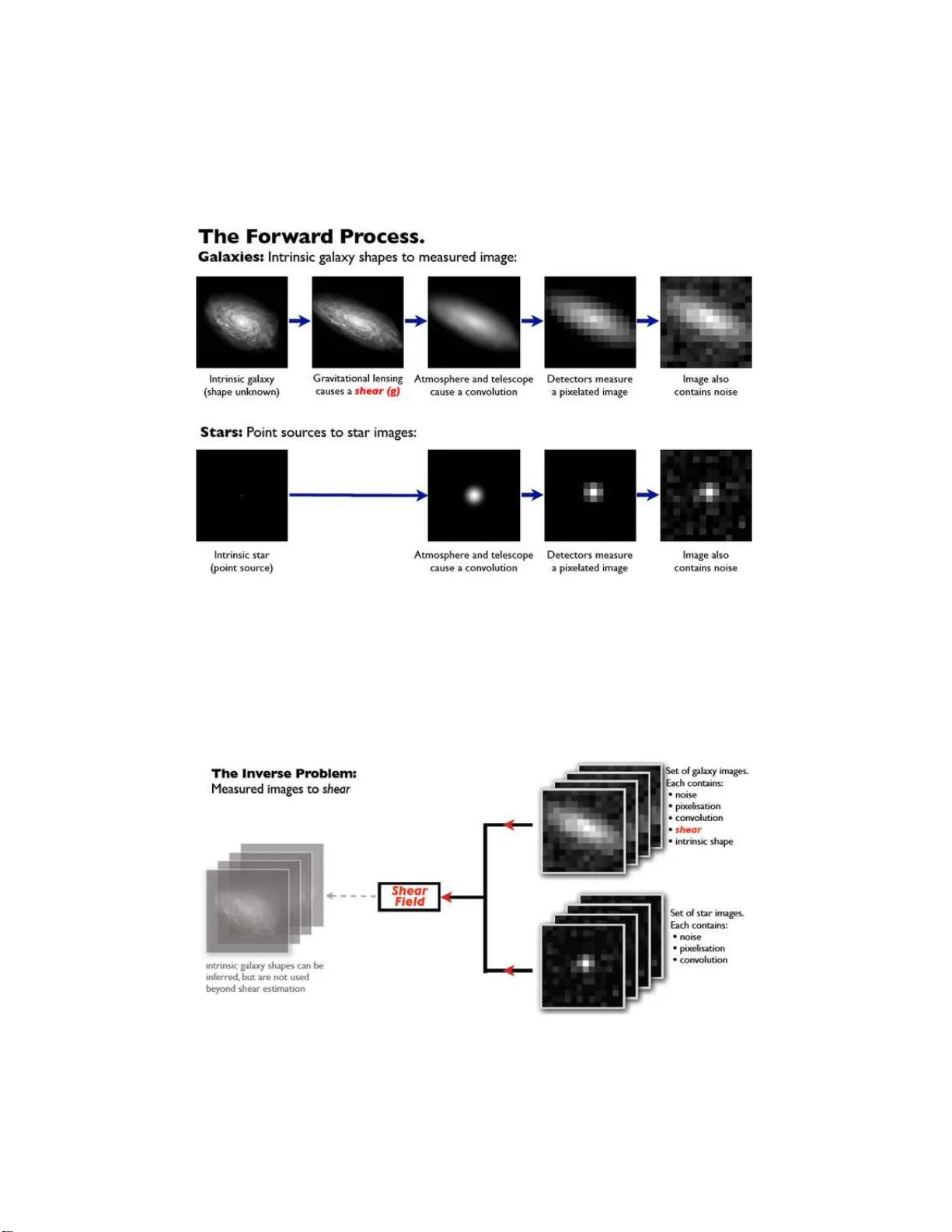
The Annals of Applie d Statistics 2009, V ol. 3, No. 1, 6–37 DOI: 10.1214 /08-A OAS222 c Institute of Mathematical Statistics , 2 009 HANDBOOK F OR THE GREA T08 CHALL ENGE: AN IMA GE ANAL YSIS COMPETITION F OR COSMOLOGICAL LENS ING By Sarah Bridle, 1,20 John Sha we-T a ylor, 1 Adam Amara, 2 Douglas Apple ga te, 3 Sreekum ar T . Balan, 1 Joel Berge, 4,5,6 Gar y Berns tein, 7 Hakon D ahle , 8 Thomas Erbe n, 9 Mandeep Gill, 10 Alan Hea vens, 11 Ca therine Heymans , 12,19, 21 F. William High, 13 Henk Hoeks tra, 14 Mike Jar vis, 7 Donnacha Kirk, 1 Thomas Kitching, 15 Jean-P a ul Kne ib, 8 K o n rad Ku ijken, 16 D a vid Laga tutt a, 17 Rachel Mandel baum, 18 Richard M assey, 5 Y annick Mellier, 19 Baback Moghaddam, 4,5 Y assir Mou dden, 6 Reiko Nakajima, 7 Stephan e P a ulin-Hen r iksson, 6 Sandrine Pires, 6 Anais Rassa t, 6 Alexandr e Refregier, 6 Jason Rhodes , 4,5,22 Tim Schrabb ack, 16 Elisabett a Semb oloni, 9 Marina Shmakov a, 3 Ludovic v an W aerbe ke, 12 Dugan W itherick, 1 Lisa Voigt 1 and D a vid Wittman 17 1 University Col le ge L ondon, 2 University of H ong Kong, 3 Stanfor d Line ar A c c eler ator Center, 4 Jet Pr opulsion L ab or atory, 5 California Institute of T e chnolo gy, 6 Commissariat a l’Ener gie Atomique, Saclay, 7 University of Pennsylvania, 8 L ab or atoir e d’A str ophysique de Marseil le, 9 University of Bonn, 10 Ohio State Uni versity, 11 R oyal Observatory, University of Edinbur gh, 12 University of British Columbia, 13 Harvar d University, 14 University of Victoria, 15 University of Oxfor d, 16 University of L eiden, 17 University of California, Davis, 18 Institute for A dvanc e d Study, Princ e ton and 19 Institut d’Astr ophysique de Paris The GRavitati onal lEnsing Accuracy T esting 2008 (GREA T08) Challenge f o cuses on a problem t hat is of cru cial importance for fu- ture observ ations in cosmology . The shap es of distant galaxies can Received Ap ril 2008 ; revised Octob er 2008. 20 Supp orted b y the Roy al So ciet y in the form of a Universit y Research F ello wship. 21 Supp orted by a Europ ean Commission Programme 6th framew ork Marie Curie Out- going I nternational F ello wship u nder Contract MOIF-CT-2006-21891. 22 Supp orted in p art by the Jet Propulsion Lab oratory , whic h is run by Caltech und er a contract from NAS A. Key wor ds and phr ases. Inference, inv erse problems, astronom y . This is an electronic reprint of the original article published by the Institute of Mathematical Statistics in The Annals of Applie d Statistics , 2009, V ol. 3, No . 1, 6– 37 . This r eprint differs from the original in pa gination and t ypo graphic detail. 1 2 S. BRI DLE ET AL. b e used to determine th e prop erties of dark energy and the n ature of gravit y , b ecause ligh t from those galaxies is b ent by gravit y from the interv ening dark matter. The observed galaxy images app ear dis- torted, although only sl igh tly , and their shapes must be precisely disentangl ed from th e effects of pixelisation, convo lution and noise. The wor ldwide gravitational lensing communit y has made significant progress in techniques to measure these distortions v ia the Shear TEsting Program (STEP). V ia STEP , we have run challenges within our o wn communit y , and come to recognise th at this particular im- age analysis problem is ideally matched to experts in statistical in- ference, inv erse problems and computational learning. Thus, in or- der to contin u e the progress seen in recent years, we are seeking an infusion of new ideas from these comm unities. This document de- tails the GREA T08 Challenge for p otential participants. Please visit www.gre at08c hallenge.info for the latest in formation. 1. In trod uction. Our Univ erse app ears to b e dominated b y dark mat- ter and dark energy [Bie llo and Caldw ell ( 200 6 ), Linder and Perlm utter ( 2007 )]. Th ese are n ot w ell describ ed or even un dersto o d by mo dern science, so stud ying their prop erties could p ro vid e the next m a j or breakthrough in physic s. This ma y ultimately lead to a d isco v ery of a new class of fu ndamen- tal particle or a theory of gra vity that sup ersedes Einstein’s theory of general relativit y . F or this reason, the p rimary science driv ers of most cosmologi cal surve ys are the study of dark matter and dark energy . F unding agencies w orld wide ha ve committed substan tial resour ces to tac kling this problem; sev eral of the planned pr o j ects will sp end tens to hundreds of millions of taxpa ye rs’ Euros on this topic. Man y cosmologists ha v e conclud ed that gra vitational lensing holds the most p romise to u nderstand the nature of dark matter and dark energy [Albrec ht et al. ( 2006 ), Pea co ck et al. ( 200 6 )]. Gra v itational lensing is the pro cess in which ligh t fr om d istan t galaxies is b ent by the gra vity of int er- v enin g mass in the Universe as it trav els to wa rds us. This b ending causes the shap es of galaxies to app ear distorted [Bartelmann and Sc hneider ( 2001 ), Wittman ( 2002 ), Refregier ( 2003b ) and Mun shi et al. ( 2006 )]. W e can relate measuremen ts of the statistical pr op erties of this distortion to th ose of th e dark matter distribution at differen t times in the history of the Univ erse. F rom the ev olution of the dark m atter distribution we can infer the main prop erties of dark energy . T o extract significan t results for cosmology , it is necessary to measure the distortion to extremely high acc uracy for millio n s of galaxies, in the presence of observ ational problems such as blur ring, pixelisation and noise and theoretical uncertain t y ab out the u ndistorted shap es of galaxies. Our tec hniques are go o d enough to analyse current data but w e need a factor of ten improv ement to capitalise on f uture surveys, whic h requires an injection of new id eas and exp ertise. W e chall enge you to solv e this pr oblem. HANDBOOK FOR THE GREA T08 CHA LLENGE 3 Section 2 explains the general problem and pr esen ts an o verview of our current metho ds. Section 3 describ es in detail the GREA T08 Challenge sim- ulations, ru les and assessment. W e conclude in Section 4 with a su mmary of the additional iss ues that arise in more r ealistic image analysis, that could b e the basis of future GREA T Ch allenges. 2. The problem. F or the v ast ma jorit y of galaxies the effect of gra vita- tional lens ing is to simply app ly a matrix distortion to the whole galaxy image x u y u = 1 − g 1 − g 2 − g 2 1 + g 1 x l y l , (2.1) where a p ositiv e “shear” g 1 stretc hes an image alo ng the x axis and com- presses along the y axis; a p ositive sh ear g 2 stretc hes an image along the diagonal y = x and compr esses along y = − x . Th e coordin ate ( x u y u ) de- notes a p oint on the original galaxy image (in the absen ce of lensing) and ( x l y l ) denotes the n ew p osition of th is p oint on the distorted (lensed) im - age. There is also an isot ropic scaling that we ig nore here. This seems a sensible p arameterisatio n to use for the sh ear b ecause it is linear in th e mass [e.g., Kaiser, Squires and Broadhurst ( 1995 )]. T h e top left tw o p anels of Figure 2 illustrate an exceptionally high qualit y galaxy image b efore and after application of a large sh ear. F or cosmic gra v itational lensing a t ypical shear d istortion is g i ∼ 0 . 03, therefore a circular galaxy would app ear to b e an ellipse w ith ma jor to minor axis ratio of 1.06 after s h earing. Note that the three-dimensional shap e of the gala xy is not imp ortan t here; w e are concerned only with the t w o-dimensional (pro jected) shap e. Since most galaxies are not circular, we cannot tell wh ether an y individu al galaxy image has b een sheared by gra vitational lensing. W e must statist ically com bine the measured shap es of man y galaxies, taking in to acco unt th e (p o orly kno wn) in trins ic galaxy shap e distribution, to extract information on dark matter and dark en er gy . Shear correlations w er e first measured in 2000 [Bacon, Refreiger and Ellis ( 2000 ), Kaiser, Wilson and Luppino ( 2000 ), Wittman et al. ( 2000 ) and v an W aerb ek e et al. ( 2000 )] and the most recen t results [Massey et al. ( 2007c ), F u et al. ( 2008 )] use millions of galaxies to measure th e clumpin ess of dark matter to around 5 p ercen t accuracy . Figure 1 sh ows a thr ee-dimensional map of th e dark m atter reconstructed by Massey et al. ( 2007b ). F u ture surveys plan to use roughly a billion galaxies to measure the dark m atter clum piness to extremely high accuracy and th u s measure the prop erties of dark energy to 1 p ercent accuracy . T h is will require a measurement accuracy on eac h of g 1 and g 2 of b etter than 0.000 3. Ho we v er this can only b e ac h iev ed if s tatistica l inference problems can b e o ve rcome. 4 S. BRI DLE ET AL. Fig. 1. Il lustr ation of the invisible dark matter distribution inferr e d using gr avi tational lensing dete cte d i n the Cosmic Evolution Survey (COSMOS) [Massey et al. ( 2007b )]. The thr e e axes of the b ox c orr esp ond to sky p osition (in right asc ension and de clination), and distanc e fr om the Earth incr e asing f r om l eft to right (as me asur e d by c osmolo gic al r e dshift). Image cr e di t: NASA, ESA and R. Massey (California Institute of T e chnolo gy). Shear measuremen t is an inv erse pr ob lem, illustr ated in Figures 2 and 3 . The forwa r d pro cess is illus trated in Figure 2 : (i) eac h galaxy image b egins as a compact sh ap e, which app ears sheared by the oper ation in equation ( 2.1 ); (ii) th e light passes th rough the atmosphere (unless the telescop e is in space) and telescop e optics, causing the image to b e con volv ed with a ke rnel; (iii) emission fr om the sky and detec tor noise ca use a roughly constant “bac k- ground” lev el to b e added to the whole image; (iv) the detecto rs sum the ligh t falling in eac h square detector elemen t (pixel) ; and (v) the image is noisy due to a com b ination of Po isson noise 23 in the n u m b er of p hotons arriving in eac h pixel, plus Gaussian noise due to detector effects. The ma- jorit y of galaxies we need to use for cosmological measurements are fain t: a t ypical uncertaint y in the total amount of galaxy light is 5 p ercen t. 23 P oisson nois e ari ses b ecause there is a finite n u mber of photons arriving at the d etector during th e fixed length of time th at the shutter is op en . The p robabilit y of receiving n photons in a pixel is therefore given by Pr( n | λ ) = λ n e − λ /n ! where λ is t h e mean num b er of p hotons observed in t hat p ixel during many exp osures of the same length of time. HANDBOOK FOR THE GREA T08 CHA LLENGE 5 Fig. 2. Il lustr ation of the f orwar d pr oblem. The upp er p anels show how the original galaxy image is she ar e d, blurr e d, pixelise d and made noisy. The l ower p anels show the e quivalent pr o c ess for (p oint-like) stars. We only have ac c ess to the right hand images. Stars are far enough a w ay f rom u s to app ear p oin t-lik e. They therefore pro v id e noisy and pixelised images of the conv olution k ernel (low er panels of Figure 2 ). The con vo lution k ernel is t yp ically of a similar s ize to the galaxies Fig. 3. Il lustr ation of the inverse pr oblem. We b e gi n on the right with a set of galaxy and star im ages. The f ul l i nverse pr oblem would b e to derive b oth the she ars and the i ntrinsic galaxy shap es. However she ar is the quant ity of inter est for c osmolo gists. 6 S. BRI DLE ET AL. w e are observing. If it were not accoun ted for, we would therefore under esti- mate the shear. The kernel can also b e up to ten times more elliptical than the ellipticit y induced by gravit ational s hear. If this is imp rop erly accoun ted for, it can masquerade as th e cosmological effect we are trying to measure. In real astronomica l observ ations, the kernel v aries across a single image con taining h und reds of stars and galaxies, and also from one image to the next. Since stars are distributed all ov er th e sky we can use nearb y stars on a giv en image to estimate the kernel for a giv en galaxy . The most s ignifi can t obstacle to shear measurement is that th e intrinsic shap e of eac h gala xy is un kno w n. E v en the p robabilit y distribution fun ction of p ossible sh ap es from which it could ha v e b een dra w n is highly uncertain; w e do not ev en hav e a go o d parameterisation for galaxy shap es. W e try to catego rise galaxies in to three typ es: spirals (e.g., Figure 2 ), ellipticals and irregulars b ut man y galaxies are somewhere b et ween the categories. One go o d assu mption that w e can make is th at unlensed galaxie s are randomly orien ted. In addition we find that the r adially a ve raged 1D galaxy ligh t intensit y profile I ( r ) is w ell fit b y I ( r ) = I o exp( − ( r /r c ) 1 /n ) [Sersic ( 1968 )], wh ere I o , r c and n are free parameters and r is the distance f rom the cen tre of the galaxy . F or elliptical galaxie s n ∼ 4 (“de V aucouleurs pr ofile”) and f or spirals n ∼ 1 (“exp on ential pr ofile”). Unfortunately we do n ot ha v e suitable galaxy images wh ic h are free of pixelisation and con v olution from whic h to learn ab out intrinsic galaxy shap es. W e can h o wev er mak e lo w noise observ ations of some small areas of sky . Metho ds dev elop ed so far b y th e lensing comm u nit y are discussed in detail in the app end ices and references therein. At the Challenge launch w e will pro v id e co de imp lemen ting some existing metho d s. Their p erformance on earlier blind chall enges is discussed in Heymans et al. ( 2006 ) and Massey et al. ( 2007a ). In all existing metho ds eac h star is analysed to p ro duce s ome information ab out the conv olution kernel. Th is is a verag ed or interp olated o ve r a n um b er of stars to reduce the noise and pr o duce inf orm ation ab out the ke rnel at the p osition of eac h galaxy . Th e gala xy image is analysed, taking in to accoun t the ke rnel, to p ro duce an estimate of the shear ( g 1 and g 2 ) at the p osition of that galaxy . Real astronomical data is simp ly an image of the con tinuous n igh t sky . The first step of an y analysis pip eline is th er efore to ident ify stars and galax- ies (distinguishin g small, fain t ga laxies from small, fain t stars in a n oisy image is a nontrivial task), cut out images around them and estimate the lo cal bac kground leve l. S in ce the conv olution kernel also usually v aries as a function of time and image p osition, the apparent sh ap es of stars m ust b e mo d elled, and the mo d el coefficients in terp olated to the p ositions of the galaxies. S implifications h a ve b een made in the GREA T08 data to eliminate these steps. HANDBOOK FOR THE GREA T08 CHA LLENGE 7 In real data the shear fields g 1 and g 2 v ary across the sky due to the clumpiness of dark matter in the Univ ers e. They also v ary with the distance of the galaxy . I t is usu ally reasonable to assu me that the sh ear is constant across the image of a sin gle galaxy . In pr actice th e shear is different for eac h galaxy but is zero w hen a verag ed ov er a large survey , that is, h g 1 i = h g 2 i = 0. It is necessary to use images of b oth stars and galaxies to extract the shear field in the pr esence of the unkno wn con vol ution k ernel. In this pro cess our priorit y is not to learn ab out the p rop erties of the un lensed galaxy images. Con ven tionally , the sh ear information from eac h galaxy image is com bined to p r o duce a statistic that can b e predicted from a cosmol ogical mo del. F or example, th e most common stati stic is the sh ear correlation function h g 1 i g 1 j i + h g 2 i g 2 j i [e.g., Bartelmann and Sc h neider ( 2001 )] where the a v erages are carried out o ver all galaxy p airs i an d j at a give n angular separation on the sky . The pr op erties of d ark matter and dark energy can then b e inferred b y calculating the probabilit y of the observ ed statistics as a function of cosmologi cal parameters. The wh ole pro cess is illustrated in Figure 4 . Note that GREA T08 fo cuses ent irely on the pro cess of going from image to shear estimate b ecause this is the curren t b ottlenec k th at is hinderin g furth er analysis of astronomical data. Ho w ever shear m easuremen t metho ds will ultimately need to fit into this larger sc heme to b e useful for cosmology . 3. The GREA T08 Challenge. In the p revious section w e describ ed the general cosmic lensin g problem. In this section we fo cus on the sp ecifics of the GREA T08 Ch allenge. W e start by describing the prop erties of the GREA T08 sim ulations. W e explain how the resu lts are assessed and the winner d etermin ed . 3.1. Simulations. The Challenge images are made by sim u lation, using the flo w chart of th e forwa r d problem (Figure 2 ). W e ha v e made a num b er of simp lifications which we aim to relax for future GREA T Challenges, as discussed in Section 5 . The sim u lations co nsist of man y small (roughly 40 b y 40 pixel) image s, eac h con taining a single ob ject. The images are clea rly lab elled as eit her stars (kernel image) or gal axies. T h e ob jects are located roughly , but not exactly , in the centre of eac h imag e. Th e images are divided in to differen t “sets,” eac h con taining thousands of images. All the images within a set ha v e ident ical v alues of the shear g 1 and g 2 and an iden tical con vo lution k ernel. A ve ry large constant is added to all pixels in a set and P oisson noise is add ed to eac h pixel. F or GREA T08 RealNoise- Kno w n and GREA T08 RealNoi se-Blind (see b elo w) the constan t is so large that the noise is v ery close to b eing Gaussian with the same v ariance for ev ery p ixel in the image. Y ou ma y use all these facts in yo ur analysis. The star images in eac h set p r o vide information on the conv olution k er- nel. T o s implify the Challenge we also provide th e equations used to mak e 8 S. BRI DLE ET AL. Fig. 4. Flowchart indic ating the extent of a ful l c onventional c osmic gr avitational lensing data analysis pip eli ne, fr om me asuring the c onvolution kernel using the shap es of stars, to me asur ements of c osmolo gy. The GREA T08 Chal lenge fo cuses exclusively on the steps en- close d in the b ox made by the dashe d black line. The final winners wil l b e determine d b ase d solely on estimates of she ar. Simulation cr e dit: An dr ey Kr avtsov (University of Chic ago). these k ernel images. T herefore y ou ha v e the c h oice of w h ether to use the exact equations or the star images pro vided. In eac h star image the star has a differen t cen tre p osition and different random noise realisation. The noise lev el and n umber of star images should b e sufficien t to r econstruct the con vol ution kernel to a pr ecision w h ere uncertain ties in the con volutio n k ern el are smaller than the small uncertain ty due to the finite n u m b er of galaxies. Y our c hallenge is to derive an estimate of the shear applied to the galaxy images w ithin eac h set. HANDBOOK FOR THE GREA T08 CHA LLENGE 9 This Ch allenge is difficult b ecause of the follo win g realistic features: (i) the extremely h igh accuracy r equired on th e final answer; (ii) a mo del for the galaxies is not provided, and the galaxy shap e and p osition are d ifferen t from image to image (d ra wn f rom some un derlying mo d el wh ic h is not disclosed); (iii) there is con vol ution and noise; (iv) images are p ixelised. The GREA T08 galaxy image simulatio n t yp es are s u mmarized in T a- ble 1 . T o make th e Challenge more approac hable there are a few sets of lo w n oise sim u lations (“GREA T08 Lo w Noise-Kno wn” and “GREA T08 Lo w- Noise-Blind”). T he true shear v alues are provided for a subset of these (“GREA T08 Lo wNoise-Known”) and there is a blind comp etition for the remainder (“GREA T08 Lo wNoise-Blind”). T h e main challe nge (“GREA T 08 RealNoise- Blind”) h as a realistic, m uc h higher, noise lev el. Th ere are also some sets with a realistic noise for which the tr u e sh ears are provided (“GREA T08 RealNo ise-Kno wn”). It is not possib le to determine the true shear of a galaxy , ev en with an infi nite amount of data. Th erefore a metho d that requires a p erfect training set will not b e usefu l in p ractice. Ho wev er w e will b e able to mak e sim u lations of the sky using imp erfect galaxy mo d els. T o sim ulate this future situatio n , w e use a sligh tly differen t m o del f or the galaxies in the “Kn own” sets than in the “Blind” sets. This means that al- though metho ds that require a training set can b e used (see ru le 4), they ma y b e at a small r elativ ely realistic disadv an tage, d ep endin g on the sensitivit y of the metho d to the galaxy prop erties. 3.2. R e sults. Eac h submission consists of a shear estimate ( g 1 and g 2 ) for eac h set of images, with asso ciated 68 p ercen t error bars . A qualit y factor is calculate d for eac h sub mission using the differences b et ween the sub mitted and true sh ear v alues. The goal of the C hallenge is to su ccessfully reco ver the true inp ut shear v alues used in the simulatio n, g t 1 j , g t 2 j , for eac h set of images, j . Y ou ma y use whatev er metho d yo u like to com b ine the sh ear inform ation from eac h galaxy within a set to estimate the shear applied to the whole s et. T he submitted shear v alues, g m 1 j , g m 2 j , will d iffer from the tru e v alues due to the n oise on the images and due to any biases induced by the m easuremen t metho d. A go o d metho d wo u ld b oth filter the noise effectiv ely and hav e small or nonexisten t T able 1 Summary of the thr e e GREA T08 simul ation suites T rue shears provided Blind compe tition Lo w noise GREA T08 LowNoise-Kno wn GREA T08 LowNoise-Blind Realistic n oise GREA T08 R ealNoise-Kno wn GREA T08 R ealNoise-Blind 10 S. BRI DLE ET AL. biases. W e defi ne the qualit y factor in terms of the mean squared error Q = 10 − 4 h ( h g m ij − g t ij i j ∈ k ) 2 i ik , (3.1) where the inner angle b rac ket s denote an a verag e o v er sets w ith similar sh ear v alue and observing conditions j ∈ k . Th e outer angle b r ac ke ts denote an a ve rage o v er sim u lations with d ifferen t true s h ears and observing conditions k and shear comp onen ts i [see Kitc h ing et al. ( 2008 )]. This delib erately designed to reward metho ds that ha ve small b iases. Th is is imp ortan t b ecause in cosmology we av erage ov er a ve ry large num b er of galaxies and an y remaining bias will bias cosmolog ical parameters. This definition will also p enalise m etho ds that hav e small biases at the exp ens e of b eing extremely noisy . This quan tit y do es not include the er r or bars y ou submit. W e are not in- terested in a metho d whic h has large b ut accurate error bars sin ce it will not pro du ce tigh t cosmologi cal constrain ts. F ur thermore the Challenge images co v er only a small (bu t realistic) range of observing cond itions, therefore it is unlik ely that an ultimately usefu l metho d would lose the comp etition b ecause of p o or p erformance in a particular corn er of observing condition parameter space w h ere y our metho d has p articularly large err or bars. It has b een sho wn that a systematic v ariance h ( h g m ij − g t ij i j ∈ k ) 2 i ik < 10 − 7 will b e needed to fully utilise future co smic lensing data sets [Amara and Refregier ( 2007 )], co rresp on d ing to Q = 100 0 [see also Huterer et al. ( 2006 ), V an W aerb ek e et al. ( 2006 )]. Th e num b er of galaxy images includ ed in GREA T08 Lo wNoise-Blind and in GREA T08 RealNoi se-Blind are suffi cien t to test Q to this v alue. If a sin gle constan t v alue of zero shear w er e sub- mitted ( g m 1 j = g m 2 j = 0 f or all j ) then since q h g t 2 ij i ij ∼ 0 . 03 it follo ws that Q ∼ 0 . 1. T he existing metho ds that h a ve b een used to analyse astronomical data ha v e Q ∼ 10, whic h w as sufficien t for those su rv eys. The GREA T08 Challenge Winner is the entry with the highest Q v alue on GREA T08 RealNoise-Blind. These will b e pub licly a v ailable on a leader b oard, as mo c k ed-up in T able 2 . Results using sev eral existing metho d s app ear on the leader b oard at the start of the Ch allenge, to show the cur ren t state-of-t he art. The main diagnostic ind icator in the leader b oard is the qualit y fact or Q , w hic h determines the ranking of the submissions. As discu s sed ab o v e, the qualit y factor d o es not take in to accoun t the subm itted u ncertain ty estimates on the shears, w hereas an ideal metho d would ca lculate these reliably . W e m ake an in ternal estimate of the uncertain ties and compare with your su bmission to pro du ce an error flag. I f the uncertain ty estimates are on a verag e wrong to more than a factor of tw o then this is fl agged in the leader b oard. Th ere are no consequences of the error flag in determinin g HANDBOOK FOR THE GREA T08 CHA LLENGE 11 T able 2 A mo ck le ader b o ar d, showing a p otential r ange of r esults. Submissions by memb ers of the GREA T08 T e am ar e marke d wi th an ast erisk. Ther e ar e two le ader b o ar ds: one for GREA T08 Lo wNoise-Blind and one for GREA T08 R e alNoi se-Blind Error Number of Date of last Name Metho d Q flag submissions submission A. Einstein BestLets 1001 – 15 25 Dec 2008 T eam Bloggs Joe1 582 W arning 2 2 Nov 2008 Dr. S ocrates ArcheoShapes 116 W arning 212 23 Sept 2008 W. Lenser* KSB+ + + 99 – 12 10 Aug 2008 A. Monkey Guess A gain 1 . 2 W arning 5 30 Nov 2008 the winner. Th e winner ma y ha ve an err or flag warning and will still win , based on th eir Q v alue. The data for w hic h tru e shears are p ro vided (GREA T08 LowNoi se-Kno wn and GREA T08 RealNoise -Kno wn ) are release d publically in July 200 8. The c hallenge data (GREA T08 Lo wNoise-Blind and GREA T 08 RealNoise- Blind) are released in fall 2008 and the deadline will b e 6 m on ths after the r elease of th e c hallenge data. Please see www.great08c hallenge.info for the latest information and discussions in the GREA T08 sect ion of CosmoCoffee at www.cosmo coffee.info . The Ch allenge deadline is to b e follo we d by a more detailed rep ort making use of the inte rnal stru cture of the sim ulations to iden tify whic h observ ational conditions fa v our whic h metho d. W e hop e this will lead to a pub licatio n and workshop. 4. Conclusions. The field of cosmic gra vitational lensing has recen tly seen great successes in measuring th e distrib ution of dark matter. Indeed, h u ndreds of millions of Eu ros will soon b e sp en t on exciting new su rv eys to determine the nature of the tw o fu ndamenta l (y et quite mysterious) materi- als that are the most common in our Unive rse. Uniqu ely among cosmological tests, measuremen ts of cosmic lensing are not currently limited by compli- cated astroph ysical pro cesses o ccurring half-w ay across the Univ erse, bu t b y impr o ve d tec h niques for statistic al image analysis righ t here on Earth. Cosmologists ha v e hosted several shear measuremen t comp etitions amongst themselv es, and dev elop ed sev eral metho d s that ac hieve an accuracy of a few p ercent . Ho we v er, reac hing the accuracy required b y futur e sur v eys needs a fresh approac h to the problem. The GREA T08 Challenge is designed to seek out y our exp ertise. Asid e from the academic interest in solving a c hallenging statistica l p roblem, successful method s are absolutely essent ial for further adv ances in cosmologica l inv estigations of dark matter and dark energy . GREA T08 marks th e fir st time that the c hallenge of h igh p recision galaxy shap e measurements has b een set outside the gra vitational lensin g commu- nit y , and as suc h marks a first step in a global effort to dev elop the next 12 S. BRI DLE ET AL. generation of cosmological to ols u sing exp ertise, exp erience and tec h niques coming from a b road disciplinary base. Th e fi eld of gra vitational lensing is exp ected to gro w at an increasing rate ov er the coming decade but an inj ec- tion of n ew ideas is vital if w e are to take full adv an tage of the p oten tial of lensing to b e th e most p o werful cosmologi cal p rob e. The GREA T Ch allenges can therefore b e seen as a compreh en siv e series wher e th e goal of eac h step is b oth to b ring new insigh t and to tac kle more complicated p roblems than the pr evious s tep. 5. GREA T08 simplifications and future challe nges. The GREA T08 Ch al- lenge outlined in this do cument is a d iffi cu lt challenge despite the s implifying assumptions wh ic h includ e: • Constan t Shear: Within eac h set of images the sh ear is constant whereas in real data shear is a sp atially v arying quantit y from which correlation statistics are u s ed to measure pr op erties of the Universe. • Constan t Kern el: Within eac h set the con volutio n k ern el is constant whereas in real data this is a spatially and time v arying quantit y that also needs to b e measur ed and inte rp olated b et ween galaxy p ositions. • Simple Kernel: The con v olution k er n els used in this Ch allenge are simple relativ e to those of real telescop es. • Simple Galaxy Shap e: The ga laxies used in this Ch allenge are simple relativ e to real data. • Simple Noise Mod el: T he noise is Po iss on. In practice there wo uld b e un- usable bad p ixels whic h ma y b e flagged and the noise wo u ld b e a com bina- tion of Gaussian and Poisso n, with the Gaussian contribution p oten tially v aryin g across the image. • Image C on s truction: I n GREA T08 there is only one ob ject in eac h sm all image and eac h is lab elled according to w hether it is a star or a galaxy . Th e selection of galaxies in a r eal image must not d ep end on the applied shear otherwise this in tro duces an additional bias: if v er y elliptical galaxies are preferent ially do wn w eighte d th en galaxies that h app en to b e aligned with the shear will tend to b e lost w hic h will bias the measured shear lo w . In addition, in real d ata some ga laxies o v erlap and are b est discarded from conv entional analyses. F urthermore, co n ven tional analyses rely on accurate lab elling of stars and galaxies. In GREA T09 we an ticipate that man y of these assumptions w ould b e relaxed therefore metho ds whic h p erform w ell in GREA T 08 by ov erly capi- talising on the simplifications may not p erform w ell in GREA T09. Bey ond GREA T09 there are a m u ltitude of further issues that ha ve a significan t effect on accurate shap e measuremen t. Cosmic rays an d satellite trac ks con taminate the image [see Stork ey et al. ( 2004 )]; detecto r pixels v ary in resp onsivit y and th e resp onsivity is n ot linear with th e num b er of HANDBOOK FOR THE GREA T08 CHA LLENGE 13 photons (Charge T r ansfer Efficiency); the detector elemen ts are not p erfectly square and /or are n ot p erf ectly aligned in the telescope so that the sky co ordinates do not p er f ectly map to pixel co ordinates, and they bleed (Inter Pixel Resp onsivit y); there are m ultiple exp osures of eac h patc h of sky , eac h with a different k ern el. The ultimate test and v erification of a metho d will b e in its ap p lication to data. T he goal of the GREA T Challenges is to encourage the deve lopmen t of metho ds which will one da y b e used in conjun ction with s tate-o f-the-art data in order to answ er some of our most profoun d and fu ndamenta l questions ab out the Un iv erse. APPENDIX A: RULES 1. P articipants ma y use a p seudonym or team n ame on the results leader b oard, how ev er real names (a s used in publications) must b e p ro vided where requested during the result submission pro cess. 2. P articipants who ha ve inv estigated several algorithms ma y ente r once p er metho d. Ch anges in alg orithm p arameters do not constitute a different metho d. 3. Re-submissions for a giv en metho d may b e sent a maxim u m of once p er w eek du r ing the 6 mon th comp etition. 4. Since reali stic future obs er v ations w ou ld include some lo w noise imag- ing, p articipan ts are welco me to use the GREA T08 Lo w-noise images to inform their GREA T08 Ma in an alysis. W e will neve r h a ve obs er v ations for whic h the true shear is kno w n , but we will b e able to mak e our o w n attempts to sim u late the sky , wh ic h could b e used to train shear esti- mation metho ds. T herefore GREA T08 Lo wNoise-Kno wn and GREA T08 RealNoise- Kno w n ha ve slight ly differen t gala xy prop erties th an GREA T08 Lo wNoise-Blind and GREA T08 RealNoise-Blind. GREA T08 Lo wNoise- Kno w n and GREA T08 RealNoise-Kno wn ma y b e used to train the r esults of GREA T08 Lo wNoise-Blind and GREA T08 RealNoise-Blind. 5. P articipants must p ro vide a rep ort detailing the metho d used, at the Challenge d eadline. W e w ould prefer that th e cod e is made public. 6. W e exp ect all participants to allo w their resu lts to b e included in the fin al Challenge Rep ort. W e will how ever b e flexible in cases where metho d s p erformed badly compared to the cur r en t metho d s if participan ts are strongly against publicising them. W e will release th e true shears after the deadline and you are encouraged to write researc h articles using the Challenge simulations. Some additional comp etition rules apply to mem b ers of the GREA T08 T eam who subm it en tries: 14 S. BRI DLE ET AL. 7. F or the pur p ose of these r ules, “GREA T 08 T eam” includ es an yone who receiv es STEP and/or GREA T08 T eam emails, and/or has the STEP passw ord. The authors of this do cument all receiv e GREA T08 T eam emails. 8. Only information a v ailable to non-GREA T08 participan ts ma y b e used in carrying ou t the an alysis, for example, no inside information ab out the setup of th e sim ulations ma y b e used. Note th at the true blind sh ear v alues will only b e a v ailable to only a small subset of th e GREA T08 T eam. APPENDIX B: OVER VIEW OF EXISTING METHODS A v ariet y of sh ear measur emen t metho ds h a ve b een dev elop ed by the cos- mic lensing comm unity . Their goal is alw ays to obtain an u n biased estimate ˜ g of the s hear, s u c h that the mean o ver a large popu lation of ga laxies is equal to the tru e sh ear h ˜ g i = g . How ev er, they adopt d ifferen t app roac hes to correct th e nuisance factors in Figure 4 (con v olution, pixelisation and n oise). Most of the methods ha ve b een d escrib ed, and tested on simulated im- ages, durin g the S hear TEsting Programme (STEP) [Heymans et al. ( 2006 ), Massey et al. ( 2007a )] and earlier [Bacon et al. ( 2001 ), Erb en et al. ( 2001 ), Ho ekstra et al. ( 2002 )]. T o summarise the current lev el of kn o wledge, b u t try- ing n ot to restrict the d evelo pmen t of new ideas, we pr esen t here an o ve rview of an idealised m etho d. In App endices C – G , we then p r o vide a more detailed in tro duction to sev eral metho ds that h a ve b een used on r eal astronomical data, with links to researc h pap ers. A t the launc h of the GREA T08 Chal- lenge, code for these metho ds will b e made a v ailable and the corresp onding results will b e en tered on the GREA T08 leader b oard. P otent ial p articipan ts ma y b e in terested in app lyin g metho d s that require a set of trainin g d ata which matc hes the Challenge data. W e do not pro- vide su c h a s et b ecause th is w ill not b e a v ailable f or realistic observ ations. It w ould in principle b e p ossible to s imulate data with similar prop er ties to the observ ed data, bu t this will not matc h exactly b ecause of our lac k of kn o wl- edge of the detailed shap es of distan t gala xies. W e do not kno w whether or not this presents a f undamenta l limitation for this t yp e of metho d. The (public) STEP1 and STEP2 sim u lations ha v e a similar noise lev el to the GREA T08 images and the true shear is giv en. Y ou are allo wed to use these to train yo ur metho ds if y ou wish. The galaxy pr op erties are n ot the same as those in GREA T08 so this is a reasonable ap p ro ximation to the realistic situation. Ho w ev er the ob jects are n ot isolated on p ostage stamps as for GREA T08. HANDBOOK FOR THE GREA T08 CHA LLENGE 15 B.1. Ellipticit y measuremen t. W e first describ e a simple s hear m easur e- men t method that would w ork in the absence of pixelisation, con volution and n oise. Th e cen tre of the image bright ness I ( x, y ) can b e defin ed via its first moments ¯ x = R I ( x, y ) x dx dy R I ( x, y ) dx dy , (B.1) ¯ y = R I ( x, y ) y dx dy R I ( x, y ) dx dy , (B.2) and we can then measure the q u adrup ole m omen ts Q xx = R I ( x, y )( x − ¯ x ) 2 dx dy R I ( x, y ) dx dy , (B.3) Q xy = R I ( x, y )( x − ¯ x )( y − ¯ y ) dx dy R I ( x, y ) dx dy , (B.4) Q y y = R I ( x, y )( y − ¯ y ) 2 dx dy R I ( x, y ) dx dy . (B.5) Gra vitational lensing m aps the u nlensed image, sp ecified by coord inates ( x u , y u ), to the lensed image ( x l , y l ) u sing a matrix transform ation x u y u = A x l y l , (B.6) where A = 1 − g 1 − g 2 − g 2 1 + g 1 . (B.7) Throughout GREA T 08, the comp onen ts of shear g 1 and g 2 are constan t across the image of a galaxy; this is u sually a goo d approximat ion in r eal images to o. Und er this coordin ate transformation, it can b e sh o wn that quadrup ole momen t tensor Q transforms as Q u = AQ l A T , (B.8) where Q u is the quadrup ole moment tensor before lensin g and Q l is that after lensing. The o veral l elli pticit y of a galaxy image can b e quantified b y the useful com bination of m oments [Bonnet and Mellier ( 1995 )] ǫ ≡ ǫ 1 + iǫ 2 = Q xx − Q y y + 2 i Q xy Q xx + Q y y + 2( Q xx Q y y − Q 2 xy ) 1 / 2 , (B.9) where w e in tro duce the complex n otation ǫ = ǫ 1 + iǫ 2 and g = g 1 + ig 2 where i 2 = − 1. F or a simple galaxy th at has concen tric, ell iptical isoph otes (con- tours of constan t brigh tness) with ma jor axis a and minor axis b , and angle 16 S. BRI DLE ET AL. θ b et w een the p ositiv e x axis and the ma jor axis, ǫ 1 = a − b a + b cos(2 θ ) , (B.10) ǫ 2 = a − b a + b sin(2 θ ) . (B.11) The quantit y ǫ transf orms under shear as ǫ l = ǫ u + g 1 + g ∗ ǫ u (B.12) for | g | < 1, wh ere the asterisk den otes complex conjugation [Seitz and Sc hnei- der ( 1997 )]. This can b e T a ylor expanded to fi rst ord er in g , for eac h of the t wo comp onents i ∈ 1 , 2. T o obtain measur emen ts of g , we next assume that there is no preferred orien tation for the shap es of galaxies in the absence of lensin g. In th is case, when av eraged ov er a large p opulation of galaxies, h ǫ u 1 i = h ǫ u 2 i = 0, h ǫ u2 1 i = h ǫ u2 2 i and h ǫ u 1 ǫ u 2 i = 0. Th er efore, on T a ylor expand ing ( B.10 ) to first order in g , w e see that ǫ l i is roughly a v ery noisy esti mate of g i since q h ǫ u2 i i ∼ 0 . 15, wh ic h is an order of magnitude larger than the t ypical v alue of g i . On applying the sym metries for a large p opulation we find h ǫ l i ≃ g. (B.13) The need to sample a p opu lation of galaxies also explains the use of complex notation for b oth ǫ and g : the t w o comp onent s of ǫ av erage cleanly to zero in th e absence of cosmic lensing, unlik e a notation in vol ving magnitude and angle. See Figure 5 for a graph ical representa tion of these parameters. More commonly considered is the com b ination of q u adrup ole m omen ts χ = Q xx − Q y y + 2 i Q xy Q xx + Q y y (B.14) (sometimes kn o wn as “p olarisation”), where we define comp onents χ = χ 1 + iχ 2 as b efore. This com bination is more stable than ǫ in th e presence of noise. A pu r ely elliptic al shap e has χ 1 = a 2 − b 2 a 2 + b 2 cos(2 θ ) , (B.15) χ 2 = a 2 − b 2 a 2 + b 2 sin(2 θ ) . (B.16) In general, χ transform s under shear as χ l = χ u + 2 g + g 2 χ u ∗ 1 + | g | 2 + 2 ℜ ( g χ u ∗ ) , (B.1 7) HANDBOOK FOR THE GREA T08 CHA LLENGE 17 Fig. 5. The p ar ameterisation of gener ali se d el li ptici ty as two quantities e 1 and e 2 , show- ing the shap e of i sophotes of an el liptic al galaxy. F or example, a galaxy ali gne d with the y axis ( θ = 90 de gr e es) has e 1 < 0 and e 2 = 0 . If this figur e had shown individual el li pticity estimates li ke ǫ or χ , the orientat ions would b e the same, but the elongations woul d vary. where ℜ denotes that the real part should be take n [S c hn eider and S eitz ( 1995 )]. On T a ylor expanding to fir st order in g and a v eraging ov er a p op- ulation for whic h h χ u 1 i = h χ u 2 i = 0, h χ u2 1 i = h χ u2 2 i and h χ u 1 χ u 2 i = 0 w e obtain h χ l i ≃ 2(1 − h χ u2 1 i ) g . (B.18) Therefore if th e v ariance of the un lensed ellipticities h χ u2 1 i of th e p opulation is kn o wn then th e sh ear can b e appr o ximately determined. F or GREA T08 it ma y b e p ossible to infer these ellipticit y pr op erties from the lo w noise sample since h χ u2 i i ≃ h χ l2 i i . F or more information, see Section 4 of Bartelmann and Sc h neider ( 2001 ) or Bernstein and Jarvis ( 2002 ). These are just tw o examples of generalised ellipticit y estimates for a galaxy shap e. All existing methods s tart in similar fashion, by construct- ing a mapp ing from the 2D image I ( x, y ) to a qu antit y with the rotational symmetries of an ellipse, such as ǫ or χ . F or some metho ds, the mapping migh t in v olve a com b ination of quad r up ole momen ts. T o redu ce con tami- nation from neigh b ourin g galaxies, an d to limit th e impact of n oise in th e wings of a gal axy , a w eight fu nction W ( x, y ) with fin ite sup p ort is normally included in equations ( B.3 ), ( B.4 ) and ( B.5 ). Other metho ds migh t inv olv e the fi tting of a parametric (e.g., elliptical Gaussian, or exp onen tial) mo d el to th e image , in which case the ma jor and min or axes a and b are return ed, along w ith the angle θ . V arious b asis functions h a ve b een tried for this mo d- elling, includin g sh ap elets (App endix D ), sums of co-elliptical Gaussians (see App end ices E and G ) de V aucouleurs profiles (App endix F ). Eac h supp ort 18 S. BRI DLE ET AL. a differen t range of p oten tial galaxy s h ap es, and h a ve h ad v arying success on galaxies of differen t morphological t yp e. B.2. Shear resp onsivit y . Con v erting a general ellipticit y measurement e in to a shear estimate ˜ g also requires kno w ledge of ho w that ellipticit y is affected by a shear. All existing sh ear measurement metho ds in volv e some form of ellipticit y estimate and corresp onding shear resp onsivit y P sh ij = ∂ e i ∂ g j (B.19) (sometimes called the shear p olarisabilit y or susceptibilit y) so that e l i = e u i + P sh ij g j + O ( g 2 ) , (B.20) where j is su m med o v er. In general, P sh ij is a unique 2 × 2 tensor for eac h galaxy . The diago n al elemen ts reflect ho w m u ch a shear in one dir ection alters the ellipticit y in the same dir ection, and the t w o diagonal elemen ts tend to b e s im ilar. Th e off-diagonal elemen ts reflect the degree to w hic h a shear in one direction alters the ellipticit y in the other, and tend to b e small. F or the presen t purp oses, it is therefore r easonable to thin k of the shear resp onsivity for eac h ellipticit y estimate as a scalar quan tit y P sh times the iden tity matrix. Exp ressions for P sh for th ree simple ellipticit y m easures are sho w n in T able 3 . In general, shear r esp onsivit y dep ends on the ellipticit y and cuspiness of an individ u al ga laxy image and can ev en dep end on the shear. F or examp le, the axis ratio of a circle initially c hanges significan tly under a s m all shear op er ation; but as th e same shear is rep eatedly reapplied, the ob ject can tend to ward a straigh t line bu t then its ellipticit y can nev er increase fu rther since | e | < 1. A shear estimate can then b e form ed via ˜ g i ≡ e i P sh . (B.21) If w e had access to the n oise-free, u nlensed galaxy imag e then we could calculate P sh for eac h galaxy . Ho wev er the lensing signal do es not c hange T able 3 Some c omm on el l ipticity estimates and their c orr esp onding she ar r esp onsivi ti es, c alculate d to first or der in g Ellipticity estimate Shear resp onsivity ǫ = ( a − b a + b )(cos(2 θ ) + i sin(2 θ )) 1 χ = ( a 2 − b 2 a 2 + b 2 )(cos(2 θ ) + i sin(2 θ )) 2(1 − h χ u2 1 i ) R I ( x,y )( x 2 − y 2 +2 ixy ) W ( x,y ) dx dy R I ( x,y )( x 2 + y 2 ) W ( x,y ) dx dy Eqn. (5-2) in K aiser, Sq uires and Broadhurst ( 1995 ) HANDBOOK FOR THE GREA T08 CHA LLENGE 19 o ve r time, and the stron gest cosmic lensing signal is carried b y the most distan t—and therefore the faint est—galaxie s . Measuremen ts of P sh from the observ ed image are consequen tly v ery noisy . S in ce P sh is on the den om- inator of equation ( B.21 ), err ors in th is quan tit y can con tribute to p otent ial biases and large wings in the glo b al distribution of ˜ g . Ge tting it wrong in existing metho d s has t yp ically led to a bias in shear measuremen t that is prop ortional to th e shear (“multiplica tive bias”). T o reduce the noise and con trol bias, P sh is often a ve raged o ve r or fitted from a large p opulation of galaxies. It is t ypically fitted as a function of galaxy size and bright ness (the d istribution of true galaxy sh ap es is kno wn to v ary as a function of these observ ables). Ho wev er, the fitting fun ction must b e c hosen carefully: shear resp onsivit y often v aries rapidly as a fu nction of galaxy brigh tness, and existing metho ds ha v e b een f ou n d to b e unstable w ith r esp ect to the metho d used for this fitting. Sometimes P sh is also fitted as a fu nction of ellipticit y . This drastically o v erestimates the cosmological sh ear signal in in- trinsically elliptical galaxies, but this should a v erage out ov er a p opulation. The goal is mer ely to create a sh ear estimat e that is u n biased for a large p opulation. Shear r esp onsivit y thus repr esents the in trinsic morphology of an indi- vidual galaxy , or the morph ology distribu tion for a p opulation of galaxies. Although in f erring the intrinsic s hap e d istr ibution is not a goal in itself (see Figures 2 and 3 ), some asp ect of it alwa ys n eeds to b e measured . As dis- cussed in App endix F , it arises in a Ba y esian context as a prior on probability distribution for eac h shear estimate. B.3. Correcting for a con volutio n ke rnel. An image is inevitably blur red b y a con v olution kernel (generally known in astronom y literature as the Poin t Spread F unction or PSF) in tro du ced by the camera optics and atmospheric turbulence. The ke rnel is u sually fairly compact, and t wo examples are give n in Figure 6 . The t ypical size is usually quan tified by the F ull Width Half Maxim um (FWHM), which is the diameter where the ligh t falls to half of the p eak. Typica lly the FWHM is tw o or three p ixels across, and of a similar size to th e gal axies of in terest. F or a Gaussian k ernel the Gaussian standard deviation is simp ly related to the FWHM via FWHM = 2 p 2 ln (2) σ . One approac h to correct for the kernel, whic h is particularly useful for momen t-based ellipticities, is to su b tract the effects of the con vo lution k er- nel fr om b oth the ellipticit y and the shear resp onsivit y [e.g., equations ( C.5 ) and ( C.6 )]. A second ap p roac h to correct for the con v olution k ern el, partic- ularly appropriate for fi tting metho d s, has b een a full decon volutio n of the image. One f airly stable wa y to do this has b een the forw ard conv olution of a predefin ed set of b asis fu nctions w ith a model of the co n volutio n k ernel, follo w ed b y th e fitting of these basis functions to th e data. A deco n volv ed v ersion of the image can then b e reconstru cted by using the d eriv ed mo del 20 S. BRI DLE ET AL. Fig. 6. Detail of two r e ali stic c onvolution kernels. The isophotal c ontours ar e lo garith- mic al ly sp ac e d. co efficien ts with the (uncon v olv ed) basis functions. This mo del can then b e u sed to measure an ellipticit y and shear resp onsivit y . Getting this step wrong in existing metho ds can lea v e residual effects of (or ov ercorr ects f or) an y anisotrop y of the conv olution k ernel in the ellipticit y estimate. This t ypically introd uces a bias in shear measuremen t that is ind ep endent of the true shear (“additiv e bias”). B.4. Correcting for pixelisation. Astronomical detectors for optical ligh t coun t the total num b er of ph otons arriving in a r egion that we call a pixel. T o a go o d app ro ximation th ese pixels are on a squ are grid and do not ov erlap or ha ve gaps b et ween them. F or metho ds that fi t a mo del to eac h galaxy shap e, including a forw ard con vo lution with the con v olution kernel, pixelisation can in principle b e incorp orated easily . T his is b ecause in tegration within a square p ixel is mathematically iden tical to con v olution with a square top hat, follo w ed by resampling at the cen tres of p ixels. Since the observed images of stars ha ve also b een pixelised, they are already a rendering of the con volution k ern el con v olve d with the squ are of the pixel. Decon volving this naturally tak es care of th e pixelisation at the same time. In practice, mo dels f or the k ern el are relativ ely s m o oth and ma y n ot captur e the con vol ution with the square we ll. HANDBOOK FOR THE GREA T08 CHA LLENGE 21 No metho ds based on quadru p ole moments, with correction for the con- v olution kernel via subtraction of those momen ts, h av e y et included a prop er treatmen t of p ixelisation. F urthermore, f or b oth t yp es of metho d, an unex- plained difference h as b een observed [Massey et al. ( 2007d )]. Th is is particu- larly imp ortan t to the cosmic lensing communit y b ecause the d esign of some future telesco p es currentl y feature only about 2 p ixels across the FWHM of the con v olution ke r nel. B.5. Av eraging to remov e noise. There are t w o contributions to the noise on a shear estimate ˜ g for a single galaxy . The first comes from the noise on the image, wh ic h is P oisson for GREA T08. The second comes from the fact that un lensed galaxies are not circular and thus it is not p ossible to tell for a single gal axy whether it is in trins ically elliptical or whether it is in trin sically circular and lensed b y a strong sh ear. Th is can b e b eaten do wn b y a veragi ng the ellipticities of man y galaxies. If the galaxies are in a similar lo cation (or within the same set of GREA T08 images), the constant sh ear signal they con tain will b e all that r emains. Unfortunately , almost all exist- ing shear measurement metho ds supply only a single (maxim um like liho o d) shear estimate for eac h gala xy , p ossibly with a single error bar (although see App end ices E an d F ). Th e PDF is not exactly a Gaussian, therefore a simple av erage is n ot the correct app r oac h. APPENDIX C: E XISTING METHOD 1: WEIGHTED QUADR UPOLE MOMENTS (KSB +) Currently , the most widely u sed and ol dest metho d for cosmic lensing analysis comes from the w ork of Kaiser, Squires and Broadh ur st ( 1995 ), Luppin o and Kaiser ( 1997 ) and Ho ekstra et al. ( 199 8 ), hereafter referred to as KSB+ . Th e version of KSB+ made av ailable for the GREA T08 c h allenge is the “CH” K S B p ip eline do cumente d in the ST EP c h allenge [Heymans et al. ( 2006 ) and Heymans et al. ( 2005 )]. Th e original KSB imcat softw are dev elop ed by Nic k Kaiser is also a v ailable on request. KSB+ parameterises galaxies and stars according to their weig h ted qu adru- p ole moments Q w ij = R I ( x, y ) x i x j W ( x, y ) dx dy R I ( x, y ) W ( x, y ) dx dy , (C.1) where W is a Gauss ian we ight fu nction of scale length r g , wh ere r g is some measure of galaxy size suc h as the half-ligh t r adius and x 1 = x − ¯ x , x 2 = y − ¯ y . An ellipticit y ε is formed from these w eight ed moments u sing equation ( B.14 ). T h e follo wing KSB+ m etho d details how to co rrect for the con vo lution k ernel and get an unbiase d estimate of the shear γ . The main limiti ng simplification in KS B+ is to assume that the con vo - lution k ernel can be describ ed as a small b u t h ighly anisotropic d istortion 22 S. BRI DLE ET AL. con vo lv ed with a large circularly symmetric fu nction. In most instances, th is is not a go o d appro ximation to mak e, but the K SB+ metho d has prov ed to b e remark ab ly accurate in practic e. With this assumption, the “corrected ellipticit y ” of a gal axy (which it would ha v e in p erfect observ ations) ε cor , is giv en by ε cor α = ε obs α − P sm αβ p β , (C.2) where p is a ve ctor that measures the k ernel anisotrop y , an d P sm is the smear resp onsivity tensor giv en in Hoekstra et al. ( 1998 ). The kernel anisotrop y p can b e estimated from images of stellar ob jects by noting that a star, denoted by an asterisk, has zero ellipticit y (it is effectiv ely a δ -function) b efore con v olution: ε ∗ cor α = 0. Hence, p µ = ( P sm ∗ ) − 1 µα ε ∗ obs α . (C.3) The isotropic effect of the con v olution kernel and th e smo othing effect of the w eight fun ction W , can b e accoun ted for by applyin g a tensor correction P γ , suc h that ε cor α = ε s α + P γ αβ γ β , (C.4) where ε s is the in trinsic source ellipticit y and γ is the gravita tional s hear. Luppin o and Kaiser ( 1997 ) sho w that P γ αβ = P sh αβ − P sm αµ ( P sm ∗ ) − 1 µδ P sh ∗ δβ , (C.5) where P sh is the shear resp onsivit y tensor give n in Hoekstra et al. ( 1998 ) and P sm ∗ and P sh ∗ are the stellar smear and shear resp onsivit y tensors, resp ectiv ely . Com bining the correction for the anisotropic p art of the con- v olution k ernel [equ ation ( C.4 )] and th e P γ isotropic correction, the fi nal KSB+ shear estimate ˆ γ is giv en by ˆ γ α = ( P γ ) − 1 αβ [ ε obs β − P sm β µ p µ ] . (C.6) This metho d h as b een used by many astronomers although differen t in- terpretations of th e ab o ve f ormula ha ve in tr o duced some subtle differences b et w een eac h astronomer’s K SB+ imp lemen tation. Other m etho ds inspired by KS B+ can b e foun d in Hirata and S eljak ( 2003 ), Mandelbaum et al. ( 2005 ), Rh o des, Refregier and Groth ( 2000 ), Kaiser ( 2000 ) and S mith et al. ( 2001 ). APPENDIX D: EXIST ING METHOD 2: S HAPELETS An orthonormal basis set, referred to as “shap elets,” can b e formed by the pro du ct of Gaussians with Hermite or Laguerre p olynomials (in Cartesian or p olar coordinates r esp ectiv ely). A wei gh ted linear su m of these basis functions can mo del an y compact image, including the irregular sp iral arms HANDBOOK FOR THE GREA T08 CHA LLENGE 23 and bu lges seen in galaxy shap es [Refregier ( 2003a ), Massey and Refregier ( 2005 )]. The sh ap elet transform acts qualitat iv ely lik e a lo calised F ourier transform, and can b e used to filter out high frequency f eatures suc h as noise. The shap elet basis functions are not sp ecifically optimised for the co m- pression of galaxy shap es. Ho w ever, they can b e analytically integ r ated within pixels and ha ve particularly elega nt and con venien t expr essions for con vo lution and shear op erations. After mo d elling b oth a galaxy shap e and a con volutio n kernel as a lin ear com bin ation of shap elet basis functions, con- v olution can b e expressed as a simple matrix m ultiplication [see also Berry , Hobson and Wit hington ( 2004 )]. Decon volutio n can b e p erformed via a m a- trix inv ersion, although in practice app ears more stable when p erformed via a forw ard con v olution of the basis fun ctions, then ob taining their co- efficien ts w ith a fast, least-squares fit. Sh earing a s hap elet mo del in volv es mixing b et wee n only a minimal num b er of mo d el co efficients. Most of the parameters in a sh ap elet mo del are linear, which helps m in- imise any p otent ial biases that could arise when fitting faint, noisy images. Additional, nonlin ear parameters are th e o verall scale size and the co ord i- nates to the cen tre of the b asis fu n ctions, plus the finite tru ncation ord er of the shap elet series. Eac h fitted nonlinear parameter r equires a slow er, n onlin- ear iteration to pre-defined goa ls. Some metho d s also u se elliptica l sh ap elet basis fun ctions, deriv ed by shearing circular s hap elets: s u c h metho ds require t wo additional nonlinear parameters (the tw o ellipticit y comp onen ts). Shap elet basis functions ha ve b een utilised in v arious w a y s , for b oth it- erativ e and noniterativ e shear measurement metho ds . There are three ap- proac hes currently in the literature: • The shap elet m o delling pro cess is used to ob tain a b est-fit den oised, de- con vo lv ed and depixelised image from w hic h qu adrup ole momen ts are cal- culated. E xp eriments with v arious functional forms for the radial shap e of the we ight function hav e b een tried in Refregier and Bac on ( 2003 ) and Massey an d Refregier ( 2005 ). Differen t w eigh t fu nctions provide a v ariet y of b enefits, primarily altering the shear resp onsivit y factor ( B.19 ). • A p erfectly circular mo d el galaxy with arbitrary radial pr ofile is sheared and con volv ed un til it b est matc hes the observ ed image according to a least-squares criterion [Ku ijk en ( 2006 )]. A sub set of the shap elet basis is used as a wa y of allo wing freedom in the radial pr ofi le. The p r obabilit y distribution fun ction of galaxy ellipticities is requir ed, in order to calibrate ho w muc h of the shearing is required to accoun t f or intrinsic s hap es. • A s h ap elet mo del for the galaxy is constructed w h ic h is “circular” b y a particular defin ition. Unlik e the previous b u llet p oint, it n eed not b e circu- larly symmetric, but is constrained to ha v e zero ellipticit y for a particular ellipticit y d efinition. Th is is then sh eared and con volv ed until it matc hes 24 S. BRI DLE ET AL. the data. This is d iscussed b y Bernstein and Jarvis ( 2002 ) and tested by Nak a jima and Bernstein ( 2007 ). This s im ilarly requires the probabilit y distribution fu nction of intrinsic ga laxy ellipticities. Concerns ha ve b een raised that the Gaussian-based functions require a large n u m b er of coefficien ts to repr o duce th e extended, lo w-lev el wings of t ypical galaxies. If these wings are hid den b en eath noise, and tr uncated in the mod el, the galaxy’s elli pticit y will b e systematically underestimated. Initial exp eriments are attempting to replace the Gaussian part of shap elets with something b etter matc hed to galaxy shap es, lik e a sec h or an exp o- nen tial (Kuijken, in prep.). Appropriate p olynomials can alw a ys b e u sed to generate an orthonormal basis set, and this sh ould extrap olate b etter in to the wings. It migh t b e p ossible to transfer exp erience with Gaussian shap elets to these new basis sets. The elegan t image manipulation op er- ations would mad e significan tly more complicated, and inv olve mixing b e- t wee n man y , nonneighb ou r ing co efficient s. Ho wev er, the mixin g matrices can still b e pre-calculat ed for a giv en basis set as a lo ok-up table. More inform ation, links to the pap ers, and a soft ware p ac k age for s h ap elet mo delling in the IDL language can b e obtained from h ttp://www.astro. caltec h .edu/˜rjm/shap elets . T ranslations of the code in to C ++ and ja v a ma y also b e a v ailable up on request. APPENDIX E: EXIS TING METHOD 3: FITTI NG SUMS OF CO-ELLIPTIC AL GA USSIANS Kuijke n ( 1999 ) presented a maxim um likeli ho o d metho d in wh ich eac h galaxy and con vo lution kernel is m o delled as a sum of elliptical Gaussians. The implementat ion b elo w follo ws Bridle et al. ( 2002 ) (im2shap e) and V oigt and Bridle ( 2008 ). Th e m o del inte nsit y B ( x ) as a function of p osition x = ( x, y ) is B ( x ) = X i A i 2 π | C i | − 1 / 2 e − ( x − x i ) T C i ( x − x i ) / 2 , (E.1) where the inv erse co v ariance m atrix for eac h comp onent C i can b e written in terms of th e ellipse ma jor and minor axes ( a i and b i ) as ( C i ) 1 , 1 = 2 cos 2 ( θ i ) a 2 i + sin 2 ( θ i ) b 2 i , (E.2) ( C i ) 1 , 2 = 1 b 2 i − 1 a 2 i sin(2 θ i ) , (E.3) ( C i ) 2 , 2 = 2 cos 2 ( θ i ) b 2 i + sin 2 ( θ i ) a 2 i (E.4) HANDBOOK FOR THE GREA T08 CHA LLENGE 25 and the matrix is sym metric. Thus eac h Gaussian ob ject comp onen t has 6 parameters, which w e consider to b e the p osition of the cent re x i = ( x i , y i ), | ǫ i | ≡ ( a i − b i ) / ( a i + b i ), θ i , r i ≡ a i b i and the amplitude A i . Be cause th e galaxy is a s um of Gaussians, con volutio n with the con vo lution kernel (an- other sum of Gaussians) is analytically simple. The like lih o o d of the parameters is calc ulated assuming that the n oise on the image is Gaussian with unknown v ariance σ and that an unkno w n con- stan t bac kground lev el b has b een added to the image. T he mo d el parame- ter vect or p thus consists of p = ( σ , b, x 1 , y 1 , | ǫ 1 | , θ 1 , ab 1 , A 1 , . . . , x n , y n , e n , θ n , ab n , A n ), where th e subscripts denote the Gaussian comp onent num b er and n is the num b er of Gaussian comp onen ts that mak e u p the ob ject. T o r e- duce the num b er of parameters, the centre p osition, ellipticit y and angle of all comp onen ts in eac h galaxy are fixed to b e the same. Thus eac h additional Gaussian contributes only tw o extra p arameters. This is a significant limi- tation on the flexibilit y of the galaxy mo del, but m akes the method more stable to noise in th e image, and means that the shear estimate is equ al to the ellipticit y ǫ of the Gaussian stac k via equation ( B.13 ). This sc h eme will not accurately mo del irregular galaxy sh ap es, but th at is not the main goal. Eac h parameter in p is assigned a prior whic h allo ws the con v ersion to the p osterior probabilit y P ( p | D , PSF ), assuming that the con volution k ernel (PSF) is known exactly . Mark ov- c hain Mon te Carlo s amp ling is used to fi n d the marginalised PDF in ǫ 1 , ǫ 2 space. This m ust b e com b in ed w ith th e PDF of u nlensed galaxy ellipticities to fi nd the PDF in g 1 , g 2 space. In practice the mean and standard d eviation of the samples in ǫ 1 and ǫ 2 space are calculate d. These are con verted to shear estimates b y adding the r o ot mean square of the u n lensed ellipticities h ( ǫ u i ) 2 i in quadratur e with the standard deviation of the samples. APPENDIX F: EXIS T ING METHOD 4: LENSFIT—BA YESIAN SHEAR ESTIMA TE WITH REALISTIC GALAXY MODEL FITTING Lensfit is a m o del fitting shap e measuremen t metho d that uses a Ba yesia n shear estima te to remo v e biases. A Ba yesian estimat e has the immediate adv antag e ov er likeli ho o d b ased tec hn iques in that, as describ ed in Miller et al. ( 2007 ), due to the inclusion of a prior the shear estimat e should b e unbiase d give n an ideal s hap e measuremen t metho d and an accurate prior. Miller et al. ( 2007 ) also discuss ho w to remo ve any bias that o ccur s as a result of assuming that the prior is cen tred on zero ellipticit y , w hic h is assumed since the actual in trin s ic distribu tion is unknown. F or eac h galaxy a (Ba y esian) p osterior pr obabilit y in ellipticit y can b e generated us ing p i ( e | y i ) = P ( e ) L ( y i | e ) R P ( e ) L ( y i | e ) d e , (F.1) 26 S. BRI DLE ET AL. where P ( e ) is the ellipticit y prior probabilit y d istribution and L ( y i | e ) is the lik eliho o d of obtaining the i th set of data v alues y i giv en an in trinsic ellipticit y (i.e., in the absence of lensing) e . By consid er in g th e su mmation o ve r the data, the tr u e distrib ution of in trin sic ellipticities can b e obtained from the d ata itself 1 N X i p i ( e | y i ) = Z d y P ( e ) L ( y | e ) R P ( e ) L ( y | e ) d e Z f ( e ) ǫ ( y | e ) d e , (F.2) where, on the righ t-hand side, th e integ ration of the pr obabilit y d istr ibution giv es the exp ectation v alue of the s u mmed p osterior p robabilit y distrib ution for th e sample. ǫ ( y | e ) is the probability d istribution for y giv en e . This will yield the true in trinsic d istribution under the conditions th at ǫ ( y | e ) = L ( y | e ) and P ( e ) = f ( e ) (assuming the lik eliho o d is normalised) from whic h w e obtain 1 N X i p i ( e | y ) = P ( e ) = f ( e ) . (F.3) This is the equation that highligh ts the essence of the Ba ye sian s hap e mea- surement m etho d, giv en a p rior that is a go o d rep r esen tation of th e intrinsic distribution of ellipticities the estimated p osterior p robabilit y should b e u n- biased. Kitc hin g et al. ( 2008 ) discuss ho w to fi nd the prior from a subset of the data itself. Th e shear is equal to the av erage exp ectation v alue of the el- lipticit y with a factor ∂ h e i i /∂ g whic h corrects for an y in correct assumptions ab out the p rior ˜ g = P N i h e i i P N i | ∂ h e i i /∂ g | , (F.4) where f or an individual galaxy the h e i = R eP ( e ) de . The shear resp onsivity is calculated by fin ding the deriv ativ e of ellipticit y with resp ect to the shear. Miller et al. ( 2007 ) show ho w th is can b e calculate d directly from the p r ior and the likeli ho o d in a Ba y esian shear estimation metho d. T o generate the fu ll lik eliho o d surface in ( e 1 , e 2 ), we fit a d e V aucouleurs profile to eac h galaxy image. T his results in six fr ee parameters p er gala xy: p osition x , p osition y , e 1 , e 2 , b righ tness and a s cale factor r . By d oing the mo del fitting in F our ier sp ace the brightness and p osition can b e marginalised o ve r analytically , lea ving the ellipticit y and radius to fit. The radius is then n u merically marginalised o ver lea ving a lik eliho o d as a fun ction of ellipticit y . This likel iho o d is th en u sed in the Ba yesian formalism ab o ve to estimate the shear. HANDBOOK FOR THE GREA T08 CHA LLENGE 27 APPENDIX G: EXIS T ING METHOD 5: MODEL-FITTING METHOD WITH NONLINEAR DISTOR TION TERMS This mod el-fitting m etho d go es b eyond those in which distortion is en- tirely parameterised by the linear effect of shear. In addition to ellipticit y , nonlinear sh ap es are measured by using generalised versions of transforma- tion ( 2.1 ) that in clud e second-order terms arisin g if the s hear signal v aries across the w idth of a ga laxy (it do es not in th e GREA T08 sim u lations). The mo dels sim ultaneously allo w for the estimation of these nonlinear parame- ters, which should yield a more reliable estimation of shear, and are also of use in cosmology . This method uses a compact form for the generali sed transformations through the use of complex v ariables { w = x + iy , ¯ w = x − iy } , where ¯ w is the complex conjugate of w . In this notation, equation ( 2.1 ) is simply written w u = w − g ¯ w l , where the su p erscripts “u” an d “l” refer to the unlensed and lensed images r esp ectiv ely . Th at transformation can b e generalised to w u = w l − g ¯ w l − b ¯ w l2 − ¯ dw l2 − 2 d ¯ w l w l , (G.1) where add itional n onlinear terms are in tr o duced, with complex co efficien ts { b = b 1 + ib 2 , d = d 1 + id 2 } and ¯ d = d 1 − id 2 . See I r win and Shm ak o v a ( 2005 ) and Schneider and Er ( 2007 ) for details. This is a direct fitting metho d that u ses an assumed mo del for a galaxy’s radial profile F ( r ). T he radial p osition r has a straigh tforward expression in the complex n otation, with r 2 = x 2 + y 2 = ¯ ww . The in tensity of th e mo d el as a fu nction of p osition ( x l , y l ) for a lensed galaxy will ha ve a form F ( w u − ( w u ) 0 ) → F ( w l − g ¯ w l − b ( ¯ w l ) 2 − ¯ dw l2 − 2 d ¯ w l w l − ( w l ) 0 ) , (G.2) where ( w u i ) 0 is the cen tr oid p osition. T he f u nction F ( r ) could b e an y radial profile fu nction: for example a Gaussian, sum of Gaussians, a Gauss ian times a Polynomial , d e V au couleur s, exp onent ial or a parametric spline function. This function represents a ga laxy m o del b efore co n volution with a kernel. It is con vol v ed w ith the con v olution k ernel and then fitted to the galaxy image. Irwin and S hmak ov a ( 2005 ) and Irwin, Shmak o v a and And erson ( 2 007 ) used a Gaussian times a Pol ynomial p rofile as a mo del fu nction F ( r u2 ) = ( A + B r u2 + C r u4 ) + e − D r u2 , (G.3) where A is related to the inte n sit y at the cen tre of the ga laxy , B is for a b etter fit to an arbitrary b eh a viour at the origin, D is a cut-off scale that reflects the image size, and C can mo d if y the b eh aviour as one app roac hes the size of the image . The “+ ” subscript indicates that if the p olynomial has a v alue less than zero, it is to b e set equal to zero. This is needed to a vo id negativ e int ensities, wh ic h would b e unp h ysical. 28 S. BRI DLE ET AL. The p arameters of the radial p r ofile { A, B , C , D } , the shap e transforma- tion parameters { g , b, d } and the cen tr oid p osition w 0 are determined b y minimizing the norm k I F − I l k 2 ω = Z ( I F − I l ) 2 ω dx l dy l , (G.4) where I F is giv en by conv olving F ( r u2 ) with the PS F con volutio n k ernel. In the mo del fu nction I F ( r u2 ), r u2 = w u ¯ w u , is un dersto o d to b e a fu nction of x l and y l through w l and ¯ w l . A w eigh t ω can b e in tro duced to accoun t for measuremen t uncertaint y in eac h pixel if some are kn o wn to b e more noisy than others. With the extra parameters b, d included in the sh ap e distortion, as well as shear g , in addition to the radial sh ap e parameters { A, B , C, D } and the cen troid p osition, w 0 → ( x l , y l ), ther e are 12 v ariables to determine. The fit is done in sev eral steps usin g a multi-dimensional Newton’s metho d. At eac h step a s ubset of th e 12 v ariables are allo w ed to v ary . The curv atur e matrix for these parameters is compu ted then d iagonalised, and eigen ve ctors w ith ve r y small eigen v alues are not allo wed to con trib ute to the fu nction c hange at that step. The rate of con v ergence to a min imum is con tr olled b y a p arameter step size. This metho d has an adv an tage o v er other m etho ds in that the mo dels can rep r esen t a b etter fit to a galaxy image for gal axies w ith nonelliptical isophotes. In addition one of the c h allenging tasks of ellipticit y measuremen ts is in th e defi n ition of a galaxy’s centroid. Th e cen troid p osition is affected b y the nonlinear terms and the simultaneo us d efinition of these parameters will giv e a b etter cen troid measurement. Ac kn owledgemen ts. This pr o ject w as b orn from the Sh ear TEstin g Pro- gramme and a clinic at the Univ ersit y C ollege London (UCL) Centre for Computational S tatistics and Mac hine Learning (CSML). T he GREA T08 Challenge is a Patte r n Analysis, Statistical Mod elling and C omputational Learning (P ASC AL) C hallenge. P ASCAL is a E u rop ean Net w ork of Excel- lence under F ramew ork 6. W e thank John Bridle, Mic hiel v an de P anne, Mic hele Sebag, An tony Lewis, Christoph Lamp ert, Bernhard Sc ho elkopf, Chris Williams, Da vid Ma cKa y , Maneesh Sahani, Da vid Barb er and Nic k Kaiser for h elpful discussions. REFERENCES Albrecht, A . , Bernstein, G. , Cahn, R., Freedman, W. L. , Hewitt, J., Hu, W., Huth, J., Kamionko wski, M. , Kolb, E. W., Knox, L., M a the r , J. C., St aggs, S . and S untzeff, N. B. (2006). Rep ort of th e dark energy task force. ArXiv Astrophysics e-prints. Av ailable at http://arx iv.org/ab s/astro-ph/ 0609591 . HANDBOOK FOR THE GREA T08 CHA LLENGE 29 Amara, A. and Refregi er, A. (2007). Systematic bias in cosmic shear: Beyond the Fisher matrix. A rXiv e-prints. Av ailable at http://arx iv.org/ab s/0710.51 71 . Bacon, D . J., Refregi er, A., Clowe, D. and Ellis, R. S. (2001). Numerical simula- tions of w eak lensing measurements. Monthly Notic es of the Roy al Astr onomic al So ciety 325 1065–1074. Ava ilable at http://arx iv.org/ab s/astro- ph/0007023 . Bacon, D. J., Refregier, A. R. and Ellis, R. S. (2000 ). Detection of weak gravitational lensing by large-scale structure. Monthly Notic es of the Ro yal Astr onomic al So ciety 318 625–640 . Av ailable at http://arx iv.org/ab s/astro- ph/0003008 . Bar telmann, M. an d Schneide r, P. (2001). W eak gravitational lensing. Phys. R ep. 340 291–472 . Av ailable at http://arx iv.org/ab s/astro- ph/9912508 . Bernstein, G. M. and Jar vis, M. ( 2002). Shap es and shears, stars and smears: Optimal m easurements for w eak lensing. Astr on. J. 123 583–618. Av ailable at http://arx iv.org/ab s/astro- ph/9912508 . Berr y, R. H., Hobson, M. P. and Withington, S. (2004). Mo dal decomp osition of astronomical images with application to shap elets. Monthly Notic es of the R oyal Astr o- nomic al So ci ety 354 199–211 . Avai lable at http://arx iv.org/ab s/astro- ph/0401160 . MR2045404 Biello, D. and Caldwell, R. (2006). What are d ark matter and dark energy , and how are they affecting t he univers e? Scientific Americ an August . Av ailable at http://www .sciam.co m/space/article/id/what- are- da rk- matter- and . Bonnet, H. and Mellier, Y. (1995 ). Statistical analysis of wea k gravitational shear in t he extended p eriph ery of rich galaxy clusters. A&A 303 331. Av ailable at http://ads abs.harva rd.edu/abs/1995A%26A...303..331B . Bridle, S., Kneib, J.-P., Bardeau, S. and G ull, S. (2002). Bay esian galaxy shap e estimation. In The Shap es of Galaxies and Their Dark Halos. Pr o c e e dings of the Y ale Cosmolo gy W orkshop “The Shap es of Galaxies and Their Dark Matter Halos,” N ew Haven, Conne cticut, USA, 28–30 May 2001 (P . Natara jan, ed.). W orld Scientific, Sin- gapore. Avail able at http://www .sarahbri dle.net/im2shape/yale.pdf . Erben, T., V an W aerbeke, L., Ber tin, E., Mellier, Y. and Schneider, P. ( 2001). How accurately can w e measure weak gravitational shear? A&A 366 717–735. Av ailable at http://arx iv.org/ab s/astro-p h/0007021 . Fu, L., Sembolo ni, E., Hoekstra, H., Kilbinger, M., v an W aerbeke, L., Tereno, I., Mellier, Y., H e ymans, C ., Coupon, J., Benabed, K., Benjamin, J., Ber tin, E., Dor ´ e, O., Hud son, M. J., Ilber t, O., Ma oli, R., Marmo, C., McCrack en, H . J. and M ´ enard, B. (200 8). V ery w eak lensing in th e CFHTLS wide: Cosmology from cos mic shear in th e linear regime. A&A 479 9–25. Av ailable at http://arx iv.org/ab s/0712.08 84 . Heymans, C., Bro wn, M. L., Barden, M., Ca ldw ell, J. A. R., Jahnke, K., Peng, C. Y., Ri x , H.-W., T a ylor, A., B eckwith, S. V. W., B ell, E. F., Borch, A., H ¨ außler, B., Jogee , S., McIntosh, D. H., Meisenhe imer, K., S ´ anchez, S. F., Somer ville, R., W isotzki, L. and Wolf, C. (2005). Cosmological weak lensing with the HST GEMS survey . Monthly Notic es of the R oyal Astr onomic al So ciety 361 160–176. Av ailable at http://arx iv.org/ab s/astro-p h/0411324 . Heymans, C., V an W aerbeke, L., Bacon, D., B erge, J., B e rnstein, G., Ber tin, E., B ridle, S ., Bro wn, M. L., Clow e, D., Dahle, H., Erben, T., Gra y, M., Hetterscheidt, M., Hoekstra, H., Hu delot, P., Jar v is, M., Kuijken, K., Margoniner, V., Massey, R., Mellier, Y., Nakajima, R., R efregier, A., Rhode s, J., Schrabba ck, T. and Wittman, D. (2006). The shear test- ing programme—I. W eak lensing analysis of simulated ground -based observ ations. 30 S. BRI DLE ET AL. Monthly Notic es of the R oyal Astr onomic al So ciety 368 1323– 1339. Ava ilable at http://arx iv.org/ab s/astro- ph/0506112 . Hira t a, C. and Seljak, U. (2003). Shear calibration biases in weak-lensing sur- veys. Monthly Notic es of the R oyal Astr onomic al So ciety 343 459–480. Av ailable at http://arx iv.org/ab s/astro- ph/0301054 . Hoekstra, H. , Fran x, M., Kuijken, K. and Squires, G. (1998). W eak lensing analysis of CL 1358+62 using Hubb le Sp ace T elescope observ ations. ApJ 504 636. A v ailable at http://ads abs.harva rd.edu/abs/1998ApJ...504..636H . Hoekstra, H. , Yee, H. K. C. , Gladders, M. D. , Barrientos, L. F., Hall, P. B. and Inf ante, L. (2002). A measurement of w eak lensing by large-scale structure in red- sequence cluster survey fields. ApJ 572 55–65. A v ailable at http://arx iv.org/ab s/astro- ph/0202285 . Huterer, D., T akada, M., Bernstein , G . and Jain, B . ( 2006). Systematic er- rors in future w eak lensing surveys: Requirements and prosp ects for self-calibration. Monthly Notic es of the R oyal Astr onomic al So ciety 366 101–114. Av ailable at http://arx iv.org/ab s/astro- ph/0506030 . Ir win, J. and Sh mako v a, M. (2005). H igher moments in weak gra vitational lens- ing and dark matter structures. New Astr onomy R eview 49 83–91. A v ailable at http://ads abs.harva rd.edu/abs/2005NewAR..49...83I . Ir win, J., Shm ak o v a, M. and Anderson, J. (2007). Lensing signals in the Hubb le Ultra Deep Field using all second-order shap e deformations. ApJ 671 1182 –1195. Av ailable at http://arx iv.org/ab s/astro-p h/0607007 . Kaiser, N. (2000). A new shear estimator for w eak-lensing observ ations. ApJ 537 555– 577. Avai lable at http://arx iv.org/ab s/astro- ph/9904003 . Kaiser, N., Squi res, G. and Br oadhurst, T. (199 5). A method for w eak lensing ob- serv ations. ApJ 449 460. Av ailable at http://arx iv.org/ab s/astro-ph /9411005 . Kaiser, N., Wilson, G . and Lupp ino, G. A. (2000). L arge-scale cosmic sh ear measure- ments. A v ailable at http://arx iv.org/ab s/astro-ph /0003338 . Kitching, T., Miller, L., Heymans, C., v an W a e rbeke, L. and He a ve ns, A. (2008). Ba yesian galaxy shap e measurement for wea k lensing surveys—II. Application to sim- ulations. Monthly Notic es of the Ro yal Astr onomic al So ciety 390 149–167. Avai lable at http://arx iv.org/ab s/0802.1528 . Kuijken, K. (199 9). W eak w eak lensing: Co rrecting weak shear measure- ments accurately for PSF anisotropy . A& A 352 355–362. Av ailable at http://arx iv.org/ab s/astro- ph/9904418 . Kuijken, K. (2006). Shears from shap elets. A&A 456 827–838. Avai lable at http://arx iv.org/ab s/astro- ph/0601011 . Linder, E. and Perlmutter, S. (2007). D ark energy: The d ecade ahead. Physics World . Av ailable at http://phy sicsworld .com/cws/arti cle/print/31910 . Luppino, G. A. and Kai ser, N. (1997). Detection of weak lensing by a cluster of galaxies at Z = 0 . 8 3. ApJ 475 20. A v ailable at http://arx iv.org/ab s/astro-p h/9601194 . Mandelbaum, R., H ira t a, C . M., Seljak, U., Guz i k, J., P adma nabhan, N., Blake, C., Blanton, M. R., Lupton, R. and B ri nkmann, J. ( 2005). S y s- tematic errors in w eak lensing: App lication to SDSS galaxy–galaxy w eak lensing. Monthly Notic es of the R oyal Astr onomic al So ciety 361 1287– 1322. Ava ilable at http://arx iv.org/ab s/astro- ph/0501201 . Massey, R. and Refregier, A. (2005). P olar shap elets. Monthly No- tic es of the R oyal Astr onomic al So ci ety 363 197–210 . Av ailable at http://arx iv.org/ab s/astro- ph/0408445 . HANDBOOK FOR THE GREA T08 CHA LLENGE 31 Massey, R., Heyma ns, C., Berg ´ e, J., Bernstein, G ., Brid le, S., Clowe, D., Dahle, H., Ellis, R., Erben, T., Hetterschei dt, M., High, F. W., Hi - ra t a, C., Hoekstra, H., Hud elot, P., Jar vis, M., Johnston, D., Kuijken, K., Margoniner, V., Mandelbaum, R., Mellier, Y., Nakajim a , R., P aulin- Henriksson, S., Peeples, M., Ro a t, C., Refregie r, A., Rhodes, J., Schrab- ba ck, T., Schirme r, M., Se ljak, U., Semboloni, E. and v an W aerbeke, L. (2007a). The shear t esting programme 2: F actors affecting h igh-precision weak-lensing analyses. Monthly Notic es of the R oyal Astr onomic al So ciety 376 13–38. A v ailable at http://arx iv.org/ab s/astro- ph/0608643 . Massey, R., Rhodes, J., Ellis, R., Scoville, N. , Leautha ud, A., Finogueno v, A., Cap ak, P., Baco n, D., Aussel, H ., Kneib, J.-P., Koekemoer, A., McCrack en, H., Mobasher, B., Pires, S., Re fregier, A., Sa saki, S., St arck, J.-L., T aniguchi, Y. , T a ylor, A. and T a ylor, J. (2007b). Dark matter maps revea l cosmic scaffolding. Natur e 445 286–290. A v ailable at http://arx iv.org/ab s/astro- ph/0701594 . Massey, R., Rhodes, J., Leauthaud, A., Cap ak, P., Ellis, R., Ko e kemoer, A., R ´ efr ´ egier, A., Scoville, N., T a ylor, J. E., Alber t, J., Berg ´ e, J., Hey - mans, C . , Johnston, D., Kneib, J.-P., Mellier, Y., Mobasher, B., Semboloni, E., Shopbell, P., T asca, L. and V an W a erbeke, L. (200 7c). COSMOS: Three- dimensional w eak lensing and the gro wth of stru ct ure. ApJS 172 239–253. Ava ilable at http://arx iv.org/ab s/astro- ph/0701480 . Massey, R., Ro we, B., Refregier, A., Bacon, D. J. and Berg ´ e, J. (2007d). W eak gra v itational shear and flexion with polar shapelets. Monthly Notic es of the Roy al Astr o- nomic al So ci ety 380 229–245 . Avai lable at http://arx iv.org/ab s/astro- ph/0609795 . Miller, L., Ki tchi ng, T. D., He ymans, C., He a ve ns, A. F. and v an W aerbeke, L. (2007). Ba yesi an galaxy shap e measurement for weak lensing surveys—I. Metho dology and a fast-fittin g algorithm. Monthly Not ic es of the R oyal Astr onomic al So ciety 382 315–324 . Av ailable at http://arx iv.org/ab s/0708.23 40 . Munshi, D., V a lageas, P., V a n W aerbeke, L. and Hea v e ns, A. (2006). Cosmolo gy with w eak lensing surv ey s. Av ailable at http://arx iv.org/ab s/astro- ph/0612667 . MR2206296 Nakajima, R. and B ernstein, G. (2007). Shear recov ery accuracy in w eak-lensing anal- ysis with the elliptical Gauss–Laguerre metho d. Astr on. J. 133 1763–1779. Ava ilable at http://arx iv.org/ab s/astro- ph/0607062 . Peaco ck, J. A ., Schnei der, P., Efst a thiou, G., Ellis, J. R., Leibundg ut, B., Lill y, S. J. and Mellie r, Y . (2006). ESA-ESO working group on “F undamental cosmology .” T echnical rep ort. A v ailable at http://arx iv.org/ab s/astro-ph/ 0610906 . Refregier, A. (2003a). Shap elets—I. A metho d for image analysis. Monthly Notic es of the R oyal Ast r onomic al So ciety 338 35–47. Av ailable at http://arx iv.org/ab s/astro- ph/0105178 . Refregier, A. (200 3b). W eak gra vitational lensing b y l arge-scale stru cture. Ann. R ev. As- tr on. Astr ophys. 41 645–668. Av ailable at http://arx iv.org/ab s/astro-p h/0307212 . Refregier, A. an d B acon, D. (2003). Sh ap elets—II . A metho d for w eak lensing mea- surements. Monthly Notic es of the R oyal Astr onomic al So ciety 338 48–56. Av ailable at http://arx iv.org/ab s/astro- ph/0105179 . Rhodes, J., Refregie r, A. and Gro th, E. J. (2000). W eak lensing measuremen ts: A revisited meth od and app lication to Hu b ble Space T elescop e images. ApJ 536 79–100. Av ailable at http://arx iv.org/ab s/astro-p h/9905090 . 32 S. BRI DLE ET AL. Schneide r , P. and Er, X . ( 2007). W eak lensing go es bananas: Wh at flexion really mea- sures. ArXiv e-prints 709. A v ailable at http://arx iv.org/ab s/0709.1003 . Schneide r , P. and Se itz, C. (199 5). Steps tow ards nonlinear cluster inv ersion through gra v itational distortions. 1: Basic considerations and circular clusters. A&A 294 411– 431. Avai lable at http://arxiv .org/abs/ astro- ph/9407032 . Seitz, C . and Schn e ider, P. (199 7). Steps tow ards nonlinear cluster inv ersion through gra v itational d istortions. I I I. Including a redshift distribution of the sources. A&A 318 687–699 . Av ailable at http://arx iv.org/ab s/astro-ph /9601079 . Sersic, J. L. (1968). Atlas de galaxias austr ales . Observ atorio Astronomico, Cordoba, Argentina. Smith, D. R., Bern stein, G. M., Fi scher, P. and Jar vis, M . (2001). W eak- lensing determination of the mass in Galaxy Halos. ApJ 551 643–650. Av ailable at http://arx iv.org/ab s/astro- ph/0010071 . Storkey, A. J., Hambl y, N . C., Williams, C. K. I. and Mann, R. G. (2004). Cleaning sky survey databases u sing hough transform and renewal string approaches. Mon. N ot. R oy. Astr on. So c. 347 36. A v ailable at http://arx iv.org/ab s/astro- ph/0309565 . v an W a erbeke, L. et al. (2000). Detection of correlated galaxy ellipticities on cfh t d ata: First evidence for gravitational lensing by large-sca le structures. Astr on. Astr ophys. 358 30–44. A v ailable at http://arx iv.org/ab s/astro-p h/0002500 . v an W a e rbeke, L., White, M., Hoekstra, H . and Hey mans, C. (2006). R ed shift and shear calibration: Impact on cosmi c shear studies and survey design. Astr op art. Phys. 26 91–101. Vo igt, L. and B ridle, S. (2008). Unpub lished manuscript. Wittman, D. ( 2002). W eak lensing. In Gr avitational L ensing: An Astr ophysic al T o ol (F. Courbin and D. Minniti, eds.). L e ctur e Notes in Physics 608 . Springer, Berlin. Av ailable at http://arx iv.org/ab s/astro-p h/0208063 . Wittman, D. M., Tyson, J. A., Kirkman, D., Dell ’Antonio, I. and Bern- stein, G. (2000). Detection of w eak gravitational lensing distortions of distant galaxies by cosmic d ark matter at large scales. Natur e 405 143–149. Avai lable at http://arx iv.org/ab s/astro- ph/0003014 . S. Bridle J. Sha we-T a ylor S. T. Balan D. Kirk D. Witherick L. Voigt Dep ar tment of Physics and Astronomy University College London Gower S treet London, WC1E 6BT United Kingdom E-mail: sarah.bridle@ucl.ac.uk A. Ama ra University of Hon g Kong Pok Fu Lam Ro ad Hong Kong D. Applegate M. Shm a ko v a St anford Linea r Accelera tor Center Na tional Accelera tor Labora tor y 2575 San d Hill Ro a d Menlo P ark, California 9402 5 USA J. Berge B. Mogh addam J. Rhodes Jet Propulsion Labora tor y 4800 Oak G rove Drive P asadena, California 9 1109 USA HANDBOOK FOR THE GREA T08 CHA LLENGE 33 J. Berge R. Ma ssey B. Mogh addam J. Rhodes California Institute of Technology 1200 East California Boulev ard P asadena, California 9 1125 USA J. Berge Y. Moudden S. P aulin-Henriksson S. Pires A. Rassa t A. Refreg ier Commissaria t a l ’Energie A tomique, Sacla y Ba t 709 —Orme des Meu risiers SAp—CEA/Sacla y 91191 Gif sur Yvette Cedex France G. Bernstein M. Jar vis R. Nakajim a Dep ar tment of Physics and Astronomy University of Penn syl v an ia 209 South 33rd Street Philadelphia, Penn syl v ania 1 9104-639 6 USA H. Dahle J.P. Kneib Labora toire d’Astrophysiq ue de Marseille Obser v at oire Astronomique de Marseille-Provence P ˆ ole de l ’ ´ Etoile Site de Ch ˆ ateau-Gomber t 38, rue Fr ´ ed ´ eric Joliot-Curie 13388 Marseille cedex 13 France T. Erben E. Sem boloni Argelander-Institut f ¨ ur Astronomie University of Bonn Auf dem H ¨ ugel 71 D-53121 Bonn Germany M. Gill Dep ar tment of Physics The Ohio St a te University 191 West Woodr u ff A venue Columbus, Ohio 4 3210 USA A. Hea vens Institute for Astronomy R oy al Ob ser v a tor y University of Edinbu rgh Blackford Hill Edinburgh EH9 3HJ United Kingdom C. Heym a ns L. v an W aerbeke University of British Columbia 2329 West Mall V ancouv er, BC V6 T 1Z4 Canada F. W. High Har v a rd-Smithsonian Center for Astrophysics Har v a rd University 60 Ga rden S treet Cambridge, Ma ssachusetts 02138 USA H. Hoekstra University of Victoria PO Box 170 0 STN CSC Victoria, BC V8W 2Y2 Canada T. Kitching Oxf ord Astrophysics Dep ar tment of Physics University of Oxford Denys Wilkinson Bu ilding Keble Ro ad Oxf ord, OX1 3RH United Kingdom K. Kuijken T. Schra b back Leiden Obser v a tor y Huygens Lab orato r y University of Leiden J. H. Oor t Building Niels Bohr weg 2 NL-2333 CA Leiden The Netherlands 34 S. BRI DLE ET AL. D. Laga tutt a D. Wittman Physics Dep ar tment University of California, Da v is One Shields A v enue Da vis, California 95616 USA R. Mandelbaum Institute for Adv anced Study Einstein Drive Princeton, New Jersey 08540 USA C. Heym a ns Y. Mellier Institut d’Astrophysique de P aris (IAP) 98bis, boulev ard Arago F-75014 P aris France
Original Paper
Loading high-quality paper...
Comments & Academic Discussion
Loading comments...
Leave a Comment