Opportunistic Spatial Orthogonalization and Its Application in Fading Cognitive Radio Networks
Opportunistic Spatial Orthogonalization (OSO) is a cognitive radio scheme that allows the existence of secondary users and hence increases the system throughput, even if the primary user occupies all the frequency bands all the time. Notably, this th…
Authors: Cong Shen, Michael P. Fitz
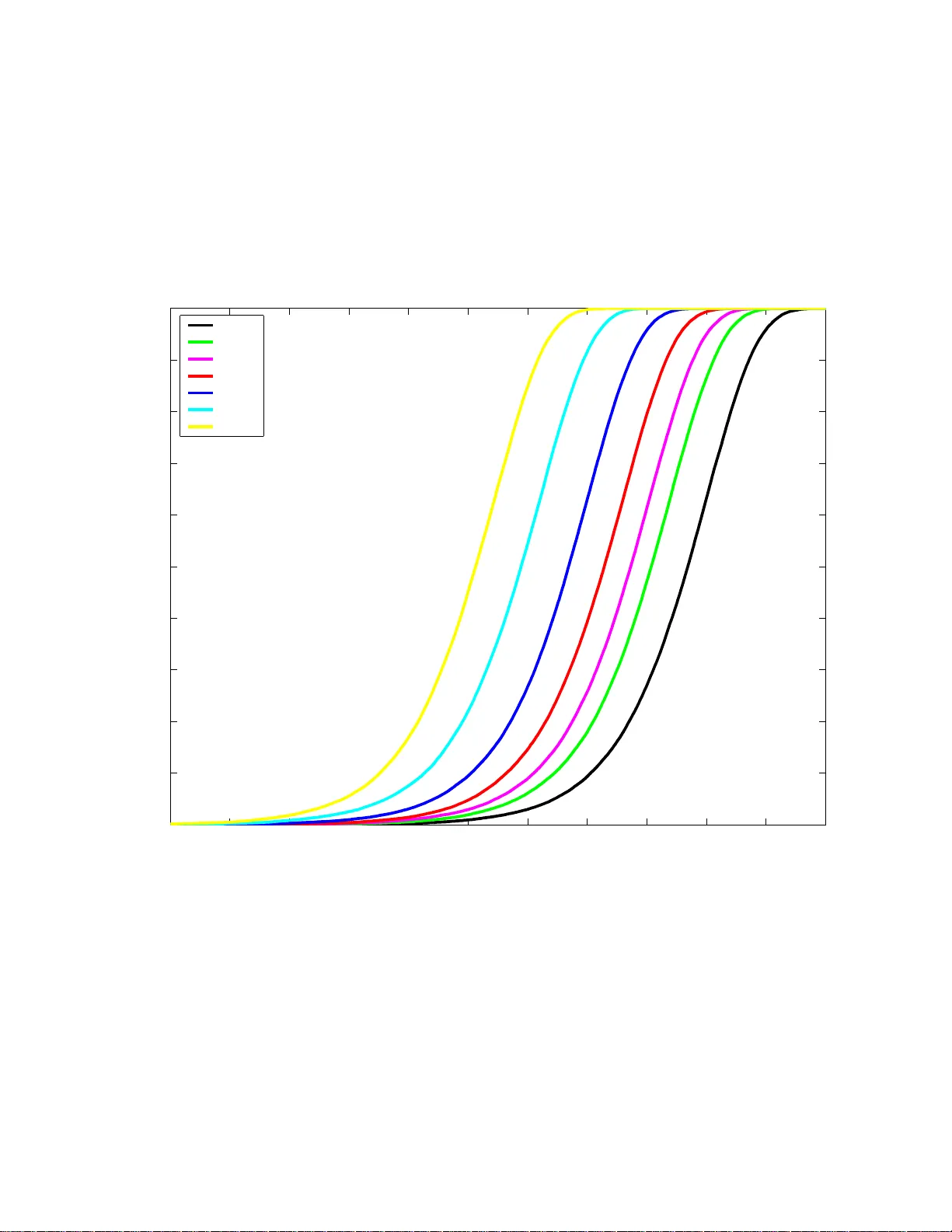
Opp ortunistic Spatial Orthogonalization and Its Application in F ading Cognitiv e Radio Net w orks Cong Shen Mic hael P . Fitz ∗ No v em b er 5, 2018 Abstract Opp ortunistic Spatial Or thogonaliza tion (OSO) is a cognitiv e radio sc heme that al- lo ws th e existence of secondary users and hence increase s the system throughpu t, ev en if the primary user o ccupies all the fr equ ency bands all the time. Notably , th is through- put adv antag e is obtained without sacrificing the p erformance of the primary user, if the interference margin is carefu lly chosen. The key idea is to exploit the sp atial dimen- sions to orthogonalize u sers and hence minimize in terf er en ce. How ev er, unlik e the time and frequ ency dimensions, there is no universal basis for the set of all m ulti-dimensional spatial c hannels, which m otiv ated the dev elopment of OSO . O n one hand, OSO can be view ed as a multi-user diversity sc h eme th at exploits the c hannel randomness and ind e- p endence. O n the other hand, OSO can b e interpreted as an opp ortunistic interfer enc e alignment sc heme, wher e the in terference from m u ltiple secondary users is opp ortunis- tically alig ned at the dir ection that is orthogo nal to the p rimary u ser’s signal space. In the case of m ultiple-input m u ltiple-output (MIMO) channels, the OSO sc heme can b e in terpreted as “riding the p eaks” ov er the eige n-c h annels, and ill-conditioned MIMO c han n el, wh ic h is traditionally view ed as detrimen tal, is sh own to b e b enefici al with resp ect to the sum throughp ut. T hroughput adv antage s are thoroughly studied, b oth analyticall y and n umerically . ∗ Part of the material in this pap er was presented at the 4 3rd Conference on Information Sciences and Systems (CISS), Baltimore, MD, Mar. 2009. Cong Shen and Mic hael P . Fitz are with the Departmen t of Electr ical Engineering , Univ ersity of California Los Angele s (UCLA), Lo s Ang eles, CA 90095, USA. Email: { congsh en,fit z } @ee.ucla.edu . Michael P . Fitz is also with Nor throp Grumman Space T e chnology , Redondo Beach, CA 90278, USA. 1 1 In tro du c tion The fo cus of this w or k is on the m ulti- user inte rference problem in a cognitiv e radio (CR) en vironmen t. The cen tral problem in general wireless net w orks is the multi-user interfer- enc e . The main tec hnique that mitigates this problem is to o rthogonalize use rs on t o differe n t degrees o f freedom to minim ize in terference among them 1 . Such orthogo nalization is tradi- tionally done in the time or frequency do main. The dev elopmen t of CR is one suc h example. The e ssen tial idea of CR is that some frequency bands ma y be uno ccupied b y the primary user (PU) for a long time, which causes a sev ere waste of the already scarce frequency re- sources. By allowin g secondary users (SUs) to detect and transmit on these idle frequencie s, resources are b etter utilized without sacrificing PU’s p erformance, since users o ccup y the same frequency bands in differen t time and hence are ortho g onal. Ev er since the dev elopment of p oint-to-p oin t m ultiple-input m ultiple-output (MIMO) sys- tems, it is w ell accepted that spatial dimens ions can b e exploited to pro vide degrees of freedom in addition to the usual time and frequency dimensions. It is also sho wn that the MIMO capacit y , either in a p oin t-to-p oin t system or a m ulti-user system, can b e signifi- can tly increased b y the additional spatial dimensions . A natur a l ques tion is whether t he user orthogonalizatio n principle can b e extended to the spatial domain for non-cen tralized wireless net works 2 . This has imp orta n t adv an tages in a CR system. As we ha v e mentioned, throughput impro v emen t o f CR relies on the fact that PU is not us ing all the frequency bands all the time, i.e., there ar e some “sp ectral holes” f o r SUs to exploit. This observ ation breaks do wn in some applications where PU is intensiv ely a ctiv e, and hence the frequency holes are v ery few and difficult to find. As a result, traditional CR will allo w v ery few SUs to transmit in order to main tain the communication qualit y of the primary link (t his is de- noted as a “PU only” sc heme). In this cas e, exploiting sp atial dimensions w o uld b e able to accommo date SUs in suc h a w a y that the ov era ll thro ughput is increased without causing in to lera ble in terference to the PU. Ho wev er, there is one fundamen tal differenc e b et wee n the spatial and the time/frequency dimensions: there is no unive rsal basis for the se t of all m ulti-dimensional s patial channels . This is in sh arp con trast t o both the time domain, where an y signal can be orthogonalized to differen t time units, and the frequency domain, where the ov erall signal can b e decomp osed (b y the FFT op eration in practice) into comp onents on differen t sub carriers and made or- thogonal to each other if the frequency se paration is c ho sen prop erly . The set of all MIMO c hannel matrice s, ho w ev er, is lac k of such univ ersal basis and eac h matrix will ha v e its own co ordinate (singular v ectors) and length (singular v alues). In other w ords, it is imp ossible to diag onalize all c hannel matrices onto a given set of orthonormal basis and assign differen t users to differen t dimensions. Hence, ex ploiting the spatia l dimensions in distributed wireless net works fa ces some conceptual difficulties. 1 Although lately ther e has b een in tensive r e search on p ow er-splitting schemes (e.g., [1]) first pro po sed by Han and K obay a shi [2], it is still immatur e in practice and the ov erwhelming technique remains to b e orthogo nalization. 2 F or centralized net works suc h as cellular, SDMA orthog onalizes users in the spatial domain. 2 There are some w o rks attac king this problem. F or ex ample, Interferenc e Alignmen t (IA) has b een prop osed [3] to study the capacity of in terference netw orks. The basic idea is to align interfere nce from m ultiple use rs to lie within only a f ew dimensions a t the intend ed receiv er, and hence reduces its impact to the useful signal. This idea was further dev elop ed in [4], where the in terference is a ligned to un used directions resulted from w ater- filling p ow er allo cation. Ho w ev er, the ma jo r problem of [3, 4] is that the strategy w or ks only if the SU kno ws the channel matrix of the primary link. Without this knowle dge, the interfere nce source no de is unable to iden tify the un used directions, and hence do es not know ho w t o b eam the signal. This assumption is highly unrealistic in practice, es p ecially for a CR system, as there is no incen tive for the PU to inform its primary c hannel to the p oten t ia l SUs 3 . It is also for this reason that one should b e v ery careful to formulate the res ource optimization problem (e.g., maximize sum thro ughput o r SU’s throughput sub ject to the qualit y of serv ice (QoS) constrain t for P U), a s this typically req uires glob al channel stat e information (CSI). F o r example , user sc he duling has b een studied for the CR net work in [6, 7]. How ev er, the optimization problem form ulated in [6] for j oin t b eamforming and user sc heduling requires global CSI, and the opp ortunistic sc heduling p olicies in [7] fo cus o n user dynamics from queuing theory . The main contribution of this paper is the prop osed OSO sc heme, whic h allo ws b oth the PU and the SU(s) to transmit at the same time and the same frequency band, but use differen t spatial dimensions and hence the in terference is minimized. The spatial orthogonalization among users is ac hiev ed without requiring SU to kno w the primary link c hannel, but instead relying on exploiting the c hannel randomness a nd indep endence to ta ke adv antage of the m ulti- user div ersity 4 . The OSO sche me is dev elop ed in g r eat detail for the single-input m ultiple-out put (SIMO) sys tem, where the concept of opp ortunistic in terference alignmen t is deriv ed. The OSO sc heme b ecomes mor e interes ting in the MIMO setting where we show that ill-conditio ned MIMO c hannel matrix, whic h is traditionally view ed as detrimen tal, in fact is b eneficial as it allows “riding the p eaks” to exploit multi-user divers it y in CR. Throughout the pap er t he follo wing not a tions will be used. Matrices and vectors are denoted with b o ld capital and low ercase letters, respectiv ely . A ( i, j ) is the ( i, j )-th elemen t of the matrix A , and a ( i ) is the i -t h elemen t of the v ector a . E X [ · ] denotes the exp ectation of a random v ariable with respect to the distribution of X . a ∗ denotes the conjugat e of the complex num b er a . h a , b i . = P i a ( i ) b ( i ) ∗ denotes the inner pro duct o f tw o complex vec tors, and || a || . = h a , a i denotes t he v ector 2-norm of a . F or matrix, T r ( A ) and || A || F denote the trace and F rob enius norm of matrix A , resp ectiv ely . A H is the Hermitian o f the complex matrix A . Finally , w e use sp { v 1 , · · · , v n } to denote the linear space spanned from ve ctors { v 1 , · · · , v n } . 3 Several itera tive algor ithms a re propo sed in [5] to r emov e the r equirement o f global c hannel knowledge, but the solutions rely on the r e cipr o city o f wireless net works (e.g., in TDD mo de) to iteratively achieve int erference alignment with only local channel kno wledge. 4 It s hould b e men tione d that exploiting m ulti-user div ersity in cognitive r adio netw or ks has b een studied in a recent w ork [8 ], but only s ing le-antenna terminals a re consider ed and hence it does not exploit spatia l dimensions. In a different pap er [9] multiple a ntennas were consider ed but no t m ulti-user diversit y . Also the int erference from PU to SU was ignored. 3 2 OSO for Cognit i v e Radio 2.1 System Mo del The system under consideration is illustrated in Fig. 1. It is assumed tha t there is one primary link whic h o ccupies all the frequency bands and transmits a ll the time. There are K candidate secondary links in the system, among whic h at most N links are activ ely transmitting 5 . W e will index all the users together: User 1(PU), 2 , · · · , N + 1 (SUs). Consider that eac h link is equipped with L t transmit an t ennas and L r receiv e an tennas. W e use H i,j to denote the c hannel betw een us er j ’s TX a nd user i ’s RX, i, j = 1 , · · · , N . In the follo wing discuss ion a sp ecial case of L t = 1 (SIMO) will b e first discuss ed and then a general ( L t , L r ) case is studied. In the f o rmer case H i,j is in v ector form and denoted as h i,j . Since b oth PU and SUs are allow ed to transmit ov er all the frequency ba nds, our attention can b e f o cused on a narrowband matrix in terference c hannel: Primary receiv er: y 1 = H 1 , 1 x 1 + P N +1 n =2 H 1 ,n x n + z 1 ; Secondary receiv ers: y m = H m,m x m + P N +1 n =1 ,n 6 = m H m,n x n + z m , ∀ m = 2 , · · · , N + 1 , (1) where x m and y m are the transmit and receiv e ve ctors of the m -th user, resp ectiv ely . W e assume that PU1-TX ha s a to tal transmit pow er constrain t T r E [ x 1 x H 1 ] ≤ P 1 , a nd SU m - TX also has a tota l p o w er constrain t T r E [ x m x H m ] ≤ P 2 , ∀ m = 2 , · · · , N + 1. Receiv ed signal at the m -th rece iv er is corrupted b y an i.i.d. Additiv e White G aussian Noise (A WGN) v ector z m ∼ C N ( 0 , N 0 I ). The channe l transfer matrices { H i,j } N +1 i,j =1 are assumed to b e indep enden t of eac h other. This assumption is generally v alid if the transmitters/receiv ers are not co-lo cated, whic h is the case for most CR systems. In all the nume rical examples, it is further assumed tha t they are also iden tically distributed with eac h elemen t H i,j ( l , m ) ∼ C N (0 , 1 ) . This brings us to the fa milia r g round of i.i.d. MIMO Rayle igh fa ding channels. A blo c k-fading mo del is assumed, i.e., the c hannel matrices are constant during the channe l coherence time and c hanges indep enden tly to a differen t v alue according to some distribution. This channel mo del will b e used to discuss t he OSO sc heme. W e consider a coherent system where all the destination no des ha v e p erfect kno wledge of b oth the direct link fro m the in tended source no de and the cross links that come from the other source no des, i.e., user i ’s receiv er kno ws { H i,j } N +1 j = 1 . Notice that N is t ypically v ery small, whic h reduces the w orkload of c hannel estimation at SU-RXs. F or the primary receiv er (PU1-RX), w e make a stronger assumption that it not only kno ws the direct link H 1 , 1 but a lso has p erfect kno wledge of the c hannels that might in t erfere with the primary link, i.e., { H 1 ,j } K +1 j = 2 . This is necessary and can be ac hiev ed in the user sele ction stage, where a ll the K candidate secondary users send orthog o nal pilots and PU1-RX p erforms channel estimation for each cross-in terference 5 The v alue o f N can b e z ero, which means that no SU is allowed to tra nsmit. How to select these N active links will be discuss e d in the se quel. 4 c hannel. In applications suc h as uplink cellular net works b eing the PU (basestation is the PU-RX), this ch annel estimation can b e reliably accomplished. Since all the destination no des hav e perfect CSI, they c an calculate the transmission rate that c urren t c hannel state can supp ort (taking in to accoun t the interference ) and f eed it back to the source nodes 6 . This assumption eliminates the p ossibilit y of outag e a nd allows us to use the av erage capacity as the p erformance measure. A final note is that some assumptions are made only to s implify the sequel discussion. F or example, w e assume that the transmit/receiv e antennas a re the same for eac h link, and there are only tw o p ow er levels P 1 (PU) and P 2 (SUs). W e also assume that t he c ha nnel matrices are iden tically Gaussian distributed. These assumptions are not crucial to our discu ssion and can b e relaxed to a more general situation. As for the assumptions of CSI, it is critical for PU1-RX to kn o w { H 1 ,j } K +1 j = 2 , as this is nece ssary for the selection o f activ e SUs. Ho w ev er, the assumption that activ e SUs’s destination no des also kn o w their cross-in terference c hannels and f eed bac k the instan ta neous rate is made only to facilitate the use of a v erag e capacit y . Without these assumptions, the prop osed OSO sc heme is still v alid and one can consider t he capacit y v ersus outage as the p erformance measure. 2.2 The OSO S cheme – SIMO One unique property of CR is the un ba la nce b etw een users. Since PU has the legitimate righ t to op erate on the giv en frequency bands , the SUs ha ve to opp ortunistically sense t he “sp ectral ho les” and then transmit their own data without degrading the service of PU [10]. Due to this unb alanc e d nature o f CR, the system design is consid erably different from the con v entional m ulti- user net w o rk. The main difference is that the primary link is m uc h more import a n t than other secondary links, and hence t he QoS of the primary link sh ould b e guaran teed, which means the inte rference caused b y secondary transmis sions needs to b e carefully con tro lled. On the other hand, the QoS of secondary links is generally not guaran teed, whic h is a price SU has to pay when op erating on a frequency band tha t is not licensed to him. Another consideration is that the primary link should b e ask ed to mak e as few c hanges as p ossible to accommo date the existence o f SUs . These design principles should b e kep t in mind when dev eloping the OSO sc heme fo r CR. As has b een discusse d b efore, the ma j or difficult y to exploit the spatial dimensions for cognitiv e radio is the lac k of a univ ersal basis for the spatial dimensions. Hence, it is imp ossible to diagonalize all p ossible c hannel matrices on to a giv en set of orthonormal basis and a ssign diffe ren t users to differen t dimen sions. The ke y idea of the prop osed solution is to exploit the channe l r andomn e ss and multi-user diversity effect [11, 12] to create m ultiple spatial dime nsions and allow the primary and secondary users to occup y differen t dimensions to ac hiev e (near) orthogonality . This idea is b est illustrated with the SIMO system, whic h 6 Note that this is not o nly a typical assumption in literature discussing multi-user div ersity but als o implemen ted in practice. 5 is the purp ose of this section. F o r simplicit y , w e b egin the discuss ion with N = 1 (i.e., there is no more than one activ e SU) and generate to any N . 2.2.1 N = 1 If one SU is presen t, the signal mo del (1) b ecomes Primary link : y 1 = h 1 , 1 x 1 + h 1 , 2 x 2 + z 1 ; (2) Secondary link : y 2 = h 2 , 2 x 2 + h 2 , 1 x 1 + z 2 . (3) Since SU1-RX p erfectly kno ws the c hannel gains h 1 , 1 and h 1 , 2 , signal mo del (2) is essen tially a m ultiple-access c hannel (MA C). Complicated MA C deco ders suc h as linear MMSE or in terference cancellation can be emplo y ed. Ho w eve r, as one of our design principles is to mak e as few c hanges as p ossible, we would lik e to reuse t he deco der when the in terference do es not e xist. Suc h approa c h w ill make the receiv er robust to the dyn amic changes in the secondary transmissions. W e w o uld like to p o in t out tha t in t his w ork the principle is to treat in terference as noise. In the in terference c ha nnel literature, there ar e adv anced tec hniques suc h as the combination of decoding the interfere nce signal and treating in terference as noise [2, 1]. These techniq ues pro vide b etter throughput but are complicated to implem en t with to day ’s techn ology . Without interfere nce mo del (2) is a standard SIMO channel and maxim um ra t io com bining (MR C) is the optimal deco der (i.e., matched filter): ˜ y 1 = h y 1 , h 1 , 1 i = || h 1 , 1 || 2 x 1 + h h 1 , 2 , h 1 , 1 i x 2 + h z 1 , h 1 , 1 i . (4) Defining the i n terfer en c e p ower β (1) 1 . = |h h 1 , 2 , h 1 , 1 i| 2 || h 1 , 1 || 2 (5) where the subscript denotes the n umber of candidate SUs and the superscript denotes the n umber of p o ssible activ e SUs, the receiv ed signal-to-interferen ce-plus-noise ratio (SINR) can b e computed as SINR 1 ( β (1) 1 ) = || h 1 , 1 || 2 P 1 |h h 1 , 2 , h 1 , 1 i| 2 || h 1 , 1 || 2 P 2 + N 0 (6) = || h 1 , 1 || 2 P 1 N 0 1 + β (1) 1 P 2 N 0 (7) ≤ || h 1 , 1 || 2 P 1 N 0 (8) . = SNR 1 (9) 6 where SNR 1 is the receiv ed signal-to-noise ratio o f the primary link when t here is no in ter- ference. The rate of t he primary user is C 1 = log 1 + SINR 1 ( β (1) 1 ) . (10) In order not to sev erely degrade the p erformance of PU, the in terference p ow er β (1) 1 needs to b e v ery small. In general this will not b e true if h 1 , 1 and h 1 , 2 are indep enden t. In Fig. 2 the curv e corresp onding to K = 1 show s the Cum ula tiv e Distribution F unction (CDF) of β (1) 1 for the i.i.d. Gaussian c hannel. Ho wev er, when there are man y candidate SUs in the system, there is a v ery go o d c hance that PU1-RX can find one secondary link whose interferen ce ch annel h 1 ,k is almost orthogonal to h 1 , 1 , and hence creates very little interference to t he primary link. Not ice that now the in terference pow er b ecomes β (1) K . = min k =2 , ··· ,K +1 |h h 1 ,k , h 1 , 1 i| 2 || h 1 , 1 || 2 . (11) The b enefit of exploiting multiple candidate SUs can b e analytically rev ealed b y comparing (5) to (11). The distribution of β (1) K with differen t v alues o f K is rep orted in Fig. 2. As t he n umber of candidate SUs increases in the system, the ta il o f the distribution for β (1) K b ecomes m uch ligh t er. This in fa ct is due to the m ulti-user div ersity effect. W e name this sche me Opp ortunistic Spatial Orthogona lizatio n (OSO). As we can see from (8), in terference from SU reduces t he SINR and the data rate of PU. W e w ould lik e to p erform the secondary user selection suc h that the in terf erence p ow er is b elo w some threshold. W ireless fading c hannels ha v e a wide range o f dynamics and a constan t QoS is v ery difficult to main ta in. T ypically the sys tem design w ould assume a certain SINR margin to deal with the dynamics of c hannel fading and multi-use r interfere nce. W e b orrow this idea and define γ ( dB ) . = SNR 1 ( dB ) − SINR 1 ( β (1) K ) ( dB ) (12) = 10 log 10 1 + β (1) K P 2 N 0 (13) ≤ γ thr ( dB ) (14) where γ thr ( dB ) is the maxim um interferenc e threshold PU can tolerate. Hence, if a SU causes an inte rference that is no la rger than this marg in, it is allo w ed to use the same f requency band sim ultaneously with the PU. It should b e noted that t his in terference threshold idea has a lr eady been discussed and adopted in the setting of CR sp ectrum s ensing by the F CC as the interfer en c e temp er atur e mo del [13]. No w let us study the p erformance of SU. Similarly w e insist that SU2- RX remains unchanged with and without interferenc e. The MRC deco der at SU2-RX giv es: ˜ y 2 = h y 2 , h 2 , 2 i = || h 2 , 2 || 2 x 2 + h h 2 , 2 , h 2 , 1 i x 1 + h z 2 , h 2 , 1 i , (15) 7 and the corr esp onding SINR is SINR 2 = || h 2 , 2 || 2 P 2 N 0 + |h h 2 , 2 , h 2 , 1 i| 2 || h 2 , 2 || 2 P 1 . (16) Notice that the statistics to c ho ose activ e SU is β (1) K , whic h is a random v ariable indep enden t of SINR 2 . Hence, the p erformance of SU cannot a lwa ys b e guaran teed, due to the p ossibly strong in terference the primary tra nsmission could ha v e caused. As is me n tio ned b efore, this is a price SU has to pa y in order to b e activ ated. One migh t think of a joint user selection sc heme, whic h first minimizes SU’s interferenc e to PU, a nd then selects the SU that a lso suffers minim um in terference from the primary transmission. There are some practical problems with this sc heme. First of all, suc h sche me requires t w o i.i.d. random v aria bles |h h 1 , 1 , h 1 , 2 i| 2 || h 1 , 1 || 2 and |h h 2 , 2 , h 2 , 1 i| 2 || h 2 , 2 || 2 to b e small simultaneous ly . Although it is possible to sho w that asymptotically ( a s K → ∞ ) this ev en t will happ en with probabilit y one, the conv ergence rate is muc h s lo wer b ecause Pr |h h 1 , 1 , h 1 , 2 i| 2 || h 1 , 1 || 2 ≤ ε, |h h 2 , 2 , h 2 , 1 i| 2 || h 2 , 2 || 2 ≤ ε = Pr |h h 1 , 1 , h 1 , 2 i| 2 || h 1 , 1 || 2 ≤ ε 2 ≪ Pr |h h 1 , 1 , h 1 , 2 i| 2 || h 1 , 1 || 2 ≤ ε , when ε is v ery small. (17) Another issue is that suc h sc heme require s PU’s receiv er to hav e kno wledge of all the inte r- ference channels { h k , 1 } K +1 k =2 . This is a hig hly unrealistic assumption. Fig. 3 g ives a nu merical example illustrating the b enefits of OSO. A few in teresting obser- v atio ns can b e made from the figure. First of all, the p erformance degradation o f PU due to the additiona l user is v ery lit tle when the in terference margin is stringen t , but the ov erall throughput is increased significan tly . When γ thr = 0 . 1 dB, the s um rate increase comes at almost no cost to the PU, whose throughput is nearly unc hanged. Secondly , a s the n um b er of candidate SUs increases , the sum ra te also increases. This is due to the mu lti-user di- v ersity , where the probabilit y that one candidate user is almost orthogonal to the primary link incre ases monotonically with the num b er of candidate users K . The third observ a t io n is that as K b ecomes v ery large, the sum rate con v erges to a performance upp er b ound. This asymptotic b ehavior will b e discussed in the sequel. Another observ ation is that when w e r elax the in terference mar g in γ thr , PU may suffer a little more ra t e loss when K is not v ery la r g e (still below the margin), but the sum rate increases and con v erges to the upp er b ound m uc h f a ster. This indicates that if t he interferenc e marg in is not v ery stringen t, only a small num b er of candidate SUs w ould allo w the s ystem to ac hiev e optimal sum rate. F or example, if γ thr = 0 . 1 dB then ev en with K = 1 00 the sum rate is no t saturated, but with γ thr = 1 dB only K = 40 already approac hes the upper b ound. A final o bserv ation is as K increases, PU’s throughput in the OSO sche me first decreases and then increases. The initial throughput for PU is large b ecause K is v ery small, and with large pro ba bilit y none 8 of the candidate SUs will b e activ ated. As there are more and more candidate SUs, the probabilit y that one of them will meet the in terference margin req uiremen t and henc e be activ at ed increases, whic h creates interferenc e and reduce s PU’s throughput. As K becomes v ery large, almost s urely one SU is activ ated a nd th us brings in terference. Ho w ev er, due to the m ulti- user div ersit y effect, this inte rference will b e extremely small when K is ve ry large, and PU’s throughput will conv erge to the no-interfere nce case. In tuitively the asymptotic performance upper b ound corresp onds to when the primary link suffers no in terference (SU is exactly orthogonal to PU) and the throughput of b oth PU and SU is the ergo dic capacit y . The in terference p o w er β (1) K is a non-increasing function of the n umber of candidate SUs K . In fa ct, we can prov e the following lemma. Lemma 1 Consider indep ende n t and c ontinuous r andom ve ctors { h 1 ,k } K +1 k =1 with pr ob abili ty distribution functions (PDF) f k ( h ) , k = 1 , · · · , K + 1 . Assume that the s upp o rt of h 1 ,k includes 0 + , i .e., R S f k ( h ) d h > 0 for any S that c ontains 0 + . Then ∀ ε > 0 we have Pr n lim K →∞ β (1) K ≤ ε o = 1 (18) with β (1) K define d in (11). Pr o o f : It is equiv alen t to show that Pr n lim K →∞ β (1) K > ε o = 0 . (19) Define the ev en t A k . = |h h 1 ,k , h 1 , 1 i| 2 || h 1 , 1 || 2 > ε . (20) for k = 2 , · · · , K + 1. Then, Pr n lim K →∞ β (1) K > ε o = Pr ( ∞ \ k =1 A k ) (21) = Z Pr ( ∞ \ k =1 A k | h 1 , 1 ) f 1 ( h 1 , 1 ) d h 1 , 1 (22) ( a ) = Z ∞ Y k =1 Pr { A k | h 1 , 1 } f 1 ( h 1 , 1 ) d h 1 , 1 (23) where ( a ) is due to the indep endence of { A k | h 1 , 1 } . Now, since R S f k ( h ) d h > 0 for any S that contains 0 + , w e hav e Pr { A k | h 1 , 1 } < 1 for an y h 1 , 1 6 = 0 . Notice that Pr { h 1 , 1 = 0 } = 0. Hence ∞ Y k =1 Pr { A k | h 1 , 1 } ≤ lim K →∞ h max k Pr { A k | h 1 , 1 } i K = 0 (24) whic h prov es (19). This completes the pro o f. 9 With Lemma 1, w e can pro ceed t o study the a symptotic b ehavior of the O SO sc heme. Since Lemma 1 states that asymptotically the in terference p ow er β (1) K go es to zero, the a v erage throughput of PU will conv erge to the no-interfere nce case, whic h is the ergo dic capacity : lim K →∞ C 1 = E h 1 , 1 log 1 + || h 1 , 1 || 2 P 1 N 0 . (25) As for the throughput of SU, although differen t channel realizations will activ ate differen t SUs, the o v erall throughput is still the ergo dic capacit y with resp ect to the distribution of h 2 , 2 and h 2 , 1 , thanks to the indep endence of c hannels: lim K →∞ C 2 = E h 2 , 2 , h 2 , 1 log 1 + || h 2 , 2 || 2 P 2 N 0 1 + |h h 2 , 2 , h 2 , 1 i| 2 P 1 || h 2 , 2 || 2 N 0 . (26) The p erformance upp er b ound plotted in Fig . 3 is the sum of (25 ) and (26 ) . 2.2.2 N > 1 In tuitively , relaxing the constraint that at most one a ctiv e SU is allow ed would increase the system o ve rall throughput while still main taining PU’s perfo rmance b y setting a thres hold on the total interferenc e. With N active SUs, the in terf erence pow er b ecomes β ( N ) K = P N +1 n =2 |h h min 1 ,n , h 1 , 1 i| 2 || h 1 , 1 || 2 (27) where { h min 1 ,n } N +1 n =2 generates t he N minim um |h h 1 ,n , h 1 , 1 i| 2 among K candidat e SUs, and the SINR of the primary link can b e similarly computed as in ( 7). F or a g iven threshold γ thr = 10 ( γ thr ( dB ) / 10) and c hannel realizations, the maximal num b er of activ e users can b e determined a s N ∗ = arg ma x M min k 1 , ··· ,k M ∈{ 2 , ··· ,K +1 } k i 6 = k j , ∀ i 6 = j P M m =1 |h h 1 ,k m , h 1 , 1 i| 2 || h 1 , 1 || 2 ≤ ( γ thr − 1) N 0 P 2 . (28) Fig. 4 compares the sum rat e of maximal N and the sp ecial case N = 1. Apparen t ly , allo wing more sec ondary users whenev er it is p ossible w ould further b o ost the sum rate, and this increase is m uch mo r e remark able when the interfere nce margin is not stringen t. Another in teresting observ ation is the b eha vior of PU’s throughput. Unlik e the N = 1 case in Fig. 3, where PU’s throughput will con v erge to the no-in terference case asymptotically , here due to the fact that we allo w as many SUs as p ossible, asymptotically there is a constant gap b et ween PU’s thro ughput with and without in terference. As the n um b er of candidate SUs b ecomes large, there will be some SUs whose in terference adds up to a lev el that approac hes the in terference marg in γ thr . Hence this asymptotical gap is determined b y the in terference threshold. 10 2.2.3 Remarks Remark 1 Opp ortunistic Interfer enc e A lignm ent There is a v ery in teresting in terpretat io n of the OSO s c heme with N > 1. Recen tly In ter- ference Alignment (IA) [3] has been prop osed to deal with the problem that one receiv er suffers interfere nce from m ultiple sources. The k ey idea is that if the sources kno w their cor- resp onding interference c hannel gains, they can p erform preco ding suc h t ha t the resulting in terference signals at the non-intended receiv er only o ccup y a small n um b er of dimensions. The essen tial idea of IA is quite similar to the prop o sed OSO sc heme: force the inte rference signals to o nly p o int at a certain direction. The IA do es so b y allowing the non-intended transmitters to preco de the signals, whic h requires a glo bal know ledge of ch annel realizations. The prop osed OSO sc heme, ho w ev er, ac hiev es t his goa l by utilizin g the randomness of the c hannels and relying on the m ult i- user div ersit y . The dra wback of OSO is the require men t of m ultiple candidate SUs and increased workload of c hannel estimation, but t he adv an tage is that there is no need for the SU transmitters to kno w the c hannel realizatio ns, whic h is practically v ery difficult. F rom this p ersp ectiv e, the OSO sch eme can b e interpreted as Opp ortunistic Interfer en c e A lign ment . Remark 2 Ortho go nal F r e quency-D i v ision Multiple A c c ess (OFDMA) Another adv antage of the OSO sc heme is that it c a n b e natur al ly inc orp o r ate d in to OFDMA systems . This has great imp o rtance in practice a s OFDMA is used extensiv ely in mo dern wireless standards, suc h as the IEEE 8 02.16 mo bile WiMAX, the 3G PP Long T erm Ev olu- tion do wnlink, and the cognitive ra dio based IEEE 802.22. F or a m ulti-user wireless net w ork adopting OF DMA, the lic ense d c arrie r own s all the fr equency bands and allo cates differen t sub carriers to differen t legitimate users in an OFDMA fashion. Consid er the situation where the netw o rk is dense and hence all the sub carriers are o ccupied b y legitimate users of the licensed carrier. Assume that there is a n unlic ense d c arri e r who also w ants to use these frequency bands to serv e his subscrib ers with O F DMA. In this case, the OSO sc heme can b e directly applied in a subcarrier-by-subcarrier basis. On eac h sub carrier, there already exists one legitimate user, and the OSO sc heme will find (if p ossible) one or more SUs of the unlicensed carrier whose in terference is within the margin, pro vided that the n um b er of candidate SUs is reasonably large. In this wa y , multiple SUs can be activ ated on differen t sub carriers and the ov erall thro ughput p erformance is improv ed without sacrificing the li- censed carrier. Notice tha t the QoS of SUs cannot b e guara nteed, and hence this sc heme fits b est for applications without stringent dela y constraint and relatively low QoS requiremen t. Remark 3 Comp arison to pr evious multi-user diversity schemes Multi-user dive rsit y was first recognized in [11, 1 4, 15, 1 2], and ha s spark ed in tensiv e researc h in terest in b oth a cademia and industry . The prop osed OSO sc heme also relies on this 11 concept, but there is one imp o rtan t difference from previous w orks. In traditional m ulti-user systems , users are generally balanced. This is an imp ortant prop ert y for the dev elopmen t of multi-user divers it y , as it requires some users to sacrifice their short-term throughput a nd w ait for “p eaks” to increase the long-term sum throughput. F or any specific user, there is no p erformance g uaran t ee at an y giv en time. This obvious ly cannot b e directly applied to the CR system, since the PU is more imp ort a n t than SUs and his p erfo rmance should b e g uaran teed. F ro m this p ersp ectiv e, the pro p osed OSO sche me can b e though t of as a m ulti- user div ersit y sc heme for extremely asymmetric wireless net works. Remark 4 The user fairness issue The prop osed OSO sc heme, just lik e other m ulti-user div ersit y sche mes, has the user fairness issue if the static fading channel is considered. The primary receiv er selects the secondary user(s) whose in terference c ha nnel is or t hogonal to the primary link. If the channe l realization is v ery slo wly v arying, then one or sev eral “luc ky” SUs will b e activ e for a long time, while other SUs remain silen t. This creates t he fair ness problem among the candidate SUs. The same problem w a s considered in the original m ulti- user div ersity sc heme [12] and man y follo wing pap ers, and se v eral solutions hav e b een prop o sed in the framew ork of user sche dul- ing . The general idea is to w eigh users suc h that the ones who get to transmit now hav e decreasing p ossibilit y of b eing se lected a gain in the near future. One example is the p r o- p ortional fairness principle in [12]. How ever, one should notice that suc h user sc heduling metho d will not work in the OSO sc heme. The reason is that user selection has to b e based on the spatial orthogo nalization. Hence, user sc heduling can b e only applied to the set of SUs who ar e orthogonal to the primary link, whic h is still unfa ir to t he other candidate SUs. There are some solutions attack ing this problem. F or example, as discuss ed in Remark 2, OFDMA in the wideband c hannel can help with the user fairness. Due to the indep endence of c hannel realizations in different sub carriers, the SU selection rule on each sub carr ier is differen t. It is v ery unlik ely that one us er w ould satisfy most of them and corresp ondingly o ccup y a lot of sub carriers. What is more lik ely is that differen t SUs ar e activ ated on differen t sub carriers, whic h allev iates the user fairness issue. Another solution is the r andom b e a mforming , whic h relies on the a rtificially in tro duced randomness at the transmitter t o v ary the equiv alent channel realization. Assume t ha t eac h transmitter is also equipp ed w ith multiple antennas 7 . F or the sak e of simplicit y , let us consider L t = L r = 2. The sc heme is to add a time-v arying phase and p ow er to the transmit an t ennas at PU-TX, similar to [1 2, Figure 5]. Note that without this random b eamforming, the SIMO primary link channel is h 1 , 1 = h 1 , 1 (1) h 1 , 1 (2) (29) 7 The use of mult iple transmit antennas here is to introduce randomness for user fairness. In Sec . 2.3, a different purpose of multip le transmit antennas will be ela bo rated. 12 whic h remains constan t ov er time and hence causes the user fairness issue. No w applying random m ultiplication factor √ α on tr a nsmit an tenna 1 a nd √ 1 − α e j θ on transmit a ntenna 2, the equiv a lent SIMO c hannel of the primary link b ecomes ˜ h 1 , 1 = H 1 , 1 √ α √ 1 − α e j θ = H 1 , 1 (1 , 1) √ α + H 1 , 1 (1 , 2) √ 1 − α e j θ H 1 , 1 (2 , 1) √ α + H 1 , 1 (2 , 2) √ 1 − α e j θ . (30) By v arying α and θ in a pseudo-random fashion, the equiv alen t SIMO c ha nnel also c hanges o v er time ev en whe n the ph ysical c hannel is static, whic h will trigger differen t SUs to be activ at ed at different times. Notice that suc h pse udo-randomness could be sync hronized on b oth the transmitter and rec eiv er side, which leads to tw o adv an tages. Firstly , the c hannel estimation needs to b e done only o nce, with resp ect to the ph ysical MIMO channel. Secondly , as long as the receiv er gets the c hannel estimation of h 1 , 1 together with the in terference links from candidate SUs, it can apply the pseudo-randomness to the primary link and perfo rm SU selection with resp ect to each realization of ( α, θ ), in an “anti-causal” w a y . That is to sa y , the SU selec tion do es not ha v e to wait un til the fav orable ( α, θ ) app ears. It can b e done once the c hannel estimation is obta ined, and the decision can b e immediately f ed back to the SU so it kno ws w hen to b e a ctiv e in the future. Remark 5 Inferiority of the se c ond ary users In t he traditional CR ba sed on time orthogonalizat io n, t he SU’s inferiorit y can be seen fr o m the fact that it has to sense the absence of PU b efore transmitting, and once PU starts comm unication it has to stop transmitting. On the other hand, the transmis sion of SU will see a n in terference-free c hannel if PU is absen t, whic h is adv an t a geous. F o r the O SO sc heme, ho wev er, the SU’s inferiority is exhibited in a different w a y . Now the selected SU(s) can transmit ev en if PU is pres en t. F rom this p ersp ectiv e, SU is less inferior than the traditional C R. In con trast, the secondary link will t ypically see a stro ng - in terference channel when transmitting, since PU’s signal is not aligned at SU’s receiv er. This is where the SU is inferior to PU , whose receiv er sees v ery little in terference from SU. 2.3 The OSO S cheme – MIMO The previous section o nly considers systems with single transmit and m ultiple receiv e an- tennas. The OSO sc heme for this SIMO mo del is relativ ely simple, as the receiv ed signal at the in tended receiv er only spans one spatial dimension and hence opp ortunistic orthog - onalization is easy to deriv e. F rom the capacit y p ersp ectiv e, SIMO only provides receiv e SNR gain. It is w ell-know n that using b o th mu ltiple transmit and m ultiple receiv e a ntennas (full MIMO) will inc rease the capacit y significan tly thanks to the multiplexing gain , whic h 13 describes the additional spatial dimensions MIMO creates. This section extends the O SO sc heme deriv e in Section 2.2 to the MIMO c hannel, and incorp orates SIMO as a sp ecial case. F o r simplicit y of argumen t, we will fo cus on L t = L r = 2 with N = 1 and then discus s general ( L t , L r ). Extension to general N is stra ig h tfo r w ard. 2.3.1 OSO based on MIMO eigen-b eamforming The system mo del remains the same as in Section 2 .1 and Fig. 1, with the follo wing t w o differences. The first is that no w eac h transmitter also has L t > 1 antennas. The second is that w e f urther assume eac h transmitter p erfectly knows the c hannel b et wee n itself and PU1-RX, i.e., transmitter of the n -th user kno ws H 1 ,n , n = 1 , · · · , N + 1. It should b e noted that this is a v alid assumption and many practical sy stems hav e either explicit 8 or implicit feedbac k that allows tr ansmitter to possess c hannel stat e information (CSIT). In practice this can be made easier if w e limit the choice of N to b e small. F or ex ample, our main discussion is on N = 1 and henc e only t w o transmitters need t o p ossess the corresponding CSIT: o ne PU and one a ctiv e SU. With these a ssumptions, the signal mo del of b oth receiv ers can b e written as Primary link : y 1 = H 1 , 1 F 1 x 1 + H 1 , 2 F 2 x 2 + z 1 ; (31) Secondary link : y 2 = H 2 , 2 F 2 x 2 + H 2 , 1 F 1 x 1 + z 2 , (32) where H mn , F n ∈ C 2 × 2 , x m , y m , z m ∈ C 2 × 1 , and F n is the b eamforming matrix at the n -th transmitter which is derive d from c hannel matrix H 1 ,n . Since PU1-TX kno ws H 1 , 1 p erfectly , the capacity -optimal transmission p o licy without in ter- ference is to first p erform t he Singular V alue D ecompo sition (SVD ) of the c hannel matrix H 1 , 1 [16] H 1 , 1 = U 1 , 1 Λ 1 , 1 V H 1 , 1 = [ u 1 , 1 (1) , u 1 , 1 (2)] λ 1 , 1 (1) 0 0 λ 1 , 1 (2) [ v 1 , 1 (1) , v 1 , 1 (2)] H (33) to obta in the b eamfo rming matrix F 1 = V 1 , 1 , (34) where U 1 , 1 , V 1 , 1 ∈ C 2 × 2 are unitary matrices, and the diagonal matrix Λ 1 , 1 consists of the ordered singular v alues { λ 1 , 1 (1) ≥ λ 1 , 1 (2) } . T ogether with left m ultiplying the receiv ed signal U H 1 , 1 , t he MIMO channel H 1 , 1 is diagonalized, and then w ater-filling p o w er a llo cation ov er the eigen-channels g ives the optimal capacit y [16]. The SVD-based b eamforming together with w a t er-filling p ow er allo cation o v er all eigen- c hannels is t he theoretically optima l transmission sc heme. In practice, how ev er, b eamforming 8 Note that PU1-RX is assumed to hav e p erfect k nowledge of { H 1 ,n } N +1 n =1 (see Section 2.1). So it is p ossible for each tr a nsmitter n to know H 1 ,n via CSI feedback. 14 using only a few s trongest eigen-c hannels is commonly adopted. This sc heme is sub optimal but ha s lo w complexit y and can b e easily implemen ted. In some scenarios it is in fa ct close to b e optimal. F or example, it is w ell-kno wn that tr ansmitting o nly on the strongest eigen- c hannel is the optimal strategy in the asymptotically lo w SNR regime. As another example, if the c hannel is i l l-c onditione d , i.e., the condition n um b er is very large, then only using a few strongest eigen- channels is also approximately optimal. This can b e inferred from the w ater- filling p o w er allo catio n. Recall that the principle of water-filling is to allo cate more p o w er if the eigen-c hannel is stro ng . Hence for the ill-conditioned channel, the matrix is close to b e singular and the very w eak eigen-channels will get v ery little p ow er from w ater-filling. Consequen t ly , discarding these eigen-channels incurs very little p erformance loss. With this subo ptimal sc heme, b oth PU and SU will send only one data stream o v er o ne eigen- c hannel and the b eamforming matrix F degenerates to a vector f . The transmit b eamfor ming of PU reduces to sending x 1 o v er the strongest eigen-c hannel { λ 1 , 1 (1) , v 1 , 1 (1) } : f 1 = v 1 , 1 (1) . (35) Hence a t PU1-RX, y 1 = H 1 , 1 v 1 , 1 (1) x 1 + H 1 , 2 f 2 x 2 + z 1 = λ 1 , 1 (1) u 1 , 1 (1) x 1 + H 1 , 2 f 2 x 2 + z 1 . (36) Consider the SVD of H 1 , 2 : H 1 , 2 = U 1 , 2 Λ 1 , 2 V H 1 , 2 = [ u 1 , 2 (1) , u 1 , 2 (2)] λ 1 , 2 (1) 0 0 λ 1 , 2 (2) [ v 1 , 2 (1) , v 1 , 2 (2)] H . (37) Similar to the metho dology in Section 2.2 , w e w o uld like to exploit the c hannel randomness and indep endence to c ho ose one SU whose we akest eigen-channel u 1 , 2 (2) is almost orthogonal to u 1 , 1 (1). Tw o r emarks a re appro priate at this stage. a) W e wan t t o c ho ose a b eamforming direc tion of SU that is almost orthogonal to the space sp { u 1 , 1 (1) } . This follows the same philosoph y as in the SIMO case. b) Item a) can b e achie v ed if either of the t wo directions { u 1 , 2 (1) , u 1 , 2 (2) } is almost orthogonal to u 1 , 1 (1). Ho w ev er, if the direction asso ciated with the la rger singular v alues λ 1 , 2 (1) is c hosen, then an y oscillation in u 1 , 2 (1) will result in larg er pro jection on t o the space sp { u 1 , 1 (1) } a nd hence larger in terference than c ho osing u 1 , 2 (2) and λ 1 , 2 (2). This is esp ecially true if the c hannel matrix H 1 , 2 is ill- conditio ned. Since f 2 = v 1 , 2 (2) , (38) 15 the ov erall receiv ed signal at PU1-RX b ecomes y 1 = λ 1 , 1 (1) u 1 , 1 (1) x 1 + λ 1 , 2 (2) u 1 , 2 (2) x 2 + z 1 . (39 ) This is the same signal mo del a s in Equation (2). The OSO sc heme discus sed in Sec tion 2.2.1 can b e dir ectly a pplied to this mo del. The SINR of PU can b e written a s SINR 1 = λ 2 1 , 1 (1) P 1 λ 2 1 , 2 (2) |h u 1 , 1 (1) , u 1 , 2 (2) i| 2 P 2 + N 0 . (40) There is a v ery intere sting o bserv ation from Equation (40). As we ha ve men tioned, one motiv a t io n for eac h user to use only one eigen-c hannel is the ill-conditioned channel matrix. In the L t = L r = 2 MIMO c hannel, this means λ (1) is muc h larger than λ (2). This channel illness has t w o direct impacts on PU’s SINR. First, the in tended signal x 1 is sen t on the strongest eigen-channe l, and hence the signal p o wer is amplified b y λ 2 1 , 1 (1). Since H 1 , 1 is ill-conditioned, λ 1 , 1 (1) is t ypically large, whic h is b eneficial to SINR 1 . A t the same time, the channel illness of H 1 , 2 suggests that λ 1 , 2 (2) is v ery small, which is also b eneficial to SINR 1 as it further r educes the residual interferenc e from the imp erfect orthogonalization b et ween u 1 , 1 (1) and u 1 , 1 (1). In other w ords, ve ry small λ 1 , 2 (2) relaxes the requiremen t of orthogonalization for a giv en interference marg in. In fact, consider the extreme case where H 1 , 2 is sing ular , whic h means that λ 1 , 2 (2) = 0. In this extreme case, u 1 , 1 (1) and u 1 , 2 (2) do not ne e d to b e ortho gonal at al l : the in terference p ow er λ 2 1 , 2 (2) |h u 1 , 1 (1) , u 1 , 2 (2) i| 2 will b e zero all the time no matt er what v alue h u 1 , 1 (1) , u 1 , 2 (2) i is. Suc h extreme e xample demonstrates the b enefit of ill- conditioned MIMO c hannels in the OSO sche me. This extreme case motiv ates a simple t w o-stage se c ondary user sele ction al g o rithm : Chec k the ra nk of a ll { H 1 ,n } K n =2 in t he first stage. If there is one (or more) H 1 ,n whic h is singular, the corresponding SU(s) are activ ated. If such SU(s) cannot b e fo und, mo ve on to the second stage and use the same pro cedure as in Sec tion 2.2.1 to ev a luate the in terference p o w er of eac h candidate SU and compare it with the threshold γ thr to determine whether it can b e activ at ed or not. On the o t her hand, the o v erall rec eiv ed signal at SU2-RX is y 2 = H 2 , 2 v 1 , 2 (2) x 2 + H 2 , 1 v 1 , 1 (1) x 1 + z 2 . ( 4 1) A second in teresting observ ation can b e made from Equation (41 ) and the indep endence b et ween { H m,n , m, n = 1 , 2 } . Notice that v 1 , 2 (2) indicates the w eak est direction o f H 1 , 2 , and due to the indep endence b et ween H 1 , 2 and H 2 , 2 it is highly imp ossible for v 1 , 2 (2) to b e aligned to either the strong o r w eak eigen-channe l of H 2 , 2 . Hence, a lthough the transmitter signal x 2 is aligned to b e orthogonal t o the inte nded signal at PU1-RX, no signal alignmen t tak es place at SU2-RX. Mean while, x 1 from PU b ecomes the in terference signal at SU2-RX, and since v 1 , 1 (1) is the strongest eigen-channe l o f H 1 , 1 , it will b e indep enden t of H 2 , 1 and hence there is no inte rference con trol fo r SU. This remains the same a s in the SIMO case. Fig. 5 giv es the sum throughput performance of the derived OSO sche me in a L t = L r = 2 MIMO CR. F or comparison the sum throughput of SIMO L t = 1 , L r = 2 is also plotted. The 16 imp ortant observ a t ion is that eve n with the same signal and noise p ow er, the sum throughput of MIMO is significan tly larger than SIMO. This should not b e expl a ine d as MIMO p r ov i d es mor e multiplexin g gain than SI MO : ev en MIMO uses only one spatial dimensions for data transmission o f eac h user. The throughput adv a ntage is b est understo o d by comparing the MIMO Equation (40 ) with the SIMO Equation (6). Let us rewrite Equation (6) as SINR 1 = || h 1 , 1 || 2 P 1 || h 1 , 2 || 2 |h h 1 , 2 || h 1 , 2 || , h 1 , 1 || h 1 , 1 || i| 2 P 2 + N 0 . (42) Compared to (40), we can see that || h 1 , 1 || 2 ( || h 1 , 2 || 2 ) play s the role of λ 2 1 , 1 (1) ( λ 2 1 , 2 (2)). The t ypical v alue of || h m,n || 2 is the a v erage channel p o w er, and hence roughly sp eaking, || h 1 , 1 || 2 ≃ || h 1 , 2 || 2 since h 1 , 1 and h 1 , 2 are i.i.d. On the other hand, λ 1 , 1 (1)/ λ 1 , 2 (2) are the largest/smallest singular v alues of H 1 , 1 / H 1 , 2 , resp ectiv ely , and t ypically λ 2 1 , 1 (1) is muc h larger than λ 2 1 , 2 (2). This is wh y the OSO sc heme f o r MIMO leads to m uch b etter av erage t hro ughput tha n the SIMO case. 2.3.2 Multi-user div ersit y on the MIMO eigen-cha nnels The previous observ at io n can b e generalized as the m ulti-user div ersit y on the MIMO eigen- c hannels, whic h is explained in the following. Let us go back to t he L t = L r = 2 MIMO c hannels H 1 , 1 and H 1 , 2 . The philosoph y of OSO is to choose the SU whose u 1 , 2 (2) is almost orthogonal to u 1 , 1 (1). F or t he sak e of ar g umen t w e a ssume the p erfect alignmen t where h u 1 , 2 (2) , u 1 , 1 (1) i = 0. F r o m a p oin t- to-p oint persp ectiv e, well-conditioned MIMO c hannel matrix is b eneficial a s it allo ws more degrees of freedom fo r communic ation and impro ves the p erfor ma nce of linear detectors suc h as Z ero-F orcing (ZF) and Minim um Mean Square Error (MMSE) [17, Chapter 7]. This view is shifted in the m ulti-user case, whic h is illustrated in F ig. 6. If bo t h c hannels are we ll-conditioned, there ar e no ob vious “p eaks” to exploit and the m ulti-user dive rsit y gain is marg ina l, as is demonstrated in the left plot of Fig. 6 . On the o ther hand, ill-conditioned c hannel matrix can greatly impro v e the o v erall throughput b y “riding the peaks”, whic h is depicted in the rig ht plot of Fig. 6. Recall that SU’s we ak c hannel is aligned to PU’s strong c hannel. This allo ws both users to beam on their strong c hannels without in terfering with eac h other. This sum throug hput adv antage is depicted with t he red curv es in Fig. 6. Note t hat whether the MIMO c hannel is w ell- or ill-conditioned not only decides the m ulti- user div ersit y gain, but determines the admission of SUs in to the cognitive radio system. A t the same time, channel conditions (e.g., rank) are determined from phys ics and cannot b e con tro lled b y system des ign. As has b een emphasized, the CR system is un balanced and PU’s p erformance should b e strictly g uaran teed. Hence one can formulate a natural adaptation sc heme fo r CR system based on OSO as follows. If PU’s c hannel is well-conditioned, it should use all the spatial dimensions for da ta transmission, w hic h lea v es no r o om f o r SU t o exploit additional spatial dimensions. In this sce nario, there is v ery little incen tiv e for PU 17 to use only one spatial dimension and lea ve the other to SU, b ecause t his will affect PU’s p erformance significan tly . On the other hand, if PU’s c hannel is extremely ill-conditioned, there is very small loss if PU only uses the strong eigen-c hannel. In this case, t he ov erall throughput will b e increased significan tly , t ha nks to the multi-user div ersit y gain, but PU’s individual p erformance remains almost undamaged. 2.3.3 Bey ond MIMO eigen-b eamforming The OSO sc heme discuss ed in Section 2.3.1 assumes L t = L r = 2 and N = 1 for simplicit y of discuss ion. If there are more an tennas, the spatial dimensions will b e increased and there is more ro om for t he SUs to co-exist with PU . F or example, conside r a L t = L r = 4 MIMO system. The PU migh t only use the t w o strong est eigen-c hannels and is already approac hing the optimal p erformance. This leav es t wo other spatial dimensions for the SUs, who can tak e adv antage by relying on m ulti- user div ersit y and opp ort unistic in terference alignmen t. In summary , more antennas creates more spatial dimensions, and there is a b etter chance that some o f them are so w eak tha t PU’s p erfor ma nce will not degrade m uc h if they are un used. This giv es a b etter opp ortunity for SUs to co-exist and impro ve s the o v erall system throughput. Similar analysis base d on in terference threshold can be p erformed, although the pro cedure will b ecome more complicated. The complication comes fro m the fact that PU has m ultiple indep enden t streams, and SU’s interferen ce on eac h of them needs to b e considered. A global threshold on the in terference pow er is hence difficult to obta in. Instead w e should directly study the decrease of MIMO capacity due to the cross in terference. F or example, an optimization problem can b e form ulated where the ob jectiv e function is the (w eighted) sum rate of both PU and SU, and the constrain ts are PU’s QoS in addition to transmit p o w er. Ho w ev er, o ne should b e v ery careful with such a pproac h, as the res ulting optimal b eamforming matrices will dep end o n the glo ba l CSI { H i,j } . 3 Conclus ion Opp ortunistic Spatial Orthogona lizat io n (OSO) is a no v el CR sc heme that allo ws the exis- tence of secondary users eve n when the primary user occupies all the frequency bands a ll the time. This sc heme relies on the r a ndomness and indep endence among c ha nnel matrices and exploits the spatia l dimens ions to orthog o nalize users and hence minimize interference . The O SO sc heme dev elop ed for SIMO has led to the in teresting concept of oppor t unistic in terference alignmen t. F or the MIMO case, it is show n that ill-conditioned MIMO c ha nnel significan tly increases the total throughput without m uch sacrifice of PU’s p erformance. The general concept b ehind OSO can be a pplied to a broad class of m ulti- user syste ms ot her 18 than CR, and for some of them, w e believ e the throughput gain will b e ev en more prominen t . CR is an un balanced system, and PU’s p erformance needs to b e strictly guaran teed. This constrain t in fa ct pr even ts us from fully exploiting the b enefit of OSO . F or example, we ha ve dis cussed in Section 2.3.2 that if the c hannel is w ell-conditioned, there is almost no incen tiv e for PU to give up one dimension for SU to exploit. This certainly limits o ur exploitation in m ulti-user div ersit y . Without this constrain t, ho w ev er, ev en if b oth users ha ve w ell-conditio ned MIM O c hannels and hence ve ry litt le v ariatio n across eigen-channe ls, w e can artificial ly add suc h v ariation b y allo cating different p o w er on the eigen-channels , whic h will create larger “p eaks” for multi-user div ersit y . This is similar to the opp ort unistic b eamforming idea in [12]. It is ob vious that such sc heme cannot guara n tee the p erformance of an y individual user, and hence is prohibited in the CR setting. Ho we v er, f r om the sum throughput p ersp ectiv e, it is highly adv an tageous. Ac knowledgmen t Cong Shen w ould lik e to thank W en yi Zhang and Ahmed Sadek from Qualcomm, and Tie Liu from T exas A&M Univers it y for helpful discussions. References [1] R . Etkin, D. Tse, and H. W a ng, “Ga ussian interfere nce c hannel capacit y to within one bit,” IEEE T r ans. Info. The ory , v ol. 54, no. 12 , pp. 55 34–5562, Dec. 2008. [2] T. Han and K . Koba y ashi, “A new ac hiev able ra t e region for the in terference c ha nnel,” IEEE T r ans. Info. The ory , v o l. 2 7, no. 1, pp. 49–60, Jan. 1 981. [3] V. R. Cadam b e a nd S. A. Jafar, “In terference alignmen t and the degree s of freedom for the K user interferenc e c hannel,” IEEE T r an s . Info . T h e o ry , v ol. 54, no. 8, pp. 3425–344 1, Aug. 200 8 . [4] S. M. P erlaza, M. D ebbah, S. Lasaulce, and J.- M. Chaufray , “Opp ortunistic in terfer- ence alignmen t in MIMO in terference c hannels,” in Pr o c e e dings of IEEE PI MR C 2008 - Workshop in Emer ging Network Persp e ctives in Multiuser and Co op er ative MIMO (NWMIMO) , Sept. 20 08. [5] K. G omadam, V. R. Cadam b e, and S. A. Jafar, “Approa c hing the capacit y of wireless net works thro ug h distributed interferenc e alignmen t,” Mar. 2 008. [Online]. Av ailable: h ttp:/ /arxiv.org/abs/0803.38 16 [6] K. Hamdi, W. Zhang, and K. B. Letaief, “Joint b eamforming and sc heduling in cognitiv e radio netw o rks,” in Pr o c e e dings of IEEE Glob e c om , Nov . 2 007. 19 [7] R . Urgaonk ar and M. J. Neely , “Opp or tunistic sc heduling with reliabilit y guaran tees in cognitiv e radio netw orks,” IEEE T r ans a ctions on Mobile C omputing , v ol. 8, no. 6, pp. 766–777, June 200 9. [8] R . Zhang and Y.- C. Liang, “ Exploiting new forms of multiuser div ersit y for sp ectrum sharing in cognitiv e radio net w orks,” Sept. 20 0 8. [Online]. Av ailable: h ttp:/ /arxiv.org/abs/0809.21 47 [9] — —, “ Degrees of freedom for the MIMO inte rference channel,” IEEE Journal of Sele cte d T opics in Signal Pr o c essing , v ol. 2, no . 1, pp. 88–102, F eb. 2008. [10] S. Hayk in, “Cognitiv e radio: brain-emp ow ered wireles s c omm unications,” IEEE J. Se- le ct. Ar e as Commun. , v ol. 23 , no . 2, pp. 201– 220, F eb. 2005. [11] R. Knopp and P . A. Hum blet, “Information capacit y and p o w er con trol in single-ce ll m ultiuser communications,” in Pr o c e e dings of IEEE International Confer en c e on Com- munic ations , v ol. 1 , June 199 5 , pp. 331–3 3 5. [12] P . Visw anath, D. N. C. Tse , and R. Laroia, “Opp ortunistic b eamforming using dumb an t ennas,” I EEE T r ans. Info. The ory , v ol. 48, no. 6 , pp. 12 77–1294, Jun. 20 0 2. [13] F CC, “ET Do ck et No 03-237 Notice of inquiry and notice of prop o sed rulemaking,” No v. 20 0 3. [14] D. Tse, “ Optimal p o w er allo cation ov er parallel Gaussian broadcast c hannels,” in Pr o- c e e dings of IEEE International Symp osium on Inform ation The ory , June 19 97, p. 27. [15] D. T se and S. Hanly , “Multiaccess fading c hannels – part I: p olymatroid structure, opti- mal resource allo cation a nd throughput capacities,” IEEE T r ans. Info. The ory , v o l. 44, pp. 2 796–2815, Nov ember 1998. [16] E. T elatar, “Capacit y of m ulti-an tenna Gaussian channels ,” A T&T–Bell Labs, T ech. Rep., June 199 5 . [17] D. Tse and P . Visw anath, F undamentals of Wir eless Communic ation . Cam bridge Univ ersit y Press, 2005 . 20 SU2−TX SU3−TX SU4−RX SU2−RX PU1−TX PU1−RX SU5−TX SU4−TX SU5−RX SU3−RX Figure 1: An exemplary m ulti-user cognitive radio mo del with one primary link (PU1-TX to PU1-RX) a nd K = 4 candidate secondary links. Among the candidate secondary links, N = 2 are activ e (SU n -TX to SU n -RX, n = 2 , 3), a nd the other tw o (SU n -TX to SU n - R X, n = 4 , 5) are silen t. Dashed blac k curv es indicate t he interferenc e SUs cause to the primary link, whic h should b e carefully con trolled to guarantee PU’s p erformance. 21 −45 −40 −35 −30 −25 −20 −15 −10 −5 0 5 10 0 0.1 0.2 0.3 0.4 0.5 0.6 0.7 0.8 0.9 1 Interference power in dB CDF K=1 K=2 K=3 K=5 K=10 K=25 K=60 Figure 2: CDF of the in terference pow er β (1) K for i.i.d. Gaussian SIMO channe ls with differen t v alues of K , N = 1. 22 0 10 20 30 40 50 60 70 80 90 100 2.2 2.4 2.6 2.8 3 3.2 3.4 3.6 3.8 Number of candidate secondary users Average throughput in b/s/Hz PU Only OSO with N=1, PU, γ thr =0.1dB OSO with N=1, sum, γ thr =0.1dB OSO with N=1, PU, γ thr =0.5dB OSO with N=1, sum, γ thr =0.5dB OSO with N=1, PU, γ thr =1dB OSO with N=1, sum, γ thr =1dB Performance bound Figure 3: Comparison of O SO and the conv en tio na l PU only sc heme in a SIMO system with L r = 4. Throughput vers us num b er of candidate SUs is plotted. Maxim um n um b er of activ e SUs is N = 1. Channels are i.i.d. Rayleigh fading. P 1 N 0 = P 2 N 0 = 0 dB. Th ree differen t in terference thresh old v a lues are considered: γ thr = 0 . 1 , 0 . 5 , and 1 dB. 23 0 10 20 30 40 50 60 70 80 90 100 2 3 4 5 6 7 8 Number of candidate secondary users Average throughput in b/s/Hz OSO with N=1, sum, γ thr =0.1dB OSO with max N, sum, γ thr =0.1dB OSO with N=1, sum, γ thr =0.5dB OSO with max N, sum, γ thr =0.5dB OSO with N=1, sum, γ thr =1dB OSO with max N, sum, γ thr =1dB PU Only OSO with max N, PU, γ thr =0.1dB OSO with max N, PU, γ thr =0.5dB OSO with max N, PU, γ thr =1dB Figure 4: Comparison of maximal N and the sp ecial case N = 1 in a SIMO system ( L r = 4) with OSO. Throughput v ersus n umber of candidate SUs is plotted. Channels a re i.i.d. Ra yleigh f ading. P 1 N 0 = P 2 N 0 = 0 dB. Three differen t in t erference threshold v alues are con- sidered: γ thr = 0 . 1 , 0 . 5 , and 1 dB. PU’s individual throughput in the OSO sc heme is a lso plotted. 24 0 10 20 30 40 50 60 70 80 90 100 1.4 1.6 1.8 2 2.2 2.4 2.6 2.8 3 3.2 Number of candidate secondary users Average throughput in b/s/Hz MIMO L t =L r =2, γ thr =0.03dB MIMO L t =L r =2, γ thr =0.05dB MIMO L t =L r =2, γ thr =0.1dB MIMO L t =L r =2, γ thr =0.5dB MIMO L t =L r =2, γ thr =1dB SIMO L r =2, γ thr =0.1dB SIMO L r =2, γ thr =0.5dB SIMO L r =2, γ thr =1dB Figure 5: Comparison of the a v erage sum capacit y for the OSO sc heme in b oth MIMO ( L t = L r = 2) and SIMO ( L t = 1 , L r = 2) cognitiv e radio systems. Sum throughput v ersus n umber of candidate SUs is plotted. Maximum n um b er of activ e SUs is N = 1. Channels are i.i.d. Ra yleigh fading. P 1 N 0 = P 2 N 0 = 0 dB. In terference threshold v alues are indicated in the figure. 25 Well−conditioned channels Eigen−channel 1 Eigen−channel 2 Eigen−channel 1 Eigen−channel 2 Ill−conditioned channels λ 2 1 , 1 (2) λ 2 1 , 2 (1) λ 2 1 , 2 (2) λ 2 1 , 1 (1) λ 2 1 , 2 (1) = λ 2 1 , 2 (2) λ 2 1 , 1 (1) = λ 2 1 , 1 (2) Figure 6: Illustration of the m ulti-user div ersity on the L t = L r = 2 MIMO eigen-channels with tw o users. User 1 is plotted with the green curv es and us er 2 is with the blue ones. Solid and dashed curv es correspond to strong and w eak eigen-c hannels, res p ectiv ely . The plot on the left is for the w ell-conditioned c hannels, in which the total c hannel p ow er is equally distributed o ve r eigen-c hannels. The plot o n the righ t sho ws the multi-use r div ersit y effect for the ill-conditio ned c hannels. The red curv e illustrates the effect of “ r iding the p eaks”. 26
Original Paper
Loading high-quality paper...
Comments & Academic Discussion
Loading comments...
Leave a Comment