On Cobweb Posets and Discrete F-Boxes Tilings
F-boxes defined in [6] as hyper-boxes in N^{\infty} discrete space were applied here for the geometric description of the cobweb posetes Hasse diagrams tilings. The F-boxes edges sizes are taken to be values of terms of natural numbers' valued sequen…
Authors: M. Dziemianczuk
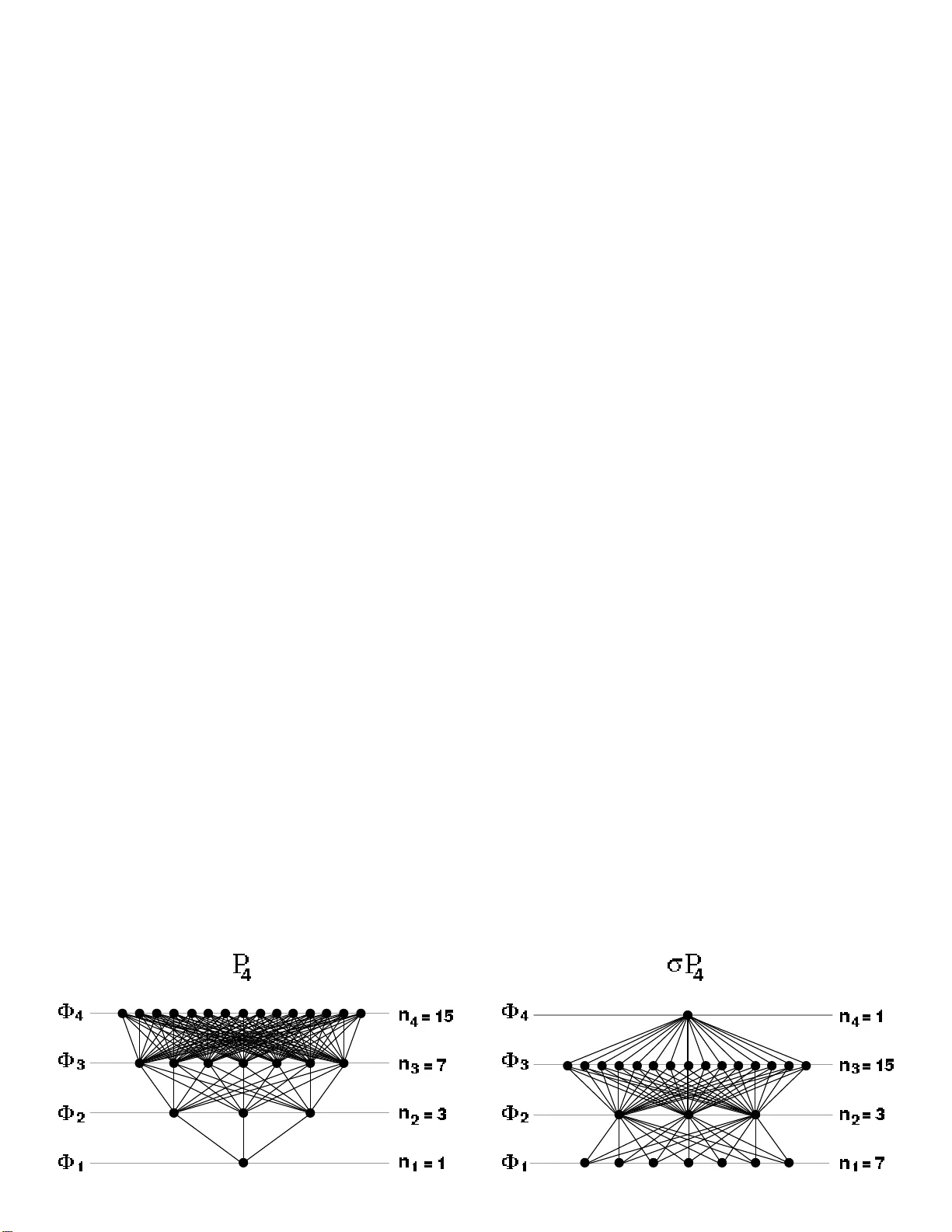
On Cobweb Posets and Discret e F-Bo xes Tilings Maciej Dziemia´ nczuk Institute of Informatics, Universit y of Gda´ nsk PL-80-952 Gda´ nsk, Wita Stw osza 57, Pola nd e-mail: mdziemianczuk@gmail.com Abstract F -b oxes defined in [6] as hyper-b oxes in N ∞ discrete space w ere applied here for the geometric des cription of the cobw eb p ose tes Hasse diagrams tiling s . The F - boxes edges s izes ar e taken to b e v alues o f terms of natural num b ers’ v alued sequence F . The pro blem of parti- tions of h yp er-b oxes represented b y graphs in to blocks of sp ecia l form is considered and these are to b e called F -tilings . The pro of of such tilings’ exis tence fo r cer tain sub-family o f a dmiss i- ble sequences F is delivered. The family o f F -tilings whic h we consider here includes among others F = Natural n umbers, Fibo nacci num- ber s, Gaussian integers with their cor resp onding F -no mial (Binomia l, Fibo nomial, Gaussian) co efficients as it is p ersis tent typical for com- binatorial interpretation of suc h tilings o riginated from Kwa ´ sniewski cobw eb po sets tiling pro blem . Extension o f this tiling problem onto the ge neral case multi F - nomial co efficients is here pr op osed. Reformulation of the pr esent cob- web tiling problem into a clique problem of a gra ph sp ecially inven ted for that pur p o se - is prop osed here to o . T o this end we illus trate the area of our reco nnaissance by means of the V enn type map of v arious cobw eb sequences families. AMS Cla s sification Number s : 0 5A10, 05 A19, 1 1 B83, 11B6 5 Keywor ds : par titio ns o f discrete h yp er-b oxes, cobw eb tiling problem, m ulti F-no mial co efficients Affiliated to The Internet Gian-Ca r lo Polish Seminar: http://ii. uwb.e du.pl/akk /sem/sem r ota.htm , Article No7 , April 200 9, 15 April 2009, (302 anniversary of Leonar d Euler’s birth) 1 In tro duction The Kwa ´ s niewski upside-down nota tion fr om [4] (see also [1, 2]) is b eing here tak en for gran ted. F or example n -th element of sequ ence F is F n ≡ n F , consequen tly n F ! = n F · ( n − 1) F · ... · 1 F and a set [ n F ] = { 1 , 2 , ..., n F } ho wev er [ n ] F = { 1 F , 2 F , ..., n F } . More ab ou t effectiv eness of this notation see references in [4] and Ap p endix “ On upside-down nota tion ” in [6]. 1 Throughout this pap er we shall consequent ly u se F letter for a sequence of p ositi v e in tegers i.e. F ≡ { n F } n ≥ 0 suc h that n F ∈ N for an y n ∈ N ∪ { 0 } . 1.1 Discrete m -dimensional F -Bo x Let u s d efine d iscrete m -dimen s ional F -b o x with edges sizes designated by natural n umbers’ v alued sequ ence F as describ ed b elo w. These F -b oxe s from [6] where in v ented as a resp o nse to Kwa ´ sniewski c obweb tiling pr oblem p osed in [1] (Problem 2 ther ein) and his question ab out visu alizatio n of this phenomenon. Definition 1 L et F b e a natur al numb ers’ value d se que nc e { n F } n ≥ 0 and m, n ∈ N such that n ≥ m . Then a set V m,n of p oints v = ( v 1 , ..., v m ) of discr ete m -dimensional sp ac e N m given as fol lo ws V m,n = [ k F ] × [( k + 1) F ] × ... × [ n F ] (1) wher e k = n − m + 1 and [ s F ] = { 1 , 2 , ..., s F } is c al le d m -dimensional F -b ox. Figure 1: F -Bo xes V 2 , 3 and V 3 , 4 with sub-b oxes. In the case of n = m we write for short V m,m ≡ V m . Assu me that w e ha v e a m -dimensional b o x V m,n = W 1 × W 2 × ... × W m . Then a set A = A 1 × A 2 × ... × A m suc h th at A s ⊂ W s , | A s | > 0 , s = 1 , 2 , ..., m ; is called m -dimensional sub-b ox of V m,n . Moreo ver, if for s = 1 , 2 , ..., m these sets A s satisfy the follo wing | A s | = ( σ · s ) F for an y p erm utation σ of set { 1 F , 2 F , ..., m F } then A is called m -dimensional sub-b ox of the f orm σ V m . Compare w ith Figure 6. Note, that the p ermutation σ migh t b e und ersto o d here as an orienta tion of sub-b o x’s p osition in the b o x V m,n . An y t w o sub -b o xes A and B are disjoin t if its s ets of p o in ts are disj oin t i.e. A ∩ B = ∅ . 2 The n umber of p oin ts v = ( v 1 , ..., v m ) of m -dimensional b o x V m,n is called volume . It it easy to see that the volume of V m,n is equal to | V m,n | = n F · ( n − 1) F · ... · ( n − m + 1) F = n m F (2) while f or m = n | V m | = | σ V m | = m F · ( m − 1) F · ... · 1 F = m F ! (3) 1.2 P art ition of discrete F -b o xes Let us consid er m -d imensional F -b o x V m,n . A finite collectio n of λ pairwise disjoin t sub-b o x es B 1 , B 2 , ..., B λ of the volume equal to κ is called κ -p artition of V m,n if their set union of giv es th e w hole b o x V m,n i.e. [ 1 ≤ j ≤ λ B j = V m,n , | B i | = κ, i = 1 , 2 , ..., λ. (4) Con ven tion. In the follo wing, we sh all deal only with these κ -partition of m -dimensional b o xes V m,n , whic h volume κ of su b-b oxe s is equal to the v olume of b o x V m i.e. κ = | V m | . Of cours e th e b ox V m,n has κ -partition not for al l F - sequ en ces [8]. Therefore we introd u ce the name: F -admissible sequence wh ic h means that F satisfies the necessary and sufficien t conditions f or the b ox V m,n to h a ve κ -partitions. In order to pro ceed let us recall first what follo ws. Definition 2 ([1, 2]) L et F b e a natur al numb ers’ value d se quenc e F = { n F } n ≥ 0 . Then F -nomial c o efficient is i dentifie d with the symb ol n m F = n F ! m F !( n − m ) F ! = n m F m F ! (5) wher e n 0 F = 0 F ! = 1 . Definition 3 ([1, 2]) A se quenc e F is c al le d admissible if, and only if for any n, m ∈ N ∪ { 0 } the value of F - nomial c o efficient is natur al numb er or zer o i.e. n m F ∈ N ∪ { 0 } (6) while n ≥ m e lse is zer o. Recall no w also a combinatorial in terp retation of the F -nomial co effi- cien ts in F -b o x reformulate d form (consult Remark 5 in [4] and [6]). And note: these co efficien ts encompass among others Binomial, Gaussian and Fib onomial co efficien ts. 3 F act 1 (Kwa ´ sniewski [1, 2]) L e t F b e an admissible se quenc e. T ake any m, n ∈ N su c h that n ≥ m , then the v alue of F -nomial c o efficie nt n m F is e qual to the numb er of sub- b oxes that c onstitute a κ -p artition of m -dimensional F -b ox V m,n wher e κ = | V m | . Pr o of. Th is pro of comes fr om Observ ation 3 in [1, 2] an d w as adopted h ere to the language of discrete b o xes. Let us consider m -d imensional b o x V m,n with | V m,n | = n m F . The vo lume of su b-b oxe s is equ al to κ = | V m | = m F !. Therefore the n um b er of su b -b o xes is equal to n m F m F ! = n m F F rom defin ition of F -admissible sequence we ha v e that the ab ov e is n atural n um b er. Hence th e thesis While considering an y κ -partition of certain m -d imensional b o x we only assume th at sub -b o xes ha v e the same volume . In the next s ection we shall take into accoun t these partitions wh ic h sub -b o xes hav e additionally established structure. 1.3 Tiling problem No w, sp ecial κ -partitions of discrete b o xes are considered. Namely , we deal with only th ese partitions of m -dimens ional b o x V m,n whic h all su b-b oxes are of t he form V m . Definition 4 L et V m,n b e a m -dimensional F -b ox. Then any κ -p artition into sub -b oxes of the form V m is c al le d tiling of V m,n . It wa s shown in [8] that j u st the adm issibilit y condition (6) is not s u f- ficien t f or the existence a tiling for an y giv en m -dimensional b o x V m,n . Kw a ´ sniewski in h is pap ers [1, 2] p osed the follo wing problem called Cob- web Tiling Pr oblem , whic h was a starting p oin t of the researc h with results b eing rep orted in the presen ts n ote. Problem 1 ( T iling) Supp ose now that F is an admissible se que nc e. Under which c onditions any F -b ox V m,n designate d by se quenc e F has a tiling? Find effe ctive char acterizations and/or find an algorithm to pr o duc e these tilings. In the n ext sections we prop ose certain family T λ of sequences F . T h en w e prov e that any F -b o x V m,n , wh ere m, n ∈ N designated by F ∈ T λ has a tiling w ith giving a construction of it. 4 Figure 2: Sample 3D and 2D tilings. 1.4 Cob web r epresen tation In this section w e recall [6] that discrete F -b o xes V m,n are unique co din gs represent ing Cobwebs , int ro duced by K w a ´ sniewski [1, 2] as a sp ecial graded p osets. An y p oset might b e represent ed as a Hasse digraph and this ap- proac h to tiling problem will b e used throughout the p ap er. Next w e shall consider partitions of m -dimen s ional b o xes as a p artitions of cobw ebs with m lev els int o sub-cob webs called blo c ks. In th e follo wing w e quote some n ecessary notation of Cobwebs adopted to the tiling problem. F or more on Cobwebs see source pap ers [1, 2, 4] and r eferences therein. Definition 5 L et F b e a natur al numb ers’ value d se que nc e. Then a simple gr aph h V , E i , such tha t V = S k ≤ s ≤ n Φ s and E = n { u, v } : u ∈ Φ s ∧ v ∈ Φ s +1 ∧ k ≥ s < n o (7) wher e Φ s = { 1 , 2 , ..., s F } i s c al le d c obweb layer h Φ k → Φ n i . Figure 3: Cobw eb lay er h Φ 2 → Φ 4 i designated b y F =Natural n u m b ers. Supp ose that w e ha v e a cob web la yer h Φ k → Φ n i of m lev els Φ s , wh ere m = n − k + 1. Then any cob w eb la yer h φ 1 → φ m i of m lev els φ s suc h th at φ s ⊆ Φ s , | φ s | = s F , s = 1 , 2 , ..., m ; (8) is called c obweb blo ck P m of la y er h Φ k → Φ n i . Additionally , one considers cob web blo cks obtained via p ermutation σ of theirs lev els’ order as follo ws (Compare with Figure 4). 5 Figure 4: Examp le of cobw eb blo c ks P 3 and σ P 3 . Definition 6 L et a c obweb layer h Φ k → Φ n i with m leve ls Φ s b e gi ven, wher e m = n − k + 1 . Then a c obweb blo ck P m with m levels φ s such tha t φ s ⊆ Φ s , | φ s | = ( σ · s ) F , s = 1 , 2 , ..., m ; (9) wher e σ is a p ermutation of the set { 1 F , 2 F , ..., m F } is c al le d c obweb blo ck of the form σ P m . Figure 5: F -Bo xes of the f orm σ V 2 and cobw eb b lo cks σ P 2 . While sa ying “a blo ck σ P m of layer h Φ k → Φ n i ” we mean that the n umb er of lev els in b lo c k an d la ye r is the same i.e. m = n − k + 1 and eac h of lev els of blo c k are n on-empt y s u bsets of corresp onding level s in the lay er. Assume th at w e ha ve a cob we b lay er h Φ k → Φ n i . A path π f rom an y v ertex at first lev el Φ k to any vertex at the last lev el Φ n , su c h that π = { v k , v k +1 , ..., v n } , v s ∈ Φ s , s = k , k + 1 , ..., n ; is noted as a maxim al-p ath π of h Φ k → Φ n i . In the same wa y we n omin ate maximal-p ath of cobw eb blo c k σ P m . Let C max ( A ) denotes a set of maximal -paths π of c ob web blo ck A . (Com- pare with [4]). Tw o cobw eb blo c ks A, B of la yer h Φ k → Φ n i are max-disjoint or d isjoin t for short ([1, 2]) if, and only if its sets of maximal-paths are dis- join t i.e. C max ( A ) ∩ C max ( B ) = ∅ . T h e cardin alit y of s et C max ( A ) is called size of blo ck A . Observ at ion 1 ([6]) L et F b e a natur al numb ers’ value d se quenc e and k , n ∈ N . Then any F -b ox V m,n is unique ly r epr ese nte d by c obweb layer h Φ k → Φ n i and vic e versa i.e., V m,n ⇔ h Φ k → Φ n i . (10) wher e k = n − m + 1 . 6 Figure 6: F -Bo xes of the f orm σ V 3 and cobw eb b lo cks σ P 3 . Pr o of. Consider a cob w eb la y er h Φ k → Φ n i of m leve ls Φ and m -dimensional b o x V k ,n . Observe that an y maximal-path π = ( v 1 , v 2 , ..., v m ) of the la yer corresp onds to only one p oin t x = ( x 1 , x 2 , ..., x m ) of m -d imensional b o x V m,n , and vice versa, i.e. [ s F ] ∋ x s ⇔ v s ∈ [ s F ] , s = 1 , 2 , ..., m ; And the num b er of these maximal-paths and p oin ts is the same (Comp are with [4] and [6]) i.e. | C max ( h Φ k → Φ n i ) | = | V m,n | where m = n − k + 1. Figure 7: Corr esp onden ce b et w een tiling of F -b o x V 3 , 4 and h Φ 3 → Φ 4 i . Next, we d ra w terminology of F -b o xes’ partitions b ac k to cobw eb’s lan- guage, used in the n ext part of this note. T ak e an y cob w eb la yer h Φ k → Φ n i with m lev els. Then a set of λ pairwise disjoin t cob web blo cks A 1 , A 2 , ..., A λ of m level s such that its size is equal to κ and th e un ion of C max ( A 1 ) , C max ( A 2 ) , ..., C max ( A λ ) is equal to the set 7 C max ( h Φ k → Φ n i ) is called c obweb κ - p artition . Finally , a κ -partition of la yer h Φ k → Φ n i with m levels in to cob web blo cks of the form σ P m is called c obweb tiling . Let us sum it u p with the follo win g T able 1. T able 1: Equiv alen t n otation and terminology . Cob webs F -b oxes 1. Maximal-path ( v 1 , ..., v m ) ∈ h Φ k → Φ n i P oint ( x 1 , ..., x m ) ∈ V m,n 2. Cob web la y er h Φ k → Φ n i F -b ox V m,n 3. Cob web blo ck σ P m ⊂ h Φ k → Φ n i Sub-b o x σ V m ⊂ V m,n 4. Tiling of cobw eb la yer Tiling of F -b o x where k = n-m+ 1. 2 Cob w eb tiling sequences Recall that for some F - admissible sequences there is no m etho d to tile cer- tain F -b o xes V m,n or accordingly cobw eb la y ers h Φ k → Φ n i (no tiling prop- ert y). F or example see Figure 8 that comes from [8]. In the next part of this n ote, we defi n e and consider only sequences w ith tiling prop erty . Figure 8: Lay er h Φ 5 → Φ 7 i that do es not ha ve tiling w ith b lo c ks σ P 3 . Definition 7 A c obweb admissible se quenc e F such that for any m, n ∈ N the c obweb layer h Φ k → Φ n i ha s a tiling is c al le d c obweb tiling se que nc e. Let T denotes the family of all cobw eb tiling sequ en ces. Characteriza - tion of w hole family T is still op en problem. Nev ertheless we d efi ne certain subfamily T λ ⊂ T of non-trivial cob web tiling sequences. This family con- tains among others Natural and Fib onacci num b ers, Gaussian inte gers and others. 8 Notation 1 L et T λ denotes the family of natur al numb er’s value d se quenc es F ≡ { n F } n ≥ 1 such tha t for any n -th term of F satisfies the fol lowing holds ∀ m , k ∈ N , n F = ( m + k ) F = λ K · k F + λ M · m F (11) while 1 F ∈ N and for c ertain c o effic i ents λ K ≡ λ K ( k , m ) ∈ N ∪ { 0 } and λ M ≡ λ M ( k , m ) ∈ N ∪ { 0 } . Note, co efficient s λ K and λ M migh t b e considered as a n atural n u m b ers’ with ze ro v alued infinite m atrixes λ K ≡ [ k ij ] i,j ≥ 1 and λ M ≡ [ m ij ] i,j ≥ 1 . More- o ve r the sequen ce F ≡ { n F } n ≥ 0 is uniqu ely designated by these matrixes λ K , λ M and first element 1 F ∈ N . Corollary 1 L et a se quenc e F ∈ T λ with its c o efficients’ matrixes λ K , λ M and a c omp osition ~ β = h b 1 , b 2 , ..., b k i of numb er n into k nonzer o p arts b e given. Then the fol lowing takes plac e n F = 1 F n X s =1 λ s ( ~ β ) · ( b s ) F (12) wher e λ s ( ~ β ) = λ K ( b s , b s +1 + ... + b k ) s − 1 Y i =1 λ M ( b i , b i +1 + ... + b k ) (13) or e quiv alent λ s ( ~ β ) = λ M ( b s +1 + ... + b k , b s ) s − 1 Y i =1 λ K ( b i +1 + ... + b k , b i ) . (14) Pr o of. It is a straightfo rwa rd algebraic in duction exercise usin g prop ert y (11) of the sequence T λ . The fi rst form (13) of th e coefficients λ s ( ~ β ) comes from the follo wing b 1 + ( n − b 1 ) F ⇒ b 1 + b 2 + ( n − b 1 − b 2 ) F while th e s econd one (14) fr om ( n − b k ) + b k F ⇒ ( n − b k − b k − 1 ) + b k − 1 + b k F If w e tak e a vec tor h 1 , 1 , ..., 1 i of n ones i.e. b s = 1 for an y s = 1 , 2 , ..., n ; then we obtain alternativ e form ula to compute elements of the sequence F . 9 Corollary 2 L et F ∈ T λ b e given. Then n -th element of the se quenc e F satisfies n F = 1 F · n X s =1 λ K (1 , n − s ) s − 1 Y i =1 λ M (1 , n − i ) (15) for any n ∈ N . Corollary 3 L et any se quenc e F ∈ T λ b e given. Then for any n, k ∈ N ∪ { 0 } such tha t n ≥ k , the F -nomial c o efficients satisfy b elow r e cu rr enc e identity n k F = λ K n − 1 k − 1 F + λ M n − 1 k F (16) wher e n n F = n 0 F = 1 . Pr o of. T ak e an y F ∈ T λ and n ∈ N ∪ { 0 } . Then from (11) of T λ and for an y m, k ∈ N ∪ { 0 } suc h that m + k = n w e ha ve that n -th elemen t of the sequence F satisfies follo win g recurr ence n F = ( k + m ) F = λ K · k F + λ M · m F Multiply b oth sides of abov e equation by ( n − 1) F ! k F ! · m F ! to get n F ! k F ! · m F ! = λ K · ( n − 1 ) F ! ( k − 1) F ! · m F ! + λ M · ( n − 1) F ! k F ! · ( m − 1) F ! And fr om Definition 2 of F -nomial co efficient s we hav e n k F = λ K n − 1 k − 1 F + λ M n − 1 k F It turns out that the recur r ence form ula (16) giv es us a metho d to gen- erating tilings of any lay er h Φ k → Φ n i designated b y sequ ence F ∈ T λ . Theorem 1 L et F b e a se quenc e of T λ family. Then F is c obweb tiling. Figure 9: Picture of Th eorem 1 pro of ’s id ea. Pr o of. Supp ose that w e hav e a cob web la y er h Φ k +1 → Φ n i with m lev els designated by sequence F fr om T λ family and m = n − k . Consider Φ n lev el 10 with n F v ertices. F rom (11) we ha ve that the n um b er of vertices at this lev el is the sum of λ M · m F and λ K · k F . T herefore we sep arate them by cutting in to t w o disjoint subsets as illustrated by Figure 9 and cop e at fir st λ M · m F v ertices in Step 1. Then we shall cop e the rest λ K · k F ones in Step 2. Figure 10: Picture of T h eorem 1 pr o of ’s Step 1. Step 1. T emp orarily w e hav e λ M · m F fixed vertices on Φ n lev el to consider (Figure 10). Let u s co ve r them λ M times by m -th level of blo c k σ P m , wh ic h has exactly m F v ertices. If λ M = 0 w e skip th is step. What w as left is th e la y er h Φ k +1 → Φ n − 1 i and we migh t ev ent ually partition it w ith smaller disjoin t blo c k s σ P m − 1 in th e next in d uction step . Figure 11: Picture of T h eorem 1 pr o of ’s Step 2. Step 2. Consider no w the second complementary situation, wh er e we ha ve λ K · k F v ertices on Φ n lev el b eing fixed (Figure 11). If λ K = 0 w e skip this step. Obs er ve that if we mo ve th is lev el lo we r th an Φ k +1 lev el, w e obtain exactly λ K the same la y ers h Φ k → Φ n − 1 i to b e partitioned w ith disjoin t blo cks of th e form σ P m . This “ move ” op eration is j u st p ermutatio n σ of leve ls’ order. R e c apitulation. Th e la yer h Φ k +1 → Φ n i migh t b e partitioned in to σ P m blo c ks if h Φ k +1 → Φ n − 1 i might b e partitioned into σ P m − 1 and h Φ k → Φ n − 1 i in to σ P m again. Contin uing these steps by induction, we are left to p ro ve that h Φ k → Φ k i migh t b e partitioned into σ P 1 blo c ks and h Φ 1 → Φ m i into σ P m ones, what is trivial Observ at ion 2 L et F b e a c obweb tiling se quenc e fr om the family T λ . Then 11 the numb e r n n k o 1 F of differ e nt tilings of layer h Φ k → Φ n i wher e n, k ∈ N , n, k ≥ 1 is e qual to: n k 1 F = n F ! ( m F !) λ M · (( k − 1) F !) λ K · n − 1 k 1 F λ M · n − 1 k − 1 1 F λ K (17) wher e n n n o 1 F = 1 and n n 1 o 1 F = 1 . Pr o of. Acco rding to steps of the pro of of T heorem 1 w e might choose m F v ertices λ M times at n -th level and next ( k − 1 ) F v ertices λ K times ou t of n F ones in n F ! ( m F !) λ M · (( k − 1) F !) λ K w ays. Next recurrent steps of the p ro of of Theorem 1 r esult in formula (17) via pr o duct ru le of coun ting Note that n n k o 1 F is not the num b er of all different tilings of the la yer h Φ k → Φ n i i.e. n n k o 1 F ≤ n n k o F as computer exp eriments sho w [8]. Th ere are m u c h more other tilings with blo cks σ P m . 3 Cob w eb m ulti tiling In this section, more general case of the tiling pr oblem is considered. F or that to do w e in tro duce the so-called m u lti F -nomial co efficien ts that coun ts blo c ks of m ulti-blo c k partitions. Definition 8 L et natur al numb ers’ value d se quenc e F ≡ { n F } n ≥ 0 and a c omp osition h b 1 , b 2 , ..., b k i of the numb er n b e give n. Then the multi F - nomial c o efficient is identifie d with the symb ol n b 1 , b 2 , ..., b k F = n F ! ( b 1 ) F ! · ... · ( b k ) F ! (18) while n = b 1 + b 2 + ... + b k . Corollary 4 L et F b e any F -c obweb admissible se quenc e. Then value of the multi F -nomial c o efficient is natur al nu mb er or zer o i.e. n b 1 , b 2 , ..., b k F ∈ N ∪ { 0 } (19) for any n, b 1 , b 2 , ..., b k ∈ N such that n = b 1 + b 2 + ... + b k . F or the sake of forthcoming combinatoria l inte rpretation of m ulti F - nomial co efficients w e introd uce the f ollo wing n otatio n. 12 Definition 9 L et a c obweb layer h Φ 1 → Φ n i of n levels Φ s and a c omp osition h b 1 , b 2 , ..., b k i of numb er n into k non-zer o p arts b e given. Then any c obweb layer h φ 1 → φ n i of n levels φ s such tha t φ s ⊆ Φ s , s = 1 , 2 , ..., n ; (20) wher e the c ar dinality of φ s is e qual to s -th element of the ve ctor L given as fol lows L = σ · h 1 , 2 , ..., b 1 , 1 , 2 , ..., b 2 , ..., 1 , 2 , ..., b k i for any p e rmutation σ of a set [ n ] is c al le d c obweb multi-blo ck of the form σ P b 1 ,b 2 ,...,b k . Figure 12: Examples of multi blo cks P 4 , 2 , 1 and σ P 4 , 2 , 1 . In the case of σ = id we write for short σ P b 1 ,b 2 ,...,b k = P b 1 ,b 2 ,...,b k . Com- pare w ith Figure 12. Example 1 T ak e a sequence F of next natural n umbers i.e. n F = n and cob we b lay er h Φ 1 → Φ 4 i designated by F . A samp le multi tiling of th e la ye r h Φ 1 → Φ 4 i with the h elp of 4 2 , 2 F = 6 disjoint m u lti blo c ks of the form σ P 2 , 2 is in Figure 13. Observ at ion 3 L et h Φ 1 → Φ n i b e a c obweb layer and h b 1 , ..., b k i b e a c om- p osition of the numb er n into k nonzer o p arts. Then the value of multi F -nomial c o efficient n b 1 ,b 2 ,...,b k F is e qu al to the numb er of blo cks that form the c obweb κ -p artition, wher e κ = | C max ( P b 1 ,...,b k ) | . Pr o of. T he pro of is n atural extension of Observ ation 3 in [1, 2] . Th e num b er of maximal paths in la ye r h Φ 1 → Φ n i is equal to n F !. Ho we v er the num b er of maximal paths in any m ulti blo c k σ P b 1 ,b 2 ,...,b k is ( b 1 ) F ! · ( b 2 ) F ! · ... · ( b k ) F !. T h u s the num b er of suc h blo c ks is equal to 13 Figure 13: Sample multi tiling of la yer h Φ 1 → Φ 4 i from Example 2. n F ! ( b 1 ) F ! · ( b 2 ) F ! · ... · ( b k ) F ! where n = b 1 + b 2 + ... + b k for any n, k ∈ N Of course for k = 2 we h a ve n b, n − b F ≡ n b F = n n − b F (21) Note. F or any p erm u tation σ of the set [ k ] the follo wing holds n b 1 , b 2 , ..., b k F = n b σ 1 , b σ 2 , ..., b σk F (22) as is obvious fr om Defin ition 8 of the m u lti F-nomial symbol. i.e. n F ! ( b 1 ) F ! · ( b 2 ) F · ... · ( b k ) F = n F ! ( b σ 1 ) F ! · ( b σ 2 ) F · ... · ( b σk ) F Let u s observ e also that for an y natural n , k and b 1 + ... + b m = n − k the follo wing holds n k F · n − k b 1 , b 2 , ..., b m F = n k , b 1 , ..., b m F (23) Corollary 5 L et F ∈ T λ and a c omp osition ~ β = h b 1 , ..., b k i of numb er n into k p arts b e given. Then the multi F -nomial c o efficients satisfy the fol lowing r e cu rr enc e r elation n b 1 , b 2 , ..., b k F = k X s =1 λ s ( ~ β ) · n − 1 b 1 , ..., b s − 1 , b s − 1 , b s +1 , ..., b k F (24) 14 for c o e ffic i ents λ s ( ~ β ) fr om (13) and for any n = b 1 + ... + b k and n n, 0 ,..., 0 F = 1 . Pr o of. T ak e an y F ∈ T λ and a comp osition ~ β = h b 1 , ..., b k i of the num b er n . Then from Corollary 1 we ha ve that for certain co efficien ts λ s ( ~ β ) an y n -th elemen t of the sequen ce F satisfies n F = k X s =1 λ s ( ~ β ) · ( b s ) F If w e multiply b oth sid es by ( n − 1) F ! ( b 1 ) F ! · ... · ( b k ) F ! then w e obtain n b 1 , ..., b k F = k X s =1 λ s ( ~ β ) ( n − 1 ) F ! ( b 1 ) F ! · ... · ( b s − 1 ) F !( b s − 1) F !( b s +1 ) F ! · ... · ( b k ) F ! Hence th e thesis Theorem 2 L et any se que nc e F ∈ T λ b e given. Then the se que nc e F is c obweb multi tiling i.e. any layer h Φ 1 → Φ n i might b e p artitione d into multi- blo ck s of the form σ P b 1 ,b 2 ,...,b k such tha t b 1 + ... + b k = n . Pr o of. T ak e any cob w eb lay er h Φ 1 → Φ n i d esignated by sequence F ∈ T λ and a num b er k ∈ N . W e need to partition the la y er into disjoin t m u lti blo c ks of the form σ P b 1 ,b 2 ,...,b k . Figure 14: Idea’s pictur e of Th eorem 2. Consider lev el Φ n with n F v ertices. F rom Corollary 1 we ha ve th at the n um b er of vertic es at this lev el is the follo wing sum n F = k X s =1 λ s ( ~ β ) · ( b s ) F for certain co efficient s λ s ( ~ β ) where 1 ≤ s ≤ k and ~ β = h b 1 , b 2 , ..., b k i . Therefore let us separate these n F v ertices by cu tting in to k d isj oin t sub sets as illustrated by Fig. 14 and cop e at fir s t λ 1 · ( b 1 ) F v ertices in Step 1, then 15 λ 2 · ( b 2 ) F ones in S tep 2 and so on up to the last λ k · ( b k ) F v ertices to consider in th e last k -th step. I f any λ i = 0 we skip i -th step. Step 1. T emp orarily we ha v e λ 1 · ( b 1 ) F fixed vertices at leve l Φ n to consider. L et u s cov er them λ 1 times by ( b 1 )-th lev el of b lo c k P b 1 ,b 2 ,...,b k , whic h h as exactly ( b 1 ) F v ertices. What wa s left is th e la ye r h Φ 1 → Φ n − 1 i and w e m igh t p artition it with smaller disjoint blocks σP b 1 − 1 ,b 2 ,...,b k in the next ind uction step. Note. In the next indu ction steps we use smaller blo c ks σ P with ou t lev els which we h a ve b een already used in p r evious steps (disjoin t of b lo c ks condition). Step 2. C on s ider n o w the second situation, wh ere we ha ve λ 2 · ( b 2 ) F v ertices at lev el Φ n b eing fixed. W e co v er them λ 2 times b y ( b 1 + b 2 )-th lev el of block P b 1 ,b 2 ,...,b k , whic h has ( b 2 ) F v ertices. Then we obtain smaller la yer h Φ 1 → Φ n − 1 i to b e partitioned with blo c ks σ P b 1 ,b 2 − 1 ,b 3 ,...,b k . And so on up to ... Step k . Analogously to pr evious steps, we co v er the last λ b s v ertices b y the last ( b 1 + b 2 + ... + b k ) = n -th lev el of b lo c k P b 1 ,b 2 ,...,b k , obtaining smaller la ye r h Φ 1 → Φ n − 1 i to b e partitioned with blo c ks σ P b 1 ,...,b k − 1 ,b k − 1 . Conclusion. The la y er h Φ 1 → Φ n i migh t b e partitioned in to bloc ks σP b 1 ,b 2 ,...,b k if h Φ 1 → Φ n − 1 i migh t b e partitioned into σ P b 1 − 1 ,b 2 ,...,b k and h Φ 1 → Φ n − 1 i into σ P b 1 ,b 2 − 1 ,b 3 ,...,b k again and so on up to the la y er h Φ 1 → Φ n − 1 i wh ic h migh t b e partitioned in to σ P b 1 ,...,b k − 1 ,b k − 1 . Contin uing th ese steps b y in duction, w e are left to prov e that h Φ 1 → Φ k i might b e partitioned into blo c ks σ P 1 , 1 ,..., 1 or h Φ 1 → Φ 1 i by σ P 1 , 0 ,..., 0 ones, whic h is trivial. 4 F amily T λ ( α, β ) of cob w eb tiling sequences In this section a sp ecific family of cobw eb tiling s equ ences F ∈ T λ is pre- sen ted as an exemplification of a might b e source metho d. W e assume that co efficien ts λ K and λ M of F ∈ T λ tak e a form λ M ( k , m ) = α k λ K ( k , m ) = β m (25) while α, β ∈ N . Notation 2 L et T λ ( α, β ) denotes a f amily of natur al numb ers’ value d se- quenc es F ≡ { n F } n ≥ 0 c onstitute d by n - th c o efficients of the gener ating func- tion F ( x ) exp ansion i.e. n F = [ x n ] F ( x ) , wher e F ( x ) = 1 F · x (1 − αx )( 1 − β x ) (26) for c ertain α, β ∈ N ∪ { 0 } and 1 F ∈ N . 16 1. If ( α = β ), then F ( x ) = 1 F · x 1 − αx + αx F ( x ) which leads to n F = 1 F · n · α n − 1 n ≥ 1 (27) 2. If ( α 6 = β ), then F ( x ) = 1 F α − β 1 1 − αx − 1 1 − β x giv es us n F = 1 F α − β ( α n − β n ) n ≥ 1 (28) Prop osition 1 L e t F ∈ T λ ( α, β ) and c omp osition ~ b = h b 1 , b 2 , ..., b k i of the numb er n into k non-zer o p arts b e given. Then any n -th element of the se quenc e F satisfies the fol lowing r e curr enc e identity n F = k X s =1 b s ! F = k X s =1 λ s ( ~ b ) · ( b s ) F (29) wher e λ s ( ~ b ) = α b s +1 + ... + b k · β b 1 + ... + b s − 1 for any n = b 1 + ... + b k . Pr o of. T ake any comp osition ~ b = h b 1 , b 2 , ..., b k i of the num b er n ∈ N into k nonzero parts i.e. b 1 + b 2 + ... + b k = n . 1. If ( α = β ) then fr om (27) P k s =1 b s F = 1 F P k s =1 b s · α n − 1 = P k s =1 1 F b s α b s − 1 α n − b s = = P k s =1 ( b s ) F α n − b s 2. If ( α 6 = β ) then fr om (28) P k s =1 b s F = 1 F α − β α b 1 + P k s =2 b s − 1 F α − β β b k + P k − 1 s =1 b s = A + B Next, den ote S ± ( m ) for 1 < m < k such th at S + ( m ) + S − ( m ) = 0 as follo ws S ± ( m ) = ± 1 F α − β α P k s = m +1 b s · β P m s =1 b s . Then observ e th at if w e add to th e A + B the sum of S ± ( m ) where 1 < m < k i.e. A + B = A + B + P 1
Original Paper
Loading high-quality paper...
Comments & Academic Discussion
Loading comments...
Leave a Comment