Two-Way Relay Channels: Error Exponents and Resource Allocation
In a two-way relay network, two terminals exchange information over a shared wireless half-duplex channel with the help of a relay. Due to its fundamental and practical importance, there has been an increasing interest in this channel. However, surpr…
Authors: Hien Quoc Ngo, Tony Q.S. Quek, Hyundong Shin
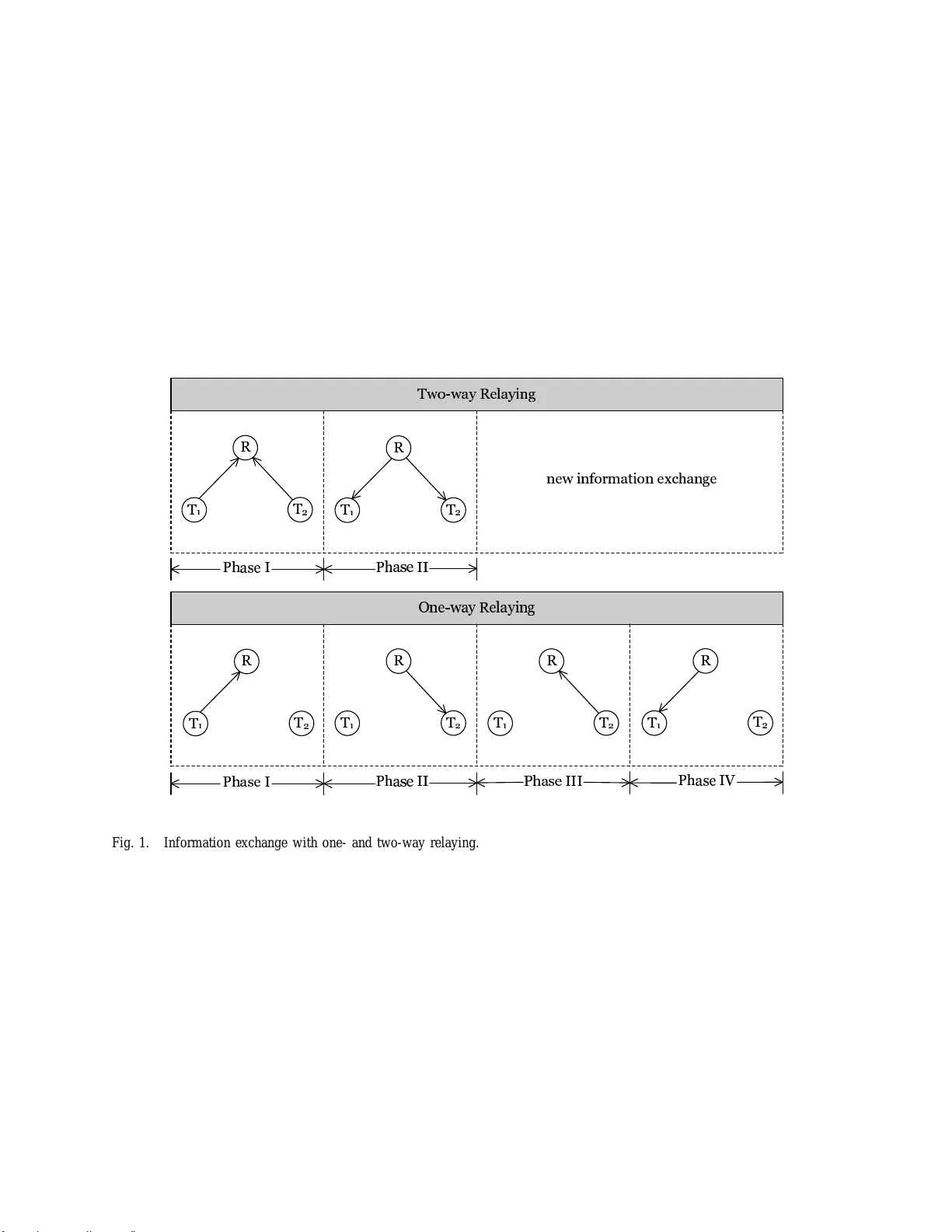
0 SUBMITTED TO THE IEEE TRANSA CTIONS ON COMMUNICA TIONS T wo-W ay Relay Channels: Error Expon ents and Resou rce Allocati on Hien Quoc Ngo, Student Member , IEEE , T on y Q. S. Quek, Member , IEEE , and Hyundong Shin, Member , IEEE Abstract In a two-way relay n etwork, two termin als exch ange inf ormation over a sha red wir eless half-d uplex channel with the help of a relay . Due to its f undamen tal and pr actical im portance, th ere has b een an increasing in terest in th is chan nel. Howe ver , s urp risingly , there has been little work tha t chara cterizes the fundam ental tradeoff between the commu nication r eliability and transmission rate across all signal- to- noise ratios. In this paper, we consider amplify -and-f orward (AF) two-way relaying due to its simplicity . W e first derive th e random co ding error exp onent for the link in each direction. Fro m the expo nent expression, th e capacity and cuto ff rate for each link are also d educed. W e then pu t fo rth the notio n of the bottleneck error exponent, wh ich is the worst exponent decay between the two links, to gi ve us in sight into the fun damental tradeoff between the r ate p air and inform ation-exchang e reliability of the two term inals. As application s of the error expo nent analysis, we present two optima l resourc e allocations to maximize the bottleneck err or exponen t: i) th e optim al rate allocation u nder a su m-rate constraint and its closed-fo rm quasi-op timal solution that r equires o nly kn owledge of the capacity and cutoff rate of e ach link; and ii) th e optimal power allocation under a tota l power constraint, which is formulated as a quasi-convex optimization p roblem. Numerical results verify o ur analysis and the effecti veness of the o ptimal rate and power allocations in max imizing the bottleneck error expo nent. Index T erms Amplify-a nd-for ward relaying, bidir ectional commun ication, quasi-co n vex op timization, rando m coding error expo nent, resour ce allocation , two-way re lay ch annel. H. Q. Ngo and H. Shin are with the Department of Electronics and Radio Enginee ring, Kyung Hee Univ ersity , 1 Seocheo n- dong, Giheung-g u, Y ongin-si, Gyeonggi-do 446-701, K orea (Email: ngoq uochien@khu.ac.kr; hsh in@khu.ac.kr). T . Q. S. Quek is with the Institute for Infocomm R esearch, 1 Fusionopolis W ay , #21-01 Conne xis South T o wer , Singapore 138632 (Email: qsquek@ieee .org). NGO et al. : TWO-W A Y RELA Y CHANNEL S: ERR OR EXPONENTS AND RESOURCE ALLOCA TION 1 I . I N T R O D U C T I O N The two-way communication channel was first introduced by Shannon, sh owing how to ef ficiently design mess age structures to enable sim ultaneous bi directional communication at the highest possible data rates [1]. Recently , th is m odel has regained significant interest by i ntroduc- ing an additio nal relay t o support the exchange of information between the two comm unicating terminals. The attracti ve feature of this two-w ay relay model is that it can compensate the spectral ineffi ciency of one-way relaying under a half-duplex constraint [2]–[7]. W ith one-way relaying, we sh ould use four p hases to exchange information bet ween two t erminals vi a a half-duplex relay , i.e., it t akes t wo phases to send information from one terminal to the other terminal and two phases for the rever se d irection (see Fig. 1). Howe ver , e xploit ing the kno wledge of terminals ’ own transm itted signals and the broadcast nature of the wireless medium, we can im prove the spectral ef ficienc y by using only two phases to exchange information in t he two-way relay channel (TWRC) [2]. Due to the aforementioned fundamental and practical importance of the TWRC, much work has in ve stigated the sum rate and the achie vable rate region o f the TWRC with d iff erent re- laying protocols [2]–[7]. The half-dupl ex ampli fy-and-forward (AF) and decode-and-forwar d (DF) TWRCs have been studied i n [2] where it was shown t hat both prot ocols with two-way relaying can redeem a signi ficant portion of the h alf-duplex loss. In [3], the achiev able rates for AF , DF , joint-DF , and denoise-and-forward relaying hav e been analyzed and the condition for m aximization of the two-w ay rate are in vestigated for each relaying scheme. The broadcast capacity region in terms of the m aximal probabi lity of error has been derived in [5] for the DF TWRC. A new achie vable rate region for the TWRC has been foun d in [6] for partial DF relaying, which i s a sup erposition of both DF and compress-and-forwa rd relaying. Bit error probability at each terminal has also been analy zed for a memoryl ess additive white Gaussi an noise (A WGN) TWRC [7]. Ho we ver , there has b een few work that chara cterizes t he fun damental tradeof f between the commun ication reliabili ty and transmis sion rate in the TWRC across all signal-to-noise rati o (SNR) regimes. In this paper , we consider half-dup lex AF two-way relaying due to its sim plicity in practical implementati on. T o characterize the fundamental tradeoff between the commu nication reliability and rate, we first d eri ve Gallager’ s random coding error exponent (RCEE)—the classical lo wer 2 SUBMITTED TO THE IEEE TRANSA CTIONS ON COMMUNICA TIONS bound to Shannon’ s reliabilit y functi on (s ee, e.g. , [8]–[11] and references therein)—for the li nk of each direction in th e AF TWRC. 1 Instead of considering only the achie vable rate or error probability as a performance measure, the RCEE results can re veal the inherent tradeoff between these m easures to un ve il the ef fecti veness o f two-way relaying in redeeming a significant portion of the half-duplex loss in the information exchange. From the exponent expression, the capacity and cutof f rate for each link in the TWRC are further deduced. W e then introduce the bottleneck error exponent, which is defined by the worst exponent decay between the link s of two directions, to capture the tradeoff between the rate pair of bo th links and the reliabilit y o f i nformation exchange at such a rate pair . Using thi s notion, we can appertain a bottleneck exponent value to each rate pair and characterize the bottleneck exponent plane from th e set of all p ossible rate pairs besides the achie v able rate re gion. This enables us to design a two-way relay network with reliable information exchange. For applications of the error exponent analysis for the TWRC, we present two optim al resource (rate and power) allocations , the main results of which can be sum marized as follows. • W e sho w t hat the opt imal rate allo cation to m aximize the bottl eneck er ror exponent un der a sum-rate constraint is a rate pair such t hat th e RCEE values of bot h links become identical at the respectiv e rates. This op timal rate pair can be determined by a clo sed-form solu tion for sum rates less th an a certain constant—called the decisive su m r ate —dependin g only on the cuto f f and critical rates of each link. Furthermo re, t he opti mal s olution requires only t he knowledge of each cutoff rate. At sum rates lar ger than t he decisiv e point, we can allocate a rate pair quasi-optimal ly i n closed form, requiri ng only knowledge of the capacity and cutoff rate of each link. • W e determine the optimal power allo cation that m aximizes the bottl eneck error exponent under a tot al power constraint of the two termin als. In the presence of perfect global chann el state information (CSI), we sho w that this po wer allocation problem can be form ulated as a quasi-con ve x optimization problem, where the optimal solution ca n be efficiently determined via a s equence of con vex feasibilit y problems in the form of second-order cone program s (SOCPs). The rest of this paper is or ganized as follows. In Section II, we describe the system model. In 1 In the follo wing, we shall use simply t he term “TWRC” to denote the AF TWRC . NGO et al. : TWO-W A Y RELA Y CHANNEL S: ERR OR EXPONENTS AND RESOURCE ALLOCA TION 3 Section III, we present the results o f the error e xponent analy sis for the TWRC. The opti mization frame work for two-way relay networks is developed for the rate and power allocations to maximize the bott leneck error exponent in Section IV . W e provide some nu merical results in Section V and finally con clude the paper in Section VI. Notation: Throughout the paper , we shall use the following notation . Boldface upper- and lower -case letters denote matrices and colum n vectors, respecti vely . The superscript ( · ) T denotes the transpo se. W e use R , R + , and R ++ to denot e the set of real numbers, nonnegative real numbers, and positive real num bers, respecti vely . A circularly s ymmetric complex G aussian dis- tribution with mean µ and v ariance σ 2 is denoted by C N ( µ, σ 2 ) and the e xponential distribution with a hazard rate λ is denoted by E ( λ ) . I I . S Y S T E M M O D E L W e consi der the TWRC as illustrated in Fig. 1, w here a half-dupl ex relay node R bidirec- tionally communicates b etween two terminals T k ∈T = { 1 , 2 } with AF relaying. In the first multipl e access phase, the terminals T k ∈T transmit their informat ion t o the relay and the recei ved signal at the relay is g iv en by y R = h 1 x 1 + h 2 x 2 + z R (1) where x k ∈T is the transmit ted signal from the termi nal T k ∈T with E | x k | 2 = p k , h k ∼ C N (0 , Ω k ) is the channel coef ficient from T k to the relay , and z R ∼ C N (0 , N 0 ) i s the com plex A WGN. 2 Note that | h k | 2 ∼ E (1 / Ω k ) . At the relay , t he receiv ed signal is scaled and broadcasted to b oth terminals in t he second broadcast phase, while satisfying its po wer constraint p R . Then, the recei ved signal at the terminal T k ∈T is giv en by y T ,k = h k x R + z T ,k (2) where x R = Gy R is the transmitted signal from the relay with E | x R | 2 = p R , z T ,k ∼ C N (0 , N 0 ) is th e A WGN, and G is the relaying gain given b y G = r p R p 1 | h 1 | 2 + p 2 | h 2 | 2 + N 0 . (3) 2 W e assume the channel reciprocity for h k as in [2]. 4 SUBMITTED TO THE IEEE TRANSA CTIONS ON COMMUNICA TIONS W e impose a total transmit po wer constraint P such that p 1 + p 2 ≤ P . As in [2], we f urther assume that t he terminal T k ∈T knows its own transmitted signal and has perfect CSI to remove sel f- interference prior to decodi ng. For notation al con venience, we shall refer t o the communi cation link T 1 → R → T 2 as the link L 1 and T 2 → R → T 1 as the link L 2 , respectively . W ith the self-interference cancellation, the ef fectiv e SNR of the link L k ∈T is given by γ eff k = p k p R α 1 α 2 p k α k + ( p R + p 1 p 2 /p k ) α 1 α 2 /α k + 1 (4) where α k ∈T , | h k | 2 / N 0 . I I I . E R RO R E X P O N E N T A NA L Y S I S A. Mathematical Pr eliminaries The reliability function or error exponent for a channel of the capacity C is the best exponent decay with t he codeword length N i n the average prob ability of error that one can achieve at a rate R < C [8]–[11]: E ( R ) , lim sup N →∞ − 1 N ln P opt e ( R, N ) (5) where P opt e ( R, N ) is th e avera ge block error probability for the optim al block code of l ength N and rate R . 3 As a classical lower bo und on the reliability function, the RCEE or Gall ager’ s exponent is giv en by [8] E r ( R ) , max Q max 0 ≤ ρ ≤ 1 { E 0 ( ρ, Q ) − ρR } (6) with E 0 ( ρ, Q ) , − ln ( Z Z Q ( x ) p ( y | x ) 1 1+ ρ dx 1+ ρ dy ) (7) where Q ( x ) is the input distribution and p ( y | x ) is the transition p robability . Unfortunately , the double maxim ization i n (6) is generally very difficult sin ce th e i nner integral i s raised to a fractional exponent when ρ ∈ (0 , 1) and the l ack of knowledge about t he optimal input distribution Q ( x ) . For analytical tractabil ity , th e Gaussian in put dist ribution Q ( x ) is often used, which is opti mal if the rate R approaches the channel capacity [8]–[11 ]. 3 Throughout the pape r, we shall us e a rate measured in units of nats per second per Hz (nats/s/Hz). NGO et al. : TWO-W A Y RELA Y CHANNEL S: ERR OR EXPONENTS AND RESOURCE ALLOCA TION 5 B. T wo-way Relay Channels The TWRC consists of two communication links and the achiev able rate can be characterized by the sum rate o f two parallel relay channels under perfect self-int erference cancellation [2]. As such, we need to first con sider the RCEE for each link and subs equently introduce a notion of the bottleneck error exponent for the TWRC to ef fective ly capture t he tradeof f between the individual rates and the reliabili ty . Using th e Gauss ian input distribution, we obt ain the fol lowing proposition for the RCEE of each link in the TWRC. Pr oposition 1: W ith the Gaussian input distribution, the RCEE for the link L k ∈T of the TWRC with A F relaying is giv en by E r ,k ( R ) = max ρ ∈ [0 , 1] { E 0 ,k ( ρ ) − 2 ρR } (8) where E 0 ,k ( ρ ) = − ln E γ eff k ( 1 + γ eff k 1 + ρ − ρ ) . (9) Pr oof: It follows immedi ately from th e resul ts of [10] along w ith th e self-interference cancellation at the terminal T k ∈T . Remark 1: It is difficult to obtain a closed-form solution for (9) in Proposi tion 1 due to an analytically intractable form of the ef fecti ve SNR γ eff k ∈T giv en in (4). In what foll ows, to alle viate such diffi culty and render (9) mo re amenable to further analysis, we use the up per bou nd γ ub k on the effec tive SNR γ eff k by ignoring the term 1 in the deno minator: γ ub k = p k p R α 1 α 2 p k α k + ( p R + p 1 p 2 /p k ) α 1 α 2 /α k (10) which corresponds to the ideal/hypothetical AF relayi ng [12]–[14]. Remark 2: The factor 2 of ρR in (8) i s due to the use of t wo phases for t he exchange of information in the TWRC. In contrast, with one-way relaying, the inform ation e xchange occurs over four p hases and hence, t his fac tor should be 4 , l eading the RCEE for each link to E r ,k ( R ) = max ρ ∈ [0 , 1] { E 0 ,k ( ρ ) − 4 ρR } . 4 4 In the one-way relay chan nel ( O WRC), if the total relaying po wer for information exchan ge is again constrained to p R , then the ideal/hypo thetical AF relaying yields the upper bound on the ef fectiv e SNR for the link L k ∈T as γ up k = p k ( p R / 2) α 1 α 2 p k α k + ( p R / 2) α 1 α 2 /α k which is slightly dif ferent from (10) bu t makes no de viation in the analysis. 6 SUBMITTED TO THE IEEE TRANSA CTIONS ON COMMUNICA TIONS Theor em 1: W ith the Gaussian input d istribution, t he RCEE for the li nk L k ∈T of the TWRC with i deal/hypothetical AF relaying is given by ˜ E r ,k ( R ) = max ρ ∈ [0 , 1] n ˜ E 0 ,k ( ρ ) − 2 ρR o (11) with ˜ E 0 ,k ( ρ ) = − ln E γ ub k ( 1 + γ ub k 1 + ρ − ρ ) = − ln 4 λ k µ k √ π Γ ( ρ ) √ λ k + √ µ k 4 H 1 , 1 , 1 , 1 , 2 1 , (1:1) , 0 , (1:2) η k (1+ ρ ) ( √ λ k + √ µ k ) 2 4 √ λ k µ k ( √ λ k + √ µ k ) 2 (2 , 1) (1 − ρ, 1) ; (1 / 2 , 1) — (0 , 1) ; ( 0 , 1) , (0 , 1) − 2 ( λ k + µ k ) √ λ k µ k √ π Γ ( ρ ) √ λ k + √ µ k 4 H 1 , 1 , 1 , 1 , 2 1 , (1:1) , 0 , (1:2) η k (1+ ρ ) ( √ λ k + √ µ k ) 2 4 √ λ k µ k ( √ λ k + √ µ k ) 2 (2 , 1) (1 − ρ, 1) ; (1 / 2 , 1) — (0 , 1) ; ( 1 , 1) , ( − 1 , 1) for 0 < ρ ≤ 1 (12) and ˜ E 0 ,k ( ρ ) = 0 for ρ = 0 , where Γ ( · ) is Euler’ s gamma functi on, H K,N ,N ′ ,M ,M ′ E , ( A : C ) ,F , ( B : D ) [ · ] is the generalized Fox H -function [15, eq (2.2.1)], and η k = p R p R + p 1 p 2 /p k λ k = N 0 p k Ω k µ k = N 0 Ω k ( p 1 p 2 /p k + p R ) Ω 1 Ω 2 . Pr oof: See Appendi x A. Remark 3: The maximum of the e xponent ˜ E r ,k ( R ) over ρ occurs a t R = 1 2 h ∂ ˜ E 0 ,k ( ρ ) /∂ ρ i ρ = ρ opt and hence, the sl ope of the exponent–rate curve at a rate R is equal t o − 2 ρ opt . The maximizing ρ opt lies in [0 , 1] if R cr ,k = 1 2 " ∂ ˜ E 0 ,k ( ρ ) ∂ ρ # ρ =1 ≤ R ≤ 1 2 " ∂ ˜ E 0 ,k ( ρ ) ∂ ρ # ρ =0 = h C k i (13) where R cr ,k and h C k i are the cr itical rate and th e (ergodic) capacity for the link L k ∈T , re spectively . For R < R cr ,k , w e ha ve ρ opt = 1 , yielding the slope of the exponent–rate curve is equal to − 2 and ˜ E r ,k ( R ) = ˜ E 0 ,k (1) − 2 R . Furthermore, the cut off rate for the link L k ∈T is given by NGO et al. : TWO-W A Y RELA Y CHANNEL S: ERR OR EXPONE NTS AND RES OURCE AL LOCA TION 7 R 0 ,k = ˜ E 0 ,k (1) / 2 . This quantit y is equal t o the value of R at which the exponent becomes zero by setting ρ = 1 . Whil e the capacity determi nes t he maximum achie vable rate, the cutoff rate determines the maximum practical transmi ssion rate for possible sequential decoding strategies and indicates both the values of the zero-rate exponent and the rate regime in whi ch the error probability can be made arbit rarily smal l by increasing the codew ord length. Cor ollary 1: The er godic capacity for the link L k ∈T of the TWRC with ideal/hypothetical AF relaying is given by h C k i = 2 λ k µ k √ π √ λ k + √ µ k 4 H 1 , 2 , 1 , 1 , 2 1 , (2:1) , 0 , (2:2) η k ( √ λ k + √ µ k ) 2 4 √ λ k µ k ( √ λ k + √ µ k ) 2 (2 , 1) (1 , 1) , ( 1 , 1) ; (1 / 2 , 1) — (1 , 1) , ( 0 , 1) ; (0 , 1) , (0 , 1) − ( λ k + µ k ) √ λ k µ k √ π √ λ k + √ µ k 4 H 1 , 2 , 1 , 1 , 2 1 , (2:1) , 0 , (2:2) η k ( √ λ k + √ µ k ) 2 4 √ λ k µ k ( √ λ k + √ µ k ) 2 (2 , 1) (1 , 1) , ( 1 , 1) ; (1 / 2 , 1) — (1 , 1) , ( 0 , 1) ; (1 , 1) , ( − 1 , 1) . (14) Pr oof: See Appendi x B. Cor ollary 2: The cutoff rate for t he lin k L k ∈T of th e T WRC wit h ideal/ hypothetical AF relaying is given by R 0 ,k = − 1 2 ln 4 λ k µ k √ π √ λ k + √ µ k 4 H 1 , 1 , 1 , 1 , 2 1 , (1:1) , 0 , (1:2) η k 2 ( √ λ k + √ µ k ) 2 4 √ λ k µ k ( √ λ k + √ µ k ) 2 (2 , 1) (0 , 1) ; (1 / 2 , 1) — (0 , 1) ; (0 , 1) , (0 , 1 ) − 2 ( λ k + µ k ) √ λ k µ k √ π √ λ k + √ µ k 4 H 1 , 1 , 1 , 1 , 2 1 , (1:1) , 0 , (1:2) η k 2 ( √ λ k + √ µ k ) 2 4 √ λ k µ k ( √ λ k + √ µ k ) 2 (2 , 1) (0 , 1) ; (1 / 2 , 1) — (0 , 1) ; (1 , 1) , ( − 1 , 1) . (15) Pr oof: It follows im mediately from (12) by settin g ρ = 1 . Remark 4: It is insuffic ient to characterize the information e xchange in th e TWRC b y o nly in vestigating th e RCEE for each link in dividually , as i t just reflects the tradeoff between t he communication rate and reliabil ity for the information t ransmission in one di rection. Therefore, we int roduce a notio n of the bottl enec k exponent for the TWRC to capture the tradeof f between the rate pair of both l inks and the reliabil ity of information exchange at such a rate pai r , enabli ng us to optim ize the resource allocation in t he TWRC. 8 SUBMITTED TO T HE IEEE TRANSACTIONS ON COMMUNICA TIONS Definition 1 (Bottleneck Err or Probability): F or a TWRC with the termin al T k ∈T transmittin g a cod e e N R k , N of rate R k , the bot tleneck error probability is defined as P ⋆ e , max k ∈T P ( k ) e (16) where P ( k ) e is th e error probability of the link L k . Note that Definit ion 1 can be app licable for a general TWRC, re gardless o f relaying protocols. From the random coding bound P ( k ) e ≤ e − N ˜ E r ,k ( R k ) (17) the bottleneck error probability of the TWRC is bounded by P ⋆ e ≤ max k ∈T e − N ˜ E r ,k ( R k ) . (18) Using (18), we define th e bo ttleneck error exponent of t he TWRC as follows. Definition 2 (Bottleneck Err or Expon ent): For a TWRC with the terminal T k ∈T transmittin g a code e N R k , N of rate R k , the bottleneck error exponent at the i nformation-exchange rate pair ( R 1 , R 2 ) is defined as E ⋆ r ( R 1 , R 2 ) , min k ∈T ˜ E r ,k ( R k ) . (19) Remark 5: Usi ng the RCEE o f t he link L k ∈T in Theorem 1 , we can readily o btain t he bottleneck error exponent E ⋆ r ( R 1 , R 2 ) . From Definition 2, we can s ee that the bottleneck error exponent captures the behavior of the w orst exponent decay between the two links in the TWRC and reflects the reliability of the inform ation exchange at a rate pair ( R 1 , R 2 ) . When the worst link is good enough, it means that th e other link must als o be good. As a resul t, using (19) as an information-exchange reliability m easure, we can design a two-way relay network such th at both l inks can comm unicate reliably . Besides t he achiev able rate re gion, we can also characterize the bott leneck exponent plane from the set of all possible rate pairs. Thi s plane cou ld provide us with further understand ing of the tradeof f between the rate pair ( R 1 , R 2 ) and the bot tleneck error exponent (i.e., in formation-exchange reliability). I V . O P T I M A L R E S O U R C E A L L O C A T I O N A. Optimal Rate All ocation In t he following, we present the optimal rate allocation that maximizes the bottleneck error exponent E ⋆ r ( R 1 , R 2 ) under a sum-rate constraint in th e reli able information-exchange region NGO et al. : TWO-W A Y RELA Y CHANNEL S: ERR OR EXPONE NTS AND RES OURCE AL LOCA TION 9 R = { ( R 1 , R 2 ) : 0 ≤ R 1 ≤ h C 1 i , 0 ≤ R 2 ≤ h C 2 i} . Mathematically , this rate allocation problem can b e formu lated as follows: P 1 = max R 1 ,R 2 E ⋆ r ( R 1 , R 2 ) s.t. R 1 + R 2 = R 0 ≤ R 1 ≤ h C 1 i , 0 ≤ R 2 ≤ h C 2 i (20) which can be solved by t he fol lowing t heorem. Theor em 2: Let C and L be the curve and straight line in R such that C = n ( R 1 , R 2 ) ∈ R : ˜ E r , 1 ( R 1 ) = ˜ E r , 2 ( R 2 ) o L = { ( R 1 , R 2 ) ∈ R : R 1 + R 2 = R } . Then, the optimal solutio n ( R 1 , R 2 ) opt of the rate allocation problem P 1 for the s um rate R ≥ | R 0 , 1 − R 0 , 2 | is the intersection point of the rate-pair curve C and straight line L . In particular , we h a ve ( R 1 , R 2 ) opt = R + R 0 , 1 − R 0 , 2 2 , R − R 0 , 1 + R 0 , 2 2 for | R 0 , 1 − R 0 , 2 | ≤ R ≤ R ⋆ d ( R , 0) for R < R 0 , 1 − R 0 , 2 , R 0 , 1 > R 0 , 2 (0 , R ) for R < R 0 , 2 − R 0 , 1 , R 0 , 1 < R 0 , 2 (21) where R ⋆ d is the decisive sum rate gi ven by R ⋆ d = min { 2 R cr , 1 − R 0 , 1 + R 0 , 2 , 2 R cr , 2 + R 0 , 1 − R 0 , 2 } . (22) Pr oof: See Appendi x C. Remark 6: For the su m rate R > R ⋆ d , we can determine the quasi-opt imal rate pai r as ( R 1 , R 2 ) opt ≈ R + R 0 , 1 − R 0 , 2 2 , R − R 0 , 1 + R 0 , 2 2 for R ⋆ d < R ≤ ` R ⋆ d ( R − h C 2 i , h C 2 i ) for R > ` R ⋆ d , h C 1 i > h C 2 i ( h C 1 i , R − h C 1 i ) for R > ` R ⋆ d , h C 1 i < h C 2 i (23) where ` R ⋆ d = min { 2 h C 1 i − R 0 , 1 + R 0 , 2 , 2 h C 2 i + R 0 , 1 − R 0 , 2 } . 5 Therefore, with knowing th e ca- pacity and cutoff rate of each link in the TWRC, we can determine the optimal rate pair 5 The numerical e xample in Section V will sho w that this quasi-optimal rate pair well appro ximates t he optimal one f or the sum rate R > R ⋆ d . 10 SUBMITTED TO T HE IEEE TRANSACTIONS ON COMMUNICA TIONS ( R 1 , R 2 ) opt that maxim izes t he reliability of in formation exchange at the sum rate R —exactly for R ≤ R ⋆ d using (21), and approximately for R > R ⋆ d using (23). B. Optimal P ower Allocation In this sub section, we present the opt imal power allocation that maximi zes the b ottleneck error exponent E ⋆ r ( R 1 , R 2 ) at a rate pair ( R 1 , R 2 ) . In the presence of perfect global CSI, for fixed ρ and ( R 1 , R 2 ) , we are maximizing the instantaneous bottleneck exponent over p p p = [ p 1 p 2 ] T for each fading s tate, i.e., before av eraging with respect to fading. Mathem atically , we can formulate this optimization problem as foll ows: P 2 = max p p p E int r ( p p p, ρ, R 1 , R 2 ) s.t. p 1 + p 2 ≤ P p 1 ≥ 0 , p 2 ≥ 0 (24) where t he s ubscript “int” denotes an instant aneous value and E int r ( p p p, ρ, R 1 , R 2 ) = min k ∈T E int r ,k ( p p p, ρ, R k ) (25) E int r ,k ( p p p, ρ, R k ) , − ln 1 + 1 1 + ρ p k p R α 1 α 2 p k α k + ( p R + p 1 p 2 /p k ) α 1 α 2 /α k + 1 − ρ − 2 ρR k . (26) W ith the opt imizing p p p opt obtained by solving the problem (24), we can find t he bot tleneck error exponent with optimal power allocation as fol lows: E ⋆ r ( R 1 , R 2 ) = E α 1 ,α 2 max ρ ∈ [0 , 1] E int r p p p opt , ρ, R 1 , R 2 . (27) Since p 1 and p 2 are posi tiv e, we can define ψ k ∈T , √ p k and ψ ψ ψ = [ ψ 1 ψ 2 ] T without los s of optimalit y . W ith thi s change of variables, we can transform the optimization problem in (24) into a quasi-concave prog ram. 6 Theor em 3: For fixed ρ and rate pair ( R 1 , R 2 ) , the function E int r ( p p p, ρ, R 1 , R 2 ) is quasi-conca ve and the program P 2 is quasi-conca ve. Pr oof: See Appendi x D. 6 Let S be a con ve x subset of R N . A function f : S → R is said to be quasi-con v ex if and only if its lo wer-lev el sets L ( f , a ) = { x x x ∈ S : f ( x x x ) ≤ a } are con vex sets for e very a ∈ R . Similarly , f is said to be quasi-con cave if and only if its upper -lev el sets U ( f , a ) = { x x x ∈ S : f ( x x x ) ≥ a } are con ve x sets for ev ery a ∈ R . NGO et al. : TWO-W A Y RELA Y CHANNEL S: ERR OR EXPONE NTS AND RES OURCE AL LOCA TION 11 It is well kno wn t hat we can solve quasi-con vex optimi zation problems effic iently through a sequence of con ve x feasibil ity problem s usi ng the bisection method [16]. 7 W e formali ze it in the following corollary . Cor olla ry 3: The program P 2 can b e sol ved nu merically us ing the bisection method: 0. Initialize t min and t max , where t min and t max define a range of relev ant values o f E int r ( p p p, ρ, R 1 , R 2 ) , and set the tolerance ε ∈ R ++ . 1. Solve the con vex feasibil ity p rogram P socp ( t ) in (28) by fixing t = ( t max + t min ) / 2 . 2. If S ( t ) = ∅ , then set t max = t else set t min = t . 3. Stop if the gap ( t max − t min ) is less than t he t olerance ε . Go to Step 1 otherwise. 4. Output ψ ψ ψ opt obtained from sol ving P socp ( t ) in Step 1. where t he conv ex feasibi lity program can be writt en in SOCP form as [17] P socp ( t ) : find ψ ψ ψ s.t. ψ ψ ψ ∈ S ( t ) (28) with t he set S ( t ) given by S ( t ) = ψ ψ ψ ∈ R 2 + : ψ ψ ψ T e e e 1 / √ v 1 A A A ψ ψ ψ √ 1 + p R α 2 K 0 , ψ ψ ψ T e e e 2 / √ v 2 A A A ψ ψ ψ √ 1 + p R α 1 K 0 , √ P ψ ψ ψ K 0 (29) where A A A and v k ∈T are defined by (52) and (53) i n Appendix D, respecti vely . Pr oof : It fol lows directly from the proof of Theorem 3 and [17] that we can represent the con vex constraints in th e set S ( t ) in terms of SOC const raints. Remark 7: It is important that we initialize an int erv al t hat contains the opti mal so lution. In our case, we can always let t min correspond to the uniform power allocation and we only need to choos e t max appropriately . V . N U M E R I C A L R E S U L T S In this section, we p rovide some numerical resul ts to illus trate our analysis. In all examples, we choose Ω 1 = 0 . 5 , Ω 2 = 2 , p R = P , and define SNR , P / N 0 . W itho ut power allo cation, we further consider equal powe r all ocation bet ween two terminals T k ∈T , namely , p 1 = p 2 = P / 2 . 8 7 Note that the prog ram P 2 is alw ays feasible as long as P > 0 . 8 For one-way relaying, the RCEE, capacity , and cutoff rate are symmetric and equal for two li nks in the case of equal power allocation. 12 SUBMITTED TO T HE IEEE TRANSACTIONS ON COMMUNICA TIONS A. Random Coding Err or Exponent T o ascertain the effecti veness of two-way relayin g i n terms of the error e xponent, Fig. 2 sho ws the RCEE for the l ink L k ∈T of the TWRC and OWRC with ideal/h ypothetical AF relaying at SNR = 20 dB. T o calculate the RCEE, we use Theorem 1 for t wo-wa y relaying, whereas we modify Theorem 1 for on e-way relaying in such a manner as d escribed in Remark 2. W e can see from the figure that the link L 2 of the TWRC s hows better exponent behavior than the link L 1 at ever y rate R due to the f act that Ω 2 > Ω 1 . In the regime below the crit ical rate, t he exponent of the TWRC decreases with the rate twi ce as slow as in the OWR C and hence, we require to increase the codeword length sl o wly with two-way relaying to achiev e the same level of reliable information exchange as the rate increases. Thi s is due to the spectral ef ficiency of two-way relaying t hat requires only half t he time duration of one-wa y relaying t o exchange t he information. B. Capacity a nd Cutof f Rate Figs. 3 and 4 demonst rate the ef fectiveness of two-way relaying on the achiev able rates, where the capacity (or achiev able sum rate) and cutof f rate versus SNR are depicted for the link L k ∈T of the TWRC and OWRC w ith ideal/hyp othetical AF relaying, respectively . W e can see from the figures that the sl opes of the capacity , achie vable sum rate, and cutoff rate curves at high SNR are twice as large in the TWRC as in the O WRC due to again the fact that two-way relaying for the information exchange can reduce the spectral efficienc y loss of half-dup lex signali ng by half in the TWRC. Hence, as can be seen in Fig. 3, the high- SNR slope of the capacity for the link L k ∈T of the TWRC is identi cal to that of the achie vable sum rate in the OWR C. C. Bottleneck Err or Exponent T o demonstrate t he tradeof f b etween the rate pair and information-exchange reliability in the TWRC, Fig. 5 shows the bottleneck error exponent E ⋆ r ( R 1 , R 2 ) ver sus R 1 for the TWRC with ideal/hypotheti cal AF relaying at SNR = 20 dB when R 2 = 0 , 0 . 2 , 0 . 5 , 0 . 7 , and 1 . 1 . For fixed R 2 , the bott leneck exponent E ⋆ r ( R 1 , R 2 ) as a function of R 1 beha ves identically to ˜ E r , 1 ( R 1 ) at R 1 ≥ R min 1 = min R 1 ∈ R + : ˜ E r , 1 ( R 1 ) ≤ ˜ E r , 2 ( R 2 ) , w hereas E ⋆ r ( R 1 , R 2 ) is limi ted to ˜ E r , 1 R min 1 for all R 1 ≤ R min 1 . In this example, the v alues of R min 1 are equal t o 0 , 0 . 1 6 , 0 . 36 , 0 . 54 , 0 . 92 for R 2 = 0 , 0 . 2 , 0 . 5 , 0 . 7 , and 1 . 1 , respectively . As can be seen, the bad link in terms NGO et al. : TWO-W A Y RELA Y CHANNEL S: ERR OR EXPONE NTS AND RES OURCE AL LOCA TION 13 of the exponent is a bottleneck that limit s reli able information exchange, and the bot tleneck exponent at large R 1 or R 2 becomes sm all, indicating the achiev able reliability of information exchange would be low at s uch rate pairs. D. Optimal R esour ce Allocation W e no w give applicati on examples of the error exponent analysis for the resource allocation in th e TWRC. 1) Opt imal Rate Al location: Fig. 6 shows th e optimal rate p air ( R 1 , R 2 ) opt that maxim izes the bo ttleneck error exponent E ⋆ r ( R 1 , R 2 ) un der a sum rate constraint for t he TWRC wi th ideal/hypotheti cal AF relaying at SNR = 20 dB. The quasi-optimal rate pairs are also plotted for the s um rate R > R ⋆ d . Th e opti mal and quasi-optim al rate pairs are determi ned us ing Theorem 2 and (23), respecti vely . The opt imal rate pairs ( R 1 , R 2 ) opt at the sum rates R = 0 . 1 48 , 0 . 4 , 0 . 8 , 1 . 2 , 1 . 6 , 2 . 0 , and 2 . 4 are (0 , 0 . 148) , (0 . 1 26 , 0 . 274) , (0 . 326 , 0 . 474) , (0 . 520 , 0 . 6 80) , (0 . 71 0 , 0 . 8 90) , (0 . 910 , 1 . 090) , and (1 . 103 , 1 . 2 97) , attaining the maximum E ⋆ r ( R 1 , R 2 ) equal to 1 . 37 , 1 . 12 , 0 . 73 , 0 . 37 , 0 . 15 , 0 . 04 , and 1 . 8 × 10 − 4 , respectively . For R > R ⋆ d = 0 . 83 , the quasi-op timal rate pairs at the s um rates R = 1 . 2 , 1 . 6 , 2 . 0 , and 2 . 431 are (0 . 526 , 0 . 674) , (0 . 726 , 0 . 874) , (0 . 926 , 1 . 074) , and (1 . 118 , 1 . 282) , attaining E ⋆ r ( R 1 , R 2 ) equal to 0 . 366 , 0 . 1 449 , 0 . 0316 , and 0 , respective ly . W e can see t hat the qu asi-optimal rate pairs quite well approxim ate the opti mal ( R 1 , R 2 ) opt for R > R ⋆ d and achie ve the bott leneck exponents very close to the maximum achiev able E ⋆ r ( R 1 , R 2 ) at s uch sum rates. In the figure, the region R can be divided by the optimal rate curve into tw o rate-pair subregions in which each RCEE ˜ E r ,k ( R k ) is domi nant for the bottleneck exponent E ⋆ r ( R 1 , R 2 ) : for example, ˜ E r , 1 ( R 1 ) is domin ant in the ligh t gray subregion, i.e., E ⋆ r ( R 1 , R 2 ) = ˜ E r , 1 ( R 1 ) . The ef fectiv eness of the opti mal/quasi-opti mal rate all ocation i n maximizing the bott leneck error exponent can be furt her ascertained b y referring Fig. 7, where th e bottleneck error exponent E ⋆ r ( R 1 , R 2 ) versus R 1 is depicted for the TWRC with ideal/h ypothetical AF relaying at SNR = 20 dB when t he sum rate R = R 1 + R 2 is fixed to 0 . 5 , 1 , and 1 . 5 , respecti vely . As can be seen from the figure, the bot tleneck exponent E ⋆ r ( R 1 , R 2 ) is un imodal as a function of R 1 for fixed R , and i ts maxim um is at th e mo de of R 1 determined by Theorem 2 for each value of R . W e can also observe that the opt imal/quasi-opt imal rate allocation is of significant benefit to t he bottleneck exponent. The optimal rate pairs ( R 1 , R 2 ) opt at t he sum rates R = 0 . 5 , 1 , and 1 . 5 are (0 . 176 , 0 . 324) , (0 . 42 5 , 0 . 5 75) , and (0 . 6 64 , 0 . 836) , attaining th e maxi mum E ⋆ r ( R 1 , R 2 ) equal to 14 SUBMITTED TO T HE IEEE TRANSACTIONS ON COMMUNICA TIONS 1 . 0243 , 0 . 5307 , and 0 . 1995 , respectiv ely . For R > R ⋆ d = 0 . 83 , t he quasi-optimal rate pairs at th e sum rates R = 1 and 1 . 5 are (0 . 426 , 0 . 574) and (0 . 676 , 0 . 824) , attai ning E ⋆ r ( R 1 , R 2 ) equal to 0 . 5286 and 0 . 18 81 , respectiv ely . W e can see again that the quasi-op timal rate pairs quit e well approximate the opti mal ones for R > R ⋆ d with a negligible los s in the bottleneck exponent. 2) Opt imal P ower Al location: Fig. 8 shows the bot tleneck error exponent E ⋆ r ( R 1 , R 2 ) ver- sus R = R 1 = R 2 for the TWRC with ideal/hy pothetical AF relaying under opt imal and uniform p o wer allocations at SNR = 20 dB. T o determine E ⋆ r ( R 1 , R 2 ) in (27), w e first find the optimal power allocation p p p opt using Corollary 3 maximize E int r p p p opt , ρ, R 1 , R 2 over ρ using the method gi ven in [9, Section 2.2.4 ], and then successively perform th e expectation of max ρ ∈ [0 , 1] E int r p p p opt , ρ, R 1 , R 2 with respect to α k ∈T by the Monte Carlo method. Compared with the uni form power allocation, we can see that the optimal power allocation significantly improves t he bottl eneck error exponent. V I . C O N C L U S I O N S In this paper , we have derived Gallager’ s random coding e xponent to analyze the fundament al tradeof f between th e com munication reliability and transmis sion rate in AF two-way relay channels. The exponent has been expressed i n terms of the generalized Fox H -function, from which the capacity and cutoff rate were al so deduced for the link of each direction in the TWRC. Using the w orst exponent decay between two links as the reliability measure for the information exchange, we put forth t he concept of the bottleneck error exponent to effecti vely capture the tradeof f between the rate pair of the two links and t he information-exchange reliabili ty at such a rate pair for the design of tw o-way relay networks such that both links can communicate reliably . As i ts applications , we formulated the optimal rate and power allocation problems th at m aximize the bottleneck error e xponent. Specifically , we presented the optim al rate al location un der a sum- rate constraint and its simp le closed-form q uasi-optimal solution that requires knowing only t he capacity and cutoff rate of each link. The o ptimal power allocation under a total power constraint of the two terminals was furth er determined i n the presence of perfect glo bal CSI b y sol ving the quasi-con vex op timization problem. NGO et al. : TWO-W A Y RELA Y CHANNEL S: ERR OR EXPONE NTS AND RES OURCE AL LOCA TION 15 A P P E N D I X A. Pr o of of Theor em 1 Let V k = p k α k and W k = ( p R + p 1 p 2 /p k ) α 1 α 2 /α k . Then, V k ∼ E ( λ k ) , W k ∼ E ( µ k ) , and γ ub k ∈T = η k V k W k V k + W k . (30) Using the probabili ty density function (PDF) of the Harmonic mean of the two exponential random variables [12] and the transformation p Y ( y ) = 1 | a | p X ( y /a ) where Y = aX , we obtain the PDF of γ ub k as p γ ub k ( γ ) = 4 η 2 k λ k µ k γ e − ( λ k + µ k ) γ η k K 0 2 γ √ λ k µ k η k + 2 η 2 k ( λ k + µ k ) p λ k µ k γ e − ( λ k + µ k ) γ η k K 1 2 γ √ λ k µ k η k , γ ≥ 0 (31) where K ν ( · ) i s the ν th order m odified Bessel function of the second kind whose i ntegral representation i s gi ven by [18, eq. (8.432.6)]. Using (31), we ha ve ˜ E 0 ,k ( ρ ) = − ln ( Z ∞ 0 1 + γ 1 + ρ − ρ p γ ub k ( γ ) dγ ) . (32) Since i t is obvious that ˜ E 0 ,k ( ρ ) = 0 for ρ = 0 , we define I ( ρ ) , Z ∞ 0 x (1 + ax ) − ρ e − bx K ν ( cx ) d x (33) to find ˜ E 0 ,k ( ρ ) in (32) for 0 < ρ ≤ 1 . T o e valuate the integral I ( ρ ) , we first express (1 + ax ) − ρ and e cx K ν ( cx ) in terms of the Fox H -functions with the h elp of [19, eqs. (8.3.2.21), (8.4.2.5), and (8.4.23.5)] as follows: (1 + ax ) − ρ = 1 Γ ( ρ ) H 1 , 1 1 , 1 ax (1 − ρ, 1) (0 , 1) (34) e cx K ν ( cx ) = cos ( ν π ) √ π H 2 , 1 1 , 2 2 cx (1 / 2 , 1) ( ν, 1) , ( − ν, 1) (35) where H m,n p,q [ · ] is t he Fox H -function [19, eq. (8.3.1.1)]. Then, subst ituting (34) and (35) into (33), we have 16 SUBMITTED TO T HE IEEE TRANSACTIONS ON COMMUNICA TIONS I ( ρ ) = cos ( ν π ) √ π Γ ( ρ ) Z ∞ 0 xe − ( b + c ) x H 1 , 1 1 , 1 ax (1 − ρ, 1) (0 , 1) H 2 , 1 1 , 2 2 cx (1 / 2 , 1) ( ν, 1) , ( − ν, 1) dx = cos ( ν π ) √ π Γ ( ρ ) ( b + c ) − 2 H 1 , 1 , 1 , 1 , 2 1 , (1:1) , 0 , (1:2) a b + c 2 c b + c (2 , 1) (1 − ρ, 1) ; (1 / 2 , 1) — (0 , 1) ; ( ν, 1) , ( − ν, 1) . (36) where the last equality foll ows from [15, eq. (2.6.2)]. Finally , from (31)–(33) and (36 ), we get (12) and compl ete the proof. B. Pr o of of Cor ollary 1 It follows from Theorem 1 that h C k i = 1 2 " ∂ ˜ E 0 ,k ( ρ ) ∂ ρ # ρ =0 = 1 2 Z ∞ 0 ln (1 + γ ) p γ ub k ( γ ) dγ . (37) Similar to the deriv ation of ˜ E 0 ,k ( ρ ) , we first express ln (1 + γ ) in terms of the Fox H -function with t he help of [19, eq. (8.4.6.5)] as ln (1 + γ ) = H 1 , 2 2 , 2 γ (1 , 1) , ( 1 , 1) (1 , 1) , ( 0 , 1) . (38) Then, again using (35 ) and [15, eq. (2.6.2)], we e valuate (37) as (14) and compl ete the proof. C. Pr oof of Theor em 2 Since the exponent ˜ E r ,k ( R k ) is a monotonically decreasing function i n R k , it is obvious t hat for any rate pair ` R 1 , ` R 2 ∈ R wit h the sum rate ` R 1 + ` R 2 = R ≥ | R 0 , 1 − R 0 , 2 | , E ⋆ r ( R 1 , R 2 ) ≥ E ⋆ r ` R 1 , ` R 2 (39) whenev er ( R 1 , R 2 ) is such that ˜ E r , 1 ( R 1 ) = ˜ E r , 2 ( R 2 ) and R 1 + R 2 = R . Therefore, the optimal solution ( R 1 , R 2 ) opt of the problem P 1 for R ≥ | R 0 , 1 − R 0 , 2 | is uniqu ely given by ( R 1 , R 2 ) opt ∈ n ( R 1 , R 2 ) ∈ R : ˜ E r , 1 ( R 1 ) = ˜ E r , 2 ( R 2 ) , R 1 + R 2 = R o . (40) Although, clearly , the optim ization problem (20) is m athematically challenging, it foll ows from (40) that the opti mal solution ( R 1 , R 2 ) opt for R ≥ | R 0 , 1 − R 0 , 2 | is the int ersection poin t of the rate-pair curve C and straight line L , and we can determine it graphicall y , as shown in Fig . 9. NGO et al. : TWO-W A Y RELA Y CHANNEL S: ERR OR EXPONE NTS AND RES OURCE AL LOCA TION 17 Let R 1 = { ( R 1 , R 2 ) ∈ R : 0 ≤ R 1 ≤ R cr , 1 , 0 ≤ R 2 ≤ R cr , 2 } and R ⋆ d be the lar gest sum rate at which the optimal so lution ( R 1 , R 2 ) opt of the problem P 1 belongs to the subregion R 1 . When the rate is less than the critical rate, the optim al value of ρ is equal to 1 and the RCEE for the link L k ∈T of the TWRC can be written as ˜ E r ,k ( R k ) = ˜ E 0 ,k (1) − 2 R k = 2 ( R 0 ,k − R k ) . (41) Therefore, for the sum rate R ≤ R ⋆ d , the problem P 1 can b e rewritten as P 1 = max R 1 ,R 2 min k ∈T ( R 0 ,k − R k ) s.t. R 1 + R 2 = R 0 ≤ R 1 ≤ R cr , 1 , 0 ≤ R 2 ≤ R cr , 2 (42) which is equiv alent to P 1 = max R 1 min { R 0 , 1 − R 1 , R 0 , 2 − R + R 1 } s.t. 0 ≤ R 1 ≤ R ≤ R cr , 1 + R cr , 2 . (43) W itho ut los s of generality , we ass ume R 0 , 2 ≥ R 0 , 1 , and we can consider two d if ferent cases as follows: • When R ≤ R 0 , 2 − R 0 , 1 , we have R 0 , 2 − R + R 1 ≥ R 0 , 1 − R 1 and min { R 0 , 1 − R 1 , R 0 , 2 − R + R 1 } = R 0 , 1 − R 1 ≤ R 0 , 1 . (44) Thus, i n thi s case, the optimal rate pair is ( R 1 , R 2 ) opt = (0 , R ) . (45) • When R ≥ R 0 , 2 − R 0 , 1 , we need to consi der t wo additional cases. If R 0 , 1 − R 1 ≥ R 0 , 2 − R + R 1 or R 1 ≤ 1 2 ( R − R 0 , 2 + R 0 , 1 ) , then min { R 0 , 1 − R 1 , R 0 , 2 − R + R 1 } = R 0 , 2 − R + R 1 ≤ R 0 , 2 − R + R − R 0 , 2 + R 0 , 1 2 = − R + R 0 , 2 + R 0 , 1 2 (46) 18 SUBMITTED TO T HE IEEE TRANSACTIONS ON COMMUNICA TIONS Therefore, the optim al rate p air i s given by ( R 1 , R 2 ) opt = R + R 0 , 1 − R 0 , 1 2 , R − R 0 , 1 + R 0 , 1 2 . (47 ) If R 0 , 1 − R 1 ≤ R 0 , 2 − R + R 1 or R 1 ≥ 1 2 ( R − R 0 , 2 + R 0 , 1 ) , then min { R 0 , 1 − R 1 , R 0 , 2 − R + R 1 } = R 0 , 1 − R 1 ≤ R 0 , 1 − R − R 0 , 2 + R 0 , 1 2 = − R + R 0 , 2 + R 0 , 1 2 (48) Therefore, the optim al rate p air i s given by ( R 1 , R 2 ) opt = R + R 0 , 1 − R 0 , 1 2 , R − R 0 , 1 + R 0 , 1 2 . (49 ) Since ( R 1 , R 2 ) opt should belon g to R 1 , we can find the decisive sum rate R ⋆ d as (22) from the fact that R + R 0 , 1 − R 0 , 1 2 ≤ R cr , 1 R − R 0 , 1 + R 0 , 1 2 ≤ R cr , 2 . (50) From (45), (47), and (49), we arrive at t he d esired result (21). D. Pr o of of Theor em 3 For any t ∈ R + , the upper-le vel set of E int r ,k ( R k ) that belongs to S is gi ven by U E int r ,k , t = ( ψ ψ ψ ∈ R 2 + : − ln 1 + 1 1 + ρ ψ 2 k p R α 1 α 2 ψ 2 k α k + ( p R + ψ 2 1 ψ 2 2 /ψ 2 k ) α 1 α 2 /α k + 1 − ρ − 2 ρR k ≥ t ) = ψ ψ ψ ∈ R 2 + : ψ 2 k ψ 2 k α k + ( p R + ψ 2 1 ψ 2 2 /ψ 2 k ) α 1 α 2 /α k + 1 ≥ v k = ( ψ ψ ψ ∈ R 2 + : ψ ψ ψ T e e e k √ v k ≥ p 1 + p R α 1 α 2 /α k + k A A A ψ ψ ψ k 2 ) = ψ ψ ψ ∈ R 2 + : ψ ψ ψ T e e e k / √ v k A A A ψ ψ ψ p 1 + p R α 1 α 2 /α k K 0 (51) NGO et al. : TWO-W A Y RELA Y CHANNEL S: ERR OR EXPONE NTS AND RES OURCE AL LOCA TION 19 with A A A , diag ( √ α 1 , √ α 2 ) (52) v k , (1 + ρ ) p R α 1 α 2 exp t + 2 ρR k ρ − 1 (53) where K denotes the generalized i nequality with respect to the s econd-order cone (SOC) K [16] and e e e k is a standard bas is vec tor with a one at the k th element. It is clear that U E int r ,k , t is a con vex set since it can be represented as an SOC. Since th e upper-le vel set U E int r ,k , t is con vex for e very t ∈ R + , E int r ,k ( p p p, ρ, R k ) is, thus, quasi-concav e. 9 W e now show that E int r ,k ( p p p, ρ, R k ) is not concave by contradiction. Since the functi on ln ( · ) is a monotoni c function, we si mply n eed to show that f k ( ψ ψ ψ ) = ψ 2 k ψ 2 k α k + ( p R + ψ 2 1 ψ 2 2 /ψ 2 k ) α 1 α 2 /α k +1 is not concav e. W e consid er ψ ψ ψ a and ψ ψ ψ b such that ψ ψ ψ a = ζ e e e k and ψ ψ ψ b = δ ζ e e e k for 0 ≤ ζ ≤ √ P and 0 < δ < 1 . Clearly , ψ ψ ψ a and ψ ψ ψ b are feasible soluti ons of P 2 . F or any λ ∈ [0 , 1] , we have f k ( λ ψ ψ ψ a + (1 − λ ) ψ ψ ψ b ) = α k + 1 + p R α 1 α 2 /α k ζ 2 [ λ + δ (1 − λ )] 2 − 1 , g k ( ζ ) (54) where g k ( ζ ) is clearly con vex in ζ . Due to con vexity of g k ( ζ ) , the following inequality must hold g k ( λζ a + (1 − λ ) ζ b ) ≤ λg k ( ζ a ) + (1 − λ ) g k ( ζ b ) . (55) Now , by letting ζ a = ζ / ( λ + δ (1 − λ )) and ζ b = δ ζ / ( λ + δ (1 − λ ) ) , we can re write (55) as f k ( λ ψ ψ ψ a + (1 − λ ) ψ ψ ψ b ) ≤ λf k ( ψ ψ ψ a ) + (1 − λ ) f k ( ψ ψ ψ b ) . (56 ) Thus, we have showed that there exist ψ ψ ψ a , ψ ψ ψ b ∈ R 2 + and λ ∈ [0 , 1] such that (56) hold s. By contradiction, f k ( ψ ψ ψ ) is no t a con ca ve function on R 2 + . Therefore, it follows that E int r ,k ( p p p, ρ, R k ) is also not conca ve. Since the nonnegative weighted minimum of quasi-concave functions is quasi-concave [16], E int r ( p p p, ρ, R 1 , R 2 ) is also q uasi-conca ve. Furthermore, P 2 is a qu asi-conca ve optimization prob- lem si nce t he cons traint set in P 2 is con vex in ψ ψ ψ . 9 Note that a conca ve function is also quasi-conca ve. 20 SUBMITTED TO T HE IEEE TRANSACTIONS ON COMMUNICA TIONS R E F E R E N C E S [1] C. E. Shanno n, “T wo-way co mmunication channels, ” i n Pr oc. 4th Berke ley S ymp. Pr obability and S tatistics , vol. 1 , Berkeley , CA, 1961, pp. 611–6 44. [2] B. Rank ov and A. W i ttneben, “Spectral efficient protocols for half-duplex fad ing relay ch annels, ” IEEE J . Select. Ar eas Commun. , vol. 25, no. 2, pp. 379–38 9, Feb . 2007. [3] P . Popovsk i and H. Y omo, “Physical network coding in two-way wireless relay channels, ” in Proc . IEEE Int. Conf. Communications (ICC’07) , Glasgo w , Scotland, June 2007, pp. 707–71 2. [4] S. J. Kim, P . Mitran, and V . T arokh, “P erformance bounds for bidirectional coded cooperation protocols, ” IEEE T rans. Inform. Theory , vo l. 54, no. 11, pp. 5235– 5241, N ov . 2008. [5] T . J. Oechtering, I. B jelako vic, C. Schnurr , and H. Boche, “Broadcast capacity r egion of two-phase bidirectional relaying , ” IEEE T rans. Inform. Theory , v ol. 54, no. 1, pp. 454– 458, Jan. 2008. [6] C. S chnurr , S. Stanczak, and T . J. Oechtering, “ A chie va ble rates for the restricted half-duplex two-way rel ay channel under a partial-decode-and-forw ard protocol, ” i n P r oc. IE EE Information Theory W orkshop ( ITW’08) , Porto, Portugal, May 2008, pp. 134–138 . [7] T . Cui, T . Ho, and J. Kl ie wer, “Memoryless relay strategies for two-way relay channels: Perf ormance analysis and optimization, ” in Proc. IEE E Int. C onf. Communications (ICC’08) , Beijing, China, May 2008 , pp. 1139–1143. [8] R. G. Gallager , Information Theory and Reliable Communication . Ne w Y ork: W iley , 1968. [9] W . K. M. Ahme d, “Information theoretic reliability function for flat fading chann els, ” Ph.D. dissertation, Queen’ s Univ ersity , Kingston, ON, Canada, Sept. 1997. [10] W . K . M. Ahmed and P . J. McLane, “Random codin g error exponents for two-dimensional flat fading channels wi th complete channel state information, ” IEE E T rans. Inform. Theory , vol. 45, no. 4, pp. 1338–1346 , May 1999. [11] H. Shin and M. Z. W in, “Gallager’ s expo nent for MIMO channels: A reriabili ty–rate tradeof f, ” IEEE T rans. Commun. , to be published. [Online]. A v ailable: http://arxiv .org/abs/cs/0607095 [12] M. O. Hasna and M.-S. Alouini, “End-to-end performance of transmission systems with relays ove r R ayleigh-fa ding channels, ” IEEE Tr ans. W ir eless Commun. , v ol. 2, no. 6, pp. 1126– 1131, No v . 2003. [13] ——, “Harmonic mean and end-to-end performance of transmission systems with relays, ” IE EE Tr ans. Commun. , vol. 52, no. 1, pp. 130–1 35, Jan. 2004. [14] P . A . Anghel and M. Kaveh, “Exact symbol error probability of a coop erativ e netwo rk in a Rayleigh-fading en vironment, ” IEEE T rans. W ir eless Commun. , vol. 3, no. 5, pp. 1416–1421 , Sept. 200 4. [15] A. M. Mathai and R. K. Saxena, The H - function with Applications in Statistics and Other Disciplines . Ne w Y ork: W iley , 1978. [16] S. Boyd and L . V andenberghe, Con vex Optimization . Cambridge, UK: Cambridge Uni versity Press, 2004. [17] M. S . Lobo, L. V anden berghe, S . Boyd, and H. L ebret, “ Applications of second-order cone programming, ” in Linear Algebr a and Its Appl. , vol. 284, Nov . 1998, pp. 193–2 28. [18] I. S. Gradshte yn and I. M. Ryzhik, T able of Inte grals, Series, and Pr oducts , 6th ed. San Diego, CA: Academic, 200 0. [19] A. P . P rudnik ov , Y . A. Brychko v , and O. I. Mariche v , Inte grals and Series . Ne w Y ork: Gordon and Breach Science, 1990, vol. 3. NGO et al. : TWO-W A Y RELA Y CHANNEL S: ERR OR EXPONE NTS AND RES OURCE AL LOCA TION 21 ! " # $ % & ' ( ) * + , - . / 0 1 2 3 4 5 6 7 8 9 : ;< = > ? @ A B C D E F G H I J K L M N O P Q R S T U V W X Y Z [ \ ] ^ _ ` a b c d e f g h i j k l m n o p q r s t u v w x y z Fig. 1. Information exc hange with one- and two-wa y relaying. 22 SUBMITTED TO T HE IEEE TRANSACTIONS ON COMMUNICA TIONS 0.0 0.3 0.6 0 .9 1.2 1.5 0.0 0.3 0.6 0.9 1.2 1.5 1.8 TWRC: link L 1 TWRC: link L 2 OWRC Random coding erro r expone nt R (nats/s/Hz) Fig. 2. Rando m coding error exponent for the link L k ∈T of the TWRC and OWRC with i deal/hypoth etical AF relaying. Ω 1 = 0 . 5 , Ω 2 = 2 , and SNR = 20 dB. NGO et al. : TWO-W A Y RELA Y CHANNEL S: ERR OR EXPONE NTS AND RES OURCE AL LOCA TION 23 0 5 10 15 20 25 30 0.0 1.0 2.0 3.0 4.0 5.0 sum rate capacity TWRC: link L 2 TWRC: link L 1 OWRC Capacity an d sum rate (nats/s/H z) SNR (dB) T W R C Fig. 3. Capacity and achie vable sum rate versus SNR for the link L k ∈T of the TWRC and OWRC with ideal/hyp othetical AF relaying. Ω 1 = 0 . 5 and Ω 2 = 2 . 24 SUBMITTED TO T HE IEEE TRANSACTIONS ON COMMUNICA TIONS 0 5 10 15 20 25 30 0.0 0.5 1.0 1.5 2.0 TWRC: link L 1 TWRC: link L 2 OWRC Cut of f rate (na ts/s/Hz) SNR (dB) Fig. 4. Cutoff rate versus S NR for the link L k ∈T of the TWRC and OWRC with ideal/hypo thetical AF relaying. Ω 1 = 0 . 5 and Ω 2 = 2 . NGO et al. : TWO-W A Y RELA Y CHANNEL S: ERR OR EXPONE NTS AND RES OURCE AL LOCA TION 25 0.0 0.2 0.4 0.6 0.8 1.0 1.2 0.0 0.3 0.6 0.9 1.2 1.5 G { } 1 1 1 2 2 { | } ~ min : ( ) ( ) R E R E R ∈ ≤ R ɶ ɶ R 2 = 1.1 R 2 = 0.7 R 2 = 0.5 R 2 = 0.2 R 2 = 0 Bottleneck error expone nt R 1 (nats/s/Hz) Fig. 5. Bottleneck error ex ponent E ⋆ r ( R 1 , R 2 ) v ersus R 1 for the TWR C wi th ideal/hypothetical AF relaying at R 2 = 0 , 0 . 2 , 0 . 5 , 0 . 7 , and 1 . 1 nats/s/Hz. Ω 1 = 0 . 5 , Ω 2 = 2 , and S NR = 20 dB. The va lues of min ˘ R 1 ∈ R + : ˜ E r , 1 ( R 1 ) ≤ ˜ E r , 2 ( R 2 ) ¯ are equal to 0 , 0 . 16 , 0 . 36 , 0 . 54 , 0 . 92 nats/s/Hz for R 2 = 0 , 0 . 2 , 0 . 5 , 0 . 7 , and 1 . 1 nats/s/Hz, respectiv ely (indicated by the cros s marks). 26 SUBMITTED TO T HE IEEE TRANSACTIONS ON COMMUNICA TIONS 0.0 0.2 0.4 0.6 0.8 1 .0 1 .2 0.0 0.2 0.4 0.6 0.8 1.0 1.2 1.4 R = 0 . 8 3 Unreliable info rmation-exc hage region ( E = 0 ) < C 2 >= 1.313 < C 1 >= 1.1 18 ( 0.726 , 0.874 ) ( 0.710 , 0.890 ) ( 0.326 , 0.474 ) optimal rate pair quasi-optimal rate pair R = 0. 148 ( 0.126 , 0.274 ) ( 0 , 0.148 ) R = 2. 4 E = 0.144 9 E = 1.37 E = 1.12 E = 0.73 E = 0.15 R = 2 R = 1. 6 R = 1. 2 R = 0. 8 R = 0. 4 R 2 = 0.489 R 1 = 0.3 95 R 1 R 1 (nats/s/Hz) R 2 (nats/s/Hz) ( 0.526 , 0.674 ) ( 0.520 , 0.680 ) E = 0.366 E = 0.37 ( 0.926 , 1.074 ) ( 0.910 , 1.090 ) E = 0.031 6 E = 0.04 ( 1.118 , 1.282 ) ( 1.103 , 1.297 ) E = 0 E = 1.8 10 -4 Fig. 6. Optimal rate pair ( R 1 , R 2 ) opt that maximizes t he bottleneck error exponent E ⋆ r ( R 1 , R 2 ) for the TWRC with ideal/hypothetical AF relaying at sum rates R = 0 . 148 , 0 . 4 , 0 . 8 , 1 . 2 , 1 . 6 , 2 . 0 , and 2 . 4 nats/s/Hz. Ω 1 = 0 . 5 , Ω 2 = 2 , and SNR = 20 dB. For R > R ⋆ d = 0 . 83 , the quasi-optimal rate pairs are also plotted for R = 1 . 2 , 1 . 6 , 2 . 0 , and 2 . 4 nats/s/Hz. NGO et al. : TWO-W A Y RELA Y CHANNEL S: ERR OR EXPONE NTS AND RES OURCE AL LOCA TION 27 0.0 0.5 1.0 1.5 0.0 0.2 0.4 0.6 0.8 1.0 1.2 optimal rate pair quasi-optimal rate pair ( 0.425 , 0 .575 ), E ¡ ¢ = 0.5307 R = 1.5 R = 1 ( 0.176 , 0. 324 ), E £ ¤ = 1.0243 R = 0.5 Bottleneck error e xponen t R 1 (nats/s/Hz) ( 0.426 , 0.57 4 ), E ¥ ¦ = 0.5286 ( 0.664 , 0. 836 ), E § ¨ = 0.1995 ( 0.676 , 0 .824 ), E © ª = 0.1881 Fig. 7. Bottleneck error expone nt E ⋆ r ( R 1 , R 2 ) versus R 1 for the T WRC with ideal/hypothetical AF relaying at sum r ates R = 0 . 5 , 1 , and 1 . 5 nats/s/Hz. Ω 1 = 0 . 5 , Ω 2 = 2 , and SNR = 20 dB. The optimal rate pair ( R 1 , R 2 ) opt for each sum rate and the quasi-op timal rate pairs for R > R ⋆ d = 0 . 83 are also plotted. 28 SUBMITTED TO T HE IEEE TRANSACTIONS ON COMMUNICA TIONS 0.0 0.3 0.6 0 .9 1.2 1.5 0.0 0.5 1.0 1.5 2.0 R 1 = R 2 = R uniform power allo cation optimal power allo cation Bottleneck error ex ponent R (nats/s/Hz) Fig. 8. Bottl eneck error expo nent E ⋆ r ( R 1 , R 2 ) v ersus R for the TWRC with ideal/hypothetical AF relaying with optimal and uniform po wer allocations. R 1 = R 2 = R , Ω 1 = 0 . 5 , Ω 2 = 2 , and SNR = 20 dB. NGO et al. : TWO-W A Y RELA Y CHANNEL S: ERR OR EXPONE NTS AND RES OURCE AL LOCA TION 29 R 1 R 2 R R 0 « ¬ R 1 ® ¯ ° R 2 C 1 C 2 1 R ± ² ³ ( , ) R R 1 2 { } ( , ) : R R R R = ∈ + = 1 2 1 2 R L R o p t i m a l r a t e - p a i r c u r v e R { } ´ µ ¶ · ( , ) : ( ) ( ) R R E R E R = ∈ = ɶ ɶ 1 2 1 1 2 2 C R ¸ Unreliab le inf ormatio n-exc hange regi on ( , ) E R R = 1 2 0 ¹ º R R + = 1 2 R » Fig. 9. Graphical interpretation of the optimal rat e pair ( R 1 , R 2 ) opt .
Original Paper
Loading high-quality paper...
Comments & Academic Discussion
Loading comments...
Leave a Comment