Resonant interactions of nonlinear water waves in a finite basin
We study exact four-wave resonances among gravity water waves in a square box with periodic boundary conditions. We show that these resonant quartets are linked with each other by shared Fourier modes in such a way that they form independent clusters…
Authors: Elena Kartashova, Sergey Nazarenko, Oleksii Rudenko
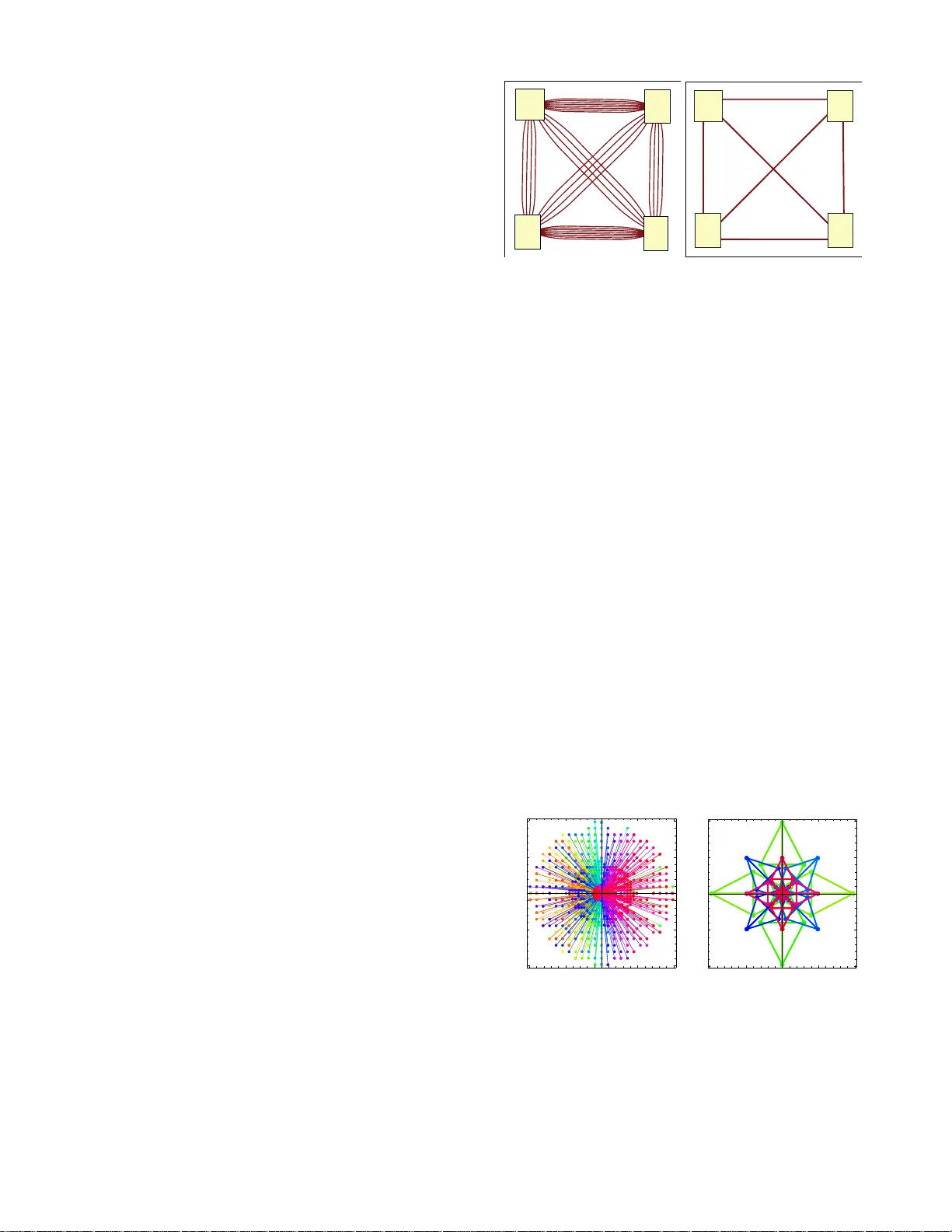
Resonan t in teractions of nonlin ear water w a ves in a finite basin Elena Kar ta shov a † ‡ , Sergey Nazar enko , Oleks ii Rudenko † † W eizmann Institute of Science, Rehov ot, Isr ael ∗ Mathematics Institute, Univ er sity of W arwick, C oven try CV4 -7AL, UK ‡ RISC, J. Kepler Universit y , Linz, Austria e-mail: lena@risc.uni- linz.ac.at W e study exact four-wa ve resonances among gra vity w ater wa ves in a square box w ith perio dic b oundary conditions. W e sho w that these resonant quartets are link ed with each other b y shared F ourier mo des in such a w ay that they form indep endent clusters. These cl usters can be f ormed by tw o types of quartets: (1) angle-r esonanc es whic h cannot directly cascade energy but which can redistribute it amo ng the initially excited modes and (2) sc ale-r esonanc es whic h are m uch more rare but which are the only ones th at can transfer energy b etw een d ifferen t scales. W e find suc h resonan t quartets and their clusters numerically on the set of 1000 x 1000 modes, classify and quantif y them and d iscuss consequences of the obtained cluster structu re for the wa vefield evolution. Finite box effects and associated resonant interaction among discrete wa ve mo des app ear to b e imp ortant in most numerical and lab oratory exp eriments on the deep water gravit y w av es, and our w ork is aimed at aiding t he in terpretation of the experimental and numerical d ata. Cont ents In tro duction 1 Construction of q -classes 2 Scale-resonances 3 Collinear quar tets 4 Non-collinear qua rtets 4 T riden ts 4 Non-tridents 5 Clusters 5 Angle-resonances 6 Dynamics 7 The wav e field 7 A quar tet 8 Summary and Dis cussion o f Results 8 Ac kno wledgm en ts 10 References 10 INTRO DUCT ION W eakly nonlinear sys tems of ra ndom wa ves ar e usu- ally studied in the framework of w av e turbulence the- ory (WTT) (for introductio n to WTT see b o ok [1 ]). Besides weak nonlinear it y and phase rando mness, this statistical description is based o n the infinite-b ox limit. This appr oach yields w av e kinetic equations for the wa ve sp ectrum which have imp ortant stationar y solutions, Kolmogo rov-Zakharov (KZ) spectr a [1]. Impo rtance o f KZ sp ectra is in that they corresp ond to a co ns tant flux of energ y in F ourier space and, therefore, they are analo- gous to the Ko lmogorov energy-casca de spectrum in hy- dro dynamic turbulence. WTT a pproach can also b e used to study evolution of higher momenta of w ave amplitudes and even their proba bility dens it y function, and, there- fore, to examine conditions for deviation from Gaussian- it y and onset of int er mittency [2, 3, 4, 5]. S ig nifica nt effort has b een done in the past to test WTT a nd its predictions numerically [3, 6, 7 , 8, 9] as well as exp er i- men tally [10, 11, 12, 13]. It has b een noted how ever that in b oth the numerical a nd the lab ora tory e xpe riments the domain boundar ies typically play a very imp or ta nt role a nd the infinite-b ox limit assumed by WTT is not achiev ed. Indeed, as mentioned in [9], to overcome the wa ven umber discr eteness asso cia ted with the final b ox one needs at least 10000 x 1 0 000 numerical resolution which is presently unav ailable for this type of problems . On the other hand, a s shown in [10], ev en in a 10m x 6m lab orator y flume the finite-b ox effects a re very strong. It is important to understand that WTT takes the infinite- box limit b efore the weak-nonlinear it y limit, which ph ys- ically means that a lot of mo des interact sim ultaneo usly if they are in quasi-r esonanc e , i.e. satisfy the following conditions ( | ω ( k 1 ) ± ω ( k 2 ) ± ... ± ω ( k s ) | < Ω , k 1 ± k 2 ± ... ± k s = 0 (1) with some res o nance br oadening Ω > 0 which is a mono- tonically increasing function of nonlinea rity (mean wav e amplitude). Here k and ω ( k ) a re wav e vector and dis- per sion function (frequency ) which cor resp ond to a g en- eral wa ve form ∼ exp i ( kx − ω t ) . WTT is supp osed to work when the resonance br o adening Ω is greater than the spa c ing δ ω betw een the adjacent w av e mo des Ω > ( ∂ ω / ∂ k )2 π /L , (2) 2 where L is the b ox s ize. F or some types of wa ves, for example for the ca pillary water wa ves, this condition is easy to s atisfy , and therefore to achieve WTT regime [14]. Howev er, this condition is o ften vio lated for some other types of wa ves, in par ticula r for the surface gravit y wa ves whic h will b e the main ob ject of this pap er. This o ccurs in numerical simulations, due to limitations on the nu mer ic al resolution [7 , 9] a nd in la bo ratory exp eriments, due to an insufficient ba sin size [10, 11]. In these ca ses, the F ourier space discreteness (which is due to a finite box siz e ) leads to significant depletion o f the num be r of wa ve resona nces with resp ect to the infinite b ox limit. In turn, this results in a slowdown of the energ y cascade through the k - s pace with resp ective steep ening of the wa ve spectra [10, 15]. In a ddition, the wa ven umber grid will cause the wav e spectr a to b e anisotropic in this cas e. What happe ns when the condition ( 2 ) is so badly vio- lated that only wav es which are in ex a ct res o nance (i.e. Ω = 0) can interact? In this case, the mechanism o f the wa ve phase randomiza tio n based on ma n y q ua si- resonant wa ves in tera cting sim ultaneously will be absent and, therefore, one should exp e c t less r andom and mor e coherent b ehavior. In [16] it was shown that in ma ny wa ve systems, re s onantly in tera cting wav es in finite do- mains a re partitioned into small indep e nden t clusters in F ourie r spa ce, such that there cannot b e an energy flux betw een different clus ter s. In par ticular, in [17] so me examples o f wav e sys tems were g iven in which no res o - nances exist (capillary water w aves, ω = | k | 3 / 2 ), a s well as systems with a n infinite num b er of res onances (oce a nic planetary w av es, ω = | k | − 1 ). Both of these exa mples ar e three-wa ve systems [i.e. s = 3 in ( 1 )]. In the pr esent pap er we will concentrate o n finding reso nances fo r the deep water gravit y wa ves, whic h is a four-wa ve sy stem. The problem o f computing exact resona nc e s in a con- fined lab or a tory exp eriment is highly non-trivial b ecause the wav enum be r s are integers and ( 1 ) is a sy stem of Dio- phantine equations on man y integer v ariables in large powers. Computational time of solving this system b y a simple enumeration of p ossibilities in this case grows exp onentially with ea ch v ariable and the size of sp ectral domain under consideration. A sp ecia lly dev elop ed q - class metho d [18, 19, 20] has allowed to ac c elerate the computation and find all the resonances among w aves in large sp ectral domains, in a ma tter of min utes. In this pap er we use q -clas s method to construct resonant w av e clusters formed by 4 - wa ve r esonances a mong water g rav- it y w aves cov er e d b y the kinematic reso na nce conditions in the form: ( | k 1 | 1 / 2 + | k 2 | 1 / 2 = | k 3 | 1 / 2 + | k 4 | 1 / 2 , k 1 + k 2 = k 3 + k 4 (3) with k i = ( m i , n i ) and integer | m i | , | n i | ≤ 1000 . O ur main aim is to understand how anisotropic resona nce clusters influence the g eneral dy na mics of the co mplete wa ve field. CONSTRUCTION OF q -CLASSES W e a do pt the g eneral definition of a q -class given in [18] for the dispe rsion function ω = | k | 1 / 2 in the following wa y . Consider the set of a lgebraic num b ers R = ± k 1 / 4 . An y such n umber k has a unique repres ent atio n k = γ q 1 / 4 , γ ∈ Z , where q is a pro duct q = p e 1 1 p e 2 2 ...p e n n , while p 1 , ...p n are all differen t primes and the p ow ers e 1 , ....e n ∈ N are all s maller than 4. Then the set of nu mbers fro m R ha ving the s ame q is called a q -class C l q . The num ber q is called a class index. F o r a num b er k = γ q 1 / 4 , γ is called the weigh t of k . F or instance, w av e vector k = (160 , 40) belo ngs to the q - class with q = 17 00 . Obviously , for an y tw o num ber s k 1 , k 2 belo nging to the same q -class, all their linea r comb inatio ns with integer co efficients belong to the same c la ss q . It ca n b e shown tha t Sys.( 3 ) hav e tw o genera l types of solutions: T yp e I: All 4 w av e vectors b elong to the sa me cla ss C l q , in which case first equation of the Sys.( 3 ) can b e rewritten as γ 1 4 √ q + γ 2 4 √ q = γ 3 4 √ q + γ 4 4 √ q (4) with integer γ 1 , γ 2 , γ 3 , γ 4 . and T yp e II: All 4 wav e vectors b elong to tw o differen t clas ses C l q 1 , C l q 2 ; in this cas e fir st e q uation of the Sy s.( 3 ) can be rewr itten as γ 1 4 √ q 1 + γ 2 4 √ q 2 = γ 1 4 √ q 1 + γ 2 4 √ q 2 (5) with integer γ 1 , γ 2 . Notice that ( 5 ) is not an identity in the initial v ar i- ables m i , n i bec ause an integer ca n hav e several differ- ent presentations as a sum of tw o sq ua res, for instance, 4-tuple {{ -1,4 } , { 2,-5 } , { -4,1 } , { 5,-2 }} is an example of II- t yp e solution, with all weigh ts γ i = 1 and q -c la ss indexes q 1 = 17 , q 2 = 29. The I- and I I-type of solutions des c rib e substantially dif- ferent energy ex changes in the k -space. The I I-type res- onances ar e called angle-r esonanc es [23] and co ns ist of wa vev ectors with pairwise equa l lengths, i.e. | k 1 | = | k 3 | and | k 2 | = | k 4 | or | k 1 | = | k 4 | and | k 2 | = | k 3 | . Thus, 3 these resonances do not transfer energy outside of the initial range of | k | and, therefo re, cannot provide a n en- ergy cascade mechanism. How ever, these resonances can redistribute ener gy among the initial w av enum b ers, in bo th the direction k / | k | and the scale | k | . Since the ini- tial supp ort of energy in | k | cannot change, the I I-type resonances alone would form a finite dimensiona l system, and it would be r easonable exp ect a relax ation of suc h a system to a thermo dynamic Rayleigh-Jeans distribution determined by the initia l v alues of the motion integrals (the energy a nd the wa veaction in the this c a se). Note that s uch a thermalization co uld happ en only among the resonant wav enum b er s, and many mo des which are ini- tially excited but no t in re s onance would not evolve at all. (Such an a bsence of the ev olutio n was called ”frozen turbulence” in [6] where the capillar y wa ves were stud- ied for whic h ther e are no exact r esonances). Whether the ther malization do es o ccur in finite clusters and under what conditio ns (e.g. the cluster size etc.) are in teresting questions that remain to b e studied in future. On the other hand, the I- t yp e resonances are ca lle d sc ale- r esonanc es [23], and they can generate new wav elengths, - this cor resp onds to 3 o r 4 different weights γ in ( 4 ) [23]. Th us, they are the only kind of resonanc e s that can transfer ene r gy outside of the range of initial | k | . Before studying the structure of reso nances let us no tice the following simple but impo rtant fac t. Supp ose a quar - tet { ˜ k 1 , ˜ k 2 , ˜ k 3 , ˜ k 4 } (6) is a solution of ( 3 ), then each p ermutation of indexes 1 ↔ 2 , 3 ↔ 4 or simultaneous 1 ↔ 3 and 2 ↔ 3 will g en- erate a new so lution of ( 6 ); in gener al case, all together 8 different symmetry gener ate d solutions . Of course, in some particular cases, when some of the vectors b elong- ing to a quartet co incide, the overall num b er of symmetry generated solutions can b e smaller. F or instance, the quartet {{{ 0 , − 54 } , { 0 , 294 } , { 90 , 120 } , {− 90 , 120 }} is part of the clus ter of 8 symmetry generated solutions, while the quartet {{ 17 , 31 } , {− 15 3 , − 279 } , {− 68 , − 124 } , {− 68 , − 124 }} belo ngs to the cluster of 4 such solutions. On the Fig. 1 the smallest tridents cluster is shown, with and without m ulti-edg es. Graphical pres ent atio n of a cluster as a graph with multi-edges is of cour se mathematica lly correct but would make the pictures of bigger cluster s somewhat nebulo us (see Fig. 1 , left pa nel). Notice tha t although formally we hav e solutions with multiplicities due to the symmetrie s, physically all these solutio ns corres p o nd to the same qua rtet, and therefo re we count them as one. The r efore, further on we o mit multi-edges in our graphical presentations a s it is shown in Fig. 1 , right panel. In the next sections, on a ll the Fig ures, the structure of r esonance clusters in the sp e ctr al sp ac e is shown as 0 -54 0 294 90 120 -90 120 0 -54 0 294 90 120 -90 120 Figure 1: Color on line. The smallest triden ts cluster formed by 8 symmetry generated solutions, t wo presentation forms are given: with multi-edges ( left panel) and without multi- edges (righ t panel) follows: e a ch wa ve vector is presented as a no de o f in tege r lattice and no des belong ing to one solution a re connected by lines. SCALE-RESONANCES W e have s tudied the cluster s tructure of the sca le- resonances in the spectr a l domain | m | , | n | ≤ 100 0 . In our computational domain we have found 2 30464 such reso- nances, among them 21376 0 collinear (i.e. all 4 wa ve vec- tors ar e collinear) and o nly 16 7 04 (7.2 5%) non-co llinear resonances . How ever, the nonlinea r in teraction co effi- cient in collinear quartets is equal to zero a nd, there- fore, they hav e no dynamical significance [24]. On the other hand, for mathema tical completeness we will co n- sider thes e solutions to o , b ecause there may exist 4-wa ve systems with the same disp ersio n law but with different forms of int er a ction c o efficients such that are not neces- sarily zero on the collinear qua r tets. - 100 - 50 0 50 100 - 100 - 50 0 50 100 - 100 - 50 0 50 100 - 100 - 50 0 50 100 Figure 2: Color online. Structure of collinear resonances in the spectral domain | k | ≤ 100 (left panel) and of n on-collinear resonances in t h e same d omain (righ t panel) In the T a ble I the structur e o f all clusters is presented while in the T able I I - the structure of non-co llinear is 4 given; cluster length is the num b er of quartets b elo nging to one cluster. Cluster Number of Cluster Nu mber of length clusters length clusters 1 43136 56 3 2 1256 6 0 6 8 452 72 1 10 184 8 0 1 12 20 92 2 16 14 128 1 20 10 152 1 40 7 17 6 1 48 2 20 8 1 T able I: Clustering in the entire set of quartets in the domain 1000x1000 (symmetrical solutions are omitted) Cluster Number of Cluster Nu mber of length clusters length clusters 1 1312 1 0 18 2 48 12 6 3 8 16 8 6 14 34 2 8 4 46 2 T able I I: Clustering in the non-c ol l ine ar subset of quartets in the domain 1000x1000 (symmetrical solutions are omitted) In Fig. 2 structure of co lline a r and non-collinear quartets is shown ia a smaller doma in p m 2 i + n 2 i ≤ 100 . Collinear quartets First of all, let us make a n impor tant rema rk. If a 4-tuple { { m 1 , n 1 } , { m 2 , n 2 } , { m 3 , n 3 } , { m 4 , n 4 }} consis ts of a ll collinea r wa ve vectors, then the ratio | m i | / | n i | is the same for all 4 w av e vectors. Let us assume that m i , n i 6 = 0, then 0 6 = | n i | / | m i | = c, ∀ i = 1 , 2 , 3 , 4 , (7) where c is an arbitrary finite rationa l constant and | k i | 1 / 2 = ( m 2 i + n 2 i ) 1 / 4 = m 1 / 2 i (1 + c 2 ) 1 / 4 , (8) and Sys.( 3 ) ta kes the form ( m 1 1 / 2 + m 2 1 / 2 = m 3 1 / 2 + m 4 1 / 2 , m 1 + m 2 = m 3 + m 4 , ⇒ n ( m 1 m 2 ) 1 / 2 = ( m 3 m 4 ) 1 / 2 ⇒ | m 1 | = | m 3 m 4 | / | m 2 | . Now we can compute m 1 taking arbitrary integer m 2 , m 3 , m 4 provided that | m 3 m 4 | is divisible o n | m 2 | , and - 10 0 10 20 30 40 50 - 10 0 10 20 30 40 50 Figure 3: Color online. First non-axial trident keeping in mind that n i = cm i , we can find all collinear solutions with c 6 = 0 . O b vio usly , a r ational num ber c de- fines a line in the spectral space a nd not all the lines are allow ed. Case c = 0 corresp o nds to the solutions lying on the axe s X ( n i = cm i ) and Y ( m i = cn i ), i.e. with all m i = 0 o r n i = 0 co rresp ondingly , e.g. 4 -tuple {{ 4 , 0 } , {− 49 , 0 } , {− 36 , 0 } , {− 9 , 0 }} . Parametrization o f the r esonances in this ca se was first given in [24]. As we have a lready mentioned b efor e, these qua rtets are dy- namically irr elev ant beca use there is no nonlinea r inter- action within these q ua rtets [24]. Non-collinear quartets T ridents Non-collinear sc ale-reso nances ha ve b een studied fir st in [9, 15] in the sp ectral domain p m 2 i + n 2 i ≤ 10 0 and a sp ecial t yp e of quartets na med tridents have been sing led out. By de finitio n, a wav e quartet is called a trident if: 1) There exist tw o vectors among four in a quar tet, say k 1 and k 2 , such that k 1 ↑ ↓ k 2 , thus they sa tisfy ( k 1 · k 2 ) = − k 1 k 2 ; 2) Tw o other v ector s in the quartet, k 3 and k 4 , hav e the same length: k 3 = k 4 ; 3) k 3 and k 4 are eq ua lly inclined to k 1 , thus ( k 1 · k 3 ) = ( k 1 · k 4 ) . The following presentation for a triden t qua rtet has b een suggested in [9, 15], k 1 = ( a, 0) , k 2 = ( − b, 0) , k 3 = ( c, d ) , k 4 = ( c, − d ) , (9) and tw o-par ametric series of solutions has b een written out: ( a = ( s 2 + t 2 + st ) 2 , b = ( s 2 + t 2 − st ) 2 , c = 2 st ( s 2 + t 2 ) , d = s 4 − t 4 , (10) with a rbitrary integer s, t . It is eas y to check that vectors k 1 , k 2 , k 3 , k 4 belo ng to the same cla ss C l 1 , with weigh ts γ 1 = s 2 + t 2 + st, γ 2 = s 2 + t 2 − st, γ 3 = γ 4 = s 2 + t 2 , 5 and obviously γ 1 + γ 2 = γ 3 + γ 4 , ∀ s, t ∈ Z . Parametrization ( 9 ) co r resp onds to the tridents ori- ent ed along the X-axis with its vectors k 1 and k 2 and, therefore, we will call them axial trident s. There ex- ist a lso non- ax ial tridents, for instance, the quartet {{ 49 , 49 } , {− 9 , − 9 } , { 5 , 35 } , { 35 , 5 }} . As ment io ne d in [9, 15], all the non-axia l tridents can b e obtained from the a xial o nes, ( 9 ), via a rotatio n by angles with r ational v alues of c o sine combined with resp ective re-sca ling (to obtain an integer-v alued solution out of ra tional-v alued ones). Cluster length N umber of clusters 1 1320 2 48 6 40 12 10 18 2 22 2 T able I I I: Clustering in the subset of tridents in the domain 1000x1000 (symmetrical solutions are omitted) In the co mputatio nal domain | m | , | n | ≤ 1000, we ha ve found 13 888 non-a xial tridents, the fir st non-ax ia l tri- dent is shown on the Fig. 3 . Among 1388 8, 13504 tridents hav e no vectors on any axis and 384 tri- dent s have just one vector o n an a xis (for instance, {{ 180 , 135 } , { 0 , 64 } , { 120 , 119 } , { 60 , 80 }} ). The total amount of all p oss ible tridents is 14 8 48, thus o nly 960 are axia l (6 . 5 % o f the total n umber). The data o n tri- dent s’ clustering are given in the T a ble I I I. Non-tridents Our study of the resonance solution set in the sp ec- tral do main | m i | , | n i | ≤ 1000 shows tha t not all non-collinear casca ding quartets are tridents . They are called fur ther non-tridents , e.g. a quar tet {{ 990 , 180 } , { 128 , 256 } , { 718 , 236 } , { 400 , 2 00 }} is a no n- trident quartet. The o verall num b er o f tr iden ts is 1484 8 while the num b er of no n- tridents is 1 856. Notice that the first non-trident quartet { { 180 , 135 } , { 0 , 64 } , { 120 , 119 } , { 60 , 80 }} lies in the sp ectral doma in | k | ≤ 2 25. This means, that if we are interested only in the lar ge-scale quartets, say , quar- tets with | k | ≤ 100 , the complete set of scale-r esonances consists of 1 728 quartets, amo ng them - 163 2 collinea r quartets a nd 96 tr idents, but no non-tr iden ts y et. 0 50 100 150 0 20 40 60 80 100 120 Figure 4: Color online. First non-trident Clusters In the pr evious Section w e have shown that there a re three different types o f scale-r esonances : collinear qua r- tets, tridents and non-tridents. There are also clus- ters formed b y different types o f scale-r esonances, for instance, clusters containing tridents and non-tridents (Fig. 5 , left pa nel) or collinear and non-collinear quar- tets (Fig. 5 , right pa nel). Notice that, since collinear quartets of gravit y water w av es ha ve zer o interaction co- efficients [24], the cluster shown on the r ight panel can dynamically b e rega rded as tw o indep endent quartets. - 1000 - 500 0 500 1000 - 500 0 500 - 200 - 100 0 100 200 - 600 - 400 - 200 0 200 400 600 Figure 5: Color on line. Left panel : A shortest cluster formed by b oth tridents and non- tridents; cluster length is 8 (64 with 8 symmetries), among them 6 (48 with 8 sym - metries) tridents and 2 (16 with symmetries) non-trid ents. Right panel : A shortest cluster formed by b oth collinear and non-collinear q u artets; cluster length is 8 (48 with 8 and 4 symmet ries), among them 6 (32 with 8 and 4 symmetries ) collinear and 2 (16 with 8 symmet ries) non-collinear qu artets. No m ulti-edges are sho wn. One of the most imp or tant characteristics of the res- onance structure is the waveve ctor multiplicity (in tro - duced in [2 0]), which des crib es how many times a given wa vev ector is a part of so me s o lution. In the T able IV the wa vev ector s m ultiplicities are given for non-colline a r quartets. It turned out that 91 % of all these wa vev ec- tors (6 720 from ov era ll amount 73 8 4) hav e multiplicit y 1 (counting the 8 symmetry gener ated so lutio ns a s the same quar tet.) 6 Multiplicit y Amount of vectors 1 6720 2 424 3 192 4 36 5 8 6 4 T able I V: W av evectors multiplici ty computed for th e n on- collinear qu artets in the sp ectral domain | m i | , | n i | ≤ 1000 (symmetrical solutions are omitted) In Fig. 1 , w e see an example of such a simple cluster con- sisting from just one physical quartet. In the Fig. 6 the cluster o f 4 c o nnected quar tets is shown (the symmetr y generated solutions ar e omitted), with all to gether only 7 different wa ve-frequencies. 784 784 625 625 560 80 401 -79 -144 -144 80 560 -79 401 Figure 6: Color on line. Example of a non-trident cluster of length 4. Obviously , the cluster structure defines the for m o f dy- namical s ystem corres p o nding to the cluster. The main motiv atio n of our detailed study of cluster s is , of cours e , in co nstructing a n isomor phism (i.e. one-to-o ne corre- sp ondence) betw een a cluster and a dynamical system. In [21] this constr uction has been presen ted for an arbitra ry 3-wa ve r esonance sys tem, with triads as primar y elements of the planar graph. Its implemen tation in Mathematica was g iven in [22], wher e interaction co efficients similar to Z in ( 18 ) were also computed. T o construct this iso - morphism tw o fo llowing facts were used: 1 ) in a 3-wav e resonance system only sc ale-r esonanc es ex is t, and 2) if we add a n arbitra ry triad to a cluster, in ge ne r al we alwa ys add so me new wa ve-frequencies a s well (the only excep- tion is iden tified in [21]). A 4-wa ve resonance sy stem do es no t p osse ss these nice prop erties; on the co n tra ry - there exis t scale- and angle-r esonances, and most of the quartets ar e parts o f symmetry generated s o lution sets. It w ould b e a c halleng e to develop a genera l a pproach to construct dynamical systems for reso nance clusters in an arbitrar y 4-wa ve sys tem. ANGLE-RESONANCES Un til now we hav e s tudied the structure of the scale- resonances which are describ ed by ( 4 ) and whic h gen- erate new scales (i.e. new v alues of | k | , thereby pr ovid- ing the energy cas c ade mec hanism. The angle - resonance s represented by ( 5 ) do not genera te new sc ales but they can redistribute energy among the mo des which were ex- cited initially (or which are forced externally). T aken on their own, these res onances could lead to the ther- mal equilibr ium distr ibution o f the energy a nd the wa ve- action amo ng the (initially excited) resonant wav es, if the num ber o f such wa ves is large, or they could le ad to a p erio dica l b ehavior or a strange attractor, if the nu mber of the initially excited mo des is small. The im- po rtant fact, how ever, is that the scale- and the angle- resonances are not indep endent and can for m a mixe d cluster containing bo th types of this resona nces [23]. The energ y cascade mechanism in such a mixed cluster is presented schematically in Fig . 7 where the quadran- gles S 1 and S 2 denote s cale-reso nances s o that 4- tuples ( V 1 , 1 , ..., V 1 , 4 ) and ( V 2 , 1 , ..., V 2 , 4 ) repr esent sca le- resonances and squar es A 1 , ...A i , .., A n represent ang le- resonances . A 1 A i A n S 1 S 2 V 1,1 V 1,2 V 1,3 V 1,4 V 2,3 V 2,2 V 2,1 V 2,4 V n,2 V n,1 V n,3 V n,4 = = Figure 7: Color on line. S chemati c presentatio n of mixed resonance cascade If a wa ve takes part simultaneously in angle- and scale- resonances , corresp onding no des of S 1 , S 2 and A j are connected by (red) das hed arr ows so that V 1 , 1 = V n, 2 and V n, 1 = V 2 , 3 . W e hav e fo und many examples of s uch mixed cluster s in our solution s e t, for instance: S 1 = {{− 6 4 , − 16 } , { 78 4 , 1 96 } , { 144 , 36 } , { 576 , 144 }} , A n = {{− 6 4 , − 16 } , { 4 , 1 6 } , {− 64 , 16 } , { 4 , − 16) }} , with V 1 , 1 = V n, 2 = ( − 64 , − 16 ) , S 2 = {{− 49 , − 196 } , { 4 , 16 } , {− 36 , − 144 } , {− 9 , − 36 }} , which is further on connected with an a ngle-reso nance A ˜ n = {{− 4 9 , − 19 6 } , { 7 84 , 196 } , {− 49 , 196 } , { 784 , − 196 }} , 7 (not shown in Fig. 7 ) via a no de-vector ( − 49 , − 1 96). The energ y flux over scales due to the mixed cluster is weak: one wa ve can participate in a few dozen of angle- resonances (see Fig. 8 ), which means that only a small part of its ener gy will go to a scale- resonance . More- ov er, even this weak energy cascade may terminate at finite wa ven umber if it happ ens to mov e along a finite cluster which terminates b efor e rea ching the dissipa tion range (or b efore reaching the range o f high frequencies where the nonlinearity gets large enough for the quasi- resonances to take over the energy flux fr om the exa ct resonances ). 80 -60 119 120 135 180 135 -180 119 -120 64 0 80 60 119 120 -119 -120 -119 -120 -1 0 1 0 0 -169 0 169 -169 0 169 0 Figure 8: Color on line. W a ve (64,0) takes p art in 2 scale- resonances, b oth non-tridents . The upp er number in the circle is m , the low er is n , and (red) thick lines drawn b etw een vectors on the same side of the Eq s.(3). W a ve (119,120) takes part in 1 scale-resonance and in 12 angle-resonances. The num b er of angle-r esonances in the sp ectral doma in | m i | , | n i | ≤ 100 0 is of order of 6 · 10 8 while the num be r of scale-re s onances in the same domain is of order of 8 · 10 5 , among them less than 2 · 10 4 are non-c ollinear and do play a role in the ener gy exchange among the mo des within the quartets (see next the Section). It is eas y to see that a n ar bitrary wa vev ector ( m, n ) tak es pa rt in infinite nu mber o f resona nces if s p ectr al domain is unbounded. Indeed, let us fix m and n, then a q uartet ( m, n )( t, − n ) → ( m, − n )( t, n ) (11) a s cale-reso nance with arbitra ry t = 0 , ± 1 , ± 2 , . . . . More inv olved 5-parametric series of a ngle-reso nances found from the following conside r ations. F or ang le - resonance s of four wa vev ectors ( a, b )( c, d ) → ( p, q )( l, m ), Eqs.( 3 ) can be rewr itten as ( a 2 + b 2 = p 2 + q 2 , c 2 + d 2 = l 2 + m 2 a + c = p + l , b + d = q + m (12) Simple algebraic transforma tions a nd k nown parameter i- zations of the sum of tw o integer squares (e.g. for a circle or for the P ythagorea n triples) yield a = ( s 2 − t 2 ) / ( s 2 + t 2 ) , b = 2 st/ ( s 2 + t 2 ) , p = ( f 2 − g 2 ) / ( f 2 + g 2 ) , q = 2 f g / ( f 2 + g 2 ) , d = ( a 2 + b 2 + ac − ap − cp − bq ) / ( q − b ) (13) This is an ea sy task to chec k then that the solutions of ( 12 ) can b e written out (per haps with r epetitio ns ) via five int eg e r pa rameters s, t, f , g , c (ratio nal solutions should be renorma liz ed to integer). Notice that ( 11 ) deg enerates to trivial resonances ( m, 0)( t, 0) → ( m, 0)( t, 0) , (14) if n = 0, i.e. it do es not include any resonanc e s of wa vev ectors of the fo rm ( m, 0), for insta nc e (1 , 0). In this ca s e the choice f = 1 , g = 1 in ( 13 ) gives (1 , 0)( c, 1 + c ) → (0 , 1)(1 + c, c ) . (15) Analytical series a re v ery helpful not o nly for co mputing resonance quartets and cluster s s tructure but also while inv estigating the a symptotic b ehavior of interaction co- efficients. 0 10 20 30 40 50 60 70 80 10 5 0 5 10 4 x Figure 9: The m ultiplicities histogram for angle-resonances. The m ultiplicity histogram for the angle-resona nces is shown in Fig. 9 . On the axis X the multiplicit y of a vec- tor is shown and on the axis Y the n umber of vectors with a given m ultiplicity . This g raph ha s b een cut o ff - m ultiplicities go v ery high, indeed the vector (10 00,100 0) takes pa rt in 11075 solutions. All this indicates that the angle-res onances play an impo r tant ro le in the ov erall dynamics of the wa ve field. DYNAMICS The wa ve field Once the clusters are found, one ca n co nsider a n evolu- tion o f amplitudes of wa ves that b elong to each individual cluster by consider ing a resp ective re ductio n o f the dy- namical equation. F or the gr avit y wa ve case, the a ppro- priate dynamical equation is Za kharov equation for the 8 complex amplitude a k ( t ) cor resp onding to the k -mo de, i da k dt = k + k 1 = k 2 + k 3 X k 1 , k 2 , k 3 T k , k 1 k 2 , k 3 a ∗ k 1 a k 2 a k 3 e i ( ω k + ω k 1 − ω k 2 − ω k 3 ) t , (16) where T k , k 1 k 2 , k 3 ≡ T ( k , k 1 , k 2 , k 3 ) is a n interaction co effi- cient for gr avit y water wav es whic h can be found in [25]. F or very w eak wa ves, amplitudes a k ( t ) v a ry in time m uch slow er than the linear o scillations. The factor e i ( ω k + ω k 1 − ω k 2 − ω k 3 ) t on RHS will ra pidly o scillate for most wa ves except for those in an exact r esonance for which this facto r is 1. Th us, only the r esonant mo des will give a contribution to the dynamics in this case and the oscillating contributions of the non-res onant terms will average out in time to zero and will not give any contribution to the cum ulative ch a ng e of a k ( t ). Lea ving only the resonant terms, we hav e i da k dt = R X k 1 , k 2 , k 3 T k , k 1 k 2 , k 3 a ∗ k 1 a k 2 a k 3 , (17) where P R means a summation o nly ov er k 1 , k 2 and k 3 which a re in resonance with k . Obviously , we should consider k ’s from the same cluster only (i.e. solve the problem for one cluster at a time). Note that the fa s t timescale of the linear dyna mics co mpletely disapp ear e d from this eq ua tion. Th us, paradoxically , the dynamics o f very weak w aves in finite b oxes is strongly no nlinear: it is more nonlinear than in WTT which works fo r larger amplitudes and where quasi-res onances ensure phase ra n- domness. This explains the fact found in the three-wa ve example that even rela tively larg e clusters often exhibit a p erio dic or quasi- per io dic b ehavior [26]. A study of the sys tem ( 17 ) is po ssible a nalytically fo r small clusters (p erha ps even integrating the sys tem in some luc ky cas e s) and numerically for lar ge cluster s, which is an in tere sting sub ject for future research. Some prop erties, how ever, can alrea dy b e seen in the ex a mple of a single q uartet which has b een studied b efore [27]. Let us briefly discuss these pr op erties. A quartet The dynamica l system describing slo wly changing ampli- tudes of a qua rtet has the form [2 7]: i ˙ a 1 = 2 Z a ∗ 2 a 3 a 4 i ˙ a 2 = 2 Z a ∗ 1 a 3 a 4 i ˙ a 3 = 2 Z ∗ a ∗ 4 a 1 a 2 i ˙ a 4 = 2 Z ∗ a ∗ 3 a 1 a 2 (18) and Z = T k 1 , k 2 k 3 , k 4 . The mathematical a nalysis of the sys- tem ( 18 ) can b e p erformed similar to what has been done in [28] for an integrable 3-wa ve sys tem of reso nantly in- teracting planetary wa ves, though computations of the mo dulus of elliptic in tegr a l ar e mor e in volv ed and v ariety of differ ent dynamical scena rios is substa ntially reacher (see [27] fo r details). The gener al ans w er can be given in terms of Jacob ean elliptic functions. Obviously , the q uartets with interaction co efficient Z = 0 do not influence the g eneral dynamics o f the wa ve field at the corr esp onding time scale. As it w as sho wn in [24], for all c ol line ar quartets Z ≡ 0, and therefore they ca n be excluded fo rm co nsideration. On the other ha nd, in [29] so-ca lled ” degenerate quar- tets” ( tridents in our terminology) have bee n studied and it was established numerically that they hav e strictly pe- rio dic behavior: a fter appropriate tr anslation in the hor- izontal plane, tw o s napshots of the fr ee-surface taken at t = 0 a nd t = T are identical. F or a general quar tet and for arbitrary and arbitrary ini- tial conditions , the system ( 18 ) ” do es not exhibit strict per io dicity” in numerical s imulations [27]. Thus, the g en- eral formulae for the solutions of ( 18 ) have to be stud- ied in more details in order to distinguish p erio dic a nd non-p erio dic dynamics o f an a rbitrary quartet. O n the other hand, s inc e our ma in interest in this pap er is the large-s cale dynamics, all scale-r e sonances with a non-zero int er a ction co efficient ar e tridents a nd therefor e demon- strate a per io dic time behavior. Of course, if a trident is inv olved in to a cluster with s o me other quartets then one should b e cautious a bo ut the predictions obtained for an isolated qua rtet. SUMMAR Y AND DISCUSSION OF RESUL TS • In this pap er, we s tudied pr op erties o f de e p water grav- it y wa ves bo unded by a squar e pe r io dic box. At very small wav e amplitudes, when the nonlinear r esonance broadening is less than the k -space spacing, WTT fails and only the wa ves which a re in exact four-wav e reso- nance ca n interact. This s ituations appea r s to be typical for a ll existing numerical sim ulatio ns [9] and la bo ratory exp eriments [10]. Thus, to understa nd the wa ve b ehavior in lab ora tory exp eriments a nd in numerical simulations it is crucial to study exact resonances among discrete wa ve mo des, which was the focus o f the present pa pe r . Of c ourse, the notation of ”very s mall amplitudes” has to be work ed out explicitly for interpreting the results of lab orator y exp eriments. The smallness of amplitudes is defined by the choice of a small pa rameter 0 < ε ≪ 1 and dep e nds o f the int r ins ic character is tics of the wa ve system, for instance, for atmo spheric planetar y wa ves it is usually taken as the ratio of the particle velo city to the phase velo cit y which allows to obtain explicit esti- mation [30] for a w ave amplitude a ( m, n ) (corr esp ond- 9 ing to the weakly nonlinear reg ime) a s a function o f m and n . F or the water surface w aves, the wav e steepness, | a ( m, n ) | / ( m 2 + n 2 ) 1 / 2 L , is usually taken as a small pa- rameter ε and ε ∼ 0 . 1 co rresp onds then to the weakly nonlinear reg ime. F o r such weakly nonlinea r wa ves to feel discretenes s of the k -spa c e, their nonlinea r frequency broadening has to b e less than the distance b etw een ad- jacent k -mo de s . In terms of the wa ve steepness this con- dition r eads ε < ( m 2 + n 2 ) − 1 / 8 , see [9, 15 ]. • W e found numerically all reso nant quartets o n the s et o f 1000 x 1000 mo des making use of the q - class metho d orig- inally develop ed in [18]. W e found that all re s onant qua r - tets s e parate into nonint er acting with each other clus- ters. E ach cluster may consist of tw o types of quartets: scale- and ang le-resona nces. The a ng le-reso na nces ca n- not tra nsfer ener gy to an y k -mo des whic h a re no t alr e ady present in the system. They cannot car ry an ene r gy flux through s c ales and their main r ole is to thermalize the initially excited modes . The s cale-res o nances are muc h more r are than the angle ones and yet their ro le is im- po rtant b ecause they a re the only resonances that can transfer ener g y b etw e en different scales. Most of the scale-re s onances, but not a ll, are of the trident type, for which a partial parametriz ation can b e written out ex- plicitly . If o ne is interested in large-scale mo des only , sa y 100 x 100 domain, then the tridents are the only scale- resonances , which is very fortunate due to the av ailable parametriza tion. • Even though the ang le-resona nces ca nnot cascade en- ergy , they are imp ortant for the overall ca scade pr o cess bec ause they are inv olved in the same wav e clusters with the scale-reso nances. One wa ve mo de ma y t ypica lly par- ticipate in man y angle resonances and only one scale res- onance. Th us, one can split large clusters into ”reser- voirs”, each for med by a large n umber o f angle quartets in quasi-ther mal equilibrium, and which a re co nnec ted with each o ther b y sparse links formed b y scale qua r- tets. This structur e suggests a significa n t ener gy casca de slowdo wn and anisotro py with resp ect to the infinite-box limit. F urther study is nee ded to examine the structure of such large clusters and p ossible energy casca de routes from the re g ion of excitation at low w av enum b ers to the dissipative large k range. In the essentially finite domain the situation is opp os ite. Q uite recently r e sults of the lab orator y exper iment s with s urface wav es on deep water were r epo rted [31, 32, 33] in which r egular, nea rly p erma- nent patterns of the water surfa ce have b een observed. A feasible w ay to interpret these results would be 1) to es- tablish that the conditions of the experiments corres po nd to the weakly nonlinea r reg ime; if y es - to pro ce ed a s follows: 2) to co mpute all ex act r esonances in the wa ve- lengths r ange cor r esp onding to those in the exp eriments; 3) to demonstr ate that for chosen wa ve-lengths a nd the size of lab or atory tank no scale-res onances app ear, 4) to a ttribute the regular pa tterns to the corr esp onding angle-res onances. Obviously , the scale-reso nances would pro duce the sp ectrum aniso tropy and disturb the r egular patterns. • W e also discussed consequences of the cluster structures for the dynamics , and argued that one sho uld exp ect a less ra ndom and more regula r behavior in the case of very low amplitude wa ves with resp ect to larger (but still weak) wa ves describ ed by WTT. More study is needed in future both ana lytically , for sma ll clus ters, and nu- merically , for lar ge clusters. A par ticularly interesting question to answer in this case is about an y possible uni- versal mechanisms of transitio n b etw een the reg ular dy- namics to chaos and po ssible co ex istence of the regula r and chaotic motions. • L a st not least. The knowledge of the 2 D -r esonance structure might yield new insights in to the orig in of so me well-kno wn ph ys ic al phenomena, for instance, Benjamin- F eir (B-F)insta bility [34] or McLea n ins tabilit y . This is ”a mo dulational instability in whic h a unifor m train of oscillator y wa ves o f finite amplitude lo sses energ y to a small p erturbatio n o f wa ves with nearly the same fre- quency and dir ection” [3 5]. As it was shown recently in [35, 3 6, 37], the mo dulationa l instability , thoug h w ell established no t o nly w ater wav es theory but a lso in plas- mas and o ptics, has to b e seriously reconsidere d. It turned out that 1 ) it ca n be shown analy tically that a rbi- trary small dissipation stabilizes the B-F instabilit y , and 2) results of lab or atory exp eriments s how tha t B-F the- ory generally ov er-predic ts the g r owth rate. Mor eov er, the g rowth rate changes with the time [3 5]. Some re- searchers state even that ”... this effect is fa r less signif- icant than was b elieved and should be disre g arded” [38]. The other wa y to treat the problem would be to try and and ex plain the mo dulational instabilit y through non- collinear (that is, essentially t wo-dimensional) exact r es- onances [39]. Similar questions arise in the study of McLean instabilities defined by the mag nitudes of the water depth on which surface wa ves are studied. F or in- stance, as it was demons trated in [40], in some reg imes of shallow w ater the insta bilities are due to highe r order resonances among 5 to 8 wa ves. It would, therefor e, b e int er e sting to see how the B-F and McLea n instabilities are mo dified b y the finite flume effects and the cor re- sp onding discreteness of the wa ve res o nances, and to see what ro le this could hav e played in the past lab or atory and numerical exp eriments. Res ults presented in o ur pa- per can b e r egarded as a necessary first step for such an inv estiga tion, and the future work would inv olve ap- plication of the q -cla ss metho d to computing the higher order resonances which may be in volved in modulational instabilities. 10 Ackno wledgments Ac kno wledge men ts . E.K. acknowledges the supp o rt of the Austrian Science F oundation (FWF) under pro ject P2016 4-N18 ”Discrete reso nances in no nlinear wa ve sys- tems”. O.R. and S.N. acknowledge the supp ort of the T ra nsnational Access Pro gramme at RISC-Linz, funded by Europ ean Commission F ramework 6 Pro gramme for Int eg r ated Infras tructures Initiatives under the pro ject SCIEnce (Contract No. 0261 33). Authors are genuinely grateful to bo th anonymous Referees whose sugge stions made the form our pap er more clear a nd led, in par tic- ularly , to including the very imp ortant parag raph abo ut Benjamin-F a ir and McL e a n instabilities. A uthor s ex- press a sp ecial gra titude to Victor L’vo v for fruitful a nd stimu lating discussions. [1] V.E. Zakharo v, V .S. L’vo v and G. F alko vich. Kol - mogoro v Sp ectra of T urbulence . Series in Nonlinear Dynamics, Springer ( 1992) [2] Y. Lvo v and S .V. Nazarenko, Phys. R ev. E : 69 : 066608 (2004) [3] Y. Choi, Y. Lvo v, S.V. Nazarenko an d B.P okorni. Physics L etters A : 339 (3-5): 361 (2004) [4] Y. Choi, Y. Lvov and S .V. Nazarenko. Physics L etters A : 332 (3-4): 230 (2004) [5] A.C. New ell, S.V. N azarenk o an d L. Biven, Physic a D 152-153 : 520 (2001) [6] A.N. Pushka rev and V.E. Zakharov, Physic a D 135 (1- 2): 98 (2000) [7] V.E. Zakharov, A.O. Korotkevic h, A .N. Pushkarev an d A.I. Dy achenko , JETP L ett. 82 (8): 487 (2005) [8] S. An nenko v and V . Shrira, Phys. R ev. L ett 96 : 204501 (2006) [9] Y.V. Lvo v, S. Nazarenko and B. P okorni. Physic a D 218 : 24 (2006 ) [10] P . D enissenko , S. Luka sch uk and S. N azarenko , Phys. R ev. L ett . 99 : 014501 (2007) [11] E. F alcon, C. Laro che and S. F auve. Phys. R ev. L ett . 98 : 094503 (2007) [12] G. Kolmako v, A. Levc henko, M. Braznik ov, L. Mezhov- Deglin, A. Slichenk o and P . McClin to c k. Phys. R ev. L ett. 93: 74501 (2004) [13] M. Braznik ov, G. Kolmako v, A . Levc henko and L. Mezho v- Deglin. Eur ophysics Le tt. 58 : 510 (2002) [14] V. M. Egu ´ ıluz, M. T. Levinsen and P . Alstrom. Eur ophys. L ett. 58 : 517 (2002) [15] S. Nazarenko. J. Stat. Me ch. LO2002 (2006) [16] E. Kartashov a. Phys. R ev. L ett. 72 : 2013 (1994 ) [17] E. Kartashov a. AMS T r ansl. 182 (2): 95 (1998) [18] E. Kartasho va . J. L ow T emp. Phys. 145 (1-4): 286 (2006) [19] E. Kartashov a and A. Kartasho v . Int. J. Mo d. Phys. C 17 (11): 1579 (2006) [20] E. K artasho v a and A. Kartashov. Comm. Comp. Phys. 2 (4): 783 (2007) [21] E. Kartasho va and G. Mayrhofer. Physic a A: Stat. Me ch. Appl. 385 : 527 (2007) [22] E. Kartasho v a, C. Raab, Ch. F eurer, G. Mayrhofer and W. S c hreiner. In Ch. Kharif, E. Pelino vsky (Eds): Ex- treme W av es in the Ocean , Springer (to app ear). E- print: http://arxiv.org/abs/0 706.3789 ) (2008) [23] E. Kartashov a. Phys. R ev. L ett. 98 (21): 214502 (2007) [24] A .I . Dyac henko, Y.V. Lvo v and V.E. Z ak haro v, Physic a D 87 (1-4): 233 (1995 ) [25] V .P . Krasitskii. J. Fluid Me ch. 272 : 1 (1994 ) [26] E. Kartasho va and V .S. L’vo v. Submitted to Phys. R ev. L ett. E-p rint arXiv:0801.33 74 v1 (2008 ) [27] M. Stiassnie and L. Shemer. Wave m otion 41 : 307 (2005) [28] E. Kartashov a and V.S. L’v ov. Phys. R ev. L ett. 98 (19): 198501 (2007) [29] L. Shemer and M. Stiassnie. In Y. T oba, H . Mitsuy asu, F.D. Reidel (Eds): The o cean surface , p.51-57. D o- drech t, Holland (1985) [30] E.A. K artashov a. The or. M ath. Phys. 99 : 1510 (1994) [31] H . Segur and D.M. Henderson. Eur o. Phys. J. – Sp e ci al T opics 147 : 25 (200 7) [32] W. Craig, D.M. Hend erson, M. Oscamou and H. Segur. Math. Comput. Simul , doi: 10.1016/ j.matcom. (2006) [33] D.M. Hend erson, M.S. Patterson and H. Segur. (2006) J. Fluid Me ch. 559 : 413 (2006) [34] T.B. Benjamin and J.E. F eir. J. Fluid Me ch. 27 : 417 (1967) [35] H . Segur, D. Henderson, J. H ammack, C.-M. Li, D. Pheiff. and K . So cha. J. Fluid Me chanics 539 : 229 (2005) [36] J.L. Hammack, D.M. Henderson. J. Offshor e Me ch. & Ar tic Eng. 125 : 48 (2003) [37] J.L. H ammack, D.M. Hen derson and H . Segur. J. Fluid Me chanics 532 : 1 ( 2005) [38] B.M. Lake and H .C. Y uen. J. Fluid Me ch. 83 : 75 (1977) [39] This idea h as b een discussed by one of the authors, E.K., and late Jo e Hammack in 1995. But at that time q - class metho d w as not yet implemented, exact resonances could not b e computed and all the reasoning w as rather theo- retical. [40] M. F rancius and C. Kharif. Ge ophysic al R ese ar ch Ab - str acts 7 : 08757 (2005)
Original Paper
Loading high-quality paper...
Comments & Academic Discussion
Loading comments...
Leave a Comment