Optimal Power Control over Fading Cognitive Radio Channels by Exploiting Primary User CSI
This paper is concerned with spectrum sharing cognitive radio networks, where a secondary user (SU) or cognitive radio link communicates simultaneously over the same frequency band with an existing primary user (PU) link. It is assumed that the SU tr…
Authors: Rui Zhang
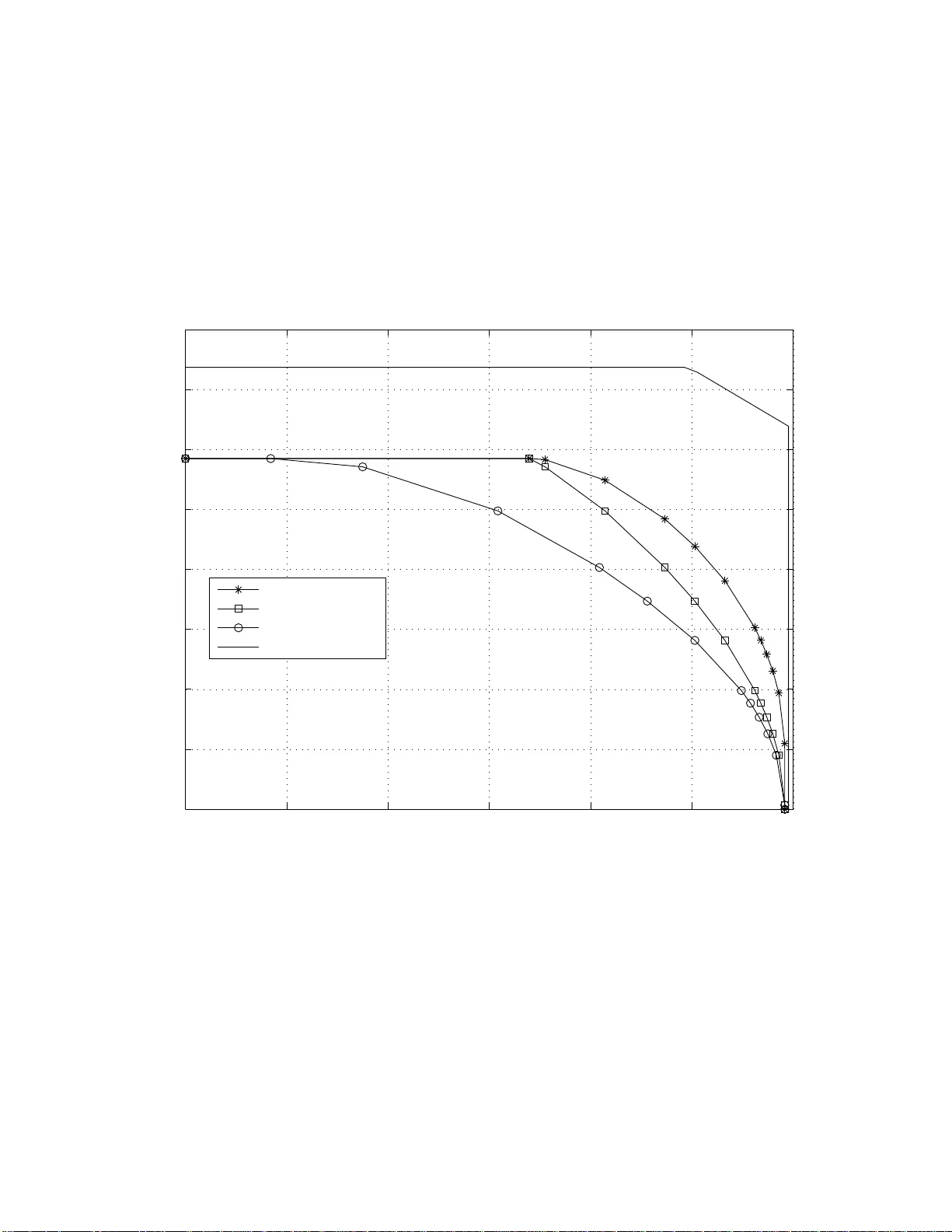
Optimal Po wer Control o ver F ading C ogniti v e Radio Ch annels by Exploiting Primary User CS I Rui Zhang Abstract This paper is con cerned with spectrum sh aring cognitive radio networks, where a seco ndary user (SU) or cognitive radio link comm unicates simultan eously over the same fr equency band with an existing pr imary user (PU) link. I t is assum ed that the SU transmitter ha s the pe rfect ch annel state inf ormation (CSI) on the fading channels from SU tr ansmitter to both PU an d SU receivers (as usually assumed in the literatu re), as well as the fading chann el fr om PU tran smitter to PU receiver (a new assump tion). Wit h the addition al PU CSI, we study the op timal power c ontrol fo r the SU over d ifferent fading states to maximize the SU ergodic capac ity subjec t to a new pr oposed co nstraint to protect the PU transmission, which limits the maxim um ergodic ca pacity loss of the PU resulted from the SU tran smission. It is shown that the propo sed SU power -co ntrol policy is superio r over the conventional p olicy under th e con straint on the maximu m tolerab le interferen ce power/interp erferecn e temperatur e at the PU re ceiv er , in terms of the ach iev able e rgodic capacities of both PU and SU. Index T erms Cognitive radio, ergodic capa city , fading chan nel, power co ntrol, spectr um sharing . I . I N T RO D U C T I O N In t his paper , we are concerned wi th the newly emerging cognitive radio (CR) type of wireless com- munication networks, where the secondary users (SUs) or the so-called CRs comm unicate over the same frequency band that has been allocated to the existin g prim ary users (PUs). For such s cenarios, the SUs usually need to deal with a fundamental tradeoff between maximizing the secondary network t hroughput and minimi zing the performance los s of the primary network resulted from th e SU transmissions . One commonly known technique used by the SUs to prot ect the PUs i s opportun istic s pectrum access (OSA) [1], whereby the SUs decide to transmi t ov er th e channel of interest only if the PU transmi ssions are detected to be off. Many algorithms ha ve been reported in the literature for detecting the PU transm ission status, in general known as spectrum sensin g (see, e.g. , [2]-[4] and references therein). In contrast to OSA, ano ther general operation model of CRs is known as spectrum sharing (SS) [5], wh ere the SUs are allowed to transmit s imultaneous ly with the PUs provided that th e i nterferences from the SUs to PUs Rui Zhang is wit h the Institute for Infocomm Research, A*ST AR, Singapore (e-mail: rzhang@i2r .a-star .edu.sg). 2 will cause the resultant PU performance loss to be within an acceptable lev el. Under t he SS p aradigm, the “cognitive relay” id ea has been proposed in [6], [7], where the SU t ransmitter is assumed to know a priori the PU’ s m essages and is thus able t o compensate for the interferences to the PU receiv er resulted from the SU transm ission by operating as an assisting relay to the PU transmission. As an alternative method for SS, th e SU can protect the PU transmi ssion by regulating the SU to PU interference power lev el to be belo w a prede fined threshold, known as the interfer ence temperatur e (IT), [8], [9]. This method is perhaps mo re practical than the cognitive relay m ethod since only the SU to PU channel gain knowledge is required to be k nown to t he SU t ransmitter . In this paper , we focus our study on the SS (as oppo sed to OSA) -based CR networks. It is kn own that in wireless networks, dynamic r esour ce all ocation (DRA) whereby the transmit powe rs, bit-rates, bandwidths and/or antenna beams of users are dynamically allocated based upon the channel state information (CSI) i s ess ential to the achiev able network through put. For th e case o f si ngle-antenna PU and SU channels , adaptiv e power con trol for the SU is an effecti ve means of DRA, and has been studi ed in, e.g., [10 ], [11], to maximi ze th e SU’ s transmi ssion rate subject t o the constraint on the maximum tolerable aver age IT level at t he PU receive r . In [12], the authors propo sed both op timal and subop timal spatial adaptation schemes for the SUs equipped w ith multiple antennas under the given IT constraints at different PU receiver s. DRA in the multiuser CR networks based on the princip le of IT has also been studied in, e.g. , [13], [14]. It is thus known t hat most existing works in the literature on DRA for the SUs are based on th e IT idea. Alt hough IT is a practical method to protect the PU transmiss ion, i ts optimalit y on the achiev able performance tradeoff for the SU has not yet been carefully addressed in the lit erature, to the aut hor’ s best knowledge. In t his paper , we consi der a sim plified fading CR net work where on ly one pair of SU and PU is present and all the t erminals inv olved are equipped with a single antenna. W e assum e t hat n ot only the CSI on the SU fading channel and that from t he SU transmitt er to PU receiver is known to the SU (as usual ly assumed in the literature), but is al so the CSI on the PU fading channel (a new assumption made in this paper). In practice, CSI on the SU’ s own channel can be obt ained via the classical channel training and feedback m ethods, while CSI from the SU transmitter to PU receiver can be obtained by the SU t ransmitter via esti mating the rev ersed channel from PU receiv er und er t he assumption of channel 3 reciprocity . The more challenging task is perhaps on obtaini ng the CSI on the PU fading channel by t he SU, for which more soph isticated t echniques are required, e.g., via eavesdropping the feedback from the PU recei ver to PU transmitter [15], or vi a a cooperativ e secondary node located in the vicinity o f the PU recei ver [16]. With the additi onal PU CSI, the SU is able to t ransmit with lar ge powers when the PU fading channel is in i nferior conditi ons such as deep fading, since under such circums tances the resultant PU performance l oss is negligibl e, nearly independent of the exact int erference le vel at the PU receiv er . In con trast, for the case where t he IT constraint is applied, the SU’ s t ransmit power is determined by the channel gain from the SU transmitter to PU recei ver , while it is in dependent of t he PU CSI. Motiva ted by these observations, thi s papersho w s that there in fact exists a better means to protect the PU transmiss ion as well as t o maximize the SU transm ission rate than the con ventional IT constraint or more specifically , t he averag e in terfer ence power cons traint (AIPC) over the fading stat es at the PU recei ver . This new proposed metho d ensures that the maximum ergodic capacity loss of t he PU resulted from the SU transm ission is no greater than some prescribed threshold, t hus nam ed as pri mary capacity loss con straint (PCLC). Clearly , t he PCLC is more directly related to the PU transm ission than the AIPC. In th is paper , we wi ll formall y study the optim al power -control policy for the SU under the new propos ed PCLC, and show its performance gains over the AIPC in term s of i mproved ergodic capacities of both PU and SU. The rest o f this paperis organized as follows. Section II presents the sys tem model. Section III presents the conv enti onal power -control policy for the SU based on the AIPC. Section IV i ntroduces the ne w PCLC, and derives the associated optimal power -control policy for the SU. Section V provides numerical examples to ev aluate t he achiev able rates of the proposed scheme. Finally , Section VI give s the concludi ng remarks. Notation : | · | denotes the Eucli dean norm of complex number . E [ · ] denotes t he statis tical expectation. The distribution of a circularly s ymmetric complex Gauss ian (CSCG) random var iable (R V) wi th mean x and variance y is d enoted by C N ( x, y ) , and ∼ means “distributed as”. ( · ) + = max(0 , · ) . The n otations | · | , ( · ) T , and ( · ) H denote the matrix determinant, transp ose, and conjugate transpose, respectively . I denotes an i dentity matrix. k · k denotes the Eu clidean norm of complex vector . 4 I I . S Y S T E M M O D E L As shown in Fig. 1, we consider a SS-based CR network where a SU li nk consisting of a SU transmitter (SU-Tx) and a SU recei ver (SU-Rx) transmits simultaneously over the same narro w band with a PU link consis ting of a PU transmitt er (PU-Tx) and a PU recei ver (PU-Rx). The fading channel complex gains from SU-Tx to SU-Rx and PU-Rx are represented by ˜ e and ˜ g , respecti vely , and from PU-Tx to PU-Rx and PU-Rx by ˜ f and ˜ o , respectiv ely . W e assume a b lock-fading (BF) channel m odel and denote i as the jo int fading state for all the channels i n volved. Furthermore, we assume coherent communication s for both th e PU and SU links and t hus only the fading channel p ower g ains (ampl itude squares) are of int erest. Let e i denote the power gain of ˜ e at fading state i , i.e., e i = | ˜ e ( i ) | 2 ; similarly , g i , f i , and o i are defined. It is assum ed that e i , g i , f i , and o i are independent R Vs each having a continuous probability dens ity function (PDF). It is also assu med that the addi tiv e nois es at both PU-Rx and SU- Rx are independent CSCG R Vs each ∼ C N (0 , 1) . Since we are int erested in the informati on-theoretic limits, it i s assumed that the optimal Gaussian codebook is used by both th e PU and SU. Consider first th e PU link. Since the PU may adopt an adaptive power control based on its own CSI, the PU’ s transmit power at f ading st ate i is denoted by q i . It is ass umed th at the PU’ s power -control policy , P p ( f i ) , is a mapping from the PU channel power gain f i to q i , subj ect to an avera ge transmit power constraint represented by E [ q i ] ≤ Q . Ex amples of PU p ower control are the “constant -power (CP)” policy q i = Q, ∀ i (1) and the “water-fi l ling (WF)” policy [17 ], [18] q i = d p − 1 f i + (2) where d p is a constant “water -l e vel” wi th which E [ q i ] = Q . In this paper , we assume that the PU i s oblivious to the existence of the SU, and any interference from SU-Tx is t reated as additi onal Gaussi an noise at PU-Rx. Thus, the ergodic capacity of the PU channel is expressed as C p = E log 1 + f i q i 1 + g i p i (3) 5 where p i denotes the SU’ s t ransmit power at fading s tate i (t o be more specified later). It is worth noti ng that the maximum PU ergodic capacity , denot ed as C max p = E [lo g (1 + f i q i )] , is achie vable o nly if f i q i 1 + g i p i = f i q i , ∀ i. (4) From (4), it follows t hat g i p i = 0 if f i q i > 0 for any i . In other words, to achie ve C max p for t he PU, the SU transmission must b e o f f when the PU transm ission is on, which is the same as the OSA with perfect spectrum sensing. Next, consider t he SU link. The SU i s also kn own as CR sin ce it is aware of the PU transmiss ion and is able to adapt its t ransmit power levels at different fading st ates based on all the av ail able CSI between the PU and SU to maximi ze the SU’ s av erage transm it rate and y et provide a sufficient protection to the PU. In t his paper , we assume that the CSI on bot h g i and f i is perfectly known at SU-Tx for each fading state i . For notation al conv enience, we comb ine the Gaussian-dis tributed i nterference from PU-Tx with the additiv e noise at SU-Rx, and define the equi valent SU channel power gain h at fading s tate i as h i := e i 1+ o i q i , which is also assum ed to be kn own at SU-Tx for each i . Thus, the SU’ s power -control policy can be expressed as P s ( h i , g i , f i ) , subject to an a verage transmit po w er const raint, E [ p i ] ≤ P . By assum ing t hat SU-Rx treats the i nterference from PU-Tx as addi tional G aussian noi se, the SU’ s achie va ble ergodic capacity is th en expressed as C s = E [lo g (1 + h i p i )] . (5) Note that the maximum SU ergodic capacity , denoted by C max s , is achie vable when P s maximizes C s with no att empt to prot ect the PU transmi ssion. In this case, t he o ptimal P s is the WF pol icy expressed as p i = d s − 1 h i + , where d s is the wa ter -lev el wi th which E [ p i ] = P . Remark 2.1: It is imp ortant to n ote that in the assum ed s ystem model, w e hav e deli berately excluded the poss ibility that the PU’ s allocated power at f ading st ate i is a function of the receiv ed interference power from SU-Tx, g i p i . If not so, the SU’ s power control needs to take in to account of any predictable reaction of the PU u pon receiving the interference from SU-Tx, e.g., t he PU m ay change t ransmit power that will also result in change of the i nterference power level at SU-Rx. Such feedback lo op ov er th e SU’ s and PU’ s power adaptatio ns will make the desig n of the SU transm ission more i n volved ev en for the determin istic channel case. This interesting phenomenon will be studied in the future work. 6 I I I . S U P OW E R C O N T RO L U N D E R A I P C Existing prior work in the literature, e.g., [10], has consi dered the peak/aver age i nterference power constraint over f adi ng states at PU-Rx as a practical means to protect the PU transmission. In this section, we first present the SU power -control policy to maxi mize the SU ergodic capacity under the constraint that the average int erference power lev el over di ff erent fading s tates at PU-Rx must be regulated bel ow some predefined threshol d, thu s named as average interfer ence power constraint (AIPC). The associ ated problem form ulation is similar to that in [10], but with an additional constraint on the SU’ s own transm it power constraint, and is expressed as (P1) : Maximize { p i } E [log (1 + h i p i )] Subject to E [ g i p i ] ≤ Γ (6) E [ p i ] ≤ P (7) p i ≥ 0 , ∀ i (8) where Γ ≥ 0 is the predefined threshol d for AIPC. It is easy to verify th at (P1) is a con vex opti mization problem, and thus by apply ing the st andard Karush-Kuhn-T ucker (KKT) opti mality conditions [20], the optimal soluti on o f (P1), deno ted as { p (1) i } , is obtained as p (1) i = 1 ν (1) g i + µ (1) − 1 h i + (9) where ν (1) and µ (1) are non-negativ e constants. 1 Note that the power -control pol icy give n in (9) is a modified version of the standard WF policy [17], [18]. Comp ared with th e standard WF poli cy , (9) di ff ers in that the water -lev el is no long er a cons tant, but is instead a function of g i . Interestingl y , similar variable water-le vel WF power control has also been shown in [19] for mul ti-carrier sy stems in the presence of mul tiuser crosst alk. If g i = 0 , (9) becomes the standard WF po licy with a const ant water-le vel 1 /µ (1) , si nce in this case the SU transm ission does n ot interfere wi th PU-Rx. On the ot her h and, if g i → ∞ , from (9) it follows th at the water -level becomes zero and thus p (1) i = 0 regardless of h i , suggest ing that i n thi s case no SU transmission is allowed since any finit e SU trans mit power wi ll result in an infinite interference p ower at PU-Rx. 1 Numerically , ν (1) and µ (1) can be obtained by , e. g., the ellipsoid method [21 ]. This method utilizes the sub-gradients Γ − E [ g i p i [ n ]] and P − E [ p i [ n ]] to iteratively update ν [ n + 1] and µ [ n + 1] until they con verg e to ν (1) and µ (1) , respectively , where { p i [ n ] } is obtained from (9) for some giv en ν [ n ] and µ [ n ] at the n th it eration. 7 Furthermore, it is observed from (9) t hat the power control under AIPC does not require the PU CSI, f i , which is desirable from an implem entation viewpoint. Howe ver , there are als o drawbacks of this power control explained as follows. Supposing that f i q i = 0 , i .e., the PU transmissio n is off, the SU can not take this opportunity to transmit i f g i happens to be suffic iently large such that (9) results in that p (1) i = 0 . On the other hand, i f f i q i happens to be a lar g e va lue, suggesting that a substantial amount of information is transmitted over t he PU channel, s uch transmissio n may be corrupted by a strong interference from the SU if in (9) g i and h i result in a lar ge i nterference power g i p (1) i (though it is upper-bounded b y 1 ν (1) ) at PU-Rx. Clearly , the above drawbacks of t he AIPC-based power con trol are due t o the lack of j oint exploitation of all the av ailable CSI at SU-Tx, whi ch will be overcome by the propos ed power -control policy in the next section . It is worth mentioning that alth ough the AIPC-based power control is non-opti mal, the AIPC s till guarantees an upper bound on the maximum PU er godic capacity loss, as give n by the following theorem: Theor em 3.1: Under t he giv en AIPC threshold, Γ , the PU ergodic capacity loss due to the SU transmissio n, defined as C max p − C p , i s upper-bounded by log (1 + Γ) , regardless of P p ( f i ) , P s ( h i , g i , f i ) , and the di stributions of f i , h i , and g i . Pr oof: The proof i s based o n the foll owing equality/i nequalities: C p ( a ) = E log 1 + f i q i 1 + g i p i ( b ) ≥ E [log (1 + f i q i )] − E [log (1 + g i p i )] ( c ) ≥ E [log (1 + f i q i )] − log (1 + E [ g i p i ]) ( d ) ≥ C max p − log(1 + Γ) where ( a ) is due t o (3); ( b ) is due to g i p i ≥ 0 , ∀ i ; ( c ) is due t o t he conca vi ty of the funct ion log (1 + x ) for x ≥ 0 and Jensen’ s i nequality (see, e.g., [18]); and ( d ) is du e t o the definition of C max p and the inequality (6). I V . S U P OW E R C O N T RO L U N D E R P C L C In this section, we propo se a new SU power -control poli cy by uti lizing all the CSI on h i , g i , and f i , known at SU-Tx. This new poli cy is based on an alternative cons traint of AIPC to protect the PU 8 transmissio n, nam ed as primary capacity loss constraint (PCLC). PCLC and AIPC are related to each other: From Theorem 3. 1, it follows that the AIPC in (6) wi th a giv en Γ implies that C max p − C p ≤ log(1 + Γ) , while th e PCLC d irectly applies the constraint C max p − C p ≤ C δ , where C δ is a predefined value for the maximum tol erable ergodic capacity loss of the PU result ed from the SU transmission. 2 The ergodic capacity maxim ization problem for the SU under the PCLC and the SU’ s own t ransmit power constraint i s expressed as (P2): Maximize { p i } E [log (1 + h i p i )] Subject to C max p − C p ≤ C δ (10) ( 7 ) , ( 8 ) . Note that (P1) and (P2) only differ in the constraints, (6) and (10). Since C max p is a fixed value given Q , the distribution of f i , and the PU power control P p ( f i ) , usi ng (3) we can re write (10) as E log 1 + f i q i 1 + g i p i ≥ C 0 (11) where C 0 = C max p − C δ . Unfortunately , the constraint (11) can be shown to be non-con ve x, rendering (P2) to be also non-con vex. Ho weve r , under the assumpt ion of continu ous fading channel gain d istributions, it can be easily verified that the so-called “tim e-sharing” condi tion given in [23] is sati sfied by (P2). Thus, we can so lve (P2) by con sidering its L agrange dual probl em, and th e resultant du ality gap between t he original and the dual probl ems is zero. Due to t he lack of space, we skip here t he detailed d eriv ations and present th e solut ion of (P2) di rectly as foll ows: p (2) i = 1 λ i ( p (2) i ) ν (2) g i + µ (2) − 1 h i ! + (12) where simi larly like (P1), ν (2) and µ (2) are nonnegativ e constants that can be obtain ed by the ellips oid method. Compared t o the AIPC-based power -control policy in (9), the new policy in (12) based on PCLC has an additional mult iplication factor in front of the term ν (2) g i , which i s further expressed as λ i p (2) i = f i q i 1 + g i p (2) i 1 + g i p (2) i + f i q i . (13) 2 Since most communication systems in practice employ some form of “power margin” and/or “rate margin” (see, e.g., [22]) f or the recei ver to deal with unexp ected interferences, t he PCLC i s a v al id assumption if the P U belongs t o such systems. 9 Note that λ i is its elf a (decreasing) function of the optimal so lution p (2) i . T hus, the power -control policy (12) can b e considered as a self-biased WF solution. From (12) and (13), we obtain Theor em 4.1: The o ptimal sol ution of (P2) is p (2) i = ( 0 if 1 λ i (0) ν (2) g i + µ (2) − 1 h i ≤ 0 z 0 otherwise , (14) where z 0 is the unique positive root of z in the fol lowing equation: z = 1 λ i ( z ) ν (2) g i + µ (2) − 1 h i . (15) An illust ration of the unique po sitive root z 0 for the equation (15) is given in Fig. 2. Note that F ( z ) , 1 λ i ( z ) ν (2) g i + µ (2) is an increasing function of z for z ≥ 0 , and F (0 ) ≥ 1 h i , F ( ∞ ) = 1 µ (2) . As shown, z 0 is obtain ed as the intersection between a 45 -degree lin e starting from the poi nt (0 , 1 h i ) and the curve showing the v alu es of F ( z ) . Numerically , z 0 can be obtained by a simple bisection search [20]. Some interesting ob serva tions are drawn on the PCLC-based power control (14) as foll ows: First, from (12) and (13) it is observed that what i s indeed required at SU-Tx for power control at each fading state is the receive d signal power at PU-Rx, f i q i , i nstead of the exact PU channel CSI, f i . Note that f i q i may be more easily obtain able by th e SU than f i in som e cases, e.g., when f i q i is estimated and then sent back by a collaborate secondary node in t he vicini ty of PU-Rx. Second, from (13) and (14) it is inferred that p (2) i > 0 for any i if and only if f i q i 1+ f i q i ν (2) g i + µ (2) < h i . For given ν (2) , µ (2) , and h i , it then follows that p (2) i > 0 only when g i and/or f i q i are suffi ciently sm all. This is intuit iv el y correct because they are indeed the cases where t he SU will cause only a n egligible PU capacity lo ss. In the extreme case of g i = 0 and/or f i q i = 0 , th e conditi on for p (2) i > 0 becomes 1 µ (2) > 1 h i , the sam e as the standard WF po licy . V . N U M E R I C A L E X A M P L E S The achiev able er godic capacity pairs of PU and SU, denot ed by ( C p , C s ) , over realist ic fading channels are presented in this section via simul ation. ˜ f , ˜ e , ˜ g , and ˜ o are assu med to independent CSCG R Vs ∼ C N (0 , 1) , C N (0 , 1) , C N (0 , 0 . 5) , and C N (0 , 0 . 01) , respectiv ely . It is also assum ed that P = Q = 10 , corresponding to an equiva lent a verage sign al-to-noise rati o (SNR) of 10 dB for both PU and SU channel s (without the i nterference between PU and SU). The fol lowing cases of ( C p , C s ) are then considered: 10 • “PCLC”: The SU emp loys th e proposed power -control policy (14). C s ’ s are obtained from (5) by substitut ing p i ’ s that are solu tions of (P2) wit h different values of C δ , while th e correspond ing C p ’ s are obtained from (3). • “ AIPC”: The SU employs the con ventional po w er -cont rol policy (9). C s ’ s are ob tained from (5) by substit uting p i ’ s that are soluti ons of (P1) with differ ent v alu es of Γ , while the correspondi ng C p ’ s are obtained from (3). • “ AIPC, Lower Bound”: The SU employs the AIPC-based power -control policy (9). C s is obtained same as that in the second case, whi le for a giv en value of Γ , C p is obtained as C max p − log (1 + Γ) . Note that log(1 + Γ) i s shown i n Theorem 3.1 to be a capacity loss upper bound for th e PU and, thus, C p in this case corresponds to a PU capacity lower bound. • “M A C, Upper Bound”: An auxi liary 2-user fading Gaussian mult iple-access channel (MA C) is considered here to provide the capacity upper boun ds for th e PU and SU. In this auxiliary MA C, all the channels are t he same as t hose given in Fig. 1 e xcept that PU-Rx and SU-Rx are assumed to be coll ocated such that the receive d signals from PU-Tx and SU-Tx can be joi ntly processed. Let h p ( i ) = [ ˜ f ( i ) ˜ o ( i )] T and h s ( i ) = [ ˜ g ( i ) ˜ e ( i )] T . Cons idering th e auxi liary MA C, for a give n PU power -control policy , P p ( f i ) , it can be shown that t he upper bounds on t he PU and SU achie va ble rates belong t o the fol lowing set [24] [ P s ( h i ,g i ,f i ): E [ p i ] ≤ P ( C p , C s ) : C p ≤ E log(1 + q i k h p ( i ) k 2 ) , C s ≤ E log(1 + p i k h s ( i ) k 2 ) , C p + C s ≤ E log I + q i h p ( i ) h H p ( i ) + p i h s ( i ) h H s ( i ) (16) which can be efficiently computed by apply ing the metho ds giv en in [25] and the details are t hus omitted here for bre vit y . Fig. 3 and Fig. 4 s how the achiev able PU and SU er godi c capacities fo r t he aforement ioned cases when the PU power -control po licy is the CP poli cy in (1) and the WF po licy in (2), respectively . It is observed that in bot h figures, the capacity gains by t he proposed SU power -control policy using the PCLC are fairly sub stantial over the con ventional policy usin g the AIPC. For example, w hen the PU capacity loss resul ted from th e SU transm ission is 5%, i.e., C p = 0 . 95 · C max p , the SU capacity gain by the proposed policy over the con ventional policy is around 28% in the CP case, and 50% in the 11 WF case. Anoth er interesting observation is that for the proposed SU po wer control, the SU capacity reaches its min imum value of zero in t he CP case when t he PU capacity attains its maximum value, C max p , while in the WF case the SU capacity has a non-zero value at C max p . In general, capacity gains of the propos ed SU power control are more s ignificant in the case of WF over CP PU power control. This is because the WF policy results in variable PU transmit power s based on the PU CSI and thus makes t he propos ed SU power control that is designed to exploit the PU CSI m ore beneficial. V I . C O N C L U D I N G R E M A R K S In this paper , we studied the fundamental capacity limits for spectrum sharing based cognitive radio networks over fading channels. In contrast to t he con ventional power -cont rol policy for the SU that applies t he i nterference-po wer or interference-temperature constraint at t he PU receiv er to prot ect the PU transmiss ion, this paper propos ed a new policy based on the constraint that li mits the m aximum permissible PU ergodic capacity loss resulted from the SU transmi ssion. This ne w p olicy is more directly related t o the PU transm ission than the con ventional on e by exploiting the PU CSI. It was verified by simulatio n t hat the p roposed poli cy can lead to subst antial capacity g ains for bot h the PU and SU ove r the con ventional poli cy . Many extensions of this work are possi ble. First, th is paper considers the er g odic capacity as t he performance limi ts for both PU and SU, while similar results can be obtained for non-ergodic PU and SU channels where the outage capacity sho uld be is a mo re appropriate measure. Second, results in this paper can also be extended to the cases wit h imperfect/quantized PU CSI. Last, the proposed scheme in this paper is applicable to the general parallel Gaussian channel with sufficiently large number o f sub- channels, e.g., the broadband channel that is decomposable int o a large number o f parallel narrow-band channels via m ulti-carrier modulati on and demodulatio n. R E F E R E N C E S [1] Joseph Mitola, “Cogniti ve radio: an integrated agent architecture for software defined radio, ” PhD Dissertation, KTH, Stockholm, Sweden, Dec. 2000. [2] D. Cabric, S. M. Mishra, and R. W . Brodersen, “Implementation issues in spectrum sensing for cognitiv e radios, ” IEEE Asilomar Confer ence on Sig., Sys., and Comp., 2004. [3] A. Ghasemi and E. S . Sousa, “Collaborative spectrum sensing for opportunistic access in fading en vironments, ” IEEE Int. Symp. New F r ont. Dyn. Spectrum Access Networks (DySP A N) , pp. 131-136, Nov . 2005. [4] S. M. Mishra, A. Sahai, and R. W . Brodersen, “Cooperativ e sensing among cogniti ve radios, ” Proc. IEEE ICC , Jun. 2006. 12 [5] Q. Zhao and B. M. S adler , “ A survey of dynamic spectrum access, ” IEEE Sig. P r oc. Mag . , vol. 24, no. 3, pp. 79-89, May 2007. [6] N. Dev roye, P . Mitran, and V . T arokh, “ Achie vable rates i n cognitiv e radio channels, ” IEEE Tr ans. Inf. Theory , vol. 52, no. 5, pp. 1813-182 7, May 2006. [7] A. Jovi ˇ ci ´ c and P . V iswanath, “Cogniti ve radio: An information-theoretic perspecti ve, ” Proc. IEEE Int. Symp. Inf. Theory (ISIT) , Jul. 2006. [8] S. Haykin, “Cognitiv e radio: brain-empo wered wi reless communications, ” IEEE J. Sel. Area s Commun. , vol. 23, no. 2, pp. 201-220, Feb . 2005. [9] M. Gastpar , “On capacity under recei ve and spatial spectrum-sharing constraints, ” IEEE Tr ans. Inf . Theory , vol. 53, no. 2, pp. 471-487 , Feb . 2007. [10] A. Ghasemi and E. S. Sousa, “F undamental limits of spectrum-sharing in fading en vironments, ” IEEE T rans. W ireless Commun. , vol. 6, no. 2, pp. 649-658, F eb . 2007. [11] S . S riniv asa and S. A. Jafar , “Soft sensing and optimal power control for cogniti ve radio”, Proc . IEE E GLOBECOM , Dec. 2007. [12] R. Zhang and Y . C. Liang, “Exploiting multi-antennas for opportunistic spectrum sharing i n cognitive radio networks, ” IEEE J. S. T opics Sig. Pr oc. , vol. 2, no. 1, pp. 88-102, Feb . 2008. [13] J. Huang, R. Berry , and M. L. Honig, “Spectrum sharing with distributed interference, ” i n Proc. IEEE Symp. New F rontier s in Dynamic Spectrum Access Networks (DySP AN) , Nov . 2005. [14] R. Z hang, S. Cui, and Y . C. Liang, “On ergod ic sum capacity of fading cogniti ve multiple-access and broadcast channels, ” submitted to IEEE T rans. Inf. Theory . A vailab le [Online] at arXiv:0806 .4468. [15] K. E swaran, M. Gastpar , and K. Ramchandran, “Bits throu gh ARQs: spectrum sharin g with a primary packet system, ” in P r oc. IEEE International Symposium on Information Theory (ISIT) , pp. 2171-2175, Jun. 2007. [16] G. Ganesan and Y . L i, “Cooperativ e spectrum sensing in cognitiv e radio networks, ” I EEE Int. Symp. New F ront. Dyn. Spectrum Access Networks (DySP AN) , pp. 137-143, Nov . 2005. [17] A. Goldsmith and P . P . V araiya, “Capacity of fading channels with channel side information, ” IEEE T rans. I nf. T heory , vol. 43, no. 6, pp. 1986-1992, Nov . 1997. [18] T . Cov er and J. Thomas, Elements of I nformation Theory , New Y ork: Wile y , 1991. [19] W . Y u, “Multiuser water -fi lling in the presence of crosstalk, ” in Pr oc. IEEE Information Theory Applications W orkshop , pp. 414-420, Jan. 2007. [20] S . Boyd and L. V andenber ghe, Con vex optimization, Cambridge Unive rsity Press, 2004. [21] R. G. Bland, D. Goldfarb, and M. J. T odd , “The ellipsoid method: A survey , ” Operations Resear ch, vol. 29, no. 6, pp. 1039-1091, 1981. [22] T . Starr, J. M. Cioffi, and P . J. S ilverman, Understanding digital subscriber line technolo gy , Engle wood Cl iffs, NJ: Prentice-Hall, 1999. [23] W . Y u and R. L ui, “Dual methods for noncon ve x spectrum optimization of multi carrier systems, ” IEEE T rans. Commun. , vol. 54. no. 7. pp. 1310-1322, Jul. 2006. [24] D. Tse and S. Hanly ,“Multi-access fading channels-Part I: polymatroid structure, optimal resource allocation and throughput capacities, ” IEEE T rans. Inf. Theory , vol. 44, no. 7, pp. 2796-28 15, Nov . 1998. [25] M. Mohseni, R. Zhang, and J. Cioffi, “Optimized transmission of fadin g multiple-access and broadca st chann els wi th multiple antennas, ” IEE E J. Sel. Area s Commun., vol. 24, no. 8, pp. 1627-16 39, Aug. 2006. 13 P S f r a g r e p l a c e m e n t s PU-Tx SU-Tx PU-Rx SU-Rx ˜ f ˜ e ˜ o ˜ g Fig. 1. System model for the CR network. P S f r a g r e p l a c e m e n t s F ( z ) z 1 h i 1 µ (2) z 0 z 0 ∡ 45 Fig. 2. Illustration of the unique positiv e root z 0 for t he equation (15) . 14 0 0.5 1 1.5 2 2.5 3 0 0.5 1 1.5 2 2.5 3 3.5 4 C p (bits/complex dimension) C s (bits/complex dimension) PCLC AIPC AIPC, Lower Bound MAC, Upper Bound Fig. 3. Achie vable rates of PU and SU when the PU power-co ntrol policy is the CP policy give n by ( 1). 15 0 0.5 1 1.5 2 2.5 3 0 0.5 1 1.5 2 2.5 3 3.5 4 C p (bits/complex dimension) C s (bits/complex dimension) PCLC AIPC AIPC, Lower Bound MAC, Upper Bound Fig. 4. Achie vable rates of PU and SU when the PU power-co ntrol policy is the WF policy given by (2).
Original Paper
Loading high-quality paper...
Comments & Academic Discussion
Loading comments...
Leave a Comment