Opportunistic Communications in Fading Multiaccess Relay Channels
The problem of optimal resource allocation is studied for ergodic fading orthogonal multiaccess relay channels (MARCs) in which the users (sources) communicate with a destination with the aid of a half-duplex relay that transmits on a channel orthogo…
Authors: Lalitha Sankar, Yingbin Liang, Narayan M
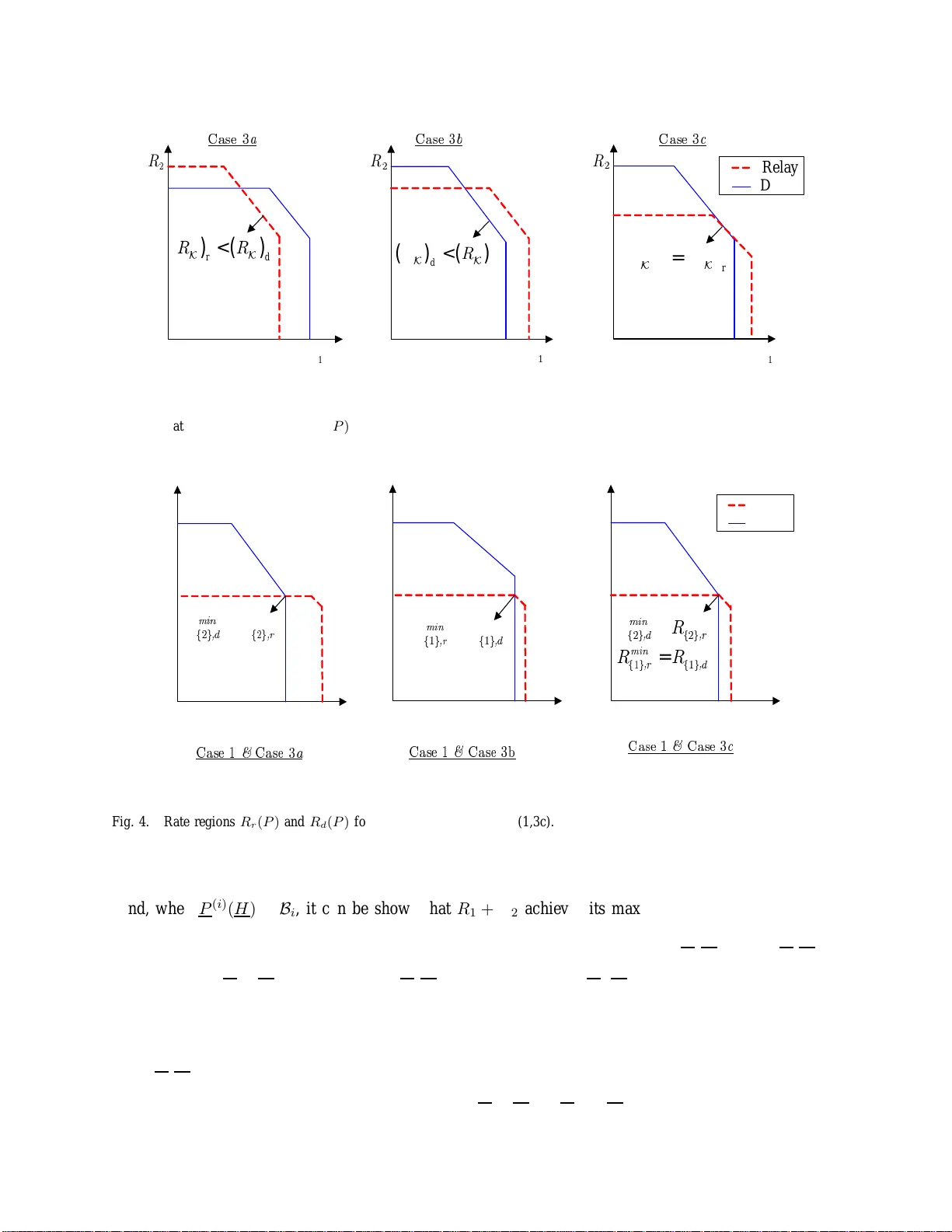
1 Opportunistic Communications in Fading Multiacc ess Relay Channels Lalitha Sankar Member , IEEE , Y ingbin Liang Member , IEEE , N. B. Mandayam Senior Member , IEEE , and H. V incent Poor F ell ow , IEEE Abstract The problem of op timal r esource allo cation is studied fo r ergodic fadin g orthogon al multiaccess relay channels (MARCs) in which the users (sources) commu nicate with a destination with the aid of a half-du plex relay that transmits o n a chann el ortho gonal to that u sed b y the transm itting source s. Und er the assumptio n that th e instantaneo us fading state info rmation is av ailable at all nod es, the max imum sum-rate an d the optimal u ser an d relay power allocations (p olicies) are developed for a decode-and - forward (DF) relay . W ith th e observation that a DF relay results in two mu ltiaccess c hannels, o ne at the r elay and the other at the destination, a single k nown lemma on the sum-rate of two intersectin g polymatr oids is used to determin e the DF sum-rate a nd the optimal u ser and relay policies. The lemma also enab les a bro ad topo logical classification of fading MARCs into on e of three types. The first ty pe is the set of p artially clustered MARCs wher e a user is c lustered either with th e relay or with the destination such that the users waterfill on their bottle-n eck links to the distant receiver . The second type is th e set of clustered M ARCs wher e all u sers are eith er pro ximal to the relay or to the destinatio n such that o pportu nistic mu ltiuser scheduling to one o f the receivers is optimal. The third type c onsists of a rbitrarily clu ster ed MARCs which are a co mbinatio n of the first two types, and for th is type it is L. Sankar and H. V . Poor are with the Department of Electri cal Engineering, Princeton Uni v ersity , Princeton, NJ 08544, USA. Y . Liang is with the Univ ersity of Hawaii, Honolulu, HI 96822, US A. N. B. Mandayam is wit h the WINL AB, Rutgers Univ ersity , North B runswick, NJ 08902, USA. A part of this work was done when L. Sankar was with the WINLAB, Rutgers Univ ersity and Y . Liang was with Princeton Uni versity . The work of L. Sankar , (pre viously S ankaranaray anan), Y . Liang, and H. V . Poor was supported by the National Science Founda tion under Grants ANI-03-38807 and C NS-06-25637. The work of N. B. Mandayam was supported i n part by the National Science Foundation under Grant No. ITR-0205362 . The material in this paper was presented in part at the IEEE International Symposium on Information Theory , Nice, France, Jun. 2007. October 25, 2018 DRAFT 2 shown that the op timal policies are o pportu nistic non- waterfilling solutions. The analysis is extended to develop the rate region of a K -user orth ogona l half -duplex MARC. Fin ally , cutset outer b ound s a re used to show that DF ach iev e s th e capacity region fo r a class of clustered o rthogo nal half- duplex MARCs. Index T erms Multiple-access relay chan nel (MARC), deco de-and -forward, ergodic cap acity . I . I N T RO D U C T I O N Node coo peration in multi-terminal wireless n etworks h as bee n sh own to improve pe rformance by providing increas ed robustness to chann el variations an d by enabling energy savings (see [1]–[7] an d the references therein). A spec ific example of relay c ooperation in multi-terminal ne tworks is the multi-acce ss relay ch annel (MARC). T he MARC is a network in which s everal users (source n odes) co mmunicate with a sing le des tination with the aid of a relay [8]. The c oding strategies developed for the relay cha nnel [9] extend readily to the MARC [10]. For example, the strategy of [9, Theorem 1], now often c alled d ecode - and-forward (DF), has a relay that de codes user mess ages before forwarding them to the destination [3], [11]. Similarly , the strategy in [9, Theorem 6], now often called c ompress-and-forward (CF), ha s the relay quantize its output symbols an d transmit the resulting qua ntized bits to the de stination [10]. W e consider a MARC with a half-duplex wireless relay that trans mits an d receiv es in orthogon al channe ls. Spec ifically , we mod el a MARC with a half-duplex relay as an orthogonal MARC in which the relay rece iv e s on a cha nnel over which all the sources transmit, and transmits to the destination on an orthogonal channel 1 . This chann el mod els a relay-inclusive up link in a v a riety of networks s uch as wireless LAN, cellular , and sen sor ne tworks. The s tudy of wireless relay channels and networks has focused on sev e ral performance aspects, inc luding c apacity [1], [3], [9], diversit y [2], [4], [13], outage [14]–[16], an d cooperative c oding [17], [18 ]. Equa lly pertinent is the problem of resource allocation in fading wireless ch annels wh ere b oth source and relay nodes ca n alloca te their transmit power to enhan ce a desired performance metric when the fading state information is available. Reso urce allocation for a 1 Y et another class of orthogonal single-source half-duplex relay channels is defined in [12] where the source and relay transmit on orthogonal bands. The source transmits in both bands, one of which is recei ved at the relay and the other is recei ved at the destination, such that the relay also transmits on the band receiv ed at the destination. In contrast to [12], we assume that all sources t ransmit in only one of orthogonal bands and t he relay transmits in the other . Furthermore, we assume that signals in both bands are recei ved at the destination. Later in the sequel we briefly discuss the general model where the sources transmit on both bands. October 25, 2018 DRAFT 3 variety of relay chan nels and networks has been s tudied in s ev eral pa pers, including [5], [14], [19]–[21]. A c ommon as sumption in all these pa pers is that the s ource an d relay nodes are s ubject to a total power constraint. For a wireless fading relay c hanne l, i.e ., a s ingle-user s pecialization of a fading MARC, the problem of resou rce allocation wh en the source and relay nodes are sub ject to individual power con straints in studied in [6] (see a lso [22]). Th e authors formulate the problem as a max-min optimization. They d raw parallels with the classica l minimax optimization in h ypothes is testing to show tha t, dep ending on the joint fading statistics, the resource allocation problem results in one o f three solutions. T he three solutions broadly c orrespond to three typ es o f cha nnel topologies , namely , so urce-relay clus tering, relay-destination clustering, a nd the non-clustered (arbitrary) top ology . Resource allocation in mu ltiuser relay networks has been studied recen tly in [23 ]–[25]. T he authors in [23] and [25] co nsider a specific orthogona l mo del where the sources time-duplex the ir transmissions and are aided in their transmissions by a half-duplex relay , while in [24] the optimal multiuser sc heduling is determined under the as sumption of a non-fading backhau l chann el between the relay and destination. In contrast, in this pa per , we conside r a more g eneral mu ltiaccess channe l with a ha lf-duplex relay and model all inter -nod e wireless links a s ergodic fading channe ls with perfect fading information available at all nodes . Ass uming a DF relay , we d evelop the optimal source and relay p ower allocations an d pres ent the conditions unde r which opportunistic time-duplexing of the users is o ptimal. The o rthogonal MARC is a multiaccess generaliza tion o f the orthogonal relay channe l studied in [6]; howe ver , the optimal DF policies d ev eloped in [6] do not extend readily to maximize the DF s um-rate of the MARC. This is beca use un like the single-use r c ase, in orde r to de termine the DF s um-rate for the MARC, we n eed to c onsider the intersection of the two mu ltiaccess rate regions tha t re sult from de coding at both the relay and the destination. Here, we exploit the polymatroid properties of these multiaccess regions and use a single known lemma on the sum-rate of two interse cting polymatroids [26, cha p. 46 ] to d ev elop inner (DF) and outer bounds on the s um-rate and the rate region a nd s pecify the s ub-class of orthogonal MARC s for which the DF bou nds are tight. A lemma in [26, chap. 4 6] e nables us to classify po lymatroid interse ctions b roadly into two s ets, namely , the s ets of active and ina ctive case s . An a cti ve or an inacti ve cas e resu lt when, in the region of intersection, the c onstraints on the K -user sum-rate at b oth rece i vers are active or ina cti ve, respe cti vely . In the sequ el we show that inac ti ve cas es s ugges t par tially cluster ed topologies whe re a subse t o f users is clustered clos er to on e of the receivers whil e the comp lementary subse t is close r to the rema ining rece i ver . On the other han d, ac ti ve cases can result from s pecific clus ter e d topologies s uch a s those in which all October 25, 2018 DRAFT 4 sources and the relay are clustered or those in wh ich the relay and the destination are clustered, o r more generally , from ar bitrarily clustered topologies that are either a comb ination of the two clustered mode ls or o f a clustered and a partially clustered model. For both the a cti ve and inactive c ases, the polymatroid intersection lemma y ields closed form expressions for the s um-rates which in turn allow o ne to develop the sum-rate optimal power a llocations (po licies). W e first study the two-user or thogonal MARC and develop the DF sum-rate maximizing po we r policies. Using the polymatroid intersection lemma we show that the fading-a veraged DF sum-rate is ac hiev ed by either one o f five disjoint case s, two inactiv e and three active, or by a bo undary case that lies at the bounda ry o f an a cti ve and an inactiv e case . W e d ev elop the s um-rate for a ll case s and show that the sum- rate maximizing DF power policy either: 1) exploits the multiuser fading di versity to o pportunistically schedu le use rs a nalogou sly to the fading MA C [27 ], [28] thoug h the optimal mu ltiuser policies are not neces sarily water- filling solutions, or 2 ) in volves simultaneous water -filling over two inde pende nt point- to-point links. Using similar tec hniques, we also develop the two-user DF rate region. Next, we gene ralize the two-user sum-rate a nd rate region analysis to the K -user channel a nd show that the inactive, a cti ve, an d boun dary cas es co rrespond to partially clustered, c lustered, an d a rbitrarily clustered topolog ies, res pectiv ely . Finally , we d ev elop the cutset o uter bou nds on the s um-capac ity o f an ergodic fading orthogonal and non-orthogona l K -user Gaussian MARC. W e s how that DF achieves the sum-capac ity for a class of half-duplex MARCs in wh ich the sources and relay are clustered s uch that the ou ter boun d on the K -user su m-rate at the des tination dominates a ll other sum-rate o uter bounds . W e also sh ow that DF ac hiev es the c apacity region when the cutset bounds a t the de stination are the dominant b ounds for all rate points on the bo undary of the outer bound rate region. In the cou rse of developing the main res ults of this p aper , we a lso s how that DF achieves the cap acity region of a class of de graded d iscrete memoryles s and Gau ssian non-fading orthogona l MARCs where the rece i ved signal at the destination is p hysically degraded with respec t to that at the relay conditioned on the transmit s ignal at the relay . The relati vely fe w capac ity res ults known for s pecific classes o f full-duplex single-user relay ch annels, s uch as those for degraded relay cha nnels [9, Theorem 5] a nd for a class of orthog onal relay c hannels [12], have not b een straightforward to extend to the MARC. T he result developed here is the first in w hich the entire capac ity region is given for a c lass of degraded MARCs. In co ntrast, in [29] it is shown that DF ach iev e s the sum-ca pacity of a cla ss o f full-duplex degraded G aussian MARCs for which the polymatroid interse ctions at the relay an d destination belong to the ac ti ve se t. The paper is organized a s follo ws . In Section II, we present the channe l models and introduce October 25, 2018 DRAFT 5 polymatroids and a lemma on their intersections. In Se ction III we develop the DF rate region for ergodic fading orthogonal MARCs . In Se ction IV we develop the power policies that ma ximize the DF sum-rate for a two-user MARC. W e extend the analysis to the K -user orthogo nal MARC a s well as to non-orthogona l mod els in Sec tion V. In Section VII, we present outer bou nds and illustrate our resu lts numerically . W e s ummarize our contributions in Se ction VIII. I I . C H A N N E L M O D E L A N D P R E L I M I NA R I E S A. Orthogonal Half-Duplex MARC A K -user MARC con sists of K source n odes nu mbered 1 , 2 , . . . , K , a relay n ode r , and a destination node d . W e write K = { 1 , 2 , . . . , K } to d enote the set o f s ources, T = K ∪ { r } to den ote the se t of transmitters, and D = { r, d } to d enote the set of receivers. In a n orthog onal MARC, the source s transmit to the relay a nd destination on one cha nnel, s ay chann el 1, wh ile the half-duplex relay transmits to the destination on an orthogon al ch annel 2 a s shown in Fig. 1. Th us, a fraction θ o f the total bandwidth resource is allocated to cha nnel 1 while the remaining fraction θ = 1 − θ is allocated to cha nnel 2. In the fraction θ , the source k , for all k ∈ K , transmits the signa l X k while the relay and the des tination receiv e Y r and Y d, 1 respectively . In the fraction θ , the relay transmits X r and the des tination recei ves Y d, 2 where the sources prec ede the relay in the transmission order . In each symbol time (cha nnel us e), we thus have Y r = P K k =1 H r,k X k + Z r , (1) Y d, 1 = P K k =1 H d,k X k + Z d, 1 , and (2) Y d, 2 = H d,r X r + Z d, 2 , (3) where Z r , Z d, 1 , and Z d, 2 are independe nt circularly sy mmetric complex Ga ussian noise random variables with zero means and unit variances. W e write H to de note a vec tor of fading gains , H k ,m , for all k ∈ D and m ∈ T , k 6 = m , s uch tha t h is a realization for a gi ven channel us e of a jointly stationary a nd ergodic (not nec essarily Gaus sian) fading proces s { H } . Note that the channe l gains H k ,m , for all k , m , are not as sumed to be inde pende nt. W e assume that the fraction θ is fixed a priori and is known a t all nodes. Since the relay is ass umed to be ca usal, w e note that the signa l X r at the relay in ea ch ch annel use d epend s ca usally only on the Y r receiv ed in the previous chan nel uses. Over n uses of the ch annel, the source and rela y transmit seq uence s { X k ,i } and { X r,i } , resp ectiv ely , October 25, 2018 DRAFT 6 h d , 1 h r ,1 h r ,2 h d,r S 1 : X 1 r : Y r h d , 2 S 2 : X 2 X r d : Y d ,1 d : Y d , 2 Fig. 1. A two-user orthogonal MARC. are con strained in power a ccording to n X i =1 | X k ,i | 2 ≤ n P k , for all k ∈ T . (4) Since the sources an d relay kn ow the fading s tates of the links o n which they trans mit, they can alloca te their trans mitted signal power ac cording to the chann el state information. W e write P k ( H ) to de note the p ower allocated a t the k th transmitter , for all k ∈ T , a s a function of the chann el s tates H . For an ergodic fading cha nnel, (4) the n simplifies to E [ P k ( H )] ≤ P k for all k ∈ T (5) where the expectation in (5) is over the distributi on of H . W e write P ( H ) to denote a vector of power allocations with entries P k ( H ) for all k ∈ T , and defi ne P to be the set of a ll P ( H ) wh ose entries satisfy (5). Throughou t the sequel, we refer to the fractions θ and 1 − θ as the first and s econd fractions, respectively . B. P olymatr oids In the seque l, we u se the prop erties of polyma troids to develop the e r godic su m-rate res ults. Poly- matroids hav e b een used to develop capacity characterizations for a vari ety of multiple-access channe l models inc luding the MARC (see for e.g. , [11], [28 ], [30]). Furthermore, in [30], Han demons trates that for ce rtain multi-terminal c hanne ls, polymatroid interse ctions n eed to be c onsidered. T o the best of our k nowledge, this is the first work where the p olymatroid intersec tion lemma has been used to explicitly characterize sum-rates and s um-capac ity , wh ere possible. W e revie w the following definition of a po lymatroid. October 25, 2018 DRAFT 7 Definition 1: Let K = { 1 , 2 , . . . , K } and f = 2 K → R + be a set function. Th e po lyhedron B ( f ) ≡ { ( R 1 , R 2 , . . . , R K ) : R S ≤ f ( S ) , for all S ⊆ K , R k ≥ 0 } (6) is a polymatroid if f sa tisfies 1) f ( ∅ ) = 0 (normalization) 2) f ( S ) ≤ f ( P ) if S ⊂ P (monotonicity) 3) f ( S ) + f ( P ) ≥ f ( S ∪ P ) + f ( S ∩ P ) (submodularity). Remark 1 : The s ubmodularity property in De finition 1 a bove is equiv a lent to requiring, for all k 1 , k 2 in K with k 1 6 = k 2 , k 1 / ∈ S , k 2 / ∈ S , that f satisfies [26 , Ch. 44] f ( S ∪ { k 1 } ) + f ( S ∪ { k 2 } ) ≥ f ( S ) + f ( S ∪ { k 1 , k 2 } . (7) This property is u sed in [11 ] to show that the rate regions ac hiev ed a t b oth the relay a nd the d estination in a full-duplex MARC are polymatroids. W e us e the follo wing lemma o n polyma troid intersec tions to dev elop optimal inner and outer bounds on the sum-rate for K -us er half-duplex MARCs . Lemma 1 ( [26, p. 79 6, Cor . 46.1c]): Let R S ≤ f 1 ( S ) and R S ≤ f 2 ( S ) , for all S ⊆ K , be two polymatroids suc h that f 1 and f 2 are nonde creasing submodular set functions on K with f 1 ( ∅ ) = f 2 ( ∅ ) = 0 . The n max R K = min S ⊆K ( f 1 ( S ) + f 2 ( K\S )) . (8) Lemma 1 states that the ma ximum K -us er sum-rate R K that results from the intersec tion o f two polymatroids, R S ≤ f 1 ( S ) an d R S ≤ f 2 ( S ) , is given by the minimum o f the two K -user su m-rate planes f 1 ( K ) and f 2 ( K ) only if b oth s um-rates are a t most as large as the sum o f the o rthogonal rate planes f 1 ( S ) a nd f 2 ( K\S ) , for all ∅ 6 = S ⊂ K . W e refer to the resulting intersection as belonging to the set of active c ases . When the re exists at leas t one ∅ 6 = S ⊂ K for which the ab ove co ndition is n ot true, an inactive case is s aid to result. For s uch c ases, the maximum s um-rate in (8) is the sum of two orthog onal rate plane s achieved by two comple mentary s ubsets of us ers. As a resu lt, the K -user sum-rate bo unds f 1 ( K ) and f 2 ( K ) are no longer a ctiv e for this case, a nd thus , the region of intersec tion is no longer a polymatroid with 2 K − 1 faces . For a K -us er MARC, there are 2 K − 2 poss ible inactive cas es. The intersec tion o f two polymatroids ca n also result in a bo undary case when for any S ⊂ K , f 1 ( S ) + f 2 ( K\S ) is e qual to one or both of the K -user s um-rate plane s. The orthogon ality of the planes f 1 ( S ) and f 2 ( K\S ) implies that no two inactiv e cas es have a bou ndary and thus a bo undary cas e always arises October 25, 2018 DRAFT 8 between a n ina ctiv e and a n active case . No te that by definition, a boun dary cas e is also a n a cti ve case though for ea se of expo sition, throughout the seq uel we explicitly distinguish be tween them. From (8), there are three poss ible activ e ca ses co rresponding to the three c ases in wh ich the sum-rate plane at one of the rec eiv ers is sma ller than, la r ger than , or e qual to tha t at the other . In fact, the case in which the sum-rates are equal is a lso a boundary ca se between the other two a ctiv e cases. Thus, there are a total of 2 K − 1 bounda ry c ases for each acti ve c ase. In summa ry , the inactive s et con sists of all intersections for which the co nstraints on the two sum-rates are not activ e, i.e. , no rate tuple on the sum-rate plane ach iev e d a t one of the rece i vers lies within or on the boundary o f the rate region achieved at the o ther recei ver . On the other ha nd, the intersec tions for which there exists at lea st one s uch rate tuple such that the two sum-rates con straints are activ e be long to the active set . Thus , by defi nition, the acti ve set also includes thos e bo undary cases between the active and ina cti ve c ases for which there is exac tly on e su ch rate pair . I I I . T W O - U S E R O RT H O G O N A L M A R C : E R G O D I C D F R A T E R E G I O N The DF rate region for a disc rete memoryles s MARC and a full-duplex relay is developed in [3, Appendix A] (se e [11] for a detailed p roof). For this mode l, X k , k ∈ T , de notes the trans mit signals a t the sources and relay and Y r and Y d , denote the rec eiv e d signals a t the relay and destination, respe cti vely . The rate region is achieved using block Markov en coding a nd back ward decoding. The following p roposition summarizes the DF rate region. Pr opo sition 1 ( [11, Append ix I]): The DF rate region is the u nion of the s et of rate tuples ( R 1 , R 2 , . . . , R K ) that s atisfy , for all S ⊆ K , R S ≤ min { I ( X S ; Y r | X S c V K X r U ) , I ( X S X r ; Y d | X S c V S c U ) } (9) where the un ion is over all distrib utions that factor as p ( u ) · Q K k =1 p ( v k | u ) p ( x k | v k , u ) · p ( x r | v K , u ) · p ( y r , y d | x T ) . (10) Remark 2 : The time-sh aring ran dom variable U e nsures tha t the region of Theo rem 1 is conv ex. Remark 3 : The independen t au xiliary random v a riables V k , k = 1 , 2 , . . . , K , help the sources cooperate with the relay . In [10] (se e also [31, Propo sition 2.5]), the DF rate bounds for a discrete memoryles s MARC with a half-duplex relay are d ev eloped. For the orthogona l MARC model studied, since the sources an d relay transmit on o rthogonal chann els, the need for auxiliary random variables V k , for all k , that model the coherent combining gains is eliminated. Under the as sumption that the transmit (bandwidth) fractions θ October 25, 2018 DRAFT 9 and 1 − θ at the users and relay , resp ectiv e ly , are known at all nodes , the follo wing proposition s ummarizes the DF rate region for the o rthogonal ha lf-duplex MARC. Pr opo sition 2 : The DF rate region of a orthogonal MARC is the union of the set of rate tup les ( R 1 , R 2 , . . . , R K ) that satisfy , for all S ⊆ K , R S ≤ min θ I ( X S ; Y r | X S c U ) , θ I ( X S ; Y d, 1 | X S c U ) + θ I ( X r ; Y d, 2 | U ) (11) where the un ion is over all distrib utions that factor as p ( u ) · θ h Q K k =1 p ( x k | u ) i · p ( y r , y d | x K ) + θ p ( x r | u ) · p ( y d | x r ) . (12) Definition 2: A parallel MARC is a collection of M MARCs, for wh ich the inputs and outputs of parallel channel (su b-channe l) j , j = 1 , 2 , . . . , M , are X k ,j , k ∈ K ∪ { r } and ( Y r,j , Y d,j ) , respectiv e ly , such that conditioned on its inputs, the outputs of eac h s ub-chan nel a re independe nt of the inputs and outputs o f othe r su b-channe ls. Theorem 1: For t he parallel MARC, the DF rate region is the union of the set of rate tuples ( R 1 , R 2 , . . . , R K ) that s atisfy , for all S ⊆ K , R S ≤ min X M m =1 I ( X S ,m ; Y r,m | X S c ,m V K ,m X r,m U m ) , X M m =1 I ( X S .,m X r,m ; Y d,m | X S c ,m V S c ,m U m ) (13) where the un ion is over all distrib utions that factor as Q M m =1 p ( u m ) · Q K k =1 p ( v k ,m , x k ,m | u m ) p ( y r,m , y d,m | x T ,m ) . (14) Pr oof: T he i nner bounds in (13) are o btained by setting U = ( U 1 U 2 . . . U M ) , V k = ( V k , 1 V k , 2 . . . V k ,M ) , X k = ( X k , 1 X k , 2 . . . X k ,M ) , Y r = ( Y r, 1 Y r, 2 . . . Y r,M ) , and Y d = ( Y d, 1 Y d, 2 . . . Y d,M ) , in (9) and choosing ( U m , V K ,m , X K ,m ) to b e indep endent for all m . For the (half-duplex) orthogon al Gau ssian MARC with a fixed H and θ that is a ssumed known a t all node s, we co nsider Gaussian signaling with ze ro mea n an d variance P k at transmitter k such that X k ∼ C N (0 , P k ) , for all k ∈ K . Thus , from (11) the DF rate region inc ludes the set of all rate pairs ( R 1 , R 2 ) that satisfy R k ≤ min ( θ C | H d,k | 2 P k θ ! + θ C | H d,r | 2 P r θ ! , θ C | H r,k | 2 P k θ !) , k = 1 , 2 (15) and R 1 + R 2 ≤ min ( θ C 2 X k =1 | H d,k | 2 P k θ ! + θ C | H d,r | 2 P r θ ! , θ C 2 X k =1 | H r,k | 2 P k θ !) . (16) October 25, 2018 DRAFT 10 For a stationary and ergodic proces s { H } , the chan nel in (1)-(3) ca n be modeled a s a s et of parallel Gaussian orthogo nal MARCs, one for eac h fading instantiation H . For a power policy P ( H ) , the DF rate bou nds for this ergodic fading chan nel are obtained from Theorem 1 by averaging the bounds in (15) and (16) over all channel realizations. The er g odic fading DF rate region, R D F , ac hieved over all P ( H ) ∈ P , for a fixed bandwidth fraction θ , is summarized b y the following theorem. Theorem 2: The DF rate region R D F of a n ergodic fading orthogonal Gaussian MARC is R D F = [ P ∈P {R r ( P ) ∩ R d ( P ) } (17) where, for all S ⊆ K , we have R r ( P ) = ( R 1 , R 2 ) : R S ≤ E θ C P k ∈S | H r,k | 2 P k ( H ) θ (18) and R d ( P ) = ( R 1 , R 2 ) : R S ≤ E θ C P k ∈S | H d,k | 2 P k ( H ) θ + θ C | H d,r | 2 P r ( H ) θ ! . (19) Pr oof: The proof follo ws from the ob servation that the channel in (1)-(3) can be mode led as a set of parallel Gaussian orthogonal MARCs , one for ea ch fading instantiation H . Thu s, from Theorem 1, for Gaussian inputs and for each P ( H ) ∈ P , the regions R r ( P ( H )) an d R d ( P ( H )) are giv e n by the bounds in (18) and (19), respec ti vely . The DF rate region, R D F , is given by the union of suc h interse ctions, one for each P ( H ) ∈ P . The con vexity of R D F follo ws from the c on vexity o f the set P and the conc avity of the log function. Conside r two rate tuples ( R ′ 1 , R ′ 2 ) and ( R ′′ 1 , R ′′ 2 ) that result from the po licies P ′ ( H ) and P ′′ ( H ) , respec ti vely . For any λ > 0 such that λ = 1 − λ , and for all k = 1 , 2 , from (18), we bound R k = λR ′ k + (1 − λ ) R ′′ k achieved at the rela y as R k ≤ λθ E " C | H r,k | 2 P ′ k ( H ) θ !# + λθ E " C | H r,k | 2 P ′′ k ( H ) θ !# (20) ≤ θ E " C | H r,k | 2 λP ′ k ( H ) + λP ′′ k ( H ) θ !# (21) ≤ θ E " C | H r,k | 2 P k ( H ) θ !# (22) where (21) follows from J ensen ’ s ine quality and (22) follo ws from the c on vexity o f the set P s uch that P ( H ) = λP ′ ( H ) + λP ′′ ( H ) ∈ P . Thus , we see that the boun d on R k is ac hiev able . One can similarly bound the s um-rate R 1 + R 2 achieved at the relay thus proving that the tuple ( R 1 , R 2 ) ∈ R r . The same approach a lso allows us to s how tha t ( R 1 , R 2 ) ∈ R d , thu s proving tha t R D F is c on vex. October 25, 2018 DRAFT 11 Pr opo sition 3 : R r ( P ( H )) and R d ( P ( H )) are polyma troids. Pr oof: In [11 , Sec. IV .B], it is shown that for ea ch choice of the input distributi on in (10), the DF rate region in (9) is an interse ction of two po lymatroids, on e resulting from the bou nds at the relay a nd the other from the boun ds a t the destination. For the orthogo nal MARC, the bounds in (11), relative to (9), in volve a weighted sum of mutua l information express ions; using the same approac h as in [11, Sec . IV .B], the su bmodularity of these expre ssions can be verified in a straightforward mann er . Remark 4 : The DF rate region gi ven by (15 ) and (16) is achieved using block Ma rkov enc oding at the sou rces. For the er godic fading mod el, the rates in Theorem 2 are ob tained as suming that a ll fading instantiations a re s een in each s uch block . In the following sec tion, we develop s um-rate optimal DF power p olicies. I V . T W O - U S E R O R T H O G O N A L M A R C : D F S U M - R A T E O P T I M A L P O W E R P O L I C Y For ea se of notation, throu ghout the sequ el, we w rite R A ,j to d enote the sum-rate bound on the users in A an d R min A ,j to den ote the sum-rate o btained by succe ssiv ely deco ding the us ers in K \A be fore decod ing those in A at receiv er j = r , d . For the two-user case , R K ,j and R A ,j , for all A ⊂ K a re given by the sum-rate and s ingle-user bou nds in (18) an d (19) at the relay a nd des tination, re spectively . The rate R min A ,j = R K ,j − R K\A ,j , for all A ⊂ K , is obtaine d by succ essively decoding the users in K \A be fore decoding those in A at the c orner points of the regions R r and R d . The region R D F in (17) is a union of the intersections of the regions R r ( P ( H )) an d R d ( P ( H )) achieved at the relay and destination respec ti vely , where the union is over all P ( H ) ∈ P . Since R D F is con vex, ea ch point on the boundary of R D F is obtained by maximizing the weighted sum µ 1 R 1 + µ 2 R 2 over a ll P ( H ) ∈ P , a nd for all µ 1 > 0 , µ 2 > 0 . Sp ecifically , we determine the optimal po licy P ∗ ( H ) tha t maximize s the sum-rate R 1 + R 2 when µ 1 = µ 2 = 1 . Obs erve from (17) that every point on the bound ary of R D F results from the intersection of the polymatroids (pen tagons) R r ( P ( H )) a nd R d ( P ( H )) for s ome P ( H ) . In Figs. 2 and 3 we illustrate the fiv e poss ible cho ices for the sum-rate resulting from such an intersection for a two-user MARC of which tw o belong to the inacti ve set and three to the activ e set. The inactiv e s et consists of cases 1 and 2 in which user 1 achiev es a signific antly larger rate at the relay an d destination, respectively , than it doe s at the other rec eiv er; and vice-versa for user 2 . The activ e set includes cas es 3 a , 3 b , a nd 3 c shown in F ig. 2 in which the su m-rate at rela y r is smaller , larger , or equal, res pectiv ely , to that achieved at the destination d . The three bound ary cases be tween case 1 and October 25, 2018 DRAFT 12 R R R { } , d R R R ! " # $ % & ' R ( ) * + , R - . / R 0 + R 1 R 2 + R 3 4 5 6 7 8 9 : ; < = > ? @ A B C D E F G 1 R 1 R 2 R 2 R Fig. 2. Rate regions R r ( P ) and R d ( P ) and sum-rate for case 1 and case 2. the three ac ti ve c ases are shown in Fig. 4 while the remaining three between case 2 and the activ e case s are sh own in Fig. 5 . W e denote a bo undary ca se as case ( l, n ) , l = 1 , 2 , n = 3 a, 3 b, 3 c . W e write B i ⊆ P a nd B l,n ⊆ P to denote the set of power policies that achieve case i , i = 1 , 2 , 3 a, 3 b, 3 c , and case ( l , n ) , l = 1 , 2 , n = 3 a, 3 b, 3 c , respe ctiv e ly . W e show in the seq uel that the optimization is simplified when the con ditions for each ca se are defined such that the sets B i and B l,n are disjoint for all i, l , and n , a nd thus, are either op en or half-open sets suc h that no two sets s hare a bounda ry . Ob serve tha t cases 1 and 2 do not share a b oundary s ince such a transition (see Fig. 2) requ ires passing through ca se 3 a or 3 b or 3 c . Finally , no te that F ig. 3 illustrates two sp ecific R r and R d regions for 3 a , 3 b , and 3 c . For e ase of exposition, we write B 3 = B 3 a ∪ B 3 b ∪ B 3 c , where B i , i = 3 a, 3 b, 3 c . In ge neral, the occurrenc e o f any one of the disjoint ca ses depen ds o n both the channe l s tatistics and the policy P ( H ) . Since it is not straightforward to know a priori the p ower allocations that achieve a certain c ase, w e maximize the su m-capacity for each case over all allocations in P a nd writ e P ( i ) ( H ) and P ( l,n ) ( H ) to denote the optimal s olution for c ase i and cas e ( l , n ) , res pectively . E xplicitly includ ing bounda ry c ases ens ures that the se ts B i and B l,n are disjoint for all i and ( l , n ) , i.e., these s ets are either open or ha lf-open se ts such that no two se ts share a power p olicy in co mmon. T his in turn simplifies the con vex op timization as follows. Let P ( i ) ( H ) be the optimal policy maximizing the sum-rate for cas e i over all P ( H ) ∈ P . The optimal P ( i ) ( H ) must satisfy the conditions for case i , i.e. , P ( i ) ( H ) ∈ B i . If the con ditions a re s atisfied, we prove the op timality of P ( i ) ( H ) using the fact that the rate function for each case is concave. On the other October 25, 2018 DRAFT 13 R H R I R J R K L M N O P Q R S TU V W R X R Y Z [ \] ^ _ ( ) ( ) r d < R R ` a ( ) ( ) d r < R R b c Relay Dest. ( ) ( ) d r = R R d e Fig. 3. Rate regions R r ( P ) and R d ( P ) and sum-rate for cases 3 a , 3 b , and 3 c . f g h i j k l m n o p q r s t u v w x y z { | } ~ Relay Dest. 1 R 1 R 1 R 2 R 2 R 2 R = R R = R R ¡ ¢ £ = ¤ ¥ ¦ § ¨ © ª R R « ¬ ® ¯ ° = ± ² ³ ´ µ ¶ · R R ¸ ¹ º » ¼ ½ Fig. 4. Rate regions R r ( P ) and R d ( P ) for cases (1,3a), (1,3b), and (1,3c). hand, when P ( i ) ( H ) 6∈ B i , it can be shown that R 1 + R 2 achieves its max imum outside B i . The proof again follows from the f act that R 1 + R 2 for a ll c ases is a concave function of P ( H ) for a ll P ( H ) ∈ P . Thus , when P ( i ) ( H ) 6∈ B i , for every P ( H ) ∈ B i there exists a P ′ ( H ) ∈ B i with a larger sum-rate. Combining this with the fact that the sum-rate expres sions are c ontinuous while trans itioning from one case to another at the bou ndary of the open set B i , ensures tha t the max imal sum-rate is ach iev e d b y some P ( H ) 6∈ B i . Similar arguments justify maximizing the optimal po licy for e ach c ase over all P . Due to the c oncavity o f the rate functions, o nly on e P ( i ) ( H ) or P ( l,n ) ( H ) will satisfy the con ditions for October 25, 2018 DRAFT 14 ¾ ¿ À Á Â Ã Ä Å Æ Ç È É Ê Ë Ì Í Î Ï Ð Ñ Ò Ó Ô Õ Ö × Ø Ù Ú Û Ü Ý Þ ß à á Relay Dest. 1 R 1 R 1 R 2 R 2 R 2 R = â ã ä å æ ç è R R éê ë ì íî = ï ð ñ ò ó ô õ R R ö ÷ ø ù ú û = ü ý þ ÿ R R = R R Fig. 5. Rate regions R r ( P ) and R d ( P ) for cases (2,3a), (2,3b), and (2,3c). its ca se. The optimal P ∗ ( H ) is given by this P ( i ) ( H ) or P ( l,n ) ( H ) . The o ptimization prob lem for cas e i or cas e ( l , n ) is given by max P ∈P S ( i ) or max P ∈P S ( l,n ) s.t. E [ P k ( H )] ≤ P k , k = 1 , 2 , r P k ( H ) ≥ 0 , k = 1 , 2 , r (23) where S (1) = R { 1 } ,d + R { 2 } ,r S (2) = R { 1 } ,r + R { 2 } ,d S ( i ) = R K ,j for ( i, j ) = (3 a, r ) , (3 b, d ) S (3 c ) = R K ,r s.t. R K ,r = R K ,d . S ( l,n ) = S ( l ) s.t. S ( l ) = S ( n ) . (24) The optimal p olicy for each case is de termined using Lagran ge multipli ers and the Karus h - K uhn - T ucker (KKT) c onditions [32, 5.5.3]. A detailed analysis is developed in the Appendix and we su mmarize the KKT conditions and the optimal policies for all cases b elow . From (24), the KKT conditions for each case x , x = i, ( l , n ) , for all i and ( l, n ) is gi ven as f ( x ) k ( P ( h )) − ν k ln 2 ≤ 0 , with equality for P k ( h ) > 0 , k = 1 , 2 , r (25) October 25, 2018 DRAFT 15 where ν k , for all k = 1 , 2 , r , are dua l variables asso ciated with the power c onstraints in (23). Specia lizing the KKT con ditions for each ca se, we obtain the o ptimal policies for e ach case as summarized be low follo wing wh ich we list the c onditions that the optimal p olicy for ea ch case needs to satisfy . Case 1 : The functions f (1) k ( P ( h )) , k = 1 , 2 , r , in (25) for cas e 1 are f (1) k ( P ( h )) = | h m,k | 2 ( 1+ | h m,k | 2 P k ( h )/ θ ) ( k , m ) = (1 , d ) , (2 , r ) (26) f (1) r ( P ( h )) = | h d,r | 2 ( 1+ | h d,r | 2 P k ( h )/ θ ) . (27) It is straightforward to verify that these KKT conditions simplify to P (1) k ( h ) = θ ν k ln 2 − θ | h m,k | 2 + ( k , m ) = (1 , d ) , (2 , r ) (28) and P (1) r ( h ) = θ ν r ln 2 − θ | h d,r | 2 ! + . (29) Case 2 : From (24), s ince S (2) can be obta ined from S (1) by interchan ging the user indexes 1 an d 2 , the functions f (2) k ( P ( h )) , and henc e, the KKT conditions for this ca se can be obtained by replacing the supe rscript (1) b y (2) and us ing the pairs ( k , m ) = (1 , d ) , (2 , r ) in (26)-(28). The resulting optimal policies a re P (2) r ( h ) = P (1) r ( h ) for all h , and P (2) k ( h ) = θ ν k ln 2 − θ | h m,k | 2 + ( k , m ) = (1 , r ) , (2 , d ) . (30) Case 3 a : The fun ctions f (3 a ) k ( P ( h )) , k = 1 , 2 , satisfying the KK T cond itions in (25) a re f (3 a ) k ( P ( h )) = | h r,k | 2 1 + 2 P k =1 | h r,k | 2 P k ( h )/ θ k = 1 , 2 . (31) Since this cas e maximize s the mu ltiaccess sum-rate at the relay , the optimal user policies a re multiuser opportunistic water-filli ng solutions giv en by | h r, 1 | 2 v 1 > | h r, 2 | 2 ν 2 P (3 a ) 1 ( h ) = θ ν 1 ln 2 − θ | h r, 1 | 2 + , P (3 a ) 2 = 0 | h r, 1 | 2 v 1 ≤ | h r, 2 | 2 ν 2 P (3 a ) 1 ( h ) = 0 , P (3 a ) 2 = θ ν 2 ln 2 − θ | h r, 2 | 2 + (32) where w ithout loss of gene rality , the users are time-duplexed even w hen their sca led fading states in (32) are the same . While the relay power d oes no t explicitly a ppear in the optimization, since this c ase res ults when the sum-rate is smaller than that at the destination, choos ing the optimal relay policy to maximize the sum-rate at the destination, i.e., P (3 a ) r ( H ) = P (1) r ( H ) , s uf fices. Case 3 b : Th e func tions f (3 b ) k ( P ( h )) , k = 1 , 2 , satisfying the KKT c onditions in (25) ca n be obtained from (31) by replacing the sub script ‘ r ’ by ‘ d ’ in (31) while f (3 b ) r ( P ( h )) = f (3 a ) r ( P ( h )) = f (1) r ( P ( h )) . October 25, 2018 DRAFT 16 Thus, this case ma ximizes the mu ltiaccess sum-rate a t the des tination and the op timal user p olicies are multiuser o pportunistic water-fill ing solutions given by | h d, 1 | 2 v 1 > | h d, 2 | 2 ν 2 P (3 a ) 1 ( h ) = θ ν 1 ln 2 − θ | h d, 1 | 2 + , P (3 a ) 2 = 0 | h r, 1 | 2 v 1 ≤ | h d, 2 | 2 ν 2 P (3 a ) 1 ( h ) = 0 , P (3 a ) 2 = θ ν 2 ln 2 − θ | h d, 2 | 2 + (33) while the optimal relay policy is a water- filling solution P (3 a ) r ( H ) = P (1) r ( H ) . Case 3 c : The functions f (3 c ) k ( P ( h )) , k = 1 , 2 , r , satisfying the KKT con ditions in (25 ) are given as f (3 c ) k ( P ( h )) = (1 − α ) f (3 a ) k ( P ( h )) + αf (3 b ) k ( P ( h )) , k = 1 , 2 , (34) f (3 c ) r ( P ( h )) = αf (3 b ) r ( P ( h )) , k = r , (35) where the Lag range multiplier α a ccoun ts for the boun dary cond ition R K ,d ( P ( H )) = R K ,r ( P ( H ) ) (36) and the op timal policy P (3 b ) ( H ) ∈ B 3 c satisfies this c ondition wh ere B 3 c is the se t o f P ( H ) tha t satisfy (36). Thu s, this cas e maximizes the mu ltiaccess s um-rate at both the rela y an d the des tination. In the Appendix, using the KKT conditions we show that the optimal use r p olicies are opportunistic in form and a re given b y f (3 c ) 1 /ν 1 > f (3 c ) 2 /ν 2 P (3 c ) 1 ( h ) = root of F (3 c ) 1 | P 2 =0 + , P (3 c ) 2 ( h ) = 0 f (3 c ) 1 /ν 1 ≤ f (3 c ) 2 /ν 2 P (3 c ) 1 ( h ) = 0 , P (3 c ) 2 ( h ) = root of F (3 c ) 2 | P 1 =0 + . (37) Analogous to cases 3 a an d 3 b , the s chedu ling c onditions in (37) dep end on both the ch annel states and the water-fil ling le vels ν k at both us ers. Howe ver , the cond itions in (37) also de pend on the power policies, a nd thus , the optimal solutions are n o longer water-fil ling solutions. In the App endix w e show that the optimal user po licies can be co mputed us ing an iterative non-water-filling a lgorithm which starts by fixing the power policy of o ne use r , computing tha t of the other , and vice-versa until the policies con verge to the optimal policy . The iterati ve algorithm is computed for increasing values of α ∈ (0 , 1) until the op timal po licy satisfie s (36 ) at the op timal α ∗ . The proof o f con ver g ence is d etailed in the Appendix. Boundary Ca ses ( l , n ) : A boun dary case ( l , n ) res ults when S ( l ) = S ( n ) l = 1 , 2 , and n = 3 a, 3 b, 3 c. (38) Recall that S ( l ) and S ( n ) are s um-rates for a n inactive ca se l , a nd an acti ve cas e n , res pectively . Thus , in addition to the con straints in (23), the maximization problem for these cases inc ludes the additional October 25, 2018 DRAFT 17 constraint in (38). For all excep t the two ca ses where n = 3 c , the equ ality c ondition in (23) is represented by a Lagrang e mu ltiplier α . T he two ca ses with n = 3 c have two La grange multipliers α 1 and α 2 to also a ccount for the condition S (3 a ) = S (3 b ) . For the dif feren t bounda ry cas es, the functions f ( l,n ) k ( P ( h )) , k = 1 , 2 , satisfying the KKT conditions in (25) are given as f ( l,n ) k ( P ( h )) = (1 − α ) f ( l ) k ( P ( h )) + αf ( n ) k ( P ( h )) , k = 1 , 2 , n 6 = 3 c (39) f ( l, 3 c ) k ( P ( h )) = (1 − α 1 − α 2 ) f ( l ) k ( P ( h )) + α 2 f (3 a ) k ( P ( h )) + α 1 f (3 b ) k ( P ( h )) , k = 1 , 2 , (40) f ( l,n ) r ( P ( h )) = αf ( l ) r ( P ( h )) , n = 3 a (41) f ( l,n ) r ( P ( h )) = αf ( l ) r ( P ( h )) + (1 − α ) f ( n ) r ( P ( h )) , n = 3 b (42) f ( l,n ) r ( P ( h )) = α 1 f ( l ) r ( P ( h )) + (1 − α 1 − α 2 ) f (3 b ) r ( P ( h )) , n = 3 c (43) For ease of expos ition an d brevity , we summarize the KKT co nditions and the op timal policies for case (1 , 3 a ) . In the Append ix, u sing the K KT conditions we show that the optimal us er policies P (1 , 3 a ) k ( H ) are opp ortunistic in form and a re given by f (1 , 3 a ) 1 ν 1 > f (1 , 3 a ) 2 ν 2 P 1 ( h ) = root of F (1 , 3 a ) 1 | P 2 =0 + , P 2 ( h ) = 0 f (1 , 3 a ) 1 ν 1 ≤ f (1 , 3 a ) 2 ν 2 P 1 ( h ) = 0 , P 2 ( h ) = root of F (1 , 3 a ) 2 | P 1 =0 + (44) where F (1 , 3 a ) k = f (1 , 3 a ) k − ν k ln 2 , k = 1 , 2 . As in cas e 3 c , the optimal po licies take an opportunistic non-waterfilling form and in fact ca n b e obtained by a n iterative no n-water-filli ng a lgorithm as desc ribed for ca se 3 c . The optimal P (1 , 3 a ) r ( H ) = αP (1) r ( H ) is a water -filling solution. The o ptimal p olicies for all o ther boundary ca ses can be o btained similarly as detailed in the Appendix. In gene ral, for all boundary case s, the optimal us er policies are opportunistic non-water -filling solutions while tha t for the relay are water -filling solutions . Finally , the sum-rate maximizing po licy for any case is the optimal policy only if it satisfie s the conditions for that case . The c onditions for the c ases a re Case 1 : R { 1 } ,d < R min { 1 } ,r and R { 2 } ,r < R min { 2 } ,d (45) Case 2 : R { 1 } ,r < R min { 1 } ,d and R { 2 } ,d < R min { 2 } ,r (46) Case 3 a : ( R K ) r < ( R K ) d (47) Case 3 b : ( R K ) r > ( R K ) d (48) Case 3 c : ( R K ) r = ( R K ) d (49) October 25, 2018 DRAFT 18 Case (1 , 3 a ) : R K ,r = R { 1 } ,d + R { 2 } ,r < ( R K ) d (50) Case (2 , 3 a ) : R K ,r = R { 1 } ,r + R { 2 } ,d < ( R K ) d (51) Case (1 , 3 b ) : R K ,d = R { 1 } ,d + R { 2 } ,r < ( R K ) r (52) Case (2 , 3 b ) : R K ,d = R { 1 } ,r + R { 2 } ,d < ( R K ) r (53) Case (1 , 3 c ) : R K ,r = R K ,d = R { 1 } ,d + R { 2 } ,r (54) Case (2 , 3 c ) : R K ,r = R K ,d = R { 1 } ,r + R { 2 } ,d (55) where in fading state H , (45)-(55) are evaluated for X k ∼ C N 0 , P ( x ) k ( H ) /θ , k = 1 , 2 , and X r ∼ C N 0 , P ( x ) r ( H ) /θ for x = i, ( l , n ) . The following theo rem summarizes the form of P ∗ and p resents an algorithm to co mpute it. Theorem 3: The optimal policy P ∗ ( H ) max imizing the DF sum-rate o f a two-user ergodic fading orthogonal MARC is obtained by computing P ( i ) ( H ) and P ( l,n ) ( H ) starting with the inacti ve ca ses 1 and 2 , followed by the bo undary cas es ( l, n ) , and fina lly the ac ti ve cas es 3 a, 3 b, an d 3 c until for some case the co rresponding P ( i ) ( H ) or P ( l,n ) ( H ) satisfies the ca se cond itions. The optimal P ∗ ( H ) is g i ven by the o ptimal P ( i ) ( H ) or P ( l,n ) ( H ) that satisfies its case conditions and falls into on e of the following three categories: Inactive Cas es : The optimal policy for the two users is s uch that o ne user water-fill s over its link to the relay while the othe r water- fills over its link to the d estination. The optimal rela y po licy P ∗ r ( H ) is water -filling over its direct link to the des tination. Cases (3 a, 3 b, 3 c ) : Th e optimal use r policy P ∗ k ( H ) , for a ll k ∈ K , is oppo rtunistic water -filling over its link to the relay for ca se 3 a and to the des tination for ca se 3 b . For ca se 3 c , P ∗ k ( H ) , for all k ∈ K , takes an oppo rtunistic n on-waterfilling form a nd depe nds on the chann el gains of use r k at both receivers. The optimal relay po licy P ∗ r ( H ) is water- filling over its direct link to the destination. Boundar y Cases : The op timal us er po licy P ∗ k ( H ) , for a ll k ∈ K , takes an opportunistic non-water- filling form. The optimal relay policy P ∗ r ( H ) is water- filling over its direct link to the destination. Pr oof: The clos ed form expres sions for the op timal policies for e ach case are developed in the Appendix. The need for an order in evaluating P ∗ ( H ) is due to the follo wing reason s. Since every case results from an intersec tion o f two polymatroids, the cond itions in (47)-(49 ) h old for all c ases. Thus, all fea sible power po licies sa tisfy one of these three conditions as a result of which these co nditions do not allow a clear distinction betwee n the c ases. In contras t, the conditions for cases 1 an d 2 in (45) October 25, 2018 DRAFT 19 and (46), respectively , are mutually exc lusiv e . For the boun dary c ases, s ince every bou ndary cas e ( l, n ) results from the interse ction of an ac ti ve ca se n = 3 a, 3 b, 3 c, with an inactiv e c ase l = 1 , 2 , an d is itself an ac ti ve c ase, one of its c onditions corresp onds to the condition for case n , n = 3 a, 3 b , 3 c in (47)-(49 ). Additionally , in the Appe ndix we s how that the bou ndary condition S ( l ) = S ( n ) implies that only one of the two inequa lity conditions o f c ase l holds strictly while the other simplifies to an e quality . An immediate implication of these two con ditions is that the bou ndary ca ses are mu tually exclusiv e an d the set of power policies satisfying them are also dis joint from those satisfying cas es 1 a nd 2 . Thus, to determine the op timal P ∗ ( H ) , o ne c an s tart with any one o f the mutua lly exclusive inacti ve and bound ary cases . If the op timal policy for any one o f the se c ases satisfie s its cas e cond itions, then, P ∗ ( H ) is giv en by that policy . Howev er , if a ll these case s are eliminated, i.e., none of their optimal policies sa tisfy the appropriate ca se conditions, the optimal policies for re maining three cases 3 a , 3 b , and 3 c can be c omputed one at a time. From (47)-(49), cas es 3 a , 3 b , and 3 c are mutually exclusive, i.e., their feasible power s ets are disjoint, and thus, the op timal policy , satisfies the conditions for on ly o ne of three acti ve c ases. Remark 5 : The conditions for cases 3 a , 3 b , and 3 c can also be redefin ed to include the negation o f a ll the conditions for the other cas es. This in turn e liminates the need for an order in co mputing the optimal policy; howe ver , the numbe r of con ditions that ne ed to be checked to verify if the optimal policy satisfies the conditions for cas es 3 a o r 3 b or 3 c rema in unch anged relativ e to the algorithm in Theorem 3. W e now discu ss in detail the optimal power p olicies at the s ources and the relay for the different c ases . Optimal R elay P olicy : In the orthog onal model we consider , the relay trans mits directly to the de sti- nation on a ch annel orthogona l to the source transmiss ions. Thus, the relay to de stination link c an be viewed as a fading p oint to point link. In fact, in all c ases the optimal relay policy in volves water-filli ng over the fading states analogous to a fading point to point link (se e [33]). Howe ver , the exact s olution, including s cale factors, depend s on the case c onsidered. The optimal co operation strategy at the relay also de pends on the case studie d. For instance, con sider case 1 where users 1 and 2 a chieve s ignificantly larger rates (relative to the other rece i ver) at the relay and destination, res pectively . Thus , the sum-rate is the sum of the rates ac hiev ed over the bottle-neck links from user 1 to the d estination and from us er 2 to the relay ; i.e. , it is the sum of the single-user rate user 1 achieves at the de stination an d the rate user 2 a chieves at the relay . Th e single-user rate achieved by user 1 at the destination requires the relay to completely cooperate with user 1, i.e., the relay uses its p ower P r ( H ) to forw ard only the mes sage from u ser 1 in every fading state in wh ich it transmits. As shown in the interse ction for case 1 in F ig. 2, this is due to the fact tha t since user 1 ach iev e s a significantly larger rate at the relay than d oes user 2 , the sum-rate is maximized whe n the relay allocates October 25, 2018 DRAFT 20 its resources entirely to cooperating with user 1 . Finally , for case 2 , the relay coope rates entirely with user 2 . For the active cases, 3 a and 3 b , the s um-rate may be ac hiev ed by a n infin ite number of feas ible points on one or both o f the sum-rate planes ; the optimal c ooperative strategy at the relay will d if fer for each such point. Thus, for a corner point the relay transmits a messa ge from only one of the users while for all no n-corner po ints the relay trans mits bo th mess ages. For the bou ndary cases including c ase 3 c , the requirement of an equa lity (boun dary) con dition res ults in the introduction o f an add itional p arameter . Thu s, for ca se 3 c , the parameter α is introduce d to satisfy the equality con straint on the s um-rates achieved a t the relay a nd d estination. Similarly for ca ses (1 , 3 a ) , (2 , 3 a ) , (1 , 3 b ) , and (2 , 3 b ) , the parameter α is cho sen to ensure tha t the op timal p ower policies at the users and relay satisfy the equ ality c onstraint for tha t c ase. Finally , for c ases (1 , 3 c ) and (2 , 3 c ) , the requirement of satisfying two bound ary c onditions requires the introduction of the two paramete rs, α 1 and α 2 , o ne for ea ch cond ition. Optimal User P o licies : As with the relay , the optimal policies for the tw o users depen d on the case considered . For cases 1 an d 2 , the o ptimal policies are water-filli ng s olutions, i.e., eac h user allocates power o ptimally as if it were trans mitting to only that rece i ver at which it ac hiev es a lower rate. In fact, the c onditions for ca se 1 in (45 ) sugges t a ne twork geome try in wh ich source 1 and the relay a re physically prox imal enoug h to form a cluste r an d source 2 and the destination form ano ther cluster; and vice-versa for cas e 2. This clustering and the resulting water- filling over the bottle-neck links is the reason why the relay forwards the messa ge of only that us er physica lly proximal to it, namely , o nly user 1 an d only use r 2 for c ases 1 and 2 , resp ectiv ely . For case 3 a , the o ptimal policies at the two users maximize the su m-rate achieved at the relay (the smaller of s um-rates ach iev e d at the two receivers). Thes e policies are the same as thos e ach ieving the sum-capac ity of a two-user mu ltiple-access chan nel with the relay as the intended rec eiv e r (se e [27 ], [28]). Thus, the optimal policy for ea ch u ser in volv es water- filling over its fading s tates to the relay . The solution also exploits the multiuser di versity to oppo rtunistically schedule the users in ea ch u se of the channe l. Analogous ly , the optimal policies for cas e 3 b req uire multiuser water-fill ing over the user links to the destination. For b oth cases, if the channe l gains have a joint fading distrib ution with a continuo us d ensity , the sum-rate maximiza tion simplifies to sched uling o nly one use r in eac h fading ins tantiation (parallel channe l). Thus, the u sers time-share the ir c hannel use and the maximum sum-rate is ac hiev ed by a un ique point o n the bou ndary o f the rate region (see [28, III.D]). October 25, 2018 DRAFT 21 The optimal policies for cas e 3 c req uire the us ers to allocate power such that the sum-rates achieved at both the relay and the destination are the same. This c onstraint ha s the effect that it prese rves the opportunistic sc heduling since the su m-rate in volves the multiaccess s um-rate bound s at both rece i vers. Howe ver , the solutions are n o longer waterfilli ng due to the fact that the equality (bound ary) condition results in the function f (3 c ) k being a weighted sum o f the functions f (3 a ) k and f (3 b ) k for cases 3 a and 3 b , respectively . Finally , the requiremen t of satisfying one o r more boundary con ditions also a f fects the nature of the optimal policies for a ll the ( l, n ) cas es. Thus, for these bo undary case s, since the sum-rate p lanes are activ e , i.e., the functions f ( l,n ) k in volve the multiple-acces s sum-rate bou nds, the optimal power p olicies result in an opportunistic sch eduling of the u sers. Howe ver , a s with case 3 c , here too the op timal policies are no long er water -filling sinc e the bou ndary co nditions result in the functions f ( l,n ) k being weighted sums o f the functions for c ases l and n . Remark 6 : The ca se cond itions in (45)-(55) require averaging over the channel states; thus , the case that maximizes the sum-rate depends on the a verag e power c onstraints and the channel statisti cs (including network topology). Remark 7 : The optimal p olicy for e ach source for cases 1 , 2 , 3 a , a nd 3 b depe nds on the chan nel gains at o nly one o f the rec eiv ers. Howe ver , the optimal policy for the boundary cases , including case 3 c , d epends on the instantaneous ch annel s tates at both recei vers. Fu rthermore, a ll the ca ses exploiting the multiuser di versity require a centralized p rotocol to coo rdinate the op portunistic sc heduling of us ers. V . T W O - U S E R D F R A T E R E G I O N : O P T I M A L P O W E R P O L I C I E S In Theo rem 2, the DF rate region R D F is shown to be a union of the interse ctions of the regions R r ( P ( H )) and R d ( P ( H )) ac hiev ed at the relay and destination, respectively , where the union is over all P ( H ) ∈ P . Fu rthermore, since R D F is con vex, eac h po int on the bound ary of R D F is o btained by maximizing the weighted sum µ 1 R 1 + µ 2 R 2 over all P ( H ) ∈ P , and for all µ 1 > 0 , µ 2 > 0 . In fact, for ev ery ( µ 1 , µ 2 ) , the rate tuple ( R 1 , R 2 ) that ma ximizes the weighted sum µ 1 R 1 + µ 2 R 2 results from an interse ction of two rate polymatroids. Thus, ana logously to the s um-rate analys is for µ 1 = µ 2 = 1 , for arbitrary ( µ 1 , µ 2 ) , µ 1 R 1 + µ 2 R 2 , is maximized by e ither one of two inac ti ve cas es, or by on e of nine activ e ca ses of which six are boun dary cases . T o find the rate tuple maximizing µ 1 R 1 + µ 2 R 2 , we use the classic resu lt in linear programming that the maximum value of a linear fun ction co nstrained over a feasible bou nded polyhed ron is achieved at a vertex of the polyhedron [32, Chapter 1.2.2 ]. Thus , for a ny P ( H ) , the ( R 1 , R 2 ) -tuple ma ximizing October 25, 2018 DRAFT 22 µ 1 R 1 + µ 2 R 2 is g i ven by a vertex o f a R r ( P ( H )) ∩ R d ( P ( H )) polyhedron at which µ 1 R 1 + µ 2 R 2 is a tan gent. Recall that for the two inactiv e cas es, the polymatroid intersections res ult in rectang les, and thus, the re is a unique vertex max imizing µ 1 R 1 + µ 2 R 2 . T he interse ction is also a rec tangle for the six bounda ry cas es sinc e the se a ctiv e cases are suc h that only one point on the sum-rate plan e is included in the region of inte rsection. On the other h and, for c ases 3 a , 3 b , an d 3 c , the intersection of K -dimensiona l polymatroids results in a K -dimensional polyhe dron. Thus, for these c ases, when µ 1 < µ 2 , µ 1 R 1 + µ 2 R 2 is maximized b y that vertex whe re use r 1 is deco ded before user 2 , i.e., a t the vertex wh ere user 2 achieves its ma ximal s ingle-user rate. For simplicity , we pres ent the results for case s 1 , 3 a , and (1 , 3 a ) . The results for the o ther cases follo w naturally from discuss ions for these three cas es. W ithout los s of generality , we let µ 1 < µ 2 ; the analys is for µ 1 > µ 2 follo ws in an analogo us ma nner . Case 1 : From Fig. 2 , the weighted sum µ 1 R 1 + µ 2 R 2 for this case is given b y µ 1 R { 1 } ,d + µ 2 R { 2 } ,r . (56) Since µ 1 and µ 2 are ind epende nt of the transmit powers, the optimization problem is the sa me a s tha t for the sum-rate case. Th us, a t the maximal rate, use rs 1 and 2 waterfill o n their bottleneck links to the destination a nd relay , res pectiv ely . The ana lysis for c ase 2 is the same as that for case 1 except now u ser 1 and 2 waterfill on the ir bottleneck links to the relay an d des tination, respe cti vely . Case 3a : Th e weigh ted sum µ 1 R 1 + µ 2 R 2 is ma ximized by the vertex with coordinates R 1 = R K ,r − R 2 (57) R 2 = min R { 2 } ,r , R { 2 } ,d . (58) The ma ximization of µ 1 R 1 + µ 2 R 2 thus simplifies to max P ∈P µ 1 R K ,r + ( µ 2 − µ 1 ) min R { 2 } ,r , R { 2 } ,d (59) where the o ptimal P (3 a ) ( H ) s atisfies the c onditions in (47) for this cas e. As in the ap pendix, there are three p ossible disjoint s olutions to the max-min o ptimization in (59) resulting from either R { 2 } ,r being smaller , larger , or equal to R { 2 } ,d . W e discu ss the optimal policies for ea ch of these sub-case s sep arately below . 1) R { 2 } ,r < R { 2 } ,d : For this su b-case, the vertex of interes t in (57) a nd (58) is ac hieved b y the MA C bounds at the same rec eiv er . Thus, the maximization for these cases simplifies to that October 25, 2018 DRAFT 23 developed in for an ergodic fading MA C in [28]. The op timal power p olicies in volve water-filli ng and opportunistic sche duling of the u sers and water -filling a t the relay over its direct link to the destination. 2) R { 2 } ,r > R { 2 } ,d : The maximization here simplifies to max P ∈P µ 1 R K ,r + ( µ 2 − µ 1 ) R { 2 } ,d . (60) As with the Lagrangian expressions for the bound ary case s in the App endix, here too, the weighted sum of rates in (60) is an ap propriately weighted mixture of sum and single-user rates ac hieved at the relay and destination, respec ti vely . Th us, analogo usly to the bound ary ca ses, one ca n verify in a straightforward manner that the optimal p olicies maximizing (60) at both users are non-waterfilling solutions with opportunistic scheduling bas ed on r elati ve f ading states while that at the relay requires waterfilling over its d irect link to the destination. Note that the optimal policies a t both the users and the relay depen d on the values cho sen for µ 1 and µ 2 . 3) R { 2 } ,r = R { 2 } ,d : Subject to av e rage p ower and positivit y cons traints, the maximization here simplifies to max P ∈P µ 1 R K ,r + ( µ 2 − µ 1 ) R { 2 } ,r s.t. R { 2 } ,r = R { 2 } ,d . (61) The maximization in (61) s ubject to the equality con straint results in a Lagra ngian with a weigh ted mixture o f sing le-user rates achieved at the relay and des tination. Thus, the optimal user and relay policies have a form similar to that disc ussed in the previous sub -case in which the sum-rate and single-user ra te a re ach iev e d at different receivers, Remark 8 : The three sub-cases for case 3 a stud ied above are dif ferentiated by add itional constraints relating the s ingle-user rates a t the relay and the destination. This in turn implies that the region B 3 a will be divided into three mutually exclusiv e subsets, wh ere the cond ition for each su b-case is satisfied in on ly one of the s ubsets. Boundar y cas e (1 , 3 a ) : Rec all that a b oundary c ase ( l , n ) resu lts from s atisfying the conditions for the activ e case n an d satisfying the con ditions for the inactive c ase l as a mixture of equalities and inequalities. The res ulting rate region b elongs to the set of activ e case s but has one unique s um-rate point su ch that the interse ction of pe ntagons results in a rec tangle (see Figs. 4 an d 5). Thus , the weighted optimization µ 1 R 1 + µ 2 R 2 for case (1 , 3 a ) simplifies to µ 1 R { 1 } ,d + µ 2 R { 2 } ,r s.t. ( R K ) r = R { 1 } ,d + R { 2 } ,r . (62) October 25, 2018 DRAFT 24 Note that the cons traint in (62) is the same as that for the bound ary c ase (1 , 3 a ) in (50 ). Th us, the constrained maximization problem in (62) is analogou s to the sum-rate maximization for the b oundary cases an d admits a similar non-waterfilling opp ortunistic solution for the user power po licies and a waterfilling solution at the relay . Remark 9 : The disc ussion here for c ases 3 a a nd (1 , 3 a ) also ap plies to the o ther active (including bounda ry) c ases. In e ach su ch cas e, the optimal policies de pend on all the Lagran ge d ual variables, with each variable reflec ting a spec ific co nstraint. V I . K - U S E R G E N E R A L I Z AT I O N A. K -user S um-Rate Ana lysis W e u se Lemma 1 to extend the an alysis in the previous sections to the K -use r cas e. Recall that R D F is given by a union of the intersection of p olymatroids, where the u nion is over a ll power policies. From Lemma 1, we have that the ma ximal K -user sum-rate tuple is achieved by an inte rsection tha t either belongs to active set or to the inactive set. W e write l = 1 , 2 , . . . , 2 K − 2 , to index the 2 K − 2 non-empty subsets of K . For a K -use r MARC, there are 2 K − 2 possible intersections of the inactive kind with sum-rate J ( l ) giv e n by case l : S ( l ) = R S ,r + R K\S ,d l = 1 , 2 , . . . , 2 K − 2 s.t. R S ,r < R min S ,d and R K\S ,d < R min K\S ,d (63) where R A ,j and R min A ,j are as defi ned in S ection III and for j = r, d, are giv e n by the bo unds in (18) a nd (19), res pectively . The sum-rates J ( i ) , for the a ctiv e case s i = 3 a, 3 b, 3 c , are S ( i ) = R K ,j for ( i, j ) = (3 a, r ) , ( 3 b, d ) (64) S (3 c ) = R K ,r s.t. R K ,r = R K ,d . (65) Finally , the sum-rate J ( l,n ) , for the boun dary c ases totaling 3 2 K − 2 and en umerated as c ases ( l , n ) , l = 1 , 2 , . . . , 2 K − 2 , n = 3 a, 3 b, 3 c , are case ( l, 3 a ) : S ( l, 3 a ) = R K ,r s.t. R K ,r = R S ,r + R K\S ,d for case l (66) case ( l, 3 b ) : S ( l, 3 b ) = R K ,d s.t. R K ,d = R S ,r + R K\S ,d for ca se l (67) case ( l, 3 c ) : S ( l, 3 c ) = R K ,r s.t. R K ,r = R K ,d = R S ,r + R K\S ,d for case l (68) October 25, 2018 DRAFT 25 where the su bset S is cho sen to c orrespond to the appropriate c ase l . Remark 1 0: The constraint for cas e l in (63) can b e o btained directly from the requirement that the K -user sum-rate cons traints a t the two rec eiv ers are larger than that for case l (see (8)). The K -use r su m-rate optimization problem for ca ses i a nd ( l , n ) can be written as max P ∈P S ( i ) or max P ∈P S ( l,n ) s.t. E [ P k ( H )] ≤ P k , k = 1 , 2 , r P k ( H ) ≥ 0 , k = 1 , 2 , r . (69) An inac ti ve case l results whe n the c onditions for that case in (63) are satisfie d. A bound ary ca se resu lts when the cond itions for o ne of the c ases in (66)-(68) is satisfie d for the app ropriate ( l , n ) c ase. Finally , case 3 a or 3 b or 3 c resu lts wh en the con ditions for neither the ina ctiv e nor the bou ndary c ases are satisfied. As in Sec tion IV, the o ptimization for eac h ca se in volves writing the La grangian and the KKT conditions. Th e op timal policy P ∗ ( H ) satisfies the conditions for only on e of the ca ses. For brevity , we su mmarize the details below . • Inactive case s : The Lag rangian for the se cases in volves a sum of the DF bou nds at the relay in (18) for users in S , for eac h no n-empty S , and the DF bou nds at the des tination in (19) for the rema ining users in K \S s uch that for i = 1 , 2 , . . . , 2 K − 2 , L ( i ) = E θ C X k ∈S | H r,k | 2 P k ( H ) θ ! + θ C X k ∈K\S | H d,k | 2 P k ( H ) θ + θ C | H d,r | 2 P r ( H ) θ − X k ∈T ν k E P k ( H ) − P k + X k ∈T λ k P k ( H ) (70) where ν k , for all k , are the dua l variables as sociated with the p ower cons traints in (5), an d λ k ≥ 0 are the du al variables ass ociated with the po siti v ity c onstraints ( P k ≥ 0 ) on P k . Writing the KKT conditions, it is straightforward to verify tha t the o ptimal policy for a user in S is a function of the channe l gains a t the relay while that for a user in K\S is a function of the channel ga ins only at the destination. In fact, when S o r K\S are singleton s ets, the optimal policy for the u ser in S or K\S is s imply water-fill ing over its bottle-nec k link to either the relay (if S ) or the destination (if K\S ). More g enerally , when S or K \S are not singleton sets, the optimal policy is a n op portunistic water -filling s olution. Finally , the relay’ s po licy is water-filli ng over its direct link to the d estination. • Cases 3 a , 3 b , and 3 c : The Lagran gian for thes e three case s is gi ven by L ( i ) = S ( i ) − P k ∈T ν k E P k ( H ) − P k + P k ∈T λ k P k ( H ) i = 3 a, 3 b, 3 c (71) October 25, 2018 DRAFT 26 where S ( i ) = E h θ C P k ∈K | H r,k | 2 P k ( H ) /θ i i = 3 a E h θ C P k ∈K | H r,k | 2 P k ( H ) /θ + θ C | H d,r | 2 P r ( H ) /θ i i = 3 b αS (3 a ) + (1 − α ) S (3 b ) i = 3 c (72) where the dual variable α is ass ociated with the b oundary cond ition S (3 a ) = S (3 b ) for c ase 3 c . From (71) and (72), for case 3 a , since the domina nt bounds are the MA C bounds at the relay , the optimal user policies in volve opportunistic water-filli ng over their links to the relay . T he o ptimal p olicies take a similar form for case 3 b , excep t now sinc e the dominant bou nds are the MA C bounds at the destination, ea ch us er opportunistically waterfills over its link to the de stination. Finally , for case 3 c , the KK T cond itions satisfie d by P k ( H ) , for all k , are α | h r,k | 2 C ( P k ∈K | H r,k | 2 P k ( h ) θ ) + (1 − α ) | h d,k | 2 C ( P k ∈K | H d,k | 2 P k ( h ) θ ) ≤ ν k with eq uality if P k ( h ) > 0 . (73) Thus, as in the two-user a nalysis for case 3 c in the Appendix, the optimal user policies are no longer water -filling but in volve opportunistic sch eduling of the us ers to exploit the multiuser di versity . In fact, the optimal p olicy for each use r depend on its c hanne l gains to both the relay a nd the de stination and ca n be c omputed using the iterativ e algorithm detailed in the A ppendix. Finally , for all case s, the optimal relay policy is a water -filling so lution. • Boundar y cases ( l , n ) : The La grangian for these cases is given by L ( l,n ) = αS ( l ) + (1 − α ) S ( n ) − X k ∈T ν k E P k ( H ) − P k + X k ∈T λ k P k ( H ) , l = 1 , 2 , n = 3 a, 3 b (74) L ( l, 3 c ) = α 1 S ( l ) + α 2 S (3 a ) + (1 − α 1 − α 2 ) S (3 b ) − X k ∈T ν k E P k ( H ) − P k + P k ∈T λ k P k ( H ) , l = 1 , 2 (75) where α is the dual variable ass ociated with the boun dary cond ition S ( l ) = S ( n ) for n 6 = 3 c and α 1 and α 2 are dual variables a ssocia ted with the b oundary conditions S ( l ) = S (3 a ) and S (3 a ) = S (3 b ) . Here again the optimal solution for e ach is no longer water-filli ng and depend s on the c hannel gains to bo th the relay and the destination. Fu rthermore, as with case 3 c , here too the optimal user policies exploit the multiuser diversity to op portunistically sched ule the u ser transmissions. Finally , the optimal relay policy for all boun dary ca ses is a water -filling s olution over its direct link to the destination. October 25, 2018 DRAFT 27 Theorem 4: The optimal p ower po licy P ∗ ( H ) that ma ximizes the DF s um-rate of an K -user ergodic fading orthogon al Gau ssian MARC is obtained by computing P ( i ) ( H ) and P ( l,n ) ( H ) starting with the inactiv e case s 1 , 2 , . . . , 2 K − 2 , followed by the bounda ry ca ses ( l, n ) , and fina lly the acti ve cases 3 a, 3 b, an d 3 c until for so me case the c orresponding P ( i ) ( H ) or P ( l,n ) ( H ) s atisfies the case co nditions. T he optimal P ∗ ( H ) is g i ven by the o ptimal P ( i ) ( H ) or P ( l,n ) ( H ) that sa tisfies its c ase conditions and falls into on e of the following three ca tegories: Inactive C ases : The op timal us er policy P ∗ k ( H ) , for all k ∈ K , is multi-user water -filling over its bottle- neck (rate limiting) link to the relay or the destination. The op timal relay policy P ∗ r ( H ) is water-filli ng over its direct link to the destination. Active Cases (3 a, 3 b, 3 c ) : The o ptimal us er policy P ∗ k ( H ) , for all k ∈ K , is opportunistic water -filling over its link to the relay for ca se 3 a a nd to the destination for cas e 3 b . For case 3 c , P ∗ k ( H ) , for all k ∈ K , takes an opportunistic no n-waterfilling form. The optimal relay policy P ∗ r is water -filling over the relay-destination link. Boundar y Cases : The op timal us er po licy P ∗ k ( H ) , for a ll k ∈ K , takes an opportunistic non-water- filling form. The optimal relay policy P ∗ r ( H ) is water- filling over its direct link to the destination. Based on the optimal DF po licies, on e ca n conclude tha t the topology of the network a f fects the form of the s olution with the clas sic multiuser oppo rtunistic waterfilling s olutions applicable o nly for the sources -relay o r the relay-destination clustered mo dels. For a ll other partially clustered o r no n-clustered networks, the solutions a re a combination of single- and mu lti-user water-fil ling and non-waterfilling but opportunistic s olutions. B. K -user Ra te Re gion Analogous to the two-user a nalysis, one can also g eneralize the sum-rate analys is above to develop the optimal policies for all po ints on the boun dary o f the K -user DF rate region. For brevity , we outline the approach below . W e start with the observation tha t the DF rate region, R D F , is conv ex, and thus, every p oint on the bounda ry of R D F is obtaine d by ma ximizing the weighted s um P k ∈K µ k R k , µ k > 0 for all k . As noted earlier , each p oint on the bo undary of R D F is o btained by an intersec tion of two polymatroids for some P ( H ) . Thus, a nalogous ly to the sum-rate analysis for µ k = 1 for a ll k , for arbitrary ( µ 1 , µ 2 , . . . , µ K ) , P k ∈K µ k R k , is max imized by either b y an inactiv e or an activ e case. Since the max imum value of P k ∈K µ k R k over a feas ible bo unded p olyhedron is achieved at a vertex of October 25, 2018 DRAFT 28 the polyhed ron, for any P ( H ) , the ( R 1 , R 2 , . . . , R K ) -tuple maximizing P k ∈K µ k R k is giv e n by a vertex of a R r ( P ( H )) ∩ R d ( P ( H )) polyh edron at which P k ∈K µ k R k is a tange nt. For the 2 K − 2 ina ctiv e cases , the po lymatroid intersec tions are polytopes with cons traints on the multiacces s rates of all users in S and K\S at the relay and des tination, resp ectiv e ly . Since bou nds on the multiacces s rates of l users result in a polymatroid with l ! vertices, the intersection o f the two orthogon al sum-rate planes will res ult in a p olytope with ( |S | !) ( |K\S | !) vertices of which an a ppropriate vertex will maximize P k ∈K µ k R k . Each of the 3 2 K − 2 bounda ry cases are a lso ch aracterized b y an intersection with ( |S | !) ( |K\S | !) vertices since these ac ti ve cas es are such that only one point on the sum-rate plane is included in the region of intersection. Fina lly , for cas es 3 a , 3 b , and 3 c , the intersection of K -dimension al polymatroids results in a K -dimensional polyhe dron. In general, the intersection o f two polymatroids is n ot a polyma troid, and thus, unlike p olymatroids, greedy algo rithms d o no t maximize the weighted su m of rates. This in turn implies that closed form expressions are not in ge neral po ssible an d de termining the optimal power policies req uires c on vex programming tec hniques. However , for s pecific clus tered geometries, we pres ent clos ed form results. W e write µ to den ote a vector of weigh ts with entries µ k , for all k . Let π be a permutation corre- sponding to a de creasing orde r of the entries of µ such that π ( k ) is the k th entry of π and π ( j : k ) = { π ( j ) , π ( j + 1) , . . . , π ( k ) } . Thus, P k ∈K π ( k ) R π ( k ) is maximized by a vertex who se r ate tuple ( R 1 , R 2 , . . . , R K ) is such that R π (1) > R π (2) > . . . > R π ( K ) , i.e., the deco ding order at the vertex is the rev erse of the order o f e ntries of µ . For simplicity , as with the two-user a nalysis, we su mmarize the results for c ases l , 3 a , and ( l , 3 a ) , for all l ∈ { 1 , 2 , . . . , 2 K − 2 } . The results for the other cas es follow naturally from discus sions for the se cases . Case l : Th is ca se res ults whe n the su m-rate pla ne a t the relay for use rs in S ⊂ K interse cts the s um- rate plane at the des tination for the co mplementary users in K\S . For a permutation π with d ecreas ing order of the en tries in µ , let π A be the decreas ing orde r of the en tries of µ for the us ers in A ⊂ K . The weighted rate -sum can be expanded as P K k =1 π ( k ) R π ( k ) = P k ∈S π S ( k ) R π S ( k ) + P k ∈S \K π K\S ( k ) R π ( k ) . (76) where (76) is maximized by cho osing the rates R π ( k ) for all k as R π S (1) = E C H r,π S (1) P π S (1) (77) R π S ( k ) = E " C | H r,π S ( k ) | 2 P π S ( k ) 1+ P k − 1 j =1 | H d,π S ( j ) | 2 P π S ( j ) !# k = 2 , 3 , .., | S | (78) October 25, 2018 DRAFT 29 and R π K\S (1) = E h C H d,π K\S (1) 2 P π K\S (1) i (79) R π K\S ( k ) = E " C ˛ ˛ ˛ H d,π K\S ( k ) ˛ ˛ ˛ 2 P π K\S ( k ) 1+ P k − 1 j =1 ˛ ˛ ˛ H d,π K\S ( j ) ˛ ˛ ˛ 2 P π K\S ( j ) !# k = 2 , 3 , .., | K \S | . (80) Thus, the users in S and K \S are de coded in the inc reasing orde r o f their weights at the relay and destination respec ti vely . The optimal power an d rate allocation for the users in S and K\S are the multiuser opportunistic water -filling solutions at the relay and destination, respectiv ely , a nd can b e computed us ing a utility function a pproach developed in [28, II.C]. Case 3a : The polytope resulting from the intersec tion o f two polymatroids is defined by the constraints R S ≤ min n E h C P k ∈S | H r,k | 2 P k i , E h C P k ∈S | H d,k | 2 P k io for all S ⊂ K (81) and R K ≤ E h C P k ∈K | H r,k | 2 P k i . (82) Howe ver , s ince the polytope giv e n by (81) and (82) above is in gene ral not a p olymatroid, greedy algorithms ca nnot be used to maximize the weigh ted sums an d thus developing close d form so lutions for this ca se is not possible in gen eral. H owe ver , the optimal policies maximizing the weighted sum of rates ca n be computed in strongly polyn omial time 2 [26, Theorem 47.4]. Remark 1 1: For the spe cial case where the bound s a t the relay a re smaller than the bounds at the destination for all S , i.e., R r ⊂ R d , the optimal user policies are multiuser water-fill ing solutions developed in [28, II.C] with the relay as the receiv er . Note tha t this co ndition implies that all possible subset o f users a chieve better rates at the destination than at the relay . This can happe n when either all use rs are clus tered closer to the destination or when the relay has a relati vely high SNR link to the destination s ufficient enou gh to achieve rate g ains for all u sers a t the destination. Remark 1 2: Similarly , for c ase 3 b, for the special case in which R d ⊂ R r , the optimal us er p olicies are multiuser water-filli ng s olutions with the des tination as the receiver . In the following section we show that DF achieves the ca pacity region when case 3 b holds for all p oints on the bo undary of the outer bound rate region. In fact, this co ndition implies that a ll possible subset of use rs ach iev e better rates at the relay tha n they do at the de stination which in turn sug gests a geo metry where all s ubsets o f us ers are 2 An algorithm is said to run in strongly polynomial time when the algorithm run time is independent of the numerical data size and is dependen t only on the inherent dimensions of the problem. In contrast polyno mial time algorithms are characterized by run t imes that are polynomial not in the size of the input but the numerical value of the input which may be expo nentially large. October 25, 2018 DRAFT 30 clustered closer to the relay than to the destination. Th e o ptimal relay policy in all c ases is a waterfilling solution over its link to the destination. Boundar y case ( l , 3 a ) : Re call that a boundary case ( l, n ) results when the K -user sum-rate for the activ e case n is e qual to that for the inactiv e cas e l . The resulting region of intersection, analogous to the inac ti ve case s, is a polytope with ( S !) ( K\S !) vertices. The w eighted o ptimization P k ∈K π ( k ) R π ( k ) for ca se ( l , 3 a ) simplifies to P k ∈K π ( k ) R π ( k ) s.t. ( R K ) r = P k ∈K π ( k ) R π ( k ) = P k ∈S R π S ( k ) + P k ∈S \K R π ( k ) (83) where R π S ( k ) and R π K\S ( k ) are given by (77)-(80). Here again, g i ven the complexity o f the optimization, closed form solutions are d if fi cult to obtain. However , as be fore, one can compu te the optimal p olicies and the rate tuple maximizing (83) in polynomial time us ing comb inatorial methods. Remark 1 3: The discus sion he re for cases 3 a an d ( 1 , 3 a ) also app lies to the other acti ve (including bounda ry) c ases. In e ach su ch cas e, the optimal policies de pend on all the Lagran ge d ual variables, with each variable reflec ting a spec ific co nstraint. V I I . O U T E R B O U N D S An outer b ound on the ca pacity region C M ARC of a K -use r full-duplex MARC is presented in [10] (se e also [29, Th. 1]) us ing cut-set b ounds a s applied to the c ase of inde pende nt s ources a nd we su mmarize it b elow . Pr opo sition 4 ( [29, Th. 1 ]): The capa city region C MARC is contained in the un ion of the set of rate tuples ( R 1 , R 2 , . . . , R K ) that satisfy , for all S ⊆ K , R S ≤ min { I ( X S ; Y r , Y d | X S c , X r , U ) , I ( X S , X r ; Y d | X S c , U ) } (84) where the un ion is over all distrib utions that factor as p ( u ) · Y K k =1 p ( x k | u ) · p ( x r | x K , u ) · p ( y r , y d | x K , x r ) . (85) Remark 1 4: The time-sharing random vari able U ∈ U ensu res that the region in (84) is conv ex. One can apply Caratheo dory’ s theorem [34] to this K -dimensional conv ex region to boun d the cardinality of U as |U | ≤ K + 1 . Pr opo sition 5 : For the orthogonal MARC the cutset bounds in (84) specialize a s R S ≤ min θ I ( X S ; Y r Y d, 1 | X S c , U ) , θ I ( X S ; Y d, 1 | X S c , U ) + θ I ( X r ; Y d, 2 | U ) for all S ⊆ K (86) October 25, 2018 DRAFT 31 where the un ion is taken over all distributions that factor as p ( u ) · θ · Y K k =1 p ( x k | u ) · p ( y r y d | x K ) + θ · p ( x r | u ) · p ( y d | x r ) . (87) Remark 1 5: The above bo unds can also be obtained by us ing a mode variable M r to denote the half-duplex listen a nd transmit states at the relay suc h that M r is in the listen and transmit states with probabilities θ and 1 − θ , respec ti vely (se e [35]). Th e instan taneous relay mode is assume d known a t all nodes, su ch that (86) results from conditioning the bo unds in (84) on M r , an d (87) from replacing X r with ( X r , M r ) in (85) and expa nding the resu lting joint distrib ution. Remark 1 6: The joint distribution for the cutset b ounds in (87) is the s ame as that for DF in (12). This is in co ntrast to the full-duplex MARC whe re in general, the two d istrib u tions (and bou nds) a re not the same. Theorem 5: For a degraded ort hogona l discrete memoryless M ARC where X S − Y r − Y d form a Markov chain, DF achieves the cap acity region of a degrade d orthogonal MARC. Pr oof: T he proof follo ws directly from app lying the Ma rkov prop erty X S − Y r − Y d to the cutset bounds in (86) and c omparing the res ulting bounds with those for DF in (11). Note that for the full- duplex degrad ed MARC, the inn er and outer bounds are not the same in ge neral. In fact, for the degraded Gaussian (full-duplex) MARC, it has bee n recently shown in [29 ] that DF ac hieves the sum-ca pacity when the intersection of the two polymatroids at the relay and des tination be longs to the s et of a ctiv e ca ses. For an orthogonal Gau ssian MARC with fixed H a nd θ , using a con ditional entropy theo rem, one can show that G aussian signals ma ximize the bounds in (86). Thus, substituting X k ∼ C N (0 , P k /θ ) , k = 1 , 2 , and X r ∼ C N 0 , P r / θ in (86), we have R S ≤ min θ log I + X k ∈S G k P k / θ , θ C X k ∈S | H d,k | 2 P k / θ ! + θ C | H d,r | 2 P r / θ ! (88) where G k = h H r,k H d,k i T h H ∗ r,k H ∗ d,k i (89) and H ∗ ( · ) is the co mplex c onjugate of H ( · ) . Using the fact that the e r godic channe l is a collection of parallel non -fading ch annels, the c apacity region of an ergodic fading orthogona l Gaussian MARC is giv e n by the following theorem. Theorem 6: The capac ity region C O − M ARC of an ergodic fading orthogon al Ga ussian MARC is contained in R O B = [ P ∈P {R 1 ( P ) ∩ R 2 ( P ) } (90) October 25, 2018 DRAFT 32 where, for all S ⊆ K , we have R 1 ( P ) = ( ( R 1 , R 2 ) : R S ≤ E " θ log I + X k ∈S G k P k ( H )/ θ #) (91) and R 2 ( P ) = ( ( R 1 , R 2 ) : R S ≤ E " θ C X k ∈S | H d,k | 2 P k ( H )/ θ ! + θ C | H d,r | 2 P r ( H )/ θ #) . (92) Remark 1 7: Comparing outer bound s in (92) with the DF bou nds in (19), we see that the bou nds at the des tination are the same in both cases. Howev er , unlike the DF bound at on ly the relay in (18), the cutse t bounds in (91) is a S IMO boun d with single-ante nna trans mitters and both the relay a nd the destination a cting as a mu lti-antenna receiv er . The expression s in (91) and (92) are conc av e functions of P k ( H ) , for all k , and thus, the region R O B is c on vex. Th us, as in Theo rem 2, the region R O B in (90) is a union of the intersections of the regions R 1 ( P ( H )) an d R 2 ( P ( H )) , where the union is taken over all P ( H ) ∈ P and eac h point on the bounda ry of R D F is obtaine d by maximizing the weighted sum µ 1 R 1 + µ 2 R 2 over a ll P ( H ) ∈ P , and for all µ 1 > 0 , µ 2 > 0 . In [29 ], it is s hown that the rate polytopes satisfying (84) are polyma troids. Sinc e, the polytopes in (91) a nd (92) are obtaine d from (84) for the special case of orthogona l sign aling, one can verify in a straightforward ma nner us ing Defi nition 1 that these a re polymatroids as w ell. A. Optimal Sum-rate P olicies and Sum-cap acity Since R O B is obtaine d completely as a un ion of the intersection of polymatroids, o ne for each c hoice of power policy , Lemma 1 can be applied to explicitly cha racterize the outer bounds o n the sum-rate. Thus, the maximum sum-rate tup le is ach iev e d by an intersection that belong s to either the active s et o r to the inacti ve set. Let l = 1 , 2 , . . . , 2 K − 2 , index the 2 K − 2 non-empty subs ets o f K . For a K -user MARC, the re are 2 K − 2 possible intersections of the inactiv e kind with su m-rate J ( l ) giv e n by case l : J ( l ) = R S , 1 + R K\S , 2 l = 1 , 2 , . . . , 2 K − 2 s.t. R S , 1 < R min S , 2 and R K\S , 2 < R min K\S , 1 (93) where R A ,j and R min A ,j are as defined in Sec tion III an d for j = 1 , 2 , are giv e n by the bounds in (91) a nd (92), res pectively . The sum-rates J ( i ) , i = 3 a, 3 b, 3 c , are J ( i ) = R K ,j for ( i, j ) = (3 a, 1) , (3 b, 2) (94) J (3 c ) = R K , 1 s.t. R K , 1 = R K , 2 . (95) October 25, 2018 DRAFT 33 Finally , the su m-rate J ( l,n ) , for the 3 2 K − 2 bounda ry case s, enumerate d as cases ( l , n ) , l = 1 , 2 , . . . , 2 K − 2 , n = 3 a, 3 b, 3 c , are case ( l , 3 a ) : J ( l, 3 a ) = R K , 1 s.t. R K , 1 = R S , 1 + R K\S , 2 for ca se l (96) case ( l , 3 b ) : J ( l, 3 b ) = R K , 2 s.t. R K , 2 = R S , 1 + R K\S , 2 for ca se l (97) case ( l , 3 c ) : J ( l, 3 c ) = R K , 1 s.t. R K , 1 = R K , 2 = R S , 1 + R K\S , 2 for ca se l (98) where the su bset S is cho sen to c orrespond to the appropriate c ase l . The K -use r su m-rate optimization problem for ca se i and c ase ( l , n ) is max P ∈P J ( i ) or max P ∈P J ( l,n ) s.t. E [ P k ( H )] ≤ P k , k = 1 , 2 , r P k ( H ) ≥ 0 , k = 1 , 2 , r . (99) An inac ti ve case l results whe n the c onditions for that case in (93) are satisfie d. A bound ary ca se resu lts when one o f the con ditions in (96)-(98) is satisfie d for the a ppropriate ( l , n ) c ase. Fina lly , case 3 a or 3 b or 3 c resu lts when the conditions for neither the ina cti ve n or the bound ary cases are satisfie d. As in Sec tion IV, the o ptimization for eac h ca se in volves writing the La grangian and the KKT conditions. The optimal policy P ( ob ) ( H ) satisfies the conditions for only o ne of the cases. For brevity and to avoid repetition, we s ummarize the de tails below . • Inactive cases : Th e Lag rangian for these case s in volves a sum of the MIMO cu tset b ounds in (91) for users in S , for some S , and the cutset bound s at the destination in (92) for the remaining users in K\S . Thu s, the op timal policy for a user in S is a function of the ch annel gains a t both the rela y and destination while that for a use r in K\S is a func tion of the c hanne l gains only at the destination. For K > 2 , using the results in [36, Th eorem 1] for er godic fading S IMO-MA C channe ls, the policies for the u sers in S are water -filling and allow a t most l 2 = 4 users to transmit simultane ously , where l is the n umber of a ntennas at the rec eiv er . Furthermore, the optimal us er policies can be obtained using an iterati ve water-fil ling approach [37]. On the other hand, the SISO-MA C bo unds for the users in K\S result in a multiuser opp ortunistic water -filling solution. Finally , the relay’ s policy is water -filling over its direct link to the de stination. October 25, 2018 DRAFT 34 • Cases 3 a , 3 b , a nd 3 c : For ca se 3 a , the dominan t bounds are the SIMO cut-set bou nds, and thus, as discuss ed for the inactiv e ca ses, the optimal policy is water -filling for eac h user such tha t a maximum of 4 users ca n transmit simultaneously . On the othe r hand for ca se 3 b , the domina nt bounds are the coop erati ve b ounds at the destination and the optimal policy for each us er is an opportunistic water -filling solution. Finally , for c ase 3 c , as one would expec t, the optimal policies are no longe r water -filling. In a ll cas es, the optimal relay policy is a water -filling so lution. • Boundar y cases ( l , n ) : The Lagrang ian for thes e cases is a weighted s um of the sum-rates for one of c ases 3 a , 3 b , or 3 c and on e of the inactive c ases. Here again the o ptimal solution for each is no longer water-fill ing and de pends on the chan nel ga ins to bo th the relay and the des tination. As with the other c ases, here too the optimal relay policy for a ll boundary ca ses is a water -filling solution. Comparing the se o ptimal policies with tha t for DF , we have the following ca pacity theorem. Theorem 7: The s um-capac ity of a K -user ergodic fading orthogon al Gaus sian MARC is ac hiev ed by DF w hen the optimal policy P ( ob ) ( H ) for the cutset bounds satisfies the conditions for cas e 3 b an d for no othe r ca se. Pr oof: The proof follo ws from comparing the expressions J ( · ) for a ll cas es in (24) and (93)-(98) for the inne r and outer b ounds, respectively . For a ll ca ses whe re the SIMO c ut-set bound d ominates the sum-rate, the cutset bo unds do n ot match the DF b ounds. Th us, when the optimal policy P ( ob ) ( H ) satisfies the cond itions for case 3 b , where the s um-rate bounds at the d estination d ominate, DF achieves capac ity . Remark 1 8: Recall that cas e 3 b corresponds to a clus tered geometry in which the relay is c lustered with all source s such that the cooperativ e multi acces s link from the sources and the relay to the d estination is the bottleneck link. Remark 1 9: The set of power policies , B ( i ) and B ( l,n ) , are defin ed b y the con ditions in (93)-(98). Note that these conditions are in gen eral not the s ame as those for DF . T hus, the set B (3 b ) for the cut-set outer bound w ill in general not be exac tly the same a s tha t for the inner DF boun d. Howe ver , w hen ca se 3 b maximizes the cut-set outer bound s the optimal DF P ∗ ( H ) = P ( ob ) ( H ) = P (3 b ) ( H ) belong s to B (3 b ) for both bou nds. B. Outer Bo unds Rate Region: Optimal P olicy an d Capa city Re gion One can s imilarly write the rate expressions and the KKT co nditions for every point o n the bound ary of R O B . Su ch a n an alysis will be similar to that for the K -user orthog onal MARC under DF developed in S ection VI-B. From T heorem 6, every point P k ∈K µ k R k on R O B results from an intersection of two October 25, 2018 DRAFT 35 polymatroids. For those ca ses in which the intersec tion is an inactive case, bo th the SIMO cut-set bo und at the relay and destination a nd the coo perativ e cut-set bo und at the destination are in volved, a nd thus, one can not achieve capa city . This is als o true for the bo undary case s. For cas es 3 a , 3 b , and 3 c , in which the polymatroid intersection also h as 2 K − 1 co nstraints, and hence, K ! corner points on the d ominant K -user sum-rate face, P k ∈K µ k R k is ma ximized by a corner point of the resu lting polytope. Sinc e any polytope that res ults from some or all o f the SIMO bounds will be larger tha n the corresp onding DF inner bounds , the cut-set b ounds are tight only when R 2 P ( ob ) ( H ,µ 1 , µ 2 ) ⊂ R 1 P ( ob ) ( H ,µ 1 , µ 2 ) where P ( ob ) ( H ,µ 1 , µ 2 ) d enotes the power policy maximizing P k ∈K µ k R k . W e summa rize this observation in the follo wing theorem. Theorem 8: The c apacity region C O − M ARC of an e r g odic o rthogonal Gaus sian MARC is achieved by DF w hen for every point P k ∈K µ k R k on R O B achieved by P ( ob ) ( H ,µ 1 , µ 2 ) , R 2 P ( ob ) ( H ,µ 1 , µ 2 ) ⊂ R 1 P ( ob ) ( H ,µ 1 , µ 2 ) (100) such that P ( ob ) ( H ,µ 1 , µ 2 ) = P (3 b ) ( H ,µ 1 , µ 2 ) . Thus, C O − M ARC is g i ven by C O − M ARC = R 2 P (3 b ) ( H ,µ 1 , µ 2 ) = R d P (3 b ) ( H ,µ 1 , µ 2 ) . (101) Pr opo sition 6 ( [3, Theorem 9] ): For the case in which H has uniform ph ase fading a nd the c hannel state information is not known at the transmitters such that P ( ob ) k ( H ) = P (3 b ) k ( H ) = P k , for a ll k ∈ T , Theorem 8 yields the capacity re g ion of an er godic phase fading ort hogona l Gaussian MARC a s de veloped in [3, The orem 9]. C. Illustration of Results W e p resent nume rical results for a two-user orthogon al MARC with Rayleigh fading links. W e model the channe l fading g ains betwee n receiver m and transmitter k , for all k and m , as H m,k = A m,k q d γ m,k (102) where d m,k is the distance betwe en the trans mitter an d receiver , γ is the path-loss expon ent, an d A m,k is a circularly symmetric co mplex Gaus sian random variable with zero me an and u nit variance such tha t | H m,k | 2 is R ayleigh distributed with zero mean an d variance 1 /d γ m,k . For the pu rpose of our illustration, we se t γ = 3 . T ow a rds illustrating the s um-capac ity result, we con sider a two-user geo metry shown in Fig. 6. For this geo metry , in Fig. 7 we plot the inn er (DF) an d ou ter cutset bo unds on the su m-rate for θ = 1 / 2 as a function of the relay position along the x-axis. As a result o f the symme tric geo metry , for every c hoice October 25, 2018 DRAFT 36 , 1 1 d d = , 2 1 d d = , 2 r d , 1 r d 0.3 0.3 , d r d 1 S 2 S Relay Destination d (0, 0) Fig. 6. A symmetric two-user MARC geometry . of the relay po sition, both the inner and outer bounds on the s um-rate are maximized by on e o f c ases 3 a , 3 b , or 3 c . For each case, we u se an iterati ve a lgorithm, as des cribed in the Appe ndix, to compute the sum-rate maximizing user policies. For case s 3 a and 3 b, the iterativ e algorithm simplifies to the iterati ve waterfilling algorithm developed in [37] in which at each step the algorithm finds the single-us er waterfilling policy for e ach user w hile regarding the signals from the other u ser a s n oise. For cas e 3 c , the optimal p olicy at eac h step is still obtained by regarding the signals from the other u ser as n oise; howe ver , the user policy at each step is n o longer a waterfilling s olution. Finally , the o ptimality of DF when the s ources are c lustered relativ ely closer to the relay tha n to the destination is amply demo nstrated in Fig . 7 . The inne r and outer bound s are also compared with the sum-cap acity of the fading multiacces s channe l without a relay and θ = 1 , s hown by the da shed line that is a cons tant indep endent of the relay position. Also shown in Fig 7 are the range s of relay positions for c ases 3 a , 3 b, and 3 c for both DF and the cutset bo unds. V I I I . C O N C L U D I N G R E M A R K S W e have developed the maximum DF sum-rate an d the sum-rate op timal power policies for an e r godic fading K -user half-duplex Ga ussian MARC. The MARC is an example of a multi-termi nal ne twork for which the multi-dimensiona lity of the policy set, the signa l s pace, and the ne twork topology space contribute to the complexity of developing ca pacity results resulting in few , if any , d esign rules for real-world communication networks. For a DF relay , the polymatroid intersection lemma allo wed us to simplify the otherwise complicated analys is of developing the DF sum-rate o ptimal power policies for the two-user a nd K -us er orthogo nal MARC a nd the K -user outer bo unds. The lemma allowed us to October 25, 2018 DRAFT 37 0 0. 1 0. 2 0. 3 0. 4 0. 5 0. 6 0. 7 0. 8 0. 9 1. 5 2 2. 5 3 3. 5 4 P o s i t i on o f re la y R 1 + R 2 DF S u m -rat e O ut er B o und s (O B ) M A C w it hou t Re la y DF : Ca s e 3 b DF : Ca s e 3 a O B : C as e 3b DF : Ca s e 3c O B : 3c O B : C as e 3a Fig. 7. Plot of inner and outer bounds on the sum-rate vs. the relay position develop a b road topo logical clas sification of fading MARCs into one of following three types : i) par tially clustered MARCs where a subse t of all use rs form a c luster with the relay while the complementary s ubset of users form a cluster with the des tination ii) clus ter ed MARCs comprised of either sources -relay o r relay-de stination clus tered ne tworks, an d iii) arbitrarily-clustered MARCs that are a c ombination of either the two c lustered models or of a clustered and a partially c lustered mod el. The optimal policies for the inner D F a nd the outer c utset bounds for the orthogonal h alf-duplex MARC mo del studied here lead to the followi ng observations: • that DF achieves the sum-capa city of a class of source-r elay clustered orthogona l MA RCs for which the co mbined link from all s ources and the relay to the d estination, i.e., the link ac hieving the K -user sum-rate at the des tination, is the bottle-nec k link. Fu rthermore, DF a chieves the capacity region when for e very weighted sum of u ser rates , the limit ing bound is the we ighted rate -sum achieved at the de stination. • that for this sum-capa city achieving case , the optimal user policies for both the orthogona l and non - orthogonal half-duplex MARCs are mu lti-user op portunistic waterfilling s olutions over their links to the destination an d the optimal relay policy is a water-filli ng solution over its direct link to the destination. October 25, 2018 DRAFT 38 • and that for the remaining class es of MARCs , the optimal users policies are waterfilling and non - waterfilling s olutions for the pa rtially c lustered and arbitrarily c lustered mod els, res pectiv ely . For the partially clustered ca ses, we have s howed that the o ptimal policy for each us er is multiuser waterfilling over its bottle-nec k link to one of the receivers. Thus , the users that are c lustered with the destination are forced to transmit at a lower rate to allow dec oding o f their signals at the relativ ely distant relay . Our results sugge st that a useful p ractical s trategy for the partially clustered top ologies may be to allow those distant users that presen t little interference at the relay to c ommunicate directly with the destination. The o ptimal relaying strategy for all except the ca pacity ach ieving clustered case d escribed a bove remains open. Gi ven the co mplexity of finding the o ptimal s ignaling schemes for a giv en performance metric in mu lti-termi nal ne tworks, a natural extension to this work c ould be to und erstand the gap in spectral e f ficiency b etween DF and the cutset outer b ounds for fading MARCs. Such bou nds have be en developed rec ently for time-in variant interference chann els an d relay chann els in [38 ] and [39], res pec- ti vely , and for fading Gaussian broadcast channels with no cha nnel state information at the trans mitter in [40]. Our ana lysis can also be extended to study the more ge neral o rthogonal half-duplex MARC mod el where the s ources trans mit on both orthogon al ch annels wh ile the half-duplex relay is limited to rec eiving on one and transmitting o n the other . The half-duplex relay rec eiv e s signa ls from the sources on one of the bands while the destination rec eiv e s it in both ban ds. For the special ca se whe re the destination can only receive in the band used by the relay to transmit, we obtain a multiple-acce ss version of the orthogonal relay channe l s tudied in [12]. Irrespective of the receiving c apabilities of the des tination, for this more gene ral orthogon al mo del, e ach source transmits two signals, one for ea ch band, subject to an av erage power cons traint over both band s. Thus, for this g eneral model, as in [12], one can consider a more gene ral de coding scheme of partial decode -and-forward (PDF) where ea ch s ource transmits two ind epende nt mess ages , one on each orthogonal chann el (see also [10]). As a result, the analys is doe s n ot simplify to stud ying an intersec tion of two polymatroids as it does for DF . However , analogo us to the time-in variant (non-fading) case , we expect that PDF will simplify to the sum-cap acity optimal DF for the s pecial c ase in wh ich all the sources and the relay are clustered. While this gene ral orthogona l model is use ful to s tudy for the sake of comp leteness, the model we s tudy here a bstracts practical multi-hopping a rchitectures and p rovides insights into network arch itectures and topo logies where using a dec ode-and-forward relay is benefic ial. Finally , a note on co mplexity: our theo retic analysis d istinguishes between a ll po ssible polymatroid October 25, 2018 DRAFT 39 intersection c ases in de termining the optimal policy for a K -user sys tem and therefore has a c omplexity that grows expon entially in the number of users. In p ractice, h owe ver , for two intersecting polymatroids the maximum of a weigh ted s um of rates and the op timizing policies can be computed using str o ngly polynomial-time algorithms [26, Theorem 47 .4]. A P P E N D I X P R O O F O F T H E O R E M 3 The sum-rate maximizing DF power p olicy P ∗ ( H ) in Theorem 3 is ob tained by sequentially deter - mining the power policies P ( i ) ( H ) and P ( l,n ) ( H ) that maximize the su m-rate for case s i and ( l , n ) , respectively , over all P ( H ) ∈ P , u ntil one of them satisfies the c onditions for its case . W e co nsider ea ch case se parately starting with case 1 . Case 1: This cas e occu rs whe n the power policy P ( H ) ∈ B 1 is such that the interse ction of the relay and destination rate regions be longs to the set of ina cti ve cas es (see Fig 2). The Lag rangian for this sum-rate maximization is given by L (1) = S (1) − X k ∈T ν k E P k ( H ) − P k + X k ∈T λ k P k ( H ) (103) where, for all k ∈ T , ν k are the dual variables ass ociated with the power constraints in (5), λ k ≥ 0 are the dual variables asso ciated with the positivity constraints P k ( H ) ≥ 0 , and S (1) = R { 1 } ,d ( P ( H ) ) + R { 2 } ,r ( P ( H )) = E h θ C | H d, 1 | 2 P 1 ( H )/ θ + θ C | H d,r | 2 P r ( H )/ θ i + E h θ C | H r, 2 | 2 P 2 ( H )/ θ i . (104) The optimal policy P (1) ( H ) maximizes (103) if it be longs to the open se t B 1 defined by the conditions R { 1 } ,d P (1) ( H ) < R min { 1 } ,r P (1) ( H ) and R { 2 } ,r P (1) ( H ) < R min { 2 } ,d P (1) ( H ) (105) where R min 1 ,r ( P ( H )) = θ I ( X 1 ; Y r | H ) = E " θ C | H r, 1 | 2 P 1 ( H )/ θ 1 + | H r, 2 | 2 P 2 ( H )/ θ !# (106) R min 2 ,d ( P ( H )) = θ I ( X 2 ; Y d | H ) . = E " θ C | H d, 2 | 2 P 2 ( H )/ θ 1 + | H d, 1 | 2 P 1 ( H )/ θ !# . (107) The KKT co nditions for (103) simplify to ∂ L ∂ P k ( h ) = f (1) k − ν k ln 2 ≤ 0 , with equality for P k ( h ) > 0 , k = 1 , 2 , r (108) October 25, 2018 DRAFT 40 where f (1) k = | h m,k | 2 ( 1+ | h m,k | 2 P k ( h )/ θ ) ( k , m ) = (1 , d ) , (2 , r ) , (109) f (1) r = | h d,r | 2 ( 1+ | h d,r | 2 P k ( h )/ θ ) . (110) It is straightforward to verify that these KKT conditions result in P (1) k ( h ) = θ ν k ln 2 − θ | h m,k | 2 + ( k , m ) = (1 , d ) , (2 , r ) (111) and P (1) r ( h ) = θ ν r ln 2 − θ | h d,r | 2 ! + . (112) Case 2: W ith ν k and λ k as the d ual variables as sociated with the power and positivit y con straints on P k , res pectively , the Lagrangian for this case is L (2) = S (2) − X k ∈T ν k E P k ( H ) − P k + X k ∈T λ k P k ( H ) (113) where S (2) = R { 1 } ,r ( P ( H )) + R { 2 } ,d ( P ( H )) (114) = E h θ C | H r, 1 | 2 P 1 ( H )/ θ + θ C | H d, 2 | 2 P 2 ( H )/ θ + θ C | H d,r | 2 P r ( H )/ θ i . (115) The o ptimal policy P (2) ( H ) max imizes (103) if it be longs to the open se t B 2 giv e n by the co nditions R { 1 } ,r ( P ( H )) < R min { 1 } ,d ( P ( H ) ) and R { 2 } ,d ( P ( H )) < R min { 2 } ,r ( P ( H )) (116) where R min { 2 } ,r and R min { 1 } ,d are given by (106) and (107), resp ectiv e ly , after replacing the use r indices 1 by 2 and 2 by 1. Note that S (2) and L (2) can be obtaine d from S (1) and L (1) , respectively , by interchang ing the user indic es. Thu s, the optimal P (2) k ( H ) and P (2) r ( H ) are giv en by (111) an d (112), resp ectiv e ly , with ( k , m ) = (1 , r ) , (2 , d ) provided P (2) ( H ) sa tisfies (11 6). Case 3: Consider the three cases 3 a, 3 b, a nd 3 c shown in Fig. 3. The sum-rate optimization for all three cases is giv en by max P min ( R K ,r , R K ,d ) (117) subject to average power and p ositi vity c onstraints on P k for all k . Recall tha t we write R K ,j to de note the su m-rate b ound a t rec eiv e r j where the two bound s at the relay a nd d estination a re given by (18) an d (19), respectiv ely . W e write B 3 to denote the open set consisting o f all P ( H ) ∈ P that do not satisfy October 25, 2018 DRAFT 41 (105) and (116) either as strict inequalities, i.e., do n ot satisfy the c onditions for cases 1 an d 2 , or a s a mixture of equ alities and inequalities, where by a mixture we mean that a su bset of the inequ alities in (105) and (116) are s atisfied with equality . W e will later show that s uch se ts of mixed equalities and inequalities in (105) and (116) corresp onds to c onditions for the various bo undary cases (see also Figs. 4 a nd 5). Thus, P ( H ) ∈ B 3 only when it does not satisfy the con ditions for the inacti ve a nd the activ e -inactiv e bounda ry cases . By definition, B 3 = B 3 a ∪ B 3 b ∪ B 3 c , where B i , i = 3 a, 3 b, 3 c, is defin ed for ca se i below . The optimization in (117) is a multiuser gen eralization of the sing le-user max-min problem s tudied in [6] (see also [22, Se c. 3.1]) for the o rthogonal single-use r relay c hanne l. In [6], the authors use a tec hnique similar to the minimax detection rule in the two hypothe sis tes ting problem (see for e.g ., [41, II.C]) to show that the max-min prob lem simplifies to optimizing three d isjoint ca ses in which the maximum rate is ac hieved e ither at the relay or at the des tination o r a t both ( boundary cas e ). The c lassical results on minimax op timization also a pplies to the multi-user sum-rate op timization in (117), and thus , the optimal policy P ( i ) ( H ) , i = 3 a, 3 b, 3 c , s atisfies one of following three co nditions Case 3a : R K ,r | P (3 a ) ( H ) < R K ,d | P (3 a ) ( H ) (118) Case 3b : R K ,r | P (3 b ) ( H ) > R K ,d | P (3 b ) ( H ) (119) Case 3c : R K ,r | P (3 c ) ( H ) = R K ,d | P (3 c ) ( H ) . (120) Note that the c onditions in (118)-(120), ev aluated a t a ny P ∈ B 3 , are also co nditions d efining the se ts B 3 a , B 3 b , an d B 3 c , res pectively . Before de tailing the optimal solution for e ach o f the ab ove three cases , we write the Lagran gian L ( i ) for case i as L ( i ) = S ( i ) − P k ∈T ν k E P k ( H ) − P k + P k ∈T λ k P k ( H ) i = 3 a, 3 b, 3 c (121) λ k P k ( H ) ≥ 0 (122) where ν k and λ k ≥ 0 are dual vari ables associate d with the av erage power and positivit y constraints o n P k , res pectively , S ( i ) = R K ,r = E C 2 P k =1 | H r,k | 2 P k ( H )/ θ i = 3 a R K ,d = E C 2 P k =1 | H d,k | 2 P k ( H )/ θ i = 3 b (1 − α ) R K ,r + αR K ,d i = 3 c, (123) and α is the dua l vari able assoc iated with the equa lity (bounda ry) c ondition in (120 ). T he res ulting KKT October 25, 2018 DRAFT 42 conditions are given by ∂ L ∂ P k ( h ) = F ( i ) k = f ( i ) k − ν k ln 2 ≤ 0 , k = 1 , 2 , r , i = 3 a, 3 b, 3 c (124) where (124) holds with e quality for P k ( H ) > 0 and for k = 1 , 2 , f ( i ) k = | h r,k | 2 1 + 2 P k =1 | h r,k | 2 P k ( h )/ θ i = 3 a | h d,k | 2 1 + 2 P k =1 | h d,k | 2 P k ( h )/ θ i = 3 b (1 − α ) f (3 a ) k + αf (3 b ) k i = 3 c. (125) and f (3 a ) r = f (3 b ) r = f (1) r , f (3 c ) r = αf (1) r . W e now pre sent the optimal p olicies and sum-rates for each case in detail. Case 3a : For this cas e, the K KT conditions in (124) and (125) dep end only the sum-rate and ch annels gains of the two use rs a t the relay . Thu s, the problem simplifies to that for a MA C ch annel at the relay and the classic mu ltiuser waterfilling solution developed in [27], [28] applies. F rom (124), the op timal user po licies are | h r, 1 | 2 v 1 > | h r, 2 | 2 ν 2 P (3 a ) 1 ( h ) = θ ν 1 ln 2 − θ | h r, 1 | 2 + , P (3 a ) 2 = 0 | h r, 1 | 2 v 1 < | h r, 2 | 2 ν 2 P (3 a ) 1 ( h ) = 0 , P (3 a ) 2 = θ ν 2 ln 2 − θ | h r, 2 | 2 + | h r, 1 | 2 v 1 = | h r, 2 | 2 ν 2 | h r, 1 | 2 P (3 a ) 1 ( h ) + | h r, 2 | 2 P (3 a ) 2 ( h ) = θ | h r, 1 | 2 ν 1 ln 2 − 1 + . (126) W ith the exc eption of the equa lity cond ition in (126), the optimal policies are unique , i.e., the optimal P (3 a ) k ( H ) at user k in (126) is an opportunistic water -filling s olution that exploits the fading di versity in a multiaccess ch annel from the s ources to the relay . If the c hannel ga ins a re jointly distributed with a continuous density , the e quality c ondition oc curs with proba bility 0. Furthermore, ev en if the distrib u tions were not continuous , o ne can choose to schedule one user or the other when the equ ality c ondition is met, thereby maintaining the opportunistic allocation p olicy . Fina lly , the o ptimal p ower policy at the relay is not explicitly obtained from L (1) in (121) as for this ca se S (1) is the su m-rate a chieved by the sources at the relay . Howe ver , since the sum-rate at the relay for this cas e is smaller than that at the destination, choosing the optimal waterfilling policy at the relay that ma ximizes the relay-des tination link preserves the condition for this case , and thus, P (3 a ) r ( H ) is gi ven by (112). When P (3 a ) ( H ) ∈ B 3 , the req uirement of sa tisfying (118 ), i.e., P (3 a ) ( H ) ∈ B 3 a , simplifies to a threshold c ondition P r > P u P 1 , P 2 where P k , k ∈ T , is defin ed in (5) and the thres hold P u P 1 , P 2 is obtained by setting (118) to a n equa lity . When P (3 a ) ( H ) ∈ B 3 but P (3 a ) ( H ) 6∈ B 3 a , R 1 + R 2 is max imized by either cas e 3b or cas e 3c . For P (3 a ) ( H ) 6∈ B 3 , a s argued in Sec tion IV, the sum-rate is not maximized by any P ( H ) ∈ B 3 . October 25, 2018 DRAFT 43 Case 3b : The optimal po licy P (3 b ) k ( H ) a t use r k for this c ase s atisfies the KKT conditions in (124 ) with f ( i ) k = f (3 b ) k in (125). As wit h ca se 3 a , h ere too, the optimal policy is an opportunistic w a ter -filling solution and is given by (126) with the s ubscript ‘ r ’ chang ed to ‘ d ’ for all k a nd with the supersc ript i = 3 b . Further , for the relay n ode, the o ptimal P (3 b ) r ( H ) satisfie s the KKT c onditions in (108), i.e., f (3 b ) r = f (1) r , and is given b y the water -filling solution in (11 2). Finally , for P (3 b ) ( H ) ∈ B 3 , the req uirement P (3 b ) ( H ) ∈ B 3 b simplifies to satisfying the thresh old cond ition P r < P l P 1 , P 2 where P l P 1 , P 2 is determined by se tting (119) to an e quality . Case 3c ( equal-rate po licy ): The op timal policy P (3 c ) k ( H ) at u ser k for this case satisfies the KKT conditions in (124) for f ( i ) k = f (3 c ) k in (12 5). The function f (3 c ) k in (12 5) is a weighted sum of f (3 a ) k and f (3 b ) k where the Lagran ge multiplier α ac counts for the bo undary c ondition in (120). S ubstituting f (3 c ) k in (125) in (124), we have the follo wing KKT conditions α | h r,k | 2 1+ 2 P k =1 | h r,k | 2 P k ( h ) θ + (1 − α ) | h d,k | 2 1+ 2 P k =1 | h d,k | 2 P k ( h ) θ ≤ ν k ln 2 with eq uality for P k ( h ) > 0 , k = 1 , 2 (127) which implies f (3 c ) 1 /ν 1 > f (3 c ) 2 /ν 2 P (3 c ) 1 ( h ) = root of F (3 c ) 1 | P 2 =0 + , P (3 c ) 2 ( h ) = 0 f (3 c ) 1 /ν 1 < f (3 c ) 2 /ν 2 P (3 c ) 1 ( h ) = 0 , P (3 c ) 2 ( h ) = root of F (3 c ) 2 | P 1 =0 + f (3 c ) 1 /ν 1 = f (3 c ) 2 /ν 2 P (3 c ) 1 ( h ) and P (3 c ) 2 ( h ) s atisfy f (3 c ) k = ν k ln 2 (128) where F (3 c ) k is defined in (124). Determining the optimal P (3 c ) k ( h ) , k = 1 , 2 , requires verifying ea ch one of the three con ditions in (128). No te that in co ntrast to c ase 3 a (and ca se 3 b with ‘ r ’ replace d in (126) by ‘ d ’), the oppo rtunistic schedu ling in (128) also depe nds on the user policies in ad dition to the ch annel states. Fu rthermore, the optimal solutions P (3 c ) k ( H ) do not take a water-fill ing form. Thus, for a gi ven P 1 ( h ) , P 2 ( h ) is given by P 2 ( h ) = po siti ve root x of (130) if it exists, othe rwise 0 (129) where the root x is d etermined by the following eq uation: α | h r, 2 | 2 1 + | h r, 1 | 2 P 1 ( h ) θ + | h r, 2 | 2 x θ + (1 − α ) | h d, 2 | 2 1 + | h d,k | 2 P 1 ( h ) θ + | h d,k | 2 x θ = ν 2 ln 2 . (130) Using P 2 ( h ) given by (130), P 1 ( h ) is obtaine d as the roo t of α | h r, 1 | 2 1 + | h r, 1 | 2 P 1 ( h ) θ + | h r, 2 | 2 P 2 ( h ) θ + (1 − α ) | h d, 1 | 2 1 + | h d,k | 2 P 1 ( h ) θ + | h d,k | 2 P 2 ( h ) θ = ν 1 ln 2 . (131) Thus, for all h , starting with an initial P 1 ( h ) , we iteratively obtain P 1 ( h ) and P 2 ( h ) until they co n verge to P (3 c ) 1 ( H ) and P (3 c ) 2 ( H ) . T he proof of conv e r gence is de tailed below . Finally , the optimal policies are determined over all α ∈ [0 , 1] to find a n α ∗ that s atisfies the equa l rate c ondition in (120). October 25, 2018 DRAFT 44 Pr oof of Co n vergence : Th e proof follows along the same lines a s that detailed in [22, p. 3440 ] a nd relies on the fact that the maximizing fun ction S (3 c ) in (123) is a strictly con cave function of P 1 ( H ) and P 2 ( H ) an d is bounded from above beca use of the p ower co nstraints at the sou rce and relay nodes. In e ach iteration, the o ptimal P 1 ( H ) a nd P 2 ( H ) are the KKT solutions tha t ma ximize the objective function. T hus, after each iteration, the objective fun ction e ither inc reases o r rema ins the same. It is eas y to che ck that for a g i ven P 1 ( H ) the objectiv e fun ction is a s trictly con cave function o f P 2 ( H ) , a nd thus, (130) yields a unique value of P 2 ( H ) . Furthermore, the objec ti ve fun ction is a lso a strictly co ncave function of P 1 ( H ) for a fixed P 2 ( H ) . Th us, as the objec ti ve func tion conv erges, ( P 1 ( H ) , P 2 ( H )) also con verge. Finally , P 1 ( H ) a nd P 2 ( H ) c on verge to the s olutions o f the KKT cond itions, which is sufficient for ( P 1 ( H ) , P 2 ( H )) to be optimal since the objective function is concave over a ll P ( H ) ∈ P . Finally , s ince f (3 c ) r = αf (1) r , the relay’ s optimal policy simplifies to the water -filling solution giv en by P (3 c ) r ( H ) = α θ ν r ln 2 − θ | h d,r | 2 ! + . (132) Case 4: ( Boundar y Cases) : Re call that we define the sets B i , i = 1 , 2 , 3 a, 3 b, 3 c , as o pen sets to ensu re that an optimal P ∗ maximizes the s um-rate for a case only if it satisfie s the conditions for that case . Since a n optimal po licy c an lie on the boundary of a ny two such cases , we also cons ider six additional cases that lie at the b oundary of an inactiv e and an acti ve case. The se bo undary c ases result whe n the conditions for an inactive case l , l = 1 , 2 , and an activ e cas e n , n = 3 a, 3 b, 3 c , are such tha t the su m-rate is the same for b oth cases. W e conside r each of the six b oundary c ases s eparately a nd d evelop the optimal P ( l,n ) ( H ) for eac h ca se. The req uirement that the optimal P ( l,n ) ( H ) satisfies the condition S ( l ) = S ( n ) for the boun dary cas e ( l, n ) simplifies to case ( 1 , 3 a ) R { 1 } ,d + R { 2 } ,r = R K ,r < R K ,d (133) case ( 1 , 3 b ) R { 1 } ,d + R { 2 } ,r = R K ,d < R K ,r (134) case ( 1 , 3 c ) R { 1 } ,d + R { 2 } ,r = R K ,r = R K ,d (135) case ( 2 , 3 a ) R { 1 } ,r + R { 2 } ,d = R K ,r < R K ,d (136) case ( 2 , 3 b ) R { 1 } ,r + R { 2 } ,d = R K ,d < R K ,r (137) case ( 2 , 3 c ) R { 1 } ,r + R { 2 } ,d = R K ,d = R K ,r (138) where the c onditions in (133)-(138) are evaluated at the appropriate P ( l,n ) ( H ) . Note tha t the co nditions in (133)-(138) also defi ne the conditions for the sets B (1 , 3 a ) through B (2 , 3 c ) , respec ti vely . Using (133)-(138), October 25, 2018 DRAFT 45 we write the Lagran gian for all bound ary case s except case s ( 1 , 3 c ) a nd (2 , 3 c ) as L ( l,n ) = αS ( l ) + ( 1 − α ) S ( n ) − P k ∈T ν k E P k ( H ) − P k + P k ∈T λ k P k ( H ) l = 1 , 2 , n = 3 a, 3 b (139) λ k P k ( H ) ≥ 0 (140) and the Lagrang ian for case s ( 1 , 3 c ) an d (2 , 3 c ) as L ( l, 3 c ) = α 1 S ( l ) + α 2 S (3 a ) + ( 1 − α 1 − α 2 ) S (3 b ) − X k ∈T ν k E P k ( H ) − P k + P k ∈T λ k P k ( H ) , l = 1 , 2 (141) λ k P k ( H ) ≥ 0 (142) where ν k and λ k ≥ 0 are dual vari ables associate d with the av erage power and positivit y constraints o n P k , resp ectiv e ly . The variable α is the dual variable asso ciated with a ll bound ary c ases with a single bounda ry con dition w hile α 1 and α 2 are the d ual variables a ssociated with cas es (1 , 3 c ) and (2 , 3 c ) . T he resulting KKT cond itions, one for e ach P k ( h ) , k = 1 , 2 , r, are Case ( l , n 6 = 3 c ) : ∂ L ( l,n ) ∂ P k ( h ) = f ( l,n ) k = αf ( l ) k + (1 − α ) f ( n ) k ≤ ν k ln 2 (143) Case ( l , n = 3 c ) : ∂ L ( l,n ) ∂ P k ( h ) = f ( l,n ) k = α 1 f ( l ) k + α 2 f (3 a ) k + (1 − α 1 − α 2 ) f (3 b ) k ≤ ν k ln 2 (144) where f ( l ) k and f ( n ) k are as defin ed earlier for cases l an d n and equa lity h olds in (143) and (144) for P k ( h ) > 0 , for all h . W e now p resent the optimal policies for ea ch cas e separate ly . Case (1 , 3 a ) : From (143), the KKT cond itions for this ca se are f (1 , 3 a ) 1 = α | h d, 1 | 2 1+ | h d, 1 | 2 P 1 ( h ) /θ + (1 − α ) | h r, 1 | 2 1+ P 2 j =1 | h r,j | 2 P j ( h ) /θ ≤ ν 1 ln 2 with eq uality if P 1 ( h ) > 0 (145) f (1 , 3 a ) 2 = α | h r, 2 | 2 1+ | h r, 2 | 2 P 2 ( h ) /θ + (1 − α ) | h r, 2 | 2 1+ P 2 j =1 | h r,j | 2 P j ( h ) /θ ≤ ν 2 ln 2 with eq uality if P 2 ( h ) > 0 (146) f (1 , 3 a ) r = α | h d,r | 2 1+ | h d,r | 2 P r ( h ) /θ ≤ ν r ln 2 with equa lity if P r ( h ) > 0 (147) which implies f (1 , 3 a ) 1 ν 1 > f (1 , 3 a ) 2 ν 2 P 1 ( h ) = root of F (1 , 3 a ) 1 | P 2 =0 + , P 2 ( h ) = 0 f (1 , 3 a ) 1 ν 1 < f (1 , 3 a ) 2 ν 2 P 1 ( h ) = 0 , P 2 ( h ) = root of F (1 , 3 a ) 2 | P 1 =0 + f (1 , 3 a ) 1 ν 1 = f (1 , 3 a ) 2 ν 2 P 1 ( h ) and P 2 ( h ) s atisfy f (1 , 3 a ) 1 ν 1 = f (1 , 3 a ) 2 ν 2 (148) where F ( l,n ) k = f ( l,n ) k − ν k ln 2 ≤ 0 , for all ( l, n ) . (149) October 25, 2018 DRAFT 46 As in case 3 c , the o ptimal policies take a n opportunistic non-waterfilling form and in fact can be o btained by the iterati ve algorithm des cribed for that case. Finally , from (147), the optimal P (1 , 3 a ) r ( H ) is given by (132). Case (1 , 3 b ) : T he ana lysis for this cas e mirrors that for cas e (1 , 3 a ) a nd the o ptimal use r policies are opportunistic non-water -filling solution giv en b y (14 8) with f (3 a ) k replaced b y f (3 b ) k , k = 1 , 2 . On the other hand in contrast to case (1 , 3 a ) whe re f (3 a ) r = 0 , since b oth f (1) r and f (3 b ) r are non-zero, the optimal relay policy P (2 , 3 a ) r = P (1) r . Case (1 , 3 c ) : For this c ase, the KKT conditions in (14 4) in volves a we ighted sum o f f ( l ) k , f (3 a ) k , and f (3 b ) k . T hus, for k = 1 , 2 , ( k , m ) = (1 , d ) , (2 , r ) , we have the KKT co nditions f (1 , 3 c ) 1 = α 1 f (1) 1 + α 2 f (3 a ) 1 + (1 − α 1 − α 2 ) f (3 b ) 1 ≤ ν 1 ln 2 with eq uality if P 1 ( h ) > 0 (150) f (1 , 3 c ) 2 = α 1 f (1) 2 + α 2 f (3 a ) 2 + (1 − β ) (1 − α ) f (3 b ) 2 ≤ ν 2 ln 2 with eq uality if P 2 ( h ) > 0 (151) f (1 , 3 c ) r = (1 − α 2 ) | h d,r | 2 . C | h d,r | 2 P r / θ ≤ ν r ln 2 with equa lity if P r ( h ) > 0 (152) where α 1 and α 2 are the dua l variables as sociated with the equalities R K ,d = R { 1 } ,d + R { 2 } ,r and R K ,d = R K ,r , respectively , in (135). From (150) an d (151), one can verify tha t the optimal user policies are opportunistic n on-waterfilling solutions given by (148) with the supers cript (1 , 3 a ) rep laced by (1 , 3 c ) . Finally , P (1 , 3 c ) r ( H ) is given by the water -filling solution in (11 2) with α replace d by ( 1 − α 2 ) . Case (2 , 3 a ) : The optimal user policies for this case and the KKT c onditions they s atisfy are gi ven by (145), (146), and (148) when f (1) k is replaced by f (2) , for a ll k , an d g ( · ) k is sup erscripted by (2 , 3 a ) . Thu s, here too, the optimal use r policies are o pportunistic non-water-fil ling s olutions. The optimal relay policy P (2 , 3 a ) r ( H ) is the same as that ob tained in case (1 , 3 a ) . Case (2 , 3 b ) : The op timal user policies P (2 , 3 b ) k ( H ) , k = 1 , 2 , a re again opportunistic non -water -filling solutions an d are given by (145 ), (146), a nd (148) wh en f (1) k and f (3 a ) k are replace d by f (2) and f (3 b ) , respectively , for a ll k , and g ( · ) k is supersc ripted by (2 , 3 b ) . The optimal relay policy P (2 , 3 b ) r ( H ) is the same as that for c ase ( 1 , 3 b ) . Case (2 , 3 c ) : The optimal policy vec tor P (2 , 3 c ) ( H ) is the same as that for case (1 , 3 c ) with f (1) k is replaced by f (2) , for all k , and with the supe rscript (2 , 3 c ) . R E F E R E N C E S [1] A. Sendonaris, E. Erkip, and B. Aazhang, “User cooperation diversity - part I: S ystem description, ” IEEE T rans. Commun. , vol. 51, no. 11, pp. 1927–193 8, Nov . 2003. October 25, 2018 DRAFT 47 [2] J. N. Laneman, D. N. C. T se, and G. W ornell, “Cooperativ e diversity in wireless networks: Efficient protocols and outage behav ior , ” IEEE T rans. Inform. Theory , vol. 50, no. 12, pp. 3062–3080, Dec. 2004. [3] G. Kramer, M. Gastpar , and P . Gupta, “Cooperati ve strategies and capacity theorems for relay networks, ” IEEE Tr ans. Inform. Theory , vol. 51, no. 9, pp. 3027–3063, Sept. 2005. [4] K. Azarian, H. El Gamal, and P . Schniter , “On the achiev able div ersity-multiplexing tradeoff in half-duplex cooperativ e channels, ” IEE E T rans. Inform. Theory , vol. 51, no. 12, pp. 4152–4172 , Dec. 2005. [5] A. Host-Madsen and J. Zhang, “Capacity bounds and power allocation for the wireless relay channel, ” IEEE Tr ans. Inform. Theory , vol. 51, no. 6, pp. 2020–204 0, June 2005. [6] Y . Liang and V . V eerav alli, “Resource allocation for wireless relay channels, ” in Proc . 38th Annual Asilomar Conf. Signals, Systems, and Computers , Pacific G rov e, CA, Nov . 2004. [7] L. Sankaranarayanan, G . Kramer , and N. B. Mandayam, “Cooperati ve div ersity in wireless networks: A geometry-inclusi ve analysis, ” in Pr oc. 43rd Annual A llerton Conf. on Commun., Contr ol, and Computing , Monticello, IL, Sept. 2005. [8] G. Kramer and A. J. van Wijngaarde n, “On the white Gaussian multiple-access relay channel, ” in P r oc. 2000 IE EE Int. Symp. Inform. Theory , Sorrento, Italy , June 2000, p. 40. [9] T . Cover and A. El Gamal, “Capacity theorems for the relay channel, ” IEEE T rans. Inform. Theory , vol. 25, no. 5, pp. 572–58 4, Sept. 1979. [10] L. Sankaranarayanan, G. Kramer, and N. B. Mandayam, “Hierarchical sensor networks: Capacity theorems and cooperativ e strategies using the multiple-access relay channel model, ” in Proc . F irst IEE E Confer ence on Sensor and Ad Hoc Communications and Networks , Santa Clara, CA, Oct. 2004. [11] L. Sankar , G. Kramer , and N. B. Mandayam, “Offset encod ing for multi access relay channels, ” IE EE T rans. Inform. Theory , vol. 53, no. 10, pp. 1–8, Oct. 2007. [12] A. El Gamal and S. Zahedi, “Capacity of relay channels with orthogonal componen ts, ” IEEE T rans. Inform. Theory , vol. 51, no. 5, pp. 1815–181 7, May 2005. [13] M. Y uksel and E. Erkip, “Multi-antenna cooperativ e wireless systems: A div ersit y-multiplexing tradeof f perspectiv e, ” IEEE T rans. Inform. Theory , vol. 53, no. 10, pp. 3371–3393 , Oct. 2007. [14] D. Gunduz and E. Erkip, “Opportunistic cooperation by dyna mic resource al loation, ” IEEE T rans. W ir eless Commun. , vol. 6, no. 4, pp. 1446–14 54, Apr . 2007. [15] A. S . A vestimehr and D. N. C. Tse, “Outage capacity of the fading relay channel in the lo w SNR regime, ” IEE E T rans. Inform. Theory , vol. 53, no. 4, pp. 1401–1415, Apr . 2007. [16] L. Sankar , G. Kramer , and N. B. Mandayam, “User vs. relay cooperation in time-duplexed multi-access relay networks, ” Aug. 2008, arxiv .org e-print 0809.222 6. [17] R. Liu, J. Luo, and P . S pasoje vic, “ Adaptiv e transmission with va riable-rate turbo bit-interleaved coded modulation, ” IEEE T rans. W ir eless Commun. , vol. 6, no. 11, pp. 3926–2936, Nov . 2007. [18] A. Stefano v and E. Erkip, “ Cooperati ve coding for wireless netwo rks, ” I EEE T rans. Co mmun. , vo l. 52, no. 8, pp. 3926–2 936, Sept. 2004. [19] I. Maric and R. Y ates, “Forwarding strategies for Gaussian parallel-relay networks, ” in Pr oc. 2004 IEEE Int. Symp. Inform. Theory , Chicago, IL, June 2004. [20] ——, “Bandwidth and power allocation for coop erativ e strategies in Gaussian relay networks, ” in Proc. 38th Annual Asilomar Conf. Signals, Systems, and Computers , Pacific Grov e, CA, Nov . 2004. October 25, 2018 DRAFT 48 [21] Y . Y ao, X. Cai, and G. B. Gi annakis, “On energy efficienc y and optimum resource allocation of relay transmissions in the lo w-po wer regime, ” IE EE T rans. W i r eless Commun. , vol. 4, no. 6, pp. 2917–2927, Nov . 2005. [22] Y . Liang, V . V eerav alli, and H. V . Poor , “Resource allocation for w ireless fading relay channels: Max-min solution, ” IEEE T rans. Inform. Theory , vol. 53, no. 10, pp. 3432–3453 , Oct. 2007. [23] W . Mesbah and T . N. Davidson, “Power and resource allocation for orthogonal multiple access relay systems, ” i n P r oc. 2008 IEEE Intl. Symp. Inform. Theory , T oronto, Canada, July 2008. [24] O. Oyman, “Opportunism in multiuser relay channels: Scheduling, r outing, and spectrum reuse, ” in Pr oc. 2007 IEEE Intl. Symp. Inform. Theory , Nice, France, June 2007. [25] S. Serbetli and A. Y ener , “Relay assisted f/tdms ad hoc networks: Node classification, po wer allocation, and relaying strategies, ” IEEE T rans. Commun. , vol. 56, no. 6, pp. 937–947, June 2008. [26] A. Schrijver , Combinatorial Optim ization: P olyhedra and Efficiency . New Y ork: Springer-V erlag, 2003. [27] R. Knopp and P . Humblet, “Information capacity and power control in single-cell multiuser communications, ” in Pro c. IEEE Intl. Conf. Commun. , Seattle, W A, June 1995. [28] D. N. C. Tse and S. V . Hanly , “Multiaccess fading channels - part I: Polymatroid structure, optimal resource allocation and throughput capacities, ” IEEE T rans. Inform. Theory , vol. 44, no. 7, pp. 2796–2815 , Nov . 1998. [29] L. Sankar , N. B. Mandayam, and H. V . P oor , “On the sum-capacity of degrad ed Gaussian multiaccess relay channels, ” Mar . 2008, arxiv .org e-print 0804.0385. [30] T . S. Han, “The capacity region of general multiple-access channel with certain correlated sources, ” Information and Contr ol , vol. 40, no. 1, pp. 37–60, Jan. 1979. [31] L. S ankar , “Relay Cooperation in Multiaccess Networks, ” Ph.D. dissertation, Rutgers, The State University of New Jersey , New Brunswick, NJ, 2007. [Online]. A vailable: http://www .winlab .rutgers.edu/$ \ sim$lalitha [32] S. Boyd and L. V andenberghe , Con vex Optimization . Cambridge, UK: Cambridge Univ ersity Press, 2004. [33] A. Goldsmith and P . V araiya, “Capacity of fading channels wi th channel side information, ” IEEE Tr ans. Inform. T heory , vol. 43, no. 6, pp. 1986–1992 , Nov . 1997. [34] H. G. Eggleston, Con vexity . Cambridge, UK: Cambridge Univ ersit y Press, 1958. [35] G. Kramer , “Models and theory for relay channels with recei ve constraints, ” in 42nd Annual Allerton Conf. on Commun., Contr ol, and Computing , Monticello, IL, Sept. 2004. [36] W . Y u and W . Rhee, “Degrees of freedom in wireless multiuser spatial multiplex systems with multiple antennas, ” IEEE T rans. Commun. , vo l. 54, no. 10, pp. 1747–175 3, Oct. 2006. [37] ——, “Iterative water-filling for Gaussian vector multi ple-access channels, ” IEEE T rans. Inform. Th. , vol. 50, no. 1, pp. 145–15 2, Jan. 2004. [38] G. Bresler and D. N. C. Tse, “The two-user gaussian interference channel: a deterministic view , ” E ur o. Tr ans. T elecomm. , vol. 19, no. 4, pp. 333–354, June 2008. [39] S. A vestimehr , S. Diggavi, and D. N. C. T se, “Wireless network information flow: a deterministic approach, ” Oct. 2007, arxi v .org e-print 0710.3781. [40] D. Tse, R. Y ates, and Z. Li, “Fading broadcast channels with state i nformation at the recei vers, ” in Proc. 46th Annual Allerton Conf. on Commun., Contr ol, and Computing , Monticello, IL, Sept. 2008. [41] H. V . Poor , An Intr oduction to Signal Detection and Estimation, 2nd. Ed. New Y ork: Springer-V erlag, 1994. October 25, 2018 DRAFT R R ! R " # $ % & ' R ( ) * + , - R . R / R 0 1 2 3 4 5 R 6 7 8 9 : ; R < = > ? @ A R B C D E F G R H R I + R J R K + R L M N O P Q R S T U V R W X Y Z [ \ ] ^ _ ` a b c d e f g h i j k R l R m R n R o p q r s t u v w x y z { | } ~ R R 0 2 4 6 8 10 0 0. 2 0. 4 0. 6 0. 8 1 1. 2 1. 4 1. 6 1. 8 2 R 1 (bi t s / c ha n ne l us e ) R 2 (bits / c han nel us e) S u b-p lo t 1 0 2 4 6 8 1 0 0 0. 5 1 1. 5 2 2. 5 3 R 1 (b i t s / c han n el us e ) R 2 (bits / c han nel us e) S ub -pl o t 2 Re la y R eg i on De s t . Re g io n M A C no C S I T Rel a y R e g i o n Des t . R e g i o n M A C no C S I T θ = 0 . 1 5 θ = 0. 25 0 2 4 6 8 10 0 1 2 3 4 5 6 R 1 (bi t s / c ha n ne l us e ) R 2 (bits / c han nel us e) S u b-p lo t 1 0 2 4 6 8 1 0 0 1 2 3 4 5 6 7 R 1 (b i t s / c han n el us e ) R 2 (bits / c han nel us e) S ub -pl o t 2 Re la y R eg i on De s t . Re g i on M A C n o C S IT Re la y R e g i o n De s t . Re g i o n M A C no C S I T θ = 0 . 5 θ = 0 . 7 5 ¡ ¢ £ ¤ ¥ ¦ § ¨ © ª « ¬ ® ¯ ° ± ² ³ ´ µ ¶ · ¸ Relay Dest. 1 R 1 R 1 R 2 R 2 R 2 R = ¹ º » ¼ ½ ¾ ¿ À Á Â R R Ã Ä = Å Æ Ç È É Ê Ë Ì Í Î R R Ï Ð = Ñ Ò Ó Ô Õ Ö × Ø Ù Ú R R Û Ü = Ý Þ ß à á â ã ä å æ R R ç è , 1 3 d d = , 2 3 d d = ,2 r d , 1 r d 0.3 0.3 , d r d 1 S 2 S Relay Destination d (0, 0) r d 1 S 2 S , 1 r d , 1 ,2 , 1 , 2 , 0.2 1 r d d r d r d d d d d = = = = = , 2 r d , 2 d d , d r d , 1 d d Geom etry 1 Geom etry 2
Original Paper
Loading high-quality paper...
Comments & Academic Discussion
Loading comments...
Leave a Comment