End-to-End Outage Minimization in OFDM Based Linear Relay Networks
Multi-hop relaying is an economically efficient architecture for coverage extension and throughput enhancement in future wireless networks. OFDM, on the other hand, is a spectrally efficient physical layer modulation technique for broadband transmiss…
Authors: Xiaolu Zhang, Meixia Tao, Wenhua Jiao
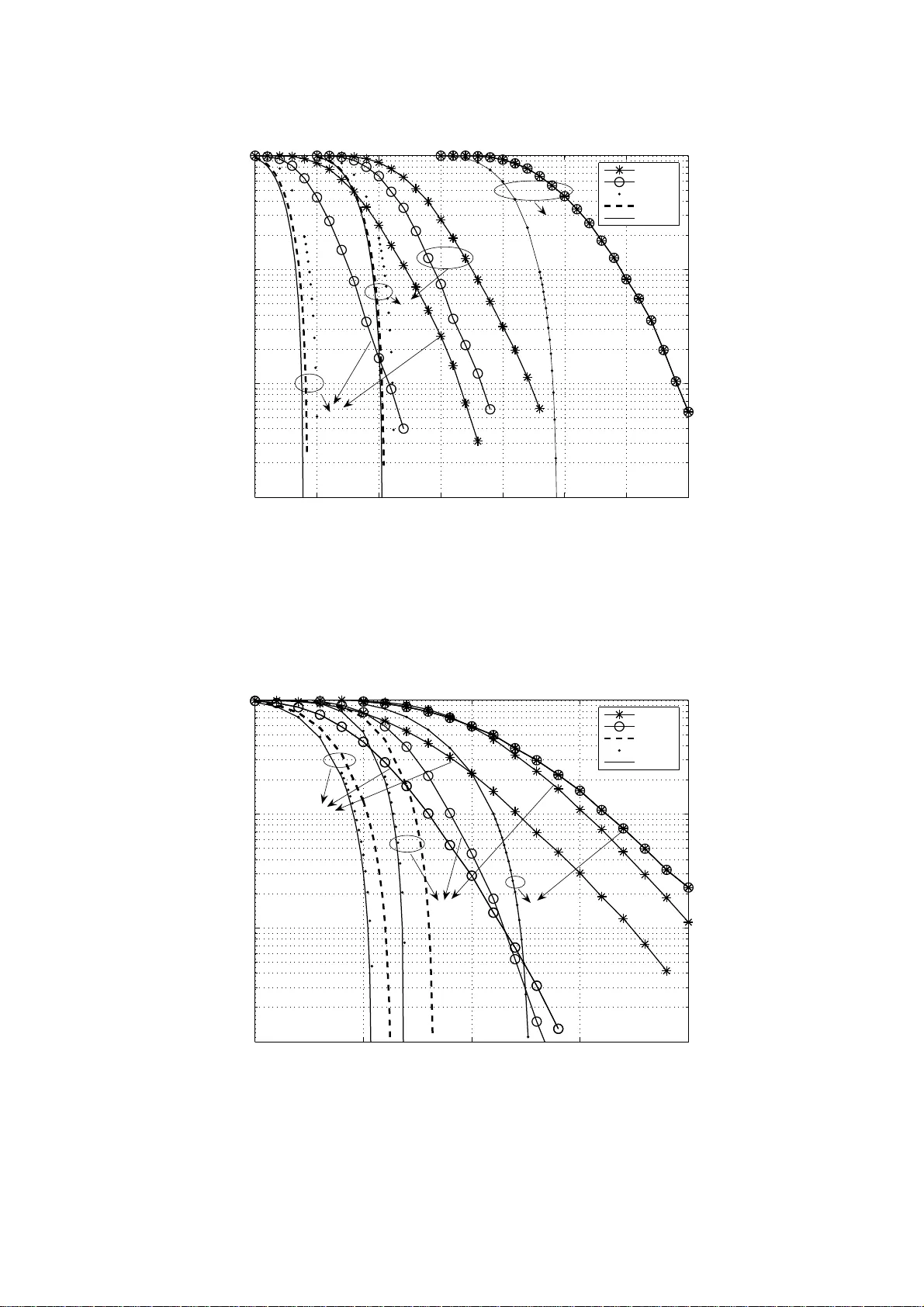
1 End-to-End Outage Minimiz ation in OFDM Based Linear Relay Netw orks Xiaolu Zhang, Meixia T ao, W enhua Jiao and Chun Sum Ng Abstract Multi-hop relay ing is an econom ically ef ficient architectu re for coverage extension and thro ugh- put enhancem ent in futur e wireless networks. OFDM, on the other hand, is a spectrally efficient physical layer modulation techniqu e for bro adband tran smission. As a natural consequ ence of combinin g OFDM with multi-hop relaying , th e allocation of per-hop subcarrier power and per- hop transmission time is crucial in o ptimizing the n etwork performan ce. This pape r is concer ned with th e end-to- end information outag e in an O FDM based linear relay network. Our goal is to find an o ptimal power and time adaptation policy to minimize the outage p robability und er a long- term total power c onstraint. W e solve the prob lem in two steps. First, for any giv en ch annel realization , we derive th e min imum shor t-term power requ ired to meet a target transmission rate. W e sho w that it ca n be obtaine d throug h two nested bisection loop s. T o redu ce compu tational complexity and signalling overhead, we also pro pose a sub-op timal algo rithm. In the seco nd step, we d etermine a power thr eshold to con trol the transmission on-o ff so that the long -term tota l power constraint is satisfied. Numerical exam ples are provided to illustrate the perfo rmance of the p roposed power and time adaptation schemes with respect to other resource adaptation schemes. Index T e rms OFDM, relay networks, o utage probability , resou rce alloc ation, en d-to-en d rate. I . I N T R O D U C T I O N Relay networks in the form of point-t o-multipoint based tree-type or multipoint -to-multipoi nt mesh-type architectures are a promisi ng network top ology in future wireless systems. The basic concept of relaying is to allow a source node to commun icate with a destinati on node X. Zhang and C. S. Ng are with the Department of Electrical and Computer Engineering, National Uni ve rsity of Singapore, Singapo re 117576 (e-mail: zhang xiaolu@nus.edu .sg; elengcs@nus.edu.sg). Meixia T ao is with Dept. of Electronic Engineering, S hanghai Jiao T ong Univ ersity , S hanghai, China 200240 (e-mail: mxtao@sjtu.edu.cn). W . Jiao is wi th Bell labs Research China, Alcatel-Lucent, Beijing, P .R. China 100080 (e-mail: wjiao@alcatel-lucent.com). 2 under the help of a sin gle or multiple relay n odes. It has been shown that relaying can bring a wireless network var ious benefits including coverage extension, th roughput and s ystem capacity enhancement. Recently , m ulti-hop relayi ng has been widely adopted i n wireless networks such as next generatio n cellular networks, broadband wireless metropolitan area networks and wireless l ocal area networks. On the ot her hand, orth ogonal frequency division multiplexing (OFDM) is an efficient phy sical layer modulati on technique for broadband wireless transmi ssion. It divides the broadband wireless channel i nto a set of orthogonal narro wband subcarriers and hence elimi nates the inter -symbol interference. OFDM is one of the dominat ing t ransmission techni ques in many wireless systems, e.g., IEEE 802.1 6 (W iMax), EV -DO Revision C and the Long-T erm-Evolution (L TE) of UM TS. The com bina- tion of OFDM and multi-hop relaying has receive d a l ot of attention recently . For example, this OFDM-based relay archit ecture has been proposed by the current wireless standard IEEE 802.16j [1]. The comp lexity o f relay station is expected to be much less th an the one of legacy IEEE 8 02.16 base stations, th ereby reducing infrastructure d eployment cost and im proving the economi c v iability of IEEE 80 2.16 systems [2]. In this work, we are interested in an OFDM-based linear relay network. The so-called linear relay network consists of one-dimensi onal chain of n odes, including a source node, a destination node and se veral intermediate relay nodes. It can be viewe d as an important special case of relay networks where only a single rou te is activ e. As a natural consequence of multi-ho p relaying and OFDM transm ission, t he allocation of per -hop subcarrier power and per- hop transmiss ion time is crucial in opti mizing the end-to-end network performance. Pre vious work on resource allo cation for relay networks is found in [3]–[8]. Y ao et al. in [3] cons idered a classic three-node network (a source node, a destination node, and a relay node) and comp ared the energy required for transmitti ng one informati on bit in different relay proto cols. Authors in [4] and [6] studied efficient scheduling and rou ting schemes in one-dimensional multi -hop wireless networks. It is assumed in all these works [3], [4], [6] that the point-to-poin t li nks are frequency-flat fading channels and the system has a fixed short-term power cons traint. In [5], Oyman et al. summarized the end-to-end capacity results of a mult i-hop relay network under fixed-rate and rate-adaptive relaying strategies, and further illustrated the merits of mult i-hop relaying in cellular mesh networks. Authors in [9] studi ed the per-hop transmiss ion t ime and sub carrier power allocation problem in the OFDM based linear mult i-hop relay network to maxi mize the end-to-end average transmission rate under a long-term total power cons traint. Howe ver , the end-to-end a verage rate can only be o btained 3 at the expense of lar ge delay . For many real-time services, one has to maint ain a target transm ission rate and av oid service outage in most of f ading condition t hrough adapti ve reso urce allocation. A n outage i s an eve nt that the actual transmission rate is belo w a p rescribed transmiss ion rate ( [10] and [11]). O utage prob ability can be vi e wed as the fraction of ti me that a codeword i s d ecoded wrongly . F or any finite a verage po wer constraint, transmission outage may be inevitable over fading chann els. Howe ver , o ne can minim ize the out age probability through adaptive power control [10]. In a relay network wh ere n o d ata is al lowed to accumul ate at any of relay nodes, an end-to-end o utage is the e vent that there exists a h op over which t he transmi ssion rate is lower than the target rate. The goal of this paper i s to in vestigate the optimal per-hop p o wer and t ime control to minimize t he end-to -end outage probability in an OFDM li near relay network under an a verage transmis sion power constrain t. At first, we derive the m inimum short-term power required to m eet a t ar get transm ission rate for any given channel realization. T he resulting power and tim e allocati on can be obtain ed th rough a T wo-nested Binary Search (TBS) which is conducted in a central controller with the knowledge of channel state inform ation (CSI) on all subcarriers and over all hops. Such algorithm give s a t heoretical performance lim it of li near relay networks, but is comp utationally i ntense. Moreover , it requires significant signalling overhead and channel feedback between network nodes and t he central control ler . For this re ason, an Iterati ve Algorithm of Sub-optimal power and time al location (IAS) is proposed. The required inform ation for s ignalling exchange only in v olves the number of acti ve subcarriers on each hop and the geometric mean and harmonic mean of channel gains averaged over the activ e s ubcarriers. Thi s sub-op timal allocatio n algorith m sug gests prolonging the transmissio n time for the h op wi th l o w geometric mean of channel gains while lowering the transmission p o wer for t he hop with low harmonic mean. After obt aining the minim um po wer required to support the tar get rate for a given channel realization, we then compare it wi th a threshol d. The transmi ssion wil l be cut off if the requi red minim um total power exceeds the threshol d. The threshol d takes t he value so that the long-term t otal power constraint is satis fied. Num erical result s s how that a sign ificant power saving can be achie ved by t he proposed o ptimal power and time allocation compared with the uniform power and time allocati on un der the sam e end-to-end o utage probability . In addi tion, the proposed sub- optimal po wer and time allocation serves as a good approximation to the optimal solution when the tar get rate is su f ficiently high. The optim al numb er of hops in the sens e of requiring 4 minimum power at different target rates is also shown numerically . The remainder o f t his paper is organized as fol lows. In Section II, th e s ystem m odel and probl em formul ation are presented. The optimal and sub-optim al resource allocation algorithms to minim ize the end-to-end outage probability under an av erage total power constraint are prop osed in Section III. Numerical results are given in Section IV. Finally we conclude this paper in Section V. I I . S Y S T E M M O D E L , E N D - T O - E N D R A T E A N D O U T AG E P RO B A B I L I T Y A. System Model Consider a wireless linear relay n etwork shown in Fig. 1. The source node R 0 commu- nicates wi th destinatio n R N by routing its data through N − 1 intermediate relay nodes R n ( n = 1 , . . . , N − 1 ) . The hop between node R n − 1 and R n is indexed by n , and the set of hops is denoted by N . W e focus on time-division based relaying. The transmission time is divided into frames of multipl e time slots. W ithin ev ery tim e frame, t he transmissio n over each hop takes place at the assigned time slots. In general, frequency reuse can be applied so that more than one hop can b e transmitti ng at a same time slot. Howe ver , due to interference issue, it will increase decoding complexity as well as decoding delay [4]. T hus, in this work we do not pursue the frequency reuse. In each time frame, the message from the source is sequentially relayed at each hop using decode-and-forw ard protocol [12]. Each relay decodes the m essage forwarded by the previous node, re-encodes i t, and then t ransmits it to the next recei ver . The channel for each hop is ass umed to be a block fading Gaussian channel, and t he channel coeffi cients remain constant duri ng the entire tim e frame but change randomly from one frame to another . Over each hop , OFDM with K sub carriers i s u sed as th e phys ical l ayer modulation scheme. W e denote the s et o f subcarriers by K . The channel gain on subcarrier k over hop n in a time frame is denoted as g k ,n and it i s independent for dif ferent n . B. End-to-end rate and outag e pr oba bility Suppose each t ime frame contains T OFDM symbols and hop n is scheduled t o transmit over T n OFDM symbol s wi th T n satisfying P n ∈N T n = T . Then we define the time-sharing fraction as ρ n , T n T . It is assumed t hat T is large enou gh so that ρ n can take an arbitrary value betw een 0 and 1 . Let p k ,n denote the transmission power on subcarrier k ov er hop n . 5 It is s ubject to a long-term t otal power cons traint P , g i ven by E " X n ∈N ρ n X k ∈K p k ,n # ≤ P . (1) Then the instant aneous transmission rate in Nat/OFDM sy mbol in a tim e frame achieve d over hop n can b e written as r n = ρ n X k ∈K ln 1 + g k ,n p k ,n Γ N 0 , ∀ n ∈ N , (2) where N 0 is the n oise power , and Γ is t he signal-to-nois e ratio (SNR) gap related to a given bit-error- rate (BER) constraint [13]. For notati on b re vity , in the remaini ng part of this paper , we redefine g k ,n as g k ,n := g k ,n / (Γ N 0 ) . Under th e assu mption that no data is allowed to accumulate at any relay nodes (also called “information-continu ous relaying” i n [5]), t he total number of bi ts recei ved at th e destination node at the end of ti me frame, B , is the minimum of the numb er of bits transmitted over each hop, B n , where B n = r n T n . Thus, the end-to-end transm ission rate r can be defined as r = min n ∈N r n . In the foll o wing we introduce the end-to-end rates under different resource adaptation p olicies. Uniform pow er and tim e allocatio n (UPT) : When each transm itting node has no CSI, or does not exploit CSI d ue to high signalling overhead, th e transm ission scheme is independent of the CSI and both the time and power are uniformly allocated. Hence, the end-t o-end rate can be achieved as r ( g , P ) = 1 N min n ∈N X k ∈K ln 1 + g k ,n P K , (3) where g = { g k ,n , k ∈ K , n ∈ N } . As can be seen, the end-to-end rate i s lim ited by th e hop with the worst channel condition. F ixed powe r and ada ptive tim e allocatio n (FP A T) : When the transmitters hav e CSI to some extend (no t necessarily global CSI), each node can perform rate adaptation to a void t he situation that the ill-conditioned h op become the bottleneck of the wh ole link. W e ass ume that the transmi ssion powe r on each subcarrer over each hop keeps unchanged, and rate- adaptation is performed by adjusting tim e-sharing fraction su ch that r n = r i , ∀ i 6 = n ∈ N . In this scenario, the maximum end-to-end transmi ssion rate is gi ven by [14] r ( g , ρ , P ) = X n ∈N 1 P k ∈K ln(1 + g k ,n P /K ) ! − 1 . (4) This rate is achie ved by assigning t he time sharin g fractions ρ = { ρ i , i ∈ N } to be ρ i ( g ) = Q n 6 = i P k ∈K [ln (1 + g k ,n P /K )] + P n ∈N Q j 6 = n P k ∈K [ln (1 + g k ,j P /K )] + , i ∈ N . (5) 6 By comparing (4) wi th (3), it is fou nd that the end-to-end rate is increased by adaptive time allocation. This is because the harmon ic mean of a set of n onnegati ve values is always greater than or equal to the minimum value. T o i mplement FPT A, the central controller only needs each hop to feedback t he v alue o f P k ∈K ln(1 + g k ,n P /K ) instead of collectin g the global CSI g . Adaptive pow er and fixed tim e all ocation (APFT) : In this case the tim e-sharing fractions are assumed to be fixed and equal to each other , but the t ransmission power can be adjust ed adaptiv ely . Hence, the conditi onal end-to-end rate for a given po wer va lue set p = { p k ,n , k ∈ K , n ∈ N } is expressed as r ( g , p ) = 1 N min n ∈N " X k ∈K ln (1 + g k ,n p k ,n ) # . (6) The set of po wer values p depends on the glo bal CSI g and the tar get end-to-end rate. Adaptive pow er and time allo cation (APT) : W e shall n o w focus on th e scenario of in terest, where both t ransmission po wer over each subcarrier and each hop and ti me over each ho p are allowed to be dynam ically allocated. W e assum e that at t he start of each time frame, the global CSI is perfectly known at a central controller , which could be embedded in the source node. The i nstantaneous end-to-end rate for give n power va lues p and time-sharing fractions ρ is expressed as r ( g , ρ , p ) = min n ∈N " ρ n X k ∈K ln (1 + g k ,n p k ,n ) # . (7) Let ρ satisfy the ti me constraint P n ∈N ρ n = 1 and p sati sfy the long-term power constraint (1). The end-to-end informatio n out age probabili ty ev aluated at target rate R for APT can be expressed as P out APT ( R, P ) = P ( r ( g , ρ , p ) < R ) . (8) Our goal is to minim ize P out APT ( R, P ) with respect to the power and time adaptio n { p ( g ) , ρ ( g ) } . Namely , P1: min { ρ n ,p k,n } P out APT ( R, P ) (9) s.t. E " X n ∈N ρ n ( g ) X k ∈K p k ,n ( g ) !# ≤ P X n ∈N ρ n ( g ) = 1 . (10) 7 The next section is d edicated to solving the problem P1. As it will b e clear later , APFT can be viewed as a special case of APT b y fixing ρ n = 1 / N , ∀ n and hence t he minim ization of its o utage probability can be solved si milarly . I I I . A D A P T I V E P O W E R A N D T I M E A L L O C A T I O N ( A P T ) The minim um out age probability problem P1 defined in the previous section can be generally solved in two steps as proposed in [10]. First, for each global channel state g , the short-term m inimum t otal power p min ( g ) required to g uarantee th e target end-to-end transmissio n rate R is to be determined. The s econd step then determi nes a threshold t o control the transmission on-off subject to a long-term power const raint. A. Short-T erm P o wer Minimizat ion In this subsection, we shall find the opt imal time sharing fraction ρ ∗ n ( ∀ n ∈ N ) and the optimal power allocation p ∗ k ,n ( ∀ n ∈ N , k ∈ K ) t o minim ize the short-term tot al power needed to achiev e a target end-to-end transm ission rate R . Then a su b-optimal algorithm with reduced complexity is dev eloped. The sub-optimal one has a closed-form expression from which a fe w attractive p roperties regarding time and power allocation can be observed. Comparison on av erage powers and comp utational com plexity between the optimal and sub- optimal algorithm s is also give n. 1) Opti mal power and time all ocation: The optim al power and time all ocation problem to minim ize short-term total power can be form ulated as P2: p min ( g ) = min { ρ n , p k,n } X n ∈N ρ n ( g ) X k ∈K p k ,n ( g ) ! (11) s.t. r ( g , ρ , p ) ≥ R (12) X n ∈N ρ n = 1 . Unfortunately , the fun ction r ( g , ρ , p ) defined in (7) is not con ca ve i n ρ and p . As a result, the prob lem P2 is not con vex. T o make the p roblem P2 more tractable, we introduce a new v ariable s k ,n defined as s k ,n := ρ n p k ,n . This new var iable can be v ie wed as the actual amount of ener gy consumed by hop n on su bcarrier k in a tim e frame i nterva l. In addition, it follows from (7) t hat constraint (12) can be re written as N sub-cons traints. By d oing these, problem P2 i s transformed into a new problem with optim ization v ariables ρ n ( ∀ n ∈ N ) and 8 s k ,n ( ∀ n ∈ N , k ∈ K ) : P3: min { ρ n , s k,n } X n ∈N X k ∈K s k ,n (13) s.t. ρ n X k ∈K ln 1 + g k ,n s k ,n ρ n ≥ R , ∀ n ∈ N (14) X n ∈N ρ n = 1 . (15) Since its Hessian matrix is negativ e semidefinit e, t he function ρ n ln(1 + g k ,n s k ,n /ρ n ) is conca ve in ρ n and s k ,n . Therefore, problem P3 is a con vex opti mization problem and t here exists a unique optim al solution. T o observe the structure o f the opti mal sol ution, we write the Lagrangian of Problem P3 as follows: J ( { ρ n } , { s k ,n } , { λ n } , β ) = X n ∈N X k ∈K s k ,n + β X n ∈N ρ n − 1 ! + X n ∈N λ n " R − ρ n X k ∈K ln 1 + g k ,n s k ,n ρ n # (16) where λ n ≥ 0 ( n ∈ N ) and β ≥ 0 are the Lagrange multipliers for th e const raints (14) and (15), respectiv ely . If { ρ ∗ n } and { s ∗ k ,n } are the optim al s olution of P3 , they should sati sfy the Karush-Kuhn-T ucker (KKT) condi tions [15 ], which are necessary and suf ficient for th e optimalit y . The KKT condit ions are lis ted as follows: ∂ J ( . . . ) ∂ s k ,n = 0 if s ∗ k ,n > 0 > 0 if s ∗ k ,n = 0 , ∀ n ∈ N , k ∈ K (17) ∂ J ( . . . ) ∂ ρ n > 0 i f ρ ∗ n = 0 = 0 i f 0 < ρ ∗ n < 1 < 0 i f ρ ∗ n = 1 , ∀ n ∈ N (18) λ n " ρ ∗ n X k ∈K ln 1 + g k ,n s ∗ k ,n ρ ∗ n − R # = 0 , ∀ n ∈ N . (19) It can be o btained from the KKT conditi on (17) that t he opt imal power distribution { p ∗ k ,n } has a w ater -filling structure, and is giv en by p ∗ k ,n = s ∗ k ,n ρ ∗ n = λ n − 1 g k ,n + , ∀ k ∈ K , n ∈ N , (20) where ( x ) + , max(0 , x ) , and λ n can be regarded as the water le vel on ho p n . Dif ferent hops may hav e dif ferent water le vels. For each hop, more power is allocated to the subcarrier with higher channel gain and vice versa. 9 Let K n denote the set of subcarriers over hop n that are assigned wi th no n-zero power , i.e. satisfying g k ,n > 1 /λ n , ∀ k ∈ K n , and let k n be the size of the set. The subcarriers in the set are said to be activ e subcarriers. Note t hat each water le vel va lue λ n cannot b e zero. Otherwise p ∗ k ,n = 0 , ∀ k , n and, as a result, the constraint (14) cannot be satisfied. Hence, we obtain the closed-form expression for ρ ∗ n by sub stituting (20) into the KKT condition (19): ρ ∗ n , h n ( g , λ n ) = R P k ∈K n ln g k ,n + k n ln λ n , ∀ n ∈ N . (21) From (21), it can be s hown that ρ ∗ n is monotoni cally decreasing in λ n (note that k n also depends on λ n ). In the following, we derive the relation between λ n and β . T aking the deriv ative of Lagrangian of P3 in (16) with respect to ρ n , we ha ve ∂ J ( . . . ) ∂ ρ n = λ n " X k ∈K ln 1 + g k ,n s k ,n ρ n − X k ∈K g k ,n s k ,n ρ n + g k ,n s k ,n # − β . (22) Suppose t hat there exists an n ∈ N such that ρ ∗ n = 0 or 1, t hen the condition (19) would be violated. Th us, we ha ve 0 < ρ ∗ n < 1 , ∀ n ∈ N . Substituting (20) into (22) and using (18), we express β as a function of λ n giv en by β , f n ( g , λ n ) = λ n X k ∈K n ln g k ,n + k n ln λ n − k n ! + X k ∈K n 1 g k ,n , ∀ n ∈ N . (23) It is seen from (23) th at finding the opt imal water levels { λ n } at a g i ven β are N ind ependent problems. It can be proven t hat f n ( g , λ n ) is a monotonicall y increasing function of λ n in the region h min k 1 g k,n , + ∞ i by ev aluating its deriv ativ e w ith respect to λ n . Hence, the in verse function, λ n = f − 1 n ( g , β ) , exists and is an increasing function o f β . Therefore, the exact value of λ n for a giv en β can b e obtained numerically using binary search when the upper bound is k nown. Substitutin g λ n = f − 1 n ( g , β ) into (21), we can express ρ ∗ n as ρ ∗ n = h n ( f − 1 n ( g , β )) . Since ρ ∗ n is decreasing in λ n and λ n is increasing in β , we have that ρ ∗ n is decreasing in β . Therefore, the optimal β can also be obtained via binary search from t he constraint (15). Hence, the optimal solution { ρ ∗ n , s ∗ k ,n } of P3 and the resulti ng p min can be obtained through two nested binary searching loops. The outer l oop varies the Lagrange multipl ier β to meet the time constraint. The inner loop searches the water level for each hop at a giv en value of β to satisfy (23). The algorithm is outl ined as follows. 10 T wo-nested Binary Search f or minimum s hort-term power (TBS ) Binary search for β 1) Find the upper b ound and lower boun d of β a) For all n ∈ N , let ¯ λ n = λ n = min k { 1 /g k,n } b) Compute ¯ ρ n = h n ( g , ¯ λ n ) using (21) c) If ¯ ρ n > 1 / N , upd ate ¯ λ n = 2 ¯ λ n and repeat Step 1)-b) and c), else, go to Step 1 )-d) d) Set β min = max n ∈N f n ( g , λ n ) , and β max = ma x n ∈N f n ( g , ¯ λ n ) 2) Set hig h = β max , low = β min 3) Let center = ( l ow + hi g h ) / 2 and binary search for λ n ( ∀ n ∈ N ) at β = center a) Find the upper bound and lower boun d of λ n , λ max n and λ min n , respecti vely i) L et λ min n = λ max n = min k { 1 /g k,n } ii) Compute β ′ = f n ( g , λ max n ) using (23) iii) If β ′ < β , up date λ min n = λ max n and λ max n = 2 λ max n and repeat Step 3)-a)- ii) and iii) else, let hig h n = λ max n , low n = λ min n , and go to Step 3)-b) b) Set center n = ( l ow n + hi g h n ) / 2 . If f n ( g , center n ) > β , let h i g h n = center n ; otherwise, let l ow n = ce nter n c) Repeat Step 3)-b) until hig h n − l ow n < ε ′ and let λ n = center n 4) If P n ∈N h n ( g , λ n ) > 1 , let low = center ; otherwise, let hig h = center 5) Repeat Step 3) and Step 4) until hi g h − low < ε 6) Using the found { λ n } and β , o btain ρ ∗ n and p ∗ k,n based on (21) and (20), respectively . 7) Compute p min = P n ∈N ρ ∗ n ( P k ∈K p ∗ k,n ) In Step 1), the bou ndaries of β are determined in order to proceed with the binary search in the outer loop. From (23), a common L agrange mult iplier β is shared by all hops and it i s a monot onically increasing functio n of λ n in th e region of h min k ∈K 1 g k,n , + ∞ i for all n . W e use λ n = min k ∈K 1 g k,n to represent the lower bou nd of λ n , then the lower bound of β is maximum of f n ( g , λ n ) amo ng N hops. The sam e lower bound of λ n will also be used in Step 3) for the inner loop. The upper bound of β is obtained from the fact that there exists at least an n ∗ such that ρ n ∗ ≥ 1 N . Correspondingly , we find a water lev el ¯ λ n = h − 1 n ( g , 1 N ) for all n , where h − 1 n ( g , · ) is the in ver se function of h n ( g , · ) . Then for hop n ∗ , we have λ n ∗ ≤ ¯ λ n ∗ since h − 1 n ( g , · ) is a decreasing function. Therefore, due to the m onotone of f n ( g , · ) , the upper bound of β can be obtained from β = f n ∗ ( g , λ n ∗ ) ≤ f n ∗ ( g , ¯ λ n ∗ ) ≤ max n ∈N f n ( g , ¯ λ n ) . The algorithm then upd ates β usi ng bi nary chop unti l th e s um of the corresponding time- sharing fraction con ver g es to 1. The con ver gence of the outer loop is guaranteed by the fact 11 that the actual sum of time-sharin g fractions is al so monotoni cally decreasing in β . The aim of t he inner loop in Step 3) is to find λ n ( ∀ n ∈ N ) for a given β . W e first initialize the upper bo und of λ n , λ max n = min k n 1 g k,n o and then keep increasing it until t he corresponding β ′ goes beyond the giv en β . In each iteration, the bi nary search guesses an halfway λ n between the new hig h and l ow and repeats it until the actual β ′ approach the giv en β . The i teration con verges because of t he monotone of β in λ n . The outer loop in volv es log 2 β max − β min ε iterations where ε represents outer loop accuracy . The inner loo p has N binary searches, and each in volves log 2 λ max n − λ min n ε ′ iterations, where ε ′ is the inter l oop accuracy . It is observed from (21) and (23) that β max = O N R e N R/K and λ max n = O e N R/K when the tar get rate is s o high t hat all sub carriers are activ e. Therefore, the aver age computati onal complexity of this algorithm is upper bounded by the magnitud e of N 3 R 2 K 2 ln( N R ε ) ln( 1 ε ′ ) in t he asymptotic sense wi th a high t ar get rate. 2) Sub-opt imal time and power allocati on: In the o ptimal tim e and power allocation, it is infeasib le to obtain an closed-form expression for the solut ion. In this part, we will observe that when the target rate is sufficiently large, the o ptimal transmission t ime can be approximated b y an explicit function of geometri c mean of channel gains ave raged on active subcarriers and the number of activ e subcarriers. In addition, the product of water le vel and the number of activ e s ubcarriers for each hop t ends t o b e the same. In the foll owing, we sh all in vestigate this sub-optim al solution and show that it has a l o w computational complexity and lit tle si gnalling exchange. Let { ρ n , n ∈ N } be any give n tim e allo cation that satisfies P n ∈N ρ n = 1 and 0 ≤ ρ n ≤ 1 . The optimal power di stribution at th e given { ρ n , n ∈ N } is expressed by (20). Substituti ng (20) into (2) and lett ing p n = P k ∈K p k ,n , the clos e-form expression of λ n can be obtained as [16] λ n = e R ρ n Q k ∈K n g k ,n ! 1 /k n , (24) where k n is the size of the set K n = { k | g k ,n > 1 /λ n } . Moreover , substitut ing (24) back into (20), we ha ve p ∗ n ( ρ n ) = e R k n 1 ρ n − a n − b n , (25) where, for no tation brevity , we define a n , 1 k n X k ∈K n ln g k ,n ! − ln k n = ln ˜ g n − ln k n , (26) 12 and b n , X k ∈K n 1 g k ,n = k n ¯ g n . (27) In (26) and (27), ˜ g n and ¯ g n represent the geometric mean and harmon ic mean of g k ,n over the active subcarriers at hop n , respecti vely . For the moment, let us assume that k n ’ s are fixed and then both a n and b n are const ants. Then, the p roblem of m inimizing t otal po wer for supporti ng the target end-to-end transmis sion rate can be reformulated as P4 only with optim ization v ariables { ρ n , n ∈ N } P4 : p min ( g ) = min { ρ n } X n ∈N ρ n p ∗ n = min { ρ n } X n ∈N ρ n e R k n 1 ρ n − a n − b n (28) s.t. X n ∈N ρ n = 1 . (29) Problem P4 can be also solved using Lagrange multipl ier method since i t is con vex. The Lagrangian of thi s problem is given b y L ( ρ , ν ) = X n ∈N ρ n e R k n 1 ρ n − a n − b n + ν 1 − X n ∈N ρ n ! , where the lagrange multiplier ν satisfies const raint ( 29). Applying KKT condition , t he optimal time-sharing fraction ρ n should satis fy ∂ L ( ρ , ν ) ∂ ρ n = e R k n 1 ρ n − a n − R k n 1 ρ n e R k n 1 ρ n − a n − ν = 0 . (30) The closed-form s olution to (30) i s difficult to obtain. It is kno wn that when the tar get transmission rate is su f ficiently small, the p o wer sa ving through ti me adaptation is insi gnificant [17]. This result motiv ates us to focus on the high tar get transmission rate wi th R ≫ K . W e consider two particular hops, n 1 and n 2 . Under the ass umption of a high tar get t ransmission rate, the equation (30) can be approximated by e − a n 1 R k n 1 ρ n 1 e R k n 1 ρ n 1 ≈ e − a n 2 R k n 2 ρ n 2 e R k n 2 ρ n 2 . From the above approximation, we can obtain a ratio k n 1 ρ n 1 k n 2 ρ n 2 ≈ 1 + k n 1 ρ n 1 R ( a n 2 − a n 1 ) − k n 1 ρ n 1 R ln k n 1 ρ n 1 k n 2 ρ n 2 . (31) W ith out l oss of g enerality , we assume a n 2 ≥ a n 1 , then we hav e ( k n 1 ρ n 1 ) / ( k n 2 ρ n 2 ) ≥ 1 from (31). Thus, (31) leads to 1 ≤ k n 1 ρ n 1 k n 2 ρ n 2 ≤ 1 + k n 1 ρ n 1 R ( a n 2 − a n 1 ) . (32) 13 Using the i nequality ln( x ) ≤ x − 1 and (31), we obtain a lower bound of ( k n 1 ρ n 1 ) / ( k n 2 ρ n 2 ) after some manipulations, k n 1 ρ n 1 k n 2 ρ n 2 ≥ 1 + k n 1 ρ n 1 ( a n 2 − a n 1 ) R 1 + k n 1 ρ n 1 R . (33) Since R ≫ K , in equalities (32) and (33) lead to k n 1 ρ n 1 k n 2 ρ n 2 ≈ 1 + k n 1 ρ n 1 R ( a n 2 − a n 1 ) . After manipul ation, we hav e 1 k n 2 ρ n 2 − a n 2 R ≈ 1 k n 1 ρ n 1 − a n 1 R , ∀ n 1 , n 2 ∈ N . Let 1 k n ρ n − a n R = µ, ∀ n ∈ N . W e can obtain the approxim ated but close-form so lution to (30) as follows ρ ′ n = R k n Rµ + k n a n , ∀ n ∈ N , (34) where µ i s determined b y the tim e constraint (29), and can be obt ained through binary search. Substitutin g (34) int o (25), the corresponding transmi ssion power all ocated to hop n is given by p ′ n = e Rµ − b n . (35) Furthermore, subst ituting (34) into (24) y ields the s ub-optimal water lev el for hop n as λ n = e Rµ k n . (36) From (20), (35) and (36), we can regard t he sub-opt imal power allocation algo rithm as a two-le vel water filling algorit hm. First , the power is poured amon g all the hop according to (35) using t he water lev el e Rµ and the h op wit h small b n will be given m ore power . In each hop, th e power obtained from th e previous lev el is th en po ured among dif ferent subcarriers following (20), and th e water lev el is equal t o e Rµ /k n . Consider a special case where e Rµ is suf ficiently large s o that all subcarriers are active, i.e., k n = K . It follows immediately from (34) that t he hops with low geometric mean of channel g ains over t he subcarriers should b e assigned wi th longer transmissio n time. Also, i t follows from (35) one should lower the transmissi on power for the hop s wit h low harmonic mean of channel gains. An intu itiv e understanding of this result is that a hi gh p riority is gi ven the hop with poor channel condition to take advantage of “Lazy Scheduling ” [18] to av oid 14 this hop becoming the bott leneck of the whole link. The idea behind “Lazy Scheduling” is that ener gy required to transmit a certain amount of information decrease when prolon ging transmissio n tim e. W e no w relax the assumption m ade earlier that k n ’ s fix ed and propose an iterati ve procedure to find th e best k n ’ s for thi s sub-optimal problem . Iterative Al gorithm of Sub -optimal power and time allocation (IAS) 1) Initialization of k n Set k n = K, ∀ n ∈ N 2) Binary search for µ for a g i ven { k n , ∀ n } a) Set hig h = µ max , low = µ min b) Let center = ( l ow + hig h ) / 2 , and calculate { ρ ′ n , ∀ n } when µ = cente r acco rding to (3 4) c) If P n ∈N ρ ′ n > 1 , let low = center ; otherwise, let hig h = cen ter d) Repeat Step 2)-b) and c) until hig h − low < ε ′′ 3) Find k n ( ∀ n ) in the set { 1 , . . . , K } for a given ρ ′ n to meet the target rate R based on (37) 4) Repeat Step 2) and 3) u ntil k n ’ s are unch anged 5) Compute p ′ k,n throug h substitutin g (24) into (20) 6) Obtain the required total p ower p ′ min = P n ρ ′ n ( P k p ′ k,n ) In Step 2)-a) µ max and µ min represent the up per bound and lower b ound of µ , respectively . The exact value µ min = max n ∈N 1 k n − a n R can be obtain from the time constraint 0 ≤ ρ ′ n ≤ 1 . Its upper bound µ max could be min n ∈N N R − k n a n k n R , since i f µ > min n ∈N N R − k n a n k n R , ρ ′ n < 1 / N ( ∀ n ) from (34), which viol ates the constraint P n ρ ′ n = 1 . The implementatio n of the above algorithm can be done as follows. At the beginning of each ti me frame, we first assume that the transm ission is o n for all subcarriers. The central controller searches for µ and broadcast it to all relays. Th e relays and source n ode then compute their own transmiss ion t ime { ρ ′ n , ∀ n ∈ N } using (34) locally . The required power allocation for hop n to meet the tar get rate sho uld sat isfy X k ∈K ln(1 + g k ,n p k ,n ) = X k ∈K n ln( g k ,n λ n ) ( a ) = R ρ ′ n , ∀ n ∈ N . (37) The left side of the abov e equ ation (a) can be sho wn to be a monotonically increasing function of λ n , and i s denoted as z n ( λ n ) . W i th loss of generality , we assume g 1 ,n ≥ g 2 ,n ≥ . . . ≥ g K,n ( ∀ n ∈ K ) . Each λ n maps to a unique k n which satis fies that 1 g k n ,n ≤ λ n ≤ 1 g k n +1 ,n . Thus, 15 we have z n 1 g k n ,n ≤ R ρ ′ n ≤ z n 1 g k n +1 ,n . Therefore, the desired k n in Step 3) can b e obtain through binary search in the set of { 1 , . . . , K } by comparing z n (1 /g k n ,n ) with R /ρ ′ n . The found k n and the geometric and harmonic mean of chann el gains on these k n subcarriers are returned to the input of (34) in the central controller . T his procedure repeats until the k n ’ s are unchanged. Al though the con vergence of thi s algorithm cannot be guaranteed t heoretically , diver gent behaviors were nev er o bserved in the simul ation. In the following, we s hall use s imulation to examine the a verage number of it erations for the algorithm to con verge and t he a verage required short-term total transmi ssion power . In th e sim ulation, SUI channel model for the fixed broadband wireless access channel en vironm ents [19] is used and t he channel parameters will be detailed in Section IV. The simulatio n i s run for 1 0 3 time frames to e v aluate the ave rage performance. The number of subcarriers is set to 16. Fig. 2 shows the av erage iterations in the outer loop over 10 3 independent channel realiza- tions required for the search of { k n } to con verge. It i s shown that t he ave rage i teration numbers, denoted as M , is d ecreasing in R and approaches 1 when the targe t rate is suffi ciently large. It can b e explained by the fact that k n = K when R goes infinity . Since t he binary search for µ in the in ner lo op in v olves log 2 µ max − µ min ε ′′ iterations and finding k n for a giv en R /ρ n in volves lo g 2 ( K ) ones, the total n umber of iterations required for the IAS can be express as C I AS = M log 2 min n ∈N N R − k n a n k n R − max n ∈N 1 k n − a n R ε ′′ + N log 2 ( K ) (38) Since M is decrea sing in R , C I AS is also decreasing in R and upp er bounded by a linear function o f N . Fig. 3 compares aver age t otal compl exities between TBS and IAS for dif ferent R and diff erent N . Fig. 4 compares th e avera ge p o wer required to meet the tar get rate between TBS de veloped in Section III-A.1 and its sub-optimal algorithm, IAS. It i s shown that IAS serves as a good approximation of TBS, especially for a hi gh target rate. As we discuss pre viously , the required con trolling signals from the feedback channel are only geom etric mean, harmoni c mean of g k ,n and t he num ber of activ e subcarriers over each hop instead of { g k ,n , ∀ k ∈ K , n ∈ N } as in T BS, thus t he sign alling exchange is greatly 16 reduced when the number of subcarriers is large and/or the tar get rate is hi gh. Furthermore, since IAS has low compl exity and near-optimal power consu mption performance, it is a good candidate for a suffi ciently high target rate in a real system. B. Long-T erm P ower Thr eshold Determi nation W e have di scussed t he short-term t otal transmissi on power minimizatio n. If the transmis- sion is on for eve ry possibl e channel realization, the long term power constraint may be violated. Simi lar to the si ngle us er case [10 ], t he optimal power all ocated to all ho ps for P1 with a l ong term power constraint must have t he following structure, p ( g ) = p min ( g ) with probabil ity w ( g ) 0 with probabili ty 1 − w ( g ) . (39) Thus, the outage probability is P ( r ( g , ρ , p ) < R ) = E [1 − w ( g )] . Then solving P1 is equiv al ent to findi ng the opt imal weighting function w ( g ) to the following problem, min w ( g ) E [1 − w ( g )] s.t. 0 ≤ w ( g ) ≤ 1 E [ p min ( g ) w ( g )] = P . According to the result of [10, Lemm a 3], the optimal weig hting function has the form w ∗ ( g ) = 1 for p min ( g ) < s ∗ w 0 for p min ( g ) = s ∗ 0 for p min ( g ) > s ∗ . (40) The power threshold s ∗ is given by s ∗ = sup { s : P ( s ) < P } , and w 0 is g i ven by w 0 = P −P ( s ∗ ) ¯ P ( s ∗ ) −P ( s ∗ ) , where the region R ( s ) and ¯ R ( s ) are defined as R ( s ) = { g : p min ( g ) < s } , ¯ R ( s ) = { g : p min ( g ) ≤ s } , and the corresponding aver age power over the two sets are: P ( s ) = E g ∈R ( s ) [ p min ( g )] , ¯ P ( s ) = E g ∈ ¯ R ( s ) [ p min ( g )] The resulting min imum outage probabilit y is denoted as P out APT = 1 − Prob { g ∈ R ( s ∗ ) } − w 0 Prob { p min ( g ) = s } . From (39) and (4 0), w e see that when the mi nimum total power for all hops required to support the target transmiss ion rate is beyond the threshold s ∗ , transmiss ion i s turned off. When the required power is l ess than the threshold, the transmission follows the minim um transmissio n power s trategy derived from Section III-A. 17 The v alue of s ∗ can be computed a priori if t he f ading statistics are kno wn. Oth erwise, the threshold can be estimat ed usin g fading sam ples. D uring t he estimation of the threshold, since the channel is assumed t o b e ergodic, th e ensemb le average transmi ssion power is equal to the t ime av erage E g ∈R ( s ) [ p min ( g )] = lim t →∞ 1 t t X i =1 ˆ p ( i ) , where ˆ p ( i ) represents t he actual transmission power at time frame i . T hus, the threshold is alwa ys adjus ted in the opposite directio n of P − 1 t P t i =1 ˆ p ( i ) as s ∗ ( t + 1) = s ∗ ( t ) " 1 + ǫ P − 1 t t X i =1 ˆ p ( i ) !# . (41) where t is the time frame i ndex. Combining the short-term po wer mi nimization and long-term power th reshold d etermina- tion, the full algorithm for APT is o utlined as follo ws. APT 1) Set t = 1 and s ∗ ( t ) = P 2) Search for minimum sh ort-term power (developed in Section III-A) 3) On-off dec ision If p min > s ∗ ( t ) , tu rn off the tran smission and let ˆ p ( t ) = 0 ; o therwise, turn on the tr ansmission and let ˆ p ( t ) = p min . 4) Update the thr eshold s ∗ s ∗ ( t + 1) = s ∗ ( t ) " 1 + ǫ P − 1 t t X i =1 ˆ p ( i ) !# . (42) 5) Let t = t + 1 and return to Step 1). If TBS in Section III-A.1 is used in Step 2), we name the optimal APT as APT -op t for short. If IAS in Section III-A.2 is used, we denote it as APT -su b . C. Sp ecial case: adapti ve p ower and fi xed time allocat ion APFT can be vi e wed as a special case of APT by fixing ρ n = 1 / N . It can also be solved following two st eps: short-term power mi nimization and long-term power thresho ld determi- nation. Ho we ver , unlike APT , the first step can be performed locally , i.e., each t ransmitter 18 only needs to kn o w the local CSI ove r the associated ho p to solve the prob lem min { p k,n } X k ∈K p k ,n s.t. 1 N X k ∈K ln(1 + g k ,n p k ,n ) ≥ R, for all n ∈ N . The soluti on of the problem is easily o btained as (20 ), where the water lev el is given by (24) with ρ n = 1 / N . I V . N U M E R I C A L R E S U L T S In this section, we present some numerical results t o il lustrate t he performance of the proposed adaptive power and tim e allocation for OFDM based linear relay networks. The proposed algorithms, APT -opt and APT -sub, are compared with UPT , FP A T and APFT as defined in Section II . W e consider an N -hop linear wireless network. The acceptable BER is chosen to be 10 − 5 , which correspon ds to 8.2dB SNR gap. W e fix the bandwidth to be 1MHz and t he end- to-end distance t o be 1 km. Th e relays are equall y spaced. In all simul ations, the channel over each hop is modell ed by Stanford University Interim (SUI)-3 channel m odel with a central frequency at around 1.9 GHz to sim ulate the fixed b roadband wireless access channel en vironm ents [19]. The SUI-3 channel is a 3-tap channel. T he receiv ed signal fading on the first tap is characterized by a Ricean dist ribution with K-fac tor equal to 1 . The fading on the ot her two taps follows a Rayleigh distribution. Th e root-mean-square (rms ) delay spread is 0.305 µ s. Then the coherence bandwidth is approximately 65KHz. Hence, t he number of subcarrier K should be greater t han 15. 2 so t hat the su bcarrier bandwidth i s small enough to experience the flat fading. Here we choose K = 16 . Doppler maximal frequency is set to 0.4 Hz. Intermedi ate path los s condition ( [20, Category B]) is chosen as the p ath loss model, which is given by P L = A + α lg d d n , where A = 20 lg (4 π d 0 /λ ) ( λ being the wa velength in m), α i s the path-loss exponent with α = ( a − bh b + c/h b ) . Here h b = 3 0 m is chosen as the height of the base station , d 0 = 100 m and a , b , c are 4, 0.0065 and 17.1 gi ven in [20]. The corresponding α will be used in all simulation s except the one in Fig. 6. In each simulatio n, 10 4 time frames are used to estimate the outage probabi lity . Fig. 5 sho ws the end-to-end outage probabilities versus a ver age total transmission power for R = 1 , 20 and 40 Nat/OFDM symbol u sing APT -opt when N varies i n the set of { 1 , 3 , 5 } . From the figure, it is shown that multi -hop transmiss ion can help to sav e total 19 power consum ption wh en the tar get transmission rate is low (e.g., R = 1 ) whereas it is b etter to send d ata directly to the destinati on if the target transmissio n rate is h igh (e.g., R = 40 ). That can be explained by the following fact. As the number of hops increases, the path lo ss attenuation on each hop reduces. But the transm ission time spent at each hop also reduces since the total frame l ength is fixed. It is observed from (2) that the transmissio n rate is linear in transmissi on t ime and conca ve i n channel gain. Hence, when the tar get transmission rate increases, the loss due t o transmissio n ti me reduction cannot be evened out by the gain brought by path loss reduction. Fig. 6 shows the opt imal number of hops to achiev e m inimum power consum ption at diffe rent target transm ission rates. Here, the outage probabili ty is fixed to 1 % , and the path loss exponent α = 2 .5 and 4, respectively . It is observed that the optimal number of hops is roughly proport ional to th e in verse of R , and increasing li nearly i n α . A similar trend is shown in [21] where a spacial case, frequency-flat fading channel and a fixed short-term tot al power constraint, i s considered. Fig. 7 and Fig. 8 compare the end-to-end out age probabil ities achiev ed by differe nt power and time adaptation schemes for R = 1 and 20 Nat/OFDM symbols, respectiv ely . A number of i nteresting observations can be m ade from the two figures. First, by com paring the curves of FP A T and UPT it is observed th at just adapting per-hop transmissi on ti me alone can increase the performance considerably . But the decreasing speed of the outage prob ability as the tot al power increases is not i ncreased m uch. On the ot her hand, by com paring the curves of APFT and UPT , it is seen that power adaption can bring dramatic improvement on the performance. In particular , the slop e of t he outage probability curves approaches almost infinity . This indicates that by turning off the transmission when the channel suf fers from deep fade can achie ve significant po wer sa ving. Next, comparing APT -opt with APFT we can see that time adaptati on on top of po wer adaptation is still beneficial, but the gain is rather lim ited when the target data rate is sm all. Finally , it can be seen that the performance of APT -sub is e ven worse than that of APFT when the target rate is low (e.g. R = 1 ). But for large tar get rate ( R = 20 ), APT -sub b ecomes superior and i s near opt imal. The above numerical resul ts suggest that multi -hop transmission is fa vorable at low and medium target rates, whereas a direct transmission from source to desti nation is preferred if th e target rate is high. Also, power adaptation plays a mo re im portant rule than ti me adaptation in min imizing the end-to-end outage probabilit y . In particul ar , APFT i s a good choice in practice for low target rates s ince it has similar performance with APT -opt and yet 20 is much less complex. F or the sim ilar reason, APT -sub i s recommended at medium target rates. V . C O N C L U S I O N S In this work, we consider adaptive power and ti me allocations for OFDM bas ed l inear relay networks for end-to-end outage probability minimizatio n. T he problem is solved in two steps. First, we deri ve the minimum short-term tot al power to meet the tar get transmissio n rate. Both optimal and sub-optim al algorithms are proposed. In particular , t he sub-optimal algorithm suggests prolonging the transmi ssion time for the hop with lo w geometric mean of channel gains a veraged ove r subcarriers while lowering the transmissio n po wer for t he hop with lo w harmon ic mean. In th e second step, th e transm ission on-of f is determi ned by comparing the required mi nimum total power with a threshol d, which is selected to s atisfy the long-term t otal power constraint. Numerical s tudy is carried ou t to i llustrate the performance of different resource adaptation schemes: APT -opt, A PT -sub, APFT , FP A T and UPT . W e find that the three schemes with adaptive power control, APT -opt, APT -sub and APFT , provide significant power savings at a same end-to-end out age probabili ty over the other two. Wh ile APFT is a good choice for practical imp lementation at lo w target rates, APT -sub becom es near optim al at medium target rats. R E F E R E N C E S [1] R. Pabst, B. W alke, D. S chultz, P . Herhold, H. Y aniko meroglu, S. Mukherjee, H. V iswan athan, M. Lott, W . Zirwas, M. Dohler , H. Aghv ami, D. Falconer , and G. F ettweis, “Relay-based deployme nt concepts for wireless and mobile broadband radio, ” IEEE Commun. Mag. , vol. 42, no. 9, pp. 80–89, 2004. [2] “ Amendment to IEE E standard for local and metropolitan area networks - part 16: Air interface for fi xed and mobile broad band wireless access systems - multihop relay specification, ” March 200 6. [Online]. A vailable: ieee802.or g/16/relay/ [3] Y . Y ao, X. Cai, and G. Giannakis, “On energy ef ficienc y and optimum resource allocation of relay t ransmissions in the low-po wer reg ime, ” IEEE T ra ns. W irel. Commun. , vol. 4, no. 6, pp. 2917 – 2927, Nov . 2005. [4] M . Sikora, J. N. Laneman, M. Haenggi, J. Daniel J. Costello, and T . E. Fuja, “Bandwidth-and power -efficien t routing in linear wireless networks, ” IEEE T ran s. Info. Theory , vol. 52, pp. 2624–1633 , 2006. [5] O. Oyman, J. N. Laneman, and S. Sandhu, “Multihop relaying for broadband wireless mesh networks: From theory to practice, ” IEEE Commun. Mag . , vol. 45, no. 11, pp. 116–122, Nov . 2007. [6] B. Raduno vic and J.-Y . L . Boudec, “Joint schedu ling, po wer control and routing in symmetric, one-dime nsional, multi-hop wireless networks, ” in W iOpt , F rance, March 2003 . [7] G. Li and H. Liu, “Resource allocation for OFDMA relay networks wi th fairness constraints, ” IEEE J. Sel. Ar eas Commun. , vol. 11, pp. 2061 –2069, Nov . 2006. 21 [8] L. Dai, B. Gui, and L. J. Cimini Jr ., “Selective relaying in OFDM multihop cooperati ve networks, ” in Pr oc. IEEE WCNC , Hong K ong, March 2007, pp. 963–968. [9] X. Zhang, W . Ji ao, and M. T ao, “End-to-end resource allocation in OFD M based li near multi-hop networks, ” in Pr oc. IEEE INFOCOM , Phoenix, AZ, USA, April 2008. [10] G. Caire, G. T aricco, and E. Biglieri , “Optimum po wer control ov er fading channelsl, ” IEEE Tr ans. Info. T heory , vol. 45, no. 5, pp. 1468–1489, 199 9. [11] L. Li and A. Goldsmith, “Capacity and optimal resource allocation for fading broadcast channels: Part II: outage capacity , ” IEEE T rans. Info. Theory , vol. 47, no. 3, pp. 120–145, 2000. [12] J. N. Laneman, D. N. C. Tse, and G. W . W ornell, “Cooperati ve diversity in wireless netwo rks: efficient protocols and outage behavior , ” IEE E T rans. Info. T heory , vol. 50, pp. 3062– 3080, 2004. [13] X. Qiu and K. Chawla, “On t he performance of adapti ve modulation in cellular systems, ” I EEE T rans. Commun. , vol. 47, no. 6, pp. 884–895, June 1999. [14] O. Oyman and S. Sandhu, “Non-ergodic po wer-ban dwidth tr adeof f in linear multi-hop networks, ” in Proc. IS IT , Seattle, W ashington, US A, July 2006. [15] S . Boyd and L. V andenberghe, C on vex Optimization . Cambridge, United Kingdom: Cambridge Univ . Press, 2004. [16] M. T ao, Y . Liang, and F . Zhang, “ Adaptiv e resource allocation for delay differentiated tr af fics in multiuser ofdm systems, ” accepted for publication in IEEE T rans. W i r el. Commun. [17] Y . Y ao and G. B. Giannakis, “Energy-ef ficient scheduling for wi reless sensor netwo rks, ” IEEE T rans. Commun. , vol. 53, no. 8, pp. 1333–1342, Aug. 2005. [18] A. E . Gamal, C. Nai r , B. Prabhakar , E. Uysal-Biyikoglu, and S. Zahedi, “Energy -efficien t scheduling of pack et transmissions ov er wireless networks, ” in IEEE INFOCOM , New Y ork, USA, March 2002. [19] V . Erceg, K. Hari, M. S mith, and D. B aum et al , “Channel models for fixed wireless applications, ” IEEE 802.16.3c- 01/29r1, 23 Feb 2001. [20] V . Erceg, L. Greenstein, S. Tj andra, S. Parkof f, A. Gupta, B. Kulic, A. Julius, and R . Jastrzab, “ An empirically based path loss model for wirel ess channels insuburban environ ments, ” IEEE J. Sel. Are as Commun. , vol. 2, no. 11, pp. 1205–1 211, 8-12 Nov . 1999. [21] M. Sikora, J. N. Laneman, M. Haenggi, J. D. J. Costello, and T . E. Fuja, “On the optimum number of hops in linear ad hoc networks, ” in Pr oc. IE EE Info. T heory W orkshop , San Antonio, Oct. 2004, pp. 165–169. 22 0 N Hop 1 Hop N 0 N Source subcarrier relay destination 1 N-1 Fig. 1. Illustration of linear relay networks 2 4 6 8 10 12 14 16 18 20 1 1.5 2 2.5 3 Target rate, R (Nat/OFDM symbol) Average number of iterations in the outer loop N=1 N=3 N=5 Fig. 2. A vera ge number of iterations i n the outer loop r equired for the search of { k n } 23 5 10 15 20 1000 2000 3000 4000 5000 6000 7000 Target rate, R (Nat/OFDM symbol) Average total number of iterations for TBS N=1 N=3 N=5 5 10 15 20 0 20 40 60 80 100 120 140 Target rate, R (Nat/OFDM symbol) Average total number of iterations for IAS N=1 N=3 N=5 Fig. 3. A vera ge total number of iterations using TBS and IAS 2 4 6 8 10 12 14 16 18 20 25 30 35 40 45 50 55 60 Target rate, R (Nat/OFDM symbol) Average required power (dB) TBS IAS N=1 N=5 N=3 Fig. 4. A vera ge short-term power required t o meet the target rate, R 24 10 20 30 40 50 60 70 80 90 10 −3 10 −2 10 −1 10 0 Power (dB) Outage probability N=1 N=3 N=5 R=1 R=20 R=40 Fig. 5. End-to-end outage probability vs. avera ge total transmission power under APT A when K = 16 5 10 15 20 25 30 0 2 4 6 8 10 12 14 16 Target rate, R (Nat/OFDM symbol) The optimal number of hops α =2.5 α =4 Fig. 6. The optimal number of hops vs. target r ate under APT A when α = 2 . 5 and 4 25 15 20 25 30 35 40 45 50 10 −3 10 −2 10 −1 10 0 Power (dB) Outage probability UPT FPAT APT−sub APFT APT−opt N=5 N=1 N=3 Fig. 7. End-to-end outage probability vs. av erage total t ransmission po wer under APT -opt, APT -sub, APFT , F P A T and UPT when K = 16 and R = 1 Nat/OF DM symbol 45 50 55 60 65 10 −3 10 −2 10 −1 10 0 Power (dB) Outage probability UPT FPTA APFT APT−sub APT−opt N=3 N=1 N=5 Fig. 8. End-to-end outage probability vs. av erage total t ransmission po wer under APT -opt, APT -sub, APFT , F P A T and UPT when K = 16 and R = 20 Nat/OFDM symbol
Original Paper
Loading high-quality paper...
Comments & Academic Discussion
Loading comments...
Leave a Comment