SWIM: A Simple Model to Generate Small Mobile Worlds
This paper presents small world in motion (SWIM), a new mobility model for ad-hoc networking. SWIM is relatively simple, is easily tuned by setting just a few parameters, and generates traces that look real--synthetic traces have the same statistical…
Authors: Aless, ro Mei (1), Julinda Stefa (1) ((1) Department of Computer Science
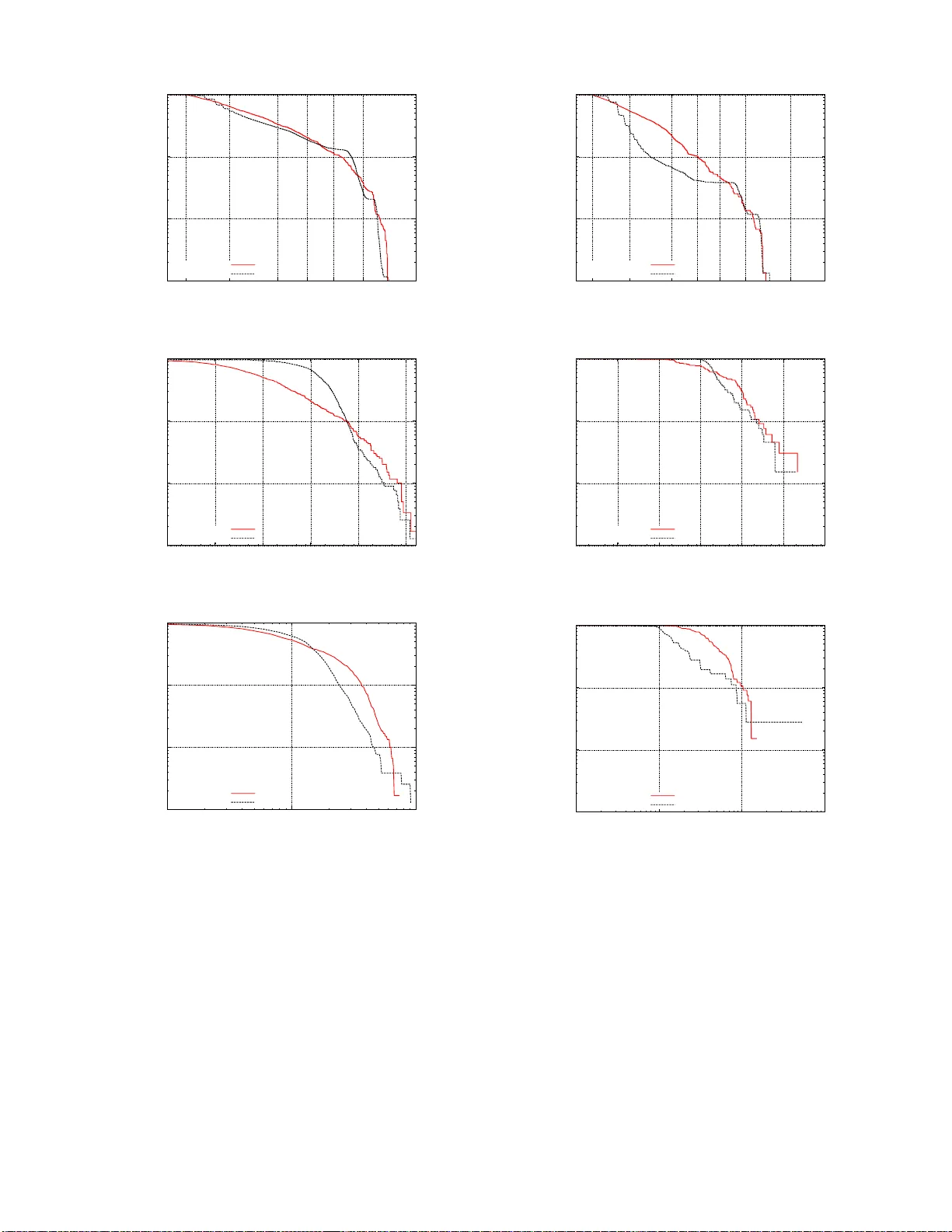
SWIM: A Simple Model to Generate Smal l Mobile W orlds Alessand ro Mei a nd J ulinda Stefa Departmen t of Co mputer Scien ce Sapienza Uni versity of Rome, Italy Email: { mei, stefa } @di.u niroma1 .it Abstract —This paper presents sma ll world in motion (SWIM), a new mobili ty model for ad-hoc n etworking. S WIM is relatively simple, is easily tun ed by setting just a few parameters, and generates traces that look real—synthetic traces h a ve the same statistical properties of real traces. SWIM sho ws experimentally and theoretically th e prese nce of the p ower law an d exponential decay dichotomy of inter -contact time, and, most importantly , our experiments show that i t can predict very accurately t he perfo rmance of f orwarding protocols. Index T erms —Mobility model, small world, si mulations, for - warding protocols in mobile networks. I . I N T R O D U C T I O N Mobile ad -hoc network ing has presented many ch allenges to the researc h community , especially in designing suitable, efficient, and well perf orming protocols. The practical an alysis and validation of such protocols often depends on synth etic data, gener ated by some m obility model. The model has the goal of simu lating r eal life scenarios [ 1] that can b e used to tune networking protoco ls a nd to ev alu ate their perfor mance. A lo t of work h as b een do ne in designing rea listic mobility models. Till a fe w ye ars ago, t he model o f choice in aca demic research was the random way point mobility model (R WP) [2], simple an d very efficient to u se in simu lations. Recently , with the aim of understanding human mobility [3], [4], [5] , [6], [ 7], m any researchers have perform ed real-life experiments by distributing wireless devices to p eople. From the d ata gath ered durin g the experiments, they have observed the typical d istribution of metrics such as inter-contact time (time inter val between two successive contacts o f the same people) and con tact duration . Inter-contact time, which cor- respond s to how o ften people see each oth er , ch aracterizes the opp ortunities of packet forwarding between nodes. Contact duration , which limits the dur ation of each meetin g be tween people in mobile networks, l imits the amount of data th at can be transferred . In [4], [5], the authors show that the distrib u tion of inter-contact time is a power -law . Later, in [6], it has been observed that the distrib u tion of inter-contact time is b est described as a power law in a first interval o n the time scale (12 ho urs, in the experiments under analy sis), then trun cated by an exponen tial cu t-off. Con versely , [8] proves that R WP yields exponential inter-contact time distribution. There fore, The wor k present ed in this pa per was partia lly funded by the FP7 EU project “SENSEI, Inte grating t he Physical with the Digital W orld of the Network of the Future”, Grant Ag reement Number 215923, www .ict-sensei .org. it has been established clearly that models like R WP are not good to simulate hum an mob ility , raising the need o f new , more realistic mobility models for mobile ad -hoc networking. In th is pap er we present small world in motion (SWIM), a simple m obility mo del that gener ates small worlds. The mo del is very simple to implement and very effi cient in simulations. The mobility pattern of the nodes is based on a simple intuition on human mobility: People go more often to places not very far from their home and where they can meet a lot of other people. By implementing this simple rule, SWIM is able to raise social behavior among nodes, which we believ e to be the base of human mobility in real life. W e validate our model using real tra ces and compar e the d istribution of in ter-contact time, contact duration and number of con tact distributions be tween nodes, showing that synthetic d ata that we g enerate m atch very well r eal data traces. Furthermo re, we show that SWIM can predict well the performanc e of forwarding protocols. W e comp are the per forman ce of two forwarding pr otocols— epidemic forwarding [9] and (a simplified version of) del- egation forwardin g [10]—o n b oth real tr aces and synthetic traces gener ated w ith SWIM. The per forman ce of the two protoco ls on the s ynthetic traces accu rately appr oximates their perfor mance on real traces, suppo rting the claim that SWIM is an excellent m odel for hu man mo bility . The rest of the paper is organized as fo llows: Section II briefly repor ts o n curren t work in the field; in Section II I we present the details of SW IM and we prove theoretically that th e distribution of inter-contact time in SWIM has an exponential tail, as recently observed in real life experiments; Section V compar es synthetic data traces to real traces and shows that the distribution of inter-contact time has a head that d ecays as a power law , again like in real experimen ts; in Section VI we show our experimental results on the beh avior of two forwardin g pro tocols on both synthetic and real traces; lastly , Section VII present some con cluding rem arks. I I . R E L AT E D W O R K The mobility m odel recently presented in [1 1] gen erates movement traces using a model which is similar to a ran dom walk, except th at the flight leng ths an d the pause times in destinations are generated based on Le vy W alks, so with po wer law distribution. In the past, Levy W alks have been shown to app roximate well th e movements of animals. The m odel produ ces inter-contact time distributions similar to real world 2 traces. Ho wev er , since e very node m oves indep endently , the model does not capture any so cial behavior b etween nodes. In [ 12], th e auth ors presen t a mobility mod el based on social network theory which takes in input a social n etwork a nd discuss the commu nity p atterns and groups distribution in geogra phical terms. They validate their synthetic d ata with real traces and show a good ma tching be tween th em. The work in [13] presents a ne w mobility model for clustered networks. Moreover, a closed- form expression fo r the stationary distribution of node position is given. The mod el captures th e phen omeno n of emerging clusters, o bserved in real partitioned networks, a nd correlation between the spatial speed distrib ution an d the cluster formation . In [14], the autho rs p resent a mo bility m odel that simulates the every d ay lif e of people that go to their work-p laces in the mornin g, spend their day at work and go b ack to their homes at ev enings. Each one of this scenarios is a simulation per se. The syn thetic data they generate m atch well the distribution of in ter-contact time and c ontact durations of real tr aces. In a very recent work, Barabasi et al. [1 5] study the trajec- tory of a very large (100 ,000) numbe r of an onymized mobile phone users w hose p osition is tracked for a six-m onths period . They observe th at hum an tra jectories show a high d egree of temporal and spatial regularity , each individual bein g ch arac- terized by a tim e ind ependen t characteristic travel distance and a significant p robab ility to return to a few hig hly freq uented locations. They also show that the p robab ility density fun ction of individual travel distance s are h eavy tailed and also are different for different groups of users and similar inside each group . Furth ermore, they plo t also the frequ ency of visiting different locations an d show that it is well approxima ted b y a p ower law . All these observations are in contrast with the random trajectories p redicted by Levy flight and ran dom walk models, and sup port the intuition behind SWIM. I I I . S M A L L W O R L D I N M O T I O N W e believe that a go od mo bility mod el shou ld 1) be simp le; and 2) predict well the perf ormanc e of networking pr otocols on real m obile n etworks. W e can’t overestimate the importan ce of having a simple model. A sim ple mo del is easier to und erstand, can be usefu l to distill th e fu ndamen tal ing redients o f “human” mob ility , can be easier to imp lement, easier to tune (just one or f ew parameters) , and can be usef ul to sup port th eoretical work . W e are also lookin g for a mo del that ge nerates traces with the same statistical properties th at real traces have. Statistical distribution o f inter-contact tim e an d number o f c ontacts, among others, are useful to char acterize the b ehavior of a mobile network. A mo del that ge nerates traces with s tatistical proper ties that are far from those of real traces is p robably useless. Lastly , and most imp ortantly , a m odel sh ould be accurate in pre dicting the perfor mance of network protoco ls on real n etworks. If a pr otocol perform s well ( or bad ) in the model, it should also perform we ll (or bad) in a real network. As ac curately as p ossible. None of the mobility mod els in th e literature meets all of these p roperties. T he rand om way-p oint mobility m odel is simple, b ut its tr aces d o not look real at all (and has a f ew other problems). Some of the other protocols we revie wed in the re lated work section can ind eed pro duce trac es th at look real, at least with re spect to some of the p ossible metrics, b ut are far from be ing simple. And, as far as we k now , no model has be en shown to pred ict real world perf ormanc e of protocols accurately . Here, we prop ose small world in motion (SWIM), a very simple mobility mode l that meets all o f the a bove require - ments. Ou r mod el is based on a couple of simple rules that are enoug h to make the typical properties of real traces emerge, just naturally . W e will also sho w that this model can predict the perfor mance of networking p rotocols o n r eal mobile n etworks extremely well. A. The intu ition When deciding where to move, human s usu ally trade-off. The best supermarket or the most po pular restauran t that ar e also not far fro m where they li ve, for example. It is unlikely (thoug h n ot impossible) that we go to a place that is far from home, or that is not so popular, or in teresting. Not only that, usually th ere are just a fe w p laces wh ere a person spends a long perio d of time (for example ho me and work o ffice or school), whereas there are lots of places where she stay s less, like for examp le post office, bank, caf eteria, etc. These are the b asic intuitions SWIM is built upo n. Of course, tr ade- offs humans face in their everyday life are usually mu ch more comp licated, and there are plenty of unkn own factors that influe nce mobility . Howe ver, we will see that simple rules—trading -off prox imity and popularity , and distribution of waiting time—ar e eno ugh to get a mob ility mo del with a number of desira ble properties and an excellent capab ility of predicting the per forman ce of fo rwarding proto cols. B. The mod el in details More in detail, to each node is assigned a so called home , which is a rand omly and unifor mly cho sen point over the network ar ea. Then, the node itself assigns to each possible destination a weight that grows with the popular ity o f the place and decreases with the distance from home. The weight represents the pro bability for the no de to cho se that place as its n ext destination . At the beginning, no node has b een anywh ere. T herefo re, nodes do n ot know how p opular destinations ar e. The num ber of oth er nod es seen in each destination is zer o and this informa tion is u pdated each time a no de reaches a destination. Since th e domain is continu ous, we divided the n etwork area into many small contigu ous c ells that rep resent possible destinations. E ach cell has a squared area, an d its size dep ends on the transmittin g rang e o f the nodes. Once a node reaches a cell, it should be able to commun icate with ev ery othe r node that is in the same cell at the same time. Hence, the size of the cell is such that its diago nal is equal to the tra nsmitting ra dius of the n odes. Bas ed on this, eac h node can easily build a map 3 of the n etwork area, and can also calcu late the weight for ea ch cell in the map. Th ese information will be used to determin e the n ext destination: The node chooses its cell d estination random ly and proportiona lly with its weight, whereas the exact destination point (remind that the n etwork area is co ntinuou s) is taken un iformly at r andom over the cell’ s area. Note that, accordin g to our experimen ts, it is no t really ne cessary that the node has a full ma p of the dom ain. It can rememb er just the most popu lar ce lls it has visited an d assume that everywhere else there is nobody (until, b y chance, it ch ooses one of these places as de stination a nd learn that th ey ar e indeed pop ular). The g eneral properties o f SWIM holds as well. Once a no de has chosen its next destination , it starts moving tow ards it f ollowing a straight line and with a speed that is propo rtional to the d istance between the starting point and the destination. T o keep things simple, in the simulato r the no de chooses as its sp eed value exactly the distance betwee n these two points. T he spee d remains constant till the n ode reach es the destination . In p articular, that means th at no des fin ish each leg of th eir movements in constant time . This ca n seem quite an oversimplification, howe ver, it is usefu l and also n ot far from reality . Useful to simp lify th e m odel; not far fr om reality since we are used to move slowly (m aybe walking) wh en the destination is nea rby , faster when it is farther, and extremely fast (ma ybe by car) when the destinatio n is far-of f. More specifically , let A be o ne o f the nodes and h A its home. L et also C be on e of the possible destination cells. W e will deno te with seen ( C ) the numbe r of nod es th at n ode A encoun tered in C th e last time it reach ed C . As we already mentioned , this number is 0 at th e beginning of the simulation and it is up dated each time no de A reach es a destina tion in cell C . Since h A is a po int, wh ereas C is a cell, when calculating the distan ce of C from its h ome h A , node A ref ers to the center of th e cell’ s are a. In ou r case, bein g th e cell a square, its cen ter is the mid diagonal po int. Th e weigh t th at node A assigns to cell C is as fo llows: w ( C ) = α · distance ( h A , C ) + ( 1 − α ) · seen ( C ) . (1) where distance ( h A , C ) is a fu nction th at de cays as a power law as th e distance be tween n ode A and cell C increa ses. In the above equation α is a constant in [ 0 ; 1 ] . Since the weight that a no de assigns to a p lace re presents the pro bability that the nod e ch ooses it as its next destination, the value of α has a strong effect on the node’ s decision s—the larger is α , the more the n ode will ten d to go to plac es near its home. The sma ller is α , the m ore the node will tend to go to “popular” places. Even if it goes beyond ou r scop e in this paper, we strongly be liev e that would b e interesting to exploit consequen ces of u sing d ifferent values for α . W e do think that both small an d big values fo r α rise clustering e ffect of the nodes. In the first case, the c lustering effect is based on the neighbo rhoo d loc ality of the nod es, an d is m ore r elated to a social type: Nod es that “live” near eac h other shou ld tend to frequen t the same places, an d th erefore tend to be “fr iends”. In the secon d case, instead, the clustering effect should raise as a con sequence of the popularity of the places. When reaching destinatio n the node decides how long to remain there. One of the key observations is th at in real life a person usually stay s for a long time only in a few places, wher eas ther e are many pla ces wher e he spends a short period of time. The refore, the distribution of the waiting time sho uld follow a power law . Howe ver, th is is in co ntrast with the experimental e vid ence that inter-contact time has an expon ential cut-off, and with the intuition that, in m any practical scenario s, we won’t spend mor e than a few hours standing at the same place (our goal is to model day time mobility). So, SWIM uses an upper boun ded power law distribution for w aiting time, that is, a truncated p ower law . Experime ntally , this seems to b e the corr ect choice. C. P ower law and exponen tial decay dichotomy In a recen t work [6], it is o bserved th at the distribution of inter-contact time in real life experiments shows a s o called dichotom y: First a power law until a certain p oint in time, then an expone ntial cut-off. In [8 ], the auth ors suggest that the expon ential cut-o ff is d ue to the bounded doma in wher e nodes move. In SWIM, inter-contact time d istribution shows exactly the same dichoto my . Mor e than tha t, ou r experimen ts show that, if the model is pro perly tun ed, the distrib utio n is strikingly similar to that of real life experiments. W e sho w h ere, with a mathematically r igorou s pro of, that the distrib u tion of inter -contact time of n odes in SWIM has an exponen tial tail. Later , we will see experimentally th at the same d istribution has inde ed a he ad distributed as a power law . Note that the proof h as to cope with a d ifficulty due to the social nature of SWIM—every decision taken in SWIM by a node not only depen ds on its own pre vious decisions, but also d epends on oth er n odes’ decisions: Where a node goes now , stron gly affects where it will choose to go in th e future, and , it will affect also whe re other no des will ch ose to go in the future. So, in SWIM there are no renewal intervals, decisions influence futu re d ecisions of othe r n odes, and nod es never “forget” their past. In th e following, we will consider two nodes A and B . Let A ( t ) , t ≥ 0, be the po sition of nod e A at time t . Similarly , B ( t ) is th e po sition o f no de B at time t . W e assume that at time 0 the two nodes are leaving visibility after meetin g. That is, || A ( 0 ) − B ( 0 ) || = r , || A ( t ) − B ( t ) || < r for t ∈ 0 − , and || A ( t ) − B ( t ) || > r for t ∈ 0 + . Here, || · || is th e euclidean distance in the sq uare. The inter-contact time of no des A and B is defined as: T I = inf t > 0 { t : || A ( t ) − B ( t ) || ≤ r } Assumption 1 : For all nodes A and f or all cells C , the distance function d ist ance ( A , C ) retur ns at least µ > 0. Theor em 1: If α > 0 and und er Assum ption 1, the tail of the inte r-contact time distribution between no des A an d B in SWIM has an exponential decay . Pr oof: T o prove the presence o f the expon ential cu t-off, we will show that there exists constan t c > 0 such that P { T I > t } ≤ e − ct 4 for a ll sufficiently large t . Let t i = i λ , i = 1 , 2 , . . . , be a sequence o f times. Constan t λ is large enoug h th at each no de has to make a way poin t decision in th e in terval b etween t i and t i + 1 and that each nod e has enoug h time to finish a leg. Recall that th is is of course possible since waiting time at way points is bou nded above and since nod es complete each leg of m ovement in constan t time. The idea is to take snapsho ts of nod es A a nd B an d see wheth er th ey see each other a t each snapshot. Howe ver , in th e following, we also need that at least one of the two no des is no t moving at each snapshot. So, let δ i = min { δ ≥ 0 : either A or B is at a way point at time t i + δ } . Clearly , t i + δ i < t i + 1 , for all i = 1 , 2 , . . . . W e take the sequ ence o f sn apshots { t i + δ i } i > 0 . L et ε i = {|| A ( t i + δ i ) − B ( t i + δ i ) || > r } be the event th at nodes A and B are no t in visibility range a t tim e t i + δ i . W e h av e that P { T I > t } ≤ P ⌊ t / λ ⌋− 1 \ i = 1 ε i = ⌊ t / λ ⌋− 1 ∏ i = 1 P { ε i | ε i − 1 · · · ε 1 } . Consider P { ε i | ε i − 1 · · · ε 1 } . At time t i + δ i , at least on e of the two n odes is at a way point, by defin ition o f δ i . Say n ode A , without loss of generality . Assume that node B is in cell C (either moving or at a way point). Dur ing its last way po int decision, n ode A h as chosen cell C a s its next way p oint w ith probab ility at least α µ > 0 , th anks to Assumption 1. If this is the case, the two no des A and B a re no w in v isibility . Note that the decision has bee n mad e after the previous snapsho t, and that it is n ot indep endent of previous decisions taken by node A , and it is no t ev en independ ent o f previous decisions taken by no de B (since the social natur e of decisions in SWIM). No netheless, with pro bability at least α µ the two nodes are now in visibility . Th erefore , P { ε i | ε i − 1 · · · ε 1 } ≤ 1 − α µ . So, P { T I > t } ≤ P ⌊ t / λ ⌋− 1 \ i = 1 ε i = ⌊ t / λ ⌋− 1 ∏ i = 1 P { ε i | ε i − 1 · · · ε 1 } ≤ ( 1 − α µ ) ⌊ t / λ ⌋− 1 ∼ e − ct , for suf ficiently large t . I V . R E A L T R AC E S In o rder to show the accu racy of SWIM in simulating real life scenarios, we will compar e SWIM with th ree tr aces gathered durin g experime nts done with real d evices carried by people. W e will re fer to th ese traces as I nfocom 0 5 , Cambridge 05 and Cambridge 06 . Characteristics of these data sets s uch as inter-contact and contact d istribution have b een observed in se veral previous works [4], [16], [5]. • In Cambridge 0 5 [17] th e authors u sed Intel iMo tes to collect th e data. The iMotes were distributed to studen ts of the University o f Cambridg e and were p rogra mmed to log contacts of all visible mob ile devices. Th e number of devices that wer e used fo r this experiment is 12. This data set covers 5 days. • In Camb ridge 06 [18] the authors repeated the experiment using more devices. Also, a num ber of statio nary no des were deployed in various locations a round the city of Cambridge UK. The data of the stationary iMotes will no t be used in th is p aper . The num ber of mo bile d evices used is 3 6 (plu s 18 stationary devices). This data set covers 11 days. • In Infocom 0 5 [19] the same devices as in Cambridge were d istributed to studen ts attending th e Infoco m 2005 student workshop. The num ber of devices is 41. This experiment covers app roximately 3 days. Further details on the real traces we use in this paper are sho wn in T able I. V . S W I M V S R E A L T R AC E S A. The simulatio n envir onment In order to ev aluate SWIM, we built a discrete e ven simu- lator o f th e model. The simulator takes as input • n : th e nu mber o f n odes in the network; • r : the transmitting radius o f the nodes; • the simulatio n time in seconds; • co efficient α that appears in Equatio n 1; • the distribution of the waiting time at destination. The ou tput of the simulator is a text file containing r ecords o n each ma in event occurren ce. T he main e vents o f the system and the related outputs are: • Meet event: When tw o nod es are in range with each other . The ou tput line contain s the ids of the two n odes inv o lved and the tim e of occu rrence. • Dep art event: When two nod es that were in ran ge of each other are not anymo re. T he outpu t line c ontains the id s of the two nodes in volved an d th e time of occurren ce. • S tart event: When a n ode leaves its current location and starts moving towards destination. The outpu t line contains the id of th e location , the id of th e node and th e time of occ urrence . • Fi nish e vent: When a node r eaches its de stination. The output line contains the id o f the destination, the id of the node and the time o f occurrenc e. In th e output, we don ’t really n eed in formatio n on the geogra phical po sition o f the node s wh en the ev ent o ccurs. Howe ver, it is just straightf orward to extend the fo rmat of the output file to in clude th is in formatio n. In this fo rm, the outp ut file contains enough in formation to compute corr ectly inter - contact intervals, number of co ntacts, duration of contacts, and to imp lement state of the art fo rwarding proto cols. During the simu lation, the simu lator keeps a vecto r seen ( C ) updated for each sensor . No te that the no des do not necessarily agree on what is the popula rity of each cell. As mentioned earlier, it is not n ecessary to keep in memor y the whole vector, without changin g the qualitative behavior o f the mobile sys- tem. H owe ver, the three scenario s I nfoco m 05 , Cam bridge 05 , 5 Experimenta l data set Cambridge 05 Cambridge 06 Infocom 05 De vice iMote iMote iMote Networ k type Blueto oth Blueto oth Blueto oth Duration (days) 5 11 3 Granulari ty (sec) 120 600 120 De vices number 12 54 (36 mobile) 41 Interna l contacts number 4,229 10,873 22,459 A ver age Contact s/pair/ day 6.4 0.345 4.6 T ABLE I T H E T H R E E E X P E R I M E N TA L D AT A S E T S and Cambridge 0 6 ar e not large enoug h to cause any real memory pro blem. V ector seen ( C ) is upd ated at each Fi nish and Start ev e nt, and is not ch anged d uring movements. B. The e xperimental res ults In this section we will present some experimen tal re sults in o rder to sh ow that SWIM is a simp le an d go od way to generate synthetic traces with the same statistical pr operties of real lif e mobile scenario s. The idea is to tu ne the f ew parameters used by SWIM in orde r to simulate Inf ocom 0 5, Cambridge 05, and Cambridge 06. F or each of the experiments we consider the fo llowing m etrics: inter-contact time CCD function , contact distribution per p air of no des, an d num ber of contacts per pair of nodes. The in ter-contact time distribution is importan t in m obile networking s ince it characterizes the frequen cy with which info rmation can b e tran sferred between people in real life. It h as be en wid ely studied for r eal traces in a large n umber of pr evious pap ers [ 4], [5], [16], [8], [ 6], [12], [20]. The contact distribution per pair of nodes and the nu mber of conta cts per pair of n odes are also im portant. Indeed they represent a way to measur e rela tionship b etween peo ple. As it was also discu ssed in [21], [22], [23] it’ s na tural to think th at if a coup le of peop le spen d mor e time together and meet each other f requen tly they are familiar to each other . Familiarity is importan t in d etecting commun ities, wh ich may help im- prove significan tly the design an d perfo rmance of forwarding protoco ls in mo bile en vir onmen ts such as DNTs [23]. Let’ s now present the exper imental results obtain ed with SWIM when simulating e ach o f th e real scenarios of data sets. Since the scen arios we c onsider u se iMotes, we mod el our n etwork node according to iMotes properties ( outdoo r range 30m). W e in itially distribute the nodes over a network area of size 300 × 30 0 m 2 . In the following, we assume for the sake of simplicity that th e network ar ea is a squ are of side 1 , and th at the n ode transmission r ange is 0.1. In all the three expe riments we use a p ower law with slope a = 1 . 45 in ord er to gen erate waiting time v a lues of nodes when arri v ing to destination, with an up per bou nd o f 4 hours. W e use as seen ( C ) function the fraction of the node s seen in c ell C , and as distan ce ( x , C ) the following distance ( x , C ) = 1 ( 1 + k || x − y || ) 2 , where x is th e po sition o f the home of the curren t no de, and y is the position of the center o f cell C . Positions are c oordin ates in the square of size 1. Constant k is a s caling factor , set to 0 . 05, which accoun ts for the small size o f the experimen t area. Note th at fun ction distan ce ( x , C ) decay s as a power law . W e come up with this choice after a large set of exper iments, and the ch oice is heavily influ enced by scaling factors. W e start with In focom 05. The numb er of nod es n a nd the simulation time are the sam e as in the rea l data set, hence 41 and 3 days respectively . Since the area of the r eal experiment was quite small (a large hotel), we de em th at 300 × 3 00 m 2 can be a good appro ximation of the real scenario. In I nfocom 05, there were many parallel sessions. T ypically , in such a ca se one chooses to follow what is mo re interesting to h im. Hen ce, peo ple with the same interests a re m ore likely to meet each other . In this experiment, the p arameter α such that the ou tput fit b est the r eal trac es is α = 0 . 75. T he r esults of th is exp eriment are shown in Fig ure 1. W e continue with the Cambrid ge scenario. The nu mber of nodes and th e simulation time ar e the same as in the real d ata set, hence 11 and 5 days respectively . In the Cambridg e data set, the iMotes wer e distributed to two grou ps of stud ents, mainly und ergrad year 1 and 2, and als o to some PhD and Master students. Ob viously , students of the same year are more likely to see each oth er mor e of ten. In this case, the par ameter α which best fits th e real traces is α = 0 . 95 . This choice proves to b e fine for b oth Cam bridge 05 and Cambridg e 06. The r esults of this experiment are shown in Figu re 2 and 3. In all of the three e xperimen ts, SWIM proves to b e an excellent way to generate synthetic traces that appro ximate real traces. It is particularly interesting th at the sam e choice of parameters gets goods re sults f or all the metrics un der consideratio n at the same tim e. V I . C O M PA R AT I V E P E R F O R M A N C E O F F O RW A R D I N G P R OT O C O L S In this section we sho w other experimental results of SW IM, related to e valuation of two simp le forwarding p rotocols for DNTs suc h as Ep idemic Forwarding [ 9] and simplified version of De legation Forwarding [10 ] in which each node has a rando m con stant as its quality . Of cou rse, this simplified version of d elegation forwarding is no t very interesting and surely non p articularly efficient. Howe ver, we use it just as a worst case b enchmar k ag ainst epid emic forwarding, with th e 6 SWIM vs Infocom 05 0 0.2 0.4 0.6 0.8 1 0 2 4 6 8 10 12 14 16 18 Success Rate Cost (Number of replicas) 2m 10m 1 h 0 2 4 6 8 10 12 14 16 18 Delay in seconds Cost (Number of replicas) EFw on Real Traces EFw on SWIM DFw on Real Traces DFw on SWIM SWIM vs Cambridge 05 0 0.2 0.4 0.6 0.8 1 1.5 2 2.5 3 3.5 4 4.5 5 5.5 6 Success Rate 2m 10m 1 h 1.5 2 2.5 3 3.5 4 4.5 5 5.5 6 Delay in seconds EFw on Real Traces EFw on SWIM DFw on Real Traces DFw on SWIM SWIM vs Cambridge 06 0 0.2 0.4 0.6 0.8 1 2 4 6 8 10 12 14 16 18 Success Rate 2m 10m 1 h 2 4 6 8 10 12 14 16 18 Delay in seconds EFw on Real Traces EFw on SWIM DFw on Real Traces DFw on SWIM Fig. 4. Performance of both forwardi ng protocols on real traces and SWIM traces. EFw denotes Epidemic Forwa rding while DF wd Delegat ion Forwardin g. understan ding that ou r goa l is just to v alid ate the q uality o f SWIM, and n ot the quality of the for warding protoco l. In the f ollowing experiments, we use for each e x perimen t the same tuning used in the pre vious section . That is, the parameters input to SWIM ar e not “op timized” for each of the f orwarding pro tocols, they are just the same th at has been used to fit real traces with synthe tic traces. For the evaluation of the two forwarding protoco ls we use the same assumptions and the same way of gener ating traffic to be r outed as in [10]. For each trace and for warding protoco l a set o f messages is gener ated with sources and destinations chosen un iformly at random, and gener ation times form a Poisson process averaging on e me ssage per 4 seconds. The n odes are assumed to have infinite buffers and carry all message r eplicas they receiv e until the end of the simulation . The metrics we are concerned with are: cost , which is the number o f replicas per generated me ssage; success rate which is the fraction of generated m essages fo r which at least one r eplica is d eliv e red; average dela y which is the av erage duration p er delivered message fro m its ge neration time to the first arrival of one of its replica s. As in [10] we isolated 3-ho ur periods for each d ata trace (real and synthetic) for our stud y . Each simu lation ru ns there fore 3 hours. to a void end -effects no messages wer e gen erated in the last ho ur of each trace. In the two fo rwarding protocols, upo n contact with node A , node B decides which m essage from its message queue to forward in the following way: Epidemic Forwarding: Node A forwards message m to node B un less B already h as a re plica of m . This p rotocol achieves the best possible perform ance, so it yields upper b ound s on success rate an d average d elay . Howe ver, it do es also have a high cost. (Simplified) Delega tion Forwarding: T o each node is ini- tially given a quality , distributed unifor mly in ( 0; 1 ] . T o each message is g i ven a rate, which, in e very instant co rrespon ds to the quality of the node with th e best quality th at message have seen so far . Whe n g enerated th e me ssage inherits the rate from the node that gener ates it ( that would be the sender for that message). No de A forwards message m to n ode B if the quality o f nod e B is g reater tha n the rate of the copy of m that A ho lds. If m is forwarded to B , b oth no des A and B up date the ra te of their copy o f m to the q uality of B . Figure VI shows h ow the two f orwarding p rotoco ls perf orm in both real and synth etic tra ces, g enerated with SWIM. As you can see, the results are excellent—SWIM predicts very ac- curately the perfo rmance of bo th proto cols. M ost imp ortantly , this is not due to a cu stomized tu ning tha t has b een optimized for these forwarding pro tocols, it is ju st th e same output tha t SWIM has gener ated with the tu ning o f the previous section . This can be imp ortant methodolog ically: T o tun e SWIM on a particular scenario , you can co ncentrate on a few well known and im portant statistical p roperties like inter-contact time, num ber of con tacts, and dur ation of con tacts. Then, yo u can have a go od confiden ce tha t the model is prop erly tuned and usable to get meaningful estimation of the perfo rmance of a for warding protoc ol. V I I . C O N C L U S I O N S In this paper we present SWIM, a new mob ility model for ad hoc n etworking. SWIM is simple, proves to generate traces that look real, and provides an accurate estimation of forwarding protoco ls in rea l mob ile networks. SWIM can b e used to improve our und erstanding of human mobility , and it can su pport theoretical work and it can be very useful to ev aluate the per forman ce of n etworking proto cols in scenar ios 7 0.001 0.01 0.1 1 2 min 10 min 1 h 3 h 8 h 1 day 1 week P[X>T] T: Time SWIM Infocom 05 (a) Distributi on of the inter-cont act time in Infocom 05 and in SWIM 0.001 0.01 0.1 1 1 10 100 1000 10000 100000 P[X>=T] T: Time SWIM Infocom 05 (b) Distribut ion of the contact duration for each pair of nodes in Infocom 05 and in SWIM 0.001 0.01 0.1 1 1 10 100 P[X>=N] N: Number of Contacts SWIM Infocom 05 (c) Distribu tion of the number of contacts for each pair of nodes in Infocom 05 and in SWIM Fig. 1. SWIM and Infocom 05 that scales up to very lar ge mobile systems, for which we don’t have rea l traces. R E F E R E N C E S [1] T . Camp, J. Boleng, and V . Davies, “ A survey of mobility models for ad hoc netw ork research, ” W irel ess Communicat ions and Mobile Computi ng Special issue on Mobile Ad Hoc Networking: Resear ch, Tr ends and Applicat ions , vol. 2, no. 5, pp. 483–502, 2002. [2] D. B. Johnson and D. A. Malt z, “Dynamic source routing in ad hoc wireless networks, ” in Mobile Computing (Imielinski and Kort h, eds.), vol. 353, Kluwer Academic Publishers, 1996. 0.001 0.01 0.1 1 2 min 10 min 1 h 3 h 8 h 1 day 1 week 1 month P[X>T] T: Time SWIM Cambridge 05 (a) Distribu tion of the inter -conta ct time in Cambridge 05 and in SWIM 0.001 0.01 0.1 1 1 10 100 1000 10000 100000 1e+06 P[X>=T] T: Time SWIM Cambridge 05 (b) Distribut ion of the contact duration for each pair of nodes in Cambridge 05 and in SWIM 0.001 0.01 0.1 1 1 10 100 1000 P[X>=N] N: Number of Contacts SWIM Cambridge 05 (c) Distribu tion of the number of contact s for each pair of nodes in Cambridge 05 and in SWIM Fig. 2. SWIM and Cambridge 05 [3] J. S u, A. Chin, A. Popi vano v a, A. Goel, and E. de Lara, “User mobility for opportunistic ad-hoc networking, ” in WMCSA ’04: Proce edings of the Sixth IEEE W orkshop on Mobile Co mputing Systems and Appli- cations , (W ashington, DC, USA), pp. 41–50, IEE E Computer Society , 2004. [4] P . Hui, A. Chaintreau, J. Scott, R. Gass, J. Cro wcroft, and C. Diot, “Pock et switche d netw orks and human mobility i n co nferenc e en vi- ronments, ” in WDTN ’05: Pr oceedi ng of the 2005 ACM SIGCOMM workshop on Delay-toler ant networkin g , pp. 244–251, A CM Press, 2005. [5] A. Chaintreau, P . Hui, J . Crowcroft , C. Diot, R. Gass, and J. Scott, “Impact of human mobility on the design of opportunistic forw arding algorit hms, ” in INFOCOM 2006. 25th IEEE International Confe re nce on Computer Communications. Pr oceedi ngs , 2006. 8 0.001 0.01 0.1 1 10 min 1 h 3 h 8 h 1 day 1 week 1 month P[X>T] T: Time SWIM Cambridge 06 (a) Distribu tion of the inter -conta ct time in Cambridge 06 and in SWIM 0.001 0.01 0.1 1 1 10 100 1000 10000 100000 P[X>=T] T: Time SWIM Cambridge 06 (b) Distribut ion of the contact duration for each pair of nodes in Cambridge 06 and in SWIM 0.001 0.01 0.1 1 1 10 100 P[X>=N] N: Number of Contacts SWIM Cambridge 06 (c) Distribu tion of the number of contacts for each pair of nodes in Cambridge 06 and in SWIM Fig. 3. SWIM and Cambridge 06 [6] T . Karagiannis, J.-Y . L. Boudec, and M. V oj novi´ c, “Po wer la w an d expo nentia l decay of inter contact times betwee n m obile de vices, ” in MobiCom ’07: Proce edings of the 13th annual AC M internat ional confer ence on Mobile computing and networking , pp. 183–194, ACM, 2007. [7] A. Chaintreau, P . Hui, J . Crowcroft , C. Diot, R. Gass, and J. Scott, “Pock et switched networks: Real-w orld mobility and its consequenc es for opportunistic forwarding , ” tech. rep., Computer Laboratory , Uni ver - sity of Cambridge, 2006. [8] H. Cai and D. Y . E un, “Crossing ove r the bounded domain: from expo nentia l t o powe r-la w i nter -meeting time in manet, ” in MobiCom ’07: Proc eedin gs of the 13th annual ACM internation al confer ence on Mobile computing and networking , pp. 159–170, ACM, 2007. [9] A. V ahdat and D. Becker , “Epidemic routing for partially connected ad hoc network s, ” T ech. Rep. CS-200006, Duke U ni versity , 2000. [10] V . Erramill i, M. Crov ella, A. Chaintre au, and C. Diot, “Del ega tion forward ing, ” in MobiHoc ’08: Proc eeding s of the 9th ACM internat ional symposium on Mobile ad hoc networking and computing , pp. 251–260, A CM, 2008. [11] I. Rhee, M. Shin, S. Hong, K. L ee, and S. Chong, “On the le vy-wal k nature of human mobil ity , ” in INFOCOM 2008. IEEE Internationa l Confer ence on Computer Communications. Proc eeding s , 2008. [12] M. Musolesi and C. Mascolo, “Designing mobility m odels based on social network theory , ” SIGMOBILE Mob . Comput. Commun. Rev . , vol. 11, no. 3, pp. 59–70, 2007. [13] M. Piorko wski, N. Sarafijanovi c-Djukic , and M. Grossglauser , “On Clusteri ng Phenomenon in Mobile Partiti oned Networks, ” in The First ACM SIGMOBILE International W orkshop on Mobility Models for Network ing Researc h , A CM, 2008. [14] F . Ekman, A. Kerne n, J. Karvo, and J. Ott, “W orking day movement model, ” in The First ACM SIGMOBILE Inte rnational W orksh op on Mobili ty Models for Network ing Researc h , A CM, 2008. [15] M. C. Gonzalez , C. A. Hidalgo, and A.-L. Barabasi, “Understand ing indi vidual human mobility patterns, ” Natur e , vol. 453, pp. 779–782, june 2008. [16] J. Legua y , A. L indgren, J. Scott , T . Friedman, and J. Crowc roft, “Opportuni stic content distribut ion in an urban setting, ” in CHANTS ’06: Pr oceedi ngs of the 2006 SIGCOMM workshop on Challenge d networks , pp. 205–212, ACM, 2006. [17] J. Scott, R. Gass, J. Crowcroft , P . Hui, C. Diot, and A. Chaintreau, “CRA WD AD t race cam- bridge/ haggle/ imote/cambridge (v . 2006–01–3 1). ” Downloa ded from http:/ /cra wdad.cs.dartmout h.edu/cambridge/haggle/imote/cambrid ge, jan 2006. [18] J. L egua y , A. Lindgre n, J. Scott , T . Riedman, J. Cro wcroft, and P . Hui, “C RA WD AD trace upmc/cont ent/i mote/cambridge (v . 2006–11–17 ). ” Downloa ded from http:/ /cra wdad.cs.dartmout h.edu/upmc/content/imote/cambridge , nov 2006. [19] J. Scott, R. Gass, J. Crowcroft , P . Hui, C. Diot, and A. Chaintreau, “CRA WD AD t race cam- bridge/ haggle/ imote/infocom (v . 2006–01–31 ). ” Do wnloaded from http:/ /cra wdad.cs.dartmout h.edu/cambridge/haggle/imote/infocom , jan 2006. [20] H. Cai and D. Y . Eun, “T o ward stochastic anatomy of inter-meet ing time distrib ution under general mobility models, ” in MobiHoc ’08: Pr oceedi ngs of t he 9th AC M internati onal sympo sium on Mobile ad hoc networkin g and computing , pp. 273–282, ACM, 2008. [21] P . Hui, E . Y oneki, S. Y . Chan, J. Cro wcroft, and J. Cro wcroft, “Dis- trib uted community detecti on in delay tolerant netwo rks, ” in MobiArc h ’07: P r oceedings of first ACM/IEEE internatio nal workshop on Mobilit y in the evolv ing internet arc hitec tur e , pp. 1–8, A CM, 2007. [22] E. Y one ki, P . Hui, S. Chan, and J. Crowcroft, “ A socio-a ware ove rlay for publish/su bscribe communication in delay tolera nt networks, ” in MSW iM ’07: Procee dings of the 10th ACM Symposium on Modeli ng, analysis, and simulatio n of wirele ss and mobil e sy stems , pp. 225–234, ACM, 2007. [23] P . Hui, J. Cro wcroft, and E. Y oneki , “Bubble rap: s ocial- based forward- ing in delay tolera nt networks, ” in MobiHoc ’08: Pro ceedi ngs of the 9th A CM international symposium on Mobile ad hoc networking and computin g , pp. 241–250, A CM, 2008.
Original Paper
Loading high-quality paper...
Comments & Academic Discussion
Loading comments...
Leave a Comment