The shortest game of Chinese Checkers and related problems
In 1979, David Fabian found a complete game of two-person Chinese Checkers in 30 moves (15 by each player) [Martin Gardner, Penrose Tiles to Trapdoor Ciphers, MAA, 1997]. This solution requires that the two players cooperate to generate a win as quic…
Authors: George I. Bell
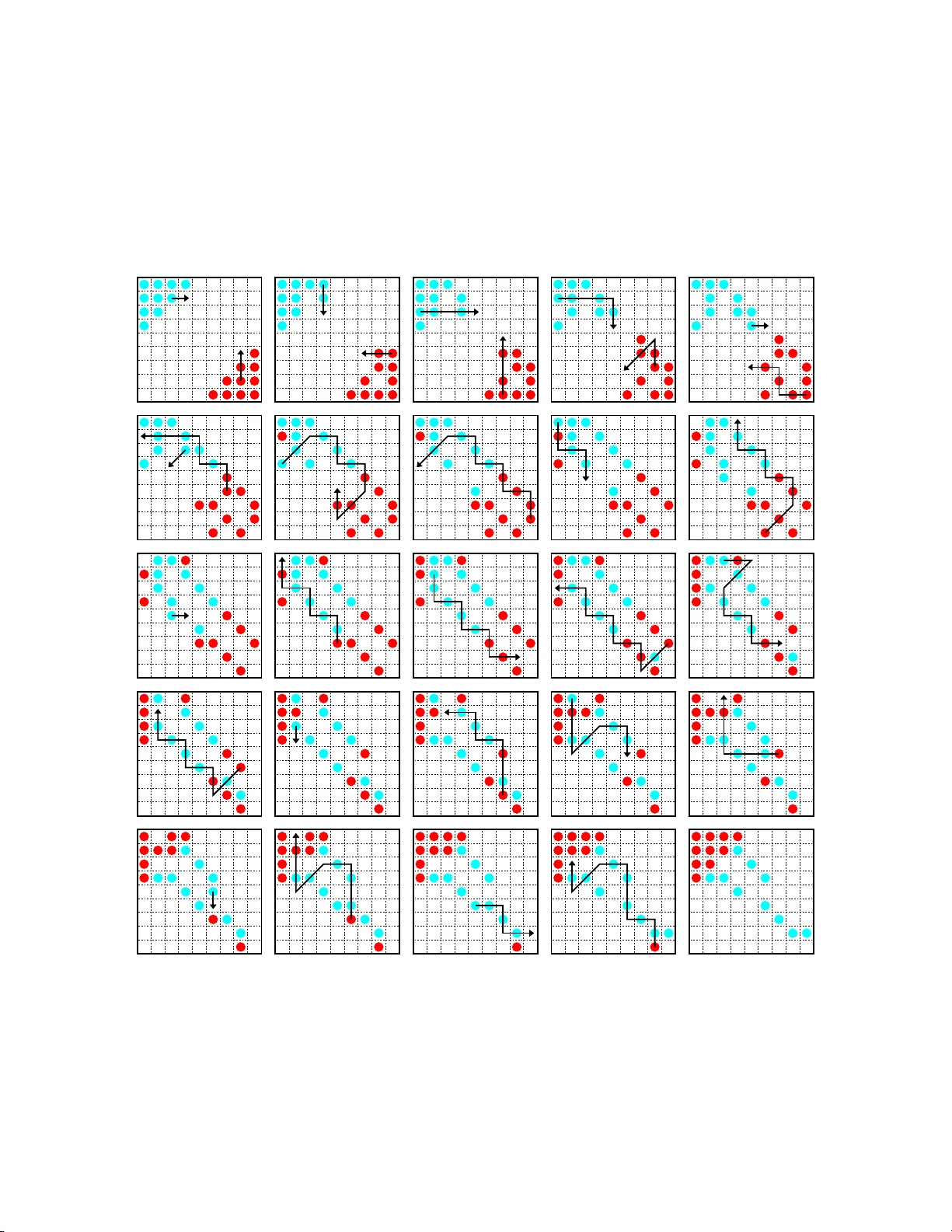
INTEGE RS: ELECTR ONIC JOURNAL OF COMB INA TORIAL NUMBER THEOR Y 9 (2009 ), #G01 THE SHOR TEST GAME OF CHINE SE CHECKERS AND RELA TED PROBLEMS George I. Bell T e ch-X Corp or ation, 5621 Ar ap ah o e Ave S u ite A, Boulder, CO 80303, USA gibell@comc ast.net R e c eive d: 3/ 4/08, Revi se d: 10/13/ 08, A c c epte d: 12/ 20/08, Publishe d: 1/ 5/09 Abstract In 1979 , Da vid F abian found a complete game of tw o- p erson Chinese C hec k ers in 30 mo v es (15 b y each pla y er) [Martin Ga rdner, P enrose Tiles t o T r ap do or Ciphers, MAA, 1997]. This solution requires t ha t the tw o play ers co op erate to generate a win as quic kly as p ossible for o ne of the m. W e s ho w, using computational searc h tec hniqu es, that no shorter game is p ossible. W e also consider a solitair e ve rsion o f Chinese Chec k ers where o ne play er attempts to mov e her pieces across the b oard in as few mo v es as p ossible. In 1 971, Octav e Lev enspiel found a solution in 27 mo v es [Ibid.]; w e demonstrate that no shorter solution exists. T o sho w optimalit y , w e emplo y a v ar ian t of A* searc h, as w ell as bidirectional s earc h. 1. In tro duction The game o f Halma w a s inv en ted in the 1880’s by George H. Monks [ 1 , 11 ]. This game is pla y ed on a rather large 16 × 16 b oa rd and is still p o pular in parts of Europe. In 1892, a significan t v ariation app eared in German y pla y ed on a triangular grid, originally called Stern-Halma [ 11 ]. W hen this game w a s mark eted in the United States it w as giv en the more exotic-sounding name Chinese Ch ec k ers , a lt hough it did not originate in China and is not a v aria nt of Chec k ers. Chinese Chec k ers remains a p opular children’s game in the United States. Chinese Chec k ers is normally play ed using marbles on a 121- ho le, star-shap ed b oard. Ho w ev er, the tw o-play er v ersion of the ga me can equiv alently b e play ed on a square 9 × 9 b oard, with mov e directions a s giv en in Fig ure 1 a 1 . Althoug h the b oard symmetry is harder 1 This is p ossible b ecause the tw o play ers mov e b etw een tw o opp osing “p oints” of the sta r . The 3 o r 6-play er versions of Chinese Check ers cannot b e play ed on a squa re 9 × 9 boa rd. INTEGE RS: ELECTR ONIC JOURNAL OF COMBINA TORIA L NUMBER THEOR Y 9 (20 09), #G01 2 1 a 2 b 3 c 4 d 5 e 6 f 7 g 8 h 9 i Figure 1: A Chinese Chec kers b oard (left) and Halma b oard (righ t) with men in their starting p ositions. The cen tral man sho ws the directions of allow ed mo v emen t. to see, it allows us to consider Halma and Chinese Chec k ers as games play ed o n the same b oard shap e. W e will refer to a b oa rd lo cation as a cell , with co ordinates g iven in Fig ure 1 a. W e will also find it useful to use Cartesian Co o rdinates to refer to a cell, with the o rigin at the cen ter o f the b o ard 2 . Each play er b egins with a certain num b er of iden tical game pieces, called men 3 . The set of men o wned by one pla y er will b e referred to as her army . The standard Chinese Chec k ers arm y has 10 men, and the standard Halma army has 19 men. A mo v e in either game is a step mo v e or a jump mo v e, as defined b y: 1. A st ep , where a man is mov ed one cell in the direction indicated by the arrows in Figure 1 . 2. A c hain of one or more jumps b y the same man. A jump is where a man hops ov er another man (o f either a rm y) in to a n empt y cell. Jumps are a llo w ed in any o f the directions indicated by the arro ws in Figure 1 . The jump ed piece is not r emo ve d from the bo a rd—there are no captures. Jumps are nev er compulsory—a pla y er ma y choo se to stop a c hain whenev er she pleases. The area where a pla y er’s ar my b egins f rom (outlined in Figure 1 ) will b e called tha t pla y er’s base . Play ers alternate mov es; t he first pla y er to fully o ccup y the opp osing base is the winner. A complicating factor is how to deal with a pla y er who refuses to v acate their o wn base, prev en ting the other play er from winning. V arious additional rules ha v e b een prop osed to prev en t this [ 11 ], but these will not concern us here. In this sq uare-b oa rd g eometry the mo v emen t rules for Chinese Chec k ers and Halma 2 The Halma bo a rd has no central ho le, we just use the cell identified in Fig ure 1 b as the origin. 3 T o comp ensate for this male- oriented terminolog y , all play ers will b e female. INTEGE RS: ELECTR ONIC JOURNAL OF COMBINA TORIA L NUMBER THEOR Y 9 (20 09), #G01 3 are identic al except for the directions of p ossible mov emen t. Halma allows mov es in all 8 directions f rom a cell, along row s, columns, and b oth diagonals—we will refer to these mo v emen t rules as 8-mo v e rules. In Chinese Chec k ers, one parallel direction of diagona l mo v emen t is no t allow ed, these will b e referred to as 6-mo v e r ules. Although it ma y app ear artificial to remov e only one direction of diago nal jump, this rule v ariation is completely natural on the triangular grid on whic h Chinese Chec k ers is norma lly play ed. A final v a riation is to allo w steps and jumps only along columns and rows; this v ariation will b e called 4-mo v e rules. Figure 2 a sho ws a standard ga me of Chec k ers (English Draughts) view ed with t he b o ard rotated 4 5 ◦ . W e can r emov e the white squares (they ar e not used), and pla y Chec k ers on the 32- cell b o ard in Figure 2 b under 4-mov e rules. Altho ugh Chec k ers has more complex j umping rules (captures), this sho ws how the ba sic jumps a nd steps of the game can b e view ed as mov es restricted to columns and row s—that is, 4-mov e rules. Figure 2: (a) A standard game of c hec kers . (b) The same g ame under 4-mo v e rules. Halma game pla y naturally divides in to three distinct phases (using George Monks’ orig- inal terminology [ 1 ]): 1. the gam bit , where the armies adv ance tow ard one another but do not in teract, 2. the melee , where the t w o armies in teract and ev en tually pass thro ug h one another, 3. the pac king , where the armies separate and attempt to fill the opp osing bases a s quic kly as p ossible. This pap er do es not address ga me pla y directly , but conside rs t w o puzzles based on Chinese Chec k ers and Halma. The first puzzle concerns the shortest p ossible game. In 1979, Da vid F abian, working by hand, found a complete game of Chinese Chec k ers in 30 mo v es [ 7 , p. 30 9] (15 mov es b y eac h pla y er). This is remark ably short considering that eac h o f the 20 men (b o th armies) m ust mak e a t least one mo v e. Such a solution requires t hat b oth sides co op erate so that one of them wins as quic kly as p o ssible, and thus has little to do with a comp etitiv e game. W e will sho w that no ga me can b e shorter than 30 mov es. A second puzzle we consider is a solitaire v ersion of t he game, where the goal is to adv a nce an arm y across the b oard in as few mo v es as p ossible (with no opp onen t’s pieces in the w a y). INTEGE RS: ELECTR ONIC JOURNAL OF COMBINA TORIA L NUMBER THEOR Y 9 (20 09), #G01 4 W e’ll refer t o these puzzles as “army transfer problems”. Suc h pro blems we re a fav orite of Martin Gardner—in three of his Scien tific American columns he discusses arm y transfer problems on three differen t b oards. First with regard to a Chec k ers b o ard (Figure 2 ) under 4-mo v e rules [ 3 ], then in the con text of Halma on a 9 × 9 b oard under 8-mo v e rules [ 4 ], and finally in the context of Chinese Chec k ers under 6 - mo v e rules [ 7 ]. W e will find the shortest p ossible solution to these three army transfer problems, and consider v arious generalizations. 2. The shortest p ossible game The game is considered ended when one play er fully o ccupies her opp onen t’s base, ev en if the other play er do es the same on her next mov e. Draw s can’t o ccur except in artificial situations where a play er refuses to lea v e her base, or the play ers mov e pieces back and forth so that the g a me go es on forev er. On some b oards one play er can b e stalemated with no p ossible mo v es. This is not p o ssible in standard Chinese Chec k ers or Halma (there are not enough men in one arm y to trap the opp osing arm y in a cor ner), but can o ccur among co op erating pla y ers for other v aria nts. W e’ll not consider such stalemated games as candidat es for the shortest p ossible game. The length of a completed game is defined as the total n um b er of mov es taken by b oth pla y ers. W e assume that the blue play er, star ting from the upp er left in F ig ure 1 , alw a ys mo v es first. The r e d pla y er mo v es second; if she wins first on her 15 t h mo v e, it is a 30 mov e game. If the blue pla y er wins first on her 15th mo v e, it is a 29 mo v e game. 2.1 Types of men 0 1 0 1 0 1 0 1 0 2 3 2 3 2 3 2 3 2 0 1 0 1 0 1 0 1 0 2 3 2 3 2 3 2 3 2 0 1 0 1 0 1 0 1 0 2 3 2 3 2 3 2 3 2 0 1 0 1 0 1 0 1 0 2 3 2 3 2 3 2 3 2 0 1 0 1 0 1 0 1 0 1 a 2 b 3 c 4 d 5 e 6 f 7 g 8 h 9 i Figure 3: T yp e lab eling of a Chinese Chec k er b oa rd. Clearly jumps are mor e effectiv e than steps to mov e an arm y quic kly across the b oard. INTEGE RS: ELECTR ONIC JOURNAL OF COMBINA TORIA L NUMBER THEOR Y 9 (20 09), #G01 5 Ho w ev er, a certain num b er of steps are generally needed. A skilled pla y er selects a careful mixture of jumps and steps to adv ance her army across t he b oard. There is a f undamental difference betw een steps and jumps. In Figure 3 , w e c hec ker the b oard with a pa ttern o f four t yp e lab els 0–3. W e lab el the men in an arm y b y their t yp e, and observ e that only step moves c an chang e a man ’s typ e . On a Chinese Chec k er b oard, b oth bases hav e the same n um b er of men o f eac h t yp e. Therefore, the winning play er will ha v e the same t yp es of men at the end o f the game t hat she started with. In terestingly , this is not tr ue of Halma, where the t yp e 0 and t yp e 3 men mus t effectiv ely change places during the game. The coun ts of the n um b er of t yp es of men for eac h game are giv en in T able 1 . Chinese Chec k ers Halma T ype # starting # finishing # starting # finishing 0 3 3 6 3 1 3 3 5 5 2 3 3 5 5 3 1 1 3 6 total men 10 10 19 19 T able 1: The nu m b er of men o f eac h ty p e for the ga mes of Chinese Chec k ers and Halma (from the blue pla y er’s p ersp ectiv e). This suggests that it may b e p ossible to pla y an en tire g a me of Chinese Chec k ers without making a n y step mov es, and w e will see that it is p ossible. F or Ha lma, how ever, the same argumen t sho ws that at le ast thr e e step moves ar e r e quir e d t o win the game. The difference is due to the fact that the b oard side in Halma is ev en (20), while for Chinese Chec k ers it is o dd (9). In general, w e’ll refer to these as ev en or odd b o a rds, a nd this t yp e disparit y will b e seen o n any ev en b oard. On an o dd b oard, the num b er of starting and finishing t yp es will be the same, as long as the starting arm y is symm etric ab out the diagona l line x = − y . In Chinese Chec k ers, to adv ance a t yp e 0 or 3 man (mov e it closer to t he opp o nen t’s base) requires a j ump ov er a t yp e 1 or 2 man, or a step, whic h conv erts it t o a type 1 or 2 man. Similarly , adv ancing a t ype 1 or 2 man requires a jump ov er or con v ersion to a type 0 or 3 man. In Halma, a man of a certain ty p e can adv a nce by jumping o r con v erting into any of the other three t yp es (b ecause it is now p o ssible to mo v e diagonally b et w een the bases). 2.2 Ladders A ladder is any configuration o f men tha t allows for quic k transfer of men b etw een the bases b y means of long c hain j ump mov es. Figure 4 show s sev eral ladders on a Chinese Chec k ers b oard. These ladders are shown using the same color men to visually separate them, but in general they can b e comp osed of either arm y . INTEGE RS: ELECTR ONIC JOURNAL OF COMBINA TORIA L NUMBER THEOR Y 9 (20 09), #G01 6 0 1 0 1 2 3 2 0 1 2 2 1 0 2 3 2 1 0 1 0 1 a 2 b 3 c 4 d 5 e 6 f 7 g 8 h 9 i Figure 4: Three la dders on a Chines e Chec k ers b oard. The red (top) ladder in Figure 4 is comp osed of men of t yp es 0 and 3, and can transp ort men of the opp osite t yp es 1 a nd 2. W e will r efer to suc h a la dder as a “type 0 &3 ladder”. The blue (middle) ladder has these r o les rev ersed, it is a type 1&2 ladder. The green ( b ottom) ladder is also a ty p e 1&2 ladder, but can only transp ort t yp e 3 men. Because it can tra nsp ort only one type of man, the green ladder is less useful. An y ladder can tra nsp ort a t most t w o of the four ty p es of men, fo r the fastest transp ort of an arm y (with men o f all types), at le ast two ladders of diff er ent typ es wil l b e ne e de d . The game w ould b e relativ ely easy if the ladders we re in place at the b eginning. In realit y , ladders ar e not only used, they m ust b e built and disassem bled. Plus, in a comp etitive game ladders will seldom b e separate or complete as in Figure 4 , and one pla y er can strategically “blo c k” a ladder by stopping a man in the middle. But o ur fo cus now is on the shortest p ossible game, where the play ers mus t co op erate t o build the most efficien t ladders, and they need not b e brok en do wn at all if they are comp osed of the losing pla y er’s men. 2.3 A low er b ound on game length Giv en t w o cells with Cartesian co o rdinates a = ( a x , a y ) and b = ( b x , b y ), what is the mini- m um n um b er of step mov es needed to mov e a man b et w een the tw o ? T o answ er this question, w e define the norm of a cell with Cartesian co ordinates ( x, y ) as || ( x, y ) || = || ( x, y ) || ∞ = max( | x | , | y | ) Halma or 8-mov e, || ( x, y ) || 1 = | x | + | y | 4-mo v e, || ( x, y ) || △ = 1 2 ( | x | + | y | + | x − y | ) C hinese Chec k er or 6- mov e. (1) The norm || ( x, y ) | | △ is a com bination of the first tw o norms, as shown by the alternate form ula || ( x, y ) || △ = max( | x | , | y | ) if sgn( x ) = sgn( y ) , | x | + | y | otherwise. (2) INTEGE RS: ELECTR ONIC JOURNAL OF COMBINA TORIA L NUMBER THEOR Y 9 (20 09), #G01 7 The form ula ( 2 ) w as giv en in 1976 in the con text of imag e pro cessing to calculate distances on a hexagonal grid [ 8 ]. The distance b et w een tw o b oa rd lo cations a = ( a x , a y ) and b = ( b x , b y ) is then defined as d ( a , b ) = || a − b || = || ( a x − b x , a y − b y ) || , (3) with norm appro pr ia te fo r the ga me as defined in ( 1 ). d ( a , b ) is the minim um nu m b er of steps needed to mo v e a man from a to b . Giv en t w o armies B and R , w e define the distance b et w een them as: d ( B , R ) = min { d ( b , r ) , ∀ b ∈ B and r ∈ R } . (4) If w e let B a nd R b e the initial p ositions of t w o a rmies at the b eginning of a game, fo r Chinese Chec ke rs we can compute that d ( B , R ) = 1 0 . Intere stingly , f o r Halma w e also hav e d ( B , R ) = 10. Th us, despite the large difference in b oard size, the initial distance b etw een the t w o armies is the same for Chinese Chec k ers and Halma. Theorem 1 If B and R ar e the initial p ositions of tw o equal-sized armies ( s = | B | = | R | ), no game can b e shorter than h mo v es, where h = max { 0 , d ( B , R ) − 2 } + 2 s − 1 . (5) Pr o of : After one pla y er mo v es, d ( B , R ) can decrease b y at most 1. As so on as d ( B , R ) ≤ 2, the next mov e can cross b et w een the t w o armies. The b est that can happ en is that d ( B , R ) decreases t o 2, the next play er then wins b y placing a man from her arm y into her opp onen t’s base on e ach o f her subse quen t s mo v es. The n um b er of mov es is then giv en b y ( 5 ). F or a standard ga me of Chinese Chec k ers, the b ound g iv en by Theorem 1 is 27 mov es, and for Halma 45 mo v es. 2.4 A 30 mov e game of Chinese Check ers Da vid F abian found a 3 0 mo v e Chinese Chec k ers game in 1979 and sen t it t o Martin Gardner [ 7 , p. 309]. I con tacted Da vid F abian a b out ho w he fo und his solution, he said he used “logic and patience” to find it b y hand. W e can come up with a set of prop erties that a short solution is lik ely to hav e. W e can’t prov e that the shortest solution m ust hav e these prop erties, but they can guide us on our searc h for them, b oth b y hand and using a computer. F rom Section 2.1, if the winning play er in Chinese Chec k ers mak es o ne step, she will b e obliged at some p oin t t o make another. Therefore, it seems reasonable t hat in the shortest p ossible game, the winning play er only jumps. The losing play er has no constrain ts on the t yp es of finishing men, and is lik ely to mak e some steps. INTEGE RS: ELECTR ONIC JOURNAL OF COMBINA TORIA L NUMBER THEOR Y 9 (20 09), #G01 8 If the game is to ha v e length L , then there is a critical mov e, α = L − 2( | A | − 1 ), after whic h the winning pla y er must hav e at least o ne man in her opp onen t’s base. In Section 2.2 w e learned that for a quic k game t w o ladders m ust b e built. The first ladder can b e built b y b oth play ers in the mo v es b efore α , while the second ladder m ust b e finished by the lo sing pla y er in the mo v es after α . Figure 5: Dav id F abia n’s 30 mov e game of Chinese Chec kers. In summary , some of the prop erties that a short solution usually has are: 1. The winning pla y er only jumps (on o dd b oards). 2. The first ladder is built b y b oth pla y ers during the first α mov es. 3. The second ladder is completed b y the losing pla y er on mo v es after α . INTEGE RS: ELECTR ONIC JOURNAL OF COMBINA TORIA L NUMBER THEOR Y 9 (20 09), #G01 9 4. After eac h mov e n ≥ α by the winning play er, there mus t b e at least ( n − α ) / 2 + 1 men in the opp osing base. 5. In the middle of the ga me, eac h diagonal line x − y = k b etw een the bases m ust b e o ccupied by at least one man, where − 4 ≤ k ≤ 4 ( t his forces placemen t o f t w o ladders). Finally , Figure 5 show s Dav id F abian’s 30 mov e solution, whic h has all these prop erties ( α = 12 in this case). W e hav e mo dified the losing pla y er’s last mov e sligh tly , as there are man y p o ssibilities. In fact this freedom migh t suggest the existence o f a 29 mo v e solution, but w e shall see that this is not the case. 2.5 Searc h algorithms One wa y to sho w that no 29 mov e solution exists is to do a searc h of the game tree. W e p erform a br eadth- first searc h so that w e can easily eliminate duplicate b oa rd p o sitions. The searc h pro ceeds b y lev els , where the lev el set L i consists of b oa r d p ositions that can b e reac hed a fter i mov es. The lev el set L 0 con tains only the initial b oard p osition, while L 1 con tains one elemen t for eac h p o ssible first mov e b y the blue play er. There are 14 p o ssible first mov es in Chinese Chec k ers, but 7 of these are equiv alen t by symmetry , so | L 1 | = 7, | L 2 | = 7 · 14 = 98, and | L 3 | = 1253. The total size of the state space for the game is 81 10 , 10 ≈ 8 . 67 × 10 23 , and the lev el sets L i gro w m uc h to o rapidly to calculate L 29 . F ortunately a ve ry go o d lo w er b o und on the nu m b er of mo v es remaining exists, namely the b ound giv en in Theorem 1. Although the b o und in Theorem 1 assumes t he b oard is in the initial p osition, it can b e easily mo dified to apply to any b oa r d p osition. If the distance b et w een the t w o armies d ( R , B ) > 2, we can use ( 5 ) unmo dified. When this distance b ecomes t w o or less, w e mo dify s in ( 5 ) to b e the num b er o f men in the winning arm y tha t are not in the opp osing base. Giv en any b oard p osition P , w e can use ( 5 ) as a low er b ound on the n um b er of mo v es remaining, h ( P ). T o apply t his in our searc h sc heme w e use a v ersion of A* search called “breadth-fir st iterativ e deep ening A*” [ 13 ]. Supp ose w e a re searchin g fo r a solution with length at least m . At mov e i if the b oard p osition is P , no solution from this boa rd p osition can be shorter than i + h ( P ). Thus , we can terminate the searc h from this no de if i + h ( P ) > m . This give s a searc h tree tha t expands rapidly un til a critical mo v e α , the first mov e where the winning play er m ust place at least one man in the opp osing base. A t this leve l the searc h tree contracts significan tly . But the next mov e b y the losing play er is unconstrained so the searc h expands, only to contract on the next mov e by the winning play er who aga in must place another man in the opp osing base. F or Chinese Chec k ers, w e kno w tha t a solution o f length 30 exists. Therefore, w e a pply the searc h a lgorithm to lo ok for all solutions of length 29 and 28. These searc hes come up empt y , so the shortest solution has 30 mov es. The solution in Figure 5 is not unique; the INTEGE RS: ELECTR ONIC JOURNAL OF COMBINA TORIA L NUMBER THEOR Y 9 (20 09), #G01 10 searc h tec hnique finds sev eral hun dred different 30 mo v e games. The same algorithm can find the shortest game for many other start ing configurations. The searc h strategy in these cases pro ceeds follo ws: first, b y incorp orating t he heuristic rules of Section 2.4, w e find a solution of length N whic h w e b eliev e is the shortest p ossible. Then, w e remo v e these heuristic rules and use o nly the b ound on solution length ( 5 ) to sho w that no solution exists of length m = N − 1 and m = N − 2. Mo v e Arm y Lo w er Shortest Game Board Rule Size d ( B , R ) Bound ( 5 ) Game Chinese Chec k ers 9 × 9 6-mo v e 10 1 0 27 30 Chinese Chec k ers (15 man) 9 × 9 6-mo v e 15 8 35 36 Halma 16 × 16 8-mo v e 19 10 45 Unkno wn Grasshopp er 8 × 8 8-mo v e 10 4 21 24 Chinese Chec k ers (8- mo v e) 9 × 9 8-mo v e 10 5 22 24 T able 2: Summary of shortest game lengths on v ario us b oards. T able 2 sho ws the results of these runs. F or a Chinese Chec k ers game with 1 5 men p er side, Da vid F abian fo und a 38 mo v e game [ 7 , p. 309], but our alg o rithm finds that a 36 mov e game is the shortest p ossible. Grasshopp er [ 4 , p. 117] is Halma play ed on an 8 × 8 (ev en) b oard, with t he initial configuration of 10 men the same shap e as in Chinese Chec k ers. By the type analysis in Section 2.1 , the winning play er must mak e at least 2 step mov es, and a ga me in 22 mo v es or less is imp ossible. In or der to win in exactly 24 mov es, the winning pla y er m ust mak e 2 step mov es and 10 jump mo v es, and eac h of the jump mov es must finish either inside their opp onen ts base or one cell short of it. F or the same game on a 9 × 9 b oard (o dd), the shortest game also has 24 mo v es, but the winning play er only jumps. 3. Arm y transfer problems W e no w conside r the problem of mo ving one a r m y quick ly b et w een bases, without an y opp osing men. On a Chinese Chec k ers b oar d, this problem was discus sed in a 197 6 Martin Gardner column [ 7 ], altho ug h the earliest reference is a 19 59 Canadian p erio dical on magic [ 2 ]. O cta v e Leven spiel w ork ed by hand to find short transfers; in 1971 he found a 2 7 mo v e solution [ 7 , p. 73]. Figure 6 show s Lev enspiel’s 27 mo v e solution. An inte resting feature of this solution is that it is palindromic , meaning that mov es 15–27 are mirror images o f the mov es 1– 13, tak en in the rev erse order (where the mirror symmetry is ab out the line x = y ) , and mov e 14 is itself mirro r symmetric. If the solution is in terrupted in the middle of the 14th mov e (the last diagram of Figure 6 ), the b oard p osition is mirror symmetric ab out the line x = y . It is not true that ev ery 27 mov e solution to this problem is palindromic, but pa lindro mic INTEGE RS: ELECTR ONIC JOURNAL OF COMBINA TORIA L NUMBER THEOR Y 9 (20 09), #G01 11 Figure 6 : Octa v e Lev enspie l’s 27 mo v e solution. Only the first half of the solution is sho wn, b ecause the solution is a palindrome (only half of the 14th mov e is sho wn). solutions often seem to exist, and are the most elegan t. In 19 73, Harry O. Davis sent Martin Gar dner a pro of that 27 mo v es was t he shortest p ossible solution to this problem. Although this pro of is men tioned in Gar dner’s b o ok [ 7 , p. 68], it was nev er published. This pro of has b een preserv ed in Martin Gardner’s files [ 5 ]. Da vis b egins his one-page pro of with an argumen t t ha t the shortest solution to the problem m ust con tain at least 10 step mo v es (note t hat Leve nspiel’s solution in Figure 6 contains 10 steps and 1 7 jump mo v es). How ev er, w e ha v e found 27 mo v e solutions to this problem with only 8 step mov es (see App endix A), so Davis ’ claim is fa lse. Although the pro of app ear s fla w ed, the theorem is nonetheless true—t here is no solution shorter than 27 mo v es. This will b e demonstrated n umerically b elo w. 3.1 Cen troids and b ounds The (diagonal) cen troid of a man a with Cartesian co ordinates ( a x , a y ) is defined as c ( a ) = a x − a y . (6) The cen troid c ( a ) is a measure of how far this man has prog ressed in his journey b etw een the bases. In the blue pla y er’s army , the cen troid of an y man b egins at − 5 or less, and ends at +5 or greater. INTEGE RS: ELECTR ONIC JOURNAL OF COMBINA TORIA L NUMBER THEOR Y 9 (20 09), #G01 12 The cen troid of an arm y A is the in teger-v alued function defined b y c ( A ) = X a ∈ A c ( a ) = X a ∈ A a x − a y . (7) This is related to the classical cen troid, or cen ter of grav it y , in the following sense: the arm y will balance across the diagonal line x − y = c ( A ) / | A | , where | A | is the size of army A . This cen troid gives a natural measure o f an army’s progress, and in comp etitiv e games whic h pla y er is curren tly in the lead. In a game of Chinese Chec kers , for example, where the origin is the cen ter of the b oar d, for the blue pla y er c ( A ) b egins at − 60 and ends at +6 0. Note that the starting arm y ba lances on the line x − y = − 6. When c ( A ) = 0, the army is exactly half-w a y to their goal, and balances across the diagonal line x = y . Theorem 2 Consider an ar my A , and let a min ∈ A b e a man with minimum cen troid, i.e. c ( a min ) ≤ c ( a ) , ∀ a ∈ A . Similarly , let a max ∈ A a man with maxim um cen troid. Then in one mo v e, the cen troid can increase at most δ , or decrease at most − δ , where δ = c ( a max ) − c ( a min ) + ℓ, (8) where ℓ = 1 for 4-mo v e and 6-mo v e pla y , and ℓ = 2 for 8-mo v e pla y . Pr o of : Only one man can mo v e, and the greatest cen tr oid increase is ac hiev ed by taking a man a min with minim um cen troid and increasing his cen troid as m uc h as p ossible. The b est a min can do is finish with a jump o v er some man with cen troid c ( a max ). Under 8-mo v e pla y , if the last jump is diagonal, his final cen troid can b e b e at most c ( a max ) + 2, o therwise it can b e at most c ( a max ) + 1. Theorem 2 giv es a relative ly crude upp er b ound o n cen troid increase, whic h it is tempting to refine further. Under 4 and 6 -mo v e rules, if c ( a max ) − c ( a min ) is ev en, in order to r eac h c ( a max ) + 1, the ma n a min m ust finish with a righ t w ard or down ward j ump o v er a man a max , and this is not p ossible b ecause this man has the wrong t yp e. In this case the upp er b ound ( 8 ) can b e reduced b y one. More significantly , supp ose the ar m y can b e partitioned in to tw o pieces A 1 and A 2 with a min ∈ A 1 , a max ∈ A 2 and d ( A 1 , A 2 ) > 2. Then the man a min cannot reac h the other half of the army , and t he b ound ( 8 ) can b e reduced considerably . All such refinemen t s result in a more complex form ula for cen troid increase. W e will also w an t to use Theorem 2 iterat ively to obtain an upp er b ound on the cen troid increase of an a rm y after n mov es. In this situation, the complexit y o f an impro v ed b o und increases greatly b ecause w e will hav e to consider the in teraction of multiple mov es. F or example, in the case where the ar my can b e partitioned in to A 1 and A 2 with d ( A 1 , A 2 ) = 3 , the first mov e could connect the t w o pieces, and then the second mo v e could g o b etw een them. The crude b ound in Theorem 2 is m uc h easier t o implemen t iterativ ely , b ecause it is v alid no matter how the mov es inte ract. W e can also use the ideas in Theorem 2 to get a low er b ound on the n um ber of mo v es to accomplish the transfer. W e a ssume that t he initial a rm y is A , and the lo cation o f the targ et INTEGE RS: ELECTR ONIC JOURNAL OF COMBINA TORIA L NUMBER THEOR Y 9 (20 09), #G01 13 base is B (a fixed set of cells). As the army A adv ances, the distance d ( A, B ) can decrease b y at most one p er mo v e. Th us, the smallest n um b er o f mo v es to place a man in the targ et base B is d ( A, B ). After this, the remaining | A | − 1 men mov e into the base B at b est one p er mo v e, so an y solution to the transfer problem has length at least d ( A, B ) + | A | − 1. F or the standard Chinese Chec k ers army , this giv es a low er b ound of 1 9 mov es, no t a v ery tigh t b ound considering t he minim um is 2 7 (a s w e shall see). Although these crude estimates don’t g et ve ry close to the true optim um, w e will see that Theorem 2 is useful during a n umerical searc h. Figure 7: An elegan t 16 mov e solution to a Ha lma tra nsfer problem (H. Ajisaw a and T. Maruy ama [ 4 , p. 118]). Again, only the first half of the solution is show n. Figure 7 sho ws a 16 mo v e solution to a Halma transfer problem [ 4 , p. 118]. The starting and ending armies in this case are 3 × 3 square arrays of men. Diagonal steps and jumps are allo w ed, in our terminology w e ha v e 8-mov e rules. The solution has eve n length and is also palindromic, the b oard p osition after 8 mo v es is mirro r symmetric ab out the line x = y . Although our simple lo w er b ound indicates that any solution m ust b e at least 12 mo v es, w e’ll b e able to sho w using the searc h algorit hm in the next section that the 16 mo v e solution in Figure 7 is the shortest p ossible. 3.2 Searc h algorithms As before our basic computational to ol is breadth-first searc h, with the lev el sets L i defined as b efo r e, except that only one play er mov es. Since the centroid m ust increase b y 120 (from − 60 to +60 ), clearly the most pro ductiv e mo v es are those that increase the cen troid. T o cut do wn on the size of t he lev el sets, it w ould seem w e should only consider mo v es t ha t increase the cen troid. If we do so, ho w ev er, there is no guara n tee that w e will find the shortest p ossible solutio n. Surprisingly , solutions of shortest po ssible length ma y contain mo v es that de cr e ase the c entr oid . Examples of this coun ter-in tuitiv e phenomenon will b e found b elo w. INTEGE RS: ELECTR ONIC JOURNAL OF COMBINA TORIA L NUMBER THEOR Y 9 (20 09), #G01 14 There are sev eral symmetries in this problem. The first is that the starting arm y is symmetric ab out the diagonal line x = − y . This effectiv ely halves the n um b er of p ossible starting mov es, and decreases the searc h space b y a facto r of t w o. The starting a nd finishing p ositions are also symmetric ab out the diag onal line x = y . Th us, the set of p ossible b oa r d p ositions one mov e b efore the finish is the same as the set of p ossible b oard p ositions one mo v e from t he start, reflected across the line x = y . This suggests tha t a go o d search tec hnique is bidirectional searc h [ 12 ]. T o searc h for a solutio n of length 2 N , w e do a breadth-first search t o N mov es, and in tersect the level set L N with the set obtained by reflecting eac h elemen t of L N across the diagonal line x = y . Supp ose w e ha v e a solutio n of length 2 N + 1, and w an t to prov e that no solution o f length 2 N exists. Supp ose we a lso kno w that the maximum p ossible cen troid a f ter any sequence of N mo v es is C max N (this is the maximum cen troid of any b oard p osition in t he lev el set L N ). F or a solution o f length 2 N to exis t, it mus t b e that C max N ≥ 0 . The k ey observ ation is that any solution of length 2 N m ust ha v e cen troid at le ast − C max N at lev el N . A t any lev el i ≤ N , w e apply Theorem 2 iterativ ely to get an upp er b ound on the cen troid after N − i additional mov es. If this upp er b o und is less than − C max N , then this b oard p osition cannot lead to a solution and we need not search further fro m this b oard p osition. This searc h combine s asp ects of bidirectional a nd A* searc h t echniq ues, and will b e called a minimum cen troid constraint (MCC) searc h, b ecause it eliminates b oards with cen troid to o small to lead to a solution. If y ou try to implemen t this MCC searc h, y ou will no t ice a problem. W e assumed tha t w e knew C max N at the start o f the algo rithm, ye t this num b er is not determined until the algorithm is finished! In realit y w e must estimate C max N , then run the searc h algorithm using this estimate. If the searc h algorithm pro duces a b o ard at lev el N with cen troid g reater than C max N , w e m ust run it all o v er ag ain with the correct C max N . It is only after the searc h finishes with a self-consisten t v alue of C max N , and the bidirectional search comes up empt y , that w e are assured that no solution of length 2 N exists. One w a y t o estimate C max N is to truncate the searc h a t eac h lev el, k eeping only t he top M b o ards with the la rgest cen troid. W e hav e found that an M of a few million giv es a go o d estimate of C max N . Short solutions can a lso be found quic kly using this truncation tec hnique. Bill Butler solv ed the Chines e Chec ke r transfer problem (Figure 6 ) this wa y , as do cumen ted on his w eb site [ 14 ]. He found fiv e different 27 mov e solutions, but because he truncated the n um b er of b oards at eac h lev el, his searc h is not exhaustiv e. F or the standard Chinese Chec k er transfer problem, we find that C max 13 = 5 . W e should note that a lthough the MCC a lgorithm mak es the searc h problem solv able, it is still not easy . The largest leve l set L 10 con tains 1 . 3 × 10 7 b oards, and the complete (unsuccess ful) searc h for a 26 mo v e solution tak es o v er tw o hours of CPU time 4 . T able 3 giv es the results of suc h a searc h o v er a wide v ariety of problems, with solutions 4 On a 1 GHz P C with 51 2MB of RAM. INTEGE RS: ELECTR ONIC JOURNAL OF COMBINA TORIA L NUMBER THEOR Y 9 (20 09), #G01 15 Shortest solution under Problem Configuration # Men Board 4- mov e 6-mo v e 8-mo v e # 1 T riangle 6 9 × 9 25 23 16 # 2 T riangle 10 9 × 9 30 27 (Fig 6 ) 20 # 3 T riangle (jumps only) 10 9 × 9 46 35 (Fig 8 ) 21 # 4 T riangle 15 9 × 9 36 † 3 1 † (Fig 9 ) 26 † # 5 Square 4 9 × 9 15 15 12 # 6 Square 9 9 × 9 25 25 16 (Fig 7 ) # 7 Chec k ers start 12 Fig 2 b 20 16 16 † - MCC searc h did not terminate, a shorter solution ma y b e p ossible. T able 3: Summary o f shortest solutio n lengths for transfer pro blems, all are the shortest p ossible except as noted. giv en in App endix A. Except as noted, the MCC searc h is run to completion in each case, so the num b er of mov es give n is the smallest p ossible. In part icular, Octav e Lev enspie l’s 27 mov e solution in Figure 6 is the shortest p o ssible, and 16 mo v es is the shortest solutio n to the Halma transfer problem in Figure 7 . Problem #7 w a s suggested b y Gardner [ 3 ], and refers to mo ving a 12- man army across a c hec k ers b oard. This is equiv a len t to moving o ne of the 12- ma n ar mies in Figure 2 b to the o pp osite side under 4-mo v e rules. The shortest solution to this problem has 20 mo v es. If w e allow only jump mo v es, how quic kly can a 10- man triangular arm y be transferred? T able 3 sho ws that the answ er (under 6-mov e rules) is 35 mov es, with a sample solution sho wn in Figure 8 . One in teresting feature of this solution is a b ackwar d j ump on the 1 0 th mo v e whic h reduces the ar my’s cen troid c ( A ). This bac kw ard jump mo v e can b e explained b y the f a ct that the man making it is of type 3. There is only one t ype 3 man in this a rm y , and in order to utilize him he mu st b e mo v ed around a lot, ev en j umping ba ckw ards. This phenomenon is also observ ed in the 4-mov e v ersion of the problem. App endix A includes solutions to problems in T able 3 with bac kw ard step mo v es. These exceptions indicate that w e cannot eliminate bac kw ard j ump and step mov es when searching for the shortest p ossible solution. One interes ting problem is the 15-man Chinese Chec ke rs army (problem #4 in T able 3 ). In 19 74, Min-W en Du of T aiw an sen t Martin Gar dner a letter with a solution to this problem in 35 mov es 5 [ 6 ]. My searc h algorithm has found a solution to this problem in 31 mo v es (see Figure 9 ), but an MCC searc h do esn’t finish, so it is not kno wn if this is the shortest solution p ossible. This 31 mov e solutio n is in teresting b ecause it uses t w o ladders rather than one. 5 Note that [ 7 , p. 68] describ es this problem incorr ectly . The letter [ 6 ] removes any ambiguit y . INTEGE RS: ELECTR ONIC JOURNAL OF COMBINA TORIA L NUMBER THEOR Y 9 (20 09), #G01 16 Figure 8: The first half of a 35 mo v e solutio n with jumps only (the shortest p ossible). No t e that the 10th mo v e (middle diagram, second row) go es bac kw a r ds! 3.3 Symmetry and palindromes In man y cases t he shortest solution can b e c hosen t o b e a palindro me, and these solutions are arguably the most elegan t. W e can add further constraints to search sp ecifically for palindromic solutions. First, we define the lev el of symmetry of an arm y A . G iv en a man a with Cartesian co ordinates ( a x , a y ), the co ordinates of the cell reflected across the line x = y are ( a y , a x ). W e define the function sym( a ) = +1 if ( a y , a x ) is o ccupied , 0 otherwise . (9) W e then define the arm y symmetry of an arm y A as sym( A ) = X a ∈ A sym( a ) , (10) so sym ( A ) v aries from zero to | A | dep ending on the symmetry of the arm y across the line x = y , and sym( A ) = | A | if and only if the arm y is mirror symmetric across this line. Starting with an ar my A 0 , denote b y A i the b oard p o sition after i mov es . F or a palin- dromic solution of o dd length 2 N + 1 to exist, it m ust b e that sym( A N ) = sym( A N +1 ) = | A | − 1. F or a palindromic solution of eve n length 2 N to exist, w e mus t hav e sym( A N ) = | A | . INTEGE RS: ELECTR ONIC JOURNAL OF COMBINA TORIA L NUMBER THEOR Y 9 (20 09), #G01 17 These tw o situations can b e seen in the second to the last diagram of Figures 6 and 8 , and the final diagram of Figure 7 . The symmetry of the starting a r m y , sym ( A 0 ) = 0, but b y the middle of a palindromic solution of length 2 N or 2 N + 1, sym( A N ) = T , where T = | A | for an ev en solution length and T = | A | − 1 for an o dd solution length. But the function sym() cannot increase from 0 to T in one mo v e. Since a single mo v e only a ffects one man, sym() can increase or decre ase b y at most tw o (the only terms that can increase in the sum ( 10 ) a r e the endp oin t of the mo v e and its mirro r image). So for a n y i ≤ N , the b oard p o sition A i in a palindromic solution m ust satisfy sym( A i ) ≥ T − 2( N − i ) . (11) No w consider the Chinese Chec k er transfer pro blem for the 1 5-man arm y (Problem #4 in T a ble 3 under 6 - mo v e rules). After N = 15 mov es, for a palindromic solution of length 2 N = 30 to exist, w e m ust ha v e sym( A 15 ) = 1 5. The symmetry constrain t ( 11 ) is therefore sym( A i ) ≥ 15 − 2 (15 − i ) = 2 i − 15 for 8 ≤ i ≤ 15 . (12) The symmetry constraint ( 12 ) can b e added to the MCC a lg orithm, and it sp eeds up the searc h after lev el 7, and we can run the searc h t o leve l 15. The resulting bidirectional search finds that there do es not exist a p alindr omic 30 mo v e solution. It remains a p ossibilit y that a non-palindromic 30 mov e solution exists. The same searc h tec hnique finds tw o palindromic solutions of length 31 (Figure 9 ). In general, t he symmetry constraint ( 11 ) can b e added to o ur searc h a lg orithm, and it can dramatically increase the searc h sp eed. Once ag ain, though, this searc h tech nique contains a “chic k en-in-egg paradox ”, b ecause in order t o run the search, w e mu st already kno w the solution’s length. F or a general problem, our searc h strategy is first to find a solution of an y length, then try t o find a short er solutio n, and finally to prov e that no shorter solution exists. T o find a solution of an y length, we can truncate t he lev el sets at eac h step, as explained in the previous Section 3.2. This tec hnique can b e view ed as a truncation based on the cen troid “score” c ( A ), but it do es not place an y extra v alue o n palindromic solutions. If the truncated n th lev el set is R n , then to find a solution of length 2 N the set R N m ust satisfy the conditions: max { c ( A ) , ∀ A ∈ R N } ≥ 0 , (13) min { c ( A ) , ∀ A ∈ R N } ≤ 0 . (14) Since the tr uncatio n tec hnique kee ps b oard p ositions with largest cen t roid, the first condition will ev en tua lly b e satisfied as N increases. Ho w ev er, f or large pro blems, the second condition ma y not b e satisfied (b ecause of the truncation), and then no solution will ev er b e found, no matter ho w large N is. F or problems starting fro m 15-man armies, w e instead tr uncate the lev el sets based on the mo dified score c ( A ) + β sym( A ) , INTEGE RS: ELECTR ONIC JOURNAL OF COMBINA TORIA L NUMBER THEOR Y 9 (20 09), #G01 18 Figure 9: The first half of a 3 1 mo v e solution starting with 15 men. The only other palin- dromic 31 mo v e solution is obtained b y extending the 15th mov e to end at c7. where β ≥ 0 is a n arbitrary weigh t f a ctor for symmetry . This mo dified score w eigh ts palin- dromic solutions more hea vily . W e ha v e had go o d results using β = 2. The palindromic solutions in Figur es 6 – 9 are symmetric ab out the line x = y . Note that the Chec k ers b oard of Figure 2 is not symmetric ab out the line x = y ; a palindromic solution on this b oard must instead b e symmetric with resp ect to 180 ◦ rotation. Martin Gardner gives a 20 mo v e palindromic solution on this b oard [ 3 , p. 217], and our algorithm can find all palindromic solutions, using a v ersion of sym( A ) corresp onding to a rotation rather than a reflection. INTEGE RS: ELECTR ONIC JOURNAL OF COMBINA TORIA L NUMBER THEOR Y 9 (20 09), #G01 19 3.4 F ast armies and balanced armies Giv en an army A , we define the cen ter o f mass m ( A ) ∈ R 2 as the av erage co ordinate ov er the arm y , m ( A ) = 1 | A | X a ∈ A ( a x , a y ) . (15) The diago nal cen troid of Section 3.1 is related to m ( A ) = ( m x , m y ) by c ( A ) = | A | ( m x − m y ). If an arm y A mov es to B in n mov es, w e define its av erage sp eed as the distance trav eled b y the cen ter of mass p er mo v e, σ = d ( m ( A ) , m ( B )) n = || m ( A ) − m ( B ) || n , (16) using the norm ( 1 ) sp ecific to 4, 6 or 8-mov e r ules. Note that the same army may hav e a differen t sp eed measured under differen t rules. W e call the arm y B a translate of A if B can b e obtained b y shifting eac h man in A b y the same (2D) v ector k , B = { a + k , ∀ a ∈ A } . Figure 10: Sp eed 1 armies under 4 and 8 -mo v e rules: “atom” (1 man, green), “frog” (2 men, blue), “serp en t” (4 men, red). Figure 10 sho ws f a st armies of size 1, 2 , o r 4. Under 4-mov e rules, the three armies in the top row eac h hav e sp eed 1. Auslander et al. [ 10 ] prov e that if A mov es to B under 4- mov e rules, and B is a translate of A , then the sp eed σ cannot exceed 1, and the only sp eed 1 armies are the three in the top row o f F igure 10 . The b ott o m r ow of Figure 10 sho ws armies under 8-mov e rules, a ll ha ving sp eed 1. Under 8- mo v e rules, all six armies in Figure 10 hav e sp eed 1, except for the top serp en t whic h has sp eed 1 / 2 . W e say that an army is balanced if the distribution of men o v er types is as uniform as p ossible. The smallest example of a p erfectly balanced army are the serp en ts in Figure 10 , whic h con tain one man of each t yp e. The balance o f an arm y can only b e c hanged by a step mo v e. O ne reason wh y a balanced army may b e fast is that the num b er of p ossible jump mo v es is large. F or example, among all 4-man armies under 4-mov e rules, the largest n um b er of p ossible jump mo v es is 8, and this can only b e ac hiev ed by taking one man of eac h t ype, as in the serp en t, or 4 men in a square configuration. In the previous sections w e hav e seen fast armies o f larger size. The sp eed in eac h case can b e computed and is giv en in Appendix A. One in teresting aspect of the armies in Figures 6 , 7 and 9 is that they are usually balanced. In the Chinese Chec k er problem of Figure 6 , the INTEGE RS: ELECTR ONIC JOURNAL OF COMBINA TORIA L NUMBER THEOR Y 9 (20 09), #G01 20 arm y is initially unbalanced, b ecause there are (3 , 3 , 3 , 1 ) men of t yp es 0–3. The first mov e (d1-d2) con v erts a man of t yp e 1 to ty p e 3, resulting in the balanced army (3 , 2 , 3 , 2). Finally , w e no te that the most common op ening among exp erienced pla y ers of comp etitive Chinese Chec k ers is the balance restoring step d1- d2 [ 15 ]. Is this a coincidence? In t he future, it may b e pro ductiv e t o lo ok in to the concept of arm y balance in comp etitiv e Chinese Chec k ers games. Halma b egins with t he un balanced army (6 , 5 , 5 , 3); restoring balance would suggest a dia g onal step ending at the t yp e 3 cells d4, f2, b6 or f6 as o ne of the op ening mo v es. 4. Summary Chinese Chec k ers and Halma seem to hav e a reputation as slo w-mo ving games. Alternate (but more complex) jumping rules hav e ev en b een devised in an attempt to sp eed them up [ 9 ]. Ho w ev er, increasing complexit y do es not necessarily improv e a game. W e ha v e show n than an en tire game of Chinese Chec k ers can tak e as few as 30 mov es. While suc h short solutions rely on the t w o pla y ers co op erating, a comp etitiv e ga me can a lso mo v e along more quic kly than man y p eople think. W e ha v e demonstrated, using computational searc h, tha t 3 0 mo v es is the shortest p ossible Chinese Chec k ers g ame. W e ha v e also studied a solitaire v ersion of the game where the goal is to transp or t a single arm y a cro ss the b oar d as quic kly as p ossible. These solutions oft en ha v e palindromic symmetry , and pa ss through a b oard p osition whic h is mirror symmetric across the line x = y . W e hav e obtained a b ound on ho w quic kly the cen troid can increase, and applied it n umerically to sho w that no standa r d Chinese Chec k ers army can cross t he b oard in under 27 mo v es. W e hav e also studied the a rm y transfer problem in a more general contex t, considering v arious army configurations under sev eral differen t jumping rules, with results summarized in T able 3 . Can w e a lw a ys find a shortest solution that is palindromic? The answ er is probably no, but w e ha v e not seen a coun terexample. The problem of the fastest w a y to transp ort a 19- man Halma army across a 16 × 16 b oar d is difficult to answe r computationally . Nonetheless, this is an in teresting problem to w ork on b y hand, and we hav e found a solution in 4 7 mov es, giv en in App endix A. Can the reader find a shorter solution? The centroid a r g umen ts of Section 3.1 giv e a low er b ound o f only 28 mo v es, so there w ould app ear to b e ample ro o m for impro v emen t. Finally , w e hav e in tro duced the concept of a balanced arm y , whic h means to ke ep (as m uc h as possible) the same n um ber of men o f eac h t yp e. The fa stest armies usually seem to b e balanced, and this is an in teresting area for further study . Ac kno wledgmen ts W e thank the anon ymous referee f or sev eral suggestions which improv ed the pap er. INTEGE RS: ELECTR ONIC JOURNAL OF COMBINA TORIA L NUMBER THEOR Y 9 (20 09), #G01 21 App endix A. Solutions A.1 Shortest games Chinese Chec k ers in 30 mov es (Figure 5 ), 10 man armies, 6-mov e rules (b y David F abian) : c2-d2 , h 8-h6 , d1-d3 , i6-g6 , a3-c3- e3 , g9-g7-g 5 , a2-c2-e2 -e4 , h7-h5-f7 , e4-f4 , i9-g9-g7-e7 , d3-c4 , g6- g4-e4- e2-c2-a 2 , a4-c2-e2 -e4-g4- g6-e8-e6 , i8-i6-g6-g4- e4-e2-c2-a4 , a1-a3-c3-c5 , f 9-h7-h5-f5-f3-d3-d1 , c5-d5 , e7-e 5-c5-c3 -a3-a1 , b2-b4-d4-d6-f6-f8-h8 , i7-g9-g7 -e7-e5-c 5-c3-a3 , c1-e1-c3-c 5-e5-e7-g7 , h 6-f8- f6-d6-d4-b4-b2 , b3-b4 , g8-g6-g4- e4-e2-c2 , b 1-b3-b5-d3-f3-f5 , g5-e5-c5-c 3-c1 , f5-f6 , f7-f5-f3-d3-b5-b3- b1 , e6-g6-g8-i 8 , h9-h7-f7-f5-f3-d3-b5-b3 ( red wins). Chinese Chec k ers in 36 mo v es, 15 man armies, 6-mov e rules: e1-e2 , g8-g6 , c1-e1-e3 , h6-f6 , e3- e4 , f9-f7-f5 , a1-c1- e1-e3-e5 -g5-e7 , g7-g5-e5-e3 -e1-c1-a1 , a5-b5 , i7-g7-g5-e5 -e3-e1-c1 , c3-a5-c 5 , g9-i7- g7-g5 -e5-e3-e 1-c3-a5 , a3-c3-e 1-e3-e5 -g5-g7-i7-g9 , i9-i7-g7 -g5-e5-e 3-e1-c3-a3 , a4-c4-c6 , e9-g7-g5 -e5- e3-e1- c3 , c6-d6 , i5-i7-g7 -g5-e5- e3-e1 , a2-a4- c4-c6-e6 -g4 , i8-g8-e8-e6 -c6-c4-a4-a2 , d2-f2 , i6-g8-e 8-e6- c6-c4- a4 , b3-d3-f1-f3-d5-d7-f7-h5 , f5-f7-d7-d5-f3-f1- d3-b3 , d1-f1-d3 , h8-h6-h4-f4-d4-d2 , b1-d1-f1-f3- d5-d7-f7-f5 , h 9-f9-f7-d7-d5- f3-f1-d1-b1 , b4-b6-d4-f4-h4-h6-h8 , h7-h9-f9-f7-d7-d5-f3-f1-d1 , c2-c4-c6 - e6-e8 , g6-e6-c6 -c4-c2 , b2-b4-b6-d4-f4-h4-h6 , f6-f4-d4-b6-b4-b2 , d3-f1-f3-d5-d7-f7-f9- h9 , f8-d8-f6-f4- d4-b6-b4 ( red wins). A.2 Short solutions t o arm y transfer problems Problem n umbers refer to those in T able 3 . All solutions giv en are palindromic, so only ha lf the solution is given, follo w ed by “(reflect)”. This indicates to rep eat the mov es in rev erse order, reflected ab out the line x = y . All solutio ns are the shortest p ossible, except as noted. Problem #2 (Figure 6 ), 6- mo v e rules in 27 mo v es (Octa v e Lev enspiel), C max 13 = 5, σ = 4 / 9: d1-d2, b1-d1-d3, a3-c3-e 3, e3-f3, c1- c3-e3-g 3, a1-a3-c3- e3, c2-e2-e4-g2 -g4, g4-g5, a4- c2-e2-e4 -g2-g4- g6, a2-c2- e2-e4-g 2-g4, d 2-d4-f2-f4-h4- f6-h6, h6-h7, b3-c2, b2-d2-d4-f2-f4- (reflect). An alternate solution with only 8 step mov es: c2-d2, a4-c2-e2, c1-e1-e 3, e3-e4, a1-c1-e1-e 3-e5, a3-c1-e1-e3 , d1-d3-f3-d5-f5, f5-g5, a2-c2, b3-d1-d3-f3-d5-f5-h5, b1-b3-d1-d3-f3-d5-f5, d2-f2-d4-f4-f6-h4-h6, h6-h7, b2-d2-f2-d4-f4- (reflect). Problem #2, 8 -mo v e rules in 20 mo v es, C max 10 = 12, σ = 3 / 10: a2-c4, c4-d4, a4-a2-c 4-e4, b1-d3-f5, f5-f6, a3-c 3-e5-g7, d1-b1-d3-f5-f7-h7, g7-h8, a1-c 3-e5-g7 -i7, b3-b1-d3-f5, (reflect). Problem #2, 4-mov e rules in 30 mov es, C max 14 = 5, C max 15 = 11, σ = 2 / 5: a4-b4, a2-a4-c4, b4-d4, d 4-d5, c1-c3-c5-e5, e5-e6, b2-b4-d4-d6-f6, f6-f7, a3-c3-c5-e 5-e7-g7, g7-h7, d1-c1 6 , c1-c3-c5- e5-e7- g7-i7, i7-i8, b 3-c3, c3-c5-e5 -e7-g7-i7 -i9, (reflect). Problem #6 ( Figure 7 ), 8-mov e rules in 1 6 mo v es, C max 8 = 10, σ = 3 / 8: b2-d4, c3- e5, e5-f6, a3-c3- e5-g7, c1-c3-e5 , a1-a3-c3, a2-c 4-e4-e6- g6-g8, b1-d3-d5-f5-f7-h7, (reflect). 6 Note this backw ard step mov e. INTEGE RS: ELECTR ONIC JOURNAL OF COMBINA TORIA L NUMBER THEOR Y 9 (20 09), #G01 22 Problem #3 (F ig ure 8 ), 6-mov e rules, jumps o nly in 35 mo v es, C max 17 = 8 , σ = 12 / 3 5 : b2-d2, d1-d3, c1-c3-e3 , a1-c1, c2-e2-c4 , a4-c2-e 2-e4, d2-d4-f4, a2-a4-c2, d3-f3-f5, f4-d4-b4-b2-d2, b1-d1-d3-f3-d5, c1-c3- c5-e5-g5 , a3-c3-c5- e5, e4-e6-g4-g 6, b 3-d1-d3, c2-e2- e4-e6, f5-h5-f7, d 2-d4-d6- (reflect). Problem #4 (Figure 9 ), 6-mo v e rules in 31 mo v es, p ossibly not shortest, σ = 32 / 93: c3-d3, d2-d4, a4-c4 -e4, c1-c3 -e3-e5, a1-c 1-c3-e3- c5, b 3-b5-d5-f5, e5-d6, d4-f4-f6, e1-c 1-c3-e3- e5-g5-e7, f6-g6, a5-c3- e3-e5-g 5-g7, b1-b3-b5-d5-d7-f7- h7, g7-f8, a2-a4-c4-c 6-e6-e8-g8-i6, a3-c1-c3-e 3-e5, b2-d2-d4-f4- (reflect). A 19- man Halma arm y crosses the b oard in 4 7 mov es, proba bly not shortest, σ = 225 / 893: d2-d4, c3-e5, e5-f6, a1-c3-e5-g7 , g7-h8, c1-c3-e 5-g7-i9 , i9-j10, e1-c1-c3 -e5-g7-i 9, a3-c3-e5 -g7, a5-c3- e5, b3-d5-f5-f7-h7- h9-j9-j11, j11-k11, b5-b3-d5-f5-f7-h7-h9-j9 -j11-l11, l11-l12 , d1-b3-d5-f5-f7-h7-h9- j9-j11-l11 -l13, l13-m13, c4-e4-e6-g6 -g8-i8-i10-k10-k12-m12-m14, m14-n14, e2-c4-e 4-e6-g6- g8-i8-i10- k10-k12- m12-m14-o1 4, d3-d5-f5-f7-h7-h9-j9-j11-l1 1-l13-n13-n15, a4-c4-e4- e6-g6-g 8-i8-i10-k10-k12- m12-m14-o 16, b2-b3, b4-c3 , b 1-d3-d5-f5-f7-h7- h9- (reflect). References [1] G. Monks, Game of S kil l , US Paten t #383 ,6 53, 1 888. [2] P . How ard Ly ons, Ibidem V olumes 2 and 3, Hermetic Pr ess, Inc, Sea ttle, 1 9 95 and 2002 , see pages 394 and 84 2–3 (compendium of a p erio dical publis hed from 19 55 to 197 9). [3] M. Gardner, Bridg-it and other Games, in New Mathematic al Diversions , 2 10–18 , MAA, 19 95 (reprint o f a n ar ticle fr o m Scientific Americ an , Jul 1961 ). [4] M. Gardner, The Game of Halma , in Whe els, Life, and other Mathematic al A musements , 115–2 3, W H F reeman & Co, 1 983 (reprint of an a rticle from Scientific A meric an , Oct 19 71). [5] H. O. Davis, 1973 letter to Martin Gardner, archiv ed a t the Stanford Universit y Libr a ry , SC64 7, Series 1, Box 37, F older 11. [6] Min-W en Du, 197 4 letter to Martin Gar dner, ar chiv ed at the Stanfor d Universit y Libr a ry , SC64 7, Series 1, Box 37, F older 11. [7] M. Gardner , Back fr o m the Klondike a nd Other Problems, in Penr ose Tiles to T r ap do or Ci- phers,and the r eturn of Dr. Matrix , 63– 7 7, MAA, 1 997 (reprint of an article from Scientific Amer- ic an , Oct 19 7 6). [8] E. Lucza k and A. Ro senfeld, Dista nce on a Hexagonal Gr id, IEEE T r ans. on Computers , 25 , #5, 1976, 532– 3. [9] R. W. Schmittberge r , New Rules for Classic Games , John Wiley & Sons, Inc, New Y ork , 1992. [10] J. Ausla nder, A. Benjamin and D. S. Wilk erson, Optimal Leapfrogg ing , Mathematics Magazine , 66 , #1, F eb 1993, 14– 19. [11] B. Whitehill, Halma and Chinese Chec kers: Origins and V aria tions, in Bo ar d Games in A c ade mia , Editions Universitaires F rib ourg Suisse, 2002, 37–47 . [12] S. Russe ll a nd P . Norvig , Artificial Int el ligenc e: A Mo dern Appr o ach , 2nd ed., Prentice Hall, 200 2, section 3.4. [13] R. Zhou and E . Hansen, Brea dth-fir st heuristic search, Artifici al Intel ligenc e , 170 , 2 0 06, 385 –408. [14] B. Butler, htt p://ww w.dura ngobill.com/ChineseCheckers.html [15] Wikipedia Chinese Checkers guide, h ttp:// en.wik ibooks.org/wiki/Chinese Checker s
Original Paper
Loading high-quality paper...
Comments & Academic Discussion
Loading comments...
Leave a Comment