QoS Challenges and Opportunities in Wireless Sensor/Actuator Networks
A wireless sensor/actuator network (WSAN) is a group of sensors and actuators that are geographically distributed and interconnected by wireless networks. Sensors gather information about the state of physical world. Actuators react to this informati…
Authors: Feng Xia
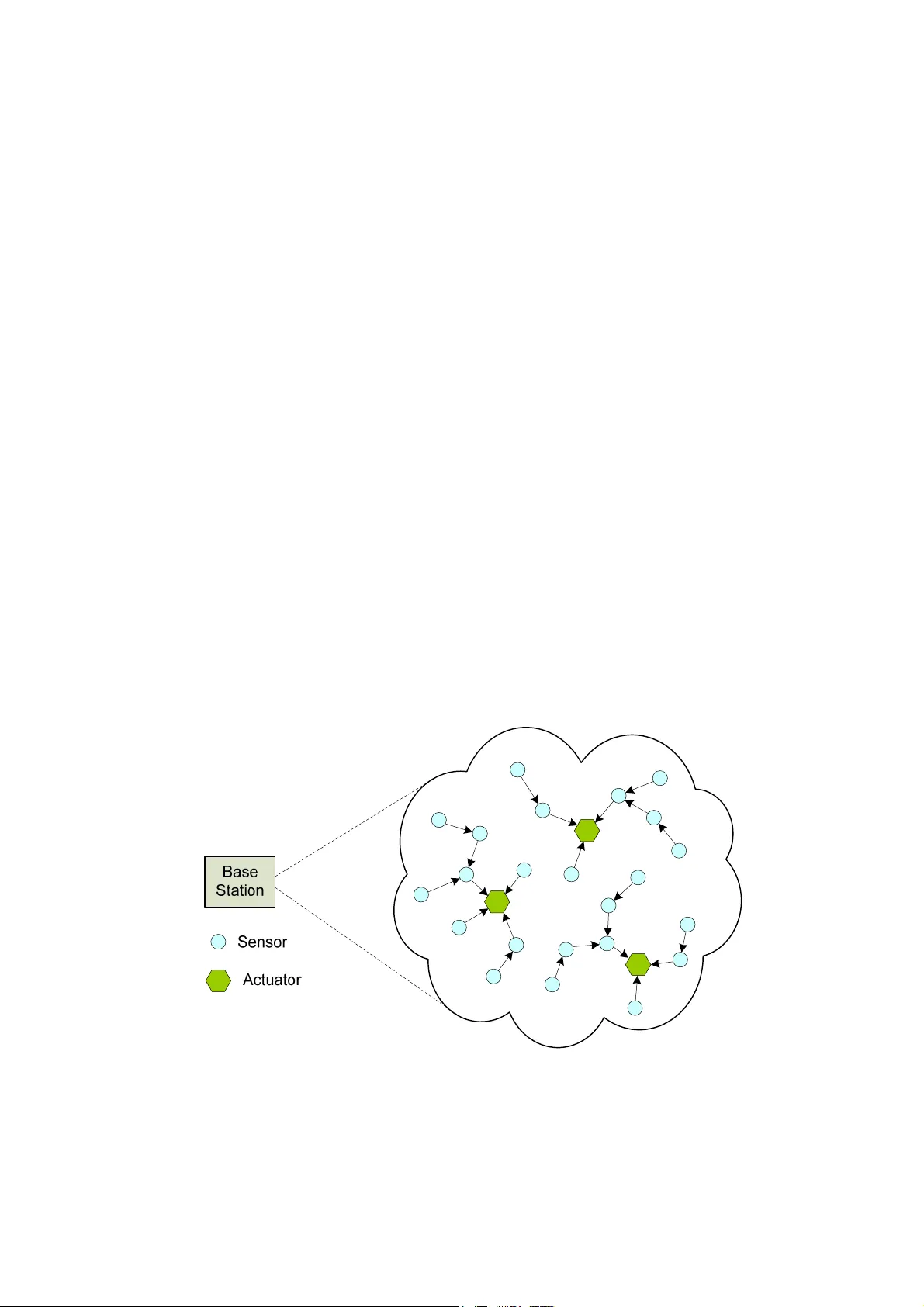
Published in Sensors 2008, 8(2), 1099-1110, www.mdpi.org/sensors. Review QoS Challenges and Opportunities in Wireless Sensor/Actuator Networks Feng Xia 1,2 1 Faculty of Information Technology, Queensland University of Technology, Brisbane QLD 4001, Australia 2 College of Computer Science and Technology, Zhejiang University, Hangzhou 310027, China E-mail: f.xia@ieee.org; f.xia@acm.org Abstract: A wireless sensor/actuator network (WSAN) is a group of sensors and actuators that are geographically distributed and interc onnected by wireless networks. Sensors gather information about the state of physical worl d. Actuators react to this inform ation by performing appropriate actions. WSANs thus enable cyber system s to monitor and manipulate the behavior of the physical worl d. WS ANs are growing at a tremendous pace, just like the exploding evolution of Internet. Supporting quality of serv ice (QoS) will be of critical importance for pervasive WSANs that serve as the network infrastructure of diverse applications. To spark new research a nd development interests in this field, this paper examines and discusses the requirement s, critical challenges, and open research issues on QoS management in W SANs. A brie f overview of recent progress is given. Keywords: wireless sensor/actuator network, quality of service, service-oriented architecture, communication protocol, self-m anagement, power m anagement. 1. Introduction Wireless sensor networks (WSNs) [1,2] have been studied for about 10 years. Today this field is widely supported by an increasing number of dedicat ed journals such as ACM Trans. on Sensor Networks and Int. J. of Distri buted Sensor Networks, conferences such as SENSYS (ACM Conf. on Embedded Networked Sensor Systems), IPSN (ACM /IEEE Int. Conf. on Information Processing in Sensor Networks), and DCOSS (IEEE Int. Conf. on Distributed Computing in Sensor Systems), and commercial com panies such as Crossbow, Ember, Se ntilla, Dust Networks, Microsoft, Intel, and Sun Microsystems, to mention just a few. Num erous special issues of renowned journals on sensor networks have been published and special sessions of leading conferences organized, with more expected to appear in the future. Since its incep tion, WSN has grown into a hot research area at a tremendous pace. A large number of institutions and re searchers around the world have set their feet in this field, and launched various research and deve lopment projects. Significant advances have been achieved in almost all aspects, including architect ure, hardware, software, system design, supporting tools, standards, applications, etc [3]. WSNs are designed to gather information about the state of physical world and transmit sensed data to interested users, typically used in applications like habitat monitoring, military surveillance, agriculture and environmental sensing, and health m onitoring. In m ost cases, they are unable to effect on the physical environment. In many applications , however, only observing the state of the physical system is not sufficient; it is also expected to respond to the sensed events/data by perform ing corresponding actions upon the system. For instance, in a fire handling system, the actuators need to turn on the water sprinklers upon receipt of a repor t of fire. This need for actuation heralds the emergence of wireless sensor/actuator networks (W SANs) [4-7], a substantial extension of sensor networks that feature coexistence of sensors and actuators. WSANs enable the application system s to sense, interact, and change the physical world, e .g., to monitor and manipulate the tem perature and lighting in a smart office or the speed and directi on of a mobile robot. It is envisioned that W SANs will be one of the most critical t echnologies for building the network infrastructure of future cyber- physical systems [8]. They will revolutionize the way we interact with the physical world. Figure 1. A wireless sensor and actuator network. As shown in Figure 1, a WSAN is a networked system of geographically distributed sensor and actuator nodes that are interconnected via wireless links. Both sensor and actuator nodes are normally equipped with certain data processing and wireless communication capabilities, as well as power supply. In most situations, sensor nodes are stationary whereas actuator nodes, e.g., mobile robots and unmanned aerial vehicles, are mobile. Sensors gather inform ation about the state of physical world and transmit the collected data to actuators through single-hop or m ulti-hop communications. Upon receiving the required information, the actuators make the decision about how to react to this information and perform corresponding actions to cha nge the behavior of the physical environm ent. The base station is principally responsible fo r monitoring and managing the overall network through communications with sensors and actuators. It is not until very recently that the area of WSAN has begun to emerge, regardless of one-decade research activities in WSN. Relatively very little work has been conducted on W SAN. In particular, quality of service (QoS) management in W SANs is an area yet to be explored [4] . WSANs are application-oriented, especially when used for c yber-physical computing. Therefore, QoS has to be supported by WSANs in order to achieve end users’ satisfaction with the services that the system provides. To a large extent, the performance of future cyber-physical system s will rely on the QoS support in WSANs, just like how we today rely on vari ous services offered by Internet to com municate with one another. This paper gives a brief overview of QoS provi sioning in the context of WSANs. Som e critical challenges and possible research topics are discussed. Related work is reviewed. The primary aim is to spark new research and development interests in this field. 2. QoS Requirements As Moore’s law continues, it is envisioned that WSANs will become pervasive in our daily lives, for example, in our homes, offices, and cars. They prom ise to revolutionize the way we understand and manage the physical world, just as Internet transfor med how we interact with one another. Ultim ately, they will be connected to the Internet in order to achieve global information sharing [8]. This technical trend is driving WSANs to provide QoS support because they have to satisfy the service requirements of various applications. From an end user’s perspective, real-world WS AN applications have their specific requirements on the QoS of the underlying network infr astructure [4]. For instance, in a fire handling system, sensors need to report the occurrence of a fire to actuators in a timely and reliable fashion; then, the actuators equipped with water sprinklers will react by a certain deadline so that the situation will not become uncontrollable. It is intuitive that different appli cations may have dif ferent QoS requirements. For instance, for a safety-critical control system, large delay in transmitting data from sensors to actuators and packet loss occurring during the course of tran smission may not be allowed, while they m ay be acceptable for an air-conditioning system that maintains the tem perature inside an office. Although QoS is an overused term, there is no comm on or formal definition of this term . Conceptually, it can be regarded as the capability to provide assurance that the service requirements of applications can be satisfied. Depending on the type of target application, QoS in WSANs can be characterized by reliability, timeliness, robustness, availability, and security, among others. Som e QoS parameters may be used to m easure the degree of satisfaction of these services, such as throughput, delay, jitter, and packet loss rate. There are many other QoS parameters worth m entioning, but these four are the most fundamental [9-12]. y Throughput is the effective number of data flow trans ported within a certain period of tim e, also specified as bandwidth in some situations. In general, the bigger the throughput of the network, the better the performance of the system is. Thos e nodes that generate high-speed data streams, such as a camera sensor node used to transmit images for target tracking, often require high throughput. In order to improve the resource e fficiency, furthermore, the throughput of W SAN should often be maximized. y Delay is the time elapsed from the departure of a da ta packet from the source node to the arrival at the destination node, including queuing delay, switching delay, propagation delay, etc. Delay- sensitive applications usually require WSANs to deliv er the data packets in real-tim e. Notice that real-time does not necessarily mean fast co mputation or comm unication [5,12]. A real-time system is unique in that it needs to execute at a speed that fulfills the tim ing requirements. y Jitter is generally referred to as variations in delay, despite many other definitions. It is often caused by the difference in queuing delays experienced by consecutive packets. y Packet loss rate is the percentage of data packets that are lost during the process of transmission. It can be used to represent the probability of pack ets being lost. A packet may be lost due to e.g. congestion, bit error, or bad connectivity. This pa rameter is closely related to the reliability of the network. 3. Challenges WSANs cannot be simply regarded as W SNs due to the co-existence of sensors and actuators, as mentioned previously. In this section, some of the m ajor features of WSANs that challenge QoS provisioning will be discussed. 3.1. Resource Constraints As in WSNs, sensor nodes are usually low-cost, low-power, small devices that are equipped with only limited data processing capability, transmission rate, battery energy, and m emory. For exam ple, the MICAz mote from Crossbow is based on th e Atm el ATmega128L 8-bit m icrocontroller that provides only up to 8 MHz clock frequency, 128-KB flash program mem ory and 4-KB EEPROM; the transmit data rate is limited to 250 Kbps. Due to the limitation on transmission power, the available bandwidth and the radio range of the wireless channel are often limited. In particular, energy conservation is critically important for extending the lifetime of the netw ork, because it is often infeasible or undesirable to recharge or replace th e batteries attached to sensor nodes once they are deployed. Actuator nodes typically have stronger computation and comm unication capabilities and more energy budget relative to sensors. Resource c onstraints apply to both sensors and actuators, notwithstanding. In the presence of resource constraints, the ne twork QoS may suff er from the unavailability of computing and/or comm unication resources. For inst ance, a number of nodes that want to transm it messages over the same W SAN have to compete for th e lim ited bandwidth that the network is able to provide. As a consequence, some data transmissions will possibly experience large delays, resulting in low level of QoS. Due to the limited mem ory si ze, data packets may be dropped before the nodes successfully send them to the destination. Therefore, it is of critical im portance to use the available resources in WSANs in a very efficient way. 3.2. Platform Heterogeneity Sensors and actuators do not share the same leve l of resource constraints, as mentioned above. Possibly designed using different t echnologies and with different goals, they are different from each other in many aspects such as computing/com muni cation capabilities, functionality, and num ber. In a large-scale system of systems, the hardware and networking technologies used in the underlying WSANs may differ from one subsystem to another. Th is is true because of the lack of relevant standards dedicated to WSANs and hence comm erc ially available products often have disparate features. This platform heterogeneity makes it very difficult to make full use of the resources available in the integrated system. Consequently, resource e fficiency cannot be m aximized in many situations. In addition, the platform heterogeneity also make s it challenging to achieve real-tim e and reliable communication between different nodes. 3.3. Dynamic Network Topology Unlike WSNs where (sensor) nodes are typically sta tionary, the actuators in W SANs may be m obile. In fact, node mobility is an intr insic nature of many applications such as, am ong others, intelligent transportation, assisted living, urban warfare, pl anetary exploration, and animal control. During runtime, new sensor/actuator nodes may be added; th e state of a node is possibly changed to or from sleeping mode by the employed power m anagement m echanism; some nodes m ay even die due to exhausted battery energy. All of these factors may potentially cause the network topologies of WSANs to change dynamically. Dealing with the inherent dynamics of WSANs re quires QoS mechanisms to work in dynam ic and even unpredictable environments. In this context, QoS adaptation becomes necessary; that is, W SANs must be adaptive and flexible at runtime with resp ect to changes in available resources. For example, when an intermediate node dies, the network should still be able to guarantee real-time and reliable communication by exploiting appropriate protocols and algorithm s. 3.4. Mixed Traffic Diverse applications may need to share the same WSAN, inducing both periodic and aperiodic data. This feature will become increasingly evident as the scale of W SANs grows. Some sensors m ay be used to create the measurements of certain physical variables in a periodic manner for the purpose of monitoring and/or control. Meanwhile, some others m ay be deployed to detect critical events. For instance, in a smart home, som e sensors are used to sense the temperature and lighting, while som e others are responsible for reporting events like th e entering or leaving of a person. Furthermore, disparate sensors for different kinds of physical variables, e.g., temperature, humidity, location, and speed, generate traffic flows with different charact eristics (e.g. message size and sam pling rate). This feature of WSANs necessitates the support of service differentiation in QoS managem ent. 4. Open Issues Over the years, in order to meet the require m ents of diverse applications on network QoS, significant effort has been made to provide e nd-to-end QoS support using various algorithm s and mechanisms at different network protocol layers. Particularly, Internet QoS has been a focus of enormous research and development activities [ 9]. Due to the many distinctive characteristics of WSANs, however, existing QoS mechanism s may not be applicable to WSANs [10,11]. To achieve QoS support in WSAN, the above challenges have to be addressed. In this section, several open research topics of interest will be identified. 4.1. Service-Oriented Architecture The concept of service-oriented architecture (SOA) [6,13-15] is by no means new and has been widely used in for example the web services domain. However, m any of its elegant potentials have not ever been explored in WSANs, though SOA will undoubt edly have a major im pact in many branches of technology [16]. SOA is an architectural style en compassing a set of services for building complex systems of systems. It can be regarded as a m ode l in which a system is decom posed into smaller, distinct units that are able to provide certain functionality. As an architectural evolution and a paradigm shift in systems integration, SOA enables rapid, cost-effective com position of interoperable, scalable systems based on reusable services exposed by these systems. This is particularly useful for QoS provisioning in WSANs that are integrated in to large-scale cyber-physical systems in which multiple applications run on diverse technologies and platforms. Identifying and specifying services are crucial for exploiting SOA in WSANs. A large number of questions need to be answered in this respect. Fo r example, how many categories of services should be classified in the context of WSAN? W hat are th e functionality, interface, and properties of each service? What are its quality levels relevant to pe rform ance requirements? In particular, how to deal with the difference between sensors and actuators when specifying services? 4.2. QoS-Aware Communication Protocols In order to efficiently support QoS in WSANs, co m munication protocols need to be designed with in mind the platform heterogeneity, specifically the heterogeneity between sensors and actuators that are involved in the communication. For this reason, state-of-the-art QoS-aware MAC, routing, and transport protocols devoted to WSNs may not be suitable for W SANs. As an essential component of QoS, service differentiation should be supported by comm unication protocols. As mentioned above, WSANs m ay be used in cyber-physical systems encom passing diverse applications, which may differ significantly in term s of QoS requirements. Obviously, the best-effort service offered by current wireless networking t echnologies such as Zigbee and Bluetooth cannot provide different QoS to different applications. Therefore, the communication protocols for W SANs should be designed to perceive the service requireme nt of each type of traffic so that it can be guaranteed a specific service level. From a practice pe rspective, the best-eff ort service is likely to be the standard for the foreseeable future [9,10]. It is therefore necessary for all new QoS mechanism s to be layered on top of the existing networks. Cross-layer design has proved to be effective in optimizing the network perform ance and hence may be incorporated in the development of Qo S-aware communication protocols for W SANs. Much work can be conducted in this line. For example, the prioritization of traffic at lower layers might be associated with the application performance at the application layer. 4.3. Resource Self-Management Resource management is of param ount importa nce for QoS provisioning because the corresponding resource budgets need to be guaranteed in order to achie ve certain QoS levels. This is particularly true for WSANs where computing, com munication and ener gy resources are inherently lim ited. Generally speaking, a higher level of QoS corresponds to a need of more resources, e.g. CPU time, m emory size, bandwidth and/or energy. Resource management in W SANs is challenging, because of the ever- increasing complexity of WSANs, highly dynam ic f eature of WSANs, and changing and unpredictable environments in which WSANs operate. To overcome these challenges, self-managem ent t echnologies [17,18] are needed. This implies that the system will address resource managem ent issu es in an autonomous m anner. With respect to changes in resource availability, resource manager will automatically adapt resource usage in a way that the resulting overall QoS is optimized. This has to be performed in an efficient way. Since the resources are limited, the overhead of resource manage m ent should be minim ized. In order to maintain scalability, distributed mechanisms have to be explored in this context. A promising way to go is to exploit feedback scheduling [4,19-21]. Taking advantage of well- established control theory and technology, feedback sc heduling offers a promising approach to flexible resource management in dynam ic and unpredictable e nvironments. Previous work has showed that feedback scheduling is capable of handling uncerta inties in resource availability through automatically adapting to dynamic changes. It is anticipated that this technology can be used in W SANs to realize resource self-management and to provide QoS guarantees. The pr edictability of the system can be enhanced thanks to the use of control theory. Nevertheless, how to map resource managem ent to control problems is still subject of future research. 4.4. QoS-Aware Power Management Energy conservation is a major concern in bot h WSNs and W SANs. The lifetime of untethered sensor/actuator nodes is tightly restricted by the available battery energy. Since wireless communication is m uch more energy-expensive than sensing and com putation, the transmission power of nodes has to be properly managed in a way that the energy consum ption is minimized in order to prolong the lifetime of the whole network. Due to the increasingly heavy com putational burdens, a significant amount of energy will be consumed by the computations in actuator nodes. Therefore, the CPU energy consumption of actuators should al so be minimized, e.g. by exploiting the dynam ic voltage scaling technology. However, minimizing energy consum ption and maxi mizing QoS are in most cases two conflicting requirements. For instance, reliability can be im proved by increasing the number of m aximum allowable retransmissions or using higher transm ission power levels; however, m ore energy will be expended in both cases. Therefore, tradeoffs must be made between energy conservation and QoS optimization. The problem then becom es how to make these tradeoffs at runtim e. Is it possible to find an integrated performance metric that accounts for both energy efficiency and QoS, and then optim ize it, either online or offline? Depending on the network topology and the QoS requi rements, the power managem ent mechanism s for actuator nodes may be different from those used in sensor nodes. Thus the QoS can be maximized through exploiting the different capabilities of sens ors and actuators. In like manner, different transmission power levels may be assigned to the sam e node with respect to different types of traffic. In-network computation can be exploited to re duce the energy consumption of both sensor and actuator nodes since it reduces traffic load at the cost of slightly increased computation in each involved node. Still, the inherently non-deterministic and open nature of wireless channels poses great challenges for QoS-aware power management. 4.5. Supporting Tools The fundamental role of WSAN is to connect th e cyber space and the physical world. Cyberspaces are by nature discrete-time systems, whereas the physical world is com posed of continuous-time systems. This hybrid feature of the integrated sy stem challenges the development of simulation and design tools that can be used to evaluate th e performance of QoS mechanism s for WSANs. An interesting question is whether or not it is techni cally feasible to develop such a tool based on a service-oriented architecture. If so, programming t echnologies for im plementing various services need to be developed. In addition, benchmark testbeds a nd prototypes also deserve extensive research and development effort. Using these supporting tools, guidelines can be further developed that help implement new protocols, m echanisms, and algorithms for QoS m anagement in practice. 5. Recent Progress Service-oriented approaches have been used in building WSANs. In [6], Rezgui and Eltoweissy explored the potential of SOA in building open, effi cient, interoperable, scalable, and application- aware WSANs. A prototype service-oriented WSAN was developed on top of TinyOS. King et al [22] developed a service-oriented WSAN platform ca lled Atlas, which enables self -integrative, programmable pervasive spaces. Kushwaha et al [14] developed a programming fram ework called OASiS that provides abstractions for object-centric, ambient-aware, service-oriented sensor network applications. OASiS decomposes specified applica tion behavior and generates the appropriate node- level code for deployment onto sensor networks. It enables the developm ent of sensor network applications without having to deal with the comp lexity and unpredictability of low-level system and network issues. Chu and Buyya [15] presented a reusable, scalable, extensible, and interoperable service-oriented sensor web architecture. The arch itecture conforms to the sensor web enablem ent standard defined by the OpenGIS consortium (OGC), integrates sensor web with grid computing, and provides middleware support for sensor webs. Golatowski et al [23] proposed a service-oriented software architecture for mobile sensor networ ks. An adaptive middleware is em ployed in the architecture that encompasses mechanism s for c ooperative data mining, self-organization, networking, and energy optimization to build higher-level service structures. Some efforts have been made on com munication protocols that provide QoS support in WS ANs. Real-time, reliable comm unication has been addressed in e.g. [24-32]. Ngai et al [24] designed a real- time comm unication framework that supports even t detection, reporting, and actuator coordination. Shah et al [25] proposed a real-time coordination a nd routing framework that addresses the coordination of sensors and actuators and respects the delay bound for routing in a distributed manner. Melodia et al [26] presented a distributed protocol for sensor-actor coordination that includes an adaptive mechanism to trade off energy consum ption fo r delay when the data transmission is subject to real-time constraints. Hu et al [27] developed an anycast comm unication paradigm that can reduce both end-to-end latency and energy consumption. A simple yet effective wireless com munication model has been employed in [28] that realizes real-time actuation in autonom ous animal control. Boukerche et al [29] proposed a routing protocol with service differentiation for WASNs, which provides low latency and reliable delivery in the presence of failures. Morita et al [30] presented a redundant data transmission protocol that can significantly enhance the reliability of data transmission over lossy WSANs. A general reliability-centric fram ework for event reporting has been presented in [31]. A low-complexity reliable transm ission scheme has been developed in [32], which is based on local wireless path repair and hop-to-hop retransmissions. Adaptive sampling approaches have been exploite d for dynam ic management of resources in W SNs, e.g. [33,34]. However, these approaches don’t take into account the co-existence of sensors and actuators. Few solutions have been devised for resource self-managem ent that facilitates QoS-enabled autonomic WSAN. In [4,35], Xia et al applied feedback control technologies to dynam ic bandwidth allocation in the context of WSAN, which take a dvantage of the idea of feedback scheduling. The flexibility and autonomy of the system is enhanced through deadline m iss ratio control, leading to improved QoS in terms of reliability. While QoS-aware power managem ent in general WS Ns has been extensively studied, e.g. [36, 37], there is relatively little work dedicated to QoS-aw are power managem ent in WSANs, particularly for actuator nodes. Rozell and Johnson [38] developed an optimal m ethod for power scheduling in WSAN that achieves a desired actuation fidelity. Sanchez et al [39] proposed an energy-efficient multicast routing protocol that was specially designed to minimize the total energy used by the m ulticast tree. Zhou et al [40] developed a data transport protocol th at reduces the energy consumption associated with data transmission while meeting the Qo S requirem ents in timeliness dom ain. Durresi et al [41] proposed a delay-energy aware routing protocol that enables a flexible range of tradeoffs between the packet delay and the energy use. A power-aware ma ny-to-many routing schem e has been proposed in [42]. A low-energy and delay-sensitive TDMA based MAC protocol has been presented in [43]. In line of supporting tools development, an interesting attem pt is TrueTime [44], a Matlab/Simulink-based simulator developed at Lund Un iversity. TrueTim e facilitates co-simulation of controller task execution in real-time kernels, ne twork transm issions, and continuous plant dynamics. It was designed primarily for simulating networke d and embedded control systems, and has supported sensor network applications. Another notable atte mpt is the Agent/Plant [45] m odule developed at Case Western Reserve University. The module ex tends NS-2 to interface network dynamics with physical behaviors, making it possible to simulate physical system s that are attached to a network. 6. Conclusion WSAN is an area still in its infancy, despite som e r ecent progress. It is anticipated that WSANs will evolve rapidly and become pervasive in the near futu re, mu ch in the same way as the Internet came to the desktop before. Lessons should be taken from In ternet that WSANs have to be designed with QoS support in mind. This paper has discussed the re quirements and challenges for supporting QoS in WSANs. Some interesting open research topics have been identified, though the spectrum of research in this field can be much broader. The challenges are f ormidable and extensive research from multiple disciplines is needed before QoS-enabled WSANs become reality. Acknowledgements The author would like to thank Yu-Chu Tian, Guos ong Tian, and Li Gui at Queensland University of Technology, Australia, for the many insights he have gained in working with them. This work is supported in part by Australian Research C ouncil (ARC) under the Discovery Projects grant DP0559111 and China Postdoctoral Science Foundation under grant 20070420232. References and Notes 1. Borriello, G.; Farkas, K.I.; Reynolds, F. ; Zhao, F. Building A Sensor-Rich World. IEEE Pervasive Computing 2007 , 6 (2), 16-18. 2. Chong, C.-Y.; Kumar, S.P. Sensor networ ks: evolution, opportunities, and challenges. Proceedings of the IEEE 2003 , 91 (8), 1247-1256. 3. A wireless sensor networks bibliography. http://ceng.usc.edu/~anrg/SensorNetBib.html. 4. Xia, F.; Zhao, W.H.; Sun, Y.X.; Tian, Y.C. Fuzzy Logic Control Based QoS Management in Wireless Sensor/Actuator Networks. Sensors 2007 , 7 (12), 3179-3191. 5. Xia, F.; Tian, Y.C; Li, Y.J.; Sun, Y.X. Wire less Sensor/Actuator Network Design for Mobile Control Applications. Sensors 2007 , 7 (10), 2157-2173. 6. Rezgui, A.; Eltoweissy, M. Service- Oriented Sensor-Actuator Networks. IEEE Communications Magazine 2007 , 45 (12), 92-100. 7. Akyildiz, I. F.; Kasim oglu, I. H. Wireless se nsor and actor networks: research challenges. Ad Hoc Networks 2004 , 2 (4), 351-367. 8. NSF Workshop on Cyber-Physical Systems, http://varm a.ece.cmu.edu/cps/, Oct. 2006 9. El-Gendy, M. A.; Bose, A.; Shin, K. G. Evoluti on of the Internet QoS and support for soft real- time applications. Proceedings of the IEEE 2003 , 91 (7), 1086-1104. 10. Chen, D.; Varshney, P. K. QoS Support in Wirele ss Sensor Networks: A Survey. In Proc. of the Int. Conf. on Wireless Networks, Las Vegas, USA, June 2004. 11. Li, Y.J.; Chen, C.S.; Song, Y.-Q.; Wang, Z. Real -tim e QoS support in wireless sensor networks: a survey. In Proc of 7th IFAC Int Conf on Fieldbuses & Networks in Industrial & Embedded Systems (FeT'07), Toulouse, France, Nov. 2007. 12. Bouyssounouse, B.; Sifakis, J. (eds.) Embe dded Systems Design: The ARTIST Roadm ap for Research and Development. Lecture Notes in Computer Science 3436, Springer-Verlag, 2005. 13. Papazoglou, M.P. Service-Oriented Computing: C oncepts, Characteristics and Directions. In Proc. of the Fourth Int. Conf. on Web Information System s Engineering, Dec 2003; pp. 3-12. 14. Kushwaha, M.; Amundson, I.; Koutsoukos, X.; Neema, S.; Sztipanovits, J. OASiS: A Programming Fram ework for Service-Oriented Se nsor Networks. In Proc. 2nd Int. Conf. on Communication System s Software and Middleware, Bangalore, India, Jan. 2007; pp.1-8. 15. Chu, X.; Buyya, R. Service Orie nted Sensor Web. In: Mahalik, N. P. (ed), Sensor Network and Configuration: Fundamentals, Standards, Plat forms, and Applications. Springer-Verlag, ISBN: 978-3-540-37364-3, Germany, Jan. 2007; pp.51-74. 16. MORE Project Deliverable D2.1: Architect ure and Services, http://www.ist-more.org/. 17. Ganek, A. G.; Corbi, T. A. The dawning of the autonom ic computing era. IBM Systems Journal 2003 , 42 (1), 5-18. 18. Herrmann, K.; Muhl, G.; Geihs, K. Self manageme nt: the solution to complexity or just another problem. IEEE Distributed Systems Online 2005 , 6 (1), 1-17. 19. Xia, F.; Tian, G.S.; Sun, Y.X. Feedback Scheduling: An Event-Driven Paradigm . ACM SIGPLAN Notices 2007 , 42 (12), 7-14. 20. Xia, F. Feedback scheduling of real-tim e contro l systems with resource constraints, PhD thesis, Zhejiang University, 2006. 21. Arzen, K.-E.; Robertsson, A.; Henriksson, D.; Johansson, M.; Hjalm arsson, H.; Johansson, K.H. Conclusions of the ARTIST2 Roadmap on Control of Computing System s. ACM SIGBED Review 2006 , 3 (3), 11-20. 22. King, J.; Bose, R.; Yang, H.; Pickles, S.; Helal, A. Atlas: a service-oriented sensor platform . In Proc. of 31st IEEE Conf. on Local Computer Networks, Nov 2006; pp. 630-638. 23. Golatowski, F.; Blumenthal, J.; Handy, M.;Haase, M.; Burchardt, H.; Timm ermann, D. Service- Oriented Software Architecture for Sensor Networks. In Proc. Int. Workshop on Mobile Computing (IMC’03), Rockstock, Germany, June 2003; pp. 93-98. 24. Ngai, E. C.H.; Lyu, M.R.; Liu, J. A Real-Tim e Com munication Framework for W ireless Sensor- Actuator Networks. In Proc. IEEE Aerospace Conf., Big Sky, Montana, U.S.A., March 2006. 25. Shah, G.A.; Bozyigit, M.; Akan, O.B.; Baykal, B. Real-Time Coordination and Routing in Wireless Sensor and Actor Networks. In Proc. 6t h Int. Conf. on Next Generation Teletraffic and Wired/Wireless Advanced Networking (NEW 2AN), Lecture Notes in Computer Science, 2006; Vol. 4003, pp. 365-383. 26. Melodia, T.; Pompili, D.; Gungor, V. C.; Akyildiz, I. F. Comm unication and Coordination in Wireless Sensor and Actor Networks. IEEE Transactions on Mobile Computing 2007 , 6 (10), 1116-1129. 27. Hu, W.; Bulusu, N.; Jha, S. A Com munication Pa radigm for Hybrid Sensor/Actuator Networks. International Journal of Wireless Information Networks 2005 , 12 (1), 47-59. 28. Wark, T.; Crossman, C.; Hu, W.; Guo, Y.; Valencia , P.; Sikka, P.; Corke, P.I.; Lee, C.; Henshall, J.; Prayaga, K.; O'Grady, J.; Reed, M.; Fisher , A. The design and evaluation of a mobile sensor/actuator network for autonomous animal control. In Proc. Int. Conf. on Inform ation Processing in Sensor Networks (IPSN), 2007; pp. 206-215. 29. Boukerche, A.; Araujo, R.B.; Villas, L. A Wi reless Actor and Sensor Networks QoS-Aware Routing Protocol for the Emergency Preparedne ss Class of Applications. In Proc. 31st IEEE Conf.on Local Computer Networks, Tampa, FL, 2006; pp. 832-839. 30. Morita, K.; Ozaki, K.; Hayashibara, N.; Enoki do, T.; Takizawa, M. Evaluation of Reliable Data Transmission Protocol in Wireless Sensor-Act uator Network. In Proc. 21st Int. Conf. on Advanced Information Networking and Applications Workshops, May 2007; Vol. 2, pp. 713-718. 31. Ngai, E. C.H.; Zhou, Y.; Lyu, M.R.; Liu, J. Re liable Reporting of Delay-Sensitive Events in Wireless Sensor-Actuator Networks. In Proc. of the 3rd IEEE Int. Conf. on Mobile Ad-Hoc and Sensor Systems (MASS'06), Vancouver, Canada, Oct. 2006. 32. Hu, F.; Cao, X.; Kum ar, S.; Sankar, K. Trustwor thiness in wireless sensor and actuator networks: towards low-complexity reliability and secur ity. In Proc. IEEE Global Telecomm unications Conference (GLOBECOM), Vol.3, Dec. 2005. 33. Gedik, B.; Liu, L.; Yu, P.S. ASAP: An Adaptive Sa mpling Approach to Data Collection in Sensor Networks. IEEE Transactions on Parallel and Distributed Systems 2007 , 18 (12), 1766-1783. 34. Liu, X.; Wang, Q.; He, W .; Caccamo, M.; Sha, L. Optim al Real-Time Sampling Rate Assignm ent for Wireless Sensor Networks. ACM Transactions on Sensor Networks 2006 , 2 (2), 263-295. 35. Xia, F.; Zhao, W.H. Flexible Time-Triggered Sampling in Sm art Sensor-Based Wireless Control Systems. Sensors 2007 , 7 (11), 2548-2564. 36. Lin, S.; Zhang, J.; Zhou, G.; Gu, L.; He, T.; St ankovic, J.A. ATPC: Adaptive Transmission Power Control for Wireless Sensor Networks. In Proc . of SenSys’06, Boulder, Colorado, USA, Nov. 2006. 37. Vidhyapriya R.; Vanathi, P.T. Conserving energy in wireless sensor networks. IEEE Potentials 2007 , 26 (5), 37-42. 38. Rozell, C.J.; Johnson, D.H. Power scheduling for wireless sensor and actuator networks. In Proc. of IPSN, Cambridge, MA, April 2007. 39. Sanchez, J.A.; Ruiz, P.M.; Stojmenovic, I. Energy-efficient geographic m ulticast routing for Sensor and Actuator Networks. Computer Communications , 2007 , 30 , 2519-2531. 40. Zhou, Y.; Ngai, E. C.-H.; Lyu, M.R.; Liu, J. POWER-SPEED: A Power-Controlled Real-Tim e Data Transport Protocol for Wireless Senso r-Actuator Networks. In Proc. IEEE W ireless Communications and Networking Conf (W CNC'07), Hong Kong, China, March 2007. 41. Durresi, A.; Paruchuri, V.; Barolli, L. Delay- Energy Aware Routing Prot ocol for Sensor and Actor Networks. In Proc. of 11t h Int. Conf. on Parallel and Distributed Systems, Fuduoka, Japan, July 2005; pp. 292-298. 42. Cayirci, E.; Coplu, T.; Emiroglu, O. Power awar e many to m any routing in wireless sensor and actuator networks. In Proc. of the Second Eu ropean Workshop on Wireless Sensor Networks, 2005; pp. 236-245. 43. Munir, M.F.; Filali, F. Low energy, adaptive a nd distributed MAC protoc ol for wireless sensor- actuator networks. In Proc. of 18th IEEE Annual Int. Symposium on Personal Indoor and Mobile Radio Communications, Athens, Greece, Sept. 2007. 44. http://www.control.lth.se/truetime/. 45. http://vorlon.case.edu/~vxl11/NetBots/.
Original Paper
Loading high-quality paper...
Comments & Academic Discussion
Loading comments...
Leave a Comment