Tight Bounds and Faster Algorithms for Directed Max-Leaf Problems
An out-tree $T$ of a directed graph $D$ is a rooted tree subgraph with all arcs directed outwards from the root. An out-branching is a spanning out-tree. By $l(D)$ and $l_s(D)$ we denote the maximum number of leaves over all out-trees and out-branchi…
Authors: Paul Bonsma, Frederic Dorn
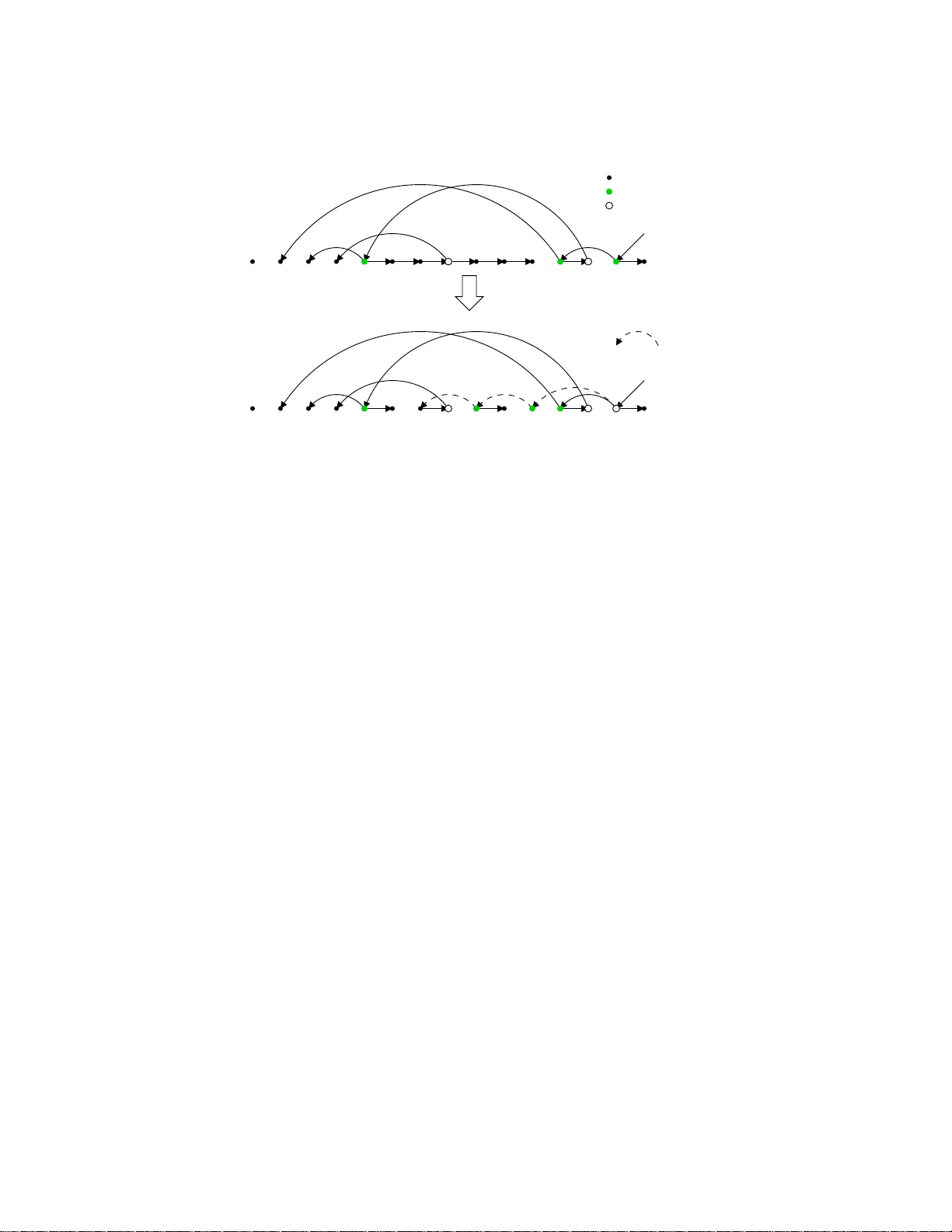
Tigh t Bounds and F aster Algorithms fo r Directed Max-Leaf Problems P aul Bonsma ∗ T echnisc he Univ ers it¨ at Berlin, Institut f ¨ ur Mathematik, Sekr. MA 5-1 , Straße des 1 7. Juni 136, 1 0623 Berlin, Germa ny bo nsma@math.tu-b erlin.de F rederic Dorn Hum b oldt-Universit¨ at zu Berlin Institut f ¨ ur Informatik Un ter den Linden 6, 1 0099 Berlin, Germa ny dorn@informa tik.hu-berlin.de June 18, 2021 Abstract An out-tree T of a directed graph D is a ro oted tree subg r aph with all ar cs directed outw ards from the ro o t. An out-branching is a spanning o ut-tree. By ℓ ( D ) and ℓ s ( D ) we denote the maximum num ber of leav es o ver all out-trees and out-branchings of D , resp ectively . W e give fixed parameter tracta ble algorithms for deciding whether ℓ s ( D ) ≥ k and whether ℓ ( D ) ≥ k for a digraph D on n vertices, b o th with time complexit y 2 O ( k log k ) · n O (1) . This impro ves o n previous algorithms with complexity 2 O ( k 3 log k ) · n O (1) and 2 O ( k log 2 k ) · n O (1) , resp ectively . T o obtain the complexit y b o und in the case of o ut-branchings, w e prov e that when all arcs of D are pa rt o f at least one o ut-branching, ℓ s ( D ) ≥ ℓ ( D ) / 3 . The second bo und w e prov e in this pap er states that for s trongly connected digra phs D with minimum in-degr ee 3, ℓ s ( D ) ≥ Θ( √ n ), where previously ℓ s ( D ) ≥ Θ( 3 √ n ) w as the best known bo und. This bo und is tight, and also holds for the la r ger cla ss o f digraphs with minimum in-degree 3 in which every arc is part of at least one out-branching. 1 In tro duction Man y imp ortant graph problems are w ell-studied on undirected graphs unlike their general- izations to directed graphs. One reason ma y b e that despite their pr actical significance, it is generally harder to obta in similar results for directed graph s. Max-Leaf Sp anning Tree is suc h a problem that has receiv ed a lot of study , b oth alg orithmically and com binatorial . This optimiza tion pr oblem is d efined as follo ws: giv en an undirected graph, fi nd a sp anning ∗ Supp orted by the Graduate S c ho ol “Methods for Discrete S tructures” in Berlin, DFG grant GRK 1408. 1 tree with maxim um n um b er of lea v es. In the decision ve rsion of this pr oblem, in a dd ition an in teger k is giv en, and the question is w hether a spanning tree w ith at least k lea v es exists ( k -Leaf Sp anning Tree ). Th ese problems are motiv ated b y man y practical and theoreti- cal app lications (see for instance [14 , 19]), though in some cases, the applicat ions call for a directed generalization [6], whic h is what we study in this pap er. F or d irected graph s or digr aphs we use notions that are defin ed for und irected graphs, suc h as p aths, trees, connectedness and verte x neigh b orho o ds. These are d efined as exp ected, where arc directions are ignored. An out-tr e e of a digraph D is a tr ee sub graph wh ere ev ery v ertex has in-degree 1 except for one, the r o ot , whic h has in-degree 0. An out-br anching is a spanning out-tree. A le af is a v ertex with out-degree 0. In the directe d generalization of the problem, one asks for an out-branc hing with maxim um n um b er of lea ves. Th is problem is called Max-Lea f Out-Branching . By ℓ ( D ) and ℓ s ( D ) we denote the maximum n um b er of lea ve s o v er all out-trees an d out-branc hings of D resp ectiv ely (when co nsiderin g ℓ s ( D ) we assume that D has at least one out-branching). Clearly ℓ ( D ) ≥ ℓ s ( D ) holds, but in con trast to undirected graphs, w e d o not alw a ys ha v e equali t y here. In fact the r atio ℓ ( D ) /ℓ s ( D ) can be arbitrarily large. Therefore, on digraphs, the problem of finding an out-tree with maxim um n umb er of lea v es ( Max-Leaf Out-Tree ) is of ind ep end en t in terest. The corresp onding de- cision problems wher e the question is asked whether ℓ s ( D ) ≥ k or whether ℓ ( D ) ≥ k are called k -Leaf Out-Branch ing and k -Leaf Out-Tree , resp ectiv ely . The related prob lem of find- ing out-branc hings with minimum num b er of lea v es has also b een considered recentl y [15]. In the first part of this pap er w e are concerned with algorithmic questions, and in the sec- ond part w e study the com binatorial question of finding low er b oun d s for ℓ ( D ) and ℓ s ( D ). Throughout this sectio n n denotes the num b er of v ertices of the graph un der consideration. The N P -hardness of all problems ab o v e f ollo ws fr om the N P -completeness of k -Leaf Sp an ning Tree . Whereas for the un directed problem, Max-Leaf Sp anning Tree , a 2-appro ximation is known [18], the b est kno wn appro ximation resu lt for Max-Leaf Out- Branching is a v ery r ecen t algorithm with ratio O ( √ n ) [11]. In the algorithmic part of this w ork, w e are in terested in fixe d p ar ameter tr actable (FPT) alg orithms for the decision problems. W e c ho ose the desired n umb er of lea v es k as th e parameter. Th en an alg orithm is an FPT algorithm if its time complexit y is b ounded by a function of the form f ( k ) · n O (1) , where the p ar ameter function f may b e an y computable fun ction only dep ending on k . FPT algorithms are w ell-studied and classified. The b o ok of Do wney a nd F ello ws [10] p r o vides an introd uction in to parameterized complexit y . S ee the b o oks of Flum and Grohe [13] and Niedermeier [17] for more recen t in tro d uctions in to parameterized complexity . The main indicator of th e practicalit y of FPT algorithms is the gro wth rate of the parameter f unction, and w h ic h is one imp ortant reason to design FPT algorithms with s m all parameter f unction. F or the undirected p r oblem k -Leaf Sp anning Tree man y imp ro v ement s ha v e b een m ade in this area (see e.g. [12, 5]), which has also has b een a la rge stimulus for r esearch on r elated com binatorial questions. The curren t fastest FPT algorithm has a runnin g time of O ∗ (6 . 75 k ) + O ( m ), w ith m b eing the n um b er of edges [7 ]. Considering the directed v ersions of th e p r oblem, Alon et al [2] w ere the firs t to giv e an FPT al gorithm for k -Leaf O ut-Tree , whic h had a running time 2 O ( k 2 log k ) · n O (1) . In [1] they impro v ed this to 2 O ( k log 2 k ) · n O (1) . T hey also observed that for digraph cl asses where out-trees with k le a ve s can alwa y s b e extended to out-br anc hings w ith k lea v es, th is solv es k - Leaf Out-Branching with the same time complexit y , and that this prop ert y holds for the imp ortant classes of strongly connected digraphs and acyclic d igraphs. F or acyclic digraph s, 2 they also ga v e a sp ecialized algorithm for k -Leaf Out-Branching with a complexit y of 2 O ( k log k ) · n O (1) [1]. On ly very recen tly , the question whether an FPT algorithm exists for k -Leaf Out-Branching for all d igraphs has b een r esolved, by giving an algorithm with complexit y 2 O ( k 3 log k ) · n O (1) [6]. In this p ap er we pr esent FPT algorith ms for b oth k -Lea f Out -Tree and k -Leaf Out- Branching with p ar ameter fu nction 2 O ( k log k ) . Th is impro ve s the complexit y of all FPT algorithms for digraphs men tioned ab o v e, except for the algorithm for ac yclic digraphs, whic h has the same complexit y . In another line of researc h, max-leaf pr ob lems ha v e b een stu d ied in a pu r ely com binatorial manner. F or in s tance, f or the und irected version, a well -known (tigh t) b ound states that undirected graphs with minim um degree 3 hav e a spanning tree with at least n/ 4+2 lea ve s [16]. Similar b ound s app ear in [7, 9]. F or digraphs, it is muc h hard er to obtain tigh t b ound s, or ev en b ound s that are tigh t up to a constant factor. Alon et al [1] sho w ed that for strongly connected digraphs D with minimum in-degree 3, ℓ s ( D ) ≥ 3 p n/ 4 − 1 (this impro ve s their previous b ound from [2]). In addition they constru ct strongly connected digraphs D with minimum in -degree 3 with ℓ s ( D ) = O ( √ n ). Considering the gap b et wee n this lo w er b ound and upp er boun d, it is ask ed in [1] what the minim um v alue of r is such th at ℓ s ( D ) ≥ f ( n ) ∈ Θ( r √ n ) for all graphs in this cl ass (2 ≤ r ≤ 3). In this p ap er we answer this qu e stion by showing that for str ongly c onne cte d digr aphs D with minimum in-de gr e e 3, ℓ s ( D ) ≥ 1 4 √ n . Considering the examples from [1], we see that this b ound is tight (up to a constan t factor). F urthermore w e generaliz e this result b y sh owing that ℓ s ( D ) ≥ f ( n ) ∈ Θ( √ n ) h olds for the la rger class of digraphs with minim um in-degree 3 without useless ar cs . Useless ar cs are arcs that are not part of any out-branc hing. Ov erview of new techniques The analysis that is required to pro ve the correctness of our improv ed al gorithms is e ntirely new. Ho wev er, the algorithms themselve s are similar to those from [1], and in particular to the one giv en in [6]. Therefore we give a short ov erview of the tec hniques used to obtain the previous FPT algorithms for k -Leaf O ut-Tree and k -Leaf Out-Branching , and then giv e an o v erview of the new ideas and tec hniqu es in this pap er. In [6], it is fi rst observed that useless arcs ma y b e d eleted from the digraph. F or the resulting digraph D , in [6] a v arian t of t he algo rithms in tro duced in [2] and [1] is u sed: starting with an arb itrary out-branching, small c hanges are made that increase the num b er of lea ves, unti l a locally optimal out-branc hing T is obtained. Back ar cs of T are those arcs of D that form a directed cycle toge ther with a part of T . If at ev ery p oint in T (w e omit the p recise defin ition used in [6 ]) there are at most 6 k 2 bac k arcs, then a path d ecomp osition of D is constructed w ith wid th w ≤ 6 k 3 , w hic h allo ws for a dynamic pr ogramming pro cedure with complexit y 2 O ( w log w ) · n to b e used. On the other hand, if the n umber of bac k arcs is at least 6 k 2 at some p oint, it is sho wn that an out-br anc hing with at least k le a ve s exists. This last pro of mak es hea vy use of the fact that n o useless arcs are present. In th is pap er, we construct a tree decomp osition instead of a p ath decomp osition (the lo cally optimal out-branching that w e start with actually serve s as the sk eleto n for the tree decomp osition), and u se a b etter w a y to group bac k arcs. These tw o simple impro v emen ts d o not only mak e the algorithm conceptually simp ler, b ut also allo w us to decrease the parameter function 2 O ( k log 2 k ) for k -Lea f Out-Tree from [1] by a logarithmical factor in the exp onent to 2 O ( k log k ) . 3 Our main tec hnical con tribution of this paper consists of t wo com binatorial b ou n ds. The first of these b ou n ds allo ws us to obtain a parameter function of 2 O ( k log k ) also for k -Lea f Out-Branching . F or out-branc hings, our r esearc h is motiv ated b y the follo wing question: for digraphs without useless arcs, wh at is the highest p ossible ratio ℓ ( D ) /ℓ s ( D )? Figure 1 sho ws an example of a digraph without us eless arcs wh ere ℓ ( D ) /ℓ s ( D ) = 2. In the first of the t w o main b ou n ds of th is pap er, w e pro v e that this ratio cannot b e m uc h larger; we pro v e that if D con tains no useless arcs, then ℓ ( D ) /ℓ s ( D ) ≤ 3. Since this ratio is b ounded b y a constan t, an algo rithm f or k -Leaf Out-Branching with th e same co mplexity is th en easily obtai ned. ... ... r ′ r Figure 1: A d igraph without useless arcs with ℓ ( D ) = n − 2 (use r as ro ot) an d ℓ s ( D ) = ( n − 2) / 2 ( r ′ has to be the ro ot). T o prov e our second b oun d, the lo we r b ound on ℓ s ( D ) in strongly conn ected digraph s w ith minim um in-degree 3, w e start with the m etho d int ro d uced in [1]: in [1] a lo cally optimal out-branc hing T is considered. It is sho wn th at if T co nta ins a path of length at least 2 k 2 that conta ins only v ertices that hav e out-degree 1 in T , an out-br an ching with at least k lea v es can b e found. If suc h a path do es not exist, and T itself also has less than k lea v es, the upp er b ound n ≤ 4 k 3 follo ws. In this pap er w e u se the same general id ea, but u sing a more sophisticated metho d to constru ct out-branc hings, we can already find an out-branching with at least k le a ve s if th e aforementio ned path has length 8 k . The pap er is organized as follo ws. Definitions and preliminary observ atio ns are gi ve n in Section 2. In Section 3 th e FPT algorithm for k -Leaf O ut-Tree is giv en, and in S ection 4 the FPT algorithm for k -Leaf Out-Branch ing is gi ve n. Sect ion 4 a lso con tains the pro of that ℓ ( D ) /ℓ s ( D ) ≤ 3 for digraphs without useless arcs. In Section 5 w e pro v e the lo we r b ound for ℓ s ( D ). 2 Preliminaries General definitions F or basic grap h theoretic defin itions see [8], and for directed graphs in particular see [3]. W e reuse man y of the defin itions and observ ations from [6] in this pap er, so parts of this preliminaries section are tak en literally from [6]. F or a digraph D , V ( D ) denotes th e set of vertices and A ( D ) the set of arcs. Arcs are 2-tuples ( u, v ) where u ∈ V ( D ) is called the tail and v ∈ V ( D ) th e he ad . F or an arc set B , Head ( B ) is the set of heads of arcs in B . A digraph D is an o riente d gr aph if ( u, v ) ∈ A ( D ) implies ( v , u ) 6∈ A ( D ). A dip ath in a d igraph D is a sequen ce of distinct vertice s v 1 , v 2 , . . . , v r suc h th at ( v i , v i +1 ) ∈ A ( D ) for all 1 ≤ i ≤ r − 1. This will also b e called a ( v 1 , v r ) -dip ath . The digraph consisting of these v ertices and arcs will also b e called a dipath. With such a dipath we asso ciate an order fr om v 1 to v r , for instance when talking ab out the fir st arc of the path that satisfies some prop ert y . A p artial or der is a b inary relatio n that is reflexiv e, an tisymmetric and tr an s itiv e. A strict p artial or der is irreflexive and transitiv e. P artial orders will b e den oted by , a nd strict partial orders b y ≺ . F or digraphs we will use normal (undirected) tree decomp ositions. Hence w e d efi ne a tr e e de c omp osition of a d igraph D as a pair ( X , U ) where U is an (und irected) tree whose v ertices 4 w e will call no des , and X = ( { X i : i ∈ V ( U ) } ) is a collection of subsets of V ( D ) ( b ags ) suc h that 1. S i ∈ V ( U ) X i = V ( D ), 2. for eac h arc ( v , w ) ∈ A ( D ), there exists a n i ∈ V ( U ) such th at v , w ∈ X i , and 3. for eac h v ∈ V ( D ), the s et of no d es { i : v ∈ X i } forms a subtree of U . The width of a tree decomp osition ( { X i : i ∈ V ( U ) } , U ) equals max i ∈ V ( U ) {| X i | − 1 } . F or notational conv enience, we w ill also allo w the graph U in a tree decomp osition ( X , U ) to b e directed, in this case it sh ou ld b e und ersto o d that we actually consider the und erlying undirected graph of U . Definitions for out-trees and out-branc hings A subtree T of a digraph D is an out- tr e e if it has only one ve rtex of in-degree zero, its r o ot . If T is a spanning out-tree of D , i.e. V ( T ) = V ( D ), then w e call T an out-br anching of D . The vertices of T of out-degree ze ro are le aves and the vertice s of out-degree at least tw o are called br anch vertic es . Let Leaf ( T ) denote the set of le a ve s of T , let Branch ( T ) d enote th e set of branc h v ertices of T , and let BrSucc ( T ) b e the v ertices of T that ha v e a b ranc h vertex of T as in-neigh b or. Note that Leaf ( T ) ∩ BrSuc c ( T ) ma y not b e empty . Prop osition 1 L et T b e an out- tr e e . Then | BrSucc ( T ) | ≤ 2 | L eaf ( T ) |− 2 , and | Branc h ( T ) | ≤ | Leaf ( T ) | − 1 . The omitted pr o ofs in th is section are straight forward and/or can b e found in [1, 6]. If there exists a dipath in D from vertex u to vertex v , we s ay v is r e acha ble from u (within D ). The set of all ve rtices that are reac hable from u with in D is denoted b y R D ( u ). (This set includ es u itself.) Prop osition 2 L et T b e an out- tr e e of a digr aph D , with r o ot r . Then D has an out-br anching T ′ with r o ot r , that c ontains T , if and only if R D ( r ) = V ( D ) . Let T b e an out-tree. Then w e write u T v if v ∈ R T ( u ), and u ≺ T v if in addition v 6 = u . The follo wing imp ortant observ ation will be used implicitly throughout the p ap er. Prop osition 3 L et T b e an out-tr e e. The r elation T is a p artial or der on V ( T ) . A d igraph H is str ongly c onne cte d if for all pairs u, v ∈ V ( H ), a ( u, v )-dipath exists. A str ong c omp onent is a maximal str ongly connected s u bgraph. A strong comp onent H of D is an ini tial str ong c omp onent if there is n o arc ( u, v ) ∈ A ( D ) with u 6∈ V ( H ), v ∈ V ( H ). Note that all initia l strong comp onents can b e found in p olynomial time. Let T b e an out-branching of D , and let ( u, v ) ∈ A ( D ) \ A ( T ), where v is not the ro ot of T . The 1-change for ( u, v ) is the op eration that yields T + ( u, v ) − ( w , v ), wh ere w is the unique in-neighbor of v in T . W e ca ll an out-branc hing T 1-optima l if there is no 1-c hange for an arc of A ( D ) \ A ( T ) that results in an out-branc hing T ′ with more lea ves. Note that a 1-optimal out-branching can b e found in p olynomial time. Prop osition 4 L et T b e an out-br anching of D , and let ( u, v ) ∈ A ( D ) \ A ( T ) . The 1-change for ( u, v ) gives again an out-br anch ing of D if and only if v 6 T u . 5 Prop osition 5 L et T b e an out-br anching of D , and let ( u, v ) ∈ A ( D ) \ A ( T ) . The 1-change for ( u, v ) incr e ases the numb er of le aves if and only if u 6∈ Leaf ( T ) and v 6∈ BrSucc ( T ) . An arc ( u, v ) of a digraph D is useless if D has no out-branching con taining ( u, v ). Prop osition 6 L et D b e a digr aph with a vertex r such tha t R D ( r ) = V ( D ) . A n ar c ( u, v ) of D with R D ( v ) 6 = V ( D ) is not useless if and only if ther e is a dip ath in D starting at r that ends with ( u, v ) . Note that useless arcs can b e remo v ed in quadratic time. 3 A F aster FPT Algorithm for k -Leaf Out-Tree W e now sh o w ho w bac k arcs of an out-tree are group ed, that is, h o w bac k arcs are assigned to ve rtices of the out-tree. Let T b e an out-tree of D with z ∈ V ( T ). Then Back T D ( z ) = { ( u, v ) ∈ A ( D ) : v ≺ T z T u } . If it is clear what the graphs D and T in question a re, the subscript a nd sup erscript will b e omitted. When | Head ( Back ( z )) | ≥ k for some c hoice of z , an ou t-tree w ith at least k lea ves is easily found. Prop osition 7 L et T b e an out-tr e e of D with | Head ( Ba ck T D ( z )) | ≥ k for some z ∈ V ( T ) . Then D has an out-tr e e with at le ast k le aves. Pro of: Start w ith the out-tree T [ R T ( z )], whic h is ro oted at z . F or every v ertex in v ∈ Head ( Back T D ( z )), add an arc fr om s ome v ertex in u ∈ R T ( z ) to v (su c h an arc exists), making v a lea f. ✷ This yields the correctness of Step 1 of the algorithm, whic h is sho wn in Algorithm 3.1. Algorithm 3.1 : An FPT algo rithm for k -Leaf Out -Tree . Input : A digraph D and inte ger k . for eve ry initial str ong c omp onent C of D do Cho ose r ∈ V ( C ), let D ′ = D [ R D ( r )]. 1 Compute a 1-o ptimal out-branc hing T of D ′ with ro ot r . 2 if | Leaf ( T ) | ≥ k then Retur n(YES). 3 if ther e exists a ve rtex z with | Head ( Ba ck T D ′ ( z )) | ≥ k then 4 Return(YES). Construct a tree decomp osition o f D ′ with width at most 4 k − 5. 5 Do dyn amic programming on the tree d ecomp osition of D ′ . 6 if an out-tr e e with at le ast k le aves is found then Ret ur n(YES). 7 Return(NO) 8 The construction of the tree decomp osition of D ′ is as follo ws. F or the tree of the tree decomp osition, w e simply use the 1-o ptimal out-branching T it self. F or a v ertex v ∈ V ( T ) with ( u, v ) ∈ A ( T ), the bag X v of the tree d ecomp osition is defined as follo ws. X v = { u, v } ∪ BrS ucc ( T ) ∪ Leaf ( T ) ∪ Head ( Back T D ′ ( v )) . 6 (If v is the ro ot of T , simply omit u .) The tree decomp osition is no w ( X , T ), with X = { X v : v ∈ V ( T ) } . Lemma 8 If T is a 1-optimal out-br anching of D ′ , then ( X , T ) as c onstructe d ab ove is a tr e e de c omp osition of D ′ . Pro of: Ev ery v ertex v ∈ V ( D ′ ) is included in at least one bag, namely X v . No w we show that for every arc ( u, v ) ∈ A ( D ′ ) there is a bag co nta ining b oth u and v . If one of its end v ertices, sa y v , is in Br Succ ( T ) or in Le af ( T ), then u, v ∈ X u . If ( u, v ) ∈ A ( T ), th en u, v ∈ X v . Oth erwise, since T is 1-optimal, w e ha v e w.l.o.g. v ≺ T u (Prop osition 4, 5), and then we ha v e v ∈ Head ( Ba ck ( u )), so u, v ∈ X u . W e no w verify the third condition, namely that the verte x set B v = { u : v ∈ X u } ind uces a co nn ected subgraph of T , for ev ery v ∈ V ( T ). If v ∈ Leaf ( T ) or v ∈ BrSuc c ( T ), then B v = V ( T ), so the p r op erty obvio usly h olds. So no w assume v 6∈ Leaf ( T ) ∪ BrSucc ( T ). Supp ose v ∈ X u for some u 6 = v , so v ∈ H ead ( Ba ck ( u )) or ( v , u ) ∈ A ( T ). It then follo ws b y the defi n ition of Back ( w ) and the transitivit y of T that for ev ery w with v T w T u , v ∈ X w holds. So T [ B v ] conta ins a p ath from v to u . This holds for e ve ry u with v ∈ X u , so this sub graph of T is connected. ✷ Prop osition 9 L et T b e an out- br anching of a digr aph D with | Leaf ( T ) | ≤ k − 1 . If for al l vertic es z ∈ V ( D ) it ho lds that | Head ( Ba ck T D ( z )) | ≤ k − 1 , then the tr e e de c omp osition ( X, T ) as c onstr ucte d ab ove has width at most 4 k − 5 . Pro of: This follo ws simply from | X u | = 2 + | Leaf ( T ) | + | BrSucc ( T ) | + | He ad ( Back ( u ) ) | ≤ 2 + ( k − 1) + (2 k − 4) + ( k − 1) = 4 k − 4 , since | BrS ucc ( T ) | ≤ 2 | Leaf ( T ) | − 2 (Prop osition 1). ✷ When a tree decomposition is giv en of D ′ , standard dynamic programming methods can b e used to decide whether D ′ has an out-tree with at lea st k lea v es (see also [4, 15]). The time complexit y of suc h a pro cedure is 2 O ( w log w ) · n , wh ere n = | V ( D ′ ) | and w is the width of the tree d ecomp osition. Theorem 10 F or any digr aph D with n = | V ( D ) | , Al gorithm 3.1 solves k -Leaf Out-Tree in time 2 O ( k log k ) · n O (1) . Pro of: Lemma 8 sho ws that th e tuple ( X, T ) w e construct is indeed a tree decomp osition. W e no w pro v e that Algorithm 3.1 retur ns th e correct answer in every case. Step 1 and 1 are clearly co rrect. Step 1 is correct b y Prop osition 7. T o p r o v e the correctness of Step 1, su p p ose an out-tree T with at least k lea v es exists in D . Th ere is an initial strong comp onen t C of D s u c h that T is p art of D [ R D ( r )] for any v ertex r ∈ V ( C ). In the iteration of the algorithm where C is considered, the dynamic programming pro cedur e of the tree decomp osition will th er efore return YES, if it is n ot returned b efore in Step 1 or 1 . So Step 1 only returns NO when no out-tree with at least k lea v es exists. Finally we consider the time complexit y of Algorithm 3.1. It is easy to see th at every step of the al gorithm can b e d one in time p olynomial in n , exc ept S tep 1, whic h tak es time 7 2 O ( k log k ) · n , since the width of the tree decomposition is at most 4 k − 5. (Prop osition 9). Steps 1–1 are rep eated at most n times (for ev ery p ossible choic e of initial strong comp onen t), so in tot al the complexit y b ecomes 2 O ( k log k ) · n O (1) . ✷ Note that Algo rithm 3.1 can b e made in to a constructive FPT algorithm. 4 A F aster FPT Algorithm for k -Leaf Out-Bran ching W e ca n mo dify the pr evious algorithm in order to solve k -Leaf Out-Branching , see Algo- rithm 4.1. Algorithm 4.1 : An FPT algo rithm for k -Leaf Out -Branching . Input : A digraph D and inte ger k . if D has no o ut-br anching then Retur n (NO). 1 Remo v e from D all u seless arcs to obtain D ′ . 2 Compute a 1-o ptimal out-branc hing T of D ′ . 3 if | Leaf ( T ) | ≥ k then Retur n(YES). 4 if T has a v ertex z such th at | Head ( Back T D ′ ( z )) | ≥ 3 k then 5 Return(YES). Construct a tree decomp osition o f D ′ with width at most 6 k − 5. 6 Do dyn amic programming on the tr ee deco mp osition of D ′ . 7 if an out-br anching with at le ast k le aves is found then Retur n(YES). 8 Return(NO) 9 The main new b ound that we use to pro v e the correctness of algorithm 4.1 is pr ov ed later in Secti on 4.1. Ther e it is shown that if a digraph without useless arcs has an ou t-tree with at least 3 k leav es, this can b e used to construct an out-branc hing with at lea st k lea v es. The tree decomp osition used in the algorithm is exactly the same as the one constru cted in Section 3 . Since | Head ( Back ( z )) | ma y no w b e at most 3 k − 1, the width is at most 6 k − 5. Prop osition 11 L et T b e a 1-optimal out-b r anching of a digr aph D with | Leaf ( T ) | ≤ k − 1 . If for al l vertic es z ∈ V ( D ) it holds that | Head ( Back T D ( z )) | ≤ 3 k − 1 , then a tr e e de c omp osition ( X, T ) of D with width at most 6 k − 5 c an b e c onstructe d. W e no w p ro v e the correctness of Alg orithm 4.1, and an alyze its time co mplexit y . Theorem 12 F or any digr aph D with n = | V ( D ) | , Algorithm 4.1 solves k -Lea f Out- Branching in time 2 O ( k log k ) · n O (1) . Pro of: W e fir s t prov e that Algorithm 4.1 retur n s the correct answe r in ev ery case. Step 2, 2 and 2 are ob viously correct. If | Head ( Back ( z )) | ≥ 3 k for some z , an out-tree with at lea st 3 k lea v es exists (Prop osition 7), whic h in tur n yields an out-branc hing with at least k lea ves since D ′ con tains no u s eless arcs (Theorem 13). Th is shows Step 2 is correct. If an out-branching of D with at least k lea ve s exists, then this is also an out-br an ching of D ′ , so in this ca se YES will b e returned in S tep 2, if n ot b efore. This pro v es the co rrectness of Step 2. Finally w e consider the time complexit y of Alg orithm 4.1. Every step of the algorithm can b e done in time p olynomial in n , except Step 1 , whic h tak es time 2 O ( k log k ) · n , sin ce the width of the tree decomp osition is b ounded by 6 k − 5 (Prop osition 11). In total the complexit y b ecomes 2 O ( k log k ) · n O (1) . ✷ 8 4.1 Constructing Leafy Out-Br anc hings from Out-trees In this section w e pro v e one of the t wo main b oun ds of this pap er, whic h yields the correctness of Step 2 of Algorithm 4.1. T he pro of of Theorem 13 can b e turned in to a p olynomial time algorithm that constructs an o ut-br an ching, an d therefore Algorithm 4.1 can b e made in to a constructiv e FPT algorithm. Theorem 13 L et D b e a digr aph without useless ar cs. If ℓ ( D ) ≥ 3 k , then ℓ s ( D ) ≥ k . Pro of: Let T b e an out-tree of D w ith at lea st 3 k leav es, and let r b e the r o ot of T . If T con tains at lea st one v ertex v with R D ( v ) = V ( D ), then also R D ( r ) = V ( D ), so then T can b e extended to an out-branching with at lea st 3 k lea v es (Proposition 2). (b) (a) l 3 CASE 1 : A ( T ) : A ( P ) \ A ( T ) : Leaf ( T ) r ′ l 4 l 2 l 1 T ′ : r ′ r r Figure 2: (a) Out-tree T and ( r ′ , r )-dipath P , and (b) th e out-tree T ′ constructed in Case 1. Otherwise, c ho ose an arbitrary v ertex r ′ with R D ( r ′ ) = V ( D ) (which exists since there are non-useless arcs, a nd thus at least one out-branching), and let P b e an ( r ′ , r )-dipath that conta ins a minimal num b er of v ertices of Leaf ( T ). L et Leaf ( T ) ∩ V ( P ) = { l 1 , . . . , l m } , lab eled with d ecreasing lab els along P . That is, if i < j , then l j ≺ P l i . These d efinitions are illustrated in Figure 2 (a). W e distingu ish t w o types of v ertices l i ( i ∈ { 1 , . . . , m } ): 1. T yp e 1: D − l i con tains an ( x, y )-dipath for some x, y ∈ V ( P ) with x ≺ P l i ≺ P y , w ith no internal v ertices in V ( P ). 2. T yp e 2: all other v ertices l i . No w we consider three cases: since | Leaf ( T ) | ≥ 3 k , one of the follo wing holds : (i) | Leaf ( T ) \ V ( P ) | ≥ k , (ii) the n umber of t yp e 1 lea v es is at least k , or (iii) the n umb er of typ e 2 lea v es is at least k . In all case s w e will find an out-branc hing with at least k le a ve s. CASE 1: | Leaf ( T ) \ V ( P ) | ≥ k . W e use P and T to construct an out-tree T ′ of D . T his is illustrated in Figure 2 (b). T o construct T ′ , s tart with T . F or all arcs ( u, v ) ∈ A ( P ) w ith v 6∈ V ( T ) or v = r , simply add ( u, v ) to the out-tree. F or arcs ( u, v ) ∈ A ( P ) \ A ( T ) with v ∈ V ( T ) \{ r } , do the 1-c hange for ( u, v ). Then T ′ is again an out-tree: for ev ery vertex v ∈ V ( T ′ ), an ( r ′ , v )-dipath exists in T ′ , ev ery v ertex except r ′ has ag ain in-degree 1, and r ′ has in-degree 0. Also, for every vertex v ∈ Leaf ( T ) \ V ( P ), the out-degree has not c hanged, s o those ve rtices are still lea v es. Th us w e ha v e an out-tree with at least k lea v es, with ro ot r ′ suc h that R D ( r ′ ) = V ( D ). This is then easily extended to an o ut-br anc hing with at least k lea v es (Prop osition 2). CASE 2: The num b er o f t yp e 1 lea v es is at least k . 9 1 2 3 4 5 4 4 3 3 y r r ′ w = z : P ′ : P : Leaf ( T ) 2 v x l i = l 2 l j = l 1 Figure 3: Definitions used in Case 2. Nu mb ers indicate Dist L . The d efi nitions used in this case are illustrated in Figure 3. F or ev ery v ∈ Leaf ( T ), we define the follo wing v alue: if r ∈ R D ( v ), then consider the ( v , r )-dipath of D th at con tains the m inim um num b er of Leaf ( T )-vertic es. Then let Dist L ( v ) denote num b er of v ertices in Leaf ( T ) on this path (including v itself ). Note that s ince we chose P to con tain th e minim um n umb er of Leaf ( T )-v ertices, w e ha v e Dist L ( l i ) = i . In particular, all v ertices l i receiv e d ifferen t v alues f or Dist L . W e no w sh ow that for eve ry t yp e 1 v ertex l i , there is a v ertex z ∈ Le af ( T ) \ V ( P ) with Dist L ( z ) = Dist L ( l i ). Since l i is of t yp e 1, we ma y consider an ( x, y )-dipath P ′ in D with x ≺ P l i ≺ P y and no internal ve rtices in P . By c hoice of P , P ′ con tains at least one Lea f ( T )- v ertex. Let v b e the fir st Le af ( T )-v ertex on P ′ , n ot equal to x . If Dist L ( v ) < Dist L ( l i ), then P ′ can b e used to fi nd a path w ith fewer Leaf ( T )-ve rtices, a contradict ion. So P ′ con tains an in ternal v ertex v with Dist L ( v ) ≥ Dist L ( l i ). Now consider the maximum j suc h that y P l j . By definition of Dist L , P ′ con tains a Le af ( T )-v ertex w 6 = y with Dist L ( w ) ≤ j + 1 ≤ i . So P ′ also con tains an internal v ertex w with Dist L ( w ) ≤ Dist L ( l i ). Combining this w ith th e fact that the Dist L -lab els d ecrease b y s teps of at most one wh en going along P ′ , it follo ws that P ′ con tains an in ternal vertex z with Dist L ( z ) = Di st L ( l i ). Internal v ertices of P ′ are not part of P , so this pr o v es that there is a v ertex z ∈ Leaf ( T ) \ V ( P ) with Dist L ( z ) = Di st L ( l i ), for ev ery typ e 1 ve rtex l i . S ince we assumed there are at le ast k typ e 1 v ertices, and all of them receiv e different lab els Dist L , this p ro v es that there are at least k vertic es in Leaf ( T ) \ V ( P ), so by case 1 ab o v e, the desired out-br an ching exists. CASE 3: The num b er o f t yp e 2 lea v es is at least k . In this case we will use the fact that D con tains no useless arcs. The definitions us ed are illustrated in Figure 4. : A ( T ) : A ( P ) \ A ( T ) h i t i l i l i +1 r ′ r r ′ r x i z i y i (b): D , Q i and P ′ . (a): T a nd P . : A ( Q i ) : A ( P ′ ) \ A ( Q i ) : A ( D ) \ A ( P ′ ) h i l i +1 l i t i Figure 4: Definitions used in Case 3. Let l i b e a t y p e 2 vertex. Consider the unique ( r , l i )-dipath in T . Let ( t i , h i ) b e the last arc of this path that is n ot in A ( P ). Note that h i = l i is p ossible. Note also that b y c hoice of ( t i , h i ), we ha v e l i +1 ≺ P h i P l i . S ince ( t i , h i ) is not useless and since we observ ed in the 10 b eginning of this pro of that we may assume R D ( h i ) 6 = V ( D ), there is a dipath P ′ in D that starts in r ′ and ends with the arc ( t i , h i ) (Prop osition 6). Let x i b e the last v ertex on P ′ with x i ≺ P h i , and let z i b e the fi rst v ertex on P ′ after x i with h i P z i . Since r ′ , h i ∈ V ( P ′ ), b oth vertices exist. Let Q i b e th e subpath of P ′ from x i to z i . S o the in ternal vertic es of Q i are not part of P , a nd x i ≺ P h i P z i . Com binin g this with l i +1 ≺ P h i P l i w e obtain the follo wing useful relations. l i +1 ≺ P z i x i ≺ P l i Let y i b e second v ertex of Q i . S o ( x i , y i ) ∈ A ( Q i ) \ A ( P ), though it is p ossible that y i ∈ V ( P ), namely wh en y i = z i . Using these definitions, w e can sho w ho w to construct an out-branc hing with at lea st k lea v es. Construct T ′ as follo w s, starting with P . F or ev ery t yp e 2 v ertex l i , if y i 6∈ V ( P ), then add ( x i , y i ). If y i ∈ V ( P ), then instead do the 1-c hange for ( x i , y i ). In order to sho w that this yields again an out-tree, w e need to pro v e that if l i and l j are t w o differen t t yp e 2 v ertices, then y i 6 = y j . This is done b elo w (Claim 1). Next w e need to p ro v e that for ev ery t yp e 2 v ertex l i , a leaf is ga ined. When y i 6∈ V ( P ), this lea f will simply b e y i itself. When y i ∈ V ( P ), then the co rr esp onding leaf will b e t he in-neighbor v of y i with resp ect to P (so ( v , y i ) ∈ A ( P )). T o pro v e that v will indeed b e a leaf, we n eed to sho w that th e ot her opera- tions do not increase its out-degree, hence that v is not equal to x j for some other typ e 2 v ertex l j . This is al so pro v ed b elo w (Claim 2). T ogether this s h o ws that T ′ is an out-tree with ro ot r ′ with at least k lea ve s, whic h is easily extended to the desired out-branc hin g (Prop osition 2). Claim 1: F or two typ e 2 vertic es l i and l j with i < j , y i 6 = y j . Supp ose y i = y j . Consider the path Q i , and replace the fir s t arc with the arc ( x j , y i ). This giv es an ( x j , z i )-dipath with x j ≺ P l j P l i +1 ≺ P z i , which sh o ws l j is in fact a t yp e 1 v ertex, a cont radiction. Claim 2: If y i = z i for so me i (so ( x i , z i ) ∈ A ( D ) ), then ther e exists no typ e 2 vertex j such that ( x j , z i ) ∈ A ( P ) . T o obtain a con tradiction, assume that ( x j , z i ) ∈ A ( P ). Note that i 6 = j . Since l i +1 ≺ P z i and x j ≺ P l j , it f ollo ws that l i +1 ≺ P l j , so i ≥ j . Using i 6 = j it follo w s that i > j , and therefore l i P l j +1 . W e ha v e an arc ( x i , z i ) ∈ A ( D ) with x i ≺ P z i . By c hoice of P it is not possib le that x i ≺ P l q ≺ P z i for an y q , s in ce then a p ath con taining fewe r lea v es of T could hav e b een c hosen. But x i ≺ P l i , so also z i P l i . No w we use the assumption that ( x j , z i ) ∈ A ( P ), whic h yields x j ≺ P z i P l i P l j +1 ≺ P z j , so the path Q j sho ws that l i is in fact a t yp e 1 v ertex, a con tradiction. ✷ 5 Lo w er b ounds for the num b er of lea v es The follo win g lemma can b e used for instance to fi nd le afy out-branchings in digraphs D with minim um in-d egree 3 (which is n eeded to satisfy the third condition). Its pro of is p ostp oned to the end of this section. Lemma 14 L et T b e an out- br anching of a digr ap h D , and let P = v 0 , . . . , v p − 1 b e a dip ath in T wher e 11 • D c onta ins no ar cs ( v i , v j ) with i < j , • V ( P ) c ontains no br anch vertic es of T , and • every v i has an in-neighb or in D other tha n v i − 1 or v i +1 . Then D has an out-tr e e with at le ast p / 8 le aves in V ( P ) . Lemma 14 is the k ey ingred ien t for our main result of th is section. Apart fr om usin g th is stronger lemma and a shorter f ormulation, the pro of of the next theorem is essentia lly the same as th e one used in [1]. Theorem 15 L et D b e a digr aph on n vertic es with at le ast one out-br anching. If D has minimum in-de gr e e 3, or if D is an oriente d g r aph with minimum in-de gr e e 2, then ℓ ( D ) ≥ 1 4 √ n . Pro of: Let k = 1 4 √ n . Consider a 1-optimal out-branc hing T o f D . W e only ha v e to consider the case that | Leaf ( T ) | ≤ k − 1, and thus | Branch ( T ) | < k − 2 (Prop osition 1) . Consider th e set P of all maximal d ipaths in T that con tain no branc h v ertices. Note that ev ery non-branch v ertex of T is in exactly one su c h path, so the paths in P giv e a p artition of V ( T ) \ Branch ( T ). No te that ev ery p ath in P either ends in a leaf of T , or end s in a v ertex u suc h that there is a branc h v ertex v ∈ V ( T ) with ( u, v ) ∈ A ( T ), and that for ev ery branc h v ertex v there is at most one suc h u . Hence the n um b er of paths in P is b ounded by | Leaf ( T ) | + | Branch ( T ) | ≤ 2 k − 3. F or ev ery path v 0 , . . . , v p − 1 in P we m ay apply L emm a 14: since D either has minimum in-degree 3 or is an orien ted graph with min im um in-degree 2, ev ery v i has an in-neigh b or in D other than v i − 1 or v i +1 . S ince T is 1-optimal, there are n o arcs ( v i , v j ) in D with i < j (Prop osition 4, Pr op osition 5). Hence if one of these paths conta ins at least 8 k v ertice s, the desired out-tree exi sts (Lemma 14). So finally supp ose ev ery path in P h as less that 8 k v ertices. This yields n < 8 k (2 k − 3) + k − 2 < 16 k 2 , a con tradiction with our choice of k . Hence in ev ery case an out-tree with at least 1 4 √ n lea v es can b e found. ✷ Com bining Theorem 15 with P rop osition 2 and Theorem 13 resp ectiv ely , w e immed iately obtain the foll o wing b ound s for out-branc hings. Corollary 16 L et D b e a digr aph on n vertic es that has minimum in-de gr e e 3, or has mini- mum in-de g r e e 2 and is an oriente d g r aph. • If D is str ongly c onne cte d, then ℓ s ( D ) ≥ 1 4 √ n . • If D c ontains no useless ar cs, then ℓ s ( D ) ≥ 1 12 √ n . It remains to pro ve Lemm a 14. F or this we will use th e follo wing lemma from [6 ]. Lemma 17 L et T b e an out-br anching of D with r o ot r . L et Q b e a dip ath in D tha t starts at r . Then making al l of the 1-changes for every ar c in A ( Q ) \ A ( T ) yields again an out-br anching of D that c ontains Q . 12 Pro of of Lemma 14 : Let T b e an out-bran ching of a digraph D , and let P b e a dipath in T that satisfies the p r op erties stated in th e lemma. Let r b e th e ro ot of T . If v p − 1 is not a leaf of T , then let v p b e the unique out-neighbor of v p − 1 in T . In this case, we add the arc ( r, v p ) to D (if it is n ot al ready presen t), and apply the 1 -c hange for ( r , v p ) to T . So in b oth cases, from no w on w e m a y conv enien tly assume th at R T ( v i ) = { v i , . . . , v p − 1 } . In the remaind er o f the pro of w e will use this to show that D has an out-branching w ith at least p/ 4 lea ve s in V ( P ). F rom this the statemen t f ollo ws; if w e added ( r, v p ) then remo ving th is arc fr om the out-branc hing will giv e t w o out-trees of the original digraph D , of whic h at least one has at least p/ 8 lea ves in V ( P ). If an a rc ( v i , v j ) is presen t in D , th en i > j . Arcs of this typ e are calle d b ack ar cs . (Note that this is a subset o f the arcs that w ere called b ac k arcs in Section 1 .) W e will no w iterativ ely make c hanges to T until ev ery v i ∈ V ( P ) is either a leaf, or is the tail of a bac k arc. T he prop ert y of T b eing an out-branching w ill b e main tained thr ou gh ou t. T o assist in the later analysis, tails of back arcs will b e colored green or white as soon as these bac k arcs are added (details are giv en b elo w). Changes to T are made in p − 1 sta ges . During sta ge i ( i ∈ { 1 , . . . , p − 1 } ), the goal is to mak e vertex v i − 1 a leaf, if th is is still p ossible. F or this we consider a d ip ath Q i that ends in the v ertex v i , and mak e 1-c hanges b ased on th is path. The c hanges w e mak e wh en consid ering the v ertex v i will only in v olv e arcs that are inciden t with v ertices of P with higher index, and v ertices not in P . So in stages later than stage i , no c h anges are made to the arcs incident with v j , for j ≤ i . In particular, v i − 1 will remain a leaf if it is made a leaf in stage i . Before w e define Q i , w e observ e that the follo wing prop erties hold for T . Th ese prop erties will b e main tained throughout the pro cedure, and will therefore b e called invariant pr op erties . Note that the s econd prop erty follo ws from the fir st. 1. v i has only out-neighbors in { v 1 , . . . , v i +1 } , for all i ∈ { 0 , . . . , p − 1 } . 2. R T ( v i ) ⊆ V ( P ). The c hanges that will b e made to T will consist of adding bac k arcs and add in g arcs with tail not in P , and remo ving arcs of the form ( v j , v j +1 ). Figure 5 (a) sho ws an example of h o w the out-branc hing ma y look after five stages (only th e vertice s of P are sho wn). Note that the in v arian t still holds ev en though th e set of reac hable vertices ma y c hange for a v ertex v i . The op eration of stage i , and the dipath Q i that we use for it is defin ed as follo ws. L et T i denote the out-branc hing as it is in the b eginning of stag e i , so T 1 = T . The changes in stage i will yield a new out-br anc hing T i +1 . I n Figure 5 an example is sh o wn where T 7 is constructed from T 6 . T he dashed arcs in Figure 5 (b) sho w the dipath Q 6 . I f v i − 1 is already a leaf or a tail of a bac k arc in T i , w e d o n othing, so T i +1 = T i . O therwise, v i is the only out-neigh b or of v i − 1 in T i (in v arian t Prop ert y 1 ). Then we consider a dipath Q i = x, v σ ( q ) , v σ ( q − 1) , . . . , v σ (1) in D that ends in v i , and has x 6∈ R T i ( v i ), co nstru cted as follo ws . Let σ (1) = i . By our assumption, v i has an in-neigh b or u in D that is not equal to v i − 1 or v i +1 . Since all arcs b etw een v ertices in V ( P ) are b ac k arcs and R T i ( v i ) ⊆ V ( P ) (in v arian t Prop ert y 2), this vertex u is either not in R T i ( v i ) or it is equal to v j for some j ≥ i + 2. In the first case, Q i = u, v i . In the second case let σ (2) = j , and con tin ue constructing the path using the same ru le: v j has an in-neigh b or that either is not in R T i ( v j ), or is equal to v l for some l ≥ j + 2, etc. This pro cess will terminate with a d ipath Q i = x, v σ ( q ) , . . . , v σ (1) , where v σ (1) = v i , the function σ increases in ste ps of at lea st 2, and x 6∈ R T i ( v i ). (Note that x ma y or ma y not b e in V ( P ).) It follo ws that if w e make 1-c hanges for all arcs in Q i , again an out-branc hing is 13 (b) (a) T 7 : T 6 : : Q 6 v 6 v p − 1 v 0 v 0 v σ (1) v σ (3) v σ (2) x : blac k : green : white Figure 5: Stage 6: constru cting T 7 from T 6 . obtained (Lemma 17, note that we can easily extend Q i to start in r ), and v i − 1 b ecomes a leaf. Obs erv e also that the inv arian t p rop erties are main tained b y these c h anges. Th is yields T i +1 . In addition we assign the follo win g colors to v ertices. All v ertices of T 1 start out b eing blac k. In T i +1 w e color the v ertices as follo ws: • The fi rst vertex x of Q i is colored white. • The inte rnal vertic es v σ ( j ) of Q i ( j ∈ { 2 , . . . , q } ) are colored green, unless they w ere already wh ite in T i . • In all other ca ses v ertices receiv e the same co lor as they hav e in T i . W e sa y a vertex b e c omes gr e en (white) i n stage i if in T i +1 it is green (white) but in T i it is colored differently . W e observ e that th e follo win g gr e en vertex pr op erties hold: 1. If v j is green in T i , then ( v j − 1 , v j ) 6∈ A ( T i ). 2. If a v ertex v j b ecomes g reen in stage i , th en T i con tains the d ipath v i , . . . , v j . After p − 1 stages, this pro cedure terminates with the out-br anc hing T p . In order to giv e a lo wer b ound for the n umber of lea v es in T p , w e map all v ertices that are tails of b ac k arcs (green and white vertices) to lea ves. This mappin g is as follo w s: • A white vertex of T p that b ecame white in stage i is mapp ed to the leaf v i − 1 (note that this is still a leaf in T p ). • A green v ertex v j of T p is map p ed to – v j − 1 if it is a leaf, – to the leaf v i − 1 if v j − 1 first b ecame wh ite in stage i , and – to the leaf v i − 1 if v j − 1 is green and b ecame green during stage i . 14 Finally , we sh o w that every lea f has at most 3 preimages in this mapping. Consid er a leaf v i − 1 . If v i − 1 w as already a le af in T i (no c hanges are made in s tage i ), then only the vertex v i ma y b e mapp ed to v i − 1 , if v i is still green in T p . On the other hand, if v i − 1 is made a leaf d u ring stage i , then at the b eginning of stag e i , its unique out-neighbor is v i , whic h therefore is not green (green v ertex Prop ert y 1) and neither will b e colored gree n during later stage s. Ho w ev er, the sin gle v ertex v j that b ecomes white in stage i is mapp ed to v i − 1 . In addition, v j +1 ma y b e green in T p , in w hic h case this v ertex is also mapp ed to v i − 1 . C onsidering the abov e assignment rules, the only other v ertices that ma y b e mapp ed to v i − 1 are green v ertices v j suc h th at v j − 1 b ecame green dur in g s tage i . W e no w argu e that th er e is at most on e suc h v ertex. The vertex v j did not b ecome green during a stage s for s > i , since in stage i the arc ( v j − 2 , v j − 1 ) is remo v ed, and v j only b ecomes green in stage s if v s , v s +1 , . . . , v j is a dipath in T during stage s (green v ertex Prop ert y 2). On the other hand , if v j b ecame green d uring an earlier stage, then du ring stage i the arc ( v j − 1 , v j ) is not presen t anymore (green v ertex Prop ert y 1). Th is means that v j − 1 m ust b e the seco nd ve rtex of the path Q i , since the in-neighbor of v j − 1 that is a dd ed to Q i is not in R T i ( v i ), so the construction of Q i ends after one more step. Hence there can only b e one suc h v ertex. This concludes the pro of th at ev ery leaf has at most 3 p reimages in our mapping. In addition, in T p ev ery ve rtex of V ( P ) is either a leaf, a gree n vertex, or a w hite v ertex (note that v p − 1 starts out as a leaf ). All white vertic es and green vertice s are mapp ed to lea v es. It follo ws that at least p/ 4 v ertices of P end up b eing lea v es. T og ether with the observ ati on made in th e b eginning of th e p r o of, the statement follo ws. ✷ 6 Discussion In S ection 4.1 we show ed that for d igraphs D without useless arcs, ℓ ( D ) /ℓ s ( D ) ≤ 3 holds. In Section 1 we ga ve a simple example where ℓ ( D ) /ℓ s ( D ) = 2. T his lea v es th e question w h at the w orst p ossible ratio ma y b e. More complex examples exist wh ere ℓ ( D ) /ℓ s ( D ) = 2 . 5. Figure 6 sho ws ho w to construct suc h a d igraph D consisting of k d igraphs on six v ertices, t w o extra v ertices r and r ′ , and arcs b et w een these. This graph has an out-t ree T w ith 5 k leav es (with ro ot r ), but it can b e v erified that ℓ s ( D ) = 2 k (any out-br an ching n eeds to ha v e r ′ as root). F or clarit y , some arcs of T are drawn as half arcs; these arcs sh ou ld be unders to o d as having r as tail. Observe th at no arc in D is useless. ..... : A ( T ) : Leaf ( T ) : A ( D ) \ A ( T ) r ′ r Figure 6: A digraph D with ℓ ( D ) /ℓ s ( D ) = 2 . 5. W e b eliev e that this is the w orst p ossible r atio. How ev er bridging the gap b etw een the factors 3 and 2 . 5 ma y require a long pro of and may not b e worth th e effort. Similarly , we do not b elieve that the factor 1 4 from Corollary 16 is tight. W e do not know what the b est p ossible factor could b e, but we do ha ve examples sho wing that the analysis from Lemma 14 is tigh t (up to a sm all additive term); to get a b etter factor, the construction 15 of the out-branc hing w ould need to b e c h anged. Again we d o not exp ect it to b e w orth the effort to impro v e the facto rs here. It s eems that in order to significan tly impro v e the parameter function of FPT algorithms for these problems further, a differen t approac h is needed, one that is not based on d y n amic programming o v er a tree decomp osition. Improving the factor from T heorem 13 fr om 3 to 2.5 wo uld for instance sligh tly improv e the constan t that is su ppressed by the O -notation in the expression 2 O ( k log k ) , but we do not co nsider this a significan t impr o v emen t. It is an in teresting question whether different, significan tly faster FPT algorithms are p ossible for these tw o problems, for instance FPT algorithms w ith a parameter fu nction of the f orm c k for some constan t c . S uc h algorithms exist for the und irected ve rsion (with c = 6 . 75, see [7 ]). This was also ask ed in [15]. References [1] N. Alon, F. V. F omin, G. Gutin, M. Krivelevich, and S. Saurabh , Better algorithms and b ounds for dir e cte d maximum le af pr oblems , in FSTTCS 07, v ol. 4855 of LNCS, Springer, 2007, pp. 316 –327 . [2] , Par ameterize d al gorithms for dir e cte d maximum le af pr oblems , in ICALP 07, vol. 4 5 96 of LNCS, Springer , 2007, pp. 35 2–36 2. [3] J. Bang-Je nsen and G . Gutin , Digr aphs: The ory , Algori thms and Applic atio ns , Springer- V erlag, 2000 . [4] H. L. Bodlaender , A tourist guide thr ough tr e ewidth , Acta Cyb ernet., 11 (19 93), pp. 1–2 1. [5] P. Bonsma, T. Br ¨ uggemann, and G. J. W oeginger , A faster FPT algo rithm for finding sp anning tr e es with many le aves , in MFCS 03, v ol. 2 747 of LNCS, Spr inger, 20 03, pp. 25 9–268 . [6] P. Bonsma and F. Dorn , A n FPT algorithm for dir e cte d sp anning k-le af . ht tp://a rxiv.or g /abs/0 711.4052, submitted, 2007 . [7] P. B onsma and F. Z ickfeld , Sp anning tr e es with many le aves in gr aphs without diamonds and blossoms . Accepted for LA TIN 08. Prepr int: http://arxiv.org /p df/070 7 .2760, 2007 . [8] R . Diestel , Gr aph The ory , Springer-V er lag, 1997. [9] G. D ing, T. Johnson, and P. Seymour , Sp anning tr e es with many le aves , J . Gra ph Theo ry , 37 (2001), pp. 189– 197. [10] R. G . Dow ney and M. R. Fellows , Par ameterize d c ompl exity , Springer-V erla g , New Y o rk, 1999. [11] M. Drescher and A. Vett a , An appr ox imation algorithm for the maximum le af sp anning arb or esc enc e pr oblem . man uscript, 2 0 07. [12] M. R. Fellows, C. McCar tin, F. A. Rosamond, and U. Stege , Co or dinatize d kernels and c atalytic r e ductions: An impr ove d FPT algorithm for m ax le af sp anning tr e e and other pr oblems , in FSTTCS 00, vol. 1974 of LNCS, Springer , 2000 , pp. 240– 251. [13] J. Flum and M. Gr ohe , Par ameterize d Complexity The ory , T exts in Theoretical Computer Science. An EA TCS Series, Spring er-V erlag , Berlin, 2006. [14] S. Guha and S. Khuller , Appr oximation algorithms for c onne cte d dominating sets , Algor ith- mica, 20 (19 98), pp. 37 4 –387 . [15] G. Gutin, E. Kim, and I. Razgon , Minimum le af out-br anching p r oblems . ht tp://a rxiv.or g /abs/0 801.1979v2, 2008. 16 [16] D. J. Kleitman and D . B. W est , S p anning t r e es with many le aves , SIAM J. Disc r ete Ma th., 4 (1991 ), pp. 99–10 6. [17] R. Niedermeier , Invitation to fixe d-p ar ameter algo rithms , vol. 31 of Oxfo rd Lecture Series in Mathematics and its Applications, O xford Universit y Pres s, Oxford, 200 6. [18] R. So lis-Oba , 2-appr oximation algorithm for finding a s p anning tr e e with maximum numb er of le aves , in ESA 9 8, v ol. 1 461 of L NCS, Springer, 199 8, pp. 441 –452 . [19] B. Wu and K. Cha o , Sp anning T r e es and optimization Pr oblems , CRC P ress, 200 3 . 17
Original Paper
Loading high-quality paper...
Comments & Academic Discussion
Loading comments...
Leave a Comment