On the Extension of Pseudo-Boolean Functions for the Aggregation of Interacting Criteria
The paper presents an analysis on the use of integrals defined for non-additive measures (or capacities) as the Choquet and the \Sipos{} integral, and the multilinear model, all seen as extensions of pseudo-Boolean functions, and used as a means to m…
Authors: Michel Grabisch (LIP6), Christophe Labreuche (TRT), Jean-Claude Vansnick
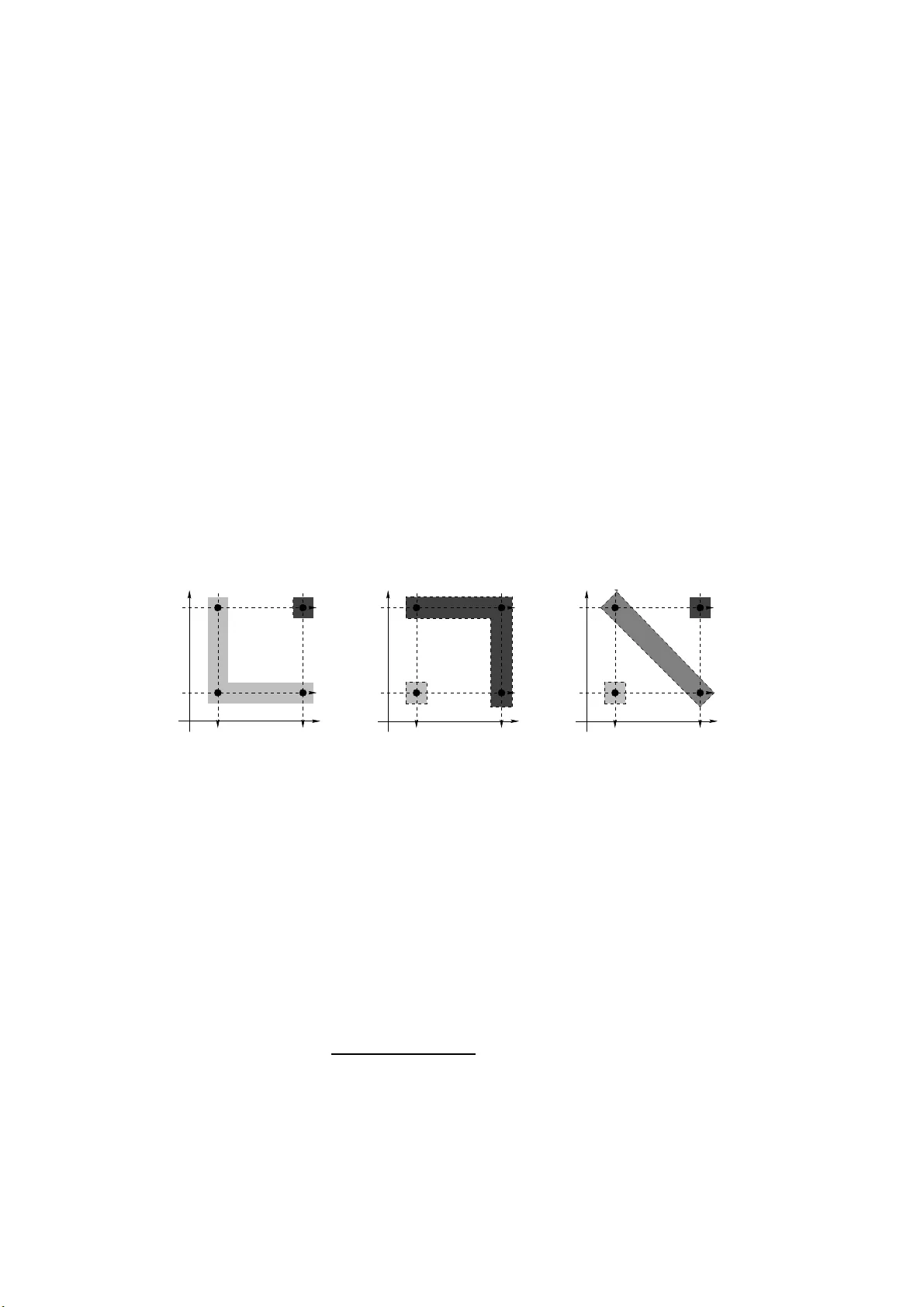
On the Extension of Pseudo-Bo olean F unctions for the Aggregation of In teracting Criteria Mic hel GRABISCH ∗ LIP6 Universit y of Paris VI 4, Pla ce Jussieu, 752 5 2 P aris, F rance email Michel.Grab isch@lip6. fr Christ o phe LA B REUCHE Thomson -C SF, C orp o rate Researc h Lab orat ory Domaine de Corb eville, 91404 Orsay Cedex, F r ance email { labreuche } @lc r.thomson-c sf.com Jean-Cla u de V AN SNICK Universit y of Mons-Hai naut Place du P arc, 20, B-70 00 Mons, Belgi um email Jean-Claude .Vansnick@ umh.ac.be Abstract The pap er presen ts an analysis on the use of integ rals defin ed for non-additiv e m easures (or capacities) as the C ho quet and the ˇ Sip o ˇ s in tegral, and the m ultilinear mo del, all seen as extensions of pseudo- Bo olean functions, and used as a means to mo del inte raction b et w een criteria in a m ulticriteria decision making problem. The emphasis is put on the u se, b esides classical comparativ e in formation, of infor- mation ab out difference of attractiv eness b et w een acts, and on the existence, for eac h p oin t of view, of a “neutral lev el”, allo wing to in - tro duce th e absolute notion of attractiv e or r epulsiv e act. It is shown ∗ Corresp onding author. On leave from Thomson-CSF, Cor po rate Rese arch Lab, 9 1404 Orsay Cedex , F rance 1 that in this case, the ˇ Sip o ˇ s integral is a su itable solution, although not unique. Prop erties of the ˇ Sip o ˇ s integral as a new wa y of aggrega ting criteria are shown, with emph asis on the inte raction among criteria. Keyw or ds: multicriteria dec ision making, Cho quet in tegral, capacity , inter- activ e criteria, negativ e scores 1 In tro duction Let us consider a decision making problem, o f whic h the structuring phase has led to the iden tification o f a family C = { C 1 , . . . , C n } of n fundamen ta l p oints of view ( criteria ), which p ermits to meet the concerns of the decision mak er (DM) in c harge of the ab ov e men tioned (decision making) problem. W e supp ose hereafter that, during the structuring phase, one has asso ciated to eac h p oin t o f view C i , i = 1 , . . . , n , a descriptor ( attribute ), that is, a set X i of reference lev els inten ded to serv e as a basis to describ e plausible impacts of p oten tial actions with resp ect to C i . W e mak e also the a ssumption that, fo r a ll i = 1 , . . . , n , there exists in X i t wo particular elemen ts whic h we call “Neutral i ” and “Go o d i ”, a nd denoted 0 i and 1 i resp ectiv ely , whic h hav e an absolute signification: 0 i is an elemen t whic h is though t by the DM to b e neither g o o d nor bad, neither attra ctiv e nor repulsiv e, relativ ely t o his concerns with resp ect to C i , and 1 i is an elemen t whic h the DM considers as g o o d and completely satisfying if he could obtain it on C i , eve n if more attractiv e elemen ts could exist on this p oin t of view. The practical iden tification of these absolute elemen ts has b een p erformed in man y real applications, see for example [6, 8, 9]. In multicriteria decision aid, af ter the structuring phase comes the ev al- uation phase, in whic h for eac h p oin t of view C i , intr a-criterion information is gathered ( i.e. attractiv eness for the D M o f the elemen ts of X i with resp ect to p oin t of view C i ), and also, according to an ag gregation mo del chose n in agreemen t with the DM, inter-criteria information. This information, whic h a ims at determining the parameters of the chose n aggregation mo del, generally consists in some infor mation on the attractiv eness for the DM of some particular elemen ts of X = X 1 × · · · × X n . These elemen ts are selected so as to enable the resolution of some equation system, whose v ariables are precisely the unkno wn parameters of the aggregation mo del. In this pap er, of whic h a im is primarily theoretical, we adopt with resp ect to the classical appro ac h described ab ov e, a rather con vers e attitude. Sp ecif- ically , w e do not supp ose to hav e b eforehand a giv en a ggregation mo del, but rather to ha v e some information concerning the attractiv eness f o r the D M of a particular collection o f elemen ts of X . Then we study ho w to extend this 2 information o n the preference of the DM to all elemen ts of X . This kind of problem can b e called an identific ation of an aggr e gation mo del which is compatible with av ailable informatio n. The pap er is organized as follows. In section 2, w e in tro duce the basic assumptions w e mak e concerning the kno wledge on the attractiv eness for the D M of particular elemen ts of X . Section 3 sho ws that this k ind of information is compatible with the existence of some in teraction phenomena b et wee n p oints of view, and in tro duces some definitions related to the concept of in t era ction. The problem of extending the informatio n o n preferences assumed to b e know n on a subpart of X , to the whole set X , is addressed in section 4, and app ears to b e the problem of iden tifying an aggregatio n mo del compatible with giv en in tra -criterion and in ter-criteria information. In section 5 , w e sho w that this problem amoun ts to define the extension of a giv en pseudo-Bo olean function, a nd w e introduce some p ossible extensions, whic h w e relate to already kno wn mo dels in the literature (section 6). Section 7 briefly studies the prop erties of t hese mo dels, and concludes ab out their usefulness in this contex t. In section 8, w e show an equiv alen t set of axioms for our construction, and in section 9, w e address the question of unicity of the solution. This pap er do es not deal with the practical asp ects of the metho do lo gy w e are pro p osing, i.e. ho w to o btain the necessary information for building the agg regation mo del. Ho w ev er, the MAC BETH appro ac h [7] could b e most useful for extracting the information fro m the DM. Lastly , we w ant to mention that one of the reasons whic h ha ve motiv ated this researc h is the recen t dev elopmen t of m ulticriteria metho ds based on capacities and the Cho quet in tegral [2], whic h seems to op en new horizons [12, 18, 20]. In a sense, this pap er a ims at giving a theoretical foundation of this ty p e of approac h in the f r amew ork o f multicriteria decision making. 2 Basic assumptio ns W e presen t tw o basic assumptions, whic h are the starting p oint of our con- struction. W e denote the index set of criteria by N = { 1 , . . . , n } . Considering t wo acts x, y ∈ X , and A ⊂ N , w e will o ften use the not ation ( x A , y A c ) to denote the comp ound act z where z i = x i if i ∈ A and y i otherwise. ∧ , ∨ denote resp ectiv ely min and max op erators. 3 2.1 In tra-criterion assumption W e consider t he particular subsets X ⌋ i , i = 1 , . . . , n , of X , whic h are defined b y: X ⌋ i = { ( 0 1 , . . . , 0 i − 1 , x i , 0 i +1 , . . . , 0 n ) | x i ∈ X i } . Using our con ven tion, acts in X ⌋ i are denoted more simply by ( x i , 0 { i } c ). W e assume to ha ve an in terv al scale denoted v i on each X ⌋ i , whic h quan- tifies the attractiv eness for the D M o f the elemen ts of X ⌋ i (assumption A1). In order to simplify the notation, w e denote for a ll i ∈ N , u i : X i − → R , x i 7→ u i ( x i ) = v i ( x i , 0 { i } c ). Th us, a ssumption A1 means exactly the follo w- ing: (A1.1) ∀ x i , y i ∈ X i , u i ( x i ) ≥ u i ( y i ) if and only if for the decision mak er ( x i , 0 { i } c ) is at least as attractiv e as ( y i , 0 { i } c ). (A1.2) ∀ x i , y i , z i , w i ∈ X i , suc h that u i ( x i ) > u i ( y i ) a nd u i ( w i ) > u i ( z i ), w e ha ve u i ( x i ) − u i ( y i ) u i ( w i ) − u i ( z i ) = k , k ∈ R + if and only if the difference of at t r activ eness that the D M feels b et w een ( x i , 0 { i } c ) and ( y i , 0 { i } c ) is equal to k times the difference o f attractive - ness b et we en ( w i , 0 { i } c ) and ( z i , 0 { i } c ). W e recognize here informat io n concerning the intra-criterion preferences (i.e. the a ttractiv eness of elemen ts of X i relativ ely to C i ), hence the name of the assumption, whic h is a classical t yp e of information in multicriteria decision aid. Observ e how ev er that our presen ta tion a v oids the in tro duction of an y independence assumption (preferen tial or cardinal). This is p ossible since w e hav e in tro duced in ev ery set X i an elemen t 0 i with an absolute meaning in terms of attractiv eness. This strong meaning allows us to fix naturally u i ( 0 i ) = 0, 1 i = 1 , . . . , n , and thus to consider u i as a rat io scale on X i . W e can also tak e adv an ta g e of the remaining degree of freedom to fix the v alue of u i ( 1 i ). Contrarily t o the case of u i ( 0 i ), no particular v alue, pro vided it is p ositiv e, is mandatory here. How ev er, since all elemen ts 1 i , i = 1 , . . . , n ha ve all the same absolute meaning, we ha v e to c ho ose for u i ( 1 i ) the same n umerical v alue for all i ∈ { 1 , . . . , n } , whic h implies that the only a dmissible transformations of t he scales u i , i ∈ N , are o f the f orm φ ( u i ) = α · u i , where α > 0 do es no t dep end on i . Thanks to the elemen ts 0 i and 1 i , the inte rv al scales u i b ecome thus c ommensur able r atio sc ales . In the sequel, we ta k e as a con ven tion u i ( 1 i ) = 1, for i = 1 , . . . , n . 1 which is technically a lwa ys possible, since an interv a l sc ale is defined up to a p ositive affine tra nsformation φ ( z ) = αz + β , α > 0, which means that we hav e tw o deg rees of freedom. 4 2.2 In ter-criteria assump tion W e consider no w another subset of X , denoted X ⌉ { 0 , 1 } , containing the fol- lo wing elemen ts: X ⌉ { 0 , 1 } := { ( 1 A , 0 A c ) | A ⊂ N } , where ( 1 A , 0 A c ) denotes an act ( x 1 , . . . , x n ) with x i = 1 i if i ∈ A and x i = 0 i otherwise, following our con v en tion. W e assume to ha v e an interv al scale u { 0 , 1 } on X ⌉ { 0 , 1 } , quan tifying the attractiv eness f or the D M of all elemen ts in this set (assumption A2). This means that: (A2.1) for all A, B ⊂ N , u { 0 , 1 } ( 1 A , 0 A c ) ≥ u { 0 , 1 } ( 1 B , 0 B c ) if and only if for the DM ( 1 A , 0 A c ) is at least as attractiv e as ( 1 B , 0 B c ). (A2.2) for all A, B , C , D ⊂ N such that u { 0 , 1 } ( 1 A , 0 A c ) > u { 0 , 1 } ( 1 B , 0 B c ) a nd u { 0 , 1 } ( 1 C , 0 C c ) > u { 0 , 1 } ( 1 D , 0 D c ), w e hav e u { 0 , 1 } ( 1 A , 0 A c ) − u { 0 , 1 } ( 1 B , 0 B c ) u { 0 , 1 } ( 1 C , 0 C c ) − u { 0 , 1 } ( 1 D , 0 D c ) = k , k ∈ R + if and only if the difference of a t tractiv eness felt by the DM b et wee n ( 1 A , 0 A c ) and ( 1 B , 0 B c ) is k times the difference of attr activ eness b e- t wee n ( 1 C , 0 C c ) a nd ( 1 D , 0 D c ). As w e did for the case of in tra-criterion information, w e use the t w o a v ailable degrees of freedom of an in terv al scale to fix: u { 0 , 1 } ( 1 ∅ , 0 N ) = u { 0 , 1 } ( 0 1 , . . . , 0 n ) :=0 u { 0 , 1 } ( 1 N , 0 ∅ ) = u { 0 , 1 } ( 1 1 , . . . , 1 n ) :=1 . Ha ving in mind the meaning of 0 i , i = 1 , . . . , n , it is natural to imp o se u { 0 , 1 } ( 0 1 , . . . , 0 n ) = 0. The scale u { 0 , 1 } is then a ra t io scale. Let us p oint out that any strictly p ositiv e v alue could hav e b een used instead of 1 for the v alue of u { 0 , 1 } ( 1 1 , . . . , 1 n ). How ev er, it is con v enien t to imp ose that the v alue of u { 0 , 1 } ( 1 1 , . . . , 1 n ) is equal to the common v alue c hosen for the u i ( 1 i ). A t this p o in t, let us remark that b oth u i ( 1 i ) and u { 0 , 1 } ( 1 i , 0 { i } c ) quan tify the attractiv eness of a ct ( 1 i , 0 { i } c ) fo r the DM, how ev er their v alues are on differen t ratio scales, but with the same 0 since u i ( 0 i ) = u { 0 , 1 } ( 0 1 , . . . , 0 n ) = 0. This means t hat there exists K i > 0 suc h that u { 0 , 1 } ( 1 i , 0 { i } c ) = K i u i ( 1 i ). An imp ortan t consequenc e of this fact is that, in or der to hav e compatibilit y b et wee n these scales (and hence b etw een assumptions A1 and A2), w e must ha ve u { 0 , 1 } ( 1 i , 0 { i } c ) > u { 0 , 1 } ( 0 1 , . . . , 0 n ) = 0 , ∀ i, 5 otherwise no constan t K i could exist. This is not restrictiv e on a practical p oin t of view as so on as eac h p oin t of view really corresp onds to a concern of the DM. W e supp ose in addition that whenev er A ⊂ B , the act ( 1 B , 0 B c ) is at least as attractiv e as ( 1 A , 0 A c ), whic h is a lso a natur a l requiremen t. Under these conditio ns, and in tr o ducing the set function µ : P ( N ) − → [0 , 1] b y µ ( A ) := u { 0 , 1 } ( 1 A , 0 A c ) (1) w e hav e defined a non-additiv e measure, or fuzzy me asur e , [3 6 ] or c ap acity [2 ], with the additional requiremen t that µ ( { i } ) > 0 . Indeed, a capacity is any non negativ e set f unction suc h that µ ( ∅ ) = 0, µ ( N ) = 1, and µ ( A ) ≤ µ ( B ) whenev er A ⊂ B . 3 In teracti on among crite ria Except the natura l assumptions ab ov e f o r µ (monotonicit y and µ ( i ) > 0 for all i ∈ N ), no restriction exis ts on µ . Let us t a k e 2 criteria to show the range of decision b eha viours w e can obta in with capa cities. W e supp ose in addition that µ ( { 1 } ) = µ ( { 2 } ), whic h means that the D M is indifferen t b et wee n ( 1 1 , 0 2 ) and ( 0 1 , 1 2 ) (i.e. equal imp ort a nce of criteria, see section 4), and consider 4 acts x, y , z , t suc h that (see figure 1): • x = ( 0 1 , 0 2 ) • y = ( 0 1 , 1 2 ) • z = ( 1 1 , 1 2 ) • t = ( 1 1 , 0 2 ) Clearly , z is more attra ctiv e than x (written z ≻ x ), but preferences ov er other pairs ma y dep end on the decision mak er. Due to the definition of capacities, w e can range from the tw o extremal follow ing situations (recall that µ ( { 1 , 2 } ) = 1 is fixed): extremal situation 1 ( low er b ound): we put µ ( { 1 } ) = µ ( { 2 } ) = 0, whic h is equiv alent to the preferences x ∼ y ∼ t , where ∼ means indifference (figure 1, left). extremal situation 2 ( upp er b ound): w e put µ ( { 1 } ) = µ ( { 2 } ) = 1, whic h is equiv alent to the preferences y ∼ z ∼ t (figure 1, middle). 6 Note that the first b ound cannot b e reac hed due to the condition µ ( i ) > 0. The exact interme diate situation is µ ( { 1 } ) = µ ( { 2 } ) = 1 / 2, meaning that z ≻ y ∼ t ≻ x (figure 1, righ t), and the difference of attractive ness b et w een x and y , t respective ly is the same than b et we en z and y , t resp ectiv ely . The first case corresp onds to a situation where the criteria are c omplemen- tary , sinc e b oth hav e to b e satisfactory in order to get a satisfactory act. Oth- erwise said, the DM make s a conjunctiv e aggregation. W e say that in such a case, which can b e c haracterized b y the fact that µ ( { 1 , 2 } ) > µ ( { 1 } ) + µ ( { 2 } ), there is a p ositive inter action b etw een criteria. The second case corresp onds to a situation where the criteria are substi- tutive , since only one has to b e satisfactory in o rder to get a satisfactory act. Here, the D M aggregates disjunctiv ely . W e say that in such a case, whic h can b e c haracterized b y the fact that µ ( { 1 , 2 } ) < µ ( { 1 } ) + µ ( { 2 } ), there is a ne gative inter action b etw een criteria. In the third case, where w e hav e µ ( { 1 , 2 } ) = µ ( { 1 } ) + µ ( { 2 } ), w e sa y that there is no inter action among criteria, they are non inter active . (b) (c) (a) criterion 1 criterion 2 x y z t 0 1 0 1 1 1 2 2 criterion 1 criterion 2 x y z t 0 1 1 1 2 2 criterion 1 criterion 2 x y z t 0 1 0 1 1 1 2 2 0 1 Figure 1: Differen t cases o f interaction The information w e assume to ha ve at hand concerning the attr a ctiv eness of acts for the D M is th us p erfectly compatible with the in teraction situations b et wee n criteria, situations whic h a re w orth to consider on a practical p oin t of view, but up to no w v ery little studied. In the ab o v e simple example, w e had only 2 criteria. In the general case, w e use the follo wing definition prop osed b y Murofushi a nd Soneda [28]. Definition 1 The in teraction index b etwe en criteria i and j is given by: I ij := X K ⊂ N \{ i,j } ( n − | K | − 2)! | K | ! ( n − 1)! [ µ ( K ∪ { i, j } ) − µ ( K ∪ { i } ) − µ ( K ∪ { j } ) + µ ( K )] . (2) 7 The definition of this index has b een extended to any coalition A ⊂ N of criteria b y Grabisc h [14 ]: I ( A ) := X B ⊂ N \ A ( n − | B | − | A | )! | B | ! ( n − | A | + 1 )! X K ⊂ A ( − 1) | A |−| K | µ ( K ∪ B ) , ∀ A ⊂ N . (3) W e hav e I ij = I ( { i, j } ). When A = { i } , I ( { i } ) is nothing else than the Shapley v alue of game theory [34]. Prop erties of this set function has b een studied and related to the M¨ obius transfor m [5]. Also, I has b een c ha r ac- terized axiomatically by G rabisc h and Roub ens [19], in a w a y similar to the Shapley index. No te that I ij > 0 (resp. < 0 , = 0) for complemen tary (resp. substitutiv e, non in teractive ) criteria. 4 Constr u cting the mo d el W e will only consider in t his pap er t he general type o f a g gregation mo del in tro duced by Kran tz et al. [25, Chap. 7]: Act x = ( x 1 , . . . , x n ) is at least as attractiv e as act y = ( y 1 , . . . , y n ) if and only if F ( u 1 ( x 1 ) , . . . , u n ( x n )) ≥ F ( u 1 ( y 1 ) , . . . , u n ( y n )) , where the aggregation function F : R n − → R is strictly increasing in all its argumen ts. Indeed, this ty p e of mo del is largely used, and has the adv an tage of b eing rather g eneral, and to lead to a complete and tra nsitiv e preference relation on X . The cen tral question w e deal with in this pap er is the identification o f an aggregation function F whic h is compatible with in tra-criterion a nd in ter- criteria information defined b y assumptions A1 and A2, and satisfies nat ura l conditions. Sp ecifically , w e are lo oking for a mapping F : R n − → R of the form F ( u 1 ( x 1 ) , . . . , u n ( x n )) = u ( x 1 , . . . , x n ) satisfying the follo wing requiremen ts (in whic h the presence of α is due t o the fact that the u i are commensurable ratio scales): (i) compatibilit y with in t ra-criteria information (assumption A1) • ∀ i ∈ N and ∀ x i , y i ∈ X i , u i ( x i ) ≥ u i ( y i ) ⇔ u ( x i , 0 { i } c ) ≥ u ( y i , 0 { i } c ) 8 whic h b ecomes, in terms of F (due to the consequences of assump- tion A1 on the scale): u i ( x i ) ≥ u i ( y i ) ⇔ F (0 , . . . , 0 , α u i ( x i ) , 0 , . . . , 0) ≥ F (0 , . . . , 0 , αu i ( y i ) , 0 , . . . , 0) (4) for all α > 0. In fact, t he constan t α here is useless, since fo r an y α > 0, u i ( x i ) ≥ u i ( y i ) ⇔ αu i ( x i ) ≥ αu i ( y i ). • ∀ i ∈ N and ∀ w i , x i , y i , z i suc h that u i ( w i ) > u i ( x i ) and u i ( y i ) > u i ( z i ), u ( w i , 0 { i } c ) − u ( x i , 0 { i } c ) u ( y i , 0 { i } c ) − u ( z i , 0 { i } c ) = u i ( w i ) − u i ( x i ) u i ( y i ) − u i ( z i ) whic h b ecomes in terms of F : F (0 , . . . , 0 , α u i ( w i ) , 0 , . . . , 0) − F (0 , . . . , 0 , αu i ( x i ) , 0 , . . . , 0) F (0 , . . . , 0 , α u i ( y i ) , 0 , . . . , 0) − F (0 , . . . , 0 , αu i ( z i ) , 0 , . . . , 0) = u i ( w i ) − u i ( x i ) u i ( y i ) − u i ( z i ) (5) for all α > 0. (ii) compatibilit y with in t er -cr it eria information (assumption A2 ) • ∀ A, B ⊂ N , w e ha ve u { 0 , 1 } ( 1 A , 0 A c ) ≥ u { 0 , 1 } ( 1 B , 0 B c ) ⇔ u ( 1 A , 0 A c ) ≥ u ( 1 B , 0 B c ) whic h b ecomes , in terms of F : u { 0 , 1 } ( 1 A , 0 A c ) ≥ u { 0 , 1 } ( 1 B , 0 B c ) ⇔ F ( α 1 A , 0 A c ) ≥ F ( α 1 B , 0 B c ) for all α > 0, where for any A ⊂ N , ( 1 A , 0 A c ) is the v ector whose comp onen t x i is 1 whenev er i ∈ A , and 0 otherwise. • ∀ A, B , C , D ⊂ N , with u { 0 , 1 } ( 1 A , 0 A c ) > u { 0 , 1 } ( 1 B , 0 B c ) and u { 0 , 1 } ( 1 C , 0 C c ) > u { 0 , 1 } ( 1 D , 0 D c ), we hav e: u ( 1 A , 0 A c ) − u ( 1 B , 0 B c ) u ( 1 C , 0 C c ) − u ( 1 D , 0 D c ) = u { 0 , 1 } ( 1 A , 0 A c ) − u { 0 , 1 } ( 1 B , 0 B c ) u { 0 , 1 } ( 1 C , 0 C c ) − u { 0 , 1 } ( 1 D , 0 D c ) whic h b ecomes , in terms of F : F ( α 1 A , 0 A c ) − F ( α 1 B , 0 B c ) F ( α 1 C , 0 C c ) − F ( α 1 D , 0 D c ) = u { 0 , 1 } ( 1 A , 0 A c ) − u { 0 , 1 } ( 1 B , 0 B c ) u { 0 , 1 } ( 1 C , 0 C c ) − u { 0 , 1 } ( 1 D , 0 D c ) (6) for all α > 0. 9 (iii) conditions related to absolute information W e imp ose that scales u and u { 0 , 1 } coincide o n particular acts cor r e- sp onding to absolute informatio n, namely: • u ( 0 1 , . . . , 0 n ) = u { 0 , 1 } ( 0 1 , . . . , 0 n ) := 0, whic h leads to F (0 , . . . , 0 ) = 0. • u ( 1 1 , . . . , 1 n ) = u { 0 , 1 } ( 1 1 , . . . , 1 n ) := 1, whic h leads to F (1 , . . . , 1 ) = 1. Ho w eve r, remem b er tha t the c hoice of v alue “1” w as arbitrary when building scales u i and u { 0 , 1 } , and an y p os- itiv e constan t α can do. Hence, w e should satisfy more generally F ( α, . . . , α ) = α , ∀ α > 0. (iv) monotonicit y of F . This prop ert y is a fundamen ta l requiremen t for an y aggregation function: ∀ ( t 1 , . . . , t n ) , ∀ ( t ′ 1 , . . . , t ′ n ) ∈ R n , t ′ i ≥ t i , i = 1 , . . . , n ⇒ F ( t ′ 1 , . . . , t ′ n ) ≥ F ( t 1 , . . . , t n ) . The monotonicity is strict if all inequalities are strict. Remark that monotonicit y en tails the first condition of ( i) , namely form ula (4). Let us remark that, as suggested in (iv) ab ov e, that F can b e view ed as an agg regation function, and th us our problem a moun ts to the search of a n aggregation mo del whic h is compatible with in t r a- and in ter-criteria info r- mation defined b y assumptions A1 and A2. A t this p o in t, let us make t w o remarks. • the reader ma y wonde r ab out the v ery sp ecific form of inter-criteria in- formation a ske d for, that is, attractiv eness o f acts of the form ( 1 A , 0 A c ). These acts presen t the double adv an tage to b e non related with r eal acts, which p ermits to a void an y emotiona l answe r from the DM, and to ha v e, taking in to accoun t the definition of 0 i and 1 i , a ve ry clear meaning, and consequen tly , to b e v ery w ell p erceiv ed and understo o d. They are curren tly used in real w orld applications o f the MA CBETH approac h [6, 8, 9 ] . Un til no w, these applications were done in the framew ork of an additiv e aggregation mo del. In suc h a case, only acts of the form ( 1 i , 0 { i } c ) ha v e to b e intro duced. What w e are doing here is merely a generalization, considering not only single criteria, but any c o alition of criteria. This natura l general- ization from singletons to subsets is indeed the k ey to the mo delling of in teraction, as explained in section 3. In this sense, the global utility 10 u ( 1 A , 0 A c ), whic h is a capacit y (see section 2 .2), could represen t the imp ortance of coalition A to mak e decision. It must b e noted, ho w ev er, that w e assum e that all acts ( 1 A , 0 A c ) a re at least conceiv able, i.e. the conjunction of at t r ibutes in A b eing “go o d” and t he other ones b eing “neutral”, do not lead t o a logical imp ossibilit y or con t radiction. This could happ en when some attributes are strongly correlated, a situation whic h should b e av oided in m ulticriteria decision making. • it can b e observ ed that conditions (ii) and (iii) ab ov e en tail tha t the function F : R n − → R to b e determined m ust coincide with µ on { 0 , 1 } n , i.e.: F (1 A , 0 A c ) = µ ( A ) , ∀ A ⊂ N . Indeed, just consider equation (6 ) with B = D = ∅ , C = N , and use (iii) , and definition of µ (eq. (1)). Th us, F m ust b e an extension o f µ on R n . In other w or ds, the assign- ment of i mp ortanc e to c o alitions is tightly linke d with the evaluation function . T his fact is w ell kno wn in the MCDM comm unit y (see e.g. Mousseau [27 ]) , but the argumen t ab ov e puts it more precisely . The next section addresses in full detail the problem of extending capacities. 5 Extensio n of pseudo- B o o l ean fun ctions The problem of extending a capacit y can b e nicely forma lized through the use of pseudo-Bo olean functions (see e.g. [21]). An y function f : { 0 , 1 } n − → R is a said to b e a pseudo-B o ole an function . By making the usual bijection b et we en { 0 , 1 } n and P ( N ), it is clear that pseudo-Bo olean functions on { 0 , 1 } n coincide with real-v alued set functions on N (of whic h capacities are a particular case). More sp ecifically , if w e define fo r any subset A ⊂ N t he v ector δ A = [ δ A (1) · · · δ A ( n )] in { 0 , 1 } n b y δ A ( i ) = 1 if i ∈ A , and 0 otherwise, then for any set function v we can define its asso ciated pseudo-Bo olean function f by f ( δ A ) := v ( A ) , ∀ A ⊂ N , and recipro cally . It ha s b een sho wn b y Hammer and Rudean u [22] that any pseudo-Bo olean function can b e written in a multilinear for m: f ( t ) = X A ⊂ N m ( A ) · Y i ∈ A t i , ∀ t ∈ { 0 , 1 } n . (7) 11 m ( A ) corresp onds to the M¨ obius transform (see e.g. Rota [31]) of v , a sso ci- ated to f , whic h is defined by: m ( A ) = X B ⊂ A ( − 1) | A \ B | v ( B ) . (8) Recipro cally , v can b e recov ered from the M¨ obius transform b y v ( A ) = X B ⊂ A m ( B ) . (9) If necessary , w e write m v for the M¨ obius transform of v . Note that (7 ) can b e put in an equiv a len t form, whic h is f ( t ) = X A ⊂ N m ( A ) · ^ i ∈ A t i , ∀ t ∈ { 0 , 1 } n . (10) More generally , the pro duct can b e replaced by an y op erator on [0 , 1] n coinciding with the pro duct on { 0 , 1 } n , such a s t-norms [32] (see e.g. [10] for a surv ey on this topic, and [24] for a complete treatment). W e recall that a t-norm is a binary op erato r T on [0 , 1] whic h is commu tativ e, as- so ciativ e, non decreasing in eac h place, and suc h that T ( x, 1) = x , fo r all x ∈ [0 , 1]. Asso ciativity p ermits to unam biguously define t-norms for more than 2 argumen ts. These are not the only w ays to write pseudo-Bo o lean functions. When v is a capacit y , it is p ossible to replace the sum b y ∨ , as the following form ula sho ws [15]: f ( t ) = _ A ⊂ N m ∨ ( A ) ∧ ^ i ∈ A t i ! . (11) The quantit y m ∨ is called the or dinal M¨ obius tr ansform , and is related to v b y m ∨ ( A ) = v ( A ) whenev er v ( A ) > v ( A \ i ) for all i ∈ A , and 0 otherwise. Note that con ve rsely we hav e (compare with (9)): v ( A ) = _ B ⊂ A m ∨ ( B ) , ∀ A ⊂ N . (12) In t he sequel, we fo cus on formulas (7) and (10). W e will come back on alternativ es to these form ulas in section 8 . In order to extend f to R n , whic h is necessary in our framew or k since the DM can judge that an elemen t ( x i , 0 { i } c ) is less attra ctive than ( 0 1 , . . . , 0 n ) (in that case u i ( x i ) < 0), tw o immediate extensions come from (7 ) and (10), where w e simply use any t ∈ R n instead of { 0 , 1 } n . W e will denote them f Π ( t ) := X A ⊂ N m ( A ) · Y i ∈ A t i , ∀ t ∈ R n , (13) 12 f ∧ ( t ) := X A ⊂ N m ( A ) · ^ i ∈ A t i , ∀ t ∈ R n . (14) Ho wev er a second wa y can b e o btained by considering the fa ct that an y real n umber t can b e written under t he form t = t + − t − , where t + = t ∨ 0, and t − = − t ∨ 0. If, b y analogy with this remark, w e replace Q i t i b y Q i t + i − Q i t − i , and similarly with V , w e obtain tw o new extensions: f Π ± ( t ) := X A ⊂ N m ( A ) " Y i ∈ A t + i − Y i ∈ A t − i # , ∀ t ∈ R n , (15) f ∧± ( t ) := X A ⊂ N m ( A ) " ^ i ∈ A t + i − ^ i ∈ A t − i # , ∀ t ∈ R n . (16) These a re not the only p o ssible extens ions. In fact, nothing prev en ts us to in tro duce for the negativ e part another capacit y , e.g. equation (16) could b ecome: f ∧± 12 ( t ) := X A ⊂ N m 1 ( A ) · ^ i ∈ A t + i − X A ⊂ N m 2 ( A ) · ^ i ∈ A t − i , ∀ t ∈ R n . (17) Ho wev er, w e will no t consider this p ossibilit y in the subs equen t dev elopmen t, except in section 9 where t he question of unicity is a ddressed. In the next sections we in ves tigate whether extensions (13) to (16) are related to kno wn mo dels o f aggregation, and whic h one satisfy the r equiremen ts (i) to (iv) in tro duced in section 4, and can b e th us used as an aggregation function in our case. 6 Link with existin g mo de l s W e intro duce the Cho quet in tegral with resp ect to a capacity , whic h has b een introduced as a n a g gregation op erator b y Grabisc h [11, 12]. Let µ b e a capacit y on N , a nd t = ( t 1 , . . . , t n ) ∈ ( R + ) n . The Cho quet inte gr al of t with resp ect to µ is defined b y [2 9]: C µ ( t ) = n X i =1 ( t ( i ) − t ( i − 1) ) µ ( { ( i ) , . . . , ( n ) } ) (18) where · ( i ) indicates a p erm utation on N so that t (1) ≤ t (2) ≤ · · · ≤ t ( n ) , and t (0) := 0 b y conv en tion. It can b e show n that the Choquet inte gral can b e written as follows : C µ ( t ) = X A ⊂ N m ( A ) ^ i ∈ A t i , ∀ t ∈ ( R + ) n (19) 13 where m denotes t he M¨ obius tr a nsform of µ . This result has b een show n b y Chateauneuf and Jaffra y [1] (also by W alley [40]), extending Dempster’s result [3]. W e are now ready to relate previous extensions to kno wn aggregation mo dels. • the extension f Π is kno wn in multiattribute utility theory as the m ul- tiline ar mo del [23], whic h w e denote b y MLE. Note that our pre- sen tation giv es a meaning to the co efficie n ts of the p olynom, since they are t he M¨ obius transform of the underlying capacit y defined b y µ ( A ) = u ( 1 A , 0 A c ), for all A ⊂ N . Up to no w, no clear in terpretatio n of these co efficien ts w ere g iven. • concerning f Π ± , to our know ledge, it do es not corresp ond to anything kno wn in the literature. W e will denote it b y SMLE (symmetric MLE). • considering f ∧ restricted to ( R + ) n , it app ears due to the ab ov e result (19) that f ∧ is the Cho quet in tegral of t with respect to µ , where µ corresp onds to f . This extension is also kno wn as the Lo v´ asz extension of f [2 6, 35]. At this po in t, let us remark that the exte nsion of the Cho- quet integral to negative argumen t s has b een considered by Denneb erg [4], who giv es t wo p ossibilities: 1. the symmetric extension S C µ defined b y S C µ ( t ) = C µ ( t + ) − C µ ( t − ) , ∀ t ∈ R n . (20) 2. the asymmetric extension AS C µ defined b y AS C µ ( t ) = C µ ( t + ) − C ¯ µ ( t − ) , ∀ t ∈ R n , (21) where ¯ µ is the conj ug ate capacity defined by ¯ µ ( A ) := µ ( N ) − µ ( A c ). The first extension has b een pro p osed first by ˇ Sip o ˇ s [39], while the sec- ond one is considered as the classical definition of the Cho quet in tegral on r eal nu m b ers. In the sequel, w e will denote the ˇ Sip o ˇ s inte gral b y ˇ S µ , while w e ke ep C µ for the (usual) Cho quet in tegral. The following prop osition giv es the expression of Choquet and ˇ Sip o ˇ s in tegrals in terms of the M¨ obius transform, a nd sho ws that f ∧ ≡ C µ and f ∧± ≡ ˇ S µ . 14 Prop osition 1 L et µ b e a c ap acity. F or any t ∈ R n , C µ ( t ) = X A ⊂ N m ( A ) ^ i ∈ A t i , (22) ˇ S µ ( t ) = X A ⊂ N m ( A ) " ^ i ∈ A t + i − ^ i ∈ A t − i # = X A ⊂ N + m ( A ) ^ i ∈ A t i + X A ⊂ N − m ( A ) _ i ∈ A t i , (23) wher e N + := { i ∈ N | t i ≥ 0 } and N − = N \ N + . The pro of is based o n the following lemma, sho wn in [16]. Lemma 1 L et v b e an y set function such that v ( ∅ ) = 0 , and c onsider its co-M¨ obius tr ansform 2 [13], d e fine d by: ˇ m v ( A ) := X B ⊃ N \ A ( − 1) n −| B | v ( B ) = X B ⊂ A ( − 1) | B | v ( N \ B ) , ∀ A ⊂ N . Then, if ¯ v denotes the c onjugate set function: ˇ m ¯ v ( A ) = ( − 1) | A | +1 m v ( A ) , ∀ A ⊂ N , A 6 = ∅ (24) and for an y a ∈ ( R + ) n , C v ( a ) = X A ⊂ N ,A 6 = ∅ ( − 1) | A | +1 ˇ m v ( A ) _ i ∈ A a i . (25) Pro of of Prop. 1: The case o f ˇ Sip o ˇ s in tegral is clear from (14) and (20). F or t he case o f Cho quet, the pro of is based on the ab ov e lemma. Using (14), w e hav e: C µ ( t + ) = X A ⊂ N m ( A ) ^ i ∈ A t + i = X A ⊂ N ,A ∩ N − = ∅ m ( A ) ^ i ∈ A t i Also, using (24) and (25) and remarking that m ( ∅ ) = 0, w e get: C ¯ µ ( t − ) = X A ⊂ N ,A 6 = ∅ ( − 1) | A | +1 ˇ m ¯ µ ( A ) _ i ∈ A t − i = X A ⊂ N m ( A ) _ i ∈ A t − i . 2 Called “commonality function” by Shafer [33]. 15 No w _ i ∈ A t − i = − V i ∈ A t i , if A ∩ N − 6 = ∅ 0 , otherwise Th us C ¯ µ ( t − ) = − X A ⊂ N ,A ∩ N − 6 = ∅ m ( A ) ^ i ∈ A t i so that C µ ( t ) = C µ ( t + ) − C ¯ µ ( t − ) = X A ⊂ N m ( A ) ^ i ∈ A t i . The next prop osition g iv es the expression of Cho quet a nd ˇ Sip o ˇ s in t egral directly in terms of the capacit y . Prop osition 2 L et µ b e a c ap acity. F or any t ∈ R n , C µ ( t ) = t (1) + n X i =2 t ( i ) − t ( i − 1) µ ( { ( i ) , . . . , ( n ) } ) (26) ˇ S µ ( t ) = p − 1 X i =1 t ( i ) − t ( i +1) µ ( { (1) , . . . , ( i ) } ) + t ( p ) µ ( { (1) , . . . , ( p ) } ) + t ( p +1) µ ( { ( p + 1 ) , . . . , ( n ) } ) + n X i = p +2 t ( i ) − t ( i − 1) µ ( { ( i ) , . . . , ( n ) } ) (27) wher e · ( i ) indic ates a p ermutation on N so that t (1) ≤ t (2) ≤ · · · ≤ t ( p ) < 0 ≤ t ( p +1) ≤ · · · ≤ t ( n ) . Pro of: from the definition (1 8), we hav e: C µ ( t ) = t (1) + n X i =2 t ( i ) − t ( i − 1) µ ( { ( i ) , . . . , ( n ) } ) . Let t ∈ R n . W e split t in to its p ositive and negat iv e par t s t + , t − . Since ( t + ) (1) = ( t + ) (2) = · · · = ( t + ) ( p ) = 0 ( t + ) ( p +1) = t ( p +1) . . . ( t + ) ( n ) = t ( n ) w e hav e C µ ( t + ) = t ( p +1) µ ( { ( p + 1 ) , . . . , ( n ) } ) + n X i = p +2 t ( i ) − t ( i − 1) µ ( { ( i ) , . . . , ( n ) } ) . 16 In the same w ay , one has C µ ( t − ) = − t ( p ) µ ( { ( p ) , . . . , (1) } ) − p − 1 X i =1 t ( i ) − t ( i +1) µ ( { ( i ) , . . . , (1) } ) . This giv es t he desired expression for ˇ Sip o ˇ s integral. The case of Cho quet in tegral pro ceeds similarly . Remarking that C µ (0) = ˇ S µ (0) for a ny capacit y , w e ha ve from prop osi- tion 2: C µ ( − t ) = −C ¯ µ ( t ) (28) ˇ S µ ( − t ) = − ˇ S µ ( t ) (29) for an y t in R n , hence the terms asymmetric and symmetric. In summary , three among the four extensions corresp ond to kno wn mo dels of aggregation, ev en if con texts may differ. 7 Prop erties of the exten sions This section is dev oted to the study o f the four extensions, regarding the prop erties requested in the construction of the aggr ega tion mo del (section 4). compatibilit y with in tr a-crit er ion information (assumption A1) Re- calling that u i ( 0 i ) = 0 ∀ i ∈ N , a nd noting that m ( { i } ) = µ ( { i } ), a straight- forw ar d computation sho ws tha t for an y α > 0: C µ (0 , . . . , 0 , αu i ( x i ) , 0 , . . . , 0) = αµ ( { i } ) u i ( x i ) if x i i 0 i α ¯ µ ( { i } ) u i ( x i ) if x i ≺ i 0 i (30) ˇ S µ (0 , . . . , 0 , αu i ( x i ) , 0 , . . . , 0) = αµ ( { i } ) u i ( x i ) (31) MLE µ (0 , . . . , 0 , αu i ( x i ) , 0 , . . . , 0) = αµ ( { i } ) u i ( x i ) (32) SMLE µ (0 , . . . , 0 , αu i ( x i ) , 0 , . . . , 0) = αµ ( { i } ) u i ( x i ) . (33) In the general case, we ha v e µ ( { x i } ) 6 = ¯ µ ( { x i } ). Th us there is an angular p oin t around the orig in for the Cho quet in tegr a l. The consequence is that equation (5), a nd hence assumption A1, are no t satisfied b y the Cho quet in tegral in general. This curious prop ert y can b e explained as follows. F or the ˇ Sip o ˇ s in- tegral, the zero has a special role, since it is the zero of the ratio scale, 17 and a ll is symmetric with resp ect to this p oint. F or the Cho quet in te- gral, the zero has no sp ecial meaning, but observ e that if x i 0 i y i , the acts ( 0 1 , . . . 0 i − 1 , x i , 0 i +1 , . . . , 0 n ) a nd ( 0 1 , . . . 0 i − 1 , y i , 0 i +1 , . . . , 0 n ) a re not comonotonic, i.e. they induce a differen t ordering of the in tegrand. compatibilit y with in ter-cr it eria information ( assumption A 2) It results from the definitions of C µ , ˇ S µ , MLE µ and SMLE µ that, ∀ A ⊂ N and ∀ α > 0, MLE µ ( α 1 A , 0 A c ) = SMLE µ ( α 1 A , 0 A c ) = X B ⊂ A m ( B ) α | B | , (34) and C µ ( α 1 A , 0 A c ) = ˇ S µ ( α 1 A , 0 A c ) = αµ ( A ) . Consequen tly , MLE and SMLE are inadequate for our mo del. use of absolute information O bviously an y extension satisfies F (0 , . . . , 0) = 0, and taking in t o accoun t the fact that µ ( N ) = 1, w e ha ve C µ ( α, . . . , α ) = ˇ S µ ( α, . . . , α ) = α , for all α > 0. But fro m (34), this prop ert y is not satisfied b y MLE and SMLE. Monotonicit y It can b e sho wn that , for an y t, t ′ ∈ R n , t i ≤ t ′ i , i = 1 , . . . , n ⇒ C µ ( t 1 , . . . , t n ) ≤ C µ ( t ′ 1 , . . . , t ′ n ) (35) t i ≤ t ′ i , i = 1 , . . . , n ⇒ ˇ S µ ( t 1 , . . . , t n ) ≤ ˇ S µ ( t ′ 1 , . . . , t ′ n ) . (36) This we ll-kno wn result (see e.g. Denneb erg [4]) comes from the fact that for an y t ∈ ( R + ) n , an equiv alen t fo rm of (18) is: C µ ( t ) = n X i =1 t ( i ) [ µ ( { ( i ) , . . . , ( n ) } ) − µ ( { ( i + 1) , . . . , ( n ) } )] . Monotonicit y is immediate from the fact that A ⊂ B implies µ ( A ) ≤ µ ( B ). No w, f o r any t ∈ R n , monotonicit y o f the Cho quet and ˇ Sip o ˇ s integrals follow from equations (2 0 ) and (21). T o obtain strict monoto nicity , we need strict monotonicit y of the capacit y , i.e. A $ B implies µ ( A ) < µ ( B ). It is easy to see from definition that MLE and SMLE are monotonic when the co efficien ts m ( A ) are a ll p ositiv e. But in general, the M¨ obius transform of a capacit y is not alw ays p ositive . T o our kno wledge, there is no result in the general case. The follo wing can b e pro v en. 18 Prop osition 3 F o r an y t ∈ [0 , 1] n , for any c ap acity µ , MLE µ is non de- cr e asing w i th r esp e ct to t i , i = 1 , . . . , n . Strict incr e asingness is ens ur e d iff µ is strictly monotonic. Pro of: W e can express easily MLE with resp ect to µ (see Ow en [30]): MLE µ ( t ) = X A ⊂ N " Y i ∈ A t i # " Y i 6∈ A (1 − t i ) # µ ( A ) . Then w e ha ve , for any t ∈ [0 , 1] n and an y k ∈ N : ∂ MLE( t ) ∂ t k = X A ⊂ N \ k " Y i ∈ A t i # " Y i 6∈ A,i 6 = k (1 − t i ) # µ ( A ∪ k ) − X A ⊂ N \ k " Y i ∈ A t i # " Y i 6∈ A,i 6 = k (1 − t i ) # µ ( A ) = X A ⊂ N \ k " Y i ∈ A t i # " Y i 6∈ A,i 6 = k (1 − t i ) # ( µ ( A ∪ k ) − µ ( A )) . Clearly , the expression is non negativ e (resp. p ositiv e) for an y k ∈ N iff µ is monotonic (resp. strictly monotonic). The pro of sho ws clearly that MLE could b e non increasing when t is no more in [0 , 1] n . T aking f or example n = 2, with µ ( { 1 } ) = µ ( { 2 } ) = 0 . 9, w e ha ve: MLE µ (1 , 1) = 0 . 9 + 0 . 9 − 0 . 8 = 1 MLE µ (3 , 3) = (3)(0 . 9) + (3)(0 . 9) − (9)(0 . 8) = − 1 . 8 < MLE µ (1 , 1) . As a conseq uence, the use of MLE should b e restricted to criteria of whic h scores ar e limited to [0 , 1 ], that is, unip olar b ounde d criteria. Also, SMLE whic h differs from MLE only for negativ e v alues, is clearly useless. Scale preserv ation Although this prop ert y is not required by our con- struction (but it someho w underlies it in assumptions A1 a nd A2), it is in teresting to in ves tigate whether the extensions satisfy it. The fo llo wing is easy to prov e. (C.1) in v ariance to the same p ositiv e affine transformatio n C µ ( αt 1 + β , . . . , α t n + β ) = α C µ ( t 1 , . . . , t n ) + β , ∀ α ≥ 0 , ∀ β ∈ R . 19 (S.1) homogeneity ˇ S µ ( αt 1 , . . . , α t n ) = α ˇ S µ ( t 1 , . . . , t n ) , ∀ α ∈ R . As remarke d b y Sugeno and Murofushi [37], this means that if the scores t i are on commensurable in terv al scales, then the global score computed b y the Cho quet in tegral is also on an in terv al scale (i.e. relativ e p osition o f the zero), and if the scores are on a rat io scale, then t he global score computed b y the ˇ Sip o ˇ s integral is o n a ra t io scale (absolute p osition o f the zero). By con trast, MLE and SMLE neither preserv e the in terv al nor the r a tio scale, since they are not homogeneous. Indeed, taking n = 2 and an y α ∈ R ∗ : MLE µ ( αt 1 , αt 2 ) = m ( { 1 } ) αt 1 + m ( { 2 } ) α t 2 + m ( { 1 , 2 } ) α 2 t 1 t 2 6 = α MLE µ ( t 1 , t 2 ) . This is t he reason wh y MLE and SMLE failed to f ulfill assumption A2 . Note ho wev er that MLE satisfies (5) but not ( 6). As a conclusion, only the ˇ Sip o ˇ s integal among our four candidat es can fit all requiremen ts of our construction. 8 An equiv alen t axiomatic Our construction is based on a certain num b er of requiremen ts for agg r ega- tion function F , whic h w e sum up b elo w: • restricted monoto nicity ( M1) , coming from a ssumption A1: ∀ i = 1 , . . . , n, ∀ a i , a ′ i ∈ R , a i ≥ a ′ i ⇒ F ( a i , 0 { i } c ) ≥ F ( a ′ i , 0 { i } c ) • inte rv al scale for in tra - criterion information (A1): F ( αa i , 0 { i } c ) − F ( αb i , 0 { i } c ) F ( αc i , 0 { i } c ) − F ( α d i , 0 { i } c ) = a i − b i c i − d i , ∀ α > 0 , ∀ a i , b i , c i , d i ∈ R , c i 6 = d i • inte rv al scale for in ter-criteria information (A2): F ( α 1 A , 0 A c ) − F ( α 1 B , 0 B c ) F ( α 1 C , 0 C c ) − F ( α 1 D , 0 D c ) = µ ( A ) − µ ( B ) µ ( C ) − µ ( D ) , ∀ α > 0 • idemp otence (I): F ( α, . . . , α ) = α , ∀ α ≥ 0 , with restricted v ersions (I0) for α = 0 and (I1) for α = 1. 20 • monotonicity (M), which is non decreasingness o f F for eac h place. As already noted, (M) implies (M1). All t hese requiremen ts come from con- siderations link ed with the preference of the D M a nd scales of measuremen t. It is p ossible to sho w that they are equiv alen t to a m uc h simpler set of a xioms ab out F . Prop osition 4 L et F : R n ⇒ R and µ a c ap acity on N . Then the set of axioms (A1), (A2), (I), ( M) is e quivalent to the fol lowing set of ax i o ms: 1. homo gen e ous extension ( HE): F ( α 1 A , 0 A c ) = αµ ( A ) , ∀ α ≥ 0 , ∀ A ⊂ N 2. r estricte d affinity (A) F ( a i , 0 { i } c ) = a i F (1 i , 0 { i } c ) , ∀ a i ∈ R , ∀ i = 1 , . . . , n 3. mono ton i c i ty (M). Pro of: ( ⇒ ) Letting B = D = ∅ , C = N in (A2) and using (I) lead to F ( α 1 A , 0) = αµ ( A ), whic h is (HE). Now , using (A1) with b i = d i = 0, c i = 1, α = 1 and using (I0) w e g et F ( a i , 0 { i } c ) = a i F (1 i , 0 { i } c ), which is (A). ( ⇐ ) Using (A), w e get: F ( αa i , 0 { i } c ) − F ( α b i , 0 { i } c ) F ( αc i , 0 { i } c ) − F ( αd i , 0 { i } c ) = αa i F (1 i , 0 { i } c ) − α b i F (1 i , 0 { i } c ) αc i F (1 i , 0 { i } c ) − α d i F (1 i , 0 { i } c ) = a i − b i c i − d i , whic h prov es (A1) . Now, from (HE) w e get immediately F ( α 1 A , 0 A c ) − F ( α 1 B , 0 B c ) F ( α 1 C , 0 C c ) − F ( α 1 D , 0 D c ) = µ ( A ) − µ ( B ) µ ( C ) − µ ( D ) whic h is (A2). Finally , fro m (HE) with A = N , w e get (I) since µ ( N ) = 1. Nota: (M) can b e dropp ed from the 2 sets of axioms without changing the equiv alence. 21 9 The unicit y issue Ha ving this simpler set o f axioms, w e a ddress the question of the unicit y of the solution, i.e. is the ˇ Sip o ˇ s in tegral the only aggregation function satisfying the requiremen ts? First w e examine the follow ing extension on [0 , 1] n of pseudo-Bo olean functions: F ( a 1 , . . . , a n ) = X A ⊂ N m ( A ) · ( i ∈ A a i ) , ∀ a i ∈ [0 , 1] (37) as suggested in section 5, where is a “pseudo-pro duct”. Recall that m is the M¨ obius transform of the underlying capacit y . Let us supp ose as a basic requiremen t that is a comm utativ e and asso ciativ e op erator, ot herwise our expression o f F w ould b e ill-defined since i ∈ A a i w ould dep end on the order of elemen ts in A (comm utativity), and on the grouping of elemen ts (asso ciativit y). Th us, it is sufficien t to define on [0 , 1] 2 . The following can b e sho wn. Prop osition 5 L et : [0 , 1] 2 − → [0 , 1] b e a c ommutative and asso ciative op er ator, a n d F b e g i v en by (37). T hen: (i) F satisfies (HE) on [0 , 1] n if and only if c oin cide with the pr o duct on { 0 , 1 } , satisfies α α = α for al l α ∈ [0 , 1] , and α 0 = 0 . (ii) F satisfies (M) implies i s no n de cr e asing. Pro of: (i) ( ⇒ ) Let us consider t he particular capacit y u 1 , 2 defined by u 1 , 2 ( A ) = 1 if { 1 , 2 } ⊂ A , and 0 otherwise (unanimit y game). It is easy to see that its M¨ obius transform is suc h that m ( { 1 , 2 } ) = 1 and 0 elsewhere. Let us consider (HE) with A = ∅ , α = 1, and the capacit y u 1 , 2 . W e o bta in F (0 , . . . , 0 ) = 1 · (0 0) = u 1 , 2 ( ∅ ) = 0 , hence 0 0 = 0 . T aking now A = N , w e get: F (1 , . . . , 1 ) = 1 · (1 1) = u 1 , 2 ( N ) = 1 , hence 1 1 = 1. Now let us take A = { 1 } , with an y α > 0 and w e obtain from (HE): F ( α, 0 , . . . , 0) = 1 · ( α 0 ) = α u 1 , 2 ( { 1 } ) = 0 , hence α 0 = 0 f o r an y = α > 0, in particular when α = 1. Thus , coincides with the pro duct on { 0 , 1 } . Lastly , let us apply (HE) with A = N and again the capacit y u 1 , 2 . W e o bta in: F ( α, α, . . . , α ) = 1 · ( α α ) = α 22 hence α α = α . ( ⇐ ) F or any capacity µ , any A ⊂ N , a n y α ∈ [0 , 1]: F ( α 1 A , 0 A c ) = X B ⊂ A m ( B ) · ( i ∈ B α ) + X B 6⊂ A m ( B ) · [( i ∈ A α ) ( i 6∈ A 0)] = α X B ⊂ A m ( B ) + 0 = αµ ( A ) . (ii) If is decreasing in some place, and m is p ositiv e, then F cannot b e increasing, a contradiction. Thus , is non decreasing in eac h place. T o go further in the analysis, let us assume in the sequel that is non decreasing. Then w e obtain the follo wing result. Corollary 1 L et : [0 , 1] 2 − → [0 , 1 ] b e a c ommutative, asso ciative, and non de cr e asing op er ator, and F b e given by (37). The fol lowing pr op ositions ar e e quivalent: (i) F satisfies (HE), (M) and (A) on [0 , 1 ] n . (ii) c oincide with the pr o duct on { 0 , 1 } , and satisfies α α = α for al l α ∈ [0 , 1] . Pro of: clear from Prop. 5, the fact that ( A) is implied b y (HE) when w orking on p ositiv e n umbers, and the fact that α 0 = 0 is implied by 0 0 = 0 = 1 0 and non decreasingness. This result g iv es necess ary and sufficien t conditions fo r in order to b e consisten t with our construction. Adding the requiremen t 1 α = α for all α ∈ [0 , 1], op erator b ecomes a t- norm, as defined in Section 5. Then, the only solution to this set of requiremen ts is the minim um op erator [24 ]. Indeed, taking α, β ∈ [0 , 1 ] suc h that α ≤ β , w e hav e α = α α ≤ β α ≤ 1 α = α . This means tha t the ˇ Sip o ˇ s integral (for n um b ers in [0 , 1 ], hence it is the Cho quet in tegr a l) is the only solution with this form of pseudo-Bo olean function. How ev er, without this additional assumption, other solutions ma y exist. In terestingly enough, the requiremen t 1 α = α has a clear in terpretation 23 in terms of F . Indeed, fo r any A ⊂ N , a nd an y α ∈ [0 , 1], F (1 A , α A c ) = X B ⊂ A m ( B ) . 1 + X B 6⊂ A m ( B ) .α = X B ⊂ A m ( B ) + α (1 − X B ⊂ A m ( B )) = α + (1 − α ) µ ( A ) = α + F (( 1 − α )1 A , 0 A c ) . This last expression show s an additivit y prop ert y of F with particular acts, sp ecifically: F (1 A , α A c ) = F ((1 − α )1 A , 0 A c ) + F ( α , . . . , α ) . It also sho ws that F induces a difference scale fo r those acts, since the zero can b e shifted and set to α without any c hang e. W e no w presen t a solution in the spirit of equation (11) , whic h is in fact the Sugeno in tegral [36 ] (see [1 5 ]). Let us first restrict to p ositiv e n um b ers. W e in tro duce the fo llo wing ag gregation function on R + : S m ∨ ( a 1 , . . . , a n ) = _ B ⊂ N h m ∨ ( B ) · ^ i ∈ B a i i . (38) This is a v arian t of Sugeno inte gral where the pro duct tak es place of the minim um op erator, whic h satisfies all requiremen ts when restricted to R + : • monotonicity (M): clear since m ∨ is a non nega tiv e set function. • (HE): using equation (12) w e get: S m ∨ ( α 1 A , 0 A c ) = _ B ⊂ A m ∨ ( B ) · α = α · µ ( A ) = αS m ∨ (1 A , 0 A c ) . • (A) fo r p ositive num b ers is simply a particular case of (HE). Note that (HE) works thanks to the pro duct op erator in S m ∨ . T h us the original Sugeno integral would not w ork. W e hav e t o extend this definition for negative n um b ers in a w ay similar to the ˇ Sip o ˇ s in tegral. The problem of extending the Sugeno in tegral on negativ e n umbers has b een studied b y Gr a bisc h [17], in an ordinal framew ork. W e adapt this approach to our case and prop ose the following: S m ∨ ( a 1 , . . . , a n ) = S m ∨ ( a + 1 , . . . , a + n ) 6 ( − S m ∨ ( a − 1 , . . . , a − n )) (39) 24 with usual notations, and 6 (called symmetric maximum ) is defined by: a 6 b = a, if | a | > | b | 0 , if b = − a b, otherwise . The main prop erties o f the symmetric maxim um are a 6 0 = a fo r all a ∈ R (existence of a unique neutral elemen t), and a 6 ( − a ) = 0 for all a ∈ R (existence of a unique symmetric elemen t). Also, it is non decreasing in each place, and asso ciativ e on R + and R − . It suffices to verify t ha t (M) and (A) still hold. (M) comes from non decreasingness of 6 and S m ∨ for p ositive argumen ts. Let us consider a i < 0. Then S m ∨ ( a i , 0 { i } c ) = 0 6 ( − a − i S m ∨ (1 i , 0 { i } c )) = a i S m ∨ (1 i , 0 { i } c ) . Th us the prop osed S m ∨ satisfies all requiremen ts of our construction. Let us examine now a third wa y to find other solutions. It was suggested in Section 5, form ula (17), which w e repro duce here with suitable not a tions: F ( a 1 , . . . , a n ) = X A ⊂ N m 1 ( A ) · ^ i ∈ A a + i − X A ⊂ N m 2 ( A ) · ^ i ∈ A a − i , ∀ a ∈ R n . with a + i := a i ∨ 0 and a − i = − a i ∨ 0. This aggregation function is built from t wo differen t capacities µ 1 , µ 2 , one for p ositiv e n umbers, and the other one for negativ e n um b ers. On eac h part, it is a Choquet in tegral. Let us men tion here that this type of function is we ll-kno wn in Cum ulative Prosp ect Theory [38]. Ob viously , F satisfies (M) and (HE), let us c hec k (A) for nega tiv e n umbers. W e hav e for an y i ∈ N , an y a i < 0: F ( a i , 0 { i } c ) = 0 − m 2 ( { i } ) a − i = a i m 2 ( { i } ) . But F (1 i , 0 { i } c ) = m 1 ( { i } ), so that a necessary and sufficien t condition to ensure the compatibilit y with our construction is: m 2 ( { i } ) = m 1 ( { i } ) , ∀ i ∈ N . A t this stage, w e do not kno w if other solutions exist, and a complete c haracterization is left for further study . 25 10 Concl u sion W e ha ve sho wn in this pap er that considering, b eside s classical comparativ e information, absolute info rmation, stro ng ly mo difies the aggregation problem in MCD A. The classical m ultilinear mo del is no more adequate but new mo dels like Cho quet and ˇ Sip o ˇ s in tegrals appear b ecause absolute information allo ws to lead to commensurable scales. Among these t wo mo dels, w e ha ve sho wn that the ˇ Sip o ˇ s in tegral is the only acceptable solution, although there exist other mo dels fitting all the r equiremen ts. The approach leading to the unicit y of the solution based on ˇ Sip o ˇ s inte gral is deserv ed for a subsequen t study . References [1] A. Chateauneuf and J.Y. Jaffra y . Some c haracterizations of low er p roba- bilities and other monotone capacities through the us e of M¨ obius inv ersion. Mathematic al So cial Scie nc es , 17:26 3–283 , 1989. [2] G. Cho qu et. Theory of capacities. Annales de l’Institut F ourier , 5:131–295, 1953. [3] A.P . Dempster. Upp er and lo w er probabilities induced b y a multiv alued map- ping. A nn. M ath. Statist. , 38:325–3 39, 1967. [4] D. Denneb erg. Non-A dditive Me asur e and Inte gr al . Kluw er Academic, 1994. [5] D. Denneb erg and M. Grabisch. In teraction transform of set f u nctions o v er a finite set. Informat ion Sci e nc es , 121:149–1 70, 1999. [6] C.A. Bana e Costa, L . En sslin, E.C. Correa, and J.C. V ansn ic k. Decision supp ort systems in action: in tegrated ap p lication in a multicriteria decision aid pro cess. E ur op e an J. of Op er ationa l R ese ar ch , 113:315–33 5, 1999. [7] C.A. Bana e Costa and J .C. V ansnick. A theoretical framew ork f or Mea- suring A ttractiv eness by a Categorical Based Ev aluation T ecHnique (MA C- BETH). In Pr o c. XIth Int. Conf. on MultiCriteria De cision Making , pages 15–24 , Coimbra, Portugal, August 1994. [8] C.A. Bana e Costa and J.C. V an s nic k. Ap plications of the MA CBETH ap- proac h in the framew ork of an additiv e aggrega tion mo del. J. of Multicriteria De cision Analysis , 6:107 –114, 1997. [9] C.A. Bana e Costa and J.C. V ansnic k. The MACBETH appr oac h: basic ideas, soft ware and an application. In N. Meske ns and M. R ou b ens, editors, A dvanc es in De cision Analysis , pages 131–157. Kluw er Academic Pub lish ers, 1999. 26 [10] J.C. F o dor and M. Roub ens. F uzzy Pr efer enc e Mo del ling and Multi- Criteria De cision Aid . Kluw er Academic Pu blisher, 1994. [11] M. Grabisch. F uzzy in tegral in m u lticriteria decision m aking. F uzzy Sets & Systems , 69:27 9–298 , 1995. [12] M. Grabisch. The app licatio n of fuzzy int egrals in m ulticriteria decision mak- ing. Eu r op e an J. of Op er atio nal R ese ar ch , 89:445–45 6, 1996. [13] M. Grabisc h. Alternativ e r ep resen tations of discrete f u zzy measur es for deci- sion making. Int. J. of Unc ertainty, F uzziness, and Know le dge Base d Systems , 5:587– 607, 1997. [14] M. Grabisc h . k -ord er additive discrete fuzzy measures and their repr esenta- tion. F uzzy Sets and Systems , 92:167– 189, 1997. [15] M. Gr ab isch. On the representat ion of k -d ecomp osable measures. In 7th IFSA World Congr ess , P r ague, Czec h Rep u blic, June 1997. [16] M. Grabisch. Th e in teraction and M¨ obius representa tions of fu zzy measures on finite spaces, k -additiv e measures: a surv ey . I n M. Grabisch, T . Muro- fushi, and M. S ugeno, editors, F uzzy Me asur es and Inte gr als — The ory and Applic ations , pages 70–93 . Ph y s ica V erlag, 2000. [17] M. Grabisch. Symmetric and asymmetric fuzzy inte grals: the ordinal case. In 6th Int. Conf. on Soft Computing (Iizuka’2000) , Iizuk a, Japan, Octob er 2000. [18] M. Grabisc h, J.M. Baret, and M. Larn icol. Analysis of in teraction b et w een criteria b y fu zzy measur e and its applicatio n to cosmetics. In Int. Conf. on Metho ds and Applic ations of M u lticriteria D e cision M aking , pages 22–25, Mons, Belgium, Ma y 1997. [19] M. Grabisc h and M. Roub ens. An axiomatic app roac h to the concept of in teraction among pla y ers in co op erativ e games. Int. Journal of Game The ory , 28:547 –565 , 1999. [20] M. Grabisc h and M. Roub ens. Application of the Cho quet integral in multic ri- teria decision making. In M. Grabisc h , T. Murofushi, and M. Su geno, editors, F uzzy Me asur es and Inte gr als — The ory and Applic ations , pages 348–3 74. Ph ysica V er lag, 2000. [21] P .L. Hammer and R. Holzman. O n app ro ximations of pseudo-Bo olean func- tions. ZOR - M e tho ds and Mo dels of O p er ations R ese ar c h , 36:3–21 , 1992. [22] P .L. Hammer and S. Rudean u. Bo ole an Metho ds in O p er ations R ese ar ch and R elate d Ar e as . Sprin ger, 1968. 27 [23] R.L. Keeney and H. Raiffa. De ci sion with Multiple Obje ctives . Wiley , New Y ork, 1976. [24] E.P . Klemen t, R. Mesiar, and E. Pap. T riangular Norms . Kluw er Academic Publishers, Dordrec ht, 2000. [25] D.H. Krantz , R.D. L uce, P . S upp es, and A. Tv ersky . F oundations of me asur e- ment , volume 1: Add itive and Polynomial Representat ions. Academic Press, 1971. [26] L. Lo v´ asz. S ubmo du lar function and conv exit y . In A. Bac hem, M. Gr¨ ot sc hel, and B. Korte, editors, Mathematic al pr o gr amming. The state of the art , pages 235–2 57. Sp ringer V erlag, 1983. [27] V. Mousseau. Analyse et classification de la litt ´ eratur e traitan t de l’imp ortance relativ e d es crit ` eres en aide m ulticrit ` ere ` a la d´ ec ision. R e cher che Op ´ er ationnel le/Op er ations R ese ar ch , 26(4):367–3 89, 1992. [28] T. Mur ofushi and S . Soneda. T echniques for reading fuzzy measures (III): in teraction index. In 9th F uzzy System Symp osium , pages 693–696 , Sapp oro, Japan, Ma y 1993. In Japanese. [29] T. Murofush i and M. Su geno. An int erpretation of fuzzy measure and the Cho quet in tegral as an in tegral with resp ect to a fuzzy measure. F uzzy Se ts & Systems , 29:201–227 , 1989. [30] G. Owe n. Multilinear extensions of games. In A.E. Roth, editor, The Shap- ley V alue. Essays in Honor of Lloyd S. Shapley , pages 139–151 . Cam bridge Univ ers ity Pr ess, 1988. [31] G.C. Rota. On the found ations of com bin atorial theory I. Theory of M¨ obius functions. Zei tschrift f ¨ ur Wahrscheinlichkeitsthe orie und V erwa ndte Geb i ete , 2:340– 368, 1964. [32] B. Sc h weizer and A. S klar. P r ob abilistic M etric Sp ac e s . North-Holland, New Y ork, 1983. [33] G. Shafer. A Mathematic al The ory of Evidenc e . P r inceton Univ. Press, 1976. [34] L.S. Sh apley . A v alue for n -p ers on games. In H.W. Kuh n and A.W. T u ck er, editors, Contributions to the The ory of Games, V ol. II , n um b er 28 in Ann als of Mathematics Studies, pages 307–31 7. Princeton Universit y Press, 1953. [35] I. Sin ger. Ex tens ions of functions of 0-1 v ariables and applications to com- binatorial optimization. Numeric al F unctional Analy sis and Optimization , 7(1):2 3–62, 1984. 28 [36] M. Su geno. The ory of fu zzy inte gr als and its applic ations . PhD thesis, T oky o Institute of T ec hn ology , 1974. [37] M. S ugeno and T. Murofush i. F uzzy me asur e the ory , vol ume 3 of Course on fuzzy the ory . Nikk an K¯ ogy¯ o, 1993. In Japanese. [38] A. Tv ersky and D. Kahn eman. Adv ances in prosp ect th eory: cumula tiv e represent ation of uncertain t y . J. of Risk and Unc ertainty , 1992. [39] J. ˇ Sip o ˇ s. Integ ral with resp ect to a pre-measure. Math. Slovac a , 29:141–155 , 1979. [40] P . W alley . Coherent low er (and upp er) probabilities. T echnical Rep ort 22, Univ ers ity of W arvick, Co ven try , 1981. 29
Original Paper
Loading high-quality paper...
Comments & Academic Discussion
Loading comments...
Leave a Comment