Adversary lower bounds for nonadaptive quantum algorithms
We present general methods for proving lower bounds on the query complexity of nonadaptive quantum algorithms. Our results are based on the adversary method of Ambainis.
Authors: Pacal Koiran (LIP), J"urgen L, es
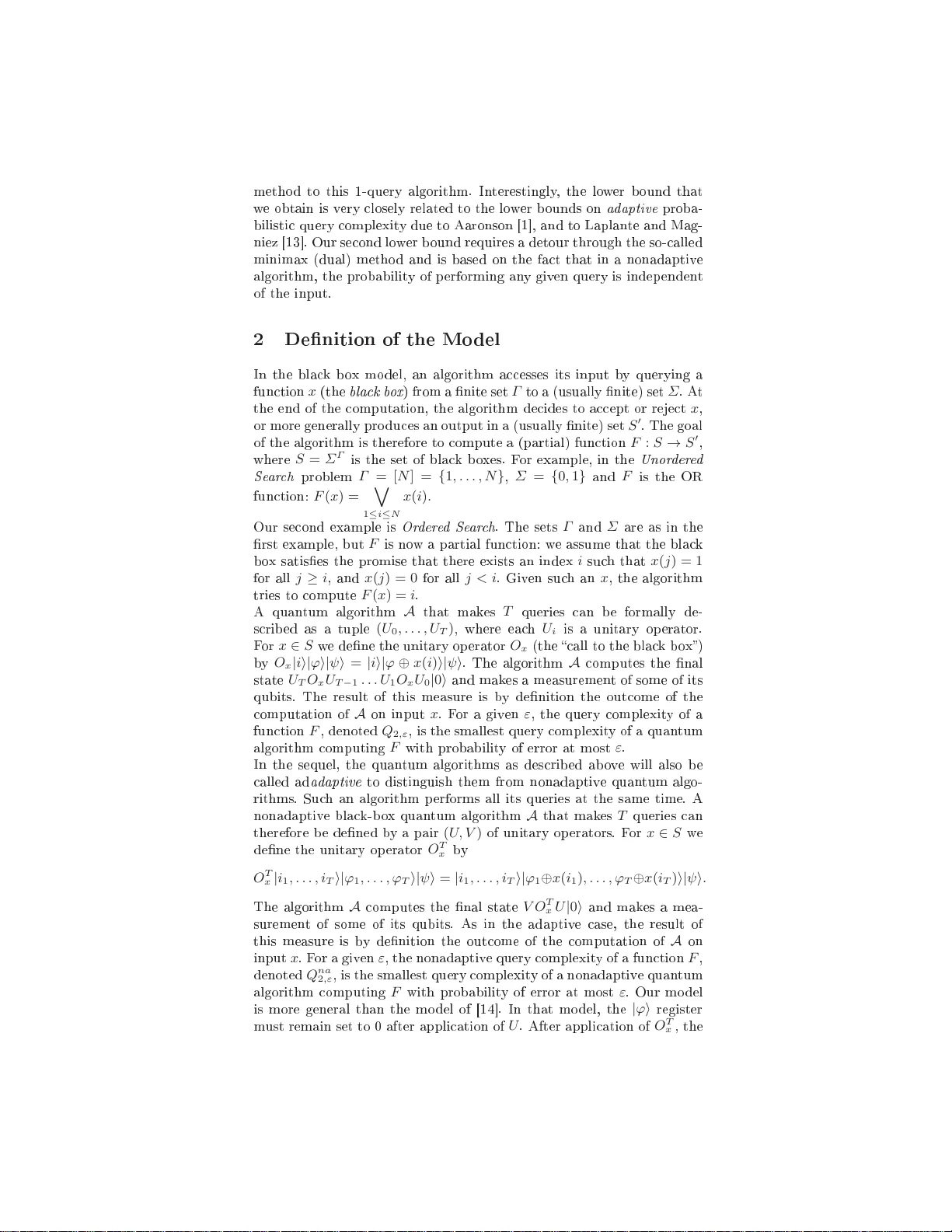
A dv ersary lo w er b ounds for nonadaptiv e quan tum algorithms P asal K oiran 1 , Jürgen Landes 2 , Nata ha P ortier 1 , and P engh ui Y ao 3 1 LIP ⋆⋆ , Eole Normale Sup érieure de Ly on, Univ ersité de Ly on 2 S ho ol of Mathematis, Univ ersit y of Man hester 3 State Key Lab oratory of Computer Siene, Chinese A adem y of Sienes Abstrat. W e presen t general metho ds for pro ving lo w er b ounds on the query omplexit y of nonadaptiv e quan tum algorithms. Our results are based on the adv ersary metho d of Am bainis. 1 In tro dution In this pap er w e presen t general metho ds for pro ving lo w er b ounds on the query omplexit y of nonadaptiv e quan tum algorithms. A nonadap- tiv e algorithm mak es all its queries sim ultaneously . By on trast, an un- restrited (adaptiv e) algorithm ma y ho ose its next query based on the results of previous queries. In lassial omputing, lasses of problems for whi h adaptivit y do es not help ha v e b een iden tied [4 ,10 ℄ and it is kno wn that this question is onneted to a longstanding op en prob- lem [15 ℄ (see [10 ℄ for a more extensiv e disussion). In quan tum omputing, the study of nonadaptiv e algorithms seems esp eially relev an t sine some of the b est kno wn quan tum algorithms (namely , Simon's algorithms and some other hidden subgroup algorithms) are nonadaptiv e. This is nev er- theless a rather understudied sub jet in quan tum omputing. The pap er that is most losely related to the presen t w ork is [14 ℄ (and [8℄ is another related pap er). In [14 ℄ the authors use an algorithmi argu- men t (this is a kind of K olmogoro v argumen t) to giv e lo w er b ounds on the nonadaptiv e quan tum query omplexit y of ordered sear h, and of generalizations of this problem. The mo del of omputation that they onsider is less general than ours (more on this in setion 2). The t w o metho ds that ha v e pro v ed most suessful in the quest for quan- tum lo w er b ounds are the p olynomial metho d (see for instane [5,2 ,11 ,12 ℄) and the adv ersary metho d of Am bainis. It is not lear ho w the p olyno- mial metho d migh t tak e the nonadaptivit y of algorithms in to aoun t. Our results are therefore based on the adv ersary metho d, in its w eigh ted v ersion [3℄. W e pro vide t w o general lo w er b ounds whi h yield optimal results for a n um b er of problems: sear h in an ordered or unordered list, elemen t distintness, graph onnetivit y or bipartiteness. T o obtain our rst lo w er b ound w e treat the list of queries p erformed b y a nonadaptiv e algorithm as one single sup er query. W e an then apply the adv ersary ⋆⋆ UMR 5668 ENS Ly on, CNRS, UCBL asso iée à l'INRIA. W ork done when Landes and Y ao w ere visiting LIP with nanial supp ort from the Mathlogaps program. metho d to this 1-query algorithm. In terestingly , the lo w er b ound that w e obtain is v ery losely related to the lo w er b ounds on adaptive proba- bilisti query omplexit y due to Aaronson [1℄, and to Laplan te and Mag- niez [13 ℄. Our seond lo w er b ound requires a detour through the so-alled minimax (dual) metho d and is based on the fat that in a nonadaptiv e algorithm, the probabilit y of p erforming an y giv en query is indep enden t of the input. 2 Denition of the Mo del In the bla k b o x mo del, an algorithm aesses its input b y querying a funtion x (the blak b ox ) from a nite set Γ to a (usually nite) set Σ . A t the end of the omputation, the algorithm deides to aept or rejet x , or more generally pro dues an output in a (usually nite) set S ′ . The goal of the algorithm is therefore to ompute a (partial) funtion F : S → S ′ , where S = Σ Γ is the set of bla k b o xes. F or example, in the Unor der e d Se ar h problem Γ = [ N ] = { 1 , . . . , N } , Σ = { 0 , 1 } and F is the OR funtion: F ( x ) = _ 1 ≤ i ≤ N x ( i ) . Our seond example is Or der e d Se ar h . The sets Γ and Σ are as in the rst example, but F is no w a partial funtion: w e assume that the bla k b o x satises the promise that there exists an index i su h that x ( j ) = 1 for all j ≥ i , and x ( j ) = 0 for all j < i . Giv en su h an x , the algorithm tries to ompute F ( x ) = i . A quan tum algorithm A that mak es T queries an b e formally de- srib ed as a tuple ( U 0 , . . . , U T ) , where ea h U i is a unitary op erator. F or x ∈ S w e dene the unitary op erator O x (the all to the bla k b o x) b y O x | i i| ϕ i| ψ i = | i i| ϕ ⊕ x ( i ) i| ψ i . The algorithm A omputes the nal state U T O x U T − 1 . . . U 1 O x U 0 | 0 i and mak es a measuremen t of some of its qubits. The result of this measure is b y denition the outome of the omputation of A on input x . F or a giv en ε , the query omplexit y of a funtion F , denoted Q 2 ,ε , is the smallest query omplexit y of a quan tum algorithm omputing F with probabilit y of error at most ε . In the sequel, the quan tum algorithms as desrib ed ab o v e will also b e alled ad adaptive to distinguish them from nonadaptiv e quan tum algo- rithms. Su h an algorithm p erforms all its queries at the same time. A nonadaptiv e bla k-b o x quan tum algorithm A that mak es T queries an therefore b e dened b y a pair ( U, V ) of unitary op erators. F or x ∈ S w e dene the unitary op erator O T x b y O T x | i 1 , . . . , i T i| ϕ 1 , . . . , ϕ T i| ψ i = | i 1 , . . . , i T i| ϕ 1 ⊕ x ( i 1 ) , . . . , ϕ T ⊕ x ( i T ) i| ψ i . The algorithm A omputes the nal state V O T x U | 0 i and mak es a mea- suremen t of some of its qubits. As in the adaptiv e ase, the result of this measure is b y denition the outome of the omputation of A on input x . F or a giv en ε , the nonadaptiv e query omplexit y of a funtion F , denoted Q na 2 ,ε , is the smallest query omplexit y of a nonadaptiv e quan tum algorithm omputing F with probabilit y of error at most ε . Our mo del is more general than the mo del of [14 ℄. In that mo del, the | ϕ i register m ust remain set to 0 after appliation of U . After appliation of O T x , the on ten t of this register is therefore equal to | x ( i 1 ) , . . . , x ( i T ) i rather than | ϕ 1 ⊕ x ( i 1 ) , . . . , ϕ T ⊕ x ( i T ) i . It is easy to v erify that for ev ery nonadaptiv e quan tum algorithm A of query omplexit y T there is an adaptiv e quan tum algorithm A ′ that mak es the same n um b er of queries and omputes the same funtion, so that Q 2 ,ε ≤ Q na 2 ,ε . Indeed, onsider for ev ery k ∈ [ T ] the unitary op erator A k whi h maps the state | i 1 , . . . , i T i| ϕ 1 , . . . , ϕ T i to | i k i| ϕ k i| i 1 , . . . , i k − 1 , i k +1 , . . . i T i| ϕ 1 , . . . , ϕ k − 1 , ϕ k +1 , . . . , ϕ T i . If the nonadaptiv e algorithm A is dened b y the pair of unitary op erators ( U, V ) , then the adaptiv e algorithm A ′ dened b y the tuple of unitary op erators ( U 0 , . . . , U T ) = ( A 1 U, A 2 A − 1 1 , . . . , A T A T − 1 T − 1 , V A − 1 T ) omputes the same funtion. 3 A Diret Metho d 3.1 Lo w er Bound Theorem and Appliations The main result of this setion is Theorem 3. It yields an optimal Ω ( N ) lo w er b ound on the nonadaptiv e quan tum query omplexit y of Unordered Sear h and Elemen t Distintness. First w e reall the w eigh ted adv ersary metho d of Am bainis and some related denitions. The onstan t C ε = (1 − 2 p ε (1 − ε )) / 2 will b e used throughout the pap er. Denition 1. The funtion w : S 2 → R + is a v alid w eigh t funtion if every p air ( x, y ) ∈ S 2 is assigne d a non-ne gative weight w ( x, y ) = w ( y , x ) that satises w ( x, y ) = 0 whenever F ( x ) = F ( y ) . W e then dene for al l x ∈ S and i ∈ Γ : wt ( x ) = P y w ( x, y ) and v ( x, i ) = P y : x ( i ) 6 = y ( i ) w ( x, y ) . Denition 2. The p air ( w , w ′ ) is a v alid w eigh t s heme if: Every p air ( x, y ) ∈ S 2 is assigne d a non-ne gative weight w ( x, y ) = w ( y , x ) that satises w ( x, y ) = 0 whenever F ( x ) = F ( y ) . Every triple ( x, y , i ) ∈ S 2 × Γ is assigne d a non-ne gative weight w ′ ( x, y , i ) that satises w ′ ( x, y , i ) = 0 whenever x ( i ) = y ( i ) or F ( x ) = F ( y ) , and w ′ ( x, y , i ) w ′ ( y , x, i ) ≥ w 2 ( x, y ) for al l x, y , i with x ( i ) 6 = y ( i ) . W e then dene for al l x ∈ S and i ∈ Γ w t ( x ) = P y w ( x, y ) and v ( x, i ) = P y w ′ ( x, y , i ) . Of ourse these denitions are relativ e to the partial funtion F . R emark 1. Let w b e a v alid w eigh t funtion and dene w ′ su h that if x ( i ) 6 = y ( i ) then w ′ ( x, y , i ) = w ( x, y ) and w ′ ( x, y , i ) = 0 otherwise. Then ( w , w ′ ) is a v alid w eigh t s heme and the funtions wt and v dened for w in Denition 1 are exatly those dened for ( w , w ′ ) in Denition 2. Theorem 1 (w eigh ted adv ersary metho d of Am bainis [3 ℄) Given a pr ob ability of err or ε and a p artial funtion F , the quantum query om- plexity Q 2 ,ε ( F ) of F as dene d in se tion 2 satises: Q 2 ,ε ( F ) ≥ C ε max ( w,w ′ ) valid min x,y ,i w ( x,y ) > 0 x ( i ) 6 = y ( i ) s wt ( x ) w t ( y ) v ( x, i ) v ( y , i ) . A probabilisti v ersion of this lo w er b ound theorem w as obtained b y Aaronson [1 ℄ and b y Laplan te and Magniez [13 ℄. Theorem 2 Fix the pr ob ability of err or to ε = 1 / 3 . The pr ob abilisti query omplexity P 2 ( F ) of F satises the lower b ound P 2 ( F ) = Ω ( L P ( F )) , wher e L P ( F ) = max w min x,y ,i w ( x,y ) > 0 x ( i ) 6 = y ( i ) max „ wt ( x ) v ( x, i ) , wt ( y ) v ( y , i ) « . Her e w r anges over the set of valid weight funtions. W e no w state the main result of this setion. Theorem 3 (nonadaptiv e quan tum lo w er b ound, diret metho d) The nonadaptive query omplexity Q na 2 ,ε ( F ) of F satises the lower b ound Q na 2 ,ε ( F ) ≥ C 2 ε L na Q ( F ) , wher e L na Q ( F ) = max w max s ∈ S ′ min x,i F ( x )= s wt ( x ) v ( x, i ) . Her e w r anges over the set of valid weight funtions. The follo wing theorem, whi h is an un w eigh ted adv ersary metho d for nonadaptiv e algorithm, is a onsequene of Theorem 3. Theorem 4 L et F : Σ Γ → { 0; 1 } , X ⊆ F − 1 (0) , Y ⊆ F − 1 (1) and let R ⊂ X × Y b e a r elation suh that: for every x ∈ X ther e ar e at le ast m elements y ∈ Y suh that ( x, y ) ∈ R , for every y ∈ Y ther e ar e at le ast m ′ elements x ∈ X suh that ( x, y ) ∈ R , for every x ∈ X and every i ∈ Γ ther e ar e at most l elements y ∈ Y suh that ( x, y ) ∈ R and x ( i ) 6 = y ( i ) , for every y ∈ X and every i ∈ Γ ther e ar e at most l ′ elements x ∈ X suh that ( x, y ) ∈ R and x ( i ) 6 = y ( i ) . Then Q na 2 ,ε ( F ) ≥ C 2 ε max( m l , m ′ l ′ ) . Pr o of. As in [3 ℄ and [13 ℄ w e set w ( x, y ) = w ( y , x ) = 1 for all ( x, y ) ∈ R . Then wt ( x ) ≥ m for all x ∈ A , wt ( y ) ≥ m ′ for all y ∈ B , v ( x, i ) ≤ l and v ( y , i ) ≤ l ′ . F or the Unordered Sear h problem dened in Setion 2 w e ha v e m = N and l = l ′ = m ′ = 1 . Theorem 4 therefore yields an optimal Ω ( N ) lo w er b ound. The same b ound an b e obtained for the Elemen t Distintness problem. Here the set X of negativ e instanes is made up of all one-to- one funtions x : [ N ] → [ N ] and Y on tains the funtions y : [ N ] → [ N ] that are not one-to-one. W e onsider the relation R su h that ( x, y ) ∈ R if and only if there is a unique i su h that x ( i ) 6 = y ( i ) . Then m = 2 , l = 1 , m ′ = N ( N − 1) and l ′ = N − 1 . As p oin ted out in [13 ℄, the Ω (max( m/l , m ′ /l ′ )) lo w er b ound from Theo- rem 4 is also a lo w er b ound on P 2 ( F ) . There is a further onnetion: Prop osition 1. F or any funtion F we have L P ( F ) ≥ L na Q ( F ) . That is, ignoring onstant fators, the lower b ound on P 2 ( F ) given by The or em 2 is at le ast as high as the lower b ound on Q na 2 ,ε ( F ) given by The or em 3. Pr o of. Pi k a w eigh t funtion w Q whi h is optimal for the diret metho d of Theorem 3. That is, w Q a hiev es the lo w er b ound L na Q ( F ) dened in this theorem. Let s Q b e the orresp onding optimal hoie for s ∈ S ′ . W e need to design a w eigh t funtion w P whi h will sho w that L P ( F ) ≥ L na Q ( F ) . One an simply dene w P b y: w P ( x, y ) = w Q ( x, y ) if F ( x ) = s Q or F ( y ) = s Q ; w P ( x, y ) = 0 otherwise. Indeed, for an y i and an y pair ( x, y ) su h that w P ( x, y ) > 0 w e ha v e F ( x ) = s Q or F ( y ) = s Q , so that max( w t ( x ) /v ( x, i ) , wt ( y ) /v ( y , i )) ≥ L na Q ( F ) . The nonadaptiv e quan tum lo w er b ound from Theorem 3 is therefore rather losely onneted to adaptiv e probabilisti lo w er b ounds: it is sandwi hed b et w een the w eigh ted lo w er b ound of Theorem 2 and its un- w eigh ted max( m/l, m ′ /l ′ ) v ersion. Prop osition 1 also implies that The- orem 3 an at b est pro v e an Ω (log N ) lo w er b ound on the nonadaptiv e quan tum omplexit y of Ordered Sear h. Indeed, b y binary sear h the adaptiv e probabilisti omplexit y of this problem is O (log N ) . In se- tion 4 w e shall see that there is in fat a Ω ( N ) lo w er b ound on the nonadaptiv e quan tum omplexit y of this problem. R emark 2. The onnetion b et w een nonadaptiv e quan tum omplexit y and adaptiv e probabilisti omplexit y that w e ha v e p oin ted out in the paragraph ab o v e is only a onnetion b et w een the lower b ounds on these quan tities. Indeed, there are problems with a high probabilisti query omplexit y and a lo w nonadaptiv e quan tum query omplexit y (for in- stane, Simon's problem [16 ,10 ℄). Con v ersely , there are problems with a lo w probabilisti query omplexit y and a high nonadaptiv e quan tum query omplexit y (for instane, Ordered Sear h). 3.2 Pro of of Theorem 3 As men tioned in the in tro dution, w e will treat the tuple ( i 1 , . . . , i k ) of queries made b y a nonadaptiv e algorithm as a single sup er query made b y an ordinary quan tum algorithm (iniden tally , this metho d ould b e used to obtain lo w er b ounds on quan tum algorithm that mak e sev eral rounds of parallel queries as in [8℄). This motiv ates the follo wing deni- tion. Denition 3. L et Σ , Γ and S b e as in se tion 2. Given an inte ger k ≥ 2 , we dene: k Σ = Σ k , k Γ = Γ k and k S = ` Σ k ´ Γ k . T o the blak b ox x ∈ S we asso iate the sup er b ox k x ∈ k S suh that if I = ( i 1 , . . . , i k ) ∈ Γ k then k x ( I ) = ( x ( i 1 ) , . . . , x ( i k )) . k F ( k x ) = F ( x ) . If w is a weight funtion for F we dene a weight funtion W for k F by W ( k x, k y ) = w ( x, y ) . Assume for instane that Σ = { 0; 1 } , Γ = [3] , k = 2 , and that x is dened b y: x (1) = 0 , x (2) = 1 and x (3) = 0 . Then w e ha v e 2 x (1 , 1) = (0 , 0) , 2 x (1 , 2) = (0 , 1) , 2 x (1 , 3) = (0 , 0) . . . Lemma 1. If w is a valid weight funtion for F then W is a valid weight funtion for k F and the minimal numb er of queries of a quantum algorithm omputing k F with err or pr ob ability ε satises: Q 2 ,ε ( k F ) ≥ C ε · min k x, k y ,I W ( k x, k y ) > 0 k x ( I ) 6 = k y ( I ) s W T ( k x ) W T ( k y ) V ( k x, I ) V ( k y , I ) . Pr o of. Ev ery pair ( x, y ) ∈ S 2 is assigned a non-negativ e w eigh t W ( k x, k y ) = W ( k y , k x ) = w ( x, y ) = w ( y , x ) that satises W ( k x, k y ) = 0 whenev er F ( x ) = F ( y ) . Th us w e an apply Theorem 1 and w e obtain the an- nouned lo w er b ound. Lemma 2. L et x b e a blak-b ox and w a weight funtion. F or any inte ger k and any tuple I = ( i 1 , . . . , i k ) we have W T ( k x ) V ( k x, I ) ≥ 1 k min j ∈ [ k ] wt ( x ) v ( x, i j ) . Pr o of. Let m = min j ∈ [ k ] wt ( x ) v ( x ,i j ) . W e ha v e W T ( k x ) = w t ( x ) and: V ( k x, I ) = X k y : k x ( i ) 6 = k y ( i ) W ( k x, k y ) ≤ X y : x ( i 1 ) 6 = y ( i 1 ) w ( x, y ) + · · · + X y : x ( i k ) 6 = y ( i k ) w ( x, y ) = v ( x, i 1 ) + · · · + v ( x, i k ) ≤ k ma x j ∈ [ k ] v ( x, i j ) . Lemma 3. If w is a valid weight funtion: Q na 2 ,ε ( F ) ≥ C 2 ε min x,y F ( x ) 6 = F ( y ) max „ min i wt ( x ) v ( x, i ) , min i wt ( y ) v ( y , i ) « . Pr o of. Let w b e an arbitrary v alid w eigh t funtion and k b e an in teger su h that k < C 2 ε min x,y F ( x ) 6 = F ( y ) max „ min i wt ( x ) v ( x, i ) , min i wt ( y ) v ( y , i ) « . W e sho w that an algorithm omputing k F with probabilit y of error ≤ ε m ust mak e stritly more one than query to the sup er b o x k x . This will pro v e that for ev ery su h k w e ha v e Q na 2 ,ε ( F ) > k and th us our result. F or ev ery x and I w e ha v e W T ( k x ) V ( k x, I ) ≥ 1 and th us b y lemma 2 for ev ery x , y and I = ( i 1 , . . . , i k ) : W T ( k x ) V ( k x, I ) W T ( k y ) V ( k x, I ) = min „ W T ( k x ) V ( k x, I ) , W T ( k y ) V ( k x, I ) « max „ W T ( k x ) V ( k x, I ) , W T ( k y ) V ( k x, I ) « ≥ max „ W T ( k x ) V ( k x, I ) , W T ( k y ) V ( k x, I ) « ≥ 1 k max „ min j ∈ [ k ] wt ( x ) v ( x, i j ) , min l ∈ [ k ] wt ( y ) v ( x, i l ) « . In order to apply Lemma 1 w e observ e that: min k x, k y ,I W ( k x, k y ) > 0 k x ( I ) 6 = k y ( I ) W T ( k x ) W T ( k y ) V ( k x, I ) V ( k y , I ) ≥ 1 k min x,y ,i 1 ,...,i k w ( x,y ) > 0 ∃ m x ( i m ) 6 = y ( i m ) max „ min j ∈ [ k ] wt ( x ) v ( x, i j ) , min l ∈ [ k ] wt ( y ) v ( x, i l ) « ≥ 1 k min x,y F ( x ) 6 = F ( y ) max „ min i wt ( x ) v ( x, i ) , min i wt ( y ) v ( x, i ) « By h yp othesis on k , this expression is greater than 1 /C 2 ε . Th us aording to Lemma 1 w e ha v e Q 2 ,ε ( k F ) > 1 , and Q na 2 ,ε ( F ) > k . W e an no w omplete the pro of of Theorem 3. Supp ose without loss of generalit y that F ( S ) = [ m ] and dene for ev ery l ∈ [ m ] : a l = C 2 ε min x,i F ( x )= l wt ( x ) v ( x, i ) . Supp ose also without loss of generalit y that a 1 ≤ · · · ≤ a m . It follo ws immediately from the denition that a 2 = C 2 ε min x,y F ( x ) 6 = F ( y ) max „ min i wt ( x ) v ( x, i ) , min i wt ( y ) v ( x, i ) « , and a m = C 2 ε max l ∈ F ( S ) min x,i F ( x )= l wt ( x ) v ( x, i ) . By Lemma 3 w e ha v e Q na 2 ,ε ( F ) ≥ a 2 , but w e w ould lik e to sho w that Q na 2 ,ε ( F ) ≥ a m . W e pro eed b y redution from the ase when there are only t w o lasses (i.e., m = 2 ). Let G b e dened b y G (1) = · · · = G ( m − 1) = 1 and G ( m ) = m . Applying Lemma 3 to GoF , w e obtain that Q na 2 ,ε ( GoF ) ≥ a m . But b eause the funtion GoF is ob viously easier to ompute than F , w e ha v e Q na 2 ,ε ( F ) ≥ Q na 2 ,ε ( GoF ) and th us Q na 2 ,ε ( F ) ≥ a m as desired. 4 F rom the Dual to the Primal Our starting p oin t in this setion is the minimax metho d of Laplan te and Magniez [13 ,17 ℄ as stated in [9 ℄: Theorem 5 L et p : S × Σ → R + b e the set of | S | pr ob ability distributions suh that p x ( i ) is the aver age pr ob ability of querying i on input x , wher e the aver age is taken over the whole omputation of an algorithm A . Then the query omplexity of A is gr e ater or e qual to: C ε max x,y F ( x ) 6 = F ( y ) 1 P i x ( i ) 6 = y ( i ) p p x ( i ) p y ( i ) . Theorem 5 is the basis for the follo wing lo w er b ound theorem. It an b e sho wn that up to onstan t fators, the lo w er b ound giv en b y Theorem 6 is alw a ys as go o d as the lo w er b ound giv en b y Theorem 3. Theorem 6 (nonadaptiv e quan tum lo w er b ound, primal-dual metho d) L et F : S → S ′ b e a p artial funtion, wher e as usual S = Σ Γ is the set of blak-b ox funtions. L et DL ( F ) = min p max x,y F ( x ) 6 = F ( y ) 1 P i x ( i ) 6 = y ( i ) p ( i ) and P L ( F ) = max w P x,y w ( x, y ) max i P x,y x i 6 = y i w ( x, y ) wher e the min in the rst formula is taken over al l pr ob ability distribu- tions p over Γ , and the max in the se ond formula is taken over al l valid weight funtions w . Then DL ( F ) = P L ( F ) and we have the fol lowing nonadaptive query omplexity lower b ound: Q 2 ,ε ( F ) ≥ C ε DL ( F ) = C ε P L ( F ) . Pr o of. W e rst sho w that Q 2 ,ε ( F ) ≥ C ε DL ( F ) . Let A b e a nonadaptiv e quan tum algorithm for F . Sine A is nonadaptiv e, the probabilit y p x ( i ) of querying i on input x is indep enden t of x . W e denote it b y p ( i ) . Theorem 5 sho ws that the query omplexit y of A is greater or equal to C ε max x,y F ( x ) 6 = F ( y ) 1 P i x ( i ) 6 = y ( i ) p ( i ) . The lo w er b ound Q 2 ,ε ( F ) ≥ C ε DL ( F ) follo ws b y minimizing o v er p . It remains to sho w that DL ( F ) = P L ( F ) . Let L ( F ) = min p max x,y F ( x ) 6 = F ( y ) X i x ( i )= y ( i ) p ( i ) . W e observ e that L ( F ) is the optimal solution of the follo wing linear program: minimize µ sub jet to the onstrain ts ∀ x, y su h that f ( x ) 6 = f ( y ) : µ − X i x ( i ) 6 = y ( i ) p ( i ) ≥ 0 , and to the onstrain ts N X i =1 p ( i ) = 1 and ∀ i ∈ [ N ] : p ( i ) ≥ 0 . Clearly , its solution set is nonempt y . Th us L ( f ) is the optimal solution of the dual linear program: maximize ν sub jet to the onstrain ts ∀ i ∈ [ N ] : ν − X x,y x i = y i w ( x, y ) ≤ 0 ∀ x, y : w ( x , y ) ≥ 0 , and w ( x, y ) = 0 if F ( x ) = F ( y ) and to the onstrain t X x,y w ( x, y ) = 1 . Hene L ( F ) = max w min i P x i = y i w ( x, y ) P x,y w ( x, y ) and DL ( F ) = 1 1 − L ( F ) = P L ( F ) . 4.1 Appliation to Ordered Sear h and Connetivit y Prop osition 1 F or any err or b ound ε ∈ [0 , 1 2 ) we have Q na 2 ,ε ( Or der e d Se ar h ) ≥ C ε ( N − 1) . Pr o of. Consider the w eigh t funtion w ( x, y ) = ( 1 if | F ( y ) − F ( x ) | = 1 , 0 otherwise . Th us w ( x, y ) = 1 when the leftmost 1's in x and y are adjaen t. Hene P x,y w ( x, y ) = 2( N − 2) + 2 . Moreo v er, if w ( x, y ) 6 = 0 and x i 6 = y i then { F ( x ) , F ( y ) } = { i, i + 1 } . Therefore, max i P x,y x i 6 = y i w ( x, y ) = 2 and the result follo ws from Theorem 6. Our seond appliation of Theorem 6 is to the graph onnetivit y prob- lem. W e onsider the adjaeny matrix mo del: x ( i, j ) = 1 if ij is an edge of the graph. W e onsider undireted, lo opless graph so that w e an as- sume j < i . F or a graph on n v erties, the bla k b o x x therefore has N = n ( n − 1) / 2 en tries. W e denote b y G x the graph represen ted b y x . Theorem 7 F or any err or b ound ε ∈ [0 , 1 2 ) , we have Q na 2 ,ε ( Conne tivity ) ≥ C ε n ( n − 1) / 8 . Pr o of. W e shall use essen tially the same w eigh t funtion as in ([6 ℄, The- orem 8.3). Let X b e the set of all adjaeny matries of a unique yle, and Y the set of all adjaeny matries with exatly t w o (disjoin t) y- les. F or x ∈ X and y ∈ Y , w e set w ( x, y ) = 1 if there exist 4 v erties a, b, c, d ∈ [ n ] su h that the only dierenes b et w een G x and G y are that: 1. ab, cd are edges in G x but not in G y . 2. ac, bd are edges in G y but not in G x . W e laim that max ij X x ∈ X,y ∈ Y x ( i,j ) 6 = y ( i,j ) w ( x, y ) = 8 n ( n − 1) X x ∈ X,y ∈ Y x ( i,j ) 6 = y ( i,j ) w ( x, y ) . (1) The onlusion of Theorem 7 will then follo w diretly from Theorem 6. By symmetry , the funtion that w e are maximizing on the left-hand side of (1) is in fat indep enden t of the edge ij . W e an therefore replae the max o v er ij b y an a v erage o v er ij : the left-hand side is equal to 1 N X x ∈ X,y ∈ Y w ( x, y ) |{ ij ; x ( i, j ) 6 = y ( i, j ) }| . No w, the ondition x ( i, j ) 6 = y ( i, j ) holds true if and only if ij is one of the 4 edges ab , cd , ac , bd dened at the b eginning of the pro of. This nishes the pro of of (1), and of Theorem 7. A similar argumen t an b e used to sho w that testing whether a graph is bipartite also requires Ω ( n 2 ) queries. 5 Some Op en Problems F or the 1-to-1 v ersus 2-to-1 problem, one w ould exp et a higher quan- tum query omplexit y in the nonadaptiv e setting than in the adap- tiv e setting. This ma y b e diult to establish sine the adaptiv e lo w er b ound [2 ℄ is based on the p olynomial metho d. Hidden T ranslation [7℄ (a problem losely onneted to the dihedral hidden subgroup problem) is another problem of in terest. No lo w er b ound is kno wn in the adap- tiv e setting, so it w ould b e natural to lo ok rst for a nonadaptiv e lo w er b ound. Finally , one w ould lik e to iden tify some lasses of problems for whi h adaptivit y do es not help quan tum algorithms. A kno wledgemen ts: This w ork has b eneted from disussions with Sophie Laplan te, T ro y Lee, F rédéri Magniez and Vinen t Nesme. Email addresses: [Pasal.Koiran, Nataha.Portier ℄ens - ly on.fr , juergen_landesyahoo.de , phyao1985gmail.om . Referenes 1. S. Aaronson. Lo w er b ounds for lo al sear h b y quan tum argumen ts. In Pr o . STOC 2004 , pages 465474. A CM, 2004. 2. S. Aaronson and Y. Shi. Quan tum Lo w er Bounds for the Colli- sion and the Elemen t Distintness Problems. Journal of the A CM , 51(4):595605, July 2004. 3. Andris Am bainis. P olynomial degree vs. quan tum query omplexit y . J. Comput. Syst. Si. , 72(2):220238, 2006. 4. Z. Bar-Y ossef, R. Kumar, and D. Siv akumar. Sampling Algorithms: lo w er b ounds and appliations. In Pr o . STOC 2001 , pages 266275. A CM, 2001. 5. R. Beals, H. Buhrman, R. Clev e, M. Mosa, and R. de W olf. Quan- tum lo w er b ounds b y p olynomials. Journal of the A CM , 48(4):778 797, 2001. 6. Christoph Dürr, Mark Heiligman, P eter Høy er, and Mehdi Mhalla. Quan tum query omplexit y of some graph problems. SIAM J. Com- put. , 35(6):13101328, 2006. 7. K. F riedl, G. Iv an y os, F. Magniez, M. San tha, and P . Sen. Hidden translation and orbit oset in quan tum omputing. In STOC '03: Pr o e e dings of the thirty-fth annual A CM symp osium on The ory of omputing , 2003. 8. Lo v K. Gro v er and Jaikumar Radhakrishnan. Quan tum sear h for m ultiple items using parallel queries. arXiv, 2004. 9. P eter Ho y er and Rob ert Spalek. Lo w er b ounds on quan tum query omplexit y . EA TCS Bul letin , 87:78103, o tob er 2005. 10. P . K oiran, V. Nesme, and N. P ortier. On the probabilisti query omplexit y of transitiv ely symmetri problems. h ttp://p erso.ens- ly on.fr/pasal.k oiran. 11. P . K oiran, V. Nesme, and N. P ortier. A quan tum lo w er b ound for the query omplexit y of Simon's problem. In Pr o . ICALP 2005 , v olume 3580 of L e tur e Notes in Computer Sien e , pages 12871298. Springer, 2005. 12. P . K oiran, V. Nesme, and N. P ortier. The quan tum query omplexit y of ab elian hidden subgroup problems. The or eti al Computer Sien e , 380:115126, 2007. 13. S. Laplan te and F. Magniez. Lo w er b ounds for randomized and quan- tum query omplexit y using K olmogoro v argumen ts. SIAM journal on Computing , to app ear. 14. Harumi hi Nishim ura and T omo yuki Y amak ami. An algorithmi argumen t for nonadaptiv e query omplexit y lo w er b ounds on advised quan tum omputation (extended abstrat). In MF CS , pages 827 838, 2004. 15. A. L. Rosen b erg. On the time required to he k prop erties of graphs: A problem. SIGA CT News , pages 1516, 1973. 16. D. R. Simon. On the p o w er of quan tum omputation. In Pr o e e dings of the 35th A nnual Symp osium on F oundations of Computer Sien e , pages 116123, 1994. 17. R. Spalek and M. Szegedy . All quan tum adv ersary metho ds are equiv alen t. In Pr o . ICALP 2005 , v olume 3580 of L e tur e Notes in Computer Sien e , pages 12991311. Springer, 2005.
Original Paper
Loading high-quality paper...
Comments & Academic Discussion
Loading comments...
Leave a Comment