Symmetry Breaking for Maximum Satisfiability
Symmetries are intrinsic to many combinatorial problems including Boolean Satisfiability (SAT) and Constraint Programming (CP). In SAT, the identification of symmetry breaking predicates (SBPs) is a well-known, often effective, technique for solving …
Authors: Joao Marques-Silva, Ines Lynce, Vasco Manquinho
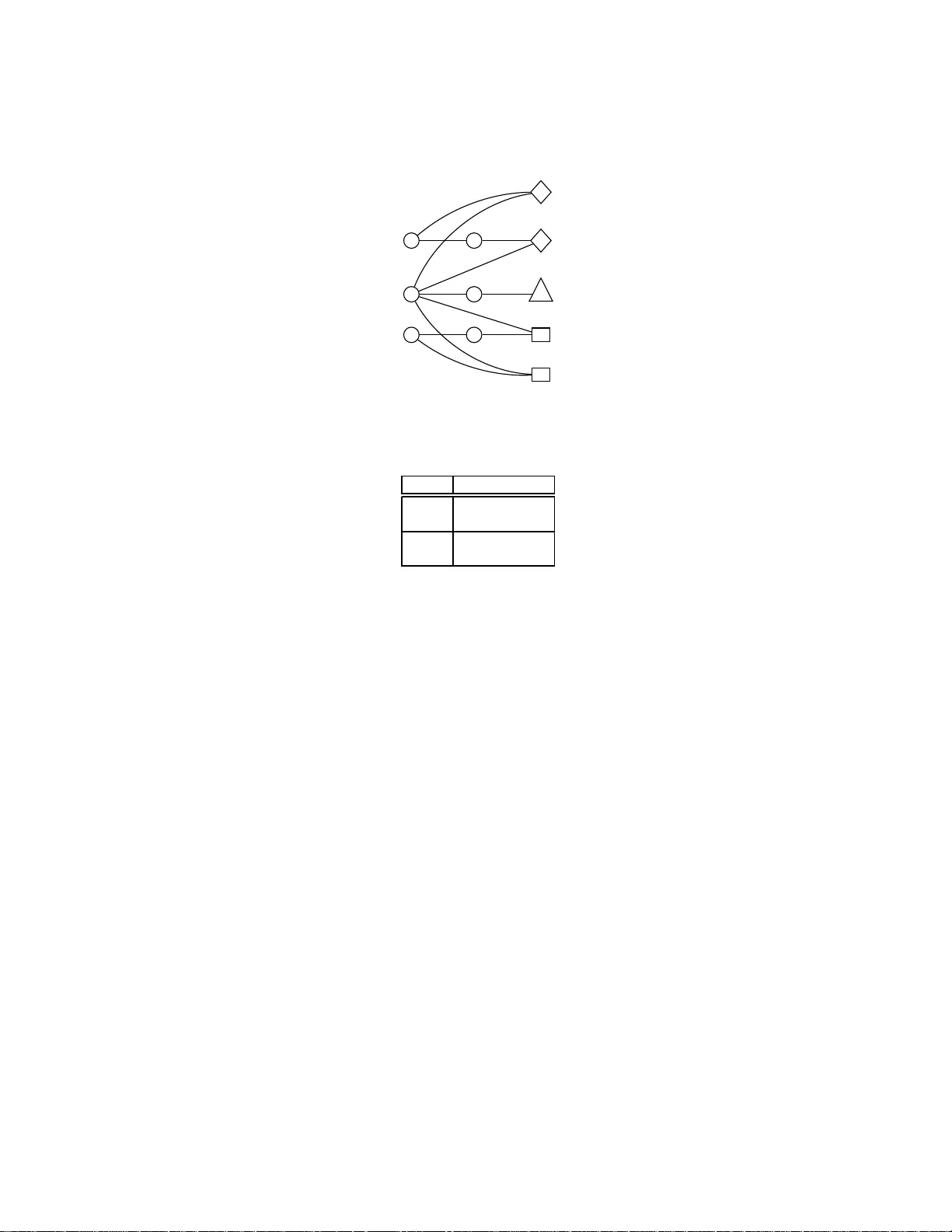
Symmetry Break ing f or Maximum Satisfiabili ty ⋆ Joao Marques-Silva 1 , In ˆ es L ynce 2 , and V asco Manquinh o 2 1 School of Electronics and Computer Science, Univ ersity of Southampton , UK jpms@ecs.soto n.ac.uk 2 IST/INES C-ID, T echnical Univ ersity of Lisbon, Portugal {ines, vmm}@sat.inesc- id.pt Abstract. Symmetries are intrinsic to man y combinatorial problems includin g Boolean Satisfiability (SA T) and Constraint P rogramming (CP ). In S A T , the iden- tification of symmetry breaking predicates (SBPs) is a well-known , often effec- tiv e, technique for solving hard problems. The identification of SBPs in SA T has been the sub ject of significant improvemen ts in recent years, resulting in more compact SBPs and more effecti ve algorithms. The i dentification of SBPs has also been applied to pseudo-Boo lean (PB) co nstraints, showing that symme try break- ing can also be an effecti v e technique for PB constraints. This paper extends further t he application of SBPs, and sho ws that SB Ps can be identified and used in Maximum S atisfiability (M axSA T), as well as in its most well-known v ariants, including partial Ma xSA T, weighted MaxSA T and weigh ted partial Ma xSA T. As with SA T and PB, symmetry breaking predicates for MaxSA T and va riants are sho wn to be effectiv e for a representativ e number of problem domains, allowing solving problem instances t hat current state of t he art MaxSA T solv ers could not otherwise solve. 1 Intr oduction Symmetry breaking is a widely used technique for solv ing combinato rial problems. Symmetries hav e been used with great success in Satisfiability (SA T) [6, 1], and are re- garded as an essential techniqu e f or solvin g sp ecific classes of pr oblem instances. Sym- metries h a ve also b een wid ely used for solving con straint satisfaction problems ( CSPs) [8] . More recent work has shown ho w to apply symmetry break ing in pseudo-Boolean ( PB) constraints [ 2] and also in so ft co nstraints [18 ]. It should be noted that symmetry break - ing is viewed as an effecti ve prob lem solv ing techniqu e, either f or SA T , PB or CP , that is often used as an altern ati ve techniqu e, to be applied when d efault algorith ms are unable to solve a gi ven problem in stance. In r ecent y ears there h as been a growing interest in algorithms f or MaxSA T and vari- ants [1 2, 13 , 20 , 1 0, 11, 14 ], in part b ecause of the wid e ran ge of p otential applica tions. MaxSA T and v ariants represent a m ore gener al framew ork than either SA T o r PB, and so can n aturally be u sed in many practical application s. The interest in MaxSA T and variants moti vated th e development of a new generatio n of MaxSA T algorith ms, re- markably mo re efficient than early MaxSA T algor ithms [19, 4]. Despite the observed improvements, th ere are many p roblems still to o complex for MaxSA T alg orithms to ⋆ This paper is also av ailable as reference [15]. 2 Marques-Silv a, L ynce and Manq uinho solve [3 ]. Natu ral lin es of resear ch f or improving Max SA T alg orithms in clude s tudying technique s known to be ef fectiv e for either SA T , PB or CP . One concr ete example is symmetry breaking. Despite its success in SA T , PB and CP , the usefulness of symmetr y breaking for MaxSA T and variants has not been thoroug hly studied . This paper addresses the problem of using symm etry breaking in Max SA T and in its most well- known variants, partial M axSA T, weigh ted MaxSA T and weighte d p artial MaxSA T. The work extends past recent work on computing symmetries for SA T [ 1] and PB constraints [2] by computin g auto morphism o n colored graphs obtained from CNF or PB formulas, and by showing how symmetry br eaking predicates [6, 1] can be exploited. The experimen tal results show that symme try b reaking is an effectiv e technique for MaxSA T and v ariants, allowing solving problem instances that state of the art MaxSA T solvers could not otherwise s olve. The paper is organized as follows. The next section intr oduces the notation u sed throug hout the p aper, provides a brief overview of MaxSA T an d variants, and also sum- marizes the work on symmetry breakin g for SA T and PB constraints. Afterwards, th e paper describes how to apply symmetry breaking in Max SA T and variants. Experi- mental r esults, obtained on representative problem instances from the MaxSA T eval- uation [3] and also from practical applications [1], d emonstrate that symmetry break- ing allows solving prob lem instances that could not be solved by any of the a v ailable state of the art MaxSA T s olvers. The paper concludes by summar izing related work, by overviewing th e main contributions, and by outlinin g d irections for future work. 2 Pr eliminaries This section introdu ces the notatio n used th rough the paper, as well as the MaxSA T problem and its v ariants. An overview o f symmetry id entification and symm etry break- ing is also presented . 2.1 Maximum Satisfiability The paper assume s the usual defin itions for SA T . A prop ositional formula is represen ted in Conjunctive Normal F orm (CNF). A CNF f ormula ϕ consists of a co njunction of clauses, where each clause ω is a disjunction of literals, and a l iteral l is either a propo- sitional variable x or its complem ent ¯ x . V ariables c an be assigned a p roposition al value, either 0 or 1. A literal l j = x j assumes value 1 if x j = 1 and assumes value 0 if x j = 0 . Con versely , literal l j = ¯ x j assumes value 1 if x j = 0 and value 0 whe n x j = 1 . For each assignment o f v alues to the variables, the value of formu la ϕ is comp uted with the rules of p roposition al logic. A clause is said to be satisfied if at least o ne o f its literals assumes value 1. If all literals o f a clause assume value 0, then the clause is unsatisfied . The propositional satisfiability (SA T) problem co nsists in decidin g wh ether there exists an assignment to the variables suc h that ϕ is satis fied. Giv en a pro positional form ula ϕ , the Max SA T pr oblem is de fined as findin g an assignment to variables in ϕ such tha t the numb er of satisfied clau ses is maxim ized. (MaxSA T can also be defined as finding an assignm ent tha t minimizes the n umber of un- satisfied clauses.) W ell-known variants of Max SA T include p artial MaxSA T, weigh ted MaxSA T and weighted partial MaxSA T. Symmetry Breaking for MaxSA T 3 For par tial Max SA T, a prop ositional f ormula ϕ is described by the conju nction of two CNF formulas ϕ s and ϕ h , where ϕ s represents the soft c lauses a nd ϕ h represents the har d clauses. The partial MaxSA T problem over a p ropositiona l for mula ϕ = ϕ h ∧ ϕ s consists in finding an assignment to the problem v ariables such that all hard clauses ( ϕ h ) are satisfied and the number of satisfied soft clauses ( ϕ s ) is maximized. For weighted Max SA T, each clause in the CNF f ormula is associated to a non- negativ e weight. A weighted clause is a pair ( ω, c ) where ω is a c lassical clause and c is a natural nu mber corresponding to the cost of unsatisfying ω . Given a weighted CNF formu la ϕ , th e weighted MaxSA T problem con sists in finding an assignm ent to p rob- lem variables such that th e total weig ht of the un satisfied clauses is minimized, which implies th at the total weight o f the satisfi ed clauses is maximized. For the weighted par- tial MaxSA T pro blem, the formula is the conjunc tion of a weighted CNF for mula (soft clauses) a nd a classical CNF for mula (hard clauses). Th e weighted partial Max SA T problem consists in finding an assign ment to th e v ariables s uch that all hard clauses are satisfied and the total weight of satisfied soft clau ses is max imized. Observe th at, for both partial M axSA T and weighted partial Ma xSA T, hard clauses can be re presented as weighted clauses. For these clauses one can consider that the weig ht is greater than the sum of the weights of the soft clauses. MaxSA T and variants find a wide range of p ractical app lications, that include sche dul- ing, rou ting, bioinfo rmatics, and design automation . Moreover , Max SA T can be used for solving pseudo -Boolean optimization [11]. The practical applications of MaxSA T motiv ated recent interest in developing more efficient algorithms. The most efficient algorithm s for MaxSA T and v ariants are based o n branch and bound search , using ded- icated bo unding and in ference techn iques [12, 13, 10, 11]. L ower boun ding techn iques include for exam ple the use o f unit propaga tion for identifying n ecessarily unsatisfied clauses, wher eas in ference tec hniques can be v iewed as restricted forms of resolution, with the objective of simplifyin g the problem instance to solve. 2.2 Symmetry Breaking Giv en a p roblem instance, a sym metry is an ope ration that preserves the constraints, and therefor e also preserves the solutions [5]. For a set of symmetric states, it is possible to obtain the whole set of states from any of the states. Hen ce, symmetr y break ing predicates m ay eliminate all but one o f th e eq uiv alent states. Symmetry breakin g is expected to speed up the search as the search space g ets reduced. For s pecific problems where symm etries may be easily fo und this redu ction may be significan t. Nonetheless, the elimination o f symmetries n ecessarily introduces overhead th at is expected to be negligible when compared with the benefits it may provide. The elimination of symmetries has b een extensi vely studied in CP and SA T [16, 6]. Th e most well-kn ow strategy for eliminating sym metries in SA T con sists in addin g symmetry breaking predicates (SBPs) to th e CNF formula [6]. SBPs ar e added to th e formu la befo re the search starts. The symmetries m ay be identified fo r each spec ific problem , and in that case it is required that th e symmetries in the problem are iden ti- fied when creating t he encodin g. Alternatively , on e may g i ve a formula to a specialized tool for de tecting all the symmetries [1]. Th e resulting SBPs are intend ed to merge 4 Marques-Silv a, L ynce and Manq uinho symmetries in equiv alent classes. In case all symmetries are broken, only o ne assign- ment, instead of n assignments, may satisfy a set of constrain ts, being n the num ber of elements in a given equ i valent class. Other approach es include remodeling the problem [17] an d breaking symmetries during search [ 9]. Remo deling th e p roblem implies creating a dif ferent en coding, e. g. obtained by defining a dif ferent set of variables, in o rder to c reate a p roblem with less symmetries o r even none at all. Alternatively , the search procedu re may be adap ted for addin g SBPs as the search pro ceeds to ensure that any assign ment symmetric to one assignment already considered will not be explored in the future, or by performin g checks that symmetric equiv alent ass ignments have n ot yet been visited. Currently a vailable tools for detecting an d b reaking sym metries f or a given formula are based on grou p theor y . From each form ula a gro up is extracted, where a group is a set of permutation s. A perm utation is a o ne-to-o ne co rrespond ence b etween a set and itself. Each symm etry defines a perm utation on a set of literals. In p ractice, each permutatio n is represented by a product of disjoint cycles. Each cycle ( l 1 l 2 . . . l m ) with size m stand s for the per mutation that m aps l i on l i +1 (with 1 ≤ i ≤ m − 1 ) and l m on l 1 . Applyin g a perm utation to a formula w ill produc e exactly the same formu la. Example 1. Consider the following CNF form ula: ϕ = ( x 1 ∨ x 2 ) ∧ ( ¯ x 1 ∨ x 2 ) ∧ ( ¯ x 2 ) ∧ ( x 3 ∨ x 2 ) ∧ ( ¯ x 3 ∨ x 2 ) The p ermutation s identified f or ϕ are ( x 3 ¯ x 3 ) an d ( x 1 x 3 )( ¯ x 1 ¯ x 3 ) . ( The p ermutation ( x 1 ¯ x 1 ) is im plicit.) Th e formula r esulting f rom the per mutation ( x 3 ¯ x 3 ) is o btained by re placing every occ urrence of x 3 by ¯ x 3 and every occur rence of ¯ x 3 by x 3 . Clearly , the o btained formula is equal to the o riginal f ormula. The same happens whe n apply ing the p ermutation ( x 1 x 3 )( ¯ x 1 ¯ x 3 ) : r eplacing x 1 by x 3 , x 3 by x 1 , ¯ x 1 by ¯ x 3 and ¯ x 3 by ¯ x 1 produ ces the same formula. 3 Symmetry Br eaking for MaxSA T This section describes how to apply sym metry break ing in MaxSA T. First, the co nstruc- tion process for the graph representing a CNF formula is briefly revie wed [6 , 1 ], as it will be mo dified later in this section. Afte rwards, plain MaxSA T is co nsidered. The next step is to address partial, weighted and weighted partial MaxSA T. 3.1 From CNF F ormulas to Colored Gra phs Symmetry breaking for Ma xSA T and variants req uires a few m odifications to the ap - proach used for SA T [6, 1]. This section sum marizes the b asic app roach, which is then extended in the following sections. Giv en a grap h, the graph a utomorphism problem consists in fin ding isom orphic group s of edges and vertices with a on e-to-on e co rrespond ence. In case of g raphs with colored vertices, th e corresponde nce is made between vertices with th e same color . It is well-known that sym metries in SA T ca n be identified by reduction to a graph au- tomorp hism pr oblem [6, 1]. The pro positional for mula is repre sented as an u ndirected Symmetry Breaking for MaxSA T 5 1 4 2 5 7 3 6 Fig. 1. Colored graph for Example 2 graph with co lored vertices, such that the au tomorph ism in th e gr aph corresp onds to a symmetry in the proposition al fo rmula. Giv en a propositional formula ϕ , a colored undirected graph is created as follows : – For each variable x j ∈ ϕ add two vertices to represent x j and ¯ x j . All vertices associated with variables are colored with color 1 ; – For each v ariable x j ∈ ϕ add an edg e between the vertices representing x j and ¯ x j ; – For each bin ary clause ω i = ( l j ∨ l k ) ∈ ϕ , add an edge b etween the vertices representin g l j and l k ; – For each non-bina ry clause ω i ∈ ϕ create a vertex colored with 2; – For ea ch literal l j in a no n-binar y cla use ω i , add an edge be tween the corresponding vertices. Example 2. Figure 1 shows the colored u ndirected graph associated with the CNF fo r- mula of Ex ample 1 . V er tices with shape ◦ r epresent c olor 1 and vertices with shape ⋄ represent color 2. V ertex 1 correspond s to x 1 , 2 to x 2 , 3 to x 3 , 4 to ¯ x 1 , 5 to ¯ x 2 , 6 to ¯ x 3 and 7 to u nit clause ( ¯ x 2 ) . Ed ges 1-2 , 2- 3, 2- 4 an d 2-6 r epresent binar y clau ses and edges 1-4, 2-5 and 3-6 link complemen ted liter als. 3.2 Plain Maximum Satisfiability Let ϕ r epresent the CNF fo rmula of a MaxSA T instance. Moreover , let ϕ sbp be the CNF for mula for th e symmetry -breakin g predica tes obtained with a CNF symmetry tool (e.g. Shatter 3 ). All clauses in ϕ ar e ef fecti vely soft clauses, fo r wh ich th e objecti ve is to maximize the numbe r o f satisfied clauses. In contrast, the clauses in ϕ sbp are har d clauses, which must necessarily be satisfied. As a result, the original MaxSA T problem is tran sformed into a p artial Max SA T proble m, w here ϕ denotes the soft clauses and ϕ sbp denotes the hard c lauses. The so lution of the p artial MaxSA T pr oblem correspon ds to the solution of the original MaxSA T prob lem. Example 3. For th e CNF fo rmula of Example 1, th e g enerated SBP pr edicates (by Shat- ter) are: ϕ sbp = ( ¯ x 3 ) ∧ ( ¯ x 1 ∨ x 3 ) As r esult, th e re sulting instanc e of partial MaxSA T will be ϕ ′ = ( ϕ h ∧ ϕ s ) = ( ϕ sbp ∧ ϕ ) . Moreover , x 3 = 0 and x 1 = 0 are necessary assignments, an d so variables x 1 and x 3 can be ign ored for m aximizing the n umber of satisfied soft clauses. 3 http://www .eecs.umich.edu/ ∼ faloul/T ools/shatter/ 6 Marques-Silv a, L ynce and Manq uinho Observe th at the hard clauses represented b y ϕ sbp do not change the solution of the original Max SA T prob lem. Indeed, th e con struction of th e symm etry break ing predi- cates guarantees th at the maximum number of satisfied soft clauses remains unchanged by the addition of the hard clauses. Proposition 1. The maximum nu mber of satisfied clauses fo r the MaxSA T pr oblem ϕ and the partial MaxSA T pr oblem ( ϕ ∧ ϕ sbp ) ar e the same. Proof: (Sketch) Th e pro of fo llows fro m the fact that symmetries map models into mod- els an d no n-mod els into n on-mo dels (see Proposition 2. 1 in [6]). Consider the clauses as an o rdered sequ ence h ω 1 , . . . , ω m i . Given a symm etry , a clause in position i will be mapped to a clause in ano ther p osition j . No w , gi ven any assignment, if the clause in position i is satisfied ( unsatisfied), then b y app lying the symm etry , the clause in posi- tion j is now satisfied (unsatisfied). Thus the number o f satisfied (unsatisfied) clau ses is unchan ged. 3.3 Partial and W eighted Maximum Satisfiability For p artial MaxSA T , the generatio n of SBPs n eeds to be modified. The grap h rep re- sentation o f the CNF formu la must take into ac count the existence of hard and soft clauses, which must be distinguished by a gr aph automo rphism alg orithm. Sym metric states for problem in stances with h ard and so ft clauses estab lish a co rrespond ence ei- ther between hard clauses or between soft clauses. In other words, when app lying a permutatio n ha rd clauses can only be replaced by other hard clau ses, and soft clauses by other soft clau ses. In ord er to address this issue, the c olored grap h generation needs to be modified. In contrast to the MaxSA T case, binary clauses are n ot disting uished from o ther clau ses, and are repr esented as vertices in the c olored g raph. Clauses can now have one o f two color s. A vertex with color 2 is associated with each soft c lause, and a vertex w ith color 3 is associated with each hard clause. This m odification e nsures that any identified a utomorp hism gu arantees that soft clau ses corresp ond o nly to soft clauses, and hard clauses cor respond only to hard clauses. Moreover , the pr ocedure for the generation of SBPs fr om the group s foun d b y a g raph autom orphism tool remains unchan ged, and the SB Ps can be a dded to the origin al in stance as new har d clauses. The resulting instance is also an instance of par tial Max SA T. Cor rectness o f this appro ach follows form the correctne ss o f the plain MaxSA T case. The solution for weig hted MaxSA T an d f or weig hted par tial MaxSA T is similar to the partial Max SA T case, but now clau ses with different weights are repr esented by vertices with different colors. This guarantees that the gro ups found by the gr aph auto- morph ism too l take into consideration th e weight of each clause. Let { c 1 , c 2 , . . . , c k } denote the distinct c lause weig hts in the C NF formula. Each clause of weig ht c i is asso- ciated with a v ertex of color i + 1 in the colored g raph. In c ase there e xist hard cla uses, an ad ditional color k + 2 is u sed, and so each har d clause is represented by a vertex with color k + 2 in the colored graph . Associating distinct clause weights with distinct colors guarantees that the g raph au tomorph ism algo rithm can only make the co rrespon - dence between clauses with the same weight. Mor eover , th e identified SBPs resu lt in new har d clau ses tha t are added to the o riginal pr oblem. For either weig hted Max SA T Symmetry Breaking for MaxSA T 7 7 1 4 8 2 5 9 3 6 10 11 Fig. 2. Colored graph for Example 4 T able 1 . Problem transformations due to SBPs Original With Symmetries MS PMS PMS PMS WMS WPMS WPMS WPMS or weigh ted partial Max SA T, the re sult is an instance of we ighted partial Max SA T. As before, cor rectness of this appr oach follows form the corr ectness of the plain MaxSA T case. Example 4. Consider the following weighted partial MaxSA T instance: ϕ = ( x 1 ∨ x 2 , 1) ∧ ( ¯ x 1 ∨ x 2 , 1) ∧ ( ¯ x 2 , 5) ∧ ( ¯ x 3 ∨ x 2 , 9) ∧ ( x 3 ∨ x 2 , 9) for which the last two clauses ar e hard . Figure 2 shows the colo red undirected gr aph associated with the fo rmula. Clauses wi th different weigh ts are rep resented with dif fer - ent colors (shown in the figure with different vertex shapes). A graph autom orphism algorithm can then be used to generate the symmetry break ing predicates ϕ sbp = ( ¯ x 1 ) ∧ ( ¯ x 3 ) , consisting of two har d clauses. As a resu lt, the assi gnmen ts x 1 = 0 and x 3 = 0 become necessary . T able 1 summarizes the pr oblem transfor mations described in this section , where MS r epresents plain MaxSA T, PMS rep resents partial MaxSA T, WMS rep resents weighted MaxSA T, and WPMS rep resents weighted par tial Max SA T. The use of SBPs introduces a number of hard clauses, an d so th e resulting pro blems are either partial Max SA T o r weighted partial MaxSA T. 8 Marques-Silv a, L ynce and Manq uinho 4 Experimental Results The experimen tal s etup has been organized as fo llows. First, all th e instan ces fro m the first and second MaxSA T ev aluations ( 2006 and 2 007) [3] were run . T hese r esults al- lowed selecting relevant benchmark families, fo r which symmetries occur an d which require a non-n egligible amount of tim e fo r b eing solved by both appr oaches (with or with out SBPs). After wards, the instanc es for which both appr oaches aborted were removed fr om the tables of results. Th is resulted in selecting the hamming an d the MANN in stances for plain Max SA T, the ii32 and again the MA NN instances for par- tial MaxSA T, the c-fat500 instances for weighted MaxSA T and th e dir and log instances for weighted partial MaxSA T. Besides the in stances that p articipated in the MaxSA T comp etition, we have in- cluded add itional pro blem instances ( hole , Urq and chnl ). Th e hole instances r e- fer to the well-known pigeon hole p roblem, the Urq instances repre sent rand omized instances based on expan der gr aphs and the chnl instan ces model th e routing o f wires in th e chann els o f field-pr ogramm able integrated circuits. These in stances refer to p rob- lems that can be n aturally encoded as MaxSA T pro blems an d are kn own to be highly symmetric [ 1]. The ap proach outlined above w as also followed for selecting the in- stances to be included in the tables of results. W e ha ve ru n different publicly av ailable MaxSA T solvers, namely M I N I M A X S A T 4 , T O O L BA R 5 and M A X S A T Z 6 . ( M A X S A T Z accep ts only p lain MaxSA T instanc es.) It has been observed that M I N I M A X S AT behavior is similar to T O O L B A R and M A X S A T Z , albeit being in gene ral more ro bust. For this re ason, the resu lts focu s on M I N I M A X S AT . T ables 2 and 3 pr ovide the results o btained. T ab le 2 refers to p lain Max SA T in - stances and T able 3 refers to partial MaxSA T (PMS), weighted MaxSA T (WMS) and weighted par tial MaxSA T ( WPMS) in stances. For e ach instance , the results shown in - clude the num ber o f clauses added as a result of SBPs (# ClsSbp), the time required for solving the original instances ( OrigT), i.e. without SBPs, and th e time requ ired for breaking the symmetries plus the time require d for solving the extended formu la af- terwards ( SbpT). In prac tice, the time required f or generating SBPs is negligible. T he results we re o btained on a Intel Xeon 516 0 server ( 3.0GHz, 13 33Mhz, 4M B) ru nning Red Hat Enterprise Linux WS 4. The experimental results allo w establishing t he following conclusions: – The inclusion o f sy mmetry br eaking is essential f or solvin g a number of problem instances. W e should note tha t all the plain M axSA T i nstances in T able 2 f or which M I N I M A X S AT abor ted, are also ab orted by T O O L BA R and M A X S AT Z . After adding SBPs all these instances becom e easy to solve by any of th e solvers. For the aborted partial, weigh ted an d weighted partial Ma xSA T in stances in T able 3 this is not always the case, since a few instan ces ab orted by M I N I M A X S A T could be solved by T O O L BA R w ithout SBPs. Howe ver, the converse is also true, as there are instances that were initially aborted b y T O O L BA R (a lthough solved b y M I N I M A X S A T ) that are solved by T O O L BA R after adding SBPs. 4 http://www .lsi. upc.edu/ ∼ fheras/do cs/m.tar . gz 5 http://carlit.toulouse.inra.fr/cgi-bin/awki.cgi/T oolBarIntro 6 http://www .laria.u-picardie.fr/ ∼ cli/maxsatz.tar .gz Symmetry Breaking for MaxSA T 9 T able 2 . Results for M I N I M A X S A T on plain MaxSA T instances Name #ClsSbp OrigT SbpT hamming10-2 81 1000 0.19 hamming10-4 1 886.57 496 .79 hamming6-4 437 0.17 0 .15 hamming8-2 85 1000 0.21 hamming8-4 253 0.36 0 .11 MANN a27 85 1000 0.24 MANN a45 79 1000 0.20 MANN a81 79 1000 0.19 hole10 758 42.11 0.24 hole11 922 510.90 0.47 hole12 1102 1000 1.78 hole7 362 0.10 0.11 hole8 478 0.40 0.13 hole9 610 3.68 0.17 Urq3 5 29 83.33 0.27 Urq4 5 43 1000 50.88 chnl10 11 1954 1000 41.79 chnl10 12 2142 1000 328.12 chnl11 12 2370 1000 420.19 – For several instances, breaking o nly a few sy mmetries can make th e dif ference. W e have o bserved that in some cases the symmetries are broken with unit clauses. – Adding SBPs is beneficial for most cases where symm etries exist. Howe ver , for a few exam ples, SBP s may degrad e p erforman ce. – There is no clear relatio n between the nu mber o f SBPs added and the impact on the search time. Overall, the inclusion of SBPs sh ould be con sidered when a hard pr oblem instance is kn own to exhibit symmetries. T his does n ot necessarily imply that after breakin g symmetries the instance becomes tri v ial to solve, and there can be cases where the ne w clauses may degrade perfor mance. Ho wev er , in a sign ificant numb er of cases, highly symmetric prob lems become much easier to solve after addin g SBPs . In many of these cases the problem instances become trivial to solve. 5 Related W ork Symmetries are a well-known r esearch topic, that serve to tac kle c omplexity in many combinato rial problems. The first ideas on symmetr y b reaking were developed in th e 90s [16 , 6], by relating sym metries with the grap h auto morph ism prob lem, an d by propo sing the first appr oach for genera ting symmetry break ing predicates. This work was later extended and o ptimized for propo sitional satisfiability [1]. Symmetries are an activ e r esearch topic in CP [8]. Appro aches for breaking symme- tries inclu de not only ad ding constraints befo re search [16] but also reform ulation [17] 10 Marques-Silv a, L ynce an d Manquinho T able 3 . Results for M I N I M A X S A T on partial, weighted a nd weighted partial MaxSA T instances Name M Stype #ClsSbp OrigT SbpT ii32e3 PMS 1756 94.40 37 .63 ii32e4 PMS 2060 175.07 129.06 c-fat500-1 0 WMS 2 57.79 11.62 c-fat500-1 WMS 112 0.03 0.06 c-fat500-2 WMS 12 0.16 0.11 c-fat500-5 WMS 4 0.16 0.11 MANN a27 WMS 1 1 000 880.58 MANN a45 WMS 1 1 000 530.86 MANN a81 WMS 1 1 000 649.13 1502.dir WPMS 1560 0.34 10.67 29.dir WPMS 132 1000 28.09 54.dir WPMS 98 4.14 0.32 8.dir WPMS 58 0.03 0.05 1502.log WPMS 812 0.76 0.71 29.log WPMS 54 17.55 0.82 404.log WPMS 124 1000 64.24 54.log WPMS 48 2.37 0.16 and dynamic sy mmetry breaking method s [9 ]. Recent work has also shown the appli- cation of symmetries to soft CSPs [18] . The approach pr oposed in this paper for using symmetry br eaking f or MaxSA T an d variants b uilds on earlier work on sy mmetry break ing for PB constrain ts [2]. Similarly to the work for PB co nstraints, symmetries are identified by co nstructing a colored graph, from which g raph automorp hisms are ob tained, which are then used to g enerate the symmetry breaking predicates. 6 Conclusions This p aper shows how symm etry breakin g can b e u sed in MaxSA T and in its mo st well- known variants, including partial MaxSA T , w eighted MaxSA T, and weigh ted partial MaxSA T. Experimental results, ob tained on repr esentativ e instan ces from the MaxSA T ev aluation [3] and p ractical instances [1] , demo nstrate that symmetry breaking allows solving p roblem instances that n o state of the art Max SA T solver cou ld otherwise solve. For all p roblem instances con sidered, the c omputation al effort of computing symme- tries is negligible. Ne vertheless, and as is the case with related work for SA T and PB constraints, symmetry breaking should be considered as an altern ati ve pro blem s olving technique , to be used when standard techniques ar e u nable to solve a given problem instance. The experimen tal resu lts mo ti vate add itional work o n symmetry breakin g fo r Max SA T. The construction of the colored g raph m ay be impr oved by focusing o n possible rela- tions am ong the different clause weigh ts. Moreover , the u se of cond itional symmetries could be considered [7, 18]. Symmetry Breaking for MaxSA T 11 Acknowledgement. This work is p artially supported by EU grants I ST/03370 9 and ICT/2170 69, by EPSRC gran t E P/E01297 3/1 and by FCT grants POSC/EIA/618 52/200 4 and PTDC/EIA/765 72/200 6. Refer ences 1. F . Aloul, K. A. S akallah, and I. Marko v . Ef ficient symmetry breaking for boolean satisfia- bility . In Interna tional J oint Confer ence on Artificial Intell igenc e , pages 271 –276, Augu st 2003. 2. F . A. Aloul, A. Ramani, I. L. Marko v , and K. A. Sakallah. ShatterP B: symmetry-breaking for pseudo-Boolean formulas. In Asian and South-P acific Design Automation Confer ence , pages 883–886 , 200 4. 3. J. Ar gelich, C. M. Li, F . Many ` a, and J. P lanes. MaxSA T e v aluation. www .maxsat07.udl.es, May 2007. 4. B. Borchers and J. Furman. A two-phase exact algorithm for MAX-SA T and weighted M AX- SA T problems. Journa l of Combinatorial Opti mization , 2(4):299–3 06, 1998. 5. D. A. Cohen, P . Jea vo ns, C. Jef ferson, K. E. Petrie, and B. M. Smith. S ymmetry definitions for constraint satisfaction problems . In Intern ational Confer ence on P rinciples an d Practice of Constraint Pr ogramming , pag es 17–31, 2005. 6. J. M. Crawford, M. L. Ginsberg, E. L uks, and A. Roy . Symmetry-breaking predicates for search problems. In International Conferen ce on Principles of Knowledge Repre sentation and Reasoning , pages 148–1 59, 1996. 7. I. P . Gent, T . Kelsey , S. Li nton, I. McDonald, I. Miguel, and B. M. Smith. Conditional symmetry breaking. In International Confer ence on Pri nciples and Practice of Constraint Pr og ramming , pag es 256–270, 2005. 8. I. P . Gent, K. E. Pet rie, and J.-F . Puget. Handbook of Constraint Pro gramming , chapter Symmetry in Constraint Programming, pages 329–37 6. Else vier , 200 6. 9. I. P . Gent and B. M. Smith. Symmetry breaking in constraint programming. In Europ ean Confer ence on Artificial Intelligen ce , pages 599–603 , 2000 . 10. F . H eras and J. Larrosa. New inference rules for ef ficient Max-SA T solving. In AAAI Con- fer ence on Artificial Intelligence , 200 6. 11. F . Heras, J. L arrosa, and A. Oliv eras. MiniMaxSat: a new weighted Max-SA T solver . In International Confer ence on Theory and Applications of Satisfiab ility T esting , May 2007. 12. C. M. Li, F . Many ` a, and J. Planes. Exploiting unit propagation to compute lower bounds i n branch and boun d Max-SA T solvers. In International Con fer ence on P rinciples and Pr actice of Constraint Pr ogramming , pag es 403–414, 2005. 13. C. M. Li, F . Man y ` a, and J. Pl anes. Detecting disjoint inconsistent subformulas for com puting lo wer bounds for Max-SA T. In AAAI Confer ence on Art ificial Intellige nce , July 2006. 14. H. Lin and K. Su. Exploiting inference rules to compute lo wer bound s for MAX-SA T so lv- ing. In International Joint Confer ence on Artificial Intelligence , pages 2334–23 39, 2007. 15. J. Marques-Silv a, I. Ly nce, and V . Manquinho. Symmetry breaking for maximum satisfi a- bility . T echn ical Report R T/039/08-CDIL, INESC-ID, Febru ary 2008. 16. J.-F . Puget. On the satisfiability of symmetrical constrained satisfaction problem s. In Inter- national Symposium on Methodolo gies for Intelligent Systems , pages 350–361, 1993. 17. B. M. S mith. Reducing symmetry i n a combinatorial desig n problem. T echnical R eport 2001.01, School of Computing, Uni versity of Leeds, January 2001 . Presented at the CP-AI- OR W orkshop , April 2001. 18. B. M. Smith, S. Bist arelli, and B. O’Sulli v an. Constraint symmetry for the soft CSP. In Inter- national Confer ence on Principles and Practice of Constraint Pro gr amming , pages 872–879 , September 2007. 12 Marques-Silv a, L ynce an d Manquinho 19. R. W allace and E. Freuder . Comparati ve studies of constraint satisf action and Da vis-Putnam algorithms for maximum satisfiability problems. In D. Johnson and M. T rick, editors, Cliques, Coloring and Satisfiability , volume 26 of DIMA CS Series in D iscr ete Mathematics and Theor etical Computer Science , pages 587– 615. American Mathematical S ociety , 1996. 20. Z. Xing and W . Zhang. MaxSolver: An efficient ex act algorithm for (weighted) maximum satisfiability . Art ificial Intellige nce , 164(1-2):47–80 , 2005 .
Original Paper
Loading high-quality paper...
Comments & Academic Discussion
Loading comments...
Leave a Comment