Stateless and Delivery Guaranteed Geometric Routing on Virtual Coordinate System
Stateless geographic routing provides relatively good performance at a fixed overhead, which is typically much lower than conventional routing protocols such as AODV. However, the performance of geographic routing is impacted by physical voids, and l…
Authors: Ke Liu, Nael Abu-Ghazaleh
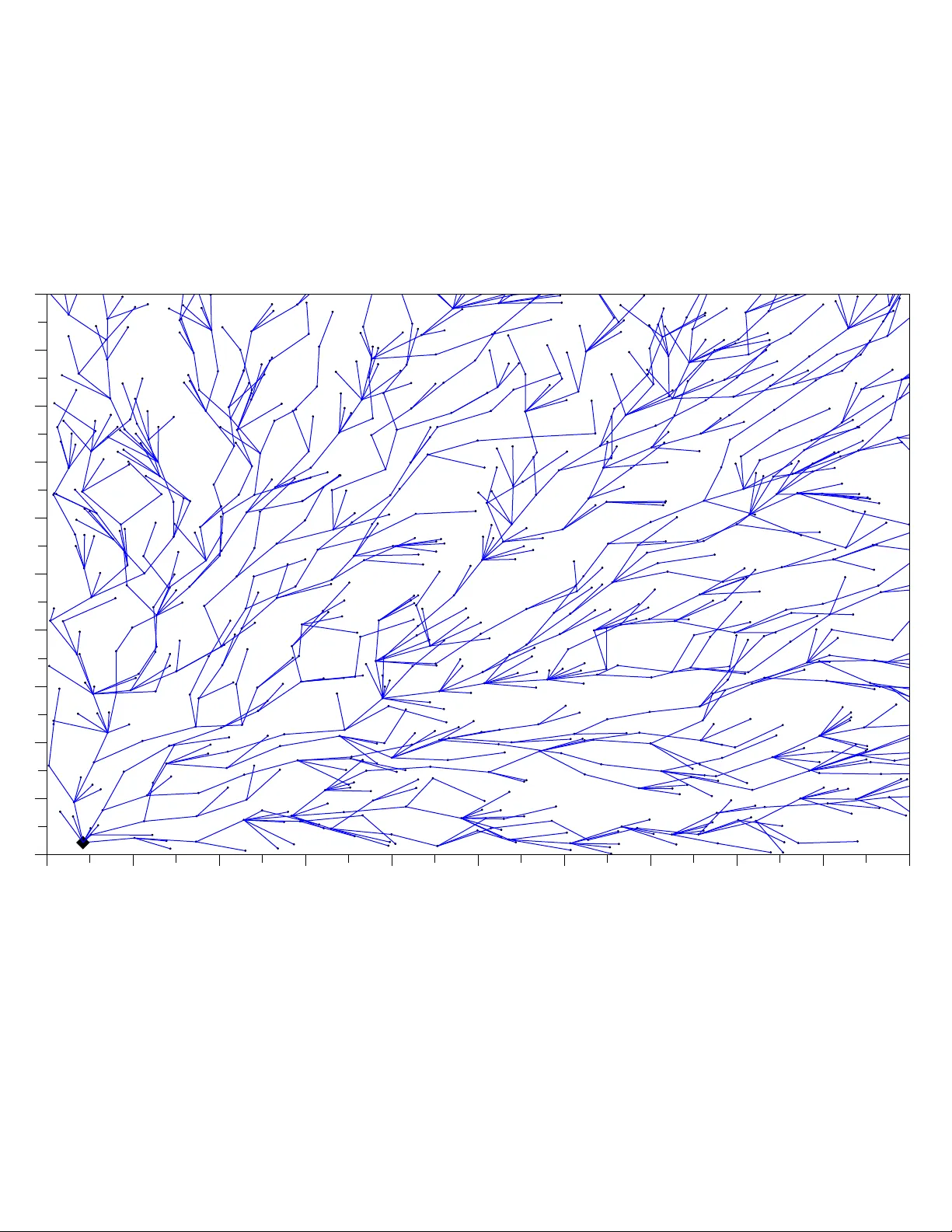
Statele ss and Deli v ery Guaranteed Geometric Routing on V irtual Coordinate Sys tem Ke Liu and Nael A bu-Ghazaleh CS De pt., SUNY Bing hamton {kliu, nael}@cs.bi nghamton.ed u Abstract — Stateless geographic routing provides r ela- tive ly goo d perf ormance at a fixed ov erhead, which is typically much lower than conv entional routing p rotoco ls such as A OD V . Howev er , th e perf ormance of geog raphic routing is impacted by physical v oids, and localization errors . Accordingly , virtual co ordinate systems (VCS) were proposed as an alternative approach that is resilient to localization er rors and that naturally routes around phys- ical voids. Howe ver , VCS also faces virtual anomalies, causing their perform ance to trail geogra phic routing. In existing VCS routing protocols, there is a lack of an effectiv e stateless and d eliv ery guaranteed complementary routing algorithm that can b e used to traver se voids. Most proposed solutions use variants of flooding or blind searching wh en a void is encountered. In this paper , we propose a spanning-path virtual coordinate system which can be used as a complete ro uting algorithm or as the complementary algorithm to greedy forwarding that is in vok ed when v oids are encountered. With t his approach, and f or the first time, we demonstrate a stateless an d delivery guaranteed geometric routing algorithm on VCS. When used in conjunction with our p re viously propose d aligned virtual coordinate system (A VCS), it out-perform s not only all geometric routing protocols on VCS, but also geographic routing wit h accurate location information. I . I N T RO D U C T I O N In contr ast to trad itional ad hoc routing proto cols such as A ODV [31], Geogr aphical routing [2], [14], [16], [17], [ 8], [ 15], [21], [9 ], [22], p rovides attractive proper ties for multi-h op wireless networks. Specifically , geogra phic routing opera tes via local in teractions amo ng neighbo ring nodes and requires a fixed and lim ited amount of state informatio n that d oes not gr ow with the nu mber of communica ting nodes, (theref ore, it is called sta teless ). Nod es exchang e location info rmation with their neighb ors. Packets addressed to a destination must provid e its location . At every in termediate hop, the subset o f the neighb ors that are closer to the des- tination than the current no de is called the fo rwarding set (FS). Routing simply forwards a p acket to a node in FS, typ ically the on e closest to the destination. This process is repeated gree dily until the packet reaches the destination. Thus, intera ctions are localized to location exchange with direct neighb ors. Geograp hical routing protocols su ffer from signifi- cant prob lems un der realistic operation. First, voids – intermediate node s whose FS r elati ve to a d estination is empty– can cause the g reedy algo rithm to fail [2], [14], [5], [8]. V oid s requir e a some what complex and ineffi- cient complementary ro uting algor ithm (e. g., pe rimeter routing ) th at is in voked when they are encounter ed. Perimeter r outing requ ires mor e inform ation in addition to th e lo cation of neigh bors [15]. M oreover , geographic routing has been shown to be sensitive to lo calization er- rors [11], especially in the pe rimeter routing phase [1 5], [34]; su ch er rors can cause ro uting anoma lies ranging from subo ptimal paths to loo ps and failure to deliver packets. Making ge ograph ical routing protocols practical is extremely difficult [1 5]. Routing based on V irtual Coordinate Systems ( VCS) has been recently p roposed [25 ], [3], [28], [ 4], [7], [20], [18] to add ress some of the shor tcomings of geogr aphic routing . A VCS o verlays virtual coordina tes on the nodes in the network b ased on th eir network d istance (typically in terms of number of hops) from som e fixed refer ence points; the coord inates are co mputed via an in itialization phase. The virtual coor dinates serve in place o f th e geo- graphic location for pu rposes of geog raphic forwarding; that is, in these algorithms the FS is the set of nodes that a re clo ser to the destination than the curren t node, based o n a function that co mputes distance between points in coo rdinate space (e.g., Cartesian distanc e, or Manhattan distance). Because it does not req uire pr ecise location in formation , VCS is n ot sensitive to lo calization errors. Furth er , it is argued that VCS is no t susceptible to conventional v oids becau se the coo rdinates are b ased on connectivity an d not physical distance [ 3]. On the negativ e side , VCS may be sen siti ve to collision s and or signal fading effects in the initialization phase. Fur- thermor e, the in itialization phase requires a flood fr om each r eference point. Fin ally , the coordin ates should be refreshed period ically if the network is dyna mic. Both geog raphic and vir tual coord inate rou ting repr esent instances of geometric r outing . Existing research work in geome tric routin g pr otocols concentr ates on op timizing different aspects of existing coordin ate systems [14], [2], [15], [9], [3], [7], [20], [18]. Why and how the virtual anomalies occur in VCS routing is a top ic that has not re cei ved atten tion. In previous work, we categorized some of the r easons b ehind VCS anomalies, [24], [23]. For example, we id entified and explained the disconn ected VCS zone prob lem ( where uncon nected nodes may receiv e the same coo rdinates). W e also iden tified a group o f ano malies that arise due to the quantization err or present in an integer VCS being overlayed over a co ntinuou s sp ace. Howe ver , a systematic analysis o f a ll the causes r emains elusi ve. The first co ntribution of this paper is to analy ze the reason s causing the virtual ano malies systematically from the pe rspectiv e of the limit of gra ph connec ti vity . More specifically , s ince the co nnectivity of the n etwork’ s mapping graph in pr actice varies, with regions th at are not well connected, the uniqueness o f nodes’ coordinate identities also varies, causing any VCS with a fixed num- ber of anchors to p otentially fail to pr ovide guarantee d delivery . For example, a 1-c onnected network (linear chain) do es not benefit from VCS with more than 1 virtual dimen sion, and mean while, an n-c onnected gr aph may benefit from inc reasing numb er of virtual dimen- sions ( anchors) beyon d n . Conseq uently , in prac tice, any VCS with an arbitrary number of virtual dimensions may suffer from d egraded connectivity and end up with multiple nod es sharing the same coordinate value in the network. The secon d contribution of this paper is to propo se a n ew VCS: Sp anning- Path virtual coor dinate system (SPVCS), providing a u niv ersal un ique id entity to any node in network, based on the conservati ve assumptio n that the n etwork is only 1- connected (if a network is 1 +- connected , it is also 1-conn ected). Based on SPVCS, a stateless and guaranteed l oop-f ree geometric routing path can be con structed. W e ca ll this routing alg orithm the Spanning -Path Geometric Rou ting (SPGR) algorithm. An o ptimization of SPVCS is also p roposed (OSPVCS), which improves the routing p erforman ce in term of path stretch of SPGR. The third co ntribution of this pap er is to explore using SPGR with our previous work, the aligned virtual coordin ate system ( A VCS), lead ing to a stateless and delivery guaran teed geom etric r outing protocol with a much better path stretch relative to other VCS and geo- graphic routin g protoco ls. Specifically , in this ap proach , we use the efficient A VCS for the gre edy phase of the algorithm , reserv ing SPGR for the comp limentary ph ase when an ano maly is encou ntered. W e call the resulting protoco l the aligned gr eedy and span ning-p ath (A GSP) routing protocol. W e use simulation to compar e th e perform ance o f geometric ro uting pro tocols on different coo rdinate sys- tems, such as geograph ic coordina te system, VCS, the aligned VCS and SPVCS. Th e experimental results show that AGSP o n A VCS and SPVCS outperform oth er other geometric routin g p rotocols including GPSR/GFG [14], [2], L CR [3] and BVR [ 7]. The remaind er of this paper is organize d as fo llow: Section II pr ovides an overview of back groun d and related works. After analyzing the systematic reason causing virtu al anom alies with VCS in Section III, we present the design of Spannin g-Path VCS and the routing protoco l that uses it in Section IV. In Section V, the experimental study is presen ted to compar e most exist- ing geom etric rou ting p rotocols o n different coordinate system. Finally , we conclude in Section VI. I I . B AC K G RO U N D A N D R E L AT E D W O R K Stateful hop-cou nt based rou ting pr otocols such as A ODV [31], ar e co mmonly- used in Ad ho c ne tworks. A variant, called Shortest Path (SP), can be used in sensor network s where d ata is fu nneled to a f ew sink s: in SP , data sinks send periodic network-wide beaco ns (typically using flooding ). As no des receive the beaco n, they set their n ext hop to be the node fr om which they received the beacon with the shor test num ber of ho ps to the sink. Thus, with a single network wide broadcast, all nodes can con struct routes to the originating node . SP gen erally pr ovides the o ptimal path in ter ms of path length. Howe ver , it is a stateful and reactive protocol: for each data sin k, the forwardin g path is n eeded befor e data transmission can begin. The requir ed storag e in creases with the n umber of destination s in the network. Fu rther- more, SP is vu lnerable to mobility o r o ther changes in the topology . T o coun ter these disadvantages, stateless geometr ic routing protoco ls wer e proposed . GFG [ 2], and the very similar GPSR [1 4], are th e earliest and most widely u sed of this class o f protoco ls. They consist of a Greedy For- warding (GF) phase where each node forwards packets to the neigh bor th at will bring the p acket closest to the destination. Each node tracks only the loca tion informa- tion of its neighb ors. Based o n this inform ation, for a packet with a giv en destination, a node can determ ine the set of neigh bors closer to th e destination th an itself; this set is called the forwarding set for this destination. GF pr oceeds by pick ing a node fro m this set, typically the closest to the de stination. 2 It is possible that GF fails, if the fo rwarding set is empty: a vo id is encoun tered. A complementa ry p hase of the algorithm is then inv oked to traverse th e v oid. T yp ically , face routing o r perimeter rou ting; this is an approa ch based planar graph theory . The general id ea is to attempt to route arou nd the void using a right hand rule that selects n odes aro und the perim eter of the void ( details may b e fou nd in the orig inal paper [14]). This appro ach is continu ed u ntil a node clo ser to the destination than the v oid origin is encountered ; at this stage, op eration switches back to gr eedy forwarding . Howe ver , a problem arises if th e p erimeter routing intersects itself – th ere is a d anger th at the p acket gets stuck in a lo op. Thu s, a tech nique f or plan arizing the graph to av oid the use of in tersecting edges is nee ded: Relative Neighborhood Graph (RNG) and Gabriel Gr aph (GG) are 2 kin ds o f such p lanarization tech niques. GPSR and other geograp hic routing protoc ols are vulnerab le to lo calization error s. Since GPS d e vices are costly , th ey may not b e feasible for sensor networks; often, localization algor ithms ar e employed that signif- icantly incr ease the u ncertainty in the loca tion estimate (e.g., [29], [12], [1 0]). The degree of error in th e location estimate de pends on the loca lization mecha nism (an error up to 40% of the radio range is consider ed a comm on case). Both the greed y f orwarding a nd face routing phases are susceptible to localization errors [11], [34]. While so me appr oaches to toler ate location err ors have been suggested, in gener al, this remain s a weakness of this class of protocols. Further , the paths con structed by face routing are typically extremely inefficient, espe- cially if the network is dense. Thus, additional routing protoco ls have attempted to optimize the face r outing phase of oper ation [ 8], [5], [6], [21], [ 9], [2 2]. Howev er , most of these works o ptimize face routing in term of path q uality , but tend to increase the overhead and the complexity . Th ey do not address th e ef fect of loc ation errors on the imp roved schemes. Routing b ased on a co ordinate system, rather th an location, was first proposed by Rao et al [32]. Howe ver , this ap proach requir es a large nu mber of nodes to serve as v irtual coord inate anchor nodes ( sufficient to form a boun ding polyg on arou nd the remain ing sensors). The drawback of having many referen ce poin ts is that forming co ordinates r equires a long time to con verge; the same is true for the overhead to refre sh coordinate s. Instead of using the virtual co ordinates directly fo r routing , Rao et al use them to estimate location fo r use in geographic routin g. Reach-ability is an issue in this protoco l as geograph ic locatio n is appro ximate; recall that it has been shown that both the greedy fo rwarding and the face rou ting phases of ge ograph ic ro uting ar e susceptible to localization errors. Similar approaches that use VCS to aid lo calization have bee n also used by other works [26], [29]. Essentially , these works collapse the orig inal VCS coordinates back into 2 g eograph ic coordin ates for the purpose o f r outing. GEM [ 27] pro posed routin g based on a virtual co or- dinate system. A virtual polar c oordinate spac e (VPCS) is used for localizing each nod e in the ne twork. A tree- style overlay is then used for ro uting. Thus, GEM is not stateless. Further , GEM works only as a lo calization algorithm , generally does not provide guaranteed unique- ness of nod e identity based on coordinates. Since it uses the VPCS to lo calize the network first, it tolerates on ly up to 10% lo calization err or [27]. Caruso et al pro posed the V irtua l Coor dinate assign- ment protocol (VCap) [ 4]. Se veral similar protoco ls are also prop osed [2 5], [28], [3], [ 7], [20], [24], [23], [18]. In this appro ach, co ordinates ar e constructed in an in i- tialization ph ase relativ e to a num ber of refer ence points. Follo wing this initialization ph ase, packets can b e ro uted using the Greedy Forwarding principles, rep lacing n ode location with its coordin ates: th e fo rwarding set consists of neighbo rs whose co ordinates are clo ser (different distance function s ha ve been propo sed) t o the destination than the curr ent nod e. Caruso et al advocate th e u se of 3 reference points to assign th e virtual coordin ates, constructing a 3-d imensional VCS. W e showed that this 3D VCS may not sufficient to m ap the network effecti vely[24 ]. VCap, even with 4 coordin ates p erforms significantly worse tha n GPSR b oth in d eli very ratio (node pair r each-ability) and p ath quality . Qing et al propo sed a similar pr otocol to VCAP , called Lo gical Co- ordinate Routing (L CR), with 4 reference nodes located at the corners of a rectang ular area [3]. LCR propo ses a b acktracking algor ithm for traversing voids; howe ver , it requires that ea ch node remem ber e very p acket that passes through it. Rodrigo et al propo sed be acon vector routin g ( BVR) [7], which forms a VCS with a large numb er o f anchors (typically 10 to 80 ). BVR uses Man hattan-style distance, whereas VCAP and LCR use Euclidean d istance, to measure distance between two given coord inate po ints. BVR uses such a large n umber of a nchors to in crease the possibility o f BVR r outing success in the greedy mode. Howe ver , even with so many an chors, BVR fails freq uently for scenario s that we ev aluated. BVR propo ses the use of a backtr acking approach upon failure to forward packets back to the reference node clo sest to the destination when greed y forwarding fails. Once the b eacon receives this packet, it floo ds it to wards the 3 destination. Few works have e xplicitly analyzed the reasons behind VCS co ordinate routing failures. Mo reover , existing p ro- tocols for complementary rou ting ar e heuristic in nature, and often qu ite complex in terms o f their state req uire- ment. In previous work, we identified quantizatio n errors as on e of the reasons f or VCS anomalies, and propo sed an aligned vir tual coo rdinate sy stem, w here eac h n ode av erages its coordinates with those of its neighbors, to reduce this quan tization erro r [23]. A VCS significantly reduces, but does no t comp letely elimina te, the onset of anomalies in VCS. Leong et al propo sed a similar improvement to A VCS which they call GSpring [20]. Howe ver , G Spring requ ires a dy namic r e-construc tion of the vir tual co ordinate system during rou ting, leading to a long convergence time. Mor eover , their achieved perfor mance does not e xceed that of A VCS. Huang et al pro posed network dilation [13] to resolve similar anomalies; Dilation require s a complicated mathem atic model, an d no routing pr otocol has been demo nstrated to capitalize on it. Papadimitriou and Ratajczak [ 30] conje cture that a greedy embed ding can be always foun d in a 4 -connecte d graph, which means if a network is 4-connected, we can always find a g reedy r outing alg orithm to be deliv ery guaran teed. Furth ermore, Rote and B ´ an ´ any proved that ev ery plan ar 3-co nnected g raph c an b e emb edded on the plane so that gr eedy routing works [33], [1]. Howe ver , in reality , a fully 4- connected graph is n ot a common network topology . A 3-connected p lanar graph is e ven more difficult to con struct since most existing g raph planarizing algorithm requires th e physical coo rdinates of all n odes in network [19]. I I I . W H AT C AU S E S V I RT UA L V O I D ? In previous work [24], [23], we an alyzed se veral categories of virtu al anomalies. Althoug h some reasons for virtu al anomalies were identified, some anom alies remained unexplained. In this section, we generalize the explanation virtual anomalies and show ho w this rea- son subsumes the explanation for the virtual coo rdinate anomalies presented in our previous work. A. Dimension De gradation In virtual co ordinate systems (VCS), it is d esirable to min imize the onset of a nomalies so that g reedy forwarding works mo re frequen tly . The intuition b ehind some of the emerging VCS designs is that the uniqueness (measured in terms of perc entage un ique no de labels) of the naming algo rithm is positively rela ted to the number of d imensions in a VCS. This intu ition is b ased on an implicit assump tion: the network is N-conne cted fo r (0, 4, 10, 10) (1, 3, 9, 9) (2, 2, 8, 8) A B D C (3, 1, 9, 9) (4, 0, 10, 10) (3, 3, 7, 7) (4, 4, 6, 6) (5, 5, 5, 5) (4, 4, 6, 6) (5, 5, 5, 5) (6, 6, 4, 4) (6, 6, 4, 4) (7, 7, 3, 3) (8, 8, 2, 2) (9, 9, 1, 3) (10, 10, 0, 4) (10, 10, 4, 0) (9, 9, 3, 1) Cloud P Q Fig. 1. Example: Dimension De gradati on an N-dimensional VCS and the uniqu eness continues to increase as th e numb er of dime nsions increases. Figure 1 shows a n etwork with a 4-d imensional VCS, by setting 4 a nchor nodes at n ode A, B, C and D. The network is just 2-conn ected. And th e highest degree of any vertex is only 3. In this case, the 4-dimensiona l VCS do es no t increase the naming uniquen ess from a 2-d imensional VCS with anch or no des as A and C (or B and D). Th e nodes in the middle Cloud can mostly fin d another no de with the same identity , either in a 2-dime nsional or 4- dimensiona l VCS, excep t the vertex cu t n odes P an d Q. Con tinuing to inc rease th e nu mber of d imensions of the VCS would not help the naming uniqueness, if the additional anchors locate o utside the cloud. W e call the h ighest number of VCS dimensio ns can be u sed to increase n aming unique ness the dimension ; when th is dimension is less than N we refer to this ph enomen a as dimension de gradation . Definition 1 : Given a g raph G ( V , E ) , a compo nent of it is a gr aph G ′ ( V ′ , E ′ ) where V ′ ⊆ V , E ′ ⊆ E an d | V ′ | ≥ 2 . Definition 2 : A no de cut (o r a vertex cut) of a compon ent C ( V ′ , E ′ ) is a set of no des V c ⊆ V ′ where removing V c will disconne ct the rest of C fr om G − C or | V ′ | = | V c | . Definition 3 : The connect ivity o f a graph G is the minimum size node cut. A graph is k -connected if its connectivity is at least k . Definition 4 : A determinant component of a net- work with VCS, is a com ponent of th e ma pping graph of th is network, con taining one or more VCS an chors. An indeterminate component is a compon ent which is not determinant. Definition 5 : The virtual co ordinate uniqueness de- gree U d of a VCS is the n umber o f u nique vir tual coordin ates of all nodes. Definition 6 : A dimensional degradatio n D d is the maximal number of dimension s of a network wh ich can increase its U d . 4 For example, if the U d of a n-dimen sional VCS o n a network is x , and the U d of a (n+1)-dim ensional VCS is also x , we say the D d of this n etwork is n . Theorem 3.1: T he D d of a 1 -conne cted graph is 1 . Pr oof: Su ppose a graph (of s ome network) G ( V , E ) is 1 -con nected, and th e vertex cut is v ∈ V ′ , wh ere C ( V ′ , E ′ ) is an indeterminate compon ent of G and | V ′ | > 1 . In 1-dim ensional virtual coordinate system, the virtual coor dinate v alue of v is P (1) = ( p 1 ) . For ∀ v i ∈ V ′ , its network distance to v is d i (in nu mber of hops). W e can directly infer the virtua l coord inate value of v i is P (1) i = ( p 1 + d i ) . W e need to p rove th at ∀ v x , v y ∈ V ′ if P (1) x = P (1) y , then in 2- dimensional virtual coordinate system, P (2) x = P (2) y . Since P (1) x = P (1) y ⇒ P (1) x = ( p 1 + d x ) = P (1) y = ( p 1 + d y ) ⇒ d x = d y If P (2) v = ( p 1 , p 2 ) , then ⇒ P (2) x = ( p 1 + d x , p 2 + d x ) = ( p 1 + d y , p 2 + d y ) = P (2) y Lemma 3. 2: For any k -con nected graph G ( V , E ) , the D d ≥ k . Pr oof: W e u se contradiction to prove. Suppose D d < k . ⇒ ∃ v x , v y ∈ V c : P ( D d ) x = P ( D d ) y W e may simply elect v x to be a new dimension an chor, then P ( D d +1) x = ( P ( D d ) x , 0) Since the network distance − − → v x v y = d xy > 0 ⇒ P ( D d +1) y = ( P ( D d ) y , d xy ) 6 = P ( D d +1) x Contradict Theorem 3.3: T he D d of a co mplete graph G ( V , E ) , is | V | − 1 . Pr oof: A comp lete g raph G ( V , E ) is | V | − 1 - connected . B. Gr eedy F orwar ding F ailur e: Lack of Naming Uniqu e- ness All routin g failur es of gree dy forwarding on VCS including those in the previous sectio n and our previous work [24], [2 3], are ca used by som e nod es with the same iden tity occur ring in the network. For example, the Exp anded VC Zon e anom aly and the Disconnected VC Zone a nomaly in a 3 -dimension al VCS [24] ar ise because the g raph of the network is 4-c onnected , which requires 4 or more anchors ( dimensions) to be present the network to produce a virtual coord inate sy stem with the maximal n aming unique ness. I n some r andomly deployed network, th e graph m ay be 1-con nected or 2- connected . Anomalies in such network’ s VCS [23] is caused by dimensional degradatio n, which may be only 1 or 2. In crease th e virtual coo rdinate dim ensions does not increase the n aming uniqu eness. I n a w ord, the an omalies in VCS are caused by either the limitation of dimensional degradation limiting the un iqueness, or d imensions does not r each the dimension al degradation – its num ber of anchor s is not suffi cient. Although b ased o n the Papadimitrio u-Ratajczak c on- jecture [ 30], Rote and B ´ an ´ any proved that a gr eedy embedd ing exists in any g i ven 3-con nected planar graph [33], [1]. In reality , a network with a 3-co nnected pro - jected graph is n ot always a vailable. A typical deployed network contains some n odes with degree 1, and m any nodes with d egree 2. Mo reover , the require d planar iza- tion may make it even th e situation worse by removing links, leading to a planar graph with lower connec ti vity . Thus, increasing the number of an chors (dimen sions) in VCS does not always make gree dy fo rwarding al ways successful due to d egraded dimen sionality . Finally , f or a complete grap h, without a | V | − 1 - dimensiona l VCS, there will always b e some nodes with same iden tity (virtual coord inates). But the | V | − 1 - dimensiona l VCS is no better than shortest path rou ting which we want to av oid. I V . S PA N N I N G P A T H V I RT UA L C O O R D I N A T E S Y S T E M In section I II, we saw that the re ason causing rou ting failure in VCS is the lack of namin g u niquen ess. In the worst case, the connectivity of a network’ s map ping graph is 1 . A consequen t o bservation is that a VCS constructed o nly b y the network d istance ( number of hops) to a nchors can not provide naming u niquene ss fo r general graph s. W e pro pose here a ne w VCS naming approa ch, on which a stateless ro uting protocol can guar- antee packet delivery . W e call the VCS the Spa nning- Path V irtual Coordinate System (SPVCS). In contrast to existing VCS, SPVCS assumes a connectivity no bigg er than 1. A. Spann ing-P ath VCS: Setup A good routing protocol must set up on a good naming base, which sh ould gi ve eac h n ode an u nique identity . Under the conservative assumption that a network is only 1-co nnected, we can not d epend on increasing th e number of an chors (or say , dimensions) of VCS as a way to p rovide this uniq ueness. The design of SPVCS is based on a dep th-first sear ch algorithm . A tree- style top ology is con structed with o nly connectio n inform ation. Any no de can be chosen as 5 the naming root. V alue 0 is assigned to root nod e as its spanning -path v irtual coordinate (SPVC). The root node would start the n aming pro cess by send ing a depth-fi rst sear ch naming packet to o ne o f its n eighbor, serving as its namin g child . On receiving a d epth-first sear ch n aming packet, each node would be assigned an uniqu e iden tity (name) incrementally to the SPVC value of its sender . Th e sender of this dep th-first sear c h naming packet is mar ked as the receiv er’ s p arent. If a node has any n eighbo r th at has no t b een assigned a SPVC, it would send a depth- first searc h naming packet to this neighbo r . Otherwise, if all its neighbo rs are assigned a SPVC accor dingly , it would d ecide that it is an end on the span ning-pa th, and sends an end - of-sear ch naming p acket to its paren t, contain ing the maximal SPVC v alue of all its child ren. On re cei ving an end-of- sear ch naming packet, a node would eithe r send another dep th-first sear ch naming packet to one of its neighbo rs which has not bee n assigned a SPVC, with the replied SPVC value in the recei ved end-o f-sear ch naming packet if applicab le. Or if all its neighbors are assigned with SPVC, it would forward this end- of-sear ch n aming packet to its paren t. This p rocess would r epeat un til the root n ode receives a n end- of-sear ch na ming packet and finds all of its neighbors are assigned som e SPVC. As long as the n etwork is conn ected, all no des rece i ve a unique identifier . The pseudo -algorith m of SPVC naming process is summarized algorithm 1, where the S etupS P V C ( node ) is a recursive function used to set the spannin g-path virtual coordina te values of node , as algorithm 2. Algorithm 1 Set up the SPVCS of ne twork anchor ← AnchorS electF unction () anchor .spvc ← 0 anchor .max range ← 0 anchor .max range ← S etup S P V C ( anchor ) Algorithm 2 Set up Spann ing-Path V irtua l Coo rdinate Recursiv ely Function S etupS P V C ( root ) fo r all node in root.neighbors do if node is not set then node.parent ← root node.spvc ← root.max range + 1 node.max range ← node.spv c root.max range ← S etup S P V C ( node ) end if end f or Return root.max r ang e A B D C 0 1 2 16 17 3 4 5 6 7 15 14 13 8 9 10 11 12 Fig. 2. Example: Spanning-Path VCS B. Spann ing-P ath Geometric Routing Based on the Sp anning -P ath V irtual Coo r dinate S ys- tem (SPVCS), a stateless and delivery gu aranteed geo- metric ro uting can be constructed . Suppose a node with SPVC value x (ref erred as node X) needs to send a packet to anoth er n ode with SPVC value y (referred as node Y) . It would mark e ach n eighbor ’ s range as the neighbo r’ s SPVC value and its max-child SPVC value. A neigh bor whose range contains the destina tion node’ s SPVC value y , is called a fo rwar ding candidate . Th ere are at most two forwarding cand idates amo ng the no de’ s neighbo rs, one of which is its par ent. T he n on-par ent forwarding candida te is preferr ed. This pro cess would be repeated by any node rece i ving th is packet, u ntil nod e Y receives the packet. Th e algorithm can be summarized as algorithm 3. Algorithm 3 Spannin g Path Routing o n VCS Procedure S P R ( sour ce, destination ) if source = de stination then Return end if fo r all node in source.neighbors do if nod e 6 = source.parent then range ← (node.spv c, node.max range) if destination.sp vc ∈ range then nextho p ← node S P R ( nexthop, destination ) Return end if end if end f or nextho p ← source.parent S P R ( nexthop, destination ) Spanning-Path Routing Example Let’ s use the SPVC value of each nod e as its ID since th is value is unique. In the figure 2 , the node 5 ne eds to send a packet to nod e 1 4. In th e VCS shown in figu re 1, the greedy forwarding will fail since the so urce has th e same 6 identity as destination. In SPVCS, no de 5 first check all its neighbor s’ ranges: node 4 ’ s range is (4, 15 ), n ode 6’ s ran ge is ( 6, 15). the destination SPVC is 14, so both neighbo rs are forwarding candida tes. And node 4 is nod e 5’ s parent, node 5 would forward the packet to node 6. Node 6 will repeat the pr ocess to for ward packet to no de 7. Node 7 ’ s neigh bors ran ge are no de 6 (6, 1 5), no de 8 (8, 12) an d no de 1 3 ( 13, 15). Node 7 would forward packet to nod e 13 . And finally , nod e 1 3 forwards p acket to node 1 4. As we ca n see, the spann ing-path geo metric routin g is stateless and definitive: a ny forwarding n ode only needs the SPVCs of all its neighb ors and the destination to make r outing d ecision, with out any repeat link on path. Theorem 4.1: Sp anning- Path Geom etric Routing is delivery guaranteed , if the ne twork is conn ected. Pr oof: Sinc e G ( V , E ) is con nected we have ∀ v ∈ V : v .spv c ∈ anchor .rang e ∀ v ∈ V : v .spv c ∈ v .par ent.r ang e ⇒ ancho r is definitive reachable where d efinitive reachable mean s n o repe at link on p ath. And ∀ v ∈ V : ∃ n ∈ an chor .neighbors , v .spv c ∈ n.ran g e ⇒ v is definitive reachable C. Optimized Spann ing-P ath VCS The DFS based constructin g proc edure of Span ning- Path VCS leads to an un-balanced tree, sho wn as fig ure 3. Quite path es con structed o n Spann ing-Path VCS n eed to g o thr ough the a nchor nod e. A con structing proced ure based on the br eadth- first sear ch (BFS) lead SPVCS to a balan ced tree topo logy , shown in figure 4. Th e algorithm can b e summar ized as algorith m 4, where the S etupO S P V C ( node ) is shown as algo rithm 5. D. A ligned Greedy an d S pannin g-P ath Routing (AGSP) Since the spanning- path rou ting do es not provide a greedy algorithm which shows a perfo rmance com para- ble to the optimal solution – the shorte st path routing [23], to use SPR as complemen tary routing to greedy forwarding is ra tional. A s we will show with experiment in section V, SPR collab orating with gr eedy forward- ing will gen erate path with much better stretch. The routing a lgorithm of alig ned g reedy and spannin g-path routing can be summarized as algorithm 6 , wh ere th e S etupAV C S ( N etwor k ) is to set up the aligned virtual coordin ate system, o n w hich the gr eedy fo rwarding can be used as GF onAV C S ( sr c, dst ) . Algorithm 4 Set up the parent of n odes in Optimized Spanning -Path VCS Procedure S etupP ar ent ( a nchor ) anchor .parent ← anchor enqueue(an chor) while queue is not empty do node ← dequ eue() fo r all n in node.neighbors do if n.parent is no t set and n is not in queu e then n.parent ← nod e enqueue(n ) end if end f or end while anchor .spvc ← 0 anchor .max range ← 0 anchor .max range ← S etup OS P V C ( anchor ) Algorithm 5 Set up the Optimized Spanning -Path V ir- tual Co ordinate Function S etupO S P V C ( r oot ) fo r all n in root.neighbors do if n.parent is roo t then n.spvc ← root.max range n.max range ← n.spvc root.max range ← S etup OS P V C ( n ) end if end f or Return roo t.max range Algorithm 6 Aligned Greedy and Spannin g-Path Rout- ing S e tupAV C S ( N etw or k ) S e tupS P V C S ( Anchor ) fo r all node src in Network do fo r all node dst in Network - { src } do current ← src while current 6 = dst do nextho p ← GF onAV C S ( nex thop, dst ) if ne xthop = current then S P R ( cur r ent, dst ) else current ← ne xthop end if end while end f or end f or 7 0 2 4 6 8 10 12 14 16 18 20 0 2 4 6 8 10 12 14 16 18 20 Fig. 3. Sample SPVCS: Anc hor at Ce nter 0 2 4 6 8 10 12 14 16 18 20 0 2 4 6 8 10 12 14 16 18 20 Fig. 4. Sample: Optimized SPVCS – Anchor at Center V . E X P E R I M E N TA L E V A L UA T I O N In this section, w e p resent an exper imental e valua- tion of th e Spannin g Path V irtual Coor dinate System (SPVCS) in comp arison to the compleme ntary rou ting protoco ls in existing g eometric protocols o n physical coordin ates (Geo CS) and virtual co ordinates Systems (VCS). The ev aluation tracks the average path stretch relativ e to SP . W e also simulate A GSP , which uses aligned vir tual coo rdinates, and switches to SPVCS when ano malies are enc ountered . W e use a custom simulator written in C, to abstract away the details of the channel and n etworking pro tocols. W e study both random (u niform ) and a custo m “C” deployment. In the uniform scenarios, each node’ s loca- tion is g enerated un iformly acr oss the simulation area. For these scenarios, each po int re presents the av erage o f 30 scenarios of 1000 nodes that are deployed 10 0 × 10 0 unit a rea; in the custom scen arios, ea ch p oints rep resents the a verage o f 3 0 scen arios of 15 0 no des d eployed in a ”C” style area to create a physical void. In both cases, the number of scenar ios was sufficient to tightly bou nd the confidenc e intervals. W e simulate different densities by varying the rad io tran smission rang e. For every scenario, reach-ab ility is determined by testing packet de li very success between each pair of node s in the n etwork. Recall that the stateful SP pr ovides optima l ro uting in 12 14 16 18 20 22 24 26 1 2 3 4 5 6 7 8 9 10 Normalized Density Normalized Path Stretch Perimeter Routing on GG Planar Perimeter Routing on RNG Planar Spanning−Path Routing Optimized Spanning−Path Fig. 5. Path Stretch: Perimeter Routing vs Spannin g-Pat h Routin g 0 2 4 6 8 10 12 14 16 18 20 0 2 4 6 8 10 12 14 16 18 20 Anchor Source Destination Spanning−Path (26 hops) GG Perimeter Path (52 hops) Fig. 6. Sample P ath: Spanning-P ath vs Perime ter terms of number o f hop s; for this r eason it is used as th e baseline for ideal per formanc e in term s of pa th stretch . A. Spann ing-P ath vs P erimeter Routing Figure 5 sh ows the path stretch o f Per imeter routing (which is the complime ntary routing proto col in GPSR) with different plan arization algorithm s. The figu re also shows the per forman ce of Span ning-Path Routing on SPVCS. As the density g oes higher, Perimeter routing suffers; this is a known pro blem for perime ter ro uting, leading to an increased path stretch. Howe ver , Spanning- Path rou ting b enefits fr om the denser network because it is based o n co nnectivity instead of physical d istance. Figure 6 shows a c omparison of sample paths con- structed by Perimeter routing on GG Planar graph and Spanning -Path r outing. Although the pa th constructed by Spanning -path rou ting is longer in distan ce length, it is much shorter in n umber of h ops. B. Aligned Gr eedy Spa nning- P ath r outing Figure 7 shows the path stretch obtained by different geometric routin g protocols. As we can see, with some VCS a lignment, AGSP (Align ed Greed y Spann ing-Path) routing provides a com petitiv e pe rforman ce to that of GPSR, especially in sparse scenario s. W ithout align- ment, g reedy spannin g-path rou ting suffers fr om the lo w greedy ratio d ue to the 4-d VCS naming failures. 8 12 14 16 18 20 22 24 26 1.0 1.1 1.2 1.3 1.4 1.5 1.6 1.7 Normalized Density Normalized Path Stretch GPSR on GG GPSR on RNG BVR LCR AGSP d0 AGSP d1 AGSP d2 Fig. 7. Path Stretch: Geometric Rou tings 12 14 16 18 20 22 24 26 1 2 3 4 5 6 7 8 9 10 11 Normalized Density Normalized Path Strenth Perimeter Routing on GG Planar Perimeter Routing on RNG Planar Spanning−Path Routing Optimized Spanning−Path Fig. 8. Complementary Routing on C T opology C. Custom Deployment T o study the protocols u nder more demandin g condi- tions when un iform coverage do es n ot exist, nod es a re deployed un iformly in a C pattern, lea ving a significan t void a rea. Figur e 8 shows the path stretch o f Perimeter and Spann ing-path routing s in such scenarios scenario. As we c an see, Spann ing-path can tolerate such scen ar- ios, while Per imeter routing su ffers poor perform ance. Also, AGSP shows a near ly optimal path stretch in such scenario com pared to shortest path r outing. Mean- while, GPSR perfo rmance suf fers since its gre edy ratio drops dram atically due to the pre sence of v oids on many paths. LCR shows a similar perfo rmance becau se its backtrack ing algorithm uses blind search o f a limited number of neighbors. D. Th e Impact o f Anchor Location on SPVCS Intuitively , anch or location has significant impact on the performan ce SPVCS. Ex perimental r esults support this intu ition (Figu re 10). An anchor no de located near the center leads to the best path stretch since it can provide a more b alanced span ning-tree. Conversely , an anchor at the co rner r esults in worse perfor mance with respect to path stretch . 12 14 16 18 20 22 24 26 1.0 1.5 2.0 2.5 3.0 3.5 4.0 Normalized Density Normalized Path Stretch GPSR on GG GPSR on RNG BVR LCR AGSP d0 AGSP d1 AGSP d2 Fig. 9. Path Stretch: C T opolog y 12 14 16 18 20 22 24 26 1.0 1.5 2.0 2.5 3.0 3.5 4.0 Normalized Density Normalized Path Stretch Anchor at Center Anchor at Corner Anchor at Random Location Optimized Anchor at Center Optimized Anchor at Corner Optimized Anchor at Random Location Fig. 10. Path Stretch: Impact of Anc hor’ s Location E. Optimizing SPVCS Figure 3 shows a sample SPVCS. The SPVCS al- gorithm leads to an un balanced span ning tree of the network; clearly this is not the mo st efficient sp anning topolog y . W e seek to optimize this to pology by replacin g it with a b alanced spanning tre e, creating more effective paths, and limiting the impact of the anchor’ s location. Sample paths ar e shown in Figure 1 1. V I . C O N C L U S I O N In this p aper , we first analy ze the reasons behind geometric rou ting failure in recently prop osed VCS: dimensiona l degrad ation leadin g to the lack o f unique- ness in naming. Practically , a uniq ue id entity can not be easily assigned to any node in VCS on network, due to limitation of network con nectivity . This analysis represents a contra st to the common assump tion of most those virtual coordinate systems – the more anchor nod es (virtual coordinate dimension s), the better the uniqueness and routability . Consequently , we propo se an alternative naming al- gorithm for v irtual coordin ate systems for geometric routing pr otocols, in wh ich only one dimension ( anchor) is used. W e call this naming algorithm the Span ning- path V irtu al Coordinate System. SPVCS p rovides unique 9 0 2 4 6 8 10 12 14 16 18 20 0 2 4 6 8 10 12 14 16 18 20 Center Anchor Corner Anchor Random Anchor Source Destination Path w/ Center Anchor (10 hops) Path w/ Corner Anchor (11 hops) Path w/ Random Anchor (12 hops) Fig. 11. Sample P ath: Optimized SPVCS number s to all nodes in th e n etwork in a way that allows greedy ro utability (albeit with some path stretch since SPVCS does not use the full conn ecti vity infor mation). Upon this SPVC assignment, a stateless an d deli very guaran teed g eometric routing proto col is constructed. W e show that this p rotocol outperfo rms geogra phic routing (GPSR) [1 4], and several recently p roposed geometr ic routing p rotocols on virtual coo rdinate systems such as LCR [3], BVR [ 7] and A VCS [23]. R E F E R E N C E S [1] Imer B ´ a r ´ any and G ¨ u ntor Rote. Strictl y conv e x drawings of planar graphs. Documenta Mathmetica , 11: 369–391, 2006. [2] Prosenjit Bose, Pat Morin, Iv an Stojmeno vic, and Jorge Urrutia. Routing with guarant eed deli v ery in ad hoc wireless netwo rks. In Proc. A CM DIALM’99 , Seattl e, W A, August 1999. [3] Qing Cao and T arek F . Abdelzaher . LCR: A scalable logica l coordina tes frame wor k for routing in wirel ess sensor networks. In RTSS , pages 349 –358, 2004. [4] Antonio Caruso, Ste fano Chessa, S. De, and A. Urpi. GPS fre e coordina te assignment and rout ing in wirele ss sensor net works. In INFOCOM , pages 150–1 60, 2005. [5] Q. Fa ng, J. Gao, and L. Gu ibas. Locating and b ypassing routi ng holes in sensor netw orks. In Proce edings of INFOCOM’04 , 2004. [6] Q. Fang, J. Gao, L. Guibas, V . de Silva , and L. Zhang. GLIDE R: Gradient landmark-based distribute d routing for sensor networks. In Proc. INFOCOM , 2005. [7] R. Fonsec a, S. Ratnasa my , J. Zhao, C. Tien E e, D. Culler , S. Shenke r , and I. Stoica. Beacon vector routing: Scalable point- to-point routing in wirel ess sensornets. In Proc. of the 2nd Symposium on Network ed Systems Design and Implementation (NSDI 2005) , May 200 5. [8] Sophia Fotopoulou-Pri gipa and A. Bruce McDonal d. GCRP: Geographi c virt ual ci rcuit routing pro tocol for ad hoc networ ks. In Proce edings of MASS’04 , 2004. [9] Hannes Frey and Iv an Stojmenovi c. On deli v ery guarant ees of fac e and combined greedy-face rout ing in ad hoc and sensor netw orks. In Proce edings of MobiCom’06 , 2006 . [10] A. Haeberlen , E. Flannery , A. M. Ladd, A. Rudys, D. S. W alla ch, and L. E. Kavrak i. Practical rob ust localiz ation over large -scale 802.11 wireless netw orks. In Pr oceedi ngs of MobiCom’02 , 2002. [11] T . He, C. Hua ng, B. Blum, J. A. Stankov ic, and T . Abdelzaher . Range-fre e localiz ation schemes for large scale sensor network s. In Proc. of MobiCom 2003 , 2003. [12] J. Hightower an d G. Borriell a. Location systems for ubiquit ous computing . In IEE E Compute r , vol ume 34, pages 57–6 6, 2001. [13] Qingfeng Huang, Chen yang Lu, and Gruia-Catali n Ro man. Spa- tiote mporal m ultic ast in sensor netw orks. In Proc. of the 1st internat ional confer ence on Embedded networked sensor systems (Sensys’03) , pages 205–217, 2003 . [14] Brad Karp and H. T . K ung. GPSR: Greedy perimet er stat eless routing for wireless networks. In Pr oc. 6th Annual Internat ional Confer enc e on Mobile Computing and Networking (Mobi Com 2000) , 2000. [15] Y oung-Jin Kim, Ramesh Govindan, Brad Karp, and Scott Shenke r . Geographi c routing made practical . In Proc eedings of the Second USE NIX/A CM Symposi um on Networke d System Design and Implementati on(NSDI’05) , May 2005. [16] Fabi an Kuhn, Roger W attenhofer , Y an Zhang, and Aaron Zollinge r . Ge ometric ad hoc routing: Of theory and pract ice. In Proce edings of P ODC’03 , 2003. [17] Fabi an Kuhn, Roger W at tenhofe r , and Aaron Zolling er . W orst- case optimal and avera ge-case effici ent geometric ad-hoc routing. In Pr oceedi ngs of the 4th AC M Internati onal Symposium on Mobile Computing and Ne tworking (MobiHoc 2003) , 2003. [18] Jonathan Ledlie, Michael Mitzen macher , Margo Seltzer , and Peter Pietzuch. Wired geometric routing. In Pro ceeding s of IPTPS 2007 , 2007. [19] Ben Leong. P hd. thesis: New technique s for geographic routing, 2006. MIT . [20] Ben Leong , Barbara Liskov , and Robert Morris. Greedy virtual coordina tes for geograp hic rout ing. In Pr oceedings of ICNP’07 , 2007. [21] Ben Leong, Saya n Mitra, , and Barbara Lisko v . Pa th vector fac e routing: Geographic routing with l ocal face information. In Pr oceedi ngs of ICNP’05 , 2005 . [22] Cong Liu and Jie W u. Destination-re gion-b ased local minimum aw are geometric rou ting. In Pr oce edings of MASS’07 , 2007. [23] Ke Liu and Nael Abu-Ghazale h. Aligned virtual coordinates for greedy geometric routing in wireless sensor networks. In Proc. of 3rd IEEE int ernation al Confer ence on Mobile Ad-hoc and Sensor Network s (MASS) 2006 , Oct. 2006. [24] Ke L iu and Nael Abu-Ghaz aleh. V irtual coordinate backtr acking for void trav ersal in geographic routing. In P r ocl. of 5th Internati onal Co nfer ence on A D-HOC Networks & W ir el ess (Ad hoc Now) , August 2006. [25] T . Mosc ibroda, R. O’Dell, M. W attenhofer , and R. W attenh ofer . V ir tual coordina tes for ad hoc and sensor networks. In Proc eed- ings of ACM DIALM-POMC’04 , October 2004. [26] R. Nagpal, H. Shrobe, and J. Bachra ch. Organ izing a globa l coordina te system from local informatio n on an ad hoc s ensor netw orks. In Proce edings of IP SN’03 , 2003. [27] J. Ne wsome and D. Song. Gem: Graph embedding for routing and data- centric storag e in sensor networks without geographic informati on. In Proce edings of Sen Sys’03 , Novembe r 2003 . [28] D. M. Nicol, M. E. Goldsby , and M. M. Johnson. Simulation analysi s of virtual geographic routing. In Pr oceedi ngs of the 2004 W inter Simul ation Confere nce , 2004. [29] D. Niculescu and B. Nath. Ad hoc positioni ng system (APS). In The IEEE Global T elecommun icatio ns Confer enc e (GLOBE- COM , volume 5, pages 2926–2931, 200 1. [30] C. H. Papadimitrio u and D. Ratajc zak. On a conjecture related to geometri c routing. In P r ocee dings of AL GOSENSORS’04 , 2004. [31] C. E. Perkins and E. M. Royer . Ad hoc on-demand distance vec tor routing. In Pro ceedin gs of the 2nd IEEE W orkshop on Mobile Computing Systems and Appli cations , February 1999. [32] A. Rao, S. Ratnasamy , C. Papad imitriou, S. Shenker , and Ion Stoica. Geographic routing without locat ion info. In P r ocee dings of MobiCom’03 , 2003. [33] G ¨ untor Rote. Strictly conv e x drawings of planar graphs. In SODA ’05: P r ocee dings of the Sixtee nth Annual ACM-SIAM Symposium on Discret e Algorithms , pa ges 728–734, 2005. [34] K. Seada, A. Helmy , and R. Govindan. On the ef fect of local izati on errors on geographic face routing in sensor networks. In Proc. of IPSN’04 , 20 04. 10 12 14 16 18 20 22 24 26 1.2 1.3 1.4 1.5 1.6 1.7 1.8 1.9 2.0 Normalized Density Normalized Path Stretch Anchor at Center Anchor at Corner Anchor at Random Location 0 2 4 6 8 10 12 14 16 18 20 0 2 4 6 8 10 12 14 16 18 20 Center Anchor Corner Anchor Random Anchor Source Destination Path w/ Center Anchor (44 hops) Path w/ Corner Anchor (26 hops) Path w/ Random Anchor (19 hops) 12 14 16 18 20 22 24 26 2 3 4 5 6 7 8 9 10 Normalized Density Normalized Path Stretch Perimeter Routing on GG Planar Perimeter Routing on RNG Planar Spanning−Path Routing 0 2 4 6 8 10 12 14 16 18 20 0 2 4 6 8 10 12 14 16 18 20 0 2 4 6 8 10 12 14 16 18 20 0 2 4 6 8 10 12 14 16 18 20 0 2 4 6 8 10 12 14 16 18 20 0 2 4 6 8 10 12 14 16 18 20
Original Paper
Loading high-quality paper...
Comments & Academic Discussion
Loading comments...
Leave a Comment