Logical Queries over Views: Decidability and Expressiveness
We study the problem of deciding satisfiability of first order logic queries over views, our aim being to delimit the boundary between the decidable and the undecidable fragments of this language. Views currently occupy a central place in database re…
Authors: James Bailey, Guozhu Dong, Anthony Widjaja To
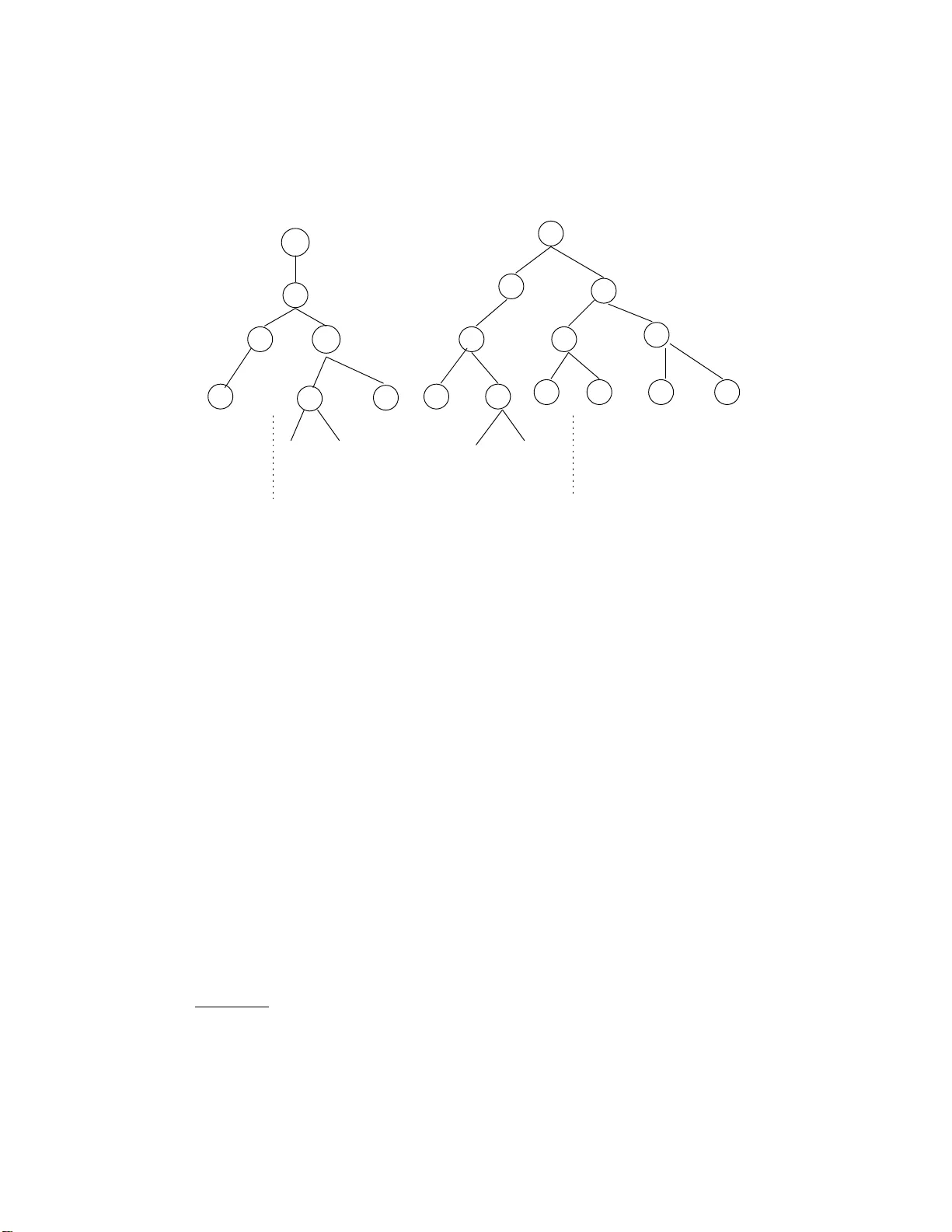
Logical Queries o v er Views: Decidabilit y and Expressive ness 1 JAMES BAILEY, The University of Mel b o urne and GUOZHU DONG, W right State University and ANTHONY WIDJAJA TO University of E dinburgh W e study the problem of deciding satisfiabilit y of first order logic queries o ve r views, our aim being to delimit the boundary b et ween the decidable and the undecidable fragments of this language. Views curr en tly occupy a cen tral place in database researc h, due to their role in applications suc h as information in tegration and data w arehousing. Our main result is the ide ntificat ion of a decidable class of fir st order queri es o ver unary conjunctive views that generalises the decidability of th e classical class of first order sen tences o ver u nary relations, kno wn as the L¨ ow enheim class. W e then demonstrate how v arious extensions of this class lead to undecidabilit y and also provide some expressi vit y results. Besides i ts theoretical interest , our new decidable class is p otentially int eresting for use in applications such as deciding i mplication of complex dep endencies, analysis of a restricted cl ass of activ e database rul es, and ontology reasoning. Categories and Sub ject Descriptors: F4.1 [ MA THEMA TICAL LOGIC AND FO RMAL LANGUA GES ]: Mathematical Logic; H2.3 [ D A T ABASE MANAGEMENT ]: Languages General T erms: Theory Additional Key W ords and Phr ases: Satisfiabilit y , containmen t, unary view, decidability , first order logic, database query , database view, conjunctiv e query , L¨ ow enheim class, monadic logic, unary logic, on tology reasoning 1. INTRODUCTION The study of v iews in relational databases ha s attrac ted muc h a tten tion over the years. Views a re an indisp ensable co mpo nent for a ctivities such as data integration and data warehousing [Widom 1 995; Garcia- Molina et al. 19 95; Le v y et al. 1996 ], where they can b e used a s “media to rs” for so urce information that is not directly accessible to use r s. This is especially helpful in mo delling the int egr ation of data from diverse sources, s uch as lega cy systems and/ o r the w or ld wide web. Much of the re search related to views has addres s ed fundamental proble ms such as containment a nd rewriting /optimisation of quer ies using views (e.g. see [Ullman 1997; Halevy 20 01]). In this pa p er, we examine the use of views in a so mewhat dif- ferent context, w he r e they are used as the basic unit fo r writing log ical expressio ns. W e provide results on the related decision pr oblem in this pap er, for a r ange o f p os- sible v ie w definitions. In particular, fo r the case wher e views a re monadic/ unary 1 A pr eliminary version of this paper appeared in [ Bailey and Dong 1999] 2 · conjunctive q ue r ies, we show that the corres p o nding query log ic is dec idable. This corres p o nds to an in teresting new frag ment o f first order logic. On the a pplication side, this decidable query lang ua ge als o has some interesting p otential applications for are a s such a s implication o f complex dep endencies, ontology reas o ning and ter - mination results for a ctive r ules. 1.1 Info rmal Statement of the Pro b lem Consider a rela tional v o cabular y R 1 , . . . , R p and a set of views V 1 , . . . , V n . Eac h view definition corres po nds to a first or der formula ov er the voca bulary . Some example v iews (using ho rn c la use s tyle no tation) ar e V 1 ( x 1 , y 1 ) ← R 1 ( x 1 , y 1 ) , R 2 ( y 1 , y 1 , z 1 ) , R 3 ( z 1 , z 2 , x 1 ) , R 4 ( z 2 , x 1 ) V 2 ( z 1 ) ← R 1 ( z 1 , z 1 ) Each such view can b e expanded into to a first or der sentence, e .g. V 1 ( x 1 , y 1 ) ⇔ ∃ z 1 , z 2 ( R 1 ( x 1 , y 1 ) ∧ R 2 ( y 1 , y 1 , z 1 ) , R 3 ( z 1 , z 2 , x 1 ) ∧ ¬ R 4 ( z 2 , x 1 )). A first or der view query is a fir s t order for mula express ed solely in terms of the given views. e.g. q 1 = ∃ x 1 , y 1 (( V 1 ( x 1 , y 1 ) ∨ V 1 ( y 1 , x 1 )) ∧ ¬ V 2 ( x 1 )) ∧ ∀ z 1 ( V 2 ( z 1 ) ⇒ V 1 ( z 1 , z 1 )) is an example firs t order view query , but q 2 = ∃ x 1 , y 1 ( V 1 ( x 1 , y 1 ) ∨ R ( y 1 , x 1 )) is not. By expanding the vie w definitions , every first order view quer y can clear ly b e re- written to eliminate the views. Hence, first order view queries can be thought o f as a fra gment of first order logic, with the exact nature of the fra gment v arying according to how expre s sive the views are p ermitted to be . F ro m a database p ersp ective, fir st o rder view queries ar e pa rticularly suited to applications where the sour ce da ta is unav ailable, but summary da ta (in the form of views) is. Since many databas e and rea soning langua ges ar e based on first order logic (or e x tensions thereof ), this makes it a useful choice for manipulating the views. Our purp os e in this paper is to determine, for wha t t yp es of view definitions, satisfiability (ov er b o th finite a nd infinite mo dels ) is decidable for the lang uage. If views can be binary , then this language is cle arly as powerful as first order logic ov er bina ry base relations, and hence undecidable (see [Bo erge r et al. 19 96]). The situation b ecomes far more interesting, when we restr ict the for m that views may take — in particula r, when their ar ity must b e unar y . Such a res triction has the effect o f cons training which pa r ts of the under lying da tabase ca n b e “seen” by the view for mula a nd als o co nstrains how such parts may b e connected. 1.2 Contributions The main co ntribution o f this pap er is the definition o f a la nguage called the first or der unary c onjunctive view language (UCV) and a proo f of its decidabilit y . As its name suggests, it uses unary arity v iews defined b y conjunctive queries 2 . W e demonstrate that it is a maxima l decidable class, in the sense that incr easing the expressiveness of the view definitions results in undecidability . Some in teresting asp ects of this decida bility r esult ar e: 2 More generally , views may b e an y existential formulas with one free v ariable, since this can b e rewritten into a disjunction of conjunctiv e formulas with one free v ariable. · 3 —It is well k nown that first o rder lo gic solely ov er monadic re la tions is decidable [L¨ owenheim 19 15], but the e x tension to dyadic re la tions is undecidable [B¨ orger et al. 19 97]. The firs t order unary co njunctiv e v iew language can b e seen a s an interesting intermediate case betw een the tw o, s inc e although o nly monadic predicates (views ) app ear in the query , they ar e intimately r elated to da tabase relations o f higher a rity . —The la nguage is able to express s ome int eres ting prop er ties, whic h might b e applied to v arious kinds of r easoning ov er o nt olo g ies. It can also b e thought of as a p ow erful generalisa tion of una ry inclusio n dep endencie s [Cosmadakis et al. 1990]. F urther more, it has an in teresting c hara cterisation as a decida ble cla ss of rules (triggers) for active databa ses. T o br iefly g ive a feel for this decidable languag e, we next provide so me example unary conjunctive views and a firs t order unary co njunctive view query defined ov er them: V 1 ( x ) ← R 1 ( x, y ) , R 2 ( y , z ) , R 3 ( z , x ′ ) , R 4 ( x ′ , x ) V 2 ( x ) ← R 1 ( x, y ) , R 1 ( x, z ) , R 4 ( y , z ) V 3 ( x ) ← R 1 ( x, y ) , R 1 ( x, z ) , R 4 ( y , y ) , R 4 ( z , x ) V 4 ( x ) ← R 1 ( x, y ) , R 3 ( y , z ) , R 4 ( z , x ′ ) , R 4 ( x ′ , y ′ ) , R 3 ( y ′ , x ) ∃ x ( V 2 ( x ) ∧ ¬ V 1 ( x )) ∧ ¬∃ y ( V 3 ( y ) ∧ ¬ V 4 ( y )) 1.3 P ap er Outline The pap er is structured as fo llows: Section 2 defines the necessar y preliminaries and background concepts. Section 3 presents the definition of the lo gic UCV. Section 4 is the co re section of the pap er, where the decida bilit y r esult for the class UCV is prov ed. Sectio n 5 shows that extensions to the languag e, such as allowing negation, inequa lity or recursio n in views, result in undecidability . Section 6 cov ers applications of the decida bilit y results and then Section 7 provides some res ults on expressiv it y . Section 8 discuss es related w ork and section 9 summarise s and discusses future w or k . 2. PRELIMINARIE S In this section, w e state basic definitions and rele v ant results. The reader is assumed to b e familia r with standar d results and notations from mathematical log ic (e.g. see [E nderton 2 001]). In the following, formulas are always first-or de r . The symbol F O denotes the se t of first o rder fo r mulas ov er any voc a bulary σ . In a ddition, if L ⊆ F O (i.e. L is a fragment of F O ), we deno te b y L ( σ ) the set of formulas in L ov er the vocabula ry σ . 2.1 First-order lo gic A (relational) vo c abulary σ is a tuple h R 1 , . . . , R n i of r elation sym b ols with each R i asso ciated with a s pe c ifie d a rity r i . A (r elational) σ - struct ur e A is the tuple h A ; R A 1 , . . . , R A n i where A is a non-empty set, called the universe (of A ), and R A i is an r i -ary relation ov er A in terpreting R i . W e refer to the elemen ts in the set A as the elements in 4 · A , or simply b y c onstants 3 (of A ). In the sequel, w e write R i instead o f R A i when the meaning is clea r fro m the con text. W e also use S T RU C T ( σ ) to deno te the set o f all σ -s tructures. W e as sume a count ably infinite set V AR of v ariables . An instantiation (or valuation ) of a structure I is a function v : V AR → I . Extend this function to fr e e tuples (i.e. tuple o f v ar iables) in the obvious wa y . W e use the usual T arsk ian notion of satisfaction to define I | = φ [ v ], i.e., whether φ is true in I under v . If φ is a se nt ence, w e simply write I | = φ . The image of a struc tur e I under a fo r mula φ ( x 1 , . . . , x n ) is φ ( I ) def = { v ( x 1 , . . . , x n ) : v is an instantiation of I , and I | = φ [ v ] } . In par ticular, if n = 0, we ha ve that φ ( I ) 6 = ∅ iff I | = φ . W e say that t wo σ -structures A and B agr e e on L iff for all φ ∈ L ( σ ) we have A | = φ ⇔ B | = φ . F ollowing the conv ention in databa se theory , the (tuple) datab ase D ( A ) c orr e- sp onding to t he struct ur e A (defined ab ove) is the set { R i ( t ) : 1 ≤ i ≤ n and t ∈ R A i } . It is eas y to see that such a da tabase can b e considered a str ucture with universe adom ( A ), which is defined to b e the set of all elements of A o ccurr ing in at least o ne relation R i , and relations built appropriately from D ( A ). Abusing ter minologies, we refer to the ele ment s of D ( A ) as tuples (asso ciate d with A ) . In addition, when the meaning is clear from the cont ext, we shall also abuse the term fr e e tuple to mean a n a tomic for mu la R ( u ), where R ∈ σ a nd u is a tuple of v ariable s . A formula φ is said to be satisfiable if ther e exis ts a structure A (either of finite or infinite size) suc h that φ ( A ) 6 = ∅ ; such a structure is said to be a mo del for φ . W e say that φ is fi nitely satisfiable if there exists a finite structure I such that φ ( I ) 6 = ∅ . Without lo ss o f generality , we shall fo cus only on sentences when we a re dealing with the s atisfiability problem. In fact, if φ has some fr ee v ariables, taking its existential closur e pr eserves satisfiability [Indeed we shall see that the languages we co nsider are clos e d under first-o rder quantification]. Given t w o σ -str uctur es A , B , recall that A is a su bstructur e of B (written A ⊆ B ) if A ⊆ B and R A ⊆ R B for every relation s y mbol R in σ . W e say that A is an induc e d substructur e of B (i.e. induc e d by A ⊆ B ) if for every relation symbol R in σ , R A = R B ∩ A r , where r is the arity of R . Now, a homo morphism from A to B is a function h : A → B such that, for every r e lation symbol R in σ a nd a = ( a 1 , . . . , a r ) ∈ R A , it is the case that h ( a ) def = ( h ( a 1 ) , . . . , h ( a r )) ∈ R B . An isomorphi sm is a bijectiv e homomor phism whose inv erse is a homomorphism. The quantifier r ank qrank( φ ) of of a for mula φ is the maximum ne s ting depth of quantifiers in φ . 2.2 Views F or our purp ose, a view over σ can b e thought of a s a n arbitra ry FO formula ov er σ . W e say that a view V is c onjunctive if it can b e written a s a c onjunctive query , 3 Although it is common in mathematical logic to use the term “constan ts” to mean the i nt erpre- tation of constant symbols in the structure, no confusion shall aris e in this article, as we assume the absence of constan t symbols in the vocabulary . Our results, nevertheless, easily extend to v o cabularies with constan t symbols. · 5 i.e. of the form ∃ x 1 , . . . , x n ( R 1 ( u 1 ) ∧ . . . ∧ R k ( u k )) where each R i is a relation symbol, and each u i is a fr e e tuple of a ppropriate ar it y . W e ado pt the horn clause style notation for writing c o njunctive views. F or example, if { y 1 , . . . , y n } is the set of free v aria bles in the above conjunctive quer y , then we can r ewrite it a s V ( y 1 , . . . , y n ) ← R 1 ( u 1 ) , . . . , R k ( u k ) where V ( y 1 , . . . , y n ) is called the he ad of V , a nd the conjunction R 1 ( u 1 ) , . . . , R k ( u k ) the b o dy of V . The length of the conjunctive view V is defined to be the sum of the a r ities of the relation symbols in the multiset { R 1 , . . . , R k } . F or ex ample, the lengths o f the tw o views V and V ′ defined as V ( x ) ← E ( x, y ) V ′ ( x ) ← E ( x, y ) , E ( y , z ) are, resp ectively , tw o and four. Additionally , if n = 1 (i.e. has a head of a rity 1 ), the view is said to be unar y . Unless state d otherwise, we shal l say “view” to me an “unary-c onjunctive view with neither e quality nor ne gation in its b o dy” . 2.3 Graphs W e use standa rd definitions from graph theory (e.g. see [Diestel 200 5]). A gr aph is a structure G = ( G, E ) where E is a binary relatio n. The girth of a g raph is the length of its s ho rtest cycle. F or tw o vertices x, y ∈ G , we denote their distance by d G ( x, y ) (or just d ( x, y ) when G is clea r from the cont ext). F or tw o sets S 1 and S 2 of vertices in G , we define their distance to b e d G ( S 1 , S 2 ) := min { d G ( a, b ) : a ∈ S 1 and b ∈ S 2 } . In a weigh ted gr aph G with weigh t w G : E → N , the weight w G ( P ) of a path P in G is just P e ∈ E ( P ) w G ( e ). W e shall write w instead of w G if the meaning is clear from the context. In the sequel, we shall frequently mention trees and forests. W e alwa ys ass ume that a ny tree has a selected no de , whic h we ca ll a r o ot of the tree. Given a tree T = ( T , E ), we can partition T accor ding to the distance of the vertices fro m the r o ot. The Gaifman gr aph (se e [Gaifman 1982]) asso ciated with a structure A is the weigh ted undirected multi-graph G ( A ) = ( G, E ) such tha t: (1) G = A . (2) The multi-set E is defined as follows: for each x, y ∈ G , we put a n R ( t )-lab eled edge xy in E with weigh t r (the a rity of R ) iff x a nd y app ear in a tuple R ( t ) in D ( A ). [Notice that the multiplicit y of xy in E dep ends on the num b er of tuples in D ( A ) that contain b oth x and y as their arguments.] Note also that the subgraph of G ( A ) induced b y the set of a ll elements of A in a tuple t is the complete gra ph K r , and so a n L -lab elled edge is adjacent to an edge e ∈ E iff all L -lab elled edges a re adjacent (i.e. co nnected) to the edge e . F or any a, b ∈ A , we define the distanc e d A ( a, b ) betw een a and b to b e their distance in G ( A ). Also, extend this distance function to tuples and sets of tuples 6 · by interpreting them as sets of elemen ts of A that app ear in them. An y pair of tuples R ( t ) and R ′ ( t ′ ) in D ( A ) are said to b e c onne cte d (in A ) if in G ( A ) so me (and hence all) R ( t )-lab eled edge is a djacent to some (and hence all) R ′ ( t ′ )-lab eled edge. 2.4 Una ry formulas A u nary formula is an arbitra r y F O formula without e quality suc h that each of its relation symbols has arity one. Let σ be a vo cabulary whose relation symbols are of arity one. W e shall use UFO( σ ) to denote the set of a ll unar y for mulas without equality ov er σ . Also, we define UFO = ∪ σ UF O( σ ). The following lemma will b e useful for pr oving expr essiveness results in Section 7. Lemma 2 .1. F or every unary sentenc e, ther e exists an e quivalent one of quanti- fier ra nk 1. Proof. By a straightf or ward manipulation. See the proo f of lemma 21.12 in [Bo olos et al. 2002]. [Their pro of actually gives more than the result they claim. In fact, their construction conv erts an arbitra ry unary sentence into o ne with one unary v a r iable and of quantifier rank 1.] 2.5 Ehrenfeucht-Fra ¨ ısse Games W e shall need a limited form o f Ehrenfeuch t-F ra ¨ ısse ga mes ; for a gene r al account, the re ader may c onsult [Libkin 2 004]. The ga mes ar e play ed by tw o players, Spo iler and Duplicator , on tw o σ -structures A and B . The go al of Sp oiler is to s how tha t the structure s a re different, while Duplicator a ims to show that they are the s ame. The game consis ts o f a single r ound. Spoiler cho o ses a structure (sa y , A ) and a n element a in it, after which Duplicator has to resp o nd by choosing a n element b in the other structur e B . Duplicator wins the game iff the substructur e of A induced by { a } is isomorphic to the substructure of B induced by { b } . Duplicator has a winning stra tegy iff Duplicator has a winning mo ve, regardless of how Spo iler behaves. Proposition 2.2 (Ehrenfeucht-Fra ¨ ısse Games). Du plic ator has a winning str ate gy on A and B iff A and B agr e e on first-or der formulas over σ of quantifier r ank 1. 2.6 Other No tation Regarding other no tation we shall use thro ughout the r est o f the pap er: we sha ll use a, b for consta nts, x, y , z for v ariables, u for free tuples, U, V for view s , U , V for sets of v ie w s , σ for voca bularies, R 1 , R 2 , . . . for relatio n symbols, A , B , . . . fo r structure s and A, B for their resp ective universes. If D is a da tabase (a set of tuples), we use adom ( D ) to denote the set of constants in D . Finally , given a a ∈ adom ( D ) and a “new” co nstant b / ∈ D , we define D [ b/ a ] to b e the database that is obtained from D by replacing e very o ccur rence of a by b . The nota tio n D [ b 1 /a 1 , . . . , b n /a n ] is defined in the sa me way . 3. DEFINITION OF FIRST ORDE R UNARY-CONJUNCTIVE-VIEW LOGIC Let σ be a n a rbitrar y voc abulary , a nd V be a finite set of (unar y conjunctive) views ov er σ , which we refer to as a σ -view s et . W e now inductively define the set · 7 UCV( σ , V ) of first or der unary-c onjunctive-view (UCV) qu eries/formulas over the vo c abulary σ and a σ -view set V : (1) if V ∈ V , then V ( x ) ∈ UCV( σ, V ); and (2) if φ, ψ ∈ UCV( σ , V ), then the formulas ¬ φ, φ ∧ ψ and ∃ xφ b elo ng to UCV( σ , V ). The smallest set of so -constructed formulas defines the set UCV( σ, V ). W e denote the set of a ll UCV form ulas over the vocabular y σ by UCV( σ ), i.e. UCV( σ ) def = S V UCV( σ , V ) where V may be any σ -view set. F urther, the set o f all UCV querie s is denoted by UCV, i.e. UCV def = S σ UCV( σ ), where σ is any vocabula ry . As usual, w e use the shortha nds φ ∨ ψ , φ → ψ , φ ↔ ψ , and ∀ xφ for (resp ectively) ¬ ( ¬ φ ∧ ¬ ψ ) , ¬ φ ∨ ψ , ( φ → ψ ) ∧ ( ψ → φ ), a nd ¬∃ x ¬ φ . Thus, the UCV language is closed under b o olean co mbinations and first-or der quantifications. As an exa mple, consider the UCV for mu la q 1 = ∃ x ( V ( x ) ∧ ¬ V ′ ( x )) where V and V ′ are defined as V ( x ) ← E ( x, y ) V ′ ( x ) ← E ( x, y ) , E ( y , z ) This for mula ass erts that there exis ts a vertex from which there is an o utgoing a rc, but no o utgoing dir ected walk of length 2. Let us make a few remark s o n the expre ssive p ow er of the logic UCV with resp ect to o ther lo gics. It is easy to s ee that the UCV langua ge strictly subsumes UFO (the L¨ ow enheim class without equality [L¨ owenheim 1915 ; B¨ o rger et al. 1997 ]), as UCV q ueries can be defined ov er any relational vocabular ies (i.e. including ones that include k -ary r elation sy mbols with k > 1). It is als o easy to see that allowing any g e neral ex istential p ositive fo rmula (i.e. of the form ∃ xφ ( x ) where φ is a quantifier-free formula with no negation) with one free v ariable, do es not increase the expr essive power of the log ic. Indeed, the quantifier-free subformula φ can be rewritten in disjunctive nor ma l form without introducing negatio n, after whic h w e may distribute the existential quantifier acro ss the disjunctions and conseque ntly transform en tire formula to a disjunction of conjunctiv e queries with one or zero free v ariables . Each such conjunctive query can then b e trea ted as a view. There are t wo w ays in which w e ca n interpret a UCV fo r mula. The standard wa y is to think of a UCV quer y as an FO for mu la ov er the underlying vocabulary . T a ke the afore-mentioned query q 2 as an ex a mple. W e can interpret this quer y as the formula ∃ x ( ∃ y , z ( E ( x, y ) ∧ E ( y , z )) ∧ ¬∃ y ( E ( x, y )) ov er the gr aph voc a bulary . The no n-standard wa y is to r egard a UCV query φ as a unary formula ov er the view set. F or example, we can think o f q 2 as a unary fo rmula ov er the vo cabulary σ ′ = h V , V ′ i . Now, if φ ∈ UCV( σ , V ), then we denote by φ V the unary for m ula over V cor resp onding to φ in the non-s tandard interpretation of UCV queries. How ever, for nota tional conv enience, we shall write φ ins tead of φ V when the mea ning is clear from the context. Given a voc a bulary σ a nd a σ -view set 8 · V = { V 1 , . . . , V n } , w e ma y define the function Λ : S T R U C T ( σ ) → S T RU C T ( V ) such that for any I ∈ S T R U C T ( σ ) Λ( I ) def = h I ; V Λ( I ) 1 , . . . , V Λ( I ) n i where V Λ( I ) i def = V i ( I ). F o r example, let σ = h E i and V = { V , V ′ } b e as ab ove, a nd let I = h{ 1 , 2 , 3 , 4 } ; E I = { (1 , 2) , (2 , 3) , (3 , 4 ) }i . Then, w e hav e J def = Λ( I ) = h{ 1 , 2 , 3 , 4 } , V J = { 1 , 2 , 3 } , V ′ J = { 1 , 2 }i . In the following, we shall reserve the symbol Λ to denote this sp ecia l function. In addition, if J ∈ S T R U C T ( V ) and there exists a structure I ∈ S T R U C T ( σ ) such that Λ( I ) = J , we say that the structure J is r e alizable with resp ect to the vocabular y σ and the view set V , o r that I r e alizes J . W e shall omit mention of σ and V if they a r e understo o d by context. A num b er o f remarks ab out the notio n of realiza bilit y are in order. Firs t, some unary str uctures a r e not realizable with r esp ect to a g iven view set V . F or example, the query q 2 has infinitely many mo dels if tre a ted as a una r y fo r mula, but none of these mo dels a re rea lizable, since V ′ ⊆ V . Second, if φ ∈ UCV( σ , V ) ha s a mo del I , then the structure Λ( I ) over V is a mo del for φ V . In other w or ds, if a UCV q uery is sa tisfiable, then it is also satisfiable if treated a s a unary formula. Conv ersely , it is also clear ly true that a UCV q ue r y is satisfiable, if it is satisfiable when trea ted as a una ry for m ula and that at least one of its mo dels is rea lizable. Mo re precisely , if Λ( I ) is a mo del for φ V , then I is a model for φ . So, combining these, we hav e I | = φ iff Λ( I ) | = φ V . So, we immediately have the following lemma: Lemma 3 .1. Supp ose A , B ∈ S T R U C T ( σ ) and φ ∈ UCV ( σ, V ) . Then, for Λ : S T R U C T ( σ ) → S T RU C T ( V ) define d ab ove, the fol lowing statements ar e e quivalent: ( 1 ) A | = φ iff B | = φ , ( 2 ) Λ( A ) | = φ Λ iff Λ( B ) | = φ Λ . This lemma is useful when combined with Ehrenfeuch t-F ra ¨ ısse games. F or example, suppo se that we are given a mo del A for φ , and we co nstruct a “nicer ” structure B that, w e wish, sa tisfies φ . If we ca n prove that the s econd s tatement in the lemma (whic h is often easier to establish as views have ar ity o ne), we might deduce that B | = φ . 4. DECIDAB ILITY OF UCV QUER IES In this section, we prove o ur main result that sa tisfiability is decida ble for UCV formulas. Our main theo rem stipulates that UCV has the b ounded mo del prop erty . Theorem 4.1. L et φ b e a formula in UCV. Supp ose, furt her, that φ c ontains pr e cisely the views in the view set V , and r elation symb ols in the vo c abulary σ , with m b eing the maximum length of t he views in V , and p = | σ | . If φ is satisfiable, then · 9 it has a mo del using at most 2 2 q ( p,m ) elements, for some fixe d p olynomial q in p and m . Before w e pr ov e this theorem, we first derive some corollar ie s . Simple algebra ic manipulations yield the fo llowing co r ollary . Corollar y 4. 2. Continu ing fr om The or em 4.1, if n is the size of (the p arse tr e e of ) a satisfiable formula φ , then φ has a mo del of size 2 2 g ( n ) for some fixe d p olynomial g in n . Corollar y 4.2 immediately leads to the decidability of satisfiability for UCV. W e can in fact derive a tighter b ound. Theorem 4.3. Satisfiability for the UCV class of formulas is in 2-NEXPTIME. This theo r em follows immediately from the following prop o sition and co rollar y 4.2 . Proposition 4.4. L et s b e a n on-de cr e asing funct ion with s ( n ) ≥ n . Then, the pr oble m of determining whether an FO sentenc e has a mo del of size at most s ( n ) , wher e n is t he size of the input formula, c an b e de cide d nondeterministic al ly in 2 O ( n log ( s ( n ))) steps. Proof. W e may us e any reaso nable enco ding co de( A ) of a finite structure A in bits (e.g . see [Libkin 20 04, Cha pter 6]). The size of the enco ding, deno ted | A | , is po lynomial in | A | . W e first guess a structure A of s ize at most s ( n ). Let s ′ = | A | . Since the size | A | of the enco ding of A is po ly nomial in s ′ , the guessing pro cedure takes O ( s k ( n )) time steps for so me constant k . W e, then, use the usua l pro cedure for ev aluating whether A | = φ . This can b e done in O ( n × | A | n ) steps (e.g . see [Libkin 2004 , Prop os itio n 6.6]). Simple algebra ic manipula tions give the so ught after upp er b o und. Observe that a low er bo und for satisfiability of UCV formulas follo ws immediately from the NEXPTIME completenes s for s a tisfiability o f UFO fo rmulas given in [B¨ orger et al. 19 97] Theorem 4.5. Satisfiability for the UCV class of formulas is NEXPTIME har d. What remains now is to prove theorem 4.1. Proof of theorem 4.1. Let φ, m, p be a s stated in theorem 4.1 . W e b eg in by first en umerating all p ossible views over σ of length at most m . As we s hall see later in the pro of of Subprop erty 4.1 4, doing so will help fa cilitate the corr ectness of o ur constructio n of a finite mo del, since en umerating a ll s uch vie w s effectively allows us to determine all p ossible ways the mo del may be “s e en” by vie w s , o r par ts of view s . Let U = { V 1 , . . . , V N } b e the set of all non-equiv alent views obtained. By elementary co unting, one may ea sily verify that N ≤ m ( mp ) m . Indeed, each view is comp osed of its head and its bo dy , whos e length is bo unded b y m . The bo dy is a set o f conjuncts tha t we may fix in some order. There a re at most m v ariables that the head can take. Each p ositio n in the b o dy is a v a r iable ( m choices) that is part o f a re lation R ( p choices). The upp er b ound is then immediate. Let I 0 be a (p oss ibly infinite) mo del for φ . [If it is infinite, b y the L¨ o wenheim- Skolem theo rem, we may a ssume that it is countable.] Without loss of gener ality , 10 · we may a ssume that there exists a “universe” relation U in I 0 which contains each constant in adom ( I 0 ). Otherwise, if U ′ / ∈ σ is a unar y relation sy m b ol, the ( σ ∪ { U ′ } )-structure obtained by adding to I 0 the re lation U ′ , which is to b e interpreted as I 0 , is als o a mo del fo r φ . Let us now define 2 N formulas C 0 , . . . , C 2 N − 1 of the fo rm C i ( x ) def = ( ¬ ) V 1 ( x ) ∧ . . . ∧ ( ¬ ) V N ( x ) , where the conjunct V j ( x ) is negated iff the j th bit of the bina ry r e pr esentation o f i is 0 . F or each A ∈ S T RU C T ( σ ), these form ulas induce an equiv alence relation on A with each set C i ( A ) b eing an equiv alence clas s. When A is clear, w e refer to the equiv alence cla s s C i ( A ) simply as C i . In addition, the exis tence of the universe relation U in I 0 implies that the a ll-negative equiv a lence cla ss C 0 is empty . W e next desc r ib e a seq uence of fiv e sa tis fa ction-preser ving procedures for deriving a finite mo del from I 0 . This seq uence is b est descr ib e d diag r ammatically: I 0 makeJF − → I 1 rename1 − → I 2 rename2 − → I 3 copy − → I 4 prune − → I 5 . The i th pro cedur e ab ove ta kes a structure I i as input, and outputs ano ther structure I i +1 . The structure I 5 is guara nteed to b e finite (and indee d b ounded). That each pro cedure preser ves s atisfiability immediately follows by subprop erties 4.8, 4.10 , 4.12, 4 .13, and 4.14. While reading the description of the pro c e dur es b e low, it is instructive to keep in mind that the prop er ty that C i ( I j ) = ∅ iff C i ( I j +1 ) = ∅ is s ufficient for showing that the j th pro cedur e prese r ves sa tis fia bility (see lemma 4.7). Roughly sp eaking, the pro cedur e m akeJF tra nsforms the initially given structure I 0 int o a nother structure that has a fo rest-like g raphical repr esentation, called a “justification fore s t”. E ach subsequent pro cedure works o nly o n justification fores ts. In the sequel, we s hall use H i to denote o ur graphical representation of I i ( i ∈ { 1 , . . . , 5 } ). The pr o c e dur e m akeJF W e define the str ucture I 1 by fir s t defining a seq uence I 0 1 , I 1 1 , . . . of structures such that I k 1 is a substructure of I k +1 1 , and then setting I 1 = S ∞ k =0 I k 1 . [Note: w e take the normal union, not disjoint union .] W e first deal with the base case of I 0 1 . F or each non-empty equiv alence class C i ( I 0 ), w e cho ose a witnessing constant a i ∈ C i ( I 0 ). W e de fine I 0 1 as the co llection of all such a i s. All r elations in I 0 1 are empty . E a ch a i is s a id to b e unjustifie d in I 0 1 , meaning that the mo del is missing tuples that c a n witness the truth of a i being a member of some equiv alence class. W e now describ e how to define I k +1 1 from I k 1 . F or each a ∈ I k 1 , if a ∈ C i ( I 0 ) for some i , it is the case that a ∈ V j ( I 0 ) iff bit j ( i ) = 1 fo r 1 ≤ j ≤ N . F or such a , we may take a minimal witnessing substructure S a of I 0 such that a ∈ V j ( S a ) iff bit j ( i ) = 1. As each constant in adom ( S a ) app ear s in a t least one relation in S a , we shall often think of these witness ing structures a s databases (i.e. sets of tuples), and refer to them as justific ation s et s . W e define the structure I k +1 1 to b e the union of I k 1 and a ll the witnessing structures S a such that a is unjustified in I k 1 . The e lement s in I k 1 bec ome justifie d in I k +1 1 . The elements in I k +1 1 − I k 1 are then said to be unjustifie d in I k +1 1 . Observe that the structure I K +1 1 do es not unjustify any e le ment s that were justified in I k 1 , since there is no negation in the view de finitio ns. Finally , the structure I 1 is · 11 defined as the union of all I k 1 s. Observe that each element in I 1 app ears in a t least one r elation in I 1 . The str ucture I 1 has an in tuitiv e g r aphical repre s entation, which we deno te by H 1 . The gra ph H 1 is simply a lab eled for e st in which each tr ee T i (for some 0 ≤ i ≤ 2 N − 1) co rresp o nds to exac tly one witnessing co nstant a i for eac h non- empt y C i . W e define T i as follows: the roo t o f T i is lab eled by S a i × C i ; and for each j = 0 , 1 , . . . , any S b × C k -lab eled no de v at level j (for s ome justification set S b and equiv alence cla ss formula C k ), and a ny co nstant c in adom ( S b ) that is distinct from b , define a new S c × C k ′ -lab eled no de to be a child of v , for the unique k ′ such that c ∈ C k ′ ( I 0 ). In the following, when the meaning is clear, we sha ll often refer to an ( S a × C k )-lab eled no de simply as a S a -lab eled no de. Also, o bserve the similarity o f the construction of H 1 and that of I 1 . In fact, the union of a ll S a , for which there is a n S a -lab eled no de in H 1 , is pr ecisely I 1 . O bserve also that ea ch tree T i may b e infinite. F or obvious reaso ns, we shall refer to T i as a just ific ation tr e e (of a i ), a nd to H 1 as ju s tific ation for est . In the following, for any justifica tio n tree T and any justification for est H , their c orr esp onding structur es (or datab ases ), denoted by D ( T ) and D ( H ) resp ectively , are defined to b e the union o f all S a , such that ther e is an S a -lab eled no de in, resp ectively , T and H . F urther more, we shall use adom ( T ) and adom ( H ) to deno te adom ( D ( T )) and adom ( D ( H )), resp ectively . The elemen ts in the set adom ( T ) and adom ( T ) and adom ( H ) are referred to as, resp ectively , constants in T and constants in H . W e now illustrate this pro cedure by a s mall ex ample. Define the UCV for mula φ = ∀ x ( V 1 ( x ) ∧ ¬ V 2 ( x )) , where the view s ar e V 1 ( x ) ← E ( x, y ) V 2 ( x ) ← E ( x, x ) . Here, we hav e V = { V 1 , V 2 } , σ = h E i , a nd m = 2. Suppos e that I 0 = h N , E = { (0 , 1) , (1 , 2) , (2 , 3) , (3 , 4 ) , . . . }i is a path extending indefinitely to the right. Then, we hav e I 0 | = φ . Enumerating all non-equiv alent views ov er σ of length a t most m , we hav e U = { V 1 , V 2 , V 3 } where V 3 ( x ) ← E ( y , x ) . Now, ther e are exa ctly tw o non-empty e q uiv a lence cla sses: C 100 = { 0 } C 101 = { 1 , 2 , . . . } . Then, we ha ve S 0 = { E (0 , 1) } and S i = { E ( i − 1 , i ) , E ( i, i + 1 ) } for i > 0. F ollowing the ab ove pro cedure, we o bta in the trees T 100 and T 101 as depicted in figur e 1. Note that H 1 is the disjoint union of T 100 and T 101 . The pr o c e dur e r ename1 Pr oviso : in subse quent pr o c e dur es ( inclu ding the pr esent one), we shal l not change the se c ond entries ( i.e. C i ) of e ach no de lab el (i.e. of the form S a × C i ) and fr e quently omit mention of them. 12 · S4 T 101 T S0 S1 S0 S2 S1 S1 S3 S1 S0 S2 S1 S0 S1 S3 S2 S0 S2 S2 100 Fig. 1. A depiction of the justification forest H 1 as an output of makeJF . The a im of this proc e dur e is to ensure that there a re no t wo justification trees T and T ′ with adom ( T ) ∩ adom ( T ′ ) 6 = ∅ . It essentially p erfor ms rena ming o f constants in adom ( T ), for each tree T in H 1 . This step will la ter help us g uarantee the correctness of the la st step that is used to pro duce the final model I 5 , which relies on a kind o f “tree dis joint ness” prop erty . Mor e formally , we define I 2 to be the dis jo int union 4 of D ( T ) ov er a ll tr ees T in H 1 . The justification forest H 2 corres p o nding to I 2 can b e obtained from H 1 by renaming co nstants o f the tuples in each tr ee T in H 1 according ly . Let us cont inue with our previous example of H 1 . The g r aph H 2 in this case will b e precisely iden tical to H 1 , except that in T 101 we us e the lab e l, say , S 0 ′ = { E (0 ′ , 1 ′ ) } (r e s p. S i ′ = { E (( i − 1 ) ′ , i ′ ) , E ( i ′ , ( i + 1 ) ′ ) } for i > 0 ) instead o f S 0 (resp. S i for i > 0 ). The pr o c e dur e r ename2 The aim of this pr o cedure is to tr ansform the mo del in such a wa y that each co nstant a can app ear only a t tw o consecutive levels, s ay j a nd j + 1, within e ach tree. It app ears a t level j as par t of an S b -lab eled no de v , for some c o nstant b 6 = a , and at level j + 1 as par t of a n S a -lab eled no de that is a child of v . F urther, the pro cedure ensures that any given constant o cc urs in at most one no de’s lab el a t each level in a tree. Again, this will step will later help us guarantee the correctnes s o f the step that is used to pro duce the final mo del I 5 , which relies on the existence of a kind of in ternal “disjointness” prop erty within trees. 4 The di sjoint union of tw o σ -structures A and B with A ∩ B = ∅ is the structure with unive rse A ∪ B and relation R inte rpreted as R A ∪ R B . If A ∩ B 6 = ∅ , one can simply for ce disjointness by renaming constan ts. · 13 Let us fix a sibling or de r ing for the no des within ea ch tree T i in H 2 . Define a set U of co nstants disjoint fro m I 2 as fo llows: U = { a j,l : j, l ∈ N and a ∈ I 2 } . F or a, b ∈ I 2 , we require that a j,l 6 = b j ′ ,l ′ whenever either j 6 = j ′ , o r l 6 = l ′ , o r a 6 = b . F or each tree T i and for each j = 1 , 2 , . . . , cho o se the l th no de v with resp ect to the fixed sibling order ing (say , S a -lab eled) at level j in T i . Let v ’s children be v 1 , . . . , v k (lab eled by , res p ectively , S b 1 , . . . , S b k with b h 6 = a ). No w do the following: change v to S a [ b 1 j,l , . . . , b k j,l /b 1 , . . . , b k ]; and change v h , where 1 ≤ h ≤ k , to S b h j,l def = S b h [ b h j,l /b h ]. Obse r ve tha t there are t wo stag es in this pro cedure where each no n-ro ot no de at level j , say S a -lab eled, undergo es r elab eling: first when we are at level j − 1 (the constant a is renamed by a j,k for some k ), and seco nd when we are at level j (co nstants other than a j,k are renamed for what is now S a j,k ). The output of this pro cedure on H 2 is deno ted by H 3 , whos e corr esp onding s tructure we deno te b y I 3 . Contin uing with our previous example. The r o ot no de u 1 of T 100 in H 2 is S 0 = { E (0 , 1) } , its child u 2 (sibling zero at level 1 ) is S 1 = { E (0 , 1) , E (1 , 2) } and in turn the children of that child are u 3 = S 0 = { E (0 , 1) } (sibling 0 a t level 2) and u 4 = S 2 = { E (1 , 2) , E (2 , 3) } (sibling 1 a t level 2). Under the r ename 2 pro cedure, no de u 1 is unchanged, since it is a t level zero. No de u 2 is changed to S 1 = { E (0 1 , 0 , 1) , E (1 , 2 1 , 0 ) } No de u 3 is changed to S 0 1 , 0 = { E (0 1 , 0 , 1 2 , 0 ) } a nd u 4 is changed to S 2 1 , 0 = { E (1 2 , 1 , 2 1 , 0 ) , E (2 1 , 0 , 3 2 , 1 ) } . The pr o c e dur e c opy This pro cedure makes a n umber of isomorphic copies o f the mo del H 3 and then unions them together. Duplicating the mo del in this w ay facilitates the c o nstruction of a b ounded mo del by the pr une pr o cedure, that will b e describ ed shor tly . Let δ be the total num be r of constants that app ear in some tuples from a no de lab el at level h := cm in H 3 , for some fixed c ∈ N , indep endent fro m φ , whose v alue will later b ecome clear in the pro ofs that follow. By virtue of pro cedure mak eJF , we are guaranteed that each no de in H 3 can have at most N × m c hildren, where N × m represents an upp er bo und on the num ber of constants ea ch justifica tion set mig ht contain. Since there are at most 2 N trees in H 3 , b y elemen tary co untin g, we s e e that δ ≤ 2 N × ( N × m ) h . Now, letting g := cm , make ∆ := δ g (isomorphic) copies of H 3 , each with a disjoint set o f constants. That is , the no de labe ling o f each new copy of H 3 is isomor phic to that of H 3 , exce pt that is uses disjoint set of cons tants. Let us call them the copies B 1 , . . . , B ∆ (the or iginal copy of H 3 is included). So, we hav e B i ∩ B j = ∅ , for i 6 = j . F or each tree T i in H 3 , we denote by T k i the iso morphic copy of T i in B k . Now, let H 4 = B 1 ∪ . . . ∪ B ∆ . The str ucture cor r esp onding to H 4 is denoted b y I 4 . In the seque l, each no de at level h in B k is sa id to b e a (p otential) le af of B k . The pr o c e dur e p rune The pur po se of this pro cedure is to transfo rm H 4 int o a finite mo del. Intuitiv ely , this is achiev ed by “pruning” all tre es a t level h and then re justifying the resulting 14 · unjustified co nstants by “linking” them to a justification b eing used in some other part of the mo del. This is the most complex step in the en tire sequences o f pro - cedures, and care will b e needed later to prov e to ensure that s a tisfiability is not violated when constants ar e b eing r e justified. W e b eg in first by des cribing the co nnections that we wish to construct b e- t ween the different parts of the mo del. Roughly sp eaking , the model we int end to construct somew ha t resembles a δ -regular graph, whose no des a r e the copies B 1 ∪ . . . ∪ B ∆ made earlier , and where edges between copies indica te that o ne copy is b eing used to make a new justification for a no de at level h in ano ther co py . Firstly though, we s tate a prop ositio n fro m extremal graph theory (see [Bollo bas 2004, Theo rem 1.4 ’ Chapter I I I]] for pr o of ) that can b e us ed to guar antee the existence o f the k ind of δ - regular graph we intend to constr uct. Proposition 4.6. Fix two p ositive inte gers δ, g and take an inte ger ∆ with ∆ ≥ ( δ − 1) g − 1 − 1 δ − 2 . Then, t her e exists a δ -r e gular gr aph of size ∆ with girth at le ast g . Using δ, g and ∆ as defined in the co py pro cedure, this propo sition implies that there exists a δ -regular gra ph G with vertices {B 1 , . . . , B ∆ } and with gir th at le a st g . Let us now treat G as a directed gr aph, wher e e a ch edge in G is regarded a s t wo bidirectiona l ar cs. Observe that, for each vertex B k , there is a bijectio n out k from the set of leafs (no des at height h ) of B k to the set of arcs going out from B k in G . W e next take each leaf of B k in turn. F or a leaf v (say , S b -lab eled), s upp o s e that out k ( v ) = ( B k , B k ′ ). Cho ose i such that b ∈ C i ( I 4 ). If the ro o t of T k ′ i is S c -lab eled, for some c ∈ I 4 , then we delete all descendants o f v in T k i and change v to S c [ b/c ]. In this wa y , we “prune” each o f the trees in H 4 , and link each leaf node to the ro ot no de o f another tree for the purpo se of justification. W e denote by H 5 the resulting collection of interlink ed mo dels, whose co rresp onding structure is denoted by I 5 . H 5 can b e thought of as a collectio n of interlinked forests, where ea ch forest corres p o nds to one of the copies {B 1 , . . . , B ∆ } a nd each forest is a collection of trees. Observe now tha t ea ch “tree” in H 5 is of height h . Since there are at most ∆ × 2 N trees in H 5 , each o f which has at most ( N × m ) h +1 constants, we see that I 5 ≤ (∆ × 2 N ) × ( N × m ) h +1 ≤ ((2 N × ( N m ) cm ) cm × 2 N ) × ( N × m ) cm +1 It is easy to calcula te now that I 5 ≤ 2 2 q ( p,m ) for some p olynomial q in p a nd m . W e hav e th us mana ged to co nstruct a b ounded model I 5 which satisfies the orig inal UCV for mula φ . W e now pr ov e the c orrectness of o ur construction for theorem 4.1 . The pr o of is divided in to a series o f subprop erties that assert the cor rectness o f each pr o cedure in our co nstruction. First, we prov e a simple lemma. Lemma 4 .7. L et V b e a set of (unary) views over a vo c abulary σ . Supp ose I , J ar e σ -st ructur es su ch t hat C ( I ) is non-empty iff C ( J ) is non-empty for e ach e qu iv- · 15 alenc e class formula C c onstructe d with r esp e ct to V . Then, I and J agr e e on UCV ( σ , V ) . Proof. By standar d Ehrenfeuch t-F r a ¨ ısse arg umen t, we see that Λ( I ) and Λ( J ) agree on UFO( V ). T he n, by lemma 3.1, w e hav e that I and J agr ee on UCV ( σ , V ). Subprope r ty 4.8 (Correctness of MakeJ F ). ( 1 ) F or e ach n o de v (say, ( S a × C i ) -lab ele d) of H 1 , a ∈ C i ( I 1 ) with witnessing structure S a . ( 2 ) If I 0 | = φ , then I 1 | = φ . Proof. First, note that I 1 ⊆ I 0 . Since conjunctive queries are monoto nic , we hav e V ( I 1 ) ⊆ V ( I 0 ) fo r each view V ∈ U . So, we hav e that a ∈ V ( I 1 ) implies that a ∈ V ( I 0 ). In addition, for e a ch constant a ∈ I 1 , if a ∈ V ( I 0 ), then a ∈ V ( I 1 ), which is witness ed at some S a -lab eled no de. In turn, this implies that for a ∈ I 1 , it is the case that a ∈ C ( I 1 ) iff a ∈ C ( I 0 ). This prov es the first statement. Also, by construction, if C i ( I 0 ) is non-empty , where i ∈ { 0 , . . . , 2 N − 1 } , we k now that o ne of its member s b elongs to I 1 , witness ed at the ro ot of T i . Ther efore, we also hav e that C ( I 0 ) is non-empty iff C ( I 1 ) is non-empty . In view of lemma 4.7, we conclude the second sta tement . A t this stage , it is worth noting that, once H 1 has b een c o nstructed, the subsequent pro cedures might mo dify the labe l ( S a × C i ) — its name (e.g. from S a × C i to S a ′ × C i for so me new constant a ′ ) as well as its co nt ents (e.g. replacing each o ccurrence o f a tuple R ( a, a ) by R ( a ′ , a ′ ) for s ome new cons ta nt a ′ ). Despite this, we wish to highlig ht that one inv aria nt is pr eserved by ea ch of these proc e dures that hav e be e n des c rib ed: Inv ariant 4 .9 (Justifica tion Set). Su pp ose H is a justific ation for est of a structur e I , and v a ( S a × C i ) -lab ele d no de of H . Then, we have a ∈ C i ( I ) with witnessing st ructur e S a . Subprop erty 4.8 shows that this is satis fie d by H 1 . In fact, tha t this inv ariant is pre s erved by the later pro ce dures will be almost immediate from the pro of of correctnes s of the pro ce dure. Hence, we leave it to the reader to verify . Subprope r ty 4.10 (Correctness of rena me1 ). If I 1 | = φ , then I 2 | = φ . Proof. In this pro cedur e , we p erfor m constant r enaming for ea ch tree T i in H 1 . F o r the purp ose of this pr o of, let us denote the tr ee so obtained by T ′ i . Such a renaming induces a bijection f i : adom ( T i ) → adom ( T ′ i ). E xtend f i to tuples, structures, and tr ees in the obvious wa y . Obser ve that the structur e s corr esp onding to the tr ees f i ( T i ) and T i are isomor phic. Now, in view of lemma 4.11 , it is easy to chec k that for ea ch tree T i in H 1 and a constant a in the structure corresp o nding to T i , a ∈ C j ( I 1 ) iff f i ( a ) ∈ C j ( I 2 ). By virtue of b y lemma 4.7, we co nclude our pro of. Lemma 4 .11. Supp ose that a is a c onstant in the st ructur e c orr esp onding to T i of H 1 . Then, a ∈ V ( I 1 ) iff f i ( a ) ∈ V ( I 2 ) . Proof. ( ⇒ ) By subpro p erty 4.8 , it is the case that a ∈ V ( S a ). Sin ce f i is a bijection, it is a lso true that f i ( a ) ∈ V ( f i ( S a )). 16 · ( ⇐ ) Let M b e a minimal set of tuples in I 2 such that f i ( a ) ∈ V ( M ). Observe that there is a o ne-to-one function mapping the s et of conjuncts in V to M . F o r each tree T j in H 2 , let M j denote the members of M that ca n b e found in T j . Note that adom ( M j ) ∩ adom ( M j ′ ) = ∅ for j 6 = j ′ . No w, let M ′ = S j f − 1 j ( M j ). It is not hard to see that a ∈ V ( M ′ ). Since M ′ ⊆ I 1 , w e hav e a ∈ V ( I 1 ). Subprope r ty 4.12 (Correctness of rena me2 ). If I 2 | = φ , then I 3 | = φ . Proof. Define the function η : I 3 → I 2 such tha t η ( a j,k ) = a . Note tha t η is onto. Extend η to tuples, and sets of tuples in the obvious wa y . In view of lemma 4.7, it is s ufficie nt to show that, for each a ∈ I 3 and i ∈ { 0 , . . . , 2 N − 1 } , a ∈ C i ( I 3 ) iff η ( a ) ∈ C i ( I 2 ). In tur n, it is enough to show that, a ∈ V ( I 3 ) iff η ( a ) ∈ V ( I 2 ). ( ⇒ ) T ake a minimal s e t M o f tuples in I 3 such that a ∈ V ( M ). Then, we hav e η ( a ) ∈ V ( η ( M )). Since η ( M ) ⊆ I 2 , w e hav e η ( a ) ∈ V ( I 2 ). ( ⇐ ) Since inv aria nt 4.9 holds for H 2 , the fact that η ( a ) ∈ V ( I 2 ) is witnessed by S η ( a ) ∈ H 2 . Since S a and S η ( a ) are is omorphic justification se ts, we have that a ∈ V ( I 3 ) is justified by S a ∈ H 3 . Subprope r ty 4.13 (Correctness of copy ). ( 1 ) F or e ach no de v (say, ( S a × C i ) -lab ele d) of H 4 , a ∈ C i ( I 4 ) with witnessing structure S a . ( 2 ) If I 3 | = φ , then I 4 | = φ . Proof. Similar to the pr o of of subpro pe r ty 4.10 . Subprope r ty 4.14 (Correctness of prun e ). If I 4 | = φ , t hen I 5 | = φ . Proof. Recall that there are N l def = δ × ∆ leafs in H 4 . Let us order these no des as v 1 , . . . , v N l . Suppose a lso that v i is lab eled by S b i for some b i ∈ I 4 . By v irtue of rename 2 , we see that b i 6 = b j whenever i 6 = j . Next, we may think of the pro cedure prune as co nsisting of N l steps, where at step i , the no de v i has all its descendants remov ed (pruned) and v i is changed to S ′ b i def = S c i [ b i /c i ] for some c i ∈ I 4 . Letting K 0 def = H 4 , we deno te by K i ( i = 1 , . . . , N l ) the resulting mo del after executing i steps o n K 0 . The structure corresp o nding to K i is denoted by J i . W e wish to prov e by induction on 0 ≤ i < N l that (I). F or each a ∈ J i +1 and V ∈ U , a ∈ V ( J i +1 ) iff a ∈ V ( J i ). (II). Inv ariant 4 .9 ho lds for J i +1 . (III). F or each a ∈ J i +1 , w e hav e a ∈ C i ( J i +1 ) iff a ∈ C i ( J i ). Note that J i +1 ⊆ J i . So , b y lemma 4 .7 and the fact that inv ar iant 4 .9 holds for the initial case J 0 (from pr o ofs of previous subprop erties), sta tement (I I I) will imply what we wish to prove. It is e asy to see that statement (I I I) is a direct conse quence of s tatement (I). It is a ls o eas y to show tha t statement (I) implies sta tement (I I). This follows since firstly , at s tep i + 1 , we repla ce the conten t of S b i by that of S c i , except for substituting b i for c i . Second, the elements b i and c i belo ng to the same equiv a lence class in J i , and inv aria nt 4 .9 holds for J i by induction. Ther efore, it remains only to prove statement (I). Let us now fix i < N l , a ∈ J i +1 , and V ∈ U . It is s imple to prove that a ∈ V ( J i ) implies a ∈ V ( J i +1 ). This is witnessed by tuples in the S a -lab eled (or S ′ b i -lab eled if a = b i ) no de in K i +1 , whic h exists by c o nstruction. · 17 Conv ersely , w e ta ke a minimal set M of tuples in J i +1 with a ∈ V ( J i +1 ), wit- nessed by the v aluation ν . Our aim is to find a set M ′ of tuples in J i with a ∈ V ( M ′ ). L e t M b i def = M − D ( J i ). Intuitiv ely , M b i contains the set of new tuples. These are tuples which did not exist in the str ucture J i and hav e b een created sp ecif- ically to justify the no de whose descendants (justifications) hav e just b een pruned. By co nstruction, we hav e M b i ⊆ S ′ b i , whic h implies that adom ( M b i ) ⊆ adom ( S ′ b i ). Observe also that b i ∈ adom ( t ) for each tuple t in M b i ; otherwise, t would b e a tuple in S c i ⊆ J i (i.e. it would not b e a new tuple). Define L := { t ∈ M − M b i : t is connected to some t ′ ∈ M b i in M } . L consis ts of tuples that are connected to ne w tuples. Also, let L ′ def = M − M b i − L , i.e., the set of all tuples o f M tha t are not co nnected to a ny (new) tuples in M b i . Note that L ∪ L ′ ⊆ J i , and that the s ets M b i , L , and L ′ form a partition on M . Also, by definition, w e have adom ( L ′ ) ∩ adom ( M b i ∪ L ) = ∅ . In the following, we define M c i def = M b i [ c i /b i ]. Note that M c i ⊆ S c i ⊆ J i . Before we pro ceed fur ther , it is helpful to see how we partition M on a simple example. Suppos e that the v ie w V is defined as V ( x 0 ) ← E ( x 0 , x 1 ) , E ( x 1 , x 2 ) , R ( x 3 , x 4 ) , R ( x 4 , x 5 ) . F urther more, supp os e that we take the v aluation ν defined as ν ( x i ) = i . In this case, M ca n b e describ ed diagr ammatically as follows V (0 ) ← E (0 , 1) , E (1 , 2 ) , R (3 , 4) , R (4 , 5) . Assume now that the only tuple in M that do es n’t b elong to D ( J i ) is E (0 , 1). Then, we have M b i = { E (0 , 1) } . It is easy to show that L = { E (1 , 2 ) } and L ′ = { R (3 , 4) , R (4 , 5) } . W e next state a result r egarding L that will shortly be needed. It clarifies the nature of a partition that exists for L and the rela tionships which hold b etw een the elements o f the par tition. Proposition 4.15. We c an find tuple-sets A , B ⊆ L such that: ( 1 ) A ∩ B = ∅ , ( 2 ) A ∪ B = L , ( 3 ) adom ( A ) ∩ adom ( B ) = ∅ , ( 4 ) b i / ∈ adom ( B ) , and ( 5 ) adom ( M b i ) ∩ adom ( A ) ⊆ { b i } . The pro of of this prop o sition can be found at the end of this section. W e now shall construct M ′ ⊆ D ( J i ) suc h tha t a ∈ V ( M ′ ). Firs t, w e put L ′ in M ′ . This do es no t affect our choice o f tuple-sets that replace M b i , A , a nd B as adom ( L ′ ) ∩ adom ( M b i ∪ L ) = ∅ (i.e. the set o f free tuples instan tiated by L ′ and the set of free tuples instantiated b y M b i ∪ L s hare no co mmon v ariables), a s we hav e noted earlier. There a re t wo cases to consider: c ase 1. a = b i . Let F be the set o f all fr ee tuples in the bo dy of V suc h that { ν ( u ) : u ∈ F } = M b i ∪ B . Suppose X is the set of all v ariables in V . Let 18 · { y 1 , . . . , y r } ⊆ X b e the set of v ariables in F such that ν ( y j ) = b i . With y as a new v a riable, let F ′ := F [ y /y 1 , . . . , y r ]. Define the new view V ′ ( y ) whose conjuncts are exactly F ′ : V ′ ( y ) ← ^ F ′ T r ivially , we have b i ∈ V ′ ( M b i ∪ B ). Then, as b i / ∈ adom ( B ) by pro po sition 4.15, we hav e c i ∈ V ′ ( M c i ∪ B ). Note tha t M c i ∪ B ⊆ D ( J i ) and V ′ ∈ U s inc e l eng th ( V ′ ) ≤ m . So, since by induction b i and c i belo ng to the same e quiv a lence class in J i , there exist tuple-sets P b i and B ′ with P b i ∪ B ′ ⊆ J i such that b i ∈ V ′ ( P b i ∪ B ′ ). [ P b i and B ′ , re s p e ctively , replace the r ole o f M c i and B .] Obser ve now tha t a / ∈ adom ( B ) as a = b i . Since adom ( M b i ) ∩ adom ( A ) ⊆ { b i } a nd adom ( A ) ∩ adom ( B ) = ∅ from prop osition 4.15, it is easy to verify that a ∈ V ( P b i ∪ A ∪ B ′ ∪ L ′ ) . c ase 2. a 6 = b i . This is divided into tw o further cases: (a). b i ∈ adom ( A ). This is divided into t wo further cas e s: (i). a ∈ adom ( A ). In this case, note that a / ∈ adom ( M b i ) (using Prop o sition 4.15(5)) and a / ∈ adom ( B ) (using Prop osition 4 .15(3)). W e can then con tinue in the same fas hio n as in the case 1. (ii). a / ∈ adom ( A ). Let F b e the set of all free tuples in the b o dy of V such tha t { ν ( u ) : u ∈ F } = A . Let { y 1 , . . . , y r } ⊆ X b e the set of v ariables in F such that ν ( y j ) = b i . Let y b e a new v ariable (i.e. y / ∈ X ) and F ′ := F [ y /y 1 , . . . , y r ], i.e., w e replace ea ch o ccurrence of the v ar iables y 1 , . . . , y r in F by y . Then, let V ′ ( y ) be the view whos e conjuncts are exactly F ′ : V ′ ( y ) ← ^ F ′ . Then, V ′ ∈ U and b i ∈ V ′ ( A ). Since A ⊆ D ( J i ) and becaus e b i and c i belo ng to the same equiv alence class in J i (b y the induction hypo thesis), there exists a set A ′ ⊆ D ( J i ) such that c i ∈ V ′ ( A ′ ). Since adom ( M b i ) ∩ adom ( A ) ⊆ { b i } and adom ( A ) ∩ adom ( B ) = ∅ fr om prop o s ition 4.15 , it is easy to c heck tha t a ∈ V ′ ( M c i ∪ A ′ ∪ B ∪ L ′ ). (b). b i / ∈ adom ( A ). Let M c i def = M b i [ c i /b i ]. By co nstruction, we see that M c i ⊆ S c i ⊆ D ( J i ). By prop osition 4.15 (items 4 and 5), it is the c a se that a ∈ V ( M c i ∪ A ∪ B ∪ L ′ ) . In any ca se, we have a ∈ V ( J i ). This completes the pro of. It remains to prove prop o s ition 4 .1 5. Proof of pr oposition 4. 15. The pr esent situation is depicted in figure 2 . This is a s na pshot o f the mo ment just b efore we apply step i + 1. Step i of p rune pro cedure simply prunes the subtree ro oted at the S b i -lab eled no de v , a nd links (rejustifies) v using the S c i -lab eled no de w , wher e b i and c i belo ng to the sa me equiv a lence class in J i . It is imp or tant to note that some cous in 5 w 3 of v might 5 node of the same tree and l ev el · 19 w 1 w 3 w 4 w 5 w 6 v w w 2 Fig. 2. v is the S b i -lab eled no de whose conten ts are to b e changed by S c i [ b i /c i ]. The no de w is S c i -lab eled, and will b e “linked” to nod e v after step i + 1 of prune procedu re is finished — signified by the dotted line. Solid lines represent links th at hav e b een established in step j < i + 1 of the pro cedure. also b e linked to a ro ot w 6 of ano ther tree, which in turn might b e linked to a leaf no de w 2 of another tree, which in turn might hav e a cousin w 1 that satisfies the same prop erty a s w 3 and so on. F urthermor e, the no de w might ha ve a lso been linked to some other leaf w 4 that has a cousin w 5 that is connected to a roo t of some other tree, a nd so on. Note that it is imp oss ible for tw o leafs of a tr ee to be link ed to the sa me ro ot no de o f a tree b y construction. Hence, the three trees in the middle (i.e. where v , w , and w 6 are loca ted) are nec e s sarily distinct. The leftmost and rightmost tree might b e the same tree dep ending on the v alue of the girth g tha t we defined ear lier. Let us now define A def = { t ∈ L : d G ( J i ) ( t, b i ) ≤ m } B def = { t ∈ L : d G ( J i ) ( t, S c i ) ≤ m } . Int uitively , the set A contains tuples up to dista nce m from the lab el S b i of no de v in J i , while the set B co ntains tuples up to distance m from the la be l S c i of w in J i . Note that this is distance in the structure J i , not J i +1 . It is immediate that we have prop erty (2) A ∪ B = L , as the length of the view V is at most m and that adom ( M b i ) ⊆ { b i } ∪ adom ( S c i ). So, it is sufficient to show that prop erties 3 and 5 ar e satisfied, as they obviously imply prop erties 1 and 4. Note that our construction has ensured that: (1) Two no des in any given tre e in K i that are at least distance tw o apart cannot share a constant. (2) Two tr ees T and T ′ in K i cannot shar e a constant except on: (i) a unique leaf of T and the ro o t of T ′ , as is the case for v and w in Figure 2 or alternatively (ii) a unique lea f of T a nd a unique leaf o f T ′ . This c a se can happ en when b oth leafs a re connected to the r o ot o f a different tr ee T ′′ , as is the s ituation for w 2 and w 3 in Figure 2 . Therefore, for so me sufficiently larg e constant c ′ ∈ N , tw o no des v ′ and v ′′ in K i of distance c ′ m cannot hav e t wo elements of J i that are of distance ≤ m in 20 · G ( J i ). [In fact, a careful ana lysis will show that c ′ = 1 is sufficient.] Ther efore, the lo cations o f the constants in A (resp. B ) ca nnot b e “very far awa y” from the tuple v (r esp. w ). In fact, if we set c ≥ c ′ (recall that g = cm ) and consider the path P b etw een a tuple t ∈ A a nd the cons tant b i (whic h b elo ngs to v and its par ent ), it ca nnot connect a ro o t and a leaf o f the same tre e (i.e. throug h the b o dy of the tree). So, either it is completely c o ntained in the tree o f which v is a leaf, or it has to a lternate alternate b etw een leafs and ro ot s e veral times, and then end in some tree. In fig ure 2 , we may pick the following example v → ∗ w 3 → w 6 → w 2 → ∗ w 1 → . . . , where we use the notatio n → ∗ to mean “ path in the sa me tree”. The same analysis can b e a pplied to determine the lo cations of the tuples of B . Therefore, in order the ensure that prop er ties 3 and 5 are satisfie d, we just need to ensur e that the height of ea ch tr ee a nd the girth of K i be lar ge enoug h, whic h c a n b e done b y taking a sufficiently larg e c . When the girth (as ensured in the copy and prune pro cedures ) is sufficiently larg e, we can be sure that no paths of length ≤ m ex ist b etw een v a nd w in K i [In fact, a car eful but tedious analysis shows that c = 1 is sufficient .] Theorem 4 .1 a lso holds for infinite mo dels , since even if the initial justification hierarchies are infinite, the pro of metho d used is unchanged. W e thus also obtain finite c ontrollabilit y (every sa tisfiable formula is finitely satisfia ble) for UCV. Proposition 4.16. The UCV class of formulas is fin itely c ontr ol lable. 5. EXTENDING TH E VIEW DEFINIT IONS The previous se c tion showed that the first o rder la nguage using unary conjunctive view definitions is decidable . A natura l way to incr ease the p ow er of the languag e is to make view b o dies mo re expressive (but retain unary a rity for the vie w s ). W e say earlier that allowing unary views to us e disjunction in their definition do es not ac tua lly incr e ase expressiveness of the UCV language and hence this case is decidable. Unfortunately , as we will show, e mploying other wa ys of extending the views r esults in sa tisfiability be c oming undecida ble. The first extens ion we conside r is allowing inequality in the views, e.g., V ( x ) ← R ( x, y ) , S ( x, x ) , x 6 = y Call the first o rder language ov er such views the first or der unary c onjunctive 6 = view language . In fact, this langua ge allows us to c heck whether a tw o counter machine computation is v alid and terminates, which thus leads to the following res ult: Theorem 5.1. Satisfiability is unde cidable for t he first or der unary c onjunctive 6 = view qu ery language. Proof. The proo f is by a r eduction fr o m the halting problem of tw o counter machines (2CM’s) star ting with z ero in the counters. Given any description o f a 2CM a nd its computatio n, we can show how to a) enco de this des c ription in database r elations and b) define querie s to chec k this descr iption. W e construct a query which is satisfia ble iff the 2CM halts. The bas ic idea of the simulation is similar to one in [Levy et al. 199 3], but with the ma jor difference that cycles ar e al lowe d in the successor r elation, though there must b e at least one g o o d chain. · 21 A tw o-counter machine is a deterministic finite sta te machine with tw o non- negative counters. The machine can test whether a pa rticular counter is empty o r non-empty . The tra nsition function has the form δ : S × { = , > } × { = , > } → S × { pop, pu sh } × { pop, pu sh } F or ex ample, the statement δ (4 , = , > ) = (2 , push, pop ) means that if we are in state 4 with counter 1 equal to 0 and counter 2 gr e a ter than 0, then go to state 2 and a dd o ne to counter 1 a nd subtract o ne fro m counter 2. The computation o f the machine is stored in the relation conf i g ( t, s, c 1 , c 2 ), where t is the time, s is the state and c 1 and c 2 are v alue s of the counters. The states o f the machine ca n b e descr ib ed by in tegers 0 , 1 . . . , h where 0 is the initial state and h the halting (accepting) state. The first configura tion of the machine is conf ig (0 , 0 , 0 , 0) and there after, for each mov e, the time is increased by one a nd the state a nd counter v a lues changed in co rresp ondence with the transition function. W e will use so me relatio ns to e nc o de the c omputation of 2CMs starting with zer o in the co unt ers . These are: — S 0 , . . . , S h : each contains a constant which repr esents that particula r state. — succ : the successor relation. W e will ma ke sure it contains one c hain star ting from z er o and ending at l ast (but it may in a dditio n co nt ain unrelated cycles). — conf ig : cont ains co mputation of the 2CM. — z ero : contains the first constant in the chain in succ . This constant is also used as the num b er zero. — l ast : cont ains the last co nstant in the chain in succ . Note that w e sometimes blur the distinction b etw een unary relations and unary views, since a view V can sim ulate a unary relation U if it is defined by V ( x ) ← U ( x ). The una r y and nullary views (the latter ca n b e eliminated using quantified unary views) a re: — hal t : true if the machine halts. — bad : true if the database do es n’t cor rectly des crib e the computation of the 2CM. — dsucc : contains all co nstants in succ . — dT : contains all time stamps in conf i g . — dP : contains all constants in succ with predec essors. — dC ol 1 , dC ol 2 : are pro jections o f the fir st and seco nd co lumns of succ . When defining the views, w e also state some formulas (such as hasP re d ) ov er the views which will b e used to form our fir st o r der sentence ov er the views . —The “domain” vie w s (those star ting with the letter d ) a re easy to define, e.g. dP ( x ) ← succ ( z , x ) dC ol 1 ( x ) ← suc c ( x, y ) dC ol 2 ( x ) ← suc c ( y , x ) — hasP r ed says “ each nonzer o constant in succ has a pre decessor:” 22 · hasP r ed : ∀ x ( dsucc ( x ) ⇒ ( z er o ( x ) ∨ dP ( x ))) — sameD om says “the constants used in succ and the timestamps in conf i g a re the same set” : sameD om : ∀ x ( dsucc ( x ) ⇒ dT ( x )) ∧ ∀ y ( dT ( y ) ⇒ dsu cc ( y ))) — g oodz er o says “the zer o o ccur s in succ ” : g oodz er o : ∀ x ( z er o ( x ) ⇒ dsucc ( x )) — nempty : each o f the do mains a nd unar y bas e re la tions is not empt y nempty : ∃ x ( dsucc ( x )) —Check that each constant in succ has at most one successor and a t most one predecessor and tha t it has no cycles o f length 1. bad ← succ ( x, y ) , su cc ( x, z ) , y 6 = z bad ← succ ( y , x ) , su cc ( z , x ) , y 6 = z bad ← succ ( x, x ) Note that the firs t tw o o f these r ules could b e enforced by da tabase s t yle func- tional dep endencie s x → y and y → x on succ . —Check that every co nstant in the chain in succ which isn’t the last o ne must hav e a suc c e ssor hassuccnext : ∀ y ( dC ol 2 ( y ) ⇒ ( l ast ( y ) ∨ dC ol 1 ( y )) —Check that the last co nstant has no successor and zero (the firs t constant) has no pr e decessor. bad ← l ast ( x ) , succ ( x, y ) bad ← z er o ( x ) , su cc ( y , x ) —Check tha t e very co nstant elig ible to b e in last and zero must be so . el ig ibl ez er o : ∀ y ( dC ol 1 ( y ) ⇒ ( dC ol 2 ( y ) ∨ z ero ( y )) el ig ibl el ast : ∀ y ( dC ol 2 ( y ) ⇒ ( dC ol 1 ( y ) ∨ l ast ( y ))) —Each S i and z er o and la st contain ≤ 1 element . bad ← S i ( x ) , S i ( y ) , x 6 = y bad ← z er o ( x ) , z ero ( y ) , x 6 = y bad ← l ast ( x ) , l ast ( y ) , x 6 = y —Check tha t S i , S j , l ast, z ero are dis joint (0 ≤ i < j ≤ h ): bad ← z er o ( x ) , l ast ( x ) bad ← S i ( x ) , S j ( x ) bad ← z er o ( x ) , S i ( x ) bad ← l ast ( x ) , S i ( x ) —Check that the timestamp is the key for conf ig . Ther e are thre e r ules, one for the state and tw o for the tw o counters; the one for the s tate is: bad ← conf ig ( t, s, c 1 , c 2 ) ,conf ig ( t, s ′ , c ′ 1 , c ′ 2 ) , s 6 = s ′ · 23 —Check the co nfiguration of the 2CM at time zero. conf ig m ust have a tuple at (0 , 0 , 0 , 0) and there must not b e any tuples in config with a zero state and non zero times or counters. V z s ( s ) ← z er o ( t ) ,conf ig ( t, s, x, y ) V z c 1 ( c ) ← z er o ( t ) ,conf ig ( t, x, c, y ) V z c 2 ( c ) ← z er o ( t ) ,conf ig ( t, x, y , c ) V y s ( t ) ← z er o ( s ) ,conf ig ( t, s, x, y ) V y c 1 ( c 1 ) ← z er o ( s ) ,conf ig ( t, s, c 1 , x ) V y c 2 ( c 2 ) ← z er o ( s ) ,conf ig ( t, s, x, c 2 ) g oodconf i g z er o : ∀ x ( V z s ( x ) ⇒ S 0 ( x ) ∧ ( V z c 1 ( x ) ∨ V z c 2 ( x ) ∨ V y s ( x ) ∨ V y c 1 ( x ) ∨ V y c 2 ( x )) ⇒ z ero ( x )) —F or each tuple in conf ig at time t which isn’t the halt state, there must also be a tuple at time t + 1 in conf ig . V 1 ( t ) ← conf ig ( t, s, c 1 , c 2 ) , S h ( s ) V 2 ( t ) ← su cc ( t, t 2) , conf i g ( t 2 , s ′ , c ′ 1 , c ′ 2 ) hasconf i g next : ∀ t (( dt ( t ) ∧ ¬ V 1 ( t )) ⇒ V 2 ( t )) —Check that the transitions of the 2CM a re followed. F o r e ach tra ns ition δ ( j, > , =) = ( k , pop, push ), we include three rules, one for chec king the state, one for chec king the first coun ter and one for c hecking the s e cond counter. F or the transition in question we hav e for checking the state V δ ( t ′ ) ← conf ig ( t, s, c 1 , c 2 ) , succ ( t, t ′ ) , S j ( s ) , succ ( x, c 1 ) , z e ro ( c 2 ) V δ s ( s ) ← V δ ( t ) , conf ig ( t, s, c 1 , c 2 ) g oodstate δ : ∀ s ( V δ s ( s ) ⇔ S k ( s )) and for the first co unter, we (i) find all the times wher e the tra nsition is definitely correct fo r the firs t count er Q 1 δ ( t ′ ) ← conf ig ( t, s, c 1 , c 2 ) , succ ( t, t ′ ) , S j ( s ) , succ ( x, c 1 ) , z ero ( c 2 ) , succ ( c ′′ 1 , c 1 ) , conf ig ( t ′ , s ′ , c ′′ 1 , c ′ 2 ) (ii) find all the times where the transition may or may no t b e co rrect for the first counter Q 2 δ ( t ′ ) ← conf ig ( t, s, c 1 , c 2 ) , succ ( t, t ′ ) , S j ( s ) , succ ( x, c 1 ) , z e ro ( c 2 ) and make sur e Q 1 δ and Q 2 δ are the s ame g oodtr ans δ c 1 : ∀ t ( Q 1 δ ( t ) ⇔ Q 2 δ ( t )) Rules for s econd c o unter ar e similar . F or tra ns itions δ 1 , δ 2 , . . . , δ k , the co mbination can b e expr essed thus: g oodstate : g oodstate δ 1 ∧ g oodstate δ 2 ∧ . . . ∧ g oodstate δ k g oodtr ans c 1 : g oodtrans δ 1 c 1 ∧ g oodtr ans δ 2 c 1 ∧ . . . ∧ g oodtrans δ k c 1 g oodtr ans c 2 : g oodtrans δ 1 c 2 ∧ g oodtr ans δ 2 c 2 ∧ . . . ∧ g oodtrans δ k c 2 —Check tha t ha lting sta te is in conf ig . 24 · hl t ( t ) ← conf ig ( t, s, c 1 , c 2 ) , S h ( s ) hal t : ∃ xhl t ( x ) Given these views, we claim that s atisfiability is undecida ble for the query ψ = ¬ bad ∧ hasP r ed ∧ same D om ∧ hal t ∧ g oodz er o ∧ g oodconf i g z er o ∧ ∧ nempty ∧ hassuccnext ∧ el ig ibl ez er o ∧ el ig i bl el ast ∧ g oodstate ∧ g oodtrans c 1 ∧ g oodtr ans c 2 ∧ hasconf i g next The second extension we consider is to allow “safe” nega tio n in the conjunctive views, e .g . V ( x ) ← R ( x, y ) , R ( y , z ) , ¬ R ( x, z ) Call the fir st order la nguage ov er such views the firs t or der unary c onjunctive ¬ view language . It is als o undecida ble, by a result in [Bailey et al. 19 98]. Theorem 5.2. [Bailey et al. 1998] Satisfiability is unde cidable for the first or der unary c onjunctive ¬ view query language. A third p oss ibilit y for incre asing the express iveness of views would be to k eep the bo dy a s a pure conjunctive query , but allow views to hav e binary arity , e.g. V ( x, y ) ← R ( x, y ) This do es n’t yield a decidable la nguage either, since this lang uage has the same expressiveness as first order logic o ver binary r elations, which is known to be un- decidable [B ¨ o rger et a l. 19 97]. Proposition 5.3. Satisfiability is u nde cida ble for the fi rst or der binary c onjunc- tive view language. A fourth p ossibility is to use una ry conjunctive views, but allow r ecursive view definitions. e.g. V ( x ) ← edg e ( x, y ) V ( x ) ← V ( x ) ∧ edg e ( y , x ) Call this the first order unary conjunctive r ec language. This la nguage is undecidable also. Theorem 5.4. Satisfiability is un de cidable for the first or der unary c onjunctive r ec view language. Proof. (sketc h): The pro of of theore m 5.1 can b e adapted b y r emoving ineq ual- it y and instead using recurs io n to ensure there e xists a co nnected chain in succ . It then b ecomes more complicated, but the main prop er ty needed is that z ero is connected to l a st via the constants in succ . This can b e expres sed by conn z ero ( x ) ← z er o ( x ) conn z e ro ( x ) ← conn z er o ( y ) , succ ( y , x ) ∃ x ( last ( x ) ∧ conn z er o ( x )) · 25 6. APPLICA TIONS 6.1 Reasoning Over Ontol ogies A currently activ e area of resea rch is that of r e asoning ov er on tolog ies (see e .g. [Horro cks 2 005]). The aim here is to us e decidable quer y languages used for ac - cessing a nd reaso ning ab out information and structure for the Seman tic W eb. In particular, on tologie s provide vocabula ries which can define relationships or asso- ciations betw een v a r ious co ncepts (cla sses) and a lso pro p erties that link different classes together. Description logics are a key to ol for r easoning over schemas and ontologies and to this end, a c onsiderable num ber of different description logics hav e bee n developed. T o illustrate so me reasoning ov er a simple ontology , we adopt an example from [Hor ro cks et al. 20 0 3], descr ibing people, countries and some rela- tionships. This example can b e enco ded in a descr iption log ic such as S H I Q and also in the UCV query language. W e show how to acco mplish the latter. —Define classes such as C ountr y , P erson, S tudent a nd C anadian . Thes e are just unary views defined over unar y relations, e.g . C ou ntry ( x ) ← countr y ( x ). Ob- serve that we can blur the distinctio n b etw een unar y views and unar y rela tions and use them interc hangea bly . —State that student is a sub class of P er son . ∀ xS tudent ( x ) ⇒ P er son ( x ) —State that C ana da and E ng la nd ar e both ins tances of the cla ss C ountry . T o accomplish this in the UCV langua ge, w e could define C anada and E ng lan d as unary views and e ns ure that they ar e contained in the C ountr y relatio n and a re disjoint with all o ther clas s es/instances. —Declare N ati onal ity as a prop erty relating the clas ses P erson (its domain) and C ountr y (its r ange). In the UCV language , we could mo del this as a binar y relation N ational i ty ( x, y ) and imp ose co ns traints on its domain and range. e.g. dom N ational i ty ( x ) ← N ati onal ity ( x, y ) rang e N ational ity ( y ) ← N ati onal ity ( x, y ) ∀ x ( dom N ational ity ( x ) ⇒ P er son ( x )) ∀ x ( rang e N ational i ty ( x ) ⇒ C oun try ( x )) —State that C ountry and P erson are disjoint cla sses. ∀ x ( C ountry ( x ) ⇒ ¬ P er son ( x )). —Assert that the clas s S tateles s is defined prec isely as those members o f the class P er son that hav e no v a lues for the prop er t y N ational ity . has N ational i ty ( x ) ← N ati onal ity ( x, y ) S tatel ess ( x ) ⇔ P er son ( x ) ∧ ¬ has N ational ity ( x ) The ab ove types of s tatements a r e reasonably simple to express. In o rder to achiev e more expressiveness, pro pe r ty chaining and prop erty c o mp o sition hav e b een ident ified as imp or tant reas oning features . T o this end, integration o f rule-based KR and DL-based KR is an active ar ea o f research. The UCV query language has the adv an tage o f b e ing a ble to express certain types of pro pe rty chaining, which would not b e expressible in the descr iption logic SHIQ, which is not a ble to accomplish chaining [Horro cks e t al. 200 3]. F or example 26 · —An uncle is precisely a parent’s brother. uncl e 1 ( z ) ← par ent ( x, y ) , br other ( x, z ) uncl e 2 ( z ) ← par ent ( x, y ) , br other ( z , x ) uncl e ( z ) ⇔ u ncl e 1 ( z ) ∨ uncl e 2 ( z ) W e co nsequently b elieve the UCV quer y languag e has some intriguing p otential to be use d as a reaso ning comp onent for ontologies, p os sibly to s upplement des cription logics for some specialize d applications. W e leav e this as an open area for future inv estigation. 6.2 Containment and Eq uivalence W e now briefly exa mine the applicatio n of our results to query containmen t. The- orem 4.1 implies w e can test whether Q 1 ( x ) ⊆ Q 2 ( x ) under the constraints C 1 ∧ C 2 . . . ∧ C n where Q 1 , Q 2 , C 1 , . . . , C n are a ll fir st order unary conjunctive view queries in 2 -NEXPTIME. This just a mounts to testing whether the s ent ence ∃ x ( Q 1 ( x ) ∧ ¬ Q 2 ( x )) ∧ C 1 ∧ . . . ∧ C n is unsa tisfiable. E quiv a lence of Q 1 ( x ) and Q 2 ( x ) ca n b e tested with co ntainmen t tests in b oth directions. Of cours e, we can also s how that tes ting the containmen t Q 1 ⊆ Q 2 is undecidable if Q 1 and Q 2 are first o rder unary conjunctive view 6 = queries, first order una ry conjunctive v ie w ¬ queries and fir s t or der una ry conjunctive r ec view quer ies. Containmen t o f queries with nega tion was firs t considered in [Sag iv a nd Y an- nak akis 19 8 0]. There it w as essentially shown that the pr oblem is decidable for queries which do not a pply pro jection to sub ex pr essions with differ ence. Such a language is dis joint from ours, since it cannot expr ess a sentence such as ∃ y V 4 ( y ) ∧ ¬∃ x ( V 1 ( x ) ∧ ¬ V 2 ( x )) where V 1 and V 2 are views defined over several v ariables. 6.3 Inclusion Dep end encies Unary inclusion dependencies were identifi ed as useful in [Cosmada kis et al. 1990 ]. They take the for m R [ x ] ⊆ S [ y ]. If we allow R a nd S a b ov e to b e unary c o njunctive view quer ies, w e co uld obtain unary c onjunctive view c ontainment dep endencies . Observe that the unar y v iews are actually unar y pr o jections of the join of one or more relations. W e ca n also define a sp ecial t yp e of dep endency called a pr op er first order unary conjunctive inclusion dep endency , having the form Q 1 ( x ) ⊂ Q 2 ( x ), where Q 1 and Q 2 are firs t or der una ry conjunctive view queries with one free v a riable. If { d 1 , . . . , d k } is a s et o f such depe ndencie s, then it is straightforward to test whether they imply another dep endency d x , b y testing the satisfiabilit y o f an appropria te first o rder unary conjunctive v iew quer y . Theorem 6.1. Implic ation for t he class of un ary c onjunctive view c ont ainment dep endencies with subset and pr op er subset op er ators is i) de cida ble in 2-NEXPTIME and ii) finitely c ontr ol lable. The results fro m [Cosmadakis et a l. 19 9 0] s how that implication is decidable in p olynomia l time, but no t finitely controllable, for either of the combinations i) functiona l dependencies plus unary inclusio n dep endencies, ii) full implication depe ndencie s plus unar y inclusion dep endencies. In contrast, the stated complexity · 27 in the ab ov e theorem is m uch higher, due to the increa sed express iveness of the depe ndencie s, yet interestingly the cla ss is finitely controllable. W e might also consider una r y conjunctive 6 = containmen t dep endencies. The tests in the pr o of of theo r em 5.1 for the 2CM ca n b e wr itten in the form Q 1 ( x ) ⊆ Q 2 ( x ), with the exception of the non-emptiness constraints, which must use the pr op er subset op era tor. In terestingly also, w e c an see fro m the pro o f of theorem 5.1, that a dding the ability to expres s functiona l dep endencie s would also res ult in undecidability . W e ca n s umma r ise these observ ations in the fo llowing theorem and its corollar y . Theorem 6.2. Implic ation is un de cidable for un ary c onjunctive 6 = (or c onjunct ive ¬ ) view c ontainment dep endencies with t he subset and the pr op er subset op er ators. Corollar y 6. 3. Implic ation is unde cidable for the c ombination of unary c on- junctive view c ontainment dep endencies plus functional dep endencies. 6.4 Active Rule T e rmin ation The languages in this pap er have their origins in [Baile y et al. 1998 ], where active database r ule la nguages based on views w ere studied. The decidabilit y result for first o rder unary co njunctive views can b e used to p o sitively ans wer an o p en ques- tion raised in [Bailey et al. 1 998], which essentially asked whether termination is decidable fo r active data ba se r ules ex pressed using unary conjunctive views . 7. EXPRESSIVE PO WER OF THE UCV LANGUAGE As we have seen in the previo us sections, the logic UCV is quite s uitable to rea son ab out her editary information such as “ x is a gr andchild o f y ” ov er family trees. This is due to the fact that UCV can express the existence of a direc ted walk o f length k in the graph, for any fixed p ositive integer k . Therefor e, it is natural to also ask what is inexpressible in the lo gic. In this se ction, we des crib e a ga me- theoretic tec hnique for proving inexpress ibilit y re sults for UCV. First, we show an easy adaptation of Ehrenfeuch t-F ra ¨ ıss´ e g ames for proving that a b o olea n quer y is inexpressible in UCV( σ , V ) for a signature σ and a finite view set V over σ . Second, we ex tend this result for pr oving that a bo o lean q uery is inexpre ssible in UCV( σ ). An inexpress ibility result of the second kind is clear ly mor e interesting, as it is independent of o ur choice of the view s et V over σ . Moreover, such a result places an ultimate limit of wha t can be expre ssed by UCV queries. Although it can b e adapted to any class C of structures, we shall only state our theore m for proving inexpressibility results in UCV over al l finite stru ctur es . F or this section only , we shall us e S T R U C T ( σ ) to denote the set of all fin ite σ -structures . Our first go al is quite easy to achiev e. Recall that each view set V over σ induces a ma pping Λ : S T R U C T ( σ ) → S T R U C T ( V ) as de fined in sectio n 2. Theorem 7.1. L et A , B ∈ S T RU C T ( σ ) . Define the function Λ : S T R U C T ( σ ) → S T R U C T ( V ) . Then, t he fol lowing statements ar e e quivalent: ( 1 ) A and B agr e e on UCV ( σ, V ) . ( 2 ) Λ( A ) ≡ UF O ( V ) 1 Λ( B ) (i.e. t hey agr e e on UFO ( V ) formulas of quantifier r ank 1. 28 · Proof. Immediate from lemma 2 .1, a nd lemma 3.1 . So, to prove tha t a b o olean quer y Q is not expr essible in UCV( σ, V ), it s uffices to find t wo σ -structures such that Λ( A ) ≡ UFO( V ) 1 Λ( B ), but A and B do not a gree on Q . In turn, to show that Λ( A ) ≡ UFO( V ) 1 Λ( B ), we can use Ehrenfeuch t-F ra ¨ ısse games. W e now turn to the s econd task. Let us beg in by stating an obvious corolla ry of the preceding theorem. Corollar y 7. 2. L et A , B ∈ S T R U C T ( σ ) . F or any view set V , define the function Λ V : S T RU C T ( σ ) → S T RU C T ( V ) . Then, t he fol lowing statements ar e e quivalent: ( 1 ) A and B agr e e on UCV ( σ ) . ( 2 ) F or any view set V over σ , we have Λ V ( A ) ≡ UF O ( V ) 1 Λ V ( B ) This c orollar y is not of immediate use. Namely , checking the second statement is a daunting task, as there ar e infinitely many po ssible view se ts V over σ . Instead, we s ha ll prop ose a sufficient condition for this, which employs the easy directio n of the w ell-known homomorphism preser v a tion theorem (see [Ho dg es 1 997]). Definition 7.3. A form ula φ over a v o cabula ry σ is said to b e pr eserve d under homomorph isms , if for any A , B ∈ S T R U C T ( σ ) the following statemen t holds: whenever a def = ( a 1 , . . . , a m ) ∈ φ ( A ) and h is a homomorphism from A to B , it is the case tha t h ( a ) def = ( h ( a 1 ) , . . . , h ( a m )) ∈ φ ( B ). Lemma 7 .4. Conjunctive queries ar e pr eserve d under homomorph isms. Theorem 7.5. L et A , B ∈ S T RU C T ( σ ) . T o pr ove that Λ( A ) ≡ UF O ( V ) 1 Λ( B ) for al l σ -view sets V , it is sufficient to show that ( 1 ) F or every a ∈ A , ther e exists a homomorphism h fr om A to B and a homo- morphism g fr om B to A such that g ( h ( a )) = a . ( 2 ) F or every b ∈ B , ther e exists a homomorph ism h fr om A to B and a homo- morphism g fr om B to A such that h ( g ( b )) = b . Proof. T ake an arbitrar y σ -view se t V . W e use Ehr enfeuch t-F ra ¨ ısse game a rgu- men t. Supp ose Sp oiler places a p ebble on an element a o f Λ( A ), whose domain is A . Then, the first as sumption tells us that there ex is t homomorphisms h : A → B and g : B → A such that g ( h ( a )) = a . Duplicator may respo nd by placing the other pebble from the same pair on the element h ( a ) of Λ( B ). T o show this, we need to prove that a 7→ h ( a ) defines a n isomor phism b etw een the substructures of Λ( A ) and Λ( B ) induced by , re s pe ctively , the sets { a } and { h ( a ) } . Let V ∈ V . It is eno ug h to s how that a ∈ V ( A ) iff h ( a ) ∈ V ( B ). If a ∈ V ( A ), then we hav e h ( a ) ∈ V ( B ) by lemma 7.4 . Similarly , if h ( a ) ∈ V ( B ), theorem 7.4 implies that a = g ( h ( a )) ∈ V ( A ). F or the case wher e Sp oiler plays an element of B , we can use the same argument with the aid of the second assumption a bove. In either ca se, we hav e Λ( A ) ≡ 1 Λ( B ). · 29 This theorem allows us to g ive easy inexpress ibilit y pro o fs for a v a riety of first- o rder queries. W e now give three easy inexpressibility pro ofs for firs t-order quer ies over directed g raphs (i.e. structures with one binar y r elation E ). Example 7.1. We show t hat the formula S Y M ≡ ∀ x, y ( E ( x, y ) ↔ E ( y , x )) ac- c epting gr aphs with symmetric E is not expr essible in UCV ( σ ) . T o do this, c onsider the gr aphs A and B define d as fol lows a b c d a b c d A B = = Obviously, the gr aph E A is symmetric, while E B is not. Consider the fun ct ions h 1 , h 2 : A → B and g : B → A define d as — h 1 ( a ) = h 1 ( c ) = a and h 1 ( b ) = h 1 ( d ) = b , — h 2 ( a ) = h 2 ( c ) = c and h 2 ( b ) = h 2 ( d ) = d , and —for i ∈ B , g ( i ) = i . It is e asy to verify that h 1 and h 2 ar e homomorphisms fr om A to B , wher e as g a homomorphism fr om B t o A . Now, for x ∈ { a, b } , we have g ( h 1 ( x )) = x and h 1 ( g ( x )) = x . F or x ∈ { c, d } , we have g ( h 2 ( x )) = x and h 2 ( g ( x )) = x . So, by the or em 7.5 and c or ol lary 7.2, we c onclude t hat S Y M is not ex pr essible in U CV ( σ ) over al l finite dir e cte d gr aphs. Example 7.2. We now show that the tr ansitivity query T RAN S ≡ ∀ x, y , z ( E ( x, y ) ∧ E ( y , z ) → E ( x, z )) is not expr essible in UCV ( σ ) . T o do this, c onsider the gr aphs A and B define d as B = A = 0 1 2 0 1 2 3 4 5 It is obvious t hat A | = T R AN S , and it is not the c ase that B | = T RAN S . Consider the homomorphi sms h 1 , h 2 fr om A to B , and the homomorphism g fr om B to A define d as —for i ∈ A , h 1 ( i ) = i ; —for i ∈ A , h 2 ( i ) = i + 3 ; and —for i ∈ B , g ( i ) = i mo d 3 . Then, for i ∈ A , we have g ( h 1 ( i )) = i . Conversely, supp ose that i ∈ B . If i = 0 , 1 , 2 , then h 1 ( g ( i )) = i . Similarly, if i = 3 , 4 , 5 , then h 2 ( g ( i )) = i . So, by the or em 7.5 and c or ol lary 7.2, tra nsitivity is not expr essible in UCV ( σ ) over finite dir e cte d gr aphs. 30 · Example 7.3. The query ∀ x, y E ( x, y ) is also not expr essible in UCV ( σ ) . It is e asy to apply the or em 7.5 and c or ol lary 7.2 on the following gr aph s to verify this fact. = A = B 8. RELA TED WORK Satisfiability of first order logic has b een thoroughly inv estigated in the co nt ext of the cla ssical dec is ion problem [B¨ orger et al. 1997]. The main thrus t there has bee n deter mining fo r which quantifier pr efixes fir st o rder languages a re decida ble. W e a re not aw are of any re sult of this t yp e whic h could be use d to demo ns trate decidability o f the fir st or der unar y co njunctive view lang uage. Instead, our result is b est cla ssified as a new decidable class ge ne r alising the tr aditional decidable unary first-order la nguage (the L¨ owenheim clas s [L¨ o wenheim 19 15]). Use of the L¨ owenheim c la ss itself for r easoning ab o ut schemas is describ ed in [Theo dor a tos 1996], wher e applications tow ards chec king intersection and disjoin tness of o b ject oriented classes are g iven. As obse r ved ear lier, description log ics are important logic s for expressing con- straints o n desir ed mo dels . In [Calv anese et al. 199 8], the quer y containmen t prob- lem is s tudied in the co nt ext of the description logic D LR r eg . There are cer tain similarities betw een this and the fir st orde r (unary) view languag es we have stud- ied in this pa p e r. The key differe nce app ears to b e that a lthough D LR r eg can b e used to define v ie w co nstraints, these cons tr aints cannot expr ess unar y conjunctive views (since a ssertions do no t allow a rbitrar y pro jection). F urthermor e, DLR r eg can express functional dep endencies on a single attribute, a feature whic h would make the UCV la nguage undecidable (see pro of of theorem 5.1). There is a result in [Calv anese et al. 199 8], howev er, showing undecida bilit y for a fra gment of DLR r eg with inequality , which could b e a da pted to give a n alter native pro of of theor em 5 .1 (although ine q uality is used there in a slightly more p ow erful way). Another int eresting family of decidable log ics ar e guar ded logic s. The Guarded F ra gment [Andrek a et al. 1998 ] a nd the Lo osely Guar ded F ra gment [V an Ben- tham 1997 ] are b o th logics that hav e the finite mo del pro p e rty [Ho dkinson 200 2 ]. The philosophy of UCV is somewhat similar to these g uarded logics , since the decidability of UCV also a rises from certain restrictions o n qua ntifi er use. In terms of expr e ssiveness though, guar ded logics seem distinct fr o m UCV formu- las, no t b eing able to express cyclic views, such a s ∃ x ( V ( x )), where V ( x ) ← R ( x, y ) , R ( y , z ) , R ( z , z ′ ) , R ( z ′ , x ). Another area of work that deals with complex ity of views is the view consis- tency pr oblem, with results given in [Abiteb oul and Duschk a 19 98]. This inv olves determining whether there exis ts an underlying database instance that realises a sp e cific (b ounded) view instance . The problem we have fo cuse d on in this paper is slig htly more complica ted; testing satisfiability o f a first order view query as k s the question whether there exis ts an ( unb ounde d ) view insta nce that makes the query true. This explains how sa tisfiability c a n b e undecidable for firs t or der unar y conjunctive 6 = view queries , but view consistency for non recursive datalog 6 = views · 31 T able 1: Summary of D ecidabilit y Results for First Order View Langua ges Unary Conjunctiv e View Decidable Unary Conjunctiv e ∪ View Decidable Unary Conjunctiv e 6 = View Undec idable Unary Conjunctiv e r ec View Undecidable Unary Conjunctiv e ¬ View Undecidable [Bailey et al. 1998] Binary Conjunctive View Undecidable is in N P . Monadic views hav e b e en rec ent ly examined in [Nas h et a l. 2007 ], where they w ere shown to exhibit nice prop erties in the cont ext of answering a nd rewriting conjunctive queries using o nly a se t of vie ws. This is an interesting counterp oint to the result of this pap er, which demo nstrate how monadic views can form the basis of a decida ble fra gment o f first or der logic . 9. SUMMARY AND FURT HER WORK In this pap er, w e hav e in tro duced a new decida ble lang uage based on the use of unary conjunctive views e m b edded within first order logic. This is a powerful gen- eralisatio n of the well known fr agment o f first order logic using only unary relations (the L¨ o wenheim c lass). W e also show ed that our new class is ma ximal, in the sense tha t increasing the expressiv it y o f views is not p oss ible without undecidabil- it y resulting. T a ble 1 provides a summary of our decidability res ults. Note that the Unary Conjunctiv e ∪ View language corresp onds to the e x tension of UCV b y allowing dis junction in the view definition. W e feel that the dec ida ble cas e we ha ve iden tified, is sufficiently natural a nd int eresting to be o f practical, as well as theoretica l interest. An interesting op en problem for future work is to inv estigate the decida bilit y of an extension to the first order unary co njunctiv e view language, when equalit y is allow ed to b e used outside of the unary views (i.e. included in the first orde r part). An ex ample for mula in this new languag e is ∀ X , Y ( V 1 ( X ) ∧ V 2 ( Y ) ⇒ X 6 = Y ) W e conjecture this extended languag e is decidable, but do not c urrently hav e a pro of. F or other future work, we believe it would b e worth while to in vestigate rela- tionships with description logics and also exa mine alternative wa ys of introducing negation into the UCV languag e. One p oss ibilit y mig ht b e to a llow views o f arity zero to sp ecify desc r iption lo gic like co nstraints, such as R 1 ( x, y ) ⊆ R 2 ( x, y ). Finally , there is still an exp onential ga p b e t ween the upp er bound complexit y of 2-NEXPTIME and low er b ound complexity of NEXPTIME-hardness that w e derived. The prima ry reaso n for this exp o nent ial blow-up is the enumeration o f all subviews of the views tha t are present in the for mula, which we need fo r the pr o of. 32 · AC KNOWLEDGMENTS W e thank Sanming Zhou for po inting o ut useful refere nces on extremal graph the- ory . W e ar e grateful to Leonid Libkin for his comments on a dr a ft of this pap er. REFERENCES Abiteboul, S . and Du schka, O. 1998. C ompl exit y of answering queries using materialized views. In Pr o c e e dings of the 17th A CM SIGMOD-SIGA CT-SIGAR T Symp osium on Principles of Datab ase Syst ems . Seattle, W ashington, 254–263. Andreka, H. , v an Bentham , J. , and Nem eti, I. 1998. Mo dal logics and b ounded fr agmen ts of predicate logics. J. Philosophic al L o gic 27 , 217–274. Bailey, J. and Dong , G. 1999. Decidability of fir s t-order l ogic queries ov er views. In Pr o ce e dings of the International Confer enc e on D atab ase The ory (ICDT) . 83–99. Bailey, J. , Dong, G . , and Ramamohan arao, K. 1998. Decidability and undecidability results for the termination problem of active database rules. In Pr o ce e dings of t he 17th ACM SIGMOD- SIGA CT-SIGAR T Symp osium on Principles of Datab ase Systems . Seattle, W ashington, 264– 273. Boerger, E. , G raedel, E. , and Gurev ich, Y. 1996. The Classic al De cision Pr oblem . Springer- V erlag. Bollobas, B. 2004. Extr emal Gr aph The ory . Dov er Publications. Boolos, G. S. , Burgess, J. P. , and J effrey, R. C. 2002. Computability and Lo gic . Camb ridge Unive rsi t y Press. B ¨ orger, E. , G r ¨ adel, E. , and Gu revich, Y. 1997. The Classic al De cision Pr oblem . Spri nger- V erlag. Cal v anese, D. , De Giacomo, G . , and Lenzerini, M. 1998. O n the decidabilit y of query con- tainmen t under constrain ts. In Pr o c e e dings of the 17th ACM SIGMOD-SIGA CT-SIGAR T Symp osium on Principles of Datab ase Sy stems . Seattle, W ashington, 149–158. Cosmadakis, S. , Kanellakis, P. , and V ardi, M. 1990. Polyno mial time implication pr oblems for unary inclusion dependencies. Journal of the ACM 37, 1, 15–46. Diestel, R. 2005. Gr aph The ory . Springer- V erlag. Ender ton, H. B. 2001. A Mathematica l Intr o duction T o L o gic . A Har court Science and T ec h- nology Company . Gaifman , H. 1982. On lo cal and nonlo cal prop erties. In L o gic Col lo quium ’81 , J. Stern, Ed. North Holland, 105–135. Garcia-Molina, H. , Qua ss, D. , P ap akonst antinou, Y. , Rajaraman , A. , and Sagiv, Y. 1995. The tsimmis approach to mediation: Data mo dels and l anguage. In The Sec ond International Workshop on Ne xt Gener ation Information T e chnolo gies and Systems . N ahari a, Israel. Halevy, A. Y. 2001. Answering queries using views: A surve y . VLD B Journal: V ery L ar ge D ata Bases 10, 4, 270–294. Hodges, W. 1997. A Shorter Mo del The ory . Cambridge Universit y Press. Hodkinson, I. M. 2002. Loosely guarded fr agmen t of first-order l ogic has the fini te mo del pr op- ert y . Studia Lo gic a 70, 2, 205–240. Horrocks , I. 2005. Applications of description logics: State of the art and r esearc h cha llenges. In Pr o c. of 13th International Confer enc e on Conc eptual Struct ur es (ICCS) . 78–90. Horrocks , I. , P at el-Schneider, P. F. , and v a n Harmelen, F. 2003. F rom s hiq and rdf to owl: the making of a web onto logy language. Journal of Web Semantics 1, 1, 7–26. Levy, A. , Mumick, I. S. , Sagiv, Y. , and Shm u eli, O. 1993. E quiv alence, query reac hability , and satisfiability in datalog extensions. In Pr o ce e dings of the t welfth ACM SIGA CT-SIGMOD- SIGAR T Symp osium on Principles of Datab ase Systems . W ashington D.C., 109–122. Levy, A. , Ra jaraman, A. , and Ordille, J. 1996. Querying heterogeneou s information sources using source descriptions. In Pr o c e e dings of 22th International Confer enc e on V ery L ar ge Data Bases . Mumbai, India, 251–262. Libkin, L. 2004. Elements of Finite Mo del Theo ry . Springer-V erlag. L ¨ owenheim, L. 1915. ¨ Uber m¨ oglich keiten im r elativk alkul. Math. Annalen 76 , 447–470. · 33 Nash, A. , Segoufin, L. , an d Vianu , V. 2007. Determinacy and rewriting of conjunctiv e queries using views: A progress rep ort. In Pr o c e e dings of the International Confer enc e on Datab ase The ory . 59–73. Sagiv, Y. and Y annakakis, M. 1980. Equiv alence s among relational expressions with the union and di fference oper ators. Journal of the ACM 27, 4, 633–655. Theodora tos, D. 1996. Deductiv e ob ject oriented sc hemas. In Pr o c e e dings of ER’96, 15th International Confer enc e on Conc eptual Mo deling . 58–72. Ullman, J. D. 1997. Information inte gration using logical views. In Pr o c ee dings of the Sixth International Confer enc e on D atab ase The ory, LNCS 1186 . Delphi, Greece, 19–40. V an Bentham, J. 1997. Dynamic bits and pieces. T ech. R ep. ILLC Researc h Rep ort LP- 97-01, Unive rsi t y of Amsterdam. Widom, J. 1995. Research problems in data warehousing. In Pr o c e e dings of the 4th International Confer enc e on Information and Know le dge Management . Baltimor e, Mar yland, 25–30.
Original Paper
Loading high-quality paper...
Comments & Academic Discussion
Loading comments...
Leave a Comment