Mapping Semantic Networks to Undirected Networks
There exists an injective, information-preserving function that maps a semantic network (i.e a directed labeled network) to a directed network (i.e. a directed unlabeled network). The edge label in the semantic network is represented as a topological…
Authors: Marko A. Rodriguez
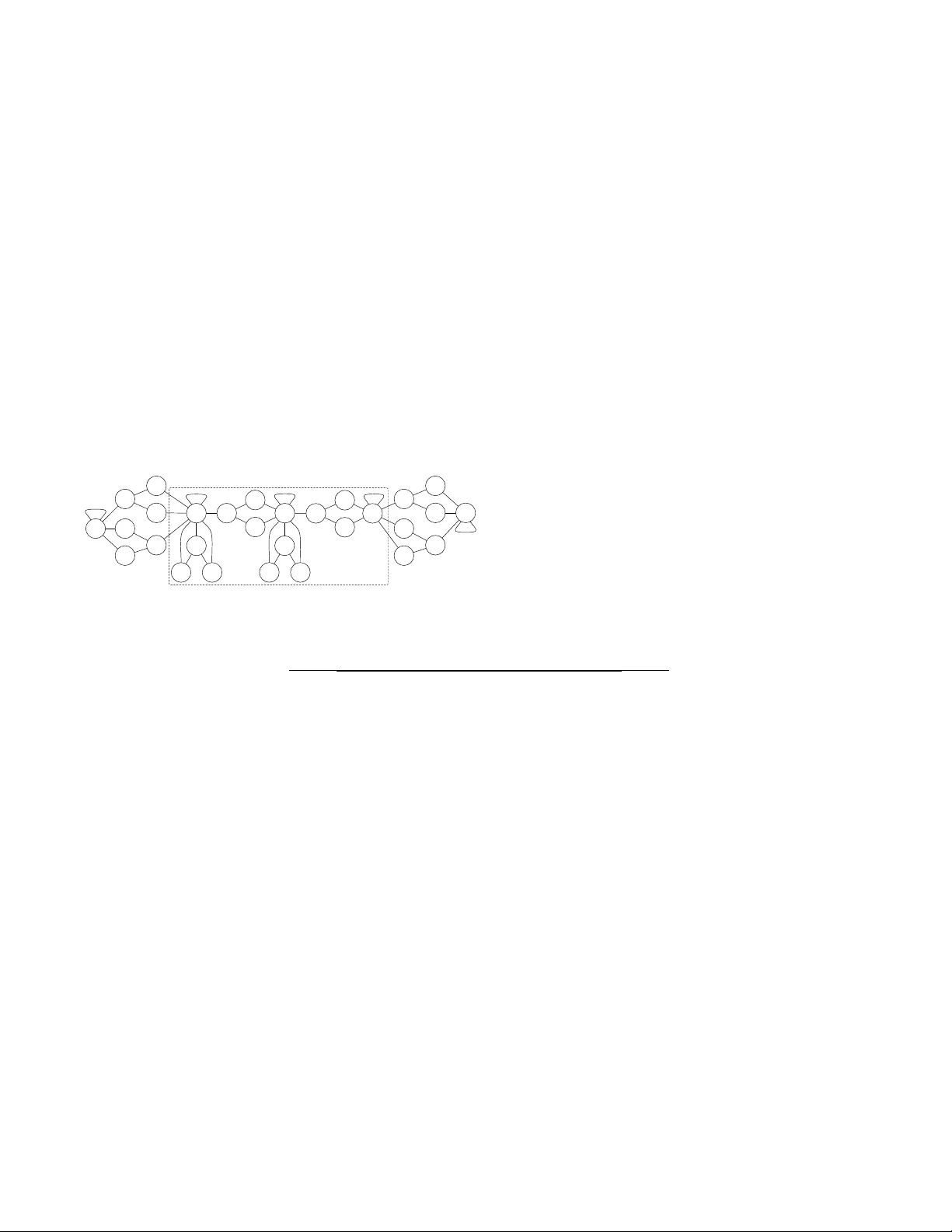
LA UR-07-5287 Mapping Seman tic Net w orks to Undirected Net works Mark o A. Ro driguez T-7, Center for Non-Linear Studies Los Alamos National Lab oratory Los Alamos, New Mexico 87545 There exists an injectiv e, information-preserving function that maps a semantic net w ork (i.e a directed lab eled net w ork) to a directed net w ork (i.e. a directed unlabeled netw ork). The edge lab el in the semantic netw ork is represented as a top ological feature of the directed netw ork. Also, there exists an injectiv e function that maps a directed net w ork to an undirected net w ork (i.e. an undirected unlab eled netw ork). The edge directionalit y in the directed netw ork is represented as a top ological feature of the undirected netw ork. Through function composition, there exists an injectiv e function that maps a semantic netw ork to an undirected netw ork. Thus, aside from space constraints, the seman tic net work construct do es not hav e any modeling functionality that is not possible with either a directed or undirected netw ork representation. Two pro ofs of this idea will b e presented. The first is a pro of of the aforementioned function comp osition concept. The second is a simpler proof in v olving an undirected binary enco ding of a semantic netw ork. I. INTR ODUCTION A net w ork is a p opular data structure for representing the relationship b etw een discrete elements [7, 9]. There are v arious types of netw orks such as the undirected net- w ork (i.e. undirected unlab eled net work), the directed net w ork (i.e. directed unlabeled net w ork), and the se- man tic net w ork (i.e. directed lab eled net w ork). In an undirected netw ork, there exists no order to the relation- ships b etw een the vertices. An undirected net w ork can b e denoted U ⊆ { V u × V u } , where V u is the vertex set and any edge { i, j } ∈ U denotes an undirected re- lationship. The directed netw ork provides the concept of edge directionality . A directed netw ork can b e rep- resen ted as D ⊆ ( V d × V d ), where V d is the v ertex set and any edge ( i, j ) ∈ D denotes a directed relationship. All edges in both an undirected and directed netw ork are homogeneous in meaning. In order to represent edge meaning, a semantic netw ork can b e used. In a semantic net w ork, an edge connecting an y tw o vertices maintains a lab el (e.g. c haracter string) that denotes the type of relationship b et w een t w o v ertices. A seman tic net w ork can b e represen ted as S ⊆ h V s × Ω × V s i , where V s is the vertex set, Ω is the set of edge lab els, and any edge (called a triple) h i, ω, j i ∈ S denotes an ordered, lab eled relationship. The semantic netw ork is perhaps best kno wn as a mo d- eling construct from the early days of kno wledge repre- sen tation in the cognitive sciences [13]. How ever, with the inception of the Semantic W eb initiativ e [4, 5] and with the dev elopmen t of triple-store tec hnology (i.e. se- man tic net w ork databases) [1, 2, 8], there has b een an increase in the use of the seman tic netw ork as a data structure for modeling data sets where there exists a heterogeneous set of vertices and edges. This trend has b een o ccurring across v arious disparate domains such as bioinformatics [10, 12], digital libraries [3, 6], and general computer-science [11]. Because of the use of the lab eled edge, the semantic net w ork is seen as the better modeling construct than both the undirected and directed net w ork for such data sets. Ho w ev er, when ignoring space constrain ts, there is no mo deling gain by using a semantic netw ork repre- sen tation as opp osed to a directed net w ork representa- tion. Moreov er, there is no mo deling gain ov er using an undirected netw ork representation. Through a series of information-preserving, injective mappings [14], this ar- ticle demonstrates that it is p ossible to mo del a seman- tic netw ork b oth as a directed and undirected netw ork. While the directed and undirected mo dels of a semantic net w ork utilize more v ertices and edges in their repre- sen tation, they ultimately hav e the ability to capture the same information. The outline of this article is as follo ws. Section I I presen ts an injectiv e function to map a seman tic netw ork to a directed netw ork. Section I I I presen ts an injective function to map a directed net work to an undirected net- w ork. Finally , through function comp osition, Section IV presen ts an injectiv e function to map a seman tic netw ork to an undirected netw ork. I I. MAPPING A SEMANTIC NETWORK TO A DIRECTED NETW ORK This section will present an injectiv e, information- preserving function that maps a seman tic netw ork to a directed netw ork. There is a t w o step pro cess to this function. First, the edge lab els of a semantic net w ork are represen ted as a binary string. Second, each binary string is represented as a unique directed netw ork enco d- ing. Given that a directed netw ork can only represen t v ertices and directed edges, each edge lab el of the se- man tic netw ork is enco ded as a top ological feature in the directed netw ork. Let S ⊆ h V s × Ω × V s i denote a semantic net w ork where V s is the set of all vertices and Ω is the set of all edge lab els. Any triple h i, ω , j i ∈ S represents a directed edge 2 from vertex i to vertex j with a lab el of ω . An example seman tic netw ork triple is diagrammed in Figure 1. i j ω FIG. 1: An edge in a semantic net work. There exists the injective function λ : Ω → { 0 , 1 } d log 2 ( | Ω | ) e (a binary enco der) that represents every lab el in Ω as a unique binary string of length d log 2 ( | Ω | ) e . While the minim um bits required to make a one-to-one mapping is d log 2 ( | Ω | ) e , p opular examples of other such one-to-one mappings include the ASCI I and Unicode functions that map b etw een human language characters and binary strings. F urthermore, there exist the inv erse function λ − 1 that maps a binary string to its original sym b olic representation. Note that for labels already rep- resen ted as unique binary strings, λ and λ − 1 are identit y functions. Given the seman tic netw ork edge diagrammed in Figure 1, the λ ( ω ) mapping is represen ted in Figure 2. Assume that | Ω | = 8 and th us, each ω ∈ Ω requires 3 bits to enco de it. i j 110 FIG. 2: A example of the λ ( ω ) mapping. Next, there exists the injectiv e function γ : { 0 , 1 } n → D (a directed netw ork enco der), where D is the family of all directed netw orks and any D ∈ D is denoted D ⊆ ( V d × V d ). If B ∈ { 0 , 1 } n is the ordered m ulti-set (or bag) of the n -bit string λ ( ω ), then γ ( B ) = n ≤| B | [ n =1 ( b n , b n +1 ) if b n = 0 ∧ n < | B | ( b n , b n +1 ) ∪ ( b n , b n ) if b n = 1 ∧ n < | B | ( b n , b n ) if b n = 1 ∧ n = | B | . If λ ( ω ) = (1 , 1 , 0), then γ ( λ ( ω )) is represented as dia- grammed in Figure 3. The num b er of v ertices in D with resp ects to γ is O ( d log 2 ( | Ω | ) e ). The num b er of directed edges in D with resp ects to γ is O (2 d log 2 ( | Ω | ) e − 1). b 1 b 2 b 3 FIG. 3: A directed netw ork representation of the edge lab el λ ( ω ) = (1 , 1 , 0). The function γ is information preserving because there also exists the inv erse function γ − 1 . If q ∈ { V d } n is the single non-lo oping path in D that trav erses every vertex in V d (i.e. the only Hamiltonian path), then γ − 1 ( D ) = n ≤| q | ] n =1 ( 1 if ( q n , q n ) ∈ D 0 otherwise . Th us, λ − 1 ( γ − 1 ( γ ( λ ( ω )))) = ω . F rom a set of functions that transform a sym bolic edge lab el to a directed net- w ork enco ding, it is p ossible to represent an entire se- man tic net w ork as a a single directed netw ork. In other w ords, given γ ◦ λ , S ⊆ h V s × D × V s i . Prop osition 1 (Seman tic-to-Directed Injection) A semantic network c an b e mo dele d as a dir e cte d network without loss of information. Ther e exists an inje ctive function Θ : S → D , wher e D ∈ D is a dir e cte d network r epr esentation of some S ∈ S . Pr o of. If Θ : S → D denotes an injective function that maps a semantic netw ork to a directed netw ork, then Θ( S ) = [ h i,ω ,j i∈ S ( i, b 1 ) ∪ ( b 1 , i ) ∪ γ ( λ ( ω )) ∪ ( b n , j ) ∪ ( j, b n ) , where any b is a vertex in γ ( λ ( ω )) and n > 1. With re- sp ects to the previous example figures, the Θ( S ) mapping is diagrammed in Figure 4. i j ω b 1 b 2 b 3 FIG. 4: A D -enco ding of S . Let D ⊆ ( V d × V d ) denote the directed netw ork Θ( S ). In V d , every vertex that does not self-lo op and has an ev en degree was originally a vertex in V s . All other v ertices in V d are used to denote the edge lab els of Ω. The gro wth of the n um ber of vertices in D with re- sp ects to Θ( S ) is O ( | V s | + | S |d log 2 ( | Ω | ) e ). The growth of the num b er of edges in D with resp ects to Θ( S ) is O ( | S | [2 d log 2 ( | Ω | ) e + 3]). In order to demonstrate the information-preserving qualit y of Θ, the inv erse function Θ − 1 also exists. Let Γ : V d → N denote the degree of a vertex and let Q i → j b e the set of paths from vertex i to vertex j in D such that Q i → j = [ ( i, b 1 , . . . , b n , j ) , where | Γ( i ) | 2 , | Γ( j ) | 2 ∈ N (i.e. i and j ’s degree is ev en), ( i, i ) , ( j, j ) / ∈ D (i.e. no self-loops), ( i, b 1 ) , ( b 1 , i ) , ( b 1 , . . . ) , ( . . . , b n ) , ( b n , j ) , ( j, b n ) ∈ D , i 6 = b 1 6 = . . . 6 = b n , j 6 = b 1 6 = . . . 6 = b n (i.e. only i and j can b e the same vertex), and no b is in a cycle with another b in the sequence. If Q = [ i,j ∈ V d Q i → j , then Θ − 1 ( D ) = [ q ∈ Q h q 1 , λ − 1 ( γ − 1 ( q 2 , . . . , q n − 1 )) , q n i , 3 where q 1 = i and q n = j and thus, the original vertices in V s . Giv en Θ and Θ − 1 , a unique, one-to-one mapping b et w een a seman tic netw ork and a directed net w ork exists such that a semantic netw ork can b e mo deled as a directed netw ork without loss of information. There exists another pro of of this concept. As demon- strated earlier, a binary string of arbitrary length can b e represen ted as a single chain (i.e. sequence, path) of v ertices, where each vertex represents a bit. In this rep- resen tation, a self-lo op represents a bit with v alue 1 and no self-lo op represents a bit with v alue 0. Because an y represen tation of a semantic netw ork, at the low est level of computing, is ultimately represen ted as a sequence of bits, a directed netw ork can be used to mo del that se- quence. I I I. MAPPING A DIRECTED NETWORK TO AN UNDIRECTED NETW ORK This section presents the injectiv e, information- preserving function ˆ Θ : D → U that maps a directed net w ork to an undirected netw ork. A directed netw ork is iden tified by a set of ordered vertex pairs. F or instance, when D ⊆ ( V d × V d ), ( i, j ) ∈ D denotes a directed edge going from i (the source) to j (the sink). A directed edge b et w een i and j is diagrammed in Figure 5. i j FIG. 5: An edge in a directed netw ork. An undirected netw ork denoted U ⊆ { V u × V u } do es not represen t edge directionality as elemen ts of U are un- ordered th us, { i, j } states that i and j are connected, but that no particular direction exists. If a directed netw ork is to b e represen ted as an undirected netw ork, then a top ological feature in the undirected form must b e used to represent edge directionality . Prop osition 2 (Directed-to-Undirected Injection) A dir e cte d network c an b e mo dele d as an undir e cte d network without loss of information. Ther e exists an inje ctive function ˆ Θ : D → U , wher e U ∈ U is an undir e cte d network r epr esentation of some D ∈ D . Pr o of. The function ˆ Θ maps each ordered vertex pair in D to a set of unique unordered vertex pairs in U . If R i → j = { i, x } ∪ { x, y } ∪ { x, z } ∪ { y , j } ∪ { z , j } , then ˆ Θ( D ) = [ ( i,j ) ∈ D { i, i } ∪ R i → j ∪ { j, j } , where the vertices x , y , and z are unique for each ( i, j ) ∈ D . An y v ertex with an undirected self-lo op in V u is an original vertex from V d . The v ertices x, y , z ∈ V u and their resp ective edges represen t the direction of the edge. The vertex i has one edge whic h denotes the tail of the original directed edge. The vertex j has t w o edges which denotes the head of the original directed edge. ˆ Θ incurs a vertex growth of O ( | V d | + 3 | D | ) and an edge gro wth of O ( | V d | + 5 | D | ). The ˆ Θ mapping of the directed edge represen ted in Figure 5 is diagrammed in Figure 6. i j x y z FIG. 6: An undirected net w ork representation of a directed edge. The function ˆ Θ is information preserving b ecause there exists the in v erse function ˆ Θ − 1 suc h that if q + : ( V × V ) → { 0 , 1 } is defined as q + ( i, j ) = ( 1 if { i, x } , { x, y } , { x, z } , { y , j } , { z , j } ∈ U 0 otherwise , then ˆ Θ − 1 ( U ) = [ i,j ∈ V u ( i, j ) : { i, i } , { j, j } ∈ U ∧ q + ( i, j ) = 1 . Th us, a directed netw ork can b e mo deled as an undi- rected netw ork. IV. MAPPING A SEMANTIC NETWORK TO AN UNDIRECTED NETW ORK This section presents the unification of the concepts presen ted in the t wo previous sections. In this section, b y means of function comp osition, it is demonstrated that a seman tic netw ork can b e mo deled as an undirected net- w ork without loss of information. This means that there exists a one-to-one mapping b etw een a semantic net w ork and some undirected netw ork. In short, given the func- tions Θ and ˆ Θ presented previously , an undirected net- w ork has the same representativ e or mo deling p o w er as a semantic netw ork. Prop osition 3 (Seman tic-to-Undirected Injection) A semantic network c an b e mo dele d as an undir e cte d network without loss of information. Ther e exists an inje ctive function ˆ Θ : S → U , wher e U ∈ U is an undir e cte d network r epr esentation of some S ∈ S . Pr o of. Recall the injective functions Θ : S → D and ˆ Θ : D → U . Through function comp osition, there exists the function Υ : S → U with the rule Υ( S ) = ˆ Θ(Θ( S )) . 4 Υ incurs a vertex gro wth of O ([ | V s | + 7 | S |d log 2 ( | Ω | ) e + 9 | S | ) and an edge growth of O ([ | V s | + 11 | S |d log 2 ( | Ω | ) e + 15 | S | ) . Finally , there also exists the in v erse function Υ − 1 , where Υ − 1 ( U ) = Θ − 1 ( ˆ Θ − 1 ( U )) . Th us, a semantic netw ork can b e mo deled as an undi- rected netw ork. Giv en the example seman tic netw ork triple dia- grammed in Figure 1, where S = h i, ω , j i and λ ( ω ) = (1 , 1 , 0), the undirected netw ork representation given by Υ( S ) is diagrammed in Figure 7. Note that each x , y , and z is a unique v ertex ev en though they are not notated as such. b 1 b 2 b 3 j i ω x y z x y z x y z x y z x y z x y z x y z x y z FIG. 7: An undirected netw ork representation of a semantic net w ork triple. It is interesting to note the v arious types of self-lo ops in the undirected netw ork represen tation in Figure 7. There are the undirected self-lo ops as demonstrated b y the edges { i, i } , { b n , b n } , and { j, j } . Next, there are the directed self-lo ops as demonstrated by the b 1 and b 2 sub- net w orks which include their resp ectiv e x, y , z vertices. Finally , if i = j , there also exists the semantic self-lo op. There exists another method to map a seman tic net- w ork to an undirected net w ork. As discussed previously , a directed netw ork can represent a binary string and any seman tic netw ork representation, computationally , is ul- timately represented as a series of bits. Therefore, it is p ossible to represen t a semantic netw ork as a directed net w ork binary string. Giv en ˆ Θ, it is p ossible to repre- sen t that directed net w ork binary string as an undirected net w ork. V. CONCLUSION This article defined the injectiv e function Υ : S → U . This function demonstrates that a semantic netw ork has a one-to-one mapping with some undirected netw ork. In this mo del, b ecause an edge in an undirected netw ork is neither lab eled nor directed, b oth the semantic netw ork edge lab els and the directionality of edges are represented as top ological features of the undirected netw ork. While represen ting a semantic net w ork as an undirected net- w ork is p erhaps an inefficient use of resources, it is theo- retically p ossible. [1] Aasman, J., 2006, A l le gr o Gr aph , T echnical Report 1, F ranz Incorp orated, URL www.franz.com/products/ allegrograph/allegrograph.datasheet.pdf . [2] Alexander, N., and S. Rav ada, 2006, in Pr o c e e dings of the 22nd International Confer enc e on Data Engine ering (ICDE’06) (IEEE Computer So ciety , W ashington, DC, USA), p. 93, ISBN 0-7695-2570-9. [3] Bax, M., 2004, in International Confer enc e on Ele ctr onic Publishing (ICCC2004) (Bras ´ ılia, Brazil). [4] Berners-Lee, T., and J. Hendler, 2001, Nature 410 (6832), 1023, URL http://dx.doi.org/10.1038/35074206 . [5] Berners-Lee, T., J. A. Hendler, and O. Lassila, 2001, Scien tific American , 34. [6] Bollen, J., M. A. Rodriguez, H. V an de Somp el, L. L. Balakirev a, and A. Hagb erg, 2007, in ACM World Wide Web Confer enc e (ACM Press, Banff, Canada). [7] Brandes, U., and T. Erlebac h (eds.), 2005, Network A nal- ysis: Metho dolgical F oundations (Springer, Berling, DE). [8] Lee, R., 2004, Sc alability R ep ort on T riple Stor e Applic a- tions , T echnical Rep ort, Massach usetts Institute of T ech- nology . [9] Newman, M., A.-L. Barabasi, and D. J. W atts, 2006, The Structur e and Dynamics of Networks (Princeton Univ er- sit y Press). [10] Quan, D., S. Martin, and D. Grossman, 2003, in 2nd International Semantic Web Conferenc e (ISWC2003) (Sanib el Island, Florida), URL http://theory.csail. mit.edu/ ~ dquan/iswc2003- bioinformatics.pdf . [11] Ro driguez, M. A., 2007, Gener al-Purpose Computing on a Semantic Network Substr ate , T echnical Rep ort LA-UR- 07-2885, Los Alamos National Lab oratory , URL http: //arxiv.org/abs/0704.3395 . [12] Ruttenberg, A., T. Clark, W. Bug, M. Samw ald, O. Bo- denreider, H. Chen, D. Doherty , K. F orsberg, Y. Gao, V. Kash y ap, J. Kinoshita, J. Luciano, et al. , 2007, BMC Bioinformatics 8 (3), S2, ISSN 1471-2105, URL http: //www.biomedcentral.com/1471- 2105/8/S3/S2 . [13] Sow a, J. F. (ed.), 1991, Principles of Semantic Networks: Explor ations in the Repr esentation of Know le dge (Mor- gan Kaufmann, San Mateo, CA). [14] An injectiv e function is one suc h that if f ( a ) = f ( b ), then a = b .
Original Paper
Loading high-quality paper...
Comments & Academic Discussion
Loading comments...
Leave a Comment