Single-Symbol ML Decodable Distributed STBCs for Partially-Coherent Cooperative Networks
Space-time block codes (STBCs) that are single-symbol decodable (SSD) in a co-located multiple antenna setting need not be SSD in a distributed cooperative communication setting. A relay network with N relays and a single source-destination pair is c…
Authors: ** (논문 본문에 저자 정보가 명시되지 않았음) **
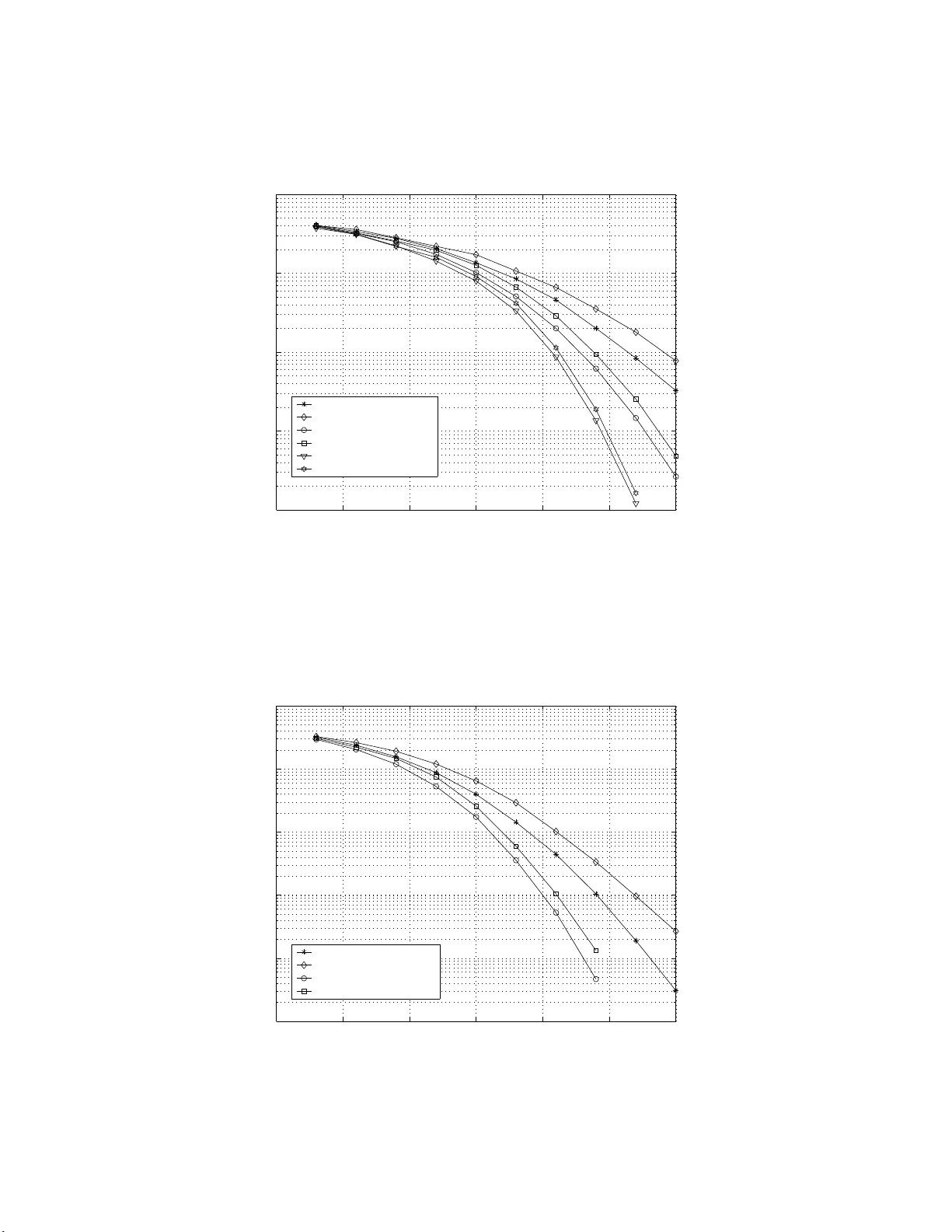
Single-Sym b ol ML Deco dable Distributed STBCs for P artially-Coheren t Co op erati v e Net w orks D. Sreedhar, A. Cho ck aling am, and B. Sundar Ra jan ∗ Departmen t of ECE, Indian Institute of Science, Bangalore 560012, IND IA Abstract Space-time blo c k co des (S TBCs) that are single-sym b ol deco dable (S S D) in a co- lo ca ted m ultiple ante nna setti ng need not b e SS D in a distrib uted coop erativ e co m- m unication setti ng. A rela y net w ork with N rela ys and a single sour ce -destination pair is called a partially-coheren t rela y c hann el (PCR C) if the d estination has p erfect c hannel state information (CSI) of all the channels and the rela ys h a v e only the ph ase information o f the source-to-rela y c hann el s. In this pap er, fi rst, a new set of neces- sary and sufficient conditions for a STBC to b e SSD for co-located multiple an tenna comm unication is obtained. Then , this is extended to a set of n ecessary and sufficient conditions for a distributed STBC (DSTBC) to b e SSD for a PCR C, b y iden tifying the additional co nditions. Using this, sev eral SSD DSTBCs for PCRC are iden tified among the k n o wn classes of STBCs . It is p ro v ed that even if a S SD STBC f or a co-lo ca ted MIMO c hannel do es not satisfy th e additional conditions for the co d e to b e SSD f or a PC R C, single-sym b ol d ec o ding of it in a PCR C give s full-div ersit y and only co ding gain is lost. It is shown that when a DSTBC is SSD for a PCRC, then arbitrary co or- dinate inte rlea ving of the in-p hase and quadrature-ph ase comp onen ts of the v ariables do es not distu r b its SSD pr o p ert y for PCRC. Finally , it is sho wn that the p ossibilit y of c h annel phase c omp ensation op eration at th e rela y n odes using partial CSI at the rela ys in crea ses the p ossible rate of SSD DST BCs from 2 N when the rela ys do not ha v e CSI to 1 2 , whic h is indep endent of N . Keywor ds – Co op er ative c ommunic ations, amplify-and-forwar d pr oto c ol, distribute d STBC, s ingle -symb ol de c o ding. ∗ This w ork in part w as pr esen ted in IEEE ICC’20 08, Beijing, China, May 2008, and in IE EE ISIT’2 008, T oro n to , Canada, July 2008. This w ork w as pa rtly supp orted b y the Swarna ja yan ti F ellowship to A. Cho c k alinga m from the Department of Science and T echnology , Gov ernment o f India (Pro ject Ref. No: 6/3/2 002-S.F.), and by the Council of Scientific & Industrial Rese arc h (CSIR), India, throug h Research Grant (22(0 365)/04/E MR- II) to B. S. Ra jan. This work was also par tly supp orted by the DRDO-I ISc Pr o- gram on Adv anced Research in Mathematica l Eng ine e ring through rese a rc h gr a n ts to a nd A. Cho c k alinga m and B. S. Ra jan. 1 In t r o duction The problem of fa ding and the wa ys to com bat it through spatial divers ity t ec hniques ha v e b een a n activ e area o f researc h. Multiple-input multiple-output (MIMO) tec hniques ha v e b ecome p opular in realizing spatial div ersit y and high data rates through the use of m ultiple transmit an tennas. F or suc h co-lo cated m ultiple transmit an tenna systems low maxim um- lik eliho o d (ML) deco ding complexit y space-time blo c k co des (STBCs) hav e b een studied by sev eral researc hers [1]-[10] whic h include the w ell kno wn complex orthogo na l designs (CODs) and their generalizations. Recen t researc h has show n that the adv antages of spatial div ersit y could b e realized in single-an tenna user no des through user co op eration [11 ],[12] via relaying. A simple wireless relay netw ork of N + 2 no des consists of a single source-destination pair with N rela ys. F o r suc h relay c hannels, use of CODs [1],[2] has b een studied in [1 3]. CODs are attra ctiv e for co op erativ e comm unicatio ns for the following r easons: i ) they offer full div ersity gain and coding gain, ii ) they are ‘scale free’ in the sense that deleting some ro ws do es not affect the orthogonality , iii ) en tries ar e linear com bination of the info rmation sym b ols and their conjugates whic h means only linear pro cessing is required at the relays, and iv ) they admit v ery fast ML deco ding (single-sym b ol decoding (SSD)). Ho w ev er, it should b e noted that the la s t prop ert y applies only to the deco de-and-forw ard (DF) p olicy at the relay no de. In a scenario where the rela ys amplify and fo r w ard (AF ) the signal, it is kno wn that the orthogonality is lost, and hence the destination has to use a complex multi-sym b ol ML deco ding or sphere deco ding [13],[14]. It should b e not ed that the AF p olicy is attractiv e for tw o reasons: i ) the complexit y at the rela y is greatly reduced, and ii ) the restrictions on the r a te b ecause the rela y has to deco de is a v oided [15]. In order to av oid the complex ML deco ding at the destination, in [16], the a ut ho r s prop ose an alternativ e co de design strategy and prop ose a SSD co de for 2 and 4 rela ys. F or arbit r a ry n um b er of relays , rece ntly in [17], distributed orthogonal STBCs (DO STBCs) ha v e b een studied a nd it is sho wn that if the destination has t he complete channel state information (CSI) of all the source-to-rela y channe ls and the rela y-to-destination c hannels, then the 2 maxim um p ossible rate is upp er b ounded by 2 N complex sym b ols p er c hannel use f or N rela ys. T o w ards improving the rate of transmission a nd a c hieving simultaneously b oth full- div ersity as w ell as SSD at the destination, in this pap er, we study rela y c hannels with the assumption t hat the rela ys hav e the phase inf o rmation of t he source-to-r elay c hannels and the destination has the CSI of all the c hannels. C o ding fo r partially-coheren t relay c hannel (PCR C, Section 2.2) has b een studied in [18], where a sufficien t condition f o r SSD has b een presen ted. The con tributions of this pap er can b e summarized as f o llo ws: • First, a new set of necessary and sufficien t conditions for a STBC to b e SSD for co- lo cated multiple an tenna communic ation is obta ined . The kno wn set of necessary and sufficien t conditions in [8] is in terms of the disp ers ion matrices (we ight matr ice s) of the co de, whereas our new set of conditions is in terms of the column ve ctor represen ta t io n matrices [5] of the co de and is a generalization of the conditions g iv en in [5] in terms of column ve ctor represen tation matrices for CODs. • A set of necessary and sufficien t conditions for a distributed STBC (D STBC ) to b e SSD for a PCR C is obtained by identifying the additional conditions. Using this, sev eral SSD DSTBCs f or PCR C are iden tified among the known classes of STBCs f o r co-lo cated m ultiple antenna system. • It is pro v ed that even if a SSD STBC for a co-lo cated MIMO channel do es not satisfy the a dditional conditions fo r t he co de to b e SSD for a PCR C, single-sym b ol deco ding of it in a PCRC g iv es full-dive rsit y and only co ding g ain is lost. • It is shown that when a DSTBC is SSD for a PCR C, then arbitrary coo r dinate in- terlea ving of the in- phase and quadrature- pha se comp onen ts of the v ariables do es not disturb its SSD prop ert y for PCR C. • It is sho wn that the p ossibilit y of channel phase c o mp ens a tion op eration at the rela y no des using part ial CSI at the rela ys increases the p ossible rate of SSD D STBCs fr o m 2 N when the rela ys do not ha v e CSI to 1 2 , whic h is indep enden t of N . 3 • Extens iv e sim ula tion results a re presen ted to illustrate the ab o v e contributions. The remaining pa r t of the pap er is org a nize d as follo ws: In Section 2, the signal mo del for a PCR C is dev elop ed. Using this mo del, in Section 3, a new set of necessary and sufficien t conditions for a STBC to b e SSD in a co- located MIMO is presen ted. Sev eral classes of SSD co des are discussed a nd conditions for full- divers ity of a sub class of SSD co des is obtained. Then, in Section 4, SSD DSTBCs for PCR C are c haracterized b y iden tifying a set of necessary and sufficien t conditions. It is sho wn that the SSD pro perty is inv ariant under co ordinate interle avin g op erations whic h leads to a class of SSD DSTBCs for PCR C. The class of rate half CODs o bt a ined from rate one real orthog onal designs (R ODs) b y stac king construction [1 ] is show n to b e SSD fo r PCRC . Also, it is shown t ha t SSD co des for co-lo cated MIMO, under sub optimal SSD deco der for PCR C offer full div ersit y . Sim ula tion results and discussion constitute Sec tion 5. Conclusions and scop e for further work are presen ted in Section 6. 2 System Mo del Consider a wireles s net w ork with N + 2 no des consisting of a source, a destination, and N rela ys 1 , as sho wn in F ig . 1. All no des are half-duplex no des, i.e., a no de can either transmit or receiv e at a time on a sp ecific frequency . W e consider amplify-and-forward (AF) transmission at the relay s. T ransmission from t he source to the destination is carried out in t w o phases. In the first phase, the source transmits informat io n sym b ols x ( i ) , 1 ≤ i ≤ T 1 in T 1 time slots. All the N rela ys receiv e these T 1 sym b ols. This phase is called the br o adc ast phase . In the second phase, all t he N relays 2 p erform distributed space-time blo c k enco ding on their receiv ed v ectors and tra nsmit the resulting enco ded v ectors in T 2 time slots. That is, eac h rela y will transmit a column (with T 2 en t ries ) of a distributed STBC matrix of size T 2 × N . The destination receiv es a faded and noise added v ersion of this matrix. This phase 1 In the system mo del considered here, we assume that there is no dir ect link b et ween source and destina- tion. How ever, whatev er results we show here can b e extended to a system model with a dir ect link b et ween source a nd destination. 2 Here, we assume that a ll the N relays participate in the co oper ativ e tr ansmission. It is also p ossible that some relays do no t participate in the tra ns mission bas ed on whether the channel is in o utage or no t. W e do not consider such a pa rtial participation s cenario here. 4 is called the r elay phase . W e assume that the source-to-rela y channels remain static o v er T 1 time slots, and the relay-to-destination channe ls remain static o v er T 2 time slots. 2.1 No CSI at the rela ys The receiv ed signal at the j th rela y , j = 1 , · · · , N , in the i th time slot, i = 1 , · · · , T 1 , denoted b y v ( i ) j , can b e written as 3 v ( i ) j = p E 1 h sj x ( i ) + z ( i ) j , (1) where h sj is the complex c hannel gain from the source s to the j th rela y , z ( i ) j is additive white G a uss ian noise a t relay j with zero mean and unit v a r ia nce , E 1 is the transmit energy p er sym b ol in t he bro a dcas t phase, and E x ( i ) ∗ x ( i ) = 1. But no c hannel kno wledge is assumed at the rela ys. Under the assumption of no CSI a t the relay s, the amplified i th receiv ed signal at the j th rela y can b e written as [13] b v ( i ) j = r E 2 E 1 + 1 | {z } △ = G v ( i ) j , (2) where E 2 is the transmit energy p er tra nsmission of a sym b ol in the rela y phase, and G is the amplification factor at the relay that mak es the total transmission energy p er sym b ol in the rela y phase to b e equal to E 2 . Let E t denote t he total energy p er sym b ol in b oth the phases put together. Then, it is sho wn in [15] t ha t the optim um energy allo cation that maximizes the receiv e SNR at the destination is when half the energy is sp en t in the broa dcas t phase and the r emaining half in the relay phase when the time allo cations for the relay and broa dcas t phase are same i.e., T 1 = T 2 . W e also assume that the energy is distributed equally i.e., E 1 = E t 2 and E 2 = E t 2 M , where M is the num b er of transmissions p er sym b ol in the STBC. F or the unequal-time a llocatio n ( T 1 6 = T 2 ) this distribution might not b e optimal. A t rela y j , a 2 T 1 × 1 real vector b v j giv en b y b v j = h b v (1) j I , b v (1) j Q , b v (2) j I , b v (2) j Q , · · · , b v ( T 1 ) j I , b v ( T 1 ) j Q i T , (3) 3 W e use the following nota tion: V e c to rs are denoted by b oldface lowercase letters, and matrices a re denoted by bo ldface upper case letters . Sup erscripts T a nd H denote tra ns pose and conjugate transp ose op erations, resp ectiv ely and ∗ denotes matrix conjugation o peration. 5 is for med, where b v ( i ) j I and b v ( i ) j Q , resp ectiv ely , are the in-phase (real part) and quadrature (imaginary part) comp onen ts of b v ( i ) j . No w, (3) can b e written in the form b v j = G p E 1 H sj x + b z j , (4) where x is the 2 T 1 × 1 data sym b ol real v ector, giv en b y x = h x (1) I , x (1) Q , x (2) I , x (2) Q , · · · , x ( T 1 ) I , x ( T 1 ) Q i T , (5) b z j is the 2 T 1 × 1 noise v ector, g iv en b y b z j = h b z (1) j I , b z (1) j Q , b z (2) j I , b z (2) j Q , · · · , b z ( T 1 ) j I , b z ( T 1 ) j Q i T , where b z ( i ) j = G z ( i ) j , and H sj is a 2 T 1 × 2 T 1 blo c k-diag o nal matrix, giv en by H sj = h sj I − h sj Q h sj Q h sj I · · · 0 . . . . . . . . . 0 · · · h sj I − h sj Q h sj Q h sj I . (6) Let C = h c 1 , c 2 , · · · , c N i (7) denote the T 2 × N distributed STBC matrix to b e sen t in t he rela y phase j oin tly by all N rela ys, where c j denotes the j t h column o f C . The j th column c j is manufactured by the j th r elay as c j = A j b v j = G p E 1 A j H sj | {z } B j x + A j b z j , (8) where A j is the complex pro cessing matrix of size T 2 × 2 T 1 for the j t h relay , called the r elay matrix and B j can b e view ed as the column v ector represen tation matrix [5] for the distributed STBC with the difference tha t in our case the vec tor x is r eal whereas in [5] it is complex. F or example, for the 2- rela y case (i.e., N = 2), with T 1 = T 2 = 2 , using Alamouti co de, the rela y matrices are given b y A 1 = 1 j 0 0 0 0 − 1 j and A 2 = 0 0 1 j 1 − j 0 0 . (9) 6 Let y denote the T 2 × 1 receiv ed signal v ector at the destination in T 2 time slots. Then, y can b e written as y = N X j =1 h j d c j + z d , (10) where h j d is the complex ch annel ga in from the j th rela y to the destination, and z d is the A W GN noise v ector at the destination with zero mean and E [ z d z ∗ d ] = I . Substituting (8) in (10), w e can write y = G p E 1 N X j =1 h j d H sj A j ! x + N X j =1 h j d A j b z j + z d . (11) 2.2 With phase only information at the rela ys In this subsection, w e obtain a signal mo del for the case of partial CSI a t the rela ys, where w e assume that each rela y has the kno wledge of the c hannel phase on the link b et we en the source and itself in t he broadcast pha se. That is, defining the c hannel g a in from source to rela y j as h sj = α sj e j θ sj , w e assume that relay j has p erfect know ledge of only θ sj and do es not hav e the know ledge of α sj . In the prop osed sc heme, w e p erform a phase comp ens ation op eration on the a mplified re- ceiv ed signals at the rela ys, and space-time enco ding is done on t hese phase-comp ensated signals. That is, w e m ultiply b v ( i ) j in ( 2 ) b y e − j θ sj b efore sp ace-time enco ding. Note that m ultiplication b y e − j θ sj do es not change the statistics of z ( i ) j . Therefore, with this phase comp ensation, the b v j v ector in ( 4) b ecomes b v j = G p E 1 H sj x + b z j e − j θ sj = G p E 1 | h s j | x + b z j . (12) Consequen tly , the c j v ector g ene rated b y relay j is given by c j = A j b v j = G p E 1 A j | h sj | | {z } △ = B ′ j x + A j b z j , (13) 7 where B ′ j is the equiv a len t w eigh t matrix with phase comp ensation. Now , w e can write the receiv ed v ector y as y = G p E 1 N X j =1 h j d | h sj | A j ! x + N X j =1 h j d A j b z j + z d | {z } ˜ z d : tota l no ise . (14) Figure 2 sho ws the pro cessing at the j th relay in the prop osed phase comp ensation sc heme. Suc h systems will b e r eferred a s p artial ly-c oher ent r elay channels (PCR C). A distributed STBC whic h is SSD fo r a PCR C will b e referred as SSD-D STBC-PCRC . 3 Condit i o ns for SSD and F ull-Div ersity for Co -lo cated MIMO The class of SSD co des, including the w ell kno wn CODs, for co- located MIMO has b ee n studied in [8], where a s et of ne cessary and sufficien t conditions for an arbitrary linear STBC to b e SSD has b een obtained in terms of the disp ersion matrices [19], also kno wn as w eight matr ices. In this section, a new set of necessary and sufficien t conditions in terms of the column vector represen tatio n matrices [5] of the co de is obta ined that are amenable for extension to PC RC . This is a generalization of the conditions given in [5] in terms of column v ector represen t ation matrices f or COD s. T ow ards this end, the receiv ed vec tor y in a co-lo cated MIMO setup can b e written as y = p E t N X j =1 h j d A j ! x + z d . (15) Theorem 1 F or c o-lo c ate d MIMO with N tr a n smit an tenn as, the line ar STBC as giv en i n (15) is SS D iff A T j I A j I + A T j Q A j Q = D (1) j j ; j = 1 , 2 , · · · , N A T j I A iI + A T j Q A iQ + A T iI A j I + A T iQ A j Q = D (2) ij ; 1 ≤ i 6 = j ≤ N A T j I A iQ + A T j Q A iI − A T iI A j Q − A T iQ A j I = D (3) ij ; 1 ≤ i 6 = j ≤ N , (16) 8 wher e A j = A j I + jA j Q , j = 1 , 2 , · · · , N , wher e A j I and A j Q ar e r e a l m atric es, and D (1) j j , D (2) ij and D (3) ij ar e blo ck diagonal matric es of the fo rm D ( k ) ij = " a ( k ) ij, 1 b ( k ) ij, 1 b ( k ) ij, 1 c ( k ) ij, 1 # | {z } D ( k ) ij, 1 0 · · · 0 0 " a ( k ) ij, 2 b ( k ) ij, 2 b ( k ) ij, 2 c ( k ) ij, 2 # | {z } D ( k ) ij, 2 · · · 0 . . . . . . . . . . . . 0 · · · · · · " a ( k ) ij,T 1 b ( k ) ij,T 1 b ( k ) ij,T 1 c ( k ) ij,T 1 # | {z } D ( k ) ij,T 1 , (17) wher e it is unde rs to o d that whenever the sup ersc ript is (1 ) a s in D (1) ij , then i = j. Pr o of: In (11), let H eq = √ E t P N j =1 h j d A j . Then the ML optimal detection of x is giv en by b x = arg min || y − H eq x || 2 . Since x is real, || y − H eq x || 2 = || y || 2 − 2 x T ℜ H H eq y + x T ℜ H H eq H eq x , whic h can b e written a s the sum of sev eral metrics each dep ending only on one sym b ol iff ℜ H H eq H eq is a blo c k diagonal matrix o f the form in (17 ) f o r eve ry p ossible realization of h j d . No w, ℜ H H eq H eq = E t N X j =1 | h j d | 2 ℜ A H j A j + E t N X j 1 =1 N X j 2 =1 ,j 2 6 = j 1 ℜ h ∗ j 1 d h j 2 d A H j 1 A j 2 + h ∗ j 2 d h j 1 d A H j 2 A j 1 = E t N X j =1 | h j d | 2 ℜ A H j A j + 9 E t N X j 1 =1 N X j 2 =1 ,j 2 6 = j 1 ( h j 1 dI h j 2 dI + h j 1 dQ h j 2 dQ ) ℜ A H j 1 A j 2 + A H j 2 A j 1 + E t N X j 1 =1 N X j 2 =1 ,j 2 6 = j 1 ( h j 1 dI h j 2 dQ − h j 1 dQ h j 2 dI ) ℑ A H j 1 A j 2 − A H j 2 A j 1 , whic h is blo c k diagonal o f the f o rm in (1 7) ∀ h j d iff (16 ) is satisfied 4 . Notice that D ( k ) ij = D ( k ) j i for all i, j, k . The conditions for ac hieving maxim um div ersity dep end on the D ( k ) ij matrices as w ell as the signal constellation used for the v ariables. Before w e discuss these conditions in Lemma 1, w e illustrate the SSD conditions (16) for the f ollo wing classes of SSD co des for co- located MIMO. 3.1 SSD c on d it ions for some kno wn c lasses of co des Complex Orthogonal designs (COD): STBCs fro m CODs ha v e b een extensiv ely studied [1],[2],[5]. A S q uar e Co mplex Ortho gonal Design ( SCOD ) G ( x 1 , x 2 , · · · , x K ) (in short G ) of size N is an N × N matrix suc h that i ) the en tries of G ( x 1 , x 2 , · · · , x K ) are complex linear com binations of the v aria bles x 1 , x 2 , · · · , x K and their complex conjugates x ∗ 1 , x ∗ 2 , · · · , x ∗ K , and G H G = ( | x 1 | 2 + · · · + | x K | 2 ) I N , where I N is the N × N ide ntit y matrix. The rate of G is K N complex sym b ols p er c hannel use. SCODs C O D 2 a for 2 a an tennas, a = 2 , 3 , · · · , can b e recursiv ely constructed starting from C O D 2 = x 1 − x ∗ 2 x 2 x ∗ 1 , C O D 2 a = G a − 1 − x ∗ a +1 I 2 a − 1 x a +1 I 2 a − 1 G H a − 1 , (18) where G 2 a is a 2 a × 2 a complex matrix. F or example, C O D 4 = x 1 x 2 − x ∗ 3 0 − x ∗ 2 x ∗ 1 0 − x ∗ 3 x 3 0 x ∗ 1 − x 2 0 x 3 x ∗ 2 x 1 , (19) 4 W e no te that, for the co- located case, SSD conditions have b e en presented in [8] in terms o f the linear disp e rsion ma trices (also ca lled weight matric e s). Our SSD co nditions given in Theore m 1 is in terms of ‘column vector r epresen tation matric e s’ [5 ]. The significa nce o f our version a s in Theorem 1 is that it is instrumental in pr o ving Theore ms 2 to 6. 10 C O D 8 = x 1 x 2 − x ∗ 3 0 − x ∗ 4 0 0 0 − x ∗ 2 x ∗ 1 0 − x ∗ 3 0 − x ∗ 4 0 0 x 3 0 x ∗ 1 − x 2 0 0 − x ∗ 4 0 0 x 3 x ∗ 2 x 1 0 0 0 − x ∗ 4 x 4 0 0 0 x ∗ 1 − x 2 x ∗ 3 0 0 x 4 0 0 x ∗ 2 x 1 0 x ∗ 3 0 0 x 4 0 − x 3 0 x 1 x 2 0 0 0 x 4 0 − x 3 − x ∗ 2 x ∗ 1 . (20) An y COD, G , can b e written as G = [ A 1 x , A 2 x , · · · , A N x ] , (21) where A 1 , A 2 , · · · , A N are the r ela y matrices. By t he definition o f CODs, G H G = x T x I , whic h implies that x T A H j A j x = x T x ; ∀ j (22) x T A H j A i x = 0; ∀ i 6 = j. (23) Eqn. (22) implies that ℜ A H j A j = I ∀ j , i.e., D (1) j j = I ∀ j , whereas Eqn. (23) implies that A H j A i T = − A H j A i ; ∀ i 6 = j, (24) whic h implies that A T j I A iI + A T j Q A iQ + A T iI A j I + A T iQ A j Q = D (2) ij = 0 ; ∀ i 6 = j A T j I A iQ + A T j Q A iI − A T iI A j Q − A T iQ A j I = D (3) ij = 0 ; ∀ i 6 = j. (25) Hence, f or CODs D (2) ij = D (3) ij = 0 ∀ i, j and D (1) j j is the iden tit y matrix ∀ j . Co ordinate Interlea ved Orthogonal designs ( C I OD) [8]: A co ordinate in terlea v ed orthog o nal design (CIOD) in v ariables x i , i = 0 , · · · , K − 1 (where K is eve n) is a 2 L × 2 N ma t r ix S , suc h that S ( x 0 , · · · , x K − 1 ) = Θ( ˜ x 0 , · · · , ˜ x K/ 2 − 1 ) 0 0 Θ( ˜ x K/ 2 , · · · , ˜ x K − 1 ) , (26) where Θ( x 0 , · · · , x K/ 2 − 1 ) is generalized COD (GCOD) of size L × N and rate K/ 2 L and ˜ x i = ℜ ( x i ) + j ℑ ( x ( i + K/ 2) K ) and ( a ) K denotes ( a mo d K ) . Consider t he fo ur transmit antenna 11 CIOD, denoted by C I O D 4 : C I O D 4 = ˜ x 0 ˜ x 1 0 0 − ˜ x 1 ∗ ˜ x 0 ∗ 0 0 0 0 ˜ x 2 ˜ x 3 0 0 − ˜ x ∗ 3 ˜ x ∗ 2 , (27) where ˜ x i = x iI + j x (( i +2) mod 4 ) Q , and the eight transmit antenna CIOD, denoted by C I O D 8 : C I O D 8 = ˜ x 1 ˜ x 2 ˜ x 3 0 0 0 0 0 − ˜ x ∗ 2 ˜ x ∗ 1 0 ˜ x 3 0 0 0 0 − ˜ x ∗ 3 0 ˜ x 1 ˜ x 2 0 0 0 0 0 − ˜ x ∗ 3 − ˜ x ∗ 2 ˜ x ∗ 1 0 0 0 0 0 0 0 0 ˜ x 4 ˜ x 5 ˜ x 6 0 0 0 0 0 − ˜ x ∗ 5 ˜ x ∗ 4 0 ˜ x 6 0 0 0 0 − ˜ x ∗ 6 0 ˜ x 4 ˜ x 5 0 0 0 0 0 − ˜ x ∗ 6 − ˜ x ∗ 5 ˜ x ∗ 4 , (28) where ˜ x i = x iI + j x (( i +4) mod 4) Q . Th e data-sym b ol v ector in (5) af ter in terlea ving can b e written a s ˜ x = ˜ I x , (29) where ˜ I is the in terlea ving matrix, whic h is a permutation matrix obtained b y p erm ut- ing the ro ws (/columns) of the iden tity matrix I to reflect the co ordinate in terlea ving op eration. Henc e, the effectiv e rela y matrices of t he design S , ¯ A j , can b e written as ¯ A j = A j 0 L × K 0 L × K 0 L × K ˜ I , 1 ≤ j ≤ N and ¯ A j = 0 L × K 0 L × K 0 L × K A j ˜ I , N + 1 ≤ j ≤ 2 N , where A j ’s are rela y matr ices of the design Θ. It can b e verifie d that D (1) j j = ˜ I T I K × K 0 K × K 0 K × K 0 K × K ˜ I for 1 ≤ j ≤ N and D (1) j j = ˜ I T 0 K × K 0 K × K 0 K × K I K × K ˜ I for N + 1 ≤ j ≤ 2 N . Also, D (2) ij = D (3) ij = 0 ; ∀ i 6 = j . Hence, D (2) ij = D (3) ij = 0 ∀ i, j fo r CIODs also. But , D (1) j j is not the iden tity matrix ∀ j. Clifford UW-SSD co des [10]: A 2 a − Clifford Unita ry W eight SSD (CUW-SSD) co de, denoted by C U W 2 a , is a 2 a × 2 a STBC, giv en b y σ x 1 N I ⊗ a − 1 2 + ρ x 2 a N σ ⊗ a − 1 3 + P a − 1 i =1 h σ x 2 i N I ⊗ a − i − 1 2 N σ 1 N σ ⊗ i − 1 3 + σ x 2 i +1 N I ⊗ a − i − 1 2 N σ 2 N σ ⊗ i − 1 3 i , (30) 12 where x i = x iI + j x iQ , σ x i = x iI j x iQ − j x iQ x iI , ρ x i = − j x iQ j x iI − x iI − j x iQ , σ 1 = 0 1 − 1 0 , σ 2 = 0 j j 0 , σ 3 = 1 0 0 − 1 , (31) and N stands for the tensor pro duct of matrices. Based on t he ab o v e definition, the 2 − C UW- SSD co de is giv en b y C U W 2 = σ x 1 + ρ x 2 = x 1 I − j x 2 Q x 2 I + j x 1 Q − x 2 I − j x 1 Q x 1 I − j x 2 Q , (32) and the 4 − CUW-SSD co de is giv en b y C U W 4 = σ x 1 N I 2 + ρ x 1 N σ 3 + σ x 2 N σ 1 + σ x 3 N σ 2 , (33) whic h is C U W 4 = x 1 I − j x 4 Q x 2 I + j x 3 I x 4 I + j x 1 Q − x 3 Q + j x 2 Q − x 2 I − j x 3 I x 1 I + j x 4 Q − x 3 Q − j x 2 Q − x 4 I + j x 1 Q − x 4 I − j x 1 Q x 3 Q − j x 2 Q x 1 I − j x 4 Q x 2 I + j x 3 I x 3 Q + j x 2 Q x 4 Q − j x 1 Q − x 2 I − j x 3 I x 1 I + j x 4 Q . (34) It can b e v erified that for Clifford UW-SSD co des D (2) ij = 0 ∀ i, j , and the matrices D (3) ij ∀ i, j and D (1) j j ∀ j are of the f orm (17). F or example, for the C U W 2 co de, D (1) j j = I ∀ j , D (2) ij = 0 ∀ i, j , D (3) 1 , 2 = − D (3) 2 , 1 = 0 2 0 0 2 0 0 0 0 0 0 2 0 0 2 0 , (35) and D (3) ij = 0 for all other v alues of i, j . F or the C U W 4 co de, D (1) j j = I ∀ j , D (2) ij = 0 ∀ i, j , D (3) 1 , 3 = D (3) 2 , 4 = − D (3) 3 , 1 = − D (3) 4 , 2 = 0 2 0 0 0 0 0 0 2 0 0 0 0 0 0 0 0 0 0 2 0 0 0 0 0 0 2 0 0 0 0 0 0 0 0 0 0 2 0 0 0 0 0 0 2 0 0 0 0 0 0 0 0 0 0 2 0 0 0 0 0 0 2 0 , (36) and D (3) ij = 0 for all other v alues of i, j . 13 3.2 Conditions for full-div ersit y In the previous subsection, w e sa w sev eral classes of SSD co des. The problem of iden tifying all p ossible classes of SSD co des is a op en problem [10]. Moreo v er, differen t classes of SSD co des may give full- div ersit y for differen t sets of signal sets. The follo wing lemma obtains a set of necess ary and sufficien t conditions for the sub class of SSD co des characterized b y D (2) ij = D (3) ij = 0 (CODs a nd CIODs, fo r example) to offer full-dive rsity for all complex constellations. Lemma 1 F or c o-lo c ate d MIMO, the line ar ST BC as given in (15) with the D ( k ) ij matric es in ( 16 ) sa tisfying D (2) ij = D (3) ij = 0 achiev e s ma x imum d i v e rsity for al l si g n al c onstel la tion s iff a (1) j j,l c (1) j j,l − b (1) j j,l 2 > 0 , 1 ≤ j ≤ N ; 1 ≤ l ≤ T 1 , (37) i.e., D (1) j j,l is p ositive definite fo r al l j, l. Pr o of: Consider t he pairwise error probability that the data vec tor x 1 as in (5) gets wrongly detected a s x 2 . By Chernoff b ound, P ( x 1 → x 2 ) ≤ E n e − d 2 ( x 1 , x 2 ) E t / 4 o , (38) where, from (1 5), d 2 ( x 1 , x 2 ) = ( x 2 − x 1 ) T ℜ H H eq H eq ( x 2 − x 1 ) . (39) Define ∆ x ( i ) = [∆ x ( i ) I ∆ x ( i ) Q ] T = [( x ( i ) 2 I − x ( j ) 1 I ) , ( x ( i ) 2 Q − x ( i ) 1 Q )] T . Giv en that the conditio ns ( 1 6 ) are satisfied, the distance metric can b e written as sum of T 1 terms as d 2 ( x 1 , x 2 ) = T 1 X l =1 ∆ x ( l ) T N X j =1 | h j d | 2 D (1) j j,l ! ∆ x ( l ) = N X j =1 | h j d | 2 T 1 X l =1 ∆ x ( l ) T D (1) j j,l ∆ x ( l ) ! . (40) Substituting (40) in ( 38) and ev aluating the exp ectation, w e obtain P ( x 1 → x 2 ) ≤ N Y j =1 1 1 + P T 1 l =1 ∆ x ( l ) T D (1) j j,l ∆ x ( l ) E t / 4 ! , (41) 14 whic h, for high SNRs, can b e written as P ( x 1 → x 2 ) ≤ N Y j =1 1 P T 1 l =1 ∆ x ( l ) T D (1) j j,l ∆ x ( l ) E t / 4 ! . (42) Hence, for high SNRS, in order to achie v e full div ersit y , ∆ x ( l ) T D (1) j j,l ∆ x ( l ) should b e no n-zero for all j, l , i.e., D (1) j j,l should b e a p ositiv e definite matrix ∀ j, l , i.e., a (1) j,l c (1) j,l − b (1) j,l 2 > 0 ∀ l , j. F or CODs, by definition, b (1) j j,l = 0 and a (1) j j,l = c (1) j j,i = 1 ∀ j, i . Hence, the condition in (37) is readily satisfied, and hence full div ersit y is a c hiev ed for all signal constellations. Ho w ev er, for CIODs, the condition (37) is not satisfied as shown b elo w for the co de C I O D 4 . F or this co de, A T 1 I A 1 I + A T 1 Q A 1 Q = A T 2 I A 2 I + A T 2 Q A 2 Q = 1 0 0 0 0 0 0 0 0 0 0 0 0 0 0 0 0 0 1 0 0 0 0 0 0 0 0 0 0 0 0 0 0 0 0 0 0 0 0 0 0 0 0 0 0 1 0 0 0 0 0 0 0 0 0 0 0 0 0 0 0 0 0 1 ; (4 3) A T 3 I A 3 I + A T 3 Q A 3 Q = A T 4 I A 4 I + A T 4 Q A 4 Q = 0 0 0 0 0 0 0 0 0 1 0 0 0 0 0 0 0 0 0 0 0 0 0 0 0 0 0 1 0 0 0 0 0 0 0 0 1 0 0 0 0 0 0 0 0 0 0 0 0 0 0 0 0 0 1 0 0 0 0 0 0 0 0 0 . (4 4) Hence, none of the D (1) j j matrices a re p ositiv e definite. This do es not mean that the co de can not give f ull dive rsit y; it only means that it can not g ive full div ersit y for all complex constellations as men tioned in Lemma 1. The constellations for whic h this co de offers full div ersity can b e obtained b y choosing t he signal constellation suc h that for any t w o constel- lation p oin ts, ∆ x ( i ) I and ∆ x ( i ) Q are b oth non-zero. Su bstituting these v alues in the pair-wise error proba bility expression (41), we get P ( x 1 → x 2 ) ≤ 2 Y i =1 1 1 + ∆ x ( i ) I 2 E t / 4 ! 1 1 + ∆ x ( i ) Q 2 E t / 4 . ( 4 5) This has already b een sho wn in [8]. 15 4 SSD C o des for PCR C In the previous section, w e saw that SSD is achie v ed if the rela y matrices satisfy the condition (16). Ho w ev er, to ac hiev e SSD in the case of dis tributed STBC with AF proto col, the equiv alent w eigh t mat r ice s B j ’s mus t satisfy the condition in (16). It can b e seen that for an y A j that satisfies the condition in (16), the correspo nding B j ’s need not satisfy (16 ) . F or example, for the w eigh t matrices in (9), the corresp onding equiv a len t weigh t matrices B 1 and B 2 do not satisfy the condition in (16). That is, the Alamouti co de is not SSD as a distributed STBC with AF prot o col. W e note that, in [16], co de designs whic h retain the SSD feature hav e b een obtained for no CSI at t he relays , but only for N = 2 and 4. A k ey con tribution in this paper is that b y usin g partial CSI at the rela ys (i.e., only the c hannel phase informatio n of the source-to-relay links), the SSD feature at the destination can b e restored fo r a large sub class of SSD co des for co-lo cated MIMO comm unication. This k ey result is give n in the f o llo wing theorem, whic h ch aracterizes t he class of SSD co des for PCR C. Theorem 2 A c o d e as given by ( 8 ) is SSD -DSTBC-PCRC iff the r elay m atric es A j , j = 1 , 2 , · · · , N , sa tisfy (16) (i.e., the c o de is SSD for a c o-lo c ate d MIMO set up), and, in addition, for any thr e e r elays with indic es j 1 , j 2 , j 3 , wher e j 1 , j 2 , j 3 ∈ { 1 , 2 , · · · , N } , A j 1 I T A j 2 I A j 2 I T + A j 2 Q A j 2 Q T A j 3 I + A j 3 I T A j 2 I A j 2 I T + A j 2 Q A j 2 Q T A j 1 I + A j 1 Q T A j 2 I A j 2 I T + A j 2 Q A j 2 Q T A j 3 Q + A j 3 Q T A j 2 I A j 2 I T + A j 2 Q A j 2 Q T A j 1 Q = D ′ j 1 ,j 2 ,j 3 , (46) A j 1 I T A j 2 I A j 2 Q T + A j 2 Q A j 2 I T A j 3 Q + A j 3 Q T A j 2 I A j 2 Q T + A j 2 Q A j 2 I T A j 1 I + A j 1 Q T A j 2 I A j 2 Q T + A j 2 Q A j 2 I T A j 3 I + A j 3 I T A j 2 I A j 2 Q T + A j 2 Q A j 2 I T A j 1 Q = D ′′ j 1 ,j 2 ,j 3 , (47) wher e D ′ j 1 ,j 2 ,j 3 and D ′′ j 1 ,j 2 ,j 3 ar e blo ck diagonal matric es of the fo rm i n (17). Pr o of: First w e sho w the sufficiency part. It can b e It can b e seen that the m atrices B ′ j = G √ E 1 A j | h sj | , j = 1 , 2 , · · · , N satisfy the condition (16) in spite of the fact that | h sj | are random v a riables (since B ′ j matrices are scaled v ersions of the A j matrices). Let H ( pc ) eq = G √ E 1 P N j =1 | h sj | h j d A j . It can b e seen that ℜ H ( pc ) eq H H ( pc ) eq is blo c k diago na l of the form in (1 7 ). This implies that eac h elemen t of the K × 1 v ector ℜ H ( pc ) eq H y is affected b y only o ne information sym b ol (i.e., there will b e no information sym b ol entanglemen t in each elemen t). Hence, for SSD, it suffices to show that noise in each of these t erms a r e uncorrelated, i.e., the DSTBC is SSD iff E " ℜ H ( pc ) eq H ˜ z d ℜ H ( pc ) eq H ˜ z d T # is a blo c k diagonal 16 matrix of the form (17). Expanding E " ℜ H ( pc ) eq H ˜ z d ℜ H ( pc ) eq H ˜ z d T # , w e arriv e, after some manipulation, at E h ℜ H H eq ˜ z d ℜ H H eq ˜ z d T i = N X j 1 =1 N X j 2 =1 N X j 3 =1 | h sj 1 || h j 2 d | 2 | h sj 3 | ( h j 1 dI h j 3 dI + h j 1 dQ h j 3 dQ ) " A j 1 I T A j 2 I A j 2 I T + A j 2 Q A j 2 Q T A j 3 I + A j 3 I T A j 2 I A j 2 I T + A j 2 Q A j 2 Q T A j 1 I + A j 1 Q T A j 2 I A j 2 I T + A j 2 Q A j 2 Q T A j 3 Q + A j 3 Q T A j 2 I A j 2 I T + A j 2 Q A j 2 Q T A j 1 Q # + N X j 1 =1 N X j 2 =1 N X j 3 =1 | h sj 1 || h j 2 d | 2 | h sj 3 | ( h j 1 dI h j 3 dQ + h j 1 dQ h j 3 dI ) " A j 1 I T A j 2 I A j 2 Q T + A j 2 Q A j 2 I T A j 3 Q + A j 3 Q T A j 2 I A j 2 Q T + A j 2 Q A j 2 I T A j 1 I + A j 1 Q T A j 2 I A j 2 Q T + A j 2 Q A j 2 I T A j 3 I + A j 3 I T A j 2 I A j 2 Q T + A j 2 Q A j 2 I T A j 1 Q # = N X j 1 =1 N X j 2 =1 N X j 3 =1 | h sj 1 || h j 2 d | 2 | h sj 3 | ( h j 1 dI h j 3 dI + h j 1 dQ h j 3 dQ ) D ′ j 1 ,j 2 ,j 3 + N X j 1 =1 N X j 2 =1 N X j 3 =1 | h sj 1 || h j 2 d | 2 | h sj 3 | ( h j 1 dI h j 3 dQ + h j 1 dQ h j 3 dI ) D ′′ j 1 ,j 2 ,j 3 , (48) where, in terms of notation, h j 1 dI and h j 1 dQ denote the real and imaginary parts of the c hannel gains fro m the rela y j 1 to destination d (i.e., the real and imaginary par t s of h j 1 d ), resp ec tiv ely . Since (48) turns out to b e a linear com bination of the D ′ j 1 ,j 2 ,j 3 and D ′′ j 1 ,j 2 ,j 3 matrices in (46) and ( 4 7), the cov ariance matrix is of the f orm (17). Hence, along with (16) the conditio ns in (46 ) and (47 ) constitute a set of sufficien t conditions. T o sho w the “necessary part,” since the terms h sj 1 || h r j 2 | 2 | h sj 3 | ( h r j 1 I h r j 3 I + h r j 1 Q h r j 3 Q ) and h sj 1 || h r j 2 | 2 | h sj 3 | ( h r j 1 I h r j 3 Q + h r j 1 Q h r j 3 I ) are indep endent and if the co-v a r iance matrix has to b e blo ck diag onal for all the realizations of h sj and h r j , then the conditions in (46) and (47) hav e to b e necessarily satisfied. Also, in t he similar lines of the pro of for The or em 1 , it can b e deduced that B ′ j satisfying condition (16 ) is necessary to ach iev e un-entanging of information sym b ols in the elemen ts of the v ector ℜ H ( pc ) eq H y . In [18], partially-coheren t distributed set up has b een studied and a sufficien t condition has b een iden tified for a distributed STBC to b e SSD . In the follo wing corollary , it is sho wn that 17 Theorem 2 subsumes this sufficien t condition as a sp ecial case. Corollary 3 The sufficient c ondition in [18], i.e., the no ise c o- v arianc e to b e a sc ale d iden- tity matrix, is a subset of the c onditions (46) a nd ( 47). Pr o of: It can b e observ ed that the Z j matrix in [18], when written in our no tation, is Z j = A j I A j Q . Hen ce, if Z j Z T j = α I ∀ j , where α is a scalar, then, A j I A j I T = α I , A j Q A j Q T = α I , A j Q A j I T = 0 , and A j I A j Q T = 0 . Substituting this in (46) and (4 7), w e g et the left hand side of ( 4 6 ) to b e α A j 1 I T A j 3 I + A j 3 I T A j 1 I + A j 1 Q T A j 3 Q + A j 3 Q T A j 3 Q , whic h, b y (16), is a lwa ys a blo c k diagonal ma t rix of the form (17 ) . Also, the left hand side of (47) is 0 . Henc e, A j I A j I T = A j Q A j Q T = α I and A j I A j Q T = A j Q A j I T = 0 ∀ j is a sufficien t condition for a D STBC to b e SSD. In [18], it is sho wn that the 8- an tenna co de giv en by ( 4 9 ), whic h w e denote b y RR 8 , do es not satisfy the sufficien t condition discussed in that pap er for SSD in PCR C, and hence not claimed t o b e SSD. How ev er, it can b e v erified that RR 8 satisfies (16 ) , (4 6 ) and (47), a nd hence SSD -DSTBC-PCR C. RR 8 = 0 B B B B B B B B B @ x 1 I − j x 4 Q x 2 I + j x 3 I x 4 I + j x 1 Q − x 3 Q + j x 2 Q 0 0 0 0 − x 2 I − j x 3 I x 1 I + j x 4 Q − x 3 Q − j x 2 Q − x 4 I + j x 1 Q 0 0 0 0 − x 4 I − j x 1 Q x 3 Q − j x 2 Q x 1 I − j x 4 Q x 2 I + j x 3 I 0 0 0 0 x 3 Q + j x 2 Q x 4 Q − j x 1 Q − x 2 I − j x 3 I x 1 I + j x 4 Q 0 0 0 0 0 0 0 0 x 1 I − j x 4 Q x 2 I + j x 3 I x 4 I + j x 1 Q − x 3 Q + j x 2 Q 0 0 0 0 − x 2 I − j x 3 I x 1 I + j x 4 Q − x 3 Q − j x 2 Q − x 4 I + j x 1 Q 0 0 0 0 − x 4 I − j x 1 Q x 3 Q − j x 2 Q x 1 I − j x 4 Q x 2 I + j x 3 I 0 0 0 0 x 3 Q + j x 2 Q x 4 Q − j x 1 Q − x 2 I − j x 3 I x 1 I + j x 4 Q 1 C C C C C C C C C A . (49) 4.1 In v ariance of SSD u nder co ordinate in terlea ving In this subsection, we sho w that the prop ert y of SSD of a D STBC for PCR C is inv ariant under co ordinate interlea ving of the data sym b ols. T o illustrate the usefulness of this result w e first sho w the f ollo wing lemma. 18 Lemma 2 If G ( x 1 , · · · , x T 1 ) is a SSD design in T 1 variables and N tr ansm it no des that satisfies (16), ( 46) a nd (47), then the d esign in 2 T 1 variables and 2 N tr ansmit no des giv e n by ¯ G ( x 1 , · · · , x 2 T 1 ) = G ( x 1 , · · · , x T 1 ) 0 0 G ( x T 1 +1 , · · · , x 2 T 1 ) (50) also sa tisfie s (1 6 ), ( 4 6 ) and (47). Pr o of: If A j , 1 ≤ j ≤ N are the rela y matrices o f G , t hen the corresp o nding ¯ A j matrices for ¯ G are ¯ A j = A j 0 0 0 , 1 ≤ j ≤ N and ¯ A j = 0 0 0 A j , N + 1 ≤ j ≤ 2 N . It is easily v erified that if A j satisfies (1 6), (46) and (47), then so do the matrices ¯ A j . As a n example, if w e c ho ose G ( x 1 , x 2 ) to b e the Alamouti co de in the lemma ab o v e then w e get the co de x 1 x 2 0 0 − x ∗ 2 x ∗ 1 0 0 0 0 x 3 x 4 0 0 − x ∗ 4 x ∗ 3 . (51) This co de is SSD for PCR C. Note that a 4- an tenna COD has only rate only 3 4 whereas t his co de has ra te 1. Ho w ev er, it is easily shown that this co de do es not giv e full-div ersit y . But, co ordinate interlea ving for this example results in C I O D 4 whic h give s full- div ersit y f or an y signal set with co ordinate pro duct distance zero, and we ha v e already seen t hat C I O D 4 has the SSD prop ert y fo r PCRC. The follo wing theorem shows tha t it is the prop ert y of co ordinate in terleav ing to leav e the SSD prop erty of an y arbitrary STBC for PCR C in tact. Theorem 4 If an STB C with K variables x 1 , x 2 , · · · , x K , satisfy (16), (46) and (47), the SSD pr op erty is unaffe cte d by doing arbitr ary c o or dinate interle avin g among al l r e a l and imaginary c omp one nts of x i . 5 Pr o of: The data- sy m b ol v ector in (5) after interlea ving can b e written as ˜ x = ˜ I x 5 It should b e noted that neither the source no r the relay do es an explicit interleaving, but the net effect of the re la y matrices is such that the output of relays is a n in terleaved version of the info rmation symbols. 19 where ˜ I is the interlea ving matrix whic h is a p erm utation matrix o bta ined by p erm uting the ro ws (/columns) of the iden tity ma t rix I to reflect the co ordinate in terlea ving op eration. It can b e easily chec k ed tha t ˜ I 2 = I . Also, if D is a blo c k diagonal matrix of the form (6), then so is the matrix ˜ ID ˜ I . Hence, for PCR C with co- ordinate interlea ving (13) can b e written as c j = A j b v j = G p E 1 A j | h sj | ˜ I | {z } B ′ j x + A j b z j , (52) whic h means that after interlea ving, the equiv alen t linear pro ce ssing matrix is A j ˜ I . It is easily v erified that if A j satisfies (1 6 ), (46) and (47), then so do es A j ˜ I also. As an example, consider t he Alamouti co de x 1 x 2 − x ∗ 2 x ∗ 1 , whose relay matrices a re giv en b y (9). F or this case, N = T 1 = T 2 = 2 . The p erm utation matrix ˜ I for the co ordinate in terlea ving op eration is 1 0 0 0 0 0 0 1 0 0 1 0 0 1 0 0 . The relay matrices fo r the co ordinate in terlea v ed co de are A 1 ˜ I = 1 0 0 j 0 j − 1 0 and A 2 ˜ I = 0 j 1 0 1 0 0 − j , (53) and the resulting co de is x 1 I + j x 2 Q x 2 I + j x 1 Q − x 2 I + j x 1 Q x 1 I − j x 2 Q = ˜ x 1 ˜ x 2 − ˜ x ∗ 2 ˜ x ∗ 1 . Also, for the co de in (51) whic h is SSD fo r PCR C, if w e choose t he p erm utatio n ma t rix ˜ I as ˜ I = 1 0 0 0 0 0 0 0 0 0 0 0 0 1 0 0 0 0 1 0 0 0 0 0 0 0 0 0 0 0 0 1 0 0 0 0 1 0 0 0 0 1 0 0 0 0 0 0 0 0 0 0 0 0 1 0 0 0 0 1 0 0 0 0 , (54) the r esulting co de is giv en b y x 1 I + j x 3 Q x 2 I + j x 4 Q 0 0 − x 2 I + j x 4 Q x 1 I − j x 3 Q 0 0 0 0 x 3 I + j x 1 Q x 4 I + j x 2 Q 0 0 − x 4 I + j x 2 Q x 3 I − j x 1 Q = ˜ x 1 ˜ x 2 0 0 − ˜ x ∗ 2 ˜ x ∗ 1 0 0 0 0 ˜ x ∗ 3 ˜ x ∗ 4 0 0 − ˜ x ∗ 4 ˜ x ∗ 3 , (55) 20 whic h is C I O D 4 . Hence, C I O D 4 is also SSD for PCR C. In general, if w e hav e a co de with K complex information symbols whic h is SSD f o r PCR C, then w e can generate (2 K )! co des whic h are SSD for PCRC by co ordinate interlea ving. 4.2 A c lass of rate- 1 2 SSD DS T BCs All the classes of co des discussed so far are STBCs from square designs. It is w ell kno wn that the rate of square SSD co des for co- located MIMO systems falls exponentially as the n um b er of ante nnas increases. In this subsection, it is sho wn that if non-square designs are used then SSD co des for PCR Cs can b e achiev ed with ra t e 1 2 for a ny n um b er of an tennas. It is w ell know n [1] that real or t hogonal designs (RODs) with rate one exist f o r an y num b er of an tennas and these a re non-square designs for more than 2 a ntennas and the delay increases exp o nen tially with the num b er of a n tennas. Using these RODs, in [1 ], a class of rate 1 2 complex o rthogonal designs for an y n umber of antennas is obtained as f ollo ws: If G is a p × N r a te o ne ROD, where p denotes the delay and N denotes the num b er o f an tennas with v ariables x 1 , x 2 , · · · , x p , then, denoting b y G ∗ the complex design obtained b y replacing x i with x ∗ i , i = 1 , 2 , · · · , p, the design G G ∗ is a 2 p × N ra te- 1 2 COD. W e refer to this construction as stack ing construction. The f o llo wing theorem a sserts that the ra te 1 2 CODs b y stacking construction are SSD f o r PCRC. Theorem 5 The r ate-1/2 CODs, c onstructe d fr om r ate one RODs by stackin g c ons truction [1] ar e SSD-DSTB C-PCR C. Pr o of: Let G c b e the rate- 1/2 COD obtained from a p × N ROD G b y stac king construction, i.e., G c = G G ∗ . (56) Let the p × p real matrices ˆ A j j = 1 , · · · , N generate the columns of G , i.e., G = h ˆ A 1 x , ˆ A 2 x , · · · , ˆ A N x i , ( 5 7) where x is the p × 1 real data vec tor and the matrices ˆ A j denote the column ve ctor r epre- sen tat io n matrices used in [5]. By the definition o f R ODs, G T G = x T x I . This implies 21 that ˆ A T j ˆ A j = I , j = 1 , · · · , N ˆ A T j ˆ A i = − ˆ A T i ˆ A j , i, j = 1 , · · · , N , i 6 = j. (58) It is no ted that the Hurwitz-R a don f a mily of ma t rice s satisfy (58) and explicit construction for an y N is giv en in [1]. It is noted that the represen tatio n in [1] is differen t from the column vec tor represen tation us ed in this pap er. An imp ortan t consequence is that t he Hurwitz-Radon family of matrices satisfy the conditio ns ˆ A T j ˆ A j = I , j = 1 , · · · , N ˆ A T j = − ˆ A j , j = 1 , · · · , N ˆ A j ˆ A i = − ˆ A i ˆ A j , i, j = 1 , · · · , N , i 6 = j, (59) and hence ˆ A j ˆ A T j = I ∀ j, whic h w e will use in our pro of. Viewing G c as a T 2 × N distributed STBC with T 1 = p and T 2 = 2 p , the T 2 × 2 T 1 rela y matrices A j of G c ha v e the structure A j I = U j U j and A j Q = V j − V j . (60) Since G c is constructed f r o m a ROD, the co efficien ts of real and imaginary comp onen t s are same, i.e., the matrices U j and V j ha v e the form U j = [ γ 1 ,j , 0 , γ 2 ,j , 0 , · · · , γ T 1 ,j , 0 ] , V j = 0 , γ 1 ,j , 0 , γ 2 ,j , · · · , 0 , γ T 1 ,j , (61) with γ i,j are column v ectors of ˆ A j . Since ˆ A j ˆ A T j = I ∀ j , it is easily v erified that U j U T j = I and V j V T j = I ∀ j . It is also easily seen tha t U j V T j = 0 and V j U T j = 0 . Hence, we ha v e A j I A j I T + A j Q A j Q T = 2 I A j I A j Q T + A j Q A j I T = 0 (62) Substituting this in (46), w e get the left hand side o f ( 46) to b e 2 A j 1 I T A j 3 I + A j 3 T A j 1 I + A j 1 Q T A j 3 Q + A j 3 Q T A j 3 Q , (63) whic h, by (16), is a lw a ys a blo ck diagonal matrix of the f o rm (1 7 ). Also the left hand side of (4 7 ) is 0 . Hence, G c is SSD for PCR C. 22 In [17], it is shown that if the N rela ys do not hav e an y CSI a nd the destination has all the CSI, then an upp er b ound on the ra t e of distributed SSD co des is 2 N , whic h decreases rapidly as the num b er o f relays increases. How ev er, Theorem 5 sho ws that, if the relay kno ws only the phase information of the source-relay ch annels then the low er b ound on the rate of the distributed SSD co des is 1 2 whic h is indep enden t of the num b er of r ela ys. F or example, the R OD pa rt o f suc h ra te-1/2 SSD DSTBCs for PCRC for 10 and 12 rela ys a r e giv en in (73) and (74), resp ectiv ely , where Hurwitz-Radon construction yields the 3 2 × 10 matr ix in (73) for 1 0 relays and the 64 × 12 matrix in (74) for 12 relay s. 4.3 F ull-div ersit y , single-sym b ol non-ML detection Theorem 6 The PCRC system giv e n by (14) achieves ful l diversity irr esp e c tive of whether the total n o ise ( ˜ z d ) is c orr elate d or not, if the STBC a c hieves ful l diversity in the c o-lo c ate d c ase and c ondition (1 6) is satisfie d. Pr o of: Since the noise ˜ z d is not assumed to b e uncorrelated, the o ptimal detection of x in the maximum like liho o d sense is g iv en by b x = arg min ( y − H ( pc ) eq x ) H Ω − 1 ( y − H ( pc ) eq x ) , (64) where Ω is co-v ariance matrix of the noise, giv en b y Ω = E { ˜ z d ˜ z H d } . W e consider the sub- optimal metric (ignoring Ω − 1 ) b x = arg min ( y − H ( pc ) eq x ) H ( y − H ( pc ) eq x ) , (65) and sho w that this decision metric achie v es full dive rsity . Pro ceeding on the similar lines fo r the pro of for the co-lo cated case, the pair- wis e error probability is upp er b ounded by P ( x 1 → x 2 ) ≤ E n e − d 2 ( x 1 , x 2 ) E t / 4 o , (66) where the Euclidean distance in (66) can b e written as d 2 ( x 1 , x 2 ) = ( x 2 − x 1 ) T ℜ H ( pc ) eq H H ( pc ) eq ( x 2 − x 1 ) . (67) 23 Since (16) is satisfied, this can b e written as sum of T 1 terms as d 2 ( x 1 , x 2 ) = T 1 X i =1 ∆ x ( i ) T N X j =1 | h sj | 2 | h j d | 2 D (1) j,i ! ∆ x ( i ) (68) = N X j =1 | h sj | 2 | h j d | 2 T 1 X i =1 ∆ x ( i ) T D (1) j,i ∆ x ( i ) ! . (69) Substituting (69) in ( 66) and ev aluating the exp ectation with resp ect to | h j d | 2 , w e g et P ( x 1 → x 2 | h sj ) ≤ N Y j =1 1 1 + | h sj | 2 P T 1 i =1 ∆ x ( i ) T D (1) j,i ∆ x ( i ) E t / 4 , ! , (70) whic h, for high SNRs, could b e approxim ated as P ( x 1 → x 2 | h sj ) ≤ N Y j =1 1 P T 1 i =1 ∆ x ( i ) T D (1) j,i ∆ x ( i ) E t / 4 ! N Y j =1 1 | h sj | 2 . (71) No w, ev a luating the exp ectation with resp ect to | h sj | , we get P ( x 1 → x 2 ) ≤ N Y j =1 1 P T 1 i =1 ∆ x ( i ) T D (1) j,i ∆ x ( i ) E t / 4 ! ( Ei (0)) N , (72) where E i ( x ) is the exp onen tial in tegral R ∞ x e − t t dt . F rom (7 2), it is clear that the condition for a chiev ing maxim um div ersit y is iden tical to that of co-lo cated MIMO (41). Theorem 6 means tha t by using an y STBC whic h satisfies t he conditions (16) a nd ac hiev es full div ersity in co-lo cated MIMO system , it is p oss ible to do deco ding of one sym b ol at a time and ac hiev e full div ersit y , though not optimal in the ML sense, in a distributed setup with phase comp ensation done at the relay , ev en if (4 6) and (47) ar e not satisfie d . F or example, the C I O D 8 is SSD and giv es full-div ersit y in a co-lo cated 8- transmit an tenna system for any signal set with co ordinate pro duct distance (CPD) not equal to zero, and is no t SSD for PCR C since it do es not satisfy the (46) and (47). Ho w ev er, according to Theorem 6 a SSD deco der for C I OD 8 in a PCR C will result in f ull-div ersit y of or der 8 . 5 Discuss ion and Sim ulatio n Result s The results of o ur necess ary and sufficien t conditions (16), (46) and (47) as w ell as the sufficien t condition in [18], ev aluated for v arious classes o f co des for PCR C are sho wn in 24 T able 1. As can b e seen from t he last column o f T able 1, t he sufficie n t condition in [18] iden t ifies only C O D 2 (Alamouti) and C U W 4 as SSDs for PCRC. Ho w ev er, our conditions (16, (46) and (47) iden tify C I O D 4 , RR 8 , and C OD s from RO D s, in addition to C O D 2 and C U W 4 , as SSDs for PCR C (4th column o f T able 1). It is no ted that, C I O D 4 b eing a construction b y using G = C OD 2 in ( 5 0) and co ordinate in terlea ving, it is SSD for PCRC from L emm a 2 and The or em 4 . Similarly , since RR 8 co de is constructed by using G = C U W 4 in (50), it f o llo ws fro m L emma 2 that RR 8 is also SSD f or PCR C. Also, COD s from R ODs are SSD for PCRC fro m The or em 5 . Since C OD 4 , C OD 8 , and C I O D 8 do not satisfy our conditions, they are not SSD for PCRC. Next, w e presen t the bit erro r rate (BER) p erformance of v arious classes of co des without and with phase comp ensation at the relays (i.e., PCR C). F or the purp oses of the sim ulation results and discussions in t his section, we classify the deco ding of co des for PCR C in to tw o categories: i ) co des for whic h single sym b ol deco ding is ML-optimal; w e refer to this deco ding as ML-SSD; w e consider ML-SSD of C O D 2 and C I OD 4 , and ii ) co des whic h when deco ded using single sym b ol deco ding are no t ML-opt imal, but ac hiev e full div ersit y; w e refer to this deco ding as non-ML-SSD; w e consider non-ML-SSD of C O D 4 , C O D 8 , and C I O D 8 . When no phase comp ensation is done at the rela ys, w e consider ML deco ding. In Fig. 3, w e plo t the BER p erformance for C OD 2 , C OD 4 , and C O D 8 without and with phase comp ensation a t the rela ys (i.e., PCR C) for 16-QAM. Note that C O D 2 is SSD for PCR C whereas C O D 4 and C O D 8 are not SSD for PCR C. So deco ding of C O D 2 with PCRC is ML-SSD, whereas deco ding of C O D 4 and C O D 8 with PCR C is non-ML-SSD. When no phase comp ensation is done at the rela ys, w e do ML deco ding for all C O D 2 , C O D 4 , and C O D 8 . The following observ ations can b e made fro m Fig. 3: i ) C O D 2 without and with phase comp ensation a t the rela ys (PCR C) ac hiev e the full dive rsit y order of 2 , ii ) C O D 2 with PCR C and ML-SSD achie v es b etter p erformance by ab out 3 dB at a BER of 10 − 2 compared to ML deco ding of C O D 2 without phase comp ensation, and iii ) ev en the non-ML-SSD of C O D 4 and C OD 8 with PCR C achie v es full div ersit y of 4 a nd 8, resp ectiv ely (but not the ML p erformance corresp onding to PCR C), a nd eve n with t his sub optim um deco ding, PCR C 25 ac hiev es ab out 1 dB and 0.5 dB b etter p erformance a t a BER of 1 0 − 2 , resp ectiv ely , compared to ML deco ding of C O D 4 and C O D 8 without phase comp ensation at the relays. In Fig. 4, w e presen t a similar BER p erformance comparison for CIODs without and with phase comp ensation at the rela ys. QPSK mo dulation with 30 ◦ rotation of the constellation is used. Here again, b oth C I O D 4 and C I O D 8 ac hiev e their full divers ities of 4 and 8, resp ec tiv ely . W e further observ e that C I O D 4 (whic h is SSD for PCR C) with PC RC and ML-SSD achiev es b etter p erformance b y ab out 3 dB at a BER of 10 − 3 compared to ML deco ding o f C I O D 4 without pha se comp ensation. Like wise, C I OD 8 (whic h is not SSD for PCR C) with PCR C and non- ML-SSD ac hiev es b etter p erformance by a b out 1 dB at a BER of 10 − 3 compared to ML deco ding of C I O D 8 without phase comp ensation. Finally , a p erformance comparison b et w een CODs and CIODs with PCR C for a given sp ec- tral efficiency is pr esen ted in Fig. 5. A comparison at a sp ectral efficiency of 3 bps/Hz is made b et w een i ) C O D 4 with ra t e-3/4 a nd 1 6-PSK (sp ectral effic iency = 3 4 × log 2 16 = 3 bps/Hz), and ii ) C I O D 4 with rate-1 and 8- PSK with 10 ◦ rotation (sp ec tral efficiency = 1 × log 2 8 = 3 bps/Hz). L ik ewise, a comparison is made at a sp ectral efficiency of 1.5 bps/Hz b et we en C O D 8 and C I O D 8 . It can b e observ ed that, as in the case of co-lo cated MIMO [8 ], in distributed STBCs with PCR C a lso, CIODs p erform b etter than COD, i.e., co ordinate in terlea ving impro v es p erformance. All these sim ulation results reinforce the claims made in the pa p er in Sec. 1. 26 RO D 10 = x 1 x 9 x 17 x 18 x 19 x 20 x 21 x 22 x 23 x 24 x 2 x 10 x 18 − x 17 x 20 − x 19 x 22 − x 21 − x 24 x 23 x 3 x 11 x 19 − x 20 − x 17 x 18 − x 23 − x 24 x 21 x 22 x 4 x 12 x 20 x 19 − x 18 − x 17 − x 24 x 23 − x 22 x 21 x 5 x 13 x 21 − x 22 x 23 x 24 − x 17 x 18 − x 19 − x 20 x 6 x 14 x 22 x 21 x 24 − x 23 − x 18 − x 17 x 20 − x 19 x 7 x 15 x 23 x 24 − x 21 x 22 x 19 − x 20 − x 17 − x 18 x 8 x 16 x 24 − x 23 − x 22 − x 21 x 20 x 19 x 18 − x 17 x 9 − x 1 x 25 x 26 x 27 x 28 x 29 x 30 x 31 x 32 x 10 − x 2 x 26 − x 25 x 28 − x 27 x 30 − x 29 − x 32 x 31 x 11 − x 3 x 27 − x 28 − x 25 x 26 − x 31 − x 32 x 29 x 30 x 12 − x 4 x 28 x 27 − x 26 − x 25 − x 32 x 31 − x 30 x 29 x 13 − x 5 x 29 − x 30 x 31 x 32 − x 25 x 26 − x 27 − x 28 x 14 − x 6 x 30 x 29 x 32 − x 31 − x 26 − x 25 x 28 − x 27 x 15 − x 7 x 31 x 32 − x 29 x 30 x 27 − x 28 − x 25 − x 26 x 16 − x 8 x 32 − x 31 − x 30 − x 29 x 28 x 27 x 26 − x 25 − x 17 − x 25 x 1 x 2 x 3 x 4 x 5 x 6 x 7 x 8 − x 18 − x 26 x 2 − x 1 x 4 − x 3 x 6 − x 5 − x 8 x 7 − x 19 − x 27 x 3 − x 4 − x 1 x 2 − x 7 − x 8 x 5 x 6 − x 20 − x 28 x 4 x 3 − x 2 − x 1 − x 8 x 7 − x 6 x 5 − x 21 − x 29 x 5 − x 6 x 7 x 8 − x 1 x 2 − x 3 − x 4 − x 22 − x 30 x 6 x 5 x 8 − x 7 − x 2 − x 1 x 4 − x 3 − x 23 − x 31 x 7 x 8 − x 5 x 6 x 3 − x 4 − x 1 − x 2 − x 24 − x 32 x 8 − x 7 − x 6 − x 5 x 4 x 3 x 2 − x 1 − x 25 x 17 x 9 x 10 x 11 x 12 x 13 x 14 x 15 x 16 − x 26 x 18 x 10 − x 9 x 12 − x 11 x 14 − x 13 − x 16 x 15 − x 27 x 19 x 11 − x 12 − x 9 x 10 − x 15 − x 16 x 13 x 14 − x 28 x 20 x 12 x 11 − x 10 − x 9 − x 16 x 15 − x 14 x 13 − x 29 x 21 x 13 − x 14 x 15 x 16 − x 9 x 10 − x 11 − x 12 − x 30 x 22 x 14 x 13 x 16 − x 15 − x 10 − x 9 x 12 − x 11 − x 31 x 23 x 15 x 16 − x 13 x 14 x 11 − x 12 − x 9 − x 10 − x 32 x 24 x 16 − x 15 − x 14 − x 13 x 12 x 11 x 10 − x 9 (73) 27 RO D 12 = 2 6 6 6 6 6 6 6 6 6 6 6 6 6 6 6 6 6 6 6 6 6 6 6 6 6 6 6 6 6 6 6 6 6 6 6 6 6 6 6 6 6 6 6 6 6 6 6 6 6 6 6 6 6 6 6 6 6 6 6 6 6 6 6 6 6 6 6 6 6 6 6 6 6 6 6 6 6 6 6 6 6 6 6 6 6 6 6 6 6 6 6 6 6 6 6 6 6 6 6 6 6 6 6 6 6 6 6 6 6 6 6 6 6 6 6 6 6 6 6 6 4 x 1 x 9 x 17 x 25 x 33 x 34 x 35 x 36 x 37 x 38 x 39 x 40 x 2 x 10 x 18 x 26 x 34 − x 33 x 36 − x 35 x 38 − x 37 − x 40 x 39 x 3 x 11 x 19 x 27 x 35 − x 36 − x 33 x 34 − x 39 − x 40 x 37 x 38 x 4 x 12 x 20 x 28 x 36 x 35 − x 34 − x 33 − x 40 x 39 − x 38 x 37 x 5 x 13 x 21 x 29 x 37 − x 38 x 39 x 40 − x 33 x 34 − x 35 − x 36 x 6 x 14 x 22 x 30 x 38 x 37 x 40 − x 39 − x 34 − x 33 x 36 − x 35 x 7 x 15 x 23 x 31 x 39 x 40 − x 37 x 38 x 35 − x 36 − x 33 − x 34 x 8 x 16 x 24 x 32 x 40 − x 39 − x 38 − x 37 x 36 x 35 x 34 − x 33 x 9 − x 1 x 25 − x 17 x 41 x 42 x 43 x 44 x 45 x 46 x 47 x 48 x 10 − x 2 x 26 − x 18 x 42 − x 41 x 44 − x 43 x 46 − x 45 − x 48 x 47 x 11 − x 3 x 27 − x 19 x 43 − x 44 − x 41 x 42 − x 47 − x 48 x 45 x 46 x 12 − x 4 x 28 − x 20 x 44 x 43 − x 42 − x 41 − x 48 x 47 − x 46 x 45 x 13 − x 5 x 29 − x 21 x 45 − x 46 x 47 x 48 − x 41 x 42 − x 43 − x 44 x 14 − x 6 x 30 − x 22 x 46 x 45 x 48 − x 47 − x 42 − x 41 x 44 − x 43 x 15 − x 7 x 31 − x 23 x 47 x 48 − x 45 x 46 x 43 − x 44 − x 41 − x 42 x 16 − x 8 x 32 − x 24 x 48 − x 47 − x 46 − x 45 x 44 x 43 x 42 − x 41 x 17 − x 25 − x 1 x 9 x 49 x 50 x 51 x 52 x 53 x 54 x 55 x 56 x 18 − x 26 − x 2 x 10 x 50 − x 49 x 52 − x 51 x 54 − x 53 − x 56 x 55 x 19 − x 27 − x 3 x 11 x 51 − x 52 − x 49 x 50 − x 55 − x 56 x 53 x 54 x 20 − x 28 − x 4 x 12 x 52 x 51 − x 50 − x 49 − x 56 x 55 − x 54 x 53 x 21 − x 29 − x 5 x 13 x 53 − x 54 x 55 x 56 − x 49 x 50 − x 51 − x 52 x 22 − x 30 − x 6 x 14 x 54 x 53 x 56 − x 55 − x 50 − x 49 x 52 − x 51 x 23 − x 31 − x 7 x 15 x 55 x 56 − x 53 x 54 x 51 − x 52 − x 49 − x 50 x 24 − x 32 − x 8 x 16 x 56 − x 55 − x 54 − x 53 x 52 x 51 x 50 − x 49 x 25 x 17 − x 9 − x 1 x 57 x 58 x 59 x 60 x 61 x 62 x 63 x 64 x 26 x 18 − x 10 − x 2 x 58 − x 57 x 60 − x 59 x 62 − x 61 − x 64 x 63 x 27 x 19 − x 11 − x 3 x 59 − x 60 − x 57 x 58 − x 63 − x 64 x 61 x 62 x 28 x 20 − x 12 − x 4 x 60 x 59 − x 58 − x 57 − x 64 x 63 − x 62 x 61 x 29 x 21 − x 13 − x 5 x 61 − x 62 x 63 x 64 − x 57 x 58 − x 59 − x 60 x 30 x 22 − x 14 − x 6 x 62 x 61 x 64 − x 63 − x 58 − x 57 x 60 − x 59 x 31 x 23 − x 15 − x 7 x 63 x 64 − x 61 x 62 x 59 − x 60 − x 57 − x 58 x 32 x 24 − x 16 − x 8 x 64 − x 63 − x 62 − x 61 x 60 x 59 x 58 − x 57 − x 33 − x 41 − x 49 − x 57 x 1 x 2 x 3 x 4 x 5 x 6 x 7 x 8 − x 34 − x 42 − x 50 − x 58 x 2 − x 1 x 4 − x 3 x 6 − x 5 − x 8 x 7 − x 35 − x 43 − x 51 − x 59 x 3 − x 4 − x 1 x 2 − x 7 − x 8 x 5 x 6 − x 36 − x 44 − x 52 − x 60 x 4 x 3 − x 2 − x 1 − x 8 x 7 − x 6 x 5 − x 37 − x 45 − x 53 − x 61 x 5 − x 6 x 7 x 8 − x 1 x 2 − x 3 − x 4 − x 38 − x 46 − x 54 − x 62 x 6 x 5 x 8 − x 7 − x 2 − x 1 x 4 − x 3 − x 39 − x 47 − x 55 − x 63 x 7 x 8 − x 5 x 6 x 3 − x 4 − x 1 − x 2 − x 40 − x 48 − x 56 − x 64 x 8 − x 7 − x 6 − x 5 x 4 x 3 x 2 − x 1 − x 41 x 33 − x 57 x 49 x 9 x 10 x 11 x 12 x 13 x 14 x 15 x 16 − x 42 x 34 − x 58 x 50 x 10 − x 9 x 12 − x 11 x 14 − x 13 − x 16 x 15 − x 43 x 35 − x 59 x 51 x 11 − x 12 − x 9 x 10 − x 15 − x 16 x 13 x 14 − x 44 x 36 − x 60 x 52 x 12 x 11 − x 10 − x 9 − x 16 x 15 − x 14 x 13 − x 45 x 37 − x 61 x 53 x 13 − x 14 x 15 x 16 − x 9 x 10 − x 11 − x 12 − x 46 x 38 − x 62 x 54 x 14 x 13 x 16 − x 15 − x 10 − x 9 x 12 − x 11 − x 47 x 39 − x 63 x 55 x 15 x 16 − x 13 x 14 x 11 − x 12 − x 9 − x 10 − x 48 x 40 − x 64 x 56 x 16 − x 15 − x 14 − x 13 x 12 x 11 x 10 − x 9 − x 49 x 57 x 33 − x 41 x 17 x 18 x 19 x 20 x 21 x 22 x 23 x 24 − x 50 x 58 x 34 − x 42 x 18 − x 17 x 20 − x 19 x 22 − x 21 − x 24 x 23 − x 51 x 59 x 35 − x 43 x 19 − x 20 − x 17 x 18 − x 23 − x 24 x 21 x 22 − x 52 x 60 x 36 − x 44 x 20 x 19 − x 18 − x 17 − x 24 x 23 − x 22 x 21 − x 53 x 61 x 37 − x 45 x 21 − x 22 x 23 x 24 − x 17 x 18 − x 19 − x 20 − x 54 x 62 x 38 − x 46 x 22 x 21 x 24 − x 23 − x 18 − x 17 x 20 − x 19 − x 55 x 63 x 39 − x 47 x 23 x 24 − x 21 x 22 x 19 − x 20 − x 17 − x 18 − x 56 x 64 x 40 − x 48 x 24 − x 23 − x 22 − x 21 x 20 x 19 x 18 − x 17 − x 57 − x 49 x 41 x 33 x 25 x 26 x 27 x 28 x 29 x 30 x 31 x 32 − x 58 − x 50 x 42 x 34 x 26 − x 25 x 28 − x 27 x 30 − x 29 − x 32 x 31 − x 59 − x 51 x 43 x 35 x 27 − x 28 − x 25 x 26 − x 31 − x 32 x 29 x 30 − x 60 − x 52 x 44 x 36 x 28 x 27 − x 26 − x 25 − x 32 x 31 − x 30 x 29 − x 61 − x 53 x 45 x 37 x 29 − x 30 x 31 x 32 − x 25 x 26 − x 27 − x 28 − x 62 − x 54 x 46 x 38 x 30 x 29 x 32 − x 31 − x 26 − x 25 x 28 − x 27 − x 63 − x 55 x 47 x 39 x 31 x 32 − x 29 x 30 x 27 − x 28 − x 25 − x 26 − x 64 − x 56 x 48 x 40 x 32 − x 31 − x 30 − x 29 x 28 x 27 x 26 − x 25 3 7 7 7 7 7 7 7 7 7 7 7 7 7 7 7 7 7 7 7 7 7 7 7 7 7 7 7 7 7 7 7 7 7 7 7 7 7 7 7 7 7 7 7 7 7 7 7 7 7 7 7 7 7 7 7 7 7 7 7 7 7 7 7 7 7 7 7 7 7 7 7 7 7 7 7 7 7 7 7 7 7 7 7 7 7 7 7 7 7 7 7 7 7 7 7 7 7 7 7 7 7 7 7 7 7 7 7 7 7 7 7 7 7 7 7 7 7 7 7 7 5 (74) 28 6 Conclus ions W e summarize the conclusions in this pap er and future w ork as f ollo ws. Amplify-and-forw ard (AF) sche mes in co op erativ e comm unications are attractive b ecause of their simplicit y . F ull div ersity (FD), linear- comple xit y single sym b ol deco ding (SSD ) , and hig h rat es o f D STBC s are three important attributes to w ork tow ards AF coo perative communications. Earlier w o rk in [17 ] has sho wn that, without a ss uming phase kno wledge at the rela ys, FD a nd SSD can b e ac hiev ed in AF distributed orthogonal STBC sc hemes; ho w ev er, the rate ac hiev ed decreases linearly with the n umber of relays N . Our work in this pap er established that if phase kno wledge is exploited at t he relays in the w a y w e hav e prop osed, then FD , SSD , and high r a te can b e ac hiev ed sim ultaneously; in particular, the rat e ac hieve d in our sche me can b e 1 2 , whic h is independen t of the n um b er of rela ys N . W e pro v ed the SSD for our sc heme in Theorem 2. FD w as pro v ed in Theorem 6. Rat e- 1/2 construc tion for any N w a s presen ted in Theorem 5. In additio n to these results, w e also established other results regarding i ) inv ariance of SSD under co ordinate in terleav ing (Theorem 4), a nd ii ) retention of FD ev en with single-sym b ol non-ML deco ding. Sim ulation results confirming the claims w ere presen ted. All these imp ortan t results hav e not b een sho wn in the literature so far. These results offer us eful insights and know ledge for the designers of future coop erativ e comm unicatio n based systems (e.g., co op erativ e communic ation ideas are b eing considered in future ev o lut io n of standards lik e IEEE 80 2 .16). In this w o rk, we ha v e assumed only phase kno wledge a t the relays . Of course, one can assume that b oth amplitude as w ell as the phase of source-to- rela y a re known at the rela y . A natural question that can arise t hen is ‘what can amplitude kno wledge at the relay (in addition to phase kno wledge) buy?’ Since we hav e sho wn that phase kno wledge alo ne is adequate to ac hiev e F D , some extra co ding g ain ma y b e p ossible with amplitude kno wledge. This asp ec t of the problem is b ey ond the scop e of this pap er; but it is a v alid topic for future work. 29 References [1] V. T arokh, H. Jafar khani, and A. R. Calder bank, “Spa ce-time blo ck co des from ortho gonal designs,” IEEE T r ans. Inform. The ory, vol. 45, pp. 1456 -1467, July 1999 . [2] O. Tirkkonen and A. Hottinen, “ Square matrix embeddable STBC for complex signal constellations space-time blo c k co des from orthogo nal desig n,” IEEE T r ans. In fo rm. The ory, vol. 48, no. 2, pp. 384 - 395, F ebruary 2002. [3] W. Su and X.-G. Xia, “Sig nal constellations for q uasi-orthogona l spa ce-time blo ck co des with full diversit y ,” IEEE T r ans. Inform. The ory, vol. 50, no . 10, pp. 233 1-2347, Octob er 2 004. [4] W. Su, X.-G. Xia, and K. J. R. Liu, “Systema tic des ign of complex orthogona l space-time block co des with hig h rates,” Pr o c. IEEE WCNC’2004 , pp. 1442- 1445, March 2004. [5] X. B. Lia ng, “O rthogonal designs with maximal ra tes,” IEEE T r ans. Inform. The ory, vol.49, no. 10, pp. 2 468-2503 , Oc tober 2003. [6] C. Y uen, Y. L. Gua n, and T. T. Tjhung, “A class o f four-g roup quasi-or thogonal space- time blo c k co de achieving full rate and full diversit y for any num b er of antennas,” Pr o c. IEEE PIMRC20 05, vol. 1, pp. 92-96 , Septem b er 2 005. [7] C. Y uen, Y. L. Guan, and T. T. Tjh ung, “Quasi-orthog onal STB C with minim um deco ding complexit y ,” IEEE T r ans. Wir eless Commun., vol. 4, no. 5, pp. 2089-2 094, September 2 005. [8] Md. Z . A. Khan and B. S. Ra jan,“Sing le-sym b ol maximum-lik eliho od dec odable linear STBC s ,” IEEE T r ans. Inform. The ory, vol. 52, pp. 2062-2 091, May 2 006. [9] D. N. Dao, C. Y uen, C. T ellambura, Y. L. Gua n, a nd T. T. Tjhung, “F our -group deco dable spa ce-time blo c k co des,” av ailable on line in ar Xiv:0707.395 9 v1 [cs.IT], 26 July 2007. Also to appe ar in IEEE T r ans. on Signal Pr o c essing. [10] S. Ka ramak ar and B. S. Ra jan, “Minimum-deco ding complexity max im um-r ate space-time block co des from Cliffor d algebra s” Pr o c. IEEE ISIT’2006, July 2006 . [11] A. Sendonar is, E. E rkip, and B. Aazhang, “User co opera tiv e diversit y - Part I: System description,” IEEE T r ans. Commun., vol. 51, no . 1 1, pp. 1927-1 948, No vem b er 2003 . [12] J. N. Lanema n and G. W. W o rnell, “Distributed spa ce-time-coded pr otoco ls for exploiting co op erative diversit y ,” IEEE T r ans. Inform. The ory., vol. 49, no. 10 , pp. 2415-2 425, Octob er 2003 . [13] Y. Jing and H. Jafarkha ni, “Using orthogona l and quasi-or tho gonal designs in wireless relay netw o rks,” Pr o c. IEEE GLOBECOM’200 6, December 2006 . Also to appe a r in IEEE T r ans. Inform. The ory . [14] G. S. Ra jan and B. S. Ra jan. “A non-or thogonal distributed space-time co ded pro tocol - Part 1: Signal mo del and de s ign criteria” Pr o c. IEEE I TW’ 06, 200 6. [15] Y. Jing and B. Hassibi, “Distributed space- time co ding in wireless relay netw orks ,” IEEE T r ans. Wir eless Commun., July 2 004. [16] G. S. Ra jan and B. S. Ra jan, “A non- o rthogonal distributed spa ce-time co ded pro tocol - Part 2 : Co de construction and DM-G tradeoff,” Pr o c. IEEE ITW’06, 2006 . [17] Z. Yi and I.-M. Kim, “ Single-sym b ol ML deco dable distributed STBC s for co op erative netw orks,” IEEE T r ans. Inform. The ory, vol. 53, no. 8 , pp. 29 77-2985, August 2 007. [18] G. S. Ra jan and B. S. Ra jan, “Distributiv e space-time co des for coo perative net works with partial CSI,” Pr o c. IEEE WCNC’07, March 2007. [19] B. Hassibi and B. Ho ch wald, “ Hig h rate co des tha t are linear in space and time,” IEEE T r ans. In fo rm. The ory , vol. 48, pp. 18 04-1824, July 20 02. 30 Relay Phase Broadcast Phase N N N R 1 R 2 D S R h s 2 h r 1 h r h s h r 2 h s 1 Figure 1: A co op erativ e relay netw ork. S D z j e j \ h sj k h j d A j G h sj x Relay j Figure 2: Pro cess ing at the j th rela y in the prop osed phase comp ens ation sc heme. Co de Num b er of Rate Necessary and sufficien t Sufficien t Rela ys Conditions (16), (46) & ( 47 ) Condition in [1 8] C O D 2 (Alamouti) N = 2 1 T rue T rue C O D 4 N = 4 3/4 F alse F alse C I O D 4 N = 4 1 T rue F alse C U W 4 N = 4 1 T rue T rue C O D 8 N = 8 1/2 F alse F alse C I O D 8 N = 8 3/4 F alse F alse RR 8 N = 8 1 T rue F alse CODs from R ODs N ≥ 4 1/2 T rue F alse T able 1: T est for necessary and sufficien t conditions fo r v arious classes of co des for PCR C. 31 0 5 10 15 20 25 30 10 −4 10 −3 10 −2 10 −1 10 0 Transmit Power (dB) Bit Error Rate 16 QAM COD 2 , PCRC, ML−SSD COD 2 , No phase comp., ML COD 4 , PCRC, Non−ML−SSD COD 4 , No phase comp., ML COD 8 , PCRC, Non−ML−SSD COD 8 , No phase comp., ML Figure 3: Comparison of BER p erformance of C O D 2 , C O D 4 , and C O D 8 without and with phase comp ensation at the rela ys. 16 - QAM. 0 5 10 15 20 25 30 10 −5 10 −4 10 −3 10 −2 10 −1 10 0 Transmit Power (dB) Bit Error Rate QPSK with 30 o rotation CIOD 4 , PCRC, ML−SSD CIOD 4 , No phase comp., ML CIOD 8 , PCRC, Non−ML−SSD CIOD 8 , No phase comp., ML Figure 4: Comparison of BER p erformance of C I OD 4 and C I O D 8 without and with with phase comp ensation at the rela ys. QPSK with 30 o rotation. 32 0 5 10 15 20 25 30 10 −5 10 −4 10 −3 10 −2 10 −1 10 0 Transmit Power (dB) Bit Error Rate PCRC 3 bps/Hz; COD 4 , Rate 3/4, 16−PSK, Non−ML−SSD 3 bps/Hz; CIOD 4 , Rate 1, 8−PSK, ML−SSD 1.5 bps/Hz; COD 8 , Rate 1/2, 8−PSK, Non−ML−SSD 1.5 bps/Hz; CIOD 8 Rate 3/4, QPSK, Non−ML−SSD Figure 5: Comparison of BER p erformance of CODs and CIODs with phase comp ensation at the rela ys (i.e., PCR C) for a give n sp ectral efficiency: i ) 3 bps/Hz; rate- 3 /4 C O D 4 with 16-PSK v ersus rate-1 C I O D 4 with 8-PSK (10 ◦ rotation), and ii ) 1 .5 bps/Hz; rate-1/ 2 C O D 8 with 8 - PSK vers us rate-3/4 C I O D 8 with QPSK (30 ◦ rotation). 33
Original Paper
Loading high-quality paper...
Comments & Academic Discussion
Loading comments...
Leave a Comment