One group of inequalities with altitudes and medians in triangle
In the article we prove some inequalities that contain relations between altitudes and medians in triangle. At least one of these inequalities has not been considered in the literature before and the main theorem has also not been proved elsewhere in…
Authors: Zhivko Zhelev
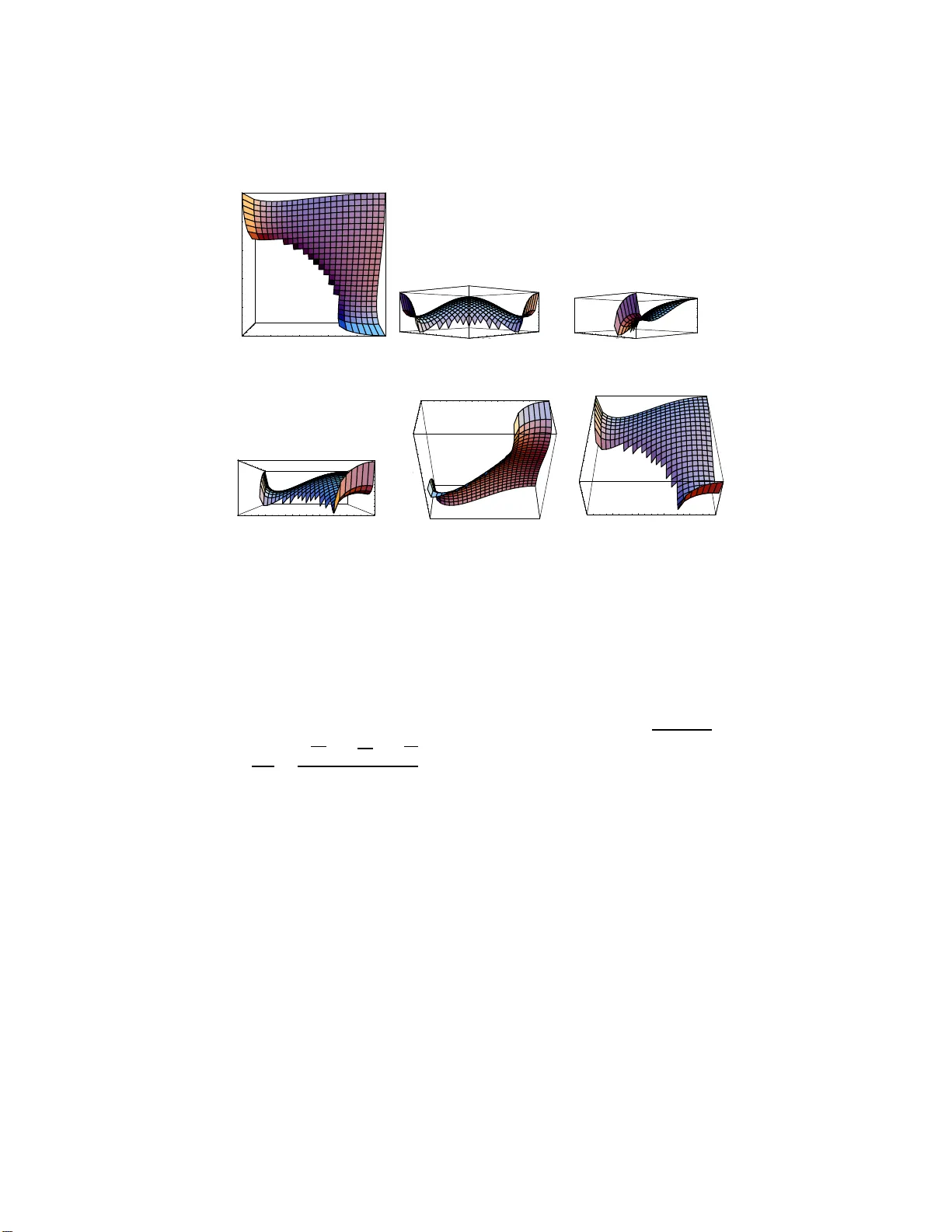
TRANSACTIONS OF THE AMERICAN MA THEMA TICAL SOCIETY V olume 00, N umber 0, Pages 000– 000 S 0002-9947(XX)0000 -0 ONE GR OUP OF INEQUALITIES WITH AL TITUDES AND MEDIANS IN TRIANGLE ZHIVKO ZHELEV Abstract. In the article w e pro ve some inequalities that con tain r elations betw een altitudes and medians in t riangle. At least one of these i nequalities has not been considered in the literature b efore and the m ain theorem has also not been prov ed elsewhere in that form. Some immediate corollaries ha v e been presen ted as well. Geometry of the triangle is a r ealm of elementary geo metry where interested new results pop up all the time. There ar e plent y of theor ems concerning geometry of the triangle, including hundreds of geo metric ineq ualities (see for example [2]). The following result c onsists of tw o inequalities which lo ok quite pleasant but the second o ne turned out to b e e x tremely difficult to tackle. In fac t we prove the following Theorem 1. L et △ AB C b e an arbitr ary triangle with sides a , b and c . L et also h a , h b , h c and m a , m b , m c b e the altitudes and me dians to t hese sides resp e ctively. Then t he fol lowing two ine qualities hold: ah a + bh b + ch c ≤ √ bch a + √ ach b + √ abh c (1) am a + bm b + cm c ≤ √ bcm a + √ acm b + √ abm c . (2) As far a s the author knows, the seco nd inequa lit y has no t b een prov ed yet. But different ra ndom chec ks of v alues of the triangle sides hav e not brought any counterexamples. Our pro of is based on one and tw o v ariable functions theory which we consider an impediment since the pro blem for m ulated above is in the ar ea of the elementary mathematics. First we formulate so me le mma s which are mo r e or less obvious. Lemma 1 ( Arithm etic-Geometric-Mean I nequalit y). L et a 1 , a 2 , . . . a n ∈ R and a i ≥ 0 , i = 1 , . . . , n . Then the fol lowing ine quality is true: (3) a 1 + a 2 + · · · + a n n ≥ n √ a 1 a 1 · · · a n . Pro of. See [4, p. 18-1 9] and [3] for a deta iled pro of. Lemma 2. If a + b + c > 0 , then a 3 + b 3 + c 3 ≥ 3 ab c . Key wor ds and phr ases. medians, altitudes, inequality . 2000 Mathematics Subje ct Classific ation. 51M04, 51M05, 51M16. c 1997 American Mathematical So ciety 1 2 ZHIVKO ZHELEV Pro of. F r om Lemma 1 ( n = 3 ), we get that a 1 + a 2 + a 3 ≥ 3 3 √ a 1 a 2 a 3 . Replacing a 1 with a 3 , a 2 with b 3 and a 3 with c 3 , we g et that a 3 + b 3 + c 3 ≥ 3 3 √ a 3 b 3 c 3 = 3 ab c ., q. e. d. Pro of of the main theorem. In order to prove (1) we use that ah a = bh b = ch c = 2 S △ AB C . Then ah a + bh b + ch c − √ bch a − √ ach b − √ abh c = 6 S − 2 S √ bc a − 2 S √ ac b − 2 S √ ab c = 2 S 3 − √ bc a − √ ac b − √ ab c ! . Therefore, ah a + bh b + ch c ≤ √ bch a + √ ach b + √ abh c ⇐ ⇒ 3 − √ bc a − √ ac b − √ ab c ! ≤ 0 ⇐ ⇒ 3 abc ≤ ( bc ) 3 2 + ( ac ) 3 2 + ( ab ) 3 2 , a > 0 , b > 0 , c > 0 . By the substitution x = √ bc , y = √ ac , z = √ ab , we ge t that 3 abc ≤ ( bc ) 3 2 + ( ac ) 3 2 + ( ab ) 3 2 ⇐ ⇒ 3 xy z ≤ x 3 + y 3 + z 3 , x > 0 , y > 0 , z > 0 . Last inequality is exac tly L e mma 2 and the pro of of (1 ) is completed. Now, without loss o f genera lit y , w e can ass ume for △ AB C , tha t a ≥ b ≥ c . Three main cases ar e p ossible: † ) △ AB C is equilateral, i. e. a = b = c ; †† ) △ AB C is isosceles, i. e. a = b > c ; † † † ) △ AB C is an a rbitrary triangle , i. e. a > b > c . First, let’s rewr ite (2 ) in the form (4) ( a − √ bc ) m a + ( b − √ ac ) m b + ( c − √ ab ) m c ≤ 0 . First case. If △ AB C is equila teral, then a − √ bc = b − √ ac = c − √ ab = 0 and (4) is fulfilled as an equality . W e will see b elow that this ca s e is in fact the extremal case for our pro blem. Second case. Now let △ AB C b e iso s celes and we ma y a ssume a = b > c > 0. On the other hand we hav e that (5) m a = 1 2 √ 2 b 2 + 2 c 2 − a 2 = 1 2 √ a 2 + 2 c 2 = m b , m c = 1 2 √ 2 a 2 + 2 b 2 − c 2 = 1 2 √ 4 a 2 − c 2 . Then using (5), (4) is transformed in to ONE GR OUP OF INEQUALITIES 3 (6) ( a − √ ac ) p a 2 + 2 c 2 ≤ a − c 2 p 4 a 2 − c 2 , a > c. W e will prov e (6). After so me tedio us computations, we get co nsequently: ( a − √ ac ) √ a 2 + 2 c 2 ≤ a − c 2 √ 4 a 2 − c 2 ⇐ ⇒ √ a ( √ a − √ c ) √ a 2 + 2 c 2 ≤ ( √ a − √ c )( √ a + √ c ) 2 √ 4 a 2 − c 2 ⇐ ⇒ 2 √ a 3 + 2 ac 2 ≤ ( √ a + √ c ) √ 4 a 2 − c 2 ⇐ ⇒ 4( a 3 + 2 ac 2 ) 4 a 2 − c 2 ≤ a + c + 2 √ ac ⇐ ⇒ 4 a 3 + 8 ac 2 − 4 a 3 + ac 2 − 4 a 2 c + c 3 4 a 2 − c 2 ≤ 2 √ ac ⇐ ⇒ c 3 + 9 ac 2 − 4 a 2 c 4 a 2 − c 2 2 ≤ 4 ac ⇐ ⇒ c 6 + 81 a 2 c 4 + 16 a 4 c 2 + 18 ac 5 − 8 a 2 c 4 − 72 a 3 c 3 ≤ 64 a 5 c + 4 ac 5 − 32 a 3 c 3 ⇐ ⇒ c 6 + 14 ac 5 + 73 a 2 c 4 − 40 a 3 c 3 + 16 a 4 c 2 − 64 a 5 c ≤ 0 ⇐ ⇒ c ( c 5 + 14 ac 4 + 73 a 2 c 3 − 40 a 3 c 2 + 16 a 4 c − 64 a 5 ) ≤ 0 ⇐ ⇒ c 5 + 14 ac 4 + 73 a 2 c 3 − 40 a 3 c 2 + 16 a 4 c − 64 a 5 ≤ 0 ⇐ ⇒ c a 5 + 14 c a 4 + 73 c a 3 − 40 c a 2 + 16 c a − 64 ≤ 0 . In the last expr ession, le t c a = t ∈ (0 , 1 ), a nd it follows that t 5 + 14 t 4 + 73 t 3 − 40 t 2 + 16 t − 64 ≤ 0 ⇐ ⇒ ( t − 1) | {z } < 0 ( t 4 + 15 t 3 + 88 t 2 + 48 t + 64) | {z } > 0 if t> 0 ≤ 0 . But the last one is obviously true and that prov e s (6) in this ca se. Third case. Let now △ AB C b e an a rbitrary triang le and let a > b > c > 0. W e rewrite (4) in the for m (7) 1 2 ( a − √ bc ) p 2 b 2 + 2 c 2 − a 2 + 1 2 ( b − √ ac ) p 2 a 2 + 2 c 2 − b 2 + 1 2 ( c − √ ab ) p 2 a 2 + 2 b 2 − c 2 ≤ 0 or 4 ZHIVKO ZHELEV (8) 1 2 a 2 1 − r b a r c a ! s 2 b a 2 + 2 c a 2 − 1 + b a − r c a s 2 + 2 c a 2 − b a 2 | {z } F 0 @ b a , c a 1 A := F ( x ,y ) + 1 2 a 2 c a − r b a ! s 2 + 2 b a 2 − c a 2 | {z } F 0 @ b a , c a 1 A := F ( x ,y ) ≤ 0 , and therefore 1 2 a 2 F ( x, y ) ≤ 0 ⇐ ⇒ F ( x, y ) ≤ 0. Two v ariable function F ( x, y ) defined ab ov e, w e na me devil-fish function and the surface this function plots in R 3 – devil-fish surfac e . In our new notation inequa lit y (4) transfor ms into the ex tr emal problem (9) max ( x,y ) ∈ M ⊂ R 2 F ( x, y ) , where M = { ( x, y ) ∈ R 2 | 0 ≤ y ≤ x ≤ 1 , x + y ≥ 1 } , where M is geometrically a r ight-angle triangle and the last inequalit y follo ws from the fact that a + b > c in an arbitrary triangle. It is a straig htforward chec k that the devil-fish function is well-defined on M . Therefore, in order to prov e (4), we have to prov e that max ( x,y ) ∈ M F ( x, y ) = 0 . Note tha t M is a compact set and since M is a co ntin uous function on M , it follows from some cla ssical results in the real mathematical a na lysis, that F ( x, y ) reaches its maximum there. In o rder to find that max ima l p oint we consider the int erior and the b oundary of M separ ately , M = int M ∪ ∂ M . Using s ome c a lculating pro grams such as Maple (computations can be done manually but that can turn into an extremely tedious hardwork), we find that ∂ F ( x, y ) ∂ x = − y p 2 x 2 + 2 y 2 − 1 2 √ xy + 2(1 − √ xy ) x p 2 x 2 + 2 y 2 − 1 + p 2 + 2 y 2 − x 2 − ( x − √ y ) x 2 + 2 y 2 − x 2 − 2 + 2 x 2 − y 2 2 √ x + 2( y − √ x ) x p 2 + 2 x 2 − y 2 , and since the devil- fish function is a symmetric function, i. e. F ( x, y ) = F ( y , x ), it follows immediately that ONE GR OUP OF INEQUALITIES 5 ∂ F ( x, y ) ∂ y = − x p 2 y 2 + 2 x 2 − 1 2 √ xy + 2(1 − √ xy ) y p 2 y 2 + 2 x 2 − 1 + p 2 + 2 x 2 − y 2 − ( y − √ x ) y 2 + 2 x 2 − y 2 − 2 + 2 y 2 − x 2 2 √ y + 2( x − √ y ) y p 2 + 2 y 2 − x 2 . Then w e solve the sys tem ∂ F ∂ x = 0 ∂ F ∂ y = 0 , which gives us tw o p oints: M 1 (0 , 9238 12749 1 . . . , 0 , 16 60179 102 . . . ) and M 2 (1 , 1). Note that M 1 , M 2 ∈ M and M 1 ∈ int M , M 2 ∈ ∂ M . Again using some softw are, we get for the devil- fish function’s hessian: H ( x, y ) := ∂ 2 F ∂ x 2 · ∂ 2 F ∂ y 2 − ∂ 2 F ∂ x∂ y 2 | M 2 (1 , 1) = − 3 √ 3 2 ! − 3 √ 3 2 ! − 3 √ 3 4 ! 2 = 9 4 2 > 0 and s ince ∂ 2 F ∂ x 2 | M 2 (1 , 1) = − 3 √ 3 2 < 0, it follows that p oint M 2 (1 , 1) is a po ssible po int of max imum over M . F o r completeness we nee d to chec k wha t is go ing on the b oundar y b ecaus e M 2 ∈ ∂ M . But that is straig h tforward and this chec king consists of the cases { x = 0 } , { x = y } , { x = 1 } , and { x + y = 1 } . This leads to the fact that the p oint in question is in fact an abso lute maximum in M . This yields sup ( x,y ) ∈ M F ( x, y ) = max ( x,y ) ∈ M F ( x, y ) = F (1 , 1) = 0 . Additionally , M 1 is a p oint of a lo c al minim um and more over: F ( x, y ) | M 1 = F (0 , 92 38127 491 . . . , 0 , 16601 79102 . . . ) = − 0 , 428 0 65796 8 . . . 6 ZHIVKO ZHELEV The devil-fish surfa c e can be seen b elow: 0 0.2 0.4 0.6 0.8 1 0 0.2 0.4 0.6 0.8 1 -0.6 -0.4 -0.2 0 0 0.2 0.4 0.6 0.8 Figure 1. Devil-fis h sur face Using soft w are such a s Maple and Mathematic a , one can get different v iews to that surface: ONE GR OUP OF INEQUALITIES 7 0 0.2 0.4 0.6 0.8 1 0 0.2 0.4 0.6 0.8 1 -0.6 -0.4 -0.2 0 (a) View from ab ov e 0 0.2 0.4 0.6 0.8 1 0 0.2 0.4 0.6 0.8 1 -0.6 -0.4 -0.2 0 0 0.2 0.4 0.6 0.8 1 (b) Left corner view 0 0.2 0.4 0.6 0.8 1 0 0.2 0.4 0.6 0.8 1 -0.6 -0.4 -0.2 0 0 0.2 0.4 0.6 0.8 1 0 (c) Ri gh t corner view 0 0.2 0.4 0.6 0.8 1 0 0.2 0.4 0.6 0.8 1 -0.6 -0.4 -0.2 0 0.2 0.4 0.6 0.8 (d) F ron t view 0 0.2 0.4 0.6 0.8 1 0 0.2 0.4 0.6 0.8 1 -0.6 -0.4 -0.2 0 0 1 0. 2 0 .4 0.6 0.8 1 (e) F ront -do wn view 0 0.2 0.4 0.6 0.8 1 0 0.2 0.4 0.6 0.8 1 -0.6 -0.4 -0.2 0 0 0.2 0.4 0.6 0.8 1 0. 2 0 .4 0.6 0.8 1 (f ) F ront -up view Figure 2. Different views of the devil- fish surface Therefore all the cases a re do ne and the theore m is prov ed. The following immediate co rollar y is true: Corollary 1 . L et a, b and c b e the sides of a triangle △ AB C and let also m a , m b m c b e the me dians to these sides r esp e ctively. Then a) (2 p − 3 a ) m a + (2 p − 3 b ) m b + (2 p − 3 c ) m c ≥ 0 , whe r e p := a + b + c 2 . b) m a m c ≤ √ ab + √ ac + √ bc a + b + c ≤ 1 , a ≥ b ≥ c . References [1] G. Boich ev. Geometric inequalities containing medians and some other elements of the tri- angle. Educ ation in mathematics , 1:41–49, 1981. (in Bulgarian). [2] O. Bottema, R. ˆ Z. Djordevi´ c, R. R. Jani ´ c, D. S. Mitri no vi ´ c, and P . M. V asi´ c. Ge ometric ine q ualities . Groningen, 1969. [3] R. B. Nelson. Pro of Without W ords: The Arithmetic-Logarithmic-Geometric Mean Inequal- ity . Math. Mag. , 8:305, 1995. [4] T. Stoilo v and K. Chilingirov a. Ine quality pr oblems . Naro dna prosve ta, Sofia, 1989. (in Bul- garian). Zhivko Zhelev Dep ar tment of Ma them a tics and Informa tics , Trakia University, Rektora t, AF, 367A, 6003 St. Zagora, Bulgaria. Email: zhelev@u ni-sz.bg
Original Paper
Loading high-quality paper...
Comments & Academic Discussion
Loading comments...
Leave a Comment