Ferrers Dimension and Boxicity
This note explores the relation between the boxicity of undirected graphs and the Ferrers dimension of digraphs.
Authors: Soumyottam Chatterjee, Shamik Ghosh
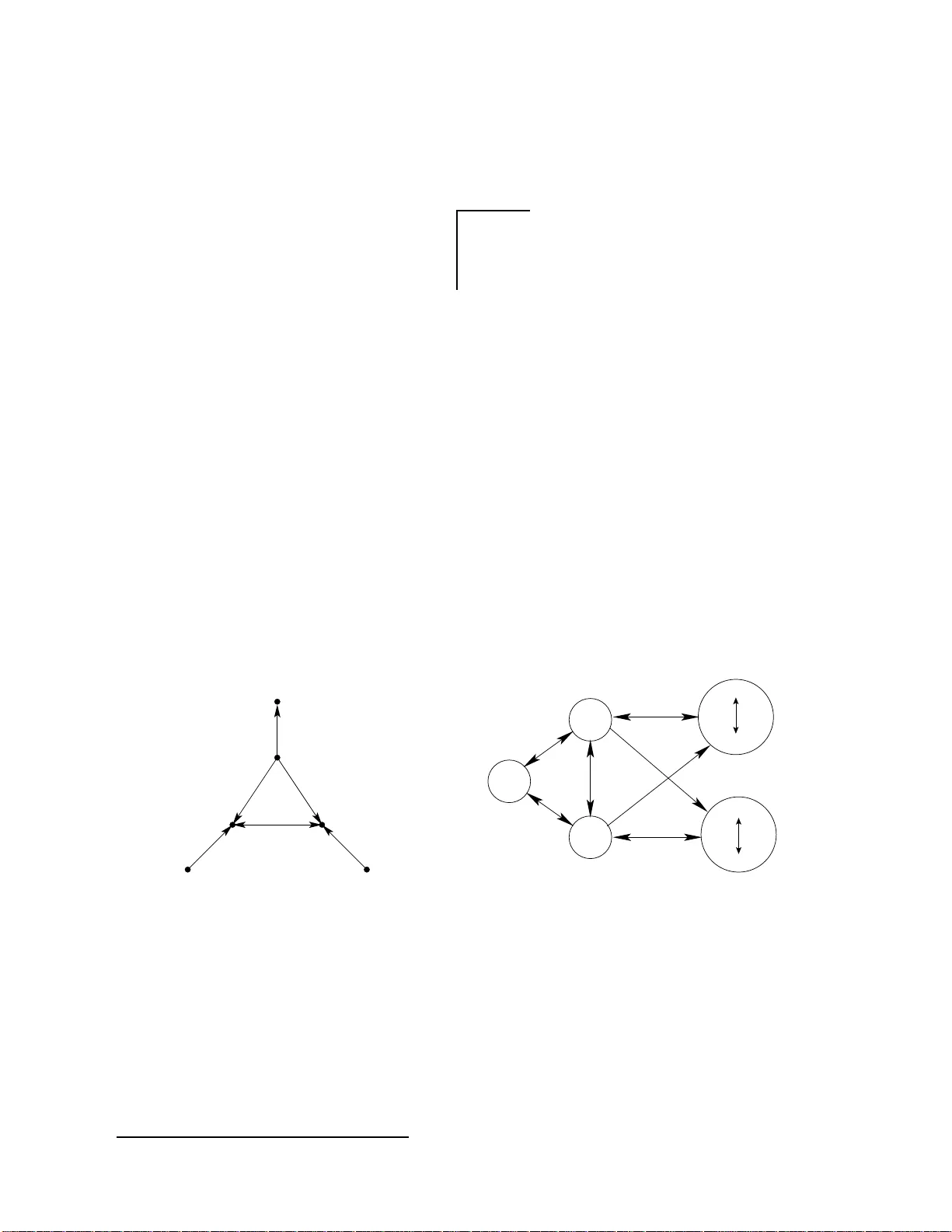
F errers Dimension and Bo xicit y Soum y ottam Chatterjee ∗ and Shamik Ghosh + No v em b er 3, 2018 ∗ Department of Electronics and T el e-Communications En gi neering and + Department of Mathematics, Jada vpu r Universi ty , Kolk ata - 700 032, India. E-mail addr ess: ∗ soumyottam chatterjee@gmai l.com, + sghosh@mat h.jdvu.ac.in Abstract This note explores the relation b etw een the b o xicity of undirected g raphs and the F errer s dimension of digraphs. Keywords: Interv al Graph, F errers digraph, F errers dimension, Boxicit y . 1 In tro duction An undir ec ted graph G = ( V , E ) is an interval gr aph if and only if it is the in tersection graph of a family of interv als on the real line. Eac h v ertex is assigned an in terv al and tw o v ertices are adjacen t if and only if their corresp onding in terv als in tersect. Moti v ated b y theoretical as w ell as practical considerations, graph theorists hav e tried to generalize the concept of interv al graphs in many w ays. In many cases, represen tation of a graph as the in tersection g raph o f a family of geometric ob jects, whic h are generalizat ions of inte rv als is sough t. An example is the concept of b o xicit y in tro duced b y F. S. Rob erts in 1969 [10]. F or a graph G , its b oxicity box ( G ) is the minimum p ositiv e inte ger b suc h that G can b e represented as the inte rsection graph of axis-parallel b-dimensional b o xes. Here a b -d imensional b o x is a Cartesian pro duct I 1 × I 2 × · · · × I b where eac h I i is a closed int erv al on the real line. The b o xicit y of a complete graph ma y b e assumed to b e zero and since a one-dimensional b o x is a closed interv al on the real line, graphs of b o xicit y at most 1 are exactly th e in terv al graphs. In tro duced in d epen den tly b y Guttman [4] and Riguet [9 ], a F er r ers digr aph D = ( V , E ) is a directed graph (in s hort, digraph) whose successor sets are linearly ordered by inclusion, where the successor set of v ∈ V is its set of out-neighbors { u ∈ V | v u ∈ E } . It is easy to see that th e successor sets are linearly ordered by inclusion if and only if the analogously defined predecessor sets are linearly ord ered by inclusion, and that b oth are equiv alen t to the transformabilit y of the adjacency matrix b y indep end en t ro w and column p erm utations to a (0 , 1)-matrix in which the 1’s are clustered in a corner in the shap e of a F errers d iagram (hence the term ‘F errers d igraph’). It is w ell-kno wn that ev ery digraph D is th e intersect ion of a fin ite num b er of F e rr ers d igraphs and 1 the m inim u m suc h n umber is its F err ers dimension . It is kn o wn [9] that a digraph D is a F err ers digraph if and only if its adjacency matrix d o es n ot conta in an y 2 × 2 p erm utation matrix: 1 0 0 1 ! or 0 1 1 0 ! . The digraph s of F errers dimension at most 2 were c haracterized by Cogis [1]. He called ev ery 2 × 2 p erm utation matrix a c ouple and defined an undir ected grap h H ( D ), the graph asso ciate d to a digr aph D whose v ertices corresp ond to th e 0’s of its adjacency m at rix with t w o such v ertices joined b y an edge if and only if the corresp ond ing 0’s b elong to a couple. Cogis [1] p ro ved th at D is of F errers dimens io n at most 2 if and only if H ( D ) is bipartite. In the general case, if d F ( D ) = n , then there exist F errers digraphs F i , i = 1 , 2 , . . . , n , such that D can b e expressed as D = F 1 ∩ F 2 ∩ · · · ∩ F n . Zeros b elonging to any particular F i do not form any couple among themselv es and consequ en tly f orm an indep enden t set in H ( D ). T hus χ ( H ( D )) ≤ d F ( D ) wh ere χ ( H ( D )) is the c hromatic n umb er of H ( D ). No instance has b een found y et for whic h the inequ ality is a strict one and it is not kn own whether χ ( H ( D )) = d F ( D ) for all digraph s D . But from th e ab o ve inequality , it follo ws that d F ( D ) > n whenever H ( D ) con tains K n . In fact, d F ( D ) = n if H ( D ) = K n , as d F ( D ) cannot exceed the num b er of 0’s of the adjacency matrix of D . Let G = ( V , E ) b e a graph (directed or undirected). W e denote the adjacency matrix of G b y A ( G ). F or con ve nience, an ent ry of A ( G ) corresp onding to, say , the vertex u i ∈ V in the row and the v ertex v j ∈ V in th e column will b e denoted by , simply , u i v j . The graph whose adjacency matrix is obtained by interc h an ging 0’s an d 1’s of A ( G ) w ill b e d enote d by G . Note that if G h as lo ops at all v ertices (i.e., all pr incipal diagonal elemen ts of A ( G ) are 1), then G is a graph without lo ops ( i.e., all principal diagonal elemen ts of A ( G ) are 0) and vice-v ersa. Again for a digraph D with adjacency matrix A ( D ), we denote the digraph w hose adjacency matrix is A ( D ) T (the transp ose of th e m at rix A ( D )) b y D T . No w we explore some n ice r ela tions b etw een F errers digraphs and in terv al graphs. A digraph D = ( V , E ) is oriente d if ev ery arc of D has a un ique directio n (i.e., uv ∈ E = ⇒ v u / ∈ E for an y u, v ∈ V ). An orien ted digraph D = ( V , E ) is tr ansitively oriente d if a, b, c ∈ V , ab, bc ∈ E = ⇒ ac ∈ E . An undirected graph G = ( V , E ) is tr ansitively orientable if eac h edge of G can b e assigned a one-wa y direction in s u c h a wa y that the resulting digraph is transitiv ely orien ted. W e call th is digraph as a tr ansitive orientation of G . A transitive digraph D = ( V , E ) without lo op at an y verte x is an interval or der digraph if a, b, x, y ∈ V , ax, by ∈ E = ⇒ ay or bx ∈ E . T he class of in terv al order digraphs are transitiv e digraphs D suc h that D ∩ D T are in terv al graphs [2 ] or equiv alen tly , lo opless F err ers digraphs [8]. Also if F is a F er r ers d igraph without lo ops, then F is a F errers digraph with lo op at ev ery vertex. F urth er we kn o w that an undirected graph is an in terv al graph if and only if it do es not conta in C 4 (the cycle of length 4) as an induced sub graph and its complemen t (called c o-interval graph) is transitive ly orien table.[3 ] Fin ally since eve ry orien tation of C 4 = 2 K 2 is isomorph ic to D 1 (cf. Figure 1), we ha ve the follo w ing obs er v ations: 2 Observ ation 1.1. L et I b e an undir e cte d gr aph (with lo op at every ve rtex). Then I is an interval gr aph if and only if ther e e xists a F err ers digr aph F (with lo op at every vertex) such that I = F ∩ F T . Observ ation 1.2. A digr aph without lo op at any ve rtex is a F err ers digr aph if and only if it is tr ansitively oriente d and do es not c ontain D 1 as an induc e d sub digr aph. Figure 1: The d ig raph D 1 Note that D 1 itself is a transitiv ely orien ted digraph without loops and the follo wing is an ex- ample of an orien ted digraph (without lo ops) whic h d o es not con tain D 1 as an ind uced sub digraph, but it is not a F errers d igraph as it is not tr ansitiv ely oriented: Moreo ver the follo wing d igraph is transitiv ely orien ted and do es not con tain D 1 as an ind uced sub digraph, though it is n ot a F errers d igraph . The follo wing are some inte resting consequences of the ab o v e observ ations: Corollary 1.3. Every tr ansitive orientation of a c o-i nterval gr aph (without lo ops) is a F err ers digr aph. Corollary 1.4. An undir e cte d gr aph I (with lo op at every v ertex) is an interval g r aph if and only if I has an orienta tion of a F err e rs digr aph (without lo ops). The interse ction digr aph D = ( V , E ) of a family of ordered p airs of sets { ( S u , T u ) | u ∈ V } is the d ig raph s uc h that uv ∈ E if and only if S u ∩ T v 6 = ∅ . An Interval digr aph is an int ersection digraph of a family of ordered pairs of interv als on the real line. A bipartite graph (in short, bigr aph ) B ( X , Y , E ) is an interse ction bigr aph if there exist a family F = { I v : v ∈ X ∪ Y } of s ets suc h th at uv ∈ E ( u ∈ X , v ∈ Y ) if and only if I u ∩ I v 6 = ∅ . An interval bigr aph is such when eac h I v is an in terv al on the real line. The sub matrix of the adjacency matrix of B consisting of the rows corresp onding to one partite set and the columns corresp onding to the other is kno wn as the biadjac ency matrix of B . It shou ld b e noted th at th e t wo concepts inte rsection digraph and in tersection bigraph are basically equiv alen t [8]. In deed the bigraph wh ose biadjacency matrix is the adjacency matrix of a digraph corresp onds to the digraph. Also giv en an y bigraph, if the n umb er of 3 v ertices of th e s ets X an d Y are not equ al, w e can m ak e th em equal b y pr operly introducing some isolated vertice s (corresp ondingly adding the required num b er of ro ws and columns consisting of all zeros in the biadjacency matrix of the bigraph ) and then conv ert it in to the ad j ac ency matrix of a digraph. Th e b igraph corr esp ond ing to a F errers d igraph is kno wn as F err ers bigr aph and the F err ers dimension of a bigraph B is the minim um n umber of F err ers b igraphs whose in tersection is B . No w we shall obser ve an inte resting relation b et wee n F err ers bigraphs and interv al graph s. Definition 1.5. Let B b e a bigraph with biadjacency m at rix A . Then the graph with the follo wing adjacency matrix is d enote d by b B : 1 A A T 1 Clearly th e graph b B is obtained from the bigraph B by joining edges s o that th e partite sets of B b ecome cliques and b y adding lo ops at all vertice s. Let M b e a symmetric (0 , 1) matrix with 1’s in the pr incipal diagonal. T hen M is said to satisfy the q u asi-line ar pr op e rty for ones if 1’s are consecutiv e right to and b elo w the principal diagonal. It is known [11] that an u ndirected graph G (with lo op at ev ery v ertex) is an inte rv al graph if and only if ro ws and columns of A ( G ) can b e su ita bly p erm uted (using the same p erm utation for ro ws and column s ) in su c h a w a y th at it satisfies the q u asi-li near pr operty for on es. No w if F is a F errers bigraph, then it is in teresting to n ot e that b F is an in terv al grap h (with lo op at every vertex) , as its adjacency matrix h as quasi-linear prop ert y for ones. 1 0 1 1 0 1 U V U V Con ve rsely , consider an inte rv al graph I wh ose v ertices are cov ered by t wo disjoin t cliques, say X and Y . W e call suc h an inte rv al graph, a 2 -cliq u e interval gr aph . No w since I is an in terv al graph, its maximal cliques are consecutive ly ordered. Let { C 1 , C 2 , . . . C r } b e a consecutiv e linear ordering of maximal cliques. Assign (closed) in terv als I v to the eac h verte x v according to its fi rst and last app earance in ab o ve sequence of m axima l cliques. Let X ⊆ C i and Y ⊆ C j . Supp ose i < j . No w for eve ry x ∈ X , i ∈ I x and for all y ∈ Y , j ∈ I y . W e ma y r estrict the righ t end p oint of eac h I x up to j wh en ev er it is exceeding j as ev ery I y con tains j and eac h I x has already a common p oint, namely i , for ev ery other verte x in X . Sim ilarly r estrict the left end p oin ts of I y up to i wheneve r it is low er than i . With th is new assignmen t of in terv als for the interv al graph I , we go for furth er reduction. No w 4 since f or ev ery y ∈ Y , th e left en d p oint of I y is > i and i ∈ I x for all x ∈ X , safely w e m a y fix all the left end p oint s of I x to i and similarly all right end p oin ts of I y to j . Finally w e arrange all the v ertices of I in its adjacency matrix according to the lexico graphic ordering (dictionary order) of the ab o ve constructed in terv als. Th us the adjacency matrix of I (with lo op at every vertex) tak es the follo wing f orm : X Y X 1 A Y A T 1 Moreo ver, in this matrix, x i y j = 0 if and only if I x i < I y j whic h giv es us x i y j = 0 = ⇒ x i y k = 0 for all k > j and x i y j = 1 = ⇒ x r y j = 1 f or all r 6 i . That is in eac h row of th e su bmatrix A , ev ery 0 has only 0 to its right and ev ery 1 h as only 1 b elo w it. What this sa ys is nothin g but the bigraph corresp onding to the biadjacency m at rix A is a F errers bigraph. The case for i > j is similar. In this case the v ertices of Y would come b efore those in X in the adjacency matrix of I . Thus we ha v e th e f ol lo wing result: Observ ation 1.6. A bigr aph B is a F err ers bigr aph if and only if b B is a ( 2 -clique) interval gr aph. It is inte resting to note that ev ery 2-clique inte rv al graph I is necessarily an indiffer enc e gr aph 1 as I do es not contai n an in duced K 1 , 3 (since among any th r ee v ertices of I , t w o of them must b e in the same clique). Also sin ce th e bigraph complemen t (also called the c onverse ) of a F err ers bigraph is again a F errers bigraph, the ab o v e observ ation immed ia tely giv es the follo wing: Corollary 1.7. A bigr aph B is a F err ers bigr aph if and only if its gr aph c omplement is a 2 -cliq u e interval gr aph (with lo op at every vertex). 2 In this note, w e relate the t wo concepts - one corresp onding to undirected graphs and the other to directed graphs - those of b o xicit y and F err er s dimension resp ectiv ely and prop ose a new construction for determinin g the F errers dimension of a d igraph in th e general case. 2 Relating b o xicit y with F errers dimension An app lication to Observ ation 1.1 leads to the follo wing theorem. Henceforth w e denote the F errers dimension of a digraph D [bigraph B ] by d F ( D ) [resp. d F ( B )]. 1 Equiv alently , a pr op er i nt erval gr aph (an in terv al graph wi th an interv al representation where no in terv al prop erly conta ins another) or a unit interval gr aph (whic h has an interv al representation with all the interv als are of same length) or an interv al graph whic h do es n ot con tain an induced copy of K 1 , 3 . 2 The result is analogous to a known one whic h states that a bigraph B is of F errers dimension at most 2 if and only if its graph complement is a 2-cliqu e circular-arc graph (with lo op at every vertex). 5 Theorem 2.1. L et G b e an undir e c te d gr aph with lo op at every vertex. Then ther e exists a digr aph D such that G = D ∩ D T and box ( G ) = d F ( D ) . In gene r al, bo x ( G ) 6 d F ( D ) for any digr aph D such that G = D ∩ D T . Cose quently, box ( G ) = min d F ( D ) | G = D ∩ D T for some digr aph D . Pr o of. Let n = box ( G ). Then G = I 1 ∩ I 2 ∩ · · · ∩ I n , wh ere eac h I i is an in terv al graph with lo op at ev ery v ertex for i = 1 , 2 , . . . , n . Also by Observ ation 1.1, for eac h i = 1 , 2 , . . . , n , I i = F i ∩ F i T for some F errers digraph F i (with loop at e very vertex). Th en G = D ∩ D T , where D = F 1 ∩ F 2 ∩ · · · ∩ F n . As D can b e expressed as the intersecti on of n F errers digraphs, d F ( D ) ≤ n . W e sh o w that d F ( D ) is exactly equal to n . If p ossible, let d F ( D ) = m where m < n . Then th ere exist F err ers digraphs F ′ i , f or i = 1 , 2 , . . . , m , for whic h D = F ′ 1 ∩ F ′ 2 ∩ · · · ∩ F ′ m . No w G = D ∩ D T = I ′ 1 ∩ I ′ 2 ∩ · · · ∩ I ′ m , where I ′ i = F ′ i ∩ F ′ i T for i = 1 , 2 , . . . , m . Again since the graph G h as lo ops at all the v ertices and G = D ∩ D T , the digraph D and h en ce eac h F ′ i also has lo ops at all its v ertices. Th en by Observ ation 1.1, eac h I ′ i ’s is an interv al graph. So G can b e expressed as the in tersection of m in terv al graphs, where m < n , con trary to the fact that the b oxici ty of G is n . Hence d F ( D ) = n . Moreo ver f r om the ab o ve deduction, it f oll o ws that, wheneve r G = D ∩ D T for some digraph D , we ha ve box ( G ) 6 d F ( D ). This completes the pro of. On the other hand the follo wing is a consequen ce of Ob s erv ation 1.6: Theorem 2.2. L et B b e a b ip artite gr aph. Then d F ( B ) = b ox ( b B ) . Pr o of. Supp ose the bigraph B is of F errers dimension m . Then B = F 1 ∩ F 2 ∩ · · · ∩ F m for some F errers bigraphs F i , ( i = 1 , 2 , . . . , m ) which imp lies b B = c F 1 ∩ c F 2 ∩ · · · ∩ c F m . Since eac h b F i is an in terv al graph by Observ ation 1.6, we hav e n 6 m , if the grap h b B has b o xicit y n . Con ve rsely , if n is the b oxi cit y of b B , then b B = I 1 ∩ I 2 ∩ · · · ∩ I n where eac h I j is an interv al graph. Also sin ce their int ersection (the graph b B ) h as t wo cliques co v ering all the v ertices, eac h I j also con tains same cliques for th ose ve rtices, i.e., eac h of them is a 2-clique in terv al graph s and the t wo cliques are consisting of the partite sets of B . Thus it follo ws f rom O bserv ation 1.6 that B is the intersecti on of n F err er s bigraphs, F 1 , F 2 , . . . , F n suc h that c F j = I j for all j = 1 , 2 , . . . , n . Therefore m 6 n , as requir ed . As an immediate consequence of th e ab o ve theorem we obtain certain c haracterizations o f bigraphs of F errers d imension 2 and int erv al bigraphs. Corollary 2.3. A bip artite g r aph B is of F err ers dimension at most 2 if and only if b B is a 2 -clique r e ctangular gr aph. 3 3 A r e ctangular gr aph is an intersecti on graph of rectangles in R 2 . A 2 -clique r e ctangular gr aph is a rectangular graph whose vertices are cov ered by tw o disjoint cliques. 6 Corollary 2.4. A bip artite gr aph B is an interval bigr aph if and only if b B is a 2 -cliqu e r e ctangular gr aph such that ther e is a r e ctangular r e pr esentation of b B in which for every p air of r e ctangles, their pr oje ctions interse ct on at le ast one of the axes. Pr o of. The pr oof follo w s from the fact th at B is an interv al b igraph ⇐ ⇒ B = F 1 ∩ F 2 where F 1 and F 2 are tw o F errer s bigraph s whose un ion is complete [11] ⇐ ⇒ b B = c F 1 ∩ c F 2 for t wo F err ers bigraph s, F 1 , F 2 with c F 1 ∪ c F 2 is complete ⇐ ⇒ b B = I 1 ∩ I 2 where I 1 and I 2 are (2-clique) in terv al graphs whose un ion is complete. Let G b e an un directed graph . Denot e the corresp onding (symmetric) digraph with the same adjacency matrix as that of G by D ( G ). Theorem 2.5. L e t G b e an undir e cte d gr aph G (with lo op at every vertex) such that box ( G ) = b . L et D ( G ) b e the c orr esp onding digr aph with the same adjac ency matrix a s that of G and k = d F ( D ( G ) ) . Then k 2 ≤ b ≤ ( k − 1) , and the b ounds ar e tight. Pr o of. Since b = box ( G ), G can b e expressed as G = I 1 ∩ I 2 ∩ · · · ∩ I b , where eac h I i is an interv al graph and so I i = F i ∩ F T i for some F errers digraphs (with lo op at every v ertex) for i = 1 , 2 , . . . , b . Then D ( G ) = ( F 1 ∩ F 1 T ) ∩ ( F 2 ∩ F 2 T ) ∩ · · · ∩ ( F b ∩ F b T ) whic h implies k = d F ( D ( G ) ) 6 2 b , i.e., k 2 6 b . The limit is reac hed in the case of G = C 4 as bo x ( C 4 ) = 2 and from the follo wing adjacency matrix of D = D ( C 4 ) it is clear that H ( D ) = K 4 and h ence d F ( D ( C 4 )) = 4. d c a b a b c d a 1 1 1 0 b 1 1 0 1 c 1 0 1 1 d 0 1 1 1 As for the up p er b ound , let d F ( D ( G ) ) = k . Then D = D ( G ) = F 1 ∩ F 2 ∩ · · · ∩ F k . Since D is symmetric, D = D T = D ∩ D T = G = ( F 1 ∩ F 2 ∩ · · · ∩ F k ) ∩ ( F 1 T ∩ F 2 2 ∩ · · · ∩ F k T ) = ( F 1 ∩ F 1 T ) ∩ ( F 2 ∩ F 2 T ) ∩ · · · ∩ ( F k ∩ F k T ). No w F T k ⊆ G = F 1 ∩ F 2 ∩ · · · ∩ F k . Also F T k ∩ F k = ∅ as F k has loops at all its v ertices and hence F k ∪ F T k is complete . So F T k ⊆ F 1 ∩ F 2 ∩ · · · ∩ F k − 1 whic h implies F k ⊆ F 1 T ∩ F 2 2 ∩· · ·∩ F k − 1 T . Thus G = ( F 1 ∩ F 1 T ) ∩ ( F 2 ∩ F 2 T ) ∩ · · ·∩ ( F k − 1 ∩ F k − 1 T ) = I 1 ∩ I 2 ∩· · ·∩ I k − 1 where I i = F i ∩ F T i for i = 1 , 2 , . . . , k − 1. Since eac h F i has lo op at every vertex, we h av e eac h I i is an interv al graph b y Obser v ation 1.1. Th erefore box ( G ) 6 k − 1. 7 This limit is r eac hed for G = C 6 (the cycle of length 6). Sin ce C 6 is not an in terv al graph, but it can b e easily obtained as an in tersection graph of 2-dimensional b oxes, we ha v e box ( C 6 ) = 2. No w D ( C 6 ) = F 1 ∩ F 2 ∩ F 3 where F i , i = 1 , 2 , 3, are F errers digraph s as represented b elo w: a b c d e f a 1 1 0 0 0 1 b 1 1 1 0 0 0 c 0 1 1 1 0 0 d 0 0 1 1 1 0 e 0 0 0 1 1 1 f 1 0 0 0 1 1 = a b f c e d a 1 1 1 0 0 0 b 1 1 1 1 0 0 f 1 1 1 1 1 0 c 1 1 1 1 1 1 e 1 1 1 1 1 1 d 1 1 1 1 1 1 \ c d b e a f c 1 1 1 0 0 0 d 1 1 1 1 0 0 b 1 1 1 1 1 0 e 1 1 1 1 1 1 a 1 1 1 1 1 1 f 1 1 1 1 1 1 \ b c a d f e b 1 1 1 1 1 1 c 1 1 1 1 1 1 a 1 1 1 1 1 1 d 0 1 1 1 1 1 f 0 0 1 1 1 1 e 0 0 0 1 1 1 So d F ( D ( C 6 )) 6 3. Again H ( M ) = K 3 where M the follo wing sub matrix of A ( D ( C 6 )): b f d a 1 1 0 M = c 1 0 1 e 0 1 1 f c e b a d Therefore d F ( D ( C 6 )) > 3 and hence d F ( D ( C 6 )) = 3, as r equired. 3 A construction to determine the F errers dimension of a directed graph Let D b e a digraph and H ( D ) b e the graph asso cia ted to D . The follo wing example sho ws that not every color class in a give n coloring of H ( D ) forms a F errers digraph . Example 3.1. Let us consid er the digraph D w hose adjacency matrix A ( D ) is given b elo w: a b c a 1 0 0 b 0 1 0 c 0 0 1 The asso ciated graph H ( D ) is giv en by: ab ba bc cb ac ca Consider the 2-coloring of H ( D ) with color classes { ab, bc, ca } and { ba, cb, ac } . No w zeros of A ( D ) 8 corresp onding to the color class { ab, bc, ca } , forms the d igraph wh ose adj ac ency matrix, a b c a 1 0 1 b 1 1 0 c 0 1 1 sho ws that it is n ot a F errers d igraph. Th us it is clear th at if a color class has to corresp ond a F errers digraph, it must cont ain all the zeros, whic h, among themselv es, ensu re th e absence of couples. Mo re precisely , if zeros ab an d cd ( ab 6 = cd ) are in the same color class, either ad or cb or b oth must also b e in that same color class. In view of this ob s erv ation, we mo dify th e construction of Cogis and introd uce the directed graph J ( D ) instead of the u ndirected graph H ( D ) corresp onding to a digraph D . Definition 3.2. Let D = ( V , E ) b e a digraph. W e define a digraph J ( D ) with v ertex set E (i.e . the arcs of D ) and there is an arc from ab ∈ E to cd ∈ E if and only if ab 6 = cd and ad ∈ E . 4 It is clear that for an y sub digraph H o f D , J ( H ) is al so a s ub digraph of J ( D ). Also J ( H ) b ecomes an induced one wh enev er H is an ind uced sub digraph of D . Example 3.3. Let us consider the follo wing digraph D . T hen the corresp onding J ( D ) is obtained as f ol lo ws: a b c d e f f d c d bc ba bd e c dc D J ( D ) Certainly not all induced s u b digraphs of J ( D ) are of the form J ( H ) for some su b d igraph H of D . F or example, the induced s ub digraph of J ( D ) with the v ertex set { bc, ec, f d } is not of the form J ( H ) for an y sub digraph H of D . Definition 3.4. A s ub digraph S of J ( D ) with v ertex set V ( S ) is called an ide al sub digraph if ab − → cd in S = ⇒ ab 6 = cd and ad ∈ V ( S ) . W e note th at for any sub d igraph H of D , J ( H ) is an ideal s ub digraph of J ( D ). 4 a, b, c, d may not b e all d isti nct. 9 Definition 3.5. An ideal sub digraph S of J ( D ) is called total if for an y ab 6 = cd in V ( S ), we h av e ab − → cd or cd − → ab or b oth (i.e., ab ← → cd ). Let D = ( V , E ). Then th e total c overing numb er of J ( D ) is the min im u m n umb er of total sub digraph s of J ( D ) needed to co ver E , i.e., the v ertex set of J ( D ). F or a digraph D , it is not known (as we men tioned ab o v e) that whether d F ( D ) = χ ( H ( D )), i.e., the clique co vering num b er of H ( D ). But we ha ve the follo w ing r esult: Theorem 3.6. L et D b e a digr aph. Then the F err e rs dimension of D is e qual to the total c overing numb er of J ( D ) . Pr o of. Let d F ( D ) = n and the total co v ering num b er of J ( D ) b e m . T hen D = F 1 ∩ F 2 ∩ · · · ∩ F n for some F err ers digraphs F i , i = 1 , 2 , . . . , n . Hence D = F 1 ∪ F 2 ∪ · · · ∪ F n . No w w e consider the sub digraph F 1 of D . W e h a ve, J ( F 1 ) is an ideal sub digraph of J ( D ) as F 1 is a sub digraph of D . W e claim that J ( F 1 ) is a total sub digraph of J ( D ), whence it will follo w th at m ≤ n . Let ab, cd ∈ E ( F 1 ), ab 6 = cd . Then ab, cd / ∈ E ( F 1 ) and so there are zero en tries in the p ositions ab and cd the adjacency m at rix of F 1 . W e hav e the follo wing thr ee cases: b d a 0 c 0 b d c = a 0 0 b = d a 0 c 0 a 6 = c, b 6 = d a = c, b 6 = d a 6 = c, b = d F or the last tw o cases, ad = cb = 0 and in the first case, since F 1 is a F err ers digraph, ad or cb (or b oth) m ust b e equal to zero. Thus ad or cb (or b oth) ∈ V ( J ( F 1 )), which im p lies ab → cd or cd → ab (or b oth) in J ( F 1 ). Therefore J ( F 1 ) is a total sub digraph of J ( D ) and the claim is ve rifi ed . Next, let { S 1 , S 2 , . . . , S m } b e a total cov ering of J ( D ). F or eac h i = 1 , 2 , . . . , m , w e define the sub digraph F i of D with the ve rtex set same as that of D and edges wh ic h are b elonging to the v ertex set of S i , i. e., F i = ( V , V ( S i )), wh ere D = ( V , E ). W e sho w that F i is a F errers digraph by the metho d of contradicti on. W e assume that F i is not a F errers digraph so that th er e is a couple b d a 1 0 c 0 1 in the adjace ncy matrix of F i . Then ab, cd ∈ E ( F i ) = V ( S i ), where ab 6 = cd . Since S i is total, w e ha ve, ad or cb (or b oth) m ust b elong to V ( S i ) = E ( F i ) as ab → cd or cd → ab in S i . This con tradiction pro ves our assertion. Also since this co v ering co v ers all ve rtices of J ( D ), i.e., all the edges of D , we ha v e D = F 1 ∪ F 2 ∪ · · · ∪ F m , wh ere eac h F i is a F errers digraph, s o that D = F 1 ∩ F 2 ∩ · · · ∩ F m . Finally , since the complemen t of a F errers digraph is ag ain a F errers digraph, we hav e n ≤ m . This completes the pr oof. 10 One fin al remark is that the u ndirected graph obtained f rom J ( D ) by ignoring the dir ec tions of the arcs is the same as the complemen t of the graph H ( D ). No w the c hromatic n umb er of H ( D ) is the clique co v ering n umber of H ( D ), whic h is less than or equ al to the total co v ering num b er of J ( D ) as every total sub digraph of J ( D ), m ade und irect ed by ignoring the direction of the arcs, is a clique in H ( D ), bu t the con verse may not b e true. References [1] O. Cogis, A char acterization of digr aphs with F err ers dimension 2 , Rapp ort de Rec herche, 19 , G. R. CNRS no. 22, Paris, 1979. [2] P . C. Fishburn, Interval or ders and interval gr aphs , John Wiley & S ons, New Y ork, 1985. [3] A. Gh ou il ` a -Houri, Car act ´ e risation des gr aphes non orientes dont on p e u t orienter les ar ˆ e tes de mani ` e r e ` a obtenir le gr aphe d’une r elation d’or dr e , C. R. Acad. Sci. P aris 254 , 1370-1371. [4] L. Guttman, A b asis for sc aling quantitative data , Am. S ocial. Rev. 9 (1944), 139-150. [5] G. Ha j ¨ o s, ¨ U b er ei ne Art von Gr aphen , Int. Math. Nachr. , 11 , P r oblem 65, 1957. [6] E. Marczewski, Sur deux pr opri ´ e t ´ e s des classes d’ensembles , F und . Math. 33 (1945), 303-307. [7] B. G. Mirkin and S. N. R o din, Gr aphs and Genes , Sp ringer-V erlag, New Y ork, 1984. [8] E. Prisner, A jour ney thr ough in tersection graph count y , W eb manuscript. [9] J. Riguet, L es R elations des F err e rs , C. R. Acad. Sci. Paris 232 (1951), 1729. [10] F. S. Rob erts, On the b oxi cit y and cubicit y of a graph in “ Recen t Progresses in Com b in ato rics” (W. T. T u tte, ed.) p p. 301-310, Academic Pr ess, New Y ork, 1969. [11] M. S en , S. Das, A. B. Ro y and D. B. W est, Interval Digr aphs: An Analo gue of Interval Gr aphs , J. Graph Th eory , 13 (1989), 189–202 . 11
Original Paper
Loading high-quality paper...
Comments & Academic Discussion
Loading comments...
Leave a Comment