Robust Linear Processing for Downlink Multiuser MIMO System With Imperfectly Known Channel
This paper proposes a roust downlink multiuser MIMO scheme that exploits the channel mean and antenna correlations to alleviate the performance penalty due to the mismatch between the true and estimated CSI.
Authors: Pengfei Ma (1), Xiaochuan Zhao (1), Mugen Peng (1)
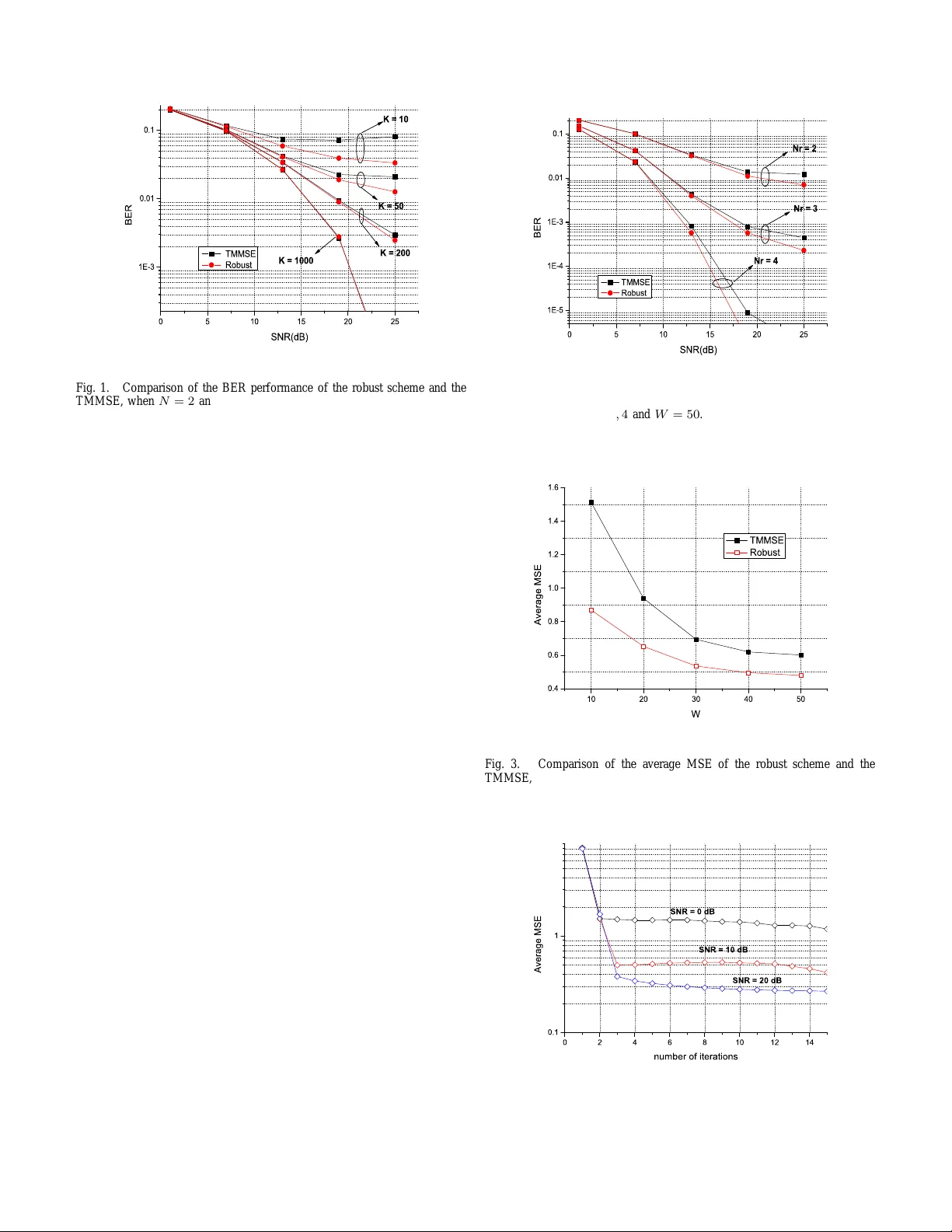
Rob ust Linear Processing for Do wnlink Multiuser MIMO Sys tem W ith Imperfectly Kno wn Channel Pengfei Ma, Xiaochuan Zhao, Mugen Peng, W enbo W ang Beijing University of Posts and T elecomm unication s Beijing, China Abstract —In practical systems, d ue to the time-v arying radio channel, th e channel state inf ormation (CS I) may not be known well at both transmitters and recei vers. For most of the cu rrent multiuser multiple-inpu t multiple-outp ut (MIMO) schemes, they suffer a signifi cant degr ession on the perfor mance due to the mismatch between the true and estimated CSI. T o alle viate the perf ormance penalty , a r obust downlink multiu ser MIM O scheme is proposed in this paper by expl oiting the channel mean and antenn a correlation. These channel statistics are more stable than th e imperfect CSI estimation in the time-varying radio channel, and th ey are u sed, in th e proposed sch eme, to minimize the total mean squared error under the sum power constraint. Si mulation results d emonstrate that th e proposed scheme effectively mitigates the perform ance loss d ue to the CSI mismatch. Index T e rms —multiu ser MIMO, downlink, robust, imperfect CSI. I . I N T RO D U C T I O N The m ultiple-inp ut multip le-outpu t (MIMO) sy stem, em - ploying m ultiple transmit an d recei ve anten nas, has been rec- ognized as a n effecti ve way to imp rove the spectr al efficiency of the radio ch annel [1] [ 2]. More rec ently , m ultiuser schemes have b een in vestigated for MIMO systems to furth er impr ove the multiuser sum capacity . Early studies have assumed a perfectly k nowledge of th e channel state information (CSI) available at the transmitter . [3] extended the single-user schem e [ 4] to the multiuser system. Howe ver , without exploring the multiuser channel info rmation, it simply treated the multiuser inter ference as th e wh ite n oise. The sch eme in [5], o n th e co ntrary , utilized the multiu ser informa tion effectively to minimize the total mea n square d error (TMMSE) and , natu rally , possess ed a better perf ormanc e. The CSI can be ob tained at the transmitter either by using a feedbac k chan nel from the receiver to th e transmitter in frequen cy division du plex (FDD) s ystems, or by inv oking the channel recipro city in time division d uplex (TDD) systems. Howe ver , u sing fe edback in FDD systems, the limited re- sources for the feed back, associated with the pro pagation delay and schedule lag, h eavily d egrade the accuracy of the CSI at the tran smitter . As to the chann el recip rocity in TDD systems, the ac curacy of the CSI is co rrup ted by antenna calibration errors an d turn-aro und time delay . In respect that the perfor- mance would degrade significan tly u nder the imperfe ct CSI, it is necessary to design a mu ltiuser scheme wh ich is stable to the imperfect CS I. In robust design method ologies, Maxmin (worst-case) and Bayesian (stochastic) are two well known ones [7]. The former optimizes the perfor mance und er the worst case of random chann els, thus, it is so conservative tha t its average perfor mance is even w orse than n on-ro bust schemes [8]. The latter m aximizes the ensemb le average perform ance over a pre-descr ibed stochastic distribution o f th e CSI. When the stochastic distribution match es well with the tru e CSI, th e latter outperform s the form er . The scheme in [7] was a Baye sian d esign for downlink multiuser M IMO systems with the imperf ectly known CSI. It intr oduced a ch annel err or matr ix to the cost f unction of [3], then foun d the solutio n which min imized the average cost. However , similar with [ 3], the mu ltiuser in terferen ce was also tre ated as the white n oise. T herefo re, it is expected that the perf orman ce can be improved by exploring the mu ltiuser informa tion. In this paper, a r obust sche me fo r downlink m ultiuser MIMO sy stems is prop osed based on the TMMSE criterion. A more general channel model inv olving the channel mean and antenna corr elation is consider ed. Th e scheme is a Bayesian design which minimizes the average co st fun ction un der the sum power con straint. The rest of this paper is organized as follows. Th e channel model and problem formu lation a re d escribed in Section II. The Section III presents th e design of the robust mu ltiuser scheme f or th e correlated imp erfect kn own cha nnel u nder the sum po wer constraint. Simu lation results and analysis are giv en in Section IV . Finally , the Section V concludes the paper . Notation : Boldface u pper-case letters deno te matrices, and boldface lower-case letter s denote column vectors. tr ( · ) , ( · ) ∗ , ( · ) H , || · || 2 and || · || F denote trace, conjugate , conjug ate trans- position, E uclidian nor m and Frob enius norm, respectively . E ( · ) rep resents the expectation of a stochastic process. [ · ] i,j , [ · ] : ,j denote the ( i , j ) -th element and j -th column of a matrix , respectively . I I . P RO B L E M S TA T E M E N T A. Cha nnel Model Consider a base station (BS) with M antennas and K mobile stations (MS’ s) each h aving N i ( i = 1 . . . K ) antennas. Represented by a matrix H i ∈ C N i × M , th e downlink MIMO channel to MS i is assumed to be f requen cy-flat and q uasi- static blo ck fading . Suppo se a no n-zero -mean ch annel with both tr ansmit and receive antenna correlation s, H i is written as follows [9][11] H i = r W i W i + 1 ˜ H 0 ,i + r 1 W i + 1 R 1 2 0 ,r,i ∆ i R 1 2 t (1) where W i is the r atio o f the p ower in the mean compo- nent to the a verage p ower in the variant compo nent of H i ; ∆ i ∈ C N i × N i is rand om, we assume that its en tries form an ind ependen t identical distribution (i.i.d .) complex Gaussian collection with z ero-mean and ide ntity co variance, i.e. , ∆ i ∼ C N (0 , 1) ; ˜ H 0 ,i ∈ C N i × M is the norm alized chan nel mean, and R 0 ,r,i ∈ C N i × N i and R t ∈ C M × M are the normalize d correlation matrices of the r eceiver of MS i and th e transmitter of BS, respectively . (1) is rewritten into the following for simplicity [11] H i = ˜ H i + R 1 2 r,i ∆ i R 1 2 t (2) where ˜ H i = p W i / ( W i + 1) ˜ H 0 ,i is the channel mean , and R r,i = 1 / ( W i + 1) R 0 ,r,i is the equiv alent correlation matrix of the receiv er of M S i . The c hannel mean and corr elation are more stable than the instantaneo us ch annel informatio n, and they are usua lly acquired b y time-averaging on chann el measurements. In the Rayleigh cha nnel, for example, the non-zer o channel mean ˜ H i is obtained by a veraging channel measurements over a windo w of tens of th e ch annel coh erence time [10]. Fur thermor e, the channel model (2) can also denote the corr elated Rician MIMO channel, in which c ase the channel mean repr esents the line- of-sight (LOS) compon ent of the MIMO channel. In this paper, we assum e that transmitters and receivers only know chan nel means and antenna co rrelations. B. P r oblem F ormu lation W e assume th at there are L i ( i = 1 . . . K ) su bstreams between BS and MS i ( i = 1 . . . K ) , that is to say , BS transmits L i symbols to MS i simultaneou sly . T hen th e sign al r eceiv ed at MS i is y i = A H i H i K X k =1 B k x k + A H i n i (3) where y i ∈ C N i × 1 is the received signal vector, and x i ∈ C L i × 1 is the transm itted sign al vector fr om BS to MS i with zero-mea n and norm alized co variance matrix I . W e assum e the transmitted sign al vecto rs of different users ar e u ncorr elated, i.e., E x i x H j = δ ij I , w here δ ij is the Kro necker fun ction, δ ij = 1 , when i = j and δ ij = 0 , when i 6 = j . W e also assum e the noise vector is ind epende nt o f any sign al vector . A linear post-filter A i ∈ C N i × L i ( i = 1 . . . K ) is used at MS i to recover an estimation of the transmitted sign al vector x i . H i defined in (1 ) [or (2)] den otes the MIMO chann el from BS to MS i . B i ∈ C M × L i ( i = 1 . . . K ) is used at BS to we ight the transmitted sig nal vector x i . After passing through B i , x i becomes into an M × 1 signal vector wh ich is transmitted by M transmit a ntennas of BS. n i ∈ C N i × 1 is the no ise vector w ith the corr elation ma trix R n i = σ 2 n I N i , where I N i denotes the N i × N i identity matrix . In this pap er , we assume L 1 = · · · = L K = L . A i and B i ( k = 1 . . . K ) are jointly designed to minimize the total MSE und er the sum po wer co nstraint. Hence, we get min T M S E = E K P k =1 || x k − y k || 2 s.t. tr K P k =1 B k B H k ≤ P (4) where P is the total transmit po wer of BS. I I I . R O B U S T T M M S E S C H E M E According to (3), the j -th user’ s M SE is M S E j = E || x j − y j || 2 = E ( tr ( A H j H j ( K P i =1 B i B H i ) H H j A j + σ 2 n A H j A j − B H j H H j A j − A H j H j B j + I )) (5) Substitute (2) into (5) and note E ( H i ) = ˜ H i , he nce E R 1 2 r,i ∆ i R 1 2 t = 0 , we obtain M S E j = tr ( A H j ˜ H j ( K P i =1 B i B H i ) ˜ H H j A j + σ 2 n A H j A j − B H j ˜ H H j A j − A H j ˜ H j B j + I ) + E ( tr ( A H j R 1 2 r,j ∆ j R 1 2 t ( K P i =1 B i B H i ) R 1 2 H t ∆ H j R 1 2 H r,j A j )) (6) Observe th e last part in (6) E ( tr ( A H j R 1 2 r,j ∆ j R 1 2 t ( K P i =1 B i B H i ) R 1 2 H t ∆ H j R 1 2 H r,j A j )) = tr ( R 1 2 t ( K P i =1 B i B H i ) R 1 2 H t E ( ∆ H j R 1 2 H r,j A j A H j R 1 2 r,j ∆ j )) (7) Moreover , as ∆ i ∼ C N (0 , 1) with i. i.d. en tries, E ([ ∆ j ] : ,n ([ ∆ j ] : ,m ) H ) = δ n,m I . T herefor e, th e ( m , n ) -th entry of the e xpectatio n in the righ t side of (7 ) is E ( h ∆ H j R 1 2 H r,j A j A H j R 1 2 r,j ∆ j i m,n ) = E (([ ∆ j ] : ,m ) H R 1 2 H r,j A j A H j R 1 2 r,j [ ∆ j ] : ,n ) = tr ( R 1 2 H r,j A j A H j R 1 2 r,j E ([ ∆ j ] : ,n ([ ∆ j ] : ,m ) H )) = δ n,m tr ( R 1 2 H r,j A j A H j R 1 2 r,j ) = δ n,m tr ( A H j R r,j A j ) (8) Thus, the e xpe ctation in the rig ht side of (7) is E ( ∆ H j R 1 2 H r,j A j A H j R 1 2 r,j ∆ j ) = tr ( A H j R r,j A j ) I (9) Substitute (9) into (7), we o btain E ( tr ( A H j R 1 2 r,j ∆ j R 1 2 t ( K P i =1 B i B H i ) R 1 2 H t ∆ H j R 1 2 H r,j A j )) = tr ( R 1 2 t ( K P i =1 B i B H i ) R 1 2 H t tr ( A H j R r,j A j ) I ) = tr ( A H j R r,j A j ) tr (( K P i =1 B i B H i ) R t ) (10) Substitute (10) into (6) M S E j = tr ( A H j ˜ H j ( K P i =1 B i B H i ) ˜ H H j A j + σ 2 n A H j A j − B H j ˜ H H j A j − A H j ˜ H j B j + I ) + tr ( A H j R r,j A j ) tr (( K P i =1 B i B H i ) R t ) (11) The Lagrangian of (4) is L ( A 1 , . . . , A K , B 1 , . . . , B K ) = K P k =1 M S E k + λ ( tr ( K P k =1 B k B H k ) − P ) (12) where λ is the L agrang ian multiplier associated with the total power con straint. So the Karush-Kuhn- T ucker ( KKT) condition s [1 0] of (4) are ∂ L ( A 1 , ..., A K , B 1 , ..., B K ) ∂ A ∗ i = 0 (13) ∂ L ( A 1 , ..., A K , B 1 , ..., B K ) ∂ B ∗ i = 0 (14) λ tr ( K X i =1 B i B H i ) − P ! = 0 (15) λ ≥ 0 (16 ) Among them, (1 3)(14 ) come fro m the fact that the gradien ts of the Lag rangian (12) definitely vanish at the optimal poin t, and (15) is known as the complemen tary slackness. According to (11) ∼ ( 14), we obtain A i = ( ˜ H i ( K P k =1 B k B H k ) ˜ H H i + tr (( K P k =1 B k B H k ) R t ) R r,i + σ 2 n I ) − 1 ˜ H i B i (17) B i = ( K P k =1 ˜ H H k A k A H k ˜ H k + tr ( K P k =1 A k A H k R r,k ) R t + λ I ) − 1 ˜ H H i A i (18) Substitute (1 8) into (1 5) , we can fin d λ is the r oot of the equation λ ( tr ( X ( X + Y + λ I ) − 2 ) − P ) = 0 (19) where X = K X k =1 ˜ H H k A k A H k ˜ H k (20) Y = tr ( K X k =1 A k A H k R r,k ) R t (21) As R t is the normalize d cor relation matrix of the transmitter , it is Herm itian, hence bo th X an d Y are Hermitian, an d so is X + Y . Perfo rm the eigen value d ecompo sition X + Y = UDU H (22) where U is unitar y and D is diagon al. If λ 6 = 0 , (1 9) can be rewritten to M X n =1 U H XU n,n ( d n + λ ) 2 − P = 0 (23) where d n is the n -th diago nal element o f D . Using a bin ary search, th e root of (23 ) can be fou nd quickly . Since the left- hand side of (23) is mo noton ous in λ when λ ≥ 0 , the upper and lo wer bo unds o n λ can be acq uired by replacing d n with d min and d max , respecti vely . Thus, λ upper = r tr ( X ) P − d min ! + (24) λ low er = r tr ( X ) P − d max ! + (25) where ( · ) + means th at the expression takes the value inside the parenth eses if the value is p ositiv e, otherwise it takes ze ro. A nu merical b inary search, then , c an be carried ou t between these two boun ds to find the ro ot of (23 ) u p to a desired precision. Once th ere is no root between the boun ds, which implies that the inequality con straint (1 6) is inactive, λ = 0 is the on ly av ailable solution to (18). From (17 ) (18) , it can be found that th e optimal transmit matrices B k ( k = 1 . . . K ) are fun ctions of the receiv e matrices A k ( k = 1 . . . K ) , and vice versa. Th erefore an iterativ e algor ithm to c alculate A k and B k ( k = 1 . . . K ) is proposed as f ollows. Initialize B (0) k and A (0) k ( k = 1 . . . K ) randomly. n = 0 1) Calculate λ from A ( n ) k ( k = 1 . . . K ) by solving (19). 2) Calculate B ( n +1) k ( k = 1 . . . K ) from A ( n ) k ( k = 1 . . . K ) and λ using (18). 3) Calculate A ( n +1) k ( k = 1 . . . K ) from B ( n +1) k ( k = 1 . . . K ) using (17). 4) Repeat 1), 2) and 3) until K P k =1 ( || A ( n +1) k − A ( n ) k || 2 F + || B ( n +1) k − B ( n ) k || 2 F ) < ε . In our simulation, we set ε = 0 . 0001 . I V . S I M U L A T I O N R E S U LT S In th is sectio n, numerical sim ulations have be en carried out to ev aluate the perform ance of the pro posed scheme. W e assume that the BS equ ipped with f our anten nas ( M = 4 ) is commun icating with two MS’ s ( K = 2 ) each with N re ceiv e antennas ( N 1 = N 2 = N ). Also we assume that the numb er of substreams of each MS is equal to 2 ( L 1 = L 2 = 2 ) , moreover , both the two MS’ s have the same W i ( W 1 = W 2 = W ) . QPSK is employed in the simulatio ns and no c hannel coding is considered . Let th e transmit antenna correlatio n matrix R t be [ R t ] i,j = 0 . 9 | i − j | and the rec eiv e anten nas be uncorr elated, i.e., R r,i = I N . 0 5 1 0 1 5 2 0 2 5 1 E - 3 0 . 0 1 0 . 1 K = 1 0 0 0 K = 2 0 0 K = 5 0 K = 1 0 T M M S E R o b u s t B E R S N R ( d B ) Fig. 1. Comparison of the BER performance of the robust scheme and the TMMSE, when N = 2 and W = 10 , 50 , 200 , 1000 . Firstly , we compare the bit error rate (BER) of the propo sed robust T MMSE scheme with th at of the traditional TMMSE scheme. Defining the signal- to-noise ratio (SNR) as the r atio of total transmitted power to the noise power of ea ch anten na ( S N R = P /σ 2 n ), Fig. 1 is the average BER curves versus the SNR When N = 2 . In ord er to h ighlight its im pact on the BER pe rforma nce, different values of W are used in the ev aluations. When W is small, the ch annel me an poo rly re- flects th e instantaneou s channe l state, thus th e receiver can not completely elimin ate the inter ference among the transmitted signals, which further induces an irre ducible erro r floor at hig h SNR region. Howev er, the p roposed robust scheme overcomes the traditional one with a n oticeable g ain. A s th e W increases, the transmitter ob tains more precise CSI, the refore the residua l interferen ce is m itigated g reatly an d the error floor vanishes. In addition , the gain b etween the p roposed r obust scheme an d the traditional one turns small when the uncertain ty of the channel state is decreasing. In Fig. 2, we comp are the BER perf ormanc e when the number of receive antennas is increasin g. Th e a dditional receive antenna s p rovide m ore spatial d iv ersity gain. In this figure, W is fixed to be 5 0 and N change s fro m 2 to 4 . Although both the two schemes explore the addition al receive div ersity gain , th e pro posed robust sch eme obvio usly has a better p erform ance fo r all N ’ s d ue to its insensitivity to the imperfect CSI. Fig. 3 sh ows the average MSE as a fu nction of W , wh en SNR = 2 0 dB and N = 2 . Th e average MSE of the prop osed robust scheme is less than that o f the trad itional TMMSE scheme over all W ’ s. Mo reover , comp ared to the traditional TMMSE, the d escending slope of the prop osed robust schem e is flat, which further indica tes that its per forman ce is insensi- ti ve to the chan nel uncertain ty . Especially when W bec omes larger , mo re reliable CSI is available, the refore closer the two curves g et. Fig. 4 illu strates the conver gence property of the pr oposed 0 5 1 0 1 5 2 0 2 5 1 E - 5 1 E - 4 1 E - 3 0 . 0 1 0 . 1 N r = 4 N r = 3 B E R S N R ( d B ) T M M S E Ro b u st N r = 2 Fig. 2. Comparison of the BER performance of the robust scheme and the TMMSE, when N = 2 , 3 , 4 and W = 50 . 1 0 2 0 3 0 4 0 5 0 0 . 4 0 . 6 0 . 8 1 . 0 1 . 2 1 . 4 1 . 6 A ve r a g e M S E W T M M S E R o b u st Fig. 3. Comparison of the averag e MSE of the robust scheme and the TMMSE, when N = 2 and S N R = 20 dB. 0 2 4 6 8 1 0 1 2 1 4 0 . 1 1 A ve r a g e M S E n u m b e r o f i t e r a t i o n s S N R = 0 d B S N R = 1 0 d B S N R = 2 0 d B Fig. 4. Con ver gence of the robust scheme, when N = 2 and W = 100 . robust schem e, wh en N = 2 , W = 100 . The cu rves of the average MSE versus th e nu mber of iterations need ed in different SNR’ s a re plotted. The hig her the SNR is, the more itera tions th e p roposed scheme ru ns f or to co n verge. Fortunately , fo r the mo st SNR’ s, fo ur iterations are big en ough to guarantee the con vergence. V . C O N C L U S I O N In this pap er, we in vestigate a r obust linear processing scheme for the downlink multiuser MIMO system u nder the consideratio n of imperfe ct CSI. As the traditio nal d ownlink multiuser MIMO systems depe nd on the instantaneo us CSI too much, they suffer poor perfo rmance once the CSI is n ot accu - rate en ough . In order to deliv er a better perf ormanc e under the imperfect CSI, an iterative Bayesian a lgorithm which explores channel statistics to of fer a much more stable descriptio n to the channel state is developed by min imize the total MSE u nder the sum power constraint. Numer ical simulations exhibit the propo sed robust sch eme experien ces an obvious perform ance gain over the traditiona l sch emes. In addition , the propo sed iterativ e algorithm has a good conv ergence prope rty – after no more than f our times of iter ations, the alg orithm achieves conv ergence. R E F E R E N C E S [1] I. T elat ar , ”Capacity of multi-anten na Gaussian channels”, Eur . T rans. T elecommun. , vol. 10, no. 6, pp. 585-595, Nov ./Dec. 1999. [2] Q. Caire and S. Shamai, ”On the ach ie vabl e throughput of a m ultian tenna gaussian broadcast channel” , IE EE T rans. Inf. Theory , vol. 49, no. 7, pp. 1691-1706, July 2003. [3] A. J.T enenb aum and R.S.Adve, ”Joint multiuse r transmit-recei v e optimiza- tion using linear proc essing”, IEEE Intl. Co nf. on C ommun. , vol .1, pp.588- 592, June 2004. [4] D. P .Palomar , J.M.Ciof fi, and M.A.Lagunas, ”Joint Tx-Rx beamforming design for multicarrie r MIMO channe ls: a unified framewo rk for con ve x optimiza tion”, IEE E T rans. Signal Pr ocessing , vol.51, pp.2381-2401, Sept. 2003. [5] J. F . Zhang and M. G. Xu, ”Minimum system-wide mean-squar ed error for do wnlink spatia l m ultiple xing in multiuser MIMO channe ls”, in proc. IEEE golbalc om’05 , vol. 5, pp. 4, DEC. 2005. [6] M. V u and A. Paulraj, ”MIMO Wire less Precoding”, IEEE Signal Pr ocessing Mag azine , accepted in 2006. [7] H. Li and C.Q. Xu, ”Robust O ptimiza tion of Linear Precoders/Decod ers for Multiuser MIMO Downli nk with Imperfect CSI at Base Station”, in pr oc. IEEE WCNC’07 , pp. 1129-1133, Mar . 2007. [8] H. T . Sun and Z. Ding, ”Rob ust precoder design for MIMO pack et retransmissio ns over imperfectly kno wn flat-fading channe ls”, in pr oc. IEEE ICC , vol.7, pp. 3287-3292, June 2006. [9] A. Hjorungnes, D. Gesbert and J. Akhtar , ”Precoding of Space-T ime Block Coded Signals for Joint Transmit-Rec eiv e Correla ted MIMO Chan- nels”, IEEE T r ans. W ire less Commun. , vol.5, pp.492-497, Mar . 2006. [10] S. Boyd and L. V andenberghe , Con ve x Optimizatio n, Cambridge: U.K. Cambridge Uni versi ty Press, 2004. [11] M. V u and A. Paulraj , ”Optimal Linear Precoders for MIMO Wire less Correla ted Channels Wi th Nonzero Mean in Space-T ime Coded Syste ms”, IEEE Tr ans. Sign al Proc essing , vol. 54, no. 6, pp. 2318-2332, June 2006.
Original Paper
Loading high-quality paper...
Comments & Academic Discussion
Loading comments...
Leave a Comment