A Statistical Approach to Modeling Indian Classical Music Performance
A raga is a melodic structure with fixed notes and a set of rules characterizing a certain mood endorsed through performance. By a vadi swar is meant that note which plays the most significant role in expressing the raga. A samvadi swar similarly is …
Authors: Soubhik Chakraborty, S, eep Singh Solanki
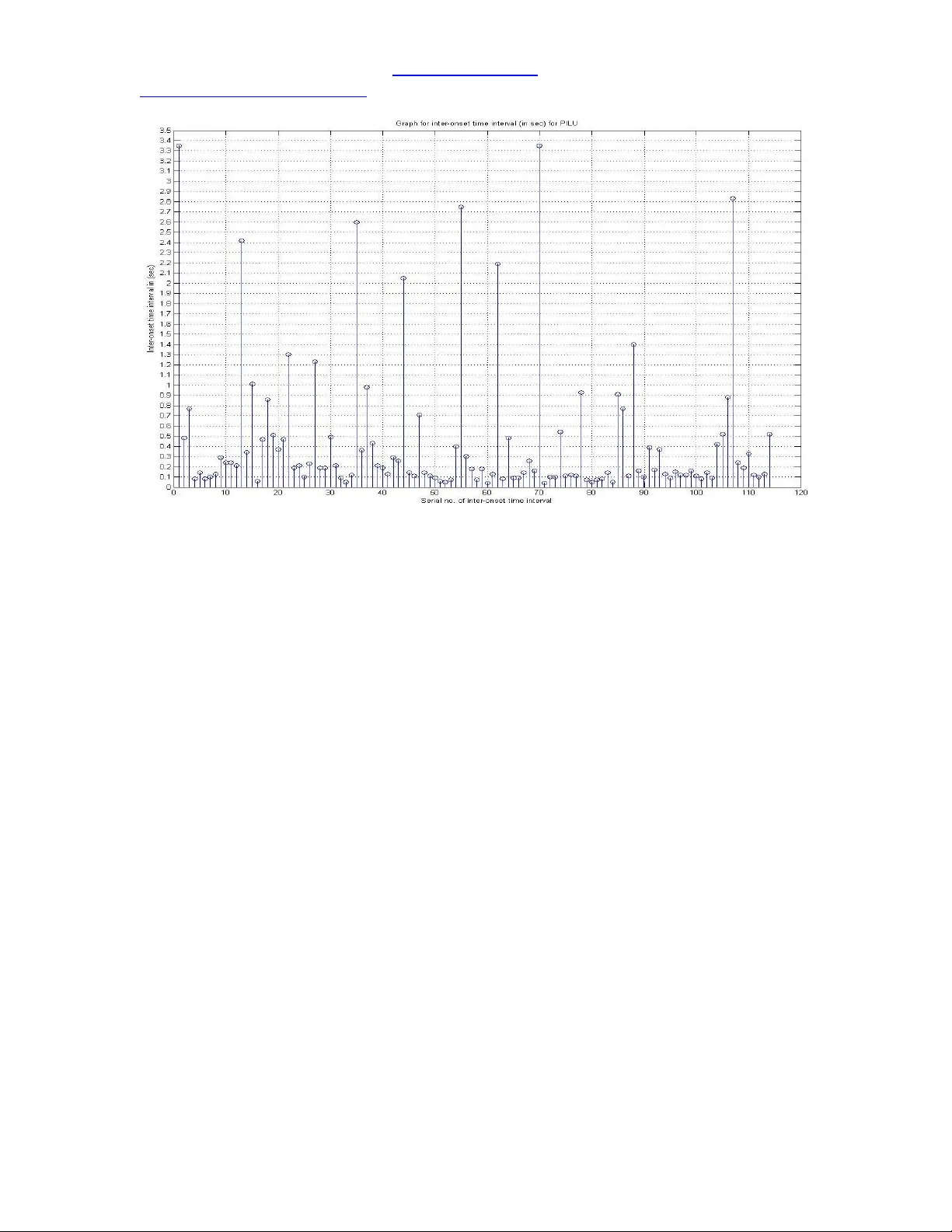
Archive of Cornell University e-library; [cs.S D][stat.AP]. A Statistical Approach to Modeling Indian Classical Music Performance 1 Soubhik Chakraborty*, 2 Sandeep Singh Solanki, 3 Sayan Roy, 4 Shivee Chauhan, 5 Sanjaya Shankar Tripathy and 6 Kartik Mahto 1 Department of Applied Mathematics, BIT Mesra, Ranchi-835215, Indi a 2, 3, 4, 5,6 Department of Electronics and Communication Engineeri ng, BIT Mesra, Ranchi-835215, India Email:soubhikc@yahoo.co.in(S.Chakraborty) sssolanki@bitmesra.ac.in (S.S . Solanki) roysay an_2002@rediff mail.com(S . Ro y ) shivee.chauhan@gmail.com(S . Chauhan) sstripathy@bitmesra.ac.in (S.S .Tripathy ) kartik_mahto@rediffmail.com *S. Chakraborty is the corresponding author (phone: +919835471223) Words make you think a thought. Music makes you feel a feeling. A song makes you feel a thought. -------- E. Y. Harburg (1898-1981) Abstract A raga is a melodic structure w ith fixed notes and a set of rules characterizing a certain mood endorsed through performance. B y a vadi swar is meant that note which plays the most significant role in expressing the raga. A samvadi swar s imilarly is the second most significant note. However, the determination of their significance has an element of subjectivity and hence we are motivated to find some truths through an objective analysis. The paper proposes a probabilistic method of note detection and demonstrates how the relative frequency (relative number of occurrences of the pitch) of the more important notes s tabilize far more quickly than that of others. In addition, a count for distinct transitory and similar looking non-transitory (fundamental) frequency movements (but possibly embedding distinct emotions!) between the notes is also taken depicting the varnalankars or musical orna ments decorating the notes and note sequences as rendered by the artist. They reflect certain structural properties of the ragas. Several case studies are presented. Key words Raga; performance; multinomial modeling; transitory/non-transitory frequency movements; alankars; statistics; Cheb y shev’s inequality 1 Archive of Cornell University e-library; [cs.S D][stat.AP]. The paper is organized as follows . Section 1 is the introduction. In section 2 we attempt to model a Pilu performance using multinomial dis tribution. Section 3 has more statistical analysis where transitory and non-transitory frequenc y movements are carefully analyzed. In s ection 4 we s ubstantiate our claims with two more s tudies in ragas Yaman and Kirwani. Finally section 5 is reserved for conclusion. 1. Introduction A major s trength of statistics lies in modeling. Tremendous progress in computer technology and the consequent availability of scores (musical notation) in digitized version has popularized modeling a musical performance greatly in the recent past. This is particularly true in Western Classical music (where scores are fixed). H owever, from the point of view of the listener or the critic, there is no unique way of analyzing a performance . This means a realistic anal ysis of musical performance cannot be cannot be purely causal or deterministic whence statistics and probability are likely to play an important role [1]. Coming to Indian classical music, where scores are not fixed (the artist decides extempore what to perform on the stage itself) we can only analyze a recorded performance. In this context, in an earlier w ork, we showed how statistics can distinguish performances of two different ragas that use the s ame notes [2]. A good text on Indian Classical music is Raghava R. M enon [3]. For technical terms, see Amrita Priyamvada [4]. Readers knowing western music will benefit from [5]. The present paper opens with a s tatistical case study of performance of raga Pilu using the only notes Sa, Sudh Re, Komal G a, Sudh Ma, Pa, Komal Dha and Sudh Ni played on a scale changer harmonium(see the remark below) b y the first author ( Sa set to natural C) and recorded in the Laptop at 44.100 KHz, 16 bit mono, 86 kb/sec mode. This raga also permits the notes Sudh Ga, Sudh Dha and Komal N i (which we have avoided for a comparison with another raga called Kirwani introduced from the South Indian classical music to the North Indian classical music) and is one of restless nature ( chanchal prakriti ), the appropriate time for pla y ing it being between 12 O’Clock noon to 3 P. M . See [6] and [3]. However, like Bhairavi it has a pleasant effect if rendered at any other ti me different from the scheduled. It is rendered more by instrumentalists and in Thumris and Tappas by vocalists. Many experts are of the view that Pilu is created by mixing four ragas, namely, Bhairavi, Bhimpalashree, Gauri and Khamaj [6]. In our analysis of the Pilu performance, special emphasis is given on modeling and we raise questions such as “What is the probability of the next note to be a Vadi Swar (most important note in the raga)?” or “In what proportions the raga notes are arriving?” and seek answers through multinomial modeling (see appendix), reserving quasi multinomial model as the model of choice in case of failure of the former to meet our expectations. Remark (what is a scale changer harmonium and w hy is it necessary?) : In a scale changer harmonium, s uch as the one used by the first author, the meaning of the phrase “Sa set to natural C” is that (i) the first white reed of the middle octave which normally represents C has not been shifted right or left to represent any other note or in other 2 Archive of Cornell University e-library; [cs.S D][stat.AP]. words we can say that the reed w hich represents C is at its natural position and that (ii) the performer has kept his Sa at this white reed itself. A scale changer harmonium has the charming facility of “shifting the scale” which assists in accompaniment. Let us take an example. Suppose the main performer (say a vocalist) has his Sa at C# (C-sharp) but the harmonium player is accustomed to playing with Sa taken at the aforesaid white reed which represents C. In this case the harmonium player would simply shift the w hite reed one place to the right s o that the same reed would now repres ent C# rather than C and then accompany the main performer without difficulty . With this shift, all reeds are shifted b y one place to the right (and we say there is a change of scale). Without a scale changer harmonium, the accompanist would be forced to take S a at the first black reed of the middle octave which represents C#. Since he is not comfortable in moving his fingers by taking Sa here, the quality of accompaniment may be affected adversely. In a scale changer harmonium, the reeds (or ke y s) are not fixed to the reed- board. Rather they are fixed to another board and the instrument is fixed to a big tape. When the tape is moved, the reeds also change their places accordingl y . Nowadays scale changer harmoniums are used in all major concerts of Indian music especially class ical music. Although built in India, a harmonium is generally western tuned with imported German reeds. 2. Modeling the Pilu performance statistically: m ultinomial or quasi multinomial? Since the instrument used is a scale changer harmonium, identifying the notes was done easily adopting the following strategy. First reeds (keys of the harmonium) corresponding to all the tw elve notes of each of the three octaves were played sequentially (Sa, Komal Re, Sudh Re, Komal Ga, Sudh Ga, Sudh Ma, Tibra Ma, Pa, Komal Dha, Sudh Dha, Komal Ni, Sudh Ni) and recorded with Sa taken at natural C (see the remark above). Their frequencies (meaning fundamental frequencies) fluctuating with small variability each about a different near horizontal line (“horizontal” due to stay on each note) were extracted using Solo Explorer 1.0 s oftware (see also section 3 and 4) and saved in a text file. Next the means and standard deviations of the fundamental frequencies of the notes were estimated from the values in the text file. We provide for the benefit of the reader the database for the middle octave only which is used more often than the other two octaves. The fundamental frequencies of corresponding notes for the first and third octaves can be approximated by dividing and multiplying the mean values by 2 respectively. The standard deviation values are nearly the same in all the three octaves and hence omitted. Table 1: Database for the middle octave Note Mean fundamental frequency (Hz) Standard Deviation (Hz) Sa 243.2661 0.4485 Komal Re 257.6023 0.1556 Sudh Re 272.3826 0.0503 3 Archive of Cornell University e-library; [cs.S D][stat.AP]. Komal Ga 287.6051 0.2155 Sudh Ga 305.2415 0.1805 Sudh Ma 323.1398 0.3172 Tibra Ma 342.2261 0.2205 Pa 362.4957 0.4241 Komal Dha 384.4443 0.1316 Sudh Dha 407.6329 0.2227 Komal Ni 432.5978 0.1387 Sudh Ni 457.4805 0.3030 Sa (next octave) 484.9670 1.8249 Next from Chebyshev’s inequalit y we know that a random variable X, irrespective of whether it is discrete or continuous satisfies the inequality P{ X-E(X) = 1.96, the null hypothesis, that the observations are random, will be rejected at 5% level of s ignificance otherwise it may be accepted [4]. In the present analysis we had n=115 (total number of notes) and U=57 leading to Z = - 0.280987, insignificant clearly to endorse overall randomness at 5% level of significance. As mentioned earlier, overall independence does not imply independence in pairs. If the reader knows probability theory he can recollect that the property that does guarantee independence for every pair and in fact independence for any subset taken from the whole is called mutual independence [7]. But we never established this here! 24
Original Paper
Loading high-quality paper...
Comments & Academic Discussion
Loading comments...
Leave a Comment