Diversity-Multiplexing Tradeoff of the Half-Duplex Relay Channel
We show that the diversity-multiplexing tradeoff of a half-duplex single-relay channel with identically distributed Rayleigh fading channel gains meets the 2 by 1 MISO bound. We generalize the result to the case when there are N non-interfering relay…
Authors: Sameer Pawar, Amir Salman Avestimehr, David N. C. Tse
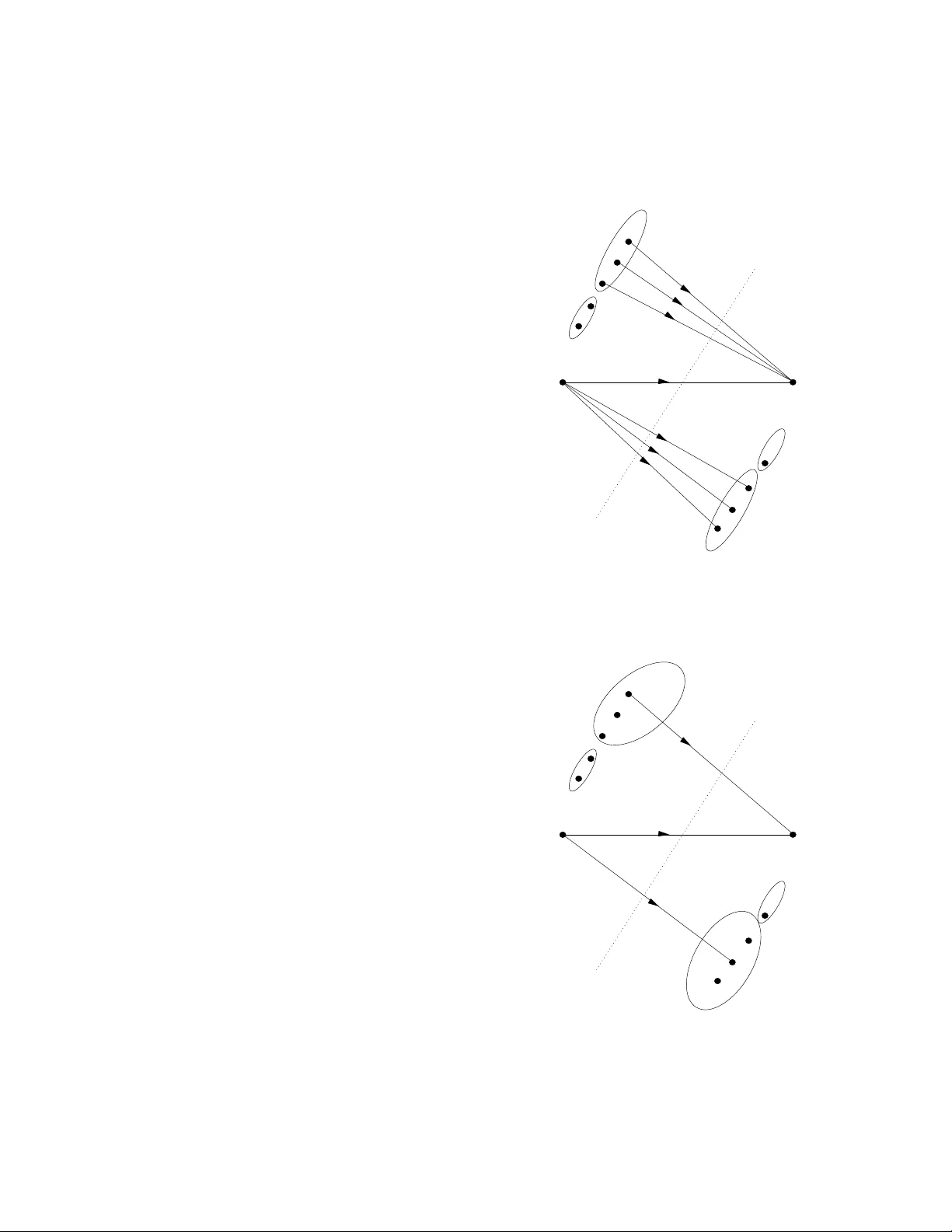
Di v ersity-Multiple xing T ra deof f of the Ha lf-Duple x Relay Chann el Sameer Pa war W ireless Foundations UC Berk eley , Berkeley , California, USA. sameer pawar@berkele y .edu Amir Salman A vestimehr W ireless Foun dations UC Berkeley , Berkeley , California, USA. av es time@eecs.berkele y .edu Da vid N C. Tse W ireless Foun dations UC Berkeley , Berkeley , California, USA. dtse@eecs.berkeley . edu Abstract —W e show tha t the diversity-multiplexing tradeoff of a half- duplex single-relay channel with identi- cally distrib uted Rayleig h fading channel g ains meets the 2 by 1 MISO bound. W e generalize the result to the case when there a re N non-interfering relays a nd show t hat the diversity-multiplexing tradeo ff is equal to the N + 1 by 1 MISO bo und. I . I N T RO D U C T I O N Cooperation between n odes c an provide both diversity and degree of f reedom gain in wireless fading chan- nels [15], [16], [1]. Th e div ersity-multiplexing tradeoff (DMT) was a metric introdu ced by Zh eng a nd Ts e [3] to ev a luate simultaneous ly the di versity and degrees of freedom gain in ge neral fading cha nnels. Significant eff ort has b een spent i n the past few years in computing the DMT of coop erati ve relay n etworks. The simplest such network has one relay and a direct link be tween the source and the des tination (Fig. 2, with the c hannel gains modeled as qua si-static identically distrib uted Rayleigh faded and known only to the resp ectiv e recei ve node. A simple u pper bou nd to p erformance is the DMT of the 2 by 1 MISO channel obtained when the source and relay can fully cooperate to transmit to the destination: d ( r ) = 2(1 − r ) 0 ≤ r ≤ 1 It is quite e asy to se e that this upper bound ca n be achieved if the relay ca n o perate on a full-duplex mode, i.e. transmit and receiv e at the sa me time. But most rad ios can on ly op erate on a half-duplex mod e. Somewhat su rprisingly , the DMT for the half-duplex single-relay network is still a n open prob lem despite substantial effort . Figure 1 s hows the DMT performanc e of several scheme s and how they comp are to the MISO bound. W e see that none of the schemes achie ves the bo und for the 0 0.1 0.2 0.3 0.4 0.5 0.6 0.7 0.8 0.9 1 0 0.2 0.4 0.6 0.8 1 1.2 1.4 1.6 1.8 2 Multiplexing rate r Diversity gain d(r) PDDF, Avestimehr−Tse [17] and Prasad−Varanasi [13] DDF, Azarian et. al, [4] Point to point MISO upper bound NAF, Nabar et. al. [14] Laneman et. al. [2] Fig. 1. Div ersity multiplexing trad eoff of se veral schemes for the half-duple x relay cha nnel entire range of multiplexing gains. The dy namic-deco de- and-forward [4] and partial d ecode-an d-forward [13], [17] schemes achiev es the MISO DMT for multiplexi ng gains r ≤ 0 . 5 but there is a gap for r > 0 . 5 . Is this gap fundamental or is the re a better scheme ? In this pape r , we s how that indeed there is a scheme that achiev es the MISO DMT for all m ultiplexing gains r up to 1 . The problem with decode-and-forward s chemes is that for r > 0 . 5 , it takes too lon g for the relay to decode the whole message and there i s not enou gh time for it to forward information. Th e problem with pa rtial- decode -and-forward s cheme is that the so urce does not know how to split the overall message without knowi ng the instantaneous chan nel gains of the v arious channe ls. In con trast, the scheme that we propose , wh ich we call quantize-and -map , does not dec ode o r partially decode the mes sage. Instea d, the relay extracts the significant bits of the receiv ed signal above no ise lev el by quan ti- zation and re-enc odes them to forward to the relay . T he destination then combines the received signal from the relay and the direct signal from the sou rce to so lve for the informati on bits. B ecaus e there is no need t o decode any mes sage, there is also no need for any d ynamic adaptation of the listening p eriod for the relay . In fact, it turns out that it suffices for the relay to always listen half o f the time and talk h alf of the time regardless of the chan nel state. The quantize -and-map scheme is bas ed o n a rece nt deterministic approa ch to app roximate the capa city of Gaussian rela y networks [7], [8], [9], [10]. Inspired by the optimal sch eme that was found for the deterministic relay networks [7], [8], the quantize-an d-map scheme was shown in [9], [10] to ac hiev e within a constan t gap of the capac ity of arbitrary Gaussian relay networks, where the c onstant gap do es not d epend on the ch annel parameters. A key ob servation is that since the scheme does not req uire any cha nnel information at t he no des, it can also be utilized in a fading sc enario in which there is no channel state information av ailable at the transmitter . Now since at high SNR a nd high rates the a pproximation gap is negligible, a s a corollary on e can show that for any listen-transmit s chedule, this scheme a chieves the div ersity-multiplexing tradeoff of the cut-set boun d on the cap acity . The de sired result is ob tained when this fact is combined with the o bservation tha t the DMT of the cutset b ound of the half duplex network ma tches that of the MISO b ound when the relay listens half of the time and talks the other half. This r esult can also be generalized to mo re than 1 relay when these relays have no link b etween themselves. I I . S Y S T E M M O D E L Consider a network as shown in Figure 2 wit h a source S , a de stination D , an d one relay no de R . h r d h sd h sr D R S Fig. 2. The relay channel. All the chann el links h sd , h sr , h r d are a ssumed to b e flat-fading, i.i.d complex normal C N (0 , 1) distribution. I t is as sumed that although random, onc e realized, channel gains remain unchan ged for the duration of the codeword and ch ange inde pende ntly from one codeword to another i.e., quas i-static fading. N oise at a ll of the receiv ers is additiv e i.i.d C N (0 , 1) independe nt o f an y other form o f randomnes s in the system. All nodes hav e single a ntenna and have equal average power constraint spec ified by av- erage Signal to Noise Rati o (SNR), denoted by ρ . Re lay node R is a ssumed to b e in half-duplex operation and for simplicity it is ass umed that transmission of s ource and relay are synchronous at symbol le vel. Fu rthermore, channe l state information (CSI) is only a vailable at the receiv ers. So, relay has CSI about h sr , des tination has CSI about h sd , h r d and no CSI at all at the sou rce. I I I . D I V E R S I T Y - M U LT I P L E X I N G T R A D E O FF O F T H E H A L F - D U P L E X R E L A Y C H A N N E L In this section we ch aracterize the di versity- multiplexing tradeof f of the ha lf-duplex relay c hanne l, described in sec tion II. First we describe the quantize - map relaying scheme that we proposed ea rlier in [9] and [10]. As we s howed in thes e references, this relaying scheme achieves a rate within a constant gap to the cut- set uppe r bou nd of the capa city o f the relay cha nnel for all chan nel gains, where the con stant is ind epende nt of the channe l SNR s. Furthermore, since this relaying scheme doe s not require any ch annel information at the source and the relay , it can also be performed in ou r scena rio (i.e. no CSI at the trans mitter). Now , s ince at high SNR and high rates the app roximation gap is negligible, as a c orollary we will show that this sc heme achieves the di versity-multiplexing tradeoff of the cut-set bound on the capacity for any listen-transmit scheduling at the rela y . Finally we illustrate that a fixed sc heduling that relay listens only half the time and transmits the rest is enough to achieve the diversity-mul tiplexing tradeoff of the 2 × 1 MISO channel, h ence we find the op timal DMT of the h alf-duplex relay chan nel. A. Descr iption of the relaying scheme W e have a single source S with a se quenc e o f messag es w k ∈ { 1 , 2 , . . . , 2 K T R } , k = 1 , 2 , . . . to be transmitted. At both the relay a nd the source we create random Gauss ian codebo oks. So urce randomly ma ps each mes sage to one of its Gaus sian codewords and sends it in K T transmission times (symbo ls) giving an overall transmission rate of R. Due to h alf-duplex nature of the relay , it h as to do listen-transmit cycles. Relay op erates over bloc ks of time T s ymbols a nd sinc e total length of co dewor d at sou rce is K T we have K blocks in e ach codeword. Relay listens to the first T t ( 0 ≤ t ≤ 1 ) time sy mbols of e ach block. Le t X 1( k ) S denote the seq uence of thes e T t symbols trans mitted at the source in block k . Also let Y ( k ) R and Y 1( k ) D be the received signal at relay and de stination res pectively during this time. Then the relay it quantizes its recei ved signal in the first tT time symbols to ˆ Y ( k ) R which is the n randomly mapped into a Gau ssian codew ord X ( k ) R using a random mapping function f R ( ˆ Y ( k ) R ) and sends it in the next T (1 − t ) time symbols. Let Y 2( k ) D denote the sequen ce of s ymbols received by destination during this time. Gi ven the knowledge of all the encoding func tions at the relay and signals received over K blocks, the decode r D , attempts to dec ode the message sent by the source. B. DMT of the relaying scheme For any fixed listen-transmit scheduling strategy (i.e. fixed t ), the cut-set u pper bound on the capac ity of the half-duplex Gaussian relay channel, C hd , is gi ven by (1) on the top of next page [11] . Now , a s we s howed in [10], for any fixed listen- transmit s cheduling, the quantize-map relaying scheme described in Section III-A, uniformly achieves a rate within a c onstant gap to the capacity . Therefore by Theorem 4.7 in [10], for all chann el gains we have, C hd ( h sr , h sd , h r d , ρ, t ) − κ ≤ R quantize-map ( h sr , h sd , h r d , ρ, t ) (3) where κ ≤ 15 is a cons tant that does not de pend o n the channe l gains an d S NR . Now since this relaying s cheme doe s not require any channe l information at the sou rce and the relay , it c an also be performed in ou r scen ario in wh ich there is no channe l s tate information av ailable at the transmitter . Furthermore, as at high SNR and high data rates the approximation gap is negligible, a s a corollary we will now show that for any fixed listen-transmit sch eduling, this sc heme achieves the diversit y-multiplexing trade of f of the cut-set bound. Theorem 3.1: For any fixed sc heduling t , the quantize-map relaying scheme achieves the diversity- multiplexing tradeoff of C hd , where C hd is defined b y (1). Pr o of: Assu me a targeted c ommunication rate R . By (3), we know that the destina tion will be able to decode the information sent by the source as long as C hd ( h sr , h sd , h r d , ρ, t ) − κ > R (4) Therefore for a ny sch eduling t , we have P outage ( ρ ) ≤ P C hd − κ < R (5) where the probab ility is ca lculated over the randomn ess of channe l gain realizations . Now by defin ition, for any schedu ling t , the achiev able div ersity of q uantize-map scheme is d QM ( r ) = − lim ρ →∞ log ( P outage ( ρ )) log ρ (6) ( 5 ) ≥ − lim ρ →∞ log P C hd − κ < r log ρ log ρ (7) ∗ ≈ − lim ρ →∞ log P C hd < r log ρ log ρ (8) where ∗ is true since κ is a consta nt and do es not s cale with ρ . Therefore for any t , the qua ntize-map relaying strategy achieves the di versity-multiple xing trade off o f C hd ( t ) . Next, we will show that with t = 0 . 5 , the diversity- multiplexing tradeo f f of C hd matches the di versity- multiplexing tradeoff of the 2 × 1 MISO c hannel, a nd hence we c omplete the p roof o f o ur main Theo rem. First we giv e s ome intuition o n why this is true. C 2 h sd C 1 h sd h sr h r d R D R S S D Fig. 3. T wo scheduling modes of the system: relay listens t fraction of the time and relay transmits (1 − t ) fraction of the time First note that in equation (2), t he first term correspond s to the information flowing through cut { S } , { R, D } (see Figure 3) and the se cond term cor- responds to the information flowing throug h the cut { S, R } , { D } . Now , the value of the first cut { S } , { R , D } correspond s to the capacity of a SIMO s ystem with 1 transmit antenna an d 2 receive an tennas where on e C hd ( h sr , h sd , h r d , ρ, t ) = max p ( x 1 S ,x 2 S ,x R ) min { tI ( X 1 S ; Y R , Y 1 D | X R ) + (1 − t ) I ( X 2 S ; Y 2 D | X R ) , tI ( X 1 S ; Y 1 D ) + (1 − t ) I ( X 2 S , X R ; Y 2 D ) } (1) ≤ min { t ` log( 1 + ρ ( | h sr | 2 + | h sd | 2 )) ´ + (1 − t ) ` log(1 + ρ | h sd | 2 ´ , (1 − t ) ` log(1 + ρ ( | h r d | + | h sd | ) 2 ) ´ + t ` log(1 + ρ | h sd | 2 ´ } (2) receiv e anten na (correspo nding to relay) is listening only t amo unt of time. Similarly , the value of the se cond cut i.e., { S, R } , { D } co rresponds to the capa city of a MISO system with 2 transmit a ntennas an d 1 receiv e a ntenna, where one trans mit a ntenna (corresponding to relay ) is transmitting on ly 1 − t amount of time. Since we a re limited by the minimum of thes e two values op timal strategy is to try to make them equal. Also since DMT of 1 × 2 SIMO is same as that of 2 × 1 MISO, a natural choice is to s et t = 0 . 5 . Once we s et t = 0 . 5 , DMT o f cut-set bou nd is just DMT of a 2 × 1 MISO system with 1 transmit anten na being used only half the time, but this system is str ictly better than a system with 2 transmit 1 receive antenna s and where each o f the two transmit antennas are use d only half the time in a n alternate fashion i.e., parallel channe l with rate r on each channe l. It is well k nown and easy to co mpute tha t DMT o f this pa rallel ch annel is 2(1 − r ) . Also w e h av e obvious up per b ound of DMT of MISO sys tem which is again 2(1 − r ) . Thus the cut- set bound achieves the optimal DMT for t = 0 . 5 . The formal p roof o f this is giv en in Appe ndix A. I V . E X T E N S I O N T O M U LT I P L E - R E L A Y N E T W O R K In this section we exten d our result to general multiple-relay ne tworks. The listen-transmit sch eduling model that we use to s tudy this problem is the s ame as [11]. In this model the network has finite modes of o peration. Each mode o f operation (or state o f the network), de noted by m ∈ { 1 , 2 , . . . , M } , is defin ed as a valid partitioning of the n odes of the network into two sets of ”s ender” node s an d ”receiver” nodes su ch that there is no ac ti ve link that arri ves at a se nder node 1 . For eac h node i , the trans mit and the rec eiv e sign al a t mode m are respe cti vely shown by x m i and y m i . Also t m defines the portion o f the time that n etwork will ope rate in state m , as the network use goes to infinity . As shown in [11], the cut-set up per bou nd on the ca pacity of the Gaussian relay n etwork with half-duplex constraint, C hd , is giv en by (9) on the top of next page. 1 Activ e li nk is defined as a link which is departing from the set of sender nodes Now we des cribe the quantize-map rela ying sc heme that we p roposed in [9], [10] for general half-duplex relay ne tworks. A. Descr iption of the relaying s cheme W e have a single sou rce S with a seq uence of mes- sages w k ∈ { 1 , 2 , . . . , 2 K T R } , k = 1 , 2 , . . . to be trans- mitted. At all nod es we crea te a rando m Gauss ian code - book. So urce randomly maps each message to one of its Gaussian c odewords and sen ds it in K T transmission times (symbols) gi ving an overall trans mission rate o f R. Relays operate over blocks of len gth T symbols. Starting from the beginning of the block each relay i s pends a total of t m T symbols in state m , m = 1 , . . . , M . In each state, if it is assigned to listen, it receives a sequen ce Y ( k, m ) i . Otherwise, if it is assigned to trans mit, it quan tizes a ll received signals in the p revious block (i.e. Y ( k − 1 , m ) i , m = 1 , . . . , M ) to ˆ Y ( k, m ) i which is then randomly mapp ed into a Gaussian codeword X ( k, m ) i using a rando m mapp ing fun ction f i ( ˆ Y ( k, m ) R ) and se nds it in that t m T time s ymbols. G i ven the knowledge of all the e ncoding fun ctions at the relay an d s ignals received over K + | V | − 2 blocks, the decod er D, attempts to decode the message W se nt by the s ource. B. DMT of the relaying sche me As we sh owed in [10], for a ny fi xed listen-transmit schedu ling, the qu antize-map relay ing sche me des cribed above, ach iev es within a co nstant gap to the capacity . Therefore by Theorem 4.7 in [10], for all c hannel gains we h av e, C hd − κ ≤ R quantize-map (10) where κ ≤ 5 |V | is a constant that does not dep end o n the c hannel ga ins a nd SNR . Therefore similar to Th eorem 3 .1 we c an s how the follo wing theorem: Theorem 4.1: For any fi xed sche duling, the quan tize- map relaying scheme achieves the diversity-mult iplexing tradeoff of C hd , where C hd is de fined by (9). T o fi nd the optimal performance of this sch eme, one should optimize over all po ssible s cheduling s trategies. In gen eral we don’t know the op timizing strategy , how- ev er as we show in Section IV -C, in a s pecial case o f C hd ≤ C hd = max p ( { x m j } j ∈V ,m ∈{ 1 ,...,M } ) t m : 0 ≤ t m ≤ 1 , P M m =1 t m =1 min Ω ∈ Λ D M X m =1 t m I ( Y m Ω c ; X m Ω | X m Ω c ) (9) two hop network with N no n interfering relays, a fixed uniform sc heduling (i.e. t m = 2 − N , m = 1 , . . . , 2 N ) achieves the optimal DMT . C. Optimal DMT of two h op network with N no n- interfering half duplex r elays Consider a two hop network with single sou rce S , destination D and N ha lf-duplex relays R i , 1 ≤ i ≤ N , as shown in Figure 4. All the as sumptions in s ection II are carried over with additional assumption that there is no link a mong any two relays. Let h sr i be the link from s ource S to relay i a nd h r i d be the link from i th relay to d estination D . Here is our main result for this relay ne twork. Theorem 4. 2: The optimal di versity-multiple xing tradeoff of a tw o-hop relay network, with N non- interfering half-duplex relay s is equa l to the di versity- multiplexing trade of f of the ( N + 1) × 1 MISO channe l. Furthermore, it is ac hieved by the qu antize-map relaying strategy d efine in Section IV -A with fixed and uniform schedu ling, t m = 2 − N , m = 1 , . . . , 2 N . Pr o of: See Appe ndix B h sr 1 h sr N h r N d h r 1 d D R N S h sd R 1 R 2 Fig. 4. T wo-ho p network with N half-duplex relays A P P E N D I X A A C H I E V I N G T H E M I S O B O U N D I N T H E R E L A Y C H A N N E L W I T H t = 0 . 5 From theorem 3.1, it is suf ficient to s how tha t DMT of C hd is eq ual to tha t o f MISO. For ease of computation define n sd := log(1 + | h sd | 2 ρ ) and α sd as its exp onential order i.e., α sd := lim ρ →∞ log(1 + | h sd | 2 ρ ) log ρ then the probability den sity function (pdf) o f α sd can be s hown to b e f α sd ( α sd ) = lim ρ →∞ exp( − ρ − (1 − α sd ) ) ρ − (1 − α sd ) log ρ = ρ − (1 − α sd ) 0 ≤ α sd ≤ 1 Consider first term in inequality (2), using t = 0 . 5 0 . 5 log(1 + ρ ( | h sr | 2 + | h sd | 2 )) + 0 . 5 log(1 + ρ | h sd | 2 . = 0 . 5 max { log(1 + ρ | h r d | 2 ) , log (1 + ρ | h sd | 2 ) } + 0 . 5 log(1 + ρ | h sd | 2 = n sd + 0 . 5( n r d − n sd ) + similarly se cond term c an b e s implified resulting in C hd . = n sd + 0 . 5 min { ( n sr − n sd ) + , ( n r d − n sd ) + } For R = r log ρ the cu t-set bound is in outage if n sd + 0 . 5 min { ( n sr − n sd ) + , ( n r d − n sd ) + } ≤ r log ρ i.e., α sd + 0 . 5 min { ( α sr − α sd ) + , ( α r d − α sd ) + } ≤ r ∴ O ( r ) = { α sd , α sr , α r d | α sd + 0 . 5 min { ( α sr − α sd ) + , ( α r d − α sd ) + } ≤ r } P O ( r ) = Z α ∈O ( r ) f α ( α ) dα = Z α ∈O ( r ) f α sd ( α sd ) f α sr ( α sr ) f α rd ( α r d ) d α = Z α ∈ O ( r ) 0 ≤ α ≤ 1 ρ − 3+( α sd + α sr + α rd ) dα . = ρ − d ( r ) where d ( r ) = inf ( α sd , α sr , α r d ) ∈ O ( r ) 0 ≤ α sd , α sr , α r d ≤ 1 3 − ( α sd + α sr + α r d ) 1) If α sd ≥ min { α sr , α r d } : The n outage im- plies min { α sr , α r d } ≤ α sd ≤ r . And since max { α sr , α r d } ≤ 1 we have ( α sd + α sr + α r d ) ≤ 1 + 2 r . 2) If α sd ≤ min { α sr , α r d } : Then Ou tage implies α sd + 0 . 5(min { α sr , α r d } − α sd ) ≤ r α sd + min { α sr , α r d } ≤ 2 r α sd + min { α sr , α r d } + max { α sr , α r d } ≤ 1 + 2 r Therefore d ( r ) = 3 − (1 + 2 r ) = 2(1 − r ) Thus quantize -map relaying scheme achie ves the optimal DMT of 2 × 1 MISO system. A P P E N D I X B D M T F O R T W O - H O P N E T W O R K W I T H N N O N - I N T E R F E R I N G H A L F - D U P L E X R E L A Y S W e prove theorem 4.2 in two steps , we first show that DMT of cut-set b ound w ith fixed uniform schedu ling achieves DMT of ( N + 1) × 1 MISO system a nd the n apply theorem 3.1. A. DMT of cut-set bound for fixe d u niform s cheduling In subsec tion IV -B theorem 3.1 showed that for a ny fixed schedu ling quantize-map relaying scheme achieves the DMT of the c ut-set for tha t schedu ling. W e make use of this f act to sh ow the a chiev ablity of MISO performance in N relay case. First we note that s ince there are N half-duplex relays , each relay has a ch oice to be either in rec eiving mode o r in transmitting mode, accordingly w e have M = 2 N states. Then follo wing the lead from ou r single relay cas e a nd us ing the fact the ev erything in ne twork is nice ly sy mmetrical we op erate network in ea ch of thes e states for equa l a mount of time i.e. , t m = 2 − N for m = 1 , · · · , 2 N . Now if we show that DMT of cut-set for this sch eduling is equ al to ( N + 1)(1 − r ) we are do ne. W e first de ri ve a lower bou nd o n the cu t-set. Any cut in a network pa rtitions a ll no des into two grou ps Ω with S ∈ Ω a nd its compliment Ω c with D ∈ Ω c , ea ch relay has a choice of being in a either Ω or Ω c , thus we have 2 N total poss ible cuts a nd the cut-set bound of network is equal to the minimum of mutual information flowing through each o f the se 2 N possible cuts. V m W m h sd D S Fig. 5. m th state of Network V m h sd R V m R W m W m S D Fig. 6. Z − channel Consider a cut Ω in the network wh ich is op erating in state m it looks as s hown in fig . 5. Let V m ⊆ Ω − S be the set of relays R j ∈ Ω which a re transmitting and W m ⊆ Ω c − D be the set of relays R j ∈ Ω c which a re receiving in state m . Let R V m be a relay with stronges t channe l s ay h ∗ r d := max j { h r j d } j ∈ V m to the des tina- tion and analogo usly let R W m be a relay with stronges t channe l say h ∗ sr := max j { h sr j } j ∈ W m from source . W e can lo wer bound t he total mutual informati on flowing across this c ut in fig 5 by the the mutual information flowing acros s the sa me cut { S, R V m }{ R W m , D } in the Z-channe l formed by these nodes , see fig 6. This Z- channe l can be viewed a s MIMO syste m with upper triangular channel matrix H = h ∗ r d h sd 0 h ∗ sr So mutual information flow a cross this c ut in Z-chan nel is giv en by log det I 2 × 2 + ρH H † = log 1 + ρ ( | h ∗ r d | 2 + | h sd | 2 + | h ∗ sr | 2 + ρ | h ∗ r d | 2 | h ∗ sr | 2 ) ≥ max { log(1 + ρ | h sd | 2 ) , log (1 + ρ | h ∗ sr | 2 )(1 + ρ | h ∗ r d | 2 ) } = max { log(1 + ρ | h sd | 2 ) , log (1 + ρ max j ∈ V m ( | h r j d | 2 )) + log(1 + ρ max j ∈ W m ( | h sr j | 2 )) } = max { n sd , m ax j ∈ V m ( n r j d ) + max j ∈ W m ( n sr j )) } Thus for each cut Ω the cut value is, C Ω ≥ 1 2 N 2 N X i =1 max { n sd , max j ∈ V m ( n r j d ) + max j ∈ W m ( n sr j ) } (11) Now the cut-set boun d is simply , C hd ≥ min Ω C Ω (12) Lemma B.1: For any cut Ω , there are N + 1 distinct links flowing across the cut a nd the mutual information flowing throu gh it gi ven by (11) can be further lower bounde d by their average C Ω ≥ n sd + P j ∈ Ω −{ S } n r j d + P j ∈ Ω c −{ D } n sr j N + 1 (13) Pr o of: See Appe ndix B-C B. Optimality of DMT of ea ch cut C Ω Follo wing Appendix A for each j , we d efine α sd , α r j d , α sr j as exp onential order’ s of n sd , n r j d , n sr j respectively . From lemma B.1 outage is equal to set O ( r ) = { α | α sd + X j ∈ Ω −{ S } α r j d + X j ∈ Ω c −{ D } α sr j ≤ ( N +1) r } (14) P O ( r ) = Z α ∈O ( r ) f α ( α ) dα = Z α ∈ O ( r ) 0 ≤ α ≤ 1 ρ − ( N +1) .ρ α sd + P j ∈ Ω −{ S } α r j d + P j ∈ Ω c −{ D } α sr j d α . = ρ − d ( r ) where d ( r ) = inf α ∈ O ( r ) 0 ≤ α ≤ 1 ( N + 1) − α sd + X j ∈ Ω −{ S } α r j d + X j ∈ Ω c −{ D } α sr j = ( N + 1)(1 − r ) last equality follo ws from the equation 14. Now since each cut has optimal DMT , from ine quality (12) it is clear that c ut-set bo und also achieves optimal DMT . And then we us e the orem 3 .1. C. Pr oof of Le mma B.1 T o prove this, first we s how the following lemma , Lemma B.2: Conside r a set of n umbers a, s 1 , . . . , s n . Assume function f is s uch tha t for any set V ⊆ { 1 , . . . , n } we have, f ( V ) ≥ max( a, s V ) (15) where s V = { s i | i ∈ V } (16) Then 1 2 n X V ⊆{ 1 ,...,n } f ( V ) ≥ a + P n i =1 s i n + 1 (17) Pr o of: W ithout loss of gene rality ass ume that s i ’ s are o rdered (i.e. s 1 ≤ s 2 ≤ . . . ≤ s n ). T hen we have 1 2 n X V ⊆{ 1 ,...,n } f ( V ) ≥ a + max( a, s 1 ) + . . . + 2 n − 1 max( a, s n ) 2 n ∗ ≥ a + max( a, s 1 ) + . . . + max( a, s n ) n + 1 ≥ a + s 1 + s 2 + . . . + s n n + 1 where ∗ is true by applying two se quenc es ( a, s 1 , . . . , s m ) and (2 − n , 2 − n , 2 − n +1 , . . . , 2 − 1 ) to the Tcheb ychef ’ s inequality , Tchebyc hef ’ s inequality: Assu me two seque nces ( a 1 , . . . , a n ) and ( b 1 , . . . , b n ) are s imilarly ordered (i.e. ( a u − a v )( b u − b v ) ≥ 0 , for a ll u and v ). The n 1 n n X i =1 a i b i ≥ 1 n n X i =1 a i ! 1 n n X i =1 b i ! (18) Now we prove Le mma B. 1. Pr o of: (proof of Lemma B.1) First note that for any V m ⊆ Ω − { S } and W m ⊆ Ω c − { D } we have f ( V m , W m ) = max n sd , max i ∈ V m ( n r i d ) + max i ∈ W m ( n sr i ) ≥ max( n sd , n 3 V m , n 2 W m ) where n 3 V m = { n r i d | i ∈ V m } n 2 W m = { n sr j | j ∈ W m } Now b y Le mma B.2 we k now that 1 2 N X V m ⊆ Ω −{ S } X W m ⊆ Ω c −{ D } f ( V m , W m ) ≥ n sd + P i ∈ Ω −{ S } n r i d + P i ∈ Ω c −{ D } n sr i N + 1 hence the p roof is complete. R E F E R E N C E S [1] J. N. Laneman and G. W . W ornell, “Di stributed space-time- coded protocols for exploiting cooperativ e di versity in wireless networks, ” IEEE T rans. Inform. Theory , vol. 49, no. 10, pp. 241524 25, Oct. 2003. [2] J. N. Laneman, D. Tse, and G. W . W ornell, “Cooperati ve di versity in wi reless networks: efficient protocols and outage behav ior , ” IEEE T ran s. Inform. Theory , vol. 50, no. 12, pp. 3062-308 0, Dec. [3] L. Zheng and D. Tse, “Di versity a nd multiplexing: A fu ndamen- tal tradeoff in multiple-antenna channels, ” IE EE T rans. Inform. Theory , vol. 49, no. 5, pp. 1073109 6, May 2003 [4] K. Azarian, H. El Gamal, and P . Schniter , “On the achiev- able diversity multiplexing tradeof f in halfduple x cooperati ve channels, ” IE EE Tr ans. Inform. Theory , vo l. 51, no. 12, pp. 415241 72, Dec. 2005. [5] S. Y ang and J.-C. B elfiore, “T o wards the optimal amplifyand- forward cooperati ve dive rsity scheme, ” IEEE T rans. Inform. Theory , vol. 53, Issue 9, pp 3114-3126 , Sept. 2007. [6] K. Sreeram, S. Birenjith, and P . V . Kumar , “DMT of Multi- hop Cooperati ve Networks - Part II : Half-Duplex Networks with Full-D uplex Performance, ” Pro c. IE EE Int. Symp. Inform. Theory , T oronto, July 6-11, 2008. [7] A. S . A vestimehr , S . N. Diggavi, and D. T se, “W ireless network information flow , ” Pr oc. F orty-fifth Allerton Conf. Commun. Contr . Comput. , Ill inois, Sep 2007. [8] A. S . A ve stimehr , S . N. Diggavi, and D. Tse, “ A deterministic approach to wireless relay networks, ” P r oc. F orty-fifth Allerton Conf. Commun. Contr . Comput. , Illinois, Sep 2007. [9] A. S. A vestimehr , S. N. Diggavi, and D. Tse, “ Approximate capacity of gaussian relay networks , ” Pro c. IE EE Int. Symp. Inform. Theory , T oronto, July 6-11, 2008. [10] A. S. A vestimehr , S . N. Diggavi, and D. Tse, “Wireless network information flow: a deterministic approach, ” preprint, to be submitted to ” IEE E T rans. Inform. T heory . [11] M. A. Khojastepour , A. S abharwa l, and B. Aazhang, “Lower bounds on the capacity of gaussian relay channel, ” P r oc 38th Annual Confer ence on Information Sciences and Systems (CISS) , Princeton, NJ, pages 597602, March 2004. [12] M. Y uksel and E. Erkip, “Multi-antenna cooperativ e wireless systems: A div ersit y multiplexing tradeoff perspectiv e”, IEEE T ransactions on Information Theory , Special Issue on Models, Theory , and Codes for Relaying and Cooperation in Communi- cation N etworks , vol. 53, no. 10, pp. 3371-339 3, October 2007. [13] Narayan Prasad, M .K. V aranasi, “High Performance Static and Dynamic Cooperativ e Communication Protocols for the Half Duplex Fading Relay Channel, ” GLOBECOM 2006. IEEE . [14] R. U. Nabar , H. Blcskei, and F . W . Kneubhler , “Fading relay channels: P erformance limits and space-time signal design, ” IEEE J. Select. Area s Commun. , vol. 22, pp. 10991109 , Aug. 2004. [15] A. Sendonaris, E. Erkip, and B. Aazhang, “User cooperation di versity Part I: S ystem description, ” IEE E Tr ans. Commun. , vol. 51, no. 11, pp. 1927193 8, Nov . 2003. [16] A. Sendonaris, E. Erkip, and B. Aazhang, “User cooperation di versity Part II: Implementation aspects and performance anal- ysis, ” IEE E T ran s. Commun. , vol. 51, no. 11, pp. 19391948 , Nov . 2003. [17] A. S. A v estimehr and D. N. C. Tse, “Outage-Optimal Coop- erativ e Relaying”, MSRI workshop, UC Berkeley , April 10-12 2006.
Original Paper
Loading high-quality paper...
Comments & Academic Discussion
Loading comments...
Leave a Comment