Characterizing hyperbolic spaces and real trees
Let X be a geodesic metric space. Gromov proved that there exists k>0 such that if every sufficiently large triangle T satisfies the Rips condition with constant k times pr(T), where pr(T) is the perimeter T, then X is hyperbolic. We give an elementa…
Authors: ** - **Roberto Frigerio** - **Aless, ro Sisto** **
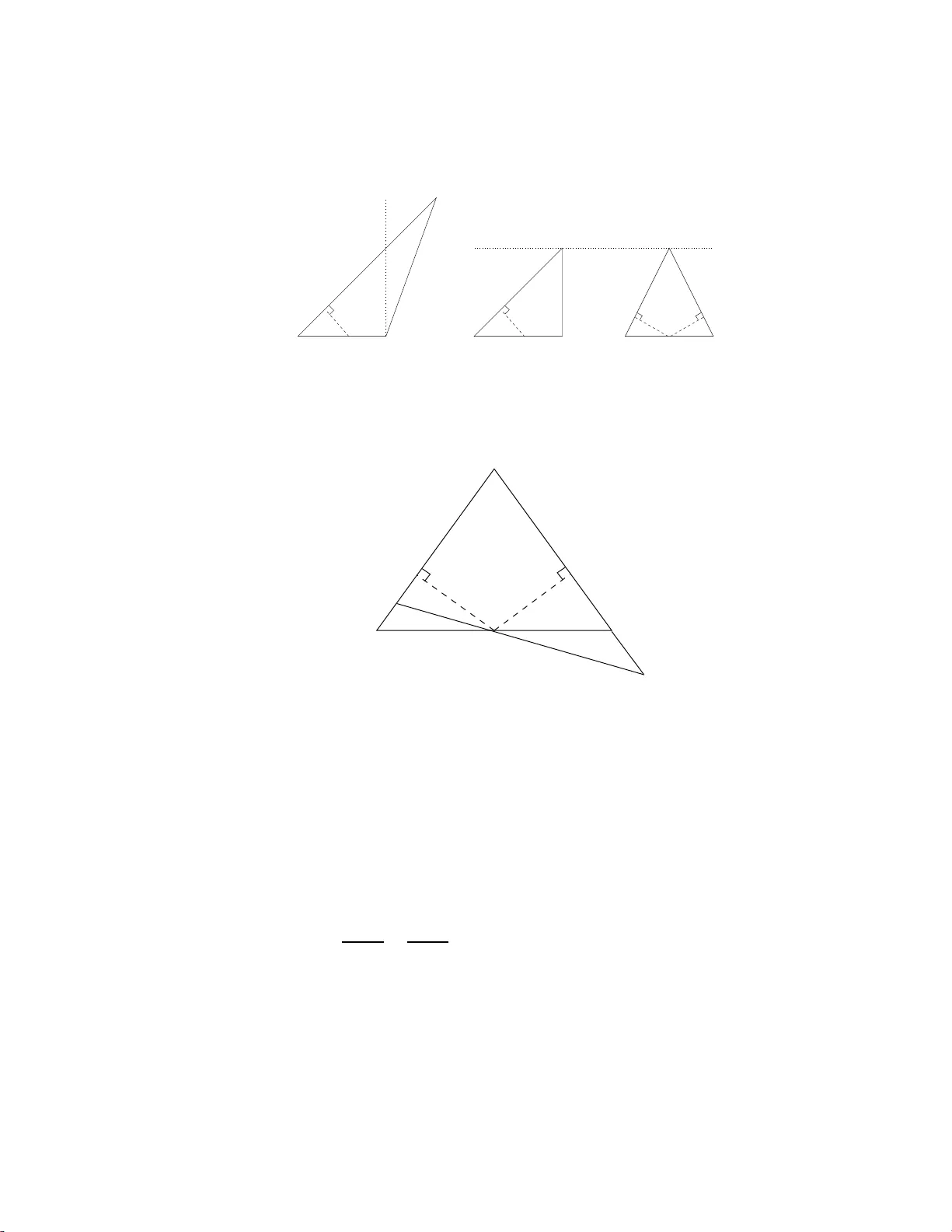
CHARA CTERIZING HYPERBOLIC SP A CES AND REAL TREES ROBER TO FRIGERIO AND ALESS ANDRO SISTO Abstra ct. Let X b e a geo desic metric space. Gromo v prov ed that there exists ε 0 > 0 such that if every sufficiently large triangle ∆ satisfies the Rips cond ition with constant ε 0 · pr(∆), where pr(∆) is t he p erimeter ∆, th en X is hyp erb olic. W e give an elementary pro of of this fact, also giving an estimate for ε 0 . W e also sho w that i f a ll the triangles ∆ ⊆ X satisfy the R ips condition with constan t ε 0 · pr(∆), then X is a real tree. Moreo ve r, we p oint out how this characterizatio n of hyperb olicity can b e used to improv e a result by Bonk, and to p ro vide an easy proof of the (well-kno wn) fact that X is hyperb olic if and only if every asymp totic cone of X is a real tree. 1. Pre liminaries and st a tements Let ( X , d ) b e a metric space. A map γ : [0 , 1] → X is a ge o desic if there exists k ≥ 0 su c h that d ( γ ( t ) , γ ( s )) = k | t − s | for eve ry t, s ∈ [0 , 1]. The space X is ge o desic if an y pair of points in X can be connected by a ge o desic, and uniquely g e o desic if suc h a geo desic is unique. With an abuse, we identify geo d esics and their images, and w e let [ x, y ] denote a geo desic joining x to y , ev en though this geod esic is n ot uniqu e. A triangle with v ertices x, y , z is the u nion of three geod esics [ x, y ] , [ y , z ] , [ z , x ], called sides , and will b e denoted by ∆( x, y , z ). W e d enote b y pr( ∆) the p erimeter o f ∆, i.e. w e set pr(∆( x, y , z )) = d ( x, y ) + d ( y , z ) + d ( z , x ). 1.1. Gromo v h yperb olic spaces and real trees. F or A ⊆ X and ε > 0, we set N ε ( A ) = { x ∈ X : d ( x, A ) ≤ ε } A triangle with sides ℓ 1 , ℓ 2 , ℓ 3 satisfies the Rip s condition with constan t δ if for { i, j, k } = { 1 , 2 , 3 } w e ha v e ℓ i ⊆ N δ ( ℓ j ∪ ℓ k ). A geod esic space X is δ -hyp erb olic if every triangle in X satisfies the Rips condition with constan t δ , and it is hyp erb olic if it is δ -h yp erb olic for some δ ≥ 0. A 0- hyperb olic geo desic space is also called a r e al tr e e . It is easily seen that a real tree is un iquely geo desic, and that if [ x, y ] , [ y , x ] are geo desics in a real tree such that [ x, y ] ∩ [ y , z ] = { y } , then [ x, z ] = [ x, y ] ∪ [ y , z ]. 1.2. The main results. Let X b e a fixed geo desic sp ace. F or every triangle ∆ in X we p ro vide a m easure of ho w muc h n on-h yp erb olic ∆ is b y setting δ (∆) = inf { δ : ∆ satisfies the Rips condition with constant δ } . 2000 Mathematics Subje ct Classific ation. 53C23, 20F67 (secondary). Key wor ds and phr ases. Gromov-h yp erb olic, real tree, Rips condition, asymptotic cone, detour. 1 CHARACTERIZING H YPERBOLIC SP A CES AND REAL TREES 2 Of course, for ev ery ∆ we hav e 4 δ (∆) ≤ pr(∆). Let Ω X : R + → R + b e d efined as follo w s : Ω X ( t ) = sup { δ (∆) , ∆ triangle in X with pr(∆) ≤ t } . By th e v ery defin ition, X is h yp erb olic if and only if Ω X is b ounded. Our main result, which will b e prov ed in S ection 2, is the follo wing: Theorem 1. L et X b e a ge o desic sp ac e. Then X is hyp erb olic if and only if lim s up t →∞ Ω X ( t ) t < 1 32 . Using to ols from plane conformal g eometry , Gr omo v pro v ed in [Gro87] that a constan t ε 0 > 0 exists su ch that if lim su p t →∞ Ω( t ) /t ≤ ε 0 , then X is hyp er b olic. Our p ro of of Theorem 1 is completely el emen tary , and g iv es for ε 0 the estimate of 1 / 32. Observe that by the very defin itions w e hav e sup t Ω X ( t ) t = sup δ (∆) pr(∆) , ∆ triangle in X . The argumen t d ev elop ed for pro ving T heorem 1 also giv es th e follo wing: Theorem 2. L et X b e a ge o desic sp ac e. Then X is a r e al tr e e i f and only if sup δ (∆) pr(∆) , ∆ triangle in X < 1 32 . Theorems 1 and 2 will b e prov ed in Section 2. 1.3. Asymptotic c ones. In Section 3 we will sh ow h o w Theorem 1 can b e used to pro vide sh ort p ro ofs (and a sligh t impr ov emen t) of other kno wn c haracterizatio ns of h yp erb olic spaces. In order to d o this, we first need the d efinition of asymptotic c one of a metric space. Roughly sp eaking, the asymp totic cone of a m etric space gives a picture of the metric space as “seen from infin itely far a wa y”. It was introd uced by Gromo v in [Gro81 ], and f orm ally defin ed in [vdDW 84]. A filter on N is a set ω ⊆ P ( N ) s atisfying the follo wing cond itions: (1) ∅ / ∈ ω ; (2) A, B ∈ ω = ⇒ A ∩ B ∈ ω ; (3) A ∈ ω , B ⊇ A = ⇒ B ∈ ω . F or example, the set of complemen ts of finite s ubsets of N is a fi lter on N , kno wn as the F r´ echet filt er on N . A fi lter ω is a u ltr afilter if for eve ry A ⊆ N we h a ve either A ∈ ω or A c ∈ ω , wh ere A c := N \ A . An u ltrafi lter is non-princip al if it do es not co n tain an y fi nite subset of N . It is readily seen th at a filter is a ultrafilter if and only if it is maximal with r esp ect to inclusion. Moreo v er, an easy applicat ion of Zorn’s L emma shows that any filter CHARACTERIZING H YPERBOLIC SP A CES AND REAL TREES 3 is con tained in a m aximal one. Thus, non-prin cipal u ltrafilters exist (just take any maximal filter conta ining the F r ´ ec het filter). Let a n on-principal ultrafilter ω on N b e fi xed from n o w on. If X is a top ological space, and ( x n ) ⊆ X is a sequence in X , w e sa y that ω − lim x n = x ∞ if for ev ery neugh b our ho o d U of x ∞ the set { n ∈ N : x n ∈ U } b elongs to ω . It is easily seen that if X is Hausd orff th en the ω -limit ab ov e, if it exists, is un ique. Moreo v er, an y sequence in any compact space admits a ω -limit. F or example, an y sequen ce ( a n ) in [0 , + ∞ ] admits a uniqu e ω -limit. No w let ( X, d ) b e a metric space, ( x n ) ⊆ X b e a sequence of base-p oin ts, and ( d n ) ⊂ R + a sequence of rescaling facto rs dive rging to infinity . Let C b e the set of sequences ( y n ) ⊆ X suc h that ω − lim d ( x n , y n ) /d n < + ∞ , and consider the equiv alence relation defined on C as follo w s: ( y n ) ∼ ( z n ) ⇐ ⇒ ω − lim d ( y n , z n ) d n = 0 . W e set X ω (( x n ) , ( d n )) = C / ∼ , end endo w it with the well- defined distance d ω suc h that d ω ([( y n )] , [( z n )]) = ω − lim d ( y n , z n ) d n . Definition 3. The m etric space ( X ω (( x n ) , ( d n )) , d ω ) is the asympto tic c one of X with resp ect to the ultrafilter ω , th e basep oints ( x n ) and the rescaling factors ( d n ). As sta ted in [Gro87, Gro93], a sp ace X is h yp erb olic if and only if ev ery asymptoti c cone of X is a real t ree (see [Dru 02] for an el emen tary p r o of ). W e will sho w in Section 3 ho w Theorem 1 easily implies this c haracterization of hyp erb olicit y (see Prop osition 10). 1.4. Detours. Th e notion of detour w e are no w g oing to recall was introd uced by Bonk in [Bo n96], where a c haracterization of hyper b olicit y was giv en in terms of detour gro wth (see T heorem 4 ). Let ( X, d ) b e a geodesic space and let t > 0. A t - detour is a con tinuous map γ : [0 , 1] → X suc h that th er e exist a geod esic [ γ (0) , γ (1)] and a p oin t z ∈ [ γ (0) , γ (1)] suc h that d ( x, Im γ ) ≥ t . The detour growth function G X : (0 , ∞ ) → (0 , ∞ ] is d efined as follo ws: G X ( t ) = inf { lenght( γ ) : γ is a t − detour } . Note that G X ( t ) = ∞ if and only if there exist no rectifiable t -detours in X , e. g. if X is a real tree (see Lemma 11). T he follo w in g result is prov ed in [Bon96]: Theorem 4 (B onk) . A ge o desic sp ac e X is hyp erb olic if and only if lim t →∞ G X ( t ) t = + ∞ . Using Th eorem 1, in Section 3 w e p r o ve the follo win g: CHARACTERIZING H YPERBOLIC SP A CES AND REAL TREES 4 Theorem 5. A ge o desic sp ac e X is hyp erb olic if and only if lim in f t →∞ G X ( t ) t > 30 . 1.5. Lo oking for optimal constan t s. A v ery n atural problem is to compute (or to giv e b etter estimates on) the largest constan ts wh ic h could r eplace 1 / 32 in the statemen ts of T h eorems 1, 2 . By Theorem 1, th e set { ε > 0 : every geod esic space X with lim sup t →∞ Ω X ( t ) t < ε is h yp erb olic } is non-empty . Being b ounded, su c h set admits a lo west upp er b oun d , whic h is readily seen to b e a maxim u m, and will b e denoted b y ε H . In the same wa y , it mak es sense to define ε T as t he large st constan t suc h t hat ev ery geodesic space X with sup t Ω X ( t ) /t < ε T is a r eal tree. The follo win g p rop osition is p r o ved in Section 4 , and pr o vid es an upp er b ound for ε H , ε T : Prop osition 6. F or e very t > 0 we h ave Ω R 2 ( t ) = 1 2 · √ 5 − 1 2 ! 5 2 · t ≈ 0 . 15 · t. F r om no w on, we set η 0 = ( √ 5 − 1) 5 / 2 / 2 7 / 2 . Since R 2 is n ot hyp er b olic, we ha v e the follo wing: Corollary 7. The fol lowing ine qualities h old: 1 32 ≤ ε H ≤ η 0 , 1 32 ≤ ε H ≤ η 0 . Our pro of of Th eorem 1 w as inte nded to give a somewhat significan t estimat e of ε H , ε T (in fact, similar but shorter argumen ts ca n b e pr o vided in o rder to sh ow just that ε H > 0, ε T > 0 exist). Ho wev er, there are no reasons w h y 1 / 32 should pro vide a goo d appr o ximation of ε H and ε T . On the other hand, a recent r esult by W enger [W en08 ] on the sh arp isop erimetric constan t for hyp erb olic sp aces seems to suggest that the Euclidean plane could pro vide sharp b oun ds on the b eha viour of curv es and triangles in hyperb olic spaces, so that ε H (and ε T , see Prop osition 8) could b e not to o far from η 0 . Finally , it seems quite reasonable that ε H = ε T , bu t at the moment w e are just able to p ro ve the follo win g: Prop osition 8. ε H ≤ ε T . The pr o of of Prop osition 8 is indep endent fr om that of Theorem 2, so we get Theorem 2 also as a corollary of Theorem 1 and Prop osition 8. CHARACTERIZING H YPERBOLIC SP A CES AND REAL TREES 5 2. The main argument This section is dev oted to the pro ofs of Theorems 1, 2. Let X b e a fixed geo desic space. In what follo w s, ev ery time t w o p oint s x, y b elong to a given geod esic ℓ , w e denote by [ x, y ] the (uniqu e) geo desic joinin g x to y such that [ x, y ] ⊆ ℓ . In that case, w e also sup p ose that the symb ol ∆( x, y , z ) denotes a triangle [ x, y ] ∪ [ y , z ] ∪ [ z , x ] suc h that [ x, y ] ⊆ ℓ . W e b egin with the follo win g: Lemma 9. L et ρ, α > 0 and let ∆ ⊆ X b e a ge o desic triangle with sides l 1 , l 2 , l 3 such that length ( l 1 ) ≤ αρ and δ (∆) ≤ ρ + 1 . Then for e ach p ∈ l 1 we have d ( p, l 2 ∪ l 3 ) ≤ Ω X ((4 α + 4) ρ + 6) + Ω X ((2 α + 4) ρ + 6) . Pr o of. If length( l i ) ≤ ( α + 1) ρ + 2 for i = 2 , 3, then pr(∆) ≤ (3 α + 2) ρ + 4, whence the conclusion since Ω X is an increasing function. So, if a i ∈ ∆ is the v ertex opp osite to the side l i , up to exchanging l 2 with l 3 w e can tak e q ∈ l 2 suc h that d ( a 3 , q ) = ( α + 1) ρ + 2. Since length( l 1 ) ≤ αρ w e get d ( q , l 1 ) ≥ ρ + 2, so δ (∆) ≤ ρ + 1 implies that r ∈ l 3 exists such that d ( q , r ) ≤ ρ + 1. S ince d ( a 3 , r ) ≤ d ( a 3 , q ) + d ( q , r ) ≤ ( α + 2) ρ + 3 , d ( a 2 , r ) ≤ d ( a 2 , a 3 ) + d ( a 3 , r ) ≤ 2( α + 1) ρ + 3 , setting ∆ 1 = l 1 ∪ [ a 3 , r ] ∪ [ r , a 2 ], ∆ 2 = [ a 3 , q ] ∪ [ q , r ] ∪ [ r , a 3 ] we get (1) pr(∆ 1 ) ≤ (4 α + 4) ρ + 6 , pr(∆ 2 ) ≤ (2 α + 4) ρ + 6 . Let no w p b e an y point of l 1 , and consider the triangle ∆ 1 . By (1) there exists s ∈ [ a 3 , r ] ∪ [ r , a 2 ] suc h that d ( p, s ) ≤ δ (∆ 1 ) ≤ Ω X ((4 α + 4) ρ + 6). If s b elongs to [ r , a 2 ], we are done. Otherwise s b elongs to [ a 3 , r ], so a p oin t t ∈ [ a 3 , q ] ∪ [ q , r ] exists suc h that d ( s, t ) ≤ δ (∆ 2 ) ≤ Ω X ((2 α + 4) ρ + 6). Th us d ( p, t ) ≤ Ω X ((4 α + 4) ρ + 6) + Ω X ((2 α + 4) ρ + 6), and if t ∈ [ a 3 , q ] w e a re d one. Otherwise, w e h a ve t ∈ [ q , r ], so d ( p, q ) ≤ d ( p, t ) + d ( t, q ) ≤ Ω X ((4 α + 4) ρ + 6) + ρ + 1. Th us ( α + 1) ρ + 1 = d ( a 3 , q ) ≤ d ( a 3 , p ) + d ( p, q ) ≤ d ( a 3 , p ) + Ω X ((4 α + 4) ρ + 6) + ρ + 1 , whence d ( a 3 , p ) ≥ αρ − Ω X ((4 α + 4) ρ + 6). Th is readily implies d ( p, a 2 ) ≤ Ω X ((4 α + 4) ρ + 6), whence d ( p, l 2 ∪ l 3 ) ≤ Ω X ((4 α + 4) ρ + 6 ), and the conclusion at once. Pr o of of The or em 1. By contradicti on, su pp ose Ω X div erges. W e set β = 1 32 − lim sup t →∞ Ω X ( t ) t > 0 , κ = 1 32 − β 2 . Let µ > 0 b e large enough so th at Ω X ( µ ) > (1 /β ) + 1 and Ω X ( l ) ≤ κl for ev ery l ≥ Ω X ( µ ) − 1. Let ∆ = ∆( a 1 , a 2 , a 3 ) b e a geod esic triangle with pr(∆) ≤ µ and λ = δ (∆) ≥ Ω X ( µ ) − 1. Up to reordering th e ve rtices of ∆, w e ma y s u pp ose there exist x ∈ [ a 1 , a 2 ] and y ∈ [ a 2 , a 3 ] suc h that d ( x, [ a 2 , a 3 ] ∪ [ a 3 , a 1 ]) = d ( x, y ) = λ . F or i = 1 , 2, l et x i b e the p oin t on [ x, a i ] suc h that d ( x, x i ) = λ/ 3, and let p ∈ [ x, y ] b e the p oint suc h that d ( x, p ) = λ/ 3. CHARACTERIZING H YPERBOLIC SP A CES AND REAL TREES 6 x 2 a 3 y ′ s y r q p x x 1 a 1 a 2 p a 2 s t q t r a 1 a 3 Figure 1: Notations for the pr o ofs of Lemma 9 and Theore m 1. Since pr(∆( x 1 , x 2 , p )) ≤ 2 λ , a p oin t q ∈ [ x 1 , p ] ∪ [ x 2 , p ] exists such that d ( x, q ) ≤ Ω X (2 λ ) ≤ 2 κλ . Without loss of generalit y , w e ma y sup p ose q ∈ [ x 1 , p ] (the f ollo wing pro of wo rking exactly in the same wa y also in the case q ∈ [ x 2 , p ]). Let y ′ ∈ [ a 1 , a 3 ] ∪ [ a 2 , a 3 ] be su c h that d ( x 1 , y ′ ) ≤ λ = δ (∆). Since pr(∆( p, x 1 , y ′ )) ≤ 2( d ( p, x 1 ) + d ( x 1 , y ′ )) ≤ (10 / 3) λ , a p oint r ∈ [ x 1 , y ′ ] ∪ [ p, y ′ ] exists suc h th at d ( q , r ) ≤ (10 / 3) κ λ . Thus (2) d ( x, r ) ≤ d ( x, q ) + d ( q , r ) ≤ 16 κλ 3 . Supp ose r ∈ [ x 1 , y ′ ]. Then d ( x 1 , r ) ≥ d ( x 1 , x ) − d ( x, r ) ≥ ((1 − 16 κ ) / 3) λ . On the other hand, since d ( x, [ a 1 , a 3 ] ∪ [ a 2 , a 3 ]) = λ and κ < 1 / 32 we h a ve λ ≤ d ( x, y ′ ) ≤ d ( x, r ) + d ( r , y ′ ) = d ( x, r ) + d ( x 1 , y ′ ) − d ( x 1 , r ) ≤ ( 16 κ 3 + 1 − 1 − 16 κ 3 ) λ = 2+32 κ 3 λ < λ, a con tradiction. Thus r ∈ [ p, y ′ ]. No w d ( y , p ) + d ( p, y ′ ) ≤ d ( y , x ) + d ( x, x 1 ) + d ( x 1 , y ′ ) ≤ (7 / 3) λ , so pr(∆( p, y ′ , y )) ≤ (14 / 3 ) λ , and a p oin t s ∈ [ y , y ′ ] ∪ [ p, y ] exists suc h that d ( r , s ) ≤ (14 / 3) κλ . By (2), it follo w s th at (3) d ( x, s ) ≤ d ( x, r ) + d ( r , s ) ≤ 10 κλ. Since (10 / 32) λ < (1 / 3) λ = d ( x, p ), this implies s ∈ [ y , y ′ ]. Obs erv e also that y ′ ∈ [ a 1 , a 3 ], b ecause otherwise we w ould ha v e [ y , y ′ ] ⊆ [ a 2 , a 3 ], an d d ( x, [ a 2 , a 3 ]) ≤ d ( x, s ) < λ , a con tr adiction. Consider no w the triangle ∆( y , y ′ , a 3 ). Of course p r(∆( y , y ′ , a 3 )) ≤ pr(∆), so δ (∆( y , y ′ , a 3 )) ≤ Ω X ( µ ) ≤ λ + 1. Since d ( y, y ′ ) ≤ d ( y , x ) + d ( x, x 1 ) + d ( x 1 , y ′ ) ≤ CHARACTERIZING H YPERBOLIC SP A CES AND REAL TREES 7 (7 / 3) λ , by Lemma 9 we obtain d ( s, [ a 1 , a 3 ] ∪ [ a 2 , a 3 ]) ≤ d ( s, [ y ′ , a 3 ] ∪ [ y , a 3 ]) ≤ Ω X ((40 / 3 ) λ + 6) + Ω X ((26 / 3 ) λ + 6) ≤ κ (22 λ + 12) . By (3), sin ce κ = 1 / 32 − β / 2 and λ > 1 /β w e finally get d ( x, [ a 1 , a 3 ] ∪ [ a 2 , a 3 ]) ≤ d ( x, s ) + d ( s, [ a 1 , a 3 ] ∪ [ a 2 , a 3 ]) < 32 κλ + 12 κ < λ, a con tradiction. Pr o of of The or em 2. Let X b e a geo desic sp ace su c h that sup t Ω X ( t ) /t < 1 / 32 and supp ose by con tr adiction that there exists µ > 0 with Ω X ( µ ) > 0. As in the pr o of of Theorem 1 , set β = 1 32 − su p t Ω X ( t ) t > 0 , κ = 1 32 − β 2 . Observe that a resca ling of the met ric of X do es not affect the hypothesis and the thesis of the theorem, so we can assume Ω X ( µ ) > (1 /β ) + 1. Then a triangle ∆ ⊆ X exists su c h that pr(∆) ≤ µ and λ = δ (∆) ≥ Ω X ( µ ) − 1, and the ve ry same argum ent of the p ro of of Theorem 1 leads to a con tradiction. 3. Cha r acterizing hyp erbolic s p aces This section is devo ted to the pr o of of the follo wing result, w hic h w ill in turn imply Th eorem 5. Prop osition 10. L et ( X , d ) b e a ge o desic sp ac e. The fol lowing facts ar e e quivalent: (1) X i s hyp erb olic; (2) for any choic e of a ultr afilter ω , a se que nc e of b asep oints ( x n ) ⊆ X and a se quenc e of r esc aling factors ( d n ) ⊆ R , the asympto tic c one X ω (( x n ) , ( d n )) is a r e al tr e e; (3) lim inf t →∞ G X ( t ) /t > 30 ; (4) lim su p t →∞ Ω X ( t ) /t < 1 / 32 . W e sho w first an easy (and w ell-kno wn) result which will b e needed in the pro of of Prop osition 10: Lemma 11. Supp ose ( X , d ) is a r e al tr e e and let γ : [0 , 1] → X b e a c ontinuous p ath with γ (0) = x , γ (1) = y . Then [ x, y ] ⊆ I m γ . Pr o of. Let z ∈ X \ [ x, y ] and observ e that since [ x, y ] is compact a p oint t ∈ [ x, y ] exists suc h that d ( z , t ) = d ( z , [ x, y ]) = k > 0. W e claim that if d ( z ′ , z ) < k / 2 and d ( z ′ , t ′ ) = d ( z ′ , [ x, y ]), then t = t ′ . In fact, of course [ z ′ , t ′ ] ∩ [ x, y ] = { t ′ } , so [ z ′ , t ] = [ z ′ , t ′ ] ∪ [ t ′ , t ]. But X b eing 0-hyperb olic, this implies t ′ ∈ [ t, z ] ∪ [ z , z ′ ]. Since d ( z ′ , t ′ ) ≥ d ( z , t ′ ) − d ( z , z ′ ) > k − k / 2 = k / 2, we cannot ha v e t ′ ∈ [ z , z ′ ], so t ′ ∈ [ t, z ], whence t ′ = t sin ce [ t, z ] ∩ [ x, y ] = { t } , and the claim is pr o ved. This readily implies CHARACTERIZING H YPERBOLIC SP A CES AND REAL TREES 8 that th e map π : X → [ x, y ] whic h sends p ∈ X to its closest point π ( p ) ∈ [ x, y ] is w ell-defined, con tin uous and lo cally constan t on X \ [ x, y ]. Being connected and con taining x , y , the set Im ( π ◦ γ ) ⊆ [ x, y ] equals in f act [ x, y ]. So, supp ose there exists s ∈ [ x, y ] \ Im γ , and obs er ve that of cour se s 6 = x . T hen ( π ◦ γ ) − 1 ( s ) ⊆ [0 , 1] is non-empt y , closed and op en (b ecause π is lo cally constan t on X \ [ x, y ]), whence equal to [0 , 1], a cont radiction since π ( γ (0)) = x 6 = s . Pr o of. (1) ⇒ (2) . This implication is well -kno wn, w e ske tc h a pro of of it for the sak e of co mpleteness. S upp ose ( X, d ) is δ -h y p erb olic. Then ( X, d/d n ) i s ob viously ( δ /d n )-h yp erb olic. W e fi rst sho w that X ω := (( X ω , ( x n ) , ( d n )) , d ω ) is u niquely geo desic. S o, let [( y n )] , [( z n )] ∈ X ω , and let γ n : [0 , 1] → X b e a geo desic j oinin g y n to z n for ev ery n ∈ N . It is easily seen that the map γ ω : [0 , 1] → X ω defined by γ ( t ) = [( γ n ( t ))] is a geod esic. Let ψ : [0 , 1] → X ω b e a geo desic with the same endp oints as γ and tak e t 0 ∈ [0 , 1]. If ψ ( t 0 ) = [( p n )], let us consid er a tr iangle ∆ n = [ y n , p n ] ∪ [ p n , z n ] ∪ Im γ n ⊆ X : by δ -hyp erb olicit y of X , a p oin t q n ∈ [ y n , p n ] ∪ [ p n , z n ] exists su c h that d ( γ n ( t 0 ) , q n ) ≤ δ . Of course, this imp lies [( q n )] = γ ω ( t 0 ). In p articular, w e ha ve d ω ([( q n )] , [( y n )]) = d ω ( γ ω ( t 0 ) , [( y n )]) = d ω ( ψ ( t 0 ) , [( y n )]) and d ω ([( q n )] , [( z n )]) = d ω ( γ ω ( t 0 ) , [( z n )]) = d ω ( ψ ( t 0 ) , [( z n )]). S ince q n ∈ [ y n , p n ] ∪ [ p n , z n ], this easily implies that [( q n )] = [( p n )], when ce ψ ( t 0 ) = γ ω ( t 0 ), and ψ = γ ω . Let now ∆ ω = [ x 1 ω , x 2 ω ] ∪ [ x 2 ω , x 3 ω ] ∪ [ x 3 ω , x 1 ω ] ⊆ X ω b e a geodesic triangle. W e ha ve just pro v ed that, X ω b eing uniquely geo desic, ∆ ω is in an ob vious sens e the ω -limit of tr iangles ∆ n = [ x 1 n , x 2 n ] ∪ [ x 2 n , x 3 n ] ∪ [ x 3 n , x 1 n ] suc h that x i ω = [( x i n )]. With resp ect to the rescaled metric d/d n , these triangles satisfy th e Rips c ondition with constan t δ /d n . Since lim n →∞ δ /d n = 0, this readily implies that ∆ ω satisfies the Rips condition with constant 0, whence the conclusion. (2) ⇒ (3) . Arguing by contradict ion, we w ill pro v e the stronger fac t that, if (2) holds, then lim t →∞ G X ( t ) /t = + ∞ . So, s upp ose th ere exist a constan t M > 0 and a div erging sequ ence ( t n ) ⊆ R + suc h that G ( t n ) /t n < M for every n ∈ N . By the v er y definition of G X , for ev ery n ∈ N there exist p oints x n , y n ∈ X , a path γ n : [0 , 1] → X with γ n (0) = x n , γ n (1) = y n and lenght( γ n ) ≤ M t n , a geo desic [ x n , y n ] and a p oin t z n ∈ [ x n , y n ] s u c h that d ( z n , I m γ n ) ≥ t n . Let now ω b e any non-p rincipal ultrafi lter, and consider the asymptotic cone X ω := ( X ω (( x n ) , ( t n )) , d ω ). Since d ( x n , y n ) ≤ lengh t ( γ n ) ≤ M t n , as in the pr o of of (1) ⇒ (2) one can pro ve that the ω -limit of the geodesics [ x n , y n ] defi nes a geod esic in X ω joining x ω := [( x n )] and y ω := [( y n )]. W e denote suc h a geodesic b y [ x ω , y ω ], and observ e that [( z n )] ∈ [ x ω , y ω ]. Without lo ss of generalit y , we may supp ose γ n is parameterized at constan t sp eed. Since lengh t ( γ n ) ≤ M t n , this implies that γ n is M t n -Lipsc h itz with resp ect to d , whence M -Lipsc hitz with resp ect to the rescaled metric d/t n . It is readily seen that under this condition the map γ ω : [0 , 1] → X ω defined b y γ ω ( t ) = [( γ n ( t ))] is a w ell-defined M -Lip sc h itz (whence contin uous) arc. Moreo ve r, CHARACTERIZING H YPERBOLIC SP A CES AND REAL TREES 9 since d ( z n , I m γ n ) ≥ t n , we h a ve [( z n )] / ∈ Im γ ω . By Lemma 11, X ω is not a real tree, a con tradiction. (3) ⇒ (4) . Let ℓ 1 , ℓ 2 , ℓ 3 b e the edge s of a geo d esic triangle ∆ ⊆ X and supp ose δ (∆) = d ( p, ℓ 2 ∪ ℓ 3 ), w here p is a p oin t of ℓ 1 . Since length l 1 ≥ 2 δ (∆), a su itable parameterizatio n of ℓ 2 ∪ ℓ 3 pro vides a δ (∆) d etour of length at most pr(∆) − 2 δ (∆). This implies that for ev ery t ∈ R + and ε > 0 w e h a ve G X (Ω X ( t ) − ε ) ≤ t − 2(Ω X ( t ) − ε ) . If Ω is b ounded, there is nothing to pr o ve, so, since Ω X is increasing, we may assume lim t →∞ Ω( t ) = + ∞ . Su pp ose n o w lim inf t →∞ G X ( t ) /t = α > 30 and tak e 0 < ε < ( α − 30) / 3. Then for t sufficiently large we ha ve (4) ε t < 1 α + 2 − 2 ε − 1 α + 2 − ε and (5) t − 2(Ω X ( t ) − ε ) ≥ G X (Ω X ( t ) − ε ) > ( α − ε )(Ω X ( t ) − ε ) . By (5) we get (Ω X ( t ) − ε ) /t < 1 / ( α + 2 − ε ), whence, b y (4), Ω X ( t ) /t < 1 / ( α + 2 − 2 ε ). Th us lim sup t →∞ Ω X ( t ) /t ≤ 1 / ( α + 2 − 2 ε ) < 1 / 32. (4) ⇒ (1) is ju st th e result pro v ed in Theorem 1. 4. The Euclidean case This section is devo ted to the p r o of of P rop osition 6. In what follo ws, for e v ery A, B ∈ R 2 w e will denote by AB the distance d ( A, B ). Th e follo win g lemma r eadily implies Ω R 2 (1) ≥ η 0 . Lemma 12 . L et ∆ = ∆( B 1 , B 2 , B 3 ) ⊂ R 2 b e a triangle with pr(∆) ≤ 1 and \ B 3 B 1 B 2 = \ B 1 B 2 B 3 = α , and let Q b e the midp oint of [ B 1 , B 2 ] . Then d ( Q, [ B 1 , B 3 ] ∪ [ B 2 , B 3 ]) ≤ η 0 , the e quality holding if and only if pr(∆) = 1 and cos α = ( √ 5 − 1) / 2 . Pr o of. It is easily seen that d ( Q, [ B 1 , B 3 ] ∪ [ B 2 , B 3 ]) = ( B 1 B 2 sin α ) / 2, while pr(∆) = B 1 B 2 (1 + cos α ) / (cos α ). Let α 0 ∈ (0 , π / 2) b e suc h that cos α 0 = ( √ 5 − 1) / 2. An easy computation sho w s that for ev ery α ∈ (0 , π / 2) we ha v e δ (∆) pr(∆) = sin α cos α 2(1 + cos α ) ≤ sin α 0 cos α 0 2(1 + cos α 0 ) = η 0 , the equalit y h olding if and only if α = α 0 , whence the conclusion. Pr o of of The or em 1. It w ill b e sufficien t to sho w that Ω R 2 (1) = η 0 : in fact, any rescaling of R 2 is isometric to R 2 itself, so for an y t > 0 we ob viously h a ve Ω R 2 ( t ) = Ω R 2 (1) · t . CHARACTERIZING H YPERBOLIC SP A CES AND REAL TREES 10 A 3 A 1 A 2 A 1 A 2 A 1 A 2 A ′′ 3 A ′ 3 P P ′ P ′′ Figure 2: Computing Ω R 2 (1): the case when \ A 1 A 2 A 3 ≥ π / 2 . A ′ 2 A 1 A ′ 1 A 2 A 3 P Figure 3: Computing Ω R 2 (1): the case when \ A 1 A 2 A 3 ≤ π / 2 . Let ∆ = ∆( A 1 , A 2 , A 3 ) ⊆ R 2 b e a triangle with pr(∆) ≤ 1. Up to reordering A 1 , A 2 , A 3 , w e ma y supp ose that P ∈ [ A 1 , A 2 ] exists suc h that δ (∆) = { d ( P , [ A 1 , A 3 ] ∪ [ A 2 , A 3 ]) = d ( P , [ A 2 , A 3 ]). If \ A 1 A 2 A 3 ≥ π / 2, then take A ′ 3 ∈ [ A 1 , A 3 ] in su c h a w ay that \ A 1 A 2 A ′ 3 = π / 2, set ∆ ′ = ∆( A 1 , A 2 , A ′ 3 ) a nd let P ′ ∈ [ A 1 , A 2 ] b e the f arthest point from [ A 1 , A ′ 3 ] ∪ [ A 2 , A ′ 3 ]. O f course we hav e d ( P ′ , [ A 1 , A ′ 3 ] ∪ [ A 2 , A ′ 3 ]) ≥ δ (∆) and pr(∆ ′ ) ≤ pr(∆). Let no w ℓ b e th e lin e passing through A ′ 3 whic h is parallel to [ A 1 , A 2 ], tak e A ′′ 3 ∈ ℓ in such a wa y that A 1 A ′′ 3 = A 2 A ′′ 3 and s et ∆ ′′ = ∆( A 1 , A 2 , A ′′ 3 ). An easy computa- tion shows that i f P ′′ is the midp oint of [ A 1 , A 2 ], then d ( P ′′ , [ A 1 , A ′′ 3 ] ∪ [ A 2 , A ′′ 3 ]) ≥ d ( P ′ , [ A 1 , A ′ 3 ] ∪ [ A 2 , A ′ 3 ]), while pr(∆ ′′ ) ≤ p r(∆ ′ ). Sin ce pr(∆ ′′ ) ≤ p r(∆) ≤ 1 and d ( P ′′ , [ A 1 , A ′′ 3 ] ∪ [ A 2 , A ′′ 3 ]) ≥ δ (∆), by Lemma 12 w e hav e δ (∆) ≤ η 0 . CHARACTERIZING H YPERBOLIC SP A CES AND REAL TREES 11 Supp ose n ow \ A 1 A 2 A 3 , \ A 2 A 1 A 3 ≤ π / 2, and let ℓ i b e the half-line with end p oint A 3 con taining A i . It is easily see n that δ (∆) = d ( P , ℓ 1 ) = d ( P , ℓ 2 ). Le t no w r b e the line orthogonal to [ A 3 , P ] and passing through P , and set A ′ i = ℓ i ∩ r , ∆ ′ = ∆( A ′ 1 , A ′ 2 , A 3 ). Of course A ′ 1 A 3 = A ′ 2 A 3 and d ( p ′ , [ A ′ 1 , A 3 ] ∪ [ A ′ 2 , A 3 ]) = δ (∆), while an easy co mputation sho ws that p r(∆ ′ ) ≤ pr(∆) ≤ 1. As b efore, Lemma 12 no w implies δ (∆) ≤ δ (∆ ′ ) ≤ η 0 . W e hav e th u s p ro ved that if ∆ ⊂ R 2 is a triangle with pr(∆) ≤ 1, then δ (∆) ≤ η 0 . This implies Ω X (1) ≤ η 0 , whence the conclusion. 5. S ome remarks o n the optimal const ants This section is en tirely dev oted to th e pro of of P r op osition 8. W e will show that, if ( X , d ) b e is geo d esic sp ace such that sup t Ω X ( t ) t = α < ε H , then ( X, d ) is a real tree. The idea o f the pro of is as follo ws: w e realize X as an isometrical ly em b edded subsp ace o f the asymptotic cone of a suitable geo desic space Y , c h osen in suc h a wa y that lim su p t →∞ Ω Y ( t ) /t < ε H . This ensur es that Y is hyperb olic, whic h in turn implies that X is a real tree. So, let p ∈ X b e a fixed basep oint, and let Y ⊆ X × R b e defined as follo ws: Y = ( { p } × R ) ∪ [ i ∈ N X × { i } ! . W e defin e a distance e d on Y by setting: e d (( x, t ) , ( x ′ , t ′ )) = i · d ( x, p ) + j · d ( p, x ′ ) + | t − t ′ | if t 6 = t ′ i · d ( x, x ′ ) if t = t ′ It is easily seen that ( Y , e d ) is a geo desic m etric sp ace, and that in ( Y , e d ) there are not unexp ected geo desics. More precisely , tak e p oints ( x, s ) , ( x ′ , s ′ ) ∈ Y : if s = s ′ = i for some i ∈ N , then a p ath γ : [0 , 1] → Y joining ( x, s ) to ( x ′ , s ′ ) is a ge o desic if and only if γ ( t ) = ( ψ ( t ) , i ) for some ge o desic ψ : [0 , 1] → X in X joining x to x ′ ; if s 6 = s ′ , then a p ath γ : [0 , 1] → Y joining ( x, s ) to ( x ′ , s ′ ) is a geodesic if and only if, up to reparameterization, γ = ψ ′ ∗ ϕ ∗ ψ , where ψ (resp ectiv ely ψ ′ ) is a (p ossibly constan t) geo desic joining ( x, s ) to ( p, s ) (resp ective ly ( x ′ , s ′ ) to ( p, s ′ )), and ϕ ( t ) = ( p, ts ′ + (1 − t ) s ). Th us, let ∆ ⊆ Y b e a triangle with vertice s z i = ( x i , s i ), i = 1 , 2 , 3, a nd let l i b e the edge of ∆ opp osite to z i . Up to reordering, we ma y su pp ose that z = ( x, s ) ∈ l 1 exists such that e d ( z , l 2 ∪ l 3 ) = δ (∆), and that s 2 ≤ s 3 , whence s 2 ≤ s ≤ s 3 . If s / ∈ N , then x = p , and it is easily see n either z is a v ertex of ∆, whence δ (∆) = 0, or s 2 < s < s 3 . In this case z 2 and z 3 lie in different connected comp onen ts of Y \ { z } , so z ∈ l 2 ∪ l 3 , and δ (∆) = 0 again. CHARACTERIZING H YPERBOLIC SP A CES AND REAL TREES 12 So let us sup p ose s = n ∈ N . W e set l ′ 1 = l 1 ∩ ( X × { n } ), and for i = 2 , 3 w e defin e l ′ i as follo w s: l ′ i = l i ∩ ( X × { n } ) if l i ∩ ( X × { n } ) 6 = ∅ , and l ′ i = { ( p, n ) } otherwise. The p revious description of the geod esics of Y implies that l ′ 2 ∪ l ′ 3 ⊆ l 2 ∪ l 3 , and that ∆ ′ = l ′ 1 ∪ l ′ 2 ∪ l ′ 3 is a geo desic triangle in Y with v ertices z ′ 1 , z ′ 2 , z ′ 3 , where z ′ i = z i if s i = n , z ′ i = ( p, n ) otherwise. Moreov er ∆ ′ is co n tained in X × { n } , so it is the rescaled cop y of a triangle ∆ ′′ in ( X , d ). Th u s δ (∆) pr(∆) = d ( z , l 2 ∪ l 3 ) pr(∆) ≤ d ( z , l ′ 1 ∪ l ′ 2 ) pr(∆ ′ ) ≤ δ (∆ ′ ) pr(∆ ′ ) = δ (∆ ′′ ) pr(∆ ′′ ) ≤ α. W e ha v e th us p r o ved th at sup t Ω Y ( t ) t = α ≤ ε H , whence in particular lim sup t →∞ Ω Y ( t ) /t < ε H . By the v ery definition of ε H , this implies that Y is hyperb olic. No w let ω b e a ultrafilter, and consider the asymptotic co ne Y ω = ( Y ω , (( p, n )) , ( n )). By Theorem 5, Y ω is a rea l tree. Let us consider the map ψ : X → Y ω defined b y ψ ( x ) = [( x, n )]. It is easily seen th at ψ is a w ell-defined isometric em b eddin g. Since X is geo desic, this readily implies that X is itself a real tree, wh ence the conclusion. Remark 13. Let Y b e a geo desic space with lim sup t →∞ Ω Y ( t ) /t = α . A geo desic γ ω : [0 , 1] → Y ω joining x ω = [( x n )] , y ω = [( y n )] is called go o d if it is the ω -limit of geo desics in X joining x n to y n , i.e. if there exist ge o desics γ n : [0 , 1] → X suc h that γ ω ( t ) = [( γ n ( t ))] for ev ery t ∈ [0 , 1]. A sligh t mo dification of the argument sho w ing that an y asymptotic cone of a hyp erb olic space is uniquely geo desic (see Prop osition 1 0, (1) ⇒ (2)) pro v es that if γ ′ is a ny geo desic in Y ω of length ℓ , then a go o d g eo desic γ in Y exists which has the s ame endp oin ts of γ ′ and is suc h that d ω ( γ ( t ) , γ ′ ( t )) ≤ 4 αℓ for eve ry t ∈ [0 , 1]. No w, it is rea dily s een t hat if ∆ ⊆ Y ω is a triangle with sides given by go o d geod esics, then δ (∆) ≤ α pr(∆). These facts imply that sup t (Ω Y ω ( t ) /t ) ≤ 5 α . By Prop osition 10, this implies in turn ε T ≤ 5 ε H . Note ho wev er that this inequalit y do es not gi v e an y information, sin ce we already kno w that 1 / 32 ≤ ε H ≤ ε T < η 0 , and 32 η 0 ≈ 4 . 8 < 5. Referen ces [Bon96] M. Bonk, Quasi-ge o desic se gments and G r omov hyp erb olic sp ac es , Geom. Dedicata 62 (1996), 281–298. [Dru02] C. Drutu, Quasi-i sometry invariants and asymptotic c ones , I nt. J. A lg. Comp. 12 (2002), 99–135. [Gro81] M. Gromo v, Gr oups of p olynomi al gr owth and exp anding maps , Inst. Hautes ´ Etudes Sci. Publ. Math. 53 (1981), 53–73. [Gro87] , Hyp erb olic gr oups , Es sa ys in group theory (N ew Y ork) (S pringer, ed.), Math. Sci. Res. I nst. Publ., vol. 8, 1987, pp. 75–263. CHARACTERIZING H YPERBOLIC SP A CES AND REAL TREES 13 [Gro93] , Asymptotic i nvariants of infinite gr oups , Geometric group theory , vol. 2 (Cam- bridge) (Cambridge Univ. Press, ed.), London Math. Soc. Lecture N ote Ser., v ol. 8, 1993, pp. 1–295. [vdDW84] L. v an den Dries and J. Wilkie, Gr omov’s the or em on gr oups of p olynomial gr owth and elementary lo gic , J. Algebra 89 (1984), 349–37 4. [W en08] S. W enger, Gr omov hyp erb olic sp ac es and the sharp isop erimetric c onstant , In vent. Math. 171 (2008), 227–255. Dip ar timento di Ma tema tica, Univer si t ` a di Pisa, Largo B. Pontecor vo 5, 56127 Pisa, It al y Scuola Normale Superi ore, piazz a de i ca v alieri 7, 56127 Pisa, It a l y E-mail addr ess : frige rio@dm.unip i.it, a.sisto@sn s.it
Original Paper
Loading high-quality paper...
Comments & Academic Discussion
Loading comments...
Leave a Comment