Spectrum Sensing in Wideband OFDM Cognitive Radios
In this paper, detection of the primary user (PU) signal in an orthogonal frequency division multiplexing (OFDM) based cognitive radio (CR) system is addressed. According to the prior knowledge of the PU signal known to the detector, three detection …
Authors: ** 저자: 논문 본문에 명시되지 않음 (제공된 텍스트에 저자 정보가 포함되어 있지 않음) **
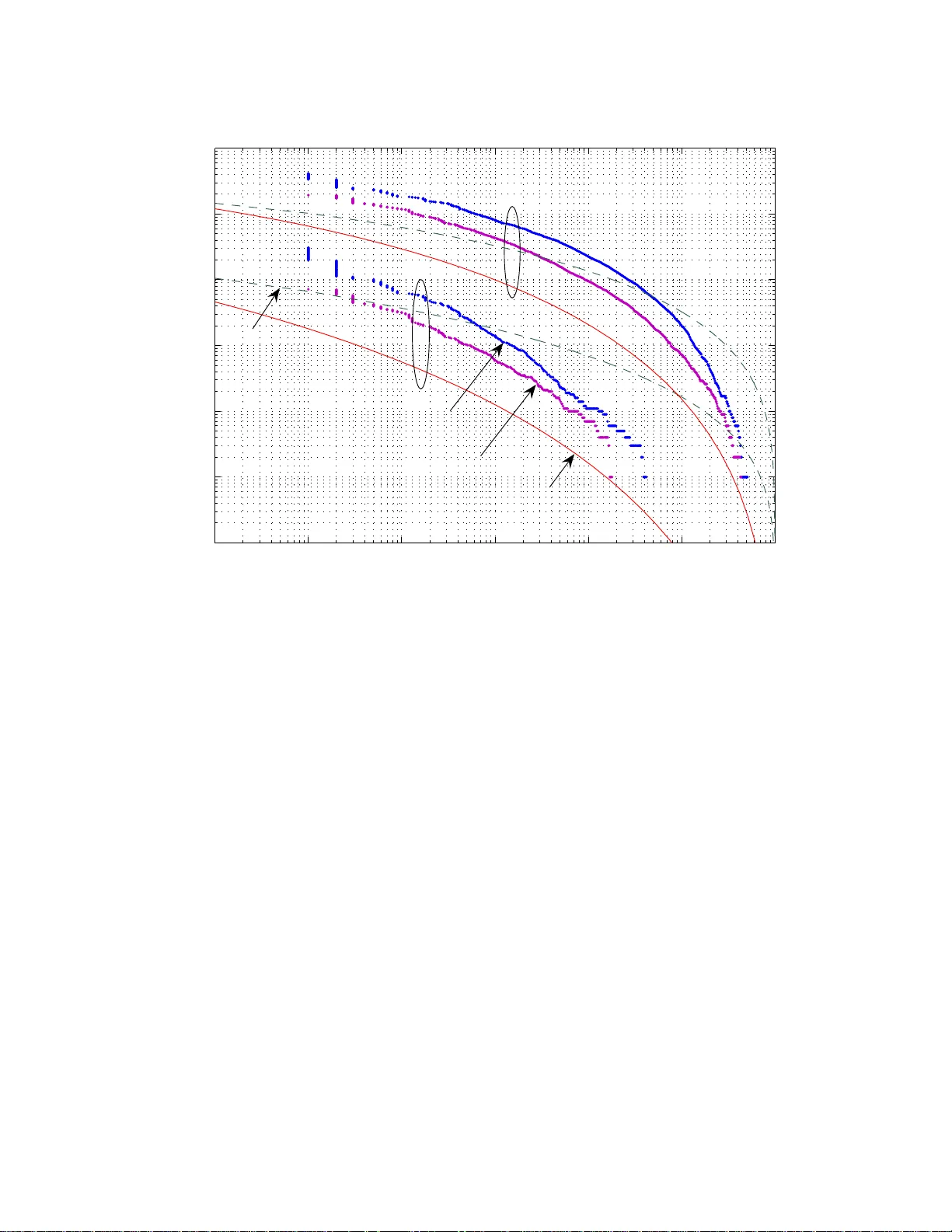
1 Spectrum Sensing in W ideband OFDM Cogniti v e Radios Chien-Hwa Hwang Shih-Chang Chen chhwang@ee .nthu.edu. tw iamcsc@rea ltek.com.t w Inst. of Commun. Engr ., Digital IC Design Dept. National Tsing Hua University , Realtek Semiconductor Corp., Hsinchu, T aiw an. Hsinchu, T aiw an. Abstract In this paper, detection of the pr imary user (PU) signal in an orthogo nal frequ ency division multi- plexing (OFDM) b ased cog nitive radio (CR) system is ad dressed. Accor ding to the pr ior knowledge of the PU signal known to the detector, three detection alg orithms based on the Neyman-Pearson philosop hy are pr oposed. In th e first ca se, a Ga ussian PU signal with com pletely known pro bability den sity fun ction (PDF) except for its received power is co nsidered. The f requency b and that the PU signal resides is also assumed kn own. Detection is p erform ed indi vidually at ea ch OFDM sub-carrier possibly in terfered by the PU signal, an d the r esults are the n combin ed to form a final decision . In the second case, the sub-car riers that the PU signal resides are kn own. Observations from all possibly inter fered sub-carriers are considered jointly to exploit th e fact that th e presence o f a PU signal interf erers all of them simultaneously . In th e last ca se, it is assum ed n o PU signal prior knowledge is av ailab le. Th e dete ction is inv olved with a search of the in terfered ban d. The pr oposed detecto r is ab le to d etect an ab rupt power change whe n tracing along the f requen cy ax is. 1 Chien-Hwa Hwang is the author for correspondence. October 27, 2018 DRAFT 2 I . I N T RO D U C T I O N Radio spectrum is the medium f or all types of wireless communications , such a s ce llular phone s, satellite-based services, wireless lo w-powered co nsumer devices, and so on. Since mos t o f the u sable spectrum has bee n allocated to existing services , the radio spec trum ha s bec ome a precious and sc arce resource, and there is an urgent c oncern about the av ailability of spec trum for future needs. Nonethe less, the alloca ted radio spec trum today is not efficiently utilized. According to a report of the United States Federal Communications Commission (FCC) [1], there are large temporal and geo graphic v ariations in the utilization o f alloca ted s pectrum ran ging from 15 % to 85%. Moreover , acco rding to Defense Advanced Research Projects Age ncy (D AR P A), in the United States, on ly 2% of the spectrum is in use at any moment. It is the n clea r that the solution to the spectrum s carcity problem is dyna mically looking for the spectrum ”white spaces ” and using them opportunistically . Cognitive radio (CR) technology , defi ned fi rst by J. Mitola [2], [3], is thus advocated by F CC as a c andidate for implemen ting opportunistic spectrum sharing. The spectrum manag ement rule of CR is that all new u sers for the spe ctrum are sec ondary (cogniti ve) users an d requiring that they mu st detec t and avoid the p rimary user . T o achieve the goal of CR, it is a fundame ntal requirement that the cognitiv e us er (CU) performs spectrum sensing to detect the presen ce o f the primary user (PU) signal. Digital signal processing techniques ca n be employed to promote the sensitivity of the PU s ignal sens ing. Three c ommonly ado pted methods are matched filtering, energy de tection [4]–[10], and PU s ignal feature detection with the cyclo- stationary fea ture most wide ly a dopted [11]–[14 ]. More over , cooperation a mong C Us in sp ectrum se nsing can not only reduce the detection time and thus increase the agility , but als o alleviate the problem that a CU fails to detect the PU signal becau se it is located a t a weak-sign al region [8]–[10], [15]–[20]. For overvie w of these approach es a nd their prop erties, see [21]–[23]. It is conc luded in [24] that orthog onal frequen cy d i vision multiplexing (OFDM) is the bes t physical layer ca ndidate for a CR system s ince it a llo ws e asy ge neration of sp ectral signa l wav eforms that can fit into d iscontinuous a nd a rbitrary-sized s pectrum s egments. Besides , OFDM is optimal from the v iewpoint of cap acity as it allows achieving the Shan non cha nnel c apacity in a fragme nted s pectrum. Owing to these reas ons, in this p aper , we con duct spectrum sen sing in an O FDM based CR system. In detec tion theory , the Neyman-Pea rson (NP) c riterion is used when there is difficulty in determining the prior probabiliti es and assigning cos ts [ 25] for hypotheses, which is the case in our PU sign al detection. The NP detec tor c ompares the likelihood ratio (LR) with a thresho ld determined by the con straint of false alarm proba bility to de cide wh ich hypothes is is true. However , in many cas es, some PU s ignal October 27, 2018 DRAFT 3 parameters, such as power level, correlation properties, frequency ba nd, and so on, ma y not be known. At this mome nt, the PU s ignal detection problem bec omes a compos ite hypo thesis testing, whic h requires performing estimation for tho se unkn own parame ters in the probability den sity function (PDF) of the observation for either hy pothesis. T hus, t he degree of detector co mplexity is directly r elated to the knowledge of the signal and no ise c haracteristics in terms of their PDFs. Moreover , since the estimation error is not negligible, the de tection pe rformance decreas es as we have less s pecific k nowledge of the signal and noise ch aracteristics. Acc ording to the prior knowledge abo ut the PU s ignal, three case s of PU sign al detection in a cognitive OFDM s ystem are co nsidered in this paper . In Case A, we assume the PU signal model is known a nd c onsider a Gaussian PU signal wi th completely known PDF except for its rece i ved power . The normalized, i.e. unity d iagonal eleme nts, covari ance matrix of the PU signal can b e de ri ved directly from the model assumed for it. As the rece i ved power as well as the normalized c ovari ance matrix of the PU signal are distinct at each OFDM sub-ca rrier , PU signa l detection in this ca se is executed individually at each su b-carrier , an d the res ults are the n combine d together to form a fi nal de cision. In Cas e B, ne ither the model of the PU s ignal n or its d istrib ution is known to the detector . The prior knowledge is the freque ncy band that the PU signal reside s. The ban d is ass umed to be a continuo us s egment of sub-ca rriers. T o inco rporate the fact tha t, once a PU sign al occurs, several sub-carriers in a row are interfered simultaneous ly , the de tector ma kes its decision by jointly co nsidering o bservations from all possibly interfered sub -carriers. In Case C, no prior knowledge of the PU signal is available. Thus, the detection is in volved with a sea rch of poss ibly interfered ba nd. The propo sed detector is able to d etect an ab rupt power c hange when tracing along su b-carriers. The organization of this pap er is summarized as follo ws. In Section II, the signa l mode l of a cognitiv e OFDM system interfered by a PU signal is d eri ved. Three cases concerning the PU signal p rior knowledge are also described. In Section III, the des igns of PU s ignal detectors a re carried out with PU signal prior information s tated in Section II. Simulation resu lts of the propose d dete ction algorithms are giv en in Section IV . Finally , we con clude this pa per in Se ction V . I I . P U S I G N A L D E T E C T I O N I N A C O G N I T I V E O F D M S Y S T E M Consider a wideband cog niti ve OFDM system with Q sub-carriers. The binary data stream generated from the source is en coded and interleaved, an d then su bdivided into groups of B bits used to gene rate blocks of Q symbo ls, whe re ea ch symbol ass umes on e of L p ossible values with B = Q log 2 L . It is assume d that (log 2 L ) -ary p hase sh ift keying (PSK) modulation is employed. W e denote the con stellation points co rresponding to the n -th block of Q symbo ls b y S ( n ) = { S 0 ( n ) , S 1 ( n ) , · · · , S Q − 1 ( n ) } . The n -th October 27, 2018 DRAFT 4 T ABLE I P R I O R KN OW L E D G E OF T H E P U S I G NA L Received P ower Signal Model Gaussian Distribution F r equency Band Case A No Y e s Y e s Y e s Case B No No Not necessarily Y e s Case C No No Not necessarily No OFDM sy mbol is gene rated by feeding S ( n ) into a Q -point in verse discrete Fourier transform (IDFT) and pre-app ending the output with cyclic prefix (CP). The resultant s ignal is up-conv erted to the ca rrier frequency , a nd then trans mitted over a wireless fading cha nnel. At the receiver , after the frequency down co n version and the CP removal, the output signal is passed through a Q -point discrete Fourier transform (DFT). In the presenc e of a PU sign al, the DFT o utput correspond ing to the n -th OFDM symbol is giv en by Y q ( n ) = H q ( n ) · S q ( n ) + I q ( n ) + W q ( n ) , 0 ≤ q ≤ Q − 1 , (1) where H q ( n ) is the frequency response o f the chan nel at s ub-carrier q experience d by the n -th OFDM symbol, and { I q ( n ) } an d { W q ( n ) } are the contributions resulting from the PU s ignal and ad diti ve white Gaussian nois e (A WGN), respectively . Suppose that a P U signa l occ upies the frequ ency band extending from the q 0 -th to the q 1 -th s ub-carriers of the OFDM sys tem. If the information of the PU signa l frequency b and, i.e. q 0 and q 1 , is kn own to the de tector , the detection algo rithm dec ides whe ther the s ignal { I q ( n ) } is prese nt in (1) b ased o n the observation { Y q ( n ) : 0 ≤ n ≤ N − 1 , q 0 ≤ q ≤ q 1 } , wh ere N is the o bservation length at ea ch sub - carrier , and, if any , the prior knowledge of the PU signal. When q 0 and q 1 are not known, the obs ervation { Y q ( n ) } ne eds to be extended to all sub-carriers 0 ≤ q ≤ Q − 1 . T ABL E I lists three c ases regarding the amo unt of prior knowledge abo ut the PU s ignal, includ ing the rec eiv ed power , the signal model, probability d istrib ution, and the frequency band it resides. In a ll three case s, the received p ower o f the PU signa l is u nknown. In Ca se A, it is as sumed the model of PU sign al is k nown. Exa mples that the PU sign al characte ristic is known to the detector ca n be foun d in, e.g. [22,2 6,11]. W e ass ume the sub-carrier indices [ q 0 , q 1 ] oc cupied by the PU signal are known, the stocha stic proce ss { I q ( n ) } obse rved at eac h s ub-carrier q 0 ≤ q ≤ q 1 is Gaussian , and the N × N normalized cov ariance matrices C q ’ s of the random signal { I q ( n ) } N − 1 n =0 at q 0 ≤ q ≤ q 1 can be ob tained October 27, 2018 DRAFT 5 from the PU signa l mod el. T he normalization factor to obtain C q is the PU signal rece i ved power a t that sub-carrier , and C q has diagona l c omponents equal to one . In Case B, the assu mptions o f kn own PU signal mo del and Gaussian distribution are removed. It will be clea r this c ase s erves as an intermediate stage for dev eloping the detector in Case C, wh ere no prior PU s ignal knowledge is av a ilable. I I I . D E S I G N O F P U S I G N A L D E T E C T O R A. Case A: Known P U Signa l Model, Pr obability Distribution, and F r eque ncy B and T wo PU signa l models, i.e. a sum of tonal signa ls a nd a n auto-regressive (AR) stocha stic process , are used as examples for the detection p roblem. The P U s ignal { I q ( n ) } N − 1 n =0 seen at the q -th OFDM sub-carrier has a c ovari ance matrix P I ( q ) C q , where P I ( q ) is the unknown received power of the PU signal at sub-carrier q , a nd C q is the n ormalized covariance matrix with unit diagon al elements. 1) T onal PU Signal: Here we mode l the PU sign al as the su m of a nu mber of complex s inusoids. Examples inc lude the worldwide interoperability for micro wa ve acc ess (W iMAX) and wireless loca l area network (WLAN) sy stems, which also employ OFDM technolog ies. W ith this mode l, the rec eiv ed PU signal is i ( t ) = P ∞ l = −∞ i l ( t − l T i ) 1 , where T i is the symbo l duration, and i l ( t ) is the signal c ontaining the l -th s ymbol. W e h av e i l ( t ) = K − 1 X k =0 ℜ{ d l,k ( t ) e j (2 πf i t + φ ) } , 0 ≤ t ≤ T i , (2) where K , f i and φ are the n umber o f c omplex sinus oids, the carrier frequency , and the ran dom carrier phase, resp ectiv ely , ℜ{·} de notes the real p art, and d l,k ( t ) is the comp lex base band s ignal of the k -th sinusoid. W e have d l,k ( t ) = ζ l,k · X l,k e j 2 πk t/T i , 0 ≤ t ≤ T i , where X l,k is the PS K modulated d ata of the k -th sinus oid at the l -th symbol, and ζ l,k is the chan nel fading c oefficient of the k -th sub-ca rrier when sy mbol l of the PU signal is received. W e ass ume, for each particular l , random variables ζ l,k , k = 0 , 1 , · · · , K − 1 , are identically d istrib uted. Let η = ⌊ T i /T s ⌋ , wh ere T s is the s ymbol duration of the co gniti ve OFDM, ⌊ x ⌋ is the lar g est integer no greater tha n x , an d β k ,q = [( f i − f s + k/T i ) T s − q ] /Q . It is shown in Append ix I-A that, the ( n, m ) -th 1 Here i ( t ) i s the time-domain PU signal, whereas { I q ( n ) } giv en in ( 1) is a frequenc y-domain signal. October 27, 2018 DRAFT 6 element of the normalized c ovari ance ma trix C q ( n, m ) of { I q ( n ) } N − 1 n =0 is given by C q ( n, m ) = 1 − | n − m | η K − 1 X k =0 e j 2 π ( n − m ) T s ( f i + k /T i ) sin 2 ( π β k ,q Q ) sin 2 ( π β k ,q ) K − 1 X k =0 sin 2 ( π β k ,q Q ) sin 2 ( π β k ,q ) , | n − m | ≤ η − 1 , 0 , otherwise . (3) 2) AR PU Signal: W e c onsider the time-domain disc rete-time PU signal { i p } at the output of the sampler following the frequency down-con verter . Suppo se tha t { i p } can be modeled as an r -th order AR random proce ss of i p = − r X j =1 φ j i p − j + e p , (4) where { e p } is a white Gaus sian random sequenc e with v ariance ν 2 , a nd p arameters { φ j } r j =1 are obta ined when { i p } has u nit power . The c ontrib ution of the PU signa l at the q -th DFT output for N OFDM symbols is I q = [ I q (0) , I q (1) , · · · , I q ( N − 1)] T , given by I q = F q i , (5) where F q = diag { f q , f q , · · · , f q | {z } N times } with f q = [ e − j 2 πq · 0 /Q e − j 2 πq · 1 /Q · · · e − j 2 πq ( Q − 1) /Q ] , and i = [ i 0 , i 1 , · · · , i QN − 1 ] T . It is readily s een that I q forms a Gaussian random proc ess as { e p } is mod eled to be Gaussian . In Append ix I-B, we show how the normalize d cov ariance ma trix C q of I q giv en in (5) can be compu ted. It is seen that, for the two PU signal mode ls presented ab ove, the normalize d covariance matrix C q at each sub -carrier q ∈ [ q 0 , q 1 ] are d istinct. Moreover , the PU s ignal at various sub-carriers have different receiv ed powers. It will be shown later , cf. (12 ), these unknown received powers nee d to be estimated. Thus, we c onduct the PU signal detection individually a t each sub -carrier , an d the final dec ision is made by combining the individual de cisions at su b-carriers. If a joint d etection o f all sub-carriers is performed, it is r equired to estimate all unk nown PU s ignal powers jointly . T o de sign a detector ba sed on the Neyman-Pearson philosop hy , the detection threshold γ q at s ub-carrier q is determined by a given overall (i.e., comb ined from a ll su b-carriers) false alarm probab ility P F A = α such that the overall de tection probability P D is maximized. Let the decisions made at individual sub-carriers be co mbined b y an OR operation, i.e., the detector decide s H 1 if any o f the su b-carriers dec lares an PU sign al is presen t. For both P F A and P D , we have P S = 1 − Y q ∈ [ q 0 ,q 1 ] (1 − P S ( q )) , S ∈ { F A,D } , (6) October 27, 2018 DRAFT 7 where P S ( q ) is the detection or false alarm proba bility a t sub-carrier q . Letting P F A ( q ) e qual for all q ’ s, we obtain the false alarm constraint at ea ch sub-carrier as P F A ( q ) = 1 − (1 − α ) 1 /B PU , (7) where we define the ba ndwidth of the PU signa l as B PU = q 1 − q 0 + 1 . Suppose that the d etection is performed when the cognitiv e OFDM system is not transmitting signals. The hyp othesis testing at the q -th s ub-carrier is H 0 : Y q ( n ) = W q ( n ) , H 1 : Y q ( n ) = I q ( n ) + W q ( n ) , n = 0 , 1 · · · , N − 1 , (8) where { W q ( n ) } is complex wh ite Gau ssian noise independe nt o f { I q ( n ) } with distrib ution C N ( 0 , σ 2 W I ) , and H 0 and H 1 represent that the PU signal is of f an d on, respectively . The PU signal { I q ( n ) } N − 1 n =0 is giv en in (39) and (5), res pectiv ely , when it is modeled as a su m of tona l signals and a n AR ran dom proc ess. Due to the abse nce of the OFDM signal, { Y q ( n ) } is a Gauss ian random proces s in either hypothesis. Since the detection a lgorithm proposed for this cas e is done individually at sub-carriers, we omit q in P I ( q ) for notational simplicity . T he likelihood ratio associated with (8) is L ( Y q ) = p ( Y q ; P I , H 1 ) p ( Y q ; H 0 ) , (9) where Y q = [ Y q (0) , Y q (1) , · · · , Y q ( N − 1)] T , p ( Y q ; P I , H 1 ) is the probability de nsity func tion (PDF) of Y q under H 1 giv en as p ( Y q ; P I , H 1 ) = 1 π N det( P I C q + σ 2 W I ) exp − Y † q ( P I C q + σ 2 W I ) − 1 Y q , (10 ) and p ( Y q ; H 0 ) is the P DF unde r H 0 obtained by se tting P I in (10) to zero. Using matrix in version lemma, we hav e the test s tatistic ln L ( Y q ) expresse d by ln L ( Y q ) = σ − 2 W P I Y † q C q ( P I C q + σ 2 W I ) − 1 Y q − ln d et P I C q + σ 2 W I + ln σ 2 N W . (11) It is se en that the unknown P I in ( P I C q + σ 2 W I ) − 1 cannot be decou pled from the observation Y q . Thus , uniformly mos t p owerf ul (UMP) test d oes not exist. Co nseque ntly , a gene ralized likelihood ratio test (GLR T) is employed, where P I in (11) is replaced with its maximum likelihood (ML) estimate ˆ P I . Let C q be eigen -decompos ed as C q = V q Λ q V † q , whe re V q = [ v q , 0 v q , 1 · · · v q ,N − 1 ] and Λ q = diag( λ q , 0 , λ q , 1 , · · · , λ q ,N − 1 ) . Henc e, det( P I C q + σ 2 W I ) = N − 1 Y i =0 ( P I λ q ,i + σ 2 W ) and ( P I C q + σ 2 W I ) − 1 = V q ( P I Λ q + σ 2 W I ) − 1 V † q October 27, 2018 DRAFT 8 The ML estimate of P I is o btained by s ubstituting the above two relations into p ( Y q ; P I , H 1 ) and finding it max imum. Moreover , w e sh ould also note that P I is non -negati ve. Thus, we hav e ˆ P I = max 0 , arg min P N − 1 X i =0 ln( P λ q ,i + σ 2 W ) + | v † q ,i Y q | 2 P λ q ,i + σ 2 W !! . (12) The general solution of the o ptimization problem in (12) is un known, a nd numerical methods are normally required. Even if we ca n so lve (12), the statistic distribution o f the d etector in (11) is intractable, which yields threshold dete rmination of the detector very dif ficult. On the o ther ha nd, und er H 0 , the ran dom variable governing the statistics of ˆ P I is zero half of the time and Gaussian for the other half 2 . T his is in contrast to the usual Gauss ian asymp totic statistics of an ML estimate. Th us, the asymptotic ch i-squared distrib ution of GLR T when N → ∞ does not ho ld for (11) [28]. Due to the difficulties encountered by GLR T stated in the previous parag raph, w e resort to a locally most powerful (LMP) detector [29,30]. W e rewrite (8) a s Y q ∼ C N ( 0 , P I C q + σ 2 W I ) with H 0 : P I = 0 versus H 1 : P I > 0 . The LMP detector , g i ven by ∂ ln p ( Y q ; P I ) ∂ P I P I =0 = − σ − 2 W tr( C q ) + σ − 4 W Y † q C q Y q , (13) is optimal when P I is sma ll. Thus, the detector is T A ( Y q ) = Y † q C q Y q H 1 ≷ H 0 γ q (14) as the rema ining part of (13) can b e abso rbed into the thresh old, where the subscript of T A ( · ) indicates it is for Case A. It is seen that LMP has an advantage tha t no e stimate for P I is ne eded. Moreover , it is almost optimal in the low signal-to-noise ratio (SNR) region for which signa l d etection is inherently a difficult problem. For large d eparture of P I from 0, there is no gua rantee of LMP’ s optimality , an d a GLR T would pe rform better . Howev er , d ue to the large SNR, the LMP detector can g enerally satisfy the sy stem requ irement with the advantage of lower complexity . An interes ting interpretation of LMP detectors as cov ariance sequen ce correlators can be fou nd in [30 , pp. 80]. 2 It is known that, if the probability density function p ( x ; θ ) of the observation x satisfies some ”regularity” conditions, then the ML estimate of an unkno wn parameter θ is unbiased and asymptotically Gaussian (see e.g. [27, Theorem 7.1]). Thus, w hen N is large, the ML estimate in the second argument of max( · , · ) in (12), denoted by ˜ P I , is Gaussian. Since P I = 0 under H 0 , ˜ P I has zero mean and is larger and smaller than 0 with equal probabilities. It follows that, when N is large, ˆ P I is zero half of the time and Gaussian for the other half. October 27, 2018 DRAFT 9 Denote by T A ( Y q ) | H i the shorthand for T A ( Y q ) under H i . Let W q = [ W q (0) , W q (1) , · · · , W q ( N − 1)] T . Unde r H 0 , eleme nts of Y q = W q are inde penden t, and T A ( Y q ) | H 0 = W † q C q W q = N − 1 X i =0 λ q ,i | v † q ,i W q | 2 is a weighted sum of indep endent chi-squa red random variables. No ge neral close d form is known for its distribution [30, pp . 74–75]. Th us, we loo k for its asymptotic distributi on. W e have ∂ ln p ( Y q ; P I ) ∂ P I P I =0 = N − 1 X n =0 ∂ ln p ( Y q ( n ); P I ) ∂ P I P I =0 , under H 0 , (15) which by c entral limit the orem be comes Gaussian. Thu s, T A ( Y q ) | H 0 a ∼ N σ 2 W N , σ 4 W tr( C 2 q ) , (16) where ∼ a indicates the sense of as ymptote, and the formula of E { x † Axx † Bx } = tr( A C ) tr ( BC ) + tr( A CBC ) (17) for x ∼ C N ( 0 , C ) and He rmitian matrices A a nd B [31] is employed. Und er H 1 , due to the P U signa l, elements of Y q may not be independen t. This makes the distribution of T A ( Y q ) | H 1 dif ficult to a nalyze. In Appen dix II, the asy mptotic d istrib ution of T A ( Y q ) | H 1 is examined using the ce ntral limit theorem of an m -depe ndent seque nce. T o determine the thres hold γ q in (14), we repres ent the cumulative d istrib ution function (CDF) of T A ( Y q ) | H 0 as CDF ( x ) . By (7), γ q is given by γ q = CDF − 1 ((1 − α ) 1 /B PU ) , with an overall false alarm probability α . If N is lar ge enough such that the asymp totic distrib ution (16 ) holds, γ q can be further written as γ q = σ 2 W N + σ 2 W q tr( C 2 q ) · Q − 1 (1 − (1 − α ) 1 /B PU ) , where Q ( x ) is the Ga ussian right-tail proba bility . On the other hand, if the as ymptotic distrib ution of T A ( Y q ) | H 0 is not vali d, histograms of T A ( Y q ) | H 0 can be obtained by s imulations to g et an e stimate of CDF ( x ) . W e can simply produce the histogram with σ 2 W = 1 . For any particular σ 2 W , the corresp onding histogram can be easily map ped from tha t of σ 2 W = 1 . October 27, 2018 DRAFT 10 PU sig na l detec tio n Channe l est imatio n Pay load t = 0 Fig. 1. The signalling of the cognitiv e OFDM system for the detection algorithm de veloped in Case B. B. Case B: Known PU Signal F requency Band In this ca se, we employ the fact that the PU signal, if pres ent, a ppears simultaneous ly at the sub- carriers from q 0 to q 1 . The algorithm developed for this case works for PU signal with the ban dwidth B PU = q 1 − q 0 + 1 ≥ 2 . When B PU = 1 , the PU signal ca n be detected by first estimating its rec ei ved power a nd then e mploying an ene r gy detec tor [4]–[10]. Unlike in Cas e A that the detection is pe rformed when the c ognitiv e OFDM is not trans mitting signals, the detection method presented for Ca se B can work when the CU signal is pre sent. The OFDM system signalling for the de tection algo rithm in Case B is illustrated in Fig. 1. Before initiating ( t = 0 ), the system performs a PU s ignal test a t the suspe ct sub-ca rriers. If the PU signal is presen t, the cogn iti ve system does no t se nd a ny s ignal over these sub-ca rriers. On the c ontrary , if the PU signal is a bsent, channe l e stimation of the c ogniti ve system is ca rried out, and the pa yloads are then transmitted over them. If ne cessa ry , during payload transmiss ion, PU signal testing may be execu ted periodically to e nsure a qu ick respons e to the app earance of the primary ne twork. As shown in Fig. 1, PU signal de tection, channe l estimation and payload transmission are repe ated over and over ag ain (add ing PU signal test during payload transmiss ion, if nece ssary) u ntil the pres ence of PU s ignal is detected . On ce PU signa l is detected e ither a t the sys tem initialization or in the middle o f a normal ope ration, the OFDM system s tops transmitting signals over sub-carriers q ∈ [ q 0 , q 1 ] . That is, c hannel estimation an d payload transmission are susp ended, while the P U signa l detection is still performed pe riodically . The f ollowing situation may a rise when PU signal monitoring is d one c oncurrently wi th the transmiss ion of the cognitiv e system. When a missed d etection o ccurs, the c hannel estimation will be executed under the presenc e o f the PU signal, res ulting in a p oor e stimation acc uracy . The se ina ccurate chann el es timates are su bseque ntly ad opted in the next PU sign al detec tion (see (19)–(21) below), wh ich is expected to deteriorate the d etection performance . T o esc ape from the v icious cyc le, it is required that PU signal detection is carried o ut in the absen ce of the CU sign al. This c an be done by enforcing a ”silent period” October 27, 2018 DRAFT 11 ev ery a giv en time interv al, during wh ich the CU sh ould susp end the transmiss ion. Although the ins ertion of silent p eriods e nables the CU to es cape from the vicious cycle, a side effect occurs that the efficiency of CU is reduced. A discuss ion of how often a nd for how long the cogn iti ve system shou ld remain silent in a giv en trans mission interval is a n important res earch topic, e.g. [32]–[35]. A trade-off sh ould be made between two oppos ing issu es of efficiency and integrity of s ensing results to produ ce a des irable balance defined by a suitable objectiv e function. For example , in [35], an MA C-layer sensing pe riod adaptation algorithm is designed to ma ximize the disc overy of s pectrum opportunities. As described in the previous parag raph, PU signal detection ma y b e executed when the cognitiv e OFDM is either o n or off. The receiv ed signal at the q -th sub-ca rrier Y q ( n ) is giv en by (1) with H q ( n ) and S q ( n ) set to z ero when the OFDM s ystem is not transmitting. For q 0 ≤ q ≤ q 1 , we build a n observation Z ( q ) from { Y q ( n ) } N − 1 n =0 such that the PU s ignal detection is based on the obse rvati on along the freque ncy doma in, i.e. Z = [ Z ( q 0 ) , Z ( q 0 + 1) , · · · , Z ( q 1 )] T . W e choose Z ( q ) = 1 N Y † q Y q , q 0 ≤ q ≤ q 1 , (18) becaus e Z ( q ) is the periodogram o f the received s ignal a t the q -th sub-ca rrier averaged over N OFDM symbols. It is well known that the pe riodogram is an estimate of the true spectrum of a signal. An other interpretation o f (18) is that the normalized cov ariance ma trix C q in the LMP dete ctor of (14) is replaced with the identity matrix due to the un av a ilability of it. That is, eleme nts of Y q are re garded as uncorrelated. Expanding (18), we obtain Z ( q ) = 1 N N − 1 X n =0 | H q ( n ) | 2 + | I q ( n ) | 2 + | W q ( n ) | 2 + 2 ℜ{ H q ( n ) S q ( n ) I ∗ q ( n ) } + 2 ℜ{ H q ( n ) S q ( n ) W ∗ q ( n ) } + 2 ℜ{ I q ( n ) W ∗ q ( n ) } . (19) Depending on w hether the OFDM sy stem is transmitting or not, H q ( n ) is either known from chann el estimation or equal to ze ro. W e define m ( q ) := 1 N N − 1 X n =0 | ˆ H q ( n ) | 2 + ˆ σ 2 W , (20) where ˆ H q ( n ) and ˆ σ 2 W are the estimates of H q ( n ) and σ 2 W , resp ectiv ely . A new obse rv ation is built as Z ( q ) = Z ( q ) − m ( q ) , q 0 ≤ q ≤ q 1 , (21) which corresp onds to subtracting the first a nd third terms inside the brackets of (19). Let Z = [ Z ( q 0 ) , Z ( q 0 + 1) , · · · , Z ( q 1 )] T be the observation o f the spectrum sen sing problem. It is seen that eac h c omponen t of Z is in volved with a numbe r of c ontrib utions from the PU sign al, CU signal, October 27, 2018 DRAFT 12 A WGN, e stimation errors o f H q ( n ) and σ 2 W , and so on. Thus , it is ha rd to make a precise statistical description for Z , lead ing to the difficulty in formulating the corresp onding hypothesis tes t. T o alleviate the problem, he re we adopt the model in vestigated in [36], where there exists a n interfering signa l lying in an arbitrary unkn own subs pace of the obse rvati on space . Specifically , when the PU signa l is prese nt, the ob servation vector Z is formulated as Z = I + R + N , (22) = H µ µ µ + U ψ ψ ψ + σ 2 N , (23) where I = 1 N " N − 1 X n =0 | I q 0 ( n ) | 2 , N − 1 X n =0 | I q 0 +1 ( n ) | 2 , · · · , N − 1 X n =0 | I q 1 ( n ) | 2 # T (24) is the contributi on of the PU signal, R is the co mponent due to an unkn own interference, a nd N is the white n oise. The PU signal I res ides in an ( r + 1) -dimension al s ubspa ce s panned b y the columns of the known B PU × ( r + 1) matrix H , given a s H = [ h 0 , h 1 , · · · , h r ] = h 0 (0) h 1 (0) · · · h r (0) h 0 (1) h 1 (1) · · · h r (1) . . . . . . . . . . . . h 0 ( q 1 − q 0 ) h 1 ( q 1 − q 0 ) · · · h r ( q 1 − q 0 ) , (25) and has an u nknown gain vector µ µ µ . That is, the powers o f the PU signal a cross su b-carriers q ∈ [ q 0 , q 1 ] is mo deled as a linear co mbination of vectors { h i : 0 ≤ i ≤ r } . The white noise N is a B PU -dimensional Gaussian rand om vector mod eled as σ 2 N , whe re the sca lar σ 2 is unk nown, an d the covariance ma trix of N is the identity matrix. Finally , the vec tor R = U ψ ψ ψ acc ounts for the e f fects that are ignored by I and N in (22 ); both the ma trix U , whose column s cons titute the s ubspac e of R , a nd the gain vector ψ ψ ψ are unknown. It is argued in [36] that we require to robustly choo se the unknown matrix U in the formulation o f a hypothes is test such that an ade quate level of protection to false alarm as well as a sufficient detec tion sensitivity to the s ignal are both maintained . Let G be a B PU × ( B PU − r − 1) matrix who se columns span the orthogo nal complemen t of the sp ace generate d by H , i.e. G = H ⊥ . A minimax-base d reas oning in [36, Append ix A] lead s to explicit an d dif ferent choice s for the un known subsp ace U in the two hypothes es. That is, U = G for H 0 , and U is the zero matrix for H 1 . Thu s, the hyp othesis test is H 0 : Z = G ψ ψ ψ + σ 2 0 N , H 1 : Z = H µ µ µ + σ 2 1 N , H µ µ µ < 0 , (26) October 27, 2018 DRAFT 13 where H µ µ µ < 0 means that all elements in H µ µ µ are non -negati ve, and ψ ψ ψ , µ µ µ , σ 2 0 and σ 2 1 are a ll unk nown. T o perform PU signal d etection, GLR T of L G ( Z ) = p ( Z ; ˆ µ µ µ, ˆ σ 2 1 , H 1 ) p ( Z ; ˆ ψ ψ ψ , ˆ σ 2 0 , H 0 ) (27) is employed, where ˆ µ µ µ , ˆ ψ ψ ψ , and ˆ σ 2 i are ML estimates of µ µ µ , ψ ψ ψ and σ 2 i , respec ti vely . Althou gh, when H 1 is true, µ µ µ and σ 2 1 are both parameterized by the PU signa l; howev er , joint estimate of these two unknowns results in a complex detector structure. Thus , in spite o f their depen dence, µ µ µ and σ 2 1 are e stimated separately . The specifica tion o f the PU signal subs pace H is o nly an approx imation, and the pe rformance of the d etector depends on wh ether the linear s ubspac e span ned by { h i } gives good d escription of the signal class. In the cas e where the co rrelation ma trix of the PU s ignal is known, H could be selec ted as orthogonal eige n vectors o f the co rrelation matrix, and the subsp ace dimension r + 1 can be chose n based on some information measure s [37], e.g . the Akaike information criterion (AIC) [38] an d the minimum description length (MDL) [39]. When the co rrelation ma trix o f the PU sign al is un known, the above information me asures a nd their variations, e.g. [40], ca n as sess the discrep ancy between the true and approximating models, which serve as us eful tools in solving the model selec tion problem. W e suppos e that the se t of vectors { h i } us ed to mode l the PU s ignal chan nel selectivit y is suitably cho sen. Consequ ently , H µ µ µ < 0 h olds most of the time, a nd the one-sided tes t of H µ µ µ in (26) d oes not bring muc h trouble. It is shown in [36] that the likelihood ratio in (27) for the robust hyp othesis test leads to the matched subspa ce fi lter , given by T B ( Z ) = B PU − r − 1 r + 1 Z T H ( H T H ) − 1 H T Z Z T ( I − H ( H T H ) − 1 H T ) Z . (28) It is known that, for the test in (26), whe n G is set a s the zero matrix, GLR T yields the matched subspa ce filter [41]. Equation (28 ) de monstrates, even in the pres ence o f un known G ψ ψ ψ , the match ed subspa ce d etector is o ptimal, mean ing that it is robust to the interferenc e whose su bspace is unkn own. Under H 0 , the detector is distributed as T B ( Z ) ∼ F r +1 ,B PU − r − 1 , where F a,b denotes a n F distribution with a numerator d egrees o f freedom and b denominator degrees of freedom. Given thresho ld γ , the false alarm proba bility is given by P F A = Q F r +1 ,B PU − r − 1 ( γ ) with Q F a,b ( x ) the right-tail p robability of F a,b ev a luated at x . If { h i } is a ble to mo del the PU signa l I October 27, 2018 DRAFT 14 well, we have T B ( Z ) ∼ F ′ r +1 ,B PU − r − 1 ( λ ) un der H 1 , whe re λ = 1 σ 2 1 q 1 X q = q 0 N − 1 X n =0 | I q ( n ) | 2 , (29) and F ′ a,b ( λ ) de notes a no ncentral F distrib ution with a numerator degrees of freedom, b denomina tor degrees o f freed om and n on-centrality parameter λ . Thus, the detection probability with threshold γ is P D = Q F ′ r +1 ,B PU − r − 1 ( λ ) ( γ ) , where Q F ′ a,b ( λ ) ( x ) is the right-tail probability of F ′ a,b ( λ ) ev aluated at x . C. Case C: No Prior Knowledge of PU Signa l In this c ase, the information o f possibly interfered frequency band is u nknown. Co nseque ntly , the detection a lgorithm sh ould be inv olved with a search of the interfered band. Intuiti vely , giv en the observation Z 0: Q − 1 = [ Z (0) , Z (1) , · · · , Z ( Q − 1)] T , this search is bas ed on the powers at all sub- carriers, and, if the cognitive OFDM system is transmitting signals , a s ub-carrier with larger freque ncy response magnitude | H q ( n ) | tends to be judged as the PU signal is present. T o av oid this problem, the search of interfered band is executed when the cogn iti ve system is not transmitting signals. The hyp othesis testing ass ociated with Cas e C is a detection of abrupt chang es [42], given as H 0 : Z ( q ) ∼ U 0 ( q ) , q ∈ [0 , Q − 1] , H 1 : Z ( q ) ∼ U 0 ( q ) , q ∈ [0 , q 0 − 1] S [ q 1 + 1 , Q − 1] , U 1 ( q ) , q ∈ [ q 0 , q 1 ] , (30) where { U 0 ( q ) } q are white Gaussian with variance σ 2 0 , and { U 1 ( q ) } q 1 q = q 0 are indepe ndent Gaussian with the mea n vec tor modeled by { h i } a nd variance σ 2 1 . All o f q 0 , q 1 , σ 2 0 , σ 2 1 and the we ighting factors of { h i } are unknown. W e c an obtain tha t the GLR T c orresponding to (30) is max a 0 ,a 1 ( ˆ σ 2 0 |H 0 ) Q/ 2 ( ˆ σ 2 0 |H 1 ) ( Q − a 1 + a 0 − 1) / 2 ( ˆ σ 2 1 |H 1 ) ( a 1 − a 0 +1) / 2 (31) where ˆ σ 2 0 |H 0 := Q − 1 Z T 0: Q − 1 Z 0: Q − 1 , ˆ σ 2 0 |H 1 := ( Q − a 1 + a 0 − 1) − 1 ( Z T 0: a 0 − 1 Z 0: a 0 − 1 + Z T a 1 +1: Q − 1 Z a 1 +1: Q − 1 ) , and ˆ σ 2 1 |H 1 := ( a 1 − a 0 + 1) − 1 Z T a 0 : a 1 ( I − H a 0 : a 1 ( H T a 0 : a 1 H a 0 : a 1 ) − 1 H T a 0 : a 1 ) Z a 0 : a 1 , denote e stimate of σ 2 0 under H 0 , estimate of σ 2 0 under H 1 , an d es timate of σ 2 1 under H 1 , resp ectiv ely , and H a 0 : a 1 is given in (25) with q 0 and q 1 replaced by a 0 and a 1 , respectively . Defining f ( a 0 , a 1 ) as the October 27, 2018 DRAFT 15 tar get to b e maximized in (31), we consider the false alarm probability for the d etector with threshold γ , i.e., P F A = Prob max a 0 ,a 1 f ( a 0 , a 1 ) > γ ; H 0 , = 1 − P rob { f ( a 0 , a 1 ) < γ , ∀ [ a 0 , a 1 ] ⊂ [0 , Q − 1]; H 0 } . Since the random variables g overning f ( a 0 , a 1 ) for dif ferent choices of a 0 and a 1 are no t nece ssarily independ ent, the determination of P F A and hence the detector threshold for a g i ven P F A = α b ecomes intractable. T o conqu er this problem, the PU signal detec tion is dec ompose d into two s teps. In the first step, we search for PU signa l’ s frequency band b y Z 0: Q − 1 to get estimates ˆ q 0 and ˆ q 1 . In the sec ond step, we assume ˆ q 0 and ˆ q 1 obtained in the first step are correct, and we can conse quently perform PU sign al detection in the same way as that propo sed for Case B, whe re PU signa l frequency band is known. In specific, the first s tep solves the optimization problem of (31). As the numera tor is not a fun ction of a 0 and a 1 , the optimization is e quiv alen t to minimizing the denominator , i.e. ( ˆ q 0 , ˆ q 1 ) = arg min ( a 0 ,a 1 ) ( ˆ σ 2 0 |H 1 ) ( Q − a 1 + a 0 − 1) / 2 ( ˆ σ 2 1 |H 1 ) ( a 1 − a 0 +1) / 2 . (32) Howe ver , this prob lem is complex b ecaus e there are abo ut Q 2 / 2 possible trials for combina tions of a 0 and a 1 . T o reduce the computational load, we can s implify the o ptimization in (32 ) to one that minimizes the least squa re (LS) error b etween the o bservations Z ( q ) ’ s and the es timated PU s ignal power , i.e., ( ˆ q 0 , ˆ q 1 ) = arg min ( a 0 ,a 1 ) X q ∈ [0 ,Q − 1] \ [ a 0 ,a 1 ] Z ( q ) 2 + X q ∈ [ a 0 ,a 1 ] Z ( q ) − r X i =0 ˆ µ i h i ( q − a 0 ) ! 2 . (33) Equation (33) is interpreted as follows. Analogo usly to the d iscussion in Case B, the vector Z q 0 : q 1 = [ Z ( q 0 ) , Z ( q 0 + 1) , · · · , Z ( q 1 )] T contains a sign al lying in the ( r + 1) -dimensiona l vector sp ace span ned by c olumns of H q 0 : q 1 and having an unknown gain vector µ µ µ . Con sider the s econd term of the target function at the right-hand-side o f (33). Supposing the PU s ignal resides at sub-carriers q ∈ [ a 0 , a 1 ] , we find the LS estimate of the gain vector ˆ µ µ µ = [ ˆ µ 0 , ˆ µ 1 , · · · , ˆ µ r ] T , i.e. ˆ µ µ µ = ( H T a 0 : a 1 H a 0 : a 1 ) − 1 H T a 0 : a 1 Z a 0 : a 1 , and c ompute the LS error between Z a 0 : a 1 and H a 0 : a 1 ˆ µ µ µ . On the other hand, in the first term of the target function, only the sum o f Z ( q ) 2 is taken into ac count since s ub-carriers q ∈ [0 , Q − 1] \ [ a 0 , a 1 ] are free from the PU signal. T o compa re the ML e stimates of q 0 and q 1 and the subop timal one s, the target function of (33) is October 27, 2018 DRAFT 16 written as the vector form Z T 0: a 0 − 1 Z 0: a 0 − 1 + Z T a 1 +1: Q − 1 Z a 1 +1: Q − 1 + Z T a 0 : a 1 ( I − H a 0 : a 1 ( H T a 0 : a 1 H a 0 : a 1 ) − 1 H T a 0 : a 1 ) Z a 0 : a 1 (34) to f acilitate examining its relation to the target func tion of (32), whe re the third term of (34) is the L S error yielded b y the second term in the target function of (33). The solution of (33) can be found by the technique of dyn amic programming (DP) [43,44] as follows. Define δ 0 ( a, b ) := X q ∈ [ a,b ] Z ( q ) 2 and δ 1 ( a, b ) := X q ∈ [ a,b ] Z ( q ) − r X i =0 ˆ µ i h i ( q − a ) ! 2 , where { ˆ µ i } r i =0 is the LS estimate that minimizes δ 1 ( a, b ) . Let e ( l ) = min 0 ≤ a 0 ≤ l − r δ 0 (0 , a 0 − 1) + δ 1 ( a 0 , l ) , r ≤ l ≤ Q − 1 , (35) where the con straint a 0 ≤ l − r gua rantees existenc e of ˆ µ i ’ s in δ 1 ( a 0 , l ) . T he o ptimization in (33) is equiv a lent to min ( a 0 ,a 1 ) δ 0 (0 , a 0 − 1) + δ 1 ( a 0 , a 1 ) + δ 0 ( a 1 + 1 , Q − 1) = min a 1 min a 0 δ 0 (0 , a 0 − 1) + δ 1 ( a 0 , a 1 ) + δ 0 ( a 1 + 1 , Q − 1) = min r ≤ a 1 ≤ Q − 1 e ( a 1 ) + δ 0 ( a 1 + 1 , Q − 1) . (36) Thus, ˆ q 1 can be found by search ing for a 1 that minimizes (36), and ˆ q 0 is equa l to the value o f the argument a 0 in (35) that minimizes e ( ˆ q 1 ) . Note that, the comp utation of δ 1 ( a 0 , l ) ’ s in so lving (35) can be done recursively by s equential LS formulas [27, pp. 242–251], and the DP can reduce the complexity of sea rch from the o rder of Q 2 to the order of Q . Suppose that DP yields c orrect v alues of q 0 and q 1 . W e then employ the detector propose d for Cas e B to decide whether a PU signa l is prese nt in the estimated frequency band. The performance an alysis of the detector is execute d as follows. The false alarm probability P F A of the detector in Ca se C is X [ a 0 ,a 1 ] ⊂ [0 ,Q − 1] Prob { ˆ q 0 = a 0 , ˆ q 1 = a 1 ; H 0 } · Prob { T B ( Z a 0 : a 1 ) > γ a 0 ,a 1 ; H 0 } , (37) where the first p robability is the one that DP yields the result of ( ˆ q 0 , ˆ q 1 ) = ( a 0 , a 1 ) unde r H 0 , and T B ( · ) is given in (28) with B PU and H there replaced by a 1 − a 0 + 1 and H a 0 : a 1 , respe cti vely . W e can not determine the first probability in (37). Howev er , for e ach DP se arching result ( ˆ q 0 , ˆ q 1 ) = ( a 0 , a 1 ) , we can choose a threshold γ a 0 ,a 1 for T B ( Z a 0 : a 1 ) s uch that the se cond probability in (37) is a co nstant. In this case, the false alarm probab ility P F A becomes P F A = Prob { T B ( Z a 0 : a 1 ) > γ a 0 ,a 1 ; H 0 } . October 27, 2018 DRAFT 17 Gi ven a con straint of P F A = α , we choos e γ a 0 ,a 1 = Q − 1 F r +1 ,a 1 − a 0 − r ( α ) , [ a 0 , a 1 ] ⊂ [0 , Q − 1] . Detection occurs wh en, under H 1 , DP returns a c orrect result an d the d ecision s tatistic is greater than the threshold. Le t p denote the proba bility that the frequen cy band s earch returns a c orrect res ult. Whe n the PU s ignal is we ll modeled by { h i } , the detection probab ility P D is equ al to p · Prob n T B ( Z q 0 : q 1 ) > Q − 1 F r +1 ,q 1 − q 0 − r ( α ); H 1 o = p · Q F ′ r +1 ,q 1 − q 0 − r ( λ ) Q − 1 F r +1 ,q 1 − q 0 − r ( α ) , where λ is giv en in (29). I V . S I M U L A T I O N R E S U LT S Throughou t the simulations, the tonal model prese nted in Paragraph III-A.1 is ado pted for the PU signal. The parameters of the P U and cognitive OFDM sys tems a re T s = 312 . 5 ns, T i = 26 . 6 µ s, f s = 3 . 1 GHz, f i = 3 . 36 GHz, and Q = 128 . The number of complex sinusoids K con tained in the PU signal is adjusted according to the PU signal bandwidth B PU . In Fig. 2, the receiver operating chara cteristic (R OC) of s ev eral detectors are s hown to illustrate the performance of the detec tor propos ed in Case A. The probabilities o f miss an d false alarm a re shown in the vertical an d horizontal axes, res pectively , where the de tection is performed at a s ingle sub-carrier . The overall detection performance considering all sub-carriers can be obtaine d by (6). Th e observation length N is set to 80 OFDM symb ols. Du ring the de tection, the co gniti ve sys tem is not transmitting signals. The curves in the figure are divided into two g roups for the power ratio of the PU signal and A WGN as 0 a nd − 2 d B. W ithin each group, the re are fou r curves. The three so lid ones from top to b ottom are simulation result of energy de tector (test statistic Y † q Y q ), simulation result of LMP detector , and analytical result of estimator- correlator 3 , respe ctiv ely; the da shed line is the analytical resu lt of LMP yielded by Gaussian approximation, i.e. T A ( Y q ) | H 0 and T A ( Y q ) | H 1 are distributed as (16) a nd (48), respectively . Consistently with o ur intuition, the es timator -c orrelator has the best pe rformance due to its full knowledge of the obse rvati on’ s PDF , and the energy d etector is the worst since the correlation in the PU s ignal is not exploited. In ge tting the distrib ution of (16 ), the cen tral limit theorem for inde penden t and identically 3 The estimator-correlator is deriv ed from the likelihood rati o test with known received power of the PU signal. T he estimator- correlator and its performance can be found in [29, pp.142]. October 27, 2018 DRAFT 18 10 −6 10 −5 10 −4 10 −3 10 −2 10 −1 10 0 10 −6 10 −5 10 −4 10 −3 10 −2 10 −1 10 0 P FA , false alarm probability P M , probability of miss SNR = −2 dB SNR = 0 dB LMP detector Energy detector Estimator−correlator LMP detector (Analytical, Gaussian) Fig. 2. R OC curves for energ y detector , L MP detector and estimator-correlator performed at a single sub-carrier; Q = 128 , N = 80 , quiet cognitiv e system. distrib uted random variables is adopted, while a ce ntral limit theorem for m -depend ent rand om variables is us ed to arriv e at the distributi on in (48). The sign ificant discrepancy in the s imulated an d analytical results of LMP detec tor demonstrates the as sumptions in ach ieving the Gaus sian approximations, in particular for (48 ), are not valid under the simulation en vironme nts. In Figs. 3 a nd 4 , the simulated R OC curves of the detec tor p roposed in Case B, i.e. (28), are p lotted for the en vironments that the PU signal experienc es a ch annel of eight multipaths with uniform power delay profile a nd IEEE 802 .15.3a ultrawide ba nd (UWB) CM3 mode l, respectively . In either case, a n umber of chann el realizations are run to o btain an av eraged p erformance. The function h i ( n ) in (25) is set as n i . Tha t is, an r -th order polyno mial is u sed to model P U signa l powers acros s the s ub-carriers. T he observation le ngth is 70 OFDM sy mbols. During detection, the co gniti ve system is q uiet. The average power ratio of the receiv ed PU signal and A WGN over the affected sub-carriers is controlled to b e 0 dB. The ban dwidth of the PU signal B PU and the orde r r of the polyno mial u sed to mode l the PU s ignal October 27, 2018 DRAFT 19 10 −4 10 −3 10 −2 10 −1 0 0.1 0.2 0.3 0.4 0.5 0.6 0.7 0.8 0.9 1 P FA , false alarm probability P D , detection probability B PU = 5, r = 0 B PU = 5, r = 1 B PU = 5, r = 2 B PU = 10, r = 0 B PU = 10, r = 2 B PU = 10, r = 1 B PU = 10, r = 3 Fig. 3. R OC curves for detector proposed in Case B when the PU signal ex periences a multipath channe l wit h path number equal to eight and uniform po wer delay profile; Q = 128 , N = 70 , quiet cognitiv e system, average PU signal to A WGN power ratio 0 dB. powers are indicated on ea ch curve. It is shown that, gi ven the same v alues of B PU and r , the detector performance shown in Fig. 3 is better tha n that in Fig. 4, indicating a severe frequency-se lecti ve channe l of the PU signal deteriorates the pe rformance. This is bec ause the p olynomial fails to model the PU signal powers in a ho stile c hannel. Another observation is that, unde r the same channe l type, detec tion performance improves when B PU increases ; whereas increa sing the p olynomial order r is not neces sarily helpful for detection. Th is can be exp lained as follo ws . The numerator a nd de nominator of T B ( Z ) ca n be seen a s estimates of the PU s ignal power and noise power , resp ectiv ely [41]. The dimensions of the signal and noise subsp aces a re r + 1 and B PU − r − 1 , resp ectiv ely . If r is too large, the signal is overestimated, which increases the false a larm probability; on the other hand, if r is too sma ll, the probab ility of miss is increased . As me ntioned in Se ction III-B, information measure s can adopted to cho ose a suitable v alue of r . October 27, 2018 DRAFT 20 10 −4 10 −3 10 −2 10 −1 0 0.1 0.2 0.3 0.4 0.5 0.6 0.7 0.8 0.9 1 P FA , false alarm probability P D , detection probability B PU = 15, r = 3 B PU = 15, r = 0 B PU =10, r = 2 B PU =10, r = 0 B PU = 5, r = 2 B PU = 5, r = 0 B PU = 5, r = 1 Fig. 4. R OC curves for the detector proposed i n Case B when the PU signal experiences an IE EE 802.15.3a UWB CM3 channel; Q = 128 , N = 70 , quiet cognitiv e system, av erage PU signal t o A WGN po wer ratio 0 dB. In Fig. 5, the pe rformance o f the detec tor prop osed in Cas e B is de monstrated when the co gniti ve system is trans mitting signa ls. An r -th order polynomial is us ed to mod el the PU signal power . The power ratio of the CU signal to A WGN is set to 8 dB at ev ery su b-carrier . The o bservation length is 70 OFDM symbols. In Fig. 5(a), the average PU signal to no ise power ratio versu s P D is plotted wh en the PU sign al experience s a multipath ch annel with p ath numb er equal to eight and u niform power delay profile. T he b andwidth B PU , P F A , an d polyn omial order r are indicated o n ea ch c urve. Fig. 5(b) sh ows the same information as Fig. 5(a) with the c hanne l experienced by the PU s ignal be ing an IEEE 802. 15.3a UWB CM3 channel. In Fig. 6 , the re sults of interfered band search ba sed on (33) o f Case C are sh own. W e try diff erent B PU and obs ervation length N with a con stant PU signal power over the sub-carriers, i.e. a frequ ency-flat fading c hannel. The dimension of signal subsp ace is set to 1 , and h 0 is an all-ones vector . A s earch is regarded to be a hit if | q 0 − ˆ q 0 | ≤ 1 a nd | q 1 − ˆ q 1 | ≤ 1 . It is shown that, with a n obse rv ation len gth October 27, 2018 DRAFT 21 4 8 12 16 20 24 0 0.1 0.2 0.3 0.4 0.5 0.6 0.7 0.8 0.9 1 SNR (dB) P D , detection probability B PU = 10, r = 2, P FA = 10 −3 B PU = 5, r = 0, P FA = 10 −3 B PU = 5, r = 0, P FA = 10 −2 B PU = 10, r = 2, P FA = 10 −2 (a) 4 8 12 16 20 24 0 0.1 0.2 0.3 0.4 0.5 0.6 0.7 0.8 0.9 1 SNR (dB) P D , detection probability B PU = 15, r = 3, P FA = 10 −2 B PU = 10, r = 2, P FA = 10 −3 B PU = 10, r = 2, P FA = 10 −2 B PU = 15, r = 3, P FA = 10 −3 B PU = 5, r = 0, P FA = 10 −2 B PU = 5, r = 0, P FA = 10 −3 (b) Fig. 5. Detection probability versus the power ratio of the PU signal t o A WGN for the detector proposed in Case B, when the power r atio of the cognitiv e signal to A WGN is 8 dB, and the channel exp erienced by t he PU signal is (a) a multipath channel with path number equal to eight and uniform po wer delay profile, (b) an IEE E 802.15.3a UWB CM3 channel; Q = 128 , N = 70 . October 27, 2018 DRAFT 22 −6 −4 −2 0 2 4 0 20 40 60 80 100 PU signal to noise Ratio (dB) Hit percentage B PU = 3 N=30 N=70 N=100 −6 −4 −2 0 2 4 20 40 60 80 100 PU signal to noise Ratio (dB) Hit percentage B PU = 10 N=30 N=70 N=100 −6 −4 −2 0 2 4 20 40 60 80 100 PU signal to noise Ratio (dB) Hit percentage B PU = 25 N=30 N=70 N=100 −6 −4 −2 0 2 4 20 40 60 80 100 PU signal to noise Ratio (dB) Hit percentage B PU = 50 N=30 N=70 N=100 Fig. 6. Hi t percentage of the interfered band searching versu s the power ratio of PU signal to A WGN for different value s of B PU ; constant P U signal power at all sub-carriers, Q = 128 , quiet cognitiv e system. N = 70 , the hit percentag e ap proaches 100% at a bout SNR 1 dB. It is also seen that the hit percentage is irrelev a nt to the bandwidth B PU . Howe ver , whe n the PU signa l exp eriences s evere freque ncy-selectiv e fading channe l, where there is a no tch within the interfered ba nd, our s imulation results ind icate that the pe rformance of ban d sea rch is not a s good as that pres ented in Fig. 6 . Ex amples of chann els that result in errone ous estimates a re shown in Fig. 7, where the resp onses (sub-carriers 30 to 39 ) at which the PU signal resides are p lotted. For each sub -figure, the horizontal an d vertical axes are sub -carrier index a nd squared ma gnitude of channe l frequ ency response , respectiv ely . In Figs. 7(a) and 7(b), the re are spec trum notches within the band; while, in Fig. 7(c), all the sub-carriers suffer from deep fades. In the cases o f Figs. 7(a) and 7(b), the es timate [ ˆ q 0 , ˆ q 1 ] is a s ubset of the true ba nd [ q 0 , q 1 ] ; in the case of Fig. 7(c), [ ˆ q 0 , ˆ q 1 ] is not even a s ubset of [ q 0 , q 1 ] . Suc h problem arising in a severe freque ncy-selectiv e cha nnel can be conqu ered by cooperation among CUs, a s ch annels from the PU signal so urce to CUs of non-proximity can be regarded October 27, 2018 DRAFT 23 30 35 40 0 0.05 0.1 0.15 0.2 0.25 (a) Sub−carrier index 30 35 40 0 0.05 0.1 0.15 0.2 0.25 (b) Sub−carrier index 30 35 40 0 0.05 0.1 0.15 0.2 0.25 (c) Sub−carrier index Fig. 7. Examples of frequency-selecti ve fading channels that result in erroneous estimates of interfered band. The vertical axis is the squared magnitude of the channel frequency response. as indep endent. V . C O N C L U S I O N In this pape r , the problem of PU s ignal detection in an OFD M b ased c ogniti ve sy stem is address ed. W e categorize the amou nt o f PU signal’ s p rior knowledge into three c ases . In each case, a Neyman-Pearson detector that exploits the prior information is propose d. In Case A, it is assume d that the PU sign al model is kn own, and the PDFs of the receiv ed signal under both hyp otheses are c ompletely av ailable except for the recei ved power . The freque ncy band that the P U s ignal resides is k nown as well. Due to the difficulti es of fi nding the rece i ved signal power estimate and the d etector threshold, the use of a GLR T detec tor is not s ugges ted. In s tead, an LMP detector is employed d ue to the advantages of being optimal for weak PU signal and no need to get the unknown power es timate. Since the covariance ma trix and the received signal power a re distinct at every sub-carrier , the detec tion is pe rformed ind i vidually at sub-carriers, and the fi nal decision is formed by an OR o peration of the resu lts o f the ind i vidual detec tions. T he simulation result of an LMP detector is compa red with an ene r gy detector (information of PU signa l covariance matrix not exploited) a nd estimator- correlator (perfect knowledge of PU sign al re ceiv ed p ower). The performance of LMP detector is betwe en the othe r two. In Cas e B, we ass ume the only PU signal prior information is its residing s ub-carriers. The detector proposed for this case exploits the fact that, onc e the PU s ignal appea rs, it interferers a c onsec uti ve October 27, 2018 DRAFT 24 segment of s ub-carriers simultaneously . Measure ments ob tained a t all these sub-carriers a re taken as the observation. The hypothesis tes t is an u nknown sub space sign al d etection in a n unknown interference and a Gaussian noise with unknown variance. The result of [36] is employed to robustly choos e the subs pace where the unknown interference locates , an d it is s hown a matche d subs pace detec tor is the GLR T of the hy pothesis testing. In Case C, no prior kn owledge a bout the PU signal is av ailable. The detection is in volved with a search o f interfered sub -carriers. It is shown that the GLR T has high co mplexity and is difficult to find the output distribution, lead ing to an undetermined thres hold. T hus, the detec tion is di vided into two steps. The first step s earches for the interfered band us ing an ML criterion, an d the secon d step de cides whether a PU sign al is prese nt in the estimated interfered band. It is se en that the secon d step correspon ds to the problem co nsidered in Case B. The first step is further simplified b y employing an LS c riterion instead of ML, which ena bles the use of the DP technique to solve the optimization problem. Simulation results show the search of interfered ba nd h as a very high ac curacy if the chann el experienced by the PU signa l is frequ ency-flat f aded . Howe ver , if the channel is severely frequency-selec ti ve, the estimation accuracy degrades. It is b eliev ed tha t coop eration among CUs is helpful in conque ring this problem. A P P E N D I X I N O R M A L I Z E D C OV A R I A N C E M A T R I C E S O F P U S I G N A L M O D E L S A. T onal PU Signal Let the cogniti ve OFDM system have sy mbol d uration T s , c arrier frequency f s , a nd its zero-th s ymbol start at t = t 0 . W e sup pose tha t, a t the time the n -th OFDM s ymbol is received, i.e. nT s + t 0 ≤ t < ( n + 1) T s + t 0 , it is within the span of PU signal’ s l -th symbol. 4 When d etecting the n -th OF DM symbo l, at the d own-con verter outpu t of the receiv er , the c ontributi on res ulting from the PU signa l is given b y K − 1 X k =0 ζ l,k X l,k e j 2 πk ( t − lT i ) /T i e j { 2 π [ f i ( t − lT i ) − f s ( t − nT s − t 0 )]+ φ } , nT s + t 0 ≤ t < ( n + 1) T s + t 0 . It is then sampled every T d := T s /Q s econds , resu lting in Q samples of i p = K − 1 X k =0 ζ l,k X l,k e j 2 π (∆ f + k /T i ) pT d e j θ ( n,l ,k ) , 0 ≤ p ≤ Q − 1 , (38) 4 Although it is possible that an OFDM symbol crosses the boundary of two PU signal symbols, as T i is in general much larger than T s , the contribution resulting from t his sit uation is negligible. For instance, if Mobile WiMAX and mulriband (MB)- OFDM-UWB are the sources of the PU signal and the cogniti ve OFDM system, r especti vely , the value of T i /T s is as large as 329 . October 27, 2018 DRAFT 25 where ∆ f = f i − f s and θ ( n, l , k ) = 2 π [( nT s + t 0 )( f i + k /T i ) − l f i T i ] + φ . The disc rete-time sign al { i p } is passe d through a Q -point DFT , which gives I q ( n ) = Q − 1 X p =0 i p e − j 2 πpq /Q = K − 1 X k =0 ζ l,k X l,k e j θ ( n,l ,k ) e j πβ k,q ( Q − 1) sin( π β k ,q Q ) sin( π β k ,q ) , 0 ≤ q ≤ Q − 1 , (39) where β k ,q = (∆ f + k /T i ) T d − q /Q . It is seen from (39) that, due to central limit theorem, { I q ( n ) } N − 1 n =0 can be a pproximated by a Gau ssian random se quence when the numbe r of complex sinusoids K is lar ge enough . Let us deno te by event A that the n - and m -th OFDM symb ols bo th fall within the sp an o f the l -th PU signal sy mbol. Clea rly , I q ( n ) and I q ( m ) are ze ro-mean random variables. C onditioned on event A , the co rrelation of I q ( n ) and I q ( m ) is E { I q ( n ) I ∗ q ( m ) |A} = E {| ζ l,k | 2 } e j 2 π ( n − m ) T s f i K − 1 X k =0 e j 2 π ( n − m ) k T s /T i sin 2 ( π β k ,q Q ) sin 2 ( π β k ,q ) , where the expectation a t the left-hand-side is with respe ct to symbo ls X l,k of the PU signal and the fading c oefficients ζ l,k . On the contrary , if OFDM symbo ls n a nd m fall within the spans of distinct symbols of the PU s ignal, we have E { I q ( n ) I ∗ q ( m ) | A} = 0 , where A is the complemen t of A . Let η := ⌊ T i /T s ⌋ with ⌊ x ⌋ the largest integer no greater than x . The probability Pr {A} of event A is roughly equ al to Pr {A} = 1 − | n − m | η , | n − m | ≤ η − 1 , 0 , otherwise , where we omit the case the OFDM symbo l(s) fall a t the borde r of two PU signa l s ymbols. Thus, the ( n, m ) -th element of the covariance matrix of { I q ( n ) } N − 1 n =0 is given by Pr {A} · E { I q ( n ) I ∗ q ( m ) |A} , which lea ds to the no rmalized covariance matrix C q in (3) assuming, for ea ch particular l , ζ l,k ’ s are identically distributed. October 27, 2018 DRAFT 26 B. AR PU Signal The method to obtain the normalized covari ance matrix for AR PU sign al ba sically follo ws the line presented in [45, pp. 4 14]. Since I q has ze ro mean, the cov ariance matrix of I q is given by E { I q I † q } = F q R i F † q , (40) where † denotes He rmitian transp ose, and R i is the correlation matrix of the time-domain PU sign al signal i . From (4), it is read ily seen that 1 . . . 1 φ r · · · φ 1 1 φ r · · · φ 1 1 . . . . . . φ r · · · φ 1 1 i 0 . . . i r − 1 i r i r +1 . . . i QN − 1 = i 0 . . . i r − 1 e r e r +1 . . . e QN − 1 , (41) which has a notational form of A i 0: r − 1 i r : QN − 1 = i 0: r − 1 e r : QN − 1 , (42) where notation definitions can be easily mappe d be tween (41) a nd (42). Righ t-multiplying both sides of (42) by the ir Hermitian transposes and then taking expec tations, we obtain AR i A † = R i 0: r − 1 0 0 ν 2 I , (43) where R i 0: r − 1 = E { i 0: r − 1 i † 0: r − 1 } is unknown. Since A is n on-singular , we have R − 1 i = A † R − 1 i 0: r − 1 0 0 ν − 2 I A . (44) Partiti on A into the follo wing four blocks: A = I 0 A 21 A 22 , (45) where the dimensions of A 21 and A 22 are ( QN − r ) × r and ( QN − r ) × ( QN − r ) , respectively . Plugging (45) into (44), we can write R − 1 i = R − 1 i 0: r − 1 + ν − 2 A † 21 A 21 ν − 2 A † 21 A 22 ν − 2 A † 22 A 21 ν − 2 A † 22 A 22 . (46) October 27, 2018 DRAFT 27 It is known that the in verse o f a nons ingular T oeplitz ma trix is persy mmetric (i.e., s ymmetric about the no rtheast-southwes t diagon al) [46 ]. Sinc e R i is T o eplitz, R i 0: r − 1 can be determined by compa ring ν − 2 A † 21 A 21 and ν − 2 A † 22 A 22 in the n orthwest a nd southeas t b locks of the block matrix in (46). The n, the right-hand -side of (40) can be w ritten as F q A − 1 R i 0: r − 1 0 0 ν 2 I ( A † ) − 1 F † q . (47) Note that sinc e the parameters { φ j } r j =1 are obtained when the PU signal { i p } has unit power , the ma trix giv en in (47) is the n ormalized covariance matrix of I q . A P P E N D I X I I A S Y M P T O T I C D I S T R I B U T I O N O F L M P D E T E C T O R O U T P U T U N D E R H 1 T o con sider the asy mptotic distrib ution of the LMP detec tor o utput und er H 1 , we e mploy a ce ntral limit theo rem for an m -de penden t s equenc e. The following defin ition and theorem a re helpful. Definition 1 : [47, pp. 69] A sequen ce of random variables, X 1 , X 2 , · · · , is said to be m -depe ndent if for every integer , s ≥ 1 , the s ets of rand om variables { X 1 , · · · , X s } a nd { X m + s +1 , X m + s +2 , · · · } are independ ent. Theorem 1: [47, pp. 70] Let X 1 , X 2 , · · · , be a s tationary m -de penden t se quence with finite variance and let S n = P n i =1 X i . The n [ S n − E ( S n )] / p var ( S n ) conv erges in distrib u tion to N (0 , 1) . In the followi ng, we will show that the LMP de tector output Y † q C q Y q under H 1 is a sum o f random variables in an m -dep endent sequen ce. W e have Y † q C q Y q = N − 1 X i =0 N − 1 X j =0 Y q ( i ) ∗ C q ( i, j ) Y q ( j ) = N − 1 X i =0 Y q ( i ) ∗ N − 1 X j =0 C q ( i, j ) Y q ( j ) , where C q ( i, j ) is the ( i, j ) -th entry of C q . Defin e a rand om variable X i as X i = Y q ( i ) ∗ N − 1 X j =0 C q ( i, j ) Y q ( j ) = Y q ( i ) ∗ min( i + η − 1 ,N − 1) X j =max (0 ,i − η +1) C q ( i, j ) Y q ( j ) , where η satisfie s that C q ( i, j ) ≈ 0 whenever | i − j | ≥ η . In the case of a tonal PU signa l mode l, we hav e η = ⌊ T i /T s ⌋ . It is clear to see { X i } is an m -depe ndent seque nce, an d Y † q C q Y q is a sum of m -de penden t random variables. By Th eorem 1, if { X i } is stationary a nd ea ch X i has fin ite vari ance , then the L MP detector output under H 1 , i.e. T A ( Y q ) | H 1 , is as ymptotically Gauss ian. At this mo ment, we hav e T A ( Y q ) | H 1 a ∼ N ( tr { C q ( P q C q + σ 2 W I ) } , tr { ( C q ( P q C q + σ 2 W I )) 2 } ) , (48) where the statistical property of Gaussian in (17) is us ed. October 27, 2018 DRAFT 28 R E F E R E N C E S [1] FCC, Spectrum P olicy T ask F or ce Report , E T Docket No. 02-155, Nov . 02, 2002. [2] J. Mitola, “Cognitive r adio: making software radio more personal, ” IE EE P ers. Commun. , vo l. 6, no. 4, pp. 48–52, Aug. 1999. [3] J. Mitola, Cognitive Radio: An Inte grated Agent Arc hitecture for Softwar e Defined Radio , Ph.D. t hesis, Royal Institute of T echnology (KTH), S weden, May 2000. [4] H. Urko wit z, “E nergy detection of unkno wn deterministic signals, ” Proce edings of IEE E , vol. 55, no. 4, pp. 523–5 31, Apr . 1967. [5] V . I. K ostyle v , “Energy detection of a signal with random amplitude, ” in Pro c. IEE E ICC , Apr . 2002, pp. 1606–1610. [6] F . F . Digham, M.-S. Al ouini, and M. K. S imon, “On the energy detection of unkno wn signals over fading channels, ” in Pr oc. IEEE ICC , May 2003, pp. 3575– 3579. [7] Marilynn P . W ylie-Green, “Dynamic spectrum sensing by multiband OFDM radio for interference mitigation, ” in Proc. IEEE Int. Symp. on New F r ontiers i n Dynamic Spectrum Access Networks , Nov . 2005, pp. 619–625. [8] A. Ghasemi and E. S. Sousa, “Collaborativ e spectrum sensing f or opportunistic access in fading env ironments, ” i n Pr oc. IEEE Int. Symp. on New F r ontiers i n Dynamic Spectrum Access Networks , Nov . 2005, pp. 131–136. [9] D. C abric, A. Tkachenk o, and R. W . Brodersen, “Experimental st udy of spectrum sensing based on energy detection and network cooperation, ” in Proc. ACM 1st Int. W orkshop on T echnolo gy and P olicy f or Accessing Spectrum , Aug. 2006. [10] S. M. Mishra, A. S ahai, and R. W . Brodersen, “Cooperativ e sensing among cogniti ve radios, ” in Proc . IE EE Int. Conf. Commun. (ICC) 2006 , June 2006, pp. 1658–1663. [11] M. ¨ Oner and F . Jondral, “On the extraction of t he channel allocation information i n spectrum pooling systems, ” IE EE J. Select. Are as C ommun. , vol. 25, no. 3, pp. 558–565, Apr . 2007. [12] M. Ghozzi, M. Dohler , F . Marx, and J. Palicot, “Cognitiv e radio: methods for the detection of free bands, ” Comptes Rendus Physique, Elsevier , vol. 7, pp. 794–8 04, 2006. [13] N. Han, S. Shon, J. H. Chung, and J. M. Kim, “S pectral correlation based signal detection method for spectrum sensing in IEEE 802.22 WRAN systems, ” in Pr oc. Int. Conf. Adv . Commun. T echn ol. , F eb . 2006, vol. 3, pp. 1765– 1770. [14] J. Lunden, V . Koi vunen, A. Huttunen, and H. V . Poor, “Spectrum sensing in cogniti ve radios based on multiple cyclic frequencies, ” in Proc. 2nd Int. Conf. Cogn itive Radio Oriented W ir eless Networks and Communications , Jul. 31-Aug. 3, 2007. [15] E. V i sotsky , S. Kuf fner , and R . Peterson, “On collaborativ e detection of TV tr ansmissions in support of dynamic spectrum sensing, ” in Pr oc. IEEE Int. Symp. on New F ron tiers in Dynamic Spectrum A ccess Networks , Nov . 2005, pp. 338–345. [16] T . W eiss, J. Hi llenbrand, and F . Jondral, “A diversity approach for the detection of idle spectral resources in spectrum pooling systems, ” in Pr oc. of the 48th Int. Sci. Colloquium , Sept. 2003. [17] G. Ganesan and Y . G. Li, “Agility improv ement through cooperation diversity in cognitiv e radio, ” in P r oc. IEEE Globecom , Nov . 2005, vol. 5, pp. 2505–2 509. [18] G. Ganesan and Y . G. Li, “Cooperati ve spectrum sensing in cogniti ve radio: Part I: two user networks, ” IEEE T rans. W ir eless Commun. , vol. 6, no. 6, pp. 2204– 2213, June 2007. [19] G. Ganesan and Y . G. Li, “Cooperativ e spectrum sensing in cogniti ve radio: Part II: multiuser networks, ” IEEE T rans. W ir eless Commun. , vol. 6, no. 6, pp. 2214– 2222, June 2007. [20] M. Gandetto and C. Regazzoni, “Spectrum sensing: a distributed approach for cognitiv e terminals, ” IEEE J. Select. A r eas Commun. , vol. 25, no. 3, pp. 546–557, Apr . 2007. October 27, 2018 DRAFT 29 [21] D. Cabric, S. M. Mishra, and R. W . Brodersen, “Implementation issues in spectrum sensing f or cognitiv e radios, ” in Pr oc. The Thirty-Eighth A silomar Confer ence on Signals, Systems and Computers , Nov . 2004, vol. 1, pp. 772– 776. [22] S. M. Mishra, S . ten Brink, R. Mahade vappa, and R. W . Brodersen, “Detect and avoid: an ultra-wideband/W i Max coexisten ce mechanism, ” IEEE Communications Maga zine , vol. 45, no. 6, pp. 68–75, June 2007. [23] I. F . Akyildiz, W .-Y . Lee, M. C. V uran, and S. Mohanty , “NeXt generation/dyn amic spectrum access/cognitiv e radio wireless networks: A surve y, ” Computer Networks: The Int. Jou rnal of Computer and T elecommunications Networking , vol. 50, no. 13, pp. 2127–2159, Sept. 2006. [24] H. T ang, “Some physical layer issues of wide-band cogniti ve radio systems, ” in Proc. IEEE Int. Symp. on New F r ontiers in Dynamic Spectrum Access Networks , N ov . 2005, pp. 151– 159. [25] H. L. V an T r ees, Detection, Estimation, and Modulation Theory: P art I . Detection, Estimation, and Linear Modulation Theory , John Wiley & S ons, Inc., 2001. [26] S. Srikanteswara, Guoqing Li, and C. Maciocco, “Cross layer interference mitigation using spectrum sensing, ” in Proc. 2007 IEE E Global T elecommunications Confer ence (Globecom) , Nov . 2007, pp. 3553–35 57. [27] S. M. Kay , Fundamentals of Statistical Signal Pr ocssing: Esti mation Theory , vol. 1, P rentice Hall P TR, 1993. [28] H. Chernoff, “On the distribution of the likelihood ratio, ” Ann. Math. Statist. , vol. 25, no. 3, pp. 573–578, Sept. 1954. [29] S. M. Kay , Fundamentals of Statistical Signal Pr ocssing: Detection Theory , vol. 2, Prentice Hall P TR, 1998. [30] H. V . Poor , A n Intr oduction to Signal Detection and Estimation , Springer-V erlag, New Y ork, 2nd edition, 1994. [31] K. S . Miller , Complex Stochastic Pr ocesses , Addison-W esley , Reading, Massm, 1974. [32] C. Cordeiro, K. Challapali, and M. Ghosh, “Cognitive PHY and MAC layers for dynamic spectrum access and sharing of TV bands, ” in P r oc. 2006 Fir st Int’l W orkshop T echnolo gy and P olicy for A ccessing Spectrum (TAP AS ’06) , Aug. 2006. [33] IEEE 802.22 W orking Gro up on W ir eless Regiona l Ar ea N etworks , http://www .i eee802.or g/22/, 2008. [34] T . A. W eiss and F . K. Jondral, “Spectrum pooling: an inno v ativ e strategy for the enhancement of spectrum ef ficiency, ” IEEE Communications Mag azine , vol. 42, no. 3, pp. 8–14, Mar . 2004. [35] H. Kim and K. G. Shih, “Efficient discove ry of spectrum o pportunities with MA C-layer sensing in cogniti ve radio networks, ” IEEE T rans. on Mobile Computing , vol. 7, no. 5, pp. 533–5 45, May 2008. [36] M. N. Desai and R. S . Mango ubi, “Robu st Gaussian and non-Gau ssian matched subspac e detection, ” IE EE T rans. on Signal Pro cessing , vol. 51, no. 12, pp. 3115– 3127, Dec. 2003. [37] M. W ax and T . Kailath, “Detection of signals by information theoretic criteria, ” IEEE T rans. Acoust. Speec h Signal Pr ocess. , vol. 33, no. 2, pp. 387–392, Apr . 1985. [38] H. Akaike, “Information theory as an extension of the maximum likelihood principle, ” in B . N. P etr ov and F . Csaki (Eds.) , Second International Symposium on Information Theory , B udapest, Akademiai Kiado , 1973, pp. 267–281. [39] J. Rissanen, “Modeling by the shortest data description, ” Automatica , vol. 14, pp. 465–471 , 1978. [40] C. M. Hurvich and C. -L. Tsai, “Regression and time series model selection in small samples, ” Biometrika , vol. 76, no. 2, pp. 297–307, 1989 . [41] L. L. S charf and B. Friedlander , “Matched subspace detectors, ” IEEE T rans. on Signal Pro cessing , vol. 42, no. 8, pp. 2146–2 157, Aug. 1994 . [42] M. Basseville and I. V . Nikiforov , Detection of Abrupt Chang es: Theory and Application , Prentice Hall, E ngle wood Cliffs, N. J., 1993. [43] C. Myers and L. Rabiner, “A lev el building dynamic time warping algorithm for connected word recognition, ” IEEE T rans. on Signal Pr ocessing , vol. 29, no. 2, pp. 284–297, Apr . 1981. October 27, 2018 DRAFT 30 [44] F . K. Svendsen and F . K. Soong, “On the automatic segmen tation of speech signals, ” i n Pr oc. 1987 Int. Conf. Acoust., Speec h, and Signal P r ocessing, Dallas, TX , pp. 77–80. [45] X. W ang and H. V . Poor , W ir eless Communication Systems: Advanced T echniqu es for Signal Reception , Pr entice Hall PTR, 2004. [46] G. H. Golub and C . F . V an Loan, Matrix Computations , Johns Hopkins University Press, Balt imore, 2nd edition, 1989. [47] T . S. Ferguson, A Cour se i n Larg e Sample Theory (T exts in Statistical Science) , Chapman & Hall /CRC, 1996. October 27, 2018 DRAFT
Original Paper
Loading high-quality paper...
Comments & Academic Discussion
Loading comments...
Leave a Comment