Comparing operadic theories of $n$-category
We give a framework for comparing on the one hand theories of n-categories that are weakly enriched operadically, and on the other hand n-categories given as algebras for a contractible globular operad. Examples of the former are the definition by Tr…
Authors: Eugenia Cheng
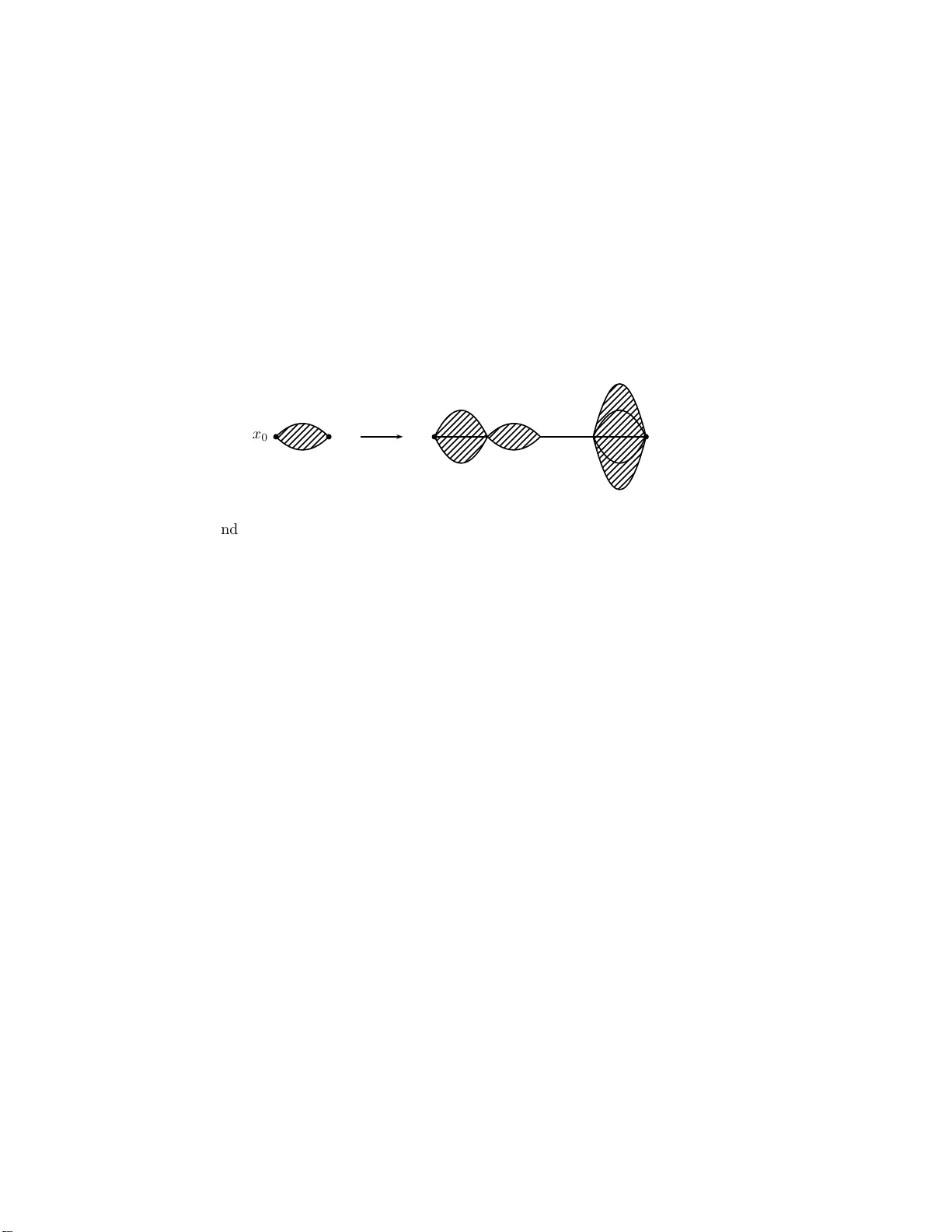
Comparing op eradic theories of n -category Eugenia Cheng Departmen t of M athematics, Univ ersit ´ e de Nice Sophia-An tip olis and Departmen t of M athematics, Unive rsit y of Sheffield E-mail: e.c heng@sheffi eld.ac.uk Octob er 22, 2018 Abstract W e giv e a framework for comparing on the one h a nd theories of n - categories that are w eakly enriched op era dically , and on the other hand n - categories giv en as algebras for a con tractible globular operad. Ex a mples of the former are the definition by T rimble and vari ants (Cheng-Gurski) and examples of the latter are the definition by Batanin and v arian ts (Leinster). W e fi rs t provide a generalisatio n of T rimble’s original theory that allo ws for the use of oth er parametrising op era ds in a very general w ay , via the notion of catego ries w eakly enric hed in V where the weakness is parametrised by a V -operad P . W e defi ne w eak n -categories by iterated w eak enrichmen t using a series of parametrising op erads P i . W e then show how to construct from such a t h eo ry an n -dimensional globular o p erad for eac h n ≥ 0 whose algebras are p reci sely th e weak n -categories, and w e sho w that the resulting globular op erad is con tractible precisely when the op era ds P i are contractible . W e then show ho w the globular op erad associated with T rimble’s top ologi cal definition is related t o the globular operad used by Bata nin to define fundamental n -groupoids of spaces. 1 Con ten ts In tro duction 2 1 T rim ble-l i k e theori es of n - c ategory 12 1.1 T rimble’s o riginal definition . . . . . . . . . . . . . . . . . . . . . 12 1.2 A more general version of T rimble’s definition . . . . . . . . . . . 15 2 Definition via free V -categories 20 2.1 Generalised op erads . . . . . . . . . . . . . . . . . . . . . . . . . 20 2.2 Op erad susp ension . . . . . . . . . . . . . . . . . . . . . . . . . . 23 3 Batanin’s de finition 26 3.1 Globular sets and pasting diagrams . . . . . . . . . . . . . . . . . 26 3.2 Batanin’s definition . . . . . . . . . . . . . . . . . . . . . . . . . . 29 4 Comparison 31 4.1 Construction of a globular o perad . . . . . . . . . . . . . . . . . . 32 4.2 Iterated distributive laws for weak n -categ ories . . . . . . . . . . 3 7 5 What T rimble’s op erad gives 40 5.1 Batanin’s op erad . . . . . . . . . . . . . . . . . . . . . . . . . . . 40 5.2 Compariso n . . . . . . . . . . . . . . . . . . . . . . . . . . . . . . 42 In tro duction Many diff erent notions of weak n -catego ry hav e b een propo sed in the literature [27, 1, 2, 24, 28, 16, 21, 19, 14, 1 5 , 29], and o ne of the most fundamental op en questions in the sub ject concerns the relations hips b et ween these theories. F ew compariso n functors have been constructed, let alone full equiv alences b et w een theories, although v arious relations hips are widely susp ected. The a im of this pap er is to compare the theories of T rimble [2 9 ] and Ba tanin [2]. The co nsequences of this compa rison go b ey ond a mere tech nicality o f the foundatio ns of higher-dimensio na l categ o ry theory . T rimble’s theory is the only one that explicitly uses classical op erads, so this compariso n ope ns up the p ossibilit y of us ing the h uge and w ell-developed theor y of classical op erads, including all the top ological and homotopy theoretic tec hniques develop ed for that sub ject, for the study of n -ca tegories. In this case, unlike when compar ing other theor ies (see for example [6, 5 ]), it is not the underlying shap es of cells that is the main issue, but ra ther the wa y in which compos itio n and coherence ar e handled. E ac h of these definitions uses the formalism of op erads to con trol the op erations of an n -categor y , but in very different wa ys. T r imble’s definition uses a classica l (non-symmetric) o perad iteratively , whereas Batanin’s definition uses a g lobular oper ad non- iterativ ely . The idea is that the op erad o perations of a given a rit y will b e the differen t w ays of comp osing a config uration of cells of that arity . Since a class ical o p erad only 2 has arities which ar e int egers k ≥ 0 , it can a priori only parametr ise co mposites of a rities k ≥ 0. This is eno ugh for 1 -categories, and indeed for the homotopy monoids with which op erads achiev ed muc h of their early s uccess [22]. That is, in a 1-ca tegory a “ configuration for comp o sition”, or pasting diag ram, is just a string of co mposable arrows a 0 a 1 . . . a k − 1 a k f 1 / / f 2 / / / / f k / / so its a rit y is completely sp ecified by o ne int eger k . How ev er, in a higher- dimensional category we hav e comp osable dia g rams suc h as · · C C K K L L · · / / G G · · C C · · / / which eviden tly ca nnot be completely spec ifie d by just one integer. The reas on is that we now have the p ossibilit y o f many different types of co mposition – along b ounding 0- cells, 1-cells, 2-cells, a nd so on – and a general n - dim ensional pasting diag r am may in volv e many o f these different types of composition at once. T rimble’s appro ac h uses an iter ativ e pro cess to build up these more compli- cated forms o f comp osition. Batanin, on the other ha nd, deals with this issue by starting with a mo re complicated form of op erad – a globula r opera d. A globu- lar op erad has as arities not just in tegers k ≥ 0, but globular p asting diagr ams . These are exactly the a rities w e need for co mposition in an n -categor y . The idea b ehind the co mp aris o n is to co mp are the o perads in que s tion. Where Batanin’s n -categories a re co n trolled by a single “contractible globula r op erad”, a “T rimble-like” theory of n -ca tegories is cont rolled b y a series of classical op erads – eac h of whic h parametrises just one t yp e of compos ition. W e will take such a series and construct from it a s ingle glo bular op erad that parametrise s all types of comp osition s im ultane o usly . That is, it sing le-handedly enco des exa ctly the op erations that the series of clas sical op erads encoded co l- lectively . Our main theorem will be that, giv en any “T rimble-like” theory o f n -categor ies, we ha ve a contractible g lo bular op erad whose a lgebras ar e pre- cisely the n -categor ie s we star ted with. This is a gener alisation of Leinster ’s Claim 1 0 .1.9 in [20], in which he conjectures this result in the specific case of T rimble’s o riginal definition, whereas we hav e generalised it to a muc h broader framework. First we must explain what w e mean by “T rimble-lik e” theory of n -catego ries. T rimble uses one sp ecific op erad to define his notion of n -category (extracting a ser ies of oper ads from it), but it is poss ible and indeed desira ble to generalis e his fr amew ork to allow for the use o f other suitable op erads. W e are motiv ated by analo gy with the study o f lo op spaces muc h of whose succes s is ro oted in the use of different op erads for different situations. As a more s pecific example, we are motiv a t ed by the desire to be able to use a “smo oth version” of T rimble’s 3 theory , to handle n -categories of cob ordisms (see [9]); T rimble’s original theory is the “ con tin uous version”. Thu s w e beg in, in Section 1.1 by stating T rimble’s orig inal definition, a nd contin ue, in Section 1 .2 b y generalis ing it to what we call an “iterated op eradic theory of n -categories ” . Given a finite pro duct category V and an opera d P in V we introduce the no tion of a ( V , P )-categ o ry , which is a cross betw een a P -algebr a and a V -ca tegory , and is to b e thought of as a “catego r y enric hed in V but weakened by the ac t ion of the op erad P ”. The idea is tha t instead o f having one comp osite for an y g iv en string of k comp osable cells, we have o ne for each such str ing t o get her with a n element o f P ( k ). W e can compar e this with the genera lisation from monoid to P -a lgebra. A monoid can be expressed as a set A tog ether with, for each in teger k ≥ 0, a multiplication map: A k − → A. This gives, for every string o f k elements of A , a n ele m ent of A which is to b e regar ded as their pro duct. F or a P -algebra , we now hav e a map: P ( k ) × A k − → A which gives, fo r every string of k elements of A to gether with an element o f P ( k ), an element of A which we might rega rd as a “para metrised pro duct” of the k elements of A . F or example, in the cas e of A ∞ -spaces [26] A a nd P ( k ) a re spaces; the m ultiplication para metr ised b y P ( k ) is a ssociative and unital up to homotopy as each P ( k ) is required to be co ntractible. W e can apply this principle for composition in a ca tegory as w ell. In an ordinary category A , comp osition is given by , for e very integer k ≥ 0 and ob jects a 0 , . . . , a k , a ma p: A ( a k − 1 , a k ) × · · · × A ( a 0 , a 1 ) − → A ( a 0 , a k ) . This gives, for every string of k comp osable mo rphisms o f A , a morphism of A which is to b e regarded as their comp osite; it is sufficien t (and usual) to sp ecify these maps only for the cas es k = 0 , 2 as the asso ciativit y axioms ensure that we then have a well-defined such map for each k ≥ 0. T o parametrise this by an oper ad P , w e now specify co mposition maps: P ( k ) × A ( a k − 1 , a k ) × · · · × A ( a 0 , a 1 ) − → A ( a 0 , a k ) which give, for every string o f k compo sable mor phisms o f A to gether with an element of P ( k ) , a morphism of A which we regard as a “ parametrised comp osite”. As above, w e can do this enriched in T op or indeed in v a rious o ther suitable enriching categ ories V , a nd this gives a notion of “weak enric hment” that w e can then itera te to form w eak n -catego ries as follows. Recall that standard enrichmen t ca n be iterated to pr oduce higher categor ies, but we will o nly r e ac h st ri ct n - categories in this w ay: we co nstruct, for each n ≥ 0 a ca tegory S n of strict n -categories inductiv ely as follows: 4 S 0 = Set S 1 = S 0 -Cat S 2 = S 1 -Cat S 3 = S 2 -Cat . . . S n = S n − 1 -Cat . . . F or weak n -categ ories w e need to use our weak form of enrichmen t, so for each n ≥ 0 we define • a categor y V n of weak n -categor ies, and • an op erad P n in V n which will parametris e comp osition in weak ( n + 1)- categorie s. W e then construct weak n -catego ries b y the following inductiv e pro cess: V 0 = Set V 1 = ( V 0 , P 0 ) -Cat V 2 = ( V 1 , P 1 ) -Cat V 3 = ( V 2 , P 2 ) -Cat . . . V n = ( V n − 1 , P n − 1 ) -Cat . . . As a final proviso, note that we need to pla ce a condition on the op erads P i to e nsure that the resulting n -ca teg ories are suitably co heren t. W e introduce a notion of con tractibility and demand that eac h of the op erads P i is c on tractible. In this framework it seems necessary to give a whole se r ies of parametr ising op erads P i as part of the data when defining n -categories. In fact T rimble’s original definition starts with just one op erad E in top ological spaces; one of the most elegant features of his definition is that the series of op erads P i is pro duced from the single oper ad E as part of the inductive pro cess. How ev er it is the se r ies o f oper ads P i that we need to make the comparison with Batanin’s definition, so this is the fr a mew ork we use for the res t of the work. In other work [9, 10] we fo cus on the iteration pro ducing the P i from the s ingle oper ad E ; May’s attempt to genera lise T rimble’s iter ation appear s in [2 3 ] but ha s been observed to b e fla wed by Batanin (the inductio n step do es not go through). Also note that as this definition is b y induction, it only defines n -catego ries for finite n ; in [10] we use a terminal coalgebra constr uction to construct a n ω -dimensional version o f T r im ble’s definition. It is useful to understand what each of these op erads P i is parametrising. Given an in teger n ≥ 0, an n - c ategory A will be defined by • a set A 0 of 0-cells, and 5 • for every pair a, a ′ of 0-cells , an ( n − 1)-categ ory A ( a, a ′ ) ∈ V n − 1 , eq uipp ed with • for every integer k ≥ 0 and 0 -cells a 0 , . . . , a k , a c omposition morphism P n − 1 ( k ) × A ( a k − 1 , a k ) × · · · × A ( a 0 , a 1 ) − → A ( a 0 , a k ) in V n − 1 giving comp osition along bo unding 0- cells satisfying cer tain a x ioms. Note that this composition morphism tells us ho w 0-comp osition o f ( m + 1 )- cells of A is parametr ised by the m -cells of P n − 1 , for each 0 ≤ m ≤ n − 1 . Of course, for an n -category w e also require comp o sition alo ng b ounding i -cells for all 1 ≤ i ≤ n − 1, but her e these ar e given inductively – they a r e contained in the da ta for the hom-( n − 1 ) -categ ories A ( a, a ′ ). Th us we see that i -comp osition in A is given by 0-comp osition in the hom-( n − i )-categ o ries, so is pa rametrised by P n − i − 1 . All of this indexing is summed up in T a ble 1, with ent ries stating whic h dimension of whic h o perad parametris es the g iv en comp osition. T able 1 : Indexing for comp osition par ametrised by op erads P i comp osition of 1-cells 2-cells 3-cells 4-cel ls · · · ( n − 1) -cells n -cells 0-cells 0 of P n − 1 1 of P n − 1 2 of P n − 1 3 of P n − 1 · · · ( n − 2) of P n − 1 ( n − 1) of P n − 1 1-cells – 0 of P n − 2 1 of P n − 2 2 of P n − 2 · · · ( n − 1) of P n − 2 ( n − 2) of P n − 2 2-cells – – 0 of P n − 3 1 of P n − 3 · · · ( n − 2) of P n − 3 ( n − 3) of P n − 3 along 3-cells – – – 0 of P n − 4 · · · ( n − 3) of P n − 4 ( n − 4) of P n − 4 . . . . . . . . . . . . . . . . . . . . . ( n − 3) -cells – – – – · · · 1 of P 2 2 of P 2 ( n − 2) -cells – – – – · · · 0 of P 1 1 of P 1 ( n − 1) -cells – – – – · · · – 0 of P 0 This pattern o f shifting dimensions is what w e need to e nc o de abstractly when w e compile the op erads P i int o one globular op erad in Section 4. As a preliminary to this pro cess, we show that ea ch ( V , P )-ca tegory constructio n is 6 itself op e r adic. This is the sub ject of Section 2 . W e recall the notion o f ( E , T )- op erad, wher e E is a car tesian c ategory and T a ca rtesian monad o n E . W e then show how to start with a class ic al op erad P in V as ab o ve, and constr uct an ( E , T )- operad Σ P whose algebras ar e precisely the ( V , P )-catego ries o f the previous section. W e will take E to b e the categ ory V -Gph of gra phs enriched in V , and T to b e the fr ee V -category mona d fc V ; these constructio ns are poss ible provided V is suitably well-b eha ved. Σ P is a sort o f “susp ension” of P , so that P can b e thought of as the “one-ob ject” version of Σ P , or rather , a lgebras for P are one-ob ject v ersions of algebra s for Σ P just as monoids are the o ne-ob ject version of categories. An immediate consequence is that we have a cartesian monad fc ( V ,P ) on V -Gph giving free ( V , P )-ca teg ories, and w e will re ly heavily on this in Sec tio n 4. This monadicit y result c o uld b e pro ved directly but w e ha ve included the abov e results as w e consider them to b e interesting in their own r ig h t. In Section 3 we briefly recall Ba tanin’s definition of weak n -category . In fact we us e a non-algebraic version of Leinster’s v ar ian t of this definition. Batanin’s original definition uses c ontr actible globular op er ads with a system of c omp osi- tions . The idea is that the “sy s tem o f comp ositions” ensures that binary and nu llary comp osites exist, the globular o perad keeps track of all the op erations derived from the binar y comp osites, a nd the co n tr actibilit y ens ur es that the result is sufficiently co heren t. These sp ecial g lobular op erads “detect” weak n - categorie s in the w ay that A ∞ -op erads “ detect” lo op spaces – a globular set is a w eak n - category if and only if it is an algebr a for a n y such op erad. Leinster’s v ariant com bines the notions of system of comp o sitions a nd co n- traction into one more g eneral notion of contraction. This means tha t con- tractions now provide compo sites and coherence cells . The compo sition is “un- biased”, that is, all arities of comp osition are sp ecified, no t just binary and nu llary ones; as b efore, the glo bular op erad k eeps track of all the op erations derived from these composites . Leinster then consider s globular op er ads with c ontra ction , and uses these to “detect” weak n -ca tegories as above. In the present work we use the no n-algebraic version of this definition, in tha t we consider c ont r actible globular op er ads rather than op erads with a sp e cifie d contraction. This means in effect that instead o f sp ecifying one compo site for each arity of comp osition, we just ensure that such a compo site exists for e a c h arity . Likewise, instead of spe c if ying one cohe r ence cell to mediate b et ween an y given pair of different comp osites of the same diagram, we simply demand that such a cell exists; if there a r e many , we do not insist on distinguishing one. This is the version used b y Berger and Cis inski in their work on Batanin’s theo ry [3, 11]. This makes for a more natural compariso n with T rimble’s theory , as we hav e already seen that, given a string of k comp osable morphisms, we do not hav e a unique compo s ite, but rather o ne compo s ite for every e le m ent of P ( k ). Note that this do es not mean T rimble’s theo ry is not alg ebraic – indeed the main result of this w ork s ho ws that T rimble-lik e n - categories are algebra s for a cer ta in o perad. The p oin t is that these n -categ ories ca n b e co ns idered to b e algebraic once the series of par ametrising oper ads has b een fixed. 7 In Section 4 we g iv e the main comparis on construction. W e sho w that any it- erative op eradic theory of n -catego r ies is op eradic in the sense of Batanin/Le ins ter. More precisely , c o nsider an iterative op eradic theory of n -categories giv en b y a series of oper ads P i in categories V i , for i ≥ 0, with • V 0 = Set , and • for all i ≥ 0, V i +1 = ( V i , P i ) -Cat . The main result of Section 4 is that, g iv en this data, there is for each n ≥ 0 a g lobular op erad Q ( n ) such tha t the categor y of algebr as for Q ( n ) is V n , the category of n -ca t egor ies w e star ted with. F urthermore, Q ( n ) is contractible (in the sens e o f Le ins t er) if fo r all 0 ≤ i ≤ n − 1 , the op erad P i is contractible (in the sense of Section 1.2). The idea b ehind the construction is to compile the cla ssical op erads P i int o one globular op erad. A g lobular op erad must hav e, for every pasting diagram α , a set of op erations of arity α , and we want this to be the set of “ways of comp osing cells in the config uration of α ”. Note that an m -pasting diagr am may involv e comp osition a lo ng any dimension of cell up to m − 1 , and according to our iterative op eradic theory , ea c h of these is para met rised by a different op erad. T able 1 indica t es to us how to find all the co mposites of a giv en pasting diagram in tuitively . F or example, for the following pasting diagram · · C C K K L L · · / / G G · · C C · · / / we hav e four “co lum ns” o f 1-comp osites, the results of which are compo s ed (horizontally) by a 4-ary 0 -compositio n. W e need a parametrising element for e ach pa rt of the co mposition, th us • for the first co lum n, we have a 2-ar y 1-comp osite o f 2-cells, so cons ulting our table we find that this is para metrised b y a 0-cell of P n − 2 (2), • for the second co lumn, we hav e a 1 -ary 1 -composite, so this is para m etrised by a 0-cell of P n − 2 (1), • similar ly for the third column we need a 0- cell of P n − 2 (0), • for the last column w e need a 0 -cell of P n − 2 (4), and fina lly • the 0-co mposition is par ametrised by a 1-cell of P n − 1 (4). So, wr iting the m -c e lls of P i ( k ) as P i ( k ) m , w e s ee that the set of “wa ys of comp osing” the ab o ve diagram sho uld b e g iven by P n − 1 (4) 1 × P n − 2 (2) 0 × P n − 2 (1) 0 × P n − 2 (0) 0 × P n − 2 (4) 0 . 8 Of cours e, to prove this rigoro usly we use a muc h mor e abstract argument. W e use the fact that a globular o perad is given b y a cartes ian monad Q , eq uip p ed with a cartesia n natural transfor ma tion Q ⇒ T , where T is the free stric t ω -category mona d on the catego ry GSet of globular sets, or the free strict n - category monad if we are dealing with n - dim ensional glo bular op erads. Thus, to construct the op erad for iterative ope r adic n -c ategories, we co nstruct its asso ciated monad. W e follo w Leinster’s method for constr uct ing the monad for strict n - categories, which pro ceeds by induction using: • the free strict ( n − 1)-categ o ry monad, T ( n − 1) , • the free V -categ ory monad fc V on V -Gph , with V = ( n − 1) -GSe t , and • a distributive law g o verning their interaction. So we can constr uc t the free s trict n -categor y on an n - g lobular set in the fol- lowing steps: 1. constr uct i -comp osites for i ≥ 1, using T ( n − 1) , a nd then 2. constr uct 0-comp osites freely , using the mo nad fc V as above. The distributive law co m es fro m the interchange laws of 0 - composition and i - comp osition, fo r all i ≥ 1; the catego ries n -GSet of n -dimensional globular sets app ear as a r esult of iterating the V -gra ph construction, starting with V = Set (Lemma 3 .2 ). W e can copy this constructio n for our weak enr ic hmen t, using: • the free we ak ( n − 1)-ca t egor y monad, Q ( n − 1) (b y induction), • the free ( V , P )-catego ry monad fc ( V ,P ) , with V = ( n − 1) -GSet and P the underlying globular set oper ad of P n − 1 , a nd • a distributive law g o verning their interaction. In this case the distributive law comes from a sort of “parametrised interchange law” which w e will expla in at the end of Section 4.2. Note that the prese nce of this law means that no t al l Batanin n -c a tegories can b e achiev ed in this w ay; we will discuss this issue mor e at the e nd o f the Int ro duction. T o complete our main result we need a cartesian na tural transfor mation Q ( n ) ⇒ T ( n ) for each n ≥ 0; this is induced by the canonical op erad morphis ms from each P i to the terminal op erad. So we have half o f our main res ult : w e ha ve for each n ≥ 0 a globular oper ad whose algebras a re the n -ca tegories we started with. In Prop osition 4 .6 w e show that the form ula obtained b y this abstr act argument is indeed the one we fir st thoug ht of b y considering the en tries in T able 1. This is useful for the purpo ses of satisfying our in tuition, but is also useful to prove the res t of the result: that the contractibility of Q ( n ) corres p onds to the co n tr actibilit y of the P i . 9 In Section 4.2 w e briefly discuss the unra velling of the above inductive argu- men t. W e find that we hav e for ea ch 0 ≤ i < n a monad Q ( n ) i for “comp osition along b ounding i -cells”. That is, w e ca n is olate each sort of comp osition and build it freely , parametr ised by the r elev ant op e r ad P n − i − 1 . W e then find that we hav e for each n ≥ 3 a “distributive series of monads” as in [7] Q ( n ) 0 , . . . , Q ( n ) n − 1 which is exa ctly analogo us to the distributive series of mo nads giving st ric t n -categor ies. In Section 5 we apply the results of the res t of the work to T rimble’s or iginal definition (that is, involving his op erad E ), with the aim of r elating it to the op erad Bata nin uses to take fundamen tal groupo ids of a space. The idea is that any top ological spac e X has a natural under ly ing globular set GX whose • 0-ce lls are the p oint s of X • 1-ce lls are the pa ths o f X • 2-ce lls are the ho mo topies b et w een paths of X • 3-ce lls are the ho mo topies b et w een homotopies betw een paths of X . . . and that these should b e the cells of the fundamental ω -groupo id of X ; for the fundamental n - groupoid we need to take homo top y cla sses at dimension n . In order to exhibit this as an n -groupo id we first need to equip it with the structure of an n -catego ry . In Bata nin’s theory , this means we must find a contractible glo bula r oper ad for which this g lobular set is an alg ebra. (W e will not b e concerned with showing it is a n n -gro up oid here.) Batanin constructs a con tractible g lobular op erad K with a ca nonical action on the under lying globular set of an y space. Giv en an m -pasting diagram α he defines the op erations of K of arity α to b e the contin uous, b oundary-preser ving maps from the top ological m -disc to the geometric r ealisation of α . These can be though t of as higher-dimensio nal reparametris ing maps – exactly the maps we would need to turn a pasting dia gram of cells in GX back in to a single cell of X . So in Sec tio n 5 we consider the following pro cess. 1. Start with T rimble’s top ological op erad E . 2. Use E to mak e T rimble’s orig inal iterative op eradic theo r y of n -categories. 3. Apply the co nstructions of Sec t ion 4 to produce an asso ciated g lobular op erad for this theory . 4. Embed this op erad in T rimble’s op erad K for fundamental n - groupoids . 10 The aim of Sec t ion 5, then, is to construct this embedding. This works, ess e n- tially , by tak ing T r im ble’s linear repar ametrising maps [1] − → [ k ] and letting them act natur ally on m -cub es; we then quotient the cub es to for m m -discs. Constructing an op erad mor phism to K is then straightforward; we will not pr o v e here that it is an em b edding, but s t udy its prop erties in a future work. Note that througho ut this w ork we will take the na tu ral num ber s N to include 0. Remarks on w eak vs strict in terc hange In the definition o f a bicateg ory as a ca tegory enrich ed in categories , the in- terchange law corr esponds to the functoriality of the comp osition functor. The same is true in general in an n -categor y defined by enrichmen t, and thus the strictness of in terchange cor responds to the strictness of the functor s we are using in our enr ic hmen t. T rimble’s definition only defines s t ric t functors betw een n -categorie s , and th us the definition may b e thoug h t of as having s tr ict interc hange laws, although they ar e par a metrised in a s lig h tly subtle way (see end of Section 4.2 ). This might b e co ns idered to b e “to o strict” and indeed un til recently atten tion was fo cused o n “fully weak” definitions. T rimble’s in tent ion was explicitly not to define the most w eak p ossible no tion of n -category; he called his version “fla bb y n -categor ies” ra t her than weak ones. Rather, his stated a im was a definition that would natu r al ly yield fundamental n -group oids of spaces, a nd his definition certainly achieves tha t – the fundamental n -gro upoid functor is a n inherent part of the definition. With regard to interc hange, the point is that fundamen tal n -gro upoids do hav e s trict int erchange (see for example [19]). They do not, how ev er, hav e str ic t units. While strict 2-g roupoids do mo del homotopy 2-types, Simpson prov ed in [25] that strict 3- groupo ids are to o strict to mo de l ho motop y 3- t y pes; in the same work he co njectur e s that having w eak units is weak enough to mo del n - t yp es fo r all n . This conjecture has b een prov ed a t dimens ion 3 by Joyal and Ko c k in [17]. All this indicates that the combination of “ strict interc hange and weak units” is worth studying. F urther mo re, this is r elated to the question of co herence. While not every weak 3 -category is equiv alent to a completely strict one, the coherence theorem of [1 2 ] tells us that every weak 3-categor y is equiv alen t to a Gray-category , which can be tho ug h t o f as a semi-strict 3-category in which ev erything is s t rict exc ept interch ange. It is gener ally belie v ed that a n analogo us res ult should be true for highe r dimensions. Howev er, there is a differen t so rt of s e mi-strict n - category whose ca ndidacy for a coher ence theorem is effectively highligh ted a nd suppo rted by the work of J oyal and Ko c k: that is, a semi-strict n -catego ry in which everything is strict exc ept units . They have already proved in [1 7] that 11 for n = 3 this is enough to pro duce braided mono idal categ ories in the do ubly degenerate case, which is effectively the con tent of the coher ence theorem for 3-catego ries. Iterative o peradic n -ca tegories, then, may b e tho ugh t of as this latter form of s emi-strict n -categor y . As such they s hould prov e useful for the s t udy of b oth homotopy t yp es a nd coherence. Ac kno wledgemen t s Much of this work w as completed with the help of the very conducive r esearch environmen ts of the Lab oratoire J. A. Dieudonn´ e a t the Universit´ e de Nice Sophia-Antipolis, and the Fields Institute, T oronto, for which I am very grateful. I would also like to thank Andr´ e Joyal and T om Le ins ter for useful discussions. 1 T ri m ble-lik e theories of n - c a tegory W e b egin this sectio n with a co ncise account of T rimble’s origina l definitio n of n - category as presented in [19]. Then, we prop ose a generalisatio n of this theory which allo ws for the use o f operads o ther tha n T rimble’s original op erad E . This more genera l framework will also serve as further explanation of T rimble’s original definition. It is this generalisatio n that we will refer to as “T rimble-like”, or iter ativ e op eradic. 1.1 T rim ble’s original definition T rimble’s definition of n -ca tegory pr oceeds b y iterated enrichmen t. It is well- known that strict n -ca t egor ies can b e defined by repea ted enrichmen t, that is, for n ≥ 1, a strict n -ca tegory is precisely a categ ory enriched in strict ( n − 1)- categorie s. Howev er, for we ak n -categor ies a notion o f “weak e nric hmen t” is required. T rimble w eakens the no tio n of enrichmen t using an oper ad action. The op erad he uses is a sp ecific one, whic h we now define. Definition 1.1. W e define the (class ical, non-symmetric) o p erad E in T op b y setting E ( k ) to b e the spac e of contin uo us endp oin t-preserving maps [0 , 1] − → [0 , k ] . for each k ≥ 0 . W e will write the clo sed interv al [0 , k ] as [ k ], and w e will often write [0 , 1] a s I . The compos ition maps E ( m ) × E ( k 1 ) × · · · × E ( k m ) − → E ( k 1 + · · · + k m ) are g iv en by reparametrisation and the unit is given by the iden tity map [1] − → [1] in E (1). Remarks 1.2. The operad E defined above has the following tw o crucial pr op- erties. 12 1. E has a natural a ction o n path spaces. That is, given a space X and po in ts x 0 , . . . , x k ∈ X we have a canonical map E ( k ) × X ( x k − 1 , x k ) × · · · × X ( x 0 , x 1 ) − → X ( x 0 , x k ) compatible with the op e r ad compo s ition. Note that this action will be crucial for making the inductio n step in the definition. 2. F or each k ≥ 0, the space E ( k ) is contractible. This is wha t will give c oher enc e for the n -categories we define; how ever from a technical p oin t of view the induction will not dep end on this pro p erty of E . W e ar e now ready to mak e the definition. W e will simultaneously define, for each n ≥ 0 • a finite pro duct categ ory n -Cat of weak n -categor ies, and • a pr oduct-preser ving functor Π n : T op − → n -Cat , which is intended to be the fundamental n -group oid functor. The idea is to use the fundamental n -group oid of each E ( k ) to par ametrise k -ary comp osition in an ( n + 1)-c a tegory . Definition 1. 3. Firs t set 0 -Cat = Set a nd define Π 0 to be the functor T op − → Set which sends a s pace X to its s et of connected co mponents. Obse r v e that Π 0 preserves pro ducts. F or n ≥ 1 a w eak n -category A consists of • ob jects: a s et A 0 , • hom-( n − 1)-catego ries: fo r all a, a ′ ∈ A 0 an ( n − 1)-catego ry A ( a, a ′ ), and • k -ary compo s ition: for all k ≥ 0 a nd a 0 , . . . , a k ∈ A 0 , an ( n − 1)-functor γ : Π n − 1 E ( k ) × A ( a k − 1 , a k ) × · · · × A ( a 0 , a 1 ) − → A ( a 0 , a k ) compatible with the o peradic comp osition of E . Given suc h n -ca teg ories A and B , an n -functor (or just functor ) A F − → B consists of • on ob jects: a function F : A 0 − → B 0 , and • on mor ph isms: for all a, a ′ ∈ A 0 an ( n − 1 )- f unctor F : A ( a, a ′ ) − → B ( F a, F a ′ ) 13 satisfying “functoriality” — for all k ≥ 0 and a 0 , . . . , a k ∈ A 0 the following diagram comm utes: Π n − 1 E ( k ) × A ( a k − 1 , a k ) × · · · × A ( a 0 , a 1 ) A ( a 0 , a k ) Π n − 1 E ( k ) × B ( F a k − 1 , F a k ) × · · · × B ( F a 0 , F a 1 ) B ( F a 0 , F a k ) . γ / / 1 × F ×···× F F γ / / W e write n -Cat for the ca tegory of w eak n -categor ies and their functors a nd observe that it has finite pr oducts. W e also define a functor Π n : T op − → n -Cat as follows. Given a space X we define an n -categor y Π n X by • ob jects: (Π n X ) 0 is the under ly ing set of X , • hom-( n − 1)-categ ories: (Π n X )( x, x ′ ) = Π n − 1 ( X ( x, x ′ )), and • comp osition: w e use the action of E on path spaces and the fact that Π n − 1 preserves pro ducts to make the following co mposition functor Π n − 1 E ( k ) × Π n − 1 X ( x k − 1 , x k ) × · · · × Π n − 1 X ( x 0 , x 1 ) Π n − 1 E ( k ) × X ( x k − 1 , x k ) × · · · × X ( x 0 , x 1 ) Π n − 1 X ( x 0 , x k ) ∼ = Π n − 1 pr eserves pr o ducts Π n − 1 of th e action of E o n path spaces . The action of Π n on morphis ms is de fined in the obvious wa y . Fina lly observe that Π n preserves pro ducts, so the induction go es through. Remarks 1.4. 1. Note that the functors defined here a re “s t rict functors”, so the enrichmen t gives s t rict interchange even tho ugh everything else ab out the definition is weak. 2. Some further expla nation abo ut compatibility with opera d op erations will be g iv en in the next section. 14 1.2 A more general v ersion of T rim ble’s definition T rimble’s definition relies on use of the top ological o perad E , but in fac t the op erads used to parametrise compo sition are the op erads Π n ( E ) given by Π n ( E )( k ) = Π n ( E ( k )) ∈ n -Cat . The fac t that the functor Π n : T op − → n -Cat pres erv es pro ducts ensures that Π n takes opera ds to oper ads (since this is true of any lax monoidal functor), so Π n ( E ) defined in this w ay is indeed an o perad. In this section we define an “iterative op eradic theory of n -catego ries” to b e given by , for all n , a categor y n -Cat of n - c a tegories and an op erad P n in n -C a t , such that ( n + 1) -Cat is the categ ory of “catego r ies enr ic hed in n -Cat weakened by P n ”. In fact w e will make a gener al definition of “( V , P )-category ” where V is the monoidal category in w hich we are enriching, and P is an op erad in V which we are using to parametris e comp osition. This is also called a “catego rical P -algebr a” or “ P -categor y ” [2 0 , Section 10.1 ], a nd ca n be thoug h t of as a cross betw een a V -category and a P -algebra; we will see that it gene r alises bo th of these no tions. Definition 1. 5. Given a catego ry V , a V -graph A is given by • a set A 0 of ob jects, and • for every pair of ob jects a, a ′ , a ho m-ob ject A ( a, a ′ ) ∈ V . A morphism F : A − → B of V -graphs is given by • a function F : A 0 − → B 0 , and • for every pair of ob jects a, a ′ , a mo rphism A ( a, a ′ ) − → B ( F a, F a ′ ) ∈ V . V -graphs and their mo rphisms form a category V -Gph . Remark 1.6. No te that V -Gph inherits many o f the prop erties of V . W e will use the fact that it is cartesian if V is, with pullbacks g iv en comp onent wis e. Definition 1. 7. Let V b e a s ymmetric monoidal categor y and P an op erad in V . A ( V , P ) -category A is given by • a V -graph A , equipp ed with • for all k ≥ 0 and a 0 , . . . , a k ∈ A 0 a compo s ition morphism γ : P ( k ) ⊗ A ( a k − 1 , a k ) ⊗ · · · ⊗ A ( a 0 , a 1 ) − → A ( a 0 , a k ) in V , compa t ible with the comp osition of the ope rad. Note that co mp osition for the case k = 0 is to b e in terpreted as, for a ll a ∈ A 0 a morphism P (0) − → A ( a, a ) . 15 A mo r phism F : A − → B of ( V , P ) -categories is a morphism of the under- lying V -graphs s uc h that the following diagr am comm utes P ( k ) ⊗ A ( a k − 1 , a k ) ⊗ · · · ⊗ A ( a 0 , a 1 ) A ( a 0 , a k ) P ( k ) ⊗ B ( F a k − 1 , F a k ) ⊗ · · · ⊗ B ( F a 0 , F a 1 ) B ( F a 0 , F a k ) γ / / F 1 ⊗ F ⊗···⊗ F γ / / Then ( V , P )-categories and their mor phisms form a category ( V , P ) -Cat . Note that the co mpatibilit y condition in the definition of ( V , P )-categ o ry c a n be sketched in pictures as fo llows. W e r epresen t elements of the op erad as op erations with multiple inputs and one output; for example an element of P (3) is represented as: E E E E E y y y y y Op eradic comp osition is then repre sen ted b y: / / 9 9 9 9 E E E E E y y y y y 9 9 9 9 A A A A A A A A A A A A A } } } } } } } } } } } } } 4 4 4 4 4 4 4 4 4 4 4 4 4 4 4 4 4 4 W e repr esen t elements of A ( a, a ′ ) as arrows, and elements of A ( a k − 1 , a k ) ⊗ · · · ⊗ A ( a 0 , a 1 ) as strings o f co mp osable a rro ws → → → → → → → without specifica lly lab elling the endp oin ts a i . Then the comp osition in our 16 ( V , P )-category A is r epresen ted by: / / → → → → → → → 4 4 4 4 4 4 4 4 4 4 4 4 4 4 4 4 4 4 / / showing tha t we take a string of k compo sable a rrows together with an element of P ( k ) and pro duce a single arrow as a r esult. Then the compatibility is represented by the commut ativity of the following diag ram: γ / / γ / / _ comp osition in P _ γ → → → → → → → 9 9 9 9 E E E E E y y y y y 9 9 9 9 A A A A A A A A A A A A A } } } } } } } } } } } } } A A A A A A A A A A A A A } } } } } } } } } } } } } / / / / / / → → → → → → → 4 4 4 4 4 4 4 4 4 4 4 4 4 4 4 4 4 4 / / 17 Examples 1. 8. 1. Put V = Set and P = 1 the termina l op erad i.e. each P ( k ) = 1. Then a ( V , P )-category is just an o rdinary small categor y . 2. Let A be a ( V , P )-catego ry with only one ob ject ∗ , thus o nly one hom- ob ject A ( ∗ , ∗ ) ∈ V whic h by abuse of notation we write a s A . T he n the comp osition morphism for each k b ecomes a morphism P ( k ) ⊗ A ⊗ k − → A and the axioms s ho w precis ely that A is a n algebr a for the op erad P . 3. Let P be the op erad defined by putting ea ch P ( k ) = I with co mposition given by the unique cohe r ence is omorphisms in V . Then ( V , P ) -Cat is equiv ale nt to V -Cat , the usual catego ry of ca tegories enriched in V . 4. Put V = T op and take P to be the oper ad E used in the previous section (Definition 1.1). Then a ( V , P )-ca tegory ca n be thoug h t of as a “catego ry weakly e nr ic hed in spaces”. An y top ological s pace is naturally a ( V , P )- category [20, Example 5.1.10]. In fact this is the precise formulation of the fact that “ E has a natura l action on path spaces”, and lies at the heart of why T rimble’s definition of n -catego ry s eems natural for mo delling homotopy types. Remark 1. 9. Note that exa mples (2) and (3) ab o ve show how the notion of a ( V , P )-categor y is a genera lisation and co nflation o f the notions of V -category and P -algebr a. In fact, ( V , P )-ca teg ories ar e prec is ely the a lgebras fo r a r e lated generalise d op erad Σ P , as w e will show in Section 2 .2 . In all our examples, the tensor pro duct in V will b e given by a c ategorical pro duct; in this case ( V , P ) -Cat also has pro ducts, and we c a n then iterate the construction. This itera tion gives us a candidate notion o f n -ca t egor y; it only r emains to have a wa y of saying tha t such n -categ ories ar e “sensible” o r coherent. F o r this we will use the notion o f contractibility of an op erad; since we are iterating our constructio ns , we also need the notion of contractibilit y o f a ( V , P )-ca tegory . Definition 1. 10. 1. W e say that a set is contra ctible if and only if it is terminal. 2. Supp ose V is a categor y with a notion of cont ractibility , that is, we know what it means for a n ob ject of V to b e “contractible”. Then w e say that an op erad P ∈ V is contra ctible if ea ch P ( k ) is con tractible. 3. Supp ose V has a no tion o f contractibility . Then we say a V -g raph is con tractible if • A 0 6 = ∅ , and 18 • for all a, a ′ ∈ A 0 , the hom-ob ject A ( a, a ′ ) is contractible in V . 4. W e say a ( V , P )-categor y is con tractible if its underlying V -g raph is contractible. Remarks 1.11 . 1. Note that by starting o ur inductiv e definition with the 1-element sets, we ensure that in a n y contractible n -catego ry every homset of n -c ells with given source and ta rget is a 1 -elemen t set. Since we will use contractible n -categor ies to parametrise comp osition in an ( n + 1)-catego ry , this is what will ensure that comp osition of top-dimensiona l cells is alwa ys strict (see Prop osition 4.7). 2. Note that elsewhere (for example [23]) “c o n tractible” is taken to mean “weakly equiv alent to the ter m inal ob ject” in a suitable model category structure; w e do not address the us e of mo del catego ries here. W e are no w re a dy to iterate the w eak enrichmen t construction to ma k e n -categor ies. W e a re not claiming here to hav e made a “ new” definition of n -categor y , no r to hav e improved on T rimble’s remar k a bly elega n t and concis e definition. W e state the definition in the a bov e form merely because this is the form in which we a re go ing to use it, and we prefer to show the grea test generality in which our comparison theorem migh t be a pplied. Definition 1.12. An i tera tiv e op eradic theory of n -categories is given by , for all n ≥ 0 a ca tegory V n and a cont ractible oper ad P n ∈ V n such that • V 0 = Set , and • for all n ≥ 0, V n +1 = ( V n , P n ) -Cat . Thu s V n is the category o f n -categ ories according to the theory in question. Note tha t putting V 0 = Set and demanding that P 0 be contractible means that w e m ust hav e P 0 = 1 the terminal op erad. Examples 1. 13. 1. T rimble’s original definition is an example of suc h a theory of n -categories, with P n = Π n ( E ) for ea ch n ≥ 0. The contractibility of each E ( k ) in the top ological sense ensures the contractibilit y of each P n in our sense. 2. Another example of such a theory is given in [8] in whic h the author s prop ose a version of T rimble’s o riginal definition b eginning with an op erad in GSet instea d of in T op . The author s use T rimble’s inductive metho d to pro duce a series of o perads P n in n -Cat , and they present sufficie nt conditions on an oper ad in GSet to ma k e the induction step w ork. 19 3. Batanin’s definition of n - category (and v ar ian ts) is a non-exa mple. W e will see in Section 4.2 that an iterative oper adic theor y of n -c a tegories neces- sarily has strict (alb eit parametrised) interc hange at all levels, whereas Batanin’s n -categ ories allow for the p ossibilit y of weak in terchange. Thus although our main theorem will show that an iterative o peradic theory can b e expressed as a Batanin-type theory of n -ca t egor ies, the converse is not true. 4. W e could alter na tiv ely start with V 0 = T op o r sSet which w ould give a c a ndidate for a notion of ω -category in whic h a ll cells are in vertible ab o ve dimension n ; such a structure is sometimes referre d to as an ( ∞ , n )- category . W e could also start with other suitable monoida l categor ies with a notion of contractibilit y . Note that in these cases it is not immediate that the re s t of the cons t ructions in this work will follow; we will study this in a future work. 2 Definition via free V -categories In the previous section we demonstrated informally that a ( V , P )-ca tegory is a “cross” betw een a P - algebra and a V -catego ry . W e now show how to derive from an opera d P a gener alise d op er ad Σ P , who se a lgebras are precis e ly the ( V , P )-categorie s. This will ena ble the constructions of Section 4. 2.1 Generalise d op erads W e first rapidly recall the definition of g eneralised op erad. The idea is to gener- alise the sor ts of ar ities that the op erations of an op erad can have. F o r a class ic a l op erad, the arities are just the natural num b ers. Obser v ing that N is the free monoid on the terminal set, we may try applying o t her monads T to terminal ob jects in o th er categories E , and this works provided E and T ar e cartesian. This genera lisation op ens up a wealth of p ossibilities for enco ding op erations whose inputs have some structure on them. One example of s uc h an oper a- tion is c o mposition in a n n -categor y; we will see that the “glo bular o perads” in Batanin’s definition are a lso a particular kind of generalised oper ad. Generalised o perads were intro duced by Burroni in [4] under the name of “ T -ca tegory”. The idea was later rediscovered indep enden tly by Hermida [13] and Leinster [1 8 ]. Definition 2.1. Let E b e a catego ry with pullbacks (i.e. it is cartesia n) and a terminal ob ject. Let T b e a ca rtesian monad on E , that is, the functor part preserves pullbacks, and all the naturality squar es for η a nd µ are pullbacks. The category T -Col l of T -collections is defined to be the slic e category E /T 1. This is a monoidal categor y where the tenso r pro duct of tw o o b jects A α T 1 ⊗ B β T 1 20 is the left-hand edg e of the following diagram T 1 T 2 1 T A T 1 B · ? ? µ 1 T α T ! ? ? ? ? ? ? ? β ? ? ? ? ? ? ? and the unit is the collection 1 η 1 T 1 . The unit and as sociativity axioms follow from the fa ct that T is a cartes ia n monad. Definition 2.2. An ( E , T ) -op erad is a monoid in the mo noidal catego r y T -col l . W e refer to such op erads gene r ally as generalised op erads . So an ( E , T )-o perad is giv en b y an ob ject P ∈ E and a morphism P d T 1 equipp e d with maps for unit 1 η T 1 ! − → P d T 1 and m ultiplication P d T 1 ⊗ P d T 1 − → P d T 1 . P can b e though t of as the op erations and T 1 their a r ities; the map d g iv es the arities of the op erations. By a buse of notation we o ft en r efer to an op erad as ab o ve simply a s P . 21 Examples 2. 3. 1. Let ( E , T ) = ( Set , id ). Then an ( E , T )-op erad is precisely a monoid. 2. Let ( E , T ) = ( Set , “free monoid monad”). Then an ( E , T )-o perad is an ordinary non-symmetric op erad in Set . 3. Let ( E , T ) = ( Gph , “free catego ry monad”). Th en an ( E , T )-o perad is what Leinster calls a fc -op erad, fc being notation for the free categor y monad on the categor y Gph of graphs [20, Chapter 5]. A k ey ex ample for us will be the enriched version of t his ex a mple, whic h w e will in tro duce in Theorem 2.6. 4. W e will later see that a g lo bular op erad is defined to b e a n ( E , T )-op erad where E = GSet and T is the free strict ω -category monad on GSet ; there is also an n - dim ensional version. W e now tur n our atten tion to algebr as. Recall that a classical op erad ha s an asso ciated mo nad, and algebras for the o p erad are precisely algebr as for its asso ciated monad. A similar result ho lds for ( E , T )-op erads as follows. Definition 2.4. Let P b e an ( E , T )-op erad. Then the asso ciated monad T P on E is de fined as follows. Giv en an ob ject A ∈ E , the ob ject T P A is given by the following pullback T P A P T A T 1 ? ? ? ? ? ? ? ? ? ? ? ? ? ? ? ? ? ? ? ? The unit and multiplication co m e from the unit and multiplication of P . An algebra for the o perad P is then defined to be a n algebr a for this mona d. The ab o ve asso ciation of a mona d to any op erad extends to the following compariso n result which characterises gener alised o perads in the for m that we will construct them in Sectio n 4; it a ppears as Corollar y 6.2.4 of [20]. Recall that a cartesian natural tr ansformation is one whose naturality squa res are all pullbacks; a car tesian mona d is one whos e functor part preserves pull- backs, and whose unit and m ultiplication are car t esian natural tra ns f orma tio ns. Theorem 2.5. L et T b e a c artesian monad on a c artesian c ate gory E . Then the c ate gory of ( E , T ) -op er ads is e quivalent to the c ate gory in which • an obje ct is a c artesian monad P on E to gether with a c artesian natur al tr ansformation α : P ⇒ T c ommuting with the m o nad st ructur es, and 22 • a m orphism ( P , α ) − → ( P ′ , α ′ ) is a c artesian natur al tr ansformation θ : P ⇒ P ′ c ommu t ing with the monad st ructur es and satisfying α ′ ◦ θ = α . W e will not giv e the proof o f this equiv a lence r esult here, but it is worth noting that the under lying collection of an ope r ad expressed as above is P 1 α 1 T 1 . By abuse of notatio n, we will often wr ite P for b oth the op erad and its asso ciated monad. 2.2 Operad suspension In this se ction we show ho w to take a class ical op erad P in a suitably well- behaved categor y V a nd co nstruct fro m it a n ( E , T )-op erad Σ P , for so me suitable E and T , such that the a lgebras for Σ P are precisely the ( V , P )-categor ie s w e defined in the prev ious section. W e use the notation Σ as the construction can b e viewed as a sort of “susp ension”. This is a generalisatio n of the Σ construction given b y Leinster for the ca se V = Set in [20, Example 5.1.6 ]. Thu s where Leinster uses T = fc , the free catego ry monad, w e will use the “free V -categor y monad” fc V which we now define. This construction is analogo us to the construction of fc , which is itself a nalogous to the constructio n of a free monoid on a set A as a k ≥ 0 A k . Leinster makes this construction in [20, App endix F] for any presheaf category V . In fact (as L e inster p oin ts out) the co nstruction works in a muc h mor e general c o n text; here we give it in a slightly more general context in order to gain some more e x amples, a ltho ugh for our main theorem in Section 4 we to o will only need the result for preshea f categories. First recall that the underlying data for a V -categ ory is a V -g raph. Theorem 2.6 . L et V b e a c ate gory with finite pr o ducts and smal l c opr o ducts that c ommute. Then the for getful funct o r V -Cat − → V -Gph is m o nadic. The induc e d “fr e e V -c ate gory monad” fc V is c artesian and c opr o duct- pr eserving. It s action is given as the identity on obje cts , and on hom-obje cts: ( fc V A )( a, a ′ ) = a k ≥ 0 , a = a 0 ,a 1 ,...,a k − 1 ,a k = a ′ A ( a k − 1 , a k ) × · · · × A ( a 0 , a 1 ) . Pr o of. Routine ca lc ula tions. 23 Example 2.7 . In the cas e V = Set we have fc V = fc . Example 2.8. The following example will b e a key e x ample for o ur cons t ruc- tions. Supp ose V satisfies the hypo theses of the ab o ve theo rem. Then since V has a terminal ob ject 1, V -Gph has a terminal ob ject whic h we will also write 1; it has a sing le ob ject, and its single hom-o b ject is 1 ∈ V . Then fc V (1) has a single ob ject and “ N ’s w orth” of morphis ms . That is, its single hom-ob ject is a k ≥ 0 1 . Definition 2.9. Let P b e a (class ical) op erad in V . W e define the susp ension Σ P of P to be a ( V -Gph , fc V )-op erad with underlying collection Σ P fc 1 where the V -graph Σ P is given by: • (Σ P ) 0 is a terminal s e t , {∗} , say , and • Σ P ( ∗ , ∗ ) = a k ≥ 0 P ( k ); the morphism Σ P − → fc V 1 is defined on hom-ob jects in the obvious w ay , by degree, so we have a k ≥ 0 P ( k ) − → a k ≥ 0 1 . F urther mo re, the unit and m ultiplication a re constructed from the unit and m ultiplication for P . Example 2.10. Let V = Set and P an ope rad in Set . Then fc V = fc and Σ P is exactly the susp ension fc - o perad descr ibed in [20, Ex a mples 5.1.6 and 5 .1 .7]. Prop osition 2.11. L et V b e a c artesian c ate gory with tensor pr o duct given by pr o duct, and smal l c opr o ducts c ommuting with pul lb acks. Th en a ( V , P ) -c ate gory is an algebr a for Σ P , and this extends t o an e qu ivalenc e of c ate gories ( V , P ) -Cat ≃ Σ P -Alg . Pro of. An alg ebra for Σ P consis ts of • a V -graph A , and • an alg ebra action (Σ P )( A ) − → A . 24 Here (Σ P )( A ) is given by the pullback · Σ P fc V ( A ) fc V (1) ? ? ? ? ? ? ? ? ? ? ? ? ? ? ? ? ? ? ? This pullback is given comp onen t wise. On o b ject sets, the low er-lefthand map is the identit y , so the the pullback has the same s e t of ob jects as fc V ( A ), i.e. just the ob jects of A . F or hom-ob jects we have for eac h pair of ob jects a, a ′ ∈ A an ob ject (Σ P )( A )( a, a ′ ) given by a pullbac k of copro ducts as below · a k ≥ 0 P ( k ) a k ≥ 0 a = a 0 ,...,a k = a ′ ∈ A (0) A ( a k − 1 , a k ) × · · · × A ( a 0 , a 1 ) a k ≥ 0 1 ? ? ? ? ? ? ? ? ? ? ? ? ? ? ? ? ? ? ? ? ? ? ? ? ? hence, since these copr oducts co mm ute with pullbacks, it is the co product over k ≥ 0 of pullbacks · P ( k ) a a = a 0 ,...,a k = a ′ ∈ A (0) A ( a k − 1 , a k ) × · · · × A ( a 0 , a 1 ) 1 ? ? ? ? ? ? ? ? ? ? ? ? ? ? ? ? ? ? ? ? ? ? ? ? 25 but for ea c h k ≥ 0 this pullback is just a pro duct, so we hav e (Σ P )( A )( a, a ′ ) = a k ≥ 0 a = a 0 ,...,a k = a ′ ∈ A (0) P ( k ) × A ( a k − 1 , a k ) × · · · × A ( a 0 , a 1 ) . Hence a n algebr a action is given by , for all k ≥ 0 , a 0 , . . . , a k ∈ A 0 a morphism P ( k ) × A ( a k − 1 , a k ) × · · · × A ( a 0 , a 1 ) − → A ( a 0 , a k ) satisfying the relev a nt ax ioms to give precis ely a ( V , P )- c a tegory . This extends to a n equiv alence of categ o ries straightforwardly . ✷ Definition 2. 12. W e wr ite fc ( V ,P ) for the ca rtesian mo nad o n V -Gph as- so ciated to the opera d Σ P . By Pr oposition 2.11, its category of algebra s is ( V , P ) -Cat , so it is the monad for “free ( V , P )-categories ”. Example 2.1 3 . In the case P = 1, we hav e fc ( V ,P ) = fc V . This example shows how our construction is a gene r alisation of the free V -categor y construction. In [20, App endix F] Leinster makes grea t use of the fc V construction to define the free s tr ict n -c a tegory mona ds ; in Section 4 we will pro ceed analo gously using the fc ( V ,P ) construction to define the free weak n -categor y monads ass ociated to an itera tive o peradic theory . 3 Batanin’s d e finition W e be g in with so me preliminaries on globular sets a nd pasting diagra ms, which will als o b e useful in understanding the constructions o f Section 4. W e are going to need the notion of “globular op erad”; these ope r ads a re the same as ( GSet , T )-op erads where T is the free strict ω -catego ry monad, which con- structs pas t ing dia grams freely . So it is useful to intro duce some no tation and terminology for pasting dia grams first. 3.1 Globula r sets and pasting diagrams Definition 3. 1. A glo b ul ar set A is a dia g ram in Set A 0 A 1 A 2 A n − 1 A n · · · · · · s / / t / / s / / t / / s / / t / / s / / t / / s / / t / / s / / t / / satisfying the globular it y conditions ss = st and ts = tt . Globular sets together with the obvious morphisms form a c a tegory GSet , which can of course also be expressed as a pre sheaf ca tegory; w e wr ite G for the “glo be” categ o ry on which glo bular sets a re pres hea v es, whose ob jects are the natural num bers . In particular GSet is cartesian. An n - dimensional globular set or simply n -globular se t is a globular set with A k = ∅ for all k > n . Similarly the n -globular sets form a categ o ry n -GSet . 26 W e will b e making use of the fact that n -globular se t s can b e for med by iter- ating the V -gr aph construction. The following is prov ed as pa r t of P ropos itio n 1.4.9 in [2 0 ]. Lemma 3.2. Write 0-Gph = Set and for al l n > 0 put n -Gph = ( ( n − 1 ) -Gph)-Gph . Then for al l n ≥ 0 we have n -Gph ≃ n -GSet . W e will use n -Gph a nd n -GSet s ligh tly in terchangeably , tending to pr e f er the former when w e are itera ting an enric hment construction, and the latter when dealing with globular oper ads. W e now pr esen t the free strict ω -catego ry monad, which is treated in g r eat detail in [2 0 ]. There is a fo rgetful functor U : ω -Cat − → GSe t where ω -Cat is the ca teg ory of strict ω -categor ies. The following is prov ed in [20, Appendix F]. Theorem 3 . 3. The for getful functor U is monadic and t h e induc e d monad T on GSet is c artesian. Like wise for the n -dimensional c ase, which induc es a monad T ( n ) on n - GSe t . Thu s T is the free strict ω -category monad, and its action on a globular s et A pro duces all formal compo sites of cells in A . Definition 3 . 4. An m -pasting diagram is an m -cell of T 1, where 1 is the terminal globular set whic h ha s precisely one cell of ea c h dimension. Example 3.5. W e will use the fo llowing running example of a 2- pasting dia - gram. · · C C K K L L · · / / G G · · C C · · / / In fact for pre cise calc ulations w e will make use of Ba tanin’s highly efficacious tree notatio n for pasting dia grams, which follows from the followin g immedia te consequence of Leinster’s construction of the free strict ω -categor y monad. Prop osition 3.6. Le t m ≥ 1 . An m -p ast ing diag r am is given by a (p ossibly empty) se quenc e of ( m − 1) -p asting diagr ams. Corollary 3. 7. L et m ≥ 0 . An m -p asting diagr am is given by a (p ossibly de gener ate) planar tr e e of height m . 27 Example 3.8 . The pa sting diagra m in Ex ample 3.5 c orrespo nds to the tree • • • • • • • • • • • • D D D D D D D D , , , , , , z z z z z z z z % % % % % 2 2 2 2 2 2 % % % % % Note that some care is required for de g enerate ca ses; the above picture also corres p onds to a degenerate m - pasting diagr am for ea c h m > 2. Definition 3.9. Given a tre e τ its dim e nsion is the dimension o f the co rre- sp onding pasting diagra m , and we write di m ( τ ); taking care to remember that for degenerate tr ees this will not be the height of the tr ee as drawn on the page. If dim ( τ ) = m then τ is called an m - stage tree . Every tree can b e decomp osed a s a sequence of tre es, a nd this cor responds to the express ion of the corresp onding m -pasting diagram as a s e q uence o f ( m − 1)- pasting diagr a ms. W e will often give constr uctions or pro ofs b y induction over dimension, expressing a n m -stage tree α as a seq uence ( α 1 , . . . , α k ) of ( m − 1 )- stage tr ees, joined by a new base node as follows: α 1 α 2 · · · α k • D D D D D D D 2 2 2 2 2 z z z z z z z Example 3.1 0 . The ab o ve 2-stage tr e e is given as the sequence • • • * * * , • • , • , • • • • • ? ? ? ? * * * of 1-stage tre es, where the third one is deg enerate. As a 2-pasting diag r am, this corres p onds to the sequence · · · / / / / , · · / / , · , · · · · · / / / / / / / / of 1-pa sting diagrams. T hes e in turn corre s pond to the four horizontally com- po sed comp onen ts o f the pasting diagram · · C C , · · / / , · , · · C C K K L L Evidently , in o rder to turn the above sequence of 1- pasting diag rams into the 2-pa sting dia gram, we hav e to shift the dimensions b y 1. This notion of “susp ension” app ears ag ain in Section 5. Remark 3.11. The b ottom no de o f a tree tells us the arity of the 0-c o mposition inv o lv ed in the pasting diagram; more g enerally the nodes at heigh t b tell us the arity of each string of b -composites in the pasting dia gram. 28 3.2 Batanin’s definition W e are now ready to give Batanin’s definition of n -categ ory . Note that we are using a non-algebraic v ersio n of Leinster’s v ar ia n t of Batanin’s definition, as discussed in the Intro duction. Definition 3.12. A gl obular op erad is a ( GSet , T )-op erad. An n -dimensional globular ope rad is an ( n - GSet , T ( n ) )-op erad. Thu s we hav e an underly ing collection P T 1 d equipp e d with unit and m ultiplication maps; P can b e thought of as the glo bular set of o perations, and each op eration has a pa sting dia gram as its a rit y , g iv en by the map d . The remaining s t ructure we need fo r o ur definition of n -categ ories is the no tio n of “contractibilit y”. Definition 3.13. Let T b e the free s trict ω -catego ry monad o n GSet . A T - collection A T 1 p is contrac tible if • given any 0-cells a, b ∈ A a nd a 1-cell y : pa − → pb ∈ T 1, there exis ts a 1-cell x : a − → b ∈ A s uch that px = y , and • for all m ≥ 1, g iv en any m -cells a, b ∈ A that are “para llel” i.e. sa = sb and ta = tb , and an ( m + 1)-cell y : pa − → pb ∈ T 1, there exists an ( m + 1)-cell x : a − → b ∈ A such that px = y . Note that this can b e expr essed as a liftin g condition just as for fibratio ns in spaces or simplicial se t s – by the inclusion of the m -sphere into the b oundary of the ( m + 1)- ball. Definition 3.14. F or each m ≥ 0 the glo bular m -sphere S m is g iv en by the following m -globular set 2 2 2 2 2 · · · 0 / / 1 / / 0 / / 1 / / 0 / / 1 / / 0 / / 1 / / 0 / / 1 / / where 2 denotes the 2-element set { 0 , 1 } and the maps 0 and 1 send e verything to 0 and 1 resp ectiv ely . The globular m -ball B m is g iv en by the following m - globular set 2 2 2 2 1 · · · 0 / / 1 / / 0 / / 1 / / 0 / / 1 / / 0 / / 1 / / 0 / / 1 / / . 29 Thu s there is an obvious inclusion S m ֒ → B m +1 , and a T -collection A T 1 p is c on tractible if and only if for all m ≥ 0 every co mm utative s quare S m A B m +1 T 1 / / _ / / has a lift S m A B m +1 T 1 / / _ / / ? ? making b oth tria ngles commute. F or the n -dimensional cas e we must “ c ollapse” everything ab ov e the n th dimension. Th us we hav e the follo wing n -dimensional definition. Definition 3. 15. Let n ≥ 0 and T ( n ) the free stric t n -category mo na d on n -GSet . A T ( n ) -collection A T ( n ) 1 p is contrac tible if • given any 0-cells a, b ∈ A a nd a 1-cell y : pa − → pb ∈ T 1, there exis ts a 1-cell x : a − → b ∈ A s uch that px = y , • for all 1 ≤ m < n , given an y m -c ells a, b ∈ A that are “pa rallel” i.e. sa = sb and ta = tb , and a n ( m + 1)-c e ll y : pa − → pb ∈ T 1, there exis ts an ( m + 1)- cell x : a − → b ∈ A such that px = y . • given any parallel n -cells a, b ∈ A a nd a n ( n + 1)-cell y : pa − → pb ∈ T 1, we hav e a = b . Definition 3.1 6. A cont ractible gl obular op erad is a globular op erad who se underlying T -colle c tio n is c o n tractible. Lik ewise for the n -dimensio nal case. Definition 3.17. A g l obular weak ω -cat egory is an algebra for an y co n- tractible globular oper ad. Likewise for the n -dimensiona l case. 30 4 Comparison In this se ction w e show how to start with an iterative op eradic theor y of n - categorie s and construct for each n ≥ 0 an n - dim ensional contractible globular op erad whose algebra s ar e the n -categories we star ted with. The conv erse will in general not be p ossible since an iterative op eradic theory of n -categorie s alw ays has strict interchange, whereas a Batanin-style globular theory do e s not. The data for an iterative opera dic th eory of n - categories is ess en tially just a series of op erads P i . F or ea c h n ≥ 1 w e combine the o perads P 0 , P 1 , . . . , P n − 1 to pro duce an n -dimensional glo bular op e rad Q ( n ) . W e then show that it is c on- tractible whenever the P i are all contractible. W e will use the characterisa tion of a globular o perad as a cartes ian monad Q eq uipped with a cartesian natura l transformatio n Q ⇒ T . W e will follow the method used b y Leinster in [20, Appendix F] to construct the free strict n - category monad T ( n ) by induction. Le ins ter’s appro ac h uses three essent ial ingredients: 1. the free V -categ ory monad fc V , for suitable ca t egor ies V , 2. the “susp ension” 2- fu nctor CA T − → CA T which sends V to V -Gph , and F : V − → W to F ∗ which is the identit y o n ob jects a nd F o n hom-ob jects, preser ving monadic adjunctions, cartesia n monads and distributive laws, and 3. for suitable monads T o n V a distributive law T ∗ ◦ fc V ⇒ fc V ◦ T ∗ whose r esulting compo site monad fc V ◦ T ∗ is the free V T -Cat mona d [20, Prop osition F.1.1]. Then the mona d T ( n ) is pro duced b y induction, by putting V = ( n − 1) -Gph and T = T ( n − 1) . Th us V T = ( n − 1) -Cat and the distributive law T ∗ ◦ fc V ⇒ fc V ◦ T ∗ gives us a mona d whose ca tegory of algebra s is ( n − 1) -Cat-Cat = n -Cat , so we hav e constructed T ( n ) as required. In o rder to constr uct the mona d Q ( n ) for weak n -ca tegories, we will gener - alise the a bov e method to include the action of the op e r ads P i . Afterwards in Section 4.2 we will describe how to construct th is monad by a distributiv e series of mo nads; this is not necessary for the pro ofs, but s heds some lig ht on the sit- uation and provides a compariso n with the analysis of the free strict n -category monad in [7]. 31 4.1 Construction of a globular operad W e a re going to copy the free n - category constructions in [2 0, Appendix F] but with comp osition parametrised by a ser ies of op erads P i . Th us, w e need to repla c e the free V -categor y functor in the constructio n with the free ( V , P )- category functor , fo r s uit able V and P . W e then hav e three ingr e dien ts analog ous to those describ ed above and can make the analog ous construc tio ns, with some mo dification whenever the a ction of the P i is inv olved. W e therefor e need the following three essential ingredients: 1. the free ( V , P )-c a tegory monad fc ( V ,P ) , for op erads P in suitable categor ies V , 2. the susp ension functor a s ab o ve, and 3. a certain distributive law, g eneralised from the one a bov e. W e ha ve already co nstructed the monad fc ( V ,P ) in Section 2 .2 . The distribu- tive law is given by the following result, which g eneralises the distributive law provided in the pro of of Prop osition F.1.1 in [20]. Theorem 4.1. L et V b e a pr eshe af c ate gory, T a monad on V that pr eserves c opr o ducts, and P an op er ad in V T , the c ate gory of algebr as of T . Write U for the for getful functor V T − → V , and U P for the op er ad in V given by ( U P )( k ) = U ( P ( k )) . Then we have monads on V -Gph given by T ∗ and fc ( V ,U P ) , and a distributive law λ : T ∗ ◦ fc ( V ,U P ) ⇒ fc ( V ,U P ) ◦ T ∗ whose r esulting c omp osite monad fc ( V ,U P ) ◦ T ∗ is the fr e e ( V T , P ) -Cat monad, that is ( V -Gph ) fc ( V ,U P ) ◦ T ∗ ∼ = ( V T , P ) -Cat . Pr o of. Since T preserves copro ducts we have ( T ∗ ◦ fc ( V ,U P ) )( A )( a, a ′ ) = a k ≥ 0 a = a 0 ,...,a k = a ′ ∈ A (0) T U ( P ( k ) × A ( a k − 1 , a k ) ×· · ·× A ( a 0 , a 1 ) and also w e have ( fc ( V ,U P ) ◦ T ∗ )( A )( a, a ′ ) = a k ≥ 0 a = a 0 ,...,a k = a ′ ∈ A (0) U ( P ( k )) × T A ( a k − 1 , a k ) ×· · ·× T A ( a 0 , a 1 ) . Now the univ ersa l prop ert y o f the pro duct U ( P ( k )) × T A ( a k − 1 , a k ) × · · · × T A ( a 0 , a 1 ) together w ith the algebra ac tio n T U ( P ( k )) − → U ( P ( k )) 32 induce a canonical mor phism T ( U ( P ( k )) × A ( a k − 1 , a k ) × · · · × A ( a 0 , a 1 ) U ( P ( k )) × T A ( a k − 1 , a k ) × · · · × T A ( a 0 , a 1 ) and this gives us the comp onen ts of a natural transfor mation λ as required. It is straig h tfor w ard to check tha t λ is a distributiv e law and that w e hav e the isomorphism of categories r equired. Note that this distributiv e law will corresp ond to the in terchange laws in our w eak n -categorie s ; we dis c uss this further at the end o f Section 4.2. Example 4.2. If P = 1 then fc ( V ,U P ) = fc V and the result b ecomes exactly the result of L e inster. W e ca n now use this theorem to construct the monads Q ( n ) for weak n - categorie s. Note that a priori w e hav e monads on V n − 1 -Gph , but we seek to construct monads on n - GSe t . Theorem 4 .3. L et P 0 , P 1 , . . . , P i , . . . give an iter ative op er adic the ory of n - c ate gories, with a r esulting c ate gory V n of n -c ate gories for e ach n ≥ 0 . Then for e ach n ≥ 0 ther e is a monad Q ( n ) on n - GSe t whose c ate gory of algebr as is V n . Pr o of. By induction. First set Q (0) = id as a monad o n V 0 = Set . Now let n > 0. W e use Theorem 4.1 with • V = ( n − 1) -GSet , • T = Q ( n − 1) so V T = V n − 1 and U is the for getful functor V n − 1 − → ( n − 1) -GSet , • P = P n − 1 , whic h is an o perad in V T = V n − 1 as required, and w e s et Q ( n ) = fc ( V ,U P ) ◦ ( T ) ∗ Then assuming T preserves copro ducts, w e know by Theorem 4 .1 that w e hav e a distributive law λ : T ∗ ◦ fc ( V ,U P ) ⇒ fc ( V ,U P ) ◦ T ∗ and the induced co mp osite monad fc ( V ,U P ) ◦ T ∗ has categor y of alg ebras ( V T , P ) -Cat = ( V n − 1 , P n − 1 ) -Cat = V n 33 as required. T o make the induction go through, it r emains to chec k that the induced monad preserves copr oducts. Now a routine calculation sho ws that the monad fc ( V ,U P ) preserves copro ducts, since pro ducts and copro ducts co mm ute in ( n − 1) -GSet ; also T ∗ preserves co pr oducts if T do es, so by induction the result follows. W e can now show almost immedia tely that this gives a g lobular op erad; we use the characteris ation of a globula r op erad as a car tesian monad Q on GSet equipp e d with a cartesian natural transformation Q ⇒ T . Theorem 4.4. F or e ach n > 0 the monad Q ( n ) as ab ove is c artesian, and ther e is a c artesian natur al tr ansformation Q ( n ) ⇒ T ( n ) . Thus we have a globular op er ad whose c ate gory of algebr as is V n . Pr o of. By induction. Clearly Q (0) is cartesian. Now let n > 0. W e know that fc ( V ,U P ) is car t esian as it is the monad a s sociated to an oper ad (see Theo- rem 2 .5 ), and it is a stra igh tforward exercis e to chec k that if mona ds S and T are cartesian, then S T is car tesian. Thus Q ( n ) = fc ( V ,U P ) ◦ ( Q ( n − 1) ) ∗ is cartesian. Now we need to exhibit a cartesian natural tra nsformation Q ( n ) ⇒ T ( n ) . Again w e pro ceed by induction. Q (0) = T (0) , so let n > 0. W e know that T ( n ) = fc V ◦ ( T ( n − 1) ) ∗ = fc ( V , 1) ◦ ( T ( n − 1) ) ∗ where here 1 is the terminal op erad. So we need a natural transformatio n fc ( V ,U P ) ◦ ( Q ( n − 1) ) ∗ ⇒ fc ( V , 1) ◦ ( T ( n − 1) ) ∗ . Now, since 1 is ter min al, we hav e an op erad map U P − → 1 whic h induces a cartesian natura l transformatio n fc ( V ,U P ) ⇒ fc ( V , 1) . C o mposing this with the cartesian natural transformation Q ( n − 1) ⇒ T ( n − 1) gives the natural trans fo r- mation as r equired. This result gives us the fir st par t of the compar ison theor em which is the main result of this w ork: we hav e constr ucted, for an y iterative o p eradic theory of n - categories, a car tesian natural tr ansformation Q ( n ) ⇒ T ( n ) and thus a globular op erad. It rema ins to s how that the resulting ope r ad is con tractible; this depends o n the cont ractibility of each of the oper ads P i . In order to pr o v e this we will need to us e the explicit description o f the g lo bular op erad ass ociated to the P i . W e need to give, for each pasting diag ram α ∈ T 1 the set of op erations of Q ( n ) 1 lying over α ; we will write this as Q ( n ) α . W e will also give the globular source and target maps in Q ( n ) 1 as these ar e important for examining con- tractibility . W e will us e the tre e no tation for pa sting diag rams. Recall that an m -pasting dia g ram is described b y a tree of dimension m . F or example, the 34 following is a 4-stage tr ee: • • • • • • • • • • • • • • • • • H H H H H H H v v v v v v v ' ' ' ' / / / / / ' ' ' ' ' ' ' ' Recall that the no des of height b describ e pasting along b ounding b -c e lls. The globular sour ce and target in T 1 ar e found b y forgetting the top level o f the tree. In the above exa mple we get the following 3-stage tree as both source and target: • • • • • • • • • • • • • H H H H H H H v v v v v v v ' ' ' ' / / / / / ' ' ' ' Definition 4.5. Let A ∈ V n and write U for the forge tful functor V n − → n -GSet . Then the m -cel l s of A ar e simply the m - cells of U A . Prop osition 4.6. F or al l n > 0 , an element of Q ( n ) (1) lying over a tr e e α ∈ T ( n ) (1) c onsists of a lab el for e ach no de of the tr e e, wher e given k ≥ 0 and 0 ≤ b < m ≤ n , a no de of arity k at height b in an m -stage tr e e must b e an ( m − b − 1) -c el l of P n − b − 1 ( k ) . The sourc e (r esp e ctively tar get) of this element is found by 1. for gett i ng the t o p level of the tr e e and the t o p level of lab els, and 2. r eplacing e ach r emaining lab el with its sour c e (r esp e ctively tar get). Pr o of. W e pro ceed by induction ov er n . F or n = 1 we are cons ider ing 1-sta g e trees, whic h are determined simply b y an integer k ≥ 0. No w Q (1) is the monad induced b y the adjunction 1 -GSet ( Set , P 0 ) -Cat ⊤ for getful / / free o o . This mo nad leav es 0- cells unchanged; 1-ce lls of Q (1) (1) a re given by the set a k ≥ 0 P 0 ( k ) 0 . 35 The canonical map to T (1) (1) is given by mapping elemen ts of P 0 ( k ) 0 to the arity k , as requir ed. Now let n > 1. W e know that Q ( n ) = fc ( V ,U P ) ◦ ( Q ( n − 1) ) ∗ where V = n -GSet and P = P n − 1 . So, using the definition of the monad fc ( V ,U P ) we see that Q ( n ) leav es 0-ce lls unchanged, and for m > 0 the m -cells of Q ( n ) (1) are g iv en by the following set Q ( n ) (1) m = a k ≥ 0 U P n − 1 ( k ) m − 1 × Q ( n − 1) (1) k m − 1 . Now b y induction w e a re done, since for an m -stage tree α given by a s equence ( α 1 , . . . , α k ) of ( m − 1)- s tage trees: • for the b o ttom no de of the tree ( b = 0) we g et a lab el in P n − 1 ( k ) m − 1 as required, where k is the a r it y of the no de, and • a no de of heigh t b > 0 is a node of height b − 1 in one of the ( m − 1)-stag e subtrees α i which, by the fo r m ula a bov e, has lab els given by Q ( n − 1) (1) giving us the dimensions w e r equire. Recall (Remark 3.11) th at the no des o f heig h t b tell us about b -comp osition, so by comparis on with T able 1 we can check informally that the lab elling de- scrib ed ab o ve parametrises compo sition in the wa y we exp ected. W e ar e now rea dy to prov e the contractibilit y result. Prop osition 4.7. With n o tation as b efor e, given n ≥ 0 the globular op er ad Q ( n ) is c ontr actible if and only if for al l 0 ≤ i < n the op er ad P i is c ontr actible. Pr o of. W e use the explicit construction above. W e wr ite the underlying collec- tion o f the globular op erad Q ( n ) as Q T 1 p omitting the n super scripts for conv enience. W e consider pa rallel m -cells a, b ∈ Q and an ( m + 1)-cell α : pa − → pb ∈ T 1. First note that the glo bula r so urce and targ et maps in T 1 are eq ual so the exis tence of α tells us pa = pb as m -stag e trees. W e write this tree as ∂ α ; it is the ( m + 1)-s ta ge tree α with the top level omitted; the m -cells a and b in Q consist o f lab els for this tree. Consider the case m < n . W e need to find a n ( m + 1)-cell x : a − → b ∈ Q such tha t px = α . Thus, b y Pro position 4.6, we need to find a lab el α ν for each no de ν of height b ≤ m o f the tree α suc h that: 36 1. if b < m then s ( α ν ) is the lab el for ν in a and t ( α ν ) is the lab el for ν in b , and 2. if b = m then α ν is 0-cell of P n − m − 2 . F or (1) the e xistence of such a cell follows from the contractibility of P n − b − 1 , and for (2) the existence of such a cell comes from the non-empty condition in the contractibilit y of P n − m − 2 . F or the case m = n w e need to show, under the ab o v e h yp otheses, that a = b i.e. b oth give the same lab e ls for each node of ∂ α . In this case the lab el o f a k -ary node of height b is a n ( n − b − 1)-cell of P n − b − 1 ( k ), a con- tractible ( n − b − 1)- c a tegory . By co n tractibilit y there is o nly one such cell (see Remark 1 .11), so we must hav e a = b . The con verse follows since if Q is co n tr actible we can use the abov e c on- struction to find cells in b et ween any parallel cells of P i ( k ) as require d. W e now sum up the results of this s ection in the main theorem as fo llows. Theorem 4.8. Supp ose we have op er ads P 0 , P 1 , . . . , P i , . . . giving an iter ative op er adic the ory of n -c ate gories, with a r esulting c ate gory V n of n - c ate gories for e ach n ≥ 0 . Then for e ach n ≥ 0 t h er e is a c ontr actible globular op er ad Q ( n ) such t h at Alg Q ( n ) ≃ V n . 4.2 Iterated distributiv e la ws for w eak n -categories In this section we will show how iterative op eradic weak n -catego ries ca n be constructed using iterated distributive la ws a s in [7]. In the previous section w e beg an with an iter ativ e op eradic theo ry of weak n -ca tegories, and constructed free w eak n -categor y monads Q ( n ) on n -GSet b y induction, as Q ( n ) = fc ( V ,U P ) ◦ ( Q ( n − 1) ) ∗ where V = ( n − 1 ) -Gph , and P = P n − 1 . In this section w e will further discuss what this actually gives us when the induction is unr a v elled. W e will show th at we have mona ds Q ( n ) i for parametr ised i -c o mposition, analo gous to the monads T ( n ) i for strict i -composition describ ed in [7]. Lemma 4.9. L et n > 0 and 0 ≤ i < n . Set Q ( n ) i = ( f c ( V ,P ) ) i ∗ as a monad on n -Gph , wher e • V = ( n − i − 1) -GSet , • P = U n − i − 1 P n − i − 1 wher e we ar e writing U n − i − 1 for t h e for getful functor V n − i − 1 − → ( n − i − 1) -GSet , and • ( − ) i ∗ denotes applying ( − ) ∗ i times. 37 Then Q ( n ) = Q ( n ) 0 Q ( n ) 1 · · · Q ( n ) n − 1 . Pr o of. Stra igh tforward b y induction. Remark 4.10. An algebra for Q ( n ) i is a n n -globular sets with parametrised i -comp osition but no other comp osition. In [7] we show ed that the monads T ( n ) 0 , T ( n ) 1 , . . . , T ( n ) n − 1 for s trict i -comp osition form a “distributive series o f monads” , shedding light on the interchange laws for strict n -categorie s. W e now prov e analogous results for the w eak ca se; first w e recall the relev ant res ult s from [7]. Theorem 4.11. Fix n ≥ 3 . Le t T 1 , . . . , T n b e monads on a c ate gory C , e quipp e d with • for al l i > j a distribut ive law λ ij : T i T j ⇒ T j T i , satisfying • for al l i > j > k t he “Y ang- Baxt er” e quation given by the c ommutativity of t h e fol lowi ng diagr am T i T j T k T j T i T k T j T k T i T i T k T j T k T i T j T k T j T i λ ij T k ? ? T j λ ik / / λ jk T i ? ? ? ? ? ? T i λ jk ? ? ? ? ? ? λ ik T j / / T k λ ij ? ? (4.1) Then for al l 1 ≤ i < n we have c anonic al monads T 1 T 2 · · · T i and T i +1 T i +2 · · · T n to gether with a distributive law of T i +1 T i +2 · · · T n over T 1 T 2 · · · T i i.e. ( T i +1 T i +2 · · · T n )( T 1 T 2 · · · T i ) ⇒ ( T 1 T 2 · · · T i )( T i +1 T i +2 · · · T n ) given by t h e obvious c omp osites of t h e λ ij . Mor e over, al l the induc e d monad structur es on T 1 T 2 · · · T n ar e the same. Definition 4.12. W e refer to a s e ries of monads as ab o ve a s a dis tri butiv e series of monads . Theorem 4 . 13. L et n ≥ 0 . F or al l 0 ≤ i < n ther e is a monad T ( n ) i for fr e e i -c omp osition on n -GSet . F or n ≥ 2 and n > i > j ≥ 0 ther e is a distribut ive law λ ( n ) ij : T ( n ) i T ( n ) j ⇒ T ( n ) j T ( n ) i 38 given by the inter change law of i -c omp osition and j -c omp osition. F or n ≥ 3 the monads T ( n ) 0 , · · · , T ( n ) n − 1 on n -GSet form a distributive series of monads. The r esu lting c omp osite monad T ( n ) 0 T ( n ) 1 · · · T ( n ) n − 1 is the fr e e s t ric t n -c ate gory monad T ( n ) on n -GSet . The analogo us results hold for the weak case as follo ws. Theorem 4.14 . L et n ≥ 3 . Th en the monads Q ( n ) 0 , · · · , Q ( n ) n − 1 on n - GSe t form a distributive series of monads as in The or em 4.11. Pr o of. The distributiv e laws ar e giv en by instances of the distributiv e law of Theorem 4.1. It is straigh tforward to c heck that the Y ang-Baxter equations hold. Here the distributive laws come from “par ametrised interc hange laws” – since comp osition is parametrised by the a ction of the ope r ads P i , w e must tak e the op erads into account when describing interc hange. T o shed s o me light on this w e will give an example for the usual interc hange o f horizontal and vertical co mposition. In a strict n - category , the usual interchange law says that given comp o sable 2-ce lls . . D D / / a c . . D D / / b d we hav e ( d ∗ c ) ◦ ( b ∗ a ) = ( d ◦ b ) ∗ ( c ◦ a ) . This c orrespo nds to the distributive la w T ( n ) 1 T ( n ) 0 ⇒ T ( n ) 0 T ( n ) 1 . In the cas e of an iterative op eradic n -catego ry , we use the distributive law Q ( n ) 1 Q ( n ) 0 ⇒ Q ( n ) 0 Q ( n ) 1 . Examining the form ulae given in P ropositio n 4.6 we find that for our underlying data on the left hand side we now hav e: • comp osable 2-cells a, b , c, d as a bov e, • for pa rametrising the t wo instances of 0-co mposition, comp osable 1-cells f , g of P n − 1 (2), and • for parametr ising the 1-comp osition, a 0-cell α of P n − 2 (2). 39 Then the par ametrised interc hange la w says: ( d ∗ g c ) ◦ α ( b ∗ f a ) = ( d ◦ α b ) ∗ g ◦ α f ( c ◦ α a ) where ∗ g denotes 0-comp osition parametr is ed by g ; likewise ∗ f and ◦ α . Note that g ◦ α f is the res ult o f co mp osing f and g para m etrised by α – recall that f and g ar e 1-c e lls of P n − 1 (2) ∈ V n − 1 = ( V n − 2 , P n − 2 ) -Cat and so α is a v alid cell to pa rametrise the compo sition of 1-cells f and g . This part of the interchange law comes fr om the part of the pro of of Theorem 4.1 inv olving the algebra actio n T U ( P ( k )) − → U ( P ( k )). Alternativ ely w e could in general wr ite α ( g , f ) instead of g ◦ α f in which cas e the parametrised distributive law b ecomes α g ( d, c ) , f ( b , a ) = α ( g, f ) α ( d, b ) , α ( c, a ) which emphasises the co nn ection with op erad comp osition, but leav es the con- nection with the or iginal in terchange law ra ther less obvious. The general in terchange law can b e written down similar ly . 5 What T rim ble’s op erad giv es In this sec tio n we apply our constr uctions to T rimble’s original op erad E for n -categor ies, a nd conjecture tha t the r esulting globular op erad is a sub oper ad of the one Batanin uses to ta k e fundamen tal n -groupo ids of a spac e . W e give an oper ad morphism fr om one to the other whose pro perties we will study in a future w ork. Again, we use the “non-alg ebraic Leins ter ” v ariant of Batanin’s ope rad; this is the op erad used b y Cisinski in his work on Batanin fundamen tal n - groupoids [11]. 5.1 Batanin’s op erad T o define Ba tanin’s op erad we need the geometric rea lisation of pa sting dia- grams, via as sociated globula r sets. Globular pasting diagrams arise among globular sets a s those that ar e connected and lo op-free. The globular set asso ci- ated t o a pasting diagram can also b e co nstructed dir ectly as in [20, Section 8.1 ] or b y induction using the usual express io n of an m -pasting diag ram as a series of ( m − 1)-pa sting diag rams, together with a “susp ension functor” σ that turns every k -cell into a ( k + 1)-cell, and a djo ins t wo new 0-cells to b e the source and target o f all the other cells. W e will not g o into the details here. The idea is simply that, given a pasting diagram, we can form a globular se t whic h co nsists of all the cells we hav e actually “drawn” in th e pa s ting diagram, and w e can then geometric a lly realise it. Definition 5. 1. The geometri c reali sation of a g lobular set is a functor | − | : GSet = [ G op , Set ] − → T op 40 defined b y Kan extension a s follows. W e hav e a functor | − | : G − → T op defined b y sending an ob ject m ∈ G to the E uclidean m -disc D m ; co source and cotar get maps are given by the low er and upp er hemisphere inclusions and coidentit y o p erators are given by ortho g onal pro jection D m +1 − → D m . W e then take the left K an extension G [ G op , Set ] T op Y on / / |−| This is the geometric realisation functor for globular sets . Giv en a pasting diagram α we also write | α | for the geometric realisa t ion of its ass ociated pasting diagram. W e are now ready to descr ibe for each n ≥ 0 the op erad K ( n ) used by Batanin to define fundamen tal n -gro upoids of a spa c e . W e first define the ω - dimensional v ersion K ; see for exa mple [2, Prop osition 9.2] and [20, Exa mple 9.2.7]. Definition 5.2. W e write K for the globular oper ad defined as follows. Given an m -pasting diagram α , the element s of K α are the contin uo us maps D m − → | α | resp ecting the b oundaries. In or der to say this more precisely , consider an m -dimensional pa sting diag r am α , with source and target ∂ α . W e have inclusion maps α ∂ α s / / t / / on the a ssociated globular sets, and thus w e ha ve maps in T o p | α | | ∂ α | s / / t / / . T o b e “b oundary preserving”, our map D m f − → | α | must have restrictio ns mak- ing the following diagrams co m mute D m − 1 | ∂ α | D m | α | sf / / s s f / / D m − 1 | ∂ α | D m | α | tf / / t t f / / 41 Note that we do not ha ve to have sf = tf ; this is in fact crucia l to a llo w for co- herence maps betw een differ ent c omp osites of cells. In the lang uage of Batanin, we have a map o f “ coglobular spaces”. Finally for the finite-dimensio na l case K ( n ) we take homotopy classes at dimension n . Note that all these op erads ar e contractible, so algebras for it are indeed n -categor ies. Example 5.3. Contin uing with the pasting diagram given in E xample 3.5, the bo undary prese r ving maps D 2 − → | α | ar e maps of spa ces depicted b e lo w b b x 0 x 1 y 0 y 1 b b sending x 0 to y 0 , x 1 to y 1 , the top edge to the top edge , and the b ottom edge to the b ottom edge; how ever the la st t wo maps may be different. No t e that the maps ar e only re quired to b e contin uous so ma y still b e quite pathologica l; one consequence of using T rimble’s op erad will b e that w e eliminate s ome of this pathology . Example 5.4. F or the 1-cells o f K ( n ) the ar ities are just na tural num b ers k , and the g eometric r ealisation of the pasting diagram of ar it y k is just the closed int erv al [ k ]. Thus the e le men ts of K ( n ) of arity k are the sa me as the p oin ts of E ( k ), for T r im ble’s op erad E . This indica tes the sense in whic h K is a higher-dimensiona l v ersion of E . Remark 5.5. Since each | α | is co n tractible it follows that K is cont ractible. F urther mo re, g iv en a space X we c an ass ociate to it a globular set whose 0-c e lls are the p oin ts of the s pace, 1-cells the paths, 2 - cells homotopies betw een paths, 3-cells the homotopies betw een ho motopies, and so on; K then acts naturally on this globular set making it an n -categ ory , which Batanin defines to b e the fundamen tal n -group oid of X . 5.2 Comparison W e no w co mpa re the globular opera d as s ociated to T rimble’s op erad E with Batanin’s opera d K . The main idea of this construction is that we need to turn T rimble’s maps of in terv als int o Batanin’s maps of discs; w e do this via the following top o logical susp ension functor. Definition 5.6. W e define a functor σ : T op − → T op as fo llo ws. Given a space X , define σ X = I × X/ ∼ 42 where ∼ is the equiv alence r e la tion defined by (0 , x ) ∼ (0 , x ′ ) and (1 , x ) ∼ (1 , x ′ ) for all x, x ′ ∈ X . Some examples are s k etc hed b elow. X ∈ T op σ X • • • • • b b • • b b Remarks 5.7. 1. As the ab o ve sketch sugges ts, iterating σ gives us a wa y o f co ns tructing top ological m -discs (up to homeomorphis m) , as for ea ch m ≥ 0 we hav e σ D m ∼ = D m +1 . 2. T op ological susp ension is related to the globula r set suspe ns ion functor σ : GSet − → GSet men tioned at the b eginning of the sectio n. It is not to o hard to prov e that for a pasting diagram α we have | σ α | ∼ = σ | α | . 3. Susp ension gives us a w ay of using induction to construct geo metric real- isation – if α is an m -pas ting diagra m given b y the series ( α 1 , . . . , α k ) of ( m − 1)-pasting diagrams, it follows from (2 ) that | α | = σ | α 1 | + 0 · · · + 0 σ | α k | where σ X + 0 σ Y deno t es the obvious pushout ∗ σ X σ Y · 1 0 ? ? ? ? ? ? ? ? ? ? ? ? ? ? ? ? ? ? ? ? ? 43 W e ar e now rea dy to define o ur comparison morphism. Theorem 5 . 8. L et n ≥ 0 . L et Q ( n ) b e t h e globular op er ad asso ciate d t o T rim- ble’s original the ory of n -c ate gories, and K ( n ) the op er ad define d ab ove. Then ther e is a morphism of op er ads θ : Q ( n ) − → K ( n ) . Pr o of. Let α b e a n m -stage tree a s b elo w as usual: α 1 α 2 · · · α k • D D D D D D D 2 2 2 2 2 z z z z z z z . W e know from Pro position 4 .6 that Q ( n ) α = P n − 1 ( k ) m − 1 × Q ( n − 1) α 1 × · · · × Q ( n − 1) α k and we use this formula to cons t ruct our mor phism b y inductio n ov er n . F or n = 0 we ha ve Q (0) = K (0) , so w e set θ to b e the identit y . F or n ≥ 1 consider τ ∈ Q ( n ) α given by ( β , τ 1 , · · · , τ k ) ∈ P n − 1 ( k ) m − 1 × Q ( n − 1) α 1 × · · · × Q ( n − 1) α k . W e need to c onstruct a map θτ : D m − → | α | preserving the boundar y . By induction we already ha ve for each 1 ≤ i ≤ k a b oundary-pre s erving map θτ i : D m − 1 − → | α i | and th us σ θτ i : σ D m − 1 ∼ = D m − → σ | α i | . W e form the following comp osite D m D m + 0 · · · + 0 D m | {z } k times D m + 0 · · · + 0 D m σ | α 1 | + 0 · · · + 0 σ | α k | ∼ = | α | / / σθ τ 1 + 0 ··· + 0 σθ τ k / / where the first co mp onent is given as follows. W e hav e a map I m I m − 1 × [ k ] D m + 0 · · · + 0 B m | {z } k times D m + 0 · · · + 0 D m quotient m − 1 times z }| { 1 ×···× 1 × β / / ∼ / / ( x 1 , . . . , x m ) x 1 , . . . , x m − 1 , β ( x 1 , . . . , x m ) / / and it is ea sy to check that this resp ects the equiv ale nc e r elation g iving D m = I m / ∼ on each comp onent , hence induces a ma p D m − → D m + 0 · · · + 0 D m . It is str aigh tforward to c heck that this is an op erad morphism, es sen tially by induction and c o n tin uit y of β . 44 In effect wher e Batanin’s oper ations give us al l repar ametrisations of the top ological pasting dia gram, T rimble’s o perations just g iv e us tho s e repara metr i- sations which co me from re p eated susp ensions of 1-dimensional reparametr isa- tions. This eliminates man y of the patholog ical repa rametrisation maps a llo w ed by Batanin’s op erad. In future work w e hope to prove that θ is a n embedding, and to use Q ( n ) and other con venien t sub ope r ads of K to study the mo delling of homotopy types. Batanin has conjectured that his n -g roupoids mode l n -types. Cisinski has proved in [11] that the ω - c ate gories mo del homoto p y t ypes , and for the case of ω -group oids has demonstrated a faithful and cons e rv ative embedding of the homo top y categ ory of spaces in the homotopy ca t egor y of ω -group oids. How ev er, the full result for higher group oids remains an op e n pr oblem. References [1] John Ba ez and Ja mes Dolan. Higher-dimensio na l algebra III: n -categ ories and the algebra of opetop es. A dv. Math. , 13 5(2):145–206 , 1 998. Also av ail- able via http:/ /math.ucr.edu/home/baez . [2] M. A. Batanin. Mono idal globular catego ries as a natural environment for the theory of w eak n -categories . A dv. Math. , 136(1):39– 103, 19 98. [3] Clemens Berger. A cellular nerve fo r higher categ o ries. A dvanc es in Math- ematics , 169:1 18–175, 2002. [4] A. Burro ni. T -ca t ´ egories (cat´ egories dans un triple). Cah iers de T op olo gie et G´ eom ´ etrie D iff´ er entiel le Cat ´ egoriques , 12:21 5–321, 1971. [5] Euge nia Cheng. W eak n -categor ies: co mp aring op etopic foundations. Jour- nal of Pur e and Applie d Alg ebr a , 186 ( 3):21 9 –231, 2004. Also av ailable via E-print math .CT/03042 79 . [6] Euge nia Cheng. W eak n -categories: ope to pic and multitopic foundations. Journal of Pur e and Applie d Algebr a , 18 6(2):109–137 , 20 04. Also av a ilable via E-print math. CT/0304277 . [7] Euge nia Cheng. Iterated distributive laws, Octob er 2007. E-prin t 0710.1 120 . [8] Euge nia Cheng and Nic k Gurski. T he p erio dic table of n -catego ries for low dimensio ns I: degenerate categories and degenera te bica teg ories. In Batanin, Da vydov, Johnson, La c k, and Neeman, editor s, Cate gories in Al - gebr a, Ge ometry and Mathematic al Physics, pr o c e e dings of Str e et f est , vol- ume 431 of Contemp or ary Math. , pages 143 – 164. AMS, 2007. also a v ailable via E-print 0708 .1178. [9] Euge nia Cheng and Nick Gurski. T owards an n -category of cob ordisms. The ory and Applic ations of Cate gories , 18 :274–302, 2007 . 45 [10] Eugenia Cheng and T om Leinster . T erminal coalgebras , 2008. T alk at PSSL86, Patras, and CT08, Calais. [11] Denis-Charle s Cisinski. Ba tanin higher gr oupoids and homotopy t yp es. In Batanin, Davydov, Johnson, Lack, a nd Neeman, editors, Cate gories in Alge br a, Ge ometry and Mathe matic al Ph ysics, pr o c e e dings of Str e etfest , vol- ume 431 o f Contemp or ary Math. , pages 171–1 86. A MS, 2007 . [12] R. Gordon, A. J. Pow e r , and R. Street. Coherence for tricategorie s . Mem- oirs of the Ameri c an Mathematic al So ciety , 117(55 8), 1995. [13] Claudio Hermida. Repr e sen table multicategories. A dv. Math. , 151:164 –225, 2000. [14] Claudio Her mida, Michael Makk ai, and John Po wer. On weak hig her - dimensional categories I: P art 1. Journal of Pur e and Applie d Algebr a , 154:22 1–246, 2000. [15] Claudio Her mida, Michael Makk ai, and John Po wer. On weak hig her - dimensional catego ries I – 2 . Journal of Pur e and Applie d Alg ebr a , 157 :247– 277, 2001 . [16] Andr´ e J o yal. Disks, dua lit y a nd θ - categories. pr eprin t, c.19 97. [17] Andr´ e Joyal and Joachim Ko c k. W ea k units a nd homotopy 3-types. In Batanin, Da vydov, Johnson, La c k, and Neeman, editor s, Cate gories in Al - gebr a, Ge ometry and Mathematic al Physics, pr o c e e dings of Str e et f est , vol- ume 431 o f Contemp or ary Math. , pages 257–2 76. A MS, 2007 . [18] T o m L einster. General o perads and multicategories, 199 8 . E-prin t math.C T/9810053 . [19] T o m Leinster. A survey of definitions of n - category . The ory and Applic a- tions of Cate gories , 10:1–70 , 2 002. [20] T o m L e inster. Higher op er ads, higher c ate gories . Num b er 298 in London Mathematical Soc iet y Lecture No t e Series. Cam bridge Universit y Press, 2004. [21] T o m Leinster. Oper ads in higher-dimensio na l category theory . The ory Appl. Cate g. , 12:No. 3, 73–194 , 2004. [22] Peter May . The ge ometry of iter ate d lo op sp ac es , volume 271 o f L e ctur e Notes in Mathematics . Springer, 197 2. [23] Peter May . Oper adic categor ies, A ∞ -categor ies a nd n -categ ories, 2001 . notes of a talk g iv en at Morelia, Mexico. [24] Jacques Penon. Appro c he p olygraphique des ∞ - cat ´ egor ies non s trictes. Cahiers de T op olo gie et G´ eom ´ etrie Diff ´ er entiel le Cat´ egoriques , XL-1:31 – 80, 1999. 46 [25] Carlo s Simpson. Homotopy t yp es o f strict 3-group oids, 199 8. math.CT/981 0 059 . [26] James Dillon Stasheff. Homotopy asso ciativity of H -spaces. I, I I. T r ans. Amer. Math. So c. 108 (1963), 275-292 ; ibid. , 108:29 3–312, 19 63. [27] Ross Str e e t . The algebr a of o rien ted simplexes. Journal of Pure and App lie d Alge br a , 49(3):283 –335, 1 987. [28] Zouhair T a msamani. Sur des notio ns de n -cat´ egorie et n -gr oupoide non- strictes via des ensembles m ulti-simpliciaux. K -The ory , 16(1):51–9 9, 1999 . [29] T o dd T rimble. What are ‘fundamental n -g roupoids’ ?, 1999 . semina r at DPMMS, Cambridge, 24 August 1999. 47
Original Paper
Loading high-quality paper...
Comments & Academic Discussion
Loading comments...
Leave a Comment