Combinatorial cube packings in cube and torus
We consider sequential random packing of cubes $z+[0,1]^n$ with $z\in \frac{1}{N}\ZZ^n$ into the cube $[0,2]^n$ and the torus $\QuotS{\RR^n}{2\ZZ^n}$ as $N\to\infty$. In the cube case $[0,2]^n$ as $N\to\infty$ the random cube packings thus obtained a…
Authors: Mathieu Dutour Sikiric, Yoshiaki Itoh
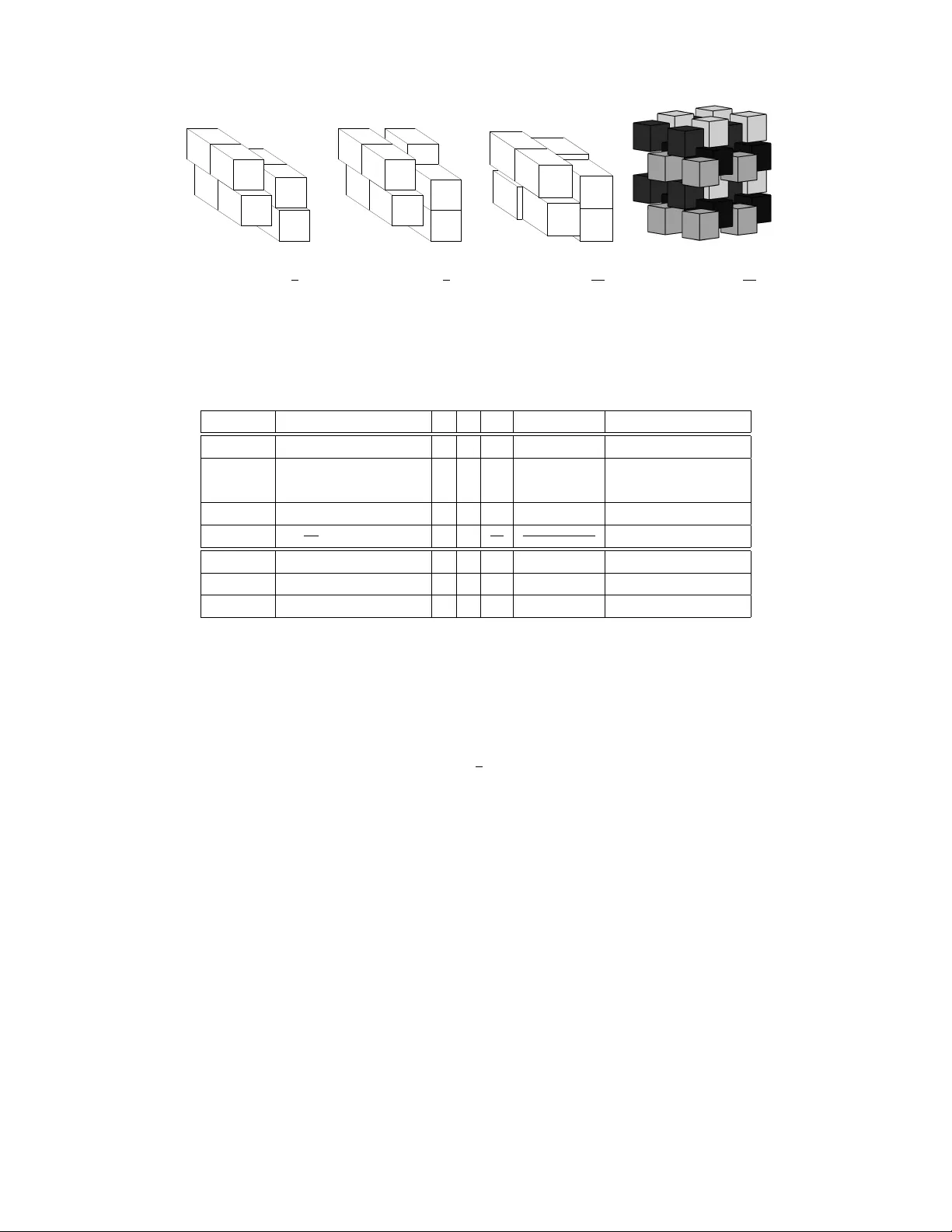
COMBINA TORIAL CUBE P A CKINGS IN CUBE AND TOR US MA THIEU DUTOUR SIKIRI ´ C AND YOSHIAKI ITOH Abstract. W e consider sequen tial random packing of cubes z + [0 , 1] n with z ∈ 1 N Z n in to the cub e [0 , 2] n and the torus R n / 2 Z n as N → ∞ . In the cub e case [0 , 2] n as N → ∞ the random cub e packings thus obtained are reduced to a single cub e with probability 1 − O 1 N . In the torus case the situation is different: for n ≤ 2, sequen tial random cub e pac king yields cub e tilings, but for n ≥ 3 with strictly p ositiv e probability , one obtains non-extensible cube packings. So, w e introduce the notion of combinatorial cub e pac king, which instead of de- p ending on N dep end on some parameters. W e use use them to deriv e an expansion of the pac king density in p o w ers of 1 N . The explicit computation is done in the cube case. In the torus case, the situation is more complicate and w e restrict ourselves to the case N → ∞ of strictly p ositiv e probability . W e prov e the following results for torus com binatorial cub e packings: • W e give a general Cartesian pro duct construction. • W e prov e that the num b er of parameters is at least n ( n +1) 2 and we conjecture it to b e at most 2 n − 1. • W e prov e that cub e packings with at least 2 n − 3 cub es are extensible. • W e find the minimal n umber of cub es in non-extensible cube packings for n o dd and n ≤ 6. 1. Introduction Tw o cub es z + [0 , 1] n and z 0 + [0 , 1] n are non-overlapping if the relative in teri- ors z +]0 , 1[ n and z 0 +]0 , 1[ n are disjoints. A family of cub es ( z i + [0 , 1] n ) 1 ≤ i ≤ m with z i ∈ 1 N Z n and N ∈ Z > 0 is called a discr ete cub e p acking if any t w o cub es are non- o v erlapping. W e consider packing of cub es z + [0 , 1] n with z ∈ 1 N Z n in to the cub e [0 , 2] n and the torus R n / 2 Z n . In those t w o cases, t w o cub es z + [0 , 1] n and z 0 + [0 , 1] n are non-o v erlapping if and only if there exist an index i ∈ { 1 , . . . , n } such that z i ≡ z 0 i + 1 (mo d 2). A discrete cub e pac king is a tiling if the num b er of cub es is 2 n and it is non-extensible if it is maximal by inclusion with less than 2 n cub es. A se quential r andom cub e p acking consists of putting a cub e z + [0 , 1] n with z ∈ 1 N Z n uniformly at random in the cub e [0 , 2] n or the torus R n / 2 Z n un til a maximal pac king is obtained. Let us denote b y M C N ( n ), M T N ( n ) the random v ariables of num ber of cub es of those non-extensible cub e packings and by E ( M C N ( n )), E ( M T N ( n )) their exp ectation. W e are interested in the limit N → ∞ and we prov e that if N > 1 then (1) E ( M U N ( n )) = ∞ X k =0 U k ( n ) ( N − 1) k with U ∈ { C , T } and U k ( n ) ∈ Q In the cub e case w e prov e that C k ( n ) are p olynomials of degree k , which w e compute for k ≤ 6 (see Theorem 3.3). In particular, C 0 = 1, since as N → ∞ with probabilit y The first author was partly supp orted by the Croatian Ministry of Science, Education and Sp ort under con tract 098-0982705-2707. 1 2 MA THIEU DUTOUR SIKIRI ´ C AND YOSHIAKI ITOH 1 − O ( 1 N ), one cannot add an y more cub e after the first one. In the torus case the co efficien ts T k ( n ) are no longer p olynomials in the dimension n . The first co efficien t T 0 ( n ) = lim N →∞ E ( M T N ( n )) is kno wn only for n ≤ 4 (see T able 1). But we prov e in Theorem 4.4 that if n ≥ 3 then T 0 ( n ) < 2 n . This upper b ound is related to the existence in dimension n ≥ 3 of non-extensible torus cub e packings (see Figure 2, T able 1, Theorem 4.4 and Section 5). Those results are derived using the notion of c ombinatorial cub e p ackings which is in tro duced in Section 2. A com binatorial cub e packing do es not dep end on N but instead on some parameters t i ; to a cub e or torus discrete cub e pac king C P , one can asso ciate a com binatorial cub e packing C P 0 = φ ( C P ). Giv en a combinatorial cub e pac king C P the probabilit y p ( C P , N ) of obtaining a discrete cub e packing C P 0 with φ ( C P 0 ) = C P is a fractional function of N . W e say that C P is obtained with strictly p ositive pr ob ability if the limit lim N →∞ p ( C P , N ) is strictly p ositive. In Section 3 the metho d of combinatorial cub e packings is applied to the cub e case and the p olynomials C k are computed for k ≤ 6. In the torus case, the situation is more complicated and w e restrict ourselv es to the case of strictly p ositiv e probabilit y , i.e. the limit case N → ∞ . In Section 4 w e consider a Cartesian product construction for con tin uous cub e pac kings obtained with strictly p ositiv e probability . The related lamination construction is used to derive an upp er b ound on E ( M T ∞ ( n )) in Theorem 4.4. In Section 5, we consider prop erties of non-extensible combinatorial torus cub e pac kings. Firstly , w e pro ve in Theorem 5.1 that combinatorial cub e packings with at least 2 n − 3 cub es are extensible to tilings. In Prop ositions 5.3 and 5.5, w e prov e that non-extensible combinatorial torus cub e pac kings obtained with strictly p ositiv e probabilit y hav e at least n ( n +1) 2 parameters and that this num ber is attained by a com binatorial cub e packing with n + 1 cub es if n is o dd. W e conjecture that the n um b er of parameters is at most 2 n − 1 (see Conjecture 5.4). In Prop osition 5.7 we pro v e that in dimension 6 the minimal n umber of cub es in non-extensible com binato- rial cub e pac kings is 8 and that none of those cub e pac kings is attained with strictly p ositiv e probabilit y . In Prop osition 5.8 w e sho w that in dimension 3, 5, 7 and 9, there exist com binatorial cub e tilings obtained with strictly p ositive probability and n ( n +1) 2 parameters. W e no w explain the origin of the mo del considered here. Pal´ asti [Pa60] considered maximal pac kings obtained from random packings of cub es [0 , 1] n in to [0 , x ] n . She conjectured that the exp ectation E ( M x ( n )) of the pac king densit y M x ( n ) satisfies the limit (2) lim x →∞ E ( M x ( n )) x n = β n . with β n = β n 1 . The v alue of β 1 is kno wn since the work of R ´ en yi [Re58] and in Penrose [P e01] the limit (2) is prov ed to exist. Note that based on simulations it is exp ected that β n > β n 1 and an exp erimen tal form ula from simulations β 1 /n n − β 1 ' ( n − 1)( β 1 / 2 2 − β 1 ) is kno wn [BlSo82]. The Itoh Ueda mo del [ItUe83] is a v arian t of the abov e: one considers pac king of cub es z + [0 , 2] n with z ∈ Z n in to [0 , 4] n . It is pro v ed in [DIP05, Po05, Po03] COMBINA TORIAL CUBE P ACKINGS IN CUBE AND TORUS 3 that the av erage n umber of cub es satisfies the inequality E ( M C 2 ( n )) ≥ ( 3 2 ) n and some computer estimate of the av erage density 1 2 n E ( M C 2 ( n )) w ere obtained in [ItSo86]. In [DIP06], w e considered the torus case, similar questions to the one of this pap er and a measure of regularity called second moment, which has no equiv alent here. 2. Combina torial cube p ackings If z + [0 , 1] n ⊂ [0 , 2] n and z = ( z 1 , . . . , z n ) ∈ 1 N Z n then z i ∈ { 0 , 1 N , . . . , 1 } . T ake a discrete cub e pac king C P = ( z i + [0 , 1] n ) 1 ≤ i ≤ m of [0 , 2] n . F or a given co ordinate 1 ≤ j ≤ n we set φ ( z i j ) = t i,j with t i,j a parameter if 0 < z i j < 1 and φ ( z i j ) = z i j if z i j = 0 or 1. If z i = ( z i 1 , z i 2 , . . . , z i n ) then we set φ ( z i ) = ( φ ( z i 1 ) , . . . , φ ( z i n )) and to C P w e asso ciate the com binatorial cub e pac king φ ( C P ) = ( φ ( z i ) + [0 , 1] n ) 1 ≤ i ≤ m . T ake a torus discrete cub e pac king C P = ( z i + [0 , 1] n ) 1 ≤ i ≤ m with z i ∈ 1 N Z n . F or a giv en co ordinate 1 ≤ j ≤ n w e set φ ( z i j ) = t k,j if z i j ≡ k N (mo d 2) and φ ( z i j ) = t k,j + 1 if z i j ≡ k N + 1 (mo d 2) with t k,j a parameter. Similarly , we set φ ( z i ) = ( φ ( z i 1 ) , . . . , φ ( z i n )) and w e define φ ( C P ) = ( φ ( z i ) + [0 , 1] n ) 1 ≤ i ≤ m the asso ciated torus com binatorial cub e pac king. In the remainder of this pap er we do not use the ab o v e parameters but instead ren um b er them in to t 1 , . . . , t N . Without loss of generalit y , we will alw a ys assume that differen t co ordinates ha v e different parameters. Of course w e can define com binatorial cub e packing without using to discrete cub e packings. In the cub e case, the relev ant cub es are of the form z + [0 , 1] n with z i = 0, 1 or some parameter t . In the torus case, the relev an t cub es are of the form z + [0 , 1] n with z i = t or t + 1 and t a parameter. Tw o cub es z i + [0 , 1] n and z i 0 + [0 , 1] n are non-ov erlapping if there exist a co ordinate j such that z i j ≡ z i 0 j + 1 (mo d 2). In the cube case this means that z i j = 0 or 1 and z i 0 j = 1 − z i j . In the torus case this means that z i j dep ends on the same parameter, sa y t , z i j , z i 0 j = t or t + 1 and z i j 6 = z i 0 j . A combinatorial cub e packing is then a family of suc h cub es with any tw o of them b eing non-ov erlapping. Notions of tilings and extensibilit y are defined as well. Moreov er, a discrete cub e pac king is extensible if and only if its asso ciated combinatorial cub e pac king is extensible. Denote by m ( C P ) the n um b er of cub es of a com binatorial cub e pac king C P and b y N ( C P ) its n um b er of parameters. Denote by C omb C ( n ), C omb T ( n ), the set of com binatorial cub e packings of [0 , 2] n , resp ectiv ely R n / 2 Z n . Giv en t wo com binatorial cube packings C P and C P 0 (either on cub e or torus), w e say that C P 0 is a subtyp e of C P if after assigning the parameter of C P to 0, 1, or some parameter of C P 0 , we get C P 0 . So, necessarily m ( C P 0 ) = m ( C P ) and N ( C P 0 ) ≤ N ( C P ) but the rev erse implication is not true in general. A combinatorial cub e packing is said to b e maximal if it is not the subtype of any other com binatorial cub e packing. Necessarily , a combinatorial cub e packing C P is a subt yp e of at least one maximal com binatorial cub e packing C P 0 . Giv en a combinatorial cub e pac king C P the num b er of discrete cub e packings C P 0 suc h that φ ( C P 0 ) = C P is denoted by N b ( C P , N ). In the cub e case we hav e N b ( C P , N ) = ( N − 1) N ( C P ) . The torus case is more complex but it is still p ossible to write explicit formulas: denote b y N j ( C P ) the num ber of parameters which o ccurs in the j -th co ordinate of C P . W e then get: (3) N b ( C P , N ) = Π n j =1 Π N j ( C P ) k =1 (2 N − 2( k − 1)) . 4 MA THIEU DUTOUR SIKIRI ´ C AND YOSHIAKI ITOH The asymptotic order of N b ( C P , N ) is (2 N ) N ( C P ) , which sho ws that N b ( C P , N ) > 0 for N large enough. More specifically , N j ( C P ) ≤ 2 n so N b ( C P , N ) > 0 if N ≥ 2 n . Note that it is p ossible to hav e C P 0 a subt yp e of C P and N b ( C P 0 , N ) > N b ( C P , N ) for small enough N . Denote by f T N ( n ) the minimal num ber of cub es of non-extensible discrete torus cube pac kings ( z i + [0 , 1] n ) 1 ≤ i ≤ m with z i ∈ 1 N Z n . Denote b y f T ∞ ( n ) the minimal num ber of cub es of non-extensible com binatorial torus cub e pac kings. Prop osition 2.1. F or n ≥ 1 we have lim N →∞ f T N ( n ) = f T ∞ ( n ) . Pr o of. A discrete cub e pac king C P is extensible if and only if φ ( C P ) is extensible. Th us f T ∞ ( n ) ≥ f T N ( n ). T ake C P a non-extensible combinatorial torus cub e packing with the minimal n um b er of cubes. By F ormula (3) there exist N 0 suc h that for N > N 0 w e hav e N b ( C P , N ) > 0. The discrete cub e packings C P 0 with φ ( C P 0 ) = C P are non-extensible. So, we hav e lim N →∞ f T N ( n ) = f T ∞ ( n ). In the cub e case w e hav e for N ≥ 2 the equality f C N ( n ) = 1. Tw o com binatorial cub e packings C P and C P 0 are said to b e equiv alen t if after a ren um b ering of the co ordinates, parameters and cub es of C P one gets C P 0 . The automorphism group of a com binatorial cub e pac king is the group of equiv alences of C P preserving it. T esting equiv alences and computing stabilizers can b e done using the program nauty [MKa05], which is a graph theory program for testing whether t w o graphs are isomorphic or not and computing the automorphism group. The metho d is to asso ciate to a given combinatorial cub e pac king C P a graph Gr ( C P ), whic h c haracterize isomorphism and automorphisms. The metho d used to find such a graph Gr ( C P ) are explained in the user man ual of nauty and the corresp onding programs are a v ailable from [Du07]. W e no w explain the sequen tial random cub e pac king. Given a discrete cube pac king C P = ( z i + [0 , 1] n ) 1 ≤ i ≤ m denote b y P oss ( C P ) the set of cub es z + [0 , 1] n with z ∈ 1 N Z n whic h do not ov erlap with C P . Every p ossible cub e z + [0 , 1] n is selected with equal probabilit y 1 | P oss ( C P ) | . The sequen tial random cub e packing pro cess is th us a pro cess that add cub es un til the discrete cub e pac king is non-extensible or is a tiling. Fix a combinatorial cub e pac king C P , N ≥ 2 n and a discrete cub e packing C P 0 suc h that φ ( C P 0 ) = C P . T o any cub e w + [0 , 1] n ∈ P oss ( C P 0 ) w e asso ciate the com binatorial cub e packing C P w = φ ( C P 0 ∪ { w + [0 , 1] n } ). The set P oss ( C P 0 ) is partitioned in to classes C l 1 , . . . , C l r with t wo cub es w + [0 , 1] n and w 0 + [0 , 1] n in the same class if C P w = C P w 0 . The com binatorial cub e packing asso ciated to C l i is denoted by C P i . The set {C P 1 , . . . , C P r } of classes dep ends only on C P . If w e had c hosen some N ≤ 2 n , then some of the preceding C P i migh t not hav e o ccurred. So, w e hav e | C l i ( N ) | = N b ( C P i , N ) N b ( C P , N ) and w e can define the probabilit y p ( C P , C P i , N ) of obtaining a discrete cub e pac king of com binatorial type C P i from a discrete cub e pac king of combinatorial type C P : p ( C P , C P i , N ) = | C l i ( N ) | | C l 1 ( N ) | + · · · + | C l r ( N ) | = N b ( C P i , N ) N b ( C P 1 , N ) + · · · + N b ( C P r , N ) . Giv en a combinatorial cub e pac king C P with m cub es a p ath p = {C P 0 , C P 1 , . . . , C P m } is a wa y of obtaining C P b y adding one cub e at a time starting from C P 0 = ∅ and COMBINA TORIAL CUBE P ACKINGS IN CUBE AND TORUS 5 ( t 1 , t 2 ) ( t 1 + 1 , t 3 ) ( t 1 , t 2 + 1) ( t 1 + 1 , t 3 + 1) A com binatorial cub e tiling obtained with probabilit y 1 2 . ( t 1 , t 2 + 1) ( t 1 + 1 , t 2 + 1) ( t 1 , t 2 ) ( t 1 + 1 , t 2 ) A com binatorial cub e tiling obtained with probabilit y 0. Figure 1. Tw o 2-dimensional torus combinatorial cub e tilings ending at C P m = C P . The probability to obtain C P along a path p is p ( C P , p, N ) = p ( C P 0 , C P 1 , N ) × · · · × p ( C P m − 1 , C P m , N ) . The probabilit y p ( C P , N ) to obtain C P is the sum o v er all the paths p leading to C P of p ( C P , p, N ). The probabilities p ( C P , p, N ) and p ( C P , N ) are fractional functions of N , whic h implies that the limit v alue p ( C P , ∞ ), p ( C P , p, ∞ ) and p ( C P , C P 0 , ∞ ) are w ell defined. As N go es to ∞ we hav e the asymptotic b eha vior | C l i ( N ) | ' (2 N ) nb i with nb i = N ( C P i ) − N ( C P ) the num b er of new parameters in C P i as compared with C P . Clearly as N go es to ∞ only the classes with the largest nb i ha v e p ( C P , C P i , ∞ ) > 0. If C l i is suc h a class then we get p ( C P , C P i , ∞ ) = 1 r 0 with r 0 the n um b er of classes C l i ha ving the largest nb i and otherwise p ( C P , C P i , ∞ ) = 0. Analogously , for a path p leading to C P w e can define p ( C P , p, ∞ ) and p ( C P , ∞ ). W e sa y that a com binatorial cub e pac king C P is obtained with strictly p ositive pr ob- ability if p ( C P , ∞ ) > 0 that is for at least one path p we hav e p ( C P , p, ∞ ) > 0. F or a path p = {C P 0 , C P 1 , . . . , C P m } we hav e p ( C P , p, ∞ ) > 0 if and only if every C P i has N ( C P i ) maximal among all p ossible extensions from C P i − 1 . This implies that each C P i is maximal, i.e. is not the subt yp e of another type. As a consequence, we can define a sequential random cub e packing pro cess for combinatorial cub e packing C P obtained with strictly p ositiv e probability and compute their probability p ( C P , ∞ ). A com binatorial cub e pac king C P is said to hav e order k = ord( C P ) if p ( C P , N ) = 1 ( N − 1) k f ( N ) with lim N →∞ f ( N ) ∈ R ∗ + . A com binatorial cub e packing is of order 0 if and only if it is obtained with strictly p ositiv e probabilit y . Let us denote b y M C N ( n ), M T N ( n ) the random v ariables of num ber of cub es of those non-extensible cub e pac kings and by E ( M C N ( n )), E ( M T N ( n )) their exp ectation. F rom the preceding discussion we hav e E ( M U N ( n )) = X C P ∈ C omb U ( n ) p ( C P , N ) m ( C P ) with U ∈ { C , T } . Denote by f T > 0 , ∞ ( n ) the minimal num ber of cub es of non-extensible combinatorial torus cub e pac kings obtained with strictly p ositiv e probability . 6 MA THIEU DUTOUR SIKIRI ´ C AND YOSHIAKI ITOH 7 parameters, probabilit y 1 3 7 parameters, probabilit y 1 3 6 parameters, probabilit y 5 18 6 parameters, probabilit y 1 18 Figure 2. The 3-dimensional combinatorial cub e pac kings obtained with strictly p ositiv e probability; tw o laminations ov er 2-dimensional cub e tilings, the ro d tiling and the smallest non-extensible cube pac king n 1 2 3 4 5 N = ∞ Nr cub e tilings 1 1 3 32 ? Nr non-extensible 0 0 1 31 ? cub e packings f T > 0 , ∞ ( n ) 2 4 4 6 6 1 2 n E ( M T ∞ ( n )) 1 1 35 36 15258791833 16102195200 ? N = 2 Nr cub e tilings 1 2 8 744 ? Nr cub e pac kings 0 0 1 139 ? f T 2 ( n ) 2 4 4 8 10 ≤ f T 2 (5) ≤ 12 T able 1. Num b er of packings and tilings for the case N = ∞ and N = 2 (see [DIP06]) In dimension 2 (see Figure 1), there are three com binatorial cub e tilings. One of them is attained with probabilit y 0; it is a subt yp e of the remaining t wo whic h are equiv alent and attained with probabilit y 1 2 . By applying the random cub e packing pro cess and doing reduction b y isomorphism, one obtains the 3-dimensional com bi- natorial cub e pac kings obtained with strictly p ositiv e probability (see Figure 2). The non-extensible cub e pac king sho wn on this figure already o ccurs in [La00, DIP06]. In dimension 4, the same enumeration metho d works (see T able 1) but dimension 5 is computationally to o difficult to en umerate. 3. Discrete Random cube p ackings of the cube W e compute here the p olynomials C k ( n ) o ccurring in Equation (1) for k ≤ 6. W e compute the first three p olynomials b y an elementary metho d. Lemma 3.1. Put the cub e z 1 + [0 , 1] n in [0 , 2] n and write I = { i : z 1 i = 0 or N } then do se quential r andom discr ete cub e p acking. (i) The minimal numb er of cub es in the p acking is | I | + 1 . COMBINA TORIAL CUBE P ACKINGS IN CUBE AND TORUS 7 (ii) The exp e cte d numb er of cub es in the p acking is | I | + 1 + O 1 N +1 . Pr o of. Let us prov e (i). If | I | = 0, then clearly one cannot insert any more cub es. W e will assume | I | > 1 and do a reasoning by induction on | I | . If one puts another cub e z 2 + [0 , 1] n , there should exist an index i ∈ I such that | z 2 i − z 1 i | = 1. T ake an index j 6 = i such that z 2 j is 0 or 1. The set of p ossibilities to add a subsequent cub e is larger if z j ∈ { 0 , 1 } than if z j ∈ { 1 N , . . . , N − 1 N } . So, one can assume that for j 6 = i , one has 0 < z 2 j < 1. This means that an y cub e z + [0 , 1] n in subsequen t insertion should satisfy | z i − z 2 i | = 1, i.e. z i = z 1 i . So, the sequential random cub e packing can b e done in one dimension less, starting with z 0 1 = ( z 1 , . . . , z i − 1 , z i +1 , . . . , z n ). The induction h yp othesis applies. Assertion (ii) follows easily by lo oking at the ab ov e pro cess. F or a given i the choice of z 2 with 0 < z 2 j < 1 for j 6 = i is the one with probabilit y 1 − O 1 N +1 . So, all neglected p ossibilities hav e probability O 1 N +1 and with probabilit y 1 − O 1 N +1 the n umber of cub es is the minimal p ossible. See b elo w the 2-dimensional p ossibilities: | I | = 0 | I | = 1 | I | = 2 The random v ariable M C N ( n ) is the num ber of cub es in the obtained non-extensible cub e-pac king. E ( M C N ( n )) is the exp ected num ber of cub es and E ( M C N ( n ) | k ) the exp ected n umber of cub es obtained by imp osing the condition that the first cub e z 1 + [0 , 1] n has |{ i : z 1 i = 0 or 1 }| = k . Theorem 3.2. F or any n ≥ 1 , we have E ( M C N ( n )) = 1 + 2 n N + 1 + 4 n ( n − 1) ( N + 1) 2 + O 1 N + 1 3 as N → ∞ . Pr o of. If one c ho oses a v ector z in { 0 , . . . , N } n the probability that |{ i : z 1 i = 0 or N }| = k is 2 N +1 k N − 1 N +1 n − k n k . Conditioning o v er k ∈ { 0 , 1 , . . . , n } , one obtains (4) E ( M C N ( n )) = n X k =0 2 N + 1 k N − 1 N + 1 n − k n k E ( M C N ( n ) | k ) . So one gets E ( M C N ( n )) = N − 1 N +1 n E ( M C N ( n ) | 0) + n 2 N +1 N − 1 N +1 n − 1 E ( M C N ( n ) | 1) + n ( n − 1) 2 ( N +1) 2 N − 1 N +1 n − 2 E ( M C N ( n ) | 2) + O 1 N +1 3 . 8 MA THIEU DUTOUR SIKIRI ´ C AND YOSHIAKI ITOH Clearly E ( M C N ( n ) | 0) = 1 and E ( M C N ( n ) | 1) = 1 + E ( M C N ( n − 1)). By Lemma 3.1, E ( M C N ( n ) | 2) = 3 + O 1 N +1 . Then, one has E ( M C N ( n )) = 1 + O 1 N +1 and E ( M C N ( n )) = 1 − 2 N +1 n + 2 n N +1 1 − 2 N +1 n − 1 (2 + O 1 N +1 ) + O 1 ( N +1) 2 = n 1 − 2 n N +1 + O 1 ( N +1) 2 o + 4 n N +1 + O 1 ( N +1) 2 = 1 + 2 n N +1 + O 1 ( N +1) 2 . Inserting this expression into E ( M C N ( n )) and F ormula (4) one gets the result. So, we get C 0 ( n ) = 1, C 1 ( n ) = 2 n and C 2 ( n ) = 4 n ( n − 2). In order to compute C k ( n ) in general w e use methods similar to the ones of Section 2. Given a cub e z + [0 , 1] n with z i ∈ { 0 , 1 N , . . . , 1 } w e define a face of the cub e [0 , 1] n in the following w a y: if z i = 0 or 1 then we set ψ ( z i ) = 0 or 1 whereas if 0 < z i < 1 we set ψ ( z i ) = t i with t i a parameter. When the parameters t i of the v ector ( ψ ( z 1 ) , . . . , ψ ( z n )) v ary in ]0 , 1[ this vector describ es a face of the cub e [0 , 1] n , whic h we denote b y ψ ( z ). This construction w as presented for the first time in [P o03, Po05]. If F and F 0 are tw o faces of [0 , 1] n , then w e say that F is a sub-face of F 0 and write F ⊂ F 0 if F is included in the closure of F 0 . A sub complex of the h yp ercub e [0 , 1] n is a set of faces, whic h contains all its sub-faces. If C P is a cub e packing in [0 , 2] n , then the v ectors z such that z + [0 , 1] n is a cub e whic h we can add to it are indexed by the faces of a sub complex [0 , 1] n with the dimension giving the exp onent of ( N − 1) k . The dimension of a complex is the highest dimension of its faces. Given a discrete cub e pac king C P , we hav e seen in Section 2 that the size of P oss ( C P ) dep ends only on the com binatorial t yp e φ ( C P ). In the cub e case whic h we consider in this section P oss ( C P ) itself dep ends only on the com binatorial type. Theorem 3.3. Ther e exist p olynomials C k ( n ) of n with deg C k = k such that for any n and N > 1 one has: E ( M C N ( n )) = ∞ X k =0 C k ( n ) ( N − 1) k . The p olynomials C k ( n ) ar e given in T able 2. Pr o of. The image ψ ( P oss ( C P )) is an union of faces of [0 , 1] n , i.e. a sub complex of the complex [0 , 1] n . Denote b y dim( F ) the dimension of a face F of the cub e [0 , 1] n . Denote by P oss ( F ) the set of vectors z ∈ { 0 , 1 N , . . . , 1 } n with ψ ( z ) = F . w e hav e the form ula: | P oss ( F ) | = ( N − 1) dim( F ) and | P oss ( C P ) | = X F ( N − 1) dim( F ) . The cubes, whose corresp onding face in [0 , 1] n ha v e dimension dim( ψ ( P oss ( C P ))) ha v e the highest probabilit y of b eing obtained. If one seeks the expansion of E ( M C N ( n )) up to order k and if C P is of order ord( C P ) then we need to compute the faces of ψ ( P oss ( C P )) of dimension at least dim( ψ ( P oss ( C P ))) − ( k − ord( C P )). The proba- bilities are then obtained in the following wa y: (5) p ( F , N ) = ( N − 1) dim( F ) P F 0 ∈ ψ ( P oss ( C P )) with dim( F 0 ) ≥ dim( ψ ( P oss ( C P ))) − ( k − ord( C P )) ( N − 1) dim( F 0 ) . COMBINA TORIAL CUBE P ACKINGS IN CUBE AND TORUS 9 The en umeration algorithm is then the follo wing: Input: Exp onen t k . Output: List L of all inequiv alent combinatorial types of non-extensible cub e pac kings C P with order at most k and their probabilities p ( C P , N ) with an error of O 1 ( N +1) k +1 . T ← {∅} . L ← ∅ while there is a C P ∈ T do T ← T \ {C P } ψ ( P oss ( C P )) ← the complex of all p ossibilities of adding a cub e to C P F ← the faces of ψ ( P oss ( C P )) of dimension at least dim( ψ ( P oss ( C P ))) − ( k − ord( C P )) if F = ∅ then if C P is equiv alen t to a C P 0 in L then p ( C P 0 , N ) ← p ( C P 0 , N ) + p ( C P , N ) else L ← L ∪ {C P } end if else for C ∈ F do C P new ← C P ∪ { C } p ( C P new , N ) ← p ( C P , N ) p ( C, N ) if C P new is equiv alent to a C P 0 in T then p ( C P 0 , N ) ← p ( C P 0 , N ) + p ( C P new , N ) else T ← T ∪ {C P new } end if end for end if end while Let us pro ve that the co efficien ts C k ( n ) are p olynomials in the dimension n . If C is the cub e [0 , 1] n then the n umber of faces of co dimension l is 2 l n l , i.e. a p olynomial in n of degree l . Supp ose that a cub e pac king C P = ( z i + [0 , 1] n ) 1 ≤ i ≤ m has 0 < z i j < 1 for n 0 ≤ j ≤ n . Then all faces F of ψ ( P oss ( C P )) of maximal dimension d = dim( ψ ( P oss ( C P ))) ha ve 0 < z j < 1 for n 0 ≤ j ≤ n and z ∈ F . When one chooses a subface of F of dimension d − l , w e hav e to c ho ose some co ordinates j to b e equal to 0 or 1. Denote by l 0 the num ber of such co ordinates j with n 0 ≤ j ≤ n . There are 2 l 0 n +1 − n 0 l 0 c hoices and they are all equiv alen t. There are still l − l 0 c hoices to b e made for j ≤ n 0 − 1 but this num ber is finite so in all cases the faces of ψ ( P oss ( C P )) of dimension at least d − l can b e group ed in a finite num b er of classes with the size of the classes dep ending on n p olynomially . Moreo ver, the n um b er of classes of dimension d is finite so the term of higher order in the denominator of Equation (5) is constan t and the co efficients of the expansion of p ( F , N ) are p olynomial in n . 10 MA THIEU DUTOUR SIKIRI ´ C AND YOSHIAKI ITOH k | C omb C k | C k ( n ) 0 1 1 1 2 2 n 2 3 4 n ( n − 2) 3 7 1 3 { 28 n 3 − 153 n 2 + 149 n } 4 18 1 2 · 3 2 · 5 { 2016 n 4 − 21436 n 3 + 58701 n 2 − 40721 n } 5 86 1 2 2 3 3 · 5 · 7 { 208724 n 5 − 3516724 n 4 + 18627854 n 3 − 35643809 n 2 + 20444915 n } 6 1980 1 2 8 3 11 5 5 7 3 11 3 · 13 · 17 { 1929868729224214329703 n 6 − 46928283796201160537385 n 5 +397379056595496330171955 n 4 − 1442659974291080413770375 n 3 +2205275555952621337847422 n 2 − 1115911322466787143241320 n } T able 2. The p olynomials C k ( n ). | C omb C k | is the n umber of types of com binatorial cub e pac kings C P with ord( C P ) ≤ k 4. Combina torial torus cube p ackings and lamina tion construction Lemma 4.1. L et C P b e a non-extensible c ombinatorial torus cub e p acking. (i) Every p ar ameter t of C P o c curs, which o c curs as t also o c curs as t + 1 . (ii) L et C 1 , . . . , C k b e cub es of C P and C a cub e which do es not overlap with C P 0 = C P − { C 1 , . . . , C k } . The numb er of p ar ameters of C , which do es not o c cur in C P 0 is at most k − 1 . Pr o of. (i) Supp ose that a parameter t of C P occurs as t but not as t + 1 in the co ordinates of the cub es. Let C = z + [0 , 1] n b e a cub e ha ving t in its j -th co ordinate. If C 0 = z 0 + [0 , 1] n is a cub e of C P , then there exist a co ordinate j 0 suc h that z 0 j 0 ≡ z j 0 + 1 (mo d 2). Necessarily j 0 6 = j since t + 1 do es not o ccur, so C + e j do es not o v erlap with C 0 as w ell and obviously C + e j do es not o v erlap with C . (ii) Let C = z + [0 , 1] n b e a cub e which do es not o v erlap with the cub es of C P 0 . Supp ose that z has k co ordinates i 1 < · · · < i k suc h that their parameters t 1 , . . . , t k do not o ccur in C P 0 . If C j = z j + [0 , 1] n , then w e fix z i j ≡ z j i j + 1 (mo d 2) for 1 ≤ j ≤ k so that C do es not o verlap with C P . This con tradicts the fact that C P is extensible so z has at most k − 1 parameters, which do not o ccur in C P 0 . T ake t w o combinatorial torus cub e pac kings C P = ( z i + [0 , 1] n ) 1 ≤ i ≤ m and C P 0 = ( z 0 j + [0 , 1] n 0 ) 1 ≤ j ≤ m 0 . Denote b y ( z 0 i,j + [0 , 1] n 0 ) 1 ≤ j ≤ m 0 with 1 ≤ i ≤ m m indep enden t copies of C P 0 ; that is every parameter t 0 k of z 0 j is replaced b y a parameter t 0 i,k in z 0 i,j . One defines the combinatorial torus cub e pac king C P n C P 0 b y ( z i , z 0 i,j ) + [0 , 1] n + n 0 for 1 ≤ i ≤ m and 1 ≤ j ≤ m 0 . Denote by C P 1 the 1-dimensional combinatorial pac king formed b y ( t + [0 , 1] , t + 1 + [0 , 1]). The combinatorial cub e pac kings C P 1 n C P 1 and C P 1 n ( C P 1 n C P 1 ) are the ones on the left of Figure 1 and 2, resp ectiv ely . Note that in general C P n C P 0 is not isomorphic to C P 0 n C P . Theorem 4.2. L et C P and C P 0 b e two c ombinatorial torus cub e p ackings of dimension n and n 0 , r esp e ctively. (i) m ( C P n C P 0 ) = m ( C P ) m ( C P 0 ) and N ( C P n C P 0 ) = N ( C P ) + m ( C P ) N ( C P 0 ) . (ii) C P n C P 0 is extensible if and only if C P and C P 0 ar e extensible. COMBINA TORIAL CUBE P ACKINGS IN CUBE AND TORUS 11 (iii) If C P and C P 0 ar e obtaine d with strictly p ositive pr ob ability and C P is non- extensible then C P n C P 0 is attaine d with strictly p ositive pr ob ability. (iv) One has f T ∞ ( n + m ) ≤ f T ∞ ( n ) f T ∞ ( m ) and f T > 0 , ∞ ( n + m ) ≤ f T > 0 , ∞ ( n ) f T > 0 , ∞ ( m ) . Pr o of. Denote by ( z i + [0 , 1] n ) 1 ≤ i ≤ m and by ( z 0 j + [0 , 1] n 0 ) 1 ≤ j ≤ m 0 the cub es of C P and C P 0 obtained in this order, i.e. first z 1 + [0 , 1] n , then z 2 + [0 , 1] n and so on. Assertion (i) follo ws by simple counting. If C P , resp ectiv ely C P 0 is extensible to C P ∪ { C } , C P 0 ∪ { C 0 } then C P n C P 0 is extensible to ( C P ∪ { C } ) n C P 0 , resp ectiv ely C P n ( C P 0 ∪ { C 0 } ) and so extensible. Supp ose no w that C P and C P 0 are non-extensible and tak e a cub e z + [0 , 1] n + n 0 with z expressed in terms of the parameters of C P n C P 0 . Then the cub e ( z 1 , . . . , z n ) + [0 , 1] n o v erlaps with one cub e of C P , say z i + [0 , 1] n . Also ( z n +1 , . . . , z n + n 0 ) + [0 , 1] n 0 o v erlaps with one cub e of C P 0 , say z 0 j + [0 , 1] n . So, z + [0 , 1] n + n 0 o v erlaps with the cub e ( z i , z 0 i,j ) + [0 , 1] n + n 0 and C P n C P 0 is non-extensible, establishing (ii). A priori there is no simple relation b et w een p ( C P n C P 0 , ∞ ) and p ( C P , ∞ ), p ( C P 0 , ∞ ). But we will prov e that if p ( C P , ∞ ) > 0, p ( C P 0 , ∞ ) > 0 and C P is not extensible then p ( C P n C P 0 , ∞ ) > 0. That is, to pro v e (iii) we hav e to provide one path, among p os- sible many , in the random sequential cub e packing pro cess to obtain C P n C P 0 with strictly p ositiv e probability from some corresp onding paths of C P and C P 0 . W e first pro v e that we can obtain the cub es (( z i , z 0 i, 1 ) + [0 , 1] n + n 0 ) 1 ≤ i ≤ m with strictly p ositiv e probabilit y in this order. Supp ose that we add a cub e z + [0 , 1] n + n 0 after the cub es ( z i 0 , z 0 i 0 , 1 ) + [0 , 1] n + n 0 with i 0 < i . If w e c ho ose a co ordinate k ∈ { n + 1 , . . . , n + n 0 } suc h that z k = ( z i 0 , z 0 i 0 , 1 ) k + 1 for some i 0 < i then we still ha ve to c ho ose a co ordinate for all other cub es. This is b ecause all parameters in ( z 0 i, 1 ) 1 ≤ i ≤ m are distinct. So, w e do not gain anything in terms of dimension by choosing k ∈ { n + 1 , . . . , n + n 0 } and the choice ( z i , z 0 i, 1 ) has the same or higher dimension. So, w e can get the cub es (( z i , z 0 i, 1 ) + [0 , 1] n + n 0 ) 1 ≤ i ≤ m with strictly p ositiv e probabilit y . Supp ose that w e ha v e the cubes ( z i , z 0 i,j ) + [0 , 1] n + n 0 for 1 ≤ i ≤ m and 1 ≤ j ≤ m 0 0 . W e will prov e b y induction that we can add the cub es (( z i , z 0 i,m 0 0 +1 ) + [0 , 1] n + n 0 ) 1 ≤ i ≤ m . Denote by n 0 m 0 0 ≤ n 0 − 1 the dimension of c hoices in the com binatorial torus cub e pac king ( z 0 j + [0 , 1] n 0 ) 1 ≤ j ≤ m 0 0 . Let z + [0 , 1] n + n 0 b e a cub e, which w e wan t to add to the existing cub e packing. Denote by S z the set of i such that z + [0 , 1] n + n 0 do es not ov erlap with ( z i , z 0 i,j ) + [0 , 1] n + n 0 on a co ordinate k ≤ n . The fact that z + [0 , 1] n + n 0 do es not ov erlap with the cub es ( z i , z 0 i,j ) + [0 , 1] n + n 0 fixes n 0 − n 0 m 0 0 co ordinates of z . If i 6 = i 0 then the parameters in z 0 i,j and z 0 i 0 ,j 0 are different; this means that ( n 0 − n 0 m 0 0 ) |S z | comp onen ts of z are determined. Therefore, since C P is non-extensible, w e can use Lemma 4.1.(ii) and so get the follo wing estimate on the dimension D of choices: (6) D ≤ { n 0 − ( n 0 − n 0 m 0 0 ) |S z |} + {|S z | − 1 } ≤ n 0 m 0 0 − ( n 0 − n 0 m 0 0 − 1) {|S z | − 1 } ≤ n 0 m 0 0 . W e conclude that w e cannot do b etter in terms of dimension than adding the cub es (( z i , z 0 i,m 0 0 +1 ) + [0 , 1] n + n 0 ) 1 ≤ i ≤ m , which we do. So we hav e a path p with p ( C P n 12 MA THIEU DUTOUR SIKIRI ´ C AND YOSHIAKI ITOH C P 0 , p, ∞ ) > 0 which prov es that C P n C P 0 is obtained with strictly p ositiv e proba- bilit y . (iv) follo ws immediately from (iii) and (ii). There exist cub e packings C P , C P 0 obtained with strictly p ositive probability suc h that p ( C P n C P 0 , ∞ ) > 0, whic h sho ws that the h yp othesis C P non-extensible is necessary in (iii). The third 3-dimensional cub e packings of Figure 2, named ro d packing has the cub es ( h i + [0 , 1] 3 ) 1 ≤ i ≤ 8 with the follo wing h i : h 1 = ( t 1 , t 2 , t 3 ) h 5 = ( t 6 + 1 , t 2 + 1 , t 5 + 1) h 2 = ( t 1 + 1 , t 4 , t 5 ) h 6 = ( t 1 , t 2 , t 3 + 1) h 3 = ( t 6 , t 2 + 1 , t 5 + 1) h 7 = ( t 1 + 1 , t 2 , t 5 + 1) h 4 = ( t 1 + 1 , t 4 + 1 , t 5 ) h 8 = ( t 1 , t 2 + 1 , t 5 ) T aking 8 ( n − 3)-dimensional combinatorial torus cub e-tilings ( w i,j ) 1 ≤ j ≤ 2 n − 3 with 1 ≤ i ≤ 8, one defines a n -dimensional r o d tiling combinatorial cub e packing ( z i , w i,j ) + [0 , 1] n for 1 ≤ i ≤ 8 and 1 ≤ j ≤ 2 n − 3 . Theorem 4.3. The pr ob ability of obtaining a r o d tiling is p 15 1 × q 8 n − 3 wher e q n is the pr ob ability of obtaining a n -dimensional cub e-tiling and p 15 1 is a r ational function of n . Pr o of. Up to equiv alence, one can assume that in the random-cub e packing pro cess, one puts z 1 = ( h 1 , w 1 , 1 ) = ( t 1 , t 2 , t 3 , . . . ) and z 2 = ( h 2 , w 2 , 1 ) = ( t 1 + 1 , t 4 , t 5 , . . . ) . Then there are n ( n − 1) possible c hoices for the next cub e, 2( n − 1) of them are resp ecting the lamination. So, there are ( n − 2)( n − 1) c hoices which do not resp ect the lamination and their probabilit y is p 3 1 = n − 2 n . Without loss of generalit y , w e can assume that one has z 3 = ( h 3 , w 3 , 1 ) = ( t 6 , t 2 + 1 , t 5 + 1 , . . . ) . In the next 5 stages w e add cubes with n − 3 new parameters each. W e ha v e more than one t yp e to consider under equiv alence and w e need to determine the total num ber of p ossibilities in order to compute the probabilities. F or the cub e z 4 + [0 , 1] n w e should hav e three in tegers i 1 , i 2 , i 3 suc h that z 4 i j ≡ z j i j + 1 (mo d 2). Necessarily , the i j are all distinct, which giv es n ( n − 1)( n − 2) p ossibilities. There are exactly 6 p ossibilities with i j ≤ 3. One of them corresp onds to the non- extensible cube pac king of Figure 2 on the first 3 co ordinates which the 5 others ha v e a non-zero probabilit y of b eing extended to the ro d tiling. When computing later probabilities, we used the automorphism group of the existing configuration and gather the possibilities of extension in to orbits. At the fourth stage, the 5 p ossibilities split in to tw o orbits: (1) O 4 1 : ( h i , w i, 1 ) for i ∈ { 1 , 2 , 3 , 4 } with p 4 1 = p 3 1 3 n ( n − 1)( n − 2) , (2) O 4 2 : ( h i , w i, 1 ) for i ∈ { 1 , 2 , 3 , 7 } with p 4 2 = p 3 1 2 n ( n − 1)( n − 2) ; write ∆ 4 2 = 3( n − 3)( n − 4) + 3( n − 3) + 4 the n um b er of p ossibilities of adding a cub e to the pac king (( h i , w i, 1 ) + [0 , 1] n ) i ∈{ 1 , 2 , 3 , 7 } . COMBINA TORIAL CUBE P ACKINGS IN CUBE AND TORUS 13 When adding a fifth cub e one finds the following cases up to equiv alence: (1) O 5 1 : ( h i , w i, 1 ) for i ∈ { 1 , 2 , 3 , 4 , 5 } with p 5 1 = p 4 1 2 2( n − 1)( n − 2) , (2) O 5 2 : ( h i , w i, 1 ) for i ∈ { 1 , 2 , 3 , 4 , 7 } with p 5 2 = p 4 1 2 2( n − 1)( n − 2) + p 4 2 3 ∆ 4 2 , (3) O 5 3 : ( h i , w i, 1 ) for i ∈ { 1 , 2 , 3 , 7 , 8 } with p 5 3 = p 4 2 1 ∆ 4 2 . When adding a sixth cub e one finds the following cases up to equiv alence: (1) O 6 1 : ( h i , w i, 1 ) for i ∈ { 1 , 2 , 3 , 4 , 5 , 6 } with p 6 1 = p 5 1 1 3( n − 2) , (2) O 6 2 : ( h i , w i, 1 ) for i ∈ { 1 , 2 , 3 , 4 , 5 , 7 } with p 6 2 = p 5 1 2 3( n − 2) + p 5 2 2 n ( n − 2) , (3) O 6 3 : ( h i , w i, 1 ) for i ∈ { 1 , 2 , 3 , 4 , 7 , 8 } with p 6 3 = p 5 2 1 n ( n − 2) + p 5 3 3 3( n − 2) . When adding a seven th cub e one finds the following cases up to equiv alence: (1) O 7 1 : ( h i , w i, 1 ) for i ∈ { 1 , 2 , 3 , 4 , 5 , 6 , 7 } with p 7 1 = p 6 1 + p 6 2 1 n − 1 , (2) O 7 2 : ( h i , w i, 1 ) for i ∈ { 1 , 2 , 3 , 4 , 5 , 7 , 8 } with p 7 2 = p 6 2 1 n − 1 + p 6 3 2 2( n − 2) . The combinatorial cub e packing of eight cub es (( h i , w i, 1 )+[0 , 1] n ) 1 ≤ i ≤ 8 is then obtained with probabilit y p 8 1 = p 7 1 + p 7 2 1 n − 2 . Then w e add cub es in dimension n − 4 follo wing in fact the construction of Theorem 4.2. The parameters t 3 , t 4 and t 6 app ear only t wo times in the cub e packing for the ro ds, whic h con tain 6 cub es in total. So, when one adds cub es w e hav e 8( n − 3) c hoices resp ecting the cub e pac king, i.e. of the form z 9 = ( h i , w i, 2 ) with w i, 2 j ≡ w i, 1 j (mo d 2) for some 1 ≤ j ≤ n − 3. W e also hav e 3( n − 3)( n − 4) choices not resp ecting the ro d tiling structure, i.e. of the form z 9 = ( k i , w ) with k i b eing one of h i for 1 ≤ i ≤ 3 with t 3 , t 4 or t 6 replaced by another parameter. But after adding a cub e ( h i , w i, 2 ) + [0 , 1] n with h i con taining t 3 , t 4 or t 6 this phenomenon cannot o ccur. Belo w a typ e T h r of probabilit y p h r is a packing formed by the 8 vectors ( h i , w i, 1 ) 1 ≤ i ≤ 8 and h − 8 vectors of the form ( h i , w i, 2 ) amongst whic h r of the parameters t 3 , t 4 or t 6 do not o ccur. Note that there may b e several non-equiv alen t cub e pac kings with the same type but this is not imp ortan t since they hav e the same n um b ers of p ossibilities. Adding 9 th cub e one gets: (1) T 9 3 , p 9 1 = p 8 1 2( n − 3) 8( n − 3)+3( n − 3)( n − 4) , (2) T 9 2 , p 9 2 = p 8 1 6( n − 3) 8( n − 3)+3( n − 3)( n − 4) . Adding 10 th cub e one gets: (1) T 10 3 , p 10 1 = p 9 1 n − 3 7( n − 3)+3( n − 3)( n − 4) , (2) T 10 2 , p 10 2 = p 9 1 6( n − 3) 7( n − 3)+3( n − 3)( n − 4) + p 9 2 3( n − 3) 7( n − 3)+2( n − 3)( n − 4) , (3) T 10 1 , p 10 3 = p 9 2 4( n − 3) 7( n − 3)+2( n − 3)( n − 4) . Adding 11 th cub e one gets: (1) T 11 2 , p 11 1 = p 10 1 6( n − 3) 6( n − 3)+3( n − 3)( n − 4) + p 10 2 2( n − 3) 6( n − 3)+2( n − 3)( n − 4) , (2) T 11 1 , p 11 2 = p 10 2 4( n − 3) 6( n − 3)+2( n − 3)( n − 4) + p 10 3 4( n − 3) 6( n − 3)+( n − 3)( n − 4) , (3) T 11 0 , p 11 3 = p 10 3 2( n − 3) 6( n − 3)+2( n − 3)( n − 4) . Adding 12 th cub e one gets: (1) T 12 2 , p 12 1 = p 11 1 n − 3 5( n − 3)+2( n − 3)( n − 4) , (2) T 12 1 , p 12 2 = p 11 1 4( n − 3) 5( n − 3)+2( n − 3)( n − 4) + p 11 2 3( n − 3) 5( n − 3)+2( n − 3)( n − 4) , 14 MA THIEU DUTOUR SIKIRI ´ C AND YOSHIAKI ITOH (3) T 12 0 , p 12 3 = p 11 2 2( n − 3) 5( n − 3)+2( n − 3)( n − 4) + p 11 3 5( n − 3) 5( n − 3)+2( n − 3)( n − 4) . Adding 13 th cub e one gets: (1) T 13 1 , p 13 1 = p 12 1 4( n − 3) 4( n − 3)+2( n − 3)( n − 4) + p 12 2 2( n − 3) 4( n − 3)+( n − 3)( n − 4) , (2) T 13 0 , p 13 2 = p 12 2 2( n − 3) 4( n − 3)+( n − 3)( n − 4) + p 12 3 4( n − 3) 4( n − 3) . Adding 14 th cub e one gets: (1) T 14 1 , p 14 1 = p 13 1 ( n − 3) 3( n − 3)+( n − 3)( n − 4) , (2) T 14 0 , p 13 2 = p 13 1 2( n − 3) 3( n − 3)+( n − 3)( n − 4) + p 13 2 3( n − 3) 3( n − 3) . Adding 15 th cub e one gets: (1) T 15 0 , p 15 1 = p 14 1 2( n − 3) 2( n − 3)+( n − 3)( n − 4) + p 14 2 . After that if we add a cube z + [0 , 1] n , then necessarily z is of the form ( h i , w ). So, we ha ve 8 different ( n − 3)-dimensional cub e packing problems sho w up and the probabilit y is p 15 1 q 8 n − 3 . A combinatorial torus cub e packing C P is called laminate d if there exist a co ordi- nate j and a parameter t suc h that for every cub e z + [0 , 1] n of C P we ha ve z j ≡ t (mo d 1). Theorem 4.4. (i) The pr ob ability of obtaining a laminate d c ombinatorial cub e p ack- ing is 2 n . (ii) F or any n ≥ 1 , one has E ( M T ∞ ( n )) ≤ 2 n (1 − 2 n ) + 4 n E ( M T ∞ ( n − 1)) . (iii) F or any n ≥ 3 , 1 2 n E ( M T ∞ ( n )) ≤ 1 − 2 n n ! 1 24 Pr o of. Up to equiv alence, w e can assume that after the first tw o steps of the pro cess, w e hav e z 1 = ( t 1 , . . . , t n ) and z 2 = ( t 1 + 1 , t n +1 , . . . , t 2 n − 1 ) . So, we consider lamination on the first coordinate. W e then consider all p ossible cub es that can b e added. Those cub es should ha v e one co ordinate differing by 1 with other v ectors. This mak es n ( n − 1) p ossibilities. If a v ector resp ects the lamination on the first co ordinate then its first co ordinate should b e equal to t 1 or t 1 + 1. This mak es 2( n − 1) p ossibilities. So, the probability of having a family of cub e resp ecting a lamination at the third step is 2 n . But one sees easily that in all further steps, the c hoices breaking the lamination hav e a dimension strictly lo w er than the one resp ecting the lamination, so they do not o ccur and we get (i). By separating b et ween laminated and non-laminated combinatorial torus cub e pac kings, b ounding the num ber of cub es of non-laminated combinatorial torus cube pac kings by 2 n one obtains E ( M T ∞ ( n )) ≤ (1 − 2 n ) × 2 n + 2 n ( E ( M T ∞ ( n − 1)) + E ( M T ∞ ( n − 1))) , whic h is (ii). (iii) follows by induction starting from 1 8 E ( M T ∞ (3)) = 35 36 (see T able 1). 5. Proper ties of non-extensible cube p ackings Theorem 5.1. If a c ombinatorial torus cub e p acking has at le ast 2 n − 3 cub es, then it is extensible. COMBINA TORIAL CUBE P ACKINGS IN CUBE AND TORUS 15 Pr o of. Our pro of closely follo ws [DIP06] but is differen t from it. T ak e C P 0 a com bina- torial torus cub e pac king with 2 n − α cub es, α ≤ 3. T ake N such that N b ( C P , N ) > 0 and C P a discrete cub e pac king with φ ( C P ) = C P 0 . If C P is extensible then C P 0 is extensible as w ell. W e select δ ∈ R and denote by I j the interv al [ δ + j 2 , δ + j +1 2 [ for 0 ≤ j ≤ 3. Denote b y n j,k the n umber of cub es, whose k -th co ordinate mo dulo 2 b elong to I j . All cub es of C P , whose k -th co ordinate b elongs to I j , I j +1 form after remo v al of their k -th co ordinate a cub e packing of dimension n − 1, whic h we denote b y C P j,k . W e write n j,k + n j +1 ,k = 2 n − 1 − d j,k and obtain the equations d 0 ,k − d 1 ,k + d 2 ,k − d 3 ,k = 0 and 3 X j =0 d j,k = 2 α. W e can then write the v ector d k = ( d 0 ,k , d 1 ,k , d 2 ,k , d 3 ,k ) in the following wa y: d k = c 1 (1 , 1 , 0 , 0) + c 2 (0 , 1 , 1 , 0) + c 3 (0 , 0 , 1 , 1) + c 4 (1 , 0 , 0 , 1) with 4 X j =1 c j = α and c i ∈ Z + . This implies d j,k = c j + c j +1 ≤ P c j = α . This means that the ( n − 1)- dimensional cub e packing C P j,k has at least 2 n − 1 − 3 cub es, so by an induction argumen t, we conclude that C P j,k is extensible. Supp ose no w that the k -th co ordinate of the cub es in C P hav e v alues 0 < δ 1 < δ 2 < · · · < δ M < 2. So, the set of p oints in the complement of C P , whose k -th co ordinate b elongs to the interv al [ δ i , δ i +1 [ with δ M +1 = δ 1 + 2 can b e filled b y translates of the parallelepip ed P ar al k ( α ) = [0 , 1[ k − 1 × [0 , α [ × [0 , 1[ n − k . Note that as δ v aries, the v ector d k v aries as w ell. Suppose that for some i , w e ha v e the k -th lay er [ δ i , δ i +1 [ b eing full and [ δ i − 1 , δ i [ containing x translates with x ≤ 3 of the parallelepip ed P ar al k ( δ i +1 − δ i ). Then if one selects another co ordinate k 0 , all parallelepip eds P ar al k 0 ( δ 0 i 0 +1 − δ 0 i 0 ) filling the hole delimited b y the parallelepip ed P ar al k ( δ i +1 − δ i ) will hav e the same p osition in the k -th co ordinate. This means that they will form x cub es and that the cub e packing is extensible. This argument solv es the case α = 1, b ecause up to symmetry d k = (0 , 1 , 1 , 0). If α = 2, then the case of v ector of co ordinate d k b eing equal to symmetry to (0 , 2 , 2 , 0) or (0 , 1 , 2 , 1) is also solved because we ha v e seen that a full lay er implies that we can fill the hole. W e hav e the remaining case (1 , 1 , 1 , 1). If the hole of this cub e packing cannot b e filled, then w e hav e a structure of this form: x k 0 x k Selecting another co ordinate k 0 , we get that the t w o parallelepipeds z + P ar al k ( δ i +1 − δ i ) and z 0 + P ar al k ( δ i 0 +1 − δ i 0 ) hav e z l = z 0 l for l 6 = k , k 0 . This is imp ossible if n ≥ 4. So, if d k = (1 , 1 , 1 , 1) for some k and δ , then the hole can b e filled. 16 MA THIEU DUTOUR SIKIRI ´ C AND YOSHIAKI ITOH If α = 3, and d k , up to symmetry , is equal to (0 , 3 , 3 , 0) or (0 , 2 , 3 , 1) then w e hav e a full lay er and so we can fill the hole. If the v ector d k = (2 , 1 , 1 , 2) o ccurs, then b y the same argumen t as for (1 , 1 , 1 , 1) we can fill the hole. Prop osition 5.2. (i) Non extensible c ombinatorial torus cub e p ackings of dimension n have at le ast n + 1 cub es. (ii) If C P is a c ombinatorial torus cub e tiling, then in a c o or dinate j a p ar ameter t o c cur the same numb er of times as t and t + 1 . Pr o of. (i) Suppose that a com binatorial torus cube pac king C P has m ≤ n cub es ( z i + [0 , 1] n ) 1 ≤ i ≤ m . By fixing z i = z i i + 1 for i = 1 , 2 , . . . , m w e get that the cub e z + [0 , 1] n do es not o v erlap with C P . (ii) Without loss of generalit y , we can assume that a given parameter t o ccurs only in one co ordinate k as t and t + 1. The cub es occurring in the la y er [ t, t + 1], [ t + 1 , t + 2] on j -th co ordinate are the ones with x j = t , t + 1; we denote b y V t and V t +1 their v olume. No w if we interc hange t and t + 1 we still obtain a tiling, so V t ≤ V t +1 and V t +1 ≤ V t . So, V t = V t +1 and the num ber of cub es with x j = t is equal to the num b er of cub es with x j = t + 1. T ake a com binatorial torus cub e pac king C P obtained with strictly p ositive prob- abilit y . Let us choose a path p to obtain C P . Denote b y N k,p ( C P ) the num ber of cub es obtained with k new parameters along the path p . Prop osition 5.3. L et C P b e a non-extensible c ombinatorial torus cub e p acking, p a p ath with p ( C P , p, ∞ ) > 0 . (i) N n,p ( C P ) = 1 and N n − 1 ,p ( C P ) = 1 . (ii) N n − 2 ,p ( C P ) ≤ 2 and N n − 2 ,p ( C P ) = 2 if and only if C P is laminate d. (iii) One has N k,p ( C P ) ≥ 1 for 0 ≤ k ≤ n . (iv) N ( C P ) = P n k =0 k N k,p ( C P ) ≥ n ( n +1) 2 . (v) If N ( C P ) = n ( n +1) 2 then N k,p ( C P ) = 1 for k ≥ 1 . Pr o of. The first cub e z 1 + [0 , 1] n has n new parameter, but the second cub e z 2 + [0 , 1] n should not o verlap with the first one so it has n − 1 parameters and N n,p ( C P ) = 1. Without loss of generality , we can assume that z 1 = ( t 1 , . . . , t n ) and z 2 = ( t 1 + 1 , t n +1 , . . . , t 2 n − 1 ). When adding the third cub e z 3 + [0 , 1] n , we ha v e to set up 2 co ordinates dep ending on the parameters t i , i ≤ 2 n − 1 thus N n − 1 ,p ( C P ) = 1. If z 3 1 = t 1 or t 1 + 1 then w e hav e a laminated cub e packing, we can add a cub e with n − 2 parameters and N n − 2 ,p ( C P ) = 2. Otherwise, we do not hav e a laminated cub e pac king, three co ordinates of z 4 need to b e expressed in terms of preceding cub es and th us N n − 2 ,p ( C P ) = 1. (iii) The pro of is by induction; supp ose one has put m 0 = P n l = k N l,p ( C P ) cub es. Then the cub e z m 0 + [0 , 1] n has k new parameters t 0 1 , . . . , t 0 k in co ordinates i 1 , . . . , i k . The cub e C = z + [0 , 1] n with z i 1 = t 0 1 + 1 and z i = z m 0 i for i / ∈ { i 1 , . . . , i k } has k − 1 free co ordinates { i 2 , . . . , i k } and th us k − 1 new parameters. So, N k − 1 ,p ( C P ) ≥ 1. (iv) and (v) are elementary . Conjecture 5.4. L et C P b e a c ombinatorial torus cub e p acking and p a p ath with p ( C P , p, ∞ ) > 0 . (i) F or al l k ≥ 1 one has P l k =0 N n − k,p ( C P ) ≤ 2 l . COMBINA TORIAL CUBE P ACKINGS IN CUBE AND TORUS 17 (ii) N ( C P ) ≤ 2 n − 1 ; if N ( C P ) = 2 n − 1 , then C P is obtaine d via a lamination c onstruction. A p erfe ct matching of a graph G is a set M of edges such that ev ery vertex of G b elongs to exactly one edge of M . A 1 -factorization of a graph G is a set of p erfect matc hings, which partitions the edge set of G . The graph K 4 has one 1-factorization; the graph K 6 has, up to isomorphism, exactly one 1-factorization with symmetry group Sym(5). Prop osition 5.5. L et C P b e a non-extensible c ombinatorial torus cub e p acking. (i) If n is even then C P has at le ast n + 2 cub es. (ii) If n is o dd and C P has n + 1 cub es then N ( C P ) = n ( n +1) 2 . Fix a c o or dinate j and a p ar ameter t o c curring in at le ast one cub e. Then the numb er of cub es c ontaining t , r esp e ctively t + 1 in c o or dinate j is exactly 1 . (iii) If n is o dd then isomorphism classes of non-extensible c ombinatorial torus cub e p ackings with n + 1 cub es ar e in one to one c orr esp ondenc e with isomorphism classes of 1 -factorizations of K n +1 . (iv) If n is o dd then the non-extensible c ombinatorial torus cub e p ackings with n + 1 cub es ar e obtaine d with strictly p ositive pr ob ability and f T ∞ ( n ) = f T > 0 , ∞ ( n ) = n + 1 . Pr o of. W e take a non-extensible cub e packing C P with n + 1 cub es. Supp ose that for a co ordinate j we hav e t w o cub es z i + [0 , 1] n and z i 0 + [0 , 1] n with z i j = z i 0 j = t . If a v ector z has z j = t + 1, then z + [0 , 1] n do es not o v erlap with z i + [0 , 1] n and z i 0 + [0 , 1] n . There are n − 1 remaining cub es to whic h z + [0 , 1] n should not o v erlap but w e hav e n − 1 remaining co ordinates so it is p ossible to choose the co ordinates of z so that z + [0 , 1] n do es not o v erlap with C P . This is imp ossible, therefore parameters app ear alw a ys at most 1 time as t and at most one time as t + 1 in a given co ordinate. By Lemma 4.1 ev ery parameter t app ear also as t + 1. So, ev ery parameter t app ears one time as t and one time as t + 1. This implies that we hav e an ev en n um b er of cub es and so (i). Ev ery co ordinate has n +1 2 parameters, whic h giv es n ( n +1) 2 parameters and so (ii). (iii) Assertion (ii) implies that any tw o cubes C i and C i 0 of C P ha v e exactly one co ordinate on which they differ by 1. So, every co ordinate corresp ond to a p erfect matc hing and the set of n co ordinates to the 1-factorization. (iv) Since parameters t app ear only one time as t and t + 1, the dimension of choices after k cub es are put is n − k and one sees that suc h a cub e packing is obtained with strictly p ositive probabilit y . The existence of 1-factorization of K 2 p (see, for example, [Al06, Ha78]) gives f T ∞ ( n ) ≤ f T > 0 , ∞ ( n ) ≤ n + 1. Combined with Theorem 5.2.i, we ha v e the result. Conjecture 5.6. If n is even then ther e exist non-extensible c ombinatorial torus cub e p ackings with n + 2 cub es and n ( n +1) 2 p ar ameters. 18 MA THIEU DUTOUR SIKIRI ´ C AND YOSHIAKI ITOH In dimension 4 there is a unique cub e pac king (obtained with probabilit y 1 480 ) satisfying this conjecture: t 1 t 2 t 3 t 4 t 5 t 6 t 7 t 4 + 1 t 1 + 1 t 8 t 7 + 1 t 9 t 5 + 1 t 8 + 1 t 3 + 1 t 10 t 1 + 1 t 6 + 1 t 7 t 10 + 1 t 5 t 2 + 1 t 7 + 1 t 9 + 1 Prop osition 5.7. (i) Ther e ar e 9 isomorphism typ es of non-extensible c ombinatorial torus cub e p ackings in dimension 6 with 8 cub es and at le ast 21 p ar ameters (se e Figur e 3); they ar e not obtaine d with strictly p ositive pr ob ability. (ii) 8 = f T ∞ (6) < f T > 0 , ∞ (6) . Pr o of. (ii) follows immediately from (i). The en umeration problem in (i) is solv ed in the follo wing w a y: instead of adding cub e after cub e like in the random cub e pac king pro cess, w e add co ordinate after coordinate in all p ossible w a ys and reduce b y isomorphism. The computation returns the listed combinatorial torus cub e pac kings. Giv en a com binatorial cub e packing C P in order to pro v e that p ( C P , ∞ ) = 0, we consider all (8!) p ossible paths p and see that for all of them p ( C P , p, ∞ ) = 0. Prop osition 5.8. If n = 3 , 5 , 7 , 9 , then ther e exist a c ombinatorial torus cub e tiling obtaine d with strictly p ositive pr ob ability and n ( n +1) 2 p ar ameters. Pr o of. If n is o dd consider the matrix H n = m i,j with all elements satisfying m i + k,i = m i − k,i + 1 for 1 ≤ k ≤ n − 1 2 , the addition b eing mo dulo n . The matrix for n = 5 is H 5 = t 1 t 7 + 1 t 13 + 1 t 14 t 10 t 6 t 2 t 8 + 1 t 14 + 1 t 15 t 11 t 7 t 3 t 9 + 1 t 15 + 1 t 11 + 1 t 12 t 8 t 4 t 10 + 1 t 6 + 1 t 12 + 1 t 13 t 9 t 5 . Then form the combinatorial cub e packing with the cub es ( z i + [0 , 1] n ) 1 ≤ i ≤ n and z i b eing the i -th ro w of H n . It is easy to see that the n um b er of parameters of cub es, whic h we can add after z i is n − i . So, those first n cub es are attained with the minimal n um b er n ( n +1) 2 of parameters and with strictly p ositiv e probabilit y . If a cub e z + [0 , 1] n is non-ov erlapping with z i + [0 , 1] n for i ≤ n then there exist σ ( i ) ∈ { 1 , . . . , n } suc h that z σ ( i ) = z i σ ( i ) + 1. If i 6 = i 0 then σ ( i ) 6 = σ ( i 0 ), which pro ves that σ ∈ Sym( n ). W e also add the n cub es corresp onding to the matrix H n + I d n . So, there are n ! p ossibilities for adding new cub es and we need to prov e that we can select 2 n − 2 n non-o v erlapping cub es amongst them. The symmetry group of the n cub es ( z i + [0 , 1] n ) 1 ≤ i ≤ n is the dihedral group D 2 n with 2 n elements. It acts on Sym( n ) by conjugation and so w e simply need to list the relev an t set of inequiv alent p erm utations in order to describ e the corresp onding cub e packings. See T able 3 for the found p erm utation for n = 3, 5, 7, 9. The cub e packing of ab o v e theorem was obtained for n = 5 by random metho d, i.e., adding cub e whenev er p ossible by c ho osing at random. Then the pac kings for n = 7 and 9 w ere built using the matrix H n and consideration of all p ossibilities COMBINA TORIAL CUBE P ACKINGS IN CUBE AND TORUS 19 0 B B B B B B B B B B @ t 1 t 5 t 9 t 14 + 1 t 17 + 1 t 19 t 1 + 1 t 6 t 10 t 13 + 1 t 16 + 1 t 19 t 2 t 5 + 1 t 11 t 13 t 18 t 20 t 2 + 1 t 7 t 9 + 1 t 15 t 16 t 21 t 3 t 6 + 1 t 12 t 14 t 18 + 1 t 21 + 1 t 3 + 1 t 8 t 10 + 1 t 15 + 1 t 17 t 20 + 1 t 4 t 7 + 1 t 12 + 1 t 13 + 1 t 17 + 1 t 19 + 1 t 4 + 1 t 8 + 1 t 11 + 1 t 14 + 1 t 16 + 1 t 19 + 1 1 C C C C C C C C C C A 21 par ameters, | Aut | = 4 0 B B B B B B B B B B @ t 1 t 5 t 9 t 13 t 17 t 21 t 1 + 1 t 6 t 10 t 14 t 18 t 21 t 2 t 5 + 1 t 10 + 1 t 15 t 19 t 22 t 2 + 1 t 6 + 1 t 9 + 1 t 16 t 20 t 22 t 3 t 7 t 11 t 13 + 1 t 18 + 1 t 22 + 1 t 3 + 1 t 8 t 12 t 14 + 1 t 17 + 1 t 22 + 1 t 4 t 7 + 1 t 12 + 1 t 15 + 1 t 20 + 1 t 21 + 1 t 4 + 1 t 8 + 1 t 11 + 1 t 16 + 1 t 19 + 1 t 21 + 1 1 C C C C C C C C C C A 22 par ameters, | Aut | = 64 0 B B B B B B B B B B @ t 1 t 5 t 9 t 13 t 17 t 21 t 1 + 1 t 6 t 10 t 14 t 18 t 21 t 2 t 5 + 1 t 10 + 1 t 15 t 19 t 22 t 2 + 1 t 6 + 1 t 9 + 1 t 16 t 20 t 22 t 3 t 7 t 11 t 13 + 1 t 18 + 1 t 22 + 1 t 3 + 1 t 8 t 12 t 14 + 1 t 17 + 1 t 22 + 1 t 4 t 7 + 1 t 12 + 1 t 16 + 1 t 19 + 1 t 21 + 1 t 4 + 1 t 8 + 1 t 11 + 1 t 15 + 1 t 20 + 1 t 21 + 1 1 C C C C C C C C C C A 22 par ameters, | Aut | = 64 0 B B B B B B B B B B @ t 1 t 5 t 9 t 13 t 17 t 21 t 1 + 1 t 6 t 10 t 14 t 18 t 22 t 2 t 5 + 1 t 10 + 1 t 15 t 19 t 22 t 2 + 1 t 6 + 1 t 9 + 1 t 16 t 20 t 21 t 3 t 7 t 11 t 13 + 1 t 20 + 1 t 22 + 1 t 3 + 1 t 8 t 12 t 14 + 1 t 19 + 1 t 21 + 1 t 4 t 7 + 1 t 12 + 1 t 16 + 1 t 17 + 1 t 22 + 1 t 4 + 1 t 8 + 1 t 11 + 1 t 15 + 1 t 18 + 1 t 21 + 1 1 C C C C C C C C C C A 22 par ameters, | Aut | = 16 0 B B B B B B B B B B @ t 1 t 5 t 9 t 13 t 17 t 21 t 1 + 1 t 6 t 10 t 14 t 18 t 22 t 2 t 5 + 1 t 10 + 1 t 15 t 19 t 22 t 2 + 1 t 6 + 1 t 9 + 1 t 16 t 20 t 21 t 3 t 7 t 11 t 13 + 1 t 20 + 1 t 22 + 1 t 3 + 1 t 8 t 12 t 16 + 1 t 17 + 1 t 22 + 1 t 4 t 7 + 1 t 12 + 1 t 14 + 1 t 19 + 1 t 21 + 1 t 4 + 1 t 8 + 1 t 11 + 1 t 15 + 1 t 18 + 1 t 21 + 1 1 C C C C C C C C C C A 22 par ameters, | Aut | = 16 0 B B B B B B B B B B @ t 1 t 5 t 9 t 13 t 17 t 21 t 1 + 1 t 6 t 10 t 14 t 18 t 21 t 2 t 5 + 1 t 11 t 15 t 18 + 1 t 22 t 2 + 1 t 6 + 1 t 9 + 1 t 16 t 19 t 22 t 3 t 7 t 10 + 1 t 13 + 1 t 20 t 22 + 1 t 3 + 1 t 8 t 12 t 14 + 1 t 17 + 1 t 22 + 1 t 4 t 7 + 1 t 12 + 1 t 15 + 1 t 19 + 1 t 21 + 1 t 4 + 1 t 8 + 1 t 11 + 1 t 16 + 1 t 20 + 1 t 21 + 1 1 C C C C C C C C C C A 22 par ameters, | Aut | = 16 0 B B B B B B B B B B @ t 1 t 5 t 9 t 13 t 17 t 21 t 1 + 1 t 6 t 10 t 14 t 18 t 22 t 2 t 5 + 1 t 11 t 15 t 19 t 22 + 1 t 2 + 1 t 6 + 1 t 9 + 1 t 16 t 20 t 21 t 3 t 7 t 10 + 1 t 13 + 1 t 20 + 1 t 22 t 3 + 1 t 8 t 12 t 14 + 1 t 19 + 1 t 21 + 1 t 4 t 7 + 1 t 12 + 1 t 15 + 1 t 18 + 1 t 21 + 1 t 4 + 1 t 8 + 1 t 11 + 1 t 16 + 1 t 17 + 1 t 22 + 1 1 C C C C C C C C C C A 22 par ameters, | Aut | = 32 0 B B B B B B B B B B @ t 1 t 5 t 9 t 13 t 17 t 21 t 1 + 1 t 6 t 10 t 14 t 18 t 21 t 2 t 5 + 1 t 11 t 15 t 18 + 1 t 22 t 2 + 1 t 6 + 1 t 9 + 1 t 16 t 19 t 22 t 3 t 7 t 10 + 1 t 13 + 1 t 20 t 22 + 1 t 3 + 1 t 8 t 12 t 15 + 1 t 19 + 1 t 21 + 1 t 4 t 7 + 1 t 12 + 1 t 14 + 1 t 17 + 1 t 22 + 1 t 4 + 1 t 8 + 1 t 11 + 1 t 16 + 1 t 20 + 1 t 21 + 1 1 C C C C C C C C C C A 22 par ameters, | Aut | = 8 0 B B B B B B B B B B @ t 1 t 5 t 9 t 13 t 17 t 21 t 1 + 1 t 6 t 10 t 14 t 18 t 22 t 2 t 5 + 1 t 11 t 15 t 19 t 22 + 1 t 2 + 1 t 6 + 1 t 9 + 1 t 16 t 20 t 21 t 3 t 7 t 10 + 1 t 13 + 1 t 20 + 1 t 22 t 3 + 1 t 8 t 12 t 15 + 1 t 18 + 1 t 21 + 1 t 4 t 7 + 1 t 12 + 1 t 14 + 1 t 19 + 1 t 21 + 1 t 4 + 1 t 8 + 1 t 11 + 1 t 16 + 1 t 17 + 1 t 22 + 1 1 C C C C C C C C C C A 22 par ameters, | Aut | = 16 Figure 3. The non-extensible 6-dimensional com binatorial cub e pac k- ings with 8 cub es and at least 21 parameters in v ariant under the dihedral group D 2 n b y computer. But for n = 11 this metho d do es not w ork. It w ould b e interesting to know in whic h dimensions n combinatorial torus cub e tilings with n ( n +1) 2 parameters do exist. 20 MA THIEU DUTOUR SIKIRI ´ C AND YOSHIAKI ITOH n = 3 (1 , 2 , 3) n = 5 (1 , 2 , 3 , 4 , 5) (1 , 2)(3 , 5 , 4) (1 , 4 , 5 , 3 , 2) n = 7 (1 , 2 , 3 , 4 , 5 , 6 , 7) (1 , 7)(2 , 5 , 4 , 3 , 6) (1 , 6 , 2 , 5 , 4 , 3 , 7) (1 , 7)(2 , 5 , 6)(3 , 4) (1 , 6 , 2 , 3 , 7)(4 , 5) (1 , 7)(2 , 3 , 4 , 5 , 6) (1 , 3 , 7)(2 , 6)(4 , 5) (1 , 3 , 7)(2 , 5 , 4 , 6) (1 , 5 , 4 , 3 , 2 , 6 , 7) n = 9 (1 , 2 , 3 , 4 , 5 , 6 , 7 , 8 , 9) (1 , 6 , 7 , 4 , 3 , 5 , 9)(2 , 8) (1 , 5 , 6 , 7 , 4 , 3 , 9)(2 , 8) (1 , 5 , 9)(2 , 8)(3 , 6 , 7 , 4) (1 , 9)(2 , 5 , 4 , 3 , 6 , 7 , 8) (1 , 6 , 7 , 8 , 2 , 5 , 4 , 3 , 9) (1 , 5 , 4 , 3 , 9)(2 , 8)(6 , 7) (1 , 9)(2 , 5 , 6 , 7 , 8)(3 , 4) (1 , 9)(2 , 3 , 6 , 5 , 4 , 7 , 8) (1 , 6 , 5 , 4 , 7 , 8 , 2 , 3 , 9) (1 , 9)(2 , 3 , 6 , 7 , 8)(4 , 5) (1 , 6 , 7 , 8 , 2 , 3 , 9)(4 , 5) (1 , 9)(2 , 3 , 4 , 7 , 6 , 5 , 8) (1 , 9)(2 , 3 , 4 , 5 , 6 , 7 , 8) (1 , 9)(2 , 3 , 6)(4 , 7 , 8 , 5) (1 , 6 , 2 , 3 , 9)(4 , 7 , 8 , 5) (1 , 5 , 4 , 7 , 8 , 6 , 2 , 3 , 9) (1 , 8 , 3 , 7 , 6 , 4 , 9)(2 , 5) (1 , 7 , 6 , 4 , 9)(2 , 5)(3 , 8) (1 , 7 , 6 , 9)(2 , 8 , 3 , 4 , 5) (1 , 4 , 5 , 2 , 8 , 3 , 7 , 6 , 9) (1 , 4 , 9)(2 , 5)(3 , 7 , 6 , 8) (1 , 4 , 8 , 3 , 7 , 6 , 9)(2 , 5) (1 , 7 , 6 , 3 , 4 , 5 , 2 , 8 , 9) (1 , 4 , 5 , 2 , 8 , 9)(3 , 7 , 6) (1 , 4 , 9)(2 , 5)(3 , 8 , 7 , 6) (1 , 3 , 7 , 6 , 9)(2 , 8 , 4 , 5) (1 , 7 , 6 , 5 , 4 , 3 , 2 , 8 , 9) (1 , 9)(2 , 5 , 8)(3 , 4)(6 , 7) T able 3. List of p erm utation describing com binatorial torus cub e tilings with n ( n +1) 2 parameters in dimension 3, 5, 7, 9 6. A cknowledgments W e thank Luis Go ddyn and the anon ymous referees for helpful comments. References [Al06] B. Alspac h, The wonderful Wale cki c onstruction , http://www.math.mtu.edu/ ∼ kreher/ ABOUTME/syllabus/W alecki.ps [BlSo82] B.E. Blaisdell, H. Solomon, R andom se quential p acking in Euclide an sp ac es of dimension thr e e and four and a c onje ctur e of Pal´ asti , Journal of Applied probabilit y 19 (1982) 382–390. [DIP05] N. Dolbilin, Y. Itoh, A. Po y arko v, On r andom tilings and p ackings of sp ac e by cub es , The Pro ceedings of COE workshop on sphere packings, Kyushu Universit y , F ukuok a, 70–79. [Du07] M. Dutour, Pr o gr ams for c ombinatorial cub e p ackings , http://www.liga.ens.fr/ ∼ dutour/ Programs.html [DIP06] M. Dutour, Y. Itoh, A. Po y ark ov, Cub e p ackings, se c ond moment and holes , Europ ean Journal of Com binatorics 28-3 (2007) 715–725. [Ha78] F. Harary , R.W. Robinson, N.C. W ormald, Isomorphic factorisations. I. Complete gr aphs , T rans. Amer. Math. So c. 242 (1978) 243–260. [ItSo86] Y. Itoh, H. Solomon, R andom se quential c o ding by Hamming distanc e , Journal of Applied Probabilit y 23-3 (1986) 688–695. [ItUe83] Y. Itoh, S. Ueda, On Packing Density by a Discr ete R andom Se quential Packing of Cub es in a Sp ac e of m Dimensions , Pro ceedings of the Institute of Statistical Mathematics 31-1 (1983) 65–69. [La00] J.C. Lagarias, J.A. Reeds, Y. W ang, Orthonormal b ases of exp onentials for the n -cub e , Duke Math. J. 103-1 (2000) 25–36. [MKa05] B.D. McKay , The nauty pr o gr am , http://cs.anu.edu.au/p eople/b dm/nauty/ . [P a60] I. P al´ asti, On some r andom sp ac e fil ling pr oblems , Publ. Math. Res. Inst. Hung. Acad. Sci. 5 (1960) 353–360. [P e01] M.D. Penrose, R andom p arking, se quential adsorption and the jamming limit , Comm unica- tions in Mathematical Ph ysics 218 (2001) 153–176. [P o03] A. Po y ark ov, Master thesis, Moscow State Universit y , 2003. COMBINA TORIAL CUBE P ACKINGS IN CUBE AND TORUS 21 [P o05] A. Po y arko v, R andom p ackings by cub es , F undamentalna ya Prikladnay a Matematik a 11 (2005) 187–196. [Re58] A. R ´ enyi, On a one-dimensional pr oblem c onc erning r andom sp ac e fil ling , Magy ar T ud. Ak ad. Mat. Kutat´ o Int. K¨ ozl. 3 (1958) 109–127. Ma thieu Dutour Sikiri ´ c, R udjer Bo ˘ sko vi ´ c Institute, Bijenicka 54, 10000 Zagreb, Cro a tia E-mail addr ess : mdsikir@irb.hr The Institute of St a tistical Ma thema tics, 4-6-7 Minami-Azabu, Mina to-ku, Tokyo 106-8569, Jap an E-mail addr ess : itoh@ism.ac.jp
Original Paper
Loading high-quality paper...
Comments & Academic Discussion
Loading comments...
Leave a Comment