On Peak versus Average Interference Power Constraints for Protecting Primary Users in Cognitive Radio Networks
This paper considers spectrum sharing for wireless communication between a cognitive radio (CR) link and a primary radio (PR) link. It is assumed that the CR protects the PR transmission by applying the so-called interference-temperature constraint, …
Authors: Rui Zhang
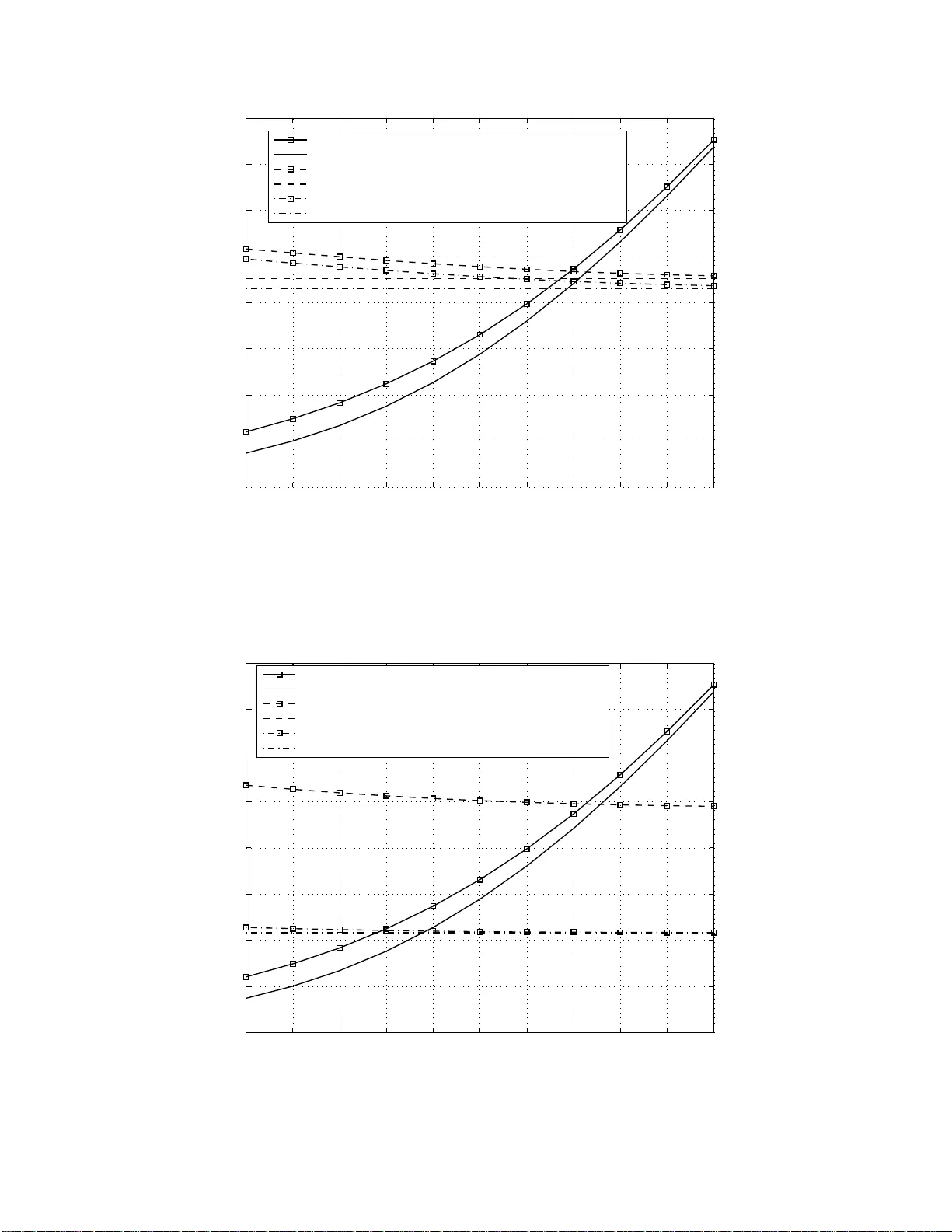
On Peak v ersus A v erage Inter ference Po wer Constraints for Protecting Primary Users in Cogniti v e Radio Networks Rui Zhang Abstract This paper considers spectrum sharing for wireless communication between a cognitive radio (CR) link and a primary radio (PR) link . It is assumed that the CR protects the PR transmission by applyin g the so-called interfer ence-temp eratur e co nstraint, whereby the CR is allowed to transmit regardless of the PR’ s on /off status provided that the resu ltant interference power level at the PR receiver is kept below some predefined thr eshold. For the fading PR and CR chann els, the in terferenc e-power constrain t at the PR re ceiv er is usually one o f the following two types: One is to regulate the average interfer ence power (AI P) over all the fading states, while the other is to limit the peak interfere nce power (PIP) at each fading state. Fro m the CR’ s per spective, given the same av erag e and peak power thre shold, th e A IP co nstraint is m ore fav or able than the PIP counterpar t b ecause of its mo re flexibility for dynamically alloca ting transmit p owers over the fading states. On the contr ary , from th e perspective of p rotecting the PR, the m ore restrictiv e PIP co nstraint appears at a fir st glance to b e a better o ption than the AIP . Som e surpr isingly , this paper shows that in ter ms o f various f orms o f ca pacity limits ach iev able for the PR fading chan nel, e.g., the ergodic and o utage capacities, the AI P co nstraint is also superio r over th e PIP . This result is based upon an interesting in terfer ence diversity phenomeno n, i.e., random ized interf erence powers over the fadin g states in the AIP case are mo re advantageou s over deter ministic ones in the PIP case for minimizing the resultan t PR capacity lo sses. T herefo re, the AIP con straint results in larger fading ch annel capacities than the PIP fo r b oth the CR an d PR transmissions. Index T erms Cognitive radio, spectrum sharing , inter ference temp erature, in terferen ce diversity , fading ch annel capacity . I . I N T RO D U C T I O N This paper is concerned wit h a ty pical spectrum sharing scenario for wireless communicati on, where a secondary radio, also commo nly known as the cognitive radio (CR), communicates over the same bandwidth that has been allocated to an existing primary radio (PR). For s uch a scenario, the CR usually Submitted to I EEE Transactions on Wireless Commun ications, June 1 2008, revised September 1 2008. Rui Z hang is with the Institute for Infocomm R esearch, A*ST AR, Singapore. (e-mail: rzhang@i2r .a-st ar .edu.sg) 2 needs to deal wi th a fundamental tradeof f between maximi zing its own transmis sion throughput and minimizi ng the amount o f i nterference caused t o the PR transmis sion. There are i n general t hree types of methods known in the literature for t he CR to deal with such a tradeof f. One i s the so-called opportunistic spectrum access (OSA), originall y outl ined in [1] and later formally introd uced by D ARP A, wh ereby the CR decides to t ransmit over the PR spectrum only when the PR transmissi on is detected to be off ; while the other two meth ods allow the CR t o transm it over the spectrum s imultaneous ly with the PR. One of them is based on the “cognitive relay” idea [2], [3]. For this method, the CR transmitter is assum ed to know perfectly all the channels from CR/PR transmitt er t o PR and CR receiver s and, furthermore, the PR’ s message prior to the PR transmissio n. Thereby , the CR transmitter is able to send messages to its own receive r and, at th e same tim e, comp ensate for the resul tant interference to the PR recei ver by operating as an ass isting relay to the PR transmissio n. In contrast , the other metho d only requires that the power gain of the channel from CR transm itter t o PR receive r i s known to t he CR transmitter and, thereby , the CR is allowed to transmit regardless of t he PR’ s o n/off status provided that the result ant interference power level at the PR receive r is kept belo w some predefined th reshold, also k nown as th e interf er ence-temperatur e con straint [4], [5]. In th is paper , we focus our stu dy o n th is method due to its many advantages from an implement ation viewpoint. T o enable wireless spectrum sharing un der the interference-temperature constraint, dynamic re sourc e allocation (DRA) for the CR becomes crucial, whereby th e transm it power lev el, bit-rate, bandwidth, and antenna beam of the CR are dynamically changed based upon the channel state inform ation (CS I) a vailable at the CR transm itter . For the single-antenna fading PR and CR channels, transmit power control for the CR has been stu died in [6], [7] under the avera ge/peak interference-power con straint at the PR receiv er based upon the CSI on the channels from th e CR t ransmitter to the CR and PR recei vers, in [8] under the combined i nterference-po wer const raint and the CR’ s own transm it-power constraint, and in [9], [10] based upon t he additional CSI on the PR fading channel. On the ot her hand, for the multi-antenna PR and CR channel s, in [11] the aut hors proposed b oth optim al and subopt imal spatial adaptation schemes for the C R transm itter . Information-t heoretic limits for multiuser mu lti- antenna/fading CR chann els ha ve also b een studied in, e.g., [12], [13]. 3 In this paper , we con sider the sin gle-antenna fading PR and CR channels. For such scenarios, the interference-po wer constraint at the PR receiver is u sually one of the foll owing two types: One is t he long-term constraint that regulates the average interference power (AIP) over all the fa ding st ates, wh ile the other is the short-term one that limits the peak int erference power (PIP) at each of the fading states. Clearly , the PIP constraint is more restrictive t han the AIP counterpart giv en the same a verage and peak interference-po wer th reshold. From the CR’ s perspective, the AIP con straint is m ore fa vorable than the PIP , since the former provides the CR m ore flexibility for dynamically allocating transmit powers over the fading states and, thus, achieves l ar ger fading channel capacities [7], [8]. Howe ver , the effe ct of the AIP- and PIP-based CR power cont rol on the PR transmis sions has not yet been studied in the literature, to the author’ s best knowledge. At a first glance, th e more restrictive PIP cons traint seems t o be a better opti on than the AIP from the perspectiv e of protecting the PR. Some s urprisingly , in t his paper t he contrary conclusio n is rigourously shown, i.e., the AIP constraint is indeed superior over the PIP in terms of v arious forms of capacity l imits achie vable for the PR fading channel , e.g., the ergodic and outage capacities. This result is due to an interesting interfer ence diversity pheno menon for th e PR transm ission: Due to the con vexity of the capacity function wit h respect to the noise/interferecne power , more randomized interference powers over the fading states at the PR recei ver in the AIP case are more advantageous over deterministic ones in the PIP case for mini mizing the resultant PR capacity losses. Therefore, this paper provides an important design rule for the CR networks in practice, i.e., the AIP constraint may resul t in i mproved fading channel capacities over t he PIP for both the CR and PR transmissio ns. The rest of this paper is organized as follows. Section II presents the system m odel for spectrum sharing. Section III consid ers t he CR link and sum marizes the result s known in the literature on th e CR fading chann el capacities and th e corresponding optimal power -control poli cies under th e AIP or the PIP const raint. Section IV then studies various forms of t he PR fading channel capacities under the interference from the CR transmitt er due to the AIP- or PIP-based CR power control, and proves that the AIP constraint results in large r channel capacities than the PIP for the same power threshold. Section V considers b oth PR and CR transmis sions and shows the simul ation results on their jointl y 4 P S f r a g r e p l a c e m e n t s PR-Tx CR-Tx PR-Rx CR-Rx f h g Fig. 1. Spectrum sharing between a PR link and a C R l ink. achie vable capacities und er sp ectrum sharing. Finally , Section VI concludes thi s paper . Notation : | z | denot es the Eucli dean n orm of a complex number z . E [ · ] denotes the statist ical expec- tation. P r {·} denot es the probability . 1 ( A ) denotes the in dicator function taking the va lue of one if the e vent A is true, and the v alue of zero o therwise. The distribution of a circular sym metric com plex Gaussian (CSCG) random var iable (r .v .) with mean x and variance y is d enoted as C N ( x, y ) , and ∼ means “distributed as”. max( x, y ) and min( x, y ) d enote, respecti vely , the maximum and t he minimum between two real numb ers x and y ; for a real number a , ( a ) + , max(0 , a ) . I I . S Y S T E M M O D E L As shown in Fig. 1, a spectrum sharing scenario is considered where a CR link consist ing o f a CR t ransmitter (CR-Tx) and a CR receiv er (CR-Rx) shares the same bandwidth for transm ission with an existing PR l ink consist ing of a PR transmitter (PR-Tx) and a PR recei ver (PR-Rx). All terminals are assumed to be equipped with a si ngle antenna. W e consider a sl ow-f ading en v ironment and, for simplicit y , assume a block-fading (BF) channel m odel for all th e channels in volved in the PR-CR network. Furthermore, we assum e coherent communi cation and t hus o nly the fading channel power gain (amplitude square) is o f interest. Denote h as the r .v . for the power g ain of the fading channel from CR-Tx to CR-Rx. Sim ilarly , g and f are defined for the fading channel from CR-Tx to PR-Rx and PR-Tx to PR-Rx, respectiv ely . For con venience, i n this paper we igno re the channel from PR-Tx t o CR-Rx. Denot e i as the joint fading state for all the channels in v olved. Then, let h i be t he i th component in h for fading state i ; sim ilarly , g i and f i are defined. It is assum ed that h i , g i , and f i are independent 5 of each ot her , and all of them have continuo us prob ability density fun ctions (PDFs). It is also assumed that the additive noises at both PR-Rx and CR-R x are i ndependent CSCG r .v .s each ∼ C N (0 , 1) . Since we are interested in the information-theoretic lim its o f t he PR and CR channels, it is assumed that the optimal Gaussian codebook is used at both PR-Tx and CR-Tx. For the PR link, the transmit power at fading s tate i is d enoted as q i . It is assum ed t hat the PR is oblivious to the CR transm ission and thus does not att empt to protect the CR nor coo perate with the CR for t ransmission . Due to the CR transmission, PR-R x m ay observe an additio nal i nterference powe r , denoted as I i = g i p i , at fading state i where p i denotes the CR transmi t power at fading state i . The PR power -control policy , denoted as P PR ( f , I ) , i s in general a mapping from f i and I i to q i for each i , wi th I i being the i th comp onent o f I , subject to an average transm it power cons traint Q , i.e., E [ q i ] ≤ Q . By treating the interference from CR-Tx as the additional Gaussian noise at PR-Rx, the mutual information of the PR f ading channel for fading state i u nder a giv en P PR ( f , I ) can then be e xpressed as [14] R PR ( i ) = log 1 + f i q i 1 + I i . (1) For the CR link, sin ce th e CR needs t o protect the PR transmi ssion, th e CR power -control policy needs to be aware of both the PR and CR transmiss ions. It is assumed that the channel powe r gains g i and h i are perfectly known at CR- Tx for each i . 1 Thus, t he CR power -control policy can be expressed as P CR ( h , g ) with h consist ing of h i ’ s, subject t o an av erage transmit power constraint P , i.e., E [ p i ] ≤ P . The mutual information of the CR fading channel for fading state i under a given P CR ( h , g ) can then be expressed as R CR ( i ) = log (1 + h i p i ) . (2) In t his paper , we assum e that the CR p rotects the PR transmission vi a t ransmit po wer control by applying the interference-po wer constraint at PR-Rx, in the form of either the AIP or t he PIP . The AIP constraint regulates t he a verage i nterference po wer at PR-Rx over all the fading states and is thus expressed as E [ I i ] ≤ Γ a or E [ g i p i ] ≤ Γ a (3) 1 In practice, the channel po wer gain between CR-Tx and PR- Rx can be obtained at CR-Tx via, e.g., estimati ng the r ecei ved signal po wer from PR-Rx when it transmits, under the assumptions of t he pre-kno wledge on the PR-Rx t ransmit power level and the channel reciprocity . 6 where Γ a denotes the predefined AIP threshold. In con trast, the P IP constraint limits the peak interference power at PR-Rx at each of t he fading st ates and is thus expressed as I i ≤ Γ p , ∀ i or g i p i ≤ Γ p , ∀ i (4) where Γ p denotes th e p redefined PIP t hreshold. Note th at the PIP constraint i s in general more restricti ve over t he AIP . This can be easily seen by observing t hat giv en Γ p = Γ a , (4) impl ies (3) b ut not vice versa. Therefore, from the CR’ s perspective, applying th e AIP constraint is more fa vorable than th e PIP because the form er provides th e CR m ore flexibility for adapting transmit po wers over the fading states. In this paper , we consi der two well -known capacity limits for the fading PR and CR channels, namely , the ergodic capacity and the o utage capacity . The ergodic capacity measures the maximum average rate over the fading states [15 ], whil e the resultant mut ual information for each fading state can be var iable. In contrast, the outage capacity measures the maximum const ant rate that is achiev able over each of the fading s tates with a guaranteed outage probabili ty [16], [17]. In the extreme case of zero outage probability , the out age capacity is also known as the delay-limit ed capacity [18 ]. In general, the ergodic and delay-limited capaciti es can b e con sidered as the th roughput li mits for a fading channel wi th no and with minimal transmission del ay requirement, respecti vely . I I I . C R C A P A C I T I E S U N D E R A IP V E RS U S P I P C O N ST R A I N T In this s ection, we summarize the results known in the li terature on the CR fading channel capacities and the corresponding optimal powe r-control policies under the AIP or the PIP constraint. Consider first the AIP case. The opt imal P CR ( h , g ) to achieve the er godic capacity of the CR fading channel is expressed as [6] p ER ,a i = 1 ν g i − 1 h i + (5) where ν is a posit iv e constant determined from E [ g i p ER ,a i ] = Γ a . N ote that the above power control resembles the well -known “water filling (WF)” po wer control [14], [15], which achieves the ergodic capacity of the con ventional fading channel, whereas there is also a ke y differe nce here: In (5), the so-called “water l e vel” for WF , 1 / ( ν g i ) , depends on the channel power gain g i from CR-Tx to PR-Rx as compared to being a cons tant in the standard WF po wer control. Substi tuting (5) int o R CR ( i ) giv en 7 in (2) and taking the expectation of the result ant R CR ( i ) ov er i , we obtain the er godic capacity for the CR u nder the AIP cons traint, denoted as C ER ,a CR . On the other hand, the op timal P CR ( h , g ) to achie ve the outage capacity of the CR fading chann el with a guaranteed outage probabi lity , ǫ 0 , is expressed as [7], [8] p OUT ,a i = ( ζ a h i , h i g i ≥ λ 0 , otherwise (6) where λ i s a nonnegati ve constant determined from P r { h i /g i < λ } = ǫ 0 , and ζ a is the con stant signal- to-noise ratio (SNR) at CR-Rx ob tained from E [ g i p OUT ,a i ] = Γ a . Note that the above p ower control resembles the well-known “truncated channel inv ersion (TCI)” po wer control [15] to achiev e the outage capacity o f th e con ventional fading channel [17], whil e there is also a difference between (6) and the standard TCI on the thresho ld value λ for p ower truncation (no transmissi on): in (6) λ depends on the ratio b etween h i and g i , as compared to o nly h i in the standard TCI. The corresponding outage capacity , denoted as C OUT ,a CR ( ǫ 0 ) , is then ob tained as log (1 + ζ a ) . Note that if ǫ 0 = 0 , it then follows that λ = 0 and the resultant po wer-control pol icy i n (6) becomes th e “channel in version (CI)” power con trol [15], which achie ves t he delay-limited capacity for the CR [17], denoted as C DL ,a CR . Consider next the PIP case. It i s easy to show th at in this case the optim al P CR ( h , g ) s hould use t he maximum po ssible transmit powe r for each fading state i so as to maxi mize both t he ergodic and the outage capacities, 2 thus, we ha ve p ER ,p i = p OUT ,p i = Γ p g i , ∀ i. (7) The resultant er godic capacity , denot ed as C ER ,p CR , is then obtained accordingly from (2). The resultant outage probability , ǫ 0 , can b e sh own equal to P r { (Γ p /g i ) h i < ζ p } where ζ p is the cons tant SNR at CR-Rx. For a giv en ǫ 0 , the correspondi ng ζ p can thus be o btained, as well as t he corresponding outage capacity , C OUT ,p CR ( ǫ 0 ) = log (1 + ζ p ) . It is easy to s ee that i f ǫ 0 = 0 , i t follows that ζ p = 0 and t hus the delay-limited capacity for the CR under the PIP const raint, denot ed as C DL ,p CR , is alw ays zero. 2 It is noted that to achiev e t he same outage capacity for the CR , under the assumption that the CR channel power gain h i is kno wn at CR-Tx for each i , it is possible for the CR power control to assign a smaller po wer value ζ p /h i than Γ p /g i if the former happens to be smaller than the l atter f or some i . Howe ver , if h i s are not av ailable at CR-Tx, it is optimal for t he CR to assign the maximum possible transmit power Γ p /g i for each i to minimize the outage probability . T herefore, in this paper we consider that p OUT ,p i = Γ p /g i , ∀ i . 8 Comparing the powe r allocation s in (5) and (6) for the AIP case with those in (7) for the PIP case, it is easy to see that the form er power allocatio ns are more flexible th an the latter o nes over the fading states. Furthermore, th e A IP-based po wer control depends on both the channel power gains , h i and g i , while the PIP-based power control on ly depends on g i . As a result, u nder the same a verage and peak power threshold, i.e., Γ a = Γ p , i t is easy to s how that C ER ,a CR ≥ C ER ,p CR , C OUT ,a CR ( ǫ 0 ) ≥ C OUT ,p CR ( ǫ 0 ) , and C DL ,a CR ≥ C DL ,p CR . Thus, t he A IP is s uperior ove r t he PIP in terms of the fading channel capacity limi ts achie vable for the CR. I V . P R C A P AC I T I E S U N D E R A I P V E R S U S P I P C O N S T R A I N T In this section, we will p resent the m ain contributions of this p aper on the comparison of t he effects of AIP and PIP constraint s on various fading channel capacities for the PR. For fair comparison, we consider the same average and peak interference-power th reshold, i.e., Γ a = Γ p = Γ . Not e t hat both AIP and PIP constraints are satisfied with equalities at PR-Rx for all the CR power -control policies presented in Section III, i.e., for the AIP case, E [ I i ] = Γ ; and for t he PIP case, I i = Γ , ∀ i . In the following two su bsections, we consider th e ergodic capacity and the ou tage capacity for the PR fading channel, respectiv ely . A. Er godic Capacity 1) Constan t-P ower P oli cy: The simplest power control for the PR is the constant -power (CP) policy , i.e., q CP i = Q, ∀ i. (8) CP is an attracti ve scheme in practice from an implementation vi ewpoint since it does not requi re any CSI on the PR fading channel at PR-Tx. In addition, CP sati sfies a peak transm it-power con straint for all th e fading states. W ith CP , the er godi c capacity of the PR fading channel in the AIP case can be obtained from (1) and expressed as C ER ,a PR , CP = E log 1 + f i Q 1 + I i (9) and in the PIP case expressed as C ER ,p PR , CP = E log 1 + f i Q 1 + Γ . (10) 9 Theor em 4.1: W ith the CP policy for t he PR, C ER ,a PR , CP ≥ C ER ,p PR , CP , u nder the same av erage and peak power threshold Γ . Pr oof: The following equalities/i nequality hol d: C ER ,a PR , CP ( a ) = E f E I log 1 + f i Q 1 + I i ( b ) ≥ E f log 1 + f i Q 1 + E [ I i ] ( c ) = E f log 1 + f i Q 1 + Γ ( d ) = C ER ,p PR , CP where ( a ) is from (9) and due to independence o f f i and g i and thus f i and I i ; ( b ) is due to conv exity of the function f ( x ) = log 1 + κ 1+ x where κ is any positive constant and x ≥ 0 , and J ensen’ s i nequality (e.g., [14]); ( c ) and ( d ) are due to E [ I i ] = Γ and (10), respectively . Theorem 4.1 s uggests that, s ome surprisingly , the AIP constraint that results in rando mized inter- ference power lev els over the fading states at PR-Rx is in fact more advantageous for im proving the PR er godic capacity over the PIP const raint that results in constant i nterference power levels at all the fading states, for t he same value of Γ . As shown in the above proof, thi s result is mainly due to the con ve xity of the capacity function with respect to the noi se/interference powe r . W e thus name this interesting phenomenon for the PR transm ission in a CR network as “interference div ersity”. 2) W ater-F illing P ower Contr ol: If the eff ective channel power gain, f i / (1 + I i ) , for the PR fading channel is known at PR-Tx for each i , the o ptimal P PR ( f , I ) to achiev e the ergodic capacity for the PR is the standard WF power -control poli cy . In the AIP case, t he optim al power allocation is expressed as q WF ,a i = 1 µ a − 1 + I i f i + (11) where µ a controls the water level, 1 /µ a , with which E [ q WF ,a i ] = Q . From (11), the ergodic capacity for the PR in the AIP case is obt ained as C ER ,a PR , WF = E " log f i µ a (1 + I i ) + # . (12) 10 Similarly , we can obtain t he optimal WF-based p ower control for the PR in t he PIP case as q WF ,p i = 1 µ p − 1 + Γ f i + (13) where µ p is obtained from E [ q WF ,p i ] = Q . The corresponding er godic capacity then becomes C ER ,p PR , WF = E " log f i µ p (1 + Γ) + # . (14) Next, w e first sh ow t hat an intu itive method to compare C ER ,a PR , WF in (12) and C ER ,p PR , WF in (14) does not work here. Then, we p resent a differ ent m ethod for such comp arison. One intuitive method to comp are C ER ,a PR , WF and C ER ,p PR , WF would be as follows. If it can be shown that µ a < µ p , then due to con vexity of the function g ( x ) = log κ 1+ x + where κ is a posi tiv e cons tant and x ≥ 0 , and si milarly like the proo f of Theorem 4.1, it can be shown that C ER ,a PR , WF > C ER ,p PR , WF . Unfortunately , in the following we prov e by contradiction that the opposite inequality is in fact true for µ a and µ p . Thus, we can not conclude which one of C ER ,a PR , WF and C ER ,p PR , WF is indeed lar ger by this intuitive method . Supposing that µ a < µ p , we then ha ve E [ q WF ,a i ] = E " 1 µ a − 1 + I i f i + # > E " 1 µ p − 1 + I i f i + # = E f E I " 1 µ p − 1 + I i f i + # ( a ) ≥ E f " 1 µ p − 1 + E [ I i ] f i + # = E " 1 µ p − 1 + Γ f i + # = E [ q WF ,p i ] = Q where ( a ) is due t o con vexity of the function z ( x ) = κ 1 − 1+ x κ 2 + where κ 1 and κ 2 are positive constants and x ≥ 0 , and Jensen’ s inequali ty . Since it i s known that E [ q WF ,a i ] = Q , whi ch cont radicts with E [ q WF ,a i ] > Q shown in the above under the presumption that µ a < µ p , it thus concl udes that µ a ≥ µ p . 11 From the abov e di scussions, we know that an alternative approach is needed for comparing C ER ,a PR , WF and C ER ,p PR , WF . The result for this com parison and its proof are g iv en belo w: Theor em 4.2: W ith the WF power control for the PR, C ER ,a PR , WF ≥ C ER ,p PR , WF , under the s ame aver age and peak power threshold Γ . Pr oof: The proof is b ased on the Lagrange duality of con vex opt imization [19]. First, we rewrite C ER ,a PR , WF and C ER ,p PR , WF as the optimal v alues of the following min-max optimizatio n problem s: C ER ,a PR , WF = min µ : µ ≥ 0 max { q i } : q i ≥ 0 , ∀ i E log 1 + f i q i 1 + I i − µ ( E [ q i ] − Q ) (15) and C ER ,p PR , WF = min µ : µ ≥ 0 max { q i } : q i ≥ 0 , ∀ i E log 1 + f i q i 1 + Γ − µ ( E [ q i ] − Q ) , (16) respectiv ely . Not e that µ a and { q WF ,a i } are the optimal sol utions to the “min” and “m ax” prob lems in (15), respectively , and µ p and { q WF ,p i } are th e optimal solutions to the “min” and “max” problems in (16), respectiv ely . Th en, we ha ve the follo wing equalities/inequali ties: C ER ,p PR , WF = min µ : µ ≥ 0 E " log f i (1 + Γ) µ + # − E " 1 − (1 + Γ) µ f i + # + µ Q (17) ≤ E " log f i (1 + Γ) µ a + # − E " 1 − (1 + Γ) µ a f i + # + µ a Q (18) = E f " log f i (1 + E [ I i ]) µ a + − 1 − (1 + E [ I i ]) µ a f i + # + µ a Q (19) ≤ E f E I " log f i (1 + I i ) µ a + − 1 − (1 + I i ) µ a f i + # + µ a Q (20) = min µ : µ ≥ 0 E " log f i (1 + I i ) µ + # − E " 1 − (1 + I i ) µ f i + # + µ Q (21) = C ER ,a PR , WF , (22) where (17) is obtained by substituting { q WF ,p i } in (13) wi th µ p replaced by an arbit rary p ositive µ into (16); (18) is due to the fact that µ a is no t the minim izer µ p for (17 ); (19) is due t o E [ I i ] = Γ ; (20) is due to con vexity of the function in E f [ · ] of (19) w ith respect to E [ I i ] for any given f i and Jensen’ s inequality; (21) and (22) are due to t he fact that µ a and { q WF ,a i } in (11) are th e optim al solutions to the min-max optimization problem in (15). 12 Theorem 4. 2 sug gests that, sim ilarly like the CP po licy , under the WF-based power control, random- ized i nterference po wer l e vels due to the CR transmi ssion in the AIP case is superior over constant interference po wer lev els in t he PIP case in terms of the maximum achiev able PR er godic capacity . Howe ver , the interference diversity gain observed here is not as obvious as that in the CP case due to the more complex WF-based PR power control. B. Outage Capacity 1) Constan t-P ower P olicy: W ith the CP policy in (8), for a given outage probability , ǫ 0 , the maxim um achie vable const ant SNR at PR-Rx, denoted as γ a , in the AIP case can be obtai ned from P r { ( f i Q ) / (1 + I i ) < γ a } = ǫ 0 , and the correspondin g outage capacity , denoted as C OUT ,a PR , CP ( ǫ 0 ) , is equal to log(1 + γ a ) . Similarly , for t he same ǫ 0 , the m aximum achie vable constant SNR at PR-Rx, γ p , in t he PIP case can be obtained from P r { ( f i Q ) / (1 + Γ) < γ p } = ǫ 0 , and the correspond ing outage capacity , C OUT ,p PR , CP ( ǫ 0 ) , is obtained as log(1 + γ p ) . Instead of comparing C OUT ,a PR , CP ( ǫ 0 ) and C OUT ,p PR , CP ( ǫ 0 ) directly , we consider the following equiv alent problem: Supposing t hat γ a = γ p = γ 0 , we compare the resul tant m inimum outage pro babilities, denoted as ǫ a and ǫ p in the AIP and PIP cases, respectively . If ǫ a ≤ ǫ p for any given γ 0 , we conclude that C OUT ,a PR , CP ( ǫ 0 ) ≥ C OUT ,p PR , CP ( ǫ 0 ) for any ǫ 0 . Thi s is true because if ǫ a ≤ ǫ p , we can increase γ a above γ 0 so t hat ǫ a increases u ntil it becomes equal to ǫ p ; since γ a ≥ γ 0 ≥ γ p , it follows that C OUT ,a PR , CP ( ǫ p ) ≥ C OUT ,p PR , CP ( ǫ p ) . Similarly , if ǫ a ≥ ǫ p for any given γ 0 , we conclude that C OUT ,a PR , CP ( ǫ 0 ) ≤ C OUT ,p PR , CP ( ǫ 0 ) for any ǫ 0 . T o compare ǫ a and ǫ p for the s ame giv en γ 0 , we first express ǫ a as ǫ a = P r f i Q 1 + I i < γ 0 (23) = E I E f 1 f i Q 1 + I i < γ 0 (24) = E I G f (1 + I i ) γ 0 Q (25) where G f ( x ) is the cumu lative density function (CDF) for f , i.e., G f ( x ) = P r { f < x } . Similarly , we can express ǫ p as ǫ p = G f (1 + Γ) γ 0 Q . (26) 13 By Jensen’ s inequality , from (25) and (26), it follows that ǫ a ≤ ǫ p if G f ( x ) is a con vex function. Similarly , ǫ a ≥ ǫ p if G f ( x ) is a conca ve fun ction. W e thus hav e the following theorem: Theor em 4.3: W ith the CP policy for the PR, C OUT ,a PR , CP ( ǫ 0 ) ≥ C OUT ,p PR , CP ( ǫ 0 ) , ∀ ǫ 0 , und er the sam e avera ge and peak po wer threshold Γ , if G f ( x ) is a con vex function; and C OUT ,a PR , CP ( ǫ 0 ) ≤ C OUT ,p PR , CP ( ǫ 0 ) , ∀ ǫ 0 , if G f ( x ) is a conca ve function. Theorem 4.3 suggests that for the CP policy , w hether the AIP or the PIP constraint result s in a lar ger PR outage capacity depends on t he con vexity/conca vity of the CDF of the PR fading channel power gain. As an example, for th e st andard Rayleigh fading model, i t is known t hat G f ( x ) has an exponential distrib ution that is con vex and, thus , C OUT ,a PR , CP ( ǫ 0 ) ≥ C OUT ,p PR , CP ( ǫ 0 ) . Ho weve r , in general, w hether the interference di versity gain is present depends on the PR fading channel dis tribution. 2) Channel-In version P ower Contr ol: Next, we consider the special case of the CR out age capacity with zero outage probabili ty , i.e., t he delay-lim ited capacity , whi ch is achiev able by the CI power -control policy . In the AIP case, the optim al PR power allocati on is expressed as q CI ,a i = γ a (1 + I i ) f i (27) and in the PIP case expressed as q CI ,p i = γ p (1 + Γ) f i (28) where γ a and γ p are the constant SNRs at PR-Rx for the AIP and PIP cases, respectively . Giv en E [ q i ] = Q , γ a and γ p can be obtained from (27) and (28) as γ a = Q E h 1+ I i f i i (29) and γ p = Q (1 + Γ) E h 1 f i i , (30) respectiv ely . Since f i is independent of I i , we ha ve E 1 + I i f i = E f 1 + E [ I i ] f i = (1 + Γ) E 1 f i and thus it follows from (29) and (30) that γ a = γ p . H ence, we conclude that the PR delay-lim ited capacities, expressed as C DL ,a PR = log(1 + γ a ) and C DL ,p PR = log(1 + γ p ) , for the AIP and PIP cases, respectiv ely , are i ndeed identical. The follo wing theorem thus holds: 14 Theor em 4.4: W ith the CI p ower control for the PR, C DL ,a PR = C DL ,p PR , under the same avera ge and peak power threshold Γ . Theorem 4.4 suggest s th at for the CI power control, the loss of the PR d elay-limited capacity due to randomized in terference p owers from CR-Tx is id entical to that due t o constant i nterference powers, i.e., the AIP constraint i s at least n o worse th an t he PIP from th e PR’ s perspective of delive ring zero-delay and constant-rate data traf fic. 3) T runcated-Channel-In version P ower Contr ol: Lastly , we cons ider the general outage capacity for the PR achiev able by the TCI power -control p olicy . In the AIP case, the optimal TCI power cont rol is expressed as q TCI ,a i = ( γ a (1+ I i ) f i , f i 1+ I i ≥ θ a 0 , otherwis e (31) where θ a is t he th reshold for the eff ective channel power gain above which CI power control is applied to achiev e a const ant receiver SNR, γ a , and below which no t ransmission is i mplemented. Similarly , the TCI po wer control in the PIP case is expressed as q TCI ,p i = ( γ p (1+Γ) f i , f i 1+Γ ≥ θ p 0 , otherwise (32) where θ p is the threshold for power truncation. Giv en the out age probability ǫ 0 , θ a and θ p can be ob tained from P r { f i / (1 + I i ) < θ a } = ǫ 0 and P r { f i / (1 + Γ) < θ p } = ǫ 0 , respectively . Then, γ a and γ p can be obtained from E [ q TCI ,a i ] = Q and E [ q TCI ,p i ] = Q , respectiv ely . The correspond ing outage capacities for the PR, denoted as C OUT ,a PR , TCI ( ǫ 0 ) and C OUT ,p PR , TCI ( ǫ 0 ) for th e AIP and PIP cases can be obtained as log(1 + γ a ) and log(1 + γ p ) , respectiv ely . Theor em 4.5: W ith the TCI power control for the PR, C OUT ,a PR , TCI ( ǫ 0 ) ≥ C OUT ,p PR , TCI ( ǫ 0 ) , ∀ ǫ 0 , under the same a verage and p eak powe r threshold Γ . Pr oof: Similarly like the d iscussions for the PR outage capacity with the CP policy , we compare C OUT ,a PR , TCI ( ǫ 0 ) and C OUT ,p PR , TCI ( ǫ 0 ) via the following equiv alent probl em: Giv en γ a = γ p = γ 0 , we compare the m inimum out age probabiliti es in the AIP and PIP cases, denoted as ǫ a and ǫ p , respectively . If ǫ a ≤ ǫ p , ∀ γ 0 , we then conclude that C OUT ,a PR , TCI ( ǫ 0 ) ≥ C OUT ,p PR , TCI ( ǫ 0 ) , ∀ ǫ 0 . Next, we sh ow that ǫ a ≤ ǫ p , ∀ γ 0 . Simil arly li ke the proof of Theorem 4.2, the Lagrange du ality is applied here. For given Q and γ 0 , ǫ a and ǫ p can be rewritten as the o ptimal values of the following 15 max-min optimizatio n problems: ǫ a = max µ : µ ≥ 0 min { q i } : q i ≥ 0 , ∀ i P r f i q i 1 + I i < γ 0 + µ ( E [ q i ] − Q ) (33) and ǫ p = max µ : µ ≥ 0 min { q i } : q i ≥ 0 , ∀ i P r f i q i 1 + Γ < γ 0 + µ ( E [ q i ] − Q ) , (34) respectiv ely . No te that µ a = θ a /γ 0 and { q TCI ,a i } are the o ptimal solutions to the “max” and “min” problems in (33), respectively , and µ p = θ p /γ 0 and { q TCP ,p i } are the optimal soluti ons to the “m ax” and “min” problems in (34 ), respectiv ely . Then, we have th e fol lowing equalities/i nequalities: ǫ p = max µ : µ ≥ 0 E f 1 f i 1 + Γ < γ 0 µ + µ E f (1 + Γ) γ 0 f i 1 f i 1 + Γ ≥ γ 0 µ − µQ (35) ≥ E f 1 f i 1 + Γ < γ 0 µ a + µ a E f (1 + Γ) γ 0 f i 1 f i 1 + Γ ≥ γ 0 µ a − µ a Q (36) = 1 + E f (1 + Γ) γ 0 µ a f i − 1 1 f i 1 + Γ ≥ γ 0 µ a − µ a Q (37) = 1 + E f (1 + E [ I i ]) γ 0 µ a f i − 1 1 f i 1 + E [ I i ] ≥ γ 0 µ a − µ a Q (38) ≥ 1 + E f E I (1 + I i ) γ 0 µ a f i − 1 1 f i 1 + I i ≥ γ 0 µ a − µ a Q (39) = ǫ a (40) where (35) is obtained by s ubstituti ng { q TCI ,p i } i n (32) wit h θ p replaced by γ 0 µ into (34); (36) is due to the fact that µ a is not the maxim izer µ p for (35); (38) is due to E [ I i ] = Γ ; (39) is due to concavity of the function i n E f [ · ] of (38) with respect to E [ I i ] for any given f i and Jensen’ s inequality; (40) is due to the fact t hat µ a and { q TCI ,a i } in (31) are the optimal sol utions to the the m ax-min optimization problem in (33). Theorem 4.5 suggests that for the TCI power control of the PR, the interference diver sit y gain due to the AIP const raint over the PIP exists regardless of t he outage probabilit y . Note t hat in Theorem 4.4 for t he e xtreme case o f zero outage probability , it has been sh own t hat the delay-limi ted capacities are the same for both t he AIP and PIP constraints. V . S I M U L A T I O N R E S U L T S A N D D I S C U S S I O N S So far , we have stud ied the ef fect of the AIP and PIP constraint s on t he ergodic/outage capacity of the CR link and the PR li nk separately . In thi s section , we wil l consi der a realisti c spectrum sharing scenario 16 over t he fading channels , and e valuate by sim ulation t he jointly achie vable ergodic/outage capacities for both the PR and CR links. In total, we will consider four cases o f different combin ations, whi ch are CR er godic capacity versus PR er godic capacity , CR ergodic capacity versus PR outage capacity , CR outage capacity versus PR ergodic capacity , and CR out age capacity versus PR outage capacity , in Figs. 2-5, respectiv ely . It is assumed that Γ a = Γ p = 1 , t he same as the additive Gaussian noise power at PR-Rx and CR-Rx. It is also assumed that h , g , and f are obtained from the Rayleigh fading m odel, i.e., t hey are the squared norm s of independent CSC G r .v .s ∼ C N (0 , 1) , C N (0 , 10) , and C N (0 , 1) , respecti vely . Note that we ha ve purpos ely set t he ave rage p ower for g to be 10 dB larger than t hat for h or f so as to pronounce the effect of the interference channel from CR-Tx t o PR-Rx on t he achiev able capacities. The PR transm it power constraint is set to be Q = 10 . In th e cases of outage capacities of the PR and/or CR, the outage probabi lity tar gets of ǫ 0 for PR and CR are set to be 0.2 and 0.1, respectively . In each figure, the PR and CR capacities in bits/com plex di mension (dim.) are plot ted versus the additi onal channel p ower gain attenuation of g in dB. For example, for 0-dB attenuation, E [ g i ] = 10 ; for 10-dB attenuation, E [ g i ] = 1 . In Figs. 2 and 3, we compare the CR er godic capacity under AIP or PIP constraint wi th the corresponding ergodic and out age capacities for the PR, respectively . Note that the CR ergodic capacities shown i n these two figures are the same. W ith increasing channel attenuation of g , it is ob served that the CR ergodic capacity increases for both AIP and PIP cases. This is obvious since given t he fixed peak or a verage in terference-po wer t hreshold at PR-Rx, decreasing of the a verage power for g results in increasing of t he average transmit power of the CR. It is also observed that the AIP-based o ptimal power control performs better t han the PIP-based one for the CR, since the former is more flexible for exploiting all the av ailable CSI at CR-Tx. Interestingl y , as the av erage po wer for g d ecreases, eventually the CR ergodic capaciti es in the AIP and PIP cases con ver ge to the s ame v alue. This can be explained as follows. From (5) and (7), i t fol lows that in t he AIP case, the in terference power at PR-Rx, I i , is randomized over i (b ut with E [ I i ] = Γ ), while in th e PIP case, I i is constantly equal to Γ for each i . Note that the abov e fact leads to the interference dive rsity gain of th e AIP ov er t he PIP for t he PR transmissio n. Howe ver , with g i → 0 , it can be shown in the AIP case that 1 /ν → Γ and I i → Γ , which 17 implies that p ER ,a i = p ER ,p i = Γ /g i , ∀ i , and thus the same CR ergodic capacity i s resultant for bot h the AIP and PIP cases. On the other hand, it is obs erved that t he er godic and outage capacities for the PR und er the AIP from CR-Tx are larger than the corresponding ones under the PIP for various PR power -control poli cies, which are in accord with the analytical result s obtained in Section IV. Not e that the PR er godic/outage capacities in the PIP case are fixed regardless of t he channel po wer for g , since I i is fixed as Γ at PR-Rx for each i . Howe ver , the PR ergodic/outage capacities in the AIP case are observed to decrease with increasing of the channel attenuation of g . This is due to t he fact that, as explained earlier , I i → Γ as g i → 0 . Since the capacity gain of the AIP ov er th e PIP is due to the randomness of I i over i , this interference div ersity g ain diminishes as I i → Γ , ∀ i . In Figs. 4 and 5, we compare t he CR out age capacity under AIP or PIP constraint wi th the corre- sponding er godic and outage capacities for the PR, respective ly . Note that the CR outage capacities shown in these two figures are identi cal. W ith increasing channel attenuati on of g , it is observed t hat, as expected, the CR outage capacity increases for both AIP and PIP cases. It is also observed that the AIP-based optimal power control resul ts in substantial outage capacity gains than th e PIP-based one for the CR. It can be shown that as the av erage power for g decreases, ev entually the CR outage capacity gaps between the AIP and the PIP cases con ver ge to log ( ζ a /ζ p ) for a given ǫ 0 . The proof is given as follows. Suppose that g ′ i = κg i , ∀ i , where κ is a pos itive constant; we thus h a ve E [ g ′ i ] = κ E [ g i ] . For a giv en ǫ 0 , it then follows that the ne w value of threshold in (6) becomes λ ′ = λ/ κ . From (6) and under the same value of Γ a , we have ζ ′ a = ζ a /κ . Thus , the outage capacity correspondin g to g ′ in th e A IP case is expressed as log (1 + ζ a /κ ) . Similarly , we can show that in the PIP case, the new value of ζ p corresponding to g ′ is ζ ′ p = ζ p /κ and thus the correspondi ng outage capacity becomes log(1 + ζ p /κ ) . Thus, the outage capacity gap between the AIP and PIP cases is equal t o lo g( 1+ ζ a /κ 1+ ζ p /κ ) . As κ → 0 , we conclude that the above capacity gap con ver ges to log ( ζ a /ζ p ) . Note that in this simu lation wi th ǫ 0 = 0 . 1 for the CR, log( ζ a /ζ p ) = 2 . 6791 bits/complex dimens ion. Furthermore, it is observed that the ergodic and outage capacities for the PR u nder the AIP from CR-Tx are also larger than the corresponding ones und er the PIP for various PR power -control poli cies, 18 as ha ve been analytically shown in Section IV. Note that not only the PR er godic/out age capacities i n the PIP case are fixed for all the av erage powers for g d ue to that I i is fixed as Γ for each i , b ut also are these capacities in the AIP case. The latter observation can be explained by noting from t he earlier proof t hat for any channel power gains g ′ i , g ′ i = κg i , ∀ i , the resultant in terference power at PR-Rx, I ′ i , can be sh own t o have the same d istribution as I i ; as a result, the PR capacities are constant regardless of κ . V I . C O N C L U D I N G R E M A R K S This paper studies the informatio n-theoretic limits for wireless spectrum sharing in the PR-CR network where t he CR applies the interference-po wer/interference-temperature const raint at the PR recei ver as a practical means to protect th e PR transmissio n. On the contrary to the traditional viewpoint that the peak- interference-po wer (PIP) constraint protects b etter the PR transmiss ion than the av erage-interference- power (AIP) constraint give n their s ame po wer-threshold value, thi s p aper sho ws that the AIP constraint can be in m any cases more advantageous over the PIP for mini mizing the resultant capacity lo sses of the PR fading channel. Thi s is mainly owing to an i nteresting in terference diversity phenomenon di scovered in this paper . Th is paper thus provides an important design rule for the CR networks in practice, i.e., the AIP constraint should be used for the p urposes of both protecting the PR transmissi on as well as maximizing the CR throughput. This paper assumes that t he perfect CSI on th e interference channel from the CR transmit ter to the PR recei ver is av ailable at t he CR transm itter for each f ading s tate. In practice, it is u sually more valid to assume a vailability of onl y the statisti cal channel knowledge. The definition of the AIP constraint in th is paper can be extendible to s uch cases. Furthermore, t his paper considers the fading PR and CR chann els, but more generally , the results obt ained also apply to other channel models consisting of parallel Gaussian channels over which the av erage and peak power constrain ts are applicable, e.g., the time-dispersive broadband channel th at is decomposable into parallel narro w-band channels by the well-known orthogonal-frequency-division-multiplexing (OFDM) modulati on/demodulat ion. R E F E R E N C E S [1] Joseph Mit ola, “Cognitiv e radio: an i ntegrated agent architecture for software defined radio, ” PhD Dissertation, KTH, Stockholm, Sweden, Dec. 2000. 19 [2] N. De vroye, P . Mitran, and V . T arokh, “ Achiev able rates in cognitiv e radio channels, ” IE EE T ra ns. Inf. Theory , vo l. 52, no. 5, pp. 1813-182 7, May 2006. [3] A. Jovi ˇ ci ´ c and P . V iswanath, “Cognitiv e radio: An information-theoretic perspec tive, ” Pr oc. IE EE Int. Symp. Inf. Theory (ISIT) , Jul. 2006. [4] S. Haykin, “Cognitiv e radio: brain-empo wered wireless communications, ” IEEE J. Sel. Ar eas Commun. , vol. 23, no. 2, pp. 201-220, Feb . 2005. [5] M. Gastpar , “On capacity under receiv e and spatial spectrum-sharing constraints, ” IEE E T rans. Inf. Theory , vol. 53, no. 2, pp . 471-487, Feb . 2007. [6] A. Ghasemi an d E. S. Sousa, “Fundamental limits of spectrum-sharing in fading en vironments, ” IEEE T rans. W ir eless Commun. , vol. 6, no. 2, pp. 649-658, Feb . 2007. [7] L. Musa vian and S. Aissa, “Erg odic and outage capacities of spectrum-sharing systems in fad ing channels, ” in Proc . IEEE Global Commun. Conf. (Globecom) , Nov . 2007. [8] X. Kang, Y . C. Liang, N. Arumugam, H. Garg , and R. Zhang ,“Optimal po wer allocation for fading channels i n cogniti ve radio networks: ergodic capacity and outage capacity , ” to appear i n IEEE T rans. W ir eless Commun. , al so av ailable at arXiv:0808.36 89 . [9] R. Zhang, “Optimal power control ove r fading cognitiv e radio channels by exploiting primary user CSI”, to appear in IEE E Global Commun. Conf. (Globecom) , also av ailable at arXiv:0804.16 17 . [10] Y . Chen G. Y u, Z. Zhang, H . H. Chen, and P . Qiu, “On cognitiv e radio networks with opportunistic po wer control strategies in fading channels, ” IE EE. Tr ans. W ireless Commun. , vol. 7, no. 7, pp. 2752-2761, Jul. 2008. [11] R. Zhang and Y . C . Liang, “Exploiting multi-antennas f or opportunistic spectrum sharing in cognitiv e radio networks, ” IEEE J. S. T opics Sig. Pr oc. , vol. 2, no. 1, pp. 88-102, Feb. 2008. [12] L . Z hang, Y . C. Liang, and Y . Xi n, “Joint beamforming an d po wer control for multiple access chann els in cog nitive radio netw orks, ” IEEE J. Sel. Areas Commun. , vol.26, no.1, pp.38-51, Jan. 2008. [13] R. Zhang, S. Cui, and Y . C. L iang, “On ergodic su m capacity of fading cognitiv e multiple-access and broadcast channels, ” submitted to IE EE T rans. Inf. Theory , also a vailable at arXiv:0806 .4468 . [14] T . Cover and J. Thomas, Elements of Information Theory , New Y ork: Wiley , 1991. [15] A. Goldsmith and P . P . V araiya, “Capacity of fading channels with channel side information, ” IEE E T ra ns. Inf. T heory , vol. 43, no. 6, pp. 1986-1992, Nov . 1997. [16] L . H. Ozarow , S. Shamai, and A. D. W yner , “Information theoretic considerations for cellular mobile radio, ” IEEE T rans. V eh. T echno l. , vol. 43 no. 2, pp. 359-378, 1994. [17] G. Caire, G. T aricco, and E. Biglieri, “Optimal po wer control over fading channels, ” IEEE T rans. Inf. T heory , vol. 45, no. 5, pp. 1468-148 9, Jul. 1999. [18] S . Hanly and D. Tse,“Multi-access fading channels-Part II: Delay-limited capacities, ” IEEE T rans. Inf. Theory , vol. 44, no.7, pp. 2816-283 1, Nov . 1998. [19] S . Boyd and L. V andenberghe, Con vex optimization, Cambridge Univ ersity P ress, 2004. 20 0 2 4 6 8 10 12 14 16 18 20 0 0.5 1 1.5 2 2.5 3 3.5 4 CR−Tx to PR−Rx Channel Attenuation (dB) Capacity (bits/complex dim.) CR Ergodic Capacity, AIP Constraint at PR−Rx CR Ergodic Capacity, PIP Constraint at PR−Rx PR Ergodic Capacity for WF Power Control under AIP from CR−Tx PR Ergodic Capacity for WF Power Control under PIP from CR−Tx PR Ergodic Capacity for CP Power Control under AIP from CR−Tx PR Ergodic Capacity for CP Power Control under PIP from CR−Tx Fig. 2. Jointly achie vable CR ergodic capacity and PR ergodic capacity . 0 2 4 6 8 10 12 14 16 18 20 0 0.5 1 1.5 2 2.5 3 3.5 4 CR−Tx to PR−Rx Channel Attenuation (dB) Capacity (bits/complex dim.) CR Ergodic Capacity, AIP Constraint at PR−Rx CR Ergodic Capacity, PIP Constraint at PR−Rx PR Outage Capacity for TCI Power Control under AIP from CR−Tx PR Outage Capacity for TCI Power Control under PIP from CR−Tx PR Outage Capacity for CP Power Control under AIP from CR−Tx PR OUtage Capacity for CP Power Control under PIP from CR−Tx Fig. 3. Jointly achie vable CR ergodic capacity and PR outage capacity . 21 0 2 4 6 8 10 12 14 16 18 20 0 0.5 1 1.5 2 2.5 3 3.5 CR−Tx to PR−Rx Channel Attenuation (dB) Capacity (bits/complex dim.) CR Outage Capacity, AIP Constraint at PR−Rx CR Outage Capacity, PIP Constraint at PR−Rx PR Ergodic Capacity for WF Power Control under AIP from CR−Tx PR Ergodic Capacity for WF Power Control under PIP from CR−Tx PR Ergodic Capacity for CP Power Control under AIP from CR−Tx PR Ergodic Capacity for CP Power Control under PIP from CR−Tx Fig. 4. Jointly achie vable CR outage capacity and PR ergodic capacity . 0 2 4 6 8 10 12 14 16 18 20 0 0.5 1 1.5 2 2.5 3 3.5 CR−Tx to PR−Rx Channel Attenuation (dB) Capacity (bits/complex dim.) CR Outage Capacity, AIP Constraint at PR−Rx CR Outage Capacity, PIP Constraint at PR−Rx PR Outage Capacity for TCI Power Control under AIP from CR−Tx PR Outage Capacity for TCI Power Control under PIP from CR−Tx PR Outage Capacity for CP Power Control under AIP from CR−Tx PR Outage Capacity for CP Power Control under PIP from CR−Tx Fig. 5. Jointly achie vable CR outage capacity and PR outage capacity .
Original Paper
Loading high-quality paper...
Comments & Academic Discussion
Loading comments...
Leave a Comment