Leveraging Coherent Distributed Space-Time Codes for Noncoherent Communication in Relay Networks via Training
For point to point multiple input multiple output systems, Dayal-Brehler-Varanasi have proved that training codes achieve the same diversity order as that of the underlying coherent space time block code (STBC) if a simple minimum mean squared error …
Authors: G. Susinder Rajan, B. Sundar Rajan
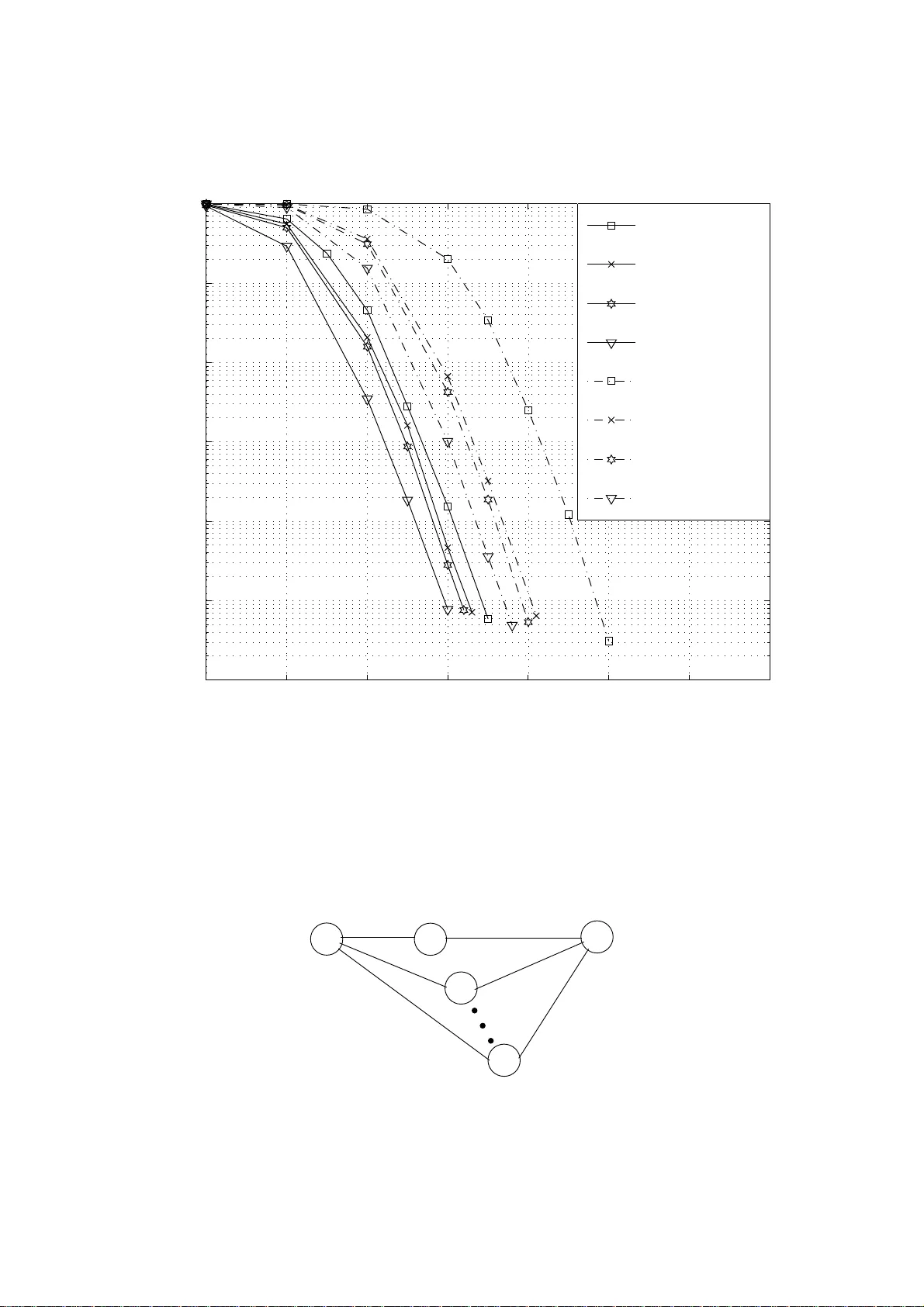
1 Le v eraging Coherent Distrib uted Space-T ime Codes for Noncoherent Commun icati on in Relay Netw orks via T raining G. Susinder Rajan and B. Sundar Rajan Abstract For point to p oint multip le inp ut multiple output system s, Dayal-Brehler-V aranasi ha ve proved that training codes ac hieve the same diversity order a s that of th e u nderlyin g coheren t space time block code (STBC) if a simple min imum mean squar ed error estimate of the c hannel form ed using the training part is employed for cohere nt detection of the under lying STBC. In this letter, a similar strategy in volving a combin ation of training, chan nel e stimation an d detection in conjunction with existing co herent distributed STBCs is proposed f or noncoher ent c ommun ication in AF relay n et- works. Simulation results show that the pr oposed simple strategy outpe rforms distributed differential space-time co ding fo r AF r elay networks. Fin ally , the prop osed strategy is extende d to asyn chrono us relay networks using o rthogo nal freq uency division m ultiplexing. Index T erms Cooperative d iv ersity , distributed STBC, noncoher ent commun ication, train ing. I . I N T R O D U C T I O N Recently t he id ea of s pace time codi ng has b een applied in wireless relay networks in the name of distributed space time coding to e xtract similar benefit as in point to poi nt multiple input multiple output (MIMO) sys tems. Mainly there are two t ypes of distributed space time coding techniques dis cussed in the l iterature: (i ) decode and forward (DF) based distributed space time coding [1], wherein a subset (chos en based o n som e criteria) of the relay nodes decode t he symbols from t he source and t ransmit a row/column 1 of a d istributed G. S usinder Rajan and B. S undar Rajan are wi th t he Department of Electrical Communication Engineering, Indian Institute of Science, Bangalore-560012, India. Email: { susinder ,bsrajan } @ece.iisc.ernet.in. 1 Whether the relay transmits a column of a STB C or a r o w of a STBC depends on the system model. Nov ember 15, 2018 DRAFT 2 space time block code (STBC) and (ii) am plify and forward (AF) based distributed space time codin g [2], where all the relay nodes perform linear processing on the receiv ed symb ols according to a di stributed space tim e block code (DSTBC) and transmit the resulting s ymbols to the destination. AF based dist ributed space time coding is of sp ecial interest because the operations at the relay nodes are greatly simplified and m oreover there i s no need for e very relay node to inform the dest ination o nce ever y quasi-static duration whether it wil l be participating in the distrib uted space time coding process as is the case in DF based distrib uted space time coding [ 1]. Ho w e ver , in [2], the destination was assumed to ha ve perfect knowledge of al l the channel fading g ains from the source to the relays and those from t he relays to the destination . T o overcome the need for channel k nowledge, distri buted d iffe rential s pace time coding was studied in [3], [4], [5], [6], which is ess entially an extension of differential unitary s pace time coding for poi nt to point MIMO sys tems to the relay n etwork case. But distributed differential space time block code (DDSTB C) desig n is dif ficult compared to coherent DSTBC design because of the extra st ringent condition s (we refer readers to [4], [6] for exact condi tions) t hat need to be met by th e codes. Moreover , all t he cod es in [3], [4], [5] for mo re t han two relays hav e exponential encoding complexity . On the other hand, coherent DSTBCs with reduced m aximum likelihood (ML) decoding complexity are a v ailable in [8], [15 ], [18]. Interestingly in [9], it was proved t hat for point to point MIMO sys tems, training codes 2 achie ve th e s ame div ersity order as that of the un derlying coherent STBC. This was sh own to be possi ble if a simple mi nimum mean s quared error (MM SE) estimate of the channel formed using the training part of the code is employed for c oherent detection of the underlying STBC. The contributions o f this letter are summarized as follows. • M otiv ated by the result s of [9], a similar training and channel estimation schem e is proposed to be used i n conjunction with coherent dist ributed space ti me coding in A F relay networks as described i n [2]. An interesting feature of the proposed tra ining scheme is that the relay nodes do not perform any channel esti mation using the training symbols transmitted by the s ource but instead simpl y amplify and forward the receive d t raining symbols. The prop osed strategy i s shown to outperform the best known DDSTBCs [3], [4], [5], [6] usin g sim ulations. Al so, it is shown that appropriate power allocation am ong 2 Each code word of a training code consists of a part known to t he receiv er ( pilot) and a part that contains code word(s) of a STB C designed for the coherent channel (in which r ecei ver has perfect kno wledge of the channel) Nov ember 15, 2018 DRAFT 3 the training and data symbols can further im prove the error performance marginally . • Fin ally , this trainin g based st rategy is extended to asynchronou s relay networks with no knowledge of the ti ming errors using th e recently proposed Ortho gonal Frequency Division Multipl exing (OFDM) based distributed s pace time codi ng [7]. The rest of this letter is organized as foll ows. The prop osed training scheme alon g with channel estim ation is described i n Section II. Extension t o the asynchronous relay network case is addressed in Section III. Simulation results comprise Section IV and a concl usions are presented in Section V. Notation: V e ctors and m atrices are represented by lowerc ase and uppercase boldface characters respecti vely . An identity matrix of size N × N will be denoted by I N . A complex Gaussian vector with zero mean and cova riance matrix Ω will b e denoted by C N (0 , Ω ) . I I . P RO P O S E D T R A I N I N G B A S E D S T R A T E G Y In this section, we briefly revie w the d istributed s pace time coding prot ocol for AF relay networks in [2], m ake some crucial observations and then proceed to describe the propos ed training based strategy . Consider a wireless relay network con sisting of a s ource node, a destination node and R relay nodes U 1 , U 2 , . . . , U R which aid the so urce in com municating information t o th e destination. All the nodes are assumed to be equ ipped with a half dupl ex constrained, s ingle antenna transceiver . The wi reless channels between the terminals are assumed to be qu asi- static and flat fading. The channel fading gains from the source to the i -th relay , f i and those from the i -th relay to t he d estination g i are all assumed to b e independent and identicall y distributed (i.i.d) complex Gaussi an random va riables with zero mean and unit variance. Symbol synchronizati on and carrier frequency synchroni zation are assumed amon g all the nodes. A. Observations fr o m Coher ent Dis tributed Space T ime Coding In order t o explain coherent distributed space time coding, we shall ass ume in t his sub- section alone that the d estination has perfe ct kno wledge of all the channel f ading gain s f i , g i , i = 1 , . . . , R . Every transmis sion cycle from the source to the destination i s comprised of t wo phases. In t he first phase, the source transmi ts a vector z = h z 1 z 2 . . . z T 1 i T composed of T 1 complex sym bols z i , i = 1 , . . . , T 1 to all the R relays using a fraction π 1 of the t otal p owe r P d for data transm ission. The vector z satisfies E[ z H z ] = T 1 and P d denotes Nov ember 15, 2018 DRAFT 4 the total a verage p ower s pent by the s ource and the relays for com municating data to the destination. The receiv ed vector at the i -th relay is then given by r i = √ π 1 P d f i z + v i where, v i ∼ C N (0 , I T 1 ) represents the additive no ise at t he i -th relay . In the second phase, the i -th relay transm its t i = q π 2 P d π 1 P d +1 B i r i or t i = q π 2 P d π 1 P d +1 B i r ∗ i to the destin ation, wh ere B i ∈ C T 2 × T 1 is called th e ‘relay matrix’. W itho ut loss of generality we may assume th at the first M relays linearly process r i and the remaining R − M relays linearly process r i ∗ . Under the assum ption that the quasi-static duration of the channel is much greater than 2 R channel uses, the receiv ed vector at the destination can be expressed as y = P R i =1 g i t i + w = q π 1 π 2 P 2 d π 1 P d +1 Xh + n w here, X = h B 1 z . . . B M z B M + 1 z ∗ . . . B R z ∗ i , h = h f 1 g 1 f 2 g 2 . . . f M g M f ∗ M +1 g M +1 . . . f ∗ R g R i T , (1) n = q π 2 P d π 1 P d +1 P M i =1 g i B i v i + P R i = M +1 g i B i v ∗ i + w and w ∼ C N (0 , I T 2 ) represents the additive noise at the destinat ion. The p ower all ocation factors π 1 and π 2 are chosen t o s atisfy π 1 P d + π 2 P d R = 2 P d . The covariance matrix of n is g iv en by Γ = E[ nn H ] = I T 2 + π 2 P d π 1 P d +1 ( P R i =1 | g i | 2 B i B H i ) . Let the DSTBC C denote t he set o f al l possible code word m atrices X . Then the M L decoder is g iv en by ˆ X = arg min X ∈ C k Γ − 1 2 ( y − s π 1 π 2 P 2 d π 1 P d + 1 Xh ) k 2 F . (2) Note from (2) that t he ML decoder in general requires t he knowledge 3 of all t he channel fading g ains f i , g i , i = 1 , . . . , R . Consi der the following decoder: ˆ X = arg min X ∈ C k y − s π 1 π 2 P 2 d π 1 P d + 1 Xh k 2 F . (3) Remark 1: The decoder in (3) is subo ptimal in general and coincides with t he ML decoder for the case when Γ is a s caled i dentity mat rix. The relay matrices for all the codes in [2], [15], [17], [18 ] and some of the codes in [8] are un itary . For the case when B i B H i is a diagonal mat rix for all i = 1 , 2 , . . . , R ( Γ is a diagonal matrix for th is case), the performance of the subop timal decoder in (3) differs from that of t he ML decoder (2) only by codin g gain and the div ersity gain is retained. This can be proved on s imilar lines as in the proof of Theorem 7 in [8]. The class of DSTBCs from p recoded co-ordin ate i nterlea ved orthogonal designs in [8] is an example for t he case o f diagonal Γ matrix. 3 Γ requires kno wledge of the g i ’ s and h requires kno wledge of f i g i , i = 1 , . . . , M and f ∗ i g i , i = M + 1 , . . . , R which together imply knowledg e of f i , g i , i = 1 , . . . , R . Nov ember 15, 2018 DRAFT 5 The decoder in (3) requires only the knowledge of h and not necessarily th e knowledge of all t he i ndividual channel fading gains f i , g i , i = 1 , 2 , . . . , R . Th e t raining s trategy t o be described in the sequel essentially exploit s this crucial observation. B. T raining cycle Note from the previous s ubsection that one data t ransmission cycle comprises of T 1 + T 2 channel uses. In the proposed t raining strategy , we introd uce a t raining cycle comprising o f R + 1 channel uses for channel estimation before t he st art of data transmission cycle. W e assume that the quasi-static durati on of the channel is greater than ( R + 1) + F ( T 1 + T 2 ) channel uses where, F denotes the total number of data transmission c ycles that can be accommodated wi thin t he channel quasi -static duration. Th us, for F = 1 , T 1 = T 2 = R , the mini mum channel quasi-static duration required for the proposed strategy is 3 R + 1 channel uses. Let P t be the total a verage power spent by the source and the relays during the training cycle. Thus, t he total av erage power P used by t he source and the relays is P = P t ( R +1)+ P d F ( T 1 + T 2 ) R +1+ F ( T 1 + T 2 ) . In the first phase of the train ing cycle, t he s ource transm its the complex num ber 1 to all the relays usi ng a fraction π 1 of the t otal power P t dedicated for training. The recei ved s ymbol at t he i -th relay denoted by ˆ r i is given by ˆ r i = √ π 1 P t f i + ˆ v i where ˆ v i ∼ C N (0 , 1) is th e additive noise at t he i -th relay . The second phase of the train ing cycle compri ses of R channel u ses, out of wh ich one channel use is assign ed to ev ery relay nod e. W it hout loss of generality , we may ass ume that the i -th time slot i s assigned to the i -th relay . Furthermore, we assum e that the value of M to be used du ring the data transm ission cycle is already decid ed. During its assig ned time slot, the i -th relay transmits ˆ t i = q π 2 P t R π 1 P t +1 ˆ r i = q π 1 π 2 P 2 t R π 1 P t +1 f i + q π 2 P t R π 1 P t +1 ˆ v i , if i ≤ M q π 2 P t R π 1 P t +1 ˆ r ∗ i = q π 1 π 2 P 2 t R π 1 P t +1 f ∗ i + q π 2 P t R π 1 P t +1 ˆ v ∗ i , if i > M . At t he end of the t raining cycle, the received vector ˆ y at the destination is giv en as follows: ˆ y = s π 1 π 2 P 2 t R π 1 P t + 1 I R h + ˆ n (4) where, ˆ n = q π 2 P t R π 1 P t +1 h g 1 ˆ v 1 . . . g M ˆ v M g M +1 ˆ v ∗ M +1 . . . g R ˆ v ∗ R i T + ˆ w , h is same as that given in (1) and ˆ w ∼ C N (0 , I R ) is the additiv e nois e at th e destination. The ent ire transmissio n from source to d estination i s illustrated pictoriall y in Fig. 1 and Fig. 2. Note that the entries of h as well as ˆ n are not complex Gaussian distributed since they in volve terms that are product of comp lex Gaussian random variables. T o be precise, the Nov ember 15, 2018 DRAFT 6 entries of h are i.i. d random variables with mean 0 and variance 1 . Similarly , the ent ries of n t are i.i.d random variables with mean 0 and variance ( π 2 P t R π 1 P t +1 + 1) . For the poi nt to point MIMO case, where the channel and addit iv e recei ver noise are modeled as com plex Gaussian, Dayal-Brehler-V aranasi in [9] have proposed a simple l inear channel est imator . In this letter , we propose to employ a similar estimator for the equ iv alent channel h as follo ws: ˆ h = s π 1 π 2 P 2 t R π 1 P t + 1 π 2 P t R + π 1 π 2 P 2 t R π 1 P t + 1 + 1 − 1 ˆ y (5) Now usi ng the estimat e ˆ h , coherent DSTBC decoding can be done in every data transm is- sion cycle, as ˆ X = arg min X ∈ C k y − q π 1 π 2 P 2 d π 1 P d +1 X ˆ h k 2 F . Thus, coherent DSTBCs [8 ], [15], [16], [17], [18] can be employed in noncoherent relay networks via the proposed traini ng scheme. W e would like t o mentio n that th ere may be better channel estim ation techniques than the one described by (5), but thi s is beyond the scop e of this letter . Ho wev er , the simulatio n results i n section V s how that a simple channel estimat or as in (5) i s good enough to outperform t he best kn own DDSTBCs. I I I . T R A I N I N G S T R A T E G Y F O R A S Y N C H RO N O U S R E L A Y N E T WO R K S The training st rategy described in t he previous section assumes that the transmissio ns from all the relays are s ymbol synchronous with reference to the destination. In this section, we relax th is assumpti on and extend the proposed traini ng strategy to asynchrono us relay networks with no knowledge of the timin g errors of the relay transmissions . Howe ver we shall ass ume that the maxim um of the relative timing errors from the source to th e destinatio n is known. An asynchronous wireless relay network is depicted in Fig.5. Let τ i denote the overa ll relative timing error of the signals arri ved at the destinati on node from the i -th relay node. W i thout loss of generalit y , we ass ume th at τ 1 = 0 , τ i +1 ≥ τ i , i = 1 , . . . , R − 1 . Recently there hav e been sev eral works [7], [8], [10], [11], [12], [13], [14] on distributed space tim e coding for asynchronous relay networks, som e of whi ch employ OFDM. Th e proposed scheme relies on th e OFDM based di stributed space tim e coding in [7], [8], whi ch is essent ially dist ributed space tim e coding over OFDM sy mbols and the cyclic prefix (CP) of OFDM i s used to mitigate the effe cts o f s ymbol asyn chronism. The number of sub -carriers N and t he length of the cyclic prefix (CP) l cp are chosen such that l cp ≥ max i =1 , 2 ,...,R { τ i } . The channel quasi-static du ration assumed for this st rategy is (( R + 1) + F (2 R )) ( N + l cp ) channel uses. Nov ember 15, 2018 DRAFT 7 As for the synchronous case, t here will be a training cycle before the st art of data transmissio n from the source. In the first phase of the training cycle, the source takes the N point in verse discrete Fourier transform (IDFT) of the N leng th vector p = h 1 1 . . . 1 i T and adds a CP of length l cp to form a OFDM symb ol ¯ p . This OFDM sym bol is transm itted t o the relays usi ng a fraction π 1 of the tot al po wer P t . The i -th relay receives ˆ r i = √ π 1 P t f i ¯ p + ¯ ˆ v i where ¯ ˆ v i ∼ C N (0 , I N + l cp ) is th e additi ve noise at the i -th relay . The second phase of the trainin g cycle com prises of R OFDM t ime slots and t he i -th relay is allotted t he i -th OFDM time slot for t ransmission. Du ring its scheduled time sl ot, the i -th relay transmits ˆ t i = q π 2 RP t π 1 P t +1 ˆ r i , if i ≤ M q π 2 RP t π 1 P t +1 ζ (( ˆ r i ) ∗ ) , if i > M where ζ ( . ) denotes t he tim e rev ersal o peration, i.e., ζ ( r ( n )) , r ( N + l cp − n ) . The d estination receives R OFDM symb ols which are processed as follows: 1) Remove t he CP for the first M OFDM symb ols. 2) For the remaining OFDM symbols, remov e CP to get a N -length vector . Then sh ift the last l cp samples of the N -length vector as the first l cp samples. Discrete F ourier transform (DFT) is then applied on the resulting R ve ctors to obtain ˆ x j = h ˆ y 0 ,j ˆ y 1 ,j . . . ˆ y N − 1 ,j i T , j = 1 , 2 , . . . , R . Let ˆ w j = h ˆ w 0 ,j ˆ w 1 ,j . . . ˆ w N − 1 ,j i T represent the additive noise at the desti nation node in the j -th OFDM time slot and let ˆ v j = h ˆ v 0 ,j ˆ v 1 ,j . . . ˆ v N − 1 ,j i T denote the DFT of ¯ ˆ v j after CP remov al. Not e that a delay τ i n the tim e domain translates to a phase change of e − i 2 πk τ N in the k -th s ub carrier . Now using the identities (DFT( x )) ∗ = IDFT( x ∗ ) , (IDFT( x )) ∗ = DFT( x ∗ ) , DFT( ζ (DFT( x ))) = x , p ∗ = p we h a ve in the j -th OFDM time slot ˆ x j = f j g j q π 1 π 2 RP 2 t π 1 P t +1 p ◦ d τ j + q π 2 RP t π 1 P t +1 g j ˆ v j ◦ d τ j + ˆ w j if j ≤ M f ∗ j g j q π 1 π 2 RP 2 t π 1 P t +1 p ◦ d τ j + q π 2 RP t π 1 P t +1 g j ˆ v ∗ j ◦ d τ j + ˆ w j if j > M where, d τ j = h 1 e − i 2 πτ j N . . . e − i 2 πτ j ( N − 1) N i T and ◦ denot es Hadamard product. Thus, in each sub-carrier k , 0 ≤ k ≤ N − 1 , we get ˆ y k = h ˆ y k , 1 ˆ y k , 2 . . . ˆ y k ,R i T = s π 1 π 2 RP 2 t π 1 P t + 1 I R h k + ˆ n k (6) where, h k = h f 1 g 1 u τ 2 k f 2 g 2 . . . u τ M k f M g M u τ M +1 k f ∗ M +1 g M +1 . . . u τ R k f ∗ R g R i T , (7) Nov ember 15, 2018 DRAFT 8 u τ i k = e − i 2 πk τ i N and ˆ n k = q π 2 P t R π 1 P t +1 h u τ 1 k g 1 ˆ v k , 1 . . . u τ M k g M ˆ v k ,M u τ M +1 k g M +1 ˆ v ∗ k ,M +1 . . . u τ R k g R ˆ v ∗ k ,R i + h ˆ w k , 1 ˆ w k , 2 . . . ˆ w k ,R i T . Analogous to the sy nchronous case, we prop ose to esti mate the equiv alent chann el matri x h k from (6) as ˆ h k = q π 1 π 2 RP 2 t R π 1 P t +1 π 2 P t R + π 1 π 2 P 2 t R π 1 P t +1 + 1 − 1 ˆ y k . After the training cycle, t he data transmi ssion cycle starts for which refer the readers to [7] and section IV of [8] for a d etailed explanation. In essence, a DSTBC is seen by the dest ination in ev ery sub -carrier and the equiv alent channel seen by the destinat ion in t he k -t h s ub-carrier is precisely the matrix h k , whose estimated value i s a vailable at the end of t he training cycle. As for the synchronous case (see (3) ), we propose to ignore the cova riance m atrix of t he equ iv alent noise while performi ng data d etection . I V . S I M U L A T I O N R E S U L T S In this section, simulations are used to compare the error performance of the proposed strategy against the best known DDSTBC for 2 relays[4] and 4 relays[6]. Note that for 4 relays, the DDSTBCs in [6] were shown to outperform the cod es reported in [3], [4], [5] in both complexity as well as performance. For all the simulation s, we set π 1 = 1 , π 2 = 1 R (as suggested in [2]), T 1 = T 2 = 4 and F = 50 . The channel fading gains f i , g i , i = 1 , . . . , R are each generated independently foll owing a complex Gaussian distribution with mean 0 and unit variance 4 . The decoder us ed for the proposed s cheme is the on e describ ed by (3) and for the DDSTBC case, the decoder proposed i n [6] has been used. W e chose P t = (1 + α ) P d , where α denotes the power boo st factor to allow for power boos ting to the pilot symbols. In order to quantify the l oss in error performance due to chann el estimat ion errors in th e proposed strategy , the performance of the corresponding coherent DSTBC (assum ing perfect channel knowledge) is taken as t he reference. For a 2 relay network, the Alamouti code is applied both as a DDSTBC[4] and as t he underlying coherent STBC in the proposed t raining scheme. T he signal constellati on is chosen to be 4-QAM and 16-QAM for rates of 1 and 2 bpcu respective ly . Fig. 3 shows the error performance of the proposed s trategy i n comparis on wit h Alamouti DDSTBC and th e 4 This is a suitable assumption for the case when the relays are approximately equidistant from both the source as well as the destination. Nov ember 15, 2018 DRAFT 9 corresponding coherent DSTBC for α = 0 and transmissio n rates 5 of 1 bi ts per channel use (bpcu) and 2 bpcu respectively . It can be o bserved that th e proposed scheme has marginally better performance compared to the DDSTBC strategy for transmis sion rates of 1 and 2 bpcu. Note t hat th e performance advantage of t he propo sed st rategy over the DDSTBC s trategy is more for the 2 bpcu case. For a 4 relay network, t he coherent DSTBC em ployed in the proposed strategy for simula- tions is z 1 z 2 − z ∗ 3 − z ∗ 4 z 2 z 1 − z ∗ 4 − z ∗ 3 z 3 z 4 z ∗ 1 z ∗ 2 z 4 z 3 z ∗ 2 z ∗ 1 where { Re( z 1 ) , Re( z 2 ) } , { Re( z 3 ) , Re( z 4 ) } , { Im( z 1 ) , Im( z 2 ) } and { Im ( z 3 ) , Im( z 4 ) } take values from quadrature ampl itude modul ation (QAM) rotated b y 166 . 7078 ◦ (QAM const ellation size chosen based on transmi ssion rate). The relay matrices corresponding to thi s coherent DSTBC are unitary and M = 2 . Th e DDSTBC taken for comparison is the one reported recently in [6]. It can be observed from Fig. 4 t hat for a rate of 1 bpcu and codeword error rate (CER) of 10 − 5 , the propos ed s trategy outperforms the DDSTBC of [6] by approxi mately 2 dB for α = 0 . For a transmis sion rate of 2 b pcu, the performance gap between the p roposed strategy and the DDSTBC of [6] increases to 8 dB. Finall y , observe that a 40% power boost to the pilot sym bols gives marginally bett er performance (gain of 0 . 7 dB). From all t he above s imulations , we in fer that the performance advantage of the proposed strategy ov er DDSTBC s increases as the transmission rate increases. Also, not e that the proposed strategy is bett er than the DDSTBCs of [6], [4] at all si gnal to nois e ratio (SNR). In spite of the simple channel esti mation method employed (Eq. (5) ), note from Fig. 3 and Fig.4 that the performance loss due to channel est imation errors is onl y abou t 3 dB for transmissio n rates of 1 and 2 bpcu respective ly . W e can attrib ute three reasons for the proposed strategy to out perform DDSTBCs as foll ows: (1) lesser equiv alent nois e power seen by the destination during data transm ission cycle as com pared to dist ributed dif ferential sp ace time coding [3], [4], [5], [6], (2) no restriction of coherent DSTBC codewords to unitary/scaled unitary m atrices as i s the case with DDSTBCs [3], [4], [5], [6] and (3) the relay matrices B i , i = 1 , 2 , . . . , R n eed n ot satisfy certain algebraic relations in volving t he codew ords (see [4], [6] for exact relations), thus giving more roo m to optim ize the minimu m determinant of 5 When calculating transmission rate, the rate l oss due to initial few channel uses for training is ignored ( R + 1 for proposed strategy and 2 R for DDS TBC [3], [4], [5], [6]). Nov ember 15, 2018 DRAFT 10 diffe rence matrices (coding gain). Simulation results are not reported for t he asynchronous case because the u se o f OFDM essentially mak es the signal mo del in e very sub-carrier similar to the synchronous case. Except for a rate loss due to CP , the performance w ill thus be sam e as that for the synchronous case. V . C O N C L U S I O N Similar to the result s of [9] for poi nt to point MIMO sys tems, a simpl e training and channel estimation scheme combined with the protocol in [2] was shown to outperform di stributed diffe rential space ti me coding at all SNR. The proposed strategy leverages existin g coherent DSTBCs [8], [15], [16], [17], [18] for non coherent communication in AF relay n etworks. Finally , the proposed strategy is extended for app lication in asynchron ous relay networks with no knowledge of the t iming errors us ing OFDM. Som e of the interestin g directions for further work are: (1) design of optimal t raining sequences, (2) bett er channel estimation techniq ues and (3) optim al p ower allocati on between the training cycle and the data transmi ssion cycle. R E F E R E N C E S [1] J.N. Laneman and G.W . W ornell, “Distributed S pace-T i me Coded P rotocols for Exploiting Coope rativ e Div ersity in W ireless Networks, ” I EEE T rans. Inf. Theory , vol. 49, no. 10, pp. 2415-2425, Oct. 2003. [2] Y . Jing and B. Hassibi, “Distr ibuted Space-Time Coding in Wireless Relay Networks, ” IEEE T rans. W ireless C ommun. , vol. 5, no. 12, pp. 3524-3536, Dec. 2006. [3] Kiran T . and B. Sundar Rajan, “Partially-Coherent Distri buted S pace-T i me Codes with Differential Encoder and Decoder , ” IEEE J. Select. Areas Commun. , vol. 25, no. 2, pp. 426-433, Feb. 2007. [4] Y . Jing and H. Jafarkhani, “Distributed Differen tial Space-T ime Coding for W ireless R elay Networks, ” IEEE T rans. Commun. , vol. 56, no. 7, pp. 1092-1100, July 2008. [5] F . Oggier , B. Hassibi, “Cyclic Distributed Space-T ime Codes for W ireless Networks with no Channel Information, ” sub- mitted to IEEE T rans. Inf. Theory . A v ai lable online http://www .systems.caltech.edu/˜frederique /submitDSTCnoncoh.pdf. [6] G. Susinder Rajan and B. Sundar Rajan, “ Algebraic Distributed Differential Space-Time Codes with Lo w Decoding Complexity , ” to appear in IEEE T rans. W ir el ess Commun. . A v ailable in arXiv: 0708.4407. [7] —-, “OFDM based Distributed Space Time Coding for Asynchronous Relay Networks, ” Proc. IE EE International Confer ence on Communications , Beijing, China, May 19-23, 2008. [8] —-, “Multi-group ML Decodable Collocated and Distributed S pace T ime Block Codes, ” submitted to IEE E Tr ans. Inf. Theory . A v ai lable i n arXiv : 0712.2384. [9] P . Dayal, M. Brehler and M.K. V aranasi, “L e veraging Coherent Space-Time Codes for Noncoherent Commun ication V ia Train ing, ” IEE E T rans. Inf. Theory , vol. 50, no. 9, pp. 2058-2080 , Sep. 2004. [10] X. Guo and X .-G. Xia, “ A Di stributed Space-T ime Coding in Asynchronous Wireless R elay Networks, ” IEEE T rans. W ireless Commun. , vol. 7, no. 5, pp. 1812-1816, May 2008. [11] Z. Li and X.-G. Xia, “ A Si mple Alamouti Space-T ime Transmission Scheme for Asynchronous Cooperativ e Systems, ” IEEE Signal Pro cessing Letters , vol. 14, no. 11, pp. 804-807, Nov . 2007. Nov ember 15, 2018 DRAFT 11 [12] Y . Li and X.-G. X ia, “ A Family of Distributed Space-T ime Trellis Codes W ith Asynchronous Cooperativ e Div ersity , ” IEEE T ran s. Commun. , vol. 55, no. 4, pp. 790-800 , April 2007. [13] P . Elia and P . V . Kumar , “Constructions of Cooperativ e Div ersity Schemes for Asynchronous Wireless Networks, ” Proc. IEEE International Symposium on Information Theory , pp. 2724 - 2728, July 9-14, 2006. [14] P . E lia, S. Kittipiyakul, and T . Javidi, “Cooperati ve div ersity schemes for asynchronous wireless networks, ” Wireless Personal Communications, vol. 43, no. 1, pp. 3-12, Oct. 2007. [15] Kiran T . and B. Sundar Rajan, “Distributed Space-Time Codes with R educed Decoding Complexity , ” Proc. IEEE International Symposium on Information T heory , S eattle, July 9-14, 2006, pp.542-546. [16] Y . Jing and H. Jafarkhani, “Using Orthogonal and Quasi-Orthogonal Designs in W ireless Relay Networks, ” IEEE T rans. Inf. Theory , vol. 53, no. 11, pp. 4106 - 4118, Nov . 2007. [17] P . Elia, F . Oggier and P . V ijay Ku mar , “ Asymptotically Optimal Cooperati ve W ireless Networks with Reduced Signaling Complexity , ” IEEE J. Select. Areas C ommun. , vol. 25, no. 2, pp. 258-267, Feb. 2007. [18] B. Maham and A. Hjorungnes, “Distributed GABBA Space-T ime Codes in Amplify-and-Forw ard Cooperation, ” P roc. IEEE Information Theory W orkshop , Bergen, Norway , July 1-6, 2007, pp. 189-193. Nov ember 15, 2018 DRAFT 12 T erminal Slot 1 Slot 2 . . . Slot M + 1 Slot M + 2 . . . Slot R + 1 Source √ π 1 P t Relay 1 q π 1 π 2 P 2 t R π 1 P t +1 f 1 + q π 2 P t R π 1 P t +1 n 1 . . . . . . Relay M q π 1 π 2 P 2 t R π 1 P t +1 f M + q π 2 P t R π 1 P t +1 n M Relay M + 1 q π 1 π 2 P 2 t R π 1 P t +1 f ∗ M +1 + q π 2 P t R π 1 P t +1 n ∗ M +1 . . . . . . Relay R q π 1 π 2 P 2 t R π 1 P t +1 f ∗ R + q π 2 P t R π 1 P t +1 n ∗ R Fig. 1. T raining cycle T erminal Data transmission Data transmission cycle 1 . . . cycle F Phase I Phase II Slots R + 2 Slots 2 R + 2 Slots R (2 F − 1) + 2 to 2 R + 1 to 3 R + 1 . . . to R (2 F + 1) + 1 Source √ π 1 P d z Relay 1 q π 1 π 2 P 2 d π 1 P d +1 f 1 B 1 z + q π 2 P d π 1 P d +1 B 1 v 1 . . . . . . Relay M q π 1 π 2 P 2 d π 1 P d +1 f M B M z . . . + q π 2 P d π 1 P d +1 B M v M Relay M + 1 q π 1 π 2 P 2 d π 1 P d +1 f ∗ M +1 B M + 1 z ∗ + q π 2 P d π 1 P d +1 B M + 1 v M + 1 ∗ . . . . . . Relay R q π 1 π 2 P 2 d π 1 P d +1 f ∗ R B R z ∗ + q π 2 P d π 1 P d +1 B R v R ∗ Fig. 2. Data transmission for the case T 1 = T 2 = R Nov ember 15, 2018 DRAFT 13 0 10 20 30 40 50 60 10 −6 10 −5 10 −4 10 −3 10 −2 10 −1 10 0 Total average power P (dB) Codeword error rate DDSTBC, rate=1 bpcu Proposed, α =0, rate=1 bpcu Coherent DSTBC, rate=1 bpcu DDSTBC, rate=2 bpcu Proposed, α =0, rate=2 bpcu Coherent DSTBC, rate=2 bpcu Fig. 3. Error performance comparison for a 2 relay network Nov ember 15, 2018 DRAFT 14 0 10 20 30 40 50 60 70 10 −6 10 −5 10 −4 10 −3 10 −2 10 −1 10 0 Total average power P (dB) Codeword error rate DDSTBC, rate=1 bpcu Proposed, α =0, rate=1 bpcu Proposed, α =0.4, rate=1 bpcu Coherent DSTBC, rate=1 bpcu DDSTBC, rate=2 bpcu Proposed, α =0, rate=2 bpcu Proposed, α =0.4, rate=2 bpcu Coherent DSTBC, rate=2 bpcu Fig. 4. Error performance comparison for a 4 relay network S U 1 D U 2 U R f 1 g 1 g 2 f 2 f R g R Fig. 5. Asynchrono us wireless relay network Nov ember 15, 2018 DRAFT
Original Paper
Loading high-quality paper...
Comments & Academic Discussion
Loading comments...
Leave a Comment